LONGITUDINAL MULTI-TRAIT-STATE-METHOD MODEL USING ORDINAL DATA
Richard Shane Hutton
A thesis submitted to the faculty of the University of North Carolina at Chapel Hill in partial fulfillment of the requirements for the degree of Master of Arts in the Department of Psychology (Quantitative).
Chapel Hill 2012
Approved by
Sy-Miin Chow, Ph.D. Robert MacCallum, Ph.D.
c
2012
Richard Shane Hutton
ABSTRACT
RICHARD SHANE HUTTON: Longitudinal Multi-Trait-State-Method Model using Ordinal Data
(Under the direction of Sy-Miin Chow)
Multi-trait multi-method (MTMM) models were designed as a way to assess
con-vergent and discriminant validity using multiple traits measured by multiple
meth-ods. In recent years, longitudinal extensions of multi-trait multi-method models have
been proposed in the structural equation modeling framework to evaluate whether
and how the trait as well as method factors change over time. This thesis is intended
to propose a longitudinal second-order multi-trait-state-method (M-TSM) model that
combines a measurement model for ordinal data, a vector autoregressive moving
av-erage (VARMA) model at the latent level to examine changes in the state as well as
method factors over time, and a second-order factor analytic model to capture shared
trait variances among the state affect factors. A set of affect items from the Affective
Dynamics and Individual Differences (Emotions and Dynamic Systems Laboratory,
2010) study was used to illustrate the proposed longitudinal M-TSM model. This
study features affect items asked in both a lab and a diary setting. Results of the
fi-nal model showed that the method factors, lab and diary, had perfect stability across
time. Furthermore, factor loadings within the lab factor showed a systemic pattern of
positive and negative loadings illustrating the complexity of individuals’ affective
re-sponses to stimuli in the lab setting. Contrary to conventional theories on emotions,
the covariances between positive and negative affect factors at the state level were not
significantly different from zero; however, evaluation of higher-order shared
between the two at the “trait” level. Comparisons of the auto- and cross-regression
regression parameters associated with the state affect factors indicated some key
dif-ferences in how people regulated negative emotions in a lab versus in a diary setting.
TABLE OF CONTENTS
List of Tables . . . vii
List of Figures . . . .viii
CHAPTER
1 Introduction . . . 11.1 Multi-Trait Multi-Method (MTMM) . . . 2
1.1.1 Multi-Trait Multi-Method Matrix . . . 3
1.2 Structural Equation Modeling (SEM) . . . 6
1.2.1 Multi-Trait Multi-Method SEM Models . . . 7
1.2.2 Ordinal Measurement Model . . . 10
1.3 Item Response Theory . . . 12
1.4 Longitudinal Models . . . 14
1.4.1 Longitudinal Multi-Trait Multi-Method . . . 14
1.4.2 Time Series Analysis . . . 15
1.4.3 Invariance . . . 17
1.5 Objectives for Thesis . . . 19
2 Methods . . . 20
2.1 Illustrative Example . . . 20
2.1.1 Participants and Measures . . . 20
2.1.2 Procedures . . . 21
2.2 Model Descriptions . . . 22
2.2.2 Item Exploratory Analysis . . . 22
2.2.3 Longitudinal M-TSM Model for the PANAS Data . . . 23
3 Results . . . 31
3.1 Results for Item Analysis . . . 31
3.1.1 IRT Analyses . . . 31
3.1.2 Establishing Longitudinal Invariance . . . 32
3.2 Most Parsimonious Model . . . 33
4 Discussion . . . 42
LIST OF TABLES
2.1 Models Used to Examine Longitudinal Invariance in the PANAS Items. . . 28
3.1 Final List of PANAS Items Retained. . . 32
3.2 Models Used to Examine Perfect Stability in the Method Factors . . . 35
3.3 Factor Loadings for the Most Parsimonious Model . . . 36
3.4 Random Shock Variance Estimates for the Most Parsimonious Model . . . 39
LIST OF FIGURES
1.1 Synthetic multitrait-multimethod matrix taken from Campbell and Fiske
(1959), pg. 82. . . 5
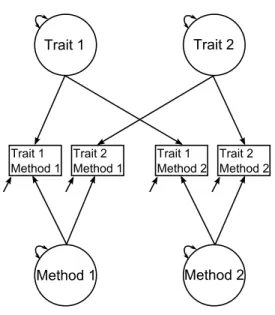
1.2 Example of a SEM-MTMM model. . . 8
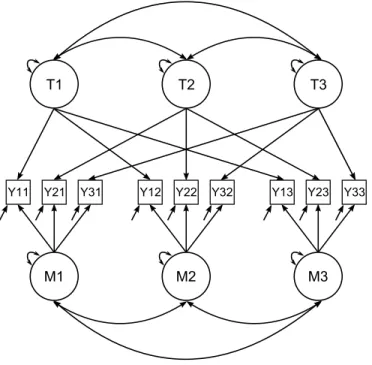
1.3 Example of a correlated trait-correlated method model. . . 9
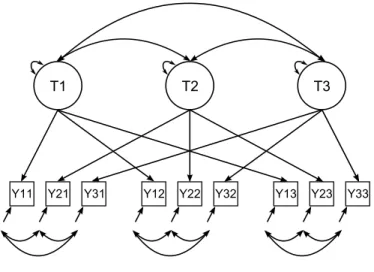
1.4 Example of a correlated trait-correlated uniqueness model. . . 10
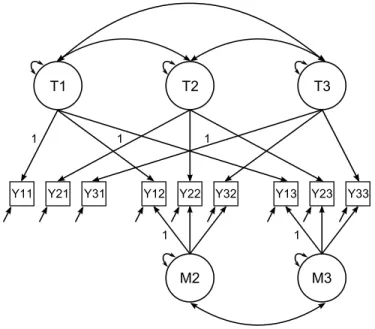
1.5 Example of a correlated trait-correlated method minus one model. . . 11
2.1 Example of (a) a“more desirable” item and (b) a “less desirable” item. . . . 23
2.2 Path diagram of a longitudinal M-TSM model with VAR(1) relationships at the factor level. . . 27
3.1 Trace lines for “irritable”. . . 34
CHAPTER 1
Introduction
Multi-trait multi-method (MTMM) models have long been used by behavioral
and social scientists to study different traits assessed by different methods (e.g.,
Winne & Marx, 1977; Waksman, 1978; Andrews, 1984; Bagozzi & Yi, 1991; Luzzo,
1993). Longitudinal MTMM models provide one possible way for researchers to
study how traits assessed by various methods vary over time. Such models not only
allow researchers to examine whether or not traits are changing over time, but also
provide a proxy for studying the stability of the assessment methods over time.
Sta-bility is a key feature that distinguishes trait processes from state processes. Trait
processes refer to stable constructs that remain relatively constant over time;
how-ever,stateprocesses refer to volatile constructs that change on a moment-to-moment
basis (Nesselroade & Bartsch, 1977).
With ecological momentary assessment designs such as experience sampling and
daily diary designs becoming increasingly popular (Iida, Shrout, Laurenceau, &
Bol-ger, in press), it is important to develop a longitudinal model that is suited for
rep-resenting the kind of less structured, “state-like” changes often seen in such data.
While longitudinal variations of MTMM models have been proposed by other
re-searchers, the change processes assumed in such models are typically structured
growth processes that are relatively smooth Grimm, Pianta, & Konold, 2009; Cole,
Ecological momentary assessment data, in contrast, are often characterized by less
systematic ebbs and flows driven by external shocks or events.
The purpose of this thesis is to propose a longitudinal second-order MTMM
model that combines a vector autoregressive moving average (VARMA) model at the
latent level and a measurement model for ordinal data to represent relatively volatile
change processes over time. The VARMA model included in the proposed
longitudi-nal MTMM model is especially suited for representing fluctuations in state processes.
In this way, the proposed model is a multi-“state” multi-method longitudinal model
at the first-order level and will be referred to as a multi-trait-state-method model
(M-TSM). Another major issue the proposed model serves to address is how MTMM
models may be adapted for use with ordinal data. Likert-type items are relatively
common in social and behavioral sciences. Proper modeling techniques are needed
to handle the ordinal nature of this type of data.
The introduction is organized as follows. I first introduce the MTMM design
and define construct validity followed by a discussion of the original MTMM matrix.
Next, structural equation modeling (SEM)—the modeling framework in which the
proposed longitudinal M-TSM model is structured—as well as various SEM-MTMM
models are introduced. In addition, a discussion of the ordinal measurement model
is given. I then present an introduction to item response theory, particularly the
graded response model, which is used to evaluate the psychometric properties of
a set of items to be used for model fitting purposes. Finally, an overview of the
VARMA model is given followed by a discussion of the importance of longitudinal
measurement invariance.
1.1 Multi-Trait Multi-Method (MTMM)
A MTMM design consists of the measurement of at least two traits using at least
two assessment methods (Campbell & Fiske, 1959). Not only are multiple methods of
need to understand whether or not these methods measure what they are intended to
measure. As such, violations of construct validity constitute a source of confound in
scientific studies. That is, researchers have the task of determining if their measures
are adequately representing the construct of interest.
In discussing MTMM, it is useful to first review the concepts of convergent,
dis-criminant and construct validity. Construct validity answers the question: are we
measuring what we intend to measure? That is, is there an association between the
measures and the theoretical construct they are purported to measure? Furthermore,
construct validity can be decomposed into two subparts: convergent and
discrimi-nant validity. Convergent validity helps determine whether or not the measures that
are supposed to be related actually are. Conversely, discriminant validity helps
de-termine whether or not the measures that are not supposed to be related actually are
not.
1.1.1 Multi-Trait Multi-Method Matrix
For decades, the MTMM Matrix has been used to examine convergent,
discrim-inant and construct validity. The MTMM Matrix is a correlation matrix that
rep-resents the intercorrelations between trait and method factors. Figure 1.1 shows
a classic MTMM matrix taken from Campbell et Fiske (1959). This synthetic
ma-trix is a correlation mama-trix composed of the correlations among three different traits
measured using three different methods. While all of the off-diagonal elements
rep-resent correlations, each of the diagonal elements of the MTMM matrix consists of
the reliability estimate of one particular measure. The solid triangles represent the
monomethod triangles and the dashed triangles represent the
heterotrait-heteromethod triangles. The heterotrait-monomethod triangles represent correlations
that share the same measurement method. Conversely, the heterotrait-heteromethod
triangles represent correlations that do not share the same measurement method.
di-agonals. These diagonals represent the correlations between measures of the same
trait but assessed using different methods.
The validity diagonal contains information about convergent validity. That is,
high correlations between measures of the same trait would be expected even if
dif-ferent methods are being used. For example, in Figure 1.1 the correlations along the
validity diagonal are relatively high in comparison with the neighboring correlations.
The neighboring correlations in the heterotrait-heteromethod triangles represent the
correlations between different traits and methods. This provides information about
discriminant validity; namely, these measures should have low correlations because
they are not related. Finally, the heterotrait-heteromethod triangles allow for the
examination of a method effect. That is, if relatively high correlations exist within
these triangles, then the methods are having a strong influence since none of these
correlations share the same trait.
The MTMM matrix has several limitations; one major limitation lies in the
diffi-culties for researchers to quantify and infer the existence of construct validity simply
by eyeballing the correlations. That is, there is no set standard to help gauge whether
the different kinds of validity are attained. It is also impossible to separate method
and error variances, which may lead to spurious correlations and wrong conclusions
(Schmitt & Stults, 1986). Finally, the MTMM matrix requires the measures to be
con-ditionally independent once the shared variances attributable to common method
and common trait have been accounted for (Campbell & Fiske, 1959); whereas, in
reality correlations might exist between method factors and trait factors. Given these
limitations of the MTMM matrix, many researchers have turned to a statistical
tech-nique called structural equation modeling (SEM) as an alternative method for
1.2 Structural Equation Modeling (SEM)
SEM is a set of statistical techniques that allows for the evaluation of relationships
among variables, specifically, the relationships between observed variables (usually
called manifest variables) and unobserved latent variables. SEM is also known as
covariance structure modeling because some of the earliest structural equation
mod-els focus explicitly on representing the covariance structures among measured and
latent variables (J ¨oreskog, 1973, 1974a). In order to describe these relationships, two
models are defined: 1) the measurement model and 2) the structural model. The
measurement model relates the manifest variables to the latent variables; whereas,
the structural model relates the latent variables to each other.
The measurement model consists of two equations. One equation links manifest
variables and exogenous latent variables and a second equation links manifest
vari-ables and endogenous latent varivari-ables. The first measurement equation is defined
as
xit =υx+Λxξi+δi (1.1)
where xit is a q × 1 vector of manifest variables for person i, υ is a q × 1 vector
of intercepts, Λx is a q × n factor loading matrix, ξi is an n × 1 vector of latent
exogenous variables for person i, and δi is aq ×1 vector of measurement errors. It
is assumed thatδi is normally distributed, ξi and δi are uncorrelated and both have
expected values of zeroes.
The second measurement equation is defined as
yi =υy+Λyηi+εi (1.2)
where yi is a p × 1 vector of manifest variables for person i, υy is a p × 1 vector
endogenous variables for person i, and εi is a p × 1 vector of measurement errors.
Once again, it is assumed that εi is multivariate normally distributed with a vector
of zeroes as expected values and covariance matrix, Ψ. In addition, ηi and εi are
assumed to be uncorrelated.
Finally, the structural model is defined as
ηi =α+Bηi+Γξi+ζi (1.3)
where α is a m × 1 vector of intercepts, B is an m × m matrix linking the latent
endogenous variables, Γ is an m × n matrix linking the latent exogenous variables
to the latent endogenous variables and ζi is a m ×1 vector of residual errors which
is assumed to be multivariate normally distributed with zero means and covariance
matrix Ψ.
1.2.1 Multi-Trait Multi-Method SEM Models
Thus far, I have introduced the MTMM matrix developed by Campbell and Fiske
(1959) and provided a brief introduction to the SEM framework. Next, I will review
how the MTMM design and how pertinent validity-related questions can be
formu-lated as part of a structural equation model. Central to the SEM-MTMM framework
is a set of latent variables representing traits and a second set of latent variables
representing methods. Each manifest variable loads onto one trait and one method.
Figure 1.2 shows an example of a basic SEM-MTMM. Note that this model consists
of only endogenous latent variables; that is, there is no exogenous component. In
addition, the trait and method factors are uncorrelated with one another. Over the
years, several different SEM-MTMM models have been formulated. I will provide a
quick review of the primary models.
The Correlated Trait-Correlated Method Model. The correlated trait-correlated
Trait 1 Method 1
Trait 2 Method 1
Trait 1 Method 2
Trait 2 Method 2
Method 1 Method 2
Trait 1 Trait 2
Figure 1.2: Example of a SEM-MTMM model.
resembles the original MTMM matrix validity defined by Campbell and Fiske (1959)
due to its formulation and interpretation; an example is shown in Figure 1.3. This
model has a latent variable for each trait and each method. Furthermore, correlations
exist between the trait factors and sometimes also the method factors; however, there
is no correlation between method and trait factors. One major benefit of this model
is the ease of interpretation. Large trait factor loadings represent convergent validity
and small correlations between trait factors represent discriminant validity. Thus,
validity is defined in much the same ways as how Campbell and Fiske (1959)
origi-nally defined validity. The major disadvantage of these models lies in problems with
identification and convergence (Marsh, 1989; Marsh & Bailey, 1991); issues include
(1) underidentified models, (2) negative variances and (3) correlations outside of the
proper range. While other models are not immune from these issues, they are most
prevalent in the correlated trait-correlated method model.
The Correlated Trait-Correlated Uniqueness Model. The correlated trait-correlated
trait-M1 T1
Y11 Y21 Y31
M2 T2
Y12 Y22 Y32
M3 T3
Y13 Y23 Y33
Figure 1.3: Example of a correlated trait-correlated method model.
correlated method model but method factors are not specified explicitly (see Figure
1.4). Instead, to account for the method effects, error terms are allowed to be
corre-lated within methods, with no correlations allowed between the errors of manifest
variables measured using different methods. Not allowing for correlations between
the errors of different methods is equivalent to assuming that the methods factors
in Figure 1.3 are independent, which may be overly restrictive in some applications.
Furthermore, another limitation is that the error terms represent both measurement
errors and the residual effects that are idiosyncractic to each method; it is not possible
to decompose the two. This model does have the advantage of fewer identification
problems than the correlated trait-correlated method model proposed by Widaman
(1985).
The Correlated Trait-Correlated Method Minus One Model. The correlated
trait-T1
Y11 Y21 Y31
T2
Y12 Y22 Y32
T3
Y13 Y23 Y33
Figure 1.4: Example of a correlated trait-correlated uniqueness model.
correlated method model (J ¨oreskog, 1974b; Widaman, 1985), except that one method
serves as a reference method (see Figure 1.5). This latter model is nested within the
correlated-trait correlated-method model, with special constraints included in the
factor loading matrix. That is, the loadings of the manifest measures on one of the
method factors - namely, the reference method - are fixed at zeroes. This implies
that there are no shared sources of variance among the manifest variables measured
using the reference method after the shared variance due to trait has been extracted.
In addition, the loadings of the trait factors on manifest variables measured using
the reference method are set to one as added identification constraints. The
ma-jor advantage of this model is that by imposing more identification constraints than
the standard correlated-trait correlated-method model, convergence issues are
re-duced; however, it can be difficult to determine which method to use as the reference
method.
1.2.2 Ordinal Measurement Model
The measurement model shown in Equations 1.1 & 1.2 assumes that continuous
indica-T1
Y11 Y21 Y31
M2 T2
Y12 Y22 Y32
M3 T3
Y13 Y23 Y33
1 1
1 1 1
Figure 1.5: Example of a correlated trait-correlated method minus one model.
tors requires a different measurement model to be specified. One common way of
incorporating ordinal manifest variables is to use an ordered probit link. The basic
assumption made is that responses to the ordinal observed measured variablesyare
influenced by an unobserved, continuous measured variable y∗. Therefore, only
re-sponse categories are observed. That is, for ordered rere-sponse categoriesk =1, 2, ...,m,
thresholds are defined as
yi,j=k ifτj,k−1<y∗ ≤τj,k (1.4)
where τj,k are threshold parameters for the jth items. The thresholds represent
cut-points on the continuous latent variable y∗ that determine whether respondents
en-dorse a particular category k on the jth observed item y. When a probit link is
specified, the cumulative distribution function (CDF) ofy∗ is assumed to be normal.
section. When estimating ordered categorical indicators in SEM, error terms for the
indicators are not being estimated; instead, the threshold parameters, τj,k, are
esti-mated. Furthermore, treating the ordered categorical items as continuous would not
be appropriate and could lead to spurious results (DiStefano, 2002). Various
estima-tion methods for handling categorical data in SEM have been summarized by Wirth
and Edwards (2007).
1.3 Item Response Theory
Item Response Theory (IRT) is a set of statistical models that relates the
proba-bility of an individual’s response on an item as a function of item parameters and
an underlying latent trait (Lord, 1980). In contrast to the SEM framework presented
above, commonly used IRT models assume a logit link for y; that is, IRT uses a
lo-gistic distribution function instead of a normal distribution function (probit) as the
CDF for the continuous latent variable,y∗. One important advantage of using IRT is
that the various estimation procedures and associated software packages have been
developed specifically to handle large-scale categorical data sets. Thus, the
assess-ment of psychometric properties of categorical items, including ordinal items, can be
performed in a computationally efficient manner.
In the IRT framework, two item-related parameters are typically of primary
inter-est: discrimination and difficulty parameters. Discrimination represents how related
an item is to the latent trait; whereas, difficulty represents the trait level needed so
that there is a 0.5 probability of endorsing a particular item (in the case of binary
items) or response category (in the case of ordinal items). An item that is highly
discriminating provides more information about the latent construct than a item that
is less discriminating. A one-parameter IRT model estimates the difficulty
param-eter for each item; whereas, a two-paramparam-eter model estimates both difficulty and
discrimination.
and the type of data used. For ordinal data, one commonly used model is the graded
response model (Samejima, 1969). The graded response model is a two-parameter
model and it postulates that the probability for individual i to endorse the kth or
other higher response categories (k=1, 2, . . . ,m), is defined as
P(yij ≥k|θi,aj,bj,k) = Pj,k(θi) = 1
1+exp[−aj(θi−bj,k)]
(1.5)
where the equation represents the probability of responding in category k or higher
given θ, the individual’s latent trait level. The parameter aj is the discrimination
parameter for item j and bj,k is the kth difficulty parameter for the jth item. In
other words, Equation 1.5 provides a probabilistic representation of responding in a
particular category or higher given a certain level ofθ.
A graphical representation of the differences between the conditional response
probabilities of adjacent response categories are known as trace lines (also called item
characteristic curves). That is, a trace line is the difference between the probabilities
of two adjoining categories, corresponding to P(yij =k|θi,aj,bj,k). Mathematically, a
trace line,Tj, for item j and category k are represented as
Tj = 1
1+exp[−aj(θi−bj,k−1)]
− 1
1+exp[−aj(θi−bj,k)]
=Tj∗(k)−Tj∗(k+1)
(1.6)
Additionally, information curves help to determine how much information an
item gives us to estimate different levels of θ. Information determines at what levels
of θ an item is best at discriminating between individuals. That is, higher
informa-tion allows for more precision in measuring θ. It is important to note that IRT and
the ordinal measurement model in the SEM framework are mathematically
expressed as
aj = (
λj
q
1−λ2j
)D and bj,k =
τj,k
λj
(1.7)
where λi is the factor loading1 for the jth item, D = 1.7 is the scaling factor, and τj,k
is the threshold for the jth item.
Finally, in order to properly estimate the item parameters, IRT models require a
set of locally independent items (i.e no local dependence). That is, item responses are
independent from each other controlling for trait level. There are multiple statistics
to evaluate local dependence; the χ2 LD statistic (Chen & Thissen, 1997) will be
used. The χ2 LD statistic examines the covaration between observed and expected
frequencies between pairs of items. This covariation should be zero if there is no
local dependence; however, if this covaration differs significantly then there exists
local dependence between a pair of items (i.e. violation of local independence).
1.4 Longitudinal Models
1.4.1 Longitudinal Multi-Trait Multi-Method
The idea of using MTMM longitudinally was first introduced by Werts, J ¨oreskog
and Linn (1972) to study growth. Since then, several longitudinal MTMM models
have been proposed to date (Conley, 1985; Cudeck, 1985; Burns, Walsh, & Gomez,
2003; Marsh & Grayson, 1995; Scherpenzeel & Saris, 2007). This section is intended to
briefly summarize the various longitudinal MTMM models that have been proposed
within the SEM framework.
Grimm et al. (2009) presented a longitudinal version of the correlated
trait-correlated method model wherein changes in the trait factors over time are
repre-sented using second-order latent growth curve models. In addition to using growth
curve models to examine linear changes in the trait factors, they also tested the
variance of the repeated measures over time. The authors noted several convergence
issues with their model especially when the correlations are high among factors.
Furthermore, the authors suggested building the model at each time point prior to
incorporating all repeated measures to evaluate trends or changes over time to aid
estimation difficulties.
Cole et al. (1996) formulated a longitudinal correlated trait-correlated
unique-ness model to study the relationship between social and academic competence and
depression using two waves of data. In line with properties of the cross-sectional
correlated trait-correlated uniqueness model (Kenny, 1976; Marsh, 1989), errors of
the same measures were allowed to be correlated across as well as within waves.
The authors also used correlations to examine stability across waves of data using a
test-retest type of design. Finally, Geiser et al. (2010) presented a longitudinal
ver-sion of the correlated trait-correlated method minus one model in which the latent
difference model (McArdle & Hamagami, 2001b) was used to represent changes in
the trait factors over time.
The longitudinal MTMM models reviewed above are similar in that the
correla-tions between trait factors over time are hypothesized to stem from some forms of
structured growth curve processes2; however, none of the models employ time series
techniques. Furthermore, the proposed model uses three waves of data, which is
more beneficial than two waves of data typically used in the aforementioned models
(Willett, 1989).
1.4.2 Time Series Analysis
Time series analysis is a set of statistical methods for analyzing time series data,
namely, data that are collected over time. Two commonly used univariate time series
models are autoregressive and moving average processes (Chatfield, 2004; Wei, 1990;
2The latent difference score models proposed by McArdle and colleagues (2001b) can be regarded
Hamilton, 1994). Time series models are traditionally used with single-subject time
series data with many repeated measurement occasions. Thus, the subject index is
typically omitted from the corresponding models. Here, these models are used with
multiple-subject longitudinal panel data with many participants and relatively few
time points. I therefore include a subject index in all the equations that follow.
Mathematically, an autoregressive model of lag order r, denoted as AR(r), for a
measured variable,yit, of personi at timet, is defined as
yit = r
∑
u=1
ϕuyi,t−u+εit (1.8)
whereϕu(u=1, . . .,r) are autoregressive parameters andεitis an error term. Browne
and Nesselroade (2005) referred to these “errors” as random shocks because they can
be regarded as shocks whose impact continues to affect later yit. In the case of
the AR process, the lagged effects of such shocks are transmitted through previous
yit. The error term εit has the following assumptions: zero mean, variance σ2, and
uncorrelated for different time values. Furthermore, r is the highest lag order of
the process and the AR processes is considered to be weakly stationary if E[yit] and
Var[yit]are constant (Chatfield, 2004)
In a similar vein, a moving average model of lag orders, denoted as MA(s), for a
measured variable yit, is defined as
yit= s
∑
v=1
δvεi,t−v+εit (1.9)
whereδv are moving average parameters andεitis an error term or random shock. A
moving average process is considered to be invertible if it can be rewritten as a linear
combination of its past values (Chatfield, 2004). Both equations 1.8 and 1.9 can be
combined to yield an auto-regressive moving-average (ARMA) model of order (r, s).
of the univariate AR(r) and MA(s) models shown in Equations 1.8 and 1.9. The
VARMA model can be structured within the SEM framework wherein a series of
autoregressive and moving average components are represented in the structural
equation. For example, combining Equations 1.8 and 1.9 the VARMA(r,s) model is
obtained
yit=
r
∑
u=1
ϕuyi,t−u + s
∑
v=1
δvεi,t−v+εit (1.10)
where yit is now a vector of manifest variables and εit is the corresponding vector
of random shocks. Multiple researchers have evaluated variations of univariate and
multivariate time series models in the context of SEM, (e.g., McArdle & Hamagami,
2001a; Bollen & Curran, 2004), but no work has been done combining SEM-MTMM
models with time series analysis. Not only do autoregressive parameters allow for
the examination of the influence of one time point on another, they offer a
straight-forward index for evaluating the stability of a construct of interest over time. In
addition, cross-regression parameters allow researchers to examine the influence of
past constructs on other constructs of interest. More importantly, times series models
are suited for representing less structured change processes typically seen in state
fluctuations, such as those evidenced in emotions data.
1.4.3 Invariance
In the study of longitudinal change processes, it is useful to understand whether
or not parameter values differ over time; that is, determining if the parameters are
invariant across time. Longitudinal measurement invariance is not frequently
consid-ered in applied longitudinal research, instead it is just assumed (Brown, 2006).
How-ever, establishing longitudinal invariance is essential to truly understand change over
time. Namely, the absence of longitudinal invariance could indicate a change in the
construct over time or a change in the measurement of the construct. Clearly, the
1983).
Golembiewski, Billingsley, and Yeager (1976) defined three types of change:
al-pha, beta and gamma change. Beta change occurs when indicators being used to
measure a construct do not remain consistent over time, typically due to a change in
the measurement scale. Gamma change occurs when there is an actual change in the
meaning of a construct over time. Finally, alpha change occurs only when both the
construct and the indicators being used to measure the construct are not changing
over time. Alpha change is also called the true score change; that is, true changes
in the level of a construct over time. The key interest in many longitudinal
stud-ies lstud-ies in the study of true score change. In order to study whether and how true
scores have changed from one time point to the next, researchers have to first exclude
possibilities due to beta and gamma changes. That is exactly the goal longitudinal
researchers seek to establish in searching for longitudinal invariance.
More generally, whether one is working with longitudinal or cross-sectional (e.g.,
multiple-group) data, two types of invariance are of concern: configural and metric.
Configural invariance is established when the free and fixed parameters in a
mea-surement model have the same patterns across time or subgroups; whereas, metric
invariance occurs when the parameters are identical across time or subgroups. For
example, in a longitudinal factor analysis model with multiple repeated assessments,
configural invariance is established when the zero and non-zero factor loadings are
located in the same positions across time; metric invariance, in contrast, is only
es-tablished when the factor loadings are the same across time (Meredith, 1993;
Van-denberg & Lance, 2000). Clearly, metric invariance is a stronger form of invariance
than configural invariance. If a researcher is able to establish metric invariance in a
longitudinal model, he or she can more justifiably examine changes at the true score
level. This is, of course, still subject to additional assumptions and restrictions (e.g.,
and the indicators have satisfactory reliability, to name a few).
1.5 Objectives for Thesis
The overall objective of this thesis is to propose and evaluate a longitudinal
M-TSM model that is suited for representing the state fluctuations of affect factors over
time taking into account the method in which the affects were assessed using ordinal
data. The specific goals of this thesis are as follows: 1) I will evaluate and retain
affect items that have “desirable” item properties using IRT for further model fitting,
2) longitudinal invariance of the selected items will be tested, 3) I will develop and
evaluate a series of time series models for describing the over-time variations in the
affect and method factors and 4) I will test a series of hypotheses aimed at examining
CHAPTER 2
Methods
2.1 Illustrative Example
The dataset used to illustrate the proposed longitudinal M-TSM model was part
of the Affective Dynamics and Individual Differences (ADID) Study (Emotions and
Dynamic Systems Laboratory, 2010). The original goal of the study was examine the
dynamics of emotion regulation in a laboratory setting and to examine day-to-day
variability of positive and negative affects using an experience sampling design.
Af-fective ratings collected during the initial laboratory visit and later in an individual’s
everyday life will be considered as measures collected using two different “methods,”
namely, in laboratory setting (denoted herein as the “lab” effect) and in everyday
set-ting (denoted herein as the “diary” effect).
2.1.1 Participants and Measures
A total of 271 participants (89 males, 182 females) were included in the study and
their ages ranged from 18 to 90 years old. The participants were university students,
faculty and staff as well as participants recruited from the community.
The only measure considered for this study is the Positive and Negative
Af-fect Schedule (PANAS). The PANAS is a 20-item self-report measure with items that
serve as markers of positive or negative affect (Watson, Clark, & Tellegen, 1988).
Re-spondents were asked to rate the extent to which they have felt each emotion on
The PANAS defines positive affect as pleasurable engagement and high energy and
negative affect as unpleasurable engagement and distress (Watson et al., 1988).
Fur-thermore, the PANAS provides independent measures of positive affect and negative
affect; namely, they are postulated to show zero correlation based on Watson et al.
(1988)’s theoretical structure of emotions.
2.1.2 Procedures
In a laboratory setting, participants were given a series of emotion disclosure
sections to complete (neutral, positive, negative) in randomized order. All
partici-pants started with the neutral disclosure but the order of the remaining disclosure
sections (negative and positive) was randomized. During the neutral disclosure,
par-ticipants described pictures from the International Affective Picture System (IAPS;
Lang, Bradley, & Cuthbert, 2005), which consist of neural objects such as geometric
shapes and household objects. During the positive and negative disclosures,
partic-ipants described happy memories and a recent event that angered them. After each
section, participants were shown a slide show of 15 negative images from the IAPS
while having physiological data collected. Furthermore, after watching the slide
show, participants were asked to report their momentary feelings using items from
the PANAS then given a relaxation period.
A follow-up daily diary study was completed after the lab experiment.
Partici-pants were asked to provide ratings on a series of affect and personality measures,
which included the PANAS items, for 30 days (five times a day). On the survey,
par-ticipants were asked to indicate the extent they felt a particular feeling or emotion
since last completing the questionnaire; participants were asked to keep between an
hour and a half and four hours between diary completions. For the purposes of this
thesis, days two, three and four from the diary will be used. Since the PANAS items
were asked five times daily, I will randomly select a time for each individual from
of missing data; for instance, only the non-missing occasions from a particular day
will be considered.
2.2 Model Descriptions
2.2.1 Preliminary Data Exploration
The data were examined for any outliers and none were detected. The final data
set was compiled using R. Randomly selected time points from days two, three and
four were selected from the diary and compiled with the three time points from the
lab. After listwise deletion of any missing data across all time points, the final dataset
contained 235 participants.
2.2.2 Item Exploratory Analysis
The PANAS has multiple ordinal items that serve as indicators of positive and
negative affects. Due to known convergence issues with the multitrait-multimethod
models (Eid, 2000), it is advantageous for us to reduce the number of items used
in model fitting. This section describes the process for item selection. Specifically,
emphasis will be placed on retaining items that display desirable psychometric
prop-erties. Preliminary item-level analysis will first be performed using IRTPRO (Cai, du
Toit, & Thissen, 2011) as an initial exploration of the item characteristics.
The IRT analysis. The goal of the IRT analysis is to remove any items that have less
desirable measurement properties. This is defined as items with low information and
thresholds that are not well separated. In order to do this, separate univariate graded
response models (Samejima, 1969) will be fit to items for each affect, method and time
point, yielding a total of twelve separate models. For instance, in the first model, the
graded response model will be fit to items that serve as indicators of positive affect
in the lab. Information curves and trace lines will then examined to determine if any
patterns exist in the same item across both methods and time points.
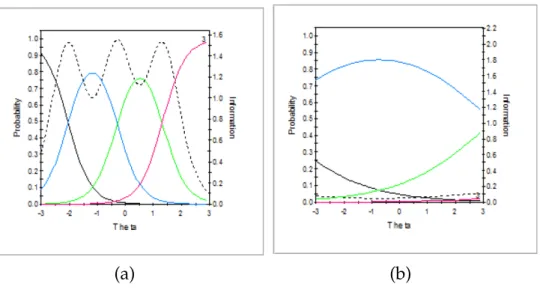
item. The solid lines represent the trace lines; whereas, the dotted lines represent
information. For the more desirable item, there is a high information curve across
θ with clear peaks; conversely, for the less desirable item there is low information
across a range of θ values. Thus, the less desirable item is not very informative
of an individual’s trait level. Secondly, the less desirable item does not have well
separated trace lines. This is problematic because there is not much variation in
response categories across different levels of θ. Ideally, a desirable item is one with
trace lines that discriminate well between categories; that is, trace lines that provide
good separation across different levels of θ.
(a) (b)
Figure 2.1: Example of (a) a“more desirable” item and (b) a “less desirable” item.
2.2.3 Longitudinal M-TSM Model for the PANAS Data
The proposed model consists of data from three time points. For each time point,
there are four latent state factors of interest, including PA lab, PA diary, NA lab and
NA diary. These state factors correspond to the participants’ momentary positive
affect and negative affect when assessed in a diary versus lab setting. Furthermore, it
is assumed that there are higher-order shared sources of variance in the participants’
shared sources of variances can be regarded as higher-order trait factors that capture
stable interindividual differences in overall levels of PA and NA. These trait factors,
denoted herein as PA trait and NA trait factors, are second-order factors that capture
systematic individual differences that are shared across time as well as method
set-tings. It is important to note that the residual variance of the state factors represents
what is common to all the items at a particular occasion and not carried to the next
time point. Whereas, the trait variance represents what is common to all the items
across time and setting. The trait-state representation is much like the trait-state
model proposed by Kenny and Zautra (2001).
The proposed model consists of a measurement model and a structural model.
The measurement model for the ordinal responses is
yit∗ =µ+Λyηit+εit (2.1)
where y∗it is a p × 1 vector of unobserved continuous response variables for person
i at time t, Λy is a p × m factor loading matrix, ηit is an m × 1 vector of latent
endogenous variables for person iat time t, andεit is a p ×1 vector of measurement
errors.
Thejth unobserved continuous response variablesy∗j,itis linked to thejth ordinal
manifest variablesyj,it by
yj,it =kif τj,k−1 <y∗j,it ≤τj,k (2.2)
whereτj,k are threshold parameters.
Finally, the structural part of the model involves a VARMA process at the latent
level. First introduced by Browne et Nesselroade (2005) with the name process factor
analysis model, the process considered differs from conventional VARMA processes
time. The model proposed in this thesis expands the process factor analysis model
by explicitly including a vector of second-order trait factors, yielding
ηit =Ληtraiti+A1ηi,t−1+A2ηi,t−2+...+Arηi,t−r+ζit (2.3)
where ηit is 6 × 1 vector of latent endogenous variables for person i at time t
consisting of the state factors: PA lab at time t, PA diary at time t, NA lab at time
t, NA diary at time t, lab at time t and diary at time t; traiti denotes a vector of
trait factor scores for person i. In the present application, these trait factors include
positive and negative affect at the trait level (i.e., second-order factors). Λη is a factor
loading matrix linking a vector of trait factors for person i to the state factors of all
time points. ζitis a vector of random shocks andA1, . . .,Arare autoregressive weight
matrices. The vector of second-order trait factors,traiti, is normally distributed with
zero means and variancesσζ2
P andσ
2
ζN, respectively, and covarianceϑPN. The loadings
of the trait factors on all state factors are constrained to be invariant across time to
reflect the time-invariant nature of the trait factors.
Figure 2.2 shows a path diagram representation of the basic proposed model.
This proposed model contains repeated measures (over three time points) of the
positive and the negative affect items from the PANAS identified in the item-level
analysis. The model shown in Figure 2.2 features three lab and three diary factors
corresponding to the three repeated measurement occasions. Only the lag-one
au-toregression (e.g., from PAL1 to PAL2) but not the cross-regression (e.g., from PAL1 to
NAL2) paths are depicted in the path diagram. Whether the cross-regression paths
are needed will be evaluated as testable hypotheses. As mentioned, two trait
fac-tors, representing trait PA and trait NA, are specified to capture higher-order shared
valence effects among the first-order state affect factors. For instance, trait PA was
to load on all the state NA factors (NAL1-PAD3).
One issue of interest is the specification of identification constraints for the
lon-gitudinal M-TSM model. Within the time points, each state latent variable will be
specified to have the first factor loading set to one. Invariance constraints are
im-posed on the second-order factor loadings over time. This is because the trait factors
are purported to reflect constructs that are invariant and stable across time. In
addi-tion, the factor loadings of the trait factors on the lab-based state affect factors were
set to unity for identification purposes. The path diagram shown in Figure 2.2 shows
a model with these constraints specified for all time points. Whether this specific
set of constraints needs to be relaxed will be assessed in the model fitting process.
Furthermore, due to convergence issues with MTMM models, it might be necessary
to consider variations along the line of the correlated trait-correlated method minus
one model (Eid, 2000). In this case, loadings on a chosen reference method would
be constrained to be zero. The correlated trait-correlated uniqueness model (Kenny,
1976 ; Marsh, 1989), however, would be too restrictive for the proposed model
be-cause autoregressive paths between method factors would not be allowed. Thus, this
specific variation will not be considered.
A series of models will be fit in order to determine the final M-TSM model. First,
an examination of longitudinal invariance in the factor loadings and thresholds will
be performed. This is important because if invariance cannot be established, that
in-troduces added confounds and issues of change cannot be examined as readily.
Fur-thermore, invariance in the intercepts of the state factors will also be examined. In
the model shown in Figure 2.2, the intercepts of all state factors were set to zero.
De-viations of these intercepts from zero may indicate the existence of over-time trends
in the state factors, which could lead to spurious interpretations of other time series
parameters. Thus, as part of the invariance analysis, the intercepts of the state
...
...
...
...
...
...
P1 L1...
...
...
P4 L1 P1 L2 P4 L2 P1 L3 P4 L3 P1 D1 P4 D1...
...
...
...
...
...
...
P1 D2 P4 D2 P1 D3 P4 D3φPD2
1
1
λP4L1
P
A
_L
1
λP4L2
PA
_L
2
λP4L3
P
A
_L3
λP4D1
P
A
_D
1
λP4D2
P
A
_D
2
λP4D3
P A _D 3 La b1 φD21
ζPL1
σ
2
φPD3
2
φPL2
1
φPL3
2
Tr
ait PA
ζPL2
σ
2
ζPL3
σ
2
ζPD1
σ
2
ζPD2
σ
2
ζPD3
σ 2 1 1 1 λPD1 λPD2
λPD3
...
...
...
...
...
...
N1 L1...
...
...
N4 L1 N1 L2 N4 L2 N1 L3 N4 L3 N1 D1 N4 D1...
...
...
...
...
...
...
N1 D2 N4 D2 N1 D3 N4 D3 φND 21λN4L1
NA
_L1
λN4L2
NA
_L2
λN4L3
NA
_L3
λN4D1
NA
_D1
λN4D2
NA
_D2
λN4D3
NA _D3 ζNL1 σ 2 φND 32 φNL 21 φNL 32 Tr ait NA ζNL2 σ 2 ζNL3 σ 2 ζND1 σ 2 ζND2 σ 2 ζND3 σ 2 1 1 1 λND1 λND2 λND3 Lab2 La b3 Di ar y1 Di ar y2 Di ar y3 1 1 1
λL3P4
1
λD1P 4
1
λD1P 4
1
λD3P4
λ L1 N1 λ L1 N4 λ L2 N1 λ L2 N4 λ L3 N1 λ L3 N4 λ D1 N4 λ D2 N4 λ D3 N4 λ D3 N1 λ D2 N1 λ D1 N1
λL1P 4 λL2P 4 φD32 φL21 φL32 ϑPN ζP σ 2 ζN σ 2 ζD3 σ 2 ζD2 σ 2 ζD1 σ 2 ζL3 σ 2 ζL2 σ 2 ζL1 σ 2 1 1 1 1 1 1 1 1 1 1 1
Figure 2.2: Path diagram of a longitudinal M-TSM model with VAR(1) relationships at the factor level. PA Mt = Positive Affect for method m at time t, NA Mt = Negative Affect for method M at time t, Labt = Lab at time t and Diaryt = Diary at time t. The factor loadings for the state factors are represented by ΛAtMt where A = Positive or
Negative Affect, M = Diary or Trait, and t is the time point. Likewise, the factor loading for the “method” factors are represented by λMtAt. The trait factor loadings
are represented by ΛAMt. The arrows depicted here correspond to elements in Λ
time points will be freed to evaluate the possible existence of trends. Secondly,
var-ious models with different time series structures will be considered. Finally, perfect
stability within the method factor will be tested.
Examining Longitudinal Invariance. The general procedure will be to begin with
a model with the least invariance constraints (namely, the model shown in Figure
2.2 wherein all factor loadings and thresholds are freed). Two models that were
nested within the first model will be then considered sequentially, with different
invariance constraints imposed. A summary of these models is shown in Table 2.1.
As mentioned, two types of invariance are of interest: configural and metric. The
goal of the invariance analysis is to retain items that at least display configural, or
preferably, metric invariance. As shown in Table 2.1, invariance constraints will be
sequentially imposed on the factor loadings followed by the thresholds.
In structural equation models involving continuous data, likelihood ratio tests
are often use to assess the relative fit of nested models (Bollen, 1989). However, when
categorical data are used with estimation methods such as the weighted least squares
means and variance adjusted (WLSMV) estimation (as will be used in the present
thesis), the differences in chi-square values between nested models are not chi-square
distributed. To adjust for this, the scaled chi-square difference test proposed by
Satorra and colleague (Satorra & Bentler, 1999 ; Satorra, 2000 ; Satorra & Bentler,
2010), as implemented in the DIFFTEST option in Mplus (Asparouhov & Muth´en,
2006), is used to examine changes in fit functions between models.
Table 2.1: Models Used to Examine Longitudinal Invariance in the PANAS Items.
Model 1 Free loadings, free thresholds Model 2 Invariant loadings, free thresholds Model 3 Invariant loadings, invariant thresholds
of a different specification of auto- and cross-regression structures. Autoregressive
paths will be specified for both the affect and the method factors (up to a lag order,r,
to be determined empirically by evaluating the statistical significance of high-order
autoregression parameters via Wald tests) to indicate the stability of these factors
over time; however, cross-regression paths will only be specified between the affect
factors. The models considered are: 1) a model with no auto-regression and no
cross-regression (denoted as the baseline model), 2) a model with only autoregressive paths
and no cross-regression and 3) a model with both auto- and cross-regression paths
of the optimal order.
I will then proceed to evaluating alternative models with further simplification
in the auto- and cross-regression structures. Four models will be considered for this.
The models will consist of a combination of a different number of lab and diary
factors. That is, the model will have either one factor representing all time points or
one factor for each time point. The models considered are: 1) one lab, one diary, 2)
one lab, three diary, 3) three lab, one diary and 4) three lab, three diary.
The justification for one factor verses three is testing for perfect stability. That
is, if a one-factor model is chosen over a three-factor model, then there is perfectly
stability over time for that factor, i.e. individuals’ factor scores at a later time point are
identical to their factor scores from earlier time points. Given the close proximity of
time points in both the lab and diary, perfect stability should be tested. It is possible
to constrain the one-factor models to be nested within the three-factor models. To
illustrate this, consider a model with no trait factor and only the method factors. In
this case, Model (1) is nested within Model (2); they are equivalent if the following
conditions are met in Model (2): (1) longitudinal invariance constraints are imposed
on the factor loadings, item thresholds, measurement error variances, (2) there are
no cross-regression paths and only lag-1 auto-regression paths are retained, (3) the
from time 2 to time 3 are constrained to be unity, and (3) the diary factor residual
variances at time 2 and time 3 are specified to be zero. Thus, likelihood ratio tests
can, in principle, be performed on nested models with appropriate constraints to test
the over-time stability of the method factors. However, due to the complexity of the
factor structures in the proposed longitudinal M-TSM model when cross-loadings on
the trait factors are present, other fit indices such as the RMSEA, CFI and TLI will be
CHAPTER 3
Results
The results section is organized as follows: 1) I will discuss results from the
IRT analyses, 2) results for examining longitudinal invariance will be presented, 3)
time series results and model testing concerning the stability of the state factors will
be discussed and 4) substantive findings and implications will be discussed in the
context of the final model.
3.1 Results for Item Analysis
3.1.1 IRT Analyses
The PANAS contains a total of 20 items; however, three items were not
mea-sured in the laboratory portion of the study (“afraid,” “hostile,” “excited”). These
items were therefore excluded in all subsequent analyses. Twelve univariate graded
response models were run in order to access item properties. The primary reason
for removing an item was because of low information. In other words, that item did
not measure an individual’s trait level on positive or negative affect very well. Issues
with poor trace line separation were also found; that is, there was not enough
vari-ation in response categories (see Figure 2.1). Finally, the χ2 LD statistic was used to
remove any items that displayed local dependence using a cutoff score of 10 (Chen
& Thissen, 1997). The final list of items retained is shown in Table 3.1. The reduced
set of items was found to yield interpretable factor loading and threshold structures.
Table 3.1: Final List of PANAS Items Retained.
Positive Affect Negative Affect
Active Ashamed
Attentive Distressed
Inspired Irritable
Strong Jittery
the PANAS was based (Zevon & Tellegen, 1982). In fact, only “active” and “strong”
overlap within the same content area; therefore, these eight items cover seven of the
20 content areas.
3.1.2 Establishing Longitudinal Invariance
Following the steps outlined in Table 2.1, the proposed model shown in Figure
2.2 was first fit with no invariance constraints on the loadings and thresholds. To aid
model convergence, I began by constraining all lag-one autoregressive parameters
and the residual variances to be invariant across time. Model fit indices indicate that
fit of the model was relatively poor (χ2(78) = 318.289, RMSEA = 0.114, CFI = 0.927
and TLI = 0.942). However, there was evidence suggesting configural invariance.
That is, all significant loadings had the same sign and relative magnitude. Some
of the residual variances were close to zero or negative and had to be constrained
to be greater than zero. As a result, I did not test for metric invariance formally
using a likelihood ratio test because the DIFFTEST option was not available with the
modeling constraints.1 Furthermore, the correlations between positive and negative
affect within lab were non-significant so those were constrained to be zero as well.
After invariance constraints were imposed on the factor loadings, a second model
with time-varying thresholds was considered. The thresholds were examined and
their magnitudes were found to be largely invariant across time. Figure 3.1 shows
1Models with time-varying time series parameters and time-varying residual variances were also
the trace lines for “irritable” across time and method. As shown for this example
item, the general patterns of separation between trace lines were sustained across all
three assessment points. Other items considered were also observed to show similar,
largely invariant threshold structures over time.
Finally, invariance of the state factor intercepts and any potential deviations from
zero (i.e., an indication of the presence of trends) were examined. To do this, the
intercepts of the state affect factors at the second and third time points were allowed
to be freely estimated. Because there is no theoretical reason to assume systematic
trends in the method factors (lab and diary), the intercepts of the method factors
were kept at zero. Results showed that all estimated intercepts were non-significant;
therefore, no evidence for systematic mean change or trend was found.
The model from this section imposes invariance constraints on the factor loadings
and thresholds across time. Additionally, the model assumes all intercepts to be zero
across time and correlations within time were constrained to be zero between positive
and negative affect for state factors.
3.2 Most Parsimonious Model
This subsection presents the results from examining the time series structures of
the state affect factors and whether perfect stability can be established in the method
factors. The latter suggests that only one lab and one diary factor (or a combination)
is needed for all three time points. This indicates there is no additional uncertainty
from one time point to the next in the lab and diary setting. Emphasis will be placed
on interpreting the results corresponding to the final model.
To determine the order and structure of the VAR relations among the state affect
factors, Wald statistics were examined and any non-significant time series parameters
were set to zero. Because data were only available from three time points, the highest
lag order possible was a lag of two (i.e., a VAR(2) structure). Results indicated that
1 2
3 4
1 2
3 4
1
2
3 4
1
2 3
4
1
2 3 4
1
2 3
4
in the diary and positive affect in the lab, and lag-two autoregression parameters for
negative affect in the diary as well as positive affect in both the lab and diary.
Four models were fit to examine the hypothesis concerning perfect stability in the
methods factor. These models were treated as non-nested; the three method factors
were collapsed into one by creating one method factor. Table 3.2 shows fit indices for
the four models considered. There were no substantial changes in model fit between
the models so the most parsimonious model, namely, the one lab, one diary model,
was chosen. Furthermore, formulating the model with fewer method factors over
time as nested within the model with separate method factors at each time point led
to negligible changes in model fit and no difference in conclusions.
Table 3.2: Models Used to Examine Perfect Stability in the Method Factors
Model RMSEA CFI TLI Chi-square
Three lab, three diary 0.112 0.926 0.945 326.086 (df=83) Three lab, one diary 0.111 0.927 0.945 324.612 (df=83) One lab, three diary 0.112 0.927 0.945 325.855 (df=83) One lab, one diary 0.112 0.926 0.945 326.081 (df=83)
Note: The degrees of freedom (dfs) for all four models were the same despite the specification of fewer factors and the omission of autoregressive parameters for the method factors in the less complicated model. This was because when WLSMV estimation is used, the df has to be estimated and not just based on the difference in the number of parameters (Muth´en & Muth´en, 1998–2007).
Table 3.3 presents the parameter estimates obtained from the most parsimonious
model. The most parsimonious model consists of one lab and one diary factor and
all statistically significant parameters. Model fit indices indicate that fit of the final
model was not great by conventional standards (χ2(83) = 326.081, RMSEA = 0.112,
CFI = 0.926 and TLI = 0.945). However, the poor fit can be understood since slight
modeling discrepancies at various levels (e.g., mild violations of longitudinal
invari-ance assumptions on the threshold parameters) can compound into large reduction
T able 3.3: Factor Loadings for the Most Parsimonious Model Item P A Lab a P A Diar y NA Lab NA Diar y Lab b Diar y Activ e 1.000 1.000 Attentiv e 0.736* (0.084) -0.222* (0.090) Inspir ed 1.322* (0.106) 0.973* (0.111) Str ong 2.270* (0.216) -0.635* (0.273) Ashamed 1.000 -1.896* (0.235) Distr essed 0.835* (0.107) -0.445* (0.106) Irritable 0.833* (0.130) 0.128 (0.102) Jitter y 1.090* (0.192) 0.865* (0.194) Activ e 1.000 1.000 Attentiv e 1.215* (0.175) 1.087* (0.106) Inspir ed 1.161* (0.202) 1.738* (0.188) Str ong 1.417* (0.210) 1.045* (0.115) Ashamed 1.000 0.507* (0.207) Distr essed 0.696* (0.101) 0.131 (0.132) Irritable 0.655* (0.096) 0.046 (0.110) Jitter y 0.923* (0.145) 0.311 (0.160) Method T rait P A c T rait NA P A Lab 1.00 P A Diar y 0.473* (0.076) NA Lab 1.00 NA Diar y 0.214* (0.061) a State factor loadings for P A Diar y, P A Lab, NA Diar y and NA Lab ar e repr esented b y λA tM t in Figur e 2.2, wher e A = Positiv e or Negativ e Af fect, M = Diar y or T rait, and t is the time point. b Method factor loadings for lab and diar y ar e repr esented b y λM tA t in Figur e 2.2.
c Trait
whether conventional standards for approximate good fit are applicable to models
with categorical data.
The loadings for the state affect factors are all positive and high. This indicates
a well-defined factor structure for the state affect factors. The factor loading patterns
for the diary factor was also relatively clean. However, three of the factor loadings
for negative items were not significantly different from zero in the diary factor. This
suggests that these items did not contribute significantly to explaining the variance
in the diary factor.
A mixed pattern of factor loadings was observed for the lab factor. The general
pattern holds even when invariance constraints were not imposed on the loadings.
For instance, individuals responding in higher categories of “inspired” are
respond-ing to lower categories of “attentive” and “strong.” This illustrates the complexity
of affective responses that arose in the lab setting. The affect induction procedures
in the lab (emotion disclosure sections and negative slide shows) might have led to
particularly intense and mixed affective responses that did not all show the same
lev-els of continuity over time, as captured by the autoregressive parameters of the state
affect factors. Some of these lingering affective reactions were picked up by the lab
factor, leading to loadings of opposite signs between some of the PA and NA items.
As mentioned, covariances between positive and negative affect within each time
point were found to be nonsignificant; whereas, the covariance between positive and
negative affect at the trait level was -0.48 (corresponding to a correlation of -0.32).
Watson, Clark and Tellegen (1988) argued that positive and negative affects are
or-thogonal, i.e. with a zero covariance between the two. While that was found in the
state factors, the trait factors displayed a moderately negative covariance. This does
not conflict with previous research as other studies have found a moderately
nega-tive covariance between posinega-tive and neganega-tive affect in the PANAS (Feldman Barrett
indepen-dence while the trait factors do not. One possible explanation to this is that the trait
PA and trait NA are capturing low activation affective reactions, such as
happiness-sadness type of emotions, which Watson and Clark (1997) argued are inversely
re-lated. In contrast, the state PA and state NA might be getting at high activation
affective reactions, such as excitement-anger type of emotions, which would show
independence (Watson & Clark, 1997).
Table 3.4 shows the random shock variances from the most parsimonious model.
Of particular interest are the initial and residual variances for the state variables. The
initial variance represents the random shock variance at the first time point; whereas,
the residual variances are random shock variances after taking into account the effect
of previous time points via time series parameters. For both positive and negative
affect, the state factors in the diary setting have more random shock variance than
in the lab setting. That is, the diary setting has more fluctuations in random shocks
than the lab setting. Given the homogeneous nature of the experimental procedures
implemented across the three lab occasions, less within-person fluctuations in
pos-itive and negative affects can be expected across time in the lab setting. In fact the
study was designed such that participants viewed the slide show with comparable
negativity ratings at each time point; therefore, not as much variability would be
expected in emotions from one time point to the next. However, the emotion
induc-tion procedures could create some affective changes but such deviainduc-tions might have
diminished by the end of the negative slide shows.
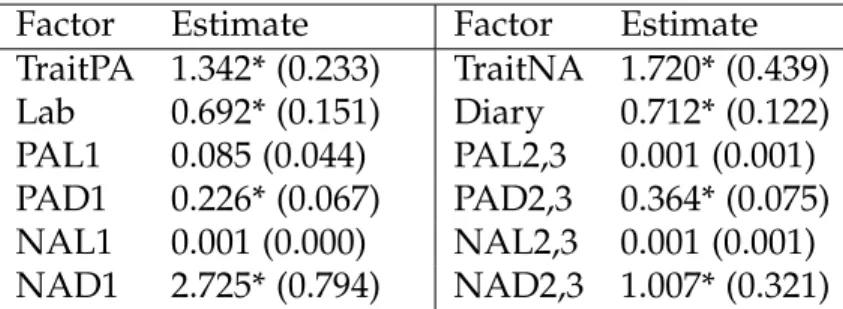
Table 3.5 shows the time series parameter estimates for the most parsimonious
model; note that negative affect within the lab setting is excluded since there were no
significant autoregression parameters. The estimates of the autoregression
parame-ters suggested that both the PA and NA state fluctuations were stationary in nature2.
2That is, the eigenvalues of the transition matrix have moduli less than one or alternatively, all the