NURSES SUPPORTING NURSES: IMPLEMENTATION OF A MENTOR TRAINING PROGRAM TO IMPROVE NEW GRADUATE REGISTERED NURSES’ SENSE OF
BELONGINGNESS
Sheri Phifer
A project submitted to the faculty at the University of North Carolina at Chapel Hill in partial fulfillment of the requirements for the degree of Doctorate of Nursing Practice in the Doctor of
Nursing Practice Program in the School of Nursing.
Chapel Hill 2018
Approved By: Cheryl B. Jones
© 2018 Sheri Phifer
ABSTRACT
Sheri Phifer: Nurses Supporting Nurses: Implementation of a Mentor Training Program to Improve New Graduate Registered Nurses' Sense of Belongingness
(Under the direction of Cheryl B. Jones)
Purpose: The purpose of this evidence-based, quality improvement project was to develop and implement a mentor training program for Registered Nurses who mentor new graduate registered nurses. The goal of the training was to foster a sense of belongingness among new graduate registered nurses in an acute care hospital. Background: New graduate registered nurse (NGRN) turnover is a critical issue for hospitals, as 35-60% of these nurses quit their jobs during the first year of employment. The use of mentors can help to ease NGRN transition to practice concerns and may help retain NGRNs during the first year of employment. Methods: A one-hour mentor training class was developed and offered to mentors. After training, mentors were matched with a NGRN employed in a different work unit who had a similar work shift and schedule. As part of this program, mentor-NGRN pairs met on a monthly basis. New graduate registered nurses’ perceptions of belongingness were measured before and three months after beginning the program using a modified version of the Belongingness Scale-Clinical Placement Experience survey (Levett-Jones, Lathlean, Higgins, & McMillian, 2008). Results: There were no
TABLE OF CONTENTS
LIST OF TABLES...viii
LIST OF FIGURES...ix
CHAPTER 1: INTRODUCTION...1
Practice Question...4
Purpose of Project...4
Significance to Nursing and Healthcare...4
Chapter Summary...6
CHAPTER 2: REVIEW OF THE LITERATURE...7
Chapter Introduction...7
Search Strategy...8
Overview of Studies...10
Common Components of Mentor Program Interventions...11
Program Outcomes...11
Job Satisfaction...12
Intent to Stay...12
Turnover...13
Belongingness...14
Summary...15
Theoretical Framework...15
CHAPTER 3: METHODOLOGY...18
Chapter Introduction...18
Design...18
Setting...18
Key Stakeholders...20
Target Population...21
Description of Intervention...22
Mentor Recruitment and Matching...22
Mentor Training Intervention...23
Measurements...24
Belongingness Scale-Clinical Placement Experience...25
Turnover Rate...26
Data Analysis...26
Protection of Human Subjects...27
Chapter Summary...27
CHAPTER 4: RESULTS...28
Chapter Introduction...28
Participants...28
Results...29
Intervention Sustainability...30
Chapter Summary...31
CHAPTER 5: DISCUSSION...32
Discussion...32
Implications for Clinical Practice...34
Implications for Future Mentor Training Programs...34
Limitations...35
Conclusions...36
APPENDIX A: LITERATURE REVIEWED SPECIFIC TO THE PROJECT...38
APPENDIX B: MENTOR TRAINING POWERPOINT...45
APPENDIX C: COURSE OUTLINE...55
APPENDIX D: RESEARCHERS CONTACTED...56
APPENDIX E: PERMISSION TO USE BELONGINGNESS SURVEY...57
APPENDIX F: MODIFIED BELONGINGNESS SURVEY...58
APPENDIX G: IRB APPROVAL...70
APPENDIX H: INTRODUCTION EMAIL TO PARTICIPANTS...72
LIST OF TABLES
Table 1. Mentor Program Needs Assessment...21
Table 2. Participant Characteristics...28
Table 3. Paired Samples t test...29
LIST OF FIGURES
CHAPTER 1 INTRODUCTION
Registered nurses (RNs) make up the largest component of the health care workforce in the United States and comprise one of the fastest-growing occupations in the country (American Nurses Association [ANA], 2014; Bureau of Labor Statistics, 2015). The Bureau of Labor Statistics projects that the RN workforce will grow by 16%, from 2.75 million in 2014 to 3.19 million in 2024 (Bureau of Labor Statistics, 2015). Despite this growth, the demand for nurses outpaces the supply, and an insufficient supply of nurses requires that hospitals develop measures to recruit and retain nurses (ANA, 2014; Carnevale, Smith, & Gulish, 2015; Punke, 2017; Thew, 2017).
Previous research indicated that 35-60% of NGRNs quit their jobs during the first year of employment (Weng et al., 2010). Without intervention, this high level of turnover can result in significant financial losses to an organization, as the cost of turnover can be as high as $88,000 for NGRN (Jones, 2005; 2008). Additionally, the loss of employees can disrupt the healthcare team and may negatively affect the delivery of quality patient care, and increase the utilization of overtime and contract nurses (Brewer, Kovner, Greene, Tukov-Shuser, & Djukic, 2011;
Cottingham, DiBartolo, Battistoni, & Brown, 2011).
One of the factors associated with NGRN turnover during the first year of employment is whether or not NGRNs feel a sense of belongingness, or acceptance, by others on their work unit (Fink, Krugman, Casey, & Goode, 2008; Lalonde & McGillis Hall, 2017). Belongingness in the workplace refers to the extent to which employees perceive they are supported, valued, included, and accepted by others in their place of work (Cockshaw & Shochet, 2010). It has also been reported that there is a strong relationship between a NGRNs’ perceived sense of belongingness and their perceived satisfaction in his or her job (Winter-Collins & McDaniel, 2000).
programs include an orientation period with a resource person, identified as either a preceptor or mentor (Gordon et al., 2014; Rush, Adamack, Gordon, Lilly, & Janke, 2013).
The terms mentor and preceptor are often used interchangeably (Wensel, 2006).
However, it is important to note that a mentor is not synonymous with a preceptor even though they both serve in supportive roles (Wensel, 2006). The role of a preceptor is to act as an educator, evaluator, role model and advocate of the NGRN (Kanaskie, 2006; Robitalle, 2013). This relationship typically involves a defined time commitment for the orientation of NGRNs, with well-defined outcomes that will determine when the precepting relationship ends (Kanaskie, 2006). A mentor serves as an objective listener, provides a voice without bias, shares insights about finding balance between one’s professional and private lives, and offers guidance for increased professional growth, typically without a defined timeline (Buffum & Brandon, 2009; Fox, 2010; Mills & Mullins, 2008)
Practice Question
Do NGRNs have an increased sense of belongingness that impacts turnover rates after participating in a NGRN mentor program with mentors that have been formally trained for their role?
Purpose of Project
The purpose of this evidence-based project was to develop and implement a mentor training program for Registered Nurses serving as mentors, to foster a sense of belongingness and positively impact turnover rates of NGRNs at one acute care hospital. This project assessed NGRNs’ sense of belongingness before and after implementation of the mentor program to determine changes that occur post-implementation, as well as turnover after three months. This project provides information that organizational managers and leaders can use to justify the development of such a program, and informs the development of practices and policies aimed at improving a sense of NGRN belongingness.
Significance to Nursing and Healthcare
program could have a significant impact on an organization's financial performance over a three-year period of time (Buffum & Brandon, 2009; Mills & Mullins, 2008).
According to the National Council of State Boards of Nursing (2015), 50% of the nursing workforce is 50 years of age or older. As these nurses retire, hospitals are expected to lose
human capital needed to provide care to the baby boomer population (Barr, 2014; McCloughen & O’Brien, 2005). The departure of experienced nurses has potentially serious implications for patient care quality because these nurses have the knowledge and clinical judgment necessary for the clinical management of patients (Benner, 1984; Barr, 2014; McCloughen & O’Brien, 2005). These experienced nurses also possess the knowledge, skills, and wisdom needed to mentor and foster the NGRNs sense of belongingness on a unit.
To help NGRNs develop essential knowledge and skills, an experienced mentor can help guide their clinical progression and help them understand and adapt to new clinical situations (Benner, Tanner, & Chesla, 2009; Ulrich et al., 2010). These NGRNs also need an experienced mentor to help them integrate into the work environment. During the transition from student to skilled practitioner, a mentor will help the NGRN grow as a professional, provide advice and guidance, and help them navigate difficult situations (Rohatinsky & Jahner, 2015).
expect that a program that trains nurses to be mentors might also improve NGRNs’ perceptions of belongingness on their work unit. In turn, mentor programs may decrease NGRN turnover and its associated costs, and improve the work environment for nurses (Buffum & Brandon, 2009; Fox, 2010; Komaratat & Oumtanee, 2009).
Chapter Summary
This chapter highlighted the problem of reality shock that NGRNs experience during their first year of practice. It introduced the purpose of this DNP project, which was to
CHAPTER 2
REVIEW OF THE LITERATURE Chapter Introduction
During the transition period from student to practitioner, NGRNs require guidance, direction and decision-making support from more experienced nurses (Rohatinsky & Jahner, 2015). This guidance often comes from a mentor – either intentionally or unintentionally formed – that occurs to promote and support socialization of new nurses within an organization (Fox, 2010; Rohatinsky & Jahner, 2015). Nurse mentor programs (NMPs) pair NGRNs with
experienced nurses to facilitate growth and development and foster relationships as NGRNs transition into professional practice (American Nurses Association [ANA], n.d.). These programs have been reported to increase new graduate nurse job satisfaction, clinical proficiency and confidence, and provide necessary structure, support and guidance to NGRNs (Fox, 2010; Grindel & Hagerstrom, 2009; Komaratat & Oumtanee, 2009).
Search Strategy
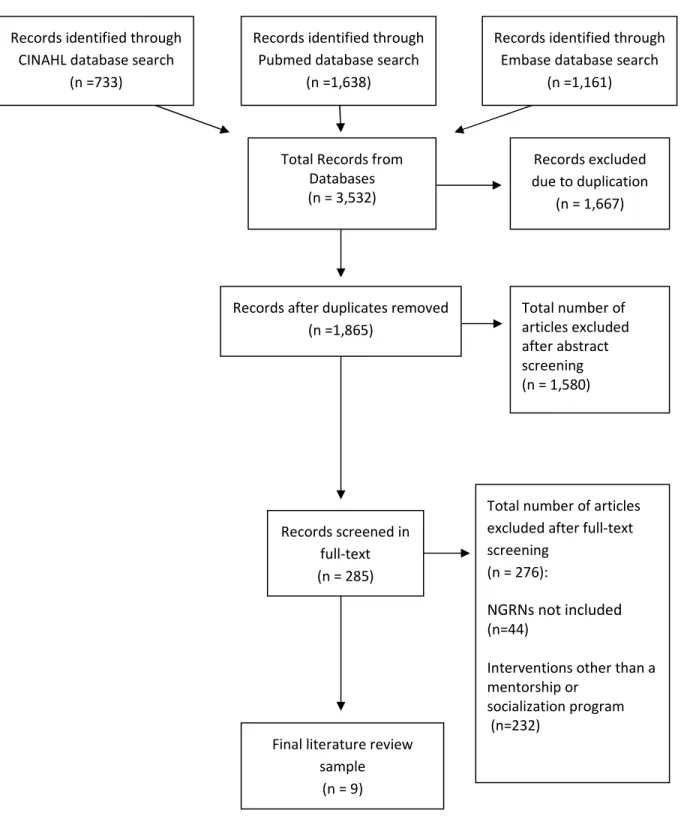
Figure 1: PRISMA Flow Diagram
Records identified through CINAHL database search
(n =733)
Records identified through Pubmed database search
(n =1,638)
Records identified through Embase database search
(n =1,161)
Total Records from Databases (n = 3,532)
Records excluded due to duplication
(n = 1,667)
Records after duplicates removed (n =1,865)
Total number of articles excluded after abstract screening (n = 1,580)
Records screened in full-text (n = 285)
Total number of articles excluded after full-text screening
(n = 276):
NGRNs not included
(n=44)
Interventions other than a mentorship or
socialization program (n=232)
Final literature review sample
The initial database search yielded 3,532 articles, of which, 1,667 articles were excluded because of duplication. The titles and abstracts of these remaining articles were screened for inclusion based on the following criteria: (a) articles were published between January 2007 and July 2017, (b) studies were conducted in hospitals, and (c) studies were conducted in an English-speaking country, in particular, the United States, Canada, or Australia. At this step, 1,580 articles were excluded because they did not meet these initial criteria.
The remaining studies (n=285) were screened a second time in full-text. Studies were excluded at this level of review (n=276) that: (a) were not consistent with the study purpose and omitted a focus on NGRNs (n=44), or (b) focused on interventions other than a mentor or socialization program (n=232). Altogether, nine studies met inclusion criteria. In general, the mentor programs described in the literature varied greatly in their design and the outcomes studied.
After the sample was determined, the literature was analyzed for common themes of mentor programs. The major themes that emerged were: program components; and program outcomes that included job satisfaction, turnover, intent to stay, and belongingness. A general overview of studies reviewed will be discussed first, followed by a discussion of the common themes and NMP components, and a discussion of the program outcomes.
Overview of Studies
All studies were quantitative in design and conducted in the United States (Burr, Stichler, &
Poeltler, 2011; Faron & Poeltler, 2007; Fox, 2010; Grindel & Hagerstrom, 2009; Halfer et al., 2008;
Latham, Ringl, & Hogan, 2011; Mills & Mullins, 2008; Schroyer, Zellers, & Abraham, 2016; Scott
Common Components of Mentor Program Interventions
Several common components of mentor programs emerged from this review. A mentor was used as an intervention in all studies to foster support and socialization of NGRNs into an organization or unit (Burr et al., 2011; Faron & Poeltler, 2007; Fox, 2010; Grindel &
Hagerstrom, 2009; Halfer et al., 2008; Latham, Ringl, & Hogan, 2011; Mills & Mullins, 2008; Schroyer et al., 2016; Scott & Smith, 2008). In five studies, the mentor program intentionally assigned a nurse mentor to a NGRN and the mentor-mentee match was established by a designated person within the organization (Fox, 2010; Grindel & Hagerstrom, 2009; Mills & Mullins, 2008; Schroyer, Zellers, & Abraham, 2016; Scott & Smith, 2008). Six of the mentor programs paired mentors and mentees for a one-on-one relationship over a 12-month period (Burr et al., 2011; Faron & Poeltler, 2007; Fox, 2010; Grindel & Hagerstrom, 2009; Halfer et al., 2008; Scott & Smith, 2008).
Several studies reported using a formal mentor/mentee training session to orient each to their respective roles and to program components (Burr, Stichler, & Poeltler, 2011; Fox, 2010; Latham et al., 2011). Two studies reported that regular, monthly meetings between the mentor and NGRN were an effective component for socialization of the nurses (Burr, Stichler, &
Poeltler, 2011; Grindel & Hagerstom, 2009). While there was no consistency in the specific type of nurse mentor program, there were common components among the studies.
Program Outcomes
Hagerstrom, 2009; Scott & Smith, 2008), decreased NGRN turnover (Burr et al., 2011; Faron & Poeltler, 2007; Fox, 2010; Halfer et al., 2008; Latham et al., 2011; Mills & Mullins, 2008; Schroyer et al., 2016), and a strong sense of belongingness (Burr et al., 2011). A discussion of the literature in each of these areas follows.
Job Satisfaction
Mentor programs have been shown to foster long-term growth and retention through a
structured support system that enhances NGRN job satisfaction (Mills & Mullins, 2008). The literature indicates that NGRNs experience varying levels of job satisfaction during the first 6 to 18 months of hire (Grindel & Hagerstrom, 2009; Mills & Mullins, 2008).
Four studies reported the effectiveness of 12-month programs that used mentors to support NGRNs on NGRN job satisfaction (Fox, 2010; Grindel & Hagerstrom, 2009; Halfer et al., 2008; Scott & Smith, 2008). In particular, one study implemented a 12-month NGRN mentor program for the purpose of increasing nurse satisfaction and decreasing turnover (Fox, 2010). The sample included 12 pairs of mentor/mentee matches from various units within a Catholic hospital. The author of this study reported that job satisfaction scores improved in 75% of the participants and that 100% of nurses participating in the mentor program were retained for a period of at least 1 year. Another study of 25 NGRNs participating in a yearlong group program that assigned mentors to NGRNs at a hospital in North Carolina found that NGRNs reported high levels of job satisfaction with working at their organization (Scott & Smith, 2008). Taken
together, these findings suggest that mentor programs have the potential to positively affect NGRN job satisfaction within their first year of employment (Fox, 2010; Scott & Smith, 2008). Intent to Stay
examined the variables that predict intent to stay and reported that job satisfaction is one of the strongest predictors of intent to stay and retention. Scott & Smith (2008) suggested that when nurses are committed to their profession and are satisfied with their jobs, they have a lower tendency to leave. Grindel and Hagerstrom (2009) reported that intent to stay among nurses peaked after 12 months of participating in a mentor program. These findings suggest that, by improving jobs satisfaction, mentor programs could strengthen NGRNs intent to stay and
subsequently improve retention rates (Bontrager, 2016; Grindel & Hagerstrom, 2009; Rohatinsky & Jahner, 2015; Scott & Smith, 2008).
Turnover
Belongingness
Belongingness represents a pervasive and universal human need to feel connected to and a part of a group (Levett-Jones, Lathlean, Higgins, & McMillan, 2009). When individuals’ feel a sense of belongingness in their work group, they feel cared about, and valued and respected by others (Winter-Collins & McDaniel, 2000). In turn, someone who feels a sense of belongingness to a group accepts, cares for and values others in the group (Levett-Jones, Lathlean, McMillan, & Higgins, 2007).
Only one study of a NGRN mentor program examined NGRNs sense of belongingness on their unit (Burr et al., 2011). Burr et al. (2011) conducted a cohort study to examine the effects of a nurse mentor program on nurse retention in a 169-bed tertiary care hospital for women and newborns. The formal 12-month program matched mentees (new graduates, newly hired RNs, or RNs new to a specialty area) with an experienced mentor. The program included monthly 1-hour formal mentor-mentee meetings. At the end of one year, the mentees completed a formal written evaluation that measured qualitative and quantitative data. One of the 11 questions asked if the mentor program helped the NGRN have a strong sense of belonging on their unit. Unfortunately, this study did not use a scale to measure belongingness or report specific findings on the question that was asked. The study did report that reduction in turnover rates from 20% to 7%, which led to substantial savings of more than $300,000 after the first year of implementation.
and organization of clinical placements to be important factors that affect nursing students’ belongingness. Similarly, McKenna et al. (2012) examined the variables that influence undergraduate midwifery sense of belongingness in their clinical placements. Results of this study suggest that several factors influence sense of belonging for undergraduate midwifery students. The most notable being the longer duration of the clinical placement resulted in an increased sense of belonging.
These studies suggested that belongingness is an important precursor to nursing students’ learning and success (Levett-Jones, Lathlean, Higgins, & McMillian, 2008; McKenna et al., 2012). As nursing students’ transition into practice, it is reasonable to assume that belongingness will continue to influence their learning and success in their professional careers. Thus, it is reasonable to believe that belongingness will be affected by the implementation of this project.
Summary
Overall, the evidence of the review of literature supports the implementation of a NGRN mentor program. The findings from the research studies reviewed validate the positive
organizational impacts of a NGRN mentor program through reduced NGRN turnover. While not specifically examined among NGRN mentor programs, belongingness is known to improve job satisfaction, and is associated with decreased NGRN turnover in general. Thus, belongingness may be a better indicator of the success of a NMP that other outcomes examined in previous studies.
Theoretical Framework
1980; Dreyfus & Dreyfus, 1986). Dreyfus and Dreyfus (1980) originally described the stages of skill acquisition as novice, competent, proficient, expert and master. The stages were later renamed novice, advanced beginner, competent, proficient, and expert (Dreyfus & Dreyfus, 1986). In 1984, Patricia Benner adapted and applied Dreyfus's five levels of competency to explain an individual's acquisition of nursing knowledge relative to their nursing practice (Altmann, 2007; Benner, 1984).
Patricia Benner's novice to expert model describes how nurses acquire skills through situational experiences (Altmann, 2007; Davis & Maisano, 2016). It explains clinical skill acquisition and asserts that nurses develop skills and understanding of patient care over time through education and experience (Davis & Maisano, 2016; Gallegos & Sortedahl, 2015). The novice to expert model posits that individuals, while acquiring and developing skills, pass through five levels of proficiency: novice, advanced beginner, competent, proficient, and expert (Altmann, 2007; Davis & Maisano, 2016; Longo et al., 2013). Each level reflects movement from reliance on past abstract principles to the use of past concrete experiences (Benner, 1984). Benner (1984) described the individual's progression at each level as being guided by clinical experience and knowledge development. She hypothesized that expertise in nursing was influenced by relevant experience as well as associated factors, such as learning styles and educational opportunities, all over a period of time (Benner, 1984).
Benner, Tanner, and Chesla (2009) later described the novice as someone who still requires a mentor or experienced nurse to assist them in integrating practical knowledge,
patient status or predict what might happen in a particular patient situation (Carlson, Crawford, & Contrades, 1989; Gallegos & Sortedahl, 2015). For novice nurses to develop skills and progress through Benner’s levels of proficiency, a mentor can help guide their clinical progression and support them as they experience and attempt to comprehend new clinical
situations (Benner et al., 2009; Davis & Maisano, 2016; Ulrich et al., 2010). The use of a mentor is an intervention that can cultivate support and socialization of NGRNs in an organization (Fox, 2010; Rohatinsky & Jahner, 2015). The formation of an emotional commitment between a novice (mentee) and experienced (mentor) nurse is essential for a successful mentoring relationship (Hnatiuk, 2013). While a mentor is the individual who nurtures and supports the NGRN during their early employment period; the act of mentoring assumes a level of knowledge and competence, in which teaching and learning is enacted through a sharing of advice or
expertise, the fostering of role development, and the offering of formal and informal support to influence the career of the NGRNs (Hnatiuk, 2013). Thus, the mentor-mentee relationship can help the NGRN to progress through Benner’s novice to expert levels.
Chapter Summary
CHAPTER 3 METHODOLOGY Chapter Introduction
The aim of this project was to implement a mentor training program that improved NGRNs’ sense of belongingness, as reflected in changes assessed from pre- to post-implementation. The following sections describe the project design, project setting, key
stakeholders, target population, description of the intervention, and data analysis for this project. Design
This Doctoral of Nursing Practice project utilized the Plan-Do-Study-Act (PDSA) cycle to implement a quality improvement project that utilized a one group, pretest-posttest design, to determine if NGRNs' sense of belongingness and turnover change following participation in a NGRN mentor program that paired NGRNs with trained mentors. This design was chosen to guide evaluation of the mentor program and the impact of the NMP on specified outcomes (LoBiondo-Wood & Haber, 2010). In this project, the NMP was anticipated to change NGRN’s sense of belongingness and affect the NGRN turnover rate.
Setting
beds and employs more than 6,400 staff members, including more than 1,800 staff nurses (J. Aucoin, personal communication, January 10, 2019). REX hires approximately 60 NGRNs per year, and the NGRN turnover rate in the first year of hire has fluctuated from 4% of NGRNs hired during calendar year 2013, to 12% of NGRNs hired during calendar year 2015, and 0% of NGRNs hired during calendar year 2016 (K. Pollara, personal communication, April 27, 2017).
The current orientation process for NGRNs at REX includes 12 weeks of orientation with a unit-based preceptor, in conjunction with ongoing education offered through the Successful Transitions program (G. Jackson, personal communication, June 2, 2017). This NGRN residency program is a year in length and consists of eight classes covering the following topics:
management of changing patient conditions, informatics and technology, management and delivery of quality patient care, patient and family centered care, incivility, resilience, delegation, and mock codes (G. Lorenzi, personal communication, June 1, 2017). NGRNs are required to attend at least six out of eight classes throughout the year.
In an effort to improve NGRN retention and address a key recommendation for NGRN residency programs, a NGRN mentor program was initiated at REX in December of 2016. The NGRN mentor program was introduced to the managers and directors at REX in a leadership meeting on September 8, 2016. Managers were asked to identify mentors on their units and submit their names to the nurse educators by the first week in October 2016 (G. Jackson,
personal communication, September 23, 2016). In all, 47 RNs were recruited to serve as mentors and 30 out of 36 NGRNs chose to participate in the program (G. Jackson, personal
communication, February 16, 2017).
to match them with a mentor. The advisor coordinated the matching process using a
questionnaire that assessed the following characteristics of mentors and mentees: shift, current specialty area, specialty interest, career goals, age/generation, and outside interests (G. Jackson, personal communication, September 1, 2016). Unfortunately, there was no formalized process to educate and prepare mentors for their roles as part of this program. Mentors and mentees were expected to meet monthly and were compensated for one hour of their base salary to cover their meeting time. Other than submission of time for compensation, there was no other means of tracking ongoing mentor-mentee meetings or mentor-related progress. Planned outcome measures for the program, prior to project implementation, included a NGRN belongingness survey conducted prior to the initiation of the program, administered periodically during the program and at the conclusion of the program (G. Jackson, personal communication, September 1, 2016). Results of these surveys were not disclosed to the PI.
Key Stakeholders
process that existed at that time "confusing" and felt that more guidance and information about the expectations of the mentor role would be beneficial to cover in a training program.
Table 1
Mentor Program Needs Assessment Survey
1) What is working well about the mentoring component of the new graduate RN orientation program?
2) What needs improvement?
3) If you could change one thing about the mentoring component of the new graduate RN program, what would it be?
4) If we were to implement a training program for mentors, what topics would you find most beneficial?
On January 25, 2018, three and a half months prior to the launch of this project, the PI made an announcement at the nurse leadership council, comprised of REX's nurse managers, clinical directors, and the Chief Nursing Officer to gain leadership buy-in for the mentor education component of the NMP. This announcement provided the nurse leaders with a brief overview of the mentor education plan, and planned outcome measures. The process for recruiting nurse mentors did not change from the current program. The leadership team shared their support of this project and agreed to continue to help recruit mentors from their respective units.
On March 21, 2018, the PI attended a Successful Transitions class and the Professional Development Council meeting to introduce the project to NGRN winter cohort and the nurse educators. The NGRNs expressed their excitement about the opportunity to participate in a mentor program and the nurse educators shared that they supported this project and wanted to hear about the outcomes once the project was completed.
Target Population
2018. NGRNs were hired at REX on a continual basis. NGRN cohorts were identified by the time of year in which they were hired.
Description of Intervention
This project was designed to improve the current NGRN nurse mentor program at REX by implementing a formalized process to educate and prepare mentors for their roles, guided by Benner’s framework as described earlier (Benner, 1982). For the purpose of this project, the mentor/mentee relationship focused solely on the novice stage when NGRNs need the most guidance in their first nursing jobs. However, the relationship could be extended for as long as the mentor-mentee pair desired.
Mentor Recruitment and Matching
On February 22, 2018, the program advisor sent an email to all REX nurse managers requesting their assistance in mentor recruitment. Five days later, the PI sent a follow-up email reminding the managers to send the names of staff that they wanted to serve as mentors for the NGRN winter cohort. In all, 41 names of potential mentors were sent by nurse managers to the program advisor. On April 6, 2018, an email announcing the date, time and location of the mentor training classes was sent to all potential mentors.
Mentor Training Intervention
A total of 31 mentors attended a one-hour class that was developed and led by the PI. The class was offered twice, on April 11, 2018 and April 18, 2018. The class was developed by drawing on the literature about NGRN mentor programs. During the class, a slide presentation, developed by the PI integrating evidence from the literature (Appendix B), was presented to mentors. Objectives of this mentor training class were: 1) to define the role and function of a mentor; 2) to gain insight on the expectations of the mentor/mentee relationship; 3) to identify ways to start conversations and foster communications between the mentor and mentee; and 4) to explore how to set goals and priorities for the mentor-mentee experience. Education strategies included lecture, interactive group discussions, and a handout of the PowerPoint presentation. The first 30 minutes of the training session was devoted to defining nursing mentoring, describing the types of mentor-mentee relationships, and differentiating the role of a mentor from the role of a preceptor. The next 25 minutes of the training session was devoted to discussing expectations of the mentor-mentee relationship, exploring ways to facilitate conversations and set goals, and discussing the benefits of a NGRN mentor program. The last 5 minutes were reserved for a question/answer period. At the conclusion of the class, mentors were informed that they would receive an email in early May with the name of their assigned NGRN and that they should reach out to their mentee to set up the first mentor-mentee meeting. The course outline is included (Appendix C).
program. Mentors and mentees were expected to meet once a month to provide the NGRNs with ongoing support, guidance, and assistance with social integration to the hospital environment. Measurements
The survey tool was formatted and administered as a web-based survey using the
Qualtrics software and housed on a Qualtrics server where anonymous responses were collected. Participants in this project were the 31 NGRNs from the winter 2018 cohort. Email addresses for the 31 NGRNs were provided by the program advisor for one time use to enter into Qualtrics. The PI did not retain any written or electronic copy of the NGRN email addresses after the Qualtrics survey was distributed.
At the completion of their 12-week clinical orientation and prior to their initial meeting with their assigned mentors, all NGRNs in the winter cohort were asked to complete a modified version of the Belongingness Scale-Clinical Placement Experiencesurvey (BSCPE). The survey was opened on April 30, 2018, which was the approximate end date of the NGRN clinical orientation. The survey remained open for two weeks. Reminders to complete the survey were sent at one week, and three days prior to the survey closing. The survey closed on May 14, 2018.
At the end of three months, NGRNs were asked to complete the modified BSCPE survey a second time. The survey opened on August 20, 2018 and remained open for two weeks.
Belongingness Scale-Clinical Placement Experience
NGRN perceptions of belongingness were measured before NGRNs began the NMP (three months after hire), and after NMP implementation (six months after hire) using a modified version of the BSCPE (Levett-Jones, Lathlean, Higgins, & McMillian, 2008; Levett-Jones et al., 2009). Researchers who previously used a modified version of this tool were contacted (see Appendix D for the researchers contacted) to gather information about their surveys and to ask for permission to use and modify their surveys. Permission to use and modify the BSCPE survey was obtained from Dr. Levett-Jones on May 9, 2017 (Appendix E).
The BSCPE survey was originally developed to measure nursing students’ perceptions of belongingness in their clinical placements (Levett-Jones et al., 2009). This instrument is a 34-item self-reported survey that uses a five-point Likert scale to measure nurses’ sense of
belongingness in the clinical environment. Responses range from 1 never true, 2 rarely true, 3 sometimes true, 4 often true, and 5 always true. Four items are negatively worded and were reverse scored. The survey is composed of three sub-scales: esteem (feeling secure, included, valued, and respected by others); connectedness (feeling part of or integral to the group, being accepted, and fitting in); and efficacy (confidence in one’s ability to perform tasks or skills, accomplish goals, or control actions or outcomes) (Levett-Jones et al., 2009).
Turnover Rate
The turnover of NGRNs is an important outcome to assess in determining the impact of this intervention. Turnover rate represents the number of employees who left an organization over a defined period of time, divided by the total number of employees during that same time period (Jones, 2005; Kovner et al., 2014; Society for Human Resource Management, 2015).
NGRN turnover rates on project units were obtained from the human resources
department at the project implementation site. This site calculates NGRN turnover rates annually by dividing the number of NGRN terminations during the year by the total number of NGRNs hired in that same year’s class of NGRNs(K. Pollara, personal communication, May 11, 2017). Since this project focused on NGRN cohorts, the turnover rate was calculated by dividing the number of NGRN terminations in a specific cohort by the total number of NGRNs hired into that cohort.
Data Analysis
Data on NGRNs’ sense of belongingness were collected pre- and post-implementation of the NMP. Data were analyzed using IBM SPSS Statistics statistical software, version 25. A total of 17 NGRNs (55%) participated in this project. A paired t-test was used to compare the
the project period (six months after initial hire) and compared to the six-month NGRN turnover rates from the previous year’s (2017) cohort.
Protection of Human Subjects
Prior to implementation, this project was reviewed by the Institutional Review Board at the University of North Carolina at Chapel Hill and deemed exempt from further review (Appendix G). All NGRNs in the winter 2018 cohort were sent an email that informed them about the project and contained an anonymous link to the survey (Appendix H). Participation was voluntary and the participants’ identity was protected using participant-generated
identification codes at the end of each survey. These codes allowed the PI to link pre- and post-intervention data for each participant without knowing the participants identity (Damrosch, 1986).
Chapter Summary
This chapter presented the methods used to develop and implement the NGRN mentor
CHAPTER 4 RESULTS Chapter Introduction
This chapter presents the results of this project. In particular, comparison data from the NGRNs’ pre-intervention and post-intervention BSCPE survey results and turnover rate. The comparison data in this chapter will focus on the aim of this project.
Participants
De-identified demographic information on the NGRN winter cohort (n=31) was provided to the PI by the program advisor (Table 2). The majority of the cohort was female (90.3%), had a BSN (58%), and worked in various units throughout the hospital, including medical units (n=8), combined medical/surgical units (n=8), intensive care units (n=2), perioperative services (n=4), the woman’s center (n= 4), cardiac services (n=3), and the emergency room (n=2).
Table 2
Characteristics n Percent Gender
Male Female
Results
Belongingness. Seventeen of the 31 NGRNs completed the initial BSCPE survey, and nine NGRNs completed the second survey. These responses represent a 55% response rate at time 1 and a 29% response rate at time 2. All respondents provided a unique code by which the first and second surveys could be paired for analysis. A paired t-test was used to compare the means of pre- and post-BSCPE subscales. Results are shown in Table 2. The mean scores for all three subscales (esteem, connectedness, and efficacy) had declined at time 2, but these changes were not statistically significant (p = .05). However, the results of this analysis for the esteem scores was close to significance (p = .072).
Table 3
Paired Samples t test
Pairs Mean t df Sig. (2-tailed)
Esteem Time 1 3.935 2.073 8 .072
Esteem Time 2 3.444
Connectedness Time 1 3.417 .263 8 .799
Connectedness Time 2 3.319
Efficacy Time 1 4.064 .250 8 .809
Efficacy Time 2 4.016
were described as: 1) personal reasons; 2) a desire to stay at home; and 3) unable to meet job requirements (K. Pollara, personal communication, November 15, 2018).
Intervention Sustainability
A quality improvement process check was completed by sending a follow-up survey to the 31 mentors that participated in this program. The survey, shown in Table 4, was modeled after the needs assessment survey that was sent to key stakeholders prior to the implementation of this project.
Table 4
Mentor Program Follow-up Survey
1) What worked well about the mentor training class you attended? 2) What didn't go well or can be improved?
3) What will you do differently now?
4) How will you share lessons learned with others?
Eight of the 31 mentors responded to the survey. All eight of the mentors felt that the mentor training class was beneficial. Three mentors felt that the training class helped outline the expectations for their mentor role, and what they could expect during the mentoring experience. Two mentors reported that they attempted to contact their mentee and never received a response. Two other mentors did not feel that the mentor/mentee assignment was appropriate because they worked on shifts opposite to their mentees, which made it difficult to find a time to meet. The remaining four mentors felt that their assignment was appropriate. Two mentors recommended that the mentor/mentee matching process be improved, and one mentor suggested that NGRN orientation include content about working with a mentor and meeting expectations of the mentor-mentee relationship to avoid behaviors such as being late for mentor-mentor-mentee meetings.
Discussions are underway to disseminate project findings to hospital leaders and
further improve the NGRN mentorship program at REX. Sustainability of this project will depend on the commitment of the organization. The program will require an instructor to teach mentor-training classes and someone to coordinate and check in with the mentor/mentee pairs to ensure that their respective expectations are being met, and that mentor-mentee meetings are occurring.
Chapter Summary
CHAPTER 5 DISCUSSION Chapter Introduction
This chapter presents an overall discussion of the project and conclusions that were drawn, based on the results of this project. A discussion of how findings might inform future organizational practices will also be discussed. Recommendations for clinical practice, future mentor training and NGRN projects, project limitations, and final conclusions of the project are also provided in this chapter.
Discussion
The purpose of this evidence-based quality improvement project was to foster a sense of belongingness among NGRNs through the implementation of a mentor training program for Registered Nurses serving as mentors for NGRNs. A group of 31 nurse mentors, recruited by their nurse managers, attended a one-hour mentor training class to introduce them to the role of mentor, and the expectations for being a NGRN mentor. The mentors were instructed to meet with their assigned NGRN mentees monthly to provide guidance and support.
approached statistical significance (p = .072), but nevertheless, the finding indicates no change in NGRNs’ sense of belongingness. The decrease in esteem reported by NGRNs was not surprising, given that the literature indicates NGRNs tend to start out with a relatively high self-esteem and confidence that decreases significantly after six months of hire (Goode, Lynn, McElroy,
Bednash, & Murray, 2013). This finding suggests that NGRNs likely need support beyond six months of entering a NGRN role, and that a measure of belongingness taken at some point later (e.g., one year) may be different than at the six month point. Although assessing belongingness in the 2017 NGRN cohort was not a part of this project, it should be noted that the means of the other subscales (connectedness and efficacy) did not change significantly, suggesting that the nurse mentor program may have had an impact.
Although there was a total of three turnovers in the winter 2018 NGRN cohort who left the organization within six-months of hire, this number increased by only one NGRN turnover from the prior year’s cohort. Resigning NGRNs primarily reported personal versus work related reasons for departing from the organization. However, a more thorough understanding of these departures would be important to determine if an increased sense of belongingness would have prevented these NGRN resignations. The current process for capturing reasons for nurse turnover at REX is through exit interviews and in a computer program that has a list of predetermined choices from which the nurse manager on the unit of the departing NGRN to select. Exit
interview was not completed on the three NGRNs from the winter 2018 cohort that left the organization (K. Pollara, personal communication, November 15, 2018).
Implications for Clinical Practice
Evidence suggests that NGRNs require time and mentoring during their transition to practice (Goode et al., 2013). Responding to the needs of NGRNs has potential long-term advantages for health care organizations, including decreased turnover resulting in a financial return on investment, and may influence both the quality and delivery of care (Rush et al., 2013). Hospital leaders and educators must work collaboratively to develop successful NGRN mentor programs that promote successful transition to practice. In particular, protected time for the mentor and mentee is needed to allow for ongoing mentor-mentee meetings, cultivate the mentor-mentee relationship, and create a work environment that encourages mentors and mentees to actively participate in the NGRN program.
Nurse educators are important to help train mentors and assist with mentor-mentee
meeting facilitation and tracking. Lack of a reliable way of tracking that mentor-mentee meetings had occurred, other than retrospective audits of payroll records was a limitation in this project. Educators or an assigned program coordinator could periodically follow up with the mentor-mentee pair to ensure that meetings and communications were occurring between mentors and mentees (Schroyer et al., 2016).
Implications for Future Mentor Training Programs
approaches used in this project. There also is a need for research using longitudinal methods of such NGRN mentor programs, with greater numbers of participants conducted at multiple sites to more clearly detect the impact that a NGRN mentor program might have on NGRNs' sense of belongingness. This finding should be explored by organizations that implement NGRN mentor training programs, especially if the implementation is occurring on a larger scale. Additionally, there are currently no recognized national standards for mentor program design or mentor training. Thus, evidenced-based projects are needed to standardize mentor programs. Furthermore, the BSCPE survey utilized in this project was modified to place emphasis on nurses’ work units. Therefore, it is recommended that future researchers evaluate the psychometric measures of the modified tool.
Limitations
There were several limitations of this project that are worth noting. First, it was conducted at only one hospital using a convenience sample of NGRNs and mentors that volunteered to participate in the program. Thus, project findings cannot be generalized beyond the project site. However, the purpose of this project was to implement an evidence-based intervention in a hospital setting, not to generate generalizable findings. Therefore, the
convenience sample was sufficient for a beginning assessment of impact in the hospital setting. Second, the project examined a single cohort of 31 NGRNs in the mentor program. The project’s small sample size may have prevented any difference to be detected between
Third, the project followed these NGRNs for only three months. The majority of studies on NGRN mentoring programs follow the NGRNs for a period of at least a year (Burr et al., 2011; Faron & Poeltler, 2007; Fox, 2010; Grindel & Hagerstrom, 2009; Halfer et al., 2008; Scott & Smith, 2008). Having only 90 days between the implementation of this program and allowing for time for only three mentoring meetings to occur may be insufficient to yield meaningful findings.
Finally, there was no method to track compliance with or adherence to monthly
mentor/mentee meetings, and there was no way to differentiate the survey results of NGRNs who met with mentors on a monthly basis, versus those who did not meet with their mentors at all. Thus, the results might not accurately portray results of all NGRN mentor programs. It would have been ideal to follow multiple cohorts and track mentor/mentee meetings for at least a year to determine if participation in a mentor program improves the NGRNs sense of belongingness.
Conclusions
The United States is currently in the midst of a nursing shortage that is only expected to intensify as society ages and health care needs continue to grow (American Association of Colleges of Nursing [AACN], n.d.). According to the U.S. Department of Labor (2018) the United States will need to expand the RN workforce by 15% in order to meet the country’s healthcare demands. Because of this, the recruitment and retention of NGRNs in hospital settings have become primary foci for nursing leaders (Halfer et al., 2008).
the new graduate nurse develop self-confidence, competency, and professional satisfaction, which can result in lower turnover rates (Mills & Mullins, 2008). Although there is no national standard for mentor programs, mentor programs that do exist are generally tailored to meet the needs of NGRNs and the organizational context where they are implemented.
3
8
APPENDIX A: LITERATURE REVIEWED SPECIFIC TO THE PROJECT
Study Location Purpose Design Sample Size Duration Intervention Outcome
Measures Burr et al.
(2011)
California Implementation of a new
registered nurse mentor program to improve nurse retention.
Quasi-experimental study
Undisclosed 1 year 1. Mentors and mentees receive initial training at a 3-hour orientation 2. Pairs were required to participate in monthly 1-hour formal mentor-mentee meetings 3. Mentor/mentee pairs received support from designated unit representatives, mentor program lead, and monthly e-mail mentor tips 4. Mentor/mentee match process was not disclosed 1. Program evaluation that includes perceived sense of belonging 2. Turnover 3. Return on investment
Faron and Poeltler (2007)
California Implementation of a new
registered nurse mentor program to facilitate successful Quasi-experimental study 87 mentee/mentor pairs (57 NGRNs)
1 year 1. Four-hour
orientation program for mentors
2. Two-hour
educational support program for both
3
9
transition into the organization. mentors and mentees 3. Monthly meetings between mentors and mentees and informal meetings with a program coordinator 4. Mentor/Mentee match process was not disclosed
participants at 6 months and at the end of 1 year
Fox (2010) Indiana Implementation of a pilot mentor program for first year registered nurses to improve job satisfaction and turnover rates. Quasi-experimental study
n = 12 NGRNs 1 year 1. Nurse managers selected and matched mentors based on degree, shift, personality type and age groups 2. Mentors and NGRNs attended orientation together 3. All participants were required to sign1 year contract 4. Required 4 to 6 week check-in on progress and 6 to 9 month celebration lunch to discuss what was working and what was not working
4 0 Grindel & Hagerstrom (2009) Several states throughou t the USA
Implementation of a 12-month mentor program for new nurses to improve jobs satisfaction, confidence and intent to stay.
n = 226 (107 mentees and 119 mentors)
1 year 1. Site coordinators at each hospital were appointed
2. Site coordinators matched mentor/ Mentee pairs, provided orientation for the mentors and mentees, and assisting in collection of evaluation data 3. Mentors and mentees were given information on how to conduct their first meetings and ways to initiate conversations 4. Evaluation
materials were collected four times over the 12- month period.
1. Intent to stay 2. Job
satisfaction 3. New Nurse Confidence Scale
4. Mentor and Mentee
satisfaction with N3 program 5. Mentor and mentee
4
1
Halfer et al. (2008)
Illinois To compare job satisfaction and retention rates of two cohorts of new graduate nurses: one before and one after the implementation of a Pediatric RN Internship Program that incorporated mentor Quasi-experimental study
n = 296 (Pre-implementatio n= 84 NGRNs; Post-implementatio n= 212 NGRNs)
1 year 1. Pediatric RN Internship Program that incorporated mentors for NGRNs 2. Mentor/mentee match process was not disclosed 3. A job satisfaction survey was mailed to both groups of participants at 3, 6, 12, and 18 months corresponding with the NGRNs time on the job
4 2 Latham, Ringl, & Hogan (2011) 2 southwest ern U.S. hospitals
To improve the health care workforce by implementing a nurse mentor program. Quasi-experimental, noncontrol group design
n = 198 (89 mentors; 109 mentees, combination of NGRNs and experienced RNs)
3 years 1. Mentees self selected mentors after meeting them, reviewing web-based videos and written profiles
2. Mentors and mentees attended two 8-hour
interactive
orientation classes together
3. Mentors used self-reflection in monthly journaling to develop self-directed learning 4. Pairs were able to meet/communication via a web site, e-mail, or in person.
1. Occupational stress 2. Cultural competence 3. Turnover 4. Perceptions of the professional work environment. Mills and Mullins (2008)
California To implement and evaluate the impact of a pilot nurse mentor program.
Quasi-experimental study
n = 450 RNs (Combination of NGRNs and
experienced nurses)
3 years 1. Sixteen-hour mentor certification training
2. Mentor and mentee matching based on shift and schedule similarity 3. Guidance during the early stages of new graduates' career with periodic
meetings
4
3
Schroyer et al. (2016)
Indiana To increase RN retention in using mentors in critical care services. Quasi-experimental, descriptive, quantitative design
n = 70 RNs (Combination of NGRNs and
experienced RNs)
6 months 1. Participants were divided into 2 equal groups (mentored and non-mentored) 2. A site coordinator matched mentors and mentees
3. Mentor program was introduced at unit meeting 4. Mentors were provided an orientation to their role
5. No information on expectations and frequency of meetings was provided 1. Program satisfaction surveys 2. Turnover Scott and Smith (2008) North Carolina
To evaluate the effectiveness of a group mentor program for new nurses.
Quasi-experimental study
n = 25 NGRNs
1 year 1. NGRNs were assigned a mentor, that was separate from preceptor 2. Mentor/mentee match was based on common interests and values 3. Program
redesigned after the 1st year to improve sustainability. 4. Final program
APPENDIX B: MENTOR TRAINING POWERPOINT
Mentorship
SHERI PHIFER
Welcome and Introductions
Name
What unit do you work on?
Why do you want to be a mentor?
Something interesting about yourself
Objectives
Define the role and function of a mentor
E
xamine expectations of the mentor/mentee relationship
Identify ways to start conversations and how to foster communication
Explore how to set goals for the mentor-mentee experience
3
Background of the Mentorship Program
What is Nursing Mentorship?
5
Nursing Mentorship is….
A relationship between two nurses formed on the basis of mutual
respect with the common goal of guiding the nurse towards personal
and professional growth
Types of Mentoring
Informal
Formal
7
Mentor Vs. Preceptor
Mentor
Preceptor
Objective listener Educator
Voice without bias Evaluator
Shares insights Role-Model
Guides professional growth Advocate
No defined timeline Defined time commitment Outcomes based on mentee’s needs Defined outcomes
Expectations of the Mentor/Mentee
Relationship
10
Meet monthly
Keep all appointments
Be open
Share, learn and grow
Conversation Starters…
Introduce yourself and ask mentee about themselves
Ask about their academic and career plans
Talk about your career (specifically your 1
stnursing job)
Talk about your education
Talk to your mentee about professional associations, networking
groups, or other affiliations within your field.
Share how you have balanced personal life and career and what to
expect.
Setting Goals
1.
Clarify what they want to accomplish
2.
Make sure their goals align with reality
3. Determine their benchmarks for success
4. Set a realistic timeline.
5. Define strategies and path to success
6. Track progress
12
Benefits for Mentors
Increased career satisfaction
Professional development
Benefits for Mentees
Job Satisfaction
Competency
Social support
Confidence
Autonomy
Cultural integration
14
Benefits for the Organization
Decreased turnover
Financial return on investment
Questions
16
References
Buffum, A. R., & Brandon, D. H. (2009). Mentoring new nurses in the neonatal intensive care unit. Journal of Perinatal & Neonatal Nursing, 23(4), 357-362. Retrieved from https://www.ncbi.nlm.nih.gov/pubmed Burr, S., Stichler, J. F., & Poeltler, D. (2011). Establishing a mentoring program. Nursing for Women’s Health, 15(3), 214-224. http://dx.doi.org/10.1111/j.1751-486X.2011.01636.x
Fox, K. C. (2010). Mentor program boosts new nurses’ satisfaction and lowers turnover rate. Journal of Continuing Education in Nursing, 41(7), 311-316. http://dx.doi.org/10.3928/00220124-20100401-04 Grindel, C. G., & Hagerstrom, G. (2009). Nurses nurturing nurses: Outcomes and lessons learned. Medsurg Nursing, 18(3), 183-194. Retrieved from
http://libproxy.lib.unc.edu/login?url=http://search.proquest.com/docview/230522862?accountid=14244 Halfer, D., Graf, E., & Sullivan, C. (2008). The organizational impact of a new graduate pediatric nurse mentoring program. Nursing Economics, 26(4), 243-249. Retrieved from
http://web.a.ebscohost.com.libproxy.lib.unc.edu/ehost
Kanaskie, M. L. (2006). Mentoring- A staff retention tool. Critical Care Nursing Quarterly, 29(3), 248-252. Retrieved from http://vb3lk7eb4t.search.serialssolutions.com.libproxy.lib.unc.edu
18
References
Komaratat, S., & Oumtanee, A. (2009). Using a mentorship model to prepare newly graduated nurses for competency. Journal of Continuing Education in Nursing, 40(10), 475-480.
http://dx.doi.org/10.3928/00220124-20090923-02
McKenna, L., Gilmour, C., Biro, M. A., McIntyre, M., Bailey, C., Jones, J., ... McLelland, G. (2012). Undergraduate midwifery students’ sense of belongingness in clinical practice. Nurse Education Today,
33(8), 880-883. http://dx.doi.org/10.1016/j.nedt.2012.09.009
Mills, J. F., & Mullins, A. C. (2008). The California nurse mentor project: Every nurse deserves a mentor.
Nursing Economics, 26(5), 310-315. Retrieved from https://www.ncbi.nlm.nih.gov/pubmed
Robitalle, P. (2013). Preceptor-based orientation programs for new nurse graduates. AORN Journal, 98(5), C7-C8. https://doi.org/10.1016/S0001-2092(13)01080-6
Tourigny, L., & Pulich, M. (2005). A critical examination of formal and informal mentoring among nurses.
Health Care Manager, 24(1), 68-76.
Wensel, T. M. (2006). Mentor or preceptor: What is the difference? American Journal of Helath-System Pharmacy, 63(17), 1597. https://doi.org/10.2146/ajhp060121
APPENDIX C: COURSE OUTLINE
Title of Course: Mentoring
By the end of the class, attendees will be able to meet the following objectives: Objective 1
Define the role and function of a mentor
a. Outline: Discuss the definition of nurse mentoring, the types of mentor-mentee relationships, and the difference between the role of a mentor and the role of a preceptor.
b. Method: Presenter provides lecture with PowerPoint presentation and facilitates group discussion with the participants.
Objective 2
Gain insight on expectations of the mentor/mentee relationship
a. Outline: Provide an overview of expectations for the mentor-mentee relationship. b. Method: Presenter provides lecture with PowerPoint presentation.
Objective 3
Identify ways to start conversations and foster communications between the mentor and mentee
a. Outline: Discuss ways to facilitate mentoring conversations
b. Method: Presenter provides lecture with PowerPoint presentation and facilitates group discussion with the participants.
Objective 4
Gain insight on how to set goals and priorities for the mentor-mentee experience
a. Outline: Discuss the benefits of an NGRN mentor program and provide an overview on how to set goals
APPENDIX D: RESEARCHERS CONTACTED
Author Date Contacted Survey Tool Response
Tracy Levett-Jones May 12, 2017 Belongingness Scale Clinical Placement
Experience
Permission to use and modify tool
was granted Anna McDaniel May 12, 2017 Modified
Hagerty-Patusky Sense of Belonging Instrument
No Response
Bonnie Hagerty May 12, 2017 Sense of Belonging Instrument
No Response
Alison Winter-Collins May 30, 2017 Modified Hagerty-Patusky Sense of Belonging Instrument
Unable to locate her modified tool
Robin Newhouse May 30, 2017 Hagerty-Patusky Sense of Belonging
Instrument
Used original Hagerty-Patuski
tool Deb Brandon June 1, 2017 and July
20, 2017
Survey Unknown Unable to send anything until August because she
APPENDIX E: PERMISSION TO USE BELONGINGNESS SURVEY
From: Tracy Levett-Jones <[email protected]> Date: May 9, 2017 at 5:36:47 PM EDT
To: "Phifer, Sheri" <[email protected]> Subject:RE: Clinical Belongingness Survey
Hello Sheri
You have my permission to use and modify the Belongingness Scale (see attached) with appropriate acknowledgment.
All the very best with your research
Tracy
Tracy Levett-Jones
Professor of Nursing Education Discipline Lead – Nursing
Faculty of Health | University of Technology Sydney
Room 234, Level 7, 235 Jones St, Ultimo NSW 2007 (PO Box 123)
T +61 2 9514 5228
Whealth.uts.edu.au
Twitter @Prof_TLJ
Blog proftlj.com
Think. Change. Do
--- Confidentiality Notice ---
APPENDIX F: MODIFIED BELONGINGNESS SURVEY
This survey contains a list of statements to which you will be asked to respond. Please read each statement that follows and then select the response that best indicates how often the statement is true for you. For example, if you eat dessert after dinner almost every night you would select ‘Often True ’. If you rarely eat dessert, you would select ‘Rarely True’.
Instructions for completing the survey:
*Please answer every item, even if one seems similar to another one.
*Answer each item quickly, without spending too much time on any one Item.
*Think generally about your current work experiences when considering your responses to the questions.
Keep in mind that the phrase "my unit" refers to the primary clinical/patient care unit where you work, and the word "colleagues" refers to clinical staff with whom you work on your work unit.
Q1. I feel like I fit in with others on my unit
• Never True • Rarely True • Sometimes True • Often True • Always True
Q2. It is important to feel accepted by colleagues on my unit
• Never True • Rarely True • Sometimes True • Often True • Always True
Q3. Colleagues on my unit see me as a competent person
• Never True
• Sometimes True • Often True • Always True
Q4. Colleagues on my unit offer to help me when they sense I need it
• Never True • Rarely True • Sometimes True • Often True • Always True
Q5. I make an effort to help new nurses or other staff feel welcome on my unit
• Never True • Rarely True • Sometimes True • Often True • Always True
Q6. I view my unit as a place to experience a sense of belonging to a group
• Never True • Rarely True • Sometimes True • Often True • Always True
Q7. I get support from colleagues on my unit when I need it
Q8. I am invited to attend social events that occur outside of typical unit events by colleagues on my unit
• Never True • Rarely True • Sometimes True • Often True • Always True
Q9. I like the people I work with on my unit
• Never True • Rarely True • Sometimes True • Often True • Always True
Q10. I feel discriminated against by others on my unit
• Never True • Rarely True • Sometimes True • Often True • Always True
Q11. I offer to help my unit colleagues, even if they don’t ask for it
• Never True • Rarely True • Sometimes True • Often True • Always True
• Rarely True • Sometimes True • Often True • Always True
Q13. I invite colleagues on my unit to eat lunch/dinner with me
• Never True • Rarely True • Sometimes True • Often True • Always True
Q14. On my unit, I feel like an outsider
• Never True • Rarely True • Sometimes True • Often True • Always True
Q15. There are people that I work with on my unit who share my values
• Never True • Rarely True • Sometimes True • Often True • Always True
Q16. Colleagues on my unit ask for my ideas or opinions about different matters
• Always True
Q17. I feel understood by colleagues on my unit
• Never True • Rarely True • Sometimes True • Often True • Always True
Q18. I make an effort when on my unit to be involved with my colleagues in some way
• Never True • Rarely True • Sometimes True • Often True • Always True
Q19. I am supportive of my unit colleagues
• Never True • Rarely True • Sometimes True • Often True • Always True
Q20. I ask for advice from my unit colleagues
Q21. People I work with on my unit accept me when I’m just being myself
• Never True • Rarely True • Sometimes True • Often True • Always True
Q22. I am uncomfortable attending social functions on my unit because I feel like I don’t belong
• Never True • Rarely True • Sometimes True • Often True • Always True
Q23. When I walk up to a group on a my unit I feel welcomed
• Never True • Rarely True • Sometimes True • Often True • Always True
Q24. Feeling “a part of things” is one of the things I like about going to work on my unit
• Never True • Rarely True • Sometimes True • Often True • Always True
Q25. There are people on my unit with whom I have a strong bond
• Rarely True • Sometimes True • Often True • Always True
Q26. I keep my personal life to myself when I’m on my unit
• Never True • Rarely True • Sometimes True • Often True • Always True
Q27. It seems that people I work with on my unit like me
• Never True • Rarely True • Sometimes True • Often True • Always True
Q28. I let colleagues on my unit know I care about them by asking how things are going for them and their family
• Never True • Rarely True • Sometimes True • Often True • Always True
Q29. Colleagues notice when I am absent from work or social gatherings because they ask about me