INEQUALITY UNEXPLAINED:
AN EXPERIMENTAL TEST OF DIFFERENTIAL TREATMENT IN SCHOOL DISCIPLINE DECISION-MAKING
Sarah McGill Davis
A thesis submitted to the faculty at the University of North Carolina at Chapel Hill in partial fulfillment of the requirements for the degree of
Master of Arts in the Department of Sociology.
Chapel Hill 2018
ABSTRACT
Sarah McGill Davis: Inequality Unexplained: An Experimental Test of Differential Treatment in School Discipline Decision-Making (Under the Direction of Karolyn Tyson and Katherine Weisshaar)
Research consistently shows a high level of racial disparity in public school discipline whereby white students receive fewer and less severe disciplinary actions than their black classmates, even for the same offense (Losen and Gillespie 2012; Fabelo et al. 2011; Fenning and Rose 2007). This study employs a survey experiment to test whether this disparity is driven by differential treatment. U.S. public school educators were presented with hypothetical student misbehavior vignettes and asked their disciplinary recommendation. I control for student
behavior while varying student race and gender in order to determine whether educators recommend differential discipline across student race and gender categories. Multivariate analyses of the survey experiment responses fail to provide evidence for the differential
ACKNOWLEDGEMENTS
TABLE OF CONTENTS
INTRODUCTION ... 1
Literature Review ... 4
Questions and Hypotheses ... 18
RESEARCH METHODS ... 20
Experimental Design ... 20
Variables and Analysis ... 25
Distribution ... 27
RESULTS ... 29
Results from Educator Sample ... 30
Results from MTurk Pretest ... 34
DISCUSSION ... 38
Explanation One: Students are Truly Treated Equally ... 39
Explanation Two: These Aren’t the Racist Ones ... 40
Explanation Three: They Knew the “Right” Answers ... 42
Explanation Four: Talking the Talk but Not Walking the Walk ... 45
CONCLUSION ... 49
APPENDIX A: TABLES AND FIGURES FOR EDUCATOR SAMPLE ... 52
APPENDIX B: TABLES AND FIGURES FOR MTURK SAMPLE ... 67
INTRODUCTION
Research consistently shows a high level of racial disparity in public school discipline whereby white students receive fewer and less severe disciplinary actions than their black classmates, even for the same offense (Losen and Gillespie 2012; Fabelo et al. 2011; Fenning and Rose 2007). This disparity occurs not just in the realm of office referrals for minor incidents but also out-of-school suspensions and expulsions, jointly termed “exclusionary discipline” (Fenning and Rose 2007). In US public schools, white students are suspended or expelled one-third as often their black counterparts; in the 2011-2012 school year, only 5% of white students across the country faced suspension while 16% of black students experienced this same
punishment (US Department of Education 2014). Since early studies conducted in the 1970s, these disparate rates of punishment between white and black students have only grown (Fabelo et al. 2011; Rocque 2010; Kinsler 2011). School discipline shows yet more disparity at the
Exclusionary discipline has wide-ranging and detrimental ramifications for students (Fenning and Rose 2007; Fabelo et al. 2011; Losen and Gillespie, 2012; Skiba et al. 2014). During the 2009-2010 school year, for example, over three million children in grades K-12 lost instructional time due to out-of-school suspension (Losen and Gillespie, 2012), which often leaves students unoccupied and unsupervised at home. The compounding impacts of
exclusionary discipline can lead students to become academically disengaged and experience lower educational achievement over time (Skiba et al. 2014). Students who receive exclusionary discipline are more likely to be held back a grade or drop out of high school (Fabelo et al. 2011). Exclusionary discipline can also result in decreased self-esteem and negative self-image, as well as other negative emotional and psychological impacts (Ferguson 2000). These factors may then contribute to involvement with the juvenile justice system and incarceration in adulthood, a process many refer to as the “school-to-prison pipeline” (Fabelo et al. 2011; Fenning and Rose, 2007; Skiba et al. 2014).
It is important to note that it is not discipline in general that researchers find problematic, but specifically exclusionary discipline that removes students from the school environment (Skiba et al. 2008). Exclusionary discipline shows negative outcomes for all students, but the problem takes on added weight when some populations face a higher risk than others, especially when one acknowledges that the students subjected to harsher discipline are often those already facing difficulties in other aspects of their lives. Thus, rather than addressing the needs these students present, schools in fact exacerbate existing inequalities and magnify the likelihood of later-in-life difficulties for these students (Rocque 2010; Ferguson 2000).
suggest that differential discipline represents an otherwise proportional response to differential rates of misbehavior, either due to black and white students’ purportedly differential inclinations toward misbehavior (Rocque 2010; Kinsler 2011; Kinsler 2013) or operating indirectly through black and white students’ differential socioeconomic or class differences (Skiba et al. 2002; Fabelo et al. 2011; Rocque and Paternoster, 2011). Previous research shows mixed evidence for these hypotheses; meanwhile, other scholars’ work lends credence to the alternate hypothesis that differential discipline results from differential treatment of black and white students (Skiba et al. 2002; Rocque 2010; Wallace et al. 2008; Morris 2005; Morris and Perry, 2017; Fabelo et al. 2011).
Literature Review
This study is situated within an existing body of empirical and theoretical scholarship that addresses both the scope and nature of school discipline disparities. I begin this section with a review of that scholarship, followed by a review of the existing research on the ways in which racialized discipline disparities are gendered. Finally, I summarize existing hypothesized explanations for these disparities, several of which this study will test empirically.
Existing literature demonstrates persistent patterns of exclusionary discipline that appear to privilege white students while black students face grave disadvantages (Losen and Gillespie 2012; Fabelo et al. 2011; Fenning and Rose 2007). In 2009-2010, for example, one in six black students across the country experienced exclusionary discipline while only one in twenty white students faced this risk (Losen and Gillespie 2012). The use of exclusionary discipline and the degree of racial disparity in school discipline have both increased since the 1970s (Skiba et al 2011; Losen and Gillespie 2012; Kinsler 2011), and the disparity extends beyond suspensions and expulsions to include disciplinary office referrals (Skiba et al 2011; Rocque 2010). For example, Skiba et al (2011) conducted descriptive and logistic regression analyses of elementary and middle school office referral data and found that African American children are 2.19
(elementary) to 3.78 (middle) times more likely to be referred to the office for what is perceived as problematic behavior.
led to the popularization of so-called zero-tolerance policies (Fabelo et al. 2011). Fabelo and colleagues (2011) explain that, while zero-tolerance policies were initially designed to
incentivize the swift expulsion of students who brought guns to schools, many school districts acted on their own volition to expand the scope of these policies beyond the mandatory standards. As of the 1990’s, zero tolerance policies were widely adopted across U.S. public schools, mandating swift and severe punishments without consideration of the extenuating circumstances, contextual factors, or the gravity of the behavior itself (Skiba et al. 2008:852). Fabelo et al. (2011) report that, as of 1997, 79% of public schools across the country utilized zero-tolerance policies for not just weapons but alcohol, drugs, and violence. This has led to a steep increase in suspensions, from 1.7 million suspensions in 1974 to 3.3 million suspensions in 2006, representing an increase from 3.7 to 6.8 percent of all U.S. public school students. This new wave of suspensions includes noteworthy stories that caught media attention: a ten-year-old girl, for example, was expelled after she brought a small knife in her lunchbox, packed by her mother so she could cut an apple; another story involves a young teenager who was expelled for breaking school rules by talking on the phone to his mother, a soldier deployed in Iraq (Skiba et al. 2008). Sadly, the bulk of these increased suspensions and expulsions were assigned to black students.
While some policymakers proposed that zero-tolerance policies would lead to
widespread evidence for an increase in the magnitude of racial disparities in school suspensions and expulsions that corresponds with zero-tolerance, “tough on crime” policies and practices.
Losen and Gillespie’s (2012) descriptive analysis of suspensions revealed that use of suspension varies drastically by state and by district, as does the degree of racial disparity. North Dakota suspends students the least of all the states, with 2.2% of all students experiencing suspension in the academic year, while South Carolina had the highest suspension rate of 12.7%. Of the 6,779 districts included in their analysis, 839 districts suspended 10% or more of their student body at some point during the school year, and nearly 200 districts suspended more than 20%. Racial disparity in suspension rates is also notably varied across districts. More than 300 districts suspended 25% or more of their black students; meanwhile over 1,400 districts
suspended less than 3% of their black students. The highest-suspending district for black students is Pontiac City, Michigan that suspended 67.5% of their black student body. Despite this
variation across states and districts, a higher proportion of black students are suspended in every state, suggesting persistent patterns of racial disparities across the country.
Relatively few studies have considered school discipline at the intersection of race and gender, yet scholars continually highlight the need for more nuanced understandings of the ways that race and gender interact as overlapping oppressions (Morris 2016; Collins 2009; Ferguson 2000). In her 2016 book Pushout: The Criminalization of Black Girls in Schools, Monique Morris raises concern about the limited attention to black girls’ experience in schools, experiences that are often shaped in troubling ways by surveillance, ostracism, and
together and differently” (Morris 2016:9), thereby hindering our sociological understanding of the complex workings of school discipline disparities. Patricia Hill Collins (2009) also
underscores the need for female Black voices and experiences to enter social science scholarship. She says their omission from the literature is “...neither accidental nor benign”, claiming
furthermore that the continual invisibility of Black women and girls has in fact served to maintain social inequalities (Collins 2009:5). Not only is this omission unjust, but it is myopic. Collins explains that the experiences of oppressed people have a unique vantage point from which to understand their oppression (Collins 2009:11); thus, the inclusion of African American females in studies of school discipline disparity is critical for a clearer understanding of
white boys to be suspended or expelled, compared to black girls who are 5.4 times more likely to be suspended or expelled than white girls.
Scholars have also documented differences in the types of behaviors girls and boys are typically disciplined for, compared across gender and across race and ethnicity. Blake and colleagues (2010) found that black girls, compared to white and Hispanic girls, were more likely to be referred for 1) defiance, 2) inappropriate dress, 3) using profane language toward a student, and 4) physical aggression. Similarly, Morris and Perry (2017) found that black girls are
significantly more likely to receive office referrals for disruptive behavior, dress code violations, disobedience, and aggressive behavior. Scholars suggest that Black girls’ higher rates of
discipline are related to their perceived failure to follow traditional views of femininity (Blake et al 2010; Morris 2005). In sum, empirical research clearly shows that race-based discipline
disparity is shaped by dynamics of gender. The next section will address what is currently known and unknown with regards to the factors driving these differential rates of discipline across race and gender.
Scholars continue to debate whether differential punishment is driven by “legitimate” or “illegitimate” factors (Rocque 2010:573). “Illegitimate” factors would include bias and
Interestingly, scholars have found evidence for differential behavior between girls and boys (Skiba et al 2002), suggesting the discipline gap between boys and girls is at least partly driven by “legitimate” reasons. Russell Skiba and colleagues (2002) collected discipline records from a large, urban Midwestern district and conducted discriminant analysis of the behaviors for which students received disciplinary office referrals. They found that boys significantly more likely to be referred for eleven out of the twelve possible categories of behavior infractions, including throwing objects, spitting, fighting, vandalism, and sexual acts. In contrast, girls were more likely to be reported for only one behavior violation: truancy (2002:331). It is important to note that, although the gendered differences in reported behavior were statistically significant, this only allows us to conclude that boys and girls are reported for significantly different behaviors. Additional evidence is needed to conclude with certainty that boys’ and girls’ behaviors are truly different. Furthermore, while these data provide some evidence for differential behavior by gender, the findings are complicated by Wallace et al.’s data (2008) showing that black boys’ rates of suspension and expulsion are 3.3 times that of white boys, while for black girls their suspension and expulsion rates are five times that of white girls. Clearly, gendered differences in misbehavior and discipline are not operating identically across racial categories. Next, a review of the literature on differential behavior by race is provided, showing that while there is some limited evidence for the existence of differential behavior along gendered lines, studies assessing differential behavior by race are much less conclusive.
society, some hypothesize that this explains why black children receive more discipline (Skiba et al. 2002). However, multivariate analysis of student demographic data and discipline records shows that these poverty-based explanations do not account for the degree of racial disparity exhibited in schools (Skiba et al 2002; Vavrus and Cole 2002; Welch and Payne 2010; Fabelo et al. 2011). Skiba and colleagues (2002) conducted multivariate logistic regression of school discipline records and found that race is in fact a stronger predictor of suspensions and expulsions than socioeconomic status, thereby effectify nullifying the hypothesis that
socioeconomic disparities can explain racial disparities in school discipline. Similarly, Fabelo et al (2011) compared exclusionary discipline rates for white and black middle schoolers in Texas, controlling for socioeconomic status as well as school attendance and academic performance, and found that black students with otherwise similar attributes were still 31% more likely to be disciplined than students of other races.
Alongside the poverty-based hypothesis is the hypothesis that black students inherently misbehave more, resulting in their higher rates of punishment (Skiba et al. 2002). The lack of observational data on school discipline disparities makes it difficult to test directly for
In one methodological approach, scholars have attempted to test for the differential behavior hypothesis by statistically comparing black and white students’ rates of reported misbehavior across several categories, from low to high severity (Skiba et al. 2002; Skiba et al. 2011; Skiba et al. 2014). In one key study, Skiba et al (2002) collected discipline data from 19 middle schools in a large, Midwestern school district. They tested for differential behavior indirectly by analyzing the types of behavior for which students received disciplinary office referrals. They found that, although black students received a significantly higher proportion of disciplinary referrals than other racial groups, there was no evidence that they were referred for more serious forms of misbehavior. Instead, they found that black students were significantly more likely to be referred for behaviors that were subjectively interpreted, including “disrespect, excessive noise, threat, and loitering” (2002:332) compared to the more objectively interpreted behaviors that white students were referred for: “smoking, leaving without permission,
vandalism, and obscene language” (2002:332). These data suggest that black students’ higher rates of office referrals are not due to differential behavior, but are instead due to educators’ differing propensity to refer black students, a form of differential treatment that will be discussed in the next section.
the same behaviors exhibited by other racial groups. Similar to Skiba and colleague’s previous work (2002), this study found that black students were significantly more likely to be referred for disruption and noncompliance, behaviors that are subjective and interactive in nature.
Michael Rocque (2010) took a different methodological approach to assess the differential behavior hypothesis, relying instead on classroom teachers’ assessments of their students’ behavior. He gathered disciplinary and behavior records from 45 elementary schools in Virginia, accounting for nearly 29,000 students. To measure behavior, Rocque asked teachers to report for each of their students “how much the student acts out, disregards rules, and is
generally disruptive” (567), generating a measure of what is termed “externalizing or antisocial” behavior (2010:567). Rocque then used teacher-reported behavior as a control in his analysis to test whether race predicts disciplinary office referrals. Rocque also controlled for a number of other factors including socioeconomic status, gender, age, special education, and academic performance. He found that when then teacher-assessed behavior is not included in the model but all other controls are, black students have a 2.27 greater odds than other racial groups of
receiving an office referral. However, when teacher-assessed behavior is added to the model, black students have a 1.58 greater odds of receiving an office referral compared to other racial/ethnic groups. Rocque concludes that differential behavior does account for some degree of the racial disparity in office referrals. However, it is important to note, as Rocque does, that accounting for behavior in this way is not a fully objective measure since teachers may
hypothetically exhibit bias in their assessments. The final 1.58 odds ratio suggests that, even when teacher-assessed behavior is included in the model, black students still receive significantly more office referrals. This lends further evidence for the existence of bias or differential
Wallace et al (2008) added a new layer to the question of differential behavior by collecting students’ self-reports of their own behavior and discipline incidents. As summarized above, they found significant variability in the rates at which black and white boys and girls report receiving discipline, suggesting that discipline disparities are not only functioning along the lines of race but also by gender. To test for differential behavior, Wallace and colleagues were particularly interested to compare the rates at which each of these demographic groups reported engaging in serious zero tolerance-worthy offenses. Interestingly, they found small but significant differences in students’ self-reports of their own zero-tolerance-worthy behavior, including the proportion of students who report having brought a gun to school. Their data shows that black students are significantly more likely than white students to carry a gun to school: 7.9% of black boys compared to 3.0 % of white boys responded that they had carried a gun to school at least once in the past four weeks, alongside 1.7% of black girls and 0.5% of white girls who reported this same behavior. While Wallace and colleagues’ data is perhaps the closest to an objective measure of differential behavior, the sheer numbers they report are unsettling; if taken at face value, these proportions suggest 382 black boys, 702 white boys, 91 black girls, and 122 white girls had brought a gun to school in the past four weeks out of their total sample of 74,000 tenth graders. However large these numbers may seem, Wallace et al report that, although the difference in students’ self-reports of this behavior are statistically significant, the apparent behavior disparities are in effect “relatively small” (2008:53), considering their finding that black boys are 3.3 times more likely than white boys to be suspended or expelled and black girls are 5 times more likely than white girls to be suspended or expelled. Thus, Wallace et al conclude that behavior disparities are “insufficient to account for the relatively large racial and ethnic
In all, a review of the literature reveals that while there is some limited evidence for differential rates of misbehavior between black and white students, these differences are not large enough in magnitude to account for the full scope of the disparity (Skiba et al. 2002; Wallace et al 2008; Rocque 2010; Skiba et al 2011). Scholars infer that, rather than either differential behavior or differential socioeconomic status driving racial disparities, it is
differential treatment by teachers and administrators that primarily contributes to these disparate outcomes (Losen and Gillespie 2012; Skiba et al 2014; Fabelo et al 2011; Ferguson 2000; Welch and Payne 2010; Lewis and Diamond 2015; Vavrus and Cole 2002). In the next section, I review evidence for the role of differential treatment and bias in school discipline decision-making, what Rocque (2010) would term the “illegitimate factors” contributing to the racialized and gendered discipline gap, and the questions that remain in the literature.
Alongside the mixed evidence for differential behavior explanations is a more robust and consistent set of findings from qualitative studies suggesting differential treatment; however, questions remain as to the nature of the differential treatment and how it may be reduced. Discipline disparities, some scholars argue, stem from educators’ desire for control in the classroom and the accompanying fear of losing control, desires that may be unevenly directed toward the behavior of black students (Fenning and Rose 2007). In contrast to white students whose cultural and linguistic expression is highly regarded (Ferguson 2000), poor students of color are often viewed as “not fitting in” with school norms and perceived as “dangerous” or “troublemakers” (Skiba et al 2002).
categorized dichotomously as either “good girls” or “ghetto girls” (Morris 2016:10). She contends that students perceived as “good girls” display behaviors that align with a “narrow, White, middle-class definition of femininity” while “ghetto girls” are instead “frequently labeled as nonconforming and thereby subjected to criminalizing responses” (Morris 2016:10). Thus, her ethnographic work documents educators’ use of school discipline to regulate Black girls’
behavior and identities. Ferguson’s ethnographic study (2000) revealed the ways discipline dynamics are shaped by racialized perceptions and expectations of masculinity. She found that black boys’ behavior infractions are readily interpreted as ominous and willful, in contrast to the childlike innocence and naiveté that is attributed to their white peers. These cognitive frames, alongside the desire of school staff to remain in control of student behavior, result in black male students being removed for infractions at higher rates.
Asian students were not held to as close scrutiny or discipline as black and Latino students. Furthermore, unlike Latino boys, white and Asian students were not required to use dress and manners to overcome surveillance and perceived threat. The author explains, “Even when [white and Asian students] affected a street style almost identical to that of black and Latino youth, educators typically interpreted white and Asian American boys as harmless and white girls as well mannered” (Morris 2005:45). They found that Whiteness and Asianness seemed to signal “docility and normative masculinity and femininity” (Morris 2005:45).
If in fact differential treatment is what primarily drives discipline disparity, the degree of discretion permitted to decision-makers when making their discipline decisions could potentially widen or narrow the gap. Fabelo et al.’s longitudinal analysis of public school students in Texas (2011) compared discretionary discipline referrals to referrals mandated by the state policy and found that just three percent of suspensions and expulsions were for behaviors that state law mandates these punishments. The remaining 97% of suspensions and expulsions were made at the discretion of school staff for violations of school conduct codes (2011:x). These scholars found that white, Hispanic, and African American students faced mandated discipline at comparable rates, but their rates of discretionary discipline were significantly different.
Similarly, Skiba et al (2002) identified a pattern whereby black students were disciplined more often for subjective or interpretive behavior infractions. Together, this research suggests that when minor behavior infractions such as classroom disruptions or non-compliance are used as discretionary grounds for suspensions, this creates room for possible bias and differential treatment.
recommendations for exceptionality testing for students (Fish 2016), as well as many other spheres beyond the realm of education, including foster care placements (Doyle 2008), custody disputes (Perry 1991), and hiring decisions (Gaddis 2015; Correll 2013). Correll (2013) finds that the degree of discretion permitted in hiring decisions in large corporations makes room for bias, whereas clear, formal policies minimize room for bias and thereby lead to reduced
inequality. To decrease the resulting inequity, Correll urges institutions to narrow the degree of discretion permitted, thereby reducing the room for stereotypes and bias to influence decision-making. Lewis and Diamond (2015) offer a similar suggestion, recommending tightening up policies to narrow the gap between the ostensive and performative aspects of disciplinary routines.
Rather than enforcing fair, equitable treatment, organizational mechanisms exist within schools that perpetuate inequity under a veil of race-neutral policies. Lewis and Diamond (2015) explain that this disconnect happens in the gap between the “ostensive aspect” and the
“performative aspect” of school discipline, the ostensive being the apparently race-neutral school discipline policy, and the performative being the way the policy is implemented in practice. Through ethnographic and interview research, Lewis and Diamond identify a range of ways in which ostensive and performative routines differ, bringing about differential selection and differential processing of disciplinary incidences for black and white students. Both differential selection and differential processing, they assert, may be exacerbated by the degree of discretion permitted by the school discipline policy.
differential treatment in school discipline decision-making, a critical addition to existing research because it allows for the isolated manipulation of race, gender, and discretion in otherwise identical student behavior scenarios.
Questions and Hypotheses
The current study uses experimental research methodology to assess the potential role of differential treatment in generating disparities in school discipline and the degree to which differential treatment may be shaped by a variety of contextual factors. The following research questions and hypotheses will be tested:
1) How does the severity of disciplinary actions change depending on students’ race? Is
there evidence for differential treatment by student race? If so, how is differential treatment
gendered?
I hypothesize that participants will prescribe harsher discipline to black students than to white students, and that these differences will vary at the intersections of race and gender. This hypothesis is consistent with empirical research that demonstrates persistent patterns of disparity whereby white students receive fewer and less severe punishments than their black peers, and that rates of discipline are typically highest for black boys, followed by black girls, white boys, and white girls in sequence (Wallace et al, 2008). If this hypothesis is supported by the data, it will provide evidence for differential treatment as a causal factor for the discipline disparity, and furthermore, will demonstrate its raced and gendered nature.
2) How do racial variations in the severity of disciplinary action change depending on
I hypothesize that when participants are given a higher degree of discretion, their disciplinary decisions will show higher rates of disparity across the disciplinary actions they recommend to black and white boys and girls. This hypothesis is derived from research that shows a wide gap between the “ostensive” and “performative” aspects of school discipline (Lewis and Diamond 2015) and that document higher degrees of disparity when decision makers have more latitude within their disciplinary purview (Fabelo et al, 2011; Skiba et al, 2014).
3) What rationales shape educators’ decisions and how do these shape the severity of
their disciplinary recommendations for black and white students?
RESEARCH METHODS
This study tests for differential treatment of white and black girls and boys in discipline decision-making and seeks to identify which if any conditions and rationales shape educators’ disciplinary recommendations. To do so, this study employs an experimental survey design, a methodology that allows researchers to manipulate the variables of interest while isolating and controlling a range of other factors.
Experimental Design
While observational studies can accurately determine the factors that correlate with various forms of social inequality, they are limited in their ability to directly measure the
potentially causal role of discrimination in generating these forms of inequality (Gaddis 2015). In contrast, experimental studies allow researchers to identify possible causal factors through the isolated manipulation of specific factors (Levin 2011). In recent years, experimental
methodology has been used in the form of audit studies and survey experiments to make important strides in understanding the mechanisms that drive disparities, including those in the labor market and in public K-12 education (Pager 2003, Gaddis 2015, Weisshaar 2018, and Fish 2016). A brief review of this literature is provided next, illustrating the ways experimental methodology has been critical in pushing forward a sociological understanding of the mechanisms driving social inequality.
this study, Pager recruited matched pairs of men to apply in person to 350 entry-level jobs across Milwaukee, varying the applicants’ race (black or white) and whether they indicated that they had formerly been incarcerated. Analysis of the employers’ responses revealed that, while having a criminal background resulted in fewer call-backs for both black and white applicants, its effect was 40% larger for black applicants than for white applicants. In fact, formerly incarcerated applicants who were white were more likely to receive a call back than black men who had never been incarcerated. Because the applicants were different only in their race and their criminal background, this study provides strong evidence for racial discrimination in hiring practices.
In another key labor market study, Michael Gaddis (2015) conducted an experimental study in which he created fictitious résumés, varying only the race of applicant and the college from which they graduated, and submitted matched pairs of résumés to 1,008 online job postings. Results show that employers were significantly less likely to respond to black
candidates than to white candidates, and when employers did respond to black candidates, they were for lower-paid and less prestigious jobs. Even when black candidates had degrees from elite universities, their likelihood of receiving a response was only as high as those of white
candidates from less selective universities. Because the only difference among the candidates was their race and the university from which they graduated, this study provides strong evidence for discrimination in hiring practices, showing that even a degree from an elite university does not protect black job candidates from racial discrimination.
were shown fictional résumés and asked their perceptions of the hypothetical applicants. Results showed that job applicants who opted out for family reasons were penalized in that they were seen as less committed to their work, less reliable, and less deserving of being hired, compared to applicants who were unemployed due to job loss. These results also varied by gender: opt-out fathers were penalized more severely than mothers. Weisshaar’s study shows how a gap in employment is perceived differentially by gender, thus providing evidence of differential treatment in the labor market.
Experimental methodology has also been extended to the topic of education inequality. Rachel Fish (2016) conducted a survey experiment to assess the role of discrimination in teachers’ recommendations for exceptionality testing, a precursor to placement in either special education or gifted/talented programs. In her study, seventy teachers read case studies of male students who varied by race/ethnicity, English language learner status, and their exceptionality characteristics (including their academic, social, and emotional strengths and challenges). After reading the case studies, teachers were asked whether they would refer the student for
exceptionality testing. Pager found that black and Latino boys were more likely to be
recommended for exceptionality testing when they exhibited behavioral challenges while white boys were more likely to be recommended when they exhibited academic challenges. Her findings suggest that teachers enact differential types of interventions for black and white students, thus providing empirical evidence for differential treatment in education. The present study falls alongside these studies, applying experimental methodology to the question of discriminatory decision-making in school discipline scenarios.
a disciplinary response for the student in each vignette. Vignettes were designed to fall within the realm of “discretionary incidents” (Fabelo et al 2011), meaning they were not substantial enough to warrant automatic expulsion or suspension. Instead, behaviors could result in a harsher or more lenient punishment based on the inclination of the respondent. Vignettes were written such that the age, socioeconomic status, attendance record, previous discipline record, and family background of the student are unspecified, while the race and gender of the student are signified by the student’s name. (See further details on the use of names below.)
Sample Vignette
At lunch in the cafeteria, the School Resource Officer saw [Hilary] and another student stand up, get in each other’s faces, and shout threats and insults at one another. Before the School Resource Officer could stop the fight, [Hilary] had pushed the other student to the ground and punched her in the face resulting in a bloody nose. After receiving statements from both students, it seems that the confrontation was over a shared romantic interest. The participants are also given a mock school discipline policy to frame their disciplinary recommendations. Two policy versions, one permitting a high degree of discretion and the other permitting a low degree, were modeled after codes of conduct currently being used in public middle schools. After reading each scenario, participants are asked to respond with their recommended disciplinary action.
Mock Discipline Policy – High Discretion
In this middle school, principals and teachers have full authority as provided by law to establish and enforce standards and rules as are necessary to create orderly schools and classrooms. According to the Student Code of Conduct, disciplinary consequences may include, but are not limited to, the following:
1. Detention
Mock Discipline Policy – Low Discretion
In this middle school, principals and teachers have full authority as provided by law to establish and enforce standards and rules as are necessary to create orderly schools and classrooms. According to the Student Code of Conduct, disciplinary consequences are assigned to students according to their offense, as outlined below:
1. Defiance or disrespect → detention 2. Inappropriate language → detention
3. Disruption → in-school suspension for one day
4. Leaving school without permission → in-school suspension for one day 5. Skipping → in-school suspension for one day
6. Communicating threats → out-of-school suspension for three days
7. Physical aggression toward another student → out-of-school suspension for four days
8. Assault of school employee → out-of-school suspension for five days 9. Possession of drugs: first offense → out-of-school suspension for seven days
Possession of drugs: second offense → expulsion
The survey also includes a few brief questions to determine the participants’ rationales in assigning their chosen disciplinary action for each case (see list below):
1. Delivering a sufficient punishment for the student’s misbehavior 2. Preventing future misbehavior from the student
3. Discouraging other students from similar behavior 4. Minimizing disruption to the learning environment 5. Ensuring the safety of other students
6. Ensuring the safety of school staff 7. Following the school discipline policy
Rationales were designed to address a range of potential decision-making considerations that research shows may vary based on the race and gender of the student. These include educators’ interests in preventing disruption, minimizing threats, encouraging “good” behavior,
Variables and Analysis
There were three key independent variables for this study: the race of the fictional student in the scenario, the gender of the fictional student, and the degree of discretion permitted by the mock discipline policy. Race and gender were indicated by student name, using methodology designed by Michael Gaddis (2015) in his audit study of racial differences in hiring practices and by Rachel Fish (2016) in her survey experiment on racial differences in student exceptionalities testing. For this study, it was critical that participants did not become aware that the study is assessing racial or gender disparities. The use of names was selected to signify race and gender instead of other possible cues such as facial images or simply stating the student’s race because it seemed less likely to trigger the participants’ awareness of the racialized nature of the research questions. Three names were selected to represent each of four experimental categories: black male, black female, white male, and white female1. To select these names, I reviewed the names
used in Michael Gaddis’s 2017 study testing race and class associations with names. Using his data, I selected three names for each race-gender combination that had 90% or higher congruent perception rates for race and that had similar proportions of college-educated mothers (between 29-41% of children with these names were born to mothers who had attended college). The names that were selected were Hilary, Susan, and Amy to signal white femininity; Ebony, Kenya, and Tyra to signal black femininity; Cody, Dustin, and Steven to signal white masculinity; and Jamal, Terrell, and Tremayne to signal black masculinity. A pretest was conducted using Amazon Mechanical Turk (MTurk) to determine to what degree participants associated each of the selected names with the race it was intended to signal (see names pretest
1 While the inclusion of other racial and ethnic categories would be beneficial for future studies, this paper is limited
survey in Appendix E). The congruence rates between the participants' selected race and the intended race ranged from 87-98% across these twelve names (N=460).
The third key independent variable was the degree of discretion permitted to the participant when making a discipline decision. As described above, mock discipline policies were provided to participants to frame their decision-making, stated in either specific terms (low discretion) or vague terms (high discretion). This was designed to allow for an analysis of whether the degree of discretion permitted by the policy had an impact on how harsh a punishment the participant recommended. For this experiment, there was not be a control condition due to the fact that the study was meant to assess the effect of the level of discretion permitted by the discipline policy rather than the effect of having a discipline policy at all. Draft discipline policies are included in the survey document in Appendix C.
Before distributing the survey to participants, it was pretested again using Amazon Mechanical Turk, this time distributing the full survey to 240 MTurk workers in order to assess the effectiveness of the various components of the survey (see MTurk pretest survey in Appendix D). The responses revealed no substantial concerns or areas of confusion related to the survey design. After gathering the pretest data, I thought to add a seventh rationale question asking participants to rate the importance of “following the school discipline policy” in shaping their disciplinary recommendations. The survey was then distributed to the intended sample by means of social media distribution (see details about distribution below).
racialized nature of the research questions (Pager and Quillian 2005). The dependent variable for the study was the type of disciplinary action participants assign to the student in the vignette. After reading each vignette, participants were asked which form of discipline they would
recommend for the student among the following options: detention, in-school suspension, out-of-school suspension, and expulsion. If the participant selected either form of suspension, they were then asked how many days of suspension they would recommend using a slider tool ranging from 1-7 days. Next, the survey included a section asking participants to rate the importance of several possible rationales in shaping their disciplinary recommendations. This section of the survey was presented after each vignette without permitting the participant to go back and revise their disciplinary reaction.
Distribution
I went through several stages to find a distribution outlet before ultimately using social media-based. The initial plan for survey distribution was to identify one or more public school districts that would permit me to distribute the survey to their full staff via email. To do so, this required the permission and cooperation of district-level administrators, a requirement that proved extremely difficult to meet. After pursuing survey distribution opportunities in fourteen school districts across five states, I was unable to find any districts willing to distribute the survey within the timeline necessary to complete this research. The second plan was to distribute the survey to the alumni network of a university’s school of education by means of their email list-serve. This required the permission and cooperation of the school’s administrators, and this too was something I was unable to find. The third plan was distribution via social media, which was the distribution outlet I ultimately used.
RESULTS
Quantitative analysis of the survey responses was conducted using StataSE 15 software to test the following hypotheses:
Hypothesis 1: Participants will prescribe harsher discipline to black students than to
white students and to boys than to girls, with black boys receiving the harshest punishment,
followed by black girls, white boys, and white girls.
Hypothesis 2: When participants are allowed a higher degree of discretion, their
disciplinary decisions will show heightened rates of disparity within the sequence described in
Hypothesis 1.
Hypothesis 3: Respondents will tend to punish white boys and girls with rationales that
involve preventing future misbehavior and restoring good behavior. Respondents will tend to
punish black boys and girls with rationales that involve protecting other students and staff and
minimizing disruptiveness.
source. Analyses of both samples are included here and are presented in sequence, allowing for an examination of the variations in findings across both samples.
Results from Educator Sample
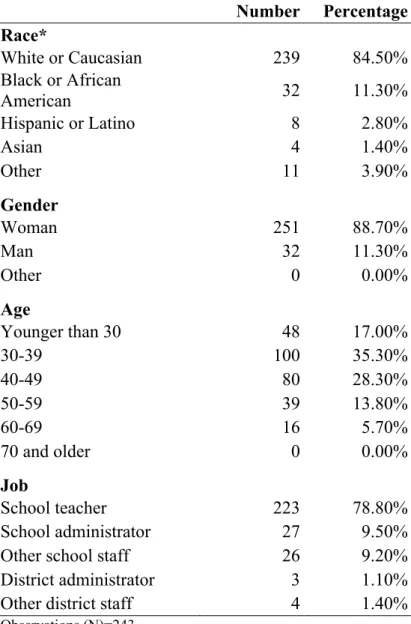
In this section I describe the descriptive and multivariate results of the survey experiment, beginning with an overview of the participants’ demographic characteristics and the scenarios to which they responded (see Table 1). Responses were dropped if the survey duration fell in the bottom fifth percentile, representing a completion time of 3.5 minutes or less, in order to remove cases in which the participants did not thoroughly consider the information presented. This resulted in a total 243 participants. The majority of participants in the sample were white (84.5%), female (88.7%), and in the 30-39 and 40-49 age brackets (35.3% and 28.3%
respectively). Most participants were employed as public school teachers (78.8%). The three key independent variables for the study (student race, student gender, and discretion level) were varied randomly among the participants and are thus divided fairly evenly across the discipline scenarios (Table 2). Given that all three key independent variables are binary, there are a total of eight possible experimental conditions. Of the data gathered, the smallest sample size for a single experimental condition was 84 while the largest was 123.
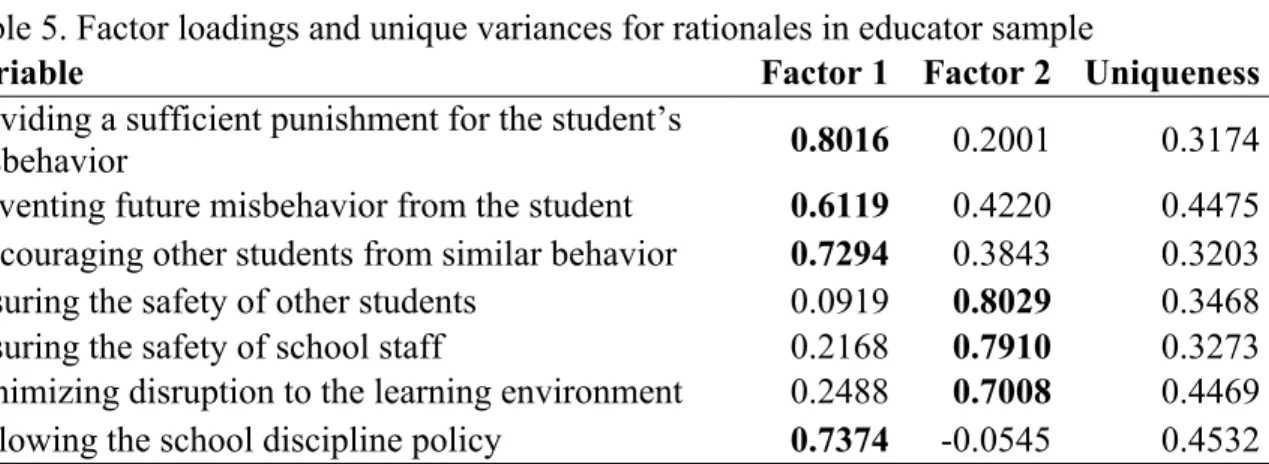
was detention (4.8%), followed by expulsion (12.4%). Out-of-school suspension was the most common disciplinary response (47.1%), followed by in-school suspension (27.0%). Participants’ ratings of the degree to which the seven rationales influenced their decision-making were fairly high (Table 4). On a scale of one to five, the average ratings fell between 3.56 and 4.15 across the six rationales, all noticeably higher than the 2.5 halfway point. Using participants’ ratings of these seven rationales, I conducted factor analysis in order to create a smaller number of
simplified variables for use in the regression analysis (Table 5). The factor analysis resulted in two dimensions of disciplinarity, which I term “authoritarianism” and “protectiveness.”
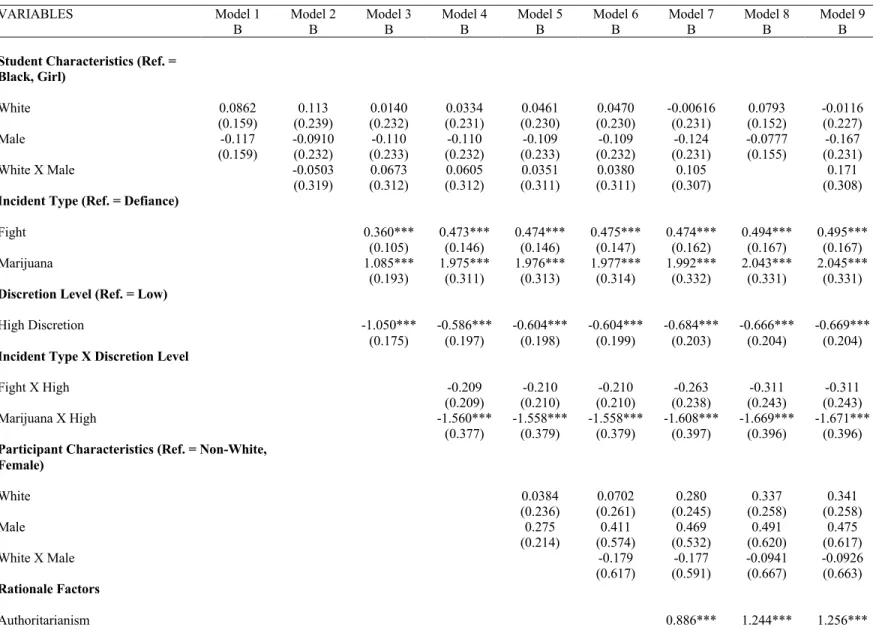
Multivariate ordered regression, clustered by participant, was conducted to assess the combined and interactive effects of race, gender, and discretion while also controlling for a variety of additional variables. The control variables for this study include the nature of the incident presented to the participant (Appendix C), the race and gender of the participant (Table 1), and the disciplinary factors created from the rationale responses (Table 5). The key dependent variable is the type of discipline recommended (detention, in-school suspension, out-of-school suspension, or expulsion), operationalized as an ordinal variable.
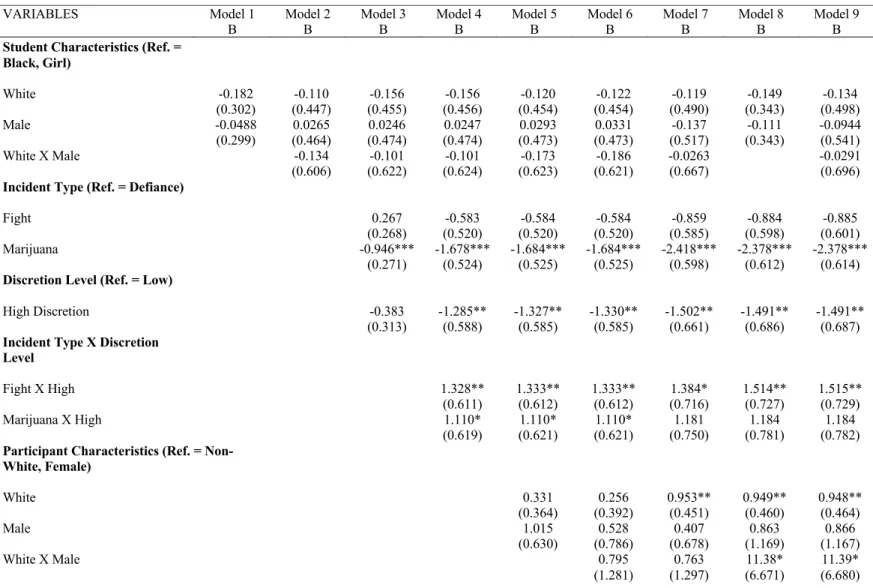
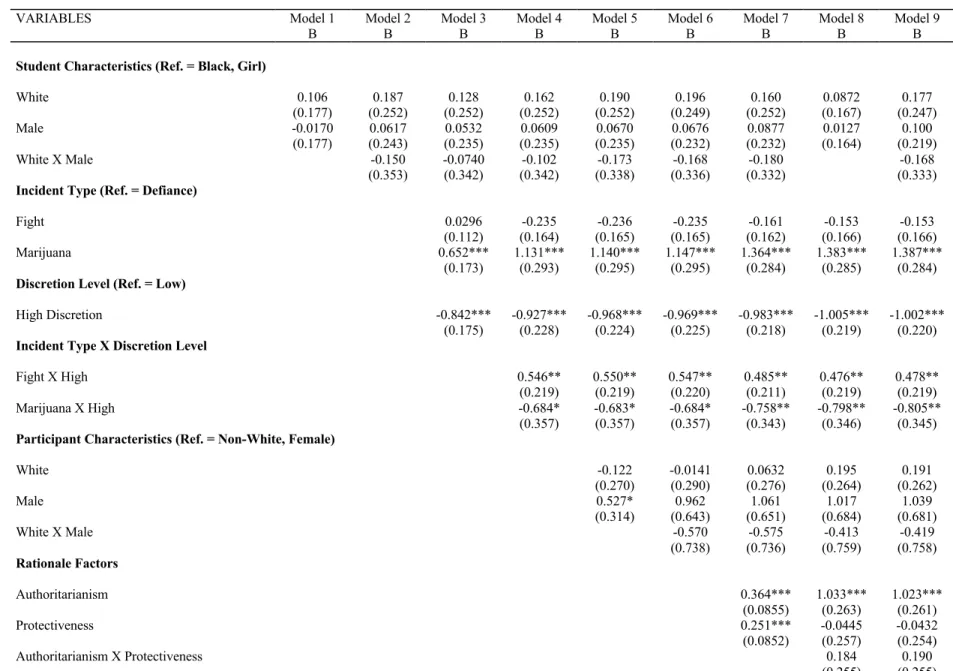
variables are all significant at the 0.01 level and are larger in magnitude than the effect of student race and gender (0.360 for a fightrelated incident, 1.085 for a marijuanarelated incident, and -1.050 for a high level of discretion). The variables for both the fight-related incident and the marijuana-related incident are positive compared to the defiance scenario, while high discretion has a negative effect on discipline severity. In Model 4, the incident type and discretion level are interacted. All three variables remain significant at the 0.01 level except for the interaction of the fight-related incident and high discretion. All three effects are fairly sizable in magnitude. For both Model 3 and Model 4, the effect of student race and gender remain insignificant and small in magnitude. In Model 5, variables are added for the race and gender of the participant, which are then interacted in Model 6. Neither variable, nor their interaction, are significant at the 0.1 level. When they are added to the model, the incident types and discretion levels that were significant in Model 4 remain significant, while student race and gender remain insignificant. Two factor variables for the six decision-making rationales are added to the analysis in Model 7. Authoritarianism is significant at the 0.01 level but protectiveness is not significant. In Model 8 and 9, the rationale factors are interacted with the race and gender of the participant and with each other. Model 8 includes student race and gender as independent variables while in Model 9 they are interacted. None of the interactions of the rationale factors with participant race and gender are significant, but the effect of authoritarianism remains significant in both models. Student race and gender fail to show statistical significance regardless of whether they are included as independent or as interacted variables.
Additional multivariate analyses were conducted using three additional
7), logistic regression predicting whether the student received exclusionary discipline (Table 8), and regression analysis of the number of days of suspension (Table 9). As with the previous analysis, student race and gender remain statistically insignificant in these additional
operationalizations of discipline severity.
analyses, none of these effects are statistically significant and, in fact, their values fall in contrast to those predicted by the hypotheses.
In sum, the results of multivariate regression analysis of these survey responses fail to confirm the study’s hypotheses. Considering that the sample for these analyses was collected by means of social media distribution, there exists the possibility that the null findings are due to the nature of the sample. Next, I provide an analysis of the results from the MTurk pretest survey in order to assess whether a sample of anonymous, non-educators produces different results.
Results from MTurk Pretest
Although the MTurk pretest was initially designed to assess the effectiveness of the survey itself, it presents a useful dataset for comparison in that a) the respondents were recruited from a very different source, b) the sample size is substantial, and c) the surveys distributed to the two groups were nearly the same. Two changes were made between the distribution of the pretest and the distribution of the survey to educators. First, I added a question to collect information about the participants’ jobs in their school district in order to assess the range of educational staff members present in the sample. Second, I thought to add a seventh rationale to assess the degree to which respondents felt compelled to adhere to the discipline policy that was given. Since these two survey questions were not included in the MTurk pretest, they are not available for analysis using this sample. As with the sample of educators, I dropped responses from participants whose response time was in the lowest fifth percentile, representing a
lacked sufficient power to run the models with third gender category as a variable. This left a sample size of 239 participants who responded to 717 scenarios.
As with the respondents in the educator sample, the participants in the MTurk sample were primarily white (78.2%) but they were fairly balanced on gender (42.3% men and 57.7% women) and were younger in age (38.5% were younger than 30 and 39.3% were between 30-39 years old) (Table 10). Across the study’s eight experimental conditions, the sample sizes were slightly smaller than in the educator sample, with 84 as the smallest sample size and 102 as the largest (Table 11). Descriptive results of the participants’ disciplinary recommendations (Table 12) show that participants were least likely to recommend no punishment (2.1%) followed by detention (8.4%) and expulsion (18%). The majority of the respondents recommended
suspension, with 23.2% of scenarios resulting in in-school suspension while 48.4% scenarios resulted in out-of-school suspension. Participants’ ratings of the importance of the six rationales (Table 13) ranged from an average of 3.66 for “ensuring the safety of staff” to an average of 4.09 for “discouraging other students from similar behavior.” As with the educator sample, I
conducted factor analysis in order to create a smaller number of simplified variables for use in the regression analysis (Table 14). Factor analysis resulted in one factor, which I term
“disciplinary zeal.”
In the first model of the analysis predicting disciplinary response (Table 15), the
independent variables are insignificant and their effects are fairly small in magnitude (0.151 for whiteness and 0.039 for masculinity). In Model 2, student race and gender are interacted. Their effects remain small in magnitude and insignificant. Model 3 includes variables for the incident type as well as the level of discretion. Both the fight-related effect and the marijuana-related effect are positive and significant at the 0.01 level compared to the excluded category which was the defiance-related incident. The effect of high discretion is also significant but has a negative relationship with discipline severity, suggesting high discretion tends to decrease the severity of participants’ recommended disciplinary responses. When the incident type and discretion level are interacted in Model 4, their effects remain significant except for the effect of high discretion in defiance-related incidents. The effects of student race and gender remain insignificant in both Models 3 and 4. Participant characteristics are added to the analysis in Models 5 and 6, first assessing their independent effects and then their interacted effects. When considered independently, the effect of masculinity is significant at the 0.05 level; however, when
considered as interacted variables, participant masculinity becomes insignificant. In Model 7, a factor variable for “disciplinary zeal” is added to the analysis. It is has a statistically significant, positive effect on discipline severity. In Model 8, disciplinary zeal is interacted with participant race and gender. Only the effects of disciplinary zeal for non-white women remains significant. Model 8 includes the full set of control variables with participant race and gender operating independently, while Model 9 assesses their interacted effects. Across all nine models, the effect of student race and gender on discipline severity remain insignificant.
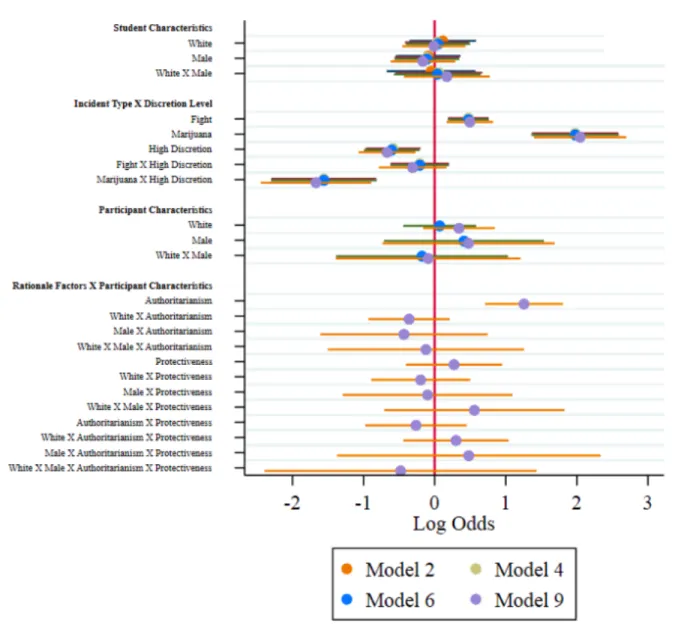
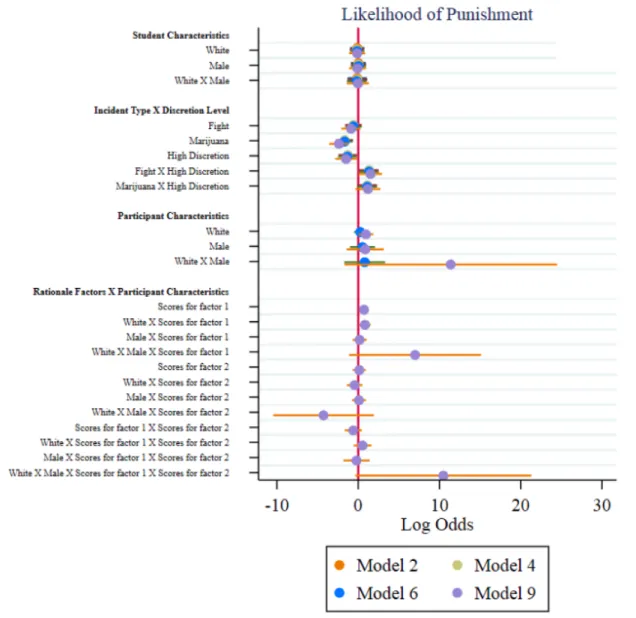
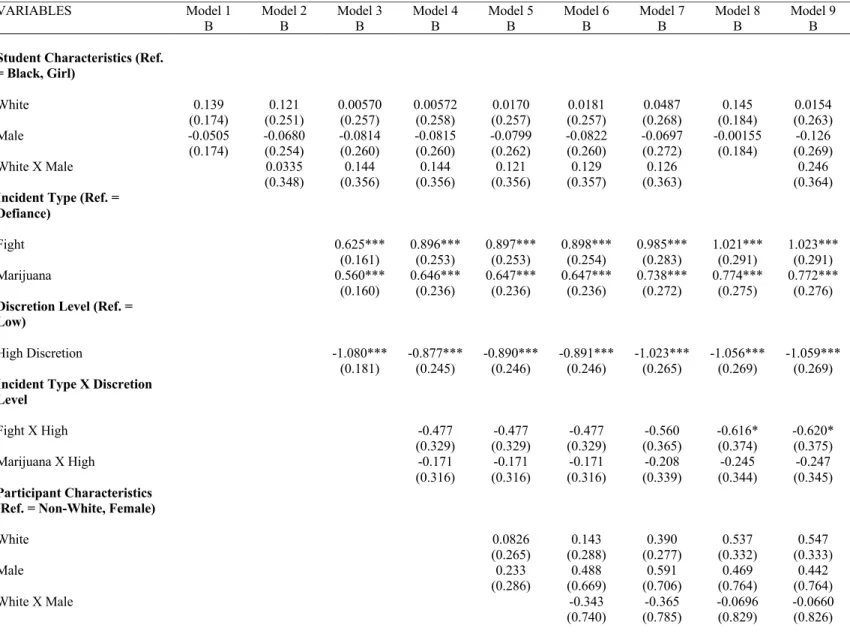
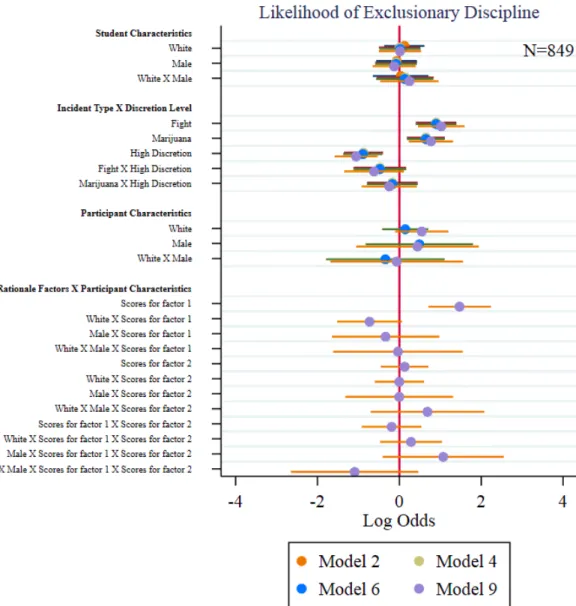
variables on other operationalizations of discipline severity. Student race and gender remain statistically insignificant in the analysis predicting days of suspension (Table 18). However, in the analyses predicting the likelihood of punishment (Table 16), black masculinity has a significant negative effect on the likelihood of punishment while white masculinity has a significant positive effect compared to black femininity. This suggests that being a white boy increases the likelihood of punishment while being a black boy decreases it. A similar trend is found in the regression predicting the likelihood of exclusionary discipline (Table 17): being a black boy seems to decrease a student’s likelihood of punishment while being a white boy seems to increase it. The effect sizes for models 2, 4, 6, and 9 across all four analyses are depicted in coefficient plots (Figures 5-8). While the results of the MTurk survey yield several instances in which student race and gender are significant, their relationship to discipline severity is in the opposite direction of that predicted by the hypotheses.
DISCUSSION
At first encounter, these findings seem to suggest that differential or discriminatory treatment does not explain the pronounced and persistent patterns of school discipline disparity across the United States (Losen and Gillespie 2012; Fabelo et al. 2011; Fenning and Rose 2007). After considering discipline severity in terms of the types of discipline recommended, the
likelihood of punishment, the likelihood of exclusionary discipline, and the number of days of suspension, my findings provide essentially no evidence for the discriminatory treatment of black students or the preferential treatment of white students. Instead, the data seem to suggest that participants recommended virtually the same degree of severity for black and white students. This finding is at odds with much of the existing literature on racial disparities in discipline. What do these findings tell us?
the ways they behave in an actual school context. I will review each of these explanations in further detail in the sections that follow.
Explanation One: Students are Truly Treated Equally
It is critical to scientifically consider all possible causes of school discipline disparity, turning one’s attention to the possibility that discriminatory decision-making may not play a part. As discussed in the literature review above, there is an enduring biological determinism
argument suggesting that black students are inherently more prone to deviant behavior, and it is thus their differential behavior instead of differential treatment that results in their higher rates of punishment (Skiba et al. 2002).
Previous research has documented only limited evidence for differential rates of
proportion of black students in the student body, regardless of students’ actual rates of misbehavior (Welch and Payne 2010; Rocque and Paternoster 2011). In short, quantitative evidence for racially disparate rates of misbehavior is overshadowed by more conclusive evidence of differential treatment. Ethnographic studies provide a more nuanced look into the comparative strength of the differential treatment and differential behavior hypotheses using data from researchers’ observations in school settings and their interviews with students and staff. These scholars find strong evidence for differential treatment, whereby school staff select black students for punishment at higher rates and afford them harsher punishments for the same behaviors white students portray (Ferguson 2000; Lewis and Diamond 2015; Morris 2016; Morris 2005).
Amidst this substantial evidence for differential disciplinary treatment, my finding that, when responding to survey vignettes, participants do not recommend harsher punishments for black students is perplexing. Next I assess the nature of the sample itself as a possible
explanation for the study’s null findings.
Explanation Two: These Aren’t the Racist Ones
homogenous (McPherson et al 2001); thus, it is probable that the study’s respondents, recruited by means of my personal Facebook page, Twitter feed, alumni networks, and friend networks, are more prone to anti-racist ideologies than the average American educator2. If so, one could
argue that, although Americans educators tend to make racially discriminatory discipline
recommendations, those weren’t the ones who were captured in my sample. In other words, one might argue, “these aren’t the racist ones.”
Arguably, the best evaluation of this explanation is done empirically with a comparison of the results from the social media and MTurk samples. If one were to argue that the null findings in the social media sample likely result from the non-prejudicial characteristics of the researcher’s personal networks, it would be unexpected to find the same null findings in a sample of MTurk participants who are presumably no less likely to be prejudiced than the average American. Previous research on MTurk survey-takers shows that, while MTurk participants do tend to be slightly younger and more educated than the average American, they are nevertheless more representative than other forms of convenience samples often used in social science experiments (Gaddis 2017; Berinsky, Huber, and Lenz 2012). In fact, when comparing demographics between this study’s educator sample and the MTurk sample, we find that the MTurk participants are on average younger and more racially diverse than the social media sample, and they include substantially more men among their ranks. Despite these differences, analysis of MTurk participants’ disciplinary recommendations are similar to the results of the educator sample in that they fail to show any statistically significant relationships with student race or gender occurring in a direction that would explain the discipline gap. Even this sample of anonymous, online strangers produces no evidence of discriminatory decision-making as a cause
of discipline disparity. Therefore, it seems unlikely that the null findings in the social media sample are due to these participants’ higher proclivity for anti-racist ideologies.
Next, I consider whether the null findings could be due to social desirability bias such that participants, regardless of any anti-racist leanings, knew to obscure their potentially prejudiced attitudes.
Explanation Three: They Knew the “Right” Answers
While the first explanation proposes that the sample of participants is the
underlying cause of the study’s unexpectedly null findings, this second explanation proposes that the participants, regardless of their political stances, would know it is not socially desirable to show preferential treatment of white students or discriminatory treatment of black students. This tendency could explain the divergence of my findings from the consistent patterns of racially discriminatory treatment that emerge from empirical studies (Skiba et al. 2002; Skiba et al. 2011; Skiba et al. 2014; Roque 2010).
When influenced by social desirability bias, research participants attempt to steer their answers toward those that demonstrate socially desirable traits and attitudes (Pager and Quillian 2005; Singleton and Straits 2018:598). In a conscious or unconscious effort to bolster their self-esteem or make a good impression, participants shape their responses to appear healthy, happy, mentally fit, and free of racial prejudice, even if doing so means departing from the truth (Pager and Quillian 2005; Singleton and Straits 2018:341)3. Split-ballot survey designs, such as that
used in the present study, are often used to avoid this form of bias, and are typically found effective (Pager and Quillian 2005). However, in the case of race-related studies, participants may notice that race has been signaled and therefore consciously or unconsciously adjust their behavior to mask any negative reaction they may have toward a black student or a positive reaction toward a white student.
The social desirability explanation is additionally meaningful given the nature of current American racial ideology. Since the late 1900s, a historical shift occurred whereby white
Americans began to disavow their earlier overt support for racial segregation and discrimination and to embrace, at least in principle, racial equality (Bonilla-Silva 2018; Omi and Winant 2014; Dixon 2017; Pager and Quillian 2005). As of the late 20th century and into today, a form of “new racism” has gained popularity that is more covert and sophisticated that previous overt forms of “old racism” (Bonilla-Silva 2018; Pager and Quillian 2005). As a result, it has become rare to find white Americans who voice support for previously popular forms of racial
discrimination and segregation, such that a number of questions were “retired” from national attitude surveys (Dixon 2017: 93). This rosy image is nevertheless confounded by the troubling endurance of racial inequality in American society in domains as far-reaching as education, housing, health, employment, politics, and the criminal justice system (Bonilla-Silva 2018; Wodtke 2016; Ioanide 2015; Sears et al 2000; Sears 1988; Omi and Winant 2014; Bobo 1988).
Political psychologists provide empirical support for this apparent contradiction, which these scholars term the “Principle-Implementation Gap” or the “Principle-Policy Paradox.” Results from attitudinal studies show that, although white survey respondents signal their support
for racial equality in principle, they oppose the policies that would be required for its implementation, (Dixon et al 2017; Wodtke 2016). Social psychologists come to similar conclusions, finding that although white Americans tend to renounce racially prejudiced principles in self-administered self-reports, they more readily express racial prejudice in other contexts (e.g. when the interviewer is also white or when a lie detector device is used).
Furthermore, studies reveal that even when participants are sincerely unaware of having racial prejudice, it nevertheless emerges in tests of implicit or unconscious racial bias (Sears et al 2000; Eberhardt 2005; Wodtke 2016; Ioanide 2015). Some examples from the field of social
psychology include experiments that used timed exercises to test for the relative accessibility of positive versus negative associations and experiments that assess participants’ subconscious cognition by tracking their eye movements (Sears et al 2000; Gilliam et al 2016). These various forms of implicit bias can operate in spite of consciously held attitudes and may persist in influencing behaviors (Pager and Quillian 2005). In short, while most white Americans comprehend that overt racism is not considered socially acceptable, they more readily demonstrate racial prejudice in studies that allow for its covert expression (Eberhardt 2005; Ioanide 2015).
In the field of sociology, this new form of racial ideology has been explained by the theories of “symbolic racism” (Sears 1988), “laissez-faire racism” (Bobo, Kluegel, and Smith 1997), and “colorblind racism” (Bonilla-Silva 2018). While these theories have important distinctions, all of them propose that in this new era, overt racism has essentially “gone underground.” Racism is now heard in different tones, emphasizing at times the values of
anti-black feeling with the finest and proudest of traditional American values”: hard work, individualism, and reward by merit. (1998:54). White Americans now use “code words” to explain what previously would have been overtly prejudiced viewpoints, using instead terms like “law and order,” “forced busing,” and “states’ rights” (Omi and Winant 2018: ch. 7-8). In short, scholars across the disciplines of sociology, psychology, and politics conclude that, in simple terms, “prejudiced people are not the only racists in America” (Wellman 1993:27). The recent shift to laissez-faire, symbolic, or color-blind racial ideologies has resulted in an American public that is highly aware that it is distasteful to be overtly racist, and has become highly skilled at the cloaked expression of their racially prejudiced ideals. In this context, it is all the more likely that social desirability would prompt participants to adjust their answers in a way that may produce this study’s puzzling null findings.
This explanation, in light of the literature, seems probable; however, it rests on the participants having deduced, consciously or subconsciously, the study’s intent to study racial trends in their responses despite the split-ballot design. The fourth explanation does not rest on this prerequisite, nor does it require any uniquely “non-prejudicial” characteristics of the sampled participants. Instead, the fourth explanation posits that it is the very nature of survey experiments, specifically in the case of racialized discipline-related decisions, that swayed participant responses from the way educators behave in real-world scenarios.
Explanation Four: Talking the Talk but Not Walking the Walk
believe they are responding as they would in an actual disciplinary incident; however, the very nature of hypothetical survey questions differs substantially from the actual disciplinary
decision-making context such that they react substantially differently. Pager and Quillian (2005) explain how vignette studies rest on the assumption that participants’ self-reported responses to hypothetical scenarios accurately mirror how they would behave in the actual situation. This is called attitude-behavior correspondence, and suggests that people’s behavior is a response to conscious thoughts and decisions. While some psychological studies find that conscious attitudes do in some ways influence behavior, others report zero or negative correlation between the two. There is enormous variation in the literature, and the relationship is far from clear-cut.
Survey vignette methodology was first developed for use in measuring racial attitudes in the 1970’s and has since been expanded upon for a broad variety of tests of racial discrimination (Pager and Quillian 2005). Survey experiments have been used to provide evidence for
discriminatory decision-making in the realms of hiring decisions (Pager 2003; Gaddis 2015), housing selection (Flage 2018; Gaddis and Ghoshal 2015), and student exceptionality testing (Fish 2016), several of which were reviewed in this study’s research methods section. In these three cases, participants’ hypothetical reactions to fictional vignettes appear to provide evidence for the types of racially discriminatory incidents that play out in the “real world.” Meanwhile, alongside these types of decision-making contexts is another set of contexts that don’t seem to align as closely with the empirically demonstrated patterns of disparities.