Potyviral Silencing Suppressor Are Not Due to
Misregulation of
AUXIN RESPONSE FACTOR 8
1[OPEN]
Sizolwenkosi Mlotshwa2, Gail J. Pruss, John L. MacArthur, Jason W. Reed, and Vicki Vance*
Department of Biological Sciences, University of South Carolina, Columbia, South Carolina 29208 (S.M., G.J.P., J.L.M., V.V.); and Department of Biology, University of North Carolina, Chapel Hill, North Carolina 27599 (J.W.R.)
ORCID IDs: 0000-0002-2973-2489 (S.M.); 0000-0001-7508-9714 (J.W.R.).
Plant viral suppressors of RNA silencing induce developmental defects similar to those caused by mutations in genes involved in the microRNA pathway. A recent report has attributed viral suppressor-mediated developmental defects to up-regulation of AUXIN RESPONSE FACTOR 8 (ARF8), a target of miR167. The key piece of evidence was that the developmental defects in transgenic Arabidopsis (Arabidopsis thaliana) expressing viral suppressors were greatly alleviated in the F1 progeny of a cross with plants carrying the arf8-6 mutation. Arf8-6is a SALK line T-DNA insertion mutant, a class of mutations prone to inducing transcriptional silencing of transgenes expressed from the 35S promoter. We have reinvestigated the role of ARF8 in viral suppressor-mediated developmental defects, using two independentarf8mutations and the P1/HC-Pro potyviral suppressor of silencing. Progeny of a cross betweenP1/HC-Protransgenic Arabidopsis and thearf8-6T-DNA insertion mutant showed little effect on the P1/HC-Pro phenotype in the F1 generation, but almost allarf8-6/P1/HC-Proprogeny had lost the phenotype in the F2 generation. However, the loss of phenotype in the F2 generation was not correlated with the number of functional copies of the ARF8gene. Instead, it reflected transcriptional silencing of theP1/HC-Protransgene, as evidenced by a pronounced decrease in P1/ HC-Pro mRNA and the appearance of 35S promoter small interfering RNAs. Furthermore, an independent loss-of-function point mutation,Arf8-8, had no detectable effects on P1/HC-Pro phenotype in either the F1 or F2 generations. Together, these data argue against the previously reported role of increasedARF8expression in developmental defects caused byP1/HC-Pro.
Eukaryotes have evolved an elaborate network of RNA silencing pathways mediated by small regulatory RNAs (for review, see Axtell et al. [2011] and Borges and Martienssen [2015]). These pathways play two major roles in plants. One is to regulate expression of endogenous genes, and the other is to defend against invading nucleic acids, such as viruses, transposons, and—more recently—transgenes. MicroRNAs (miR-NAs) are the small RNAs involved in regulation of endogenous genes and play an important role in de-velopment, while small interfering RNAs (siRNAs) function in defense against invading nucleic acids. Both of these classes of small RNA are produced by RNase
III-like ribonucleases called DICER-LIKE (DCL) in plants; however, miRNAs and siRNAs differ not only in function but also in biogenesis. In Arabidopsis, DCL1 processes miRNAs from endogenous, imperfectly double-stranded transcripts to produce a duplex con-taining the miRNA and the opposite strand, the miRNA*. In contrast, siRNAs are processed by DCL2, DCL3, or DCL4 from the usually perfectly dsRNA that triggers the defensive arm of RNA silencing. MiRNA and siRNA duplexes are methylated by HUA EN-HANCER1 (HEN1), and one strand incorporates into an RNA-induced silencing complex to guide the Argonaute silencing effector proteins to complemen-tary target sequences. Thus, partially overlapping bio-synthetic pathways lead to two classes of small RNAs with distinct functions.
To counteract antiviral silencing, many plant viruses have evolved proteins that suppress RNA silencing. It was noted early on that transgenic plants expressing P1/HC-Pro, thefirst discovered plant viral suppressor of silencing (Anandalakshmi et al., 1998; Kasschau and Carrington, 1998), exhibited pronounced developmental abnormalities (Anandalakshmi et al., 2000) in addition to being sup-pressed for silencing. These developmental defects were
first observed in tobacco (Anandalakshmi et al., 2000; Mallory et al., 2002a) but were subsequently characterized in greater detail in Arabidopsis (Arabidopsis thaliana; Kasschau et al., 2003; Chapman et al., 2004; Mlotshwa et al., 2005). In Arabidopsis, P1/HC-Pro-mediated
1This work was supported by the National Science Foundation
(IOS-1029803 to V.V. and IOS-1147045 to J.W.R.).
2Present address: Department of Molecular Genetics, The Ohio
State University, Columbus, OH 43210.
* Address correspondence to [email protected].
The author responsible for distribution of materials integral to the findings presented in this article in accordance with the policy de-scribed in the Instructions for Authors (www.plantphysiol.org) is: Vicki Vance ([email protected]).
V.V. conceived the project and supervised the experiments per-formed by S.M.; S.M. perper-formed most of the experiments; J.L.M. pro-vided technical assistance to S.M.; S.M. and G.J.P. analyzed the data; J.W.R. designed and performed thearf8-8mutant phenotypic analysis; G.J.P. wrote the article with contributions from S.M., J.W.R., and V.V.
[OPEN]
Articles can be viewed without a subscription. www.plantphysiol.org/cgi/doi/10.1104/pp.16.01030
developmental defects include reduced size, serrated leaves, lateflowering, and abnormalities in floral mor-phology resulting in reduced fertility. Some of these de-velopmental abnormalities resemble ones caused by mutations in genes involved in plant miRNA biogenesis and function. In addition, P1/HC-Pro transgenic lines display clear defects in both the biogenesis and function of miRNAs. MiRNAs are present at higher levels in the P1/HC-Prolines, but the usually labile miRNA* also ac-cumulates (Mallory et al., 2002b; Chapman et al., 2004). In addition, although miRNA levels are generally increased, so are their mRNA targets, suggesting a reduction in miRNA function (Kasschau et al., 2003; Chapman et al., 2004). This correlation of developmental defects with defects in the miRNA pathway led to the logical idea that the abnormalities in morphology are caused by interfer-ence with miRNA control of developmental pathways (Kasschau et al., 2003; Chapman et al., 2004).
Following up on this idea, a subsequent study in-vestigated the possibility that ectopic overexpression of DCL1, which encodes the Dicer that produces miRNAs in plants, might rescue the defects in the miRNA pathway and thereby alleviate the developmental ab-normalities inP1/HC-Protransgenic Arabidopsis. Sur-prisingly, although overexpression ofDCL1did largely alleviate the developmental defects, it did not correct the P1/HC-Pro-associated defects in the miRNA path-way: Levels of miRNAs and their targets were un-changed from those seen in the parentalP1/HC-Proline (Mlotshwa et al., 2005). These data indicate that P1/ HC-Pro-mediated defects in development do not result from general impairments in miRNA biogenesis or function. However, because only a few miRNAs and their targets were examined, the study could not rule out the possibility that the developmental defects were due to interference with one or a small set of miRNA-controlled genes. Consistent with that idea, it was later reported that the developmental defects inP1/HC-Pro transgenic plants are due to up-regulation of AUXIN RESPONSE FACTOR 8(ARF8), a target of miR167 that plays a key role in auxin signaling and developmental patterning (Jay et al., 2011).
We were interested in further investigating the role of ARF8 in P1/HC-Pro-mediated developmental defects because the conclusion that up-regulation ofARF8 is re-sponsible for the defects is in conflict with the earlier work on the effect of overexpression ofDCL1on P1/HC-Pro phenotype (Mlotshwa et al., 2005). Importantly, one of the miRNA and target pairs looked at in Mlotshwa et al. (2005) was miR167 and its target,ARF8. Increased accu-mulation of ARF8 mRNA was unaffected by over-expression ofDCL1inP1/HC-Proplants, even though the P1/HC-Pro developmental phenotype was largely elimi-nated. Moreover, the developmental phenotypes ofP1/ HC-Pro-expressing plants differ from those caused by mutation of themiR167target site in ARF8 or the re-dundantly actingARF6.P1/HC-Pro-expressing plants have narrow serrated leaves, narrow sepals and petals, and short stamen filaments (Kasschau et al., 2003; Chapman et al., 2004; Mlotshwa et al., 2005). In
contrast,mARF8ormARF6plants with mutatedmiR167 target sites do not have serrated leaves or narrowflower organ but do have elongated stamen filaments and swollen (indehiscent) anthers and are also female sterile due to arrested ovule integument growth (Wu et al., 2006). Based on those results, up-regulation of ARF8 would not appear to be correlated with or responsible for P1/HC-Pro-mediated developmental defects. To re-solve these apparent discrepancies, therefore, we further characterized the effects ofarf8mutations on the P1/HC-Pro phenotype using the same mutation as in the published work (Jay et al., 2011) as well as a second, in-dependent mutation. Our results argue against the pre-viously reported role of increased ARF8 expression in developmental defects caused byP1/HC-Pro.
RESULTS
The P1/HC-Pro Developmental Phenotype Is Largely Retained in the F1 Generation of a Cross with thearf8-6 T-DNA Insertion Mutant
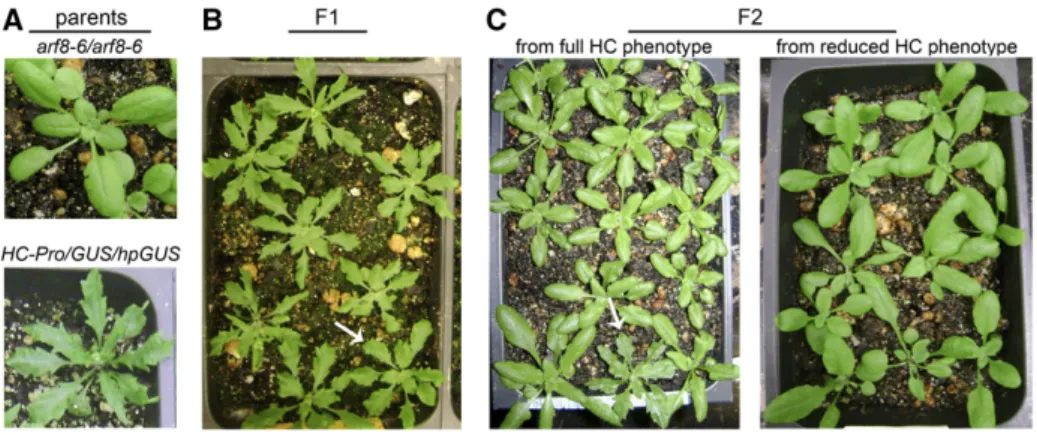
Developmental defects in a P1/HC-Pro transgenic Arabidopsis line were reported to be greatly alleviated in the F1 progeny of a cross with plants carrying the arf8-6 mutation (Jay et al., 2011). To try to reproduce that result, we used the samearf8-6SALK line as in that study and crossed it to our established P1/HC-Pro transgenic Arabidopsis line (Mlotshwa et al., 2005, 2008; Endres et al., 2010). TheP1/HC-Proline is hemi-zygous for the turnip mosaic virus coding region, expresses high levels of theP1/HC-PromRNA, and has a severe developmental phenotype (Mlotshwa et al., 2005; Fig. 1). In the F1 generation, about half (124/238) of the progeny of the cross had the P1/HC-Pro phe-notype, while about half (114/238) did not. Genotyping 69 of the nonphenotypic plants revealed that none had theP1/HC-Protransgene, and all but three had thearf8-6 mutation, indicating that absence of P1/HC-Pro pheno-type in the F1 progeny population did not reflect any effect of thearf8-6mutation but simply reflected absence of the P1/HC-Pro transgene. Among 71 F1 plants
con-firmed to be both hemizygous forP1/HC-Proand hetero-zygous for arf8-6, all had the P1/HC-Pro phenotype. Thus, in our system, hemizygousarf8-6does not cause widespread, strong reduction in P1/HC-Pro phenotype in the F1 generation. A minority of our P1/HC-Pro phenotypic F1 progeny, however, showed a subtle re-duction in developmental abnormalities (Fig. 1, F1), suggesting that effects of thearf8-6mutation might be better detected in the F2 generation of the cross.
The P1/HC-Pro Phenotype Is Largely Lost in the F2 Generation of thearf8-6Cross, But the Loss Is Independent of Whether thearf8-6Mutation Is Hemizygous or Homozygous
when plants are homozygous rather than hemizygous for the mutation, we examined the phenotypes of the F2 progeny of the cross (after self-pollination of the F1 plants). Progeny of the slightly reduced P1/HC-Pro phenotypic F1 plants had completely lost the pheno-type in the F2 generation (Fig. 1, F2), whether plants were hemizygous or homozygous forarf8-6. P1/HC-Pro phenotypic progeny obtained from the slightly re-duced P1/HC-Pro phenotype F1 plants all lacked the arf8-6T-DNA insertion. Thus, although complete loss of P1/HC-Pro phenotype occurred in this population of the F2 progeny of thearf8-6cross, the loss did not require that arf8-6be homozygous. The P1/HC-Pro phenotype was also lost in the F2 progeny of the fully P1/HC-Pro phe-notypic F1 plants but was not total in this case (Fig. 1, F2). Only about 25% (67/271) of this F2 population had a P1/ HC-Pro phenotype, and most (50/67) had a reduced phenotype. All of these reduced P1/HC-Pro phenotype plants hadarf8-6, but only 11 out of the 50 were homo-zygous for the mutation. Thus, progressive loss of P1/ HC-Pro phenotype occurred in successive generations of thearf8-6cross but was independent of whether thearf8-6 mutation was hemizygous or homozygous. Of the 17 fully P1/HC-Pro phenotypic plants obtained in this F2 population, 10 had the arf8-6 mutation. Two of the 10 were homozygous forarf8-6, showing that the full P1/ HC-Pro phenotype can occur even in the complete ab-sence ofARF8expression.
Altogether, our results suggest that some mechanism other than reducedARF8expression is responsible for alleviation and loss of P1/HC-Pro phenotype in plants carrying thearf8-6mutation. Because the arf8-6 muta-tion is a SALK line T-DNA insermuta-tion mutamuta-tion, one likely candidate is transcriptional silencing induced by the T-DNA. The T-DNAs used to generate SALK lines and several other T-DNA insertion lines carry an
extraneous cauliflower mosaic virus 35S promoter that is known to transcriptionally silence 35S promoter-driven transgenes elsewhere in the plant genome (Daxinger et al., 2008).
Such unexpected silencing effects can generate mis-leading results, especially in studies involving viral suppressors of silencing, because such suppressors are not effective against transcriptional silencing. The P1/ HC-Protransgene in our lines and the one in the work of Jay et al. (2011) are both expressed from the 35S pro-moter. Therefore, one likely possibility is that tran-scriptional silencing is the mechanism responsible for alleviation and loss of P1/HC-Pro phenotype in plants also carrying thearf8-6mutation.
Indications of 35S Promoter-Induced Transcriptional Silencing Are Evident in the Reduced P1/HC-Pro Phenotype F1 Progeny of thearf8-6Cross
To see whether transcriptional silencing of 35S promoter-driven transgenes was occurring in ourarf8-6 mutant plants, we performed RNA gel blot analysis of high and lowMrRNA isolated from F1 and F2 progeny
of the arf8-6 cross. For the purpose of the molecular analysis, theP1/HC-Proline we used for the cross con-tained two additional transgenes that provide an assay for silencing suppression (Mlotshwa et al., 2008). These additional loci are a senseuidAtransgene (GUS) encod-ing b-glucuronidase and a hairpin transgene (hpGUS) that posttranscriptionally silences theGUSlocus (Béclin et al., 2002). Expression of each of the three transgenes in thisP1/HC-Proline is under the control of the cauliflower mosaic virus 35S promoter. ThehpGUSandGUS trans-genes function not only as reporters for suppression of posttranscriptional silencing by P1/HC-Pro, but also as additional indicators of transcriptional silencing because
Figure 1.The P1/HC-Pro phenotype is largely retained in the F1 but lost in the F2 generation of a cross with thearf8-6mutant.
each is expressed from a 35S promoter. On their own, however, these two transgenes do not induce transcrip-tional silencing (Béclin et al., 2002; Mlotshwa et al., 2008). For the RNA gel blot analysis, we examined RNA from plants that hadP1/HC-Pro, thearf8-6mutation, as well as both thehpGUSandGUStransgenes. In the F1 progeny of the cross, 50 plants were heterozygous for thearf8-6mutation and contained all three of the other transgenes. Of these, 38 plants retained the full P1/HC-Pro phenotype, while 12 showed a slight reduction in the phenotype. RNA gel blot analysis shows that fully P1/HC-Pro phenotypic arf8-6 plants have the same levels as theP1/HC-Proparent for all high and lowMr
RNA species examined (Fig. 2, lanes 1–6):P1/HC-Prois expressed at about the same level and suppresses posttranscriptional silencing equally well, as indicated by the highly increased accumulation of GUS and hpGUS mRNA compared to the non-P1/HC-Pro con-trols (Fig. 2, compare lanes 1–6 with lanes 15–19). The GUSlocus gives rise to a transcript that is slightly lon-ger than the full-lengthhpGUStranscript; however, a prominent high MrhpGUS RNA species that also
ac-cumulates corresponds to the loop of the hairpin (Mlotshwa et al., 2008). With respect to lowMrRNA
species, the fully P1/HC-Pro phenotypicarf8-6plants and the P1/HC-Pro parent show the same increased accumulation of miRNAs and of primary siRNAs, which are the siRNAs from the stem of the hpGUS transcript (Fig. 2, compare lanes 1–6 with lanes 15–19). Although the difference in phenotype between F1 progeny having the full P1/HC-Pro phenotype and
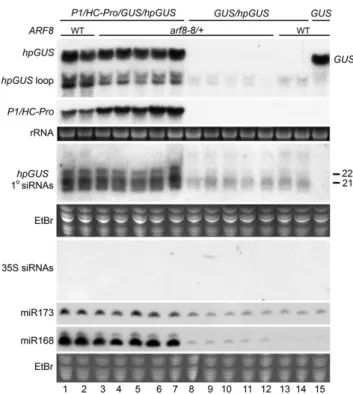
those having a slightly reduced phenotype is quite subtle, the difference in the RNA data of these two groups is very striking. The RNA data for the slightly reduced phenotype plants present a very complicated picture because transcriptional silencing and P1/HC-Pro suppression of posttranscriptional silencing both appear to be occurring to some degree. 35S promoter siRNAs are associated with transcriptional silencing induced by T-DNA insertion mutants (Mlotshwa et al., 2010), providing a good indicator for 35S promoter homology-dependent transcriptional silencing. 35S siRNAs were not evident in any of the fully P1/HC-Pro phenotypic arf8-6 F1 plants (Fig. 2, lanes 3–6) or in plants that lacked the arf8-6 mutation (Fig. 2, lanes 1 and 2 with lanes 18 and 19). In contrast, we detected 35S promoter siRNAs in RNA from all of the slightly reduced P1/HC-Pro phenotype arf8-6 F1 plants assayed (Fig. 2, lanes 7–14), indicating that transcrip-tional silencing had begun in this population. Consis-tent with the very subtle reduction in phenotype, however, accumulation of P1/HC-Pro mRNA appears unaffected (Fig. 2, compare lanes 7–14 with lanes 1–6). In contrast, accumulation ofGUSandhpGUSmRNA as well as primary siRNAs from hpGUS is much lower than in the fully P1/HC-Pro phenotypic plants (Fig. 2, compare lanes 7–14 to lanes 3–6), although still higher in some cases than in plants lackingP1/HC-Pro(Fig. 2, compare lanes 7–14 to 15–19). Thus, despite the onset of transcriptional silencing, P1/HC-Pro suppression of posttranscriptional silencing appears to be occurring in at least some of the mildly reduced phenotype F1
Figure 2.Transcriptional silencing is
evi-dent in F1 progeny of thearf8-6cross that have a reduced P1/HC-Pro phenotype. Accumulation of high and low molecular weight RNA from parental and F1 progeny plants having the indicated genotypes and phenotypes was determined using RNA gel blot analysis. RNA from theGUSline was included as a control to show the position of theGUStranscript. Grouped lanes are all from the same gel. The high molecular weight blot was hybridized with a probe forGUSand hpGUS, then stripped and probed forP1/HC-Pro. Two separate low molecular weight (LMW) RNA gels were run. One LMW blot was probed forhpGUS
progeny. P1/HC-Pro activity in the mildly reduced phenotype F1 progeny is more clearly demonstrated by the increased miRNA accumulation in those plants compared to plants without P1/HC-Pro (Fig. 2, com-pare lanes 7–14 to lanes 15–19). Indeed, miRNA accu-mulation in the mildly reduced phenotype F1 progeny appears comparable to that in fully P1/HC-Pro phe-notypic plants (Fig. 2, compare lanes 7–14 to lanes 1–6). Thus, the P1/HC-Pro/arf8-6 F1 plants are a mixed population. Most are completely normal for transgene expression and P1/HC-Pro activity, but some have started to transcriptionally silence 35S promoter-driven transgenes. It is interesting to note that 35S promoter-induced transcriptional silencing appears to have star-ted even inarf8-6progeny that do not have theP1/HC-Pro transgene: 35S promoter siRNAs are very faintly detect-able in RNA from two of the threearf8-6/GUS/hpGUS plants we analyzed (Fig. 2, compare lanes 15 and 16 with lanes 18 and 19).
35S Promoter-Induced Transcriptional Silencing Is Widespread and Well Developed in the F2 Progeny of thearf8-6Cross
RNA gel blot analysis of the F2 progeny of thearf8-6 cross confirms that transcriptional silencing of 35S promoter-driven transgenes is occurring, even in the absence of the P1/HC-Pro transgene. All three of the
arf8-62/2/GUS/hpGUS plants analyzed are transcrip-tionally silenced for the GUS and hpGUS transgenes. These plants show high levels of 35S siRNAs and have no detectableGUSandhpGUSmRNA or primary siR-NAs fromhpGUS, in contrast toGUS/hpGUScontrols lacking arf8-6 (Fig. 3, compare lanes 15–17 with lanes 18 and 19). Similarly, P1/HC-Pro/arf8-62/2/GUS/ hpGUSF2 plants that have completely lost the P1/HC-Pro phenotype are clearly transcriptionally silenced for P1/HC-Pro as well as for the GUS and hpGUS trans-genes. These plants have easily detectable levels of 35S siRNAs and accumulate little or no P1/HC-Pro mRNA and no GUS and hpGUS mRNA or primary siRNAs fromhpGUS, compared toP1/HC-Procontrols lacking the arf8-6 mutation (Fig. 3, compare lanes 7–14 with lanes 1 and 2). Surprisingly, however, miR168 accu-mulation is elevated compared to nonP1/HC-Pro con-trols (Fig. 3, compare lanes 7–14 with lanes 15–19).
As discussed above, some P1/HC-Pro/arf8-62/2 F2 plants had a P1/HC-Pro phenotype (Fig. 1, F2). Most of these had a reduced phenotype, but a few had the full P1/HC-Pro phenotype. RNA gel blot analysis shows that 35S promoter-induced transcriptional si-lencing had started in the reduced phenotype plants, as evidenced by the presence of 35S siRNAs as well as re-duced levels ofP1/HC-Pro,GUS, andhpGUSmRNA and hpGUS primary siRNAs (Fig. 3, compare lanes 3 and 4 with lanes 1 and 2). In contrast, 35S promoter-induced
Figure 3. Transcriptional silencing is
wide-spread in the F2 progeny of thearf8-6cross. Accumulation of high and low molecular weight RNA from the original parental lines and from F2 progeny having the indicated genotypes and F1 parental phenotypes was determined using RNA gel blot analysis. RNA from theGUSline was included as a control to show the position of theGUS transcript. Grouped lanes are all from the same gel. Two high molecular weight (HMW) RNA gels were run. One HMW blot was hybridized with a probe forGUS
andhpGUS, while the other was probed for
P1/HC-Pro. Two LMW RNA gels were run. One LMW blot was probed for hpGUS
transcriptional silencing does not appear to have started in the fewP1/HC-Pro/arf8-62/2F2 plants that still have the full P1/HC-Pro phenotype. These plants look iden-tical to theP1/HC-Proparent for all high and low Mr RNA species examined (Fig. 3, compare lanes 5 and 6 with lanes 1 and 2). Thus, 35S promoter-induced transcriptional silencing appears well established in the vast majority of F2 progeny of the arf8-6 cross, sup-porting our hypothesis that transcriptional silencing is the mechanism responsible for loss of P1/HC-Pro phe-notype inP1/HC-Pro/arf8-6plants. The fewP1/HC-Pro/
arf8-6 plants that retain some degree of P1/HC-Pro phenotype are ones in which transcriptional silencing has not yet been completely established.
Thearf8-8Loss-of-Function Point Mutation Does Not Alleviate P1/HC-Pro-Mediated Developmental Defects
To test further whether loss ofARF8function can al-leviate the P1/HC-Pro phenotype, we used the arf8-8 mutant line, which has a point mutation at the junction of thefifth intron and sixth exon ofARF8(Reeves et al.,
Figure 4.Comparison ofarf8-3andarf8-8
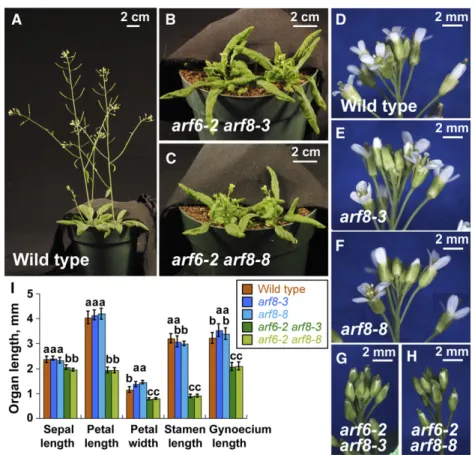
devel-opmental phenotypes. A to C, 5-week-old wild-type,arf6-2 arf8-3andarf6-2 arf8-8plants. D to H, Inflorescence apices of 5-week-old plants of in-dicated genotypes. D, E, and F were each assem-bled from multiple overlapping photographs. I, Measurements of floral organ lengths and petal widths of mature flowers of each genotype. Data are means6SD(n= 13–18 flowers). In I, letters above each bar indicate values that were not sta-tistically distinguishable by ANOVA atP,0.05 based on Tukey’s HSD statistic, calculated within each measurement class. As ARF6 and ARF8 act redundantly, thearf6-2background exposes the full phenotypic effects of thearf8mutations.
Figure 5.Thearf8-8mutation has no effect on the
2012). Based on phenotype, thearf8-8mutation appears indistinguishable from the loss-of-function T-DNA in-sertion mutation arf8-3. However, because ARF8 acts partially redundantly withARF6, the loss of function of ARF8alone has only a subtle effect, whereas thearf8 arf6 double mutant is profoundly affected (Nagpal et al., 2005). Figure 4 shows that thearf8-8andarf8-3mutations have indistinguishable mild effects on vegetative and
flower growth phenotypes (Fig. 4I; and compare Fig. 4, E and F, with D). In addition, thearf8-8mutation in com-bination with thearf6-2loss-of-function mutation causes the same strong phenotype as thearf8-3 arf6-2 double mutant (Fig. 4I; and compare Fig. 4, B and C, with A and Fig. 4, G and H, with D). Thus,arf8-8 appears pheno-typically as a null allele. We crossed our P1/HC-Pro/ GUS/hpGUSline to thearf8-8mutant line and examined the phenotypes of the F1 progeny. There were two classes of phenotype: P1/HC-Pro and wild type. All of the F1 progeny we obtained that hadP1/HC-Proin the heterozygous arf8-8 background retained the distinc-tive P1/HC-Pro phenotype (Fig. 5, F1). None of the
nonphenotypic plants had theP1/HC-Protransgene, and none of the P1/HC-Pro heterozygous arf8-8 plants showed any reduction in P1/HC-Pro phenotype. The P1/HC-Pro phenotype was also retained in the F2 generation of the cross, whether plants were homozy-gous or heterozyhomozy-gous for thearf8-8mutation (Fig. 5, F2).
Thearf8-8Loss-of-Function Point Mutation Does Not Affect P1/HC-Pro Function
Because P1/HC-Pro phenotype was unaffected by thearf8-8mutation (Fig. 5), we expected that molecular measures of P1/HC-Pro function would also be unaf-fected. RNA gel blot analysis of high and lowMrRNA isolated from F1 and F2 progeny of the arf8-8 cross support that expectation. P1/HC-Pro plants hemizy-gous (Fig. 6) or homozyhemizy-gous (Fig. 7) for arf8-8 look nearly identical to theP1/HC-Proparent for all high and lowMrRNA species examined (Fig. 6, compare lanes 3–7 with lanes 1 and 2; Fig. 7, compare lanes 3–6 with
Figure 6. Thearf8-8mutation has no effect on molecular measures of
P1/HC-Pro function in the F1 generation of a cross to ourP1/HC-Pro
line. Accumulation of high and low molecular weight RNA from pa-rental and F1 progeny plants having the indicated genotypes was de-termined using RNA gel blot analysis. RNA from theGUSline was included as a control to show the position of the GUStranscript. Grouped lanes are all from the same gel. The HMW blot was hybridized with a probe forGUSandhpGUS, then stripped and probed for
P1/HC-Pro. Two separate LMW RNA gels were run. One LMW blot was probed forhpGUSprimary siRNAs, while the other was probed for 35S siRNAs, then successively stripped and probed for the indicated miRNAs. Ethidium bromide (EtBr)-stained rRNA and the major RNA species in LMW RNA are shown as loading controls.
Figure 7. The arf8-8 mutation has no effect on molecular measures of
P1/HC-Pro function in the F2 generation of a cross to ourP1/HC-Pro
lanes 1 and 2). P1/HC-Pro suppresses the hpGUS transgene-induced silencing in these plants, as indi-cated by the highly increased accumulation ofGUSand hpGUS mRNA and mediates increased accumulation of miRNAs and hpGUS primary siRNAs compared to the non-P1/HC-Procontrols (Fig. 6, compare lanes 3–7 and 1 and 2 with lanes 8–14; Fig. 7, compare lanes 3–6 and 1 and 2 with lanes 7–12). Thus, reduced levels of functional ARF8 in the absence of 35S promoter-induced transcriptional silencing affect neither P1/ HC-Pro phenotype nor molecular measures of P1/HC-Pro function.
DISCUSSION
Our results clearly show that ARF8 is not the key factor responsible for developmental defects in Arabi-dopsis expressing a turnip mosaic virus P1/HC-Pro transgene. Moderate up-regulation ofARF8was origi-nally reported to underlie developmental defects in Arabidopsis induced by P1/HC-Pro and two other vi-ral suppressors of silencing (Jay et al., 2011). The iden-tification ofARF8as a candidate for this role came from determining what miRNA targets are upregulated in common in Arabidopsis expressing any one of the viral suppressors, P1/HC-Pro, P19, and P15, as well as in Arabidopsis hen1-1 and dcl1-9 mutants. The up-regulation in all cases was about 1.5- to 2-fold, suggesting that loss of just one copy ofARF8would greatly reduce or eliminate the developmental defects caused by the viral suppressors. Alleviation of the de-velopmental defects by one copy of the arf8-6 SALK insertion mutation was then taken as evidence that misregulation ofARF8 was the key factor underlying viral suppressor-mediated developmental anomalies.
We were led to question the conclusions of the Voinnet group (Jay et al., 2011) for three reasons. The
first was our prior work, which showed no correlation between P1/HC-Pro phenotype andARF8 expression (Mlotshwa et al., 2005). The second reason was a par-adoxical result presented in the gel blot analysis of RNA isolated from P1/HC-Proplants that carried thearf8-6 mutation and a hairpin transgene that targets the gene encoding chalcone synthase (CHS; Jay et al., 2011; Fig. 5E). The paradoxical result was that the gel blot analysis in Figure 5E showed a total absence ofCHSsiRNAs in those plants, although Figure 5E also presented evi-dence that P1/HC-Pro was suppressing the hairpin transgene-induced posttranscriptional silencing. It has been well established, however, that primary siRNAs, such as those that would derive from the stem of a hairpin transgene, are not eliminated in P1/HC-Pro suppression of silencing (Johansen and Carrington, 2001; Mlotshwa et al., 2008; Zhang et al., 2008; Endres et al., 2010). Therefore,CHSsiRNAs should have been present if P1/HC-Pro suppression of silencing was truly occurring, and their absence strongly suggested that some confounding factor had affected the Jay et al. (2011) P1/HC-Pro studies. Lastly, the P1/HC-Pro phenotypes differ in several aspects from those
caused by loss of miR167 regulation ofARF6 orARF8 (Wu et al., 2006).
Our work shows that all the effects of the arf8-6 T-DNA insertion mutation on P1/HC-Pro phenotype and on molecular indicators of P1/HC-Pro function are most likely due to 35S promoter homology-dependent transcriptional silencing induced by thearf8-6T-DNA insertion. In addition, thearf8-8 loss-of-function point mutation has no effect on P1/HC-Pro phenotypes or on molecular measures of P1/HC-Pro function, further arguing againstARF8as the key factor responsible for developmental defects caused by P1/HC-Pro expres-sion. Thus, the exact mechanism responsible for P1/ HC-Pro-mediated developmental defects remains an open question. Interference with miRNA-controlled developmental pathways is a very attractive hypothe-sis, but ectopic overexpression ofDCL1has been shown to separate P1/HC-Pro phenotype from effects on general miRNA biogenesis and function (Mlotshwa et al., 2005). Therefore, one or a few key miRNA-controlled factors might, in fact, underlie the develop-mental defects caused by P1/HC-Pro; however, our work shows thatARF8is not one of these key factors.
MATERIALS AND METHODS
Arabidopsis Lines
The mutant and transgenic lines used are all in the Columbia (Col-0) ecotype and have been described in previous studies. TheP1/HC-Pro/GUS/hpGUSline is hemizygous for theP1/HC-Protransgene and was previously published asP1/ HC-Pro/6b4/306 (Mlotshwa et al., 2008). Thearf8-6line is the University of Wisconsin T-DNA line WiscDsLox324F09 (Goetz et al., 2006). Thearf8-8line has an ethyl methane sulfonate-generated G to A mutation in a splice acceptor site inARF8(Reeves et al., 2012). Thearf8-3null mutation line has a T-DNA in-sertion in the transcribed region ofARF8(Nagpal et al., 2005).
Genotyping
Hemizygous and homozygousarf8-8plants were genotyped using the PCR primers andEcoNI digestion of the PCR product as described previously (Reeves et al., 2012). For hemizygous and homozygousarf8-6genotyping, the T-DNA primer LB (59-AACGTCCGCAATGTGTTATTAAGTTGTC-39) was used with primers ARF8-6LP (59-CGAGGAAAGGTGAAACCTAC-39) and ARF8-6RP (59-AGCTGTCAACATCTGGATTGG-39). Primers ARF8-6LP and ARF8-6RP amplify a 1014 bp product from the wild-type locus, and primers ARF8-6RP and LB amplify a 500 bp product from thearf8-6locus. Genotyping for thehpGUS(= 306) andGUS(= 6b4) transgenes was performed as described previously (Mlotshwa et al., 2008).P1/HC-Pro primers HC-F (GTGCCCA-GAAGTTCAAGAGC) and HC-R (GTCAACGACTATGCCACTCCAACC) were used to confirm the presence of theP1/HC-Protransgene in combination with phenotypic selection. P1/HC-Pro phenotype was evaluated based on the degree of dwarfing and leaf serration compared to wild-type Arabidopsis (Arabidopsis thaliana).
RNA Isolation and Gel Blot Analysis
High and lowMrtotal RNA was isolated from aerial tissues of individual flowering plants and gel blot analysis performed as described previously (Mlotshwa et al., 2005, 2008) [a-32P]UTP-labeled antisense RNA probes to detect
GUS,hpGUS, and P1/HCPro mRNAs or the sense RNA probes to detecthpGUS
miRNAs were prepared by end-labeling with32P using T4 polynucleotide ki-nase (New England Biolabs) and hybridized to miRNA blots at 42°C in Ambion ULTRAhyb-oligo buffer.
arfMutant Phenotypic Analyses
Flower organs were dissected from mature openflowers of wild-type andarf8
single mutants (2 or 3flowers per apex) or from arrestedflower buds at the equivalent position on the inflorescence ofarf6 arf8double mutants (5–7flowers per apex). Organs were placedflat on agar plates, and measured using a camera lucida attached to a dissecting microscope (Reeves et al., 2012). Mean lengths or widths measured from at least two sepals, petals, and long stamens for each flower were used in the summary graph in Figure 4.
Received June 28, 2016; accepted September 26, 2016; published September 29, 2016.
LITERATURE CITED
Anandalakshmi R, Marathe R, Ge X, Herr JM Jr, Mau C, Mallory A, Pruss G, Bowman L, Vance VB(2000) A calmodulin-related protein that suppresses posttranscriptional gene silencing in plants. Science290:142–144
Anandalakshmi R, Pruss GJ, Ge X, Marathe R, Mallory AC, Smith TH, Vance VB(1998) A viral suppressor of gene silencing in plants. Proc Natl Acad Sci USA95:13079–13084
Axtell MJ, Westholm JO, Lai EC(2011) Vive la différence: biogenesis and evolution of microRNAs in plants and animals. Genome Biol12:221 Béclin C, Boutet S, Waterhouse P, Vaucheret H(2002) A branched pathway for
transgene-induced RNA silencing in plants. Curr Biol12:684–688
Borges F, Martienssen RA(2015) The expanding world of small RNAs in plants. Nat Rev Mol Cell Biol16:727–741
Chapman EJ, Prokhnevsky AI, Gopinath K, Dolja VV, Carrington JC (2004) Viral RNA silencing suppressors inhibit the microRNA pathway at an intermediate step. Genes Dev18:1179–1186
Daxinger L, Hunter B, Sheikh M, Jauvion V, Gasciolli V, Vaucheret H, Matzke M, Furner I(2008) Unexpected silencing effects from T-DNA tags in Arabidopsis. Trends Plant Sci13:4–6
Endres MW, Gregory BD, Gao Z, Foreman AW, Mlotshwa S, Ge X, Pruss GJ, Ecker JR, Bowman LH, Vance V(2010) Two plant viral suppressors of silencing require the ethylene-inducible host transcription factor RAV2 to block RNA silencing. PLoS Pathog6:e1000729
Goetz M, Vivian-Smith A, Johnson SD, Koltunow AM(2006) AUXIN RESPONSE FACTOR8 is a negative regulator of fruit initiation in Ara-bidopsis. Plant Cell18:1873–1886
Jay F, Wang Y, Yu A, Taconnat L, Pelletier S, Colot V, Renou JP, Voinnet O(2011) Misregulation of AUXIN RESPONSE FACTOR 8 underlies the developmental abnormalities caused by three distinct viral silencing suppressors in Arabidopsis. PLoS Pathog7:e1002035
Johansen LK, Carrington JC(2001) Silencing on the spot. Induction and suppression of RNA silencing in the Agrobacterium-mediated transient expression system. Plant Physiol126:930–938
Kasschau KD, Carrington JC(1998) A counterdefensive strategy of plant viruses: suppression of posttranscriptional gene silencing. Cell95:461–470 Kasschau KD, Xie Z, Allen E, Llave C, Chapman EJ, Krizan KA,
Carrington JC(2003) P1/HC-Pro, a viral suppressor of RNA silencing, interferes with Arabidopsis development and miRNA unction. Dev Cell4:205–217
Mallory AC, Parks G, Endres MW, Baulcombe D, Bowman LH, Pruss GJ, Vance VB(2002a) The amplicon-plus system for high-level expression of transgenes in plants. Nat Biotechnol20:622–625
Mallory AC, Reinhart BJ, Bartel D, Vance VB, Bowman LH(2002b) A viral suppressor of RNA silencing differentially regulates the accumu-lation of short interfering RNAs and micro-RNAs in tobacco. Proc Natl Acad Sci USA99:15228–15233
Mlotshwa S, Pruss GJ, Gao Z, Mgutshini NL, Li J, Chen X, Bowman LH, Vance V (2010) Transcriptional silencing induced by Arabidopsis T-DNA mutants is associated with 35S promoter siRNAs and requires genes involved in siRNA-mediated chromatin silencing. Plant J64:699–704 Mlotshwa S, Pruss GJ, Peragine A, Endres MW, Li J, Chen X, Poethig RS,
Bowman LH, Vance V(2008)DICER-LIKE2 plays a primary role in transitive silencing of transgenes inArabidopsis.PLoS One3:e1755 Mlotshwa S, Schauer SE, Smith TH, Mallory AC, Herr JM Jr, Roth B, Merchant
DS, Ray A, Bowman LH, Vance VB(2005) Ectopic DICER-LIKE1 expression in P1/HC-Pro Arabidopsis rescues phenotypic anomalies but not defects in microRNA and silencing pathways. Plant Cell17:2873–2885
Nagpal P, Ellis CM, Weber H, Ploense SE, Barkawi LS, Guilfoyle TJ, Hagen G, Alonso JM, Cohen JD, Farmer EE, et al(2005) Auxin response factors ARF6 and ARF8 promote jasmonic acid production andflower maturation. Development132:4107–4118
Reeves PH, Ellis CM, Ploense SE, Wu MF, Yadav V, Tholl D, Chételat A, Haupt I, Kennerley BJ, Hodgens C, et al(2012) A regulatory network for coordinatedflower maturation. PLoS Genet8:e1002506
Wu MF, Tian Q, Reed JW(2006) Arabidopsis microRNA167 controls pat-terns of ARF6 and ARF8 expression, and regulates both female and male reproduction. Development133:4211–4218