EXPRESSION AND COMPOSITION OF OPTIMIZATION-BASED APPLICATIONS FOR SOFTWARE-DEFINED NETWORKING
Victor Heorhiadi
A dissertation submitted to the faculty at the University of North Carolina at Chapel Hill in partial fulfillment of the requirements for the degree of Doctor of Philosophy in the
Department of Computer Science.
Chapel Hill 2017
Approved by: Michael K. Reiter Jay Aikat
ABSTRACT
Victor Heorhiadi: Expression and Composition of Optimization-based Applications for Software-Defined Networking
(Under the direction of Michael K. Reiter)
TABLE OF CONTENTS
LIST OF TABLES . . . viii
LIST OF FIGURES . . . ix
LIST OF ABBREVIATIONS . . . xii
1 Introduction . . . 1
1.1 SOL: SDN Optimization Layer. . . 3
1.2 Chopin: Composition of Multiple Optimization Applications . . . 4
1.3 SNIPS: Scalable Network Intrusion Prevention . . . 5
2 Background and Prior Work . . . 6
2.1 Software-Defined Networking . . . 6
2.1.1 SDN Applications. . . 6
2.1.2 Higher-layer Abstractions for SDN . . . 7
2.1.3 Composition of Multiple SDN Applications . . . 8
2.2 Optimization . . . 8
2.2.1 Linear Programming (LP) . . . 9
2.2.2 Network Optimization . . . 10
2.2.3 General Optimization Enhancements. . . 10
2.3 Network Security . . . 11
2.3.1 Network Intrusion Detection and Prevention . . . 11
2.3.2 Security Applications of SDN . . . 13
3.1 Motivation and Challenges. . . 15
3.1.1 Traffic engineering . . . 16
3.1.2 Service chaining . . . 17
3.1.3 Flexible topology management . . . 18
3.1.4 Network function virtualization . . . 19
3.1.5 Motivation for SOL . . . 20
3.2 SOL Overview . . . 20
3.3 SOL Detailed Design . . . 23
3.3.1 Preliminaries. . . 24
3.3.2 Routing requirements . . . 25
3.3.3 Resource capacity constraints . . . 26
3.3.4 Node/link activation constraints . . . 29
3.3.5 Specifying network objectives . . . 30
3.3.6 Minimizing reconfiguration changes . . . 32
3.3.7 Low-level API . . . 33
3.4 Path generation and selection . . . 34
3.5 Examples . . . 35
3.6 Implementation . . . 37
3.7 Evaluation . . . 38
3.7.1 Deployment benchmarks . . . 39
3.7.2 Optimality and scalability . . . 40
3.7.3 Comparison to Merlin and DEFO . . . 42
3.7.4 Developer benefits . . . 42
3.7.5 Sensitivity . . . 44
4 Robust Composition of Multiple Optimizations . . . 46
4.1 Background and Motivation . . . 47
4.2.1 High-level approach . . . 53
4.2.2 Workflow. . . 54
4.3 Detailed Design . . . 55
4.3.1 Preliminaries. . . 56
4.3.2 Online, Unified Optimization . . . 58
4.3.3 Offline, Coordinated Path Selection. . . 61
4.4 Implementation . . . 64
4.5 Evaluation . . . 65
4.5.1 Resource-efficiency, Fairness and Responsiveness . . . 67
4.5.2 Scalability . . . 71
5 Scalable Network Intrusion Prevention Using Chopin . . . 73
5.1 Motivation and Challenges. . . 75
5.1.1 Case for offloading . . . 75
5.1.2 Challenges in offloading NIPS. . . 76
5.2 SNIPS System Overview . . . 79
5.3 SNIPS Optimization. . . 82
5.3.1 First-principles SNIPS Optimization . . . 82
5.3.2 SNIPS Optimization using Chopin . . . 88
5.4 Implementation Using SDN . . . 92
5.4.1 First-principles approach. . . 92
5.4.2 Deployment with Chopin . . . 98
5.5 Evaluation . . . 98
5.5.1 SNIPS and Chopin . . . 99
5.5.2 SNIPS benefits . . . 100
5.5.3 Sensitivity Analysis . . . 103
LIST OF TABLES
3.1 SOL network data input . . . 24
3.2 Variables internal to the optimization . . . 24
3.3 Selected constraint template functions . . . 31
3.4 Common objective functions . . . 33
3.5 Development effort benefits provided by SOL . . . 43
LIST OF FIGURES
3.1 Overview of SOL framework . . . 15
3.2 Traffic engineering applications . . . 16
3.3 Service chaining applications . . . 17
3.4 Topology reconfiguration applications . . . 18
3.5 Offloading network functions . . . 20
3.6 SOL architecture, overview of the workflow . . . 23
3.7 Customizable functions . . . 28
3.8 Code to express SIMPLE in SOL . . . 35
3.9 Deployment benchmarks using the ONOS controller . . . 40
3.10 SOL runtime . . . 41
3.11 Reconfiguration minimization capabilities for SOL . . . 42
3.12 Runtime of SOL vs. state-of-the-art optimization frameworks . . . 43
3.13 Runtime and optimality gap as function of number of paths . . . 44
4.1 Example composition scenario. . . 48
4.2 Static resource allocation for composition . . . 48
4.3 Low-level optimization example . . . 50
4.4 Drawbacks of uncoordinated path selection . . . 51
4.5 Impact of traffic shifts on the solution . . . 53
4.6 Chopin operator workflow . . . 56
4.7 Conceptual composition of two applications . . . 58
4.9 Offline coordinated path selection . . . 61
4.10 Scability improvements for coordinated path selection . . . 62
4.11 Integration between Chopin and ONOS . . . 64
4.12 Time to deploy multiple applications . . . 67
4.13 Optimality comparison between Chopin and Athens-like voting framework. . . 68
4.14 Relative improvement in objective function when using Chopin . . . 69
4.15 Relative error of the objective function in the presence of traffic estimation errors. . . 70
4.16 Impact of chosen fairness metric on the objective function . . . 70
4.17 Runtime comparison of the optimal ILP path selection and relaxed selection. Relaxed paths selection is orders of magnitude faster. . . 71
4.18 Mean time to execute a single-epoch optimization . . . 71
5.1 Offloading example . . . 76
5.2 Need to model the impact of inline traffic modifications. . . 77
5.3 Impact of rerouting to remote locations. . . 77
5.4 Need to carefully select offload locations in order to account for the latency for user connections . . . 78
5.5 Overview of the SNIPS architecture for NIPS offloading . . . 79
5.6 An example to highlight the key concepts in our formulation and show modeling of the additional latency due to rerouting. . . 83
5.7 Formulation for balancing the scaling, latency, and footprint of unwanted traffic in network-wide NIPS offloading. . . 84
5.8 Potentially conflicting rules with bidirectional forwarding . . . 94
5.10 Ratio of SNIPS and SNIPS-Chopin objective functions . . . 99
5.11 Time to compute optimal solution using original SNIPS and
SNIPS-Chopin optimizations. . . 100
5.12 Trade-offs between current deployments and SNIPS . . . 101
5.13 Link load as a function of fraction of “unwanted” traffic. . . 102
5.14 Compute and link load optimality gap as functions of drop rate
deviation . . . 102
LIST OF ABBREVIATIONS
ASIC Application-Specific Integrated Circuit API Application Programming Interface CPU Central Processing Unit
DC Data Center
DoS Denial of Service
DPI Deep Packet Inspection GPU Graphics Processing Unit IDS Intrusion Detection System ILP Integer Linear Program IRC Internet Relay Chat
IPS Intrusion Prevention System ISP Internet Service Provider
LP Linear Program
MCFP Multi-Commodity Flow Problem NFV Network Function Virtualization NIDS Network Intrusion Detection System NIPS Network Intrusion Prevention System ONOS Open Network Operating System
RAM Random Access Memory
REST Representational State Transfer
SA Simulated Annealing
SDN Software-Defined Networking
SOL SDN Optimization Layer
SLA Service Level Agreement
TCP Transmission Control Protocol
TE Traffic Engineering
UDP User Datagram Protocol
CHAPTER 1: Introduction
As modern networks grow increasingly complex, the demand for fine-grained net-work control increases. Custom data paths in a datacenter, fault tolerance logic and han-dling of transport layer protocols are only a few examples that can benefit from better programmability of the network. Unfortunately, traditional network routing protocols, commonly implemented in hardware switches and routers, provide little flexibility and room for experimentation. Software-Defined Networking (SDN) attempts to answer this challenge by moving all routing logic into software, while still maintaining the benefits of fast switching fabric.
The SDN view decouples the network into an “intelligent” control plane, a “naive“ data plane, and a standardized communication interface between the two. The con-trol plane (often referred to as simply the concon-troller) maintains a global view of net-work topology and is well suited to run custom software. The data plane consists of multiple packet forwarding devices (e.g., switches) that only execute the instructions given to them by the controller using a standardized configuration protocol (e.g., Open-Flow [72]). Such decoupled design enables a high degree of network programmability.
them to migrate as virtual machines (VMs) to different points in the network. These types of applications have been made more accessible with the help of SDN.
While this body of work has been instrumental in demonstrating the potential ben-efits of SDN, realizing these benben-efits still requires significant effort. In particular, at the core of many SDN applications are customoptimization problemsto tackle various con-straints and requirements that arise in practice. For instance, an SDN application might need to account for limited TCAM, link capacities, or middlebox capacities, among other considerations. Developing such formulations involves a non-trivial learning curve, a careful understanding of theoretical and practical issues, and considerable manual ef-fort. Furthermore, when the resulting optimization problems are intractable to solve with state-of-the-art solvers (e.g., CPLEX or Gurobi), heuristic algorithms must be crafted to ensure that new configurations can be generated on timescales demanded by the ap-plication as relevant inputs (e.g., traffic matrix entries) change (e.g., [38,61]). Without a common framework for representing network optimization tasks, reusing key ideas across applications or combining features into a new application is difficult. As such, many efforts reinvent common building blocks, e.g., ensuring that the rules output by the optimizations can fit inside the TCAM, or generating volume-aware load-balancing rules that also maintain flow affinity.
outlined in Section1.2and detailed in Chapter4. Finally, to demonstrate the efficacy of SOL and Chopin features, we present a case study where we construct a novel applica-tion for managing Network Intrusion Prevenapplica-tion Systems (NIPS), outlined in Secapplica-tion1.3
and detailed in Chapter5. The resulting system, SNIPS, leverages an optimization for balancing workloads across intrusion prevention systems.
1.1 SOL: SDN Optimization Layer
Our goal in creating SOL is to raise the level of abstraction for writing SDN-based network optimization applications. There are two natural requirements for such a frame-work: 1)generalityto express the requirements for a broad spectrum of SDN applications (e.g., traffic engineering, policy steering, load balancing, and topology management); and 2)efficiencyto generate (near-) optimal configurations on a timescale that is respon-sive to application needs. Given the diversity of the application requirements and the trajectory of prior work in developing custom solutions (e.g., [81,44,42,38,61,28,15,
105,82,39]), generality and efficiency appear individually difficult, let alone combined. We show that it is indeed possible to achieve both generality and efficiency.
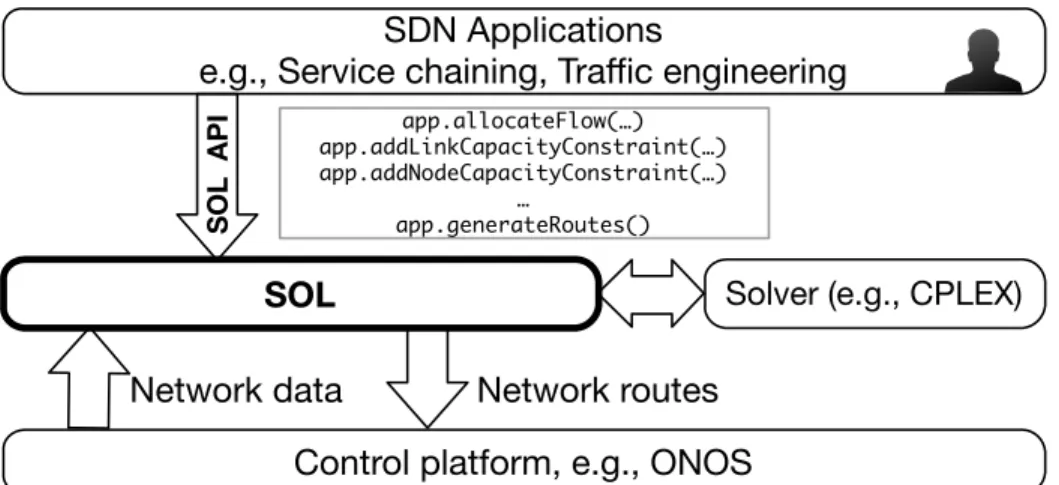
To this end, we introduce SOL in Chapter3, a framework that enables SDN applica-tion developers to express high-level applicaapplica-tion goals and constraints. Conceptually, SOL is an intermediate layer that sits between the SDN optimization applications and the actual control platform. Application developers can create new network optimiza-tion capabilities and express their requirements using the SOL API. SOL then generates configurations that meet these goals, which can be deployed to SDN control platforms.
1.2 Chopin: Composition of Multiple Optimization Applications
As SDN gains momentum, it gives rise to increasingly complex network deploy-ments. In particular, deployments with multiple, specialized network management ap-plications. SDN needs the ability to compose applications and their functionality on a single network, considering the growth of application diversity and recent potential emergence of SDN “app stores” [88,70,92].
Such composition presents new challenges in the deployment of multiple applica-tions. While policy composition has been studied extensively and many solutions are available [46,83,79], optimal resource management remains a hard problem due to a wide range of applications and their demands (e.g., load balancing, power saving, ser-vice chaining, etc.) [81,61,38].
A high-level network optimization framework, such as SOL, offers a promising al-ternative for SDN resource management applications. Unfortunately, the original SOL design is not robust on three key dimensions discussed below, precluding it from being used as-is for composition:
• Fairness: Multiple applications lead to multi-objective optimizations, i.e., moving away from a single notion of optimality. Hence, the framework must fairly balance multiple optimization criteria.
• Resource efficiency:multiple applications introduce variability into the network, since one application’s routing decisions impact the decision-making process of co-existing applications by modifying network state. However, optimizations are sen-sitive to such data uncertainty, possibly causing the solution quality to degrade [7].
To address aforementioned challenges, we propose Chopin1in Chapter4— a
frame-work that enables robust composition of resource-management SDN applications. Chopin’s design provides several attractive features. First, Chopin provides transparent tion. By exposing single-application APIs to the developers, Chopin abstracts composi-tion details from the development process. The abstraccomposi-tion enables applicacomposi-tion-agnostic development. Second, Chopin supports multiple composition modes based on different fairness metrics (e.g., [34,54,3]), providing flexibility for the operator. Finally, Chopin produces near-optimal composition results in short timescales, in order to respond to traffic variations.
1.3 SNIPS: Scalable Network Intrusion Prevention
To demonstrate the process and benefits of creating a new application using SOL, we present a novel approach for managing Network Intrusion Prevention Systems using SDN in Chapter5.
We choose NIPS as a case study for a number or reasons. First, the ubiquity of such systems; NIPS are an integral part of today’s network security infrastructure [111]. Sec-ond, NIPS require new scaling approaches to process increasing volumes of network traffic. Third, the complexity of modeling the NIPS scaling problem as an optimiza-tion problem serves as a good proving ground for Chopin’s capabilities. We present a first-principles optimization to implement SNIPS capabilities, and compare it with the Chopin-enabled optimization. We highlight the benefits of using Chopin to create a complex application such as SNIPS.
CHAPTER 2: Background and Prior Work
This chapter provides background on Software Defined Networking and optimiza-tion — two fields around which this dissertaoptimiza-tion revolves. We also summarize closely related work on optimization frameworks and network intrusion prevention.
2.1 Software-Defined Networking
Some of the ideas that form Software-Defined Networking, such as control and data plane separation [103,59], active [100,87] and programmable [10] networks, date back to the 1990s. We, however, focus on the most recent incarnation of SDN, as described by Open Networking Foundation [27]. This embodiment gained popularity after a work describing the OpenFlow protocol [63] was published. We highlight that SDN and Flow are not synonymous and can exist separately from each other. However, Open-Flow has become a de-facto standard protocol for switch management in the academic literature.
Of particular relevance to our work are the subsequent improvements to the con-trollers [78,32,8,71] and applications running atop the controllers, which we describe in detail below.
2.1.1 SDN Applications
imple-ment max-min fairness for flow allocation.
Going beyond simple flow management, SDN applications can be used to manage middleboxes and even create energy savings in the datacenter . For example, Elastic-Tree [38] and Response [105] leverage redundant path structure in modern datacenters to power off switches and/or links at low-demand times to reduce energy costs. Scis-sors [52] tackles power efficiency by reducing packet header sizes.
SIMPLE [81] utilizes SDN to route traffic through a series of middleboxes accord-ing to a global policy, while maintainaccord-ing acceptable levels of load on switches, network links, and middleboxes. Aplomb [93] is a system that leverages network programmabil-ity to offload middlebox processing outside of the network (e.g., a cloud provider).
2.1.2 Higher-layer Abstractions for SDN
In addition to building new and improved applications, other works explore new and improvedways of makingapplications. This includes new programming languages (e.g., [83,25]), testing and verification tools (e.g, [53]), semantics for network updates (e.g., [84]), compilers for rule generation (e.g., [51]), abstractions for handling control conflicts (e.g., [4]), and APIs for users to express requirements (e.g., [22]).
DEFO accomplishes using a two-layer architecture and support for networks that are not OpenFlow-enabled via segment routing.
Finally, Maple [108] allows expression of SDN applications using an “algorithmic policy”. Conceptually it allows the developer to run a function on each network packet that determines the packet’s forwarding path. However, Maple does not take into resource-management constraints.
2.1.3 Composition of Multiple SDN Applications
Composing multiple SDN applications running atop a single controller presents an a new set of challenges. First, one must ensure that there are no conflicts with respect to the routing policies different applications are trying to enforce. Second, the applications are “competing” for a finite set of network resources, each attempting to deploy a solu-tion that optimizes for its own goal.
Works such as Covisor [46] and Frenetic [25,67] focus on OpenFlow rule composi-tion and packet-level policy chain composicomposi-tion. PGA [79], Statesman [99], and PANE [22] are systems that focus on resolving policy conflicts between applications and enforcing network invariants.
The closest work that focuses on composition of resource-management applications is Corybantic [4] and its successor Athens [5]. These systems utilize voting protocols to generate a global network configuration across applications, and require modified, composition-aware applications. Chopin, in contrast, does not require applications to be aware of each other, provides automatic resource conflict resolution, and allows fair composition of applications.
2.2 Optimization
best possible solution — global optimization algorithms. In particular, many problems from the networking domain are modeled using specific subfields of mathematical opti-mization. In particular, convex optimization, where convex functions are minimized (or maximized) over convex sets. A special case of convex optimization is linear program-ming, which we desribe below.
2.2.1 Linear Programming (LP)
Linear programming is a special case of mathematical optimization that limits the objective and constraint functions to be linear. This ensures that the problem can be modeled using a system of linear inequalities, which enables fast solution (i.e., solvable in polynomial time). More formally, a linear program in standard form is expressed as follows:
maximizef0(x) Subject to
fi(x)≤bi fori= 1..m x≥~0
where a vectorxdenotes the decision variables whose values must be assigned to max-imize (or minmax-imize)f0(x), subject tomconstraintsfi(x). Each functionf0(x) : Rn → R maps then-dimensional vectorxto a real number andbis a vector of constants. Note that if any of the variables inxmust take on an integer value, the problem becomes an Integer-Linear Program (ILP) and finding the optimal solution becomes NP-hard [74].
AMPL [26], Mosek [68], PyOpt [77], and PuLP [66] were built for easier modeling and expressing of optimization tasks. However, these tools do not specifically target network optimization.
2.2.2 Network Optimization
Many classic networking problems for which custom algorithms were designed (e.g., maximum flow and shortest path routing problems) can also be expressed as linear pro-grams [1]. In fact, they are simply special cases of a broad class of problems, called net-work flow problems. As the name implies, the vector of decision variablesxrefers to the amount of flow routed along a network edge (or path) while optimizing for a given ob-jective function. Of particular interest to computer networking is the multi-commodity flow problem (MCFP) [91]. MCFP computes the best routing for multiple, concurrent commodities on a given network. A commodity has an origin, a destination and a de-mand, whilst network links have capacities. Naturally, MCFP presents a convenient ab-straction for modern IP networks.
Edge and Path formulations: There are two ways of writing network flow problems using linear programs. The most common is a node-edge (also referred to as node-arc or node-link) formulation, where the decision variables are the amount flow traveling on a given edge, and the constraints capture the amount of flow that enters and exits each node. An alternative approach is the path formulation, where the decision variables rep-resent fraction of flow on each path. The two are equivalent, but trade off larger num-bers of variables (the path formulation, since the number of paths in a graph is large) versus larger numbers of constraints (the node-edge formulation) [1].
2.2.3 General Optimization Enhancements
better model real-world problems.
Multi-objective optimization: Extensive literature exists on multi-objective opti-mization (e.g., [98,17]). The goal of multi-objective optimization is to compute solutions that simultaneously optimize multiple objectives. In many cases, finding a solution that is optimal for all objectives is impossible, and therefore new notions of optimality must be introduced (e.g., pareto optimality, ordered optimization).
Robust optimization: The field of robust optimization [7] develops ways of “pro-tecting” optimizations against uncertain data. More specifically, it deals with the cases where the values used in constraint or objective functionsfi(x), i = 0..mare not known but can be bound. In networking this takes on the form of network design validation against failures [14] or (semi-)oblivious routing [6,56,58]. Unfortunately, such tech-niques can be overly conservative and computationally intensive, especially with multi-ple resources involved in addition to bandwidth.
2.3 Network Security
Since this dissertation presents a case study focused on managing network security appliances (in particular, Intrusion Prevention Systems), we present a cursory overview of literature on NIPS followed by works that explore the interplay between SDN and network security.
2.3.1 Network Intrusion Detection and Prevention
Signature matching systems face a continuous scaling struggle, due to computation-ally expensive expression matching, commonly called deep packet inspection (DPI). Un-like network forwarding, which operates on data- and network-layer headers, DPI re-quires processing packet payloads to guard against application-layer attacks. Such high costs make it difficult for NIPS to keep up with the “line rate” of a network, requiring novel scaling approaches besides faster hardware.
2.3.1.1 Scaling approaches
Traditional NIPS/NIDS scaling: There are several complementary approaches for scaling NIPS, including algorithmic improvements [96], using specialized hardware such as TCAMs (e.g., [112,64]), FPGAs (e.g., [60]), or GPUs (e.g., [106,45]).
On-path offloading: Work by Sekar et al. explores on-path offloading [90,89], where the traffic is either processed or ignored by different NIPS machines along a routing path. They employ a centralized optimization framework to optimally balance the pro-cessing responsibilities across a network. One of the benefits of network offloading is the ability to balance without access to internals of NIPS software. Thus the load-balancing can be accommodate a variety of NIPS types, including legacy and propri-etary solutions.
2.3.2 Security Applications of SDN
CHAPTER 3: SOL — SDN Optimization Layer1.
We start by developing a baseline framework that allows expression of different types of network optimizations. The high-level overview is shown in Figure3.1. Recall that two major challenges in developing a framework such as SOL is creating a general abstraction capable of supporting a variety of applications and generating efficient solu-tions.
The key insight in SOL to achieve generality is that many network optimization problems can be expressed aspath-basedformulations. Paths are a natural abstraction for application developers to reason about intended network behaviors and to express policy requirements. For example, we can use paths to specify service chaining require-ments (e.g., each path includes a firewall and intrusion-detection system, in that order) or redundancy (e.g., each includes two intrusion-prevention systems, in case one fails open). Finally, it is easy to model device (e.g., TCAM space, middlebox CPU) and link resource consumption based on the volume of traffic flowing through paths that tra-verse that device or link.
SOL
Control platform, e.g., ONOS SDN Applications
e.g., Service chaining, Traffic engineering
Solver (e.g., CPLEX)
app.allocateFlow(…) app.addLinkCapacityConstraint(…) app.addNodeCapacityConstraint(…)
…
app.generateRoutes()
Network data Network routes
SOL API
Figure 3.1: Developers use the SOL high-level APIs to specify optimization goals and constraints. SOL generates near-optimal solutions and produces device configura-tions that are input to the SDN control platform.
We have implemented SOL as a Python-based library that interfaces with ONOS [8] and prototyped numerous SDN applications in SOL, including SIMPLE [81], Elastic-Tree [38], Panopticon [61].
Our evaluations on a range of topologies show that: 1) SOL outperforms several ap-plications’ original optimization algorithms by an order of magnitude or more, and is even competitive with their custom heuristics; 2) SOL scales better than other network management tools like Merlin [97]; 3) SOL substantially reduces the effort required (e.g., in terms of lines of code) for implementing new SDN applications by an order of magni-tude; and 4) optional SOL extensions can reduce route churn substantially across recon-figurations with modest impact on optimality.
3.1 Motivation and Challenges
N1 N3
N4 N2
N5 500 Mbps
100 Mbps
1 Gbps 100 Mbps
100 Mb
ps 500 Mb ps
C1: N1→N5 1 Gbps
C2: N2→N5 100 Mbps
Satisfy demands C1, C2 100%; minimize maximum link utilization
5
0
0
Mb
p
s
Figure 3.2: Traffic engineering applications
3.1.1 Traffic engineering
Traffic engineering (TE) is a canonical application that was an early driving appli-cation for SDN [44,42]. Figure3.2shows an example where traffic classes C1 and C2 need to be routed completely while minimizing the load on the most heavily loaded link. A TE application takes as input traffic demands (e.g., the traffic matrix between WAN sites), a specification of the traffic classes and priorities, and the network topology and link capacities. It determines how to route each class to achieve network-wide ob-jectives, e.g., minimizing network link load [24] or weighted max-min fairness [44,42].
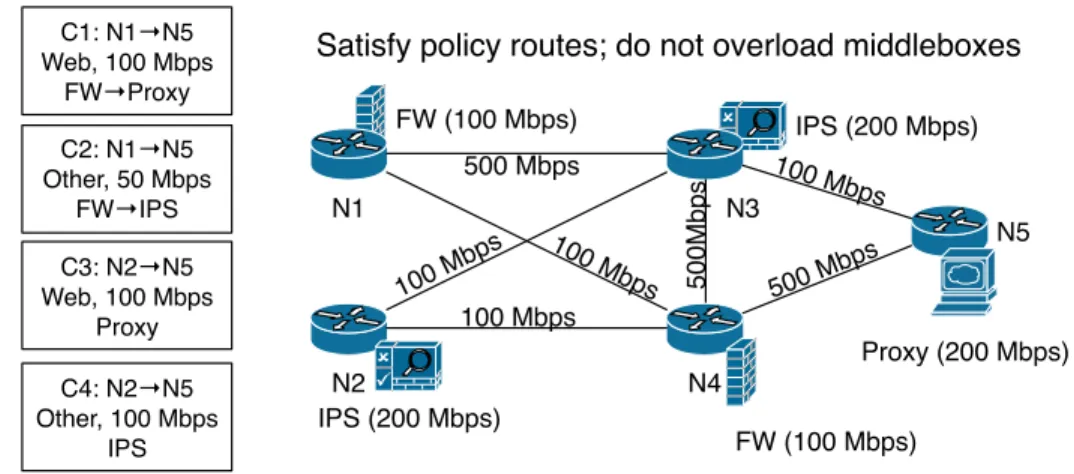
IPS (200 Mbps) FW (100 Mbps)
N1 N3 N4 N2 N5 500 Mbps 100 Mbps
500 Mb
ps
100 Mbps
100 Mb
ps 100 Mb
ps
C1: N1→N5 Web, 100 Mbps
FW→Proxy
Satisfy policy routes; do not overload middleboxes
C2: N1→N5 Other, 50 Mbps
FW→IPS
C4: N2→N5 Other, 100 Mbps
IPS
IPS (200 Mbps)
FW (100 Mbps)
Proxy (200 Mbps)
C3: N2→N5 Web, 100 Mbps
Proxy 5 0 0 Mb p s
Figure 3.3: Service chaining applications
3.1.2 Service chaining
Networks today rely on a wide variety of middleboxes (e.g., IDS, proxy, firewall) for performance, security, and external compliance capabilities (e.g., [93]). The goal of ser-vice chaining is to ensure that each class of traffic is routed through the desired sequence of network functions. For example, in Figure3.3, class C1 is required to traverse a fire-wall and proxy in order. Such policy routing rules must be suitably encoded within the available TCAM on SDN switches [81]. Since middleboxes are often compute-intensive, they can get easily overloaded and thus operators would like to balance the load on these appliances [81,29]. The key inputs to such applications are the service chaining re-quirements of different classes, traffic demands, and the available middlebox processing resources. The application then sets up the forwarding rules such that the service chain-ing requirements are met while respectchain-ing the switch TCAM and middlebox capacities. Furthermore, as many of these middleboxes are stateful, these rules must ensure flow affinity.
abstrac-N1 N3
N4 N2
N5 500 Mbps
100 Mbps
500 Mb ps
100 Mbps
100 Mb
ps 100 Mb
ps
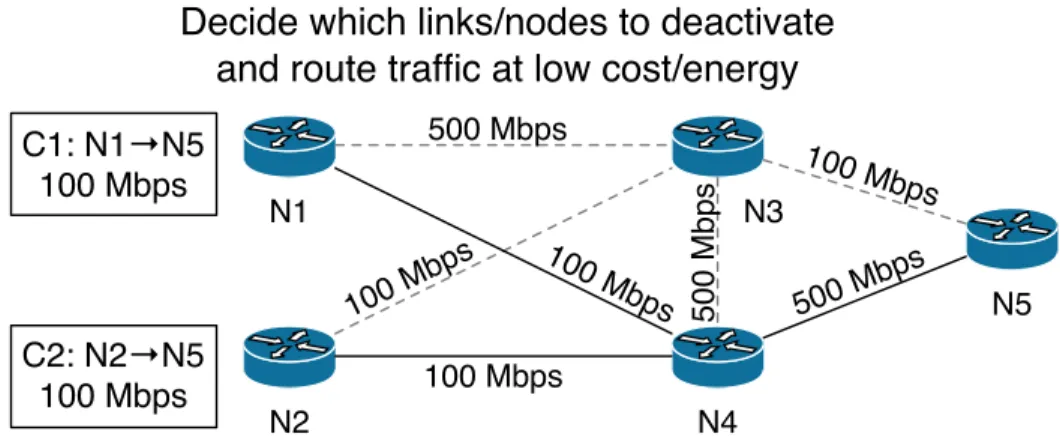
C1: N1→N5 100 Mbps
C2: N2→N5 100 Mbps
Decide which links/nodes to deactivate
and route traffic at low cost/energy
5
0
0
Mb
p
s
Figure 3.4: Topology reconfiguration applications
tions [15]. Third, service chaining highlights the complexity of combining different re-quirements; e.g., reasoning about the interaction between the load balancing algorithm and the switch TCAM constraints is non-trivial [47]. Existing service chaining efforts developed custom heuristics [12] or new theoretical extensions [15]. Furthermore, as ob-served previously, ensuring flow affinity can be quite tricky [40,39].
3.1.3 Flexible topology management
SDN enables topology modifications that would be difficult to implement with ex-isting control plane capabilities. For instance, ElasticTree [38] and Response [105] use SDN to dynamically switch on/off network links and nodes to make datacenters more energy efficient. In Figure3.4, these applications might shut down node N3 during pe-riods of low utilization, if classes C1 and C2 can be routed via N4 without significantly impacting end-to-end performance. Topology reconfiguration is especially feasible in rich topologies with multiple paths between every source and destination. Such appli-cations take as input the demand matrix (similar to the TE task) and then compute the nodes and links that should be active and traffic-engineered routes to ensure perfor-mance SLAs.
and difficult to express using max-flow like abstractions. Solving such problems re-quires significant computation even on small topologies and thus forces developers to design new, heuristic solving strategies; e.g., ElasticTree uses a greedy bin-packing algo-rithm [38].
3.1.4 Network function virtualization
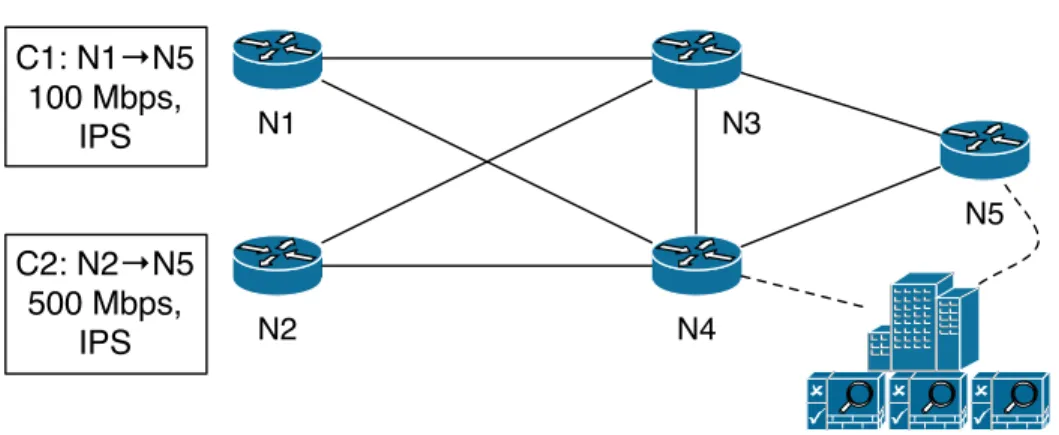
Prior work has leveraged SDN capabilities to offload or outsource network func-tions to leverage clusters or clouds [93,30,82]. This is especially useful for expensive deep-packet-inspection services (as we show in [39], and Chapter5). The key decision here is to decide how much of the processing on each path to offload to the remote dat-acenter — e.g., in Figure3.5, how much of class C1 traffic should be routed to the dat-acenter between N4 and N5 for IPS processing, versus processing it at N3. Offload-ing can increase user-perceived latency and impose additional load on network links. Moreover, some active functions (e.g., WAN optimizers or IPS) induce changes to the observed traffic volumes due to their actions. Thus, optimizing such offloading must take into account the congestion that might be introduced, as well as latency impact and any traffic volume changes induced by such outsourced functions. Further generaliza-tions have considered not only offloading middlebox services but also elastically scaling them [73,28,69,9], exacerbating these issues.
N1 N3
N4 N2
N5
C1: N1→N5
100 Mbps, IPS
C2: N2→N5
500 Mbps, IPS
Offload expensive functions to remote “clouds”
Figure 3.5: Offloading network functions
to the topology modification application, further decaying the problem’s tractability.
3.1.5 Motivation for SOL
Drawing on the above discussion, we summarize a few key considerations:
• Network applications have diverse and complex optimization requirements; e.g., service chaining requires us to reason about valid paths while topology modifica-tion needs to enable/disable nodes.
• Designers of these applications have to spend significant effort in expressing and debugging these problems using low-level optimization libraries.
• It can take non-trivial expertise to ensure that the problems can be solved fast enough to be relevant for operational timescales, e.g., recomputing TE every few minutes or periodically solving the large integer-linear programs (ILPs) support-ing topology reconfiguration (e.g., [38]).
3.2 SOL Overview
developing SDN-based optimizations, making them more accessible for deployment by network managers. To do so, SOL abstracts away low-level details of optimization solvers and SDN controllers, allowing the developer to focus on the high-level applica-tion goals (recall Figure3.1). SOL takes as inputs the network topology, traffic patterns, and optimization requirements in the SOL API. It then translates these into constraints for optimization solvers such as CPLEX or Gurobi. Finally, SOL interfaces with exist-ing SDN control platforms such as ONOS to install the forwardexist-ing rules on the SDN switches. SOL does not require modifications to the existing control or data plane com-ponents of the network. Our vision for SOL stands in stark contrast to the state of affairs today, in which a developer faces programming a new SDN optimization either directly for a generic and low-level optimization solver such as CPLEX or using a heuristic al-gorithm designed by hand, after which she must translate the decision variables of the optimization to device configurations.
Path abstraction: For SOL to be useful and robust, we need a unifying abstraction that can capture the requirements of diverse classes of SDN network optimization ap-plications described in the previous section. SOL is built usingpathsthrough a network as a core abstraction for expressing network optimization problems. This is contrary to how many optimizations are formulated in the literature — using a more standard edge-centric approach [1]. In our experience, however, an edge-centric approach forces com-plexity when presented with additional requirements, especially ones that attempt to capture path properties [61,38].
ease. For example, usage of TCAM space in a switch corresponds to a traffic-carrying path traversing that switch (and thus a rule to accommodate that path). Without the path abstraction, modeling such constraints is difficult (cf., [81]). Finally, expressing con-straints on nodes and edges does not introduce increased difficulty compared to edge-centric approach.
Scalability: In a pure flow-routing scenario, an edge-based formulation admits sim-ple algorithms that guarantee polynomial-time execution. Path-based formulations, on the other hand, are often dismissed because of their inefficient appearance — after all, in the worst case, the number of paths in the network is exponential in the network size — or due to the complexity of algorithms to solve path based formulations (column-generation, decompositions, etc. [1]). However, in many practical scenarios, the num-ber of valid paths (as defined by the application) is likely to be significantly smaller. Furthermore, multipath routing can provide only so much network diversity before its value diminishes [62]. So, the set of paths that need to be considered is not large.
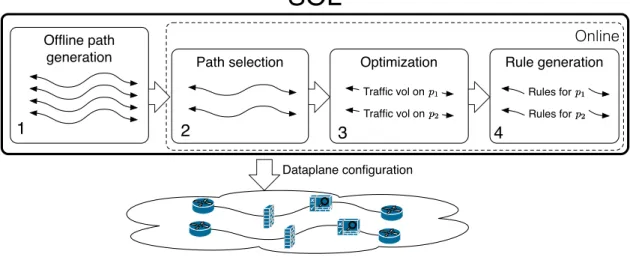
SOL leverages an off-line path generation step to determine valid paths (step 1 of Figure3.6). Since for most applications, the set of valid paths is fairly static and does not need to be recomputed every time the optimization is run, we expect this step is infre-quent. Next, SOLselectsa subset of these paths (step 2) using a selection strategy (see Section3.4) and runs the optimization with only the selected paths as input (step 3), to ensure that the optimization completes quickly. We show in Section3.7that this strat-egy still permits inclusion of sufficiently many paths for the optimization to converge to a (near) optimal value. So, while the efficiency of path-based optimization is a valid theoretical concern, in practice we show that there are practical heuristics to address this issue.
SOL
Online
Path selection Optimization
Dataplane configuration
2
Rule generation
4
Rules for pp11
Rules for pp22
Offline path generation
1 3
Traffic vol on pp11
Traffic vol on pp22
Figure 3.6: SOL architecture, overview of the workflow
based on that in previous work [109,39]. However, because the optimization is path-based, the algorithm is more straightforward and requires fewer steps.
3.3 SOL Detailed Design
In this section, we present the detailed design of SOL. We focus on the high-level API that the SDN application developer would use to express applications via SOL, and the impact of these API calls on the SOL’s internal representation of the optimization prob-lem. Note, however, that the developer “thinks” in terms of the high-level API rather than low-level details of dealing with the solver-level variables, how paths are identi-fied, etc.
nodes Set of all nodes, part of the topology links Set of all links, part of the topology classes Set of all traffic classes
paths(c) Paths available for classc ∈ classes; output by path-selection stage (Sec-tion3.4)
Table 3.1: Network data input
Variable Description
Decision
xc,p Fraction of class-cflows allocated to pathp∈paths(c); non-integer
bp Is pathpused; binary
bv Is nodevused; binary
bl Is linklused; binary
capvarr
v Capacity allocated for resourcerat nodev; non-integer
Derived
ac Fraction ofc’s “demand” routed; non-integer
loadrl Amount of resourcerconsumed by flows routed over linkl; non-integer loadrv Amount of resourcerconsumed by flows routed via nodev; non-integer
Table 3.2: Variables internal to the optimization
3.3.1 Preliminaries
Data inputs:There are two basic data inputs that the developer needs to provide to any network optimization. First, the network topology is a required input, specified as a graph withnodesandlinks. It also contains metadata of node/edge types or prop-erties; e.g., nodes can have designated functions like “switch” or “middlebox”. Second, SOL needs a specification oftraffic classes, where each classchas associated ingress and egress nodes and some expected traffic volume. Each class can (optionally) be associ-ated with a specification of the “processing” required for traffic in this class, e.g., ser-vice chaining. Finally, to each traffic classcis associated a setpaths(c)available to route flows in classc;paths(c)is output by a path-selection preprocessing step described in Section3.4.
variables:
• Decision variablesthat identify key optimization control decisions. The most fun-damental decision variable isxc,p, which captures traffic routing decisions and de-notes the fraction of flow for a traffic classcthat pathp ∈ paths(c)carries. This variable is central to various types of resource management applications as we will see later. To capture topological requirements (e.g., Section3.1.3), we introduce three binary decision variablesbp,bv, andblthat denote whether each path, node or link (respectively) is enabled (= 1) or disabled (= 0). The variablecapvarr
v is the SOL-assigned allocation of resource-rto nodev.
• Derived variablesare functions defined over the above decision variables that serve as convenient “shorthands”.ac denotes the total fraction of flow for classcthat is carried by all paths. The load variablesloadrvandloadrl model the consumption of resourceron nodev and linkl, respectively.
3.3.2 Routing requirements
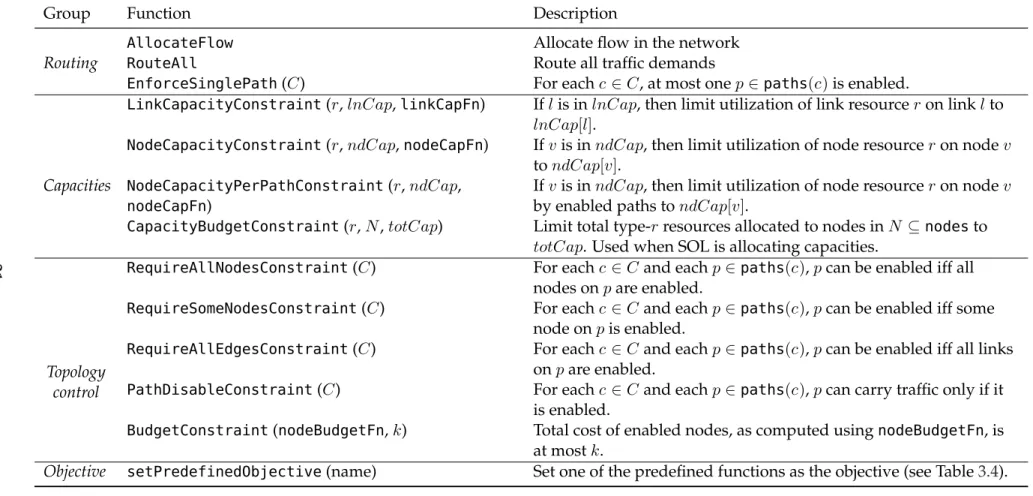
Routing constraints control the allocation of flow in the network. AllocateFlow cre-ates the necessary structure for routing the traffic through a set of paths for each traffic class. Some network applications try to satisfy as much of their flow demands as pos-sible (e.g., max-flow) while others (e.g., TE) want to “saturate” demands. For example, a developer of a TE application (Section3.1.1) would like to route all traffic though the network, and thus she would add the following high-level routing constraint templates to her emptyoptobject:
opt.AllocateFlow()
opt.RouteAll()
TheEnforceSinglePath(C)constraint forces a single flow-carrying path per classc ∈ C, preventing flow-splitting and multi-path routing. Finally,
FlowAffinityConstraint(Cpair)ensures that for each pair of traffic classesc1, c2 ∈Cpair equal amount of processing from each class occurs at the same nodes, thus maintaining flow affinity for processing that requires session-level (as opposed to flow-level) granu-larity.
Internals: AllocateFlowensures that the total traffic flow across all chosen paths for the classcmatches the variableac.
∀c ∈classes: X p∈paths(c)
xc,p =ac
Similarly,RouteAllimplies:
∀c∈classes: ac = 1
EnforceSinglePathensures that only a single path is used for routing traffic, and is expressed as follows:
∀c ∈classes: X p∈paths(c)
bp = 1
FlowAffinityConstraintensures that the load on each processing node con-tributed by each path in both forward and reverse directions is equal:
∀c1, c2 ∈Cpair∀v :
X
p∈paths(c1):v∈p
xc1,p =
X
p∈paths(c2):v∈p
xc2,p
3.3.3 Resource capacity constraints
by specifying several “cost” functions, depicted in Figure3.7. These functions prescribe how to compute the cost of routing traffic through a link, a node, or a given path. SOL provides default implementations of these for common tasks, but allows the user to specify their own logic, as well, as we will show later (Section3.5).
These cost functions can then be passed into constraint templates. For example, to add a constraint that limits link usage, the user can invoke the template function LinkCapacityConstraintwith a resource that we are constraining (e.g., ‘bandwidth’), a map of links to their capacities,2and optionally, a customlinkCapFnto compute the
cost of traffic on a link.
opt.LinkCapacityConstraint (’bandwidth’,
{(1,2): 10**7, (2,3): 10**7},
defaultLinkFunction)
This indicates that bandwidth should not exceed 10 Mbps for links 1-2 and 2-3. Note that the default function is purely for illustration; the developer can write her own linkCapFn(recall Figure3.7).
NodeCapacityPerPathConstraintgenerates constraints on the nodes that do not depend on the traffic, but rather on the routing path. That is, the cost of routing at a node does not depend on the volume or type of traffic being routed; it depends on the path and its properties. The best example of such usage is accounting for the limited rule space on a network switch (e.g., Section3.1.2). If a path is “active”, the rule must be installed on each switch to support the path.
Allo-linkCapFn(l, c, p, r): Amount of resource typerconsumed if all class-ctraffic is allocated to pathp3lfor
linkl
nodeCapFn(v, c, p, r): Amount of resourcerconsumed if all class-ctraffic is allocated to pathp3vfor
nodev
nodeBudgetFn(v): Cost of using nodev; required withBudgetConstraint
routingCostFn(p): Cost of routing along pathp; required withminRoutingCost
predicate(p): Determine whether any given path is valid by returningTrueorFalse
Figure 3.7: Customizable functions
given resourcer.
∀l inlnCap:
loadrl =X
c
X
p∈paths(c):l∈p
xc,p×linkCapFn(l, c, p, r)
loadrl ≤lnCap[l]
Node capacity equations function similarly, and operates on nodes instead of links:
∀v inndCap:
loadrv =X
c
X
p∈paths(c):v∈p
xc,p×nodeCapFn(v, c, p, r)
loadrv ≤ndCap[v]
TheNodeCapacityPerPathConstraintfunctions a bit differently, as it depends on enabled paths:
∀v inndCap:
loadrv =X
c
X
p∈paths(c):v∈p
bp×nodeCapFn(v, c, p, r)
loadrv ≤capvarrv
3.3.4 Node/link activation constraints
Next set of constraints, when used, allow developers to logically model the act of en-ablingordisablingnodes, links, and paths; e.g., for managing energy or other costs (e.g., Section3.1.3). We identify two possible modes of interactions between these topology modifiers, and the optimization developer can choose the one that is most suitable for their context. 1)RequireAllNodesConstraintcaptures the property that disabling a node disables all paths that traverse it; and 2)RequireSomeNodesConstraint cap-tures the property that enabling a node permits any path traversing it to be enabled, as well. The latter version is suitable when, e.g., a node can still route traffic even if its other (middlebox) functionality is disabled, and so a path containing that node is potentially useful as providing middlebox functions if at least one of its nodes is en-abled. There are analogous constraint templates for links. A third constraint template, PathDisableConstraint, restricts a path to carry traffic only if it is enabled.
For example, a developer trying to implement the application from Section3.1.3
can model the requirements for shutting off datacenter nodes by adding the RequireAllNodesConstraintandPathDisableConstrainttemplates: opt.RequireAllNodesConstraint (trafficClasses)
opt.PathDisableConstraint (trafficClasses)
Other efficiency considerations may enforce a budget on the number of enabled nodes, to model constraints on total power consumption of switches/middleboxes, cost and budget of installing/upgrading particular switches, etc. These are captured via the BudgetConstrainttemplate function.
for-malized as follows:
∀p∈paths(c) :
RequireAllNodesConstraint ∀v∈p: bp ≤bv
RequireSomeNodesConstraint bp ≤Pv∈pbv
PathDisableConstraint xc,p ≤bp
Naturally, similar constraints are constructed for links. Note that
PathDisableConstraintis crucial to the correctness of the optimization in that it enforces that no traffic traverses a disabled path.
BudgetConstraintallows the developer to cap the number of enabled nodes in the topology according to a custom cost function. More formally,
X
v∈nodes
bv×nodeBudgetFn(v)≤k
In its simplest form, wherenodeBudgetFnreturns 1, this constraint simply allows up to knodes to be enabled.
3.3.5 Specifying network objectives
The goal of SDN applications is eventually to optimize some network-wide objective, e.g., maximizing the network throughput, balancing load, or minimizing total traffic footprint. Table3.4lists the most common objective functions, drawing on the applica-tions considered in Section3.1. For instance, the developer of a TE application may want to implement the objective of minimizing the maximum link load and thus add the fol-lowing code snippet:
opt.setPredefinedObjective (minMaxLinkLoad, ’bandwidth’)
Group Function Description
AllocateFlow Allocate flow in the network
RouteAll Route all traffic demands
Routing
EnforceSinglePath(C) For eachc∈C, at most onep∈paths(c)is enabled.
LinkCapacityConstraint(r,lnCap,linkCapFn) Iflis inlnCap, then limit utilization of link resourceron linklto lnCap[l].
NodeCapacityConstraint(r,ndCap,nodeCapFn) Ifvis inndCap, then limit utilization of node resourceron nodev
tondCap[v]. NodeCapacityPerPathConstraint(r,ndCap,
nodeCapFn)
Ifvis inndCap, then limit utilization of node resourceron nodev
by enabled paths tondCap[v].
Capacities
CapacityBudgetConstraint(r,N,totCap) Limit total type-rresources allocated to nodes inN ⊆nodesto
totCap. Used when SOL is allocating capacities.
RequireAllNodesConstraint(C) For eachc∈Cand eachp∈paths(c),pcan be enabled iff all
nodes onpare enabled.
RequireSomeNodesConstraint(C) For eachc∈Cand eachp∈paths(c),pcan be enabled iff some
node onpis enabled.
RequireAllEdgesConstraint(C) For eachc∈Cand eachp∈paths(c),pcan be enabled iff all links
onpare enabled.
PathDisableConstraint(C) For eachc∈Cand eachp∈paths(c),pcan carry traffic only if it
is enabled. Topology
control
BudgetConstraint(nodeBudgetFn,k) Total cost of enabled nodes, as computed usingnodeBudgetFn, is
at mostk.
Objective setPredefinedObjective(name) Set one of the predefined functions as the objective (see Table3.4).
Table 3.3: Selected constraint template functions for building optimizations; see Figure3.7forlinkCapFn,nodeCapFn, andnodeBudgetFn
cost and include aminRoutingCostobjective. This objective is parameterized with routingCostFn(p); i.e., developers can plugin their own cost metrics such as number of hops or link weights. As shown, we also provide a range of natural load-balancing templates.
3.3.6 Minimizing reconfiguration changes
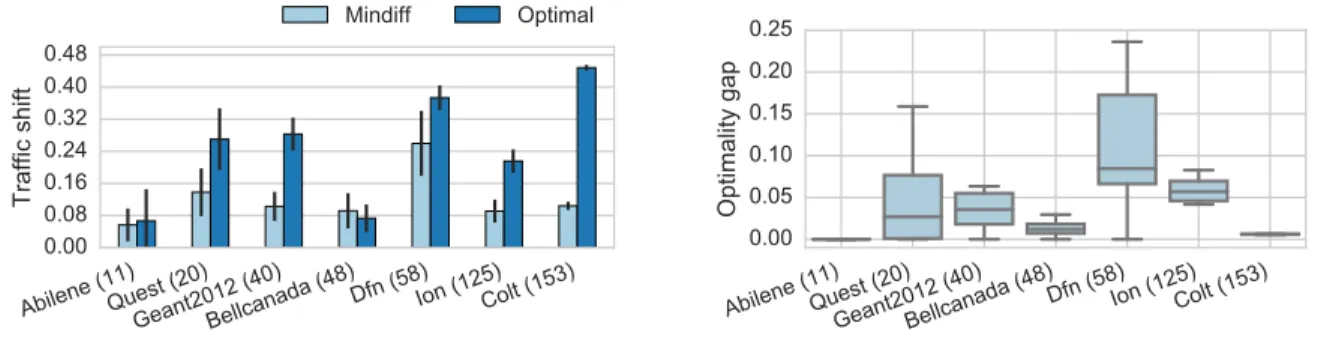
As the network state changes, the optimization can be recomputed to adjust traffic allocations along forwarding paths. Traditionally, there are no guarantees on the sim-ilarity of newly computed solution and previous solution. This can result in signifi-cant amount of network churn, where traffic is reallocated to different paths unneces-sarily. To mitigate network churn, SOL supports an additional constraint, for simplic-ity dubbed “mindiff”. The goal of mindiff is to limit the fraction of traffic that migrates from one path to another with respect to a previous solution.
We express the churn per class using the difference between flow fractions on each path:
∀c Churnc = X
p∈paths(c) z
ε≥xc,p−xˆc,p ε≤ −xc,p+ ˆxc,p
wherexˆc,pis the fraction of traffic on pathpfor traffic classcin the previous solution. The global network churn is computed as follows:
Diff = 1
|classes| X
c∈classes
Churnc
maxAllFlow maximize X c∈classes
ac minMaxNodeLoad(r) minimize max
v∈nodes load
r v minMaxLinkLoad(r) minimize max
l∈links load
r l
minRoutingCost X
c,p
routingCostFn(p)×xc,p
Table 3.4: Common objective functions
or added to the objective function to be minimized. If adding to the objective function, an appropriate weight must be specified to avoid sacrificing the primary objective’s op-timality.
3.3.7 Low-level API
While the SOL API described above is general and expressive enough to capture the diverse requirements of the broad spectrum of applications, we also expose a low-level API that gives more control to the user by giving access to the SOL internal variables. Advanced users can use this API for further customization.
3.4 Path generation and selection
Given these constraint templates, the remaining question is how we populate the path setpaths(c)for each traffic classcto meet two requirements. First, eachp ∈ paths(c)should satisfy the desired policy specification for the classc. Second,paths(c) should contain paths for each classcthat make the formulation tractable and yet yield near-optimal results. We describe how we address each concern next.
Generation: First, to populate the paths, SOL does an offline enumeration of all sim-ple (i.e., no loops) paths per class.3 Given this set, we filter out the paths that do not
sat-isfy the user-defined predicatepredicate, i.e., wherepredicate(p) =Trueonly ifpis a valid path. Note that we can generalize this to allow different predicates per class, but do not do so for ease of explanation.
In practice, we implement the predicate as a flexible Python callable function rather than constrain ourselves to specific notions of path validity (e.g., regular expressions as in prior work [97]). Using this predicate gives the user flexibility to capture a range of possible requirements. Examples include waypoint enforcement (forcing traffic through a series of middleboxes in order); enforcing redundant processing (e.g., through mul-tiple IDS, in case one fails open); and limiting network latency by mandating shorter paths.
1 SIMPLE_predicate = functools.partial(waypointMboxPredicate, order=(’fw’,’ids’))
2 def SIMPLE_NodeCapFunc(node,tc,path,resource,nodeCaps):
3 if resource==’cpu’ and node in nodeCaps[’cpu’]:
4 return tc.volFlows*tc.cpuCost/nodeCaps[resource][node]
5 capFunc = functools.partial(SIMPLE_NodeCapFunc, nodeCaps=nodeCaps)
7 def SIMPLE_TCAMFunc(node, tc, path, resource):
8 return 1
9 # Path generation, typically run once in a precomputation phase 10 opt = getOptimization()
11 pptc = generatePathsPerTrafficClass(topo, trafficClasses, SIMPLE_predicate, 10, 1000, functools.partial(useMboxModifier, chainLength=2))
12 # Allocate traffic to paths 13 pptc = chooserand(pptc, 5)
14 opt.addDecisionVariables(pptc)
15 opt.addBinaryVariables(pptc, topo, [’path’,’node’])
16 opt.addAllocateFlowConstraint(pptc)
17 opt.addRouteAllConstraint(pptc)
18 opt.addLinkCapacityConstraint(pptc, ’bandwidth’, linkCaps, defaultLinkFuncNoNormalize)
19 opt.addNodeCapacityConstraint(pptc, ’cpu’, {node: 1 for node in topo.nodes() if ’fw’ or
’ids’ in topo.getServiceTypes(node)}, capFunc)
20 opt.addNodeCapacityPerPathConstraint(pptc, ’tcam’, nodeCaps[’tcam’], SIMPLE_TCAMFunc)
21 opt.setPredefinedObjective(’minmaxnodeload’,’cpu’)
22 opt.solve()
23 obj = opt.getSolvedObjective()
24 pathFractions = opt.getPathFractions(pptc)
25 c = controller()
26 c.pushRoutes(c.getRoutes(pathFractions))
Figure 3.8: Code to express SIMPLE [81] in SOL
balancing (selectStrategy=random). SOL is flexible to incorporate other selection strategies, e.g., picking paths with minimal node overlap for fault tolerance. We find randomworks well for many applications that require load balancing. We conjecture this is because choosing random paths on sufficiently rich topologies yields a high degree of edge-disjointedness among the chosen paths, yielding sufficient degrees of freedom for balancing loads.
3.5 Examples
Service chaining (Section3.1.2): As a concrete instance of the service chaining ex-ample, we consider SIMPLE [81]. SIMPLE involves the following requirements: route all traffic through the network, enforce the service chain (e.g., “firewall followed by IDS”) policy for all traffic, load balance across middleboxes, and do so while respecting CPU, TCAM, and bandwidth requirements. Figure3.8shows how the SIMPLE optimiza-tion can be written in≈25 lines of code. This listing assumes that topology and traffic classes have been set up, in thetopoandtrafficClassesobjects, respectively.
The first part of the figure shows function definitions and the path generation step, which would typically be performed once as a precomputation step. We start by defin-ing a path predicate (line1) for basic enforcement through middleboxes by using the SOL-provided function with the middlebox order. The next few lines (lines2–4) show a custom node capacity function to normalize the CPU load between 0 and 1. This com-putes the processing cost per traffic class (number of flows times CPU cost) normal-ized by the current node’s capacity. Similarly, the TCAM capacity function captures that each path consumes a single rule per switch (line7). The user gets the optimiza-tion object (line10), and generates the paths (line11), obtaining the “paths per traffic class” (pptc) object. The path generation algorithm is parameterized with the custom SIMPLE_predicate, a limit on path length of 10 nodes, and a limit on the number of paths per class of 1000. It is also instructed to evaluate every possible use of two mid-dleboxes on a routing path for inclusion as a distinct path in the output.
The remaining lines show what would be executed whenever a new allocation of traffic to paths is desired. Line13selects 5 random paths per traffic class; lines14–20
SDN controller to automatically install the rules (line26).
ElasticTree [38]: We only show the most important differences between ElasticTree and SIMPLE. There is no requirement on paths, and sonullPredicateis used for path generation. We use link binary variables (see line1below) and the node/link activa-tion constraints (lines2–4). Finally, we use the low-level API (recall Section3.3.7) to define power consumption for switches and links (lines5,6, wherein “opt.bn(node)”
and “opt.be(u,v)” retrieve the names of variablesbnodeandb(u,v)from Figure3.2, respec-tively) and use these variables to define a custom objective function (line7).
1 opt.addBinaryVariables(pptc,topo,[’path’,’node’,’edge’])
2 opt.addRequireAllNodesConstraint(pptc)
3 opt.addRequireAllEdgesConstraint(pptc)
4 opt.addPathDisableConstraint(pptc)
5 opt.defineVar(’SwitchPower’, {opt.bn(node):switchPower[node] for node in topo.nodes()})
6 opt.defineVar(’LinkPower’, {opt.be(u, v): linkPower[(u, v)] for u, v in topo.links()})
7 opt.setObjectiveCoeff({’SwitchPower’: .75, ’LinkPower’: .25}, ’min’)
3.6 Implementation
Developer interface: We currently provide a Python API for SDN optimization that is an extended version of the interface described in Section3.3.
Invoking solvers: We use CPLEX (via its existing Python API) as our underlying solver. This choice largely reflects our familiarity with the tool, and we could substi-tute CPLEX with other solvers like Gurobi. SOL offers APIs to exploit solver capabili-ties to use a previously computed solution and incrementally find a new solution. This approach is typically faster than starting from scratch and so is useful for faster reconfig-urations. SOL also allows hard-limiting of the optimization runtime, albeit affecting the optimality of the solution.
new applications emerge.
Rule generation and control interface: We implement applications for ONOS [8] and use custom REST API to allow remote batch installation of the relevant rules. We generate the rules based on the optimization output, using network prefix splitting to implement the fractional responsibilities represented by thexc,pvariables. This step is similar to prior work that map fractional processing and forwarding responsibilities onto network flows (e.g., [109,50]). The only difference is that in case of flow affinity constraints, the IP prefix splitting is done on the source addresses for the “forward” traffic class, and on the destination addresses for the “reverse” traffic class. For mid-dleboxes attached to a single switch using a single port, packet tagging can be used to avoid loops. With ONOS, we leveragepath intents[8]: while not required, it facilitates easier integration.
Minimizing reconfiguration changes: Networks are in flux during reconfigurations with potential performance or consistency implications, and thus it is desirable to mini-mize unnecessary configuration changes. SOL supports constraints that bound (or min-imize) the logical distance between a previous solution and the new solution. Following the optimization constraints, the rule generation logic can employ techiques described in previous work [50] to help minimize the number of flows that have to be assigned a new route.
3.7 Evaluation
In this section we show that SOL
• performs well with the ONOS controller;
• computes optimal solutions for published applications order(s) of magnitude faster than their original optimizations; allows to minimize traffic churn
• significantly reduces development effort in comparison to manually coding opti-mization applications; and
• scales well, because it computes near-optimal solutions using few paths per traffic class.
Setup: We evaluate the effect of using SOL to implement three existing SDN appli-cations: ElasticTree [38], SIMPLE [81], and Panopticon [61]. For each application, we implemented the original formulation presented in prior work or obtained the origi-nal source code. We refer to these as “origiorigi-nal” formulations (and solutions). We chose topologies of various sizes from the TopologyZoo dataset [55]; when indicating a topol-ogy, we generally include the number of nodes in the topology in parentheses, e.g., “Abilene (11)” for the 11-node Abilene topology. For ElasticTree, we also constructed FatTree topologies of various sizes [2]. We synthetically generated traffic matrices using a uniform traffic matrix for the FatTree networks and a gravity-based model [86] for the TopologyZoo topologies. We used randomly sampled values from a log-normal distri-bution as “populations” for the gravity model. Unless otherwise specified, we used 5 paths per traffic class when running SOL. All times below refer to computation on com-puters with 2.4GHz cores and 128GB of RAM. For deployment benchmarks, we used the default Mininet [65] virtual machine to emulate topologies.
3.7.1 Deployment benchmarks
Abilene (11)
Quest (20)
Geant2012 (40)
Bellcanada (48)
Dfn (58)
Internode (66)
0
4
8
12
16
Time (s)
Optimization
Route generation
Route installation
(a) Time for SOL to configure the network using the ONOS controller for a traffic engi-neering application.
Abilene (11)
Quest (20)
Geant2012 (40)
Bellcanada (48)
Dfn (58)
Internode (66)
0
3
6
9
12
Time (s)
ONOS
SOL
(b) Route generation & installation time of SOL traffic engineering app vs. ONOS all-pair shortest paths
Figure 3.9: Deployment benchmarks using the ONOS controller
to generate and install routes for a traffic engineering application using SOL, in contrast to installing shortest path routes using methods available in ONOS. The difference is insignificant, and exists due to the additional optimization time and because of the mul-tiple paths per source-destination pair in the SOL case.
3.7.2 Optimality and scalability
Comparing to optimal: Next, we examine how well SOL’s results match original so-lutions, which are optimal (by definition). In all cases except ElasticTree, SOL finds the optimal solution. Due to complexity of ElasticTree’s optimization, SOL suffers a 10% op-timality gap: the relative error in the objective value computed by SOL (i.e., relative to the true optimal objective value).
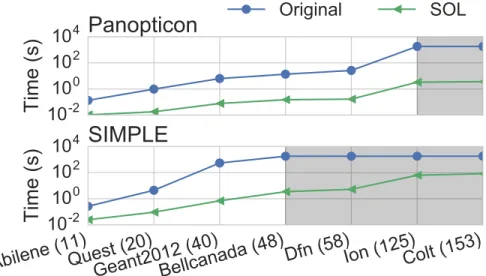
SOL solution times are at least one order of magnitude faster than solving the origi-nal formulations, and are often two or even three orders of magnitude faster. Figure3.10
indi-10
-210
010
210
4Time (s)
Panopticon
Original
SOL
Abilene (11)
Quest (20)
Geant2012 (40)
Bellcanada (48)
Dfn (58)Ion (125)Colt (153)
10
-210
010
210
4Time (s)
SIMPLE
Figure 3.10: Optimization runtime of SOL and original formulations; gray regions show where original formulation could not be solved within 30 mins
cated in the gray regions in Figure3.10.
Comparing to specialized heuristics: We found that SOL performs fairly well even compared to specialized heuristics. Specifically, we compared the performance of SOL to the custom heuristic for SIMPLE, obtained from its authors. The runtime of SOL is comparable to that of the SIMPLE heuristic algorithm, with a performance gap of at most 3 seconds on the largest topologies we considered (up 58 nodes, namely the “Dfn” topology). We believe the benefit of not having to design custom heuristics outweighs this performance gap.
Abilene (11)Quest (20)Geant2012 (40)Bellcanada (48)Dfn (58)Ion (125)Colt (153)
0.00 0.08 0.16 0.24 0.32 0.40 0.48
Traffic shift
Mindiff Optimal
(a) Fraction of traffic reassigned to different paths with and without “mindiff”
Abilene (11)Quest (20)Geant2012 (40)Bellcanada (48)Dfn (58)Ion (125)Colt (153)
0.00 0.05 0.10 0.15 0.20 0.25
Optimality gap
(b) Optimality gap when using “mindiff”
Figure 3.11: Traffic shift and optimality gap when using reconfiguration minimization capabilities of SOL
3.7.3 Comparison to Merlin and DEFO
Merlin [97] tackles problems of network resource management similar to SOL. While the goals and formulations of Merlin and SOL are quite different, we use this compari-son to highlight the generality of SOL and the power of its path abstraction. Specifically, Merlin uses a more heavyweight optimization that is always an ILP and operates on a graph that is substantially larger than the physical network. We implemented the exam-ple application taken from the Merlin paper using both SOL and Merlin. Figure3.12a
shows that SOL outperforms Merlin by two or more orders of magnitude.
DEFO [36] is an optimization framework that aims to simplify traffic engineer-ing [36]. We obtained the DEFO authors’ implementation and compared the optimiza-tion times of DEFO and SOL on a simple traffic engineering applicaoptimiza-tion. DEFO and SOL exhibit comparable runtimes (see Figure3.12b). However, DEFO lacks the ability to ex-press more complex applications and objectives and to filter paths by arbitrary predi-cates.
3.7.4 Developer benefits
some-Abilene (11)Quest (20)Geant2012 (40)Bellcanada (48)Dfn (58)Ion (125)Colt (153) 10-2
100
102
104
Time (s)
Merlin SOL
(a) Optimization runtimes of SOL and Mer-lin; gray region indicates where Merlin did not complete in 30 mins
Abilene (11) Quest (20) Geant2012 (40) Bellcanada (48)
0.0 0.4 0.8 1.2 1.6
Time (s)
DEFO SOL
(b) Optimization runtimes of SOL and DEFO, for a traffic engineering application
Figure 3.12: Runtime of SOL vs. state-of-the-art optimization frameworks
what quantitatively, Table3.5shows the number of lines of code (LOC) in our SOL im-plementations of various applications (“SOL lines of code”), and the ratio of the LOC of the original formulations to the LOC for our SOL implementations (“Estimated im-provement”). We acknowledge that lines-of-code comparisons are inexact, but we do not know of other ways of comparing “development effort” without conducting user studies.
Name SOL lines of code Estimated improvement
ElasticTree 16 21.8×
Panopticon 13 25.7×
SIMPLE 21 18.6×
Table 3.5: Development effort benefits provided by SOL
rele-0.0
0.8
1.6
2.4
3.2
4.0
Time (s)
Panopticon
0.00
0.01
Opt. gap
5
10
15
20
25
30
50
Number of paths (per class)
0
5
10
15
20
25
Time (s)
SIMPLE
5
10
15
20
25
30
50
Number of paths (per class)
0.00
0.05
Opt. gap
Abilene (11)
Quest (20)
Geant2012 (40)
Bellcanada (48)
Dfn (58)
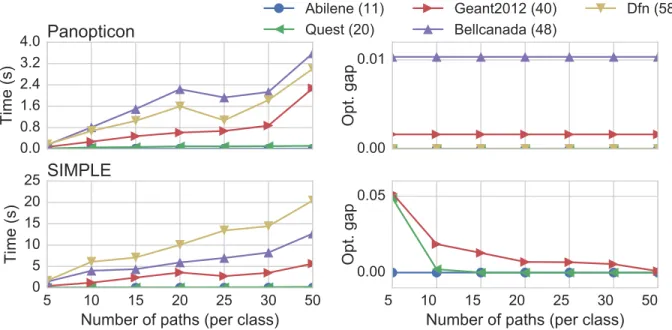
Figure 3.13: Runtime and optimality gap as function of number of paths; optimality is achieved in most cases with as few as 5 paths per class
vant device configurations.
3.7.5 Sensitivity
SOL solutions require the specification of both the number (selectNumber) and type (shortestorrandom) of paths to select per traffic class. In this section, we quantify how sensitive SOL is to these parameters.