Effect of Playing Surface on Knee and Hip Kinematics in Healthy Female Populations
Amy Loretta Fraley
A thesis submitted to the faculty of the University of North Carolina at Chapel Hill in partial fulfillment of the requirements for the degree Master of Arts in the Department of Exercise and Sport Science in the College of Arts and Sciences.
Chapel Hill 2011
iii ABSTRACT
AMY L. FRALEY: Effect of Playing Surface on Knee and Hip Kinematics in Healthy Female Populations
(Under the direction of Michael D. Lewek, PT, PhD)
Previous research implicates specific hip and knee kinematics during functional tasks as increasing the risk of ACL injury. Since a large number of severe knee injuries in females are non-contact, the purpose of this study is to determine if knee and hip kinematics during a jump landing cutting task in healthy female populations differ between third generation artificial turf and natural grass playing surfaces. We hypothesized that the task performed on the artificial turf would place the subjects in a biomechanical position that places a greater load on the ACL. Thirty-one female varsity and club soccer athletes performed a 90 degree cutting maneuver immediately after landing from a box jump on a natural grass and a 3rd generation artificial turf playing surface while 3D hip and knee kinematics were assessed. Subjects showed significantly different hip excursions in the frontal (p = 0.038) and transverse (p = 0.048) planes and knee excursions in the frontal plane (p = 0.014) between surface conditions, resulting in increased hip adduction and relatively more internal rotation on artificial turf. Such movements with functional tasks may increase the load placed on the ACL. Therefore, future research is needed to determine the ideal in-fill percentage and type of synthetic fiber, leading to further advancements and improvements in the safety of an artificial surface. In addition, further study into muscle recruitment patterns and the effect of experience on artificial turf surfaces could lead to the development of an intervention program and analysis of its long-term effect on injury prevention.
iv
TABLE OF CONTENTS
LIST OF FIGURES ... vii
LIST OF TABLES ... viii
CHAPTER I: INTRODUCTION ... 1
Variables ... 5
Independent Variables ... 5
Dependent Variables ... 5
Research Questions ... 5
Research Hypotheses... 6
Statistical Hypotheses ... 8
Null ... 8
Alternative ... 9
Operational Definitions... 9
Assumptions ... 10
Delimitations ... 10
Limitations ... 11
CHAPTER II: REVIEW OF LITERATURE ... 12
Introduction ... 12
v
Intrinsic Factors that Load the ACL ... 14
Gender Differences on Loading Factors ... 17
Extrinsic Risk Factors ... 18
History of Artificial Turf Use ... 20
Risk of Injury on Third Generation Artificial Turfs ... 21
Differences between 3rd Generation Turfs and Natural Grass ... 24
Plantar Pressure Distribution Patterns ... 24
Differences at the Shoe-Surface Interface ... 26
Clinical Significance ... 28
CHAPTER III: METHODOLOGY ... 30
Subjects ... 30
Instrumentation ... 31
Biomechanical Analysis ... 31
Testing Procedure ... 32
Setting ... 32
Subject Preparation ... 33
Data Collection Procedure ... 34
Data Analysis ... 35
Data Processing ... 35
vi
CHAPTER IV: RESULTS ... 37
Initial Contact ... 37
Excursion... 37
CHAPTER V: DISCUSSION ... 39
Limitations ... 43
Future Research ... 45
Clinical Significance ... 47
Conclusion ... 47
FIGURES ... 49
TABLES ... 56
APPENDIX A: Inclusion Criteria and Demographic Information Questionnaire ... 57
APPENDIX B: Manuscript formatted for Clinical Biomechanics ... 59
vii
LIST OF FIGURES
Figure 1. Transmitter placed between two playing surfaces to establish global reference
frame of the system. ... 49
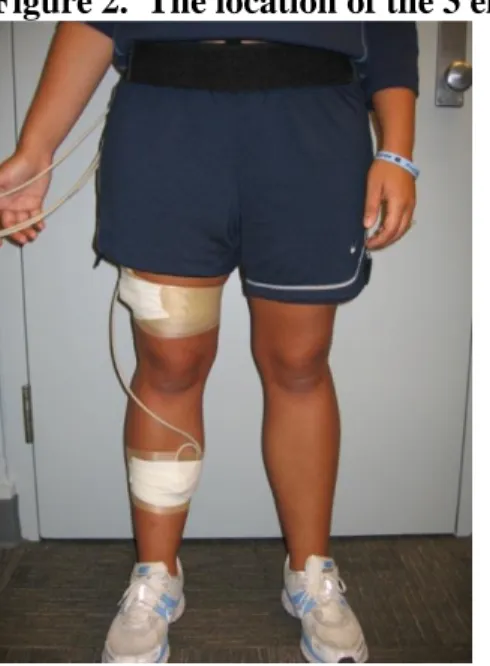
Figure 2. The location of the 3 electromagnetic tracking sensors. ... 49
Figure 3. The location of the 4 pressure sensors. ... 50
Figure 4. The attachment of the 4 pressure sensors’ connection wires to the leg. ... 50
Figure 5. Field set-up ... 51
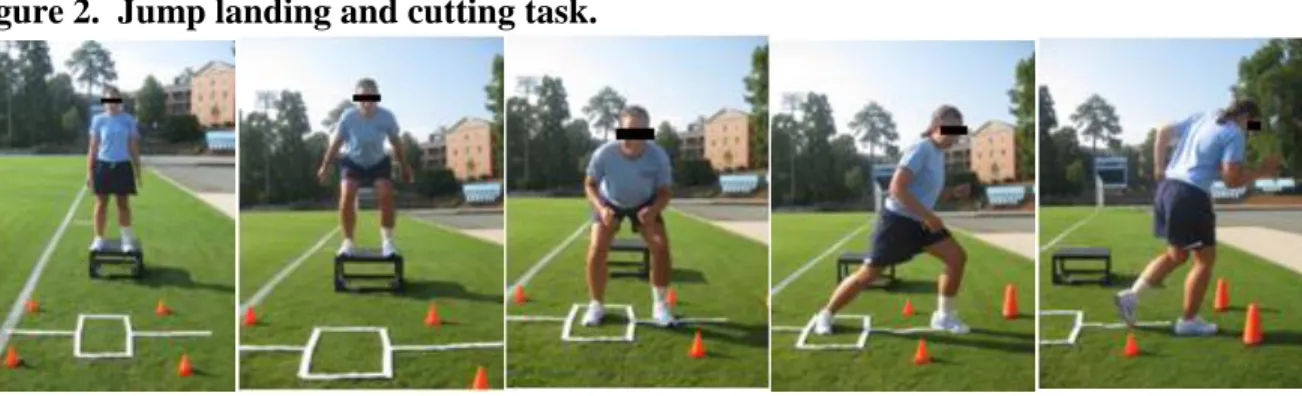
Figure 6. Jump landing and cutting task. ... 51
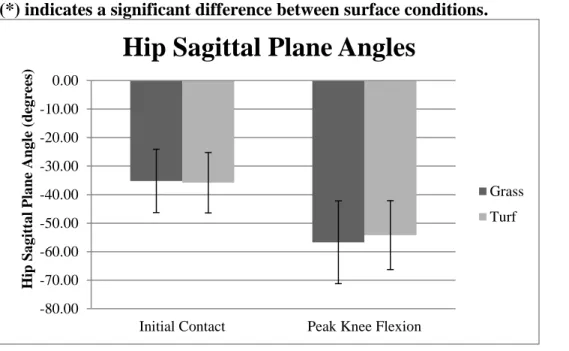
Figure 7. Means and standard deviations (SD) of hip sagittal plane angles at initial contact and peak knee flexion on natural grass and artificial turf surfaces. ... 52
Figure 8. Means and standard deviations (SD) of hip frontal plane angles at initial contact and peak knee flexion on natural grass and artificial turf surfaces. ... 52
Figure 9. Means and standard deviations (SD) of hip transverse plane angles at initial contact and peak knee flexion on natural grass and artificial turf surfaces. ... 53
Figure 10. Means and standard deviations (SD) of knee sagittal plane angles at initial contact and peak knee flexion on natural grass and artificial turf surfaces. ... 53
Figure 11. Means and standard deviations (SD) of knee frontal plane angles at initial contact and peak knee flexion on natural grass and artificial turf surfaces. ... 54
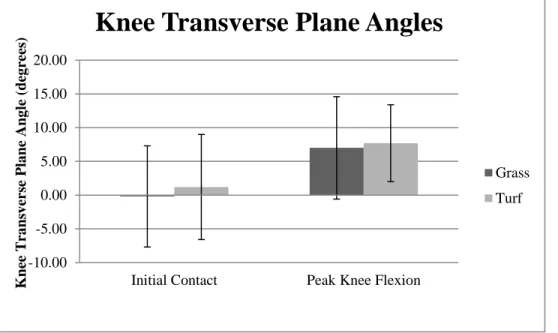
Figure 12. Means and standard deviations (SD) of knee transverse plane angles at initial contact and peak knee flexion on natural grass and artificial turf surfaces. ... 54
Figure 13. Means and standard deviations (SD) of hip angles from initial contact to peak knee flexion (excursion values) on natural grass and artificial turf surfaces . ... 55
viii
LIST OF TABLES
Table 1. Subject Demographics. ... 56
Table 2. Means and standard deviations (SD) of hip and knee kinematic variables at initial
contact and peak knee flexion during a jump landing cutting task on natural grass and
artificial turf surfaces. ... 56
Table 3. Means and standard deviations (SD) of hip and knee kinematic variables from
CHAPTER I INTRODUCTION
Since the beginning of the 1970s and the passing of Title IX, there has been a dramatic increase in the number of female athletes participating in individual and team sports in the United States (Arendt, Agel et al. 1999). Since then, the number of anterior cruciate ligament (ACL) injuries in the country has increased to an estimated 80,000 every year (Shimokochi and Shultz 2008). Of this daunting number, female athletes have been found to experience these injuries at a rate of 2 to 6 times more often than males playing the same sport (Arendt, Agel et al. 1999). Even more overwhelming is the fact that approximately 70% of these injuries occur in non-contact situations, usually during quick deceleration before a cutting maneuver or during a jump landing (Cowley, Ford et al. 2006; Shimokochi and Shultz 2008).
2
described as having “ligament dominance,” meaning that they rely more on passive restraints
in the knee by limiting motion in the sagittal plane, placing more stress on their ligaments (Ford, Myer et al. 2003; Pollard, Sigward et al. 2010). This behavior typically results in increased knee valgus, which has been shown, along with hip internal rotation and knee abduction and predicted by hip adduction angles, to increase the risk for ACL injury (Imwalle, Myer et al. 2009; Pollard, Sigward et al. 2010). The strain imposed to the ACL has also been found during in vivo and cadaveric studies to increase with knee internal rotation moments and decrease with knee external rotation moments when combined with a quadriceps force, resulting in a greater risk for ACL injury during excessive knee internal rotation moments and quadriceps force in weight-bearing (Shimokochi and Shultz 2008).
Extrinsic risk factors to injury include the playing surface, environmental conditions such as temperature and amount of moisture, and the forces occurring at the shoe-surface interface. It has been shown that increased ground hardness and high rotational traction and friction at the shoe-surface interface results in a higher potential for lower extremity injury (Livesay, Reda et al. 2006; Villwock, Meyer et al. 2009).
3
new generation turf resulted in greater shock absorption, to combat the higher amounts of overuse injuries seen on the first and second generation turfs, greater grass imitation, and a new in-fill system of sand and rubber to address the stiffness issues with the older turfs. The new turf also allows for an increased speed of play and is marketed to improve performance (Steffen, Andersen et al. 2007). Following these improvements, there has been an increased use in third generation turfs for multiple reasons. First, environmental and climatic conditions may make natural playing surfaces unsuitable for year-round events. In addition, the high use rates of the playing surface results in an inability to properly maintain grass, while overall maintenance costs are lower on artificial turf surfaces (Fuller, Dick et al. 2007). Recently, prospective and retrospective studies have shown no overall significant differences between the new artificial turfs and natural grass on incidence, severity, nature, and cause of acute and chronic injuries. However, no study was specific to ACL injury (Meyers and Barnhill 2004; Ekstrand, Timpka et al. 2006; Fuller, Dick et al. 2007; Fuller, Dick et al. 2007; Steffen, Andersen et al. 2007).
4
the cutting task, possibly causing more valgus stress to the knee (Eils, Streyl et al. 2004). This pattern differs from that found on a grass surface, which shows higher pressures on the medial forefoot and lateral midfoot. The higher loaded areas on the turf raise concerns that they may produce higher friction at the shoe-surface interface, which is known to lead to injury (Ford, Manson et al. 2006).
5 Variables
Independent Variables
Playing surface:
1. Natural grass surface
2. 3rd generation artificial turf surface (i.e. FieldTurf)
Dependent Variables
3D knee and hip kinematics from initial contact to peak knee flexion of a jump landing cutting task:
Knee sagittal plane angles (flexion / extension) Knee frontal plane angles (valgus / varus)
Knee transverse plane angles (internal / external rotation) Hip sagittal plane angles (flexion / extension)
Hip frontal plane angles (adduction / abduction)
Hip transverse plane angles (internal / external rotation) Research Questions
RQ1: Do knee sagittal plane angles during a jump landing cutting task in a sample of healthy female soccer players differ between third generation artificial turf and natural grass playing surfaces?
6
RQ3: Do knee transverse plane angles during a jump landing cutting task in a sample of healthy female soccer players differ between third generation artificial turf and natural grass playing surfaces?
RQ4: Do hip sagittal plane angles during a jump landing cutting task in a sample of healthy female soccer players differ between third generation artificial turf and natural grass playing surfaces?
RQ5: Do hip frontal plane angles during a jump landing cutting task in a sample of healthy female soccer players differ between third generation artificial turf and natural grass playing surfaces?
RQ6: Do hip transverse plane angles during a jump landing cutting task in a sample of healthy female soccer players differ between third generation artificial turf and natural grass playing surfaces?
Research Hypotheses
RH1: We hypothesize that there will be a significant difference between the natural grass surface and the 3rd generation artificial turf on knee sagittal plane angles from initial contact to peak knee flexion of a jump landing cutting task. The 3rd generation artificial turf will result in significantly less knee flexion during the jump landing cutting task when compared to the natural grass surface.
7
RH3: We hypothesize that there will be a significant difference between the natural grass surface and the 3rd generation artificial turf on knee transverse plane angles from initial contact to peak knee flexion of a jump landing cutting task. The 3rd generation artificial turf will result in significantly greater knee external rotation angle during the jump landing cutting task when compared to the natural grass surface.
RH4: We hypothesize that there will be a significant difference between the natural grass surface and the 3rd generation artificial turf on hip sagittal plane angles from initial contact to peak knee flexion of a jump landing cutting task. The 3rd generation artificial turf will result in significantly less hip flexion during the jump landing cutting task when compared to the natural grass surface.
RH5: We hypothesize that there will be a significant difference between the natural grass surface and the 3rd generation artificial turf on hip frontal plane angles from initial contact to peak knee flexion of a jump landing cutting task. The 3rd generation artificial turf will result in significantly greater hip adduction during the jump landing cutting task when compared to the natural grass surface.
8 Statistical Hypotheses
Null
Ho1: There will not be a significant difference between the natural grass surface and the 3rd generation artificial turf on knee sagittal plane angles from initial contact to peak knee flexion of a jump landing cutting task.
Ho2: There will not be a significant difference between the natural grass surface and the 3rd generation artificial turf on knee frontal plane angles from initial contact to peak knee flexion of a jump landing cutting task.
Ho3: There will not be a significant difference between the natural grass surface and the 3rd generation artificial turf on knee transverse plane angles from initial contact to peak knee flexion of a jump landing cutting task.
Ho4: There will not be a significant difference between the natural grass surface and the 3rd generation artificial turf on hip sagittal plane angles from initial contact to peak knee flexion of a jump landing cutting task.
Ho5: There will not be a significant difference between the natural grass surface and the 3rd generation artificial turf on hip frontal plane angles from initial contact to peak knee flexion of a jump landing cutting task.
9 Alternative
H1: There will be a significant difference between the natural grass surface and the 3rd generation artificial turf on knee sagittal plane angles from initial contact to peak knee flexion of a jump landing cutting task.
H2: There will be a significant difference between the natural grass surface and the 3rd generation artificial turf on knee frontal plane angles from initial contact to peak knee flexion of a jump landing cutting task.
H3: There will be a significant difference between the natural grass surface and the 3rd generation artificial turf on knee transverse plane angles from initial contact to peak knee flexion of a jump landing cutting task.
H4: There will be a significant difference between the natural grass surface and the 3rd generation artificial turf on hip sagittal plane angles from initial contact to peak knee flexion of a jump landing cutting task.
H5: There will be a significant difference between the natural grass surface and the 3rd generation artificial turf on hip frontal plane angles from initial contact to peak knee flexion of a jump landing cutting task.
H6: There will be a significant difference between the natural grass surface and the 3rd generation artificial turf on hip transverse plane angles from initial contact to peak knee flexion of a jump landing cutting task.
Operational Definitions
10
turfs have imitated grass with 50-60 mm synthetic fibers and an in-fill system of siliceous sand and rubber granules.
2. Initial contact was defined as the instant that the dominant foot came in contact with the ground from the jumping task to initiate the cutting maneuver.
3. Peak knee flexion was defined as the greatest knee flexion value in the dominant leg when landing from the jumping task and initiating the cutting maneuver. 4. Excursion was defined as the joint motion during the time period from initial
contact to peak knee flexion (weight acceptance). Assumptions
1. Subjects studied will represent their population accurately.
2. Subjects will follow directions when performing the study, including putting forth 100% effort for each cutting task.
3. The artificial turf and natural grass fields are located in the same geographical location. Therefore, environmental conditions (moisture and temperature) are the same.
Delimitations
1. Only females were tested.
2. Only healthy individuals were tested. Those with a recent history of knee or hip surgery in their dominant leg, ACL injury in either leg, or current hip, knee, ankle, or back injury that prevents athletic participation did not participate.
3. Dominant leg was assessed for all subjects.
11 Limitations
1. Results may not apply to males.
2. Results may not apply to athletes that have a history of or current injury to the back or lower extremity.
3. Results may not apply to the non-dominant limb. 4. The studied athletes may not represent all athletes. 5. Results will not apply to older generation turfs.
CHAPTER II
REVIEW OF THE LITERATURE
Introduction
In recent years, ACL injury rate has reached a frightening level, resulting in the thousands injured annually being affected financially, physically, and psychologically for many years to come. Of these injuries, females experience noncontact ACL injury more often than their male counterparts, with the disparity between genders thought to be because of differences in knee-loading motions while performing sport-specific tasks.
13 Epidemiology
Since the beginning of the 1970s and the passing of Title IX, there has been an impressive increase in the number of female athletes participating in individual and team sports in the United States (Arendt, Agel et al. 1999). Since that time, the number of ACL injuries in the country has increased to an estimated 80,000 every year, resulting in over 50,000 reconstructive ACL surgeries annually (Shimokochi and Shultz 2008). The monetary cost of these knee surgeries and the rehabilitation surrounding them has surpassed one billion dollars a year. Unfortunately, financial costs are not the only issues surrounding these devastating injuries. Short-term complications include negative effects on academic achievement, self-esteem, and psychological well-being. ACL injury also limits, if not completely eliminates, sport participation and the athletes’ pre-injury level of performance. Potential long-term complications include loss of normal knee function, lesions to the meniscus, osteoarthritis, and arthrofibrosis, each of which provide a barrier against and affect overall health and activity status (Cowley, Ford et al. 2006; Livesay, Reda et al. 2006; Shimokochi and Shultz 2008; Imwalle, Myer et al. 2009).
14
knee loaded in multiple planes of motion (Agel, Arendt et al. 2005; Cowley, Ford et al. 2006; Shimokochi and Shultz 2008).
Intrinsic Factors that Load the ACL
Overall risk factors for significant non-contact knee injury include specific intrinsic elements, or certain biomechanics inherent to the athlete, which have been shown to increase the likelihood of sustaining a significant knee injury, especially in the female population. A “position of no return” has been suggested by researchers as the situation in which an athlete
is most likely to injure the ACL. This position includes knee extension, knee valgus, knee external rotation, low hip flexion, hip adduction, and hip internal rotation (Ireland 1999). In general, load is imposed on the ACL during an anteriorly directed force to the tibia as the ACL works to restrict anterior tibiofemoral shear force. The amount of anterior tibiofemoral shear force directed to the ACL is affected by sagittal plane knee angle, quadriceps and hamstring activation, and gastrocnemius muscle force (Woo, Fox et al. 1998).
15
its capability to uphold against elastic deformation (Blackburn and Padua 2008; Alentorn-Geli, Myer et al. 2009).
Quadriceps muscle contraction, combined with knee flexion angle, is also believed to play a major role in producing anteriorly directed forces on the tibia (Pandy and Shelburne 1997; Isaac, Beard et al. 2005). With a decreased knee flexion angle, the angle between the patellar tendon and the longitudinal axis of the tibia is at its greatest. As a result, excessive quadriceps force at a decreased knee flexion angle increases the amount of strain experienced by the ACL. Conversely, hamstring muscle contraction decreases the amount of loading placed on the ACL. As knee flexion increases, the insertion angle of the hamstrings to the longitudinal axis of the tibia decreases to allow a hamstring contraction to counteract the loading placed on the ACL with anterior tibiofemoral shear force (Yu and Garrett 2007; Alentorn-Geli, Myer et al. 2009). The amount of tensile force placed on the ACL with a quadriceps contraction is decreased with the coactivation of the hamstrings, and it continues to decrease as knee flexion increases. Therefore, it seems that the protective ability of the hamstrings to combat ACL injury decreases with knee extension (Li, Rudy et al. 1999; Markolf, O'Neill et al. 2004).
16
Within the female population, it is indicated that females who limit knee motion in the sagittal plane rely on passive knee restraints in the frontal plane to help control the effects of movement and deceleration occurring to the body (Pollard, Sigward et al. 2010). This compensation has been termed “ligament dominance,” indicating that the musculature
surrounding the knee does not absorb the necessary energy during sport-specific activities, placing additional loading on the knee ligaments. It has also been shown that those females who exhibit decreased knee flexion with landing also demonstrate increased knee valgus angles and knee adductor moments, which have been found to be predictive of ACL injury (Hewett, Myer et al. 2005; Pollard, Sigward et al. 2010).
17
al. 2000). Conversely, it is also thought that ACL stress may increase with knee external rotation accompanied by knee valgus because these motions result in ACL impingement against the intercondylar notch. Therefore, ACL injury risk may be increased with knee valgus accompanied by either knee internal or external rotation (Fung and Zhang 2003).
Hip kinematics in the sagittal, frontal, and transverse planes also affect the motions occurring at the knee that are associated with increased risk for ACL injury. During cutting maneuvers, subjects have demonstrated increased hip and knee internal rotation angles with sharper cuts, possibly initiating high-load ACL positions and increasing risk for injury (Imwalle, Myer et al. 2009). It was also found that hip adduction and knee abduction were correlated during cutting tasks. With the hip adducted, knee valgus also increased, making hip adduction a predictor of the injurious knee valgus mechanism at the knee (Imwalle, Myer et al. 2009). In the sagittal plane, higher hip, knee, and trunk flexion angles during landing results in less impact to the knee as more energy is absorbed by the musculature. Increased hip and knee flexion also result in less vertical ground reaction force with landing, decreasing anterior tibiofemoral shear to the ACL (Alentorn-Geli, Myer et al. 2009).
Gender Differences on Loading Factors
18
compared to the male subjects. Since greater knee extension is known to load the ACL, females performing this cutting task placed greater stress on their ACL during initiation of the task and at their maximum knee flexion when compared to their male counterparts. Even though there was no statistical significance in differences in overall range of motion between genders, the tendency of females having overall greater range of motion may indicate a lack of joint control and coordination or differences in muscle strength in the female population when compared with males. These results indicate that males and females do perform cutting maneuvers using different techniques and control motion in the sagittal plane differently, with females showing a pattern more indicative of ACL loading.
Pollard et al. (2010) determined that females who utilized decreased knee flexion angles with landing showed greater knee valgus and knee adductor moments as well. This necessitates relying on the passive restraints in the frontal plane, resulting in the “ligament dominance” pattern associated with females. In a comparison of female to male high school
athletes during a landing task, Ford et al. (2003) found significant gender differences with maximum valgus and total valgus motion, with the females displaying more valgus motion with landing. These poor biomechanics of decreased knee flexion angle and greater valgus motion demonstrated by the female subjects show increased risk of ACL injury after examination of those factors that place additional stress on the ACL.
Extrinsic Risk Factors
19
risk factors were examined to find relationships between external factors and risk for injury. They determined that a relationship exists between ACL injury and weather conditions that result in a dryer playing surface, asserting that the speed of the game increases on a dryer surface, as well as the friction and torsional resistance between cleats and grass. In the long-term, it was concluded that low water evaporation and high rainfall significantly decreased the risk of noncontact ACL injuries, possibly from the decreased traction occurring at the shoe-surface interface. Meyers and Barnhill (2004) also noted a significant increase in incidence of injury on FieldTurf during temperatures greater than 70 degrees Fahrenheit when compared to colder days and to injuries on natural grass.
20 History of Artificial Turf Use
Previous research on the risk of injury on first and second generation artificial turfs is minimal and not easily accessible. Even with the lack of research concerning these earlier generation artificial turfs, there seems to be a preconception of overall negative public opinion and biasing against their safety. This deficiency of documented research evaluating the characteristics of the earlier artificial turfs is no where near comparable to the media hysteria and abundance of newspaper and magazine articles nationwide on their safety, furthering the public prejudice that artificial turfs predispose injury (Steffen, Andersen et al. 2007). Since the emergence of the first artificial turfs in the mid-1970s, artificial turf surfaces have been modified and improved from the high stiffness and friction that caused them to differ greatly from natural grass to a third generation of turf that closely imitates the properties of a natural playing surface. This advancement to the new generation turf included greater shock absorption to combat the higher amounts of overuse injuries seen on the first and second generation turfs, greater grass imitation with synthetic fibers, and a new in-fill system of different percentages of sand and rubber to address the stiffness issues experienced with the older turfs. The new turf also allows for an increased speed of play and is marketed to improve performance; however, some authors argue that the resulting increased speed of the game may be a factor of increased probability of risk for athletes participating on these surfaces (Meyers and Barnhill 2004; Steffen, Andersen et al. 2007).
21
game in addition to making field maintenance difficult and expensive. Further, high use rates of natural playing surfaces result in the inability for proper maintenance, while overall maintenance costs after installation are lower on artificial turf surfaces (Fuller, Dick et al. 2007; Fuller, Dick et al. 2007).
Risk of Injury on Third Generation Artificial Turfs
Several prospective studies have examined and compared the incidence, cause, and risk of injuries on natural grass and third generation artificial turf. Although most studies agree that there are no overall differences in the level of risk and cause of the injuries experienced on both surfaces, none have been specific to ACL injury. Specific differences in the incidence, cause, and risk of injury also continue to exist between surfaces across the research.
22
new artificial turf, but females experienced significantly less ankle sprains on turf compared with grass during match play. Mean severity in days lost were also higher during training with injuries experienced on the artificial turf for both males and females, although these differences were not statistically significant. The researchers decided before data collection that an increase of injury on artificial turf had to be 33% more than the level on natural grass for it to be considered a significant effect. They used an estimated incidence of match injuries of 25/1000 exposures for male and females, and their study was also limited by a small sample size. Therefore, even though there were specific significant differences and tendencies found between the new artificial turf and grass surfaces, Fuller et al. (2007; 2007) concluded that there are no major differences in overall cause of training or match injuries or level of risk of injury on new artificial turf and grass for athletes of both genders.
In a prospective two-cohort study, Ekstrand et al. (2006) found an increased risk of ankle sprains on artificial turf, but a decreased risk of muscle strains in elite male soccer players. They also found a tendency of fewer severe injuries occurring on natural grass during training sessions. The researchers found it encouraging that the overuse injury rate on the artificial turf was similar to that on natural grass, since a major change in the new generation artificial turf was increased shock absorption to decrease chronic injury. In conclusion, Ekstrand et al. (2006) asserted that incidence of injury is similar on artificial turf and natural grass in elite male soccer players, although the study was restricted by a small sample size.
23
injuries on FieldTurf when compared to grass and asserted that these injuries could be a function of the faster play that is associated with the new artificial turfs. A significant playing surface effect by mechanism of injury was also found. There was a higher incidence of noncontact running and sprinting injuries reported on the FieldTurf than on natural grass. However, they also found a higher rate of ligament tears on grass. No significant differences in injury rates were found between playing surfaces across specific knee injury cases, but a higher incidence of knee trauma was found on grass. It was acknowledged that there was a low amount of rainfall during the season that resulted in an increased hardness of the grass playing surfaces, which is known to be an extrinsic risk factor to injury. Although no significant environmental differences were found between surfaces, a significant increase was noted in incidence of injury on FieldTurf during temperatures greater than 70 degrees Fahrenheit. Therefore, Meyers and Barnhill (2004) concluded that there were overall differences between FieldTurf and natural grass on incidence, cause, and severity of game-related injury in high school football players.
24
The overall consensus of the prospective research indicates that there are no differences in injury risk between the new generation artificial turfs and natural grass for female or male athletes. However, trends and tendencies within each study indicated that there are specific differences between playing surfaces, with the negative tendency leaning toward the artificial turf.
Differences between 3rd Generation Turfs and Natural Grass
Even though the rubber or sand in-fill systems associated with the new generation artificial turfs are meant to mimic the characteristics of natural grass, these newer artificial turfs still have different traits when compared to grass, such as stiffness, friction, and elasticity, which have been shown to cause differences on foot loading patterns and the forces at the shoe-surface interface (Ford, Manson et al. 2006).
Plantar Pressure Distribution Patterns
25
the “cleat-catch” mechanism that occurs on natural grass. The increased friction and rotation
at the shoe-surface interface could then be transferred proximally to the knee. The total loading experienced by the entire foot did not change across surfaces, and there were no differences found in performance time and stance phase contact time during the cutting task. Because the total loading under the entire foot remained the same across surfaces, differences found were thought to be caused by changes in foot motion between the new generation artificial turf and natural grass surfaces.
26 Differences at the Shoe-Surface Interface
From an injury prevention standpoint, there are a lot of risk factors and possible causes of noncontact ACL injuries, many of which have been listed above. However, one major factor often implicated in noncontact injuries is the interaction of the injured athlete’s shoe with the playing surface. Several factors have been identified as influences on the torque produced at the shoe-surface interface. These include the number and size of the cleats on the shoe, the material distribution at the toe and heel of a shoe, the type of playing surface, the weight and stance of the athlete, and the effective cleat engagement. In studies performed by Torg and Quedenfeld (1971) and Lambson et al. (1996), they determined that the type of cleat was correlated with ankle and knee injuries. Torg and Quedenfeld (1971) determined that the number and size of cleats on the shoe is correlated with ankle and knee injuries and that less aggressive cleats produced fewer injuries. Lambson et al. (1996) agreed that long, irregular cleats along the outside of the shoe and smaller, pointed cleats on the inside with most associated with the incidence of ACL tears. Even though cleat design has been determined to have an impact on incidence of injury, it is hard to make generalizations about “safe” and “unsafe” cleats, since their interaction and production of torque will change
with the playing surface (Livesay, Reda et al. 2006). Therefore, it is necessary to look past the shoe design and focus on the characteristics of the playing surface.
27
stiffness developed at the interface. The highest peak torques were found on the FieldTurf surface, with the lowest peak torques found with the same cleat shoe on natural grass.
Villwock et al. (2009) found similar results when studying the effect on shoe design and playing surface on rotational traction. Peak torque and rotational stiffness at the shoe-surface interface were significantly affected by the playing shoe-surface. Third generation artificial turfs produced higher torques and rotational stiffness that the grass surface. The lower rotational stiffness on grass indicates a lower rate of loading during a maneuver, which might allow more time for neuromuscular control during a cutting task. This may provide protection to the passive restraints of lower extremity joints, while high rotational traction could lead to lower extremity injury. Livesay et al. (2006) agreed that rotational stiffness may play the most important role at the shoe-surface interface in risk for injury, and they believe that it could be a more perceptive indicator of the mechanical interactions occurring at the interface. In comparison of shoe design, Villwock et al. (2009) determined that cleat pattern showed no difference in rotational stiffness; however, peak torque was lower with the turf cleat. In addition, the shoe model did not have an effect on peak torque, but it did affect rotational stiffness.
28
the shoe-surface interface and on motions caused by plantar pressure distribution, necessitating further study on their effects on injury risk at proximal joints.
Clinical Significance
29
CHAPTER III METHODOLOGY
This study is a within subjects, repeated measures design. All subjects’ knee and hip sagittal, frontal, and transverse plane kinematics were evaluated during a jump landing cutting task on two different playing surfaces. Differences in knee and hip kinematics were examined within subjects and attributed to the playing surface.
Subjects
31
injury on the hip and knee kinematics across the surfaces. Athletic activity was not allowed prior to testing to avoid the effects of fatigue.
Instrumentation
Biomechanical Analysis
Knee and hip kinematics were collected using the Flock of Birds electromagnetic motion analysis system (Ascension Technologies, Inc., Burlington, VT) during a jump landing cutting task on a natural grass surface and a 3rd generation artificial turf surface. The Motion Monitor software system (Innovative Sports Training, Inc., Chicago, IL) was used to record measurements at a kinematic sampling rate of 144 Hz. A transmitter was placed on a stationary stand between the 2 surfaces to establish the global reference frame of the system
(Figure 1). Relative to the natural grass surface, the positive x-axis was established in the
direction of the jump pre-cut, positive y-axis was to the subject’s left pre-cut, and the positive z-axis was directed vertically and extending superiorly to the subject.
32
lateral malleolus, left anterior superior iliac spine, and right anterior superior iliac spine. The digitization of the bony landmarks allowed for the definition of each segment’s end points and joint centers of the lower extremity. The knee joint center was defined as the midpoint between the lateral and medial femoral condyles. The hip joint center was defined by means of the Bell method, mathematically estimating the center using the right and left anterior superior iliac spines (Bell, Pedersen et al. 1990).
Foot switches (MA-300 EMG System; Motion Lab Systems, Baton Rouge, LA), or force sensitive resistors, were used to determine the dominant leg’s first foot contact from the
jump landing to define initial contact on each playing surface. The one-inch in diameter switches were able to detect pressure or force changes in resistance, creating a trigger that was picked up by the Motion Monitor software. The trigger indicated initial contact. The 4 pressure sensors were placed in the athlete’s dominant shoe under the great toe, first
metatarsal head, fifth metatarsal head, and heel (Figure 3 and 4).
Testing Procedure Setting
33
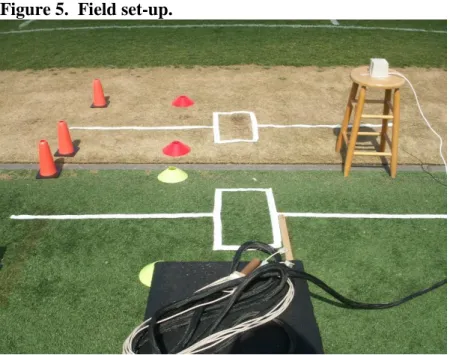
cm box with a non-slip surface was placed on each surface to allow for a landing task immediately prior to the cutting task (Figure 5).
Subjects who volunteered for participation in this study reported to the fields for one testing session. The testing session lasted approximately 30-45 minutes. On arrival to the testing session, all participants read and signed an informed consent form approved by the University of North Carolina at Chapel Hill Institutional Review Board. Subjects were also given the opportunity to discuss the study and all testing procedures.
There were five days of testing, from mid-February to March. Temperatures ranged in the sixties, and testing was only completed on sunny days to avoid moisture and humidity around the equipment. One testing session occurred following a day of rain, so 9 subjects may have performed their testing on more moist ground conditions when compared with the other 22 subjects.
Subject Preparation
Subjects were given a questionnaire to confirm eligibility status and lack of exclusion criteria (Appendix A). The questionnaire was also used to determine the subjects’ age, shoe size, dominant leg, and possible allergies to adhesives. Dominant leg was determined as the leg the subject would choose to kick a ball as far as possible. All subjects were asked to wear athletic attire, specifically shorts, to aid in the visualization of bony landmarks during the digitizing process and to allow placement of the electromagnetic sensors and full range of motion. Subjects were also asked to bring the cleats they would choose to wear in competition on natural grass and 3rd generation artificial turf surfaces.
After the completion of the questionnaire, the subjects’ height and weight were
34
fifth metatarsal head, and heel of the subject’s dominant foot (Chu, Tang et al. 2009). Each subject was then given 5 minutes to warm-up on a stationary bicycle and an opportunity to stretch, and the jumping box was placed at half the subject’s height away from the cutting
box taped on the field. Each subject was then instrumented with the 3 electromagnetic tracking sensors and digitized for the definition of each segment’s end points and joint
centers of the lower extremity as described above. Subjects were given specific instructions on how to perform the trial. These instructions included jumping off the 30 cm jumping box, landing on both feet with the dominant foot in the cutting rectangle, and cutting at a 90 degree angle on the dominant leg immediately following initial contact with the playing surface (Figure 6). A cutting demonstration was then given to each subject, and up to 5 practice trials were allotted so that the subject would be familiar with the testing process.
Data Collection Procedure
35 Data Analysis
Data Processing
Embedded right-hand Cartesian coordinate systems were defined for the hip and knee to describe the three-dimensional position and orientation of the pelvis, thigh, and shank in alignment with the global reference system. Euler angles were used to calculate the hip angles between the pelvis and thigh and knee angles between the thigh and shank. Flexion and extension occurred about the y-axis, knee valgus/varus and hip abduction/adduction occurred about the x-axis, and internal and external rotation occurred about the z-axis. The kinematic data from the Motion Monitor software was exported and reduced using customized MATLAB software (The MathWorks Inc., Natick, MA). The kinematic data was low pass filtered using a 4th order Butterworth filter at 14.5 Hz. Hip extension, hip adduction, and hip internal rotation were indicated by positive values. Knee flexion, knee varus, and knee internal rotation were indicated by positive values.
36
change from initial contact to the time corresponding with peak knee flexion. These values were created for each subject’s dependent variables on both surfaces. The 3 “best” trials were chosen by initially looking at trials 2, 3, and 4. However, trial 1 or 5 may have been used if there was increased motion artifact or if initial contact could not be determined in trials 2, 3, and 4.
Statistical Analysis
CHAPTER IV RESULTS
Initial Contact
Hip and knee kinematic variables at initial contact and peak knee flexion are presented in Table 2 (Figures 7-12). Qualitatively, there are minimal differences at initial contact of all kinematic variables between the two playing conditions (< 2 degrees).
Excursion
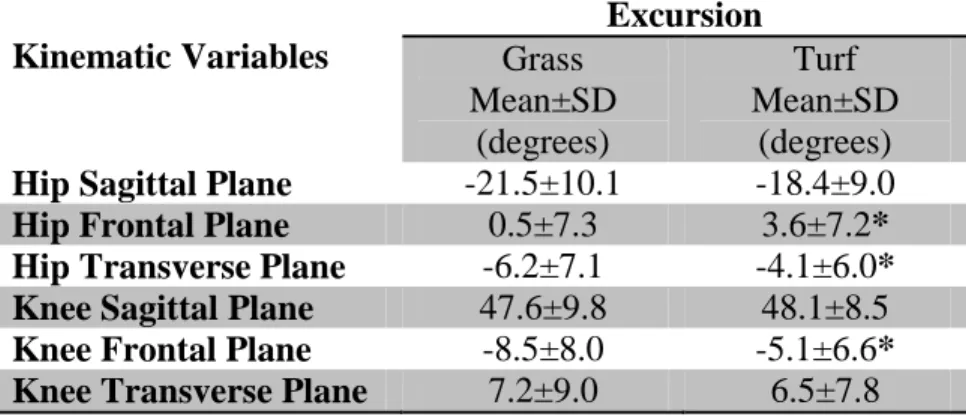
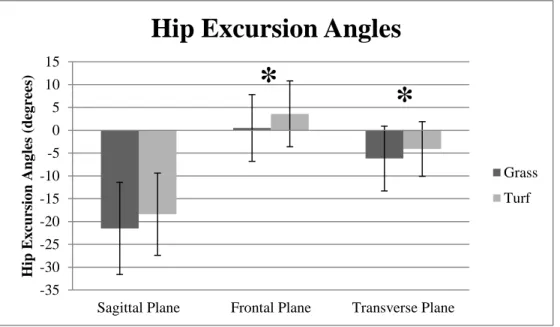
Hip and knee kinematic variables from initial contact to peak knee flexion (excursion values) are presented in Table 3. Although sagittal plane hip excursion angles were not significantly different between the natural grass and artificial turf surfaces (t26 = -1.987, p = 0.058), significant differences were observed at the hip in the frontal (t26 = -2.190, p = 0.038) and transverse planes (t26 = -2.075, p = 0.048) from initial contact to peak knee flexion
(Figure 13). Specifically, subjects showed significantly more hip movement in the frontal
38
surface than the artificial turf surface at peak knee flexion. The mean hip transverse plane angle at peak knee flexion on the grass surface was -5.6±8.2º and the mean on the artificial turf surface was -2.7±7.7º, meaning that the hip was more externally rotated on the natural grass surface.
CHAPTER V DISCUSSION
These findings partially confirm the hypothesis that performing a jump landing and cutting task on the artificial turf surface alters lower extremity kinematics when compared to natural grass. Specifically, the performance of a jump landing and cutting task on an
artificial turf surface produced more hip adduction and less hip external rotation motion during weight acceptance compared to the same task performed on a natural grass surface. In addition, there was an increased frontal plane excursion on natural grass. This altered
movement pattern may have clinical implications for injury risk at the knee.
40
as well as changes in proximal joint kinematics, which is known to lead to injury (Ford, Manson et al. 2006).
We are particularly concerned about the abnormal motion of the hip joint, due to its role in controlling knee movement and the subsequent increase in load on the ACL. Previous investigators have examined movement patterns in the frontal plane and established that hip adduction and knee abduction were correlated during cutting tasks. With the hip adducted, knee valgus also increased, making hip adduction a predictor of the injurious valgus
41
In addition to the elevated risk for ACL injury, increased hip adduction and internal rotation with functional tasks can increase stress at the patellofemoral joint. Souza and Powers (2009) found that females with patellofemoral pain displayed increased hip internal rotation during running. In addition, Powers et al. (2003) concluded that the excessive lateral tilt and glide of the patella during a single leg squat was due to the internal rotation of the femur occurring at the hip instead of movement at the patellofemoral joint. These results suggest that the movement patterns occurring at the hip during functional tasks can influence the kinematics of the patellofemoral joints in a manner consistent with causing
patellofemoral pain (Powers, Ward et al. 2003; Souza and Powers 2009).
42
peak knee flexion during the performance of a more demanding quick deceleration maneuver.
It is possible that the magnitude of the changes occurring at the hip in the frontal and transverse planes may not be enough to elicit a change in biomechanical positioning at the knee. Therefore, the hip kinematic differences between landing surfaces alone may not be great enough to predispose an athlete to injury on the artificial turf surface. However, for those athletes already playing with additional or increased risk factors, competing on artificial turf may further increase the risk for ACL injury beyond the threshold for injury. Thus, the results of the current research study suggest that the performance of jump landing cutting tasks on 3rd generation artificial turf alters hip frontal and transverse plane kinematics in a manner consistent with increasing the load placed on the ACL.
43
We suspect that any increased comfort or effort could have resulted in more movement at the knee in the frontal plane.
Even though hip kinematic differences were found between surfaces, these changes in biomechanics do not necessarily mean that more ACL injuries will occur on the artificial turf when compared to natural grass. Several prospective studies have examined and compared the incidence, cause, and risk of injuries on natural grass and third generation artificial turf (Meyers and Barnhill 2004; Ekstrand, Timpka et al. 2006; Fuller, Dick et al. 2007; Fuller, Dick et al. 2007; Steffen, Andersen et al. 2007). Although most studies agree that there are no overall differences in the level of risk and cause of the injuries experienced on both surfaces, none have been specific to ACL injury.
Limitations
Potential limitations to the current research study include the use of only female soccer players. Females were chosen specifically because it was believed that greater
44
Results also cannot be applied to other brands of 3rd generation artificial turfs. The multiple types of artificial turfs have different qualities of the synthetic grass fibers and the in-fill systems of different percentages of sand and rubber. These different qualities could lead to changes in friction and stiffness at the shoe-surface interface, possibly affecting hip and knee kinematics with landing and cutting maneuvers (Meyers and Barnhill 2004; Steffen, Andersen et al. 2007).
Excessive motion artifact (i.e., noise) from the electromagnetic tracking sensors during landing limited the ability to analyze the hip and knee kinematic data over the loading phase. Although theoretically most loading to the ACL would occur at peak knee flexion, it was not possible to verify peak kinematic values over the loading phase. Therefore, for example, higher knee valgus could have occurred prior to peak knee flexion, but was not analyzed due to the variability of the data.
45
et al. 2001). Since more moisture would be absorbed on the artificial surface when compared to natural grass, it could be suggested that the friction and torsional resistance would be higher on the artificial surface. In addition, Meyers and Barnhill (2004) noted a significant increase in incidence of injury on FieldTurf during temperatures greater than 70 degrees Fahrenheit when compared to colder days and to injuries on natural grass. The testing of the current study occurred during temperatures less than 70 degrees. Therefore, greater
kinematic differences could have been noted if testing had been completed during higher temperatures.
Future Research
46
It would also be beneficial to study muscular recruitment or firing patterns during landing or cutting maneuvers on multiple playing surfaces. Different surfaces could cause changes in preparation for the task, which may not necessarily present as kinematic
differences. This information may allow for the development of training programs to battle the increased risk of hip adduction and internal rotation during deceleration tasks on artificial turf surfaces.
Because our subjects were chosen specifically based on their experience with activities on both natural grass and artificial turf surfaces, future study is necessary to make assertions about how athletes naïve to participation on artificial surfaces would react to competing on that condition. Those athletes with familiarity on artificial surfaces may have the experience necessary to mitigate abnormal movement patterns during those tasks that place additional load on the ACL. Conversely, athletes without the experience to avoid altered movement patterns that may be related to playing on artificial turf may have a greater predisposition to injury than those athletes with an awareness of the surface. A related question would then concern if those athletes that play on artificial surfaces should practice on those surfaces as well. If the artificial turf does predispose ACL injury, additional
exposures on that surface would only increase the likelihood for injury. However, increased familiarity with the surface may decrease the probability of injury during game play.
47 Clinical Significance
As excessive hip frontal and transverse plane kinematics can add to the load placed on the ACL, injury prevention programs designed to decrease the injurious biomechanical position of hip adduction and internal rotation may be necessary for those athletes
continuously competing on artificial turf surfaces. In an in-season ACL injury prevention program study performed by Pollard et al. (2006), the intervention program significantly altered the hip kinematics of female soccer players. After participating in a season-long training program, female soccer players demonstrated decreased peak hip internal rotation and adduction angles during landing. Pollard et al. (2006) concluded that injury prevention training, completed with normal soccer practice, is beneficial in altering the lower extremity kinematics that otherwise would place athletes in a biomechanical position that places additional load on the ACL.
Conclusion
During a jump landing cutting task, females displayed altered movement in the frontal and transverse planes at the hip, resulting in greater hip adduction and less hip external rotation during loading on a 3rd generation artificial turf surface compared to a natural grass surface. The observed changes in kinematics at the hip could be caused by or lead to altered frontal plane motion at the knee. These findings suggest that the artificial turf surface places females in a biomechanical position at the hip that places more load on the ACL, but a position at the knee which is protective of the ACL. Future research is needed to determine the ideal in-fill percentage and type of synthetic fiber, leading to further
48
FIGURES
Figure 1. Transmitter placed between two playing surfaces to establish global reference frame of the system.
50 Figure 3. The location of the 4 pressure sensors.
51 Figure 5. Field set-up.
52
Figure 7. Means and standard deviations (SD) of hip sagittal plane angles at initial contact and peak knee flexion on natural grass and artificial turf surfaces. The asterisk (*) indicates a significant difference between surface conditions.
Figure 8. Means and standard deviations (SD) of hip frontal plane angles at initial contact and peak knee flexion on natural grass and artificial turf surfaces. The asterisk (*) indicates a significant difference between surface conditions.
-80.00 -70.00 -60.00 -50.00 -40.00 -30.00 -20.00 -10.00 0.00
Initial Contact Peak Knee Flexion
H ip Sa g it ta l P la ne Ang le (deg re es)
Hip Sagittal Plane Angles
Grass Turf -15.00 -10.00 -5.00 0.00 5.00 10.00
Initial Contact Peak Knee Flexion
H ip F ro nta l P la ne Ang le (deg re es)
Hip Frontal Plane Angles
Grass
53
Figure 9. Means and standard deviations (SD) of hip transverse plane angles at initial contact and peak knee flexion on natural grass and artificial turf surfaces. The asterisk (*) indicates a significant difference between surface conditions.
Figure 10. Means and standard deviations (SD) of knee sagittal plane angles at initial contact and peak knee flexion on natural grass and artificial turf surfaces. The asterisk (*) indicates a significant difference between surface conditions.
-15.00 -10.00 -5.00 0.00 5.00 10.00 15.00
Initial Contact Peak Knee Flexion
H ip T ra ns v er se P la ne Ang le (deg re es)
Hip Transverse Plane Angles
Grass Turf
*
0.00 10.00 20.00 30.00 40.00 50.00 60.00 70.00 80.00 90.00Initial Contact Peak Knee Flexion
K n ee S a g itt a l Pla n e An g le ( d eg rees)
Knee Sagittal Plane Angles
Grass
54
Figure 11. Means and standard deviations (SD) of knee frontal plane angles at initial contact and peak knee flexion on natural grass and artificial turf surfaces. The asterisk (*) indicates a significant difference between surface conditions.
Figure 12. Means and standard deviations (SD) of knee transverse plane angles at initial contact and peak knee flexion on natural grass and artificial turf surfaces. The asterisk (*) indicates a significant difference between surface conditions.
-20.00 -15.00 -10.00 -5.00 0.00 5.00 10.00
Initial Contact Peak Knee Flexion
K nee F ro nta l P la ne Ang le (deg re es)
Knee Frontal Plane Angles
Grass Turf -10.00 -5.00 0.00 5.00 10.00 15.00 20.00
Initial Contact Peak Knee Flexion
K nee T ra ns v er se P la ne Ang le (deg re es)
Knee Transverse Plane Angles
Grass
55
Figure 13. Means and standard deviations (SD) of hip angles from initial contact to peak knee flexion (excursion values) on natural grass and artificial turf surfaces. The asterisk (*) indicates a significant difference between surface conditions.
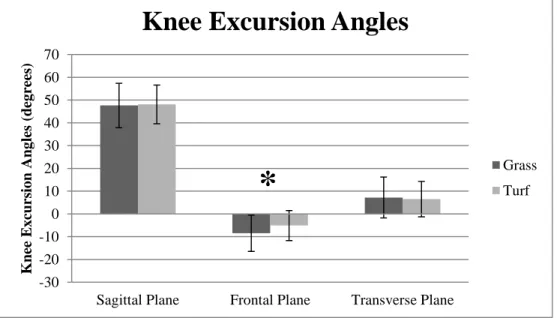
Figure 14. Means and standard deviations (SD) of knee angles from initial contact to peak knee flexion (excursion values) on natural grass and artificial turf surfaces. The asterisk (*) indicates a significant difference between surface conditions.
-35 -30 -25 -20 -15 -10 -5 0 5 10 15
Sagittal Plane Frontal Plane Transverse Plane
H ip E x cursio n Ang les (deg re es)
Hip Excursion Angles
Grass Turf
*
*
-30 -20 -10 0 10 20 30 40 50 60 70Sagittal Plane Frontal Plane Transverse Plane
K nee E x cursio n Ang les (deg re es)
Knee Excursion Angles
Grass
TABLES
Table 1. Subject Demographics.
Number of Subjects (n) 27
R Dominant/L Dominant 25/2
Varsity/Club 17/10
Age (yrs) 20.0±1.4
Height (cm) 167.5±6.5
Mass (kg) 65.2±11.1
Years Playing Competitively 11.6±3.3
Table 2. Means and standard deviations (SD) of hip and knee kinematic variables at initial contact and peak knee flexion during a jump landing cutting task on natural grass and artificial turf surfaces. The asterisk (*) indicates a significant difference between surface conditions.
Kinematic Variables
Initial Contact Peak Knee Flexion
Grass Mean±SD (degrees) Turf Mean±SD (degrees) Grass Mean±SD (degrees) Turf Mean±SD (degrees)
Hip Sagittal Plane -35.2±11.1 -35.8±10.6 -56.7±14.5 -54.2±12.1
Hip Frontal Plane -3.7±6.6 -2.8±6.4 -3.2±6.6 0.8±7.0*
Hip Transverse Plane 0.6±8.3 1.4±8.1 -5.6±8.2 -2.7±7.7*
Knee Sagittal Plane 19.1±8.3 21.0±5.7 66.7±11.2 69.0±7.8
Knee Frontal Plane 0.8±4.1 -0.7±4.3 -7.7±8.3 -5.8±6.9
Knee Transverse Plane -0.2±7.6 1.2±7.8 7.0±7.6 7.7±5.7
Table 3. Means and standard deviations (SD) of hip and knee kinematic variables from initial contact to peak knee flexion (excursion values) during a jump landing cutting task on natural grass and artificial turf surfaces. The asterisk (*) indicates a significant difference between surface conditions.
Kinematic Variables Excursion Grass Mean±SD (degrees) Turf Mean±SD (degrees)
Hip Sagittal Plane -21.5±10.1 -18.4±9.0
Hip Frontal Plane 0.5±7.3 3.6±7.2*
Hip Transverse Plane -6.2±7.1 -4.1±6.0*
Knee Sagittal Plane 47.6±9.8 48.1±8.5
Knee Frontal Plane -8.5±8.0 -5.1±6.6*
57
APPENDIX A: Inclusion Criteria and Demographic Information Questionnaire
Identification Number: ________
Inclusion Criteria and Demographic Information Questionnaire
Please answer the following questions honestly and to the best of your ability.
What is your gender?
How old are you?
What is your shoe size?
What sport do you play at UNC-CH? Are you a varsity or club athlete?
How many years have you been playing soccer competitively?
What is your dominant leg? You dominant leg is defined as the leg you would choose to kick a ball as far and as hard as possible.
Do you currently have any lower extremity of other injury that prevents or limits your athletic participation? If yes, what and why?
58
Do you have a history of any other knee surgery to your dominant leg in the past year? If yes, what?
Did you participate in any athletic activity in the hour prior to this testing session? Athletic activity is defined as any activity that may raise your heart rate, such as running, sport-specific activities, or resistance exercises. If yes, what and when?
Do you have an allergy to any type of adhesive? The tracking sensors will be applied with double-sided tape.
Height: ___________
59
APPENDIX B: Manuscript formatted for Clinical Biomechanics
EFFECT OF PLAYING SURFACE ON KNEE AND HIP KINEMATICS IN HEALTHY FEMALE POPULATIONS
Amy L. Fraley, ATC, LAT Graduate Student
University of North Carolina at Chapel Hill Chapel Hill, NC
Michael D. Lewek, PT, PhD Assistant Professor
University of North Carolina at Chapel Hill Chapel Hill, NC
Steven Zinder, PhD, ATC Assistant Professor
University of North Carolina at Chapel Hill Chapel Hill, NC
Benjamin M. Goerger, MS, ATC Doctoral Student
University of North Carolina at Chapel Hill Chapel Hill, NC
Corresponding Author: Amy Fraley, ATC, LAT Fetzer Hall, CB# 8700
Sports Medicine and Neuromuscular Research Laboratories University of North Carolina at Chapel Hill
Chapel Hill, NC 25799-8700 Phone #: 919-962-2728 Fax #: 919-962-0489
Email: [email protected] Abstract Word Count: 250 Main Body Word Count: 5,451 Number of Figures: 4
60 ABSTRACT
Background. Previous research implicates specific hip and knee kinematics during functional tasks as increasing the risk of ACL injury. Since a large number of severe knee injuries in females are non-contact, the purpose of this study is to determine if knee and hip kinematics during a jump landing cutting task in healthy female populations differ between third generation artificial turf and natural grass playing surfaces. We hypothesized that the task performed on the artificial turf would place the subjects in a biomechanical position that places a greater load on the ACL.
Methods. Thirty-one female varsity and club soccer athletes performed a 90 degree cutting maneuver immediately after landing from a box jump on a natural grass and a 3rd generation artificial turf playing surface while 3D hip and knee kinematics were assessed.
Results. Subjects showed significantly different hip movement in the frontal (p = 0.038) and transverse (p = 0.048) planes and knee movement in the frontal plane (p = 0.014) between surface conditions.
Interpretation. Increased hip adduction and internal rotation with functional tasks can increase the load placed on the ACL. Therefore, future research is needed to determine ideal in-fill percentages and synthetic fibers, leading to further advancements in the safety of an artificial surface. In addition, further study into muscle recruitment patterns and the effect of experience on artificial turf surfaces could lead to the development of an intervention program and analysis of its long-term effect on injury prevention.
61 1. Introduction
Since the beginning of the 1970s and the passing of Title IX, there has been a dramatic increase in the number of female athletes participating in individual and team sports in the United States (Arendt, Agel et al. 1999). Since then, the number of anterior cruciate ligament (ACL) injuries in the country has increased to an estimated 80,000 every year (Shimokochi and Shultz 2008). Of this daunting number, female athletes have been found to experience these injuries at a rate of 2 to 6 times more often than males playing the same sport (Arendt, Agel et al. 1999). Even more overwhelming is the fact that approximately 70% of these injuries occur in non-contact situations, usually during quick deceleration before a cutting maneuver or during a jump landing (Cowley, Ford et al. 2006; Shimokochi and Shultz 2008).
Overall risk factors for non-contact knee injury include intrinsic and extrinsic factors. Of these risk factors, certain biomechanics inherent to the athlete, as well as those from the playing surface and environmental conditions,have been shown to increase the likelihood of sustaining a significant knee injury (James, Sizer et al. 2004; Alentorn-Geli, Myer et al. 2009; Pollard, Sigward et al. 2010). Females have been described as having “ligament dominance,” meaning that they rely more on passive restraints in the knee by limiting motion
in the sagittal plane, placing more stress on their ligaments (Ford, Myer et al. 2003; Pollard, Sigward et al. 2010). This behavior typically results in increased knee valgus, which has been shown to increase the risk for ACL injury (Imwalle, Myer et al. 2009; Pollard, Sigward et al. 2010).