Acknowledgements
Abstract
Over the past decade, conservative states in the US have passed a wide array of laws restricting abortion access to a point unseen since the landmark decision of Roe v. Wade. While the
I. Introduction
In 2010, Republicans took control of the entire legislature in 25 states, the most the party had won since 1952 (Rasmussen 2010). Since then, Republican governments have been enacting abortion laws to restrict access in an unprecedented scope. These laws have typically consisted of 4 different types of policy: Targeted Regulation of Abortion Providers (TRAP), Forced
Counseling and Waiting Periods, Banned Insurance Coverage of Abortion, and Limited Abortion to the First 20 Weeks of Pregnancy (Guttmacher Institute 2017). More state abortion restrictions were enacted between 2011 and 2013 than in the entire previous decade (Guttmacher Institute 2014).
By July of 2013, Texas had passed one of the most comprehensive abortion laws in the country, widely known as HB2. The bill included TRAP, Forced Counseling and Limited
Abortion provisions. The following year, the state reported 8,947 fewer induced abortions than in 2013. The abortion ratio, the total number of induced abortions among Texas residents of all ages per 1,000 women aged 15-44 years, dropped to 9.5 in 2014 compared to 11.2 in 2013 (Texas Health and Human Services 2014). The number of open abortion clinics in the state fell by over half, from 40 to 19 (Ura et al 2016).
25 percent, yet 24 percent of women are still expected to have an abortion by age 45 (Jones and Jerman 2017).
In this paper, I seek to estimate the effects of these restrictive abortion policies on female labor supply through the mechanism of their effect on fertility. Since fertility is an endogenous explanatory variable, restrictive abortion policies are used as instruments for fertility in a
Two-Stage Least Squares Model. This allows us to test whether these laws have affected fertility and whether this variation in fertility has in turn affected female labor force participation.
Ultimately, this strategy enables me to examine fertility as the pathway through which restrictive abortion policies impact female labor supply.
I also estimate a reduced form equation with abortion policies as the explanatory
variables to test the total effect of these laws on labor force participation and a structural form of the female LFP equation uncorrected for endogeneity to test the direct effect of fertility on the outcome of interest while controlling for several other observable factors. A standard LFP model including both fertility and the restrictions is used to test the endogeneity of the potential
instruments. Utilizing a discrete time hazard model, I am able to correct for issues in measuring the timing of births in the data and thus able to more effectively examine the relationship between the implementation of abortion restrictions and fertility.
participation even after controlling for fertility. However, this endogeneity is controlled for by incorporating state fixed effects into the model.
The seemingly weak relationship between the abortion restrictions and fertility appears to be an issue of timing in the data, which is corrected by examining each year of each individual woman’s life from age 12 until first birth through a discrete time hazard model. The discrete time hazard model indicates that almost all of the abortion policy variables have a positive and
significant effect on the timing of first births. Further, the structural form of the female LFP equation with fertility as an endogenous right hand side variable indicates a negative and significant association between fertility and labor force participation.
II. Literature Review
The literature on female labor market decisions has consistently found a strong negative correlation between young children in the household and female labor supply, as well as that labor force participation increases with the age of the youngest child. However, the endogeneity of fertility has presented obstacles in determining the direction of causality when studying the effect of fertility on female labor supply (Browning 1992). Thus, researchers have used changes in relevant legislation across political boundaries and time as instruments for fertility. As a result, many researchers have looked at both the relationship between abortion laws and fertility and the ability of these abortion laws to predict female labor supply either directly or through the
mechanism of fertility.
legalization both worked to significantly reduce fertility. My paper will go further than Levine et al and Klerman by testing the effects of abortion laws on fertility and then, as an IV for fertility, testing the effect of these laws on female labor force participation.
Angrist and Evans (1996) exploit 1970 state abortion reforms as instruments for teenage fertility, finding substantially reduced teenage birth rates and thereby increased education and employment rates among African-American women exposed to these abortion reforms. Bloom et al. (2007) use cross-country variation in abortion legislation as an instrument for fertility,
determining a large negative effect of the fertility rate on female labor force participation. Bailey (2006) utilizes cross-state variation in birth control pill access legislation, finding a significantly negative effect on births before age 22 and a positively significant effect on female labor supply and hours worked. These studies have found differing effects across race (Angrist and Evans 1996, Levine et al. 1999), marital status and age (Levine et al. 1999).
Relative to Angrist and Evans, Bloom et al and Bailey, I will examine the effect of recent, restrictive state abortion policies on female labor supply through the mechanism of fertility. My research will be the first to examine these state policies, which are unprecedented in their ubiquity and level of restriction on abortion access (in the US since Roe v. Wade), with respect to both fertility and female labor force participation. It will also be the first to examine the effect of abortion policy on female labor force decisions during such a short time frame, and thus unique in its approach of testing the time lag of this effect. Further, while most studies examining the effect of fertility on female labor supply have looked at state policies that
improved contraceptive access and altered cultural attitudes toward women in the workforce. Finally, to the best of my knowledge, this paper will be the first to use a discrete-time hazard model to better measure the effect of abortion policies on the timings of first births.
III. Theoretical Model
Fertility is endogenous to female labor force participation because it is a choice variable for the individual that is affected by some of the unobserved factors that also affect the choice of labor force participation. Therefore, I theorize that state abortion restrictions can be used as effective instruments for fertility in the labor force participation equation. Restrictive abortion laws raise the cost of terminating unwanted pregnancies, possibly increasing unintended births and as a result reducing the ability of women to participate in the labor force. Thus, it can be tested whether abortion restrictions indirectly affect female labor force participation through their direct effect on fertility by instrumenting these abortion policies for the endogenous fertility variable in the right hand side of the female labor force participation equation.
I use a simple model of female fertility and labor supply choices based on Bloom et al (2009):
U(c,d,n)=log(c+c0)+ log(d)+ log(n)- log( )α β γ Nn
where the Utility of a representative woman is defined by consumption (c), leisure (d) and fertility (n). In addition to the utility of children, I assume there is a cost of unintendedγ
pregnancy (unintended births as a proportion of total birth). C0 is defined as husband’s income. We can show that N, unintended pregnancies, is a function of the cost and availability of fertility control:
Total time available is normalized to one. This time is divided between work (l), leisure (d), child care (bn), education (s) and other factors (E).
1=l+d+bn+s+ε
where b refers to the time cost per child, consumption is defined as c=wl and w=wage. We can then solve for Utility as a function of fertility and labor supply.
V(n,l)=log(wl+c0)+ log(1-l-bn-s- )+ log(n)- log(α ε β γ fcn+υ ) Solving for the first order condition we get:
= - =0
dl dV w
wl+c0 1−l−bnα−s−ε
=0 dn dV = n β + n
γ − αb
1−l−bn−s−ε
The optimal labor supply given a fixed number of children (n): l= 1 (1- -bn-s- )
1+α w
αc0 ε
The optimal number of children given a fixed labor supply (l):
n=b(α+β+γ)β+γ (1-l-s- )ε
We want to test the optimal labor supply equation to estimate the effect of variations in fertility on female labor supply. We see that optimal labor supply is decreasing in fertility. Nevertheless, there are unobserved factors ( ) such as non-market work which may jointly predict fertility andε
female labor supply, thereby creating an error in the estimation of the effect of fertility on female labor supply. To account for this endogeneity of fertility, I will use state abortion restrictions as an Instrumental Variable for fertility.
n*=(β+γ)(bw(1+α+β+γ)c0+w(1−ε))
And, taking the derivative of equilibrium fertility with respect to the cost of unintended pregnancy:
= > 0
dγ
dn*
bw(1+α+β+γ)2
(c0+w(1−ε))(1+α)
This implies that optimal fertility is high when the cost of fertility control is high. Specifically, the cost of fertility control predicts fertility, but is not correlated with the error term in labor supply. Thus, the cost of fertility control affects labor supply only through its effect on fertility. Thus, state abortion laws, along with other policies affecting the cost of fertility control, can be used as instruments for fertility in estimating the effect of fertility on female labor supply. IV. Econometric Procedures
Dataset
My data is the Current Population Survey, a cross-sectional survey interviewing 54,000 households containing approximately 106,000 people 15 years and older each month. Each household is interviewed once a month for four months and then returned to 8 months later during the same time period of the following year. At its core, the CPS provides data on the employment situation of a representative sample of the US population. I will use the basic monthly surveys combined with the the June Fertility Supplement, which asks women questions about childbirth.
Key Variables
births ever had by an individual woman and the birth year of a woman’s most recent child. Labor force status is used as the dependent variable to determine the impact of abortion laws on female labor supply. Continuous age, race, ethnicity, marital status, high school graduation and total live births are used as controls. The birth year variable is used to determine whether a woman gave birth in the current or prior year and thus forms a measure of fertility. Information on state parental leave policies is drawn from other sources and used as an instrument for fertility along with the abortion restrictions. Data on the different abortion restrictions are collected from other sources, specifically the Guttmacher Institute and NARAL Pro-Choice America.
Data Manipulation
I want to keep only women that are in the June Fertility Supplement. Since individuals are only surveyed for four consecutive months each year, I limit my dataset to only women that were surveyed consecutively between March, April, May, and June. Thus, I ensure that the women I am analyzing are included in the Fertility Supplement. I also limit the dataset to women between the ages of 18 and 54. Doing so leaves me with 213,846 observations and 36,342 unique individual women between 2006 and 2017. Collapsing the data so that we have one yearly
For labor force participation specifically, we take the mean of each woman across the four months they were observed. This continuous average (between 0 and 1) is used as the outcome of interest in our analysis. For fertility we collapse the value (0 or 1) obtained from the data in the June Fertility Supplement. Similarly, for each of the abortion policies, we collapse the dummy variable for each year dependent on whether the policy was already implemented in prior years or was implemented before July of that year.
Summary Statistics
Descriptive statistics for key variables following the collapsing of the data into yearly observations are exhibited in Table 1 of the appendix.
Figure 1
As indicated in Figure 1, the proportion of women in the labor force in the sample remained largely unchanged between 2006 and 2017. However, the proportion of women who gave birth in each year exhibited a noticeable decline in the period between 2010 and 2012, stagnating at this lower level for the remainder of the sample. Beginning in 2010, there is a dramatic rise in the proportion of women facing restrictions on abortion coverage through ACA exchange insurance plans (this is also when the Affordable Care Act itself is passed).
restrictions on private and public employee insurance coverage of abortions and bans on abortions after twenty weeks also significantly increase in prevalence during this period. The proportion of women facing bans on abortion post viability and 24 hour mandatory waiting periods decreases as these older restrictions are replaced with newer, more severe restrictions. Laws
Twenty-five states currently restrict abortion coverage in health insurance plans sold through the ACA exchanges, while 10 states restrict coverage in all private insurance plans and 21 states restrict coverage in insurance plans for public employees (Guttmacher Institute 2017). Thirty-three states currently refuse to cover abortion for women enrolled in Medicaid (Kaiser Family Foundation 2017). Twenty-seven states currently mandate that women receive
counseling before having an abortion and wait at least 18 hours between the counseling and the operation. In 8 states this mandatory waiting period is at least 48 hours, and in 14 states the counseling must be provided in person, thus requiring two trips to the clinic. Twenty-three states have applied onerous regulations on abortion providers: 18 states require abortion facilities to maintain structural standards comparable to those for surgical centers (procedure room size, corridor width, distance to hospital), while 11 states require abortion providers to be affiliated with a local hospital, specifically through admitting privileges or an agreement with a physician possessing admitting privileges. Seventeen states ban abortion at approximately 20 weeks post-fertilization (Guttmacher Institute 2017).
TRAP Mandatory Waiting Periods and Forced Counseling
Restricting
Insurance Coverage of Abortion
Bans on Later Abortions
Ambulatory surgical center requirements
18 Hours Private Insurance 18 weeks post fertilization Admitting Privileges 24 Hours Insurance bought
through ACA exchanges
20 weeks post fertilization
48 Hours Insurance for Public Employees
Post Viability
72 Hours Medicaid
In-person counseling requires two trips to the clinic
Highlighted policy variations indicate those that will be tested as separate instruments in my model.
Model
confirm whether these policies have a direct effect on fertility. In 2014, women with no previous live births accounted for 40.4 percent of abortions (Jatlaoui et al. 2017).
Cross-state variation in abortion legislation and timing of implementation facilitates estimation of the effect of abortion restrictions on female labor supply of individual women through changes in fertility. Specifically, I will use state-level abortion policies--which are believed to be exogenous with regard to female LFP--as instruments for fertility, thus correcting for the endogeneity of fertility. Different variations of each one of the four major types of restrictive abortion policies (TRAP, Forced Counseling/Waiting Period, Restrictions on Insurance Coverage of Abortions and Ban on Later Abortions), along with state parental leave laws, will serve as separate instruments for fertility in the final model. These instruments are variables that are believed to directly affect fertility but not directly affect female labor force participation; in other words, these variables are believed to indirectly affect female labor supply through their effect on fertility.
Each type of policy has varying levels of restrictiveness implemented across states and time. Dummy variables will be used to determine the presence of each of these significant variations across individuals based on the year and state in which they are observed. These laws will vary across states as well as within states across time (as new laws are passed). I will also empirically test the time lag in the effect of these restrictive abortion policies on fertility and thus the time-lag in the effect of the fertility instrument on female labor supply decisions.
restrictions and female LFP and between fertility and female LFP. The first will act as a reduced form equation by directly regressing female labor force participation on the abortion restrictions to test if they have the expected direct effect on female LFP in the absence of fertility. The next will examine the structural form of the model with fertility as a regressor absent the policy variables in order to test the expected negative association between the uncorrected endogenous right hand variable and female LFP controlling for several other observed factors. The final female LFP equation will include both fertility and the restrictions as regressors in order to test whether the restrictions are exogenous after controlling for fertility. These primary LFP
equations are shown below:
1) LF Pits = λ1LAW Sits+ λ2Xits+ νits2 (reduced form) With F ertilityits = β1LAW Sits+ β2Xits+ μits1
2) LF Pits = δ1F ertilityits+ δ2Xits+ μits2(structural form) 3) LF Pits = δ1F ertilityits+ δ2Xits+ δ3LAW Sits+ μits2
The first stage of the IV equation will use a linear probability model to regress the
instruments--state abortion restrictions and parental leave laws--and controls (variables that have a direct effect on both fertility and female labor force participation) on the endogenous variable fertility. This will give us a predicted value of/proxy for fertility (FERThat) which can be
birth in the past year across different barriers to abortion access, which will vary across states and within states across time.
We want to test LF Pits = δ1F ertilityits+ δ2Xits+ μits2, where X1 is fertility and LFP is female labor force participation. However, since fertility is endogenous to female LFP, we regress fertility on our instruments and control variables to in order to acquire estimated values of fertility. Thus, we have:
FERThatits = δ0+δ1Z1its+δ2Z2its+δ3Z 3its+ δ4Z4its +Ait+ A2it+SESit +MS it +PB it+SD s+TDt+ μ its Where t refers to time and s refers to the current state of residence of individual i. FERThat refers to the predicted probability that an individual woman had a birth (Pr(y=1)) in the past year. Z1 refers to the implementation (0 or 1) of state TRAP laws, Z2 refers to the implementation of various state forced counseling/mandatory waiting period laws (0 or 1), Z3 is a dummy variable indicating whether a state has implemented a certain ban on later abortions and Z4 refers to a dummy variable indicating whether a state has implemented parental leave policies. A refers to age, SES refers to socioeconomic background controls (race, ethnicity, high school graduation), MS refers to marital status, PB refers to a control for the number of lifetime births given by each woman prior to the most recent year, TD refers to time dummies and SD indicates state dummy variables which will control for state fixed effects. The time dummies will be used to control for unobservable factors that may affect fertility through time.
endogeneity of the instruments (i.e. whether they are correlated with the error term of the labor force participation equation and thus have a direct effect on LFP rather than an indirect effect through fertility). The model will also be tested separately using time dummies and state dummy variables as regressors. This will ensure that individual variation in the probabilities of labor force participation are due to changes in fertility (as a result of restrictive abortion policies) rather than unobserved factors that may affect female labor force participation over time or unobserved state characteristics that predict both implementation of restrictive abortion policies and female LFP. Control variables (socioeconomic background, education, marital status, prior births) that are believed to have direct effects on both fertility and female labor supply will be transferred from the first stage equation to the second stage equation.
LFPits = π0+π1FERThat its+A it +A2it+SESit+MSit+PB it +SDs+TDt +υits
Where Y=1 is indicative of a woman being in the labor force and Y=0 is indicative of a woman being out of the labor force. FERThat refers to the estimated value of fertility for individual i in state s at time t, π1 is the coefficient for the effect of estimated fertility on the probability of a
In order to do so, I will restrict the sample to only single child mothers and collapse the data so that we have a single observation per each individual women. I will then expand the data so that we look at women from the time they are 12 years old until the time they give birth (or reach the age at which they were last observed in the case of no births). Next, I will use variation in the abortion restrictions, with regards to the implementation of certain policies across women and the timing of implementation (the presence of these policies at different ages) amongst individual women, to determine the effect of different restrictions on the log odds that a woman has a first birth in period P (age A). Looking at the specific timing of these effects (exact onset of policies in relationship to exact period of first birth) provides a better understanding of how these policies affect fertility without censoring out the effects on births that didn’t occur within the year that a subject was observed.
The linear model follows:
ln[(P(Y =0|Y =0)] = B0 +B 1X1its +B2X 2its +B3X 3its +SES it+MS it+P it+ it+ s+ is
tis t−1,is
P(Ytis=1|Yt−1,is=0)
P2 υ ε
Where the outcome of interest is the probability that a woman has a first birth (Y) in period P (age A). For example, if a woman gives birth at age 18, in period 18, then we have the
probability that she had a first birth age 18 (Period 18) conditional on the fact that she did not give birth in the prior 5 periods (between ages 12 and 18). This timing is then compared to other women based on the variation in the timing and implementation of abortion restrictions and other controls.
in the case of no births), MS refers to marital status and SES refers to socioeconomic background controls (race, ethnicity, highschool education). Period and period squared serve to adjust for non-linear duration dependence, since expected odds of fertility in the future will clearly depend on how much time has already elapsed. As age increases, it is expected that the odds of first birth occurring in the next time period will also increase. However, it is also expected that as a woman passes a certain age without having a first birth, her odds of giving birth in the future will
actually start to decrease. For example, a 35 year old women with no children will most likely never give birth (or at least the probability of birth occurring will start to decrease). In 2014, women between the ages of 20 and 29 accounted for 58.9 percent of abortions, while women 35 years old and greater accounted for only 13.3 percent (Jatlaoui et al 2017). Period squared accounts for the certain period in which a woman’s expected odds of giving birth in the future change from increasing to decreasing.
There are two error terms in the model. υs represents unobserved, fixed, state-level
characteristics that affect the timing of births. It is likely that the ’s are correlated with theυ
both policy implementation and fertility. If a certain population’s mixture of women with
predispositions toward wanting, not wanting or being indifferent toward having children depends on the abortion policies that were in place prior to the beginning of observation, this will be accounted for by state fixed effects.
The second error term, εis, represents a time invariant random effect at the individual
woman level that controls for selection into older ages with no first birth yet. In the discrete time
hazard model, women will drop out following the period that they give their first birth. Thus, there is a selection bias in terms of the remaining women. They have yet to experience birth and will be older in terms of age. Thus, these women will exhibit a higher probability of either having a birth in the next period or having no children at all. Some of this effect is accounted for by non-linear duration dependence. I will estimate a random effects logit model to further account for this selection bias amongst each individual woman across time.
V. Results
Labor Force Participation Equations
relationship female LFP, most likely due to the reality that the availability of this support
encourages women (especially those planning on having a child in the near future) to work in the first place. Ambulatory surgical requirements, 48 hour mandatory waiting periods and
restrictions on insurance coverage of abortion through ACA exchange plans have an expectedly negative association with female labor force participation. However, the 72 hour mandatory waiting periods along with the restrictions on abortion coverage through private plans, Medicaid and plans for public employees have an unexpectedly positive association with female LFP. This is difficult to explain intuitively outside of a correlation with a certain state or time effect.
Time dummies can be used to control for unobservable year specific shocks that affect all individuals, such as the Great Recession that begins in 2008. Nevertheless, adding the
time-specific fixed effects largely fails to correct for the unexpectedly positive correlations between some of the potential instruments and female LFP. However, the restrictions on ACA exchange insurance coverage of abortion do become non-significant. The time dummies exhibit a largely negative effect on female LFP beginning in 2010, but only 2014 is significant at the 0.05 level.
State fixed effects can be used to account for unobserved, time invariant state
also become non-significant. However, family leave policies and restrictions on insurance coverage of abortion through Medicaid remain significant in the positive direction.
Overall, only three of the restrictions (ambulatory surgical requirements, 48 hour mandatory waiting periods and restrictions on insurance coverage of abortion through ACA exchange plans) have a significant and negative relationship with respect to female LFP in the reduced form equation absent fertility. Further, these associations become non-significant when unobserved, time invariant state heterogeneities are controlled for. However, several other policies exhibit unexpectedly positive significant relationships with female LFP. One of these laws--restrictions on Medicaid coverage of abortion--remains significant even after incorporating state fixed effects into the model. This could pose problems for properly identifying a
relationship between the Instrumental Variable FERThat and female LFP.
Most of the controls appear to have a significant effect on female labor supply in the expected direction. Unexpectedly, black (and white) women are more likely to be in the labor force than Asian women. Prior births, being Hispanic and being married all have a negative and significant effect on female LFP, as expected. Graduating from high school has a positive and significant effect on female LFP, also as expected. Age has a positive effect on female labor supply, but age squared has a negative effect, indicating that as women reach a certain age their LFP declines.
effects (time dummies) and state fixed effects into the model only serves to strengthen this relationship. However, we are skeptical of these results because the endogeneity of fertility is not accounted for in this model.
Finally, I estimate the labor force participation equation with both the restrictions and the fertility variable in order to test whether the restrictions are actually exogenous (i.e. they only affect female LFP through their affect on fertility). However, even when controlling for fertility, the same abortion restrictions as in the reduced form LFP equation (family leave policies, ambulatory surgical center requirements, the 48 hour and 72 mandatory waiting periods and restrictions on insurance coverage of abortion through private plans, ACA exchange plans, Medicaid and plans for public employees) have significant relationships with female labor force participation in the same directions. The direct effect (endogeneity) of these instruments on female LFP (rather than indirectly through fertility) could potentially cause problems with proper identification of the link between FERThat and female labor force participation.
There seems to be no intuitive reason for mandatory waiting periods (positive and negative) and ambulatory surgical center requirements (negative-expected) to directly affect female LFP when fertility is controlled for, outside of a correlation with a certain state or time effect. Restrictions on Medicaid, private and public employee insurance coverage of abortions have a positively significant effect on female LFP, while restrictions on ACA plans have a negatively significant effect. The positive relationship between restrictions on Medicaid
relationships between restrictions on private, ACA exchange and public employee insurance coverage on LFP are not clearly intuitive, but it is obvious that there is a relationship between employment and insurance coverage as well as a relationship between these policies and other state characteristics.
Adjusting for time-specific fixed effects and state fixed effects yet again produces similar results as the original reduced form equation including the restrictions. Only family leave
policies and restrictions on Medicaid coverage of abortions remain significant with regard to female LFP. Thus, these variables are clearly endogenous to female LFP even when controlling for fixed state characteristics, and will not be included as an instrument in the IV model. The remaining insurance restrictions are also intuitively endogenous to female LFP and therefore will not be included in the IV estimation. Nevertheless, even if these direct relationships between the restrictions and female LFP can be weakened by state fixed effects, the reduced form equation indicates an inability of the restrictions to significantly predict a decrease in LFP in the absence of fertility. This could undoubtedly pose problems for our model by creating a weak and/or endogenous Instrumental Variable.
IV Model
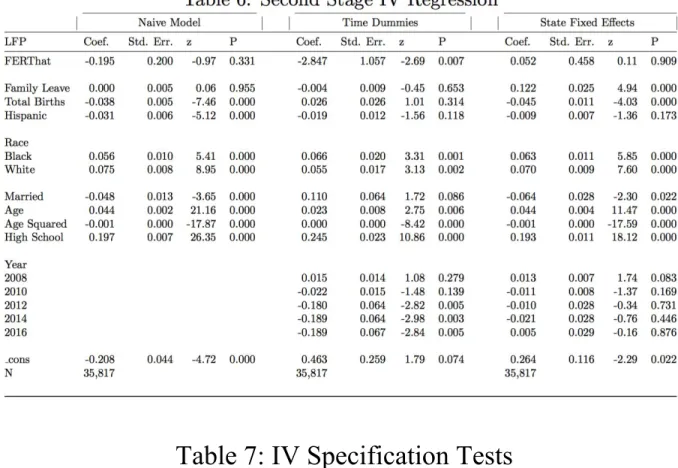
largely insignificant in its relationship to female labor force participation. The correlation, however, is negative as expected.
In the first stage, the controls are all significant with respect to fertility except for family leave policies, ethnicity and race. High school graduation exhibits demonstrates an unexpectedly positive effect on fertility. It is likely that high school graduation is endogenous to fertility. As expected, both being married and having a higher number of prior children have a significantly positive effect on fertility. Age has a negative and significant relationship with fertility while age squared also has a small negative effect.
The F-statistic for the first stage is high (8.9) while the p-value is equal to 0, rejecting the null that the instruments have no explanatory power after accounting for the control variables. Thus, this test surprisingly fails to validate that the additional instruments are in fact weak predictors of the endogenous regressor fertility. However, both overidentification tests (p=0.000) show that the instruments are indeed correlated with the error term of the LFP equation in the second stage, meaning that together they have a direct relationship with female labor force participation. The tests of endogeneity, in which the p-values are equal to 0.567, both fail to reject the null hypothesis that fertility is exogenous to female labor force participation.
Nevertheless, the results of the overidentification tests call into question whether this outcome is valid.
effect on female LFP and this is being carried over into the relationship between FERThat and female LFP. Thus, the instruments are not valid.
Adding time-specific fixed effects makes all of the instruments non-significant in the first stage except for ambulatory surgical requirements, which have a positive effect on fertility. The time dummies are largely negative and significant in beginning in 2012, fitting with the overall pattern of falling fertility in the US. Surprisingly, the second stage indicates a negative and significant relationship between FERThat and female LFP. Further, the overidentification tests register very high p-values of 0.808 and 0.809, indicating that the instruments are not correlated with the error term of the LFP equation. The tests of endogeneity (p=0.000) also show that fertility is endogenous to female LFP. Nevertheless, a very small first-stage F-statistic of 1.175 and a high p-value of 0.310 points to weak and invalid instruments with little ability to predict fertility. Ultimately, there seems to be no intuitive reason for the fertility IV to become suddenly significant when all of the policy instruments become non-significant without changing the direction of their correlations with respect to female LFP.
the null hypothesis that fertility is exogenous. The state fixed effects seem to clean up the endogeneity of the policies with regard to female LFP, but the problem remains the inability to define a strong relationship between the restrictions and the current fertility dummy.
The lack of a significant and positive correlation between the instruments and current fertility, along with the direct correlation between these instruments and female LFP, presents significant obstacles to proper identification of the model. Perhaps the instruments exhibit a weak relationship with current fertility because there is a time lag between the implementation of a policy and the effect on a woman’s fertility.
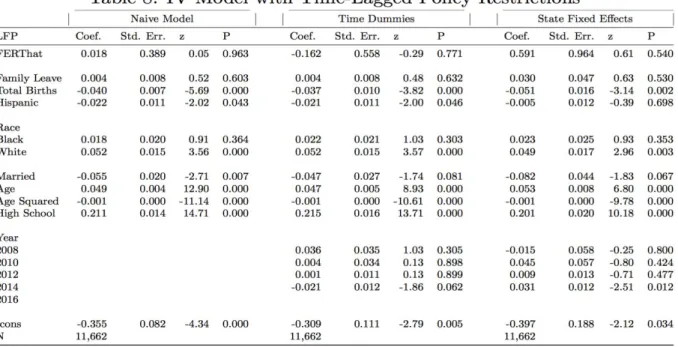
However, as indicated by Tables 8 and 9, incorporating the time lagged policies into the IV model produces similar results. The standard time-lagged IV model indicates a positive and non-significant (p=0.963) relationship between the fertility IV and female labor force
participation. The specification tests indicate that the instruments have explanatory power (p=0.004) and are exogenous with regard to the female LFP (p=0.277 and p=0.278). However, the tests of endogeneity fail to reject the null that fertility is exogenous to female LFP (p=0.854), thus invalidating the IV estimator. Adding in time-specific fixed effects and state fixed effects does little to change the relationship between FERThat and female labor force participation. The specification tests for these models indicate very weak instruments (p=0.189 and p=0.759). Discrete Time Hazard Model
does not face the IV model’s issue of censoring out births and laws that didn’t occur during the one to two years each woman was observed. Therefore, it may be better equipped to identify the effects of these abortion restrictions on the probability that a woman experiences fertility.
The structural form of the labor force participation equation indicated that fertility, when controlling for other important factors, has a significant and negative effect on female labor supply. By showing that these restrictions do affect fertility, it is possible to create an indirect causal link between these policies and a decline in female labor supply.
As shown in Table 10, the standard logit model identifies positive and significant effects on the timing of first births for all of the policy restrictions (48 hour waiting period at the 0.10 significance level). As expected, the abortion restriction variables significantly predict an increase in fertility. Period, Hispanic, black and being married also have a significant and positive effect on the expected odds of first births. Period squared, as expected, has a negatively significant relationship with the timing of first births, indicating that at a certain period (age), the lack of prior fertility transitions from increasing the probability of having a child in the next period to decreasing the probability of having a child at all. Graduating high school also has a 1
negative and significant effect on the outcome of interest. Being white has a non-significant effect on fertility compared to being Asian.
Nevertheless, the unobserved, fixed state characteristics may be endogenous and thus biasing the estimators for the policy variables. However, including state dummies in the model produces similar results. While four of the abortion policies--the 18, 48 and 72 hour mandatory waiting periods and the ban on abortion after 18 weeks--become non-significant, the remainder
of the restrictions--ambulatory surgical requirements, 24 hour mandatory waiting period and bans on abortions after 20 weeks and post viability--maintain significant and positive effects on the timing of first births. Testing the likelihood ratio of the null hypothesis that the state
dummies are jointly equal to 0 results in a strong rejection of the null, indicating their joint significance.
Adding random effects into the model to account for selection bias across time at the individual level maintains similar results. The only change is to the 72 hour mandatory waiting period, which gains significance at the 0.10 level.
VI. Conclusions
Ultimately, the Two-Staged Least Squares model using IV estimation was unable to properly identify the abortion restrictions as instruments for fertility and thus identify the relationship between these abortion policies and female labor supply through the mechanism of an exogenous fertility instrument. The first stage results indicate a weak relationship between the instruments (abortion restrictions) and fertility, while the reduced form LFP equation exhibits the inability of the policies to predict a significant and negative decrease in female labor force
participation in the absence of fertility. Including both the restrictions and fertility in the female labor force participation equation reveals the potential endogeneity of the instruments. However, the structural form of the LFP equation indicates that fertility in the past year--controlling for socioeconomic background variables, time-specific fixed effects and state fixed effects--has a negative and significant effect on female labor supply.
supply through the variation across individuals. We are prevented from looking at the relationship between the abortion restrictions and fertility across the span of an individual woman’s life. Further, we are restricted to examining the effect of these policies on fertility in the past year and thus all other births and relationships are censored out, creating a biased estimator in which we fail to properly identify the relationship between the instruments and fertility.
The discrete time hazard model is able to correct for this issue in timing by examining the incident of first births compared to the implementation of certain restrictions from the beginning of a woman’s life until the age at which she is last observed. It is thus able to estimate the effect of abortion restrictions on fertility by comparing variation in the implementation of certain restrictions and variation in the timing of first births across the span of a woman’s observed life and between individual women. Therefore, the discrete time hazard model is successful at identifying a significant relationship between almost all of the policy variables and the expected odds of a first birth, even when controlling for unobserved fixed state characteristics and
unobserved fixed individual heterogeneity.
VII. References
Angrist, Joshua, and William Evans. 1996. “Schooling and Labor Market Consequences of the 1970 State Abortion Reforms.” NBER Working Paper Series.
Bailey, Martha. 2006. “More Power to the Pill: The Impact of Contraceptive Freedom on Women’s Life Cycle Labor Supply.” The Quarterly Journal of Economics: 289-320. Blau, Francine, and Lawrence Kahn. 2013. “Female Labor Supply: Why Is the US Falling
Behind?” NBER Working Paper Series.
Bloom, David, David Canning, Gunther Fink, and Jocelyn Finlay. 2007. “Fertility, Female Labor Force Participation, and the Demographic Dividend.” NBER Working Paper Series. Browning, Martin. 1992. “Children and Household Economic Behavior.” Journal of Economic
Literature: 1434-1475.
Dvorkin, Maximiliano. 2015. “Labor Force Participation: The U.S. and Its Peers.” Federal Reserve Bank of St. Louis. Federal Reserve Bank of St. Louis.
Finer, Lawrence, and Mia Zolna. 2016. “Declines in Unintended Pregnancy in the United States, 2008–2011.” The New England Journal of Medicine: 843-852.
Jerman, Jenna, Rachel Jones, and Tsuyoshi Onda. 2016. “Characteristics of U.S. Abortion Patients in 2014 and Changes Since 2008.” Guttmacher Institute.
Jones, Rachel, and Jenna Jerman. 2017. “Abortion Incidence and Service Availability in the United States, 2014.” Perspectives on Sexual and Reproductive Health: 17-27. Jones, Rachel, and Jenna Jerman. 2017. “Population Group Abortion Rates and Lifetime
Klerman, Jacob. 1999. “U.S. Abortion Policy and Fertility.” The American Economic Review: 261-264.
Levine, Phillip, Douglas Staiger, Thomas Kane, and David Zimmerman. 1999. “Roe v. Wade and American Fertility.” American Journal of Public Health: 199-203.
Rindfuss, R., Guilkey, D., Morgan, S., Kravdal, O., & Guzzo, K. 2007. “Child Care Availability and First-Birth Timing in Norway.” Demography: 345-372.
Storey, Tim. 2010. “GOP Makes Historic State Legislative Gains in 2010.” Rasmussen Reports. Jatlaoui, Tara, Jill Shah, Michele Mandel, Jamie Krashin, Danielle Suchdev, Denise Jamieson,
and Karen Pazol. 2017. “Abortion Surveillance - United States, 2014.” Morbidity and Mortality Weekly Report - CDC.
Toossi, Mitra, and Teresa Morisi. 2017. “Women in the Workforce Before, During and After the Great Recession.” Bls.Gov. US Bureau of Labor Statistics.
Ura, Alex, Ryan Murphy, Annie Daniel, and Lindsay Carbonell. 2016. “Here Are the Texas Abortion Clinics That Have Closed Since 2013.” The Texas Tribune.
2017. “Counseling and Waiting Periods for Abortion.” Guttmacher Institute. Guttmacher Institute.
2017. “Interactive: How State Policies Shape Access to Abortion Coverage.” Women’s Health Policy. Kaiser Family Foundation.
2017. “Restricting Insurance Coverage of Abortion.” Guttmacher Institute. Guttmacher Institute. 2017. “State Policies on Later Abortions.” Guttmacher Institute. Guttmacher Institute.
2017. “2014 Induced Terminations of Pregnancy.” Texas Health and Human Services. Texas Department of State Health Services.
Table 7: IV Specification Tests
Model First-Stage Summary Statistics
Tests of Endogeneity (Ho: Variables are Exogenous)
Tests of Overidentifying Restrictions
Table 9: Specification Test for IV Model with Time-Lagged
Policy Variables
Model First-Stage Summary Statistics
Tests of Endogeneity (Ho: Variables are Exogenous)
Tests of Overidentifying Restrictions