FINDING COMMON GROUND:
CONSERVATION, DEVELOPMENT AND INDIGENOUS
LIVELIHOODS IN THE HUASCARÁN BIOSPHERE
RESERVE, PERU
Brandie L. Fariss
A dissertation submitted to the faculty of the University of North Carolina at Chapel Hill in partial fulfillment of the requirements for the degree of Doctor of Philosophy in the Curriculum in Ecology
Chapel Hill 2007
Approved by:
Dr. Richard Bilsborrow
Dr. Paul Leslie
Dr. Jack Weiss
Dr. Peter White
Dr. Thomas Whitmore
iii
ABSTRACT
Brandie L. Fariss:
FINDING COMMON GROUND:
CONSERVATION, DEVELOPMENT AND INDIGENOUS
LIVELIHOODS IN THE HUASCARÁN BIOSPHERE
RESERVE, PERU
(Under the direction of Dr. Bruce Winterhalder and Dr. Tom Whitmore)
The Huascarán Biosphere Reserve (HBR) is a tropical Andean protected area
managed for “conservation with development,” one that is experiencing the common
challenge of achieving both. Although there is little question that what was recognized as
a global treasure in 1975, is a cultural landscape shaped by a long history of human
occupation and management, the sustainability of indigenous agro-pastoral land use is
now in question. My research was motivated by a desire to understand the environmental
outcomes of indigenous livelihoods in an era in which they are being increasingly
transformed by the conservation and development agendas of national and international
actors. I argue that failures of people-centered conservation are less to do with failures of
local indigenous peoples to sustainably manage resources, and more to do with failures of
policy-makers to accept responsibility for their role in shaping this outcome. Through the
lens of cultural and political ecology I show that successful biodiversity conservation in
institutions and their constituent decision-makers are embedded. This multi-scaled
perspective takes a critical look at tourism and its influence on the herding practices of
indigenous agro-pastoral households in the HBR. By drawing on common property theory, human behavioral ecology, and ecological fieldwork I show that enclosure in a
protected area and the unsustainable growth of adventure tourism have had many
unintended consequences. I discuss these consequences throughout the dissertation as
they are revealed through analyses of data collected during 2 years of fieldwork, their
implications for indigenous livelihoods and biodiversity conservation in the HBR, as well
as some potential solutions for avoiding negative outcomes in this unique protected
v
DEDICATION
ACKNOWLEDGEMENTS
As is the case with any effort of this magnitude, or any process as long, I could
not have done it alone. Reflecting on the rather substantial number of individuals to
whom I owe a debt of thanks, I must simply say that I am extremely fortunate. Some
individuals assisted with very specific stages of this process, while some have had a
presence throughout. I want to begin by thanking the individuals that have been with me
from the beginning. Thanks to my parents, Bob and Lisa Sullivan, for the opportunity to
pursue a graduate education and for their moral support over the duration of this project. I
especially want to recognize my mother, whose expert editorial and data entry skills were
often employed without solicitation or pay. Most importantly, I am grateful for my
husband, Barker Fariss, for his unconditional love, tireless support, long hours in the
field, and unyielding optimism. Lastly, thanks to my two-year old son Keller, for being
my biggest source of inspiration, even if he doesn’t yet know it.
Many others deserve thanks for helping me accomplish the Ph.D. I would first
like to extend my gratitude to Bruce Winterhalder and Tom Whitmore. Their guidance
over the years helped shape my research interests and focus them on the Andes; a
geography to which I am now forever committed. Thanks to Jack Weiss for statistical
advice and marathons of code-writing before, during and after my data collection.
Thanks also to Dick Bilsborrow, Peter White and Paul Leslie for advice on a number of
vii
(coffee, beer). Special thanks to Amy Cooke, Flora Lu, Bram Tucker, and Laura
Dominkovic for their friendship and for their ear on all matters academic or otherwise.
Many more must be acknowledged for making this work possible. Foremost, I
would like to thank the people of Collón and Pashpa for allowing me into their
community and their homes, for permitting me a glimpse into contemporary Andean
livelihoods, and for patience with my unending inquiry into their daily lives. Without
their cooperation, this work would not have been possible. A great many others deserve
mention for assisting me while I was in the field. A special debt of gratitude goes to my
field assistants, Leoncio Alva Chinchay, Juan Sanchez Duran and Fiorella Marcone. I am
forever grateful to Juan and his family for naming us god parents to Luz, and for ensuring
that we maintain the friendship we formed over long days of time allocation observation,
especially in the rainy season. I would also like to thank the Huaraz office of The
Mountain Institute (TMI), especially Jorge Recharte, Miriam Torres, and Roberto
Arevalo for assisting with the bureaucratic challenges of conducting research in the HBR,
helping to garner community support for my work, and assisting me in finding field
assistants. My gratitude to this organization extends to Alton Byers for sharing his
experiences and observations on conditions in the Ishinca valley, and for his dedication to
protecting mountain environments and cultures. Thanks also to the staff of the Instituto
Nacional de Recursos Naturales (INRENA) and the Huascarán National Park (HNP) for
research clearance and access to the herbarium, the Casa de Guías of Huaraz for
information about tourism services and statistics, and the Refugio staff at the Ishinca
My acknowledgements would not be complete without thanks to the friends we
made along the way. First, I want to thank Ankur Tohan for my introduction to the
Ishinca valley; Holly Hobby for her light-heartedness and for accompanying me on a
number of extended fieldwork excursions; Zarela for her kindness, translation assistance
and use of the garage; and Jennifer Lipton for research advice, an enduring friendship,
and long conversations about the prospects of future research collaborations. Thanks also
to Bruni Frampton and Alex Good for the occasional recreational diversion, and for
enlightening us on the rules of RISK in the U.K. I also want to thank Naresuan for his
contagious love of life and his terrific Thai dinners. Although I’m not likely to ever do it
again, I must also thank Mark Bullard for talking me into a two-day horseback ride
through the Ishinca valley to visit my collaborators before leaving the field. Last but not
least, I would also like to thank Tim, Louisa, Angela and Vanessa Norris for their
hospitality, and for the sense of family and home they created for us while there.
In addition to having such a large community supporting this endeavor, I am
extremely fortunate to have had the financial support of the National Science Foundation,
the Institute for Latin American Studies, the Carolina Population Center, the Graduate
School and the Royster’s Society of the University of North Carolina at Chapel Hill
(UNC-CH). Thanks also to the administrative assistants of the Ecology Curriculum at
UNC-CH, including Cottie Pasternak, Karen Henry, and Denise Kent, for assisting me
with a number of submission deadlines and requirements related to graduate work. It
should now be clear that many people and organizations have contributed to this work,
ix
I hope that mine does justice to the lives and challenges of those most intimately
TABLE OF CONTENTS
LIST OF TABLES... xv
LIST OF FIGURES ... xvii
LIST OF PHOTOS ... xx
LIST OF ABBREVIATIONS... xxii
GLOSSARY ... xxiii
CHAPTER 1 INTRODUCTION: ILLUSION AND REALITY IN PROTECTED LANDSCAPES OF THE TROPICAL ANDES People and Parks ... 3
Scaling Up in Human-Environment Research... 4
Scaling Down in Human-Environment Research ... 5
Common Property... 8
Human Behavioral Ecology... 11
Research Objectives... 13
Study Site Selection ... 15
Organization and Chapter Progression ... 19
CHAPTER 2 THE UNINTENDED CONSEQUENCES OF CONSERVATION AND DEVELOPMENT FOR INDIGENOUS COMMUNITIES OF THE HUASCARÁN BIOSPHERE RESERVE, PERU Abstract... 26
Introduction... 28
Study Site... 33
Methods... 37
Maintaining the High Ground... 40
Lo Andino: The high altitude economy of Tupac Yupanqui ... 44
Farming in Tupac Yupanqui... 46
xi
Tourism: A fair-weather industry... 61
Changes in Household Farming Practices... 66
Changes in Household Herding Practices ... 71
Managing Individual Users of a Commons ... 78
The Antagonists of Common PropertyManagement... 79
No Security from Confiscation: When the state comes marching in... 82
Unequal Commoners: The unintended side-effect of well-intentioned development ... 85
Shifting Membership in the Commons: Population growth and migration ... 88
Conclusion ... 93
CHAPTER 3 EXPLORING THE EFFECTS OF TOURISM ON THE MANAGEMENT OF HOUSEHOLD HERDS IN THE HUASCARÁN BIOSPHERE RESERVE, PERU Abstract... 96
Introduction... 100
Study Site... 103
Methods... 111
Census ... 111
Time Allocation... 112
Analytical Approach ... 114
Model Description ... 115
Multilevel Logistic Regression ... 116
Introducing Random Effects ... 118
Estimation Approach... 121
Household Herding Labor... 124
Control Variables ... 125
Age of the Economic Head of the Household ... 126
Farming... 127
Season... 128
Opportunity Cost ... 132
Herd Wealth... 135
Fitting Models of Household Herding Labor... 139
Results... 148
Using Predictive Simulation to Evaluate the Herding Model ... 152
The Odds of Herding Relative to Tourism Involvement... 155
Discussion... 158
Conclusion ... 162
CHAPTER 4 THE IMPACTS OF GRAZING ON NATIVE PLANT DIVERSITY IN THE HUASCARÁN BIOSPHERE RESERVE, PERU Abstract... 164
Introduction... 166
Study Site... 170
Methods... 175
Vegetation Sampling ... 175
Analytical Approach ... 180
Model Description ... 183
Native Species Richness... 183
Grazing as a Scaled Disturbance... 186
Pasture-Level Grazing Intensity ... 186
Plot-Level Grazing Intensity ... 190
Additional Control Variables ... 193
Plot-Level Controls ... 194
Pasture-Level Controls ... 195
Preliminary Observations of Pasture Condition ... 201
Fitting Models of Native Species Richness ... 209
Results... 217
Pasture-level Native Species Richness... 223
Discussion... 223
Exploring the Model's Suitability for Prediction... 227
Projecting Changes in Native Diversity ... 231
xiii
CHAPTER 5
CONCLUSION: RECONSIDERING THE PROBLEM OF PEOPLE AND PARKS
Summary of Findings... 244
Understanding Household Decision-Makers ... 246
Understanding Institutions of Common Property ... 255
Synthesis and Recommendations... 257
Lessons of Scale ... 259
Lessons for Reserve Administrators... 259
Lessons for Conservation/Development NGOs ... 261
Lessons for Local Resource Managers... 263
Conclusion ... 264
APPENDICES Appendix 2.1: Crops grown in the study community... 267
Appendix 2.2: Stock equivalents... 268
Appendix 3.1: Time allocation form ... 269
Appendix 3.2: Time allocation codes... 270
Appendix 3.3: Statistical justification for a model of household herding labor with random effects... 273
Appendix 3.4: Additional controls considered for the multilevel model of household herding labor... 274
Appendix 3.5: Estimates obtained for the multilevel model of household herding labor... 275
Appendix3.6: An exploration of normality in the multilevel model of household herding labor... 277
Appendix 3.7: Various regressors of herd wealth and their effects on household herding labor... 278
Appendix 3.8: Modifications to the game theoretic model of herd wealth ... 279
Appendix 4.1: Unsampled pastures of the TMI pasture improvement project... 287
Appendix 4.2: Statistical justification for a model of native species richness with random effects ... 288
Appendix 4.4: Plant species encountered during
vegetation sampling... 290 Appendix 4.5: Residuals of a multilevel model of native
species richness assuming a linear version of the plot-level
grazing variable ... 297 Appendix 4.6: Additional controls considered for the multilevel model of native species richness ... 298 Appendix 4.7: Species of relative abundance on
sampled pastures... 299 Appendix 4.8: Estimates obtained for the multilevel model of native species richness ... 301 Appendix 4.9: An exploration of normality in the multilevel model of native species richness ... 308
xv
LIST OF TABLES
Table 2.1: Communal chacras and their characteristics ... 48
Table 2.2: Composition of empresa herds in Collón and Pashpa in 2002 ... 56
Table 2.3: Household herding strategies, their relative labor demands and reliance on the HNP... 74
Table 3.1: Characteristics of the time allocation sample. ... 112
Table 3.2: Definition and summary statistics for variables in the multilevel model of household herding labor ... 123
Table 3.3a: Taxonomy of multilevel models fitted to the herding labor data. ... 141
Table 3.3b: Composite versions of the models of herding labor shown in Table 3.3a... 143
Table 3.4: Evaluation of the candidate models of household
herding labor ... 146
Table 3.5a: Odds ratios for variables of interest in the best
multilevel model of household herding labor. ... 156
Table 3.5b: Median odds ratio for the best multilevel model of household herding labor. ... 156
Table 4.1: Key characteristics of sampled pastures ... 177
Table 4.2: Definition and summary statistics for variables in the multilevel model of native species richness... 182
Table 4.3: Summary of pasture characteristics, with a focus on native diversity and the presence of invasive species and indicators of over-grazing. ... 205
Table 4.4a: Taxonomy of multilevel models fitted to native species richness data. ... 211
Table 4.4b: Composite versions of the models of native species richness shown in Table 4.4a. ... 212
Table 4.6: Changes in native species diversity predicted with an increased use of community and park pastures
xvii
LIST OF FIGURES
Figure 1.1: Location of the study site. ... 18
Figure 1.2: Framework for evaluating the outcomes of communal resource management... 20
Figure 2.1: Natural history of the Ishinca valley ... 32
Figure 2.2: Land use zones in the indigenous community of Tupac Yupanqui ... 36
Figure 2.3: Sample design reflecting the stratified random sample of 80 households... 38
Figure 2.4: Generalized altitudinal profile of land use and land tenure in Tupac Yupanqui... 46
Figure 2.5: Time allocation to farming by gender ... 53
Figure 2.6: Time allocation to herding by gender ... 60
Figure 2.7: Foreign and national tourists making overnight stays in Huaraz from 1988 to 2001... 62
Figure 2.8: Time allocation to wage-earning by gender... 66
Figure 2.9: Agricultural calendar and crop rotation sequence... 70
Figure 2.10: Key events in the region... 84
Figure 2.11: Distribution of herd wealth within the study community... 87
Figure 2.12: Trends in urban and rural population in the department of Ancash ... 90
Figure 2.13: Age structure of the study community ... 91
Figure 3.1: Distribution of household size in the study community... 106
Figure 3.2: Distribution of herd size in the study community ... 107
Figure 3.4: Plot of the functional form of household herding labor relative to continuous and categorical
versions of the tourism predictor ... 132
Figure 3.5: Distributions of herd wealth relative to various levels of involvement in tourism... 138
Figure 3.6: Estimates, 50% and 95% credibility intervals for the regression coefficients of predictors in the multilevel model of household herding labor ... 150
Figure 3.7: Observed vs. predicted probabilities of herding by the household in the wet and dry season... 152
Figure 3.8: Household probabilities of herding grouped by level of tourism involvement ... 154
Figure 4.1: Sites where vegetation sampling took place... 173
Figure 4.2: Pasture sampling strategy... 175
Figure 4.3: Diagram of the Modified-Whittaker plot ... 179
Figure 4.4: Distribution of plot-level native species richness observations. ... 185
Figure 4.5: GIS implementation flow chart emphasizing the calculation of pasture-level predictors ... 189
Figure 4.6: Distribution of plot-level grazing intensity scores for sampled pastures ... 193
Figure 4.7: Average sine-transformed aspects for sampled pastures... 197
Figure 4.8: Interpretation of sine-transformed aspect values ... 198
Figure 4.9: Interpretation of topographic wetness index values... 199
Figure 4.10: Average wetness for sampled pastures grouped by pasture-level grazing intensity ... 201
Figure 4.11: Response of plot level native specis richness to multiple scales of grazing ... 207
xix
Figure 4.13: Estimates, 50% and 95% credibility intervals for the regression coefficients of predictors in the multilevel model of native species richness... 219
Figure 4.14: Effect of plot-level grazing intensity on native species richness... 220
Figure 4.15: Observed vs. predicted estimates of native species richness... 222
Figure 4.16: Comparison of actual and simulated vales of native species richness grouped by pasture-level grazing intensity... 229
Figure 4.17: The relative loss of native species predicted for sampled pastures ... 234
LIST OF PHOTOS
Photo 1.1: Nevado Huascarán reflected in an ephemeral lake above Pashpa... 2
Photo 1.2: The windswept puna of the HBR ... 8
Photo 2.1: Adobe bricks drying in front of a choza in Collón... 42
Photo 2.2: Woman of Collón spinning yarn while tending livestock ... 42
Photo 2.3: Young girls of Collón pausing for a photo upon return from school... 43
Photo 2.4: Women of Collón preparing food for a community event in Collón... 43
Photo 2.5: Choza with a campaña grande planting of potatoes in the foreground... 51
Photo 2.6: The alpaca herd of EcoAgro, together with a few household animals on Winac Pampa. ... 58
Photo 2.7: Field assistant, Juan Sanchez Duran, stopping to
observe a recently sprayed field of potatoes ... 67
Photo 2.8: A choza located at the upper limit of cultivation and just inside the formal boundary of the HNP ... 76
Photo 3.1: Young herder of Musho, north of the Ishinca valley... 98
Photo 3.2: Young arriero of Collón... 98
Photo 3.3: The high altitude pasture of Miyu Pampa (base camp), with the summit of Toclaraju in the background... 99
Photo 3.4: An arriero transporting gear to base camp amidst climber’s tents and vacas silvestres... 99
Photo 4.1: Visible terracettes and bare ground on Miyu Pampa... 168
xxi
Photo 4.3: Large stand of Polylepis near the entrance of the Ishinca valley ... 172
Photo 4.4: Toclaraju, a popular climbing pursuit in the Ishinca valley... 172
Photo 4.5: Puya ramondii, an endemic species found in the valley of Pastoruri to the south of the study area... 174
Photo 4.6: Llama on Winac Pampa in the puna baja... 174
LIST OF ABBREVIATIONS
ASAM Asociación de Servicios de Alta Montaña
AATAM Asociación de Asociación de Trabajadores de Alta Montaña
CEDEP El Centro de Estudios para el Desarrollo y Participación
CP Common property
CUP Comités de Usuarios de Pastos; pasture user-groups
FONCONDES Fondo Nacional de Compensación y Desarrollo
GIS Geographic information system
GO Governmental organization
GPS Global positioning system
HBE Human behavioral ecology
HBR Huascarán Biosphere Reserve
HNP Huascarán National Park
INEI Instituto Nacional de Estadística e Informática
INRENA Instituto Nacional de Recursos Naturales
NGO Non-governmental organization
PRONAA Programa Nacional de Asistencia Alimentaría
PRONOMACHS Programa Nacional de Manejo de Cuencas Hidrográficas y Conservación de Suelos
TMI The Mountain Institute, Instituto de Montaña; Andean program
xxiii
GLOSSARY
The words in this glossary are italicized throughout the text. Brief definitions are offered here:
Alcalde: mayor of a town or peasant community.
Arriero: mule driver hired to carry gear for visiting trekkers and mountaineers.
Asamblea: community meeting or assembly.
Barrio: area or neighborhood: a collection of houses and fields within a community.
Bofedale: wet pasture created by topographies that allow for water accumulation; a critical dry season reserve that is usually avoided in the wet season.
Campaña chica: the less common dry season planting of the agricultural calendar.
Campaña grande: the most common wet season planting of the agricultural calendar.
Campesino/a: rural man/woman; peasant.
Chacra: agricultural field worked by a single household or collective.
Choza: small round hut of rock or adobe mud brick; dwelling.
Common pool resource: a resource with the characteristics of subtractability (i.e., one person’s use subtracts from another’s) and excludability (i.e., difficult and costly to exclude others from using). Examples include irrigation networks and rangelands.
Common property: a socially defined relationship to a resource whereby its
management is achieved by a clearly defined group of individuals with rights of access and use; contrast with open-access.
Comunero/a: recognized member of the community; an individual entitled with rights to access and use common property in the community.
Comunidades Campesinas: rural indigenous communities.
Cordillera Blanca: a glaciated north–south trending mountain chain in Peru, approximately 21 km wide and 180 km long; translates as the White Range.
Empresa: a business; usually a community-run enterprise.
Hacienda: a large land-holding estate granted to Peruvian elites and operated largely by the labor of the rural poor; a system that was dismantled during Peru’s land reform of 1969.
Huerto: household garden.
Jalca: high altitude grasslands in the transitional ecotone between wetter páramo grasslands of the northern Andes and drier puna grasslands of the southern Andes.
Jefe: economic head of the household, usually (but not exclusively) the adult male.
Jornal: day laborer.
Laguna: lake.
Lo andino: a way of life characteristic of the Andes.
Minka: reciprocity-based communal work party.
Nevado: mountain.
Open-access: a relationship to a resource whereby rights of access and use are open to all; there are no clear owners and no arrangements for how the resource is used or managed.
Paja: crop stubble utilized as livestock fodder.
Páramo: high altitude grasslands of the northern Andes.
Partible inheritance: system of inheritance whereby property is divided equally among descendents.
Portada: gate to the Ishinca valley used as a mechanism of establishing community-sanctioned openings and closings for high altitude pastures in the national park.
Puna: high altitude grasslands of the southern Andes.
Quebrada: valley.
Siete Cabrillos: Seven goats; the constellation of Pleiades.
Transhumance: seasonal herding patternsdictated strongly by the availability of natural forage; in mountainous landscapes, this movement is often up-valley as the dry season progresses.
Trigo: wheat.
xxv
Vacas silvestres: wild cattle; an unmanaged communal herd often in the national park.
CHAPTER 1
INTRODUCTION: ILLUSION AND REALITY IN PROTECTED
LANDSCAPES OF THE TROPICAL ANDES
As I sat at a small ephemeral lake with the silhouette of the Huascarán Biosphere
Reserve’s (HBR) highest summit (6768 meters) perfectly mirrored in its still depths, the
image before me was as magnificent as any I could conjure in my mind’s eye. Such an
image evokes certain impressions about a place (see Photo 1.1). The monumental and
rugged appearance of the Andean landscape creates the illusion that it is timeless and
untouched. But, things are not often what they appear. Although Nevado Huascarán is
perfectly reflected in the lake before it, the true nature and complexity of contemporary
Andean landscapes is not. Their true nature is first revealed by recognizing that
“interaction with nature has…been humankind’s most enduring practical concern
(Netting 1986). Despite increasing efforts to protect places like these from human
influence (Rodriguez et al. 2004), most of this area is neither beyond the influence of
local actors, nor by consequence of its protected status, beyond the influence of distant
2
A closer look at the landscape of the HBR reveals a multi-faceted human
dimension as complex as its topography (Zimmerer 2000, Zimmerer 2006, Zimmerer and
Bassett 2003, Zimmerer, Galt, and Buck 2004). Landscapes of the tropical Andes are
cultural ones, shaped not only by a long history of human occupation and use, but
recently by the policies of conservation actors with very different practical concerns.
While the HBR may hold a variety of meanings for all parties involved (i.e., indigenous
residents, conservationists, and tourists), all must agree that it is undeniably shaped by the
ongoing dialectic between them and it. The reality below the surface of the illusion in
Photo 1.1 is that this protected area is not only a landscape influenced by humans, but one
that reflects what these various actors think it is, and what they think it should be. It is
the juxtaposition of indigenous livelihoods and conservation interests, and the inability to
find common ground between them that have created numerous tensions between people
and parks world-wide. In the HBR, a similar tension brews just below the surface—this
is its current reality.
PEOPLE AND PARKS
Concerns of environmental degradation in the HBR implicate the region’s
indigenous communities because they are directly involved in its use and management
(INRENA 1990a, INRENA 2002, TMI 1996b, TMI 1997, TMI 2001a).1 While local
resource use is undoubtedly an important factor to consider, simple assumptions that
4
local livelihood strategies are inimical to conservation are short-sighted and inadequate
according to most political ecologists (Robbins 2004). Even so, local mismanagement
has a long history as the dominant explanation for environmental degradation in the
highlands (Eckholm 1976, Ellenberg 1979, reviewed in Forsyth 1998), and protected
areas in general (Kramer, van Schaik, and Johnson 1997, Oates 1999). This pervasive
attitude manifests itself in a growing trend to exclude humans from protected areas or to
diminish their role in managing them (Chapin 2004, Terborgh et al. 2002). In doing so,
conservation not only marginalizes but vilifies indigenous peoples and local resource
users (Fairhead and Leach 2000, Neumann 1998, Stevens 1997, Wilshusen et al. 2002).
My research was motivated by a fundamental concern with viewing environmental
change (real or perceived) in the HBR with such a narrow focus, and in doing so,
jumping to false conclusions about indigenous peoples, indigenous institutions, and
people-centered approaches to conservation. Instead, my research looks beyond
proximate causation to the ways in which their political and economic contexts shape
decisions regarding the use and management of the reserve and its conservation core. In
doing so, I hope to illustrate that the condition of the tropical Andes, for better or worse,
is a responsibility which both local and supra-local actors have in common.
SCALING UP IN HUMAN-ENVIRONMENT RESEARCH
My research adopts a cultural and political ecology perspective. By doing so it
explores the complexity of interactions between the region’s indigenous agro-pastoralists
and their recently protected environment. It seeks to understand how this interaction is
affected by the creation of the park and its policies of “conservation with development,”
various scales of influence shaping the HBR are “nested within one another, with local
decisions [e.g., individual, household, community] influenced by regional policies, which
are in turn directed by global politics and economics” (Robbins 2004). While I
acknowledge that there are a variety of definitions and research agendas emerging in
political ecology, my perspective is loosely based on combining “the concerns of ecology
with a broadly defined political economy” (Blaikie and Brookfield 1987). A prominent
focus in political ecology research is on conservation in the developing world (e.g.,
Zimmerer and Young 1998). My study follows the same line of inquiry and employs
similar methodologies to those grounded in biogeography and ecology, including an
attention to place and ecological analyses (e.g., Turner 1998, Zimmerer 1991, Zimmerer
1993, Zimmerer 1996). By conducting this research I hope to provide additional insights
into the conservation challenges specifically facing the HBR, as well as to add to
examples specific to protected highland landscapes in general (i.e., Brower and Dennis
1998, Byers 2000, Echavarria 1998, Young 1998).
SCALING DOWN IN HUMAN-ENVIRONMENT RESEARCH
Although human-environment researchers realize the need to situate their study of
local resource users in a broader context, such a focus does not diminish the necessity to
address the dynamics of environmental change at the scale where decisions are acted out
upon the landscape (Hewitt 1988, Lauer 1993). Environmental change is the aggregate
consequence of the actions of independent decision-makers. The focus of much of the
research presented here is on the decision-making processes of the household; the
household being an important unit of decision-making in the Andes (Brush and Guillet
6
ecology perspective requires us to examine the contexts in which household decisions are
made as well as how they are mediated at scales beyond as well as within the household.
This requires exploring the role of conservation NGOs, government agencies, and
communal institutions, as well as the role of individuals of different ages, genders, and
access to opportunities such as wage-earning and education in influencing
household-level decision making and its environmental outcomes.
There is a lack of conclusive theory guiding attempts to explore local
decision-making and its environmental outcomes within this multi-scaled framework. This
research draws on common property (CP) and human behavioral ecology (HBE) as its theoretical framework. This includes the use of game theory as a means of predicting the
decisions of multiple users of a commons, and how these decisions are mediated by
community rules and sanctions. Persistent attention has been given to common property management from cultural and political ecology researchers. CP theory allows us to
explore the ways in which communal institutions function to maintain the cooperation of
their constituents, as well as the conditions under which they are likely to fail.
Recent decades have seen an increase in conservation initiatives, predominately in
tropical countries of the western hemisphere, which have increasingly brought many local
actors into real or potential conflict with national and international conservation agendas
(Bruner et al. 2001, Zimmerer 2006). Most of these conservation projects are focused on
biodiversity, and many seek to achieve its conservation by integrating local resource
users into sustainable economies designed to offset their use of key resources, thereby
decreasing their potential degradation. At best, these policies may be presumptuous. A
management maintain, and in some cases create biodiversity (Fjeldså, Lambin, and
Mertens 1999, Oldfield and Alcorn 1991, Piperno and Pearsall 1998, Robbins et al.
2006).
Human subsistence in the Callejón de Huaylas of the Peruvian Andes extends as
far back as 10,000 years bp, as estimated from the oldest cultivated botanical
assemblages of the New World found in the region’s Guitarrero Cave (Moseley 1992).
The imprint of humans on the Andean landscape is prominent (Gade 1992). In the buffer
zone of the HBR, this imprint manifests itself in terraces, irrigation canals, and the
patchwork of chacras (agricultural fields) and livestock corrals of local comunidades campesinas (rural indigenous communities); while subtle, but no less significant, imprints are evident at the higher elevations of the HNP. Given this long occupation and the
region’s status as a biodiversity hotspot (Manne, Brooks, and Pimm 1999, Myers et al.
2000, Rodriguez and Young 2000), it is likely that local communities have played a role
in creating the landscape and the diversity conservationist wish to protect; at a minimum,
they have not been strongly inimical. If this is so, how can indigenous peoples of the
HBR be both defenders and destroyers of the tropical Andes, as it is currently assumed?
This question cannot fully be explored without careful consideration of the importance of
common pool resources in the world’s highlands, the institution of common property management, and the challenges of maintaining collective action under changing
socio-political and economic contexts (Agrawal 2001, Bromley et al. 1992, Lambin et al. 2001,
8
COMMON PROPERTY
Many common pool resources play an integral part in rural livelihoods of the
highlands (Berkes 1989, Netting 1976, Prakash 1998). The focus of this dissertation is
on the puna (high elevation grassland), which is managed as common property by the reserve’s indigenous communities despite its enclosure in a national park (see Photo
1.2).2
Photo 1.2: The windswept puna of the HBR (photograph by the author, 2002).
A few key terms and clarifications will be relevant for subsequent chapters. First,
a resource is any material good. Those that are diminished in quantity or quality through
use (i.e., are subtractable) as well as costly to exclude others from using are common pool resources (McKean 2000). Mountains are particularly rich in these resources, and the study of their use and potential degradation has been a research priority in recent decades
(e.g., Casimir and Rao 1998, Orlove 1976, Lynch 2001). Property is a social construct whereby people relate to a resource through a set of social arrangements defining the
rights and responsibilities governing resource use (Bromley and Cernea 1989, McCay
and Acheson 1996). A resource and the social context in which it is embedded
collectively define a property regime. Common property (i.e., property held and
managed by a group) is one possible type; while private (i.e., property held and managed
by an individual) and state property regimes (i.e., property held and managed by a
centralized authority) are others (Stevenson 1991). Common pool resources that are extensive, spatially or temporally heterogeneous, low yielding, unpredictable and offer
little potential for intensification, like those of the puna, can be optimally managed as common property (Berkes et al. 1989, Feeny et al. 1998, McKean 2000, Netting 1976).
Many protected areas were established as a means of transferring access and
control of resources from an individual or group to the state. Yet this transfer is not
absolute in people-centered conservation approaches. Indigenous communities in the
HBR are allowed access to and use of pasture resources within the conservation core of
10
institutions continue to mediate the use of the reserve’s resources the region’s indigenous
residents despite the ultimate and sometimes ill-defined authority of the state (Pinedo
1999).3
Although there are current concerns about the sustainability of community-based
management in the HBR and the need for increased state involvement, recent decades
have seen the demise of an erroneous assumption that these arrangements are doomed to
failure.Garrett Hardin’s (1968), “Tragedy of the Commons” was the reigning metaphor
regarding the management of property by a group, and still lingers in popular discourse
and policy-making today. Yet, it is now widely recognized that common property regimes are fundamentally different from open-access where such failures are more certain (Ciriacy-Wantrup and Bishop 1975, Feeny et al. 1998). In short, common property is akin to private property for a defined group, where accountability and rules of use do
exist (McKean 2000). In other words, it is not a situation of open-access, where
everyone can use a resource and there are no incentives for managing it sustainably. This
permits the possibility that common property institutions of the Andes may not only avoid tragic outcomes, but also be the most optimal and socially just arrangement that
exists for managing the puna.
This dissertation is based on the premise that indigenous institutions for managing
resources in the HBR can be sustainable when supported by appropriate policies. Such
policies depend on an enhanced understanding of the importance of common pool resources to the world’s highland subsistence communities, the various decision-making arrangements that govern their use, the patterns of use that emerge among individual
users of a commons, and the factors that affect them in the present day. Given the
prominence of common property in the Andes, and the challenges of maintaining sustainable use of a commons in the face of economic diversification and growing
heterogeneity among its users, these insights will also be critical for the success of
“conservation with development” (Adams et al. 2003, Jodha 1992).
HUMAN BEHAVIORAL ECOLOGY
Many “conservation with development” projects have arguably failed due to a
lack of sufficient attention to indigenous livelihoods and institutions of resource
management. Conservation in the HBR will require an exploration of the factors
influencing local decision-makers so that we may better understand the challenges faced
by communal institutions in maintaining their cooperation (Caro 1998). This study draws
on human behavioral ecology (HBE) to frame hypotheses of the decision-making
processes driving environmental change in the HBR. To date, HBE has contributed in
innumerable ways to the conservation literature, and has the potential to shed many
insights on the situation unfolding there (Holt 2005, Smith and Wishnie 2000, Tucker
2007, Winterhalder and Lu 1997). In general, HBE operates from an assumption that
decisions are driven by economic concerns—by the resource user’s consideration of the
12
Given the criticisms of ‘rational behavior’ by some political ecologists, it is
important to note that the approach of HBE does not imply that available options are
unrestricted, knowledge of them perfect, or that the decision reached is necessarily the
optimal one relative to a particular phenomenon under study. What it does imply is that
decision-makers do their best to operate rationally, and where they appear not to, are not
‘irrational’, but likely operating under the influence of additional constraints that can be
revealed through careful study. HBE researchers have included the effects of power
inequalities, wealth differentials, coercion, uncertainty and risk in their decision-making
models (Winterhalder 1990); in doing so, they have offered us many heuristic devices for
generating testable hypotheses of human behavior and resource use (Winterhalder
2002a). Thus, the perspectives of HBE are not necessarily at odds with those of cultural
and political ecologists, who are largely concerned with the same research questions
focused on understanding the factors affecting indigenous resource management and
environmental degradation. Here the aim is to apply both individual and institutional
perspectives and scales of human-environment analysis to indigenous decision-makers;
who are no less divorced from economic concerns, and are perhaps even more likely
constrained geographically, economically, politically, socially and historically.
Innumerable conservation failures justify the need to develop a comprehensive
approach such as this; especially when considering the current trend of polarizing
indigenous peoples as inherently conservationist or inherently incapable of serving as
environmental stewards regardless of the context in which they are embedded (Redford
and Stearman 1993). HBE offers an alternative to these stereotypes, as well as a
research, and one tested in Chapter 4, applies game theory to the decision-making of
transhumant Barabaig pastoralists managing a commons. Ruttan and Borgerhoff-Mulder
(1999) present an alternative the “tragedy of the commons” scenario by illustrating that
wealthy herders receive a greater share of the benefits from communal resources. Thus,
they are more likely to have a vested interest in managing their own herd sustainably. In
addition, the authors show that wealthy herders typically have more power and the means
to coerce other relatively poor herders to do the same (ibid 1999). This finding offers the possibility of an optimistic outcome for conservation in the HBR given the region’s
growing tourism industry and the associated increase in livestock holdings for these
households as described in Chapter 2. However, if conservation is “isomorphic with
economic efficiency” for wealthy herders and can be encouraged of poor herders, at some
point this cooperation becomes unlikely when wealth inequalities are extreme (ibid 1999). Even if rejected, like any model tested against empirical observation, it serves to
increase our understanding of the various scales of influence acting on particular resource
users and allows us to frame new questions about the factors affecting the
decision-making process (Winterhalder 2002b).
RESEARCH OBJECTIVES
The overall objective of this research was to take a disciplinary and
multi-scaled approach to study the factors affecting land use, communal resource management,
and conservation in the HBR. Although a number of studies have described Andean
agro-pastoral land uses and institutions for managing them (e.g., Brush 1977, Guillet
1983, Knapp 1991, Mayer 2002, Orlove 1977), few have focused on their overlap with
14
relevant exceptions include Byers (2000), Kintz, Young, and Crews-Meyer (2006),
Tohan (2000), Young (1993), and Young and León (1993). My research was motivated
by a desire to contribute to the literature on Andean livelihoods in an era where many are
increasingly transformed by the conservation and development agendas of national and
international actors (Bebbington 2000). It was also motivated by claims that indigenous
agro-pastoral communities are mismanaging the resources of the HBR, and therefore
threatening the biodiversity it seeks to protect.
Recent work in cultural and political ecology has revealed that policies
collectively referred to as “conservation with development” can result in significant
unintended consequences (see Zimmerer 2006). Although contrary to intention, such
policies have often disrupted or even disabled indigenous livelihoods without creating
sustainable alternatives. Thus, the research questions explored during my fieldwork were
predicated on the possibility that a comprehensive study of over-grazing in the HBR
would require looking beyond local resource management to the policies of
“conservation with development” that have encouraged the growth of the region’s
adventure tourism industry (i.e., climbing and trekking). While this frames the
dissertation as a critique of current policies in the HBR, a nuanced understanding of how
the adventure tourism industry articulates with the land use and resource management
decisions of the region’s agro-pastoral residents is necessary in order to move beyond a
stale debate over people vs. parks, the sustainability of tourism, and the viability of
“conservation with development” in the developing world. With these interests in mind,
(1) What is the current state of land use in the HBR? How has enclosure in a national park and the subsequent development of tourism industry affected indigenous resource users and the communal institutions that manage them?
(2) How does tourism involvement influence the management of household herds in the HBR? Do the patterns of use and interaction emerging on common property pastures suggest unsustainable outcomes?
(3) Is there evidence of environmental degradation in the buffer zone or the core of the HBR? Specifically, what is the relative effect of grazing on native plant diversity, and what are the implications of changing land use scenarios for biodiversity conservation in this protected landscape?
These findings should be of interest to ecological anthropologists, geographers,
cultural and political ecologists, conservation biologists, common property researchers, tourism researchers, and highland tropical ecologists in general; as well as to stakeholders
in protected areas, including local (often indigenous) peoples, governments, and
international NGOs in the HBR.
STUDY SITE SELECTION
I returned to the Andes, specifically to the Ishinca valley of the HBR, to answer
these questions in 2001. The HNP was established in 1975, and is one of Peru’s
longer-established national parks. Shortly after recognition as a national park, in 1977, its
conservation territory was extended to include several indigenous communities in what is
referred to as the Huascarán Biosphere Reserve (HBR). By 1985, the reserve gained
international status as a UNESCO world heritage site; and its core (the HNP) is currently
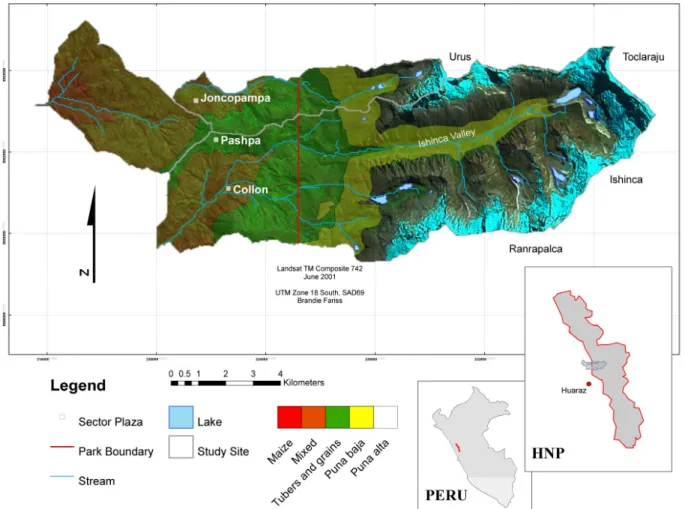
categorized as a level II protected area by the IUCN (see Figure 1.1).
The reserve is located in the Peruvian department of Ancash. Its conservation
16
of the Cordillera Blanca, a north–south oriented mountain chain forming the continental divide between Peru’s arid coast and the Amazon basin. The HNP is approximately 180
km in length and only 40 km at its widest in the east–west direction. Despite the
prominence of glaciated peaks within its borders, it boasts an amazing diversity of plant
and animal life; including 779 plant, 112 bird, and 10 different mammalian species—
many rare and endemic to the Andes (Kolff and Kolff 1997, Smith 1988). In addition to
these conservation priorities, the buffer zone of the HBR encompasses a number of
agro-pastoral Quechua-speaking communities whose enclosure in this conservation territory
instantly brought an estimated 226,000 decision-makers into national and international
conservation agendas (Byers 2000, INRENA 2002). The juxtaposition of local and
supra-local interests that has ensued has not been without conflict. The challenge of reconciling
the two is what spurred this research.
I sought to explore this conflict by conducting an in-depth study of land use and
resource management by one of the HBR’s indigenous communities. This decision was
motivated by my anthropological training and my desire to paint an intimate portrait of
indigenous life and the realities influencing local resource use. My first trip to park
headquarters and the offices of NGOs in Huaraz allowed me to identify several possible
communities for study. My criteria for selection included the indigenous community’s
level of involvement in tourism, and the conservation community’s perceptions of
environmental degradation on the lands managed by them. Although these criteria
allowed for several different possibilities, the Ishinca valley seemed well-suited for the
purpose. I consider it representative of the trajectory many other indigenous
industry. The Ishinca valley is often considered degraded by park officials and NGOs; it
also reportedly receives a substantial amount of tourism traffic (INRENA 1996, INRENA
2002, Ramirez 2002, Tohan 2000). This prompted me to visit the indigenous community
of Tupac Yupanqui, specifically the sectors of Collón and Pashpa. These sectors are
responsible for the management of resources in the Ishinca valley. In addition, they are
ideally situated to take advantage of a stream of tourism traffic that ensures their
integration into the market economy. Pashpa ironically happened to be the same
community where I first sat at the ephemeral lake of Cochapampa to observe the
reflection of Huascarán. Thus, I sought answers in the very place where I formed my
18
ORGANIZATION AND CHAPTER PROGRESSION
This dissertation was written as a series of stand-alone papers progressing from a
description of the problem and its context, to exploration of its implications for local
resource users, and its consequences for biodiversity conservation. Given the
significance of common pool resources to highland subsistence economies, I have
organized the chapters loosely after a framework proposed by Oakerson (1992) for
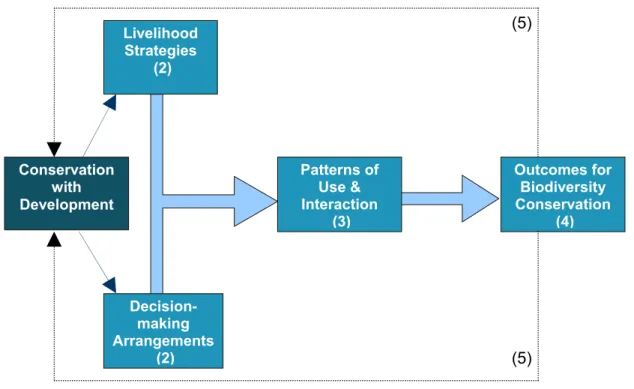
evaluating the outcomes of common property management(Figure 1.2). This includes describing the physical attributes, technologies and decision-making arrangements
defining livelihood strategies in the study site (Chapter 2), exploring the patterns of
interaction of individual actors and the factors influencing their decision-making (Chapter
3), quantifying the environmental outcomes of these decisions with regard to native plant
diversity (Chapter 4), and making recommendations to help ensure positive outcomes for
20
Figure 1.2: Framework for evaluating the outcomes of communal resource management modified from one proposed by Oakerson (1992). I modified the original framework to reflect the influence of policies associated with the creation of a protected area, including enclosure and the development of a tourism industry. Chapters related to each element in this framework are indicated in parentheses (#). Dotted lines indicate conclusions and recommendations that may allow for alternative outcomes in the HBR.
Presentation of the research begins with Chapter 2, which provides an important
foundation for subsequent chapters. Keeping in the tradition of cultural ecology research,
it offers a detailed description of the agricultural and pastoral land uses of variously
scaled decision-makers (i.e., individual, household, community, and empresa) and the loosely structured and largely implicit common property regime through which these uses are mediated. After this background is established, the remainder of the chapter focuses
on outlining how a variety of socio-political and economic changes facilitated by the
region’s enclosure as a national park are creating potentially unsustainable patterns of
interaction and failures of cooperation in the management of communal resources. In Livelihood
Strategies (2)
Decision-making Arrangements
(2)
Patterns of Use & Interaction
(3)
Outcomes for Biodiversity Conservation
(4) Conservation
with Development
(5)
particular, it explores the effects of (1) interventions by the state, (2) market integration
through the development of a tourism industry, and (3) increases in rural population and
temporary out-migration. Findings suggest that the establishment of the park boundary,
below 4000 meters in the Ishinca valley, has reduced the historical extent of the
community’s arable land base.4 Through a combination of land scarcity and increased
access to fertilizers and pesticides (granted by wage-earning opportunities and easy
access to the Huaraz market), many households are reducing fallow times and
intensifying their agricultural production.
Given the coordination of agriculture and pastoralism in the Andes (McCorkle
1987), changes in one have repercussions for the other. With less land in fallow, there
has become less land available for grazing in the community. This potentially translates
to more dependence on high elevation grasslands in the conservation core of the HNP. In
addition to changes in the spatial management of herds, the lucrative tourism industry,
which mainly involves transporting the gear of visiting mountaineers with packstock, has
created an incentive for households to own more animals. Involvement in tourism, as
well as temporary out-migration to work in the growing city of Huaraz, appears to have
created the potential to make these investments. The data presented in this chapter
indicate that tourism households have larger herds on average. Beyond the measurable
inequality in livestock holdings between market and subsistence-oriented households, the
nature of the tourism industry is such that the types of animals favored are mostly
22
native. Cattle (requiring little supervision), horse and mule are animals increasingly
preferred by all members of the community. With a growing number of non-native
livestock and less land in the community to herd them on, sustainable use and
cooperation appear more difficult to maintain with the existing institutional framework
and the context of uncertainty created by the involvement of actors external to the
community. These findings shed important insights on the reasons behind park and
community observations that there are more animals in the park than in the past, and raise
concerns over the outcomes of such trends.
Chapters 3 and 4 attempt to quantify the patterns described in Chapter 2, their
causes, and their outcomes for biodiversity conservation in the HBR by taking a more
locally scaled approach. In Chapter 3, a detailed time allocation dataset is used to model
household herding labor and the effects of tourism involvement on decision-making by
the household. This model tests competing hypotheses from the human behavioral
ecology (HBE) literature, in an attempt to explore the effects of market involvement on
the household’s use of communal resources. Whereas in Chapter 2, I describe the
concern of over-grazing in the HBR, in Chapter 3, I illustrate that tourism households
have larger herds on average, and that the very industry created to offset the use of the
park may have had the unintended consequence of intensifying its use. This chapter is
motivated by a desire to understand whether an increase in herd size translates to an
increased dependence on communal resources and an increased incentive to manage them
sustainably, as suggested by game theory and empirical evidence presented by Ruttan and
Borgerhoff-Mulder (1999). Alternatively, does increased market involvement create
result in spending less effort to manage a larger herd? The results of the time allocation
study suggest that the latter is an important constraint for many households. Households
involved in tourism, with larger herds on average, spent less time actively herding them.
This model corroborates the ethnographic observations of absentee herding presented in
Chapter 2, a pattern in which some households leave animals unattended on the high
elevation grasslands of the HNP.
While these findings would seem to confirm the park’s worst fears, the actual
outcomes for biodiversity conservation are more complicated, and are mediated by a
number of other factors explored in the dissertation—biophysical, social and political.
For example, pasture improvement projects by a local NGO in the sector of Collón offer
its households a solution to absentee herding in the park. Households of Collón,
especially those most involved in tourism, have the option to buy access to improved and
enclosed pastures in the community. This access minimizes the conflict between herding
and tourism, so that households can manage their herds while maintaining a presence in
the community with their packstock if arriero work materializes. While this suggests that the actions of local NGOs have offset the community’s reliance on the park,
Chapters 2 and 3 discuss the need for similar projects in the sector of Pashpa, which
makes up the other half of the user-group for resources in the Ishinca valley. The tourism
households of Pashpa experience the same opportunity costs, but do not have the same
enclosures devoted to herding in their sector. Beyond this, Pashpa is not well-situated
(geographically) in the stream of tourism traffic passing through the Ishinca valley. As a
result, its households have only moderate involvement in tourism and little means to
24
constituent that is responsible for an increased use of the Ishinca valley. The implications
are more than those that are immediately obvious. Sustainable management of a
commons requires the continued cooperation of all households from both sectors, and
community members of Pashpa feel that they have been disadvantaged. Recommendation
for how to improve this situation will be explored throughout the dissertation.
Chapter 4 links the patterns of interaction observed among these diverse
households to their outcomes for biodiversity conservation in the HBR. The analysis
presented in this chapter is an attempt not only to explore widely held assumptions of
over-grazing and environmental degradation, but to tease apart the relative effects of
grazing from other abiotic factors structuring vegetation communities. The ecological
data presented in this chapter illustrate that plant species frequently cited as indicators of
over-grazing, including Opuntia flocossa, Astragalus garbancillo and Aciachne pulvinata (e.g., Poma 2002, Tovar and Oscanoa 2002), occur throughout the lands grazed by the
study community. This occurrence has most likely created the numerous and somewhat
qualitative perceptions of environmental degradation in the Ishinca valley. Yet, a model
of plant species richness, developed from a sample of 12 different pastures throughout the
Ishinca valley illustrates that sites with moderate levels of grazing intensity have the
highest native species richness. Given the park’s focus on biodiversity conservation,
there are numerous implications for local land use and resource management. Rather
than view the agro-pastoral communities surrounding the HNP as the problem, this
analysis argues that they are integral to the creation of the Andean landscape that we wish
However, an important extension of the analysis in Chapter 4 offers a cautionary
tale of assuming that human-environment interactions are static. The patterns of
interaction described in Chapters 2 and 3 suggest the potential for unsustainable
outcomes by changing the intensity of grazing at certain locales and undermining the
prospect for cooperation. Thus, various potential outcomes for biodiversity conservation
were modeled in Chapter 4, based on future land use scenarios informed by observation.
There was little evidence at the time of fieldwork that the community had responded with
new rules to govern these changing patterns of use. Therefore, one prediction was based
on the worst-case scenario of doing nothing about a growing pattern of absentee herding
in the HNP. The model conditioned with this land use scenario suggests that high
altitude pastures in the Ishinca valley may be negatively affected by increased grazing
pressure, resulting in the potential loss of a number of plant species at the locales and
scales sampled.
Given the lack of baseline ecological data, including detailed climate data, the
model developed is admittedly a simplification of reality whose predictions are based on
“space for time” substitutions driven by a few key biophysical and anthropogenic
variables. However, such an approach offers important initial insights into the role of
humans in shaping this landscape and the potential outcomes of policies affecting the
decision-making of actors most intimately involved in its use and management. Like any
model its purpose is to aid our understanding of human-environment dynamics, while
recognizing that the reality is sufficiently more complicated. Chapter 5 concludes the
dissertation with a summary of the findings, policy implications and recommendations
CHAPTER 2
THE UNINTENDED CONSEQUENCES OF CONSERVATION AND
DEVELOPMENT FOR INDIGENOUS COMMUNITIES OF THE
HUASCARÁN BIOSPHERE RESERVE, PERU
ABSTRACT
The environment and biodiversity of the Huascarán Biosphere Reserve (HBR) are
threatened according to many in the region’s conservation community. This chapter
explores how social, political, and economic changes in the region have affected
agro-pastoral land uses and indigenous institutions for managing them. Here, I examine the
extent to which the region’s policies of “conservation with development” may ultimately
be responsible for these threats. The focus of my analysis is on the conservation of
grasslands in the HBR, a resource managed as common property. I adopt a cultural and political ecology perspective that relies on common property theory to describe the effects of state intervention, tourism involvement, and demographic change on the
decision-making of the Ishinca valley user-group, specifically the sectors of Collón and
Pashpa in the indigenous community of Tupac Yupanqui (TY). Findings illustrate how
conflicts and unintended consequences can emerge when attempting to balance
conservation and development, especially where the management of a commons is
involved. Data compiled from diverse sources, including census, household and
community-level surveys, time allocation observations, ethnography and participant
national park, the subsequent integration of many of its households into the market, a
young population age structure, and growing number of temporary out-migrants create
the following potential problems with respect to biodiversity conservation in the HBR:
(1) reductions in fallow on agricultural lands in the buffer zone;
(2) unanimous desire and widespread ability to increase livestock holdings through wage earnings in tourism;
(3) changes in spatial and temporal management of herds that have increased the presence of non-native livestock in the park;
(4) growing inequalities in livestock ownership and access to pasture resources that may undermine cooperation in the management of grazing commons; and
28
“La vida acá tiene dos lados. La vida de la montaña es duro, pero hermosa. Por eso somos pobres, pero somos ricos también.”
Life here has two sides. The life of the mountains is hard, but beautiful. For this we are poor, but we are also rich.
(a comunero of Tupac Yupanqui, Sector Pashpa, 2002)
INTRODUCTION
Despite the beauty of mountain landscapes, one readily associates notions of
remoteness, ruggedness and harshness with them. Characteristics such as these suggest
that high altitudes provide sparse means to make a living. Yet, life in the mountains can
be rewarding as well as difficult, uncertain but consistently so; a contrast realized by all
intimately familiar with Andean cultures and Andean landscapes. Contemporary
agro-pastoralists of the Huascarán Biosphere Reserve (HBR) recognize the constraints and
opportunities that shape their daily lives, and credit their existence to the bounty of the
chacra (field) and the puna (pasture), while many are increasing their participation in tourism. Agro-pastoralism has had a very long and prominent history in this region while
tourism has not. A number of concerns have recently been raised over the sustainability
of long-standing land use and resource management practices in the HBR—especially in
the Ishinca valley. The ensuing study was motivated by the possibility that these concerns
are the result of incompatibilities between subsistence and tourism, which brings into
question the viability of adventure tourism in the HBR and the fundamental assumptions
of the “conservation with development” paradigm that have encouraged it.
This chapter analyzes land use and land tenure in a single indigenous community