LANGUAGE SUPPORTS PERCEPTUAL SYMBOLS FOR EMOTION
Cameron M. Doyle
A thesis submitted to the faculty of the University of North Carolina at Chapel Hill in partial fulfillment of the requirements for the degree of Master of Arts in the Department of
Psychology and Neuroscience.
Chapel Hill 2017
ABSTRACT
Cameron M. Doyle: Language supports perceptual symbols for emotion (Under the direction of Kristen A. Lindquist)
The present studies test the hypothesis that language shapes emotion perception by
reactivating sensorimotor aspects of prior experiences to shape the perception of others’
facial actions. In Study 1, I show that language guides the acquisition of new exemplars of
emotional facial actions (“perceptual symbols”) that then bias subsequent perceptions of
similar emotional facial actions. In a learning phase, participants viewed non-stereotypical instances of anger and fear, and categorized them using the words “anger” and “fear” (verbal condition) or made a perceptual judgment that did not require emotion words (control
condition). Next, in a target phase, participants studied slightly different facial actions and categorized them using the words previously linked with the learned perceptual symbols. Finally, during a test phase, participants identified which face the individual had been making during the target phase (i.e., the learned face, the target face, or a morphed
access them during subsequent perceptions to make meaning of facial actions as instances of emotion. Implications for emotion theory and applications to special populations are
TABLE OF CONTENTS
LIST OF FIGURES ... vii
CHAPTER 1: THEORETICAL BACKGROUND ... 1
Language guides category acquisition ... 3
Language shapes emotion perception ... 4
A proposed mechanism for the role of language in emotion perception ... 5
Perceptual Inference Hypothesis ... 8
CHAPTER 2: THE PRESENT STUDIES ... 11
CHAPTER 3: STUDY 1 ... 13
Method ... 14
Results ... 18
Discussion ... 21
CHAPTER 4: STUDY 2 ... 22
Method ... 23
Results ... 28
Discussion ... 30
CHAPTER 6: GENERAL DISCUSSION ... 33
Implications ... 34
Limitations and Future Directions ... 37
LIST OF FIGURES
Figure 1 – Overview of Study 1 ... 17
Figure 2 – Bias scores from Study 1 ... 19
Figure 3 – Examples of novel emotion stimuli used in Study 2 ... 25
Figure 4 – Overview of Study 2 ... 27
CHAPTER 1: THEORETICAL BACKGROUND
Imagine someone who looks angry. Chances are, you just imagined the last angry person you saw by envisioning the particular scowl, frown, grimace, or growl made by your coworker, spouse, friend, or favorite television villain. But how did you know that person was angry when you saw him or her making those facial actions in the first place? Most likely it appeared to you that anger was just there, present on his face for the world to see. Yet growing evidence suggests that the ability to perceive a discrete emotion (“anger,” “disgust,” “fear,” etc.) in someone else’s facial actions is a constructive process that relies on your pre-existing knowledge about
emotional facial actions (Lindquist, MacCormack, & Shablack, 2015, Lindquist, Satpute & Gendron, 2015, Lindquist, Gendron, & Satpute, 2016). The scowls, frowns, grimaces, and growls you saw in the past are part of your conceptual knowledge of “anger” and help you make meaning of new instances of facial actions. So the next time you see a friend as angry, you will likely be drawing on conceptual knowledge acquired during prior instances of seeing others as angry to make meaning of your friend’s facial actions.
all human faces move in ways that signify pleasure, displeasure, startle and social aggression, yet different cultures make meaning of those basic actions in different ways (Jack, Sun, Delis,
Garrod, & Schyns, 2016). The process of meaning making is generally called “categorization” in psychology at large, but simulationist accounts of categorization refer to this process as “situated conceptualization” (Barsalou, 2009; Wilson-Mendenhall, Barrett, Simmons, & Barsalou, 2011) to denote the fact that all categorizations draw on context-specific knowledge. In the case of emotion, the emotion words a person knows refer to a cache of modality-specific knowledge about emotions acquired across specific instances. The various scowls, frowns, grimaces and growls that were perceived in the past when seeing angry individuals across myriad different contexts (e.g., anger at an employee, anger at a child, anger at a malfunctioning computer) are stored as “perceptual symbols” of sensorimotor aspects of prior experience that are reactivated during subsequent perceptions (Barsalou, 1999).
Growing evidence suggests that conceptual knowledge about emotion categories (e.g., anger) is important to the perception of emotion in faces (e.g., Aviezer et al. 2008a; Aviezer et al. 2008b; Aviezer, Trope, & Todorov, 2012; Hassin, Aviezer, & Bentin, 2013; Gendron et al. 2012; Nook et al. 2015; Lindquist et al. 2006; 2014; Widen & Russell, 2010; Noh & Isaacowitz, 2013; Ngo & Isaacowitz, 2015; for reviews see Lindquist & Gendron, 2013; Lindquist, Gendron & Satpute, 2016; Lindquist, MacCormack & Shablack, 2015; Lindquist, Satpute, & Gendron, 2015). Yet no studies to date have examined the ultimate mechanisms by which conceptual knowledge supported by language might shape the perception of emotion from facial actions.
sensorimotor representations of prior experiences that were previously paired with those words, which contributes to how incoming sensory information from faces is perceived (Barrett et al., 2007). Finally, I present findings from two studies that provide support for this hypothesis by demonstrating that language helps individuals to acquire and then use conceptual knowledge about emotions to make meaning of others’ facial actions.
Language guides category acquisition
Language is important to the acquisition of concept knowledge about all manner of categories. For instance, the phonological form of words has been shown to help infants acquire category knowledge about objects (e.g., Dewar & Xu, 2009; Ferry, Hespos, & Waxman, 2010; Gliga, Volein, & Csibra, 2010), perhaps because words are “essence placeholders” (cf. Xu, 2002) that activate the most diagnostic features of a category for use during categorizations (see Lupyan & Thompson-Schill, 2012; Waxman & Gelman, 2009). Labeling perceptually distinct objects with the same word also enables infants to infer that, despite perceptual differences, those objects belong to the same category (Plunkett et al. 2008, see Waxman & Gelman, 2009).
similar role in emotion, helping to group together certain perceptual features (e.g., a scowl, furrowed brows) as members of a certain perceptual category in some instances (e.g., “anger”), but members of a different perceptual category (e.g., “fear”) in other instances.
Words may be especially critical in developing categories for emotion because category-specific statistical regularities in the sensory information available on a face (e.g., facial muscle actions) are low due to the inherent variability within emotion categories (Barrett, 2006;
Cacioppo et al. 2000; Mauss & Robinson, 2009; Siegel et al. under review). For instance, objective measurements of facial muscle movements using electromyography cannot reveal a single pattern of facial muscle movements that exists for the category of anger (Cacioppo et al. 2000). Furthermore, not all people make the same facial expression when experiencing anger (if they make a facial expression at all; see Reisenzein et al. 2013) and the facial expressions made and perceived differ by context and culture (e.g., Gendron, Roberson, van der Vyver, & Barrett, 2014; Jack et al. 2016; for reviews see Barrett et al. 2011; Elfenbein, 2013; Fernandez-Dols & Crivelli, 2013; Hassin et al. 2013; Nelson & Russell, 2013). Language might thus be a form of “glue” that holds together visual representations of perceptually distinct facial actions as members of the same emotion category.
Language shapes emotion perception
scowling face) (Nook, Lindquist & Zaki, 2015). This is likely because words prompt more categorical perceptions of visual stimuli than other cues (Edmiston & Lupyan, 2015; Lupyan & Thompson-Schill, 2012). These findings suggest that the presence of language during emotion perception helps us to make meaning of other peoples’ facial actions as instances of discrete emotion.
There is also evidence that the absence of emotion concept knowledge during tasks hinders emotion perception. For example, temporarily reducing access to an emotion concept word (e.g., “anger”) impairs the perception of emotional facial actions (e.g., a scowling face), even when the task itself does not require labeling (e.g., as in perceptual priming; Gendron, Lindquist, Barsalou & Barrett, 2012; or perceptual matching; Lindquist, Barrett, Bliss-Moreau & Russell, 2006; Roberson & Davidoff, 2000). Similarly, individuals who have permanently impaired concept knowledge due to a neurodegenerative disease called semantic dementia demonstrate impaired perception of emotional facial actions, although they maintain the ability to perceive the general affective valence (positivity v. negativity v. neutrality) of those actions (Lindquist, Gendron, Barrett & Dickerson, 2014). These findings are consistent with the idea that emotion words help individuals to categorize very general information about faces (e.g., the valence of a facial expression) into instances of specific discrete emotion categories (e.g., anger v. fear v. disgust v. sadness). Even healthy individuals fail to perceive emotional facial actions in terms of discrete emotion categories (i.e., display categorical perception) when emotion concept words are not part of the experimental task (see Lindquist & Gendron, 2013 for a review).
A proposed mechanism for the role of language in emotion perception
the perception of emotion from facial actions. It is possible that emotion words play a role in emotion perception by helping to activate the concept knowledge about emotion categories that is integral to perceiving emotion in others’ facial muscle movements (Barrett, Lindquist & Gendron, 2007; Fugate, 2013; Lindquist & Gendron, 2013; Lindquist, Gendron & Satpute, 2016; Lindquist, Satpute, & Gendron, 2015; see Medin & Smith, 1984 for a review of the role of concepts in categorization). This concept knowledge helps to reduce the uncertainty that is inherent in most naturally occurring pleasant or unpleasant facial actions, resolving these actions into perceptions of discrete behaviors associated with discrete emotion categories such as anger,
fear, or sadness (for reviews, see Barrett, et al. 2007; Barrett, et al. 2011; Gendron, Mesquita, & Barrett, 2013; Lindquist & Gendron, 2013; Lindquist, Satpute & Gendron, 2015). Consistent with this view, labeling faces with emotion words helps to reduce amygdala activation in
response to those faces (Lieberman et al. 2007; see Brooks et al. in press for a meta-analysis); the amygdala is a brain region that is responsive to novelty and uncertainty (see Cunningham & Brosch, 2012; Whalen, 1998; Weierich, Wright, Negreira, Dickerson & Barrett, 2010). In effect, concept knowledge about emotion categories is hypothesized to reduce the perceiver’s
uncertainty about the meaning of pleasant or unpleasant facial actions.
sensory experiences, and that this information is reactivated during new perceptions to help make meaning of incoming “bottom-up” sensations from the world (Barsalou, 2009; Martin, 2016; Wilson-Mendenhall, Barrett, Simmons, & Barsalou, 2011). According to such simulationist accounts, semantic knowledge is not exclusively represented as abstract propositional knowledge about a category (e.g., “anger involves scowling”), but as perceptual symbols (Barsalou, 1999) constructed out of prior modality-specific experiences of that category (e.g., a partial
Perceptual Inference Hypothesis
A viable hypothesis for the role of language in emotion perception is that emotion words reactivate sensorimotor representations that were previously paired with those words, which contributes to how incoming sensory information from faces is actually seen in the first place. Consistent with the idea that language can shape the perception of incoming sensory information, language has been shown to facilitate the detection of otherwise invisible objects in the visual field (Lupyan & Ward, 2013). The objects were camouflaged from participants’ view using continuous flash suppression (CFS), a technique in which a static visual stimulus is presented to one eye, and a series of rapidly changing stimuli are simultaneously presented to the other eye (Tsuchiya & Koch, 2005). This procedure engenders inter-ocular competition that renders the static stimulus “invisible.” Using CFS, Lupyan and Ward (2013) demonstrate that simply hearing a word (e.g., “pumpkin”) denoting the suppressed stimulus (e.g., an image of a pumpkin) is enough to “boost” the visual representation of that stimulus into awareness, enabling participants to see what would otherwise not have been selected into visual awareness. This finding suggests that the presence of language brings online conceptual knowledge about object categories, making information about those categories more salient during visual perception.
(e.g., closer to anger on the happiness-anger continuum) than they actually were. The findings from this and other studies of categorical perception of faces (for a review, see Fugate, 2013) demonstrate that the concept knowledge we have about particular emotion categories can help us make meaning of emotional faces. The ease with which we perceive emotion on faces paired with the tremendous variability in the facial actions associated with a single emotion category implies that we routinely use conceptual information to make meaning of others’ emotions in our daily lives. For example, the word “anger” might cohere together an individual’s embodied knowledge about the causes and consequences of the emotion concept anger, as well as stored representations of what others’ angry facial “expressions” have looked like across different contexts in the past. The word “anger” thus allows an individual to store representations of various facial actions as instances of the same category.
It is possible that repeatedly pairing instances of the emotion anger with the label “anger” over time (as is done in daily life when we categorize our own and others’ emotions) leads to the formation of specific perceptual symbols (Barsalou, 1999) for the category anger. These
perceptual symbols might shape the subsequent processing of other faces as instances of anger
CHAPTER 2: THE PRESENT STUDIES
Study 1 uses a learning paradigm adapted from Santos (2008) to investigate whether words guide the acquisition of perceptual symbols for emotion that shape perception of
subsequently presented faces paired with the same words. This learning paradigm enabled me to test the perceptual inference hypothesis which predicts that language helps participants to first acquire new perceptual symbols for emotion categories, and then use those perceptual symbols to make meaning of subsequent instances of emotional facial actions. In a learning phase of the experiment, participants viewed non-stereotypical instances of angerand fear paired with the words “anger” and “fear” (the verbal condition) or made a perceptual judgment of the features of the faces (control condition). Perceivers were next presented with a series of faces that exhibited slightly different, more stereotypical instances of anger and fear than those presented during the learning phase (the target phase of the experiment). Finally, a test phase assessed the extent to which perceptions of the target faces was biased by the perceptual symbols acquired during the learning phase. Evidence of bias would suggest that perceptual symbols for emotion are acquired when facial actions are paired with words and that these perceptual symbols can shift perceptions of subsequently viewed faces.
CHAPTER 3: STUDY 1
Method
Participants. Participants were 91 undergraduate students (44 women, Mage = 19.30, SD = 2.82).
Data from eight participants were removed because they failed to complete at least 75% of the trials in either the learning or target phase. Data from two additional participants were removed because they failed to enter a response on two trials in the test phase. Because missing two or more responses meant that I had 75% or less of these participants’ test phase data, I chose to exclude these two participants as well (final N = 81).
Procedure and Data Analysis. Participants were positioned approximately 20 inches from a
monitor with a screen resolution of 1440 x 900 pixels. The images presented were 250 x 310 pixels. Thus, the images subtended approximately 7.9° x 10.8° of visual angle.
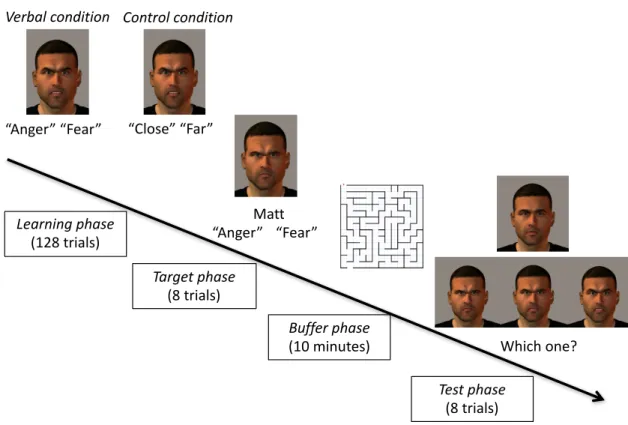
Learning phase. As Figure 1 illustrates, participants completed 128 trials where they viewed non-stereotypical depictions of fear and anger and were asked to categorize the faces as “fear” vs. “anger” (verbal condition) or “close” vs. “far” (control condition). Non-stereotypical actions are not typically associated with fear and anger (e.g., fearful faces were frowning with slightly raised eyebrows or angry faces were open-mouthed and scowling with slightly raised eyebrows). On each trial, the face was one of eight digital identities created in the Poser 7 3D character art and animation software (http://poser.smithmicro.com/poser.html). Poser allowed me to manipulate the specific facial actions displayed on faces and create both stereotypical and non-stereotyped exemplars for each category. Two identities were used to create perceptual
presented a total of 16 times, each time shown with the same stereotyped emotional facial action for one of the two emotions used in the study (i.e., fear and anger). Mean accuracy was high (M
= 99.50%, SD = 0.91), indicating that participants were attending to the task and were easily able to categorize the faces when forced-choice labels were provided. Following a 1-minute break, participants completed the target phase.
Target phase. As Figure 1 illustrates, participants viewed the same eight identities from the learning phase, but this time the faces depicted stereotypical facial actions. Stereotypical faces were developed based on the caricatures of English emotional facial actions depicted in Ekman & Friesen (1976). For instance, fearful faces had wide eyes, raised eyebrows and open mouths. Angry faces had furrowed eyebrows and clenched teeth. See Figure 1 for examples of caricatured, stereotypical facial behaviors associated with English emotion categories.
Participants were told that their goal in this phase was to learn the names of the individuals they had seen previously. In reality, the purpose of this phase was to expose perceivers to the target faces while activating the perceptual symbols established for the two emotion words during the learning phase. My interest was to see if those perceptual symbols would then bias perception and encoding of the target faces. To ensure that participants did not explicitly encode differences between the learned and target faces, target facial actions were only subtly different from the faces seen during the learning phase. On each trial, a stereotyped face appeared for 3s along with a name (i.e., “Brian,” “John,” “Matt,” “Steve”), and participants were asked to learn the
associated previously with each word. Each identity was seen once; participants thus completed a total of eight trials.
Buffer phase. Participants performed a buffer task for 10 minutes, in which they completed a series of paper-and-pencil mazes. The buffer phase was included to ensure that perceptual symbols were not merely stored in working memory between the phases, or that my findings were merely evidence of perceptual priming.
Test phase. I assessed participants’ perceptual memory for the target phase face by asking
Figure 1. Overview of Study 1. Participants in the verbal condition learned to associate “non-stereotypical” facial expressions with emotion words. Participants in the control condition made a perceptual judgment about the features of the faces. Participants in both conditions then saw more stereotypical versions of the same emotion category during the target phase. In a buffer phase,
participants completed a series of paper-and-pencil mazes. During the test phase, they were asked to rank order which facial expression they recalled seeing during the target phase: the learned face, the target face, or a morph of the two. I used a weighted “bias score” to see if participants’ perceptual memory was biased towards the learned face.
Data analysis. My data analysis method was adapted from Santos (2008) to assess the extent to which a perceptual symbol of the learned face influenced the perception and encoding of the target face. I computed a bias score by assigning a weighted value to participants’
“Anger”(“Fear”
“Anger” “Fear”Matt
Target'phase
(8(trials)
Learning'phase
(128(trials)
Test'phase
(8(trials)
Buffer'phase
(10(minutes) Which(one?
Verbal'condition
“Close”(“Far”
face was assigned a weight of 0, and the morphed face was assigned a weight of 1 (because it was a 50-50% blend of the two). Weights were then multiplied by participants’ responses. For instance, if a participant ranked the learned face “1”, and the morph face “2” and the target face “3”, then the contrast would be (2 x 2) + (1 x 1) + (0 x 0) = 5, indicating the largest degree of bias. If a participant ranked the target face “1”, and the morph face “2” and the learned face “3”, the contrast would be (0 x 2) + (1 x 1) + (2 x 0) = 1, indicating no bias. This bias score was computed for participants’ responses on each of the eight test trials, and the mean bias score was calculated for each participant across trials. Mean bias scores were compared to two different values in a one-sample t-test. First, I compared mean bias scores to the value of 1, which
indicated that there was no bias in the weighted contrast (i.e., participants consistently chose the target face first, followed by the morph, followed by the learned face). Second, I compared mean bias scores to the value of 3, since 3 represented the mid-point of the 1-5 bias range.
Since it can be argued that participants’ first choice is an indication of their most confident perceptual memory, I also computed descriptive analyses by indicating on which percentage of trials participants chose the learned face first, the morph face first, and the target face first. This provided a complementary index of participants’ memory for the faces presented in the target phase.
Results
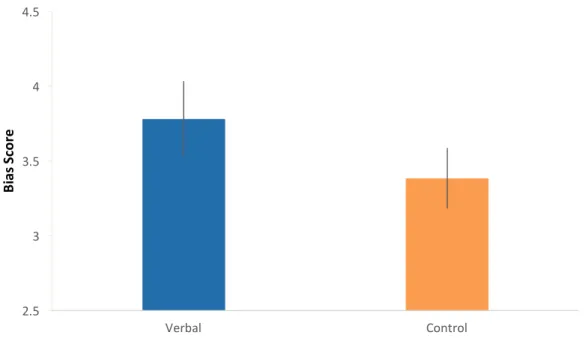
As predicted, emotion words were relatively more likely to help participants form perceptual symbols for emotion that then biased perceptions of subsequently perceived faces. Mean bias values for the test trials were significantly greater than 1 for both the verbal (M = 3.78, SD = .81), t(41) = 22.19 p < .001, d = 3.42, 95% CI [2.53, 3.04] and control (M=3.39
were also greater than 3 for verbal, t(41) = 6.24 p < .001, d = 0.96, 95% CI [0.53, 1.04] and control t(38)=3.83, p < .001, d = 0.62, 95% CI [0.18, 0.59] conditions.1 Most importantly, as predicted, bias values for the verbal condition were significantly greater than bias values for the control condition t(79) = 2.45, p = .02, d = 0.55, 95% CI [0.07, 0.72] (Figure 3), suggesting that emotion words preferentially helped to facilitate the acquisition of perceptual symbols for emotion categories and the extent to which newly acquired perceptual symbols influenced perceptions of subsequently perceived emotional facial actions.
Figure 2. Bias scores from Study 1. Means and 95% confidence intervals reveal that verbal trials had significantly more bias than control trials, indicating that emotion words employed during the initial learning phase helped participants acquire new perceptual symbols that biased perception of subsequent faces towards the perceptual information presented in the learning phase.
2.5
3 3.5 4 4.5
Verbal Control
Bi
as
S
co
As a follow-up to the bias score analysis, I investigated descriptively which face participants were more likely to choose first during the test phase.2 Consistent with my hypotheses, participants in the verbal condition were marginally more likely than those in the control condition to choose the learned face first, t(80) = 1.81, p = .075, d = 0.40, 95% CI [-0.86%, 17.73%]. Consistent with the finding that words helped participants acquire novel
perceptual symbols for emotion (i.e., representations of the specific faces presented), participants in the verbal condition were more likely to choose the learned face (on 50.00% of trials) first when deciding which face they had seen during the target phase, as compared to the actual target face(17.56% of trials), t(41) = 5.29, p < .001, d = 1.48, 95% CI [20.06%, 44.82%]. Participants were more likely to choose the morph face first (29.46% of trials) compared to the target face,
t(41) = 2.64, p = .01, d = 0.65, 95% CI [2.80%, 21.01%]. Participants were also more likely to choose the learned face compared to the morph face first t(41) = 3.74, p = .001, d = 0.99, 95% CI [9.46%, 31.61%].
In the control condition, participants were again more likely to choose the learned face (on 41.56% of trials) first when deciding which face they had seen during the target phase, as compared to the actual target face(23.44% of trials), t(39) = 3.83, p < .001,d = 0.69, 95% CI [8.55%, 27.70%]. Participants in the control condition were also more likely to choose the morph face (33.13% of trials) compared to the target face first, t(39) = 2.10, p = .042, d = 0.21, 95% CI [0.35%, 19.03%]. Whereas participants in the verbal condition were more likely to choose the
learned vs. morph face first, participants in the control condition were equally likely to choose the learned vs. morph face first (p > .05).
Discussion
The findings from Study 1 suggest that pairing facial actions with emotion words in the verbal condition better facilitated the updating of perceptual symbols for emotion categories, which influenced perceptual memory for those faces. Without pairing the facial actions with emotion words, participants in the control condition were equally biased to choose the learned and morph faces first. These findings are all the more striking in that the updated perceptual information biased participants’ perceptions away from the more stereotypical instances of emotion viewed in the target phase. Perceptual symbols for non-stereotypical facial actions of emotion were acquired when paired with words and biased perception of later facial actions. This effect likely reflects the reality of day-to-day life, since facial actions are not likely to match stereotypes of emotional facial expressions in varied day-to-day interactions.
CHAPTER 4: STUDY 2
Study 1 explicitly tested the importance of language in helping participants acquire perceptual symbols for known emotion categories (anger and fear). Presumably, the English-speaking participants in Study 1 already understood the meaning of the emotion labels “anger” and “fear” prior to the start of the experiment, and possessed pre-existing perceptual symbols for those particular emotion categories. Associating the words “anger” and “fear” with ostensibly angry and fearful faces enabled participants to update their perceptual symbols for the emotion categories anger and fear, with the result that their perceptions for new exemplars of anger and fear were shifted towards their newly updated perceptual symbols.
bringing those perceptual symbols online to aid in later instances of emotion perception. Study 2 thus sought to replicate and extend the findings from Study 1 by testing whether language supports the formation of novel perceptual categories for never-before-seen “alien emotions.” Method
Participants. Participants were 111 undergraduate students (63 women, Mage = 19.16, SD
= 1.81). Data from seven participants were removed because their learning phase data were not properly saved, so I could not verify that they had completed at least 75% of the trials. Data from an additional 10 participants were removed because they failed to enter a response on at least two trials in the test phase, meaning that they responded to less than 75% of trials (final N = 94). Importantly, results were identical whether these 17 participants were included in the final sample or not. I thus excluded them to be conservative as I did in Study 1.
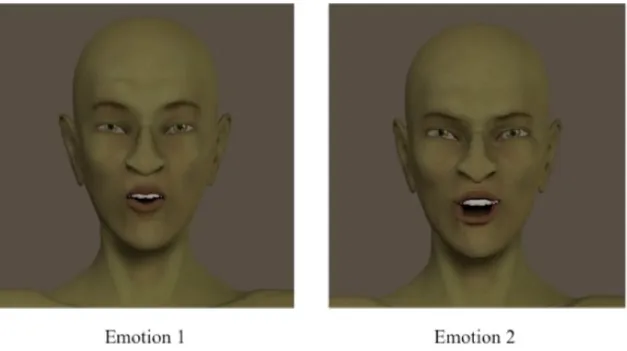
Stimuli. Drawing inspiration from Lupyan, et al. (2007), I created a set of novel “alien”
facial stimuli using the Poser Pro 2012 3D character art and animation software
which emotion category words were freely produced). For instance, Emotion 1 was labeled as an instance of 18 different emotional and mental states (N = 160) (e.g., 18.75% of participants used labels such as “surprised” or “shocked,” 15.63% used labels such as “curious” or “interested,” 11.88% labeled it as “happiness,” “laughter,” “amusement,” “excitement,” or “joy,” 11.25% used labels such as “confused,” “befuddled,” or “dumbfounded,” and so on). Emotion 2 was labeled as 19 different emotional and mental states (N = 166) (e.g., 34.34% of participants used labels such as “happiness,” “laughter,” “amusement,” “excitement,” or “joy,” 21.08% used labels such as “surprised,” “appalled,” or “shocked,” 10.24% used labels such as “anger,” “fury,” or “mad and so on). The stimuli were ambiguous in terms of their emotional meaning and can thus be considered novel facial actions not clearly associated with specific English-language emotion categories.
Figure 3. Examples of novel emotion stimuli used in Study 2. Stimuli were created using the Poser Pro 2012 3D art and animation software and were not reliably rated as depicting any single English-language emotion category.
Procedure and Data Analysis. Participants were positioned approximately 20 inches
from a monitor with a screen resolution of 1440 x 900 pixels. The images presented were 275 x 297 pixels. Thus, the images subtended approximately 8.7° x 10.4° of visual angle.
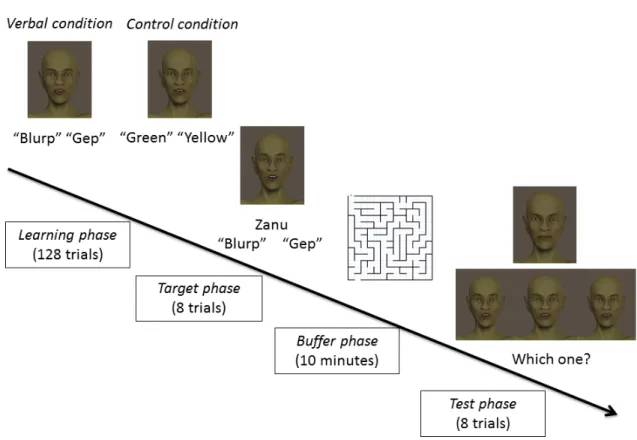
I made three major changes to the procedure for Study 2. First, in the verbal condition, participants learned to categorize pictures of eight identities expressing two “novel emotion” categories using the nonsense labels “blurp” and “gep,”3 whereas in the control condition,
participants were asked to make an unrelated categorical perceptual judgment about the novel faces, judging whether the alien’s skin was more yellow or green in color. In contrast to Study 1
3Because certain nonsense consonant-vowel structures are typically associated with particular perceptual
(where participants judged how close vs. far apart the eyes were), this judgment was categorical in nature and had an accuracy criterion, which allowed me to ensure that participants were not more accurate in one of the learning conditions compared to the other. Accuracy rates for the categorical judgments in both the control condition (M = 98.96%, SD = 1.41) and verbal conditionwere high (M = 96.04%, SD = 10.41).
Second, the nature of the novel emotion categories necessitated the use of a modified procedure for the target phase of the experiment. Given that there are not stereotypes for the novel alien facial actions, I had to make the facial actions in the target phase appear different from those in the learning phase using a different method in Study 2. I used Poser to reduce the degree of activation in each facial action in the novel “emotions” by 20-50%, depending on the degree of activation of that particular facial action in the initial face. This achieved the goal of creating two exemplars that looked different from one another (e.g., if “Emotion 1” had lowered eyelids and a dropped jaw, the version seen in the target phase had 20% less lowered eyelids and 50% less lowered jaw).
phase. Otherwise, the procedure used in Study 2 was the same as that of Study 1. See Figure 4 for an overview of Study 2.
Results
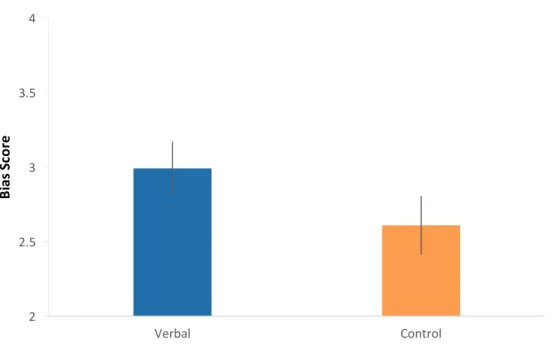
Consistent with my predictions, the nonsense labels specifically helped participants form perceptual symbols for novel emotion categories and biased subsequent perceptions of the novel alien faces. As in Study 1, mean bias scores for the test trials were significantly greater than 1 for both the verbal condition (M = 2.99, SD = .64), t(48) = 21.56, p < .001, d = 6.22, 95% CI [1.80, 2.17], and the control condition (M = 2.61, SD = .67), t(44) = 16.16, p < .001, d = 4.87, 95% CI [1.41, 1.82], indicating some degree of bias. Mean bias values were not significantly different from 3 for the verbal condition (p > .1), but they were significantly less than 3 for the control condition, t(44) = -3.86, p = .001, d = -1.16, 95% CI [-0.59, -0.18],4 indicating a difference in the magnitude of bias between conditions. Most critical to my hypothesis, as in Study 1, bias values for the verbal condition were significantly larger than bias values for the control condition t(92) = 2.73, p = .01, d = 0.56, 95% CI [0.10, 0.64] (Figure 7), suggesting that emotion words
preferentially helped to facilitate the acquisition of novel perceptual symbols for emotion that biased perceptions of subsequently viewed faces.
Figure 5. Bias scores from Study 2. Means and 95% confidence intervals reveal that, as in Study 1, verbal trials had significantly more bias than control trials. These findings suggest that nonsense words used as emotion labels in the learning phase helped participants acquire novel perceptual categories that biased perception of subsequent faces.
Also consistent with my hypothesis, participants in the verbal condition were
significantly more likely than those in the control condition to choose the learned face first (t(92) = 2.25, p = .03, d = 0.46, 95% CI [1.00%, 15.93%]).5 However, in contrast to Study 1,
participants in the verbal condition were equally likely to choose the morph face (on 27.04% of trials) or target face (on 36.48% of trials) first when deciding which face they had seen during the target phase, as compared to the learned face (on 32.91% of trials) (ps> .10). Participants in the verbal condition were significantly more likely to choose the target face versus the morph face first (t(48) = -2.65, p = .01, d = 0.61, 95% CI [-16.60%, -2.28%]).6 It is possible that
participants in the verbal condition only chose the morph face first on 27% of trials because they
5This test is not significant at the Bonferroni adjusted threshold of .017.
2 2.5 3 3.5 4
Verbal Control
Bi
as
Sc
or
had not previously seen the morph face or paired it with a nonsense word during the learning or target phases. Thus, they had not acquired a perceptual symbol for that particular face, and so did not select it first on many of the trials in the test phase.
Consistent with the finding that words helped participants acquire completely novel perceptual symbols for emotion that biased later perceptions of exemplars from that category, participants who did not pair novel faces with words (control condition) were more likely to accurately choose the target face (on 42.78% of trials) first when deciding which face they had seen during the target phase, as compared to the learned face (24.44% of trials), t(44) = -3.39, p
= .001, d = 0.91, 95% CI [-29.24%, -7.42%], or the morph face (28.89% of trials), t(44) = -2.68,
p = .01, d = 0.71, 95% CI [-24.35%, -3.44%]7. Participants in the control condition were equally likely to choose the learned vs. morph face first (p > .10). Thus, participants who did not pair novel “alien” facial actions with words during an initial learning phase more accurately
perceived subsequently seen “alien” facial actions than did those who had initially learned to pair “alien” facial actions with words.
Discussion
Study 2 demonstrated that language guides the acquisition of novel perceptual symbols for never-before-seen facial actions. Pairing facial actions with nonsense words biased
perceptions of other faces towards those new perceptual symbols. Bias due to newly learned perceptual symbols occurred even though the faces learned were completely novel and differed only subtly from the faces studied in the target phase.
These findings are similar to several previous findings observed in the literature. First, Roberson et al. (2007) found that labels biased perceptual memory towards the central tendency
of a category (i.e., the prototype) and away from the veridical perceptual symbol of that category. The learning phase of the present study may thus have served to create the prototype (i.e., most frequently observed) representation of the alien facial action. When individuals later saw and labeled a novel version of the alien facial action, it was encoded in memory as being more similar to the prototype acquired during the learning phase than the veridical representation seen during the target phase. Participants in the control condition, who did not pair facial actions with words during the learning phase, might have been less likely to acquire the prototype and thus less likely to show biased perceptual memory later at test.
Second, Halberstadt and Niedenthal (2001) found that individuals who paired a morph of angry and happy facial actions with the label “angry” later remembered the face as being more similar to a caricature of an angry facial expression than it actually was. Participants first viewed the morphed face, and labeled it as an instance of “anger.” Next, participants viewed a
continuous array of stimuli, ranging from 100% happiness to 100% anger. When asked to select the previously viewed face from the continuum, participants who had labeled the face as “anger” were more likely to choose a face that was closer to anger on the continuum than the morphed face actually was. In the present studies, individuals who did not pair faces with labels had relatively unbiased perceptual memory for the faces later. A similar mechanism is likely to underlie both my effects and Halberstadt and Niedenthal’s effects, insofar as language is helping to support the perceptual symbols for emotion that are initially acquired and then used during subsequent instances of perception and perceptual memory.
As compared to Study 1, the bias effect in Study 2 was less robust. Participants were
CHAPTER 6: GENERAL DISCUSSION
Two studies demonstrated the role of language in the acquisition of conceptual
knowledge about emotion categories. Study 1 demonstrated that words help individuals update existing perceptual symbols for the English emotion categories of anger and fear. Study 2 demonstrated that words help individuals acquire entirely novel perceptual symbols, as might occur when children are learning about emotions (i.e., Widen & Russell, 2003; 2010) or when individuals are learning the facial actions associated with emotion words in different cultures. Thus, Study 2 extended my findings to demonstrate that language guides the acquisition of novel perceptual symbols for never-before-seen facial actions.
In both studies, bias due to newly learned perceptual symbols occurred even when the faces learned were only subtly different from the faces studied in the target phase. It is important to note that because the acquisition of perceptual symbols can occur relatively quickly (e.g., within an experimental session), they are likely to change over time based on statistical regularities present in the environment.
Implications
My findings have several important theoretical and practical implications. First, they are consistent with psychological constructionist accounts of emotion, which hypothesize that language plays an important role in the perception and experience of emotion (Barrett et al. 2007; Lindquist et al. 2015; 2016; Lindquist, MacCormack & Shablack, 2015; Lindquist & Gendron, 2013). In particular, it is proposed that language plays a role in the acquisition and use of emotion category knowledge to guide perceptions of otherwise ambiguous facial muscle movements (cf. Lindquist, MacCormack & Shablack 2015). Psychological constructionist views challenge the long held assumption that the perceptual information contained in a person’s face is enough for another person to perceive that he is angry, sad, afraid, etc. (e.g., Allport, 1924; Ekman, 1972; Tomkins, 1963). According to this “natural kinds” approach, emotion perception occurs in the blink of an eye because anger, sadness, and fear are perceptual categories that are language-free and are either inborn (Izard, 1971) or develop from the perceptual similarity of the expressions within a category (Allport, 1924; Ekman, 1999). An emerging body of evidence suggests, however, that emotion perception is achieved when prior instances of emotion perception and knowledge about emotion categories are brought to bear by the activation of emotion words (see Lindquist, MacCormack & Shablack, 2015; Lindquist, Satpute, & Gendron, 2015; Lindquist, Gendron, & Satpute, 2016 for reviews). Through this rapid, unconscious process, an individual is able to quickly disambiguate (and thereby make meaning of) another person’s facial muscle movements.
particular emotion category based on their most common, most recent, or most relevant perceptual symbol for that category. Once acquired, perceptual symbols for anger shape perceptions of subsequent faces that are labeled “anger” in a predictive manner. If words shape the formation and use of perceptual symbols, as in Study 1, then researchers can unintentionally introduce perceptual symbols in the minds of their participants any time stimuli are paired with words and repeated in an experiment (as in most forced-choice categorization studies). This could shape how stimuli on subsequent trials are remembered, categorized, or even perceived in the first place. For instance, Sauter et al. (2010) claimed to observe universality in the perception of emotional vocalizations because both Western participants and participants from the nomadic Himba tribe in Namibia could associate vocalizations with English emotion categories. In this study, participants completed a task that has historically been used in cross-cultural
investigations of emotion (e.g., Ekman & Friesen, 1969): they heard a story about an individual experiencing an emotion and then they picked which of three emotional stimuli (in this case, emotional vocalizations) matched the story. However, in 2015, Sauter et al. published additional methodological details describing the fact that experimenters regularly performed “manipulation checks” prior to completing the study by asking Himba participants to listen to the story and to describe in their own words what individuals in the story were feeling. Researchers then performed a “rigorous manipulation check with experimenter verification” rather than relying solely on “participants’ reports” of what was occurring in the story. That is, the
A broader implication of this work is that it can be applied in at least three special
populations that would benefit from learning how to better perceive the emotions of those around them: Children, individuals with communication disorders, and immigrants in the process of acculturating to a new cultural context. First, understanding the role of language in the
acquisition of emotion concepts could help us teach children how to more accurately perceive others’ affective states as they are learning the words that are used to denote different emotion categories. This is implicitly recognized in the RULER approach to emotional intelligence applied in schools (Rivers & Brackett, 2010; Brackett et al. 2011). In this method, children learn to associate their personal experiences with new emotional language (e.g., regret) in an effort to help them recognize such feelings in themselves and others.
Second, this research suggests that the language and emotion deficits observed in individuals with autism spectrum disorder (ASD) may be caused by the same mechanism. This knowledge contributes to a better understanding of why individuals with ASD have trouble communicating with and relating to others.
Third, this research could help explain findings that recent immigrants who better understand the emotional patterns of their new culture report increased levels of relational well-being (De Leersnyder, Mesquita, Kim, Eom, & Choi, 2014). Although some basic facial actions associated with valence, arousal and aggression appear to be universal, there are multiple
Limitations and Future Directions
There are limitations of the present studies that should be addressed in future research. The present findings cannot pinpoint whether the acquisition of perceptual symbols impacted the encoding of the faces seen during the target phase, the retrieval of those faces during the test phase, or both. Prior research suggests that both mechanisms are possible. For instance, there is growing evidence that emotion perception is an inherently context-dependent phenomenon (see Barrett et al. 2007; Barrett, Mesquita & Gendron, 2011; Fernandez-Dols & Crivelli, 2013; Hassin et al. 2013; Lindquist & Gendron, 2013; Lindquist, et al. 2015; Lindquist et al. 2016; Parkinson, 2013). The prior experience of the perceiver (cf., Barrett, et al. 2011) and the emotion word available to make meaning of a face (e.g., Barrett et al. 2007) served as context for emotion perception. Contextual influences on emotion perception are also consistent with evidence showing that context is intrinsically involved in even the most basic aspects of object perception (e.g., Bar et al. 2006).
Future research should examine at which points during perception/encoding and retrieval language is most specifically having an impact. Halberstadt (2005) has shown that language may be influencing emotion perception during encoding, and broader research on the role of concept knowledge in categorization may also be informative. Although there is some evidence to suggest that concept knowledge influences categorization during category learning, other
evidence suggests that concept knowledge is activated during the category judgment (i.e., during perception) (for a discussion, see Murphy, 2002). It is further possible that the role of language in emotion perception is task-dependent. For instance, it may be that perceptual symbols supported by language are most likely to have an impact on perceptual processes when a
might have more or less of an impact on perception in some contexts and more or less of an impact on memory in others.
Conclusion
Allport, F. H. (1924). Social psychology. New York: Houghton Mifflin.
Aviezer, H., Hassin, R., Ryan, J., Grady, C., Susskind, J., Anderson, A., Moscovitch, M., & Bentin, S. (2008a). Angry, disgusted or afraid? Studies on the malleability of emotion perception. Psychological Science, 19, 724-732.
Aviezer, H., Hassin, R., Bentin, S., & Trope, Y. (2008b). Putting facial expressions into
context. In N. Ambady and J. Skowronski (Eds.), First Impressions, New York: Guilford Press.
Aviezer, H., Trope, Y., & Todorov, A. (2012). Holistic person processing: Faces with bodies tell the whole story. Journal of Personality and Social Psychology, 103, 20-37.
Bar, M., Kassam, K. S., Ghuman, A. S., Boshyan, J., Schmid, A. M., Dale, A. M., Hämäläinen, M. S., et al. (2006). Top-down facilitation of visual recognition. Proceedings of the National Academy of Sciences of the United States of America, 103, 449.
Barrett, L. F. (2006). The emotion paradox. Personality and Social Psychology Review, 10, 20-46.
Barrett, L. F., & Lindquist, K. A. (2008). The embodiment of emotion. Chapter in G. R. Semin and E. R. Smith (Eds.), Embodied grounding: social, cognitive, affective, and
neuroscientific approaches. (pp. 237-262).New York: Cambridge University Press. Barrett, L. F. & Simmons, W. K. (2015). Interoceptive predictions in the brain. Nature Reviews
Neuroscience, 16, 419-429.
Barrett, L. F., Lindquist, K. A., & Gendron, M. (2007). Language as context for the perception of emotion. Trends in Cognitive Sciences, 11, 327–332.
Barrett, L. F., Mesquita, B., & Gendron, M. (2011). Context in emotion perception. Current Directions in Psychological Science, 20, 286-290.
Barsalou, L. W. (1999). Perceptual symbol systems. Behavioral and brain sciences, 22, 577– 660.
Bombari, D., Schmid, P. C., Mast, M. S., Birri, S., Mast, F. W. & Lobmaier, J. S. (2013). Emotion recognition: The role of featural and configural face information, Quarterly Journal of Experimental Psychology, 66(12), 2426-2442.
Brace, N. A., Hole, G. J., Kemp, R. I., Pike, G. E., Van Duuren, M., & Norgate, L. (2001). Developmental changes in the effect of inversion: Using a picture book to investigate face recognition. Perception, 30, 85-94.
Brackett, M. A., Maurer, M., Rivers, S. E., Elberston, N. A., Carpenter, M. D., Kremenitzer, J. P., . . . Bauer, J. (2011). Emotional literacy for students: The Feeling Words
Curriculum. In M. A. Brackett, J. P. Kremenitzer, M. Maurer, S. E. Rivers, N. A. Elberston, & M. D. Carpenter (Eds.), Creating emotionally literate classrooms: An introduction to The RULER Approach to social and emotional learning. Port Chester, NY: National Professional Resources.
Brooks, J. A., Shablack, H., Gendron, M., Satpute, A. B., Parrish, M. J., & Lindquist, K. A. (in press). The role of language in the experience and perception of emotion: A
neuroimaging meta-analysis. Social Cognitive and Affective Neuroscience.
Cacioppo, J. T., Bernston, G. G., Larsen, J. T., Poehlmann, K. M., & Ito, T. A. (2000). The psychophysiology of emotion. Chapter in M. Lewis & J. M. Haviland-Jones (Eds.),
Handbook of emotions, (2nd ed.)(pp. 173-191). New York: Guilford Press.
Calder, A. J., Young, A. W., Keane, J., & Dean, M. (2000). Configural information in facial expression perception. Journal of Experimental Psychology: Human Perception and Performance, 26(2), 527-551.
Calvo, M. G. & Lundqvist, D. (2008). Facial expressions of emotion (KDEF): Identification under different display-duration conditions. Behavior Research Methods, 40, 109-115. Camras, L. A. & Allison, K. (1985). Children’s understanding of emotional facial expressions
and verbal labels. Journal of Nonverbal Behavior, 9, 84-94.
Cunningham, W. A., & Brosch, T. (2012). Motivational salience: Amygdala tuning from traits, needs, values, and goals. Current Directions in Psychological Science, 21, 54-59. De Leersnyder, J., Mesquita, B., Kim, H., Eom, K. & Choi, H. (2014). Emotional fit with
Dewar, K., & Xu, F. (2009). Do early nouns refer to kinds or distinct shapes? Evidence from 10-month-old infants. Psychological Science, 20, 252–257.
Durand, K., Gallay, M., Seigneuric, A., Robichon, F., & Baudouin, J-Y. (2007). The
development of facial emotion recognition: The role of configural information. Journal of Experimental Child Psychology, 97, 14-27.
Edmiston, P. & Lupyan, G. (2015). What makes words special? Words as unmotivated cues. Cognition. 143. (93-100).
Ekman, P. (1972). Universal and cultural differences in facial expressions of emotions. In J. K. Cole (Ed.), Nebraska symposium on motivation, 1971 (pp. 207–283). Lincoln, NE: University of Nebraska Press.
Ekman, P. (1999). Basic emotions. Handbook of cognition and emotion, 45–60. Ekman P. & Cordaro D. (2011). What is meant by calling emotions basic. Emotion
Review,3(4), 364–370.
Ekman, P. & Friesen, W. V. (1969). The repertoire of nonverbal behavior: Categories, origins, usage, and coding. Semiotica, 1(1), 49-98.
Elfenbein, H. A. (2013). Nonverbal dialects and accents in facial expressions of emotion.
Emotion Review, 5, 90-96.
Fernandez-Dols, J. M., & Crivelli, C. (2013). Emotion and expression: Naturalistic studies.
Emotion Review, 5, 24-29.
Ferry, A. L., Hespos, S. J., & Waxman, S. R. (2010). Categorization in 3-and 4-Month-Old Infants: An Advantage of Words Over Tones. Child development, 81, 472–479.
Fugate, J. M. B (2013). Categorical perception for emotional faces. Emotion Review, 5, 84-89. Fugate, J., Gouzoules, H., & Barrett, L. F. (2010). Reading chimpanzee faces: Evidence for the
role of verbal labels in categorical perception of emotion. Emotion, 10, 544-554.
Gallese, V. & Lakoff, G. (2005). The brain’s concepts: The role of the sensory-motor system in conceptual knowledge. Cognitive Neuropsychology 22, 455-479.
Gendron, M., Mesquita, B., & Barrett, L. F. (2013). Emotion perception. Chapter in D. Reisberg (Ed.), Oxford Handbook of Cognitive Psychology. (pp. 539-556). New York: Oxford University Press.
Gendron, M., Roberson, D., van der Vyver, J. M., & Barrett, L. F (2014). Perceptions of emotion from facial expressions are not culturally universal: Evidence from a remote
culture. Emotion, 14, 251-262.
Gliga, T., Volein, A., & Csibra, G. (2010). Verbal labels modulate perceptual object processing in 1-year-old children. Journal of Cognitive Neuroscience, 22, 2781-2789.
Halberstadt, J. B., & Niedenthal, P. M. (2001). Effects of emotion concepts on perceptual memory for emotional expressions. Journal of Personality and Social Psychology, 81,
587-598.
Halberstadt, J.B. (2005). Featural shift in explanation-biased memory for emotional faces.
Journal of Personality and Social Psychology, 88, 38-49.
Halberstadt, J. B. (2006). The generality and ultimate origins of the attractiveness of prototypes.
Personality and Social Psychology Review, 10, 166–183.
Hassin, R. R., Aviezer, H., & Bentin, S. (2013). Inherently ambiguous: Facial expressions of emotions, in context. Emotion Review, 5, 60-65.
Helmholtz, H. von (1925). Treatise on Physiological Optics, Volume III. (J.P.C. Southall, Trans.). New York, NY: Dover. (Original work published 1867)
Izard, C. E. (1971). The face of emotion (Vol. 23). New York: Appleton-Century-Crofts.
Jack, R. E., Sun, W., Delis, I., Garrod, O. G. B., and Schyns, P. G. (2016) Four not six: revealing culturally common facial expressions of emotion. Journal of Experimental Psychology: General, 145, 708-730.
Kan, I. P., Barsalou, L. W., Solomon, K. O., Minor, J. K., & Thompson-Schill, S. L. (2003). Role of mental imagery in a property verification task: fMRI evidence for perceptual symbols of conceptual knowledge. Cognitive Neuropsychology, 20, 525-540.
Lindquist, K. A., Barrett, L. F., Bliss-Moreau, E., & Russell, J. A. (2006). Language and the perception of emotion. Emotion, 6, 125–138.
Lindquist, K. A., & Gendron, M. (2013). What’s in a word? Language constructs emotion perception. Emotion Review 5, 66-71.
Lindquist, K. A., Gendron, M., Barrett, L. F., & Dickerson, B. C. (2014). Emotion perception, but not affect perception, is impaired with semantic memory loss. Emotion, 14, 375-387. Lindquist, K.A., Gendron, M., & Satpute, A.B. (2016). Language and emotion: Putting words
into feelings and feelings into words. In L.F. Barrett, M. Lewis & J.M. Haviland-Jones (Eds.) Handbook of Emotions (4th ed.). New York: Guilford.
Lindquist, K. A., MacCormack, J. K., & Shablack H. (2015). The role of language in emotion: Predictions from psychological constructionism. Frontiers in Psychology, 6, 444. Lindquist, K.A., Satpute, A.B., & Gendron, M. (2015). Does language do more than
communicate emotion? Current Directions in Psychological Science, 24, 99-108.
Lupyan, G., Rakison, D. H., & McClelland, J. L. (2007). Language is not Just for Talking.
Psychological Science, 18, 1077.
Lupyan, G., Thompson-Schill, S.L. (2012). The evocative power of words: Activation of
concepts by verbal and nonverbal means. Journal of Experimental Psychology: General. 141(1), 170-186.
Mauss, I. B., & Robinson, M. D. (2009). Measures of emotion: A review. Cognition and Emotion, 23, 209-237. Reprinted in 2010 in J. De Houwer & D. Hermans (Eds.),
Cognition and Emotion. Reviews of current research and theories (p. 99-127). New York:
Taylor and Francis.
Medin, D. L., & Smith, E. E. (1984). Concepts and concept formation. Annual Review of Psychology, 35, 113-138.
Ngo, N., & Isaacowitz, D. M. (2015). Use of context in emotion perception: The role of
top-down control, cue type, and perceiver’s age. Emotion, 15(3), 292-302.
Noh, S. R., & Isaacowitz, D. M. (2013). Emotional Faces in Context: Age Differences in Recognition Accuracy and Scanning Patterns. Emotion (Washington, D.C.), 13(2), 238– 249.
Nook, E., Lindquist, K. A., & Zaki, J. (2015). A new look at emotion perception: Concepts speed and shape facial emotion recognition.
Parkinson, B. (2013). Contextualizing facial activity. Emotion Review, 5, 97-103.
Pecher, D., Zeelenberg, R., & Barsalou, L. W. (2004). Sensorimotor simulations underlie conceptual representations: Modality-specific effects of prior activation. Psychonomic Bulletin & Review, 11, 164-167.
Plunkett, K., Hu, J-F, & Cohen, L. B. (2008). Labels can override perceptual categories in early infancy. Cognition, 106, 665-681.
Reisenzein, R., Studtmann, M., & Horstmann, G. (2013). Coherence between emotion and facial expression: Evidence from laboratory experiments. Emotion Review, 5, 16-23.
Rivers, S. E. & Brackett, M. A. (2010) Achieving Standards in the English Language Arts (and More) Using The RULER Approach to Social and Emotional Learning, Reading & Writing Quarterly, 27:1-2, 75-100.
Roberson, D., & Davidoff, J. (2000). The categorical perception of colors and facial expressions: The effect of verbal interference. Memory & Cognition, 28, 977–986.
Roberson, D., Damjanovic, L., & Pilling, M. (2007). Categorical perception of facial
expressions: Evidence for a “category adjustment” model. Memory & Cognition, 35, 1814-1829.
Santos, A. J. (2008). Verbal overshadowing as perceptual interference (Doctoral dissertation). Available from ProQuest dissertations and Theses database. (UMI No. 3279893). Sauter, D. A., Eisner, F., Ekman, P., & Scott, S. K. (2010). Cross-cultural recognition of basic
Sauter, D. A., Eisner, F., Ekman, P., & Scott, S. K. (2015). Emotional vocalizations are
recognized across cultures regardless of the valence of distractors. Psychological Science, 26, 354–356. Tracy, J. L., & Robins, R. W.
Siegel, E. H., Sands, M. K., Condon, P., Chang, Y., Dy, J., Quigley, K. S., & Barrett, L. F. (under review). Emotion fingerprints or emotion populations? A meta-analytic investigation of autonomic features of emotion categories.
Tomkins, S. S. (1963). Affect Imagery Consciousness - Volume II the Negative Affects. Springer Publishing Company.
Waxman, S.R., Gelman, S.A. (2009). Early word-learning entails reference, not merely associations. Trends in Cognitive Sciences, 13(6), 258-263.
Weierich, M. R., Wright, C. I., Negreira, A., Dickerson, B. C., & Barrett, L. F. (2010). Novelty as a dimension in the affective brain.Neuroimage, 49, 2871-2878.
Whalen, P. J. (1998). Fear, Vigilance, and Ambiguity: Initial Neuroimaging Studies of the Human Amygdala. Current Directions in Psychological Science, 7, 177-188. Widen, S. C. (2013). Children’s interpretation of facial expressions: The long path from
valence-based to specific discrete categories. Emotion Review, 5, 72-77.
Widen, S. C., & Russell, J. A. (2008). Children acquire emotion categories gradually. Cognitive Development, 23, 291–312.
Widen, S. C. & Russell, J. A. (2010). Children's scripts for social emotions: Causes and consequences are more central than are facial expressions. British Journal of Developmental Psychology, 28, 565-581.
Wilson-Mendenhall, C.D., Barrett, L.F., Simmons, W.K., & Barsalou, L.W. (2011). Grounding emotion in situated conceptualization. Neuropsychologia, 49, 1105-1127.
Winkielman, P., Halberstadt, J., Fazendeiro, T. & Catty, S. (2006). Prototypes are attractive because they are easy on the mind. Psychological Science, 17. 799-806.