COMPETENCY DEVELOPMENT FOR PUBLIC LIBRARY DIRECTORS
Mary Wilkins Jordan
A dissertation submitted to the faculty of the University of North Carolina at Chapel Hill in partial fulfillment of the requirements for the degree of Doctor of Philosophy in the School of
Information and Library Science.
Chapel Hill 2012
Approved by: Evelyn Daniel Deborah Barreau Claudia Gollop Barbara Moran Jeffrey Pomerantz
ii ABSTRACT
MARY WILKINS JORDAN: Competency Development for Public Library Directors (Under the direction of Evelyn Daniel)
The purpose of this study is to develop a set of competencies for public library directors, which can help them to successfully lead their libraries. The research objectives for this study were:
to identify in the literature and report desired competencies for library manager/leaders
drawn from the literature;
to validate the competencies found in the literature through the opinions of current
library manager/leaders; and,
to refine the competencies found in the literature through the opinions of current public
library directors.
iii
TABLE OF CONTENTS
CHAPTER ONE: INTRODUCTION………. 1
Problem Statement………..……….. 3
Purpose and Research Objectives……….. 4
Definition of Terms……….. 5
Assumptions and Limitations……… 6
Significance………7
CHAPTER TWO: LITERATURE REVIEW………... 9
Brief Review of Leadership Theories………. 9
Library Leadership Competencies……… 13
LIS leadership competency development research………... 15
LIS leadership competency lists compiled using means other than research………... 18
Summary………. 24
Leadership Competencies in Professions other than LIS………. 24
Competency Development Research………... 25
Healthcare Fields………. 25
Business Areas……… 30
Other Careers……….. 36
Leadership Competencies without professional Focus………... 38
Competencies with no research basis ………... 40
Healthcare Fields………. 40
iv
Other Careers……….. 44
Leadership Competencies without professional Focus………... 47
Summary………. 54
Library Leadership Training……… 55
Summary………. 61
CHAPTER THREE: METHODOLOGY……….. 63
Methodology Literature Review for This Study………63
Content Analysis……… 64
Content Analysis Research Examples……….. 65
Delphi Method……… 67
Delphi Method Research Examples………. 69
Content Analysis for This Study………...72
Information Collection……… 72
Study Population………. 72
Data Analysis………... 73
Delphi Method for This Study………. 74
Study Population………. 74
Information Collection……… 76
Study Instruments and Data Collection………77
Round One……….. 77
Round Two………. 78
Round Three………79
Data Analysis………... 79
v
CHAPTER FOUR: RESULTS………81
Content Analysis……….. 81
First Round of Delphi………. 82
Second Round of Delphi………. 87
Third Round of Delphi………90
Statistical Testing Looking at Years Worked as a Librarian………... 92
Statistical Testing Looking at Years Worked as a Director……….94
Statistical Testing Looking at Population Differences……….. 97
CHAPTER FIVE: DISCUSSION AND CONCLUSION……… 100
Issues in Competency Development……….. 101
Competency Training Development………...104
Training for Soft Skill Competencies………. 107
Training for the Competencies in this Study……….. 109
Emergent Competencies for the Library Director……….. 111
Conclusion……….116
APPENDICES Appendix A: LIS leadership competencies developed through research……… 120
Appendix B: LIS leadership competencies compiled by means other than research………. 126
Appendix C: Frequency of mention of competencies in the LIS literature, with definitions………138
Appendix D: Delphi Instrument, Round One………140
vi
Appendix F: Initial Recruiting Email……….. 149
Appendix G: Delphi Second Round Mean, Standard Deviation, Median, Mode.………... 151
Appendix H: Delphi Third Round Mean, Standard Deviation, Median, Mode………152
Appendix I: ANOVA testing of Years as a Librarian………. 153
Appendix J: Kruskal-Wallis Statistical Testing of Years as a Librarian………159
Appendix K: Comparison of ANOVA and Kruskal-Wallis Statistical Testing of Years as a Librarian………... 170
Appendix L: ANOVA Testing of Years as a Director……… 172
Appendix M: Kruskal-Wallis Statistical Testing of Years as a Director…... 178
Appendix N: Comparison of ANOVA and Kruskal-Wallis Statistical Testing of Years as a Director……….188
Appendix O: ANOVA testing of Population Size Differences…………... 190
Appendix P: Kruskal-Wallis Statistical Testing of Population Size Differences………... 196
Appendix Q: Comparison of ANOVA and Kruskal-Wallis Statistical Testing of Population Size Differences……….. 206
BIBLIOGRAPHY………. 208
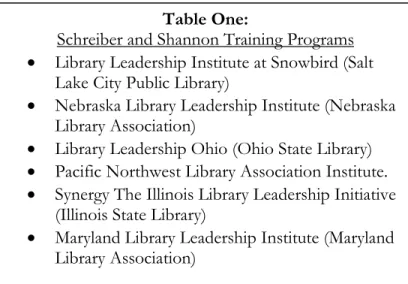
LIST OF TABLES Table One: Schreiber and Shannon Training Programs………57
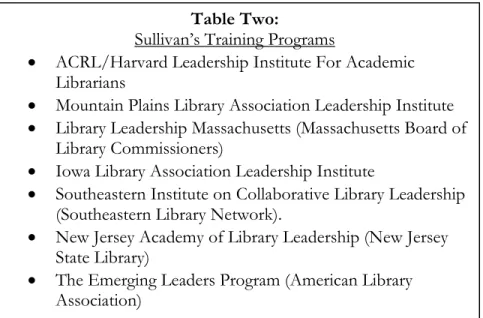
Table Two: Sullivan’s Training Programs……… 58
Table Three: Institution-led Training Programs………... 60
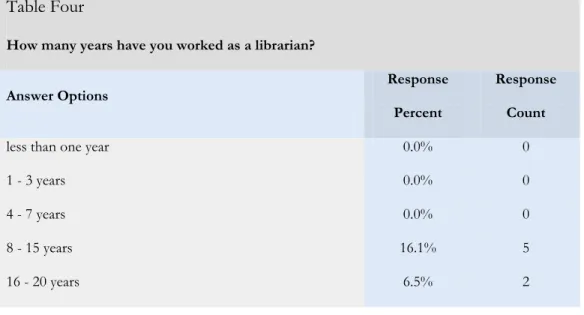
Table Four: How many years have you worked as a librarian?...82
Table Five: How many years have you been a public library director?... 83
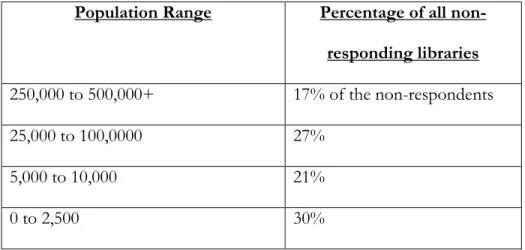
Table Six: Population Size of Libraries with Non-responding Directors…... 84
vii
Table Eight: Competencies eliminated in Round Two………..89 LIST OF CHARTS
Chart One: Spearman’s rho comparing ANOVA and Kruskal-Wallis
breakdown for Years as a Librarian………. 95 Chart Two: Spearman’s rho comparing ANOVA and Kruskal-Wallis
breakdown for Years as a Director………97 Chart Three: Spearman’s rho comparing ANOVA and Kruskal-Wallis
CHAPTER ONE INTRODUCTION
Public libraries play an important role in their communities and are being asked to meet community needs in new ways, including assisting with community education, addressing literacy issues, bridging the digital divide, and providing a place for all community members to gather. As McCook (2004, p. 75) has noted, “Librarians have worked hard to establish the public library as an essential community service, sought local, state, and federal funds to implement and expand public library services, and defined and articulated an ethos that defends the ideals of free inquiry”. But with the pressures of changing demands and shrinking resources, the need is increasing for skilled library directors to run libraries that can continue to be successful in the future and to cope with a threatened present.
Many library and information (LIS) professionals are concerned about the shortage of experienced librarians as their rate of retirement increases (Cross, 2005, p. 193). A simple demographic overview demonstrates the potential problem: the Baby Boomer generation (born between 1946 and 1960), currently hold most of the upper-level leadership positions in public libraries, outnumbering significantly the next group of leaders, the Generation X librarians (born between 1961 and 1981). When they leave, they will take important professional and
2
The current leaders in public libraries need to be prepared to help the next generation of directors to be as successful as possible. It is important that they are given the tools to help them succeed, but it is also important that opportunities that will help upcoming directors are defined. As Cross (2005, p. 193) puts it, "The problem is not only attracting people to the field, but also finding avenues for individuals to gain the skills and experience necessary to become tomorrow's library administrators". It is not enough for librarians who are, potentially, candidates for
administrative positions to merely be present as things are happening and decisions are made around them; they need to be introduced systematically to the skills of leadership with a set of definite goals. Public libraries themselves will need to be more active in developing new library leaders, a need identified by Sager (1999, p. 91) thirteen years ago that was as pressing then as it is now. Without a generally accepted set of competencies, they are rudderless in this process, left to hand down leadership training haphazardly.
The LIS profession has not ignored the issue of the leadership shortage. Several local, state, and national library organizations have begun to address the training of future public library leaders and directors through organized training programs. However, many of these programs have not been sustained, due to budget cuts or lack of leadership follow-through. Most of the programs neither make the details of any of the goals they set for leadership
3
acknowledged that some leaders are getting the training and support they need and are emerging from programs ready to face the demands of public library management, it can be said that without a set of competencies to use as goals and benchmarks, there is no way of confirming that this is the case or of measuring progress in and effectiveness of public library leadership training. Development of competencies – specific knowledge, skills, and abilities – that arise from the evidence of research will help individual librarians wanting to develop their leadership skills, as well as helping the profession itself to provide the best possible preparation for library directors.
Problem Statement
As the speed of change in society seems to be constantly increasing, public libraries need to keep pace with change to serve their communities as effectively as possible. New
technologies, new services, new demands all combine to make the job of a library director more complicated than it was a generation, or even five or ten years, ago. To continue to not only keep pace with the speed of change in technologies and services, but also to get out ahead of change and ensure that public libraries continue to be valued in their communities, public libraries need good manager/leaders. Public libraries in too many communities are in danger of losing staff, resources and hours, or of closing entirely. They need capable and competent directors, if they are to meet the current challenges and to sustain them into the future.
4
necessary for library directors. Without a consensus on which of these competencies are the most crucial, it will be impossible for current managers to develop opportunities for upcoming leaders through which they can learn the skills and qualities they need to be effective. The development of a set of research-informed competencies will give answers to these questions and provide a foundation for developing other research-informed ideas to assist
manager/leaders in libraries. This study will develop a set of research-informed competencies for public library directors
Purpose and Research Objectives
The purpose of this study was to develop a set of competencies for public library directors, which can help them to successfully lead their libraries. The competencies mentioned in the literature, used in previous training or developed as informal lists by members of the profession are pieces of a puzzle that need to be assembled to give a clear picture of the ideas being advanced by the profession. Disparate opinions on the knowledge, skills, abilities and other less easily measured personal attributes necessary for library directors to learn need to be brought together and examined systematically. Using those ideas as a basis, the competency set developed in this study will be further refined by current public library directors in successful libraries, thus helping to ensure that the most important competencies identified from the literature of the profession are confirmed and enhanced by the people who actually carry out these tasks of leadership and management in public libraries.
The research objectives for this study were:
to identify in the literature and report desired competencies for library manager/leaders
5
to validate the competencies found in the literature through the opinions of current
library manager/leaders; and,
to refine the competencies found in the literature through the opinions of current public
library directors.
The research-based development of competencies for public library directors will provide a foundation for those who wish to build up their own skills as they move toward director jobs and will give libraries and professional organizations a useful set of competencies for use in developing training programs, which will ensure they are helping grow and develop those who will be moving up leadership ranks. It also provides a foundation for future research. Good directors are very important for ensuring the success of their libraries, but they do not function alone; other leaders and managers, with or without qualifications or titles, also
contribute to the success. Their contributions should also be analyzed and methods developed for their competency development through research that extends the scope of the set of competencies developed in this study.
Definition of Terms
For the purpose of this study, the following definitions will be used:
Competencies: LIS authors often use the term competency in a casual way, without clear definition, but apparently meaning almost any idea that can be used to identify something important about the position they are describing. Consequently, some ideas of what competencies are that have been derived from the literature review may not fit a classic
6
for leaders will be considered to ensure that important ideas are not overlooked. Later studies may want to build on this study by focusing on a stricter definition of competency.
For the purposes of this research study, competencies will be understood to be
knowledge, skills, and abilities that can be taught and evaluated (Dole, Hurych & Liebst, 2005, p. 125), but will also expand to include less easily measured attainments important for a
manager/leader in public libraries. Improvement may exist on a sliding scale and an individual may never achieve perfection, but the possibility and awareness of and progress toward an ideal will be sufficient for a concept to be included in this study and called a competency.
Manager/leader: Warren Bennis (1991) has said the difference between leaders and managers is that managers do things right and leaders do the right thing. However, when looking at the needs of public library directors, the distinction between these two concepts is necessarily blurred. The best directors combine the skills traditionally associated with managers and with leaders, and this study is aimed at producing a set of competencies for use in helping to create successful directors. In this project, the term manager/leader will be used to describe people who exhibit the skills associated with both “doing things right” and “doing the right thing.”
Assumptions and Limitations
The underlying assumption of this study is that a set of competencies, useful to current and future public library directors, can be developed from ideas expressed in the literature and gathered from current directors. It is assumed that using the ideas and experiences of members of the profession to build research-informed competencies will provide a foundation for training for future directors.
7
competencies developed in this research study will not be immutable. However, devising a method to identify important competencies will give aspiring and new manager/leaders a set of specific goals to strive for in their own professional development and will give library institutions a set of competencies for use in recruiting, hiring and training. While a set of competencies may not stand for all time, developing that first set with a firm basis in research is an important step toward building skills for successful public library directors. Future research can build on the ideas presented here.
The benefit of looking at the past, through the literature and the views of current public library directors, could be questioned as a basis for developing competencies for the future. But this is the body of knowledge, and the collection of our ideas, as expressed in the words of members of the profession. Building a definition of the competencies necessary for the future should start with a clear understanding of the ideas already presented as important to the profession. Future research into the subject can look to other bases for development of competencies, to ensure the most complete view for public library directors and for the profession as a whole.
Significance
8
Leadership Massachusetts (Massachusetts Board of Library Commissioners), and The Emerging Leaders Program (American Library Association).
However, there has not been a formal set of research-informed goals and standards advanced for any of these programs, nor has the effectiveness of the programs been evaluated. Without a definite set of goals at the outset of any kind of training program, the success or failure of the program cannot be evaluated. Therefore, we have no real evidence of a positive contribution to the profession by any of these programs, and we have no basis on which to begin building the development of our directors.
This research study will develop that first set of competencies for public library directors, based on information derived from literature and current professionals. It is hoped that
CHAPTER TWO LITERATURE REVIEW
This section will examine the literature on competencies from two directions. The first is a review of ideas on leadership from the LIS literature and literature from other professions, sharing ideas on competencies important for manager/leaders. The second is a review of the leadership training programs offered by the library profession, to see what ideas they are already providing to librarians interested in leadership positions.
Brief Review of Leadership Theories
To provide a more complete understanding of the ideas about what is needed for the
development of good leaders, the theories of leadership in the last century will help provide a good background of material. While this review is not comprehensive, it should provide adequate coverage of the different theories advanced for good leadership.
10
procedures their parents used to develop their method and describe how the Gilbreths practiced their efficiency and motion studies on their twelve children. Also in this theoretical school is Henry Gantt, who is best known for his scheduling charts (Gantt charts) which allow tasks to be seen and planned out in a graphic way so users can see both tasks and the timeframe for
completion. He also focused on efficiency, looking to managers to improve the performance and environment of the staff to ensure the best performance. This kind of management strategy is still seen today in different organizations or, at least, in tasks within an organization. For
example, it is not uncommon in libraries for the circulation staff to develop a best practice set of procedures to ensure that everyone does the same tasks in the same way every time.
The Administrative School of management and leadership theories was the next to develop to help managers to be successful. Frenchman Henri Fayol developed six primary functions of management, promulgating them in 1918, still in use by many in management training today: forecasting, planning, organizing, commanding, coordinating, controlling. He also developed his fourteen principles of management – his attempt at a competency list – which included discipline, order, equity, initiative, and esprit de corps (Brodie, 1967). Mary Parker Follett was a Boston-based theoretician in this school, who focused on the holistic aspect of an organization and on the need to build reciprocal relationships between managers and staff during the 1910s and 1920s. This Administrative School represents a step closer to the
management ideas used by many managers today. The focus on identifying tasks that managers can do to help staff is important, and is a shift in attitude from the more rule-bound Scientific managers.
In the 1920s and 30s, the Human Relations School of thought rose to prominence. Chester Barnard wrote Functions of the Executive in 1938, in which he outlined his ideas on
11
top three functions were: to establish and maintain an effective communication system; to hire and retain effective personnel; and to motivate those personnel. The perspective of managers and leaders as taskmasters is by now really shifting from that of Scientific Management
proponents to focus more on looking at staff as individuals and on the need to work with them as individuals to accomplish the strategic goals of the organization. Some of the specific
incentives he suggested to help improve staff performance were: Money and other material inducements;
Personal non-material opportunities for distinction;
Desirable physical conditions of work; and
Ideal benefactions, such as pride of workmanship, etc.
These are all ideas that are used in workplaces today, as managers struggle to motivate staff to keep working and to produce high-quality products. It is a manager’s job to make people work, but there are many ways to carry out that job, as these different theories illustrate. While there may not be a single approach to being a good manager/leader, looking at different methods others have tried can help managers reflect on their own skills.
Some of the theories of good management and leadership that have arisen in more recent years include:
Contingency Theory. In his 1967 book A Theory of Leadership Effectiveness, Fred Fiedler
theorized there was no one best way to manage and that, instead, leaders need to look at each situation (situational favorableness) and fit their leadership style to suit the
circumstances of the situation.
Total Quality Management (TQM), which focuses on building quality in the workplace
mid-12
1980s, requires leaders to be constantly watching the organization and the products (or services) to ensure the best definitions are created and the best assessments are carried out. This model encourages manager/leaders to have their employees develop the skills necessary to meet the quality standards (Oakland, 2003).
Theories X and Y. Douglas McGregor wrote The Human Side of Enterprise in 1960 to lay
out two different kinds of workers. Theory X says that employees are naturally lazy and need to be constantly prodded to work, requiring a lot of hands-on intervention from the manager. In Theory Y, employees are presumed to want to work and to be interested in being successful, and that managers only need to help bring out the inner
self-motivation of their employees. Each style of manager can be useful in bringing out the best work from different types of workers.
Theory Z. William Ouchi wrote the book Theory Z: How American Business Can Meet the
Japanese Challenge in 1981, when Japanese businesses were booming and American industry was declining. He based his theories on ideas he saw in Japanese businesses, in particular that workers want to have close relationships with people at work, that social/family-style aspects of an organization are as important (or more so) than the work people are doing, and that managers need to be responsible for the well-being of staff. In the application of this theory, managers would function both as facilitators of work and as pseudo heads of a family.
13
Fish! A Remarkable Way to Boost Morale and Improve Results (Lundin, Paul & Christensen,
2000)
The One Minute Manager (Blanchard & Johnson, 1982)
Our Iceberg Is Melting: Changing and Succeeding Under Any Conditions (Kotter & Rathgeber,
2006)
First, Break All the Rules: What the World's Greatest Managers Do Differently (Buckingham &
Coffman, 1999)
Good to Great: Why Some Companies Make the Leap... and Others Don't (Collins, 2001)
The 7 Habits of Highly Effective People (Covey, 2004)
Who Moved My Cheese?: An Amazing Way to Deal with Change in Your Work and in Your Life
(Johnson, 1998).
None of these titles provide what is needed specifically by managers and those with leadership aspirations in libraries. The next section moves beyond the foundations of general management theory to consider literature more specifically focused on libraries and the leadership ideas and competencies needed to run them effectively
Library Leadership Competencies
Just what can be considered a competency differs from author to author. The language used in Dole, Hurych, and Liebst's definition seems to be very common in discussion of
competencies: “competencies are skills and knowledge that can be learned and can be measured” (2005, p. 125). Although this definition might exclude a number of things referred to as
14
competencies as “the combination of knowledge, skills, and abilities which are relevant to a particular job position and which, when acquired, allow a person to perform a task or function at a high level of proficiency”. Again, the idea of improving these task or function performances plays a key role in defining what is a competency and what is not.
This is specifically different from traits as discussed in older leadership literature, in which trait would be something that is inherent in an individual – it is either present or not and is not something that can be improved on with training. In some of the literature, the concepts of personal skill and personal trait are fused, and the idea of looking at competencies is
discarded as foolish (Suwannarat, 1994, p. 20). Older literature looking at leadership traits often measured things like height, gender, weight, health, or personal appearance, and considered them important for leaders. These may or may not be relevant for manager/leaders, but they do not provide useful information in the context of competencies, either because no training or improvement can be provided for developing these traits – for example, it is not possible to train someone to be taller – or because they are not applicable to our understanding of what constitutes a good leader.
While it may be difficult to create one standard list that will detail the competencies required to become a successful director, it does not mean the profession can ignore the need to struggle toward this ideal. As Helmick and Swigger (2006, p. 62) have noted, “Librarians have listed, debated, revised, and negotiated lists of competencies for 125 years, since the beginnings of formal education for librarianship.” Comparing and contrasting the lists created by
practitioners and researchers will help to discover if any consensus exists about what the competencies should be.
15
search for competencies. To gather a complete understanding of the diversity of views about the most important competencies for public library directors that are being discussed as significant in the profession, this section will look at materials in which the authors use the words behavior, or characteristic, as well as the word competency.
Looking broadly at these ideas gives an understanding of the views of the profession as expressed in the literature, without considering the extent to which these views can be
incorporated into training. Regardless of whether or not these ideas can be defined as specific knowledge, skills, or abilities, they are the ideas currently held out as important in the literature of the profession, and, therefore, need to be examined for relevance to a set of usable
competencies. Further research will be needed to update the list of competencies to be sure they continue to be as useful as possible for new and potential library directors. This process cannot end with a literature review, but a literature review provides a place to begin studying the best ideas for manager/leaders already being shared in the profession.
LIS leadership competency development research
There has been little research of good quality into the competencies most useful for directors in the LIS profession. Competency lists that have been derived from methodological research are, quite reasonably, preferable to those with no explanatory statement about what they include or how they were created. This makes the studies that have been completed even more valuable in any attempt to develop a standard set of useful competencies for librarians to use as they seek to improve their own skills. (The lists of leadership competencies developed by LIS researchers, and identified in the literature reviewed here, are provided in Appendix A.)
16
directors to find desirable leadership attributes in both public and academic libraries. They used multiple research methods to identify and rank ideas, to compare these ideas, and to suggest some ideas for training (Hernon, Powell & Young, 2003). They list several competencies, including credibility, multitasking, focus on change, and communication skills. They emphasize that these leadership competencies can be used by people at any level of an organization. This idea of leading from any position is a powerful one, and its leadership implications could be explored in future research (and is discussed in other literature).
They also emphasized the need for flexibility in defining competencies for library leaders: “One set of attributes does not fit all: there is room for creative packaging of leadership
attributes for particular organizational expectations, which change over time” (Hernon & Powell, 2004, p. 35). This description of a Contingency Theory view of leadership is repeated by many writers, who emphasize the flexibility that manager/leaders need to show to be successful. The manager/leader competencies developed in any one study or any one situation will not be universal. However, there is sufficient overlap among the many lists of competencies already created for them to be used in an attempt to make a general list that is helpful to most directors in most situations.
As a follow-up to this study, the researchers worked with ten Generation X academic library leaders, using a Delphi study, to examine their perceptions of leadership attributes. Competencies this group regarded as important included good interpersonal skills, comfort with change, building working relationships with others, and articulating a vision that inspires others (Young, Hernon & Powell, 2006).
Winston and Dunkley (2002) researched academic library job ads, looking for
17
Some of the competencies they found to be most important to hiring authorities include interpersonal skills, evidence of being a team player, vision, and flexibility. Knowing what competencies hiring authorities are looking for should help give a sense of what competencies are important for new and upcoming leaders to develop, not only to keep their skills sharp but also to be hired for director positions.
Hernon and Rossiter look at leadership in terms of emotional intelligence, a term popularized by Daniel Goleman and others in the 1990s. Their study consisted of two parts: a content analysis of job ads for academic library directors, and; a survey of current university library directors to see how they characterize competencies from the job ads in terms of
emotional intelligence (Hernon & Rossiter, 2006). Many competencies were considered, with the five most important on each of four groups of emotional intelligence ideas identified. The four groups were; self-awareness, self-regulation, motivation, and empathy. Some of the more
important competencies included optimism (even in the face of failure), exercise good judgment, effective at leading charge, comfortable with ambiguity, and building rapport with a wide circle of people (Hernon and Rossiter, 2006).
Helmick and Swigger carried out a study of leadership competencies for librarians, looking at those working in the western part of the United States. Although the focus of the research was not on leadership, the management-related items they discussed seem to be heavily weighted toward leadership skills, and thus appropriate for inclusion in this review. Their competencies include: build positive staff-patron relationships; respond to customer needs and demands; apply creative thinking and problem-solving skills, and; articulate the value of positive attitude (Helmick & Swigger, 2006).
18
competencies observed by these leaders to be important for successful library leadership. They include communication, persistence, empowering others, and vision. Although this study looked at special librarians in the corporate world, the results of her research seem to accord with those already reviewed and could be applicable to other types of libraries.
Ameen (2006) explored some of the educational challenges of preparing library
professionals to obtain leadership positions in Pakistan. He gathered data using mixed methods: survey, content analysis and focus groups (p. 204). Several competencies were found to be important to the LIS professionals for education of new leaders in the profession, including creativity, a vision, self-confidence, and high professional morale.
LIS leadership competency lists compiled using means other than research Many authors discuss competencies they themselves have developed to be successful as leaders; others discus those that they have seen others use successfully. Some other authors discuss ideas without giving any basis for their selection. Collecting these lists should give some perspective on the competencies felt to be important by people in the profession and should be considered in a wide-ranging content analysis. Although these lists may individually have less validity for a wider population than lists created using research, when they are considered as a group they can provide some valuable insights into the definition of successful leadership for librarians. (The lists of leadership competencies not developed by formal research processes, examined in the literature here, are provided in Appendix B.)
19
identified explicitly in the materials made available about their training programs, it would appear that they try to incorporate these aspects of leadership into the training they provide.
Maureen Sullivan (1999) brings forward her leadership competency list in a discussion about leadership on a national level in the profession. Competencies she believes important include collaboration, persistence, and investment of time and energy (Sullivan, 1999, p. 141). In their discussion of the urban library council training program, Nicely and Dempsey (2005) discuss the effects the program has had on the mentee sponsored in their own library. Competencies they see as developing as a result of this program include confidence, decisiveness, and savvy at building networks (Nicely & Dempsey, 2005, p. 297).
Hernon and Schwartz (2006) discussed a Ph.D. program introduced recently at Simmons College focusing on leadership in libraries. One of the outcomes they hope their graduates will attain is mastery of the area of leadership, which they define using some competencies such as demonstrating teambuilding skills, functioning effectively in a political environment, self-awareness, and showing reasonable risk-taking skills (Hernon & Schwartz, 2006, p. 2).
Riggs (1997) discusses leadership in academic libraries. Writing about leadership, he discusses change in vision for leaders: “Transformational leaders have to be excellent strategists, strong planners, synthesizers, change agents, and visionaries. No one leader will have all these attributes” (Riggs, 1997, p.4). Again, the Contingency Theory is evident in this expression of the need to use different skills at different times. Weiner (2003) also looked at academic libraries and the challenges in leading them; she completed a literature review looking at the leadership styles of university librarians and library directors. Competencies she identified as significant included power, diversity issues, and boldness (Weiner, 2003, p. 9).
20
librarians, focusing on competencies appropriate for the head of a reference department, as opposed to the library director. Although he does not attempt to generalize these to a director position, it is not much of a stretch to apply leadership competencies identified for leaders of reference departments to library directors’ positions. Competencies he regards as significant include time management, courage, decisiveness, enthusiasm, and honesty. Osa (2003) also developed a set of competencies for leaders of reference departments of academic libraries. His competencies include setting expectations, motivating, and creating and maintaining a positive and nurturing workplace, climate and culture. Thirdly, Howze (2003) discussed leadership competencies necessary to become a successful head of reference. His competencies include reference experience in more than one library, an understanding of service quality and how it is measured, and open and honest receptivity to cultural diversity.
Orenstein (1999) investigated leadership in a total quality management process; the competencies that emerged include communication, building trust, and emphasizing teamwork. Von Dran (2005) discussed studies, which she did not cite or identify, bringing forward other competencies, including the desire to lead, honesty, and self-confidence. She also discusses the difficulty of defining what leadership really is. She, like others, emphasizes the idea that no one list or one set of standards will be correct for every situation a director faces.
21
the concept of leadership in a concise definition, employees recognize leadership when they see it, and they want to work for good leaders. Providing good directors for libraries may have an additional benefit of attracting and retaining good employees to public libraries.
In public libraries, library boards are responsible for hiring new directors. The selection and hiring of a new director is an important, if not the most, task of a board (Wyrick &
Brothers, 2003, p. 23). It is, therefore, extremely important for library boards to be able to articulate the competencies they are looking for in a new library director. Competencies Wyrick and Brothers believed were important in the search for library directors included finding a dynamic individual with integrity and vision.
McAbee’s list (2002) focuses on the importance of the idea of the leader as the force behind not only efficient library operations, but also the motivation and organizational environment of the staff. McAbee’s competencies include raising morale, handling conflict constructively, and initiating a team approach. She believes that by developing these
competencies, leaders can make their staff happier and make them want to work harder for the director. Lester (1990) discusses leadership and refers to some competencies leaders can develop. They include caring, quality versus quantity, and delegation: "There is ample evidence that something so simple as caring for one's employees improves leadership effectiveness" (Lester, 1990, p. 18). The ample evidence is not cited, but may include Lester's personal experience or anecdotal evidence.
22
In discussing library leadership in a school setting, Frost (2005) emphasizes the
importance of training for development of good directors. Leadership will have a different focus in different kinds of libraries, and in school libraries leadership generally needs to include
reminding the school community that the library exists, as well as extolling the benefits and services the library can provide students and teachers. Other important competencies noted by Frost include vision, passion, and humor.
Like many other library organizations, the American Association of Law Libraries has put renewed focus on leadership and leadership development. Holcomb discusses competencies librarians need, including leading conflict, leading change, and leading differences (Holcomb, 2005, p. 733). The Western Council of State Libraries, led by project director Catherine Helmick, assembled a set of core competencies for librarians, including a set for library managers.
Included in their competency list are vision, empowerment, feedback, and personal energy (Helmick & Western Council of State Libraries, 2004, p. 12). Former ALA Executive Director Robert W. Wedgeworth discussed his view of leadership competencies in a presentation made at Rutgers School of Communication, Information and Library Science in 1988. His competencies include knowledge, power, seizing opportunities, and vision (Wedgeworth, 1989, p. 39).
Sheldon (1999) discusses an interview she did with Julie Todaro, who was at that time the incoming president of the Texas Library Association. Competencies she believes important for library leaders include: vision, successful work with groups, change, and conflict management (Sheldon, 1999, p. 142). Sheldon also discusses some of the leadership competencies she herself has learned in her career as a library leader, including decision making and articulation of vision.
23
could help overcome any uncertainty leaders may have about relinquishing their own sense of authority. Other competencies he defines as important for a leader include being imaginative, independent thinking, and articulate.
Important competencies are not always immediately apparent. According to Winston (2001, p. 517), "Cutting-edge research into this study of diversity in the private sector has highlighted a documented connection between the investment in diversity and overall organizational success in performance". Although Winston does not cite the research he is referring to, he discusses the importance of leaders bringing diversity into a library; common sense would seem to confirm that diversity of ideas, opinions, backgrounds, and suggestions would make a library stronger, and should, therefore, be important for library directors. This would seem to be particularly true in public libraries, as these organizations need to be extremely flexible to respond to the needs of their diverse and changing communities.
"Although the world in which librarianship exists has changed radically in the last few decades, the qualities needed in new librarians are much the same as those of previous generations of the profession” (Parker-Gibson, 2003, p. 161). Parker-Gibson identifies
competencies that will be useful for leaders in the future, including curiosity, a broad education, a tolerance for change, flexibility, and a sense of humor. This idea of leadership as a relatively stable set of competencies is important because there needs to be some constancy, but the changes in the environment within which libraries operate will call for constant fine-tuning of the competencies library directors will need in order to be successful.
Also looking to the future, Shoaf (2004) put together a list of library leadership
24
there than staff operating in an environment of leadership, where they are free to interpret and respond to events rather than follow the rule book" (Shoaf, 2004, p. 365). This can be a frightening idea for some directors, but working with staff to build their own leadership competencies seems like a useful idea for leaders interested in developing staff in helping build morale.
Summary
Looking at competencies that members of the LIS profession hold as important, whether they have been developed from research or drawn from personal experience and observation, is a valuable first step in determining what kind of competencies will be most helpful to new and future leaders of public libraries. These ideas may or may not be suitable for inclusion in a competency-based training program, but, as the ideas expressed in the literature can be taken to represent what is important to the LIS profession, their close examination is central to the discussion of a suitable set of competencies for manager/leaders in libraries. A literature review is only the first step and allows a broad view of the profession through the accumulation of ideas put forward as important, which is a helpful beginning in determining a standard set of competencies for public library directors.
Leadership Competencies in Professions other than LIS
25
help us to understand competencies for LIS leadership. Although the focus of this project is developing competencies for public library directors, examining the competencies other
professions hold as important should help give a more complete picture of leadership in general.
Competency development research
In other professions leadership has been investigated using more formal research methods, instead of relying on the less systematic and less organized approaches. This section will look at the different ways that competencies have been developed in a variety of fields using research methodologies, in order to see what is important for manager/leaders in those fields.
Healthcare fields
Strand (1981) looks at leadership competencies in the public health field in the northeast United States. The idea of leadership is important in the public health area, as practitioners are likely to face a wide variety of situations they need to handle in the course of a day. In this study, researchers in six states visited 697 community residents, urban and rural, giving them each a questionnaire, which “consisted of 39 leadership competencies which were used by community resident respondents to rate the extent to which it is important that an identified community leader uses each competency listed (the community leader was a person identified as such by the respondent)” (Strand, 1981, p. 398). The idea that leaders should have leadership competencies so they look like leaders to the public is unusual in the literature, but customers (of any sort) who perceive people as leaders may be more likely to follow them without really knowing much about them.
26
members, group organization and communication competencies, organizational leadership competencies, leadership attitudes/principles, and management of change competencies.
Although it is unusual to develop competencies based on the end-recipient’s perceptions of their importance, the idea of bringing forward competencies for training that have been identified as important is not new and is a good strategy for developing training programs.
Nowlin and Hickok (1992) looked at healthcare CEOs and developed a 360-degree evaluation process using leadership competencies and leadership development. They used a survey that listed the leadership competencies they had decided were important to evaluate the leader’s effectiveness. It was “designed to elicit data on 16 key leadership dimensions:
• Planning • Motivating • Listening • Flexibility • Creativity • Organizing • Delegating • Leading meetings • Conflict management • Coaching
• Teamwork
• Time management • Personal integrity • Technical knowledge
• Communications (oral and written)
• Problem-solving and decision making (Nowlin & Hickok, 1992, p. 66). Although they do not go into detail as to how these competencies were selected, they used those competencies to look at 99 different leadership practices, each of which was related to one of their competencies. This specific definition of each competency for a successful manager/leader allows a stronger training and evaluation process to help develop the
27
describing leadership behavior.” Combining good competencies with a good evaluation process should assist leaders in any organization to develop their own skills.
In a sidebar of this article, the authors look at another set of leadership competencies developed by the 3M Health Care Leadership profile. Employees working under 81 upper and middle hospital managers were asked how important different skills were when they were working with their leaders. They were ranked as follows:
Highly important • Integrity
• Communication skills • Listening skills • Problem-solving • Motivating • Planning Slightly less important
• Teamwork
• Organizing • Flexibility
• Conflict management • Coaching
• Delegating • Creativity Moderately important • Time management • Leading meetings
• Technical knowledge (Nowlin & Hickok, 1992, p. 66).
Although the exact source of this ranking is not made clear, having yet another ranking of necessary skills, one provided by employees evaluating their supervisors, can assist leaders who are looking for ways to improve their own leadership skills. Most of these skills, particularly those ranked as highly important, are mentioned in other competency lists; the overlap of competencies would indicate their widespread importance to manager/leaders wanting to be successful.
28
for successful leadership in the field, undertaking an “extensive project to define the unique leadership competencies in health care”, from which “a leadership competency directory composed of 300 specific leadership competencies within five domains of leadership” was created (What does it take to lead?, 2006, p. 78). Under each of the five domains are knowledge competencies and skill competencies.
The first of the five leadership domains is communication. The skills in this domain include building relationships and working with teams. Leadership is the second domain (although using the word “leadership” as a competency domain to help build leadership skills seems to challenge the definitions). The domain focuses on an understanding of leadership styles and techniques (What does it take to lead?, 2006, p. 79). Understanding the different ways people choose to lead can be beneficial when developing one’s own individual leadership style – a use of Contingency Theory of leadership.
The third leadership domain is professionalism, which if leaders possess it makes them behave “in accordance with ethical and professional standards that include a responsibility to the patient community served, a service orientation, and a commitment to lifelong learning and improvement” (What does it take to lead?, 2006, p. 79). This one is somewhat unique in this review; it reflects the importance of professional behavior on the part of a leader, but it also discusses the need for leaders to get involved with the community they serve. No publicly supported organization can survive without the support of the public they serve, and it is the leader who is responsible for ensuring that the community not only is served but feels well-served. This is as true in public libraries as in healthcare.
Knowledge of the healthcare environment is the next leadership domain.
29
peers. The final leadership domain is business knowledge and skills: “Healthcare management leaders should be able to apply basic business principles including organizational and analytical thinking, to the healthcare environment” (What does it take to lead?, 2006, p. 80). Business knowledge and skills are becoming more important for public library leaders as budgets tighten and the requirement increases for them to justify their spending to their funding communities. An understanding of where the money comes from, what happens to it in their library, and where it goes is basic knowledge for any leader who wants to be successful.
Krejci and Malin discuss leadership competencies for nurses, claiming that “From staff nurses at the point of service to nurses in expanded and management roles, nursing practice has become more complex” (Krejci & Malin, 1997, p. 235). In this changing environment, nurses, like librarians, are expected to lead regardless of the changes going on around them. They describe the application of the Leadership Competency Instrument, “a 48-item tool, developed by the researchers, to specifically measure the impact of training on 12 specific leadership competencies identified to assist nurses to be effective leaders in the present health care
environment” (Krejci & Malin, 1997, p. 237). It is not clear from the article how they developed the leadership competencies they used in their training.
The competencies were:
• Effective communication • Effective conflict resolution • Accurate problem diagnosis • Systems thinking
• Personal power
• Effective group dynamics • Change agency
• Oppressed group behaviors • Decision making/reframing
• Nursing’s unique contribution to patient outcomes • Healthcare environment
30
While some of these are only relevant to nursing and other healthcare occupations, most are typical of the leadership competencies developed by other authors, both in healthcare and in other professions. Participants were measured before and after training on both their
understanding of these competencies and their ability to demonstrate these competencies. Significant differences were found after their training. Although the return rate in a follow-up three months after training was low (29%), those participants who did respond continued to show significant improvement three months after their training.
Business areas
Daniel (1992) discusses a leadership training development program run in Texas Instruments (TI) for their leaders. The first stage of the study of this program developed competencies and the second attempted to test those competencies in the TI leaders. The researchers used critical incident interviews as their methodology. The competencies were divided into the following groupings:
Achievement Orientation 1. Goal orientation 2. Bottom-line orientation
3. Communicates and enforces standards 4. Initiative
Skillful Use of Influence 5. Strategic influence
6. Communicates confidence in people 7. Interpersonal sensitivity
8. Develops and coaches others 9. Gives performance feedback 10. Collaboration and team building Conceptual Skills
11. Systematic problem solving Concern for Image
12. Image and reputation
31
In the second study they used a questionnaire to attempt to see if high-performing leaders, selected by their supervisors, differed on any of these competencies from a random selection of managers. Daniel (1992, p. 68) reported that, “Given the combined results, it was determined that the following 7 competency dimensions represented true distinguishing competencies within the context of the present studies: a. Goal orientation, b. bottom-line orientation, c. initiative, d. collaboration and team building, e. systematic problem solving, f. image and reputation, and g. self-confidence”. Distilling the essential competencies using research methodologies brings a significance to this final list of competencies that is lacking in other lists which do not detail how the competencies they find to be important were selected. Hunt (1996) discusses leadership competencies he codifies as significant at the London Business School. Developing that list is helpful to the new leaders, to help them learn what to do in their positions. One of Hunt’s persisting findings was “that those who are effective
understand the political processes of leadership and quickly learn to separate or differentiate themselves from the rest. Force of character, specific knowledge or skill, and analytical ability are some of the ways leaders differentiate themselves” (Hunt, 1996, p. 81). Interestingly, he also discovered leaders are like actors and participate in what he calls the social drama. This view of leadership places emphasis on communication and learning.
32
necessarily attainable. Additionally, leaders need to have something to overcome through the training process. In his research Hunt “found that the best leaders actually have a real flaw and far from attempting to overcome it, will make a feature of it and use it as something that humanizes themselves and shows their fallibility” (Hunt, 1996, p. 81).
Looking at the needs of successful companies, Tichy (2002) writes of the steps they take to build their leaders. He, like several others, discusses the importance of building leaders at all levels of a company – leading from every position. His list includes competencies that reflect action orientations in leaders. Tichy views the development of ideas and visions for the future as separating leaders from the other company employees.
Leaders can be distinguished in other ways. They have a strong sense of values and live up to them. It does not seem to be important what the specific values are; what is important is that leaders share these values with their organizations. Tichy identifies leaders as “not only highly energetic people themselves, but they actively work to create positive emotional energy in others” (Tichy, 2002, p. 25). Having the drive and energy to motivate staff and keep going to face the difficult tasks that leaders have to take on in their positions requires successful leaders to have a good store of personal energy.
33
rewards may not be excessive, but the needs may be great. Encouraging people to work towards the goals of the organization is part of the job of a good manager/leader.
Brown and Posner also conducted a study looking at the relationship between leadership and learning of which the “guiding hypothesis was that individuals who are better learners are more engaged in leadership principles” (Brown & Posner, 2001, p. 276). They used standard scales to assess both leadership competencies and learning. To define competencies for leaders, they used the leadership practices inventory (LPI), which “yields five scales, each of which represents a separate set of leadership behaviors:
1. challenging the process, 2. inspiring a shared vision, 3. enabling others to act, 4. modeling the way,
5. encouraging the heart” (Brown & Posner, 2001, p. 276-277).
The four learning tactics they measured were action, thinking, feeling and accessing and they found that “respondents who reported using more frequently any one of the four learning tactics…also reported engaging more frequently in leadership behaviors like challenging, inspiring, enabling, modeling and encouraging” (Brown & Posner, 2001, p. 278). Their research also makes the point that learning is an important part of good leadership, claiming
“Importantly, creating a culture of leadership and learning is the ultimate act of leadership development” (Brown & Posner, 2001, p. 280). Leaders who continue to learn better ways to keep their skills sharp and keep advancing their own leadership abilities will be the most useful to their organizations.
34
competencies developed by the Gallup Organization in years of interviews, which “identified 20 key leadership talents or ‘themes’ – which Gallup defines as natural predispositions or recurring patterns of thoughts, feelings, and behaviors that can be applied productively” (Fulmer & Wagner, 1999, p. 31). They are grouped into four categories with specific competencies under each.
Direction: Relates to a leader’s abilities to provide direction o Vision
o Concept
o Focus
Drive to execute: relates to motivation o Ego drive
o Competition o Achiever o Courage o Activator
Relationships: relates to the capacity to develop relationships with others o Relater
o Developer o Multirelater
o Individualized perception o Stimulator
o Team
Management systems: relates to management abilities o Performance orientation
o Discipline
o Responsibility and ethics o Arranger
o Operational
o Strategic thinking (Fulmer & Wagner, 1999, p. 31).
The approach taken here, and in other literature reviewed here, of defining larger competencies by breaking them into smaller, more manageable pieces, would seem to lend itself well to development of effective training programs.
35
practices common to personal-best leadership experiences” (Kouzes & Posner, 2002, p. 13). They refer to these as the Five Practices of Exemplary Leadership:
• Model the Way.
• Inspire a Shared Vision. • Challenge the Process. • Enable Others to Act.
• Encourage the Heart (Kouzes & Posner, 2002, p. 13).
They identify these competencies as the ones any leader will need to be successful, claiming that they have “stood the test of time, and our most recent research confirms that they’re just as relevant today as they were when we first began our investigation over two decades ago – if not more so” (Kouzes & Posner, 2002, p. 13-14). That kind of consistency in competencies over a large span of time would seem to be important itself. Although some ideas of good leadership may change, there seem to be some basic ideas that remain useful over years. They could have positive implications for training programs, in that they might offer more stability in curriculum and more opportunity to assess and compare graduates over a longer period of time.
They have carried out extensive research into discovering what leadership competencies are identified by business and government executives as important, having “administered this questionnaire to over seventy-five thousand people around the globe,” and updating “the findings continuously” (Kouzes & Posner, 2002, p. 24). People are given a list of 25
36
(Kouzes & Posner, 2002, p. 24). These four are: honest, forward-looking, competent, and inspiring.
The rest of their list of characteristics of admired leaders is as follows: • Intelligent
• Fair-minded • Broad-minded • Supportive • Straightforward • Dependable • Cooperative • Determined • Imaginative • Ambitious • Courageous • Caring • Mature • Loyal
• Self-controlled
• Independent (Kouzes & Posner, 2002, p. 25).
This list is the order given in the 2002 edition of their book; the percentages of respondents who choose each of these characteristics that were published in the 1995 and 1987 editions are also given and indicate that they have not changed greatly over fifteen years. This would seem to indicate there is some validity and stability in the characteristics they are describing as important for leaders.
Other careers
Twehous, Groves and Lengfelder (1991) looked at leadership in an unusual profession – outdoor adventures. They were attempting to measure the success of the competencies they identified as the most significant and did so by reviewing the literature “to identify important competencies in the outdoor adventure field”; they also incorporated “competencies covered in the AYH [American Youth Hostels] Leadership training course” (Twehous, Groves &
37
them to rank the nine competencies they found in the literature, so they could identify the most important competencies. They determined the five most important ones were judgment,
interpersonal relations, group dynamics, risk analysis and management, and safety skills (Twehous, Groves & Lengfelder, 1991, p. 114). Most of the competencies on this list could translate to important leadership competencies in any field (with the possible exception of “safety skills” which are not usually needed in public libraries).
Warren Bennis (1991) discusses his own leadership frustration as president of the
University of Cincinnati. He looked at other leaders to see what they were doing to develop their skills and to see what made a leader successful. Based on his years of observation and
discussions he developed four competencies for successful leaders, the first of which “is the management of attention through a set of intentions or a vision, not in a mystical or religious sense but in the sense of outcome, goal, or direction” (Bennis, 1991, p. 14). Vision is a leadership competency frequently mentioned by other leadership theorists. The second
leadership competency he identified was management of meaning – “To make dreams apparent to others and to align people with them, leaders must communicate their vision” (Bennis, 1991, p. 14). Communication is more than just telling others things; it is a complex process of give and take in discussions and sharing of ideas. Leaders have to be able to do this with their staff to get everyone moving in the same direction – toward the vision.
38
knowing one’s skills and deploying them effectively”, which is critical and “without it, leaders and managers can do more harm than good” (Bennis, 1991, p. 15). He compares bad managers to iatrogenic illnesses – those caused by doctors and hospitals, suggesting that “There should be [a term] for illnesses caused by leaders, too” (Bennis, 1991, p. 15). Untrained leaders may not understand what they are supposed to do when leading staff, and their own ignorance and frustration can be taken out on the staff, making a bad situation even worse. Developing adequate leadership competencies and training for all public library leaders should help to avoid these problems while helping the leaders to be successful.
Leadership competencies without professional focus
Daniel Goleman is one of several to attempt to model emotional intelligence. In Primal Leadership (Goleman, Boyatzis & McKee, 2002), he brought his ideas on the importance of emotional intelligence to the leadership field. He discusses his leadership competencies in Appendix B of this book, although he gives no details about how he developed them. They are broken into groups, with meta-competencies defined further by supporting competencies, as some other writers have done.
•Self-Awareness
o Emotional self-awareness o Accurate self-assessment o Self-confidence
•Self-Management o Self-control o Transparency o Adaptability o Achievement o Initiative o Optimism •Social awareness
o Empathy
o Organizational awareness o Service
39 o Inspiration
o Influence
o Developing others o Change catalyst o Conflict management
o Teamwork and collaboration (Goleman, Boyatzis & McKee, 2002, p. 253-256).
Breaking the larger competencies of emotional intelligence into more specific, and maybe more measurable and trainable, competencies seems like an effective way of developing an entire set of competencies that can be used in training programs. Good definitions will help make competencies more widely understandable for new and developing manager/leaders.
Stephen Covey investigates the competencies of a principle-centered leader and isolates “eight discernible characteristics of people who are principle-centered leaders” (Covey, 1991, p. 24).
• They are continually learning • They are service-oriented • They radiate positive energy • They believe in other people • They lead balanced lives • They see life as an adventure • They are synergistic
• They exercise for self-renewal.
40 Competency lists with no research basis
Many articles discuss the competencies they have found to be important, without detailing the research process in their development, if any was used. This does not mean these ideas are not worth considering, but it does mean that their uncertain origins may preclude them as the first choice for competencies. As discussed with LIS lists compiled with no apparent basis in research, studying the literature in a widespread analysis such as this one means that ideas that are important to many people will be uncovered, and for this reason they are considered
important for this study.
Healthcare fields
The healthcare field is perhaps more similar to the library profession than is the business world. Healthcare workers and librarians are both concerned with providing assistance to people, and for both of these groups there may be no direct profit motive to encourage leaders to develop their skills. This does not diminish the need for good leaders in the slightest. Farrell and Robbins (1993) noted that the competencies needed by physician leaders vary with the needs of the organization in which they are working. Competencies they identified as important for physician leaders are:
1. Group leadership. 2. Direct persuasion.
3. Organizational awareness. 4. Initiative.
5. Relationship building.
6. Planning/organizing (Farrell & Robbins, 1993, p. 40).
41
As Farrell and Robbins (1993, p. 41) note, “In reviewing the changing role of physician leaders, the Hay Group has identified several competencies that will cause and predict superior physician leadership performance in an integrated setting”, which are
• Strategic business orientation • Empowering/developing others • Mission articulation
• Group leadership • Negotiation skills
• Stakeholder relationship building • Organizational awareness
These competencies are general enough to be relevant to leaders in most types of organizations, including public libraries. Farrell and Robbins (1993, p. 41) also mention competencies that are “more important – and more difficult to spot – … relating to intellectual abilities, motives, and traits as well as self-concept, attitudes, and values.” It is the process of searching for those more “difficult to spot” competencies, trying to name and measure them, which makes the sweeping review of a large body of literature so valuable.
Wright, Rowitz, Merkle, and Reid (2000) discuss the leadership competencies created by the National Public Health Leadership Development Network (NLN), which provides a system for leadership development. In setting up the NLN, a workgroup gathered to develop
competencies useful to their members, and “began the process of identifying major areas of leadership practice and corresponding competencies by defining the following core categories and their characteristics: transformational, legislative and politics, transorganization, and team and group dynamics” (Wright et al, 2000, p. 1204). Within each of these four groups they developed the competencies that make up the group, and listed examples of how each competency is actually defined in practice:
1. Core transformational competencies a. Visionary leadership