
Annual Report & Financial Statements 2014
176
0
0
Full text
(2) Contents LETTER TO THE MINISTER FOR FINANCE. 1. KEY OBJECTIVES SET BY THE NAMA BOARD. 2. KEY PERFORMANCE INDICATORS. 3. OTHER KEY BUSINESS HIGHLIGHTS. 4. CHAIRMAN’S STATEMENT. 6. CHIEF EXECUTIVE’S STATEMENT. 8. 10-29. BUSINESS REVIEW Debtor engagement NAMA market activity Development funding Social and economic contribution. 11 14 20 25. 30-41. FINANCIAL REVIEW. 42-48. NAMA ORGANISATION AND SERVICE PROVIDERS Organisational structure Service providers to NAMA. 43 48. 49-65. GOVERNANCE Board members Board and Committees of the Board Reports from Chairpersons of NAMA committees Disclosure and accountability Risk management. 50 52 54 64 65. 66-170. CONSOLIDATED FINANCIAL STATEMENTS Glossary of terms. 171.
(3) HIGHLIGHTS BUSINESS REVIEW FINANCIAL REVIEW. 12 May 2015. Mr. Michael Noonan T.D. ORGANISATIONAL STRUCTURE. Minister for Finance Government Buildings Upper Merrion Street Dublin 2.. Dear Minister, GOVERNANCE. We have the honour to submit to you the Report and Accounts of the National Asset Management Agency for the year ended 31 December 2014.. Yours sincerely, FINANCIAL STATEMENTS. Frank Daly Chairman . Brendan McDonagh Chief Executive. WWW.NAMA.IE. 1.
(4) ANNUAL REPORT & FINANCIAL STATEMENTS 2014. Key Strategic Objectives set by the NAMA Board. 1. 2. 3. 4. 5.. 2. The Board’s primary commercial objective is to redeem all of its senior debt (€30.2 billion) before the end of 2018. The Board also aims to redeem the NAMA subordinated debt (€1.593 billion) by 1 March 2020 and to generate a surplus by the time its work has been completed. It aims to meet all of its future commitments out of its own resources. In order to meet its primary commercial objective (as at 1 above), NAMA will manage assets intensively and invest in them so as to optimise their income-producing potential and disposal value. Through its disposal activity, it will continue to generate transactions aimed at sustaining the strong performance which the Irish property market has experienced over recent years. NAMA will facilitate the delivery of Grade A office accommodation in the Dublin Docklands SDZ; it will contribute, not only in terms of project funding, if required, but also in bringing coherence, direction and drive to the delivery process. NAMA will facilitate the completion of 4,500 new residential units in the Dublin area in the period to the end of 2016 and, through intensive asset management of residential sites, will aim to ensure that additional new supply can be delivered as expeditiously as possible thereafter, particularly in Dublin. Subject to the primacy of its Section 10 commercial mandate but often complementing it, NAMA will seek to make a positive social and economic contribution across the broad range of its activities..
(5) HIGHLIGHTS. Key Performance Indicators. BUSINESS REVIEW. 2014. OPERATING PROFIT. SENIOR BOND REDEMPTIONS. FINANCIAL REVIEW. €9.1 billion. ORGANISATIONAL STRUCTURE. €648m. GOVERNANCE. FROM INCEPTION TO END-MARCH 2015. DEVELOPMENT FUNDING IN IRELAND. €25billion CASH GENERATION. €8.6 €7.8. FINANCIAL STATEMENTS. €1billion. billion billion CASH GENERATION. DISPOSAL RECEIPTS. €19.9billion DISPOSAL RECEIPTS. €17.6billion. SENIOR BOND REDEMPTIONS (58%). WWW.NAMA.IE. 3.
(6) ANNUAL REPORT & FINANCIAL STATEMENTS 2014. Other Key Business Highlights 2014 DUBLIN DOCKLANDS SDZ. 75. %. Development land NAMA holds an interest in 75% of the 22 hectares of developable land within the Dublin Docklands SDZ.. Potential apartments. 1,950. It is estimated that up to 3.8m sq. ft. of commercial space and 1,950 apartments could be delivered in all the sites in the Dublin Docklands SDZ in which NAMA has an interest.. NAMA SDZ ACTIVITY. The planning application for the development of the landmark Boland’s Mill site in the south Dublin Docklands.. Planning applications for the development of 5 Hanover Quay, 6-8 Hanover Quay and 76 Sir John Rogerson's Quay.. The selection of a preferred bidder for the development of a key site located at 72-80 North Wall Quay.. RESIDENTIAL DEVELOPMENT FUNDING. 40% 4. New housing supply NAMA funded more than 40% of Dublin’s total new housing supply in 2014..
(7) HIGHLIGHTS. NARPSL. BUSINESS REVIEW. SOCIAL HOUSING. over. 1,000 As part of this process NARPSL, a NAMA SPV, acquires residential units from NAMA debtors and receivers and leases them directly to approved housing bodies.. By end-2014, over 1,000 units were delivered under this initiative.. FACILITATING BUSINESS AND EMPLOYMENT IN IRELAND. 15,000. NAMA, through the deployment of working capital, is directly supporting 15,000 jobs in Ireland in trading businesses linked to its loans.. €23m. NAMA has approved rent abatements with an annual aggregate value in excess of €23m.. €40m. NAMA has approved long-term rent reliefs worth €40m to support small and medium retail businesses throughout the country.. IDA Ireland. WWW.NAMA.IE. FINANCIAL STATEMENTS. NAMA is working with IDA Ireland and other State agencies to identify suitable properties for companies looking to establish or expand existing business operations in Ireland.. GOVERNANCE. Working with. ORGANISATIONAL STRUCTURE. NAMA is facilitating local authorities and housing bodies to purchase and lease properties for social housing.. FINANCIAL REVIEW. units. 5.
(8) ANNUAL REPORT & FINANCIAL STATEMENTS 2014. Chairman’s Statement Mr Frank Daly Chairman. 2014 was a year of major achievement for NAMA. We reported a profit for the fourth year in a row. Significantly, we also passed the half-way point in repaying our Senior Bonds. The extent of our progress during 2014 is demonstrated by the fact that we repaid more of our Senior Bonds in a single year (€9.1 billion) than we were able to do in the previous four years combined (€7.5 billion). We intend to build on this excellent progress by staying ahead of schedule for the remainder of NAMA’s lifespan. Based on our current outlook, we hope to complete our core work by 2018, well ahead of our original target of 2020. For too long in Ireland’s recent past, big numbers meant bad news: billions lost as a result of poor lending, billions written off bank balance sheets and billions added to the national debt. But 2014 showed that big numbers can also mean good news – the billions invested in the Irish commercial property market and in Irish loan portfolios in 2014 reduced substantially the contingent liability of Irish taxpayers to IBRC and to NAMA and will give much-needed impetus to Ireland’s economic recovery and to employment. By the end of 2014, NAMA had generated €23.7 billion in cash from the loans it acquired. We sold assets totalling €18.7 billion to investors whose interest in investing in Ireland has been transformed by the economic recovery. To date, we have approved €3.2 billion in loan advances to debtors and receivers, investing in our assets to make them worth more for Irish taxpayers, to support jobs and to stimulate further investment in our economy. We finished 2014 in a strong position, closer to our destination, although much work remains to be done.. 6. Ancillary mandates 2014 also saw NAMA being tasked by the Minister for Finance with additional responsibilities. Following the completion of the Minister’s review of the Agency, undertaken under Section 227 of the NAMA Act, we have been asked to carry out two new mandates. The first is to ensure the timely and coherent delivery of key Grade A office, retail and residential space within the Dublin Docklands SDZ and Dublin’s Central Business District. The second is to maximise the delivery of residential housing units in areas of most need. We believe we can deliver on these ancillary mandates and we are already making strong progress on both fronts. Major strides were made in 2014 on advancing the development of the Dublin Docklands SDZ. Following approval of the Docklands SDZ Scheme by An Bord Pleanála in May 2014, NAMA intensified preparatory work in relation to the development land within the SDZ in which it holds an interest (75% of the 22 hectares of developable land in the SDZ area). Initial appraisal work suggests that.
(9) We are facilitating the delivery of social housing. We exceeded our target of delivering 1,000 homes for social housing by the end of 2014 and our target is to deliver an additional 1,000 units in 2015, subject to local authorities and housing bodies confirming their intention to buy or lease these homes from NAMA debtors and receivers or directly from NAMA’s social housing SPV, NARPSL.. WWW.NAMA.IE. FINANCIAL STATEMENTS. We are supporting debtor businesses which, in total, directly employ more than 15,000 people in Ireland – this is in addition to people employed in construction projects that NAMA is funding.. Five years on from its establishment, NAMA is firmly on course to repay its senior and subordinated bonds and is confident of generating a surplus for Irish taxpayers. If we achieve these objectives, much of the credit must go to the dedication, hard work and ability of NAMA’s Board and NAMA staff so ably led by CEO Brendan McDonagh. The coming years offer NAMA a unique opportunity to combine its blend of property and finance expertise, its lending capability and the assets under the control of its debtors and receivers, with the aim of making a major contribution to addressing current and prospective supply shortages and, more generally, of leaving a positive imprint on Ireland’s economy and society after we complete our work. It is an opportunity that we look forward to tackling with energy and vigour.. GOVERNANCE. We are working closely with IDA Ireland in relation to assets in our portfolio that may be suitable for companies looking to establish or expand existing business operations in Ireland. This has resulted in a number of important transactions in the Irish economy with companies such as Google, Facebook, Yahoo and LinkedIn.. Conclusion. ORGANISATIONAL STRUCTURE. As part of its contribution to address emerging residential supply shortages in the Greater Dublin area, NAMA established a dedicated Residential Delivery team in April 2014. The team is driving delivery of NAMA’s commitment to facilitate the completion of 4,500 new residential units in the period to the end of 2016 and to assess the scope for delivery of additional units thereafter. The end-2014 delivery target of 1,000 units has been exceeded; our target is to deliver another 1,500 units in 2015 with the residual to be delivered in 2016.. NAMA is not just about generating financial returns. We can and are making a broader contribution to the Irish economy. We have, for example, helped stimulate Ireland’s property market recovery by bringing assets to the market in an orderly way, tapping into growing domestic and international investor interest and generating that interest.. FINANCIAL REVIEW. The development potential offered by the SDZ is illustrated by the proposed redevelopment of the Boland’s Mill site: it alone will deliver approximately 350,000 sq. ft. of new quality office space (the equivalent of almost 20% of the office space contained in the International Financial Services Centre), a block of 42 apartments, a cultural and exhibition space and substantial retail and restaurant space. When completed, the redevelopment will create a new urban quarter, opening up public access to a large city block with new streets and open spaces in a waterfront area adjoining the Grand Canal Dock Basin.. Making a wider contribution. NAMA is a commercial entity and of course we are delivering on the commercial mandate set for us by the Oireachtas, but NAMA does not operate in a vacuum. We are very sensitive to the impact of our work on the wider Irish economy and we work hard to ensure that our impact is a positive one.. BUSINESS REVIEW. In that context, a number of initiatives announced towards the end of 2014 will help, including the initiation of the planning process for the development of the landmark Boland’s Mill site and the award of a long leasehold interest for a site on North Wall Quay to Oxley Holdings Limited (Project Wave). NAMA is also a minority shareholder in a number of funds which are engaged in the development of five other Docklands sites on some of which construction has already commenced.. We have the capacity, if required, to invest up to €3 billion in these and other viable projects which can deliver high-quality offices and new homes in Dublin and other areas where there is strong demand.. HIGHLIGHTS. up to 3.8m sq. ft. of commercial space and 1,950 apartments could potentially be delivered if all the 15 sites in which NAMA has an interest are fully developed over the next decade.. 7.
(10) ANNUAL REPORT & FINANCIAL STATEMENTS 2014. Chief Executive’s Statement. Mr Brendan McDonagh Chief Executive. For NAMA, it may well be that 2014 will be seen as a pivotal year in terms of the progress made on our main commercial objective which is to redeem our Senior Bonds and thereby remove a major contingent liability for Irish taxpayers. At the start of 2014, we had redeemed a cumulative €7.5 billion – or 25% - of the €30 billion of the Senior Bonds that we issued to acquire our original portfolio of bank loans. By the end of 2014, we had brought cumulative redemptions up to €16.6 billion, 55% of the Senior Bonds originally issued. And indeed further progress has been made since then: by end-March 2015, our cumulative redemptions had reached €17.6 billion (58% of Senior Bonds). Assuming market conditions remain supportive, we are well on our way towards meeting our next major milestone – the redemption of a cumulative 80% of Senior Bonds by end-2016.. Market recovery A major contributory factor to NAMA’s progress in 2014 was an unprecedented level of demand and activity in the Irish commercial property market. This enabled us to authorise a significant increase in the flow of Irish assets offered for sale by our debtors and receivers. We generated total cash of €8.6 billion in 2014, almost twice the amount generated in 2013. A total of €7.8 billion was generated by asset disposals, including €3.7 billion from the disposal of Irish assets. By contrast, in the years between 2010 and 2013, Irish asset sales had generated a total of €1.8 billion for NAMA – this reflects our reluctance, during these years, to approve the sale of Irish assets in a thin, illiquid market at what we considered to be sub-optimal prices. The strong recovery in the Irish market in 2014 and the fact that yields for certain asset classes. 8. reverted towards pre-crisis levels created opportunities for NAMA to increase the flow of assets offered for sale. Overall, the volume of activity in the Irish investment property market in 2014 is estimated to have exceeded €4.5 billion - over twice the level of activity in 2013 and well in excess of the previous peak of €3.5 billion achieved in 2006. There were a number of factors which gave rise to this buoyancy: the increased attractiveness of Ireland to investors following Ireland’s exit from the Troika programme; the greater appeal of property assets in the context of an economic recovery which was gaining momentum in 2014; the attractive yields offered by Irish commercial real estate assets at a time when yields on many other asset classes had fallen to very low levels and, not least, the reemergence of interest from domestic investors. NAMA made a notable contribution towards meeting.
(11) GOVERNANCE. WWW.NAMA.IE. FINANCIAL STATEMENTS. The fact that NAMA made such major progress on a number of key objectives in 2014 does not mean that there is any room for complacency in terms of the remaining challenges ahead. Current benign market conditions cannot be taken for granted and it is our job to take advantage of them to the greatest extent possible while they exist. As. In my remarks in both the 2012 and 2013 Annual Reports, I expressed concern at the impact on NAMA of the public sector remuneration adjustments which were introduced in 2013 and the associated implications for NAMA’s ability to retain staff with the appropriate skillsets and experience to manage its portfolio. During the course of 2014, some 67 staff left NAMA – 20% of the headcount as at the beginning of the year. As the year progressed, the issue of key staff retention became more acute, particularly in the context of the Board’s accelerated disposal and bond redemption strategies and its ancillary Dublin Docklands SDZ and residential delivery strategies. The risk was highlighted in the Minister’s Section 227 review of NAMA which stated that “any proposal that would help to safeguard NAMA’s operational. To conclude, I wish to acknowledge the major commitment and effort of the Board, the Board Committees, the Executive team, the staff assigned to NAMA and also to those within the wider NTMA who contributed to the enormous progress made in 2014. We look forward in 2015 to maintaining a strong momentum towards achieving our key strategic objectives.. ORGANISATIONAL STRUCTURE. Challenges. The single most important factor which will determine whether NAMA ultimately achieves its objectives will be its ability to manage its staffing requirements over the coming years. On the one hand, we still have major challenges ahead and we will need to retain key staff with the expertise and the experience necessary to confront those challenges. On the other hand, NAMA is in accelerated wind-down mode and it would be entirely understandable if our staff – who are almost all on specified purpose contracts – left to take up permanent and better remunerated positions elsewhere.. In January 2015, I outlined to NAMA staff the key elements of a redundancy programme that would see NAMA reducing its headcount by 78 at the end of 2015 and by another 167 staff at the end of 2016. Subsequently, in March 2015, the Minister announced that, arising from his discussions with the NAMA Board, appropriate staff retention measures would be put in place to protect the financial performance of NAMA. He indicated that the overall costs of any redundancy scheme, including statutory redundancy, would be not more than €20m. I am hopeful that these measures will enable us to manage our staffing requirements so as to ensure that there will be no adverse impact on our ability to deliver on our various objectives.. FINANCIAL REVIEW. NAMA continues to generate significant cash through disposal activity and non-disposal income. As of end-March 2015, total cash generated since inception had reached €25 billion, of which €19.9 billion related to asset disposals and €5.1 billion to other income, mainly rental receipts from properties controlled by debtors and receivers.. Staff retention. capacity and staffing expertise should receive careful consideration in light of potentially significant value implications associated with losing key employees”.. BUSINESS REVIEW. A significant development in the Irish market in 2014 was the major upsurge in loan sales – it is estimated that over €22 billion of loans were sold by Irish vendors, including NAMA, in 2014. The principal NAMA loan sales included Project Eagle (loans secured by assets controlled by Northern Ireland debtors), Project Tower (loans secured by investment and developments assets, mainly in Ireland, Britain and Germany) and Project Holly and Project Spring (both of which were secured largely by commercial and development assets in Ireland). NAMA will continue to ensure that a strong flow of asset and loan portfolios will be offered to the market during the course of 2015, assuming that market conditions continue to support larger transactions.. of end-March 2015, we had a residual amount of €12.6 billion of Senior Bonds still to be redeemed in addition to €1.6 billion of subordinated debt. Our current projections suggest that, assuming that market conditions remain accommodating, we will have redeemed all of the Senior Bonds by 2018. We also hope to be in a position to return a surplus to the Exchequer by the time we complete our work.. HIGHLIGHTS. investor demand for Irish assets: its major asset portfolio sales including a number of office portfolios in Dublin (Project Redwood and the Central Park complex), a Dublin residential portfolio (Project Orange) and two retail portfolios (Project Acorn, Project Parks).. 9.
(12) ANNUAL REPORT & FINANCIAL STATEMENTS 2014. Business Review. 10.
(13) HIGHLIGHTS. Debtor Engagement. BORROWING ENTITIES. 780. DEBTOR CONNECTIONS. 60,000. INDIVIDUAL PROPERTIES. NAMA acquired more than 12,000 loans linked to 5,000 borrowing entities (managed initially as 780 debtor connections). The loans were secured by 60,000 individual properties.. n. Following the acquisition of the loans, NAMA directly managed the engagement with the largest debtor connections (referred to as NAMA-managed) and delegated the day-to-day management, within specific delegated authority limits, of smaller debtor connections to the Participating Institutions ('PIs') and Service Provider ('SP') (referred to as PI/SP-managed).. n. All debtor business plans were assessed by mid-2012 and strategies approved.. FINANCIAL STATEMENTS. n. GOVERNANCE. 5,000. ORGANISATIONAL STRUCTURE. LOANS ACQUIRED. FINANCIAL REVIEW. 780. 12,000. BUSINESS REVIEW. €. WWW.NAMA.IE. 11.
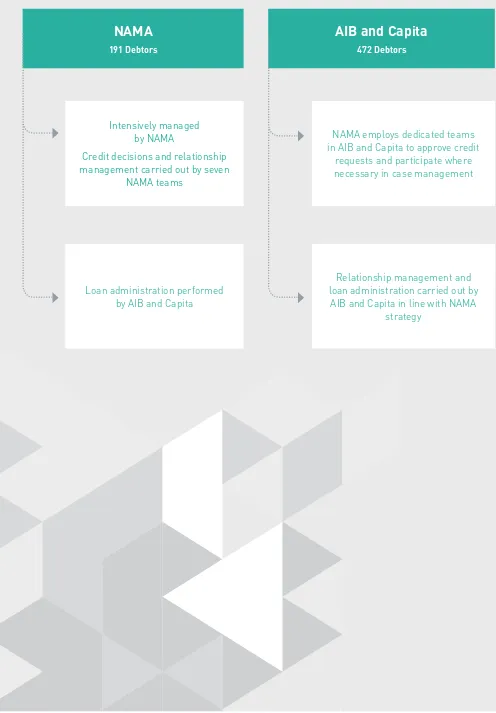
(14) ANNUAL REPORT & FINANCIAL STATEMENTS 2014. Business Review (continued) FIGURE A: Day-to-day debtor management. NAMA. AIB and Capita. 191 Debtors. 472 Debtors. Intensively managed by NAMA Credit decisions and relationship management carried out by seven NAMA teams. Loan administration performed by AIB and Capita. 12. NAMA employs dedicated teams in AIB and Capita to approve credit requests and participate where necessary in case management. Relationship management and loan administration carried out by AIB and Capita in line with NAMA strategy.
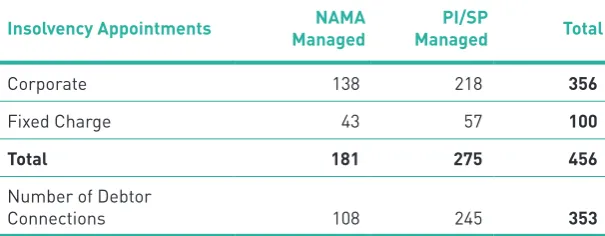
(15) By value, NAMA is in a consensual workout with debtors who account for 70% of its loan portfolio. A consensual workout means that debtors manage the agreed property and realisation strategy, under close monitoring by NAMA. Consensual workout arrangements may include some or all of the following: – Schedules of agreed asset or loan sales.. – Charges over unencumbered assets.. n. To date there have been 456 insolvency appointments across 353 debtor connections who account for 30% of NAMA’s loan portfolio by value (Table 1).. FINANCIAL STATEMENTS. – Rental income from investment assets controlled by debtors have been brought within NAMA’s control with rents lodged to bank accounts over which NAMA has security.. The outcome of the review of some debtors’ business plans included asset management and incentivisation mechanisms which would only be triggered if they met very ambitious or ‘stretch’ financial targets which were set for them. In certain cases, if debtors achieve these stretch targets, they may retain a proportion of any excess achieved above target levels. The major share of any excess will go to NAMA and ultimately to taxpayers if the stretch financial targets are achieved. Had such fee arrangements not been agreed with debtors, it is very probable that the consequences would have been a significantly reduced return in terms of the disposal value of assets and in the ultimate return to NAMA and to taxpayers.. GOVERNANCE. – NAMA has obtained charges over additional security, through both the reversal of asset transfers and charges over unencumbered assets, with combined value of more than €800m.. During the period from 2010 to 2012, NAMA agreed business plans with the majority of its debtors. NAMA disclosed in its 2010 Annual Report (published in July 2011) that asset management and incentivisation mechanisms could be a feature if betterthan-expected financial outcomes were achieved by debtors.. ORGANISATIONAL STRUCTURE. – Reversal of certain asset transfers.. n. FINANCIAL REVIEW. n. The objective of these mechanisms was to ensure that debtors were motivated to extract maximum value from the workout and realisation of their assets. At this stage, NAMA expects that very few debtors will achieve the stretch financial targets set for them. However, the continued strong improvement in property market conditions since the end of 2013 has triggered asset management fee payments in a small number of cases. The major part of the benefit of the strong financial outcomes likely to be achieved by these debtors will flow to NAMA and to taxpayers.. – NAMA provides funding for viable commercial and residential development projects with a view to increasing the longer-term recoverable value of assets.. BUSINESS REVIEW. At end-2014, 663 debtor connections remain: 191 NAMA-managed and 472 PI /SP-managed.. HIGHLIGHTS. n. TABLE 1: Enforcements as at end-December 2014 Insolvency Appointments. NAMA Managed. PI/SP Managed. Total. 138. 218. 356. 43. 57. 100. Total. 181. 275. 456. Number of Debtor Connections. 108. 245. 353. Corporate Fixed Charge. WWW.NAMA.IE. 13.
(16) ANNUAL REPORT & FINANCIAL STATEMENTS 2014. Business Review (continued). NAMA Market Activity NAMA Asset Disposals Disposals by location NAMA’s strategy in each of its main markets has been to release assets for sale in a phased and orderly manner consistent with the level of demand, the availability of credit and the absorption capacity of each market. As Figure B illustrates, in the period 2010 to 2013, this meant concentrating sales activity in Britain, particularly London, where commercial investment property yields had fallen in some cases below 3%. Over that period, London assets accounted for 60% of total NAMA disposal proceeds disposal receipts, with assets in the rest of Britain accounting for a further 13%. Irish assets, by contrast, accounted for just 16% of total disposal receipts in the same period. NAMA strategy was to limit asset disposals into a market where, prior to mid-2013, prices were still trending downwards. NAMA focused primarily during that period in Ireland on ensuring that debtor properties were efficiently managed, that rental and occupancy were optimised and that rental income was fully captured. Improving conditions in the Irish property market, a desire amongst institutional investors to diversify their real estate risk over wider geographic areas and improving sentiment towards Ireland, enabled NAMA to substantially increase the scale of its disposal activity in the Irish market in 2014 and its overall disposal activity in general. The step change in disposal activity can be seen in total NAMA disposal receipts of €7.8 billion in 2014, an increase of €4.1 billion on total proceeds in 2013. Of the €7.8 billion, 47% or €3.7 billion was generated from the sale of Irish properties and loans. This compares to total Irish disposal receipts in the four years to end-2013 of just over €1.8 billion.. 14. FIGURE B: Disposals by location 2010-2013 ■ London ■ Rest of UK ■ Dublin ■ Rest of World ■ Rest of ROI ■ Not an Asset Sale ■ Northern Ireland. 60% 13% 11% 8% 5% 2% 1%. FIGURE C: Disposals by location 2014. ■ Dublin ■ Rest of UK ■ Rest of ROI ■ London ■ Northern Ireland ■ Rest of World ■ Not an Asset Sale. 30% 20% 17% 13% 10% 9% 1%. FIGURE D: Disposals by location since inception ■ London ■ Dublin ■ Rest of UK ■ Rest of ROI ■ Rest of World ■ Northern Ireland ■ Not an Asset Sale. 41% 19% 16% 10% 8% 5% 1%.
(17) HIGHLIGHTS. Disposals by sector FIGURE E: Disposals by sector 2014 ■ Residential ■ Office ■ Retail ■ Land & Development ■ Hotel & Leisure ■ Other ■ Industrial ■ NRE. 25% 22% 20% 14% 10% 5% 3% 1%. BUSINESS REVIEW. A breakdown of disposals (including loan sales and asset sales) by sector for both 2014 and from inception to end-2014 is shown in Figures E and F. This breakdown underlines the diversity of NAMA’s portfolio with three sectors (residential, office and retail) each accounting for more than 20% of total disposals proceeds in 2014 and two further sectors each accounting for more than 10% of total proceeds.. FINANCIAL REVIEW. FIGURE F: Disposals by sector since inception 25% 23% 17% 15% 13% 3% 3% 1%. ORGANISATIONAL STRUCTURE. ■ Office ■ Residential ■ Land & Development ■ Retail ■ Hotel & Leisure ■ Industrial ■ Other ■ NRE. GOVERNANCE FINANCIAL STATEMENTS. WWW.NAMA.IE. 15.
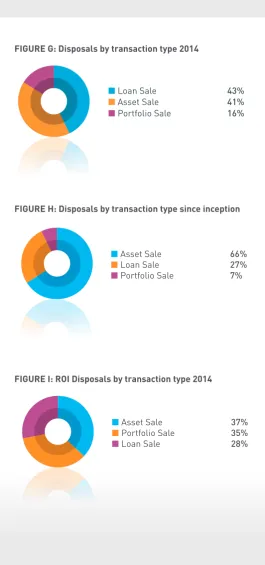
(18) ANNUAL REPORT & FINANCIAL STATEMENTS 2014. Business Review (continued) Disposals by transaction type A key feature of market demand in 2014 was the upsurge in institutional investor interest in multi-asset property portfolios and loan portfolios. This was driven in the main by the effects of monetary easing in the US, by the low level of bond yields worldwide and the relative attractiveness of Irish property yields. Reflecting this, property portfolio and loan portfolio sales have become an increasingly important part of the overall NAMA sales mix, accounting for 63% of Irish disposals in 2014 and 59% of total NAMA disposals in 2014. From inception to end-2014, property portfolio and loan sales accounted for nearly half of all Irish disposals and one-third of disposals across NAMA’s entire portfolio. NAMA’s market engagements indicate that demand and interest remain strong for portfolio sales with new investors continuing to enter the market and existing investors extending their exposure. This is expected to ensure competitive pricing in 2015 as overseas investors continue to seek opportunities to capitalise on the emerging recovery in Irish commercial property markets at a time when many other asset classes are becoming less attractive.. FIGURE G: Disposals by transaction type 2014. ■ Loan Sale ■ Asset Sale ■ Portfolio Sale. 43% 41% 16%. FIGURE H: Disposals by transaction type since inception. ■ Asset Sale ■ Loan Sale ■ Portfolio Sale. 66% 27% 7%. FIGURE I: ROI Disposals by transaction type 2014. ■ Asset Sale ■ Portfolio Sale ■ Loan Sale. 37% 35% 28%. As Table 2 illustrates, the sale of individual properties is also an important part of NAMA’s overall sales activity. From inception to end-2014, NAMA had overseen almost 7,500 individual disposal transactions involving almost 31,000 individual property units. TABLE 2: Transactions and property unit disposals 2010 - 2014 Transactions. 16. No. of Units. 2010. 391. 583. 2011. 1,167. 2,707. 2012. 1,216. 4,373. 2013. 1,859. 5,172. 2014. 2,820. 17,913. 7,453. 30,748.
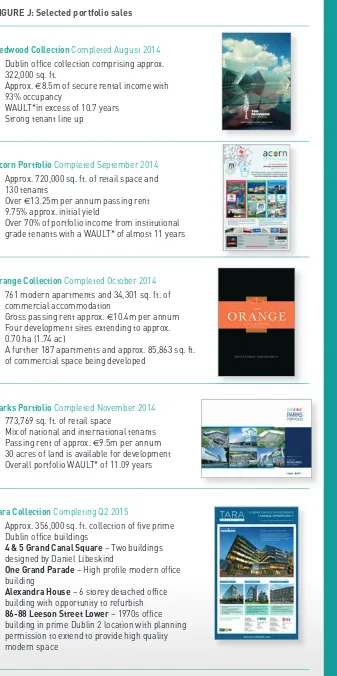
(19) To help sustain positive momentum in the Irish market and provide investors with certainty as to transaction flow, NAMA signalled at the start of 2014 that it would offer for sale property portfolios in Ireland with a minimum value of €250m in each quarter. The extent of recovery in the Irish market during 2014 meant that the €250m minimum value was exceeded in each quarter. Reflecting this, NAMA approved the sale of a number of very substantial property portfolios with an aggregate market value in excess of €1 billion in Ireland in 2014, including:. • Dublin office collection comprising approx. 322,000 sq. ft. • Approx. €8.5m of secure rental income with 93% occupancy • WAULT*in excess of 10.7 years • Strong tenant line up. Acorn Portfolio Completed September 2014. Orange Collection Completed October 2014. Sector. Platinum. Office. Central Park. Office/Residential. Redwood. Office. Acorn. Retail. Orange. Residential. Parks. Retail. NAMA brought to the market in 2014 an additional €500m worth of portfolios which will complete in 2015: Sector. Parks Portfolio Completed November 2014. Rockbrook. Residential. • • • • •. Plum. Residential. Tara. Office. Harvest. Retail. 773,769 sq. ft. of retail space Mix of national and international tenants Passing rent of approx. €9.5m per annum 30 acres of land is available for development Overall portfolio WAULT* of 11.09 years. Tara Collection Completing Q2 2015 • Approx. 356,000 sq. ft. collection of five prime Dublin office buildings • 4 & 5 Grand Canal Square – Two buildings designed by Daniel Libeskind • One Grand Parade – High profile modern office building • Alexandra House – 6 storey detached office building with opportunity to refurbish • 86-88 Leeson Street Lower – 1970s office building in prime Dublin 2 location with planning permission to extend to provide high quality modern space. *WAULT - Weighted Average Unexpired Lease Term. More than 80% of NAMA portfolio sales in Ireland from inception to end-2014 related to Dublin, mirroring both the dominant location of NAMA’s Irish assets and the current focus of investor interest.. FINANCIAL STATEMENTS. Portfolio. GOVERNANCE. • 761 modern apartments and 34,301 sq. ft. of commercial accommodation • Gross passing rent approx. €10.4m per annum • Four development sites extending to approx. 0.70 ha (1.74 ac) • A further 187 apartments and approx. 85,863 sq. ft. of commercial space being developed. Portfolio. ORGANISATIONAL STRUCTURE. • Approx. 720,000 sq. ft. of retail space and 130 tenants • Over €13.25m per annum passing rent • 9.75% approx. initial yield • Over 70% of portfolio income from institutional grade tenants with a WAULT* of almost 11 years. FINANCIAL REVIEW. Redwood Collection Completed August 2014. BUSINESS REVIEW. SIGNIFICANT PROPERTY PORTFOLIO SALES IN 2014. HIGHLIGHTS. FIGURE J: Selected portfolio sales. FIGURE K: Irish portfolio sales by location since inception. ■ Dublin 84% ■ Rest of ROI 16%. ■ Dublin 84% ■ Rest of ROI 16%. WWW.NAMA.IE. 17.
(20) ANNUAL REPORT & FINANCIAL STATEMENTS 2014. Business Review (continued) SIGNIFICANT LOAN SALES IN 2014 FIGURE L: Cumulative loan sale trend since inception by location In the four years to end-2013, NAMA had completed sales of loans with nominal balances of €3.9 billion. By end-2014 that figure had increased to €13.3 billion, reflecting increased investor interest in larger transaction sizes and the maturing of Europe’s loan sales market.. 1,400. London Rest of UK. 1,200. Dublin 1,000. Rest of ROI Rest of World. 800. NI. €m 600. Not an Asset Sale. 400. 200. 0. 2010. 2011. 2012. 2013. 2014. Some of the major loan portfolio sales which NAMA completed in 2014 are outlined below:. 18. Project Tower A €1.8 billion par debt portfolio secured on UK student accommodation, UK commercial and development property, Irish development land and Irish retail and residential property, which was sold to an affiliate of the Blackstone Group L.P in Q2 2014.. Project Drive A €226m par debt portfolio secured primarily on Irish retail and industrial assets, which was sold to Patron Capital in Q2 2014.. Project Eagle A £4.6 billion par debt portfolio, consisting of loans advanced to Northern Ireland based debtors secured primarily by assets in Northern Ireland, Britain and Ireland, was sold to an affiliate of Cerberus Capital Management L.P. in Q2 2014.. Project Spring A €438m par debt portfolio secured primarily on Irish office assets, which was sold to Deutsche Bank AG in Q3 2014..
(21) As the Irish property market continued to move through the recovery cycle in 2014, improving fundamentals across occupational markets replaced pricing as the key attraction for investors. Indeed, stronger pricing was evident across all prime markets as rents increased and yields contracted. Furthermore, there was evidence that as investors looked to move up the risk curve, price. Whilst US private equity continued to be the dominant source of investment in the market, a broadening of the investor pool was clearly evident in 2014 as the Irish Real Estate Investment Trusts ('REITs'), domestic institutions and European investors began to participate in the market, thereby adding to the level of competitive tension in asset sales bidding.. FINANCIAL STATEMENTS. It is also worth noting that since the property crash in 2008-2012 the Irish investment market has transformed from a highly leveraged debt-funded model to an equity-based model, which should put the market on a more sustainable footing and bring it into line with general international best practice.. recovery slowly started to percolate out to secondary properties and prime regional locations. Also, given the supply-demand imbalances that exist in key segments of the occupier market, most notably Dublin prime office and residential property, a return to development activity became an emerging feature of the market.. GOVERNANCE. The European commercial real estate market experienced record levels of activity in 2014 as investors continued to view the returns offered by property as being attractively priced relative to other investment alternatives such as government bonds or bank deposits. Ireland attracted a very significant portion of this investor activity (an estimated 28%) in what was an unprecedented year for the Irish market. During 2014, it is estimated that over €14.5 billion of Irish assets traded in total, comprising of €4.5 billion of investment property sales and a further €10 billion (traded value) of Irish property loan sales. To put this in context, the previous peak for investment in the Irish property market was approximately €3.5 billion in 2006.. To do so would expose NAMA to unnecessary execution risk and damage the credibility of the NAMA sales process and, by extension, the willingness of future prospective bidders to engage in such sales.. ORGANISATIONAL STRUCTURE. MARKET TRENDS. A key consideration for NAMA is the mitigation of execution risk. NAMA, in line with standard industry practice in any property portfolio or loan sales process, will not accept conditional bids including bids that are contingent on funding.. FINANCIAL REVIEW. Prior to the launch of a property portfolio or a loan sale, all relevant data, including loan agreements, security and title documentation, data tapes, lease information and tenancy schedules, is assembled in a data room by NAMA in conjunction with its legal and sales advisors. An initial high-level summary of the property or loan portfolio is then issued to potential purchasers so as to generate as much interest as possible.. Bidders are required to submit binding unconditional bids, proof of funding and marked-up contracts for sale. The final bids are assessed by NAMA with advice and recommendations from the portfolio sales agents or loan sales brokers, and a recommendation is made to the appropriate decision-making authority in NAMA. The successful and unsuccessful parties are advised of the outcome with the successful party also being notified of the timescale for completing the transaction.. BUSINESS REVIEW. NAMA’s policy is that the sale of all loans and the sale of properties by debtors and receivers should be openly marketed to ensure that the best price available in the market is achieved in all instances. NAMA enjoys a strong reputation in the market for the quality of information it provides as part of its property portfolio and loan sale processes and for the transparent and professional manner in which such transactions have been completed to date. Both its property portfolio and loan sales processes are built on international best practice and NAMA uses experienced advisers to ensure that transactions are executed to the highest market standards and that bidders are treated equally by mapping out a clear and rigorous process to be followed in each sale.. All potential investors must sign a Non-Disclosure Agreement (NDA) prior to gaining access to each portfolio or loan sale data room. Once the NDA is signed interested parties are legally bound not to have any further contact or share data room information.. HIGHLIGHTS. Property Portfolio and Loan Sales Processes. A distinguishing feature of the property market over the past two years has been the practice of pooling together assets, in the form of property portfolio sales and loan sales, in order to achieve transactions of sufficient scale to attract large investors. For NAMA, this has proven to be a very efficient and effective mechanism for capitalising on investor demand. These market dynamics are underpinning the commercial feasibility of new development in Ireland and NAMA is currently providing substantial funding and is facilitating the delivery of new office and residential supply on a commercial basis in Ireland. This is covered in more detail in the Development Funding section of this report.. WWW.NAMA.IE. 19.
(22) ANNUAL REPORT & FINANCIAL STATEMENTS 2014. Business Review (continued) DEVELOPMENT FUNDING A key element in NAMA’s strategic planning, by reference to its mandate to achieve the best financial return for the State from the loans acquired by it, is recognition of the need to invest in assets to make them more commercially attractive to purchasers and thereby enhance their ultimate disposal value. NAMA does not own properties and it is not a developer. Rather, NAMA’s remit in relation to properties is, like a bank, that of a secured lender. In this capacity, NAMA facilitates development by funding viable commercial and residential construction projects under the control of its debtors and receivers and, where applicable, in joint ventures with credible investment partners. To date, NAMA has approved funding of €1.6 billion across a range of construction projects in Ireland. €1 billion of this has already been drawn down to fund commercial and residential construction projects in Ireland, including the completion of existing projects and the development of new projects to meet prospective supply shortages in certain sectors. These include large-scale projects such as the €65m completion and fit-out of Grade A office space at Grand Canal Square in Dublin’s Docklands; the €14m completion of Block G in Central Park, Leopardstown, Co. Dublin; a mixeduse development on a 20-acre site in Sandyford, south Dublin; and substantial residential developments at, for example, Beacon South Quarter, the Grange and Honeypark in south Dublin; Bracken Park and Diswellstown in north Dublin; Castlepark in Maynooth, Co. Kildare; Forest Hill in Carrigaline, Co. Cork; and Roscam in Co. Galway.. 20. NAMA’s funding is focused, in particular, on meeting current and prospective shortages in the Dublin office and residential sectors and emerging shortages in the other major urban centres. NAMA has indicated that, if required, it could advance a further €3 billion in funding across these two key funding programmes. However, NAMA is open to joint ventures and partnership arrangements which could involve other parties meeting at least some of that funding requirement. NAMA is involved, for instance, as a minority shareholder in a number of Qualifying Investor Alternative Investment Funds (‘QIAIFs’) linked to sites in the Dublin Docklands and the wider Central Business District. It also recently announced a preferred bidder for a long leasehold interest in a key site located at 72-80 North Wall Quay within the Docklands Strategic Development Zone ('SDZ'). This site has the potential to deliver more than 645,000 sq. ft. of Grade A office space, with capacity to accommodate up to 5,500 employees, as well as 200 apartments. Construction is expected to begin in late 2015 / early 2016.. Dublin Docklands SDZ A core objective of NAMA’s development activities is to facilitate the delivery of office accommodation within the Dublin Docklands SDZ area. The North Lotts and Grand Canal Docks area of the Dublin Docklands was designated as a SDZ in December 2012 and the Docklands SDZ scheme was approved by An Bord Pleanála in May 2014. The SDZ plan divides the Docklands into development blocks. NAMA has an interest in 15 of the 20 development blocks identified in the Dublin Docklands SDZ and has developed detailed strategies for these blocks. Cumulatively NAMA has an exposure to 16.74 hectares (41.25 acres) - 75% of the 22 hectares of developable land in the Dublin Docklands SDZ area.. From an initial appraisal exercise, it is estimated that up to 3.8m sq. ft. of commercial space and 1,950 apartments could potentially be delivered if all the sites in which NAMA has an interest were to be fully developed over the lifetime of the Dublin Docklands SDZ scheme. Following the approval of the Dublin Docklands SDZ in May 2014, NAMA intensified its preparatory work in relation to the sites in which it has an interest. This is illustrated by a number of SDZ initiatives announced in 2014 in which NAMA is directly involved: n. NAMA is funding a planning application to Dublin City Council for the development of the landmark Boland’s Mill site in Dublin’s south Docklands. The application submitted by the site’s receivers includes proposed office, residential, cultural and retail development, totaling almost 400,000 sq. ft.. n. NAMA is a minority shareholder in a fund – the South Docks Fund - which submitted a planning application to Dublin City Council for the development of over 450,000 sq. ft. of office and residential accommodation at 5 Hanover Quay and 76 Sir John Rogerson’s Quay in the Docklands. Planning has been approved and the new developments are expected to accommodate up to 2,400 employees and 158 apartments..
(23) 76 Sir John Rogerson’s Quay, Dublin Docklands. FINANCIAL STATEMENTS. NAMA also entered into a joint venture with Kennedy Wilson in December 2014, where adjoining sites owned by NAMA and Kennedy Wilson were combined and a fund created, structured as a QIAIF, which is authorised by the Central Bank of Ireland. The fund, KW Irish Real Estate Fund VIII, submitted a planning application in April 2015 to Dublin City Council seeking permission to develop 313,000 sq. ft. of office space and 204 apartments in the Dublin Docklands. The development has been branded as “Capital Dock” and is located on Sir John Rogerson’s Quay in Dublin 2.. The South Docks Fund – in which NAMA is a minority shareholder - submitted a planning application to Dublin City Council for the development of over 450,000 sq. ft. of office and residential accommodation at 5 Hanover Quay and 76 Sir John Rogerson’s Quay in the Docklands.. GOVERNANCE. n. Hanover Quay, Dublin Docklands. ORGANISATIONAL STRUCTURE. In December 2014, NAMA announced Oxley Holdings Limited as its preferred bidder for a key site located at 72-80 North Wall Quay. Under the transaction, Oxley has acquired a long leasehold interest with the right to develop, manage and realise the site. NAMA retains the freehold interest and will receive a secure income stream in addition to a percentage of any future sales proceeds.. FINANCIAL REVIEW. n. BUSINESS REVIEW. NAMA is also a shareholder in another fund - the City Development Fund – which has recently begun the construction of a new building, comprising 50,000 sq. ft. of office space, at 6-8 Hanover Quay. The building is entirely pre-let to US corporation, Airbnb. When completed, the new office development will accommodate 300 staff in Airbnb’s new European headquarters. NAMA is providing construction finance to the City Development Fund and practical completion is expected by early 2016.. HIGHLIGHTS. n. Boland’s Mill, Dublin Docklands NAMA was involved in a number of initiatives announced in 2014 in respect of the Dublin Docklands SDZ, including the planning application for the development of the landmark Boland’s Mill site in the south Docklands.. WWW.NAMA.IE. 21.
(24) ANNUAL REPORT & FINANCIAL STATEMENTS 2014. Business Review (continued) Residential development funding in Dublin. Diswellstown | Dublin 15 NAMA has approved funding for the development of 119 houses including the refurbishment of Diswellstown House and outbuildings. NAMA has approved funding of €35m for the project.. Piper’s Hill | Naas, Co. Kildare NAMA is currently providing €8.5m in development funding for the construction of 26 units in Phase 1, Piper’s Hill, Naas, Co. Kildare.. Coill Dubh | Malahide, Co. Dublin NAMA is currently providing €18m in development funding for 74 houses at Coill Dubh, Malahide, Co. Dublin.. Maoilín | Galway NAMA is funding the development of 73 houses being built over four phases in Maoilín, Galway. NAMA has approved funding of €15.8m for the project. 22. As part of its contribution to addressing emerging residential supply shortages in the Greater Dublin area, NAMA established a dedicated Residential Delivery team in April 2014. The team’s purpose is to co-ordinate and drive the delivery of NAMA’s commitment to facilitate the completion of 4,500 new residential units in the period to the end of 2016 and to assess the scope for delivery of additional units thereafter. Of the 4,500 target, 1,362 units were delivered in 2014, across 23 individual projects, against a target to end-2014 of 1,000. New projects for which NAMA funding has been approved and which are expected to commence in 2015 include: n. College Square, Terenure, Dublin 6. n. Ballygossan Park, Skerries, Co. Dublin. n. Diswellstown, Dublin 15. n. Waterside, Malahide, Co. Dublin. n. Coill Dubh, Malahide. Co. Dublin. n. Anglesea Road, Ballsbridge, Dublin 4. n. Thormanby Road, Howth, Co. Dublin. n. Dublin Road, Shankhill, Co. Dublin. n. Hazelbrook, Nutgrove Avenue, Churchtown, Dublin 14. n. Meadowvale, Arklow, Co Wicklow. n. Piper’s Hill, Naas, Co Kildare. n. Roseberry Hill, Newbridge, Co Kildare. n. Heidelberg, Knockrabo, Dublin 14. n. Maoilín, Ballymoneen Road, Galway.
(25) HIGHLIGHTS. TABLE 3: Examples of NAMA-funded residential units. Local authority. County. Number of NAMA funded homes delivered 2014. Belmayne, Balgriffin. Dublin City Council. Dublin. 125. Block G, The Grange, Stillorgan. Dun Laoghaire Rathdown County Council. Dublin. 120. Honeypark, Glenageary. Dun Laoghaire Rathdown County Council. Dublin. 104. Beacon South Quarter, Sandyford. Dun Laoghaire Rathdown County Council. Dublin. 85. Miller’s Glen, Oldtown, Swords. Fingal County Council. Dublin. 60. Rathborne, Ashtown. Dublin City Council. Dublin. 60. Castlepark Maynooth. Kildare County Council. Kildare. 52. Bracken Park, Castleknock. Fingal County Council. Dublin. 36. Prospect Hill, Finglas. Dublin City Council. Dublin. 35. Broadfield, Rathcoole. South Dublin County Council. Dublin. 30. Clongriffin. Dublin City Council. Dublin. 23. Waterside, Malahide/Swords. Fingal County Council. Dublin. 23. Elmfield, Leopardstown Rd, Dublin 18. Dun Laoghaire Rathdown County Council. Dublin. 21. College Square, Terenure. Dublin City Council. Dublin. 17. BUSINESS REVIEW. Project Name. FINANCIAL REVIEW ORGANISATIONAL STRUCTURE GOVERNANCE FINANCIAL STATEMENTS. WWW.NAMA.IE. 23.
(26) ANNUAL REPORT & FINANCIAL STATEMENTS 2014. Business Review (continued) Residential development funding in London. Embassy Gardens | Nine Elms, London. NAMA’s dual strategy in London, where demand and prices have remained favourable since 2010, has involved taking advantage of opportunities to sell completed investment assets at very strong yields, whilst at the same time funding new residential construction on undeveloped sites in key city locations. In line with this strategy, NAMA has funded a number of significant residential developments in London. This strategy is based on the superior returns which will be achieved from completed developments by comparison with the returns that would be achieved from the sale of undeveloped sites.. London City Island | London. Embassy Gardens is a development of 639 private and affordable residential units together with retail and commercial space located adjacent to the new US Embassy site in Nine Elms. The handover of new units has commenced. The financing was successfully de-risked through the advance sale of all private and affordable residential units.. NAMA is funding the construction of four buildings comprising 561 residential units together with new commercial/ community floor space on a former industrial site in this regeneration area, now branded as “City Island”. The development has been de-risked by the use of advance sales. NAMA also funded a pedestrian bridge to link this unique peninsula site to Canning Town Rail Station. The handover of new units is scheduled to commence in 2016. Having funded residential development on these sites, an enhanced return to the taxpayer was achieved for the residual elements through the sale of the remaining sites in a joint venture structure.. Lincoln Plaza | Canary Wharf, London Lincoln Plaza is a development of 654 units on the Isle of Dogs, adjacent to Canary Wharf. The development is comprised of six buildings with both residential units and a hotel. Construction commenced in September 2012, with final units due to be handed over to residents in early 2016. A funding structure whereby NAMA limited its contribution to 65% of the construction costs was agreed. The financing was further successfully de-risked through advance sales of the hotel and all private and affordable residential units.. 24.
(27) HIGHLIGHTS. Social and Economic Contribution. NAMA continues to work closely with the DECLG and the Housing Agency in seeking to match the residential stock held by its debtors and receivers with the requirements of local authorities for social housing. By end-2014, NAMA had identified over 5,750 residential properties as being available and potentially suitable for social housing. Of these, demand has been confirmed by local authorities for just over 2,200 residential properties.. Capital expenditure in excess of €20m has been incurred to date in completing residential properties for social housing use. Works funded by NAMA include both the completion of buildings and the remediation of building defects, such as noncompliance with regulatory standards which has been a prevalent feature of many of the residential developments that came within NAMA’s portfolio following its acquisition of the related loans.. WWW.NAMA.IE. FINANCIAL STATEMENTS. Once the suitability of a property has been confirmed, NAMA facilitates contact and negotiation between its debtor or receiver and a local authority or Approved Housing Body to acquire the property. Contractual arrangements can take the form of a lease or purchase. In addition, as a means of expediting the provision of social housing, NAMA established a special purpose vehicle – National Asset Residential Property Services Limited (‘NARPSL’) – to purchase units from its debtors and receivers and to make them available to Approved Housing Bodies by way of a long term lease. NAMA’s involvement. Of the 472 properties which were delivered during 2014, almost 60% of them were located in Dublin. It is noteworthy that 53% of the 2014 properties were delivered through NARPSL which highlights the importance of the role of this mechanism. It is unlikely that these units would otherwise have been delivered due to the lack of available capital funding. NARPSL has to date spent €29m in acquiring 252 units for social housing. This initiative will generate a future rental income stream for NAMA.. GOVERNANCE. The onus for determining the suitability of these properties for social housing purposes rests with the local authorities and the Housing Agency. An important consideration for local authorities when assessing the suitability of identified houses and apartments is the requirement to provide for an appropriate mix of housing tenures and to avoid undue housing segregation within individual developments and wider residential areas.. By end-2014, 1,068 residential units had been delivered under this initiative. The delivery of these units has involved 65 individual transactions across 15 counties.. ORGANISATIONAL STRUCTURE. This has resulted in a number of very significant property transactions in Ireland with companies such as Google, Facebook, Eli Lilly, Kerry Group, Novartis, LinkedIn, Amazon, BskyB, Adroll, and Scottish and Southern Energy. Examples of such transactions in 2014 include the letting of a combined 250,000 sq. ft. of Grade A office space at 4 and 5 Grand Canal Square to Facebook for its EMEA headquarters, the sale of an office development site in Dublin 2 to LinkedIn and a 10 year lease arrangement with Yahoo for over 71,000 sq. ft. of office space at the Point Village.. Social Housing. has facilitated what may potentially become one of the single largest allocations of social housing in the history of the State.. FINANCIAL REVIEW. Another important part of NAMA’s work is to facilitate important transactions in the Irish property market that might not otherwise take place. A good example of this is NAMA’s on-going work in identifying suitable properties for companies looking to establish or expand existing business operations in Ireland and facilitating engagement between these companies and NAMA debtors and receivers. NAMA’s work in this area is closely aligned with that of IDA Ireland and other State agencies whose core responsibility is to attract and expand Foreign Direct Investment activity and employment in Ireland.. NAMA is also working with local authorities and other public bodies in the planning system to support the achievement of key policy objectives including, for example, the resolution of the problem of unfinished housing estates.. BUSINESS REVIEW. In the context of its overriding commercial mandate, NAMA seeks to manage its portfolio in Ireland in a manner that complements the objectives of other public bodies, including Government departments, State agencies and local authorities. One way that NAMA gives practical effect to this is by giving public bodies first option on the purchase, at assessed market valuations, of property securing NAMA loans. In line with this, NAMA has facilitated the sale of land and property for a range of public uses including schools and healthcare facilities.. 25.
(28) ANNUAL REPORT & FINANCIAL STATEMENTS 2014. Business Review (continued) FIGURE M: Units identified by NAMA for social housing at end-2014 5,753 Identified by NAMA. 3,360 No Longer Under Consideration. 2,214 Demand Confirmed. 1,225 Sold or let. 1,068 Contracted/delivered. 2,135 Deemed unsuitable or no demand. 686 Terms agreed/ in active negotiation. 179 Demand to be determined. 460 Pre-appraisal. Examples of properties delivered for social housing in 2014 through NAMA’s social housing SPV, NARPSL include:. 26. Ardmore | Bettystown, Co Meath. Woodfield House | Blarney, Co Cork. Long term lease of 11 houses and apartments to North and East Housing Association, Completed and occupied in May 2014. Long term lease of 12 apartments to Túath Housing, Completed and occupied in September 2014. The Tannery | Bandon, Co Cork. Rathborne | Pelletstown, Dublin 15. Long term lease of 24 houses to National Association of Building Co-operatives (NABCO), 24 units completed and occupied in October 2014. Long term lease of 60 apartments to Circle Voluntary Housing Association. 60 units completed and occupied in December 2014 / Q1 2015.
(29) HIGHLIGHTS. Full schedule of properties delivered for social housing by NAMA via an Approved Housing Body or local authority to end-2014.. Circle Voluntary Housing Association 31. 43. -. 8. Clúid Housing Association. 191. 76. Dublin Simon Community. 8. 20. Dublin City Council. 8. -. Focus Ireland. 12. -. Fingal County Council. 16. 9. HAIL. 8. 19. Túath Housing. 88. -. 12. Túath Housing. 15. ORGANISATIONAL STRUCTURE. Louth County Council. LO UTH. 3. Brothers of Charity. Clúid Housing Association/Túath Housing 26. North and East Housing Association. 20. Galway City Council. 22. -. Túath Housing. 12. -. MEATH. WESTMEATH. Oaklee Housing Association 29 O FFALY. 11. DUBL IN. Clúid Housing Association. 35. Kildare County Council. 8. Túath Housing. 50. GOVERNANCE. GALWAY. Túath Housing 20. FINANCIAL REVIEW. Clanmil Ireland. BUSINESS REVIEW. Social Housing Delivery as at Q4 2014. K IL DAR E Banner Housing Association 7. Respond! Housing Association 55. Brothers of Charity. 7. Focus Ireland. 4. Clúid Housing Association. 5. CAR LOW K IL K EN N Y Kilkenny County Council. LI M ERI CK. Clúid Housing Association. FINANCIAL STATEMENTS. CLARE. 5. WEXFO R D Wexford County Council. 2. -. Clúid Housing Association. 8. 20. 15 WATER FO R D. K ERRY NABCO. 8. CORK Clúid Housing Association. 24. Túath Housing. 18. NABCO. 37. Cork City Council. 53. C OMPLETED C ON TR ACTED by individual transaction. WWW.NAMA.IE. 27.
(30) ANNUAL REPORT & FINANCIAL STATEMENTS 2014. Business Review (continued) ESRI Study NAMA, along with Banking & Payments Federation Ireland, is co-funding a programme of research by the Economic and Social Research Institute (‘ESRI’) on the Irish residential property market. The objective of the programme is to produce practical market research and insights that will facilitate informed decision making by policy makers and market participants, including potential purchasers, investors and the construction industry. The initial phase of the research in 2014 was focused on the demand for housing, with reports delivered on demographic change, household formation and housing need, and the role of credit in the housing market. A number of papers have been published by the ESRI as a result of the research completed thus far. These are Alternative Scenarios for New Household Formation in Ireland (in April 2014), Household Formation and Tenure Choice (in July 2014), Projected Population Change and Housing Demand: A County Level Analysis (in August 2014) and The Role of Credit in the Housing Market (in December 2014) – all are available on www.esri.ie.. 28. In September 2014, NAMA convened a special National Housing Supply Conference to bring together policy makers from national and local Government and wider stakeholders to discuss the supply issues facing the housing market. The results of the ESRI research helped to inform the conference and its deliberations. The next phase of the research by the ESRI will focus on the supply of housing to meet demand, with initial research findings expected in mid-2015.. Resolution of unfinished housing estates NAMA advances funding for site resolution works on unfinished housing estates in which it has an interest as a secured lender. The DECLG, in conjunction with local authorities throughout the country, prepared an updated survey in 2014 of unfinished housing developments. Based on that survey, NAMA has security over 229 or 23% of the revised estimate of 992 unfinished housing estates in the country. This represents a substantial reduction in the number of unfinished housing estates within the overall NAMA portfolio over the course of 2014 and reflects the impact of funding to debtors and receivers to undertake remedial works in line with Site Resolution Plans agreed with local authorities. NAMA has advanced in excess of €5m for such works to date, which include the completion of internal roads and paths and the completion of remaining housing units to a saleable standard..
(31) HIGHLIGHTS. 9. BUSINESS REVIEW. Reduction in the number of unfinished estates within the NAMA portfolio. 5. DO N EGAL. 8. FINANCIAL REVIEW. 6. 12. 2. MO N AGHAN. SL IGO. 3. 2. 3. 1. 6. CAVAN. 2. LO UTH 6. 1. 5. 1 3. R O SC O MMO N. M AYO. 0. 16. LO N GFO R D. 11. MEATH 10 22. 6 39. WESTMEATH. 16. 24. DUBL IN. GALWAY 2 11. O FFALY. 6. K IL DAR E 6. 15. 5. 10. GOVERNANCE. 4. 10. ORGANISATIONAL STRUCTURE. L EITR IM. WIC K LOW. L AO IS 6. FINANCIAL STATEMENTS. CLARE 7. 2. CAR LOW 17 12. 10. 14 10. 13. K IL K EN N Y. TIPPER AR Y. 16. LI M ERI CK. 13. WEXFO R D 21. 7. 15. 7. WATER FO R D. KE RRY 59. 47. COR K. NAMA Unfinished Housing Estates 2013 2014. WWW.NAMA.IE. 29.
(32) ANNUAL REPORT & FINANCIAL STATEMENTS 2014. Financial Review. 30.
(33) HIGHLIGHTS. SUMMARY 2014 FINANCIAL HIGHLIGHTS. Total cash generated. 8,562. 4,480. 23,646. Disposal receipts. 7,757. 3,672. 18,627. 809. 792. 4,416. 9,100. 2,750. 16,600. Operating profit before impairment. 648. 1,198. Impairment charge. (137). (914). Profit for the year. 458. 213. 13,360. 19,598*. Financial Highlights Cash Generation. Non disposal income. Senior Bond Repayments Senior bonds redeemed. Profitability. GOVERNANCE FINANCIAL STATEMENTS. Loan Portfolio Total loans and receivables (net of impairment). ORGANISATIONAL STRUCTURE. From Inception €m. FINANCIAL REVIEW. 2013 €m. BUSINESS REVIEW. 2014 €m. *Excluding National Asset Resolution Limited ('NARL'). WWW.NAMA.IE. 31.
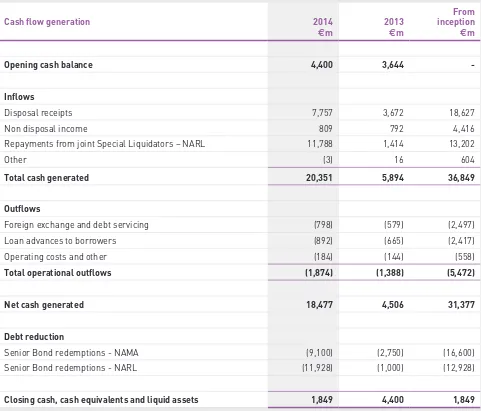
(34) ANNUAL REPORT & FINANCIAL STATEMENTS 2014. Financial Review (continued) Cash Generation Cash generation is a critical measure of the progress being made by NAMA in meeting its stated objectives. During 2014, NAMA Group (excluding NARL) generated €8.6 billion (2013: €4.5 billion) in cash, bringing total cash generated from inception to end-2014 to €23.7 billion. Cash is generated principally through disposal receipts and non-disposal income. Disposal receipts comprise the proceeds of both property collateral and loan sales. Non-disposal income represents income generated by debtor assets, principally rental income. Total cash generated is used to repay NAMA’s Senior Bonds and to fund NAMA’s administration expenses, debt servicing costs and advances to debtors. FIGURE N: NAMA Cash generation since inception (excluding NARL) 4000. Disposal Receipts. 3500. Non Disposal Income (mainly rentals). 3000. Cumulative Cash Generation (RHS Axis). 2500. 25000. 20000. 15000 €m. 2000 €m. 10000. 1500 1000. 5000 500 0 0. Q1 2010 Q2 2010 Q3 2010 Q4 2010 Q1 2011 Q2 2011 Q3 2011 Q4 2011 Q1 2012 Q2 2012 Q3 2012 Q4 2012 Q1 2013 Q2 2013 Q3 2013 Q4 2013 Q1 2014 Q2 2014 Q3 2014 Q4 2014. 0 0. 500 5000 1000 NAMA’s significant cash flow generation since inception and in 2014 reflects the Agency’s continued active management of its loan portfolio including: 1500 10000 n Significant acceleration of disposal activity in response to a step-change improvement in the Irish property market. €m n Intensive ongoing management of its debtors and receivers to ensure adherence to milestones set by NAMA, 2000 €m including property disposal milestones. 15000 n Intensive management of assets so as to derive incremental value prior to disposal. 2500 n Proactive engagement with potential investors and purchasers of NAMA loans to maximise sales proceeds from loan or portfolio(RHS assetAxis) sales. 3000 Cumulative Cash Generation 20000 (mainly rentals) 3500 Non Disposal Income 4000. 32. Disposal Receipts. 25000.
(35) HIGHLIGHTS. TABLE 4: NAMA’s summary cash flow since inception: 2013 €m. From inception €m. Opening cash balance. 4,400. 3,644. -. 7,757. 3,672. 18,627. 809. 792. 4,416. 11,788. 1,414. 13,202. (3). 16. 604. 20,351. 5,894. 36,849. Foreign exchange and debt servicing. (798). (579). (2,497). Loan advances to borrowers. (892). (665). (2,417). Operating costs and other. (184). (144). (558). Total operational outflows. (1,874). (1,388). (5,472). Net cash generated. 18,477. 4,506. 31,377. Senior Bond redemptions - NAMA. (9,100). (2,750). (16,600). Senior Bond redemptions - NARL. (11,928). (1,000). (12,928). 1,849. 4,400. 1,849. Inflows Disposal receipts Non disposal income Repayments from joint Special Liquidators – NARL Other Total cash generated. FINANCIAL REVIEW. 2014 €m. BUSINESS REVIEW. Cash flow generation. Outflows. One of NAMA’s primary activities is the origination and management of property and loan disposal transactions. Disposal receipts during 2014 totalled €7.8 billion (2013: €3.7 billion), comprising property collateral disposals of €3.8 billion (2013: €3.2 billion), loan sale transactions of €3.4 billion (2013: €0.3 billion) and other disposal transactions (including the sale of unencumbered assets, non-real estate assets and loan redemptions) of €0.6m (2013: €0.2m). Disposal receipts from inception to end-2014 total €18.6 billion.. FINANCIAL STATEMENTS. Disposal receipts. GOVERNANCE. Closing cash, cash equivalents and liquid assets. ORGANISATIONAL STRUCTURE. Debt reduction. During 2014, there were 2,798 property disposal transactions (2013: 1,840) and 22 loan sale transactions (2013: 19). From inception to date, there have been almost 7,500 property disposal transactions and 60 loan sales. There was a marked increase in the volume of loan sale transactions during 2014 – the larger transactions are listed on page 18.. WWW.NAMA.IE. 33.
(36) ANNUAL REPORT & FINANCIAL STATEMENTS 2014. Financial Review (continued) Non-disposal income Cash generated during 2014 included non-disposal income of €809m (2013: €792m). One of NAMA’s key objectives is to manage assets so as to optimise, and capture for debt servicing purposes, their income-producing potential through the generation and collection of rental and other income. The capture and collection of such income was not widespread prior to NAMA’s acquisition of the loans; indeed, there appears to have been a significant leakage of funds. By implementing strategies and operating structures to ensure capture of this income, NAMA has generated substantial incremental non-disposal income from its portfolio. Furthermore, an integral part of NAMA’s day-to-day asset management activity is to ensure that vacant space is made available for rent, that lease terms are enhanced and that rental income is thereby maximised. These initiatives have played a major part in the generation of non-disposal income which has totalled €4.4 billion from inception to end March-2015.. Profitability TABLE 5: Income statement – NAMA Group 2014 €m. 2013 €m. 955. 1,335. (313). (375). Net interest income. 642. 960. Net profit on disposal of loans, property assets; and surplus income. 285. 505. Foreign exchange loss. (22). (89). (159). (54). Administration and other income / (expenses). (98). (124). Operating profit before impairment. 648. 1,198. (137). (914). Profit for the year before tax. 511. 284. Tax charge. (53). (71). Profit for the year. 458. 213. Interest and fee income Interest expense. Derivatives loss. Impairment charge. NAMA recorded an operating profit before impairment of €648m in 2014 (2013: €1,198m). The overall result after tax was a profit of €458m for 2014 (2013: €213m). NAMA has reported its fourth successive year of profit. The 2014 impairment charge of €137m has reduced significantly from the €914m impairment charge that was recorded in 2013.. 34.
(37) HIGHLIGHTS. Net interest income TABLE 6: Net interest margin - NAMA Group. 955. 1,133. (313). (341). Net interest income. 642. 792. Cash generated from non-disposal income. 809. 792. 16,479. 21,187. 3.9%. 3.7%. Interest and fee income Interest expense. NAMA average loans and receivables (net of impairment) Net interest margin. ORGANISATIONAL STRUCTURE. The decrease in net interest income from €792m in 2013 to €642m in 2014 is primarily due to the decline in loans and receivables balances. Interest income is recognised at a fixed rate of interest, which was set by reference to an estimation of cash flows carried out as part of NAMA’s due diligence in respect of its original loan portfolio. Interest income is not recognised on any impaired portion of a loan. Debt servicing costs, which includes the cost of hedge derivatives in place and the interest paid on Senior Bonds securities, increased in 2014 due to the impact of accelerated Senior Bond redemptions and the related increase in the interest cost of hedges in place against the Senior Bonds. Average debt servicing costs in 2014 were 1.54% (2013: 1.3%).. FINANCIAL REVIEW. 2013 €m BUSINESS REVIEW. 2014 €m. TABLE 7: Net profit on disposal of loans, property assets; and surplus income. Net (loss)/profit on disposal of loan and property assets. From inception €m. 572. 531. 1,748. (287). (26). (227). 285. 505. 1,521. Net profit on disposal of loans, property assets; and surplus income of €285m in 2014 (2013: €505m), comprises losses on disposal of loans and property assets of €287m (2013: loss of €26m) which was offset by surplus income of €572m (2013: €531m).. FINANCIAL STATEMENTS. Total net profit. 2013 €m. GOVERNANCE. Surplus income on loan repayments in excess of debt. 2014 €m. NAMA acquired loans from the Participating Institutions at a significant discount to par value. The discounted acquisition value is the amount NAMA recognised on its balance sheet. Debtors are still required to repay the loan par value, which was originated with the Participating Institutions. Therefore NAMA has the potential to generate surplus cash if a debtor’s repayments exceed the NAMA acquisition price. Where this occurs any surplus cash generated is taken directly to the income statement as profit (or surplus income). As part of its impairment exercise, NAMA estimates the expected future cash flows to be generated from each debtor connection. Where the net present value of the expected future cash flows is less than the total debt in a debtor connection, an impairment provision is booked. Where the net present value of the expected future cash flows exceeds the total debt in a debtor connection, in limited circumstances where stringent stress conditions are met, the excess cash is recognised as profit (or surplus income) in the current reporting period. Following the results of its 2014 impairment exercise, the net present value of total expected cash flows exceeds the total debtor connection carrying value by over €1.9 billion, of which €330m was recognised in 2014. The remaining amount of approximately €1.6 billion, if maintained, will be recognised as profit (or surplus income) over the remaining life of NAMA.. WWW.NAMA.IE. 35.
Figure

+7


Related documents
(BWF), which comprise the statements of financial position as of December 31, 2014 and 2013, and the related statements of activities, functional expense and cash flows for
Specifically, we use Demographic and Health Surveys (DHS) and Malaria Indicator Survey (MIS) data to test the hypothesis that modern, improved housing is associated with lower odds
A third possible question can be raised: if, say, the average pure country volatility is larger than the average pure sector variance, does this mean that diversification
Flow cytometry data were exported as standard FCS files and the forward and side scattered light (FSC and SSC) signals were analysed and plots generated using Matlab. Spencer
The hypothesized structure of consumer based brand equity consisting of brand awareness, perceived quality, brand loyalty and brand associations (decomposed into perceived
The Condensed Consolidated Statutory Statements of Financial Position as of December 31, 2013 and the Condensed Consolidated Statutory Statements of Cash Flows for the year
Map of residential buildings spread throughout urban area of Prishtina, based on building typology (source: Author’s plot on the basis of statistical data from Urban development
The financial statements in this report present the financial condition, results of operations and cash flows of the Company, on a consolidated basis at March 31, 2013 and December
