Physical Review
Style and Notation Guide
Instructions for correct notation and stylein preparation of REVTEX compuscripts and conventional manuscripts
Compiled and edited by
Anne Waldron, Peggy Judd, and Valerie Miller
Published by The American Physical Society First Edition July 1983 Revised February 1993 Minor Revision June 2005 Minor Revision June 2011
Copyright 1993, by The American Physical Society
Permissionis granted to quote from this journal with the customary acknowledgment of the source. To reprint a figure, table or other excerpt requires, in addition, the consent of one of the original authors and notification of APS.No copying fee is required when copies of articles are made for educational or research purposes by individuals or libraries (including those at government and industrial institutions). Republicationor reproduction for sale of articles or abstracts in this journal is permitted only under license from APS; in addition, APS may require that permission also be obtained from one of the authors. Address inquiries to the APS Administrative Editor (Editorial Office, 1 Research Rd., Box 1000, Ridge, NY 11961).
Physical Review Style and Notation Guide
Anne Waldron, Peggy Judd, and Valerie Miller(Received: )
Contents
I. INTRODUCTION 2
II. STYLE INSTRUCTIONS FOR PARTS OF A MANUSCRIPT 2
A. Title . . . 2
B. Author(s) name(s) . . . 2
C. Author(s) affiliation(s) . . . 2
D. Receipt date . . . 2
E. Abstract . . . 2
F. Physics and Astronomy Classification Scheme (PACS) indexing codes . . . 2
G. Main body of the paper—sequential organization . . . 2
1. Types of headings and section-head numbers . . . 3
2. Reference, figure, and table numbering . . . 3
3. Equation numbering . . . 3
H. Acknowledgments . . . 3
I. Appendix(es) . . . 3
J. Footnotes and references . . . 4
1. Footnotes—introductory . . . 4
2. Footnotes—reference citations . . . 4
3. Footnotes—nonparenthetical side remarks . . . 4
4. Footnotes—tables and figures . . . 4
K. Tables . . . 8
1. Sizes . . . 8
2. Captions . . . 8
3. Lines and space . . . 9
4. Headings . . . 9
5. Entry lineup . . . 10
L. Figures . . . 11
1. Types of figures . . . 11
2. Designing and labeling figures . . . 11
3. Identifying figures . . . 12
4. Figure captions . . . 12
III. STYLE INSTRUCTIONS FOR GRAMMAR, PUNCTUATION, SPELLING, HYPHEN-ATION, AND ABBREVIATION OF UNITS 12 A. Grammar and punctuation . . . 12
1. Text and math as sentences . . . 12
2. Use of the comma . . . 12
3. Use of parentheses . . . 13
4. Use of the colon . . . 13
B. Spelling and hyphenation guide . . . 13
C. Abbreviation rules . . . 14
D. Units . . . 14
IV. INSTRUCTIONS FOR COMPOSING MATHEMATICAL MATERIAL 15 A. Characters available . . . 15
1. Alphabets . . . 15
2. Numbers . . . 15
3. Symbols . . . 15
4. Diacritical signs in math . . . 16
B. Abbreviations in math . . . 16
1. Abbreviations designating mathematical functions . . . 16
2. Abbreviations in subscripts and superscripts . . . 17
C. Mathematical expressions . . . 17
1. When to display . . . 17
2. Punctuation . . . 17
3. Equation “breaking” (multilinear equations) . . . 17
4. Equation numbering . . . 18
D. Bracketing . . . 19
1. Grouping sequence . . . 19
2. Specific bracket notation . . . 19
3. Specialized notation . . . 19
E. Additional style guidelines . . . 19
1. Placement of limits . . . 19
2. Fractions . . . 19
3. Multiplication signs . . . 20
4. Mathematical terms . . . 20
Physical Review Style and Notation Guide
I. INTRODUCTION
This notation guide represents a compendium of gen-eral Physical Review style rules to help authors when preparing a paper for submittal as a REVTEX com-puscript or a conventional manuscript. It is essential that notation be consistent and standardized so that all pa-pers can be processed efficiently.
This guide has been arranged so it can be used as a reference manual. Differences or exceptions for specific journals may exist, and may be conveyed to the author by the appropriate journal editor. Authors should consult the Information for Contributors section published in the first issue of each volume ofPhysical Review. Some of the journals may also have additional instructions for prepar-ing manuscripts on specialized subjects, obtainable from the editor.
II. STYLE INSTRUCTIONS FOR PARTS OF A MANUSCRIPT
The basic parts of a manuscript are discussed below. Those parts which must be included in every manuscript are marked with an asterisk.
A. *Title
Titles are to be simple and concise. Begin the first word with a capital letter; thereafter capitalize only proper or trade names and chemical symbols. The use of nonstandard abbreviations and acronyms is not allowed. Unnecessary words (a, on, an, the, etc.) at the beginning of the title should be dropped.
B. *Author(s) name(s)
It is preferable to use only one form of your name as an author in all of your publications.
C. *Author(s) affiliation(s)
Write out the names and postal addresses of all institu-tions in full. Include box numbers, apartment numbers, or street numbers only if necessary for effective mail de-livery. ZIP codes are required for U.S. addresses. [Note: If you expect to be contacted by readers, provision of a complete mailing address in the bylines (including de-partment) is advantageous.]
D. *Receipt date
The received date indicates the date the manuscript was received by the scientific editor. This date will be verified by the editor and will appear in the printed ar-ticle.
E. *Abstract
An abstract must accompany each manuscript. The abstract should consist of one paragraph and be com-pletely self-contained. It cannot contain numbered ref-erences; incorporate such information into the abstract itself. Use this form:
Further information is available [A. B. Smith, Phys. Rev. A 26, 107 (1982)].
Displayed equations and tabular material are discour-aged. Define all nonstandard symbols and abbreviations.
F. *Physics and Astronomy Classification Scheme (PACS) indexing codes
Each manuscript must be assigned indexing codes which are used in computerized secondary information services. See alsoPhysical Review Letters, 14 December 1992, for code indexing information. In general, follow these guidelines.
(1) Choose no more than four index number codes. (2) Place your principal index code first.
(3) Always choose the lowest-level code available. (4) Always include the check characters.
All indexing will be verified by the journal scientific edi-tor.
G. *Main body of the paper—sequential organization
The body of the paper (text and math) should be di-vided into sections with the use of section headings and subheadings. However, headings are not always required; for short papers headings may not be necessary or per-mitted. Equations, tabular material, figures, and refer-ences should also follow a sequential numerical scheme in order to ensure a logical development of subject matter.
1. Types of headings and section-head numbers
The major divisions in a paper are indicated by prin-cipal headings [level (1)]. Each major section can be fur-ther divided by subheadings [levels (2)–(4)]. Each subdi-vision of a heading indicates a more specific topic.
The following list indicates the four different types of section headings and the appropriate style for each. In all headings symbols and abbreviations should appear as they would in text. Refer to a recent issue of Physical Review for comparison.
Level (1)
I. PRINCIPAL HEADING
Centered heading, all capital letters, preceded by a ro-man numeral and a period.
Level (2)
A. First subheading
Centered heading, first word capitalized, preceded by a roman capital letter and a period.
Level (3)
1. Second subheading
Centered heading, first word capitalized, all italic, pre-ceded by an arabic numeral and a period.
Level (4)
(a) Third subheading. Text following a paragraph in-dentation, first word capitalized, all italic, preceded by a lowercase letter or number in parentheses.
2. Reference, figure, and table numbering
In the body of the paper all references, figures, and ta-bles must be cited consecutively in numerical order. Ta-bles are numbered with roman numerals (I, II, III, etc.). Figures use arabic numerals (1, 2, 3, etc.) with (a), (b), (c), etc., to label the parts of figures. Note that paren-theses are used to enclose the labels for parts of figures, e.g., Fig. 1(a). ForPhysical Review B, references use nu-merals as superscripts (Jones1) or on line [Jones (Ref. 1) or Jones, Ref. 1]. Superscript numbers are always placed after a comma, period, quotation marks, colon,
and semicolon (Jones,1Jones.1Jones”1Jones:1Jones;1). ForPhysical Review A, C,D,E, andLetters, references use on-line numerals in square brackets (Jones [1]); these are spaced away from the preceding word or symbol, and are placed inside punctuation.
3. Equation numbering
Equations that are important, long, complex, or ref-erenced later in the paper are set off from the text (dis-played) and may be numbered consecutively with arabic numbers within parentheses [(1), (2), (3), etc.]. These numbers are placed to the extreme right of the equation. For more details, see Sec.??.
H. Acknowledgments
The acknowledgment section follows the main body of the paper and precedes any appendixes. One paragraph is suggested, with acknowledgment of financial support listed at the end. A principal heading [level (1)] is used for this section, but the section is not numbered. Dedi-cations, as contrasted to acknowledgments, are not per-mitted.
I. Appendix(es)
Appendixes are placed after the acknowledgments sec-tion and before the listing of references. All appendixes must have a heading [level(1)]. A variety of styles is per-mitted; examples of each appear below:
APPENDIX (single appendix, no titles),
APPENDIX A (more than one appendix, no titles),
APPENDIX: SURVEY OF RESULTS (single appendix, with title),
APPENDIX A: SURVEY OF RESULTS (more than one appendix, all must be titled).
Equations in appendixes that are displayed and require numbering are treated separately from those in the main
body of the paper. The appendix equations are num-bered consecutively [(A1), (A2), (A3), etc.], bearing the label of the appendix in which they appear. In each ap-pendix the equations are numbered separately. For the case of one appendix the same (A1), (A2), (A3) form for numbering equations is used.
J. *Footnotes and reference citations Footnotes are divided into four categories:
(1) footnotes to introductory information [author(s) and address(es)],
(2) footnotes for references cited in text,
(3) footnotes for short comments relevant to the text material, and
(4) footnotes that are pertinent to a table or figure only.
All four types should be cited where appropriate and should be cited in consecutive numerical order. For Phys-ical Review B, andLetterstypes (1)–(3) are incorporated into one consecutive list of references to be placed at the end of the paper. For the other journals, type (1) foot-notes are placed instead at the bottom of the page on which they appear. As an option (Physical Review A, C, and D only), footnotes [types (1) and (3)] may appear separately from the references [type (2)] and be placed at the bottom of the page on which they appear. Type (4) footnotes should be written out completely in the table or figure caption where they are cited. All types of footnotes are discussed in the following instructions. Examples of the recommended form and content forPhysical Review references are presented in Table?? on page ??. For a list of some standard journal abbreviations used, please see the Appendix.
1. Footnotes—introductory
For introductory [type (1)] footnotes use these symbols (always as superscripts): *,†,‡,§,k,¶, **,††,‡‡,§§,kk, ¶¶(in the order listed), if there are 12 or fewer footnotes. Use lowercase letters a, b, c, etc., if there are 13 or more footnotes. For example, an introductory footnote which refers to an author’s name will appear as J. M. Smith∗ in the author’s byline citation and will appear either as the first reference in the listing at the end of the paper or at the bottom of the page on which they appear. Ac-knowledgments of financial support should not appear as footnotes to the title or an author’s name, but rather should be part of the acknowledgment section.
2. Footnotes—reference citations
For Physical Review B, reference footnotes [type (2)] are noted in text by the insertion of numerals as either a
superscript or on line in this manner:
Smith2 does not agree with the original values given in Ref. 1.
The use of a superscript is preferred. When that use could possibly cause confusion (i.e., Pb4), the on-line form should be used [Pb (Ref. 4)]. In the footnote listing at the end of the paper use only the superscript form.
ForPhysical Review A,C,D,E, andLetters, reference footnotes [type (2)] are noted in text by on-line arabic numerals in square brackets in this manner: Smith and Jones [3] also measured . . ..
Reference indicators should be at least one full space from words (not closed up to them as with superscripts). Multiple reference indicators should be set closed up within a single set of brackets: Smith and Jones [1,3,5– 8] performed . . .. Reference indicators should be set in-side punctuation: The work of Smith [3], that of Jones [4], and our previous work [5–8] disagree with that of Doe and Roe [13]. When the word “reference” is used in specifying a reference, use the abbreviation (unless at the beginning of a sentence) with the indicator in brack-ets: . . . as was shown in Ref. [4]. Note that use of the following form is also acceptable: . . . as was shown in [4].
3. Footnotes—nonparenthetical side remarks
For Physical Review A, C, and D, footnotes to text material, when cited separately from references, are designated in text by superscript numerals and num-bered consecutively, separately from reference number-ing, throughout the paper.
4. Footnotes—tables and figures
Type (4) footnotes are those that are pertinent only to a particular figure or table and that do not appear in the final reference list at the end of the paper. A type (4) footnote can appear in the appropriate table or figure caption. Two forms can be used:
FIG. 1. Theoretical data, denoted by 4’s, are from J. M. Smith, Phys. Rev. B26, 1 (1982).
FIG. 2. Theoretical data, denoted by4’s [J. M. Smith, Phys. Rev. B26, 1 (1982)].
Alternatively, a type (4) footnote can be included in a list immediately below the table.
TABLE X. The data in column 1 [J. M. Smith, Phys. Rev. B26, 1 (1982)] are of primary importance. The other . . .
1.01 x= 2.2 . . .
2.01 x= 3.2a . . .
a
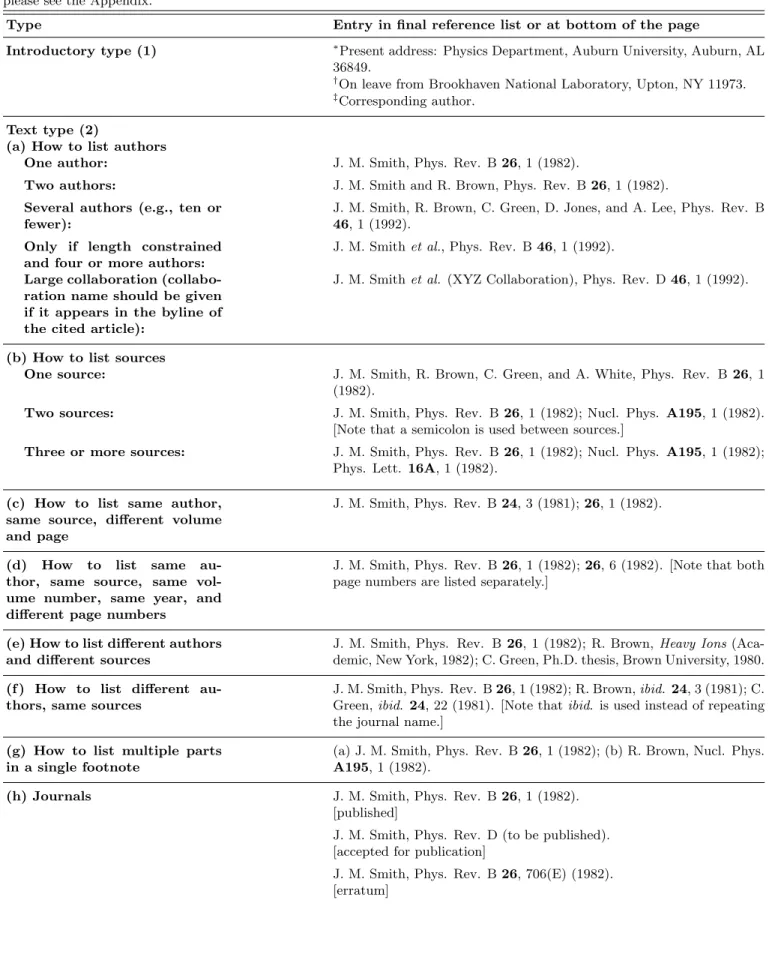
TABLE I. Physical Review has established general forms to make the presentation of reference information as simple and concise as possible. Follow the instructions below and use these forms in the final reference list. Comments pertaining to a particular reference are enclosed in square brackets at the end of some examples. For a list of the standard journal abbreviations, please see the Appendix.
Type Entry in final reference list or at bottom of the page
Introductory type (1) ∗Present address: Physics Department, Auburn University, Auburn, AL 36849.
†
On leave from Brookhaven National Laboratory, Upton, NY 11973.
‡
Corresponding author. Text type (2)
(a) How to list authors
One author: J. M. Smith, Phys. Rev. B26, 1 (1982).
Two authors: J. M. Smith and R. Brown, Phys. Rev. B26, 1 (1982). Several authors (e.g., ten or
fewer):
J. M. Smith, R. Brown, C. Green, D. Jones, and A. Lee, Phys. Rev. B 46, 1 (1992).
Only if length constrained and four or more authors:
J. M. Smithet al., Phys. Rev. B46, 1 (1992). Large collaboration
(collabo-ration name should be given if it appears in the byline of the cited article):
J. M. Smithet al.(XYZ Collaboration), Phys. Rev. D46, 1 (1992).
(b) How to list sources
One source: J. M. Smith, R. Brown, C. Green, and A. White, Phys. Rev. B26, 1 (1982).
Two sources: J. M. Smith, Phys. Rev. B26, 1 (1982); Nucl. Phys. A195, 1 (1982). [Note that a semicolon is used between sources.]
Three or more sources: J. M. Smith, Phys. Rev. B26, 1 (1982); Nucl. Phys. A195, 1 (1982); Phys. Lett. 16A, 1 (1982).
(c) How to list same author, same source, different volume and page
J. M. Smith, Phys. Rev. B24, 3 (1981);26, 1 (1982).
(d) How to list same au-thor, same source, same vol-ume number, same year, and different page numbers
J. M. Smith, Phys. Rev. B26, 1 (1982);26, 6 (1982). [Note that both page numbers are listed separately.]
(e) How to list different authors and different sources
J. M. Smith, Phys. Rev. B26, 1 (1982); R. Brown,Heavy Ions (Aca-demic, New York, 1982); C. Green, Ph.D. thesis, Brown University, 1980. (f ) How to list different
au-thors, same sources
J. M. Smith, Phys. Rev. B26, 1 (1982); R. Brown,ibid. 24, 3 (1981); C. Green,ibid. 24, 22 (1981). [Note thatibid. is used instead of repeating the journal name.]
(g) How to list multiple parts in a single footnote
(a) J. M. Smith, Phys. Rev. B26, 1 (1982); (b) R. Brown, Nucl. Phys. A195, 1 (1982).
(h) Journals J. M. Smith, Phys. Rev. B26, 1 (1982). [published]
J. M. Smith, Phys. Rev. D (to be published). [accepted for publication]
J. M. Smith, Phys. Rev. B26, 706(E) (1982). [erratum]
J. M. Smith, Zh. Eksp. Teor. Fiz. 51, 165 (1966) [Sov. Phys. JETP 24, 11 (1967)].
[Russian journal reference with English journal translation]
(i) Books J. M. Smith,Molecular Dynamics(Academic, New York, 1980), Vol. 2, p. 20.
[published, use italic title; additional information (Vol., Chap., Sec., p., etc.) as appropriate]
J. M. Smith, in Molecular Dynamics, edited by C. Brown (Academic, New York, 1980).
[published, use italic title; for edited works use form “in” and “by”] J. M. Smith,Molecular Dynamics(Academic, New York, in press). [in the process of being published, use italic title and the form “in press”] (j) Proceedings J. M. Smith, in Proceedings of the International Conference on Low Temperature Physics, Madison, 1958, edited by C. Brown (University of Wisconsin, Madison, 1958), p. 201.
[published, use italic title; edited form as above]
J. M. Smith, in Proceedings of the International Conference on Low Temperature Physics, Madison, 1958, edited by C. Brown (unpublished). [not published, use roman title; edited form as above]
J. M. Smith, inLow Temperature Physics, proceedings of the Interna-tional Conference, Madison, Wisconsin, edited by C. Brown (University of Wisconsin, Madison, 1958).
[shortened published title, use italic title with descriptive information following; edited form as above]
(k) Reports J. M. Smith, Brookhaven National Laboratory Report No. 10, 1982 (unpublished).
[Most reports are considered to be unpublished. Those reports consid-ered as full publications should be designated without the parenthetical unpublished at the end of the reference.]
(l) Preprints (journal specific) J. M. Smith, Brookhaven National Laboratory Report No. 110, 1992 (to be published).
(m) Theses J. M. Smith, Ph.D. thesis, Brown University, 1980. (n) Others J. M. Smith (private communication).
J. M. Smith (unpublished).
J. M. Smith as discussed in A. Jones, Phys. Rev. B26, 1 (1982). [cited in another paper]
J. M. Smith, computer codecrux, Bell Laboratories, Murray Hill, NJ, 1972.
Tables may also contain type (2) footnotes which ap-pear in the final reference list. Such footnotes may be cited by letter on line, or may be incorporated with other footnotes mentioned in the table into a listing at the end of the table. Lowercase roman letters are used to identify the footnotes in the table and in the list, i.e., a, b, c, etc. They are in superscript form when they refer to an entry or heading and on line when they replace a missing entry. Order the footnote letters consecutively row by row, and not by column.
Form:
TABLE X. Experimental results (Ref. [6]).
δ(E2/M1)
Theor.a Expt.
−41.0 −18±0.3b
−57.5 −10±0.6
37.3
13.7 c
aReference [1]. b
Reference [2].
cNot available.
K. Tables
Tabular material of more than approximately four lines should not remain as part of the text. It should be treated as a separate numbered table, complete with a descrip-tive caption. All such tables must be cited in text and are to be numbered consecutively in order of their ap-pearance in text. Use roman numerals. The following instructions and descriptions of components are included here to assist you in the preparation of tables. Exam-ination of some current issues of Physical Review will illustrate a wide variety of tables and will serve to clarify the instructions below.
Extensive tabular material (and useful informa-tion that is not essential to understanding an ar-ticle’s main results) may be deposited as Sup-plemental Material. For more information, see http://forms.aps.org/author/supmatinstr.pdf.
1. Sizes
There are several standard types of tables. Each type is determined by its width and/or length. Each type requires captions, lines, and spacing, as well as headings appropriate to its size. It is, therefore, necessary to first estimate what the width and length of a table will be.
There are four standard one-page table widths: (1) narrow (one column, 8.6 cm or 3.4 in.), (2) medium (centered, 14 cm or 5.5 in.), (3) wide (two columns, 17.8 cm or 7.0 in), and
(4) turned table (one-page length turned sideways, 25.4 cm or 10.0 in.).
A turned table requires special handling by the produc-tion staff. Please identify it as such in a cover letter.
In addition, to accommodate extremely wide tabular material, tables can read across facing pages (35.6 cm or 14.0 in.). This type of table also requires special han-dling by the production staff and should be identified in a cover letter. This table requires a duplicate set of wide headings, lines, and a “continued” caption.
Form:
TABLE I.(Continued).
A one-page table (narrow, medium, or wide) may not exceed 25.4 cm or 10.0 in. in length or approximately 63 lines. This overall length has to include the caption, opening lines and spacing, headings, entries, closing lines and spacing, and any footnote material connected to the table. If the total length exceeds this limit, the table may be treated in one of the following ways.
(1) A very long, narrow, one-column table can be split and continued in a second column on the same page. It will require a wide caption, a duplicate set of headings, and wide opening and closing lines.
(2) A very long medium or wide table can be continued on the next page or pages. In addition to its first-page caption, headings, etc., it will need a duplicate set of headings, lines, etc., for each additional continued page. It will also require a “continued” caption (see above) for each additional page of the table.
2. Captions
Each table that is not part of the text must have a de-scriptive caption. It should be as concise as possible. The caption can consist of an abbreviated sentence (without a beginning article and/or verb) punctuated as a complete sentence. If it is made up of more than one sentence, treat it as a single paragraph.
The caption must begin with the word table, in capital letters, followed by the appropriate roman numeral and period, and then a small amount of explanatory text. Displayed math is allowed within the caption, but the use of short mathematical expressions in broken-down form is preferred. Abbreviations and acronyms that pertain to the whole table should be defined in the caption. Those already defined in text need not be defined again.
Form:
TABLE I. Spin-orbit parameters.
TABLE II. Calculated M1 matrix elements for 156Gd,
Mrs(M1) =hS1|M(M1)|riin 10−2µN.
3. Lines and space
Lines and space are used to separate and define the integral parts of a table. They aid the eye and group information appropriately.
A simple table needs lines in only three locations: two lines together at the beginning and end of the table and a single line separating the headings and columns of en-tries. A more complicated table, one made up of several parts and having more than one set of headings, will need additional space and lines. Each set of headings will re-quire a line below it and extra space running horizontally above it to separate it from the preceding part of the ta-ble.
Use spacing also for grouping. Clear separation of one column and heading from another is created by inserting extra space running vertically between them.
Extra space running horizontally can be used to distin-guish broad groups among the entries. Smaller groupings of related entries can be indicated by the use of a single curly brace or a combination of a single curly brace and extra space.
Tables that require nonstandard treatment will need to be discussed in a cover letter. The production staff will accommodate special handling of tables. As a dou-ble check of tadou-ble setup, please review your author proofs carefully. Check alignment, lines, and spacing to ensure that no distortion of your meaning has occurred. If in-correct placement is evident, carefully in-correct it on your proof copy.
4. Headings
There are two major kinds of headings used in tables: (1) column headings,
(2) row headings.
Each type may contain or be made up of standard abbreviations. Always capitalize the first word or abbre-viation in all headings and subheadings.
(1) Column headings are separated from the body of the table by a horizontal line. They are usually dropped to the bottom of the heading area. However, units of measure that pertain to each entry in a whole column should be included in parentheses and placed as the last entry in the heading on a line by itself (sample 1) or spaced off from the heading on the same line (sample 2).
Sample 1 Branching
ratio (%)
1 2 3
Sample 2
Ex (MeV) Jπ
2720 2−
4141 2−
Use centering or straddle rules to group several sub-headings under one main heading.
Form:
Collimator measurements
Off-axis point
No. Radius A(r) correction
of holes (mm) (counts) [Gp(r)/Gp0]
x x x x
x x x x
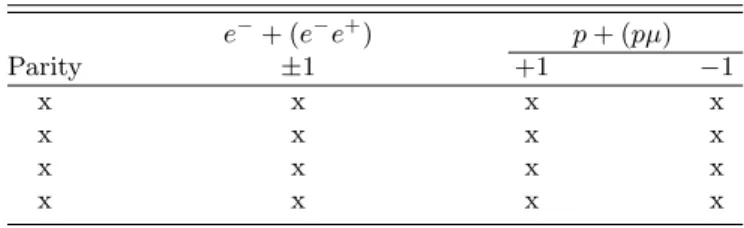
Form:
e−+ (e−e+) p+ (pµ)
Parity ±1 +1 −1
x x x x
x x x x
x x x x
x x x x
(2)Row headingsare read from left to right on one line. When used in the heading area they need a diagonal line to separate them from any column headings.
Thejheading refers to the 1 2 horizontal row; 1 and 2 in turn are column headings that read down as does the iheading.
Form:
j 1 2
@ @
@
i
1 0.3601×10³ −0.5224×101
2 −0.2691×10⁴ 0.5130×10²
3 0.7733×10⁴ 0.1717×10³
In the body of a table, row headings have similar form. They are read left to right with any units of measure enclosed in parentheses and separated by one space on the same line. To continue a row heading or indicate a row subheading, indent the second line.
Form:
xxx xxx
1. Counting
a. Counting statistics in Table IV 0.017%
b. Error in counting estimate 0.02%
c. Error from estimate of240Pu 0.009%
5. Entry lineup
The manner in which table entries are aligned in their columns will greatly affect the readability of a table. For this reason use one or a combination of the following types of alignments.
(1) Flush left. To be used in a situation where the entries are not similar and/or of different lengths. All entries are flush left with the column heading centered over the column.
Form:
Interpretation
J= 1 BE triplet
J= 0 BE singlet BE states from splitoff cf.B1in Fig. 2
SecondB1replica
(2) Center. An alternative to (1). Each entry is cen-tered with the column heading cencen-tered.
Form:
Mode
β−
Stable
β+ β−
Stable
β−
(3) Lineup by digit and/or decimal. To be used in a situation where all or most of the entries are numbers. Align according to digit and/or decimal placement. Form:
Theory
1 2
9.7 15.6
7.4 7.7
14.9 15.2
24.9 22.9
3.06 3.32
−0.74 −0.93
(4)Lineup by operator. To be used in a situation where most entries are similar and have some kind of operator (multiplication, plus, minus signs, etc.) in common. Form:
1 0.4557×101
−0.2051×101
−0.650 ×10²
(5) Lineup by unit. To be used when the entries in-clude different units of measurement [see example (a)]. In other cases where all entries include the same unit, the unit designation should be removed from the column entries, enclosed in parentheses, and made part of the column heading [see example (b)]. Lineup will then be by operator, decimal, and/or digit as appropriate.
Form:
(a) Half-life 41.3 ±0.1 day
5.37±0.009 day 11.05±0.02 min
(b) Half-life
(day) 41.3 ±0.1
5.37±0.009 11.05±0.02
(6)Combination of lineups. Whenever possible lineups (3), (4), and (5) should be used in conjunction.
Form:
Neutron energy
9840 ±30 eV
10.34± 0.04 keV 10.50± 0.02 keV
L. Figures
There are both style and technical considerations when preparing figures as part of an author-prepared paper. Keep the following technical suggestions and basic style requirements in mind when designing and composing fig-ures.
1. Types of figures
(1) Line drawings (original drawing or photograph of drawing). This kind of figure is considered the most de-sirable. Use black ink on a white background. Submit original or glossy print only.
(2) Continuous tone photograph (photographs that contain variations in tone). Do not screen. Submit sharp glossy photographs.
(3) Combination (composite figure, both line drawing or photograph and continuous tone photograph). Pre-pare as separate figures. Submit two photographs, indi-cating that they are to be treated as one figure. Include registration marks or instructions. Do not screen.
(4) Machine-generated (computer output or material reproduced directly from automatic plotters). Figures of this type are sometimesnotacceptable because of unsuit-able lettering size, lettering quality, or curves that break up when the figure is reduced. Figures must have clear background and unbroken lines with as much black and white contrast as possible.
2. Designing and labeling figures
(1) Prepare figures on standard size paper (21×28 cm or 8.5×11 in.). Larger figures are easily damaged by han-dling and smaller ones are sometimes overlooked or mis-placed.
(2) Size figures for reduction to journal column width, i.e., ∼8.6 cm (∼3.4 in.) or ∼17.8 cm (∼7.0 in.), and single page or less length. The production staff photo-graphically reduces all line drawings and photographs, if they are in proper scale, to three basic sizes to fit within the following limits:
(a) narrow, to fill the width of one column; (b) wide, to fill two columns; or
(c) centered, with space on either side.
Figures will be treated as narrow unless flagged and iden-tified as wide or centered in a cover letter.
(3) Make symbols, line thickness, and lettering in proper scale in relation to the overall figure size so that reduction will not reduce clarity.
(4) Avoid handlettering. Use of a mechanical device is strongly urged. Two sizes for lettering (one for on-line lettering, the other for subscripts, superscripts, and data points) is strongly recommended. Draw symbols and let-tering so that after reduction the smallest of these, such as those used for subscripts, etc., will not be less than 1.5 mm (161 in.) tall. Consider also that intricate symbols tend to fill in when reduced. Solid or open symbols are easier to read.
(5) Make line thickness consistent (solid and dark). Lines tend to become less distinct when reduced.
(6) When shading is necessary, use diagonal or cross-hatched lines.
(7) Figure labeling must be consistent with the rest of the paper. Use the same abbreviations, symbols, and upper- and lowercase letters throughout.
(8) Label parts of figures (a), (b), (c), etc.; curves A, B,C, etc.; geometric points, angles, and linesA,B, C, etc.; ora,b,c, etc., as appropriate.
(9) Treat graphs so that they are completely self-explanatory. Label each axis (horizontal and vertical) with the quantity being plotted, including the appro-priate units, which should be spaced off and enclosed in bracketing, i.e., θ (deg). Do not use powers of 10 if possible; instead use the appropriate prefixes of the Syst`eme International (see Table ??, p. ??). If powers of 10 cannot be avoided the following form is preferred: R(10−4 Ω).
3. Identifying figures
Number each figure consecutively with an arabic nu-meral according to the order in which it is discussed in the paper. Write the figure number and first author’s name preferably on the bottom of each figure. If not pos-sible, write them on the back of the figure with a very soft pencil. This will ensure proper matching of figure and text. All figures must be cited in consecutive order in text. For example, you could refer to your first figure in one of these ways:
Form:
(a) Figure 1 shows experimental results.
(b) Experimental results are shown in Fig. 1.
Note that the word figure is written out when it begins a sentence, but it is abbreviated at other times. The production staff will place each figure as close as possible to its original citation when designing the final layout of the paper.
4. Figure captions
Give each figure a separate caption. Like a table cap-tion, it should be concise. It may be made up in part of an abbreviated sentence or group of sentences in a single paragraph. It must begin with FIG. (all capital letters), followed by the appropriate arabic numeral and period, and then by the abbreviated explanatory sentence or sen-tences.
Form:
FIG. 1. Plot of χ2 against different values of Re[f−
N(0) + fN+(0)]. Solid curves for the x plane; dot-dashed curves for thezplane.
Within the explanatory material of a caption include definitions of all symbols, abbreviations, and acronyms used in the figure that have not been previously defined in text. Also describe separate figure parts or insets. Form:
FIG. 1. Part of the fluorite structure around an oxygen va-cancy;◦, oxygen vacancy;•, normal oxygen ion.
FIG. 1. Continuous line: solution of the Lippmann-Schwinger equation (13) with the use of dynamical self-energy of Eq. (5). Broken line: static Coulomb wave function given by Eq. (9) of the text. The inset shows the behavior in the near-surface region.
FIG. 1. Cluster geometries used for (a) substitutional site in bcc Fe, (b) octahedral interstitial site in bcc Fe, (c) tetrahe-dral interstitial site in bcc Fe, and (d) octahetetrahe-dral interstitial site in fcc Co and Ni. Filled symbols denote hydrogen posi-tions and unfilled symbols show host-atom posiposi-tions.
III. STYLE INSTRUCTIONS FOR GRAMMAR, PUNCTUATION, SPELLING, HYPHENATION,
AND ABBREVIATION OF UNITS A. Grammar and punctuation
Good grammar and clear punctuation are essential to successful technical writing. Clear, simple sentence struc-ture best presents scientific ideas and mathematical for-mulas. For a general guide to good grammar, use Nichol-son’sDictionary of American-English Usage.
Specific modification and adaptation of the basic rules are sometimes required by scientific conventions. In ad-dition, the combination of forms including abstract, text, mathematical formulas, figures, tables, and references also creates the need for special structure and style con-siderations. Below are guidelines to assist you.
1. Text and math as sentences
(1) Treat the text and mathematical formulas as an entity. Punctuate mathematical expressions as sentences or parts of sentences.
Form:
A slight rearrangement of terms then gives
Ds= ¯ξsX
−1/2−
b, (14)
where
X = 4tχ2(−lnt)/π2, (15) ¯
ξs=ξs/t1/2, (16)
and the reduced transition temperature t is defined to be
Tc/Tcs.
(2) Avoid beginning a sentence with a symbol if the sentence before it has ended with a symbol or number.
2. Use of the comma
(1) Do not surround a symbol with commas or paren-theses when it immediately follows the noun that defines it, but do insert the commas or parentheses if another phrase intervenes.
Form:
As the temperatures approached the melting temperature
Tm, all . . .
As the temperatures approached the melting temperature reported by Greenet al.,Tm, all . . .
(2) Please use the serial (Harvard) comma. See the example below, where the second comma is the serial comma.
Form:
Symmetry requires thatω1=ω2,ω3=ω4, andω5=ω6.
(3) Place commas around etc., e.g., i.e., viz., namely, for example, that is, say, in particular, and respectively. Do not use commas around cf. oret al.
(4) Nonrestrictive clauses should be introduced by “which” and set off by commas.
Form:
TheK= 1 component, which in this case does not influence the band shape, gives rise to . . .
3. Use of parentheses
(1) When inserting a parenthetical remark into a sen-tence do not punctuate what is within the parentheses. Form:
Recall that the Brown-Green theory (see Sec. II below) must still be tested.
(2) A completely separate parenthetical remark is punctuated as a regular sentence or group of sentences except that everything including the ending punctuation is enclosed within the bracketing.
Form:
(Recall that the Brown-Green theory is still to be tested.) Again we begin to evaluate . . .
(3) Square brackets enclose a phrase that already con-tains parentheses.
Form:
Recall that the Brown-Green theory [see Eq. (2)] is still to be . . .
4. Use of the colon
(1) Phrases introduced by a colon do not begin with a capital letter.
Form:
Furthermore, the lake has a natural noise center source: a dam.
(2) A complete sentence introduced by a colon may be, but need not be, capitalized.
Form:
Finally, the energies of bound surface states are calculated by means of the “effective-Hamiltonian” technique: LetHeff
be defined byE−Heff =G0(E−1−V).
Finally, the energies of bound surface states are calculated by means of the “effective-Hamiltonian” technique: letHeff
be defined byE−Heff =G0(E−1−V).
(3) When more than one sentence is introduced by a colon capitalize the first word.
Form:
In order to tackle Eq. (A5) we introduce the following sim-plifications and approximations: (1) Each eigenmode in the band is excited by white noise. (2) No eigenmode beyond the band is excited. (3) Because the . . .
(4) Do not use a colon after a form of the verb “to be” or between a verb or a preposition and its object. Form:
The momenta of the threeαparticles in the c.m. system are p1,p2, andp3.
New values were obtained for the quantum cyclotron radius, the Debye shielding radius, and the plasma frequency.
B. Spelling and hyphenation guide
In technical writing the proper spelling and hyphen-ation of words is a controversial point of style. In general, for nontechnical words refer toWebster’s New Interna-tional Dictionaryif a question of correct form arises. Use the first spelling if there is more than one correct version. A list of general spelling and hyphenation rules follows.
(1) Use American, not British, spellings except in proper names.
(2) When possible, use single, not double consonants in forming endings (e.g., labeled not labelled). However,
if the accent is on the last syllable, then double the con-sonant, e.g., controlled.
(3) Do not use contractions.
(4) To form the plural of numbers add s (1980s), to symbols add ’s (A’s), and to abbreviations add ’s or s (NMR’s or NMRs).
(5) To form the possessive of names add ’s (apostrophe s), regardless of the number of syllables or final letter (Green’s, Jones’s, de Gennes’s).
(6) Capitalize adjectives and nouns formed from proper names (Gaussian, Ohmic); however, lowercase the names of units (gauss), well-established particles (boson and fermion, butnot Pomeron), and minerals (scheelite).
(7) Use small capitals to identify computer program names, designation of ionization states in atomic spec-troscopy, and the names of logical operations; e.g.,
dwuck, Feii, andor.
(8) Avoid hyphens that serve no useful purpose, e.g., cutoff, not cut-off; output, not out-put.
(9) Prefixes and suffixes usually should be closed up (nonradioactive); but do not close them up if a double letter is produced (semi-infinite), when added to a proper noun (non-Fermi), when added to two or more words (non-time-dependent), or if closing up could change the meaning of the word (un-ionized). Chemical prefixes and suffixes should be hyphenated (cis-dimethylethylene) and so should numbers above 10 (11-fold, but twofold).
(10) “Self” words, “free” words, and some “half” words should be hyphenated (self-consistent, worry-free, and half-life), but “like” words are closed up (spacelike) un-less they become extremely long or cumbersome.
(11) To prevent ambiguity and make reading easier, modifiers made up of two or more words can be hyphen-ated (wrong-signature points, 8-MeV data). Strings of modifiers can be sorted with a combination of short and long hyphens (two-particle–two-hole configuration). Ed-itorial policy varies on this subject from journal to jour-nal. Check a recent issue of the journal in which you are publishing and query your editor.
(12) A hyphen also can be used as a sorting agent in predicate adjectives of three or more words (... is face-centered-cubic).
(13) Use a hyphen in written-out numbers of two words or more (twenty-five).
(14) Use hyphens in the names of materials such as β-brass.
C. Abbreviation rules
When creating or using abbreviations, keep the follow-ing guidelines in mind.
(1) An abbreviation for a single word should be a short-ened form of that word. It should be made up of low-ercase roman letters and is almost always unpunctuated (obs for observed or av for average).
(2) An abbreviation for a phrase (acronym) should in-clude the initial letters of the words of the phrase in either capital or lowercase roman letters (DWBA for distorted-wave Born approximation, bcc for body-centered-cubic). Always use capital letters if you are abbreviating a proper name (BCS for Bardeen-Cooper-Schrieffer), and when creating acronyms.
(3) When you are using an abbreviation of a proper name as a superscript or subscript, retain the initial cap-ital letter (ECoul orEC for Coulomb).
(4) Do not use multiletter abbreviations as mathemat-ical variables. Use the conventional symbol instead, e.g., EK; not KE for kinetic energy.
(5) Abbreviations should be defined the first time they are introduced in text, i.e.,
. . . to describe dislocation-mediated melting of two-dimensional (2D) crystals, we . . .
Thereafter it is acceptable to use the abbreviation without definition.
(6) For a list of standard abbreviations appropriate to the specific journal, consult the editor.
D. Units
The use of metric units (of theSyst`eme International) is preferred. This system is based on the meter, second, kilogram, ampere, kelvin, mole, and candela. [See The International System of Units, Natl. Bur. Stand. (U.S.) Spec. Publ. 330 (U.S. GPO, Washington, D.C., 1977).]
(1) Decimal multiples or submultiples of units are in-dicated by the use of prefixes. See Table?? below. The combination of prefix and unit symbol is treated as a single symbol. For instance, such a combination can be raised to a power, i.e., cm2. Compound units are
writ-ten 1 g cm2or g cm2s−2, with a thin space between unit
parts. The form 6 J/cm3/s is ambiguous and
unaccept-able; write
6 J cm−3s−1 or 6 J/(cm3s), if that is what is meant.
(2) Most units have a single form for both singular and plural, i.e.,
1.0 cm and 2.7 cm.
(3) Most symbols for units are printed in lowercase roman type without periods. Units derived from proper names, however, are written with initial capital letters, i.e., coulomb (C), weber (Wb).
(4) Units are written in the following forms: The ab-breviation must be used after a number given in numerals
but the unit is written out in cases like a few centimeters.
The number (numeral) is separated from the unit fol-lowing by a full space, e.g.,
1.8 MeV
TABLE II. Multiplier prefixes of theSyst`eme International.
Prefix Symbol Factor Prefix Symbol Factor
deci d 10−1 deka da 101
centi c 10−2 hecto h 102
milli m 10−3 kilo k 103
micro µ 10−6 mega M 106
nano n 10−9 giga G 109
pico p 10−12 tera T 1012
femto f 10−15 peta P 1015
atto a 10−18 exa E 1018
Some units are not spaced off from the number, e.g., 1%, 1◦, and 1◦C.
(5) For a list of standard symbols for units of measure appropriate to a specific journal, consult the editor.
IV. INSTRUCTIONS FOR COMPOSING MATHEMATICAL MATERIAL
Mathematical material can be difficult to present in a clear, concise manner. By nature it is often complex and this makes specialized treatment a necessity. Con-ventionally accepted notation and standardized forms are an aid both to the author and reader. It is with this in mind that the following instructions and guidelines have been included.
A. Characters available
1. Alphabets
There are two alphabets used conventionally: Greek and Latin (upper- and lowercase letters of each) in light-face and boldlight-face. The Latin alphabet is available in five letter type fonts: roman (upright), italic (slanted), script (cursive), German (Fraktur), and sans serif (unadorned). Each alphabet and font has specialized uses. The two main Latin fonts, roman and italic, are used to create a distinction between words and mathematical symbols. Latin letters as mathematical symbols are conventionally printed in the italic font to distinguish them from the text
material which is printed in the roman font. Below are listed specific uses for both alphabets and the fonts.
a. Greek alphabet. Letters of the Greek alphabet are used to represent the following: some variables and con-stants, symbols for particles, some operators, and some units of measure. Note here that the Greek letter, not the word, is commonly used in most situations.
b. Latin alphabet. Roman (upright) font: English words, abbreviations of words, chemical symbols and compounds, most multiletter abbreviations (both on line and as subscripts and superscripts), units of measure, bold three-vector notation (e.g.,k), most multiletter op-erators and functions (e.g., exp, ln), modes (e.g., TE, LO), shapes, data-run numbers, figure part labels [e.g., (a), (b), etc.], parts of apparatus, letters in periodic ta-bles, letters in equation numbers [e.g., (1a), (1b)], figures, tables, section headings, section heading letters, and let-ters in enumerative lists.
Italic (slanted) font: foreign words, words or phrases that indicate emphasis, variables, constants, symbols for particles, most single-letter operators, axes and planes, channels, types (e.g.,n,p), bands, geometric points, an-gles, lines, chemical prefixes, symmetry designations, transitions, critical points, color centers, quantum-state symbols in spectroscopy, and most single-letter abbrevia-tions. In an alloy, the major constituent is italicized, the other chemical symbol is roman as usual, e.g.,CuMn.
Script (cursive) font: variables and operators, con-stants, matrix elements, and some quarks.
German (Fraktur) font: variables.
Sans serif (unadorned) font: a few variables (S,T in tensor notation), shapes (e.g.,Lshaped), and a few op-erators.
Boldface type is reserved for indicating three-vectors and in some special cases matrices. Dyadics are rep-resented by the roman font and appropriate diacritical mark, e.g., k↔.
2. Numbers
Numbers are printed in either the roman or italic font. Use the roman font for all numbers except those in the following situations: (1) numbers in second and third subheadings, (2) numbers in published reference titles. These should be made italic.
3. Symbols
Those symbols listed in Appendix A of the REVTEX Input Guide, published concurrently with this guide, are available for your general use. Other special symbols may be available as part of the paste-up procedure. Small Feynman diagrams will be treated as figures and inserted at the paste-up stage. Please discuss your intention to use any nonstandard symbols in a cover letter.
4. Diacritical signs in math
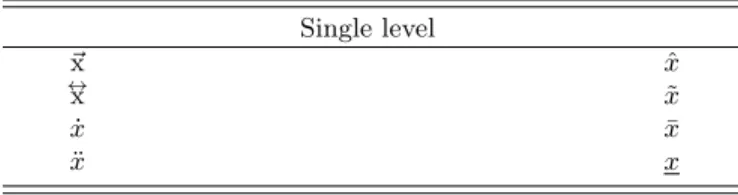
For a list of available diacritics see Table III below. It is possible to make multilevel accents, but placing one sign above a symbol or letter and one below is often more clear. Restrict the number of oversymbols to two. The underline can appear under any configuration. Some combinations may not be permitted by the journal editor.
TABLE III. Diacritical signs in math. Single level
~x xˆ
x
↔
˜
x
˙
x x¯
¨
x x
5. Subscripts and superscripts
All available characters can be used as subscripts or su-perscripts. Position of subscript or superscript is dictated by standard notation. In almost all cases you should set right and left subscripts and superscripts flush against the symbol they accompany (as in the following):
Rx0, 110Agm, ρ(0N), 14N,
Z 1
0
, X0, 14N2,
liml→∞ (in text).
There are however, some exceptions to this general rule. Examples appear below:
tensor notation: gµν(φz);α;α molecular ions: H2+,O2
−
footnotes in tables: Ena.
Presuperscripts or presubscripts also are to be set flush against the symbols they accompany. In addition, it is advisable to insert an extra thin space between a presu-perscript or presubscript and a preceding symbol in cases where clarity is questionable, i.e.,
8pσ1Σ+
u or d9szp3P2.
The number of levels of subscripts and superscripts at-tached to a symbol will also affect clarity. Two double levels is generally considered the most complicated com-bination acceptable, i.e.,
Mα2i b†k
When additional indices are needed, insert a comma or thin space and keep the added indices on the same line, i.e.,
Mbk,dp, σr,s+1, or σr s+1.
B. Abbreviations in math
Some abbreviations, such as those for mathematical functions and those used in superscripts or subscripts, require special handling and are discussed below.
1. Abbreviations designating mathematical functions
Usage of multiletter abbreviations that designate mathematical functions has been standardized. The ro-man font is to be used, e.g., cos and tan.
(1) Roman multiletter abbreviations must be closed up to the argument following and separated from any preceding symbol by a thin space, i.e.,
Kcos[Q(z−z0)],
K exp[x2(b
2+b1)−1/2].
(2) In addition, by convention it is assumed that an argument ends as soon as another function appears, i.e., sinxcosb, or at a plus or minus sign, i.e., sinx+y, but if other mathematics is involved or there is any ambi-guity you should insert bracketing, as in the following examples:
sin[−(x+a)], (sinx)/a, and exp[x2(bz+b1)
−1/2
].
(3) When the argument of a function contains paren-theses, enclose it in bold round parenparen-theses, i.e.,
g(x2a3/2(α
1+α2)−1/2).
(4) e and exp (for exponent) notation follow both of the preceding conventions. The choice of which form to use, e or exp, is determined by the number of charac-ters and the complexity of form of the superscript. The exx form is appropriate when short, simple superscripts would be involved, i.e., ez. exp(xx) should be used if
the superscript form is complex. In the on-line form the argument should be enclosed in bracketing.
2. Abbreviations in subscripts and superscripts
Abbreviations in subscripts and superscripts fall into two categories: (1) single-letter and (2) multiletter ab-breviations. Most single-letter abbreviations are con-ventionally printed in the italic font, i.e., EC where C stands for Coulomb. Multiletter abbreviations are con-ventionally printed in the roman font whether they rep-resent one or more words, i.e.,Elab, where lab stands for
laboratory (truncated word—lowercase) andEHF, where
HF stands for Hartree and Fock (acronym), two proper names. Please note that you should always capitalize abbreviations that represent proper names.
When you are creating your own abbreviations in text do not put periods in acronyms (whether on line or in subscripts), but do insert them if you are abbreviating words that are headings in a table.
C. Mathematical expressions
1. When to display
Display (1) equations of importance, (2) all equations that are numbered, (3) those that are too long to fit easily in text (over ∼25 characters), or (4) those that are complicated (contain built-up fractions, matrices, or matrixlike expressions). Consider, also, displaying math that contains multilevel indices, integral, summation, and product signs, with multilevel or complex limits, or any other situation in a formula that creates the need for extra vertical spacing in a text line.
2. Punctuation
Even though displayed math is separated by space from the running text it still is a part of that text and needs to be punctuated accordingly. The following is an example. The final result is
Hij = Ω
∆
2 |J|2
Eg+12(Wc+Wv)
eλK·Rij, (11)
where
K= 1 a(
ˆi+ˆj+ˆk), (12)
and
λ= ln[WlWv/(12Eg)2]. (13)
3. Equation “breaking” (multilinear equations)
Mathematical expressions often need to be displayed on two or more lines (“broken”) because of the line-length limitations of thePhysical Review standard two-column layout. The best place for a “break” is right before an operator or sign of relation. These signs should begin the next line of the equation. When it is necessary to break a product, begin the continued line with a multiplication sign. Note that the material that comes after a break can and should be aligned so that its relationship to the material on the first line is mathematically correct. See examples of breaking displayed math below:
Nx(r) +iN2(r) =eiθ(r)
= exp[−ijxu(r)], (1)
H2m2l(θ(i), θ(j)) =
√
wiwj(sinθ(i)sinθ(j))1/2
×[K2m2l(θ(i), θ(j))
+K2m−2l(θ(i), θ(j))]. (2)
There are situations where breaking an equation is not possible or appropriate. See the following equation as an example:
av,k = W
(1)
1 (x)−2W (1) 2 (x)−
2 3W
(1) 3 (x)
[W1(0)(x) +W1(2)(x)]−2[W2(0)(x) +W2(2)(x)]−2 3[W
(0)
3 (x) +W (2) 3 (x)]
. (3)
Equations that are not displayed but appear in text may also need to be broken. Basically the same rules apply as when breaking displayed math. Breaking at an operator or sign of relation is best. The operator or sign of relation usually begins the next line of text:
. . . and their respective displacement vectors are aˆi/2 +√2aˆj/2 and . . .
Products are broken with a multiplication sign:
. . . keep δm ' 4 MeV as before and choose γ (= −5.46
×10−3) at . . .
In addition, you may break in text at a solidus, leaving the numerator and fraction bar on the top line. The de-nominator will begin the continued line. See an example below:
. . . the above current is proportional to T0(∆1,∆3)1/2/
N2(0) if the injection levelGngΩ−21 remains . . .
4. Equation numbering
Equations must be numbered consecutively. Use arabic numbers and roman letters (for grouping according to relationship). Enclose the number in parentheses, e.g., (1), (1a), (1.1a), etc. The numbering sequence should be either continuous throughout the paper [(1)–(22)] or according to section [(1.1)–(1.22), (2.1)–(2.22)].
Appendix equations are an exception to the rule above. They must be numbered separately, and the equation number must include a capital roman letter identifying the appendix. If there is only one appendix the equation numbering is (A1), (A2), (A3), etc. For more than one appendix, each appendix section heading will be labeled and the equation numbering should be (A1), (A2), (A3), etc., (B1), (B2), (B3), etc.
Some situations require unique numbering indepen-dent of where they occur in a paper. Please use the forms shown in the following examples when you encounter sim-ilar circumstances.
(1) A set of equations of equal importance may be numbered to demonstrate that relationship, e.g., (1a), (1b), and (1c).
(2) A principal equation and subordinate equations (those that define quantities or variables in that equa-tion) may be numbered (1), (1a), and (1b), etc.
(3) If an equation is a variant of a previous equation (it may be separated from the original equation by other equations and/or by text), it may be numbered with the same number as the original and a prime, double prime, etc., as appropriate (one prime means first variation, dou-ble prime means second variation, etc.).
Equation numbers are placed flush with the right mar-gin according to standard forms in examples (a)–(f) be-low:
(a) One-line equation and number:
a+b= 0. (1)
(b) Broken equation and condition:
a+b=c+d+e+f+g+h+i+j+k+l
+m+n (a= 1). (1)
(c) Two equal equations with one number: a+b= 0,
(1) c+d= 0.
(d) Two equal equations with only one left side and separate numbers:
a+b= 0 (1a)
=x. (1b)
(e) One equation with one condition:
a+b= 0 (a= 1) (1) or
(f) One equation and one condition that will not fit on one line:
a1+b2+c3+d4+e5+f6+g7+h8+i9= 0 (1)
(a= 1).
D. Bracketing
1. Grouping sequence
For the purpose of grouping, the sequence of bracketing preferred for Physical Review articles is {[()]}, working outwards in sets ( ), [ ], and{ }. If you have used these three sets and need additional bracketing, begin the se-quence again in the same order but in bold print:
{[ ({ [ ( ) ] }) ]}
For grouping situations that contain built-up material and need larger sized bracketing, it is preferable to start again at the beginning of the sequence around the built-up material, i.e.,
(a−2)1/2
α2
(x+ 2)1/2 β
= 0.
2. Specific bracket notation
Bracketing (ordered and special) is also used to create specific notation that defines what it encloses. A list of approved specialized notation is included below. When used in an equation along with ordered bracketing, this special kind of bracketing should not alter the regular sequence of bracketing. The special notation h iin the following equation does not interfere with the sequence of the equation bracketing:
¯
h[hE−(a+ 1)i]−1= 0.
Ordered bracketing is also used to create specialized notation, e.g., [L2, L3] in the equation below:
1
3{−i(L1[L2, L3] +T)}= 0.
When there is a mixture of bracketing that orders and defines, the order sequence starts at the beginning with parentheses, skips the specialized notation (in this case, square brackets) and goes on to the next ordered bracket set (curly braces).
There are situations where special bracketing will oc-cur in pairs, i.e.,
||r2+r2||1/2, hhr1+r2iiav, (r||f(r)).
The outside bracket set should be printed in bold.
3. Specialized notation
Plane or set of parallel planes (111)
Direction [111]
Class (group) of symmetry equiva-lent directions
h111i
Class (group) of symmetry equiva-lent planes
{111}
Point designated by coordinates (x, y, z) Lattice position in a unit cell
(notbracketed; included for your information) 1 2 1 2 1 2
Vector written in components (Hz, Hy, Hz)
Commutator [f, g]
Iterated commutations [H0,[H0, H1]]
or[H0,[H0, H1]]
Functionals F[x]
Anticommutators {f, g}
Sets {x}
Coefficients of fractional parentage {|σi|}
Absolute values |a|
Determinants |x|
Notation used to indicate at what value of the argument some quantity is to be taken
|s→∞
Matrices or norms ||f||
Averages h i, h iav
Dirac bra-ket notation h | | iand (| |),
E. Additional style guidelines
1. Placement of limits
In displayed math, limits are treated in the following manner: X i,j,k i<j<k ∞ X n=1 X l 0 Y n>1
Z +∞
−∞
lim α→0
Stacking of limits, seen in the first example, is possi-ble, as is centering. In text, however, space limitations require that limits be treated as subscripts and super-scripts. The second example above should be setP∞
n=1
in text. The stacking in the first example would mean that any math containing that summation should be dis-played or be rewritten.
2. Fractions
(1) Fractions can be “built up” with a fraction bar, a+b
c ,
(3) written with a negative exponent, (a+b)c−1. In standard articles, in text all fractions must be ei-ther slashed, cased, or written with a negative exponent. In displayed math all three forms are allowed. In com-puscripts sized fractions are acceptable in text and dis-play.
Apply the following guidelines to the mathematics in your compuscript:
(a) Use built-up fractions in matrix notation (instead of the slashed configuration):
M1=−
∂2 ∂x2 2θ00
∂ ∂x θ0∂x∂ θ20 ∂
2 ∂x2
.
(b) Use built-up fractions (instead of the slashed con-figuration) if there are three or more simple fractions in a formula:
HA(w) = "
1 2
Q πω2
2 + c
2
e 4d
# πω2d.
(c) Using slashed fractions in subscripts, superscripts, and limits is preferred:
N−1/2.
(d) Use slashed or sized fractions in the numerators and denominators of built-up fractions except where excessive bracketing would obscure your meaning or slashing would interfere with continuance of notation:
ϕ+ (β/6)ϕ
γ+ [β(β−1)/12]ϕ2 = 0.
(e) When slashing fractions, respect the following con-ventions. In mathematical formulas this is the accepted order of operations:
(1) raising to a power, (2) multiplication, (3) division,
(4) addition and subtraction.
According to the same conventions, parentheses indi-cate that the operations within them are to be performed before what they contain is operated upon. Insert paren-theses in ambiguous situations. For example, do not writea/b/c; write in an unambiguous form, such as
(a/b)/c or
a/(b/c), as appropriate.
3. Multiplication signs
The primary use of the multiplication sign is to indi-cate a vector product of three-vectors (κ×A). Donot use it to express a simple product except
(1) when breaking a product from one line to another (described in equation breaking, Sec.??) or
(2) for other cases such as indicating dimensions (3×3 ×3 cm3), magnification (3×), symbols in figures (×’s), or
numbers expressed in scientific notation (5.3×10²MeV).
The center dot also should not be used to mean a sim-ple product. Use the dot to represent inner products of vectors and dyadics (κ·A).
4. Mathematical terms
The use of the following standard symbols is strongly recommended.
≈ approximately equal
∝ proportional to
→ tends to
∼ asymptotically equal to
O( ) of the order
A∗ complex conjugate ofA
A† Hermitian conjugate of matrixA
˜
A, AT transpose of matrixA
ˆ
APPENDIX: JOURNAL TITLE ABBREVIATIONS
Most journal names are abbreviated in the list of references that appears at the end of the manuscript. The following list contains the names of many journals commonly cited in the physics research literature. Additional standard abbreviation listings recommended for your use are Chemical Abstracts Service Source Index (CASSI) (American Chemical Society, Washington, D.C.) and Abbreviations of the Names of Scientific Periodicals Reviewed in Mathe-matical Reviews (American Mathematical Society, Providence, RI). Note that in the list below the standard journal abbreviation is printed in boldface (Accounts ofChemical Research). Add periods to these abbreviated parts as appropriate (Acc. Chem. Res.). Please note: Lately, many Russian journals have changed their names. Citations of recent works should reflect these changes.
Accounts ofChemicalResearch
Acta ChemicaScandinavica
Acta Crystallographica
Acta Crystallographica, SectionA: Crystal Physics, Diffraction, Theoretical and General Crystallography
Acta Crystallographica, SectionB: Structural Crystallography and Crystal Chemistry
Acta MathematicaAcademiaeScientiarumHungaricae
Acta Metallurgica
Acta Oto-Laryngologica
Acta Physica
Acta PhysicaAustriaca Acta PhysicaPolonica
Acustica
Advances in AppliedMechanics
Advances in Atomic andMolecularPhysics
Advances in Chemical Physics
Advances in MagneticResonance
Advances in Physics
Advances in Quantum Chemistry
AIAA Journal
AIChE Journal
AIP ConferenceProceedings
AkusticheskiiZhurnal[SovietPhysics—Acoustics] AmericanJournal ofPhysics
AnalyticalChemistry
Annalen derPhysik(Leipzig) Annales deChimie et dePhysique
Annales deGeophysique
Annales de l’InstitutHenri Poincare
Annales de l’InstitutHenri Poincare,SectionA: Physique Theorique
Annales de l’InstitutHenri Poincare,SectionB: Calcul des Probabilites et Statistique
Annales dePhysique(Paris) Annals ofFluid Dynamics
Annals ofMathematics
Annals ofOtology,Rhinology, &Laryngology
Annals ofPhysics(NewYork) AnnualReview ofNuclearScience
AppliedOptics
AppliedPhysicsLetters
AppliedSpectroscopy
Arkiv foerFysik
AstronomicalJournal
AstronomicheskiiZhurnal[SovietAstronomy] AstronomischeNachrichten
Astronomy andAstrophysics
Astrophysical Journal
Astrophysical Journal,Letters to the Editor
Astrophysical Journal,SupplementSeries
Astrophysical Letters
AtomicDataandNuclearData Tables
AtomnayaEnergiya[SovietJournal ofAtomicEnergy] AustralianJournal ofPhysics
Bell SystemTechnicalJournal
Berichte derBunsengesellschaft fuerPhysikalische
Chemie
BiographicalMemoirsofFellows of theRoyalSociety
BiologyLetters
BritishJournal ofAppliedPhysics
Bulletin of theAcademy ofSciences of theUSSR, PhysicalSeries(translation ofIzvestiya Akademii Nauk SSSR, Seriya Fizicheskaya)
Bulletin of theAmericanAstronomicalSociety
Bulletin of TheAmericanPhysicalSociety
Bulletin of theAstronomicalInstitutes of theNetherlands
Bulletin of theChemical Society ofJapan Bulletin of theSeismologicalSociety of America
CanadianJournal ofChemistry
CanadianJournal ofPhysics
CanadianJournal ofResearch
Chemical Physics
Chemical PhysicsLetters
Chemical Reviews
ChineseJournal ofPhysics [translation ofWuli Xuebao (Acta Physica Sinica)]
CommentsonAstrophysics andSpace Physics
CommentsonAtomic andMolecularPhysics
CommentsonNuclear andParticle Physics
CommentsonPlasma Physics andControlled Fusion CommentsonSolid State Physics
Communications inMathematicalPhysics
Communications onPureandAppliedMathematics
ComptesRendus Hebdomadaires des Seances de l’Academie desSciences
ComptesRendus Hebdomadaires des Seances de l’Academie desSciences,SerieA: Sciences Mathematiques
ComptesRendus Hebdomadaires des Seances de
l’Academie desSciences,SerieB: Sciences Physiques
ComputerPhysicsCommunications
Cryogenics
Discussions of theFaraday Society
DokladyAkademiiNauk SSSR [Soviet
Physics—Doklady]
EarthandPlanetaryScienceLetters
ElectronicsLetters
Experientia FieldsandQuanta
FizikaElementarnykhChastitsiAtomnogoYadra [SovietJournal ofParticles andNuclei]
Fizika iTekhnikaPoluprovodnikov[Soviet
Physics—Semiconductors]
FizikaMetallov iMetallovedenie[Physics ofMetals and
Metallography(USSR)]
FizikaNizkikhTemperatur[SovietJournal ofLow TemperaturePhysics]
FizikaPlazmy [SovietJournal ofPlasma Physics] FizikaTverdogoTela (Leningrad) [Soviet
Physics—Solid State] Fizika (Zagreb)
Fortschritte derPhysik
Foundations ofPhysics
GeneralRelativity andGravitation
Geochimica etCosmochimicaActa HelveticaChimicaActa
HelveticaPhysicaActa
High Temperature(USSR)(translation of Teplofizika Vysokikh Temperatur)
IBM Journal ofResearch andDevelopment
Icarus
IEEE Journal ofQuantum Electronics
IEEE Transactions onAntennasandPropagation
IEEE Transactions onElectron Devices IEEE Transactions onInformationTheory IEEE Transactions onInstrumentation and
Measurement
IEEE Transactions onMagnetics
IEEE Transactions onMicrowave Theoryand
Techniques
IEEE Transactions onNuclearScience
IEEE Transactions onSonics andUltrasonics
Industrial andEngineeringChemistry
Infrared Physics
Inorganic Chemistry
Inorganic Materials(USSR)(translation of Izvestiya Akademii Nauk SSSR, Neorganicheskie Materialy) Instruments andExperimentalTechniques(USSR)
(translation of Pribory i Tekhnika Eksperimenta) InternationalJournal ofMagnetism
InternationalJournal ofQuantum Chemistry
InternationalJournal ofQuantum Chemistry, Part1 InternationalJournal ofQuantum Chemistry, Part2 InternationalJournal ofTheoreticalPhysics
Izvestiya,Academy ofSciences,USSR, Atmospheric and
Oceanic Physics(translation ofIzvestiya Akademii Nauk SSSR, Fizika Atmosfery i Okeana)
Izvestiya,Academy ofSciences,USSR, Physics of the
Solid Earth(translation of Izvestiya Akademii Nauk SSSR, Fizika Zemli)
IzvestiyaAkademiiNauk SSSR, FizikaAtmosfery i
Okeana [Izvestiya,Academy ofSciences,USSR, Atmospheric andOceanic Physics]
IzvestiyaAkademiiNauk SSSR, FizikaZemli
[Izvestiya,Academy ofSciences,USSR, Physics of the
Solid Earth]
IzvestiyaAkademiiNauk SSSR, Neorganicheskie
Materialy[InorganicMaterials(USSR)]
IzvestiyaAkademiiNauk SSSR, SeriyaFizicheskaya
[Bulletin of theAcademy ofSciences of theUSSR, PhysicalSeries]
IzvestiyaVysshikhUchebnykhZavedenii,Fizika[Soviet
PhysicsJournal]
IzvestiyaVysshikhUchebnykhZavedenii,Radiofizika
[SovietRadiophysics]
JapaneseJournal ofAppliedPhysics
JapaneseJournal ofPhysics
JETP Letters(translation of Pis’ma v Zhurnal Eksperimental’noi i Teoreticheskoi Fiziki) Journal deChimiePhysique
Journal dePhysique(Paris) Journal dePhysique et leRadium Journal ofAppliedCrystallography
Journal ofAppliedPhysics
Journal ofAppliedSpectroscopy(USSR)(translation of Zhurnal Prikladnoi Spektroskopii)
Journal ofAtmospheric andTerrestrialPhysics
Journal ofAtmosphericSciences
Journal ofChemical Physics
Journal ofComputationalPhysics
Journal ofCrystalGrowth Journal ofFluid Mechanics
Journal ofGeophysical Research
Journal ofHigh Energy Physics
Journal ofInorganic andNuclearChemistry
Journal ofLow TemperaturePhysics
Journal ofLuminescence
Journal ofMacromolecularScience,[Part B]Physics
Journal ofMathematicalPhysics
Journal ofMolecularSpectroscopy
Journal ofNon-CrystallineSolids Journal ofNuclearEnergy
Journal ofNuclearEnergy, Part C: Plasma Physics, Accelerators, Thermonuclear Research
Journal ofNuclearMaterials
Journal ofPhysical and ChemicalReferenceData Journal ofPhysical Chemistry
Journal ofPhysics A: General Physics
Journal ofPhysics andChemistry of Solids Journal ofPhysics B: Atomic and Molecular Physics
Journal ofPhysics C: Solid State Physics
Journal ofPhysics D: Applied Physics
Journal ofPhysics E: Scientific Instruments
Journal ofPhysics F: Metal Physics
Journal ofPhysics (Moscow) Journal ofPlasma Physics
![TABLE X. Experimental results (Ref. [6]).](https://thumb-us.123doks.com/thumbv2/123dok_us/8432626.2243496/11.918.82.450.332.442/table-x-experimental-results-ref.webp)