FORMULATION AND DEVELOPMENT OF LEVETIRACETAM
FILM-COATED TABLETS AND IT'S COMPARATIVE EVALUATION
OF PHYSICAL AND CHEMICAL PARAMETERS BETWEEN
ACCELERATED AND REAL TIME STABILITY
Vijay Kumar Panthi*
Department of Pharmacy, Sunsari Technical College, Laxmisadak-4, Dharan, Sunsari, Nepal.
ABSTRACT
Levetiracetam is an antiepileptic drug with favourable pharmacologic
characteristics and demonstrated activity in improving seizure control.
Core part of tablet is prepared by wet granulation method. After final
formulation the tablet is coated by both seal and film coating method
with Hydroxy Propyl Methyl Cellulose 5 cps and packed in alu-alu
strips, finally placed in Accelerated and Real time stability by
maintaining 75%±5% humidity & 40ºC±2ºC temperature and 65±5%
humidity & 30º±2ºC temperature respectively and periodically
followed up to three months for comparative observation of physical
and chemical parameters of levetiracetam tablets. As per stability data
it is concluded that the product is appeared effective in case of both physically and
chemically in a accelerated and real time stability chamber but Real time stability sample is
considered more stable than Accelerated in case of physical parameters because hardness and
disintegration time is increased higher rate in accelerated as compared to real time. Similarly,
Assay% is also observed more good in real time than accelerated which is considered that
levetiracetam tablet is chemically more stable in real time stability than accelerated but there
is no significant difference in drug release between these two stability chamber because they
both are appeared equally release in Accelerated and Real time analysis. Hence, it has finally
concluded that levetiracetam tablet is found more stable in Real time stability than
Accelerated in case of both physically and chemically but in case of drug release, it is
observed that two stability chamber showed the product equally stable.
Volume 6, Issue 2, 998-1013. Research Article ISSN 2277– 7105
*Corresponding Author
Dr. Vijay Kumar Panthi
Department of Pharmacy,
Sunsari Technical College,
Laxmisadak-4, Dharan,
Sunsari, Nepal. Article Received on 09 Dec. 2016,
Revised on 29 Dec. 2016, Accepted on 19 Jan. 2017
KEYWORDS: Levetiracetam, Physical Parameters, Chemical Parameters, Accelerated stability, Real Time Stability
INTRODUCTION
Levetiracetam (LEV) is an antiepileptic drug with favourable pharmacologic characteristics
and demonstrated activity in improving seizure control. There has been increasing evidence
that besides partial seizures in adults and paediatric patients, Levetiracetam may also be
useful in patients with generalized absence or myoclonic seizures, in patients with
Lennox-Gastaut syndrome. It has become one of the most frequently prescribed new drugs for the
treatment of partial seizure. In vitro studies revealed that LEV has no significant affinity for
gamma-aminobutyric acid (GABA) or benzodiazepine receptors. LEV appears to act via an
unknown specific binding site in the brain. This novel binding site is the synaptic vesicle
protein, SV2A, which is an integral membrane protein present on synaptic vesicles and some
neuro endocrine cells.[1] Levetiracetam rapidly and completely absorbed after oral
administration (99%). Peak plasma concentrations occuring in about an hour following oral
administration in fasted subjects. The major metabolic pathway of levetiracetam (24% of
dose) is an enzymatic hydrolysis of the acetamide group.[2] Levetiracetam, a pyrrolidone
derivative, is an antiepileptic drug (AED) which is structurally unrelated to any known
antiepileptic drug. The drug provides broad-spectrum seizure protection in animal models of
epilepsy but lacks anticonvulsant activity in conventional models. The compound has been
granted marketing approval for an oral tablet and solution (KEPPRA) as well as a parenteral
I.V injection.[3] The pharmacokinetics are linear and time variant, with low intra and
inter-subject variability. Food does not affect the extent of absorption of levetiractem but it
decreases Cmax by 20% and delays Tmax by 1.5 hours. The pharmacokinetics of
levetiracetam are linear over the dose range of 500-5000 mg. Steady state is achieved after 2
days of multiple twice-daily dosing.[5]
The film-coated tablets must be taken orally, swallowed with a sufficient quantity of liquid
and may be taken with or without food. The daily dose is administered in two equally divided
dose. In accordance with the current clinical practice, if levetiracetam have to be discontinued
it is recommended to withdraw the medication gradually (e.g. in adults and adolescents
weighing more than 50 kg: 500 mg decreases twice daily every two to four weeks; in infants
older than 6 months. Suicide, suicide attempt, suicidal ideation and behavior have been
meta-analysis of randomized placebo-controlled trials of anti-epileptic medicinal products has
shown a small increased risk of suicidal thoughts and behavior. The mechanism of this risk is
not known.[4]. Somnolence, asthenia (loss of strength) and dizziness are the main adverse
drug reactions of levetiracetam.[6]
MATERIALS AND METHODS Materials
Levetiracetam, SSG, MCCP 101/200, HPC LH-21, HPMC 5 CPS and Ethyl Cellulose were
obtained as a gift sample from Asian pharmaceuticals, Bhairahawa, Nepal. All the other
chemicals used were of analytical reagent grade.
Methods 1. Sifting
Levetiracetam, Maize Starch (Dried), MCCP 101, HPC LH-21 and Crospovidone sifted
through sieve no. 60 and mixed properly all ingredients.
2. Preparation of Preservative Solution
Dissolved Methyl Paraben, Propyl Paraben and PVPK-30 in Ethanol (95%) with continuous
stirring for 5 minutes then granulated with step 1.
3. Drying
After complete granulation, sifted the granules through sieve no.14 and allowed it to dry in
tray dryer at 45º C until complete drying then again sifted the dried granules through sieve
no. 20.
4. Lubrication
Aerosil, Magnesium Stearate and Purified Talc were sifted through sieve no. 60 mixed
properly then finally lubrication was done with step 3.
Preparation of Coating Solution A. Seal Coating Solution
1. Swelling of HPMC 5 CPS
HPMC 5 CPS was dispersed on Isopropyl Alcohol then added Methylene Chloride in it under
2. Preparation of Solubilizer Solution
Dissolved Ethyl Cellulose, Polyethylene Glycol-6000 on Methylene Chloride with
continuous stirring then added this solution to above step.
3. Preparation of Colour Solution
Dispersed Titanium Dioxide on Isopropyl Alcohol then passed this solution through 300
mesh (white colour nylon cloth).
B. Film Coating Solution 1. Swelling of HPMC 5 CPS
HPMC 5 CPS was dispersed on Isopropyl Alcohol then added Methylene Chloride in it under
continuous stirring for it's complete swelling.
2. Preparation of Solubilizer Solution
Dissolved Ethyl Cellulose, Polyethylene Glycol-6000 on Methylene Chloride with
continuous stirring then added this solution to above step.
3. Preparation of Colour Solution
Dispersed Yellow Oxide of Iron and Titanium Dioxide on Isopropyl Alcohol then passed this
solution through 300 mesh (white colour nylon cloth). After that added this step to step 2.
4. Mixing:
Added Castor Oil and Polyethylene Glycol-400 to step 3 then finally stirred the solution for
properly mixing the ingredients.
Evaluation
Levetiracetam tablets prepared by wet granulation and film coating were subject to following
physical evaluation.
Physical observation
At initial phase tablets ejected from compression machine was observed only colour and
appearance but after stability period eject the tablets from packed aluminium foil and
observed the characteristics of tablets by naked eye such as colour change, smell, breaking,
Hardness
The tablet hardness is the force required to break a tablet in a diametric compression force. A
Digital hardness tester was used in this study. This tester applies force to the tablet straightly.
The test was performed on six tablets and the average was calculated in kilo pound.[8]
Thickness
The thickness of the tablets was determined using a Vernier caliper. Five tablets from each
formulation were used and average values were calculated.[8]
In-vitro Disintegration Studies
Six Tablet were placed in basket then basket dipped in a beaker containing 800 ml of distilled
water at 37 ±0.5 °C. Time for complete disintegration of the tablet was measured in minute.
Stability studies
Stability studies on the best formulation were carried out to determine the effect of presence
of formulation additives on the stability of the drug and also to determine the physical
stability of the formulation under accelerated storage conditions and Real time conditions.
The tablets were stored in an aluminum foil and subjected to:
Accelerated stability conditions: Elevated temperature and humidity conditions of 40ºC ±
2ºC & 75% ± 5 %.
Real Time conditions: 30ºC± 2ºC & 65%±5%
The samples were withdrawn at the end of month and evaluated for physical parameters
viz. physical observation, hardness, thickness, disintegration time and percentage of drug
release and also chemical parameters i.e. Assay (drug potency). [9-10]
Method of Dissolution determination[7] Apparatus: 2, Paddle
Revolution/ min: 50
Temperature: 37ºC
Time: 15 min
Media: 900 ml, Purified Water
Procedure
Measured the absorbance of a 0.055 mg/ml concentration of standard and test preparation
After 15 minutes, withdrawn a sample of the medium from each jar (total six jar) and
measured the absorbance of the filtered sample meticuluously at 220 nm by Ultraviolet
Spectroscopy.
Assay determination
[image:6.595.70.539.244.524.2] Concentration of Standard and Test Preparation: 0.05 mg/ml Wavelength: UV 220 nm
Table 1. Formulation of uncoated part of Levetiracetam tablets
S.No. Materials (mg) F1 F2 F3 F4
1. Levetiracetam 500 500 500 500
2. Maize Starch(Dried) 41.0 65.0 29.94 30.0
3. Crospovidone 30.0 - 23.31 26.64
4. HPC LH-21 - 26.64 - 20.0
5. SSG 44.0 - - -
6. CCS - - 16.65 -
7. Methyl Paraben - 0.67 0.67 0.67
8. Propyl Paraben - 0.13 0.14 0.13
9. PVPK-30 - - 26.64 26.0
10. MCCP pH 102 22.5 18.63 - -
11. MCCP pH 101 - 18.6 25.0 52.56
12. Tween-80 - 3.33 3.33 -
13.. Aerosil 15.0 27.0 27.32 4.0
14. Magnesium Stearate 1.5 4.0 4.0 4.0
15. Purified Talc - 2.0 2.0 2.0
16. Purified Water 6.0 - - -
17. Ethanol (95%) - 162.0 131.25 162.0
Total 666.00 666.00 666.00 666.00
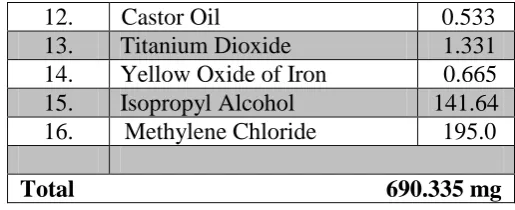
Table 2. Film coating materials for Final formulation (F4): Seal coating materials S.No. Materials (mg) F4
1. HPMC 5 CPS 5.354
2. Ethyl Cellulose 0.198
3. Polyethylene Glycol-6000 3.20
4. Titanium Dioxide 0.266
5. Methylene Chloride 65
6. Isopropyl Alcohol 44
Film coating materials
7. HPMC 5 CPS 6.657
8. Ethyl Cellulose 0.078
9. PVPK-30 0.066
10. Polyethylene Glycol-6000 3.99
[image:6.595.170.427.556.764.2]12. Castor Oil 0.533
13. Titanium Dioxide 1.331
14. Yellow Oxide of Iron 0.665
15. Isopropyl Alcohol 141.64
16. Methylene Chloride 195.0
Total 690.335 mg
RESULTS
A. Preformulation Studies
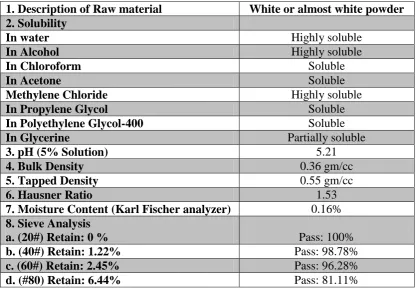
Before commencement of levetiracetam formulation, the various preformulation studies were
carried out for the convenience of final formulation. Levetiracetam itself white or almost
white powder and it's solubility in various solvents, pH, sieve analysis were performed with
[image:7.595.167.425.71.176.2]the help of related apparatus. The all performed preformulation studies were illustrated in
table 3.
B. In-process granules parameter
After initiation of levetiracetam formulation, the first step carried out was sifting of API. The
all granules parameters which required in-process checking were mentioned in table 4.
C. Initial and stability observation of both Physical and Chemical Parameters 1. Physical parameters of Initial duration
After completion of successful four trials, the physical parameters of final trial (F4) were
observed which were mainly physical observation, hardness, thickness and disintegration
time. Most of the parameters are found satisfactory within appropriate limits and their results
were shown in table 5.
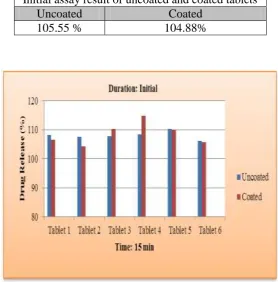
2. Drug release observation of Levetiracetam uncoated and coated tablets in Initial duration
The drug release of levetiracetam tablet was obtained good in case of both uncoated and
coated tablet in initial duration. After 15 minutes, the total drug release of levetiracetam is
determined as per method illustrated in materials and methods. All six tablets of each
uncoated and coated tablets shown drug release above than 100%. This result is also justified
in figure 1.
3. Physical test observation of Accelerated stability analysis in different month
The final formulation (F4) is also followed up to three months in monthly basis as a stressful
physical parameters were also found stable in case of Accelerated stability which are given in
table 6.
4. Physical test observation of Real Time stability analysis in different month
The final formulation (F4) is also simultaneously and continuously followed in Real time
stability up to three months same as Accelerated. The range of temperature and humidity
were 30ºC±2º & 65%±5% respectively. The result of this statement is also elaborated in table
7.
5. Drug release observation of Levetiracetam film coated tablets of First month duration on both Accelerated and Real Time stability
The drug release is found approximately same range in case of both Accelerated and Real
time stability. All the individual tablets exhibited their release profile above than 100% which
is same range as compared to initial uncoated and coated tablets. This result is also
enumerated in figure 2.
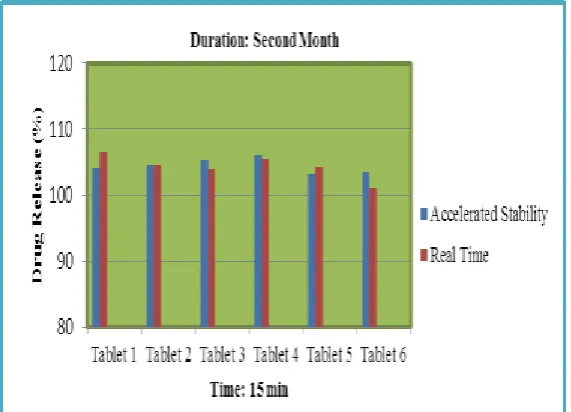
6. Drug release observation of Levetiracetam film coated tablets of Second month duration on both Accelerated and Real Time stability
The drug release found good up to second month in case of both Accelerated and Real time
but it is very slightly decreased as compared to initial and first month duration. The second
month comparative data of drug release is also presented in figure 3.
7. Drug release observation of Levetiracetam film coated tablets of Third month duration on both Accelerated and Real Time stability
On the basis of observed data it can be readily say that the levetiracetam film coated tablets is
more stable up to third months by means of various physical parameters such as drug release,
physical observation, hardness, thickness and disintegration. The comparative dissolution
profile of third month is mentioned in figure 4.
8. Chemical parameters of Initial duration
The chemical analysis or chemical parameters (Assay%) of both uncoated and coated tablets
9. Chemical parameter (Assay%) of levetiracetam film coated tablets in both Accelerated and Real time stability
The result of chemical parameter is found stable up to third months in case of both
Accelerated and Real time stability, assay percentage was obtained above than 100%. Hence
on the basis of all physical and chemical parameters it has justified that Levetiracetam film
coated tablets is stable by both physically and chemically in case of both Accelerated and
[image:9.595.90.510.271.562.2]Real time stability. The comparative chemical parameter value (Assay%) is also illustrated in
figure 5.
Table: Table 3. Preformulation Studies
Table 4 In-process granules parameters
Table 5. Physical parameters of Initial duration
1. Description of Raw material White or almost white powder 2. Solubility
a. In water Highly soluble
b. In Alcohol Highly soluble
c. In Chloroform Soluble
d. In Acetone Soluble
e. Methylene Chloride Highly soluble
f. In Propylene Glycol Soluble
g. In Polyethylene Glycol-400 Soluble
h. In Glycerine Partially soluble
3. pH (5% Solution) 5.21
4. Bulk Density 0.36 gm/cc
5. Tapped Density 0.55 gm/cc
6. Hausner Ratio 1.53
7. Moisture Content (Karl Fischer analyzer) 0.16% 8. Sieve Analysis
a. (20#) Retain: 0 % Pass: 100%
b. (40#) Retain: 1.22% Pass: 98.78%
c. (60#) Retain: 2.45% Pass: 96.28%
d. (#80) Retain: 6.44% Pass: 81.11%
Moisture content(%) by moisture analyser
Bulk Density (gm/cc)
Tapped Density
(gm/cc) C.I. (%) Hausner Ratio
Lubricated granules: 2.43 0.416 0.526 20.97 1.26
Hardness (kp) Thickness (mm) Disintegration Time (min) Friability (%)
Table 6. Physical test observation of Accelerated stability analysis in different month Parameters Code Initial 1st month 2nd month 3rd month
Physical observation F4 Yellow colour same Same same
Hardness(kp) F4 12.49-14.68 17.52-19.43 18.55-20.75 18.45-21.00
Thickness(mm) F4 5.88-5.96 5.90-5.96 5.88-5.94 5.92-5.96
D.T(min) F4 4'45"-5'55" 6'00-6'55'' 7'13'-7'45'' 7'15''-8'10''
Table 7. Physical test observation of Real Time stability analysis in different month
Table 8. Chemical parameters (Assay%) of Initial duration
Initial assay result of uncoated and coated tablets
Uncoated Coated
105.55 % 104.88%
Figure:
Figure1. Drug release observation of Levetiracetam uncoated and coated tablets in Initial duration
Parameters Code Initial 1st month 2nd month 3rd month
Physical observation F4 Yellow colour Same Same Same
Hardness (kp) F4 12.49-14.68 14.87-16.40 16.68-18.18 16.87-18.85
Thickness (mm) F4 5.88-5.96 5.88-5.94 5.86-5.94 5.88-5.96
[image:10.595.157.436.316.599.2]Figure 2. Drug release observation of Levetiracetam film coated tablets of First month duration on both Accelerated and Real Time stability
[image:11.595.156.442.336.542.2]Figure4. Drug release observation of Levetiracetam film coated tablets of Third month duration on both Accelerated and Real Time stability
Figure5. Chemical parameter (Assay%) of levetiracetam film coated tablets in both Accelerated and Real time stability
ABBREVIATIONS
F Formulation
LEV Levetiracetam
HPMC 5 CPS Hydroxy Propyl Methyl Cellulose 5 Centipoise
GABA Gamma-aminobutyric acid
C Centigrade
HPC LH Low substituted hydroxy propyl cellulose
PVPK-30 Polyvinylpyrrolidone k-30
SSG Sodium Starch Glycolate
DISCUSSION
All the formulations are done by wet granulation method and details of formulation are
illustrated in formula code. Levetiracetam tablet with different formulation is compressed in
8 station rotatory compression machine. Only the final formulation (F4) is followed
continuously by both physically and chemically. When at first F1 trial is taken with wet
granulation by Purified water the ultimate result in compression is low hardness but rest of
the other compression parameters were satisfactory. Due to low hardness, processing of F1 is
rejected hence trial is gone with further attempts by Ethanol (95%) as a solvent of wet
granulation. The all details of second attempt (F2) is mentioned in formulation chart. At first
step of formulation second (F2), Low substituted hydroxyl propyl cellulose-21 is used a
binder to shoot out the low hardness problem. Again low hardness problem is repeated but in
this trial hardness was not achieved low while observing hardness, only the capping was seen
during friability observation which was ultimately might be the root cause of low hardness.
The obtained difference between F1 and F2 is low hardness but the condition was slight
different (i.e. while observing hardness and friability). Low substituted hydroxyl propyl
cellulose-21 is not appeared as a effective binder and anticapping agent in formulation
second. Due to observation of capping the F2 is also rejected and proceeded for another
attempts.
In third trial (i.e. F3), decided to add proper binder to overcome the previous hardness and
capping trouble hence 26.64 mg/tab Polyvinylpyrrolidone k-30 is added as a binder and gone
for required processing of formulation. Polyvinylpyrrolidone k-30 is dissolved directly in
Ethanol (95%) with continuous stirring until getting clear solution then preservatives are
added in this solution and granulated with sifted ingredients. Although trial was taking by
good binder still F3 also suffered with low hardness trouble hence this trial is also rejected for
further compression. After three unsuccessful attempts, formulation is continue with
Polvinylpyrrolidone k-30 and by adding extra more amounts of MCC pH 101 as a binder to
counteract the existing problem but few other ingredients and quantity is addressed as per
formulation requirement. The all parameters also elaborated in formulation chart. By
compression parameters were observed satisfactory and it's whole method of preparation and
other procedure are Detaille discussed in chapter, materials and methods. From initial trial to
fourth attempts it is seen that the low hardness and capping problem has been overcome by
adding as well as maintaining the optimize concentration of polyvinylpyrrolidone k-30
(3.9%), Low substituted hydroxyl propyl cellulose-21 and MCC pH 101 (7.89%) in the
formulation of uncoated portion of levetiracetam tablets.
After successful completion of uncoated tablets of levetiracetam it has been transferred to
coating machine for film coating. All the coating related formulation is justified in
formulation chart. Initially, prepared seal coating solution as per the procedure elaborated in
materials and methods. For entire process of coating, the 1 kg capacity of conventional
coating machine is used in which the quantity of solution sprayed at a time (initially) is 10
ml/min, drying time was 30 min, drying temperature was 45 degree centigrade and drum
speed initially and drum speed during drying were 45 rpm and 10 rpm respectively. By this
way the tablets obtained the 0.623% of seal coating solution then again it is forwarded for
film coating and the final film coating solution attained is 2.44%. All the parameters were
observed satisfactory and this formulation is finalized for levetiracetam film coated tablets.
After successful completion of coating the tablets were packed in alu-alu strips (both side
aluminium) and placed in Accelerated and Real time stability chamber by maintaining proper
limit of humidity and temperature. Accelerated stability analysis is observed by maintaining
75%±5% humidity and 40ºC±2ºC temperature while Real time is operated at 65%±5%
humidity and 30ºC±2ºC temperature. Both this stability analysis is followed up to three
months for comparative observation of physical and chemical parameters of levetiracetam
tablets and the testing schedule was performed on monthly basis.
CONCLUSION
The low hardness and capping problem is appeared frequently in the formulations of
levetiracetam tablets mainly in core part which was initially observed that root cause of
trouble is lacking proper binder hence after two unsuccessful trials, attempts is tried by the
application of polyvinylpyrrolidone k-30 as a binder but couldn't obtained the satisfactory
results. Low substituted hydroxyl propyl cellulose-21 is also not appeared effective binder in
this formulation. All the compression parameters were found satisfactory except low hardness
and capping. As per formulation elaborated in formulation chart it is mainly concluded that
mainly polyvinylpyrrolidone k-30 and by adding extra more amounts of MCC pH 101. In
addition, as per above attempts it is also justified that the purified water was not effective
solvent in wet granulation while formulating levetiracetam tablets but Ethanol (95%) was
considered effective solvent in levetiracetem tablet formulation as a wet granulation process.
In both seal and film coating part of levetiracetam tablets the HPMC 5 CPS is considered
effective coating materials in case of weight attained and release maintaining polymers. The
initial drug release of uncoated and coated tablet of levetiracetam is not that much appeared
differ, approximately drug release was same. Although there is higher humidity and
temperature in Accelerated stability than Real time, the hardness of tablet is slightly increased
more in Accelerated as compared to Real time. Hardness and Disintegration time were
increased gradually in both stability chamber but slightly higher in Accelerated stability. The
gradually increased hardness and Disintegration doesn’t showed degradative impact on drug
release and potency.
As per data observed in stability schedule it is concluded that the product is appeared
effective in case of both physically and chemically in a accelerated and real time chamber but
Real time stability sample is considered more stable than Accelerated in case of physical
parameters because hardness and disintegration time is increased higher rate in accelerated as
compared to real time. Similarly, potency (Assay%) is also observed more good in real time
than accelerated which is considered as levetiracetam tablets is chemically more stable in real
time stability than accelerated but there is no significant difference in drug release between
these two stability chamber because they both are appeared equally release in Accelerated
and Real time analysis. Hence on the basis of above finding result and discussion, it has
finally concluded that levetiracetem tablet is found more stable in Real time stability than
Accelerated in case of both physically and chemically but in case of drug release, it is
observed that two stability chamber showed the product equally stable.
ACKNOWLEDGEMENTS
I would highly gratitude thanks to my respected family members for their continuous
encouragement and support and gratefulness to Asian Pharmaceuticals for valuable support in
raw materials and sincere thanks goes to all technical staffs of my academic institution for
advisory and fruitful discussion. Similarly, I'm highly acknowledged to all my batch mates
REFERENCES
1. Krishna Kavita, Raut Asawari, Gohel Kushal, Dave Priti: A drug review in levetiracetam,
JAPI, October 2011; Vol. 59.
2. Karna Nabin et al, International Journal of Pharm Tech Research. 2014; 6(2): 476-486.
3. Martin S. Rusinowitz, Center for drug evaluation and research, clinical review,
Application number, September 5, 2008: 22-285,
4. Medicines and Healthcare products Regulatory Agency (MHRA), Levetiracetam 250 mg,
500 mg, 750 mg and 1000 mg film coated tablets, PL 14017/0228-0231.
5. Levetiracetam tablets 250 mg, 500 mg, 750 mg, 1000 mg, NDA 21-035, Proposed REMS
26 March, 2009. page no. 3 of 40.
6. Saif S R, Pharmacology review: edition first, page no. 145.
7. Unites States Pharmacopoeia 37: 2014, Volume 3 A, page no. 3522.
8. www.Pharmainfo.net/Evaluation of tablets, Accessed on: 01/02/2016.
9. Jens Cartensen, ICH Guidelines, In drug stability principles and practices, 2nd edn, New
York: Marcel Dekker, Inc., 1995, 68: 541 – 546.
10.SA. Kanvinde, Stability of oral solid dosage forms- a global perspective. Pharma times.