A Rule-Augmented Statistical Phrase-based Translation System
Cong Duy Vu Hoang†, AiTi Aw†and Nhung T. H. Nguyen‡∗ †Human Language Technology Dept.
Institute for Infocomm Research (I2R), A*STAR, Singapore {cdvhoang, aaiti}@i2r.a-star.edu.sg
‡School of Information Science
Japan Advanced Institute of Science and Technology (JAIST), Japan
Abstract
Interactive or Incremental Statistical Ma-chine Translation (IMT) aims to provide a mechanism that allows the statistical mod-els involved in the translation process to be incrementally updated and improved. The source of knowledge normally comes from users who either post-edit the entire trans-lation or just provide the transtrans-lations for wrongly translated domain-specific termi-nologies. Most of the existing work on IMT uses batch learning paradigm which does not allow translation systems to make use of the new input instantaneously. We introduce an adaptive MT framework with a Rule Definition Language (RDL) for users to amend MT results through trans-lation rules or patterns. Experimental re-sults show that our system acknowledges user feedback via RDL which improves the translations of the baseline system on three test sets for Vietnamese to English translation.
1 Introduction
In current Statistical Machine Translation (SMT) framework, users are often seen as passive con-tributors to MT performance. Even if there is a collaboration between the users and the system, it is carried out in a batch learning paradigm (Ortiz-Martinez et al., 2010), where the training of the SMT system and the collaborative process are car-ried out in different stages. To increase the produc-tivity of the whole translation process, one has to incorporate human correction activities within the translation process. Barrachina et al. (2009) pro-posed an iterative process in which the translator activity is used by the system to compute its best
∗∗Work done during an internship at I2R, A*STAR.
(or n-best) translation suffix hypotheses to com-plete the prefix. Ortiz-Martinez et al. (2011) pro-posed an IMT framework that includes stochas-tic error-correction models in its statisstochas-tical formal-ization to address the prefix coverage problems in Barrachina et al. (2009). Gonzalez-Rubio et al. (2013) proposed a similar approach with a spe-cific error-correction model based on a statistical interpretation of the Levenshtein distance (Leven-shtein, 1966). On the other hand, Ortiz-Martinez et al. (2010) presented an IMT system that is able to learn from user feedback by incrementally up-dating the statistical models used by the system. The key aspect of this proposed system is the use of HMM-based alignment models trained by an in-cremental EM algorithm.
Here, we present a system similar to Ortiz-Martinez et al. (2010). Instead of updating the translation model given a new sentence pair, we provide a framework for users to describe trans-lation rules using a Rule Definition Language (RDL). Our RDL borrows the concept of the rule-based method that allows users to control the translation output by writing rules using their lin-guistic and domain knowledge. Although statis-tical methods pre-dominate the machine transla-tion research currently, rule-based methods are still promising in improving the translation qual-ity. This approach is especially useful for low resource languages where large training corpus is not always available. The advantage of rule-based methods is that they can well handle par-ticular linguistic phenomena which are peculiar to languages and domains. For example, the TCH MT system at IWSLT 2008 (Wang et al., 2008) used dictionary and hand-crafted rules (e.g. regu-lar expression) to process NEs. Their experiments showed that handling NE separately (e.g., person name, location name, date, time, digit) results in translation quality improvement.
In this paper, we present an adaptive and
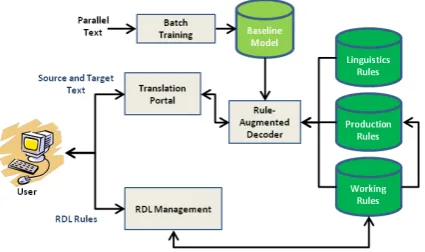
Figure 1: The proposed rule-augmented SMT framework.
teractive MT system that allows users to correct the translation and integrate the adaptation into the next translation cycle. Our experiments show that the system is specifically effective in han-dling translation errors related to out of vocabulary words (OOVs), language expressions, name enti-ties (NEs), abbreviations, terminologies, idioms, etc. which cannot be easily addressed in the ab-sence of in-domain parallel data.
2 System Overview
Figure 1 shows the translation and interactive pro-cess of our system. The system is trained with a batch of parallel texts to create a baseline model. Users improve the translation by adding RDL rules to change or correct the unsatisfactory trans-lation. New RDL rules are tested in a working environment before uploading to the production environment where they would be used by subse-quent translation requests.
In our system, RDL Management checks, vali-dates and indexes the translation rules. The Rule-Augmented Decoder has two components: (1) the RDL Matcher to find applicable RDL rules for a given source text to create dynamic translation hy-potheses; and (2) the Augmented Decoder to pro-duce the final consensus translation using both dy-namic hypotheses and static hypotheses from the baseline model.
3 Rule Definition Language (RDL)
The Rule Definition Language (RDL) comprises a RDL grammar, a RDL parser and a RDL matching algorithm.
3.1 RDL Grammar
Our RDL grammar is represented with a Backus-Naur Form (BNF)s syntax. The major feature of
Node Type Description
Token Any string of characters in the defined basic processing unit of the language. String A constant string of characters. Identifier A term represents a pre-defined role
(e.g. integer, date, sequence, . . . ). Meta-node A term executes a specific function
(e.g. casing, selection/option, con-nection).
Context cue A term describes source context’s ex-istence.
[image:2.595.306.526.61.184.2]Function A term executes a pre-defined task.
Table 1: A brief description of RDL nodes.
Figure 2: An Example of RDL Rule.
RDL grammar is the support of pre-defined identi-fiers and meta-operators which go beyond the nor-mal framework of regular expression. We also included a set of pre-defined functions to further constraint the application and realization of the rules. This framework allows us to incorporate semantic information into the rule definition and derive translation hypotheses using both semantic and lexical information. A RDL rule is identified by a unique rule ID and five constituents, includ-ingSource pattern, ruleCondition,Target transla-tion,Reordering rule and user ConFidence. The source pattern and target translation can be con-structed using different combination of node types as described in Table 1. The rules can be further conditioned by using some pre-defined functions and the system allows users to reorder the transla-tion of the target node. Figure 2 gives an example of a RDL rule where identifier@Num is used.
3.2 RDL Parsing and Indexing
The RDL Parser checks the syntax of the rules before indexing and storing them into the rule database. We utilize the compiler generator (WoB et al., 2003) to generate a RDL template parser and then embed all semantic parsing components into the template to form our RDL Parser.
[image:2.595.78.291.64.190.2]Figure 3: A linked item chain for a rule source (@a @b [c] [“d e”] [“f g h”] (“i”|“j k”)).
represented in Algorithm 1.
Data: ruleID & srcPatn
Result: idxTbl
// To build data structure−Forward Step doForward(srcPatn, linkedItmChain); // To create index table−Backward Step doBackward(linkedItmChain, ruleID, idxTbl);
Algorithm 1:Algorithm for RDL rule indexing.
The main idea of the rule indexing algorithm is to index all string-based nodes in the source pat-tern of the RDL rule. Each node is represented using 3-tuple. They are ruleID, number of nodes in source pattern and all plausible positions of the node during rule matching. The indexing is car-ried out via a Forward Step and Backward Step. The Forward Step builds a linked item chain which traverses all possible position transitions from one node to another as illustrated in Figure 3. Note that S and E are the Start and End Node. The link indi-cates the order of transition from a node to another. The numbers refer to the possible positions of an item in source. The Backward Step starts at the end of the source pattern; traverses back the link to index each node using the 3-tuple constructed in the Forward Step. This data structure allows us to retrieve, add or update RDL rules efficiently and incrementally without re-indexing.
3.3 RDL Matching Algorithm
Each word in the source string will be matched against the index table to retrieve relevant RDL rules during decoding. The aim is to retrieve all RDL rules in which the word is used as part of the context in the source pattern. We sort all the rules based on the word positions recorded dur-ing indexdur-ing, match their source patterns against the input string within the given span, check the conditions and generate the hypotheses if the rules fulfill all the constraints.
4 Rule-Augmented Decoder
The rule-augmented decoder integrates the dy-namic hypotheses generated during rule match-ing with the baseline hypotheses durmatch-ing decodmatch-ing. Given a sentenceffrom a source languageF, the fundamental equation of SMT (Brown et al., 1993) to translate it into a target sentencee of a target languageEis stated in Equation 1.
ebest=argmaxePr(e|f)
=argmaxePr(f|e)Pr(e)
=argmaxe N
X
n=1
λnhn(e, f)
(1)
Here,Pr(f|e)is approximated by a translation model that represents the correlation between the source and the target sentence and Pr(e) is ap-proximated by a language model presenting the well-formedness of the candidate translation e. Most of the SMT systems follow a log-linear ap-proach (Och and Ney, 2002), where direct mod-elling of the posterior probabilityPr(f|e)of Equa-tion 1 is used. The decoder searches for the best translation given a set of modelhm(e, f)by max-imizing the log-linear feature score (Och and Ney, 2004) as in Equation 1.
For each hypothesis generated by the RDL rule, an appropriate feature vector score is needed to en-sure that it will not disturb the probability distribu-tion of each model and contributes to hypothesis selection process of SMT decoder.
4.1 Model Score Estimation
table with a default weight. Arora et al. (2008) extended the phrase table by adding new phrase translations for all source language words that do not have a single-word entry in the original phrase-table, but appear in the context of larger phrases. They adjusted the probabilities of each entry in the extended phase table.
We performed different experiments to estimate the lexical translation feature vector for each dy-namic hypothesis generated by our RDL rules. We obtain the best performance by estimating the fea-ture vector score using the baseline phrase table through context approximation. For each hypoth-esis generated by the RDL rule, we retrieve en-tries from the phrase table which have at least one similar word with the source of the generated hy-pothesis. We sort the entries based on the sim-ilarities between the generated and retrieved hy-potheses using both source and target phrase. The medium score of the sorted list is assigned to the generated hypothesis.
5 System Features
The main features of our system are (1) the flexi-bilities provided to the user to create different lev-els of translation rules, from simple one-to-one bilingual phrases to complex generalization rules for capturing the translation of specific linguis-tic phenomena; and (2) the ability to validate and manage translation rules online and incrementally.
5.1 RDL Rule Management
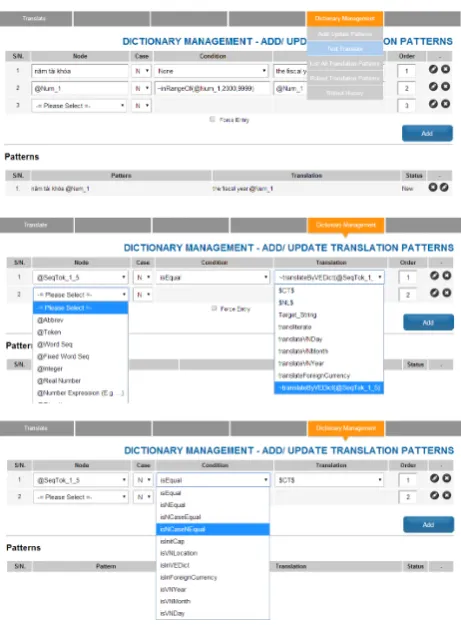
Our system framework is language independent and has been implemented on a Vietnamese to En-glish translation project. Figure 4 shows the RDL Management Screen where a user can add, mod-ify or delete a translation rule using RDL. A RDL rule can be created using nodes. Each node can be defined using string or system predefined meta-identifiers with or without meta-operators as de-scribed in Table 1. Based on the node type selected by the user, the system further restricts the user to appropriate conditions and translation functions. The user can define the order of the translation out-put of each node and at the same time, inform the system whether to use a specific RDL exclusively during decoding, in which any phrases from the baseline phrase table overlapping with that span will be ignored1. The system also provides an
edi-1Similar to Moses XML markup exclusive feature
http://www.statmt.org/moses/?n=Moses.
Figure 4: RDL Management screen with identi-fiers & meta-functions supported.
tor for expert users to code the rules using the RDL controlled language. Each rule is validated by the RDL parser (discussed in section 3.2), which will display errors or warning messages when an in-valid syntax is encountered.
5.2 RDL Rule Validation
Our decoder manages two types of phrase table. One is the static phrase-table obtained through the SMT training in parallel texts; the other is the dynamic table that comprises of the hypothe-ses generated on-the-fly during RDL rule match-ing. To ensure only fully tested rules are used in the production environment, the system supports two types of dynamic phrase table. The work-ing phrase-table holds the latest updates made by the users. The users can test the translation with these latest modifications using a specific transla-tion protocol. When users are satisfied with these modifications, they can perform an operation to upload the RDL rules to the production phrase-table, where the RDLs are used for all translation
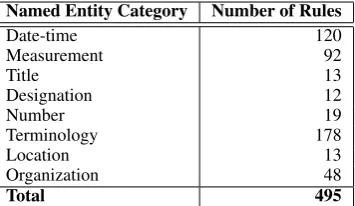
Named Entity Category Number of Rules
Date-time 120
Measurement 92
Title 13
Designation 12
Number 19
Terminology 178
Location 13
Organization 48
Total 495
Table 2: Statistics of created RDL rules for Vietnamese-to-English NE Translation.
requests. Uploaded rules can be deleted, modified and tested again in the working environment be-fore updated to the production environment. Fig-ure 5b and FigFig-ure 5c show the differences in trans-lation output before and after applied the RDL rule in Figure 5a.
6 A Case Study for Vietnamese−English Translation
We performed an experiment using the proposed RDL framework for a Vietnamese to English translation system. As named entity (NE) con-tributes to most of the OOV occurrences and im-pacts the system performance for out-of-domain test data in our system, we studied the NE usage in a large Vietnamese monolingual corpus com-prising 50M words to extract RDL rules. We cre-ated RDL rules for 8 popular NE types including title, designation, date-time, measurement, loca-tion, organizaloca-tion, number and terminology. We made use of a list of anchor words for each NE category and compiled our RDL rules based on these anchor words. As a result, we compiled a total of 495 rules for 8 categories and it took about 3 months for the rule creation. Table 2 shows the coverage of our compiled rules.
6.1 Experiment & Results
[image:5.595.308.542.58.311.2]Our experiments were performed on a training set of about 875K parallel sentences extracted from web news and revised by native linguists over 2 years. The corpus has 401K and 225K unique En-glish and Vietnamese tokens. We developed 1008 and 2548 parallel sentences, each with 4 refer-ences, for development and testing, respectively. All the reference sentences are created and revised by different native linguists at different times. We also trained a very large English language model using data from Gigaword, Europarl and English
Figure 5: Translation Demo with RDL rules.
Data Set nS nT nMR
TrainFull (VN) 875,579 28,251,775 627,125 TrainFull (EN) 875,579 20,191,526
-Test1 (VN) 1009 34,717 737
Test1 (4 refs) (EN) 1009 ≈25,713
-Test2 (VN) 1033 29,546 603
Test2 (4 refs) (EN) 1033 ≈22,717
-Test3 (VN) 506 16,817 344
Test3 (4 refs) (EN) 506 ≈12,601
-Dev (VN) 1008 34,803
-Dev (4 refs) (EN) 1008 ≈25,631
-Table 3: Statistics of Vietnamese-to-English paral-lel data. nS, nT, and nMR are number of sentence pairs and tokens, and count of matched rules, re-spectively.
web texts of Vietnamese authors to validate the impact of RDL rules on large-scale and domain-rich corpus. The experimental results show that created RDL rules improve the translation perfor-mance on all 3 test sets. Table 3 and Table 4 show respective data statistics and results of our evalua-tion. More specifically, the BLEU scores increase 3%, 3.6% and 1.4% on the three sets, respectively.
7 Conclusion
[image:5.595.94.272.62.165.2]fea-Data Set System BLEU NIST METEOR
[image:6.595.71.297.62.139.2]Set 1 Baseline 39.21 9.2323 37.81 +RDL (all) 39.51 9.2658 37.98 Set 2 Baseline 40.25 9.5174 38.24 +RDL (all) 40.61 9.6092 38.84 Set 3 Baseline 36.77 8.6953 37.65 +RDL (all) 36.91 8.7062 37.69
Table 4: Experimental results with RDL rules.
tures that go beyond the popular regular expres-sion framework. Without restricting the mark-up on the source text, we allow multiple translations to be specified for the same span or overlapping span.
Our experimental results show that RDL rules improve the overall performance of the Vietnamese-to-English translation system. The framework will be tested for other language pairs (e.g. Chinese-to-English, Malay-to-English) in the near future. We also plan to explore advanced methods to identify and score “good” dynamic hypotheses on-the-fly and integrate them into cur-rent SMT translation system (Simard and Foster, 2013).
Acknowledgments
We would like to thank the reviewers of the paper for their helpful comments.
References
Paul M. Sumita E. Arora, K. 2008. Translation of unknown words in phrase-based statistical ma-chine translation for languages of rich morphol-ogy. InIn Proceedings of the Workshop on Spoken Language Technologies for Under-Resourced
Lan-guages, SLTU 2008.
Sergio Barrachina, Oliver Bender, Francisco Casacu-berta, Jorge Civera, Elsa Cubel, Shahram Khadivi, Antonio Lagarda, Hermann Ney, Jes´us Tom´as, En-rique Vidal, and Juan-Miguel Vilar. 2009. Sta-tistical approaches to computer-assisted translation.
Comput. Linguist., 35(1):3–28, March.
Peter F. Brown, Vincent J. Della Pietra, Stephen A. Della Pietra, and Robert L. Mercer. 1993. The mathematics of statistical machine translation: Pa-rameter estimation. Comput. Linguist., 19(2):263– 311, June.
Jes´us Gonz´alez-Rubio, Daniel Ort´ız-Martinez, Jos´e-Miguel Bened´ı, and Francisco Casacuberta. 2013. Interactive machine translation using hierarchical translation models. InProceedings of the 2013 Con-ference on Empirical Methods in Natural Language
Processing, pages 244–254, Seattle, Washington,
USA, October.
Nizar Habash. 2008. Four techniques for online han-dling of out-of-vocabulary words in arabic-english statistical machine translation. In Proceedings of
ACL: Short Papers, HLT-Short ’08, pages 57–60,
Stroudsburg, PA, USA.
Philipp Koehn and Kevin Knight. 2000. Estimating word translation probabilities from unrelated mono-lingual corpora using the em algorithm. In Proceed-ings of the Seventeenth National Conference on Ar-tificial Intelligence and Twelfth Conference on Inno-vative Applications of Artificial Intelligence, pages 711–715. AAAI Press.
Tobias Kuhn. 2013. A survey and classification of con-trolled natural languages. Computational Linguis-tics.
VI Levenshtein. 1966. Binary codes capable of cor-recting deletions, insertions and reversals. Soviet Physics Doklady, 10:707.
Franz Josef Och and Hermann Ney. 2002. Discrim-inative training and maximum entropy models for statistical machine translation. InIn Proceedings of ACL, pages 295–302, Stroudsburg, PA, USA. Franz Josef Och and Hermann Ney. 2004. The
align-ment template approach to statistical machine trans-lation. Comput. Linguist., 30(4):417–449, Decem-ber.
Daniel Ortiz-Martinez, Ismael Garcia-Varea, and Fran-cisco Casacuberta. 2010. Online learning for inter-active statistical machine translation. InIn
Proceed-ings of NAACL, HLT ’10, pages 546–554,
Strouds-burg, PA, USA.
Daniel Ortiz-Mart´ınez, Luis A. Leiva, Vicent Alabau, Ismael Garc´ıa-Varea, and Francisco Casacuberta. 2011. An interactive machine translation system with online learning. In In Proceedings of ACL:
Systems Demonstrations, HLT ’11, pages 68–73,
Stroudsburg, PA, USA.
Michel Simard and George Foster. 2013. Pepr: Post-edit propagation using phrase-based statistical ma-chine translation. Proceedings of the XIV Machine
Translation Summit, pages 191–198.
Haifeng Wang, Hua Wu, Xiaoguang Hu, Zhanyi Liu, Jianfeng Li, Dengjun Ren, and Zhengyu Niu. 2008. The tch machine translation system for iwslt 2008.
InIn Proceedings of IWSLT 2008, Hawaii, USA.
Albrecht WoB, Markus Loberbauer, and Hanspeter Mossenbock. 2003. Ll(1) conflict resolution in a recursive descent compiler generator. In Modular
Programming Languages, volume 2789 ofLecture
Notes in Computer Science, pages 192–201.
![Figure 3: A linked item chain for a rule source(@a @b [c] [“d e”] [“f g h”] (“i” | “j k”)).](https://thumb-us.123doks.com/thumbv2/123dok_us/208468.519943/3.595.75.290.62.111/figure-linked-item-chain-rule-source-h-k.webp)