Head-Driven Hierarchical Phrase-based Translation
Junhui Li Zhaopeng Tu† Guodong Zhou‡ Josef van Genabith Centre for Next Generation Localisation
School of Computing, Dublin City University †Key Lab. of Intelligent Info. Processing
Institute of Computing Technology, Chinese Academy of Sciences ‡School of Computer Science and Technology
Soochow University, China
{jli,josef}@computing.dcu.ie
[email protected] [email protected]
Abstract
This paper presents an extension of Chi-ang’s hierarchical phrase-based (HPB) model, called Head-Driven HPB (HD-HPB), which incorporates head information in translation rules to better capture syntax-driven infor-mation, as well as improved reordering be-tween any two neighboring non-terminals at any stage of a derivation to explore a larger reordering search space. Experiments on Chinese-English translation on four NIST MT test sets show that the HD-HPB model signifi-cantly outperforms Chiang’s model with aver-age gains of 1.91 points absolute in BLEU.
1 Introduction
Chiang’s hierarchical phrase-based (HPB) transla-tion model utilizes synchronous context free gram-mar (SCFG) for translation derivation (Chiang, 2005; Chiang, 2007) and has been widely adopted in statistical machine translation (SMT). Typically, such models define two types of translation rules: hierarchical (translation) rules which consist of both terminals and non-terminals, and glue (grammar) rules which combine translated phrases in a mono-tone fashion. Due to lack of linguistic knowledge, Chiang’s HPB model contains only one type of non-terminal symbolX, often making it difficult to se-lect the most appropriate translation rules.1 What is more, Chiang’s HPB model suffers from limited phrase reordering combining translated phrases in a monotonic way with glue rules. In addition, once a
1
Another non-terminal symbolSis used in glue rules.
glue rule is adopted, it requires all rules above it to be glue rules.
One important research question is therefore how to refine the non-terminal categoryXusing linguis-tically motivated information: Zollmann and Venu-gopal (2006) (SAMT) e.g. use (partial) syntactic categories derived from CFG trees while Zollmann and Vogel (2011) use word tags, generated by ei-ther POS analysis or unsupervised word class in-duction. Almaghout et al. (2011) employ CCG-based supertags. Mylonakis and Sima’an (2011) use linguistic information of various granularities such asPhrase-Pair,Constituent,Concatenation of Con-stituents, and Partial Constituents, where applica-ble. Inspired by previous work in parsing (Char-niak, 2000; Collins, 2003), our Head-Driven HPB (HD-HPB) model is based on the intuition that lin-guistic heads provide important information about a constituent or distributionally defined fragment, as in HPB. We identify heads using linguistically mo-tivated dependency parsing, and use their POS to refineX. In addition HD-HPB provides flexible re-ordering rules freely mixing translation and reorder-ing (includreorder-ing swap) at any stage in a derivation.
Different from the soft constraint modeling adopted in (Chan et al., 2007; Marton and Resnik, 2008; Shen et al., 2009; He et al., 2010; Huang et al., 2010; Gao et al., 2011), our approach encodes syntactic information in translation rules. However, the two approaches are not mutually exclusive, as we could also include a set of syntax-driven features into our translation model. Our approach maintains the advantages of Chiang’s HPB model while at the same time incorporating head information and
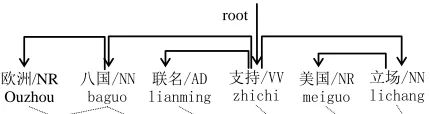
欧洲/NR Ouzhou
八国/NN baguo
联名/AD lianming
支持/VV
zhichi 美国/NR meiguo
立场/NN lichang
root
[image:2.612.82.297.60.117.2]Eight European countries jointly support America’s stand
Figure 1: An example word alignment for a Chinese-English sentence pair with the dependency parse tree for the Chinese sentence. Here, each Chinese word is at-tached with its POS tag and Pinyin.
ible reordering in a derivation in a natural way. Ex-periments on Chinese-English translation using four NIST MT test sets show that our HD-HPB model significantly outperforms Chiang’s HPB as well as a SAMT-style refined version of HPB.
2 Head-Driven HPB Translation Model
Like Chiang (2005) and Chiang (2007), our HD-HPB translation model adopts a synchronous con-text free grammar, a rewriting system which gen-erates source and target side string pairs simulta-neously using a context-free grammar. Instead of collapsing all non-terminals in the source language into a single symbolXas in Chiang (2007), given a word sequencefij from positionito positionj, we first findheadsand then concatenate the POS tags of these heads asfij’s non-terminal symbol. Specif-ically, we adopt unlabeled dependency structure to derive heads, which are defined as:
Definition 1. For word sequence fij, word
fk(i≤k ≤j) is regarded as a head if it is domi-nated by a word outside of this sequence.
Note that this definition (i) allows for a word se-quence to have one or more heads (largely due to the fact that a word sequence is not necessarily lin-guistically constrained) and (ii) ensures that heads are always the highest heads in the sequence from a dependency structure perspective. For example, the word sequenceouzhou baguo lianming in Figure 1 has two heads (i.e.,baguo andlianming, ouzhouis not a head of this sequence since its headwordbaguo
falls within this sequence) and the non-terminal cor-responding to the sequence is thus labeled as NN-AD. It is worth noting that in this paper we only refine non-terminalX on the source side to head-informed ones, while still usingXon the target side. According to the occurrence of terminals in
translation rules, we group rules in the HD-HPB model into two categories: head-driven hierarchical rules (HD-HRs) and non-terminal reordering rules (NRRs), where the former have at least one terminal on both source and target sides and the later have no terminals. For rule extraction, we first identify ini-tial phrase pairson word-aligned sentence pairs by using the same criterion as most phrase-based trans-lation models (Och and Ney, 2004) and Chiang’s HPB model (Chiang, 2005; Chiang, 2007). We extract HD-HRs and NRRs based on initial phrase pairs, respectively.
2.1 HD-HRs: Head-Driven Hierarchical Rules
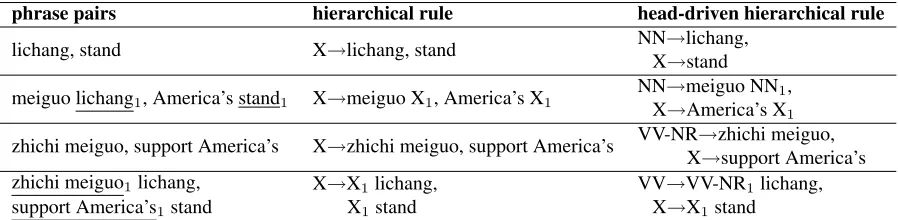
As mentioned, a HD-HR has at least one terminal on both source and target sides. This is the same as the hierarchical rules defined in Chiang’s HPB model (Chiang, 2007), except that we use head POS-informed non-terminal symbols in the source lan-guage. We look for initial phrase pairs that contain other phrases and then replace sub-phrases with POS tags corresponding to their heads. Given the word alignment in Figure 1, Table 1 demonstrates the dif-ference between hierarchical rules in Chiang (2007) and HD-HRs defined here.
Similar to Chiang’s HPB model, our HD-HPB model will result in a large number of rules causing problems in decoding. To alleviate these problems, we filter our HD-HRs according to the same con-straints as described in Chiang (2007). Moreover, we discard rules that have non-terminals with more than four heads.
2.2 NRRs: Non-terminal Reordering Rules
NRRs are translation rules without terminals. Given an initial phrase pair on the source side, there are four possible positional relationships for their target side translations (we use Y as a variable for non-terminals on the source side while all non-non-terminals on the target side are labeled asX):
• MonotonehY →Y1Y2, X→X1X2i;
• Discontinuous monotone
hY →Y1Y2, X→X1. . . X2i;
• SwaphY →Y1Y2, X→X2X1i;
• Discontinuous swap
phrase pairs hierarchical rule head-driven hierarchical rule
lichang, stand X→lichang, stand NN→lichang,
X→stand
meiguo lichang1, America’s stand1 X→meiguo X1, America’s X1
NN→meiguo NN1, X→America’s X1
zhichi meiguo, support America’s X→zhichi meiguo, support America’s VV-NR→zhichi meiguo, X→support America’s zhichi meiguo1lichang,
support America’s1stand
X→X1lichang, X1stand
[image:3.612.82.531.60.170.2]VV→VV-NR1lichang, X→X1stand
Table 1: Comparison of hierarchical rules in Chiang (2007) and HD-HRs. Indexed underlines indicate sub-phrases and corresponding non-terminal symbols. The non-terminals in HD-HRs (e.g., NN, VV, VV-NR) capture the head(s) POS tags of the corresponding word sequence in the source language.
Merging two neighboring non-terminals into a single non-terminal, NRRs enable the translation model to explore a wider search space. During train-ing, we extract four types of NRRs and calculate probabilities for each type. To speed up decoding, we currently (i) only use monotone and swap NRRs and (ii) limit the number of non-terminals in a NRR to 2.
2.3 Features and Decoding
Givenefor the translation output in the target lan-guage, s and t for strings of terminals and non-terminals on the source and target side, respectively, we use a feature set analogous to the default feature set of Chiang (2007), including:
• Phd-hr(t|s)andPhd-hr(s|t), translation
probabili-ties for HD-HRs;
• Plex(t|s)andPlex(s|t), lexical translation
proba-bilities for HD-HRs;
• P tyhd-hr=exp(−1), rule penalty for HD-HRs; • Pnrr(t|s), translation probability for NRRs; • P tynrr=exp(−1), rule penalty for NRRs; • Plm(e), language model;
• P tyword(e) =exp(−|e|), word penalty.
Our decoder is based on CKY-style chart parsing with beam search and searches for the best deriva-tion bottom-up. For a source span [i,j], it applies both types of HRs and NRRs. However, HD-HRs are only applied to generate derivations span-ning no more than K words – the initial phrase length limit used in training to extract HD-HRs – while NRRs are applied to derivations spanning any length. Unlike in Chiang’s HPB model, it is pos-sible for a non-terminal generated by a NRR to be included afterwards by a HD-HR or another NRR.
3 Experiments
We evaluate the performance of our HD-HPB model and compare it with our implementation of Chiang’s HPB model (Chiang, 2007), a source-side SAMT-style refined version of HPB (SAMT-HPB), and the Moses implementation of HPB. For fair compari-son, we adopt the same parameter settings for our HD-HPB and HPB systems, including initial phrase length (as 10) in training, the maximum number of non-terminals (as 2) in translation rules, maximum number of non-terminals plus terminals (as 5) on the source, beam thresholdβ (as 10−5) (to discard derivations with a score worse thanβtimes the best score in the same chart cell), beam sizeb(as 200) (i.e. each chart cell contains at mostbderivations). For Moses HPB, we use “grow-diag-final-and” to obtain symmetric word alignments, 10 for the max-imum phrase length, and the recommended default values for all other parameters.
We train our model on a dataset with ˜1.5M sen-tence pairs from the LDC dataset.2 We use the 2002 NIST MT evaluation test data (878 sentence pairs) as the development data, and the 2003, 2004, 2005, 2006-news NIST MT evaluation test data (919, 1788, 1082, and 616 sentence pairs, respec-tively) as the test data. To find heads, we parse the source sentences with the Berkeley Parser3 (Petrov and Klein, 2007) trained on Chinese TreeBank 6.0 and use the Penn2Malt toolkit4to obtain (unlabeled) dependency structures.
We obtain the word alignments by running
2
This dataset includes LDC2002E18, LDC2003E07, LDC2003E14, Hansards portion of LDC2004T07, LDC2004T08 and LDC2005T06
3http://code.google.com/p/berkeleyparser/ 4
GIZA++ (Och and Ney, 2000) on the corpus in both directions and applying “grow-diag-final-and” re-finement (Koehn et al., 2003). We use the SRI lan-guage modeling toolkit to train a 5-gram lanlan-guage model on the Xinhua portion of the Gigaword corpus and standard MERT (Och, 2003) to tune the feature weights on the development data.
For evaluation, the NIST BLEU script (version 12) with the default settings is used to calculate the BLEU scores. To test whether a performance differ-ence is statistically significant, we conduct signifi-cance tests following the paired bootstrap approach (Koehn, 2004). In this paper,‘**’and‘*’ de-notep-values less than 0.01 and in-between [0.01, 0.05), respectively.
Table 2 lists the rule table sizes. The full rule ta-ble size (including HRs and NRRs) of our HD-HPB model is ˜1.5 times that of Chiang’s, largely due to refining the non-terminal symbolX in Chi-ang’s model into head-informed ones in our model. It is also unsurprising, that the test set-filtered rule table size of our model is only ˜0.7 times that of Chi-ang’s: this is due to the fact that some of the refined translation rule patterns required by the test set are unattested in the training data. Furthermore, the rule table size of NRRs is much smaller than that of HD-HRs since a NRR contains only two non-terminals.
Table 3 lists the translation performance with BLEU scores. Note that our re-implementation of Chiang’s original HPB model performs on a par with Moses HPB. Table 3 shows that our HD-HPB model significantly outperforms Chiang’s HPB model with an average improvement of 1.91 in BLEU (and sim-ilar improvements over Moses HPB).
Table 3 shows that the head-driven scheme out-performs a SAMT-style approach (for each test set p <0.01), indicating that head information is more effective than (partial) CFG categories. Taking lian-ming zhichi in Figure 1 as an example, HD-HPB labels the span VV, as lianming is dominated by
zhichi, effecively ignoring lianming in the transla-tion rule, while the SAMT label isADVP:AD+VV5
which is more susceptible to data sparsity. In addi-tion, SAMT resorts toXif a text span fails to satisify pre-defined categories. Examining initial phrases
5
the constituency structure forlianming zhichiis(VP (ADVP (AD lianming)) (VP (VV zhichi) ...)).
System Total MT 03 MT 04 MT 05 MT 06 Avg.
HPB 39.6 2.8 4.7 3.3 3.0 3.4
HD-HPB 59.5/0.6 1.9/0.1 3.4/0.2 2.3/0.2 2.0/0.1 2.4/0.2 Table 2: Rule table sizes (in million) of different mod-els. Note: 1) For HD-HPB, the rule sizes separated by / indicate HD-HRs and NRRs, respectively; 2) Except for “Total”, the figures correspond to rules filtered on the cor-responding test set.
System MT 03 MT 04 MT 05 MT 06 Avg. Moses HPB 32.94* 35.16 32.18 29.88* 32.54 HPB 33.59 35.39 32.20 30.60 32.95 HD-HPB 35.50** 37.61** 34.56** 31.78** 34.86 SAMT-HPB 34.07 36.52** 32.90* 30.66 33.54 HD-HR+Glue 34.58** 36.55** 33.84** 31.06 34.01 Table 3: BLEU (%) scores of different models. Note: 1) SAMT-HPB indicates our HD-HPB model with non-terminal scheme of Zollmann and Venugopal (2006); 2) HD-HR+Glue indicates our HD-HPB model replac-ing NRRs with glue rules; 3) Significance tests for Moses HPB, HD-HPB, SAMT-HPB, and HD-HR+Glue are done against HPB.
extracted from the SAMT training data shows that 28% of them are labeled asX.
In order to separate out the individual contribu-tions of the novel HD-HRs and NRRs, we carry out an additional experiment (HR+Glue) using HD-HRs with monotonic glue rules only (adjusted to re-fined rule labels, but effectively switching off the ex-tra reordering power of full NRRs). Table 3 shows that on average more than half of the improvement over HPB (Chiang and Moses) comes from the re-fined HD-HRs, the rest from NRRs.
Examining translation rules extracted from the training data shows that there are 72,366 types of non-terminals with respect to 33 types of POS tags. On average each sentence employs 16.6/5.2 HD-HRs/NRRs in our HD-HPB model, compared to 15.9/3.6 hierarchical rules/glue rules in Chiang’s model, providing further indication of the impor-tance of NRRs in translation.
4 Conclusion
ad-dition, improved and better integrated reordering rules allow better reordering between consecutive non-terminals through exploration of a larger search space in the derivation. Experimental results on Chinese-English translation across four test sets demonstrate significant improvements of the HD-HPB model over both Chiang’s HD-HPB and a source-side SAMT-style refined version of HPB.
Acknowledgments
This work was supported by Science Foundation Ire-land (Grant No. 07/CE/I1142) as part of the Cen-tre for Next Generation Localisation (www.cngl.ie) at Dublin City University. It was also partially supported by Project 90920004 under the National Natural Science Foundation of China and Project 2012AA011102 under the “863” National High-Tech Research and Development of China. We thank the reviewers for their insightful comments.
References
Hala Almaghout, Jie Jiang, and Andy Way. 2011. CCG contextual labels in hierarchical phrase-based SMT. In Proceedings of EAMT 2011, pages 281–288.
Yee Seng Chan, Hwee Tou Ng, and David Chiang. 2007. Word sense disambiguation improves statistical ma-chine translation. InProceedings of ACL 2007, pages 33–40.
Eugene Charniak. 2000. A maximum-entropy-inspired parser. InProceedings of NAACL 2000, pages 132– 139.
David Chiang. 2005. A hierarchical phrase-based model for statistical machine translation. InProceedings of ACL 2005, pages 263–270.
David Chiang. 2007. Hierarchical phrase-based transla-tion.Computational Linguistics, 33(2):201–228. Michael Collins. 2003. Head-driven statistical models
for natural language parsing. Computational Linguis-tics, 29(4):589–637.
Yang Gao, Philipp Koehn, and Alexandra Birch. 2011. Soft dependency constraints for reordering in hierar-chical phrase-based translation. In Proceedings of EMNLP 2011, pages 857–868.
Zhongjun He, Yao Meng, and Hao Yu. 2010. Maxi-mum entropy based phrase reordering for hierarchical phrase-based translation. InProceedings of EMNLP 2010, pages 555–563.
Zhongqiang Huang, Martin Cmejrek, and Bowen Zhou. 2010. Soft syntactic constraints for hierarchical
phrase-based translation using latent syntactic distri-butions. InProceedings of EMNLP 2010, pages 138– 147.
Philipp Koehn, Franz Josef Och, and Daniel Marcu. 2003. Statistical phrase-based translation. In Proceed-ings of NAACL 2003, pages 48–54.
Philipp Koehn. 2004. Statistical significance tests for machine translation evaluation. In Proceedings of EMNLP 2004, pages 388–395.
Yuval Marton and Philip Resnik. 2008. Soft syntactic constraints for hierarchical phrased-based translation. InProceedings of ACL-HLT 2008, pages 1003–1011. Markos Mylonakis and Khalil Sima’an. 2011. Learning
hierarchical translation structure with linguistic anno-tations. InProceedings of ACL-HLT 2011, pages 642– 652.
Franz Josef Och and Hermann Ney. 2000. Improved statistical alignment models. InProceedings of ACL 2000, pages 440–447.
Franz Josef Och and Hermann Ney. 2004. The align-ment template approach to statistical machine transla-tion.Computational Linguistics, 30(4):417–449. Franz Josef Och. 2003. Minimum error rate training in
statistical machine translation. InProceedings of ACL 2003, pages 160–167.
Slav Petrov and Dan Klein. 2007. Improved inference for unlexicalized parsing. InProceedings of NAACL 2007, pages 404–411.
Libin Shen, Jinxi Xu, Bing Zhang, Spyros Matsoukas, and Ralph Weischedel. 2009. Effective use of linguis-tic and contextual information for statislinguis-tical machine translation. InProceedings of EMNLP 2009, pages 72–80.
Andreas Zollmann and Ashish Venugopal. 2006. Syntax augmented machine translation via chart parsing. In Proceedings of NAACL 2006 - Workshop on Statistical Machine Translation, pages 138–141.