Munich Personal RePEc Archive
Leading the Diffusion of Intellectual
Capital Management Practices in Science
Parks
Khavandkar, Ehsan and Theodorakopoulos, Nicholas and
Hart, Mark and Preston, Jude
Aston Business School, Aston University, Aston Business School,
Aston University, Aston Business School, Aston University, Aston
Business School, Aston University
4 January 2015
Online at
https://mpra.ub.uni-muenchen.de/82115/
Leading the Diffusion of
Intellectual Capital Management
Practices in Science Parks
Ehsan Khavandkar, Nicholas Theodorakopoulos, Mark Hart and
Jude Preston
Introduction
This chapter discusses how leadership interventions in science parks can promote the diffusion of intellectual capital management (ICM) prac- tices. It focuses on how operationalisation of the different social interac- tions leads to the accommodation of suitable mechanisms for diffusion of those practices associated with ICM among tenants of science parks, under the theoretical notion of the ecosystem.
This issue is becoming important in small and medium sized enter- prises (SMEs), as intellectual capital is likely to be the key source of competitive advantage (European Commission, 2006; Huggins & Weir, 2012). SMEs generally have advantages over established companies in terms of learning (Davenport, 2005; Lee et al., 2010). In order to prevent science parks from becoming just real estate brokerage entities, managers and policy makers need to undertake a range of boundary- spanning activities to optimise the mobility of intangible and tangible knowledge and resources. This notion reflects the fact that science park management could, and should, harness ideas for strategic change when
they seek to unleash an SME’s entrepreneurial potential. This chapter
explores the ways in which leadership interventions in science park
ecosystems may orchestrate tenants’ management insight and strategic
This chapter is useful to the directors and CEOs of science parks for four primary reasons: first, to clarify the relationships between the science park and its key players; second, to build an understanding of the different social mechanisms for diffusion of intellectual capital manage- ment practices; third, to understand the cognitive patterns in possible adaptation preferences and conditions within SMEs; and fourth, to educate managers about the types and roles of external agents’ involve- ments in the diffusion of ICM practices.
The science park: an ecosystem of ecosystems
One may doubt whether science parks qualify as ecosystems within the conventional sense and usage of the terms, such as ‘business ecosystem’ or
‘knowledgeecosystem’ or ‘innovationecosystem’. For example, in many cases the concept of the science park does not fit well into the context of a knowledge, innovation or business ecosystem. In other instances, the stated missions and objectives do not mirror the roles generally expected to be played by the management of such ecosystems, such as that of anchor tenant (Agrawal & Cockburn, 2003), ecosystem orchestrator (Dhanaraj & Parkhe, 2006) or keystone (Iansiti & Levien, 2004).
It is worth noting that while each of these exemplars differs in its initial growth impetus, frontier researchers have commonly drawn on the clustering and geographical agglomeration literature to describe and discuss their factors of success. While this has provided a simple and widely used analytical framework in which the topical and emergent issues of economic geography and the institutional aspects of science parks are addressed, it is limited in its usefulness for exploring the func- tional form of the science park. As a result, over-attributing the success of onsite firms only to the physical configuration of science parks, espe- cially in the case of SMEs, rather than acknowledging the integrative leadership competency of science park management in brokering coop- erative, collaborative and coopetitive interactions has caused much confusion. Further, by assuming a limited role of the management of science parks as a being just that of real estate agent, it then becomes the argument that the sole role of the management team is one of managing the relationships between investors, and whilst this is clearly not the case, this definition of the management team has sometimes resulted in tenant selection criteria being inappropriately relaxed, to create greater levels of income for the park (Westhead, 1997).
‘in the commercialisation process and the linking of science park firms
with Higher Education Institutions, other tenants on the park, as well as firms located off-park, [the quality of managerial intermediaries] needs to be carefully monitored’ (Siegel et al., 2003: 181), since onsite firms
may also ‘seek access to assets that are complementary to their human and social capital’ (Wright et al., 2008: 132).
Here we argue that the science park is more than just a geograph- ical position of agglomerated firms. Drawing on the concept of the ecosystem and the ecology of strategic alliances (Iansiti & Levien, 2004; Zahra & Nambisan, 2012), we define the park ecosystem as a geograph- ical concentration of knowledge-intensive firms from different sectors which exploit market opportunities based on innovation architectures provided by dominant firms in their parent ecosystems, or pursue new value-adding knowledge combinations in the interests of their own independent innovation architectures and in the meantime, may form a community of strategic interests, values and webs of relations with each other, or with other stakeholders in the science park ecosystem. The living life of the ecosystem also stimulates specialisation and co-evolution by supporting and facilitating the diffusion of knowledge, ideas, innovation, technologies, skills and management practices, and access to tangible and intangible resources.
The importance of intellectual capital for SMEs located in science parks ecosystems
The evolving role of science parks, as enablers in inter-organisational relationships, is evidenced in the findings of extant research into the dynamics of interactions between tenants (Corsaro et al., 2012; Löfsten & Lindelöf, 2003; Siegel et al., 2003; Westhead, 1997). In this sense, tenants and stakeholders may be seen as partners, customers and competitors who are cooperatively, collaboratively or coopetitively linked through a non- linear set of activities and interactions. Under such networked configura- tions, knowledge can be communicated, organised and conveyed, and the ecosystem facilitates both the creation of new knowledge and opti- mises the ways in which agents share and apply the knowledge gener- ated. In SMEs, particularly high-tech SMEs located in science parks, the fundamental resources of the firm are its knowledge and technology base (Khavandkar et al., 2013). This thinking is in keeping with the
traditional view that SMEs ‘benefit from collaborative knowledge-based activities within geographic regions, which is based on the presumption that it is easier to mobilise the complementary resources and capabilities
It is generally argued that intellectual capital is likely to be the key source of sustainable competitive advantage for SMEs; a developed stock of intellectual capital enhances the ability of SMEs to apply existing and generate further knowledge for advancing and commercialising innovative technology (European Commission, 2006; Huggins & Weir, 2012). Intellectual capital management should therefore be regarded as an on-going and dynamic process, which constantly matches market demand. Considering the tacitness and spatial stickiness of managerial know-how, close proximity is necessary for knowledge flow between actors. Science parks by their very nature provide opportunities for local knowledge dissemination, and the networking opportunities they offer become critical sources for the development of shared ‘know-how’ and effective practice sharing between onsite SMEs. Therefore, science parks may promote co-specialisation between SMEs and other tenants, and consequently may also enhance the opportunities for improving intel- lectual capital management capabilities. In this way, science parks can
be regarded as ‘networks of opportunities’, stimulating interconnected- ness and co-evolution by facilitating the diffusion of knowledge, inno- vation and management practices.
Effective diffusion of novel practice is dependent on creating heter-
ogeneity between the new practice and a potential adopter’s current
practice. Further, in any attempt to increase diffusion of ICM practice, demonstrating the compatibility between the new practices and the strategic, technical and cultural objectives of the organisation is para- mount, as is the use of an interpretive approach to encourage imitative behaviour, and linking success stories and cultural discourse as forms of legitimisation of the new methods (Ansari et al., 2010).
Intellectual capital management practices
The four inter-related practices of intellectual capital management
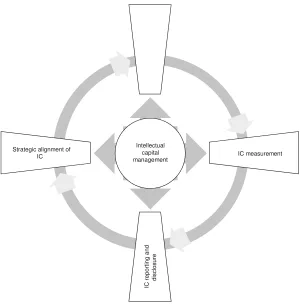
Creating, shaping and updating the stock of intellectual capital requires the formulation of a strategic vision, which blends together all three dimensions of intellectual capital within the organisational context through exploration and exploitation, measurement and disclosure. The organisational value of intellectual capital is developed via an on-going and emergent process focused on the capability to leverage, develop and change the dimensions (Subramaniam & Youndt, 2005). Yet a research gap exists in this area requiring further studies that focus on managerial issues of intellectual capital in SMEs. We conceptualise the management of intellectual capital as occurring via a multiple stage process, governed by an evolutionary logic. In Figure 14.1 we illustrate ICM as a cycle of four inter-related sets of practices: strategic alignment, exploration and exploitation, measurement and reporting of intellectual capitals (Khavandkar et al., 2013):
Figure 14.1 The general framework for intellectual capital management in SMEs
IC
e
x
p
lo
ra
tio
n
a
n
d
e
x
p
lo
ita
tio
n
Strategic alignment of IC
Intellectual capital management
IC measurement
IC
r
e
p
o
rt
in
g
a
n
d
d
is
cl
o
su
[image:6.397.51.351.253.557.2]● Intellectual capital exploration and exploitation practices are defined
as ‘the capabilities of SMEs required in order to effectively utilise
their human, relational and structural capital, and efficiently exploit the relevant external sources of intellectual capital to create added
value’.
● Intellectual capital measurement practices are defined as ‘managerial
initiatives intended to translate an SME’s internal hidden values to sets of tangible indices and communicate non-financial and financial factors in order to make them understandable to the market’.
● Intellectual capital reporting and disclosure practices are defined as
‘managerial initiatives intended to bridge the common information asymmetries between main interest groups and SMEs about hidden values of intellectual capital, and can be tailored to satisfy various information needs’.
● Strategic alignment of intellectual capital practices are defined as ‘a
set of practices by which an SME understands the value of its intel- lectual capital in both the industry and ecosystem context, defines its intellectual capital management vision and objectives, and commu-
nicates them at the strategy formulation level’ (Khavandkar et al., 2013; Khavandkar, 2013).
Science parks, leadership interventions and adaptation considerations in SMEs
Apart from general considerations, having foresight and being predictive about post-adoption patterns offer a considerable insight into making ICM practices meaningful and suitable for onsite SMEs in science parks. Ansari et al. (2010: 71) define the post-adoption considerations, or
adaptation behaviours, as ‘the process by which an adopter strives to
create a better fit between an external practice and the adopter’s partic-
ular needs to increase its zone of acceptance during implementation’.
Therefore, the degrees of technical, cultural and strategic fit between an adopted practice and organisational pre-assumptions determine both the magnitude and fidelity of adoption in the implementation phase.
Commonly, a set of adopted practices is not a ‘stand-alone’ solution in its initial configuration; rather, it depends on accompanying changes in
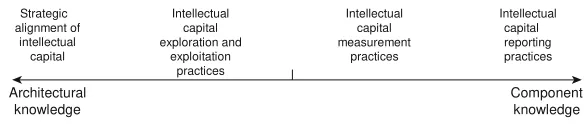
degree of ‘transferability’ of these practices. Henderson and Clark (1990) identify two types of knowledge, with regard to the degree of tacitness and explicitness inherited with organisational routines, namely compo- nent and architectural knowledge. Tallman et al. (2004) refer to these types of knowledge in clusters. While some ICM practices are generally more transferable to the informed SMEs, or in other words belong to the category of component knowledge (e.g. ICM reporting and disclosure practices), others are highly organisation-specific and less transferable, and belong to the category of architectural knowledge (e.g. practices regarding the strategic alignment of intellectual capital).
Whilst understanding the concepts of component and architectural knowledge, it is also important to determine whether a set of diffusing practices is potentially includable within the component knowledge store of an SME, or whether it needs to be processed or wholly developed in-house and stored at architectural level. In general, based on various degrees of path dependency in different types of knowledge, it can be said that those practices related to the reporting competency of ICM belong to the category of component knowledge. On the other end of the continuum, those practices related to strategic alignment of ICM belong to the architectural knowledge domain (Figure 14.2).
The influencing shapers of intellectual capital management practice diffusion
As Haeussler et al. (2012: 219) argue, success in gaining knowledge
usually ‘depends on the firm’s ability to identify and acquire knowl- edge from partners as well as understand and apply this knowledge for
its own use’. Just as for the diffusion process for other practices, the
necessity of adopting a set of intellectual capital management practices is always driven by either a growing pressure for social conformity, an imperative economic benefit, or both (Khavandkar, 2013). Greater inti- macy with their external knowledge bases and their sources of diffusion is more commonly found in SMEs rather than their larger rivals. In order
Strategic alignment of
intellectual capital
Architectural knowledge
Intellectual capital exploration and
exploitation practices
Intellectual capital measurement
practices
Intellectual capital reporting practices
Component knowledge
Figure 14.2 Intellectual capital management practices and the knowledge path-
[image:8.397.53.345.463.527.2]for the adoption of diffusing practices to follow an incremental trajec- tory in SMEs there is an increased prerequisite for relational depend- ency in order for the necessary skills and capabilities to be developed, particularly in the face of the ambiguity and complexity inherent in the practices themselves and because of the scarcity of in-house managerial resources and competencies to identify and integrate the adopted prac- tices. Therefore, apart from the endogenous factors, it is reasonable that variable exogenous agents and transmission mechanisms involved in the process also engender different fit-adjustment requirements.
The first step is to examine and analyse the repertoire of participa- tion characteristics of different stakeholders, which can co-create these
‘soft relational rents’. In general, there are five main exogenous agents:
ownership and controlling agents, contributing agents (current or poten- tial future contributors), knowledge-sharing agents (active or potential future knowledge sharers), participating agents (continuous or infrequent participants) and using agents (current or potential future users). These may all act directly or indirectly as driving forces for SMEs in the science park ecosystem. However, the objectives and impacts of each of these stakeholders may differ considerably, and the benefits to be gained from each type depends on the presence of these driving forces, which are in turn associated with types and the characteristics of a particular science park ecosystem. In general, the shape of the demanded ICM practices may be governed by the type of stakeholder in the process (Khavandkar et al., 2013), which might include governments, the managers, owners and shareholders in the science park itself, onsite incubators and inno- vation centres, knowledge stakeholders such as universities and research institutes, financial institutions and investors, intermediaries, suppliers and service providers in the supply chain. In terms of size, these may be multinationals and large companies, or SMEs and start-ups, as well as
members of tenants’ parent ecosystems, and organisational types might
include alliances, customers, rivals or even the local community. Different mechanisms may also provide onsite SMEs variation in access to a selection of ICM practice sources, leading to spontaneous or deliberate adoption, or indeed, rejection. Clearly, understanding these mechanisms of interaction would facilitate the rational develop- ment of new and more effective diffusion strategies in the science park ecosystem.
Channels of intellectual capital practice diffusion
coopetitive mechanisms in the science park ecosystem. The vertical upstream drivers of diffusing practices (i.e. where favoured practices
diffuse downwards from those organisations upstream in the SME’s
value chain, such as government, financial institutions, universities) generally occur through formal social mechanisms and channels. When vertical upstream interactions do occur, they are usually cost- effective ways of attenuating the complexity and pressure towards social conformity that may emerge from a competitive environment. Within the science park ecosystem, SMEs exhibit a strong desire to appear legitimate in their practices and organisational arrangements, and to commit more time, resources and energy to learning. Consequently, this results in a higher degree of conformity to the original prototyp- ical practices during the adaptation process. Therefore, once adequate information about the diffusing practices has been obtained from the upstream organisation, there is then a general tendency towards wishing to gain legitimacy, coupled with the social pressures brought to bear by
the SME’s stakeholders, and these stimulate the ‘pious’ implementa- tion of diffusing practices with higher levels of fidelity and extensive- ness (Ansari et al., 2010). The vertical upstream agents (either first or second order) – because of their abilities in generalising experiences are important sources for obtaining specialised knowledge (Haeussler et al.,
2012), and ‘are proactive in creating interest in, influencing the devel- opment of, and legitimising the effectiveness and retention of new
management practices’ (Birkinshaw et al., 2008: 832) such as how to
prepare intellectual capital statements, how to communicate financial and non-financial measures.
Learning by the observation of external best practices can take place during collaborative interactions. In the context of science park ecosystem, this type of interaction usually includes relationships with multinationals and large established companies. In this case, adoption of the diffusing practices occurs generally when SMEs tend to obtain rele- vant experience from the established companies operating downstream to the SME in their value chain, or via some form of training. External experience, according to Mol and Birkinshaw, (2014: 1291–1292), ‘could act both as a source of ideas, when internal change agents reapply prac-
tices they know from elsewhere’. For example, in the context of intel- lectual capital management practices in SMEs, this may include external experience on how to measure ICM, how to apply measurement models and which sets of measures to be used in order to improve the compa-
help SMEs to avoid making duplicative investments on in-house devel- opment of know-how that may not pay off.
A further type of interactions may be observed in the horizontal phenomenon of simultaneous cooperation and competition –‘coopeti-
tion’, which may be between SMEs and other similar onsite firms, or in
their parent ecosystems. Although these types of relationships between tenants may seem logical and obvious, the coopetition culture has still not received the required attention as a driving force for co-evolution of tenants in the science park ecosystem. Similarly, less attention has been paid to the role of coopetition in strengthening the innovation efforts and providing opportunities for diffusion of new and complementary knowledge in tenants, in particular SMEs. Consequently, the majority of
the tenants’ distribution is usually concentrated at the competition end,
rather than the mid-point of coopetition. There may be only handful of tenants observable as operating at the cooperation (mainly between alliances, if any) end, and when intensive interactions do occur between competing similar tenants through informal channels, the coopeti- tion morphs into one of the main motives for the ‘competition for
competence’.
When this happens, tenants may use this opportunity proactively to learn and expropriate as much as knowledge as possible in order to enhance their expertise. The externally sourced knowledge obtained in this way, as Mol and Birkinshaw (2014: 1291) argue, ‘either takes the form of outside examples that are partially transferable to an organi- sation, or of more abstract principles that are accepted by the organi-
sation’. For example, in the case of ICM practices this might include knowledge about how to run a flexible human resource development programme, or how to acquire and leverage knowledge from internal and external sources and experiences, or how ownership of intellectual property rights can be proven, enforced and transferred by a firm and so on.
High
Full and True adaptation
Domain of IC exploration and
exploitation
Domain of IC reporting
Low Extensiveness
High
Domain of IC Measurement
Distant adaptation
Domain of strategic alignment of IC
Low Tailored
[image:12.397.55.350.148.504.2]Adaptation Diffusion of intellectual capital management practice in the science park ecosystem
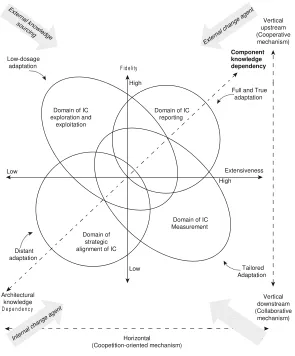
Figure 14.3 suggests there is a predictable dimensional variability in the adaptation of ICM practices, driven by diffusion kinetics, in the science park ecosystem. The first dimension (X-axis), extensiveness, is the extent to which an adapted intellectual capital management practice
Low-dosage
adaptation F id e lity
Vertical upstream (Cooperative mechanism)
Component knowledge dependency
Architectural knowledge D e p e n d e n c y
Vertical downstream (Collaborative
mechanism)
Horizontal (Coopetition-oriented mechanism)
Figure 14.3 Dimensions of intellectual capital management practice variability
and adaptation in onsite SMEs
may depart from the scale of the original diffusing practice. The second dimension (Y-axis), fidelity, shows the scope and the meaning of an adapted ICM practice compared to the scope of the original diffusing practice. The third dimension (Z-axis) represents the position of each set of practices on the knowledge continuum. These dimensions are important because they can describe the linkages between the inherent characteristics of intellectual capital management practices, and the effectiveness of possible leadership intervention modes.
Since volunteerism is part of every business ecosystem (Moore, 2006), the two dimensions of extensiveness and fidelity can be identified as being cognitive predictors for various scenarios of ICM practice adop- tion in onsite SMEs (Ansari et al., 2010), while the third dimension – as an indicator of diffusion efficiency – explains the path dependency of the four sets of practices.
Each exogenous factor has a unique mechanism of action in diffusion of ICM practices in the science park ecosystem. Therefore, in line with Ansari et al. (2010), we define four different cognitive patterns, each of which predicts an onsite SME’s decisions in the adaption of different sets of ICM practices: full and true adaptation, tailored adaptation, low- dosage adaptation and distant adaptation.
Domain 1: Intellectual capital reporting practice and adoption considerations in SMEs
Here, external change agents, for example, government and financial institutions, are characterised either as driving forces for the legitimisa- tion of intellectual capital reporting, or in a more direct fashion; they may even become involved by setting benchmarks, rules and objectives. Therefore, issues of strategising and brokering relationships between different stakeholder groups open new avenues for initiating leadership interventions by the management of science parks; these interventions should focus on balancing interest groups’ values through an integrated ICM platform.
There are, however, two major points to be made about the possible leadership interventions. The first point is about the establishment of the political standpoint of ICM within the organisation; when there is a high level of uncertainty surrounding a set of diffusing practices, widening the zone of acceptance becomes difficult. This leads to two possibilities: rejection, or full adaptation of the diffusing intellectual capital reporting practices. In order to optimise full adaptation, leadership interventions need to be accompanied by a measure of political campaigning and the use of potent cultural artefacts to promote acceptance (Moore, 2006). The second point is about the ability of the science park management to envision the ways in which passive external change agents can also create a crowding effect in order to provide greater acceptance of novel intellectual capital reporting practices among SMEs.
Of perhaps greater importance, this may also lead to the emergence of newer versions of reporting practice, which better accommodate
various stakeholder and SMEs’ interests, for example tailored intellec- tual capital reports and management commentary. Moreover, different forms of external involvement, through different social mechanisms, can mutually substitute to create interest and legitimise the adoption of intellectual capital reporting practices in the science park ecosystem. This can ease the emergence of alternative routes for both tailored and low-dosage adaptation in SMEs, although these modes may themselves impose both a technical and a cultural misfit on the organisations.
reporting platform, but they may be able, by contextualisation, to mimic qualities that allow them to determine the required scope and scale of intellectual capital reports. Once intellectual capital reporting practices reach full maturity in the science park ecosystem, the complexity of the relevant practices decreases, thus allowing SMEs to more effectively focus on internal standards, to screen potential interest groups and explore their intellectual capital. Therefore, by supporting the development of park-level knowledge of intellectual capital reporting, the manage- ment of a science park can also further enhance the process of accessing, acquiring and assembling those capabilities required for mastering other ICM practices.
Domain 2: Intellectual capital measurement practice and adoption considerations in SMEs
The domain of intellectual capital measurement practices in SMEs, placed on the bottom right corner (Figure 14.3), is characterised by high level of extensiveness, but low fidelity in practice adaptation. In general, SMEs tend to adopt more informal approach in performance measure- ment, which is exacerbated by the fact that almost all intellectual capital measurement frameworks are based on large enterprise models, and the complexity of the measurement methods poses a significant risk of incompatibility between the cultural characteristics of the diffusing practice and those of the organisational culture of the SMEs. These chal- lenges decrease the chance of successful adoption of intellectual capital measurement practices in horizontal mechanisms, where external knowledge is basically in abstract forms, and not fully transferable.
Coopetition-oriented interactions though may still provide some insights about the measurement processes in similar firms, but the limited scope and scale of current practices in SMEs increase the risk of misinterpretation. More importantly, external knowledge sourced through coopetition is devoid of any experimentation and legitimisa- tion characters, which are critical for successful implementation of intel- lectual capital measurement practices in SMEs. On the other hand, both
external change agents’ involvement and external experience can posi- tively affect the process of adaptation in SMEs. However, due to the lack of financial resources in SMEs, assumptions about the feasibility of such
Adopting intellectual capital measurement practices is a necessary prerequisite for preparing intellectual capital reports. The process, though, also seems a popular vehicle for vertical downstream mecha- nisms; gaining access to the complementary capabilities through vertical downstream interactions in the science parks ecosystems is more doable, and experience gained through vertical downstream interactions, in
particular with established external firms, can reduce SMEs’ tendency
to experiment with intellectual capital measurement practices, and later helps SME to achieve better contextualisation of the measurement requirements to its local needs. However, to avoid any ambiguity of the measurement objectives and interconnectedness among financial and non-financial measures, it is generally expected that SMEs will adapt those diffusing intellectual capital measurement practices with lower fidelity. Conversely, aggressive growth ambitions among SMEs push them towards more extensiveness adaptation of the practices.
Leadership interventions are associated with interconnectedness and co-evolution strategies; leadership initiatives are aimed at connecting different firms located within the science parks ecosystem and creating communal identity. As Tallman et al. (2004) argue, it is expected that the communal identity can also bring sustained competitive advantages to tenants, by restricting the movement of component knowledge out of the science park and providing a unique common base of know-how for the application of intellectual capital practices. In this sense, the management of science parks should place emphasis on reducing the transaction costs of knowledge interactions thus reducing the risk in appraising the reliability of potential collaborators. By providing more systemic intermediaries, which promote the perceptual usefulness of establishing and maintaining formal and informal inter-firm relation- ships between established firms and SMEs, the quality of the collabora- tive outcome of the diffusion of ICM practices can be better assured.
Domain 3: Intellectual capital exploration and exploitation practices and adoption considerations
measurement practices, while it is initially absent during the diffusion of exploration and exploitation practices in SMEs.
Moreover, different components of intellectual capital are utilised via different approaches in SMEs. Consequently intellectual capital explora- tion and exploitation practices, which are being put to work in order to organise stocks of intellectual capital, similarly vary. Furthermore, archi- tectural knowledge as embodied in complex managerial practices and built on experience tends to be unique and difficult to imitate. These issues increase uncertainty surrounding the exploration and exploita- tion practices, and therefore force SMEs to adapt high-fidelity versions of exploration and exploitation practices.
Horizontal coopetitive interactions between similar SMEs intensify the potential for ‘first-mover advantage’ among SMEs and motivate them to enrich their own knowledge from the competitive environment. The coopetition mechanisms provide a critical source for external knowledge sourcing when access to required expertise is otherwise limited through both vertical upstream and downstream. However, due to the fact that externally sourced knowledge is only partially transferable in coopeti- tive interactions, SMEs tend to less extensive adaptation of diffusing practices. In the science park business ecosystem, where a majority of tenants are high-tech SMEs, the scope and scale of adopted practices are often highly similar. In general, the management of science parks can increase the identity connectedness and receptiveness to know-how of intellectual capital exploration and exploitation by acting as a conduit among tenants, in particular among SMEs, and by providing opportu- nities for informal contacts between them. There is also the possibility that later in the diffusion process, conformity pressures also arise, and that in response SMEs commonly adapt intellectual capital exploration and exploitation practices.
Domain 4: Strategic alignment of intellectual capital management practices
management initiatives should be aligned strategically with the organ- isational philosophy.
From the demand perspective, the availability of information about ICM practices in a science park ecosystem can act as a key mechanism, influencing strategic alignment of ICM efforts in SMEs. Higher degrees of awareness and specialisation in general ICM practices can act as a key organisational contingency that later influences the strategic align- ment of intellectual capital measurement. The key challenge for SMEs, however, is to strike a balance between their organisational strategies and business objectives, and their intellectual reporting standards and targets. Moreover, given the rapid pace of change, these have to be continuously updated and recalibrated. Therefore, to attain maximum benefit from the adaptation of ICM practices in SMEs, these practices need to be designed, integrated and carried out in accordance with an
SME’s business strategy. There is no doubt that by creating strong link-
ages between a firm’s strategy, resources, stakeholders and operational
functions, implementation of their ICM strategy is expedited by the complementary and vibrant actions of internal agents. However, the external environment is generally accepted as the driver of, and provides the rationale for, ICM in SMEs.
Summary
Both endogenous and exogenous push factors are involved in the diffusion of ICM practices. Adaptation decisions are normal reactions to overcome possible technical, cultural or strategic incompatibilities between a set of adopted/intended practices and the characteristics of an adopting organisation. These may enforce different degrees of fidelity and/or extensiveness during the implementation of diffusing practices compared to their prototypical versions Therefore, in order to make predictions about different adaptation patterns of intellectual capital management practices in onsite SMEs, or even building a persuasive desire for diffusing of these practices, it is necessary to understand not only the demand side of the diffusion process, but the supply side as well.
References
Agrawal, A. & Cockburn, I. (2003) The Anchor Tenant Hypothesis: Exploring the Role of Large, Local, R&D-Intensive Firms in Regional Innovation Systems.
Ansari, S. M., Fiss, P. C. & Zajac, E. J. (2010). Made to Fit: How Practices Vary as
They Diffuse. Academy of Management Review, 35 (1): 67–92.
Birkinshaw, J., Hamel, G. & Mol, M. J. (2008). Management Innovation. Academy
of Management Review, 33 (4): 825–845.
Corsaro, D., Ramos, C., Henneberg, S. C. & Naudé, P. (2012). The Impact of
Network Configurations on Value Constellations in Business Markets – The Case
of an Innovation Network. Industrial Marketing Management, 41 (1): 54–67.
Davenport, S. (2005). Exploring the Role of Proximity in SME Knowledge-
Acquisition. Research Policy, 34 (5): 683–701.
Dhanaraj, C. & Parkhe, A. (2006). Orchestrating Innovation Networks. Academy
of Management Review, 31 (3): 659–669.
Edvinsson, L. & Malone, M. S. (1997). Intellectual Capital: Realizing Your Company’s
True Value by Finding Its Hidden Brainpower. New York, NY: Harper Business.
European Commission (2006). Reporting Intellectual Capital to Augment Research,
Development and Innovation in SMEs (RICARDIS). Brussels: European Commission
(EC). Retrieved from http://ec.europa.eu.
Haeussler, C., Patzelt, H. & Zahra, S. a. (2012). Strategic Alliances and Product Development in High Technology New Firms: The Moderating Effect of
Technological Capabilities. Journal of Business Venturing, 27 (2): 217–233.
Henderson, R. M., & Clark, K. B. (1990) Architectural Innovation: The Reconfiguration of Existing Product Technologies and the Failure of Established
Firms. Administrative Science Quarterly, 35 (1): 9–30.
Huggins, R. & Weir, M. (2012). Intellectual Assets and Small Knowledge-Intensive
Business Service Firms. Journal of Small Business and Enterprise Development, 19
(1): 92–113.
Iansiti, M., & Levien, R. (2004). The Keystone Advantage: What the New Dynamics of
Business Ecosystems Mean for Strategy, Innovation and Sustainability. Boston, MA:
Harvard Business School Press.
Khavandkar, J. (2013). Intellectual Capital, Higher Education, Science Parks and
Techno-Based Enterprises. In J. Khavandkar (Ed.), Intellectual Capital
Management: Global Perspectives on Higher Education, Science and Technology,
UNESCO & ISESCO: Tehran, 1–9.
Khavandkar, J., Khavandkar, E. & Mottagi, A. (2013). Intellectual Capital:
Management, Development and Measurement Models-3rd Edition. MSRT Press:
Tehran.
Koh, F. C. C., Koh, W. T. H. & Tschang, F. T. (2005). An Analytical Framework for Science Parks and Technology Districts with an Application to Singapore.
Journal of Business Venturing, 20 (2): 217–239.
Lee, S., Park, G., Yoon, B. & Park, J. (2010). Open Innovation in SMEs-an
Intermediated Network Model. Research Policy, 39 (2): 290–300.
Löfsten, H. & Lindelöf, P. (2003). Determinants for an Entrepreneurial Milieu:
Science Parks and Business Policy in Growing Firms. Technovation, 23 (1): 51–
64.
Mol, M. J. & Birkinshaw, J. (2014). The Role of External Involvement in the
Creation of Management Innovations. Organization Studies, 35 (9): 1287–1312.
Moore, J. F. (2006). Business Ecosystems and the View from the Firm. Antitrust
Bulletin, 51 (1): 31–75.
Siegel, D., Westhead, P. & Wright, M. (2003). Science Parks and the Performance of New Technology-Based Firms: A Review of Recent U.K. Evidence and an
Cite as:
Khavandkar E., Theodorakopoulos N., Hart M., Preston J. (2016) Leading the Diffusion of Intellectual Capital Management Practices in Science Parks. In: Shipton H., Budhwar P., Sparrow P., Brown A. (eds) Human Resource Management, Innovation and Performance. Palgrave Macmillan, London
Subramaniam, M. & Youndt, M. A. (2005). The Influence of Intellectual Capital
on the Types of Innovative Capabilities. Academy of Management Journal, 48 (3):
450–463.
Tallman, S., Jenkins, M., Henry, N. & Pinch, S. (2004). Knowledge, Clusters, and
Competitive Advantage. Academy of Management Review, 29 (2): 258–271.
Westhead, P. (1997). R&D ‘Inputs’ and ‘Outputs’ of Technology-Based Firms
Located on and Off Science Parks. R and D Management, 27 (1): 45–62.
Wright, M., Liu, X., Buck, R., & Filatotchev, I. (2008). Returnee Entrepreneurs, Science Park Location Choice and Performance: An Analysis of High-Technology
SMEs in China. Entrepreneurship Theory and Practice, 32 (1): 131–155.
Youndt, M. A., Subramaniam, M. & Snell, S. A. (2004). Intellectual Capital Profiles:
An Examination of Investments and Returns. Journal of Management Studies, 41
(2): 335–361.
Zahra, S. a. & Nambisan, S. (2012). Entrepreneurship and Strategic Thinking in