Efficient Third-order Dependency Parsers
Terry Koo and Michael Collins MIT CSAIL, Cambridge, MA, 02139, USA {maestro,mcollins}@csail.mit.edu
Abstract
We present algorithms for higher-order de-pendency parsing that are “third-order” in the sense that they can evaluate sub-structures containing three dependencies, and “efficient” in the sense that they re-quire onlyO(n4) time. Importantly, our new parsers can utilize both sibling-style and grandchild-style interactions. We evaluate our parsers on the Penn Tree-bank and Prague Dependency TreeTree-bank, achieving unlabeled attachment scores of 93.04% and 87.38%, respectively.
1 Introduction
Dependency grammar has proven to be a very use-ful syntactic formalism, due in no small part to the development of efficient parsing algorithms (Eis-ner, 2000; McDonald et al., 2005b; McDonald and Pereira, 2006; Carreras, 2007), which can be leveraged for a wide variety of learning methods, such as feature-rich discriminative models (Laf-ferty et al., 2001; Collins, 2002; Taskar et al., 2003). These parsing algorithms share an impor-tant characteristic: they factor dependency trees into sets ofpartsthat have limited interactions. By exploiting the additional constraints arising from the factorization, maximizations or summations over the set of possible dependency trees can be performed efficiently and exactly.
A crucial limitation of factored parsing algo-rithms is that the associated parts are typically quite small, losing much of the contextual in-formation within the dependency tree. For the purposes of improving parsing performance, it is desirable to increase the size and variety of the parts used by the factorization.1 At the same time, the need for more expressive factorizations
1For examples of how performance varies with the degree of the parser’s factorization see, e.g., McDonald and Pereira (2006, Tables 1 and 2), Carreras (2007, Table 2), Koo et al. (2008, Tables 2 and 4), or Suzuki et al. (2009, Tables 3–6).
must be balanced against any resulting increase in the computational cost of the parsing algorithm. Consequently, recent work in dependency pars-ing has been restricted to applications of second-order parsers, the most powerful of which (Car-reras, 2007) requiresO(n4)time andO(n3)space, while being limited to second-order parts.
In this paper, we present new third-order pars-ing algorithms that increase both the size and vari-ety of the parts participating in the factorization, while simultaneously maintaining computational requirements ofO(n4)time andO(n3)space. We evaluate our parsers on the Penn WSJ Treebank (Marcus et al., 1993) and Prague Dependency Treebank (Hajiˇc et al., 2001), achieving unlabeled attachment scores of 93.04% and 87.38%. In sum-mary, we make three main contributions:
1. Efficient new third-order parsing algorithms.
2. Empirical evaluations of these parsers.
3. A free distribution of our implementation.2
The remainder of this paper is divided as follows: Sections 2 and 3 give background, Sections 4 and 5 describe our new parsing algorithms, Section 6 discusses related work, Section 7 presents our ex-perimental results, and Section 8 concludes.
2 Dependency parsing
In dependency grammar, syntactic relationships are represented as head-modifier dependencies: directed arcs between a head, which is the more “essential” word in the relationship, and a modi-fier, which supplements the meaning of the head. For example, Figure 1 contains a dependency be-tween the verb “report” (the head) and its object “sales” (the modifier). A complete analysis of a sentence is given by a dependency tree: a set of de-pendencies that forms a rooted, directed tree span-ning the words of the sentence. Every dependency tree is rooted at a special “*” token, allowing the
2
http://groups.csail.mit.edu/nlp/dpo3/
Insiders must report purchases and sales immediately
*
Figure 1: An example dependency structure.
selection of the sentential head to be modeled as if it were a dependency.
For a sentencex, we define dependency parsing as a search for the highest-scoring analysis ofx:
y∗(
x) = argmax y∈Y(x)
SCORE(x, y) (1)
Here,Y(x) is the set of all trees compatible with
xand SCORE(x, y)evaluates the event that treey is the analysis of sentencex. Since the cardinal-ity ofY(x)grows exponentially with the length of the sentence, directly solving Eq. 1 is impractical. A common strategy, and one which forms the fo-cus of this paper, is tofactoreach dependency tree into smallparts, which can be scored in isolation. Factored parsing can be formalized as follows:
SCORE(x, y) = X p∈y
SCOREPART(x, p)
That is, we treat the dependency tree y as a set of partsp, each of which makes a separate contri-bution to the score ofy. For certain factorizations, efficient parsing algorithms exist for solving Eq. 1. We define the order of a part according to the number of dependencies it contains, with analo-gous terminology for factorizations and parsing al-gorithms. In the remainder of this paper, we focus on factorizations utilizing the following parts:
g
g
h h
h h h
m m
m m
m
s s
s
t
dependency sibling grandchild
tri-sibling grand-sibling
Specifically, Sections 4.1, 4.2, and 4.3 describe parsers that, respectively, factor trees into grand-child parts, grand-sibling parts, and a mixture of grand-sibling and tri-sibling parts.
3 Existing parsing algorithms
Our new third-order dependency parsers build on ideas from existing parsing algorithms. In this section, we provide background on two relevant parsers from previous work.
(a)
=
+
h e h m m e
(b)
=
+
[image:2.595.86.274.537.622.2]h m h r r+1 m
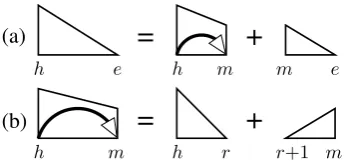
Figure 2: The dynamic-programming structures and derivations of the Eisner (2000) algorithm. Complete spans are depicted as triangles and in-complete spans as trapezoids. For brevity, we elide the symmetric right-headed versions.
3.1 First-order factorization
The first type of parser we describe uses a “first-order” factorization, which decomposes a depen-dency tree into its individual dependencies. Eis-ner (2000) introduced a widely-used dynamic-programming algorithm for first-order parsing; as it is the basis for many parsers, including our new algorithms, we summarize its design here.
The Eisner (2000) algorithm is based on two interrelated types of dynamic-programming struc-tures: complete spans, which consist of a head-word and its descendents on one side, and incom-pletespans, which consist of a dependency and the region between the head and modifier.
Formally, we denote a complete span as Ch,e wherehandeare the indices of the span’s head-word and endpoint. An incomplete span is de-noted asIh,m wherehandmare the index of the head and modifier of a dependency. Intuitively, a complete span represents a “half-constituent” headed byh, whereas an incomplete span is only a partial half-constituent, since the constituent can be extended by adding more modifiers tom.
Each type of span is created by recursively combining two smaller, adjacent spans; the con-structions are specified graphically in Figure 2. An incomplete span is constructed from a pair of complete spans, indicating the division of the range [h, m] into constituents headed by h and
m. A complete span is created by “complet-ing” an incomplete span with the other half of
m’s constituent. The point of concatenation in each construction—m in Figure 2(a) or r in Fig-ure 2(b)—is thesplit point, a free index that must be enumerated to find the optimal construction.
(a)
=
+
h e h m m e
(b)
=
+
h m h s s m
(c)
=
+
m m
[image:3.595.307.525.62.238.2]s s r r+1
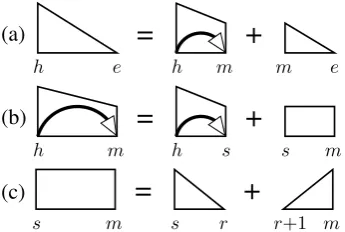
Figure 3: The dynamic-programming structures and derivations of the second-order sibling parser; sibling spans are depicted as boxes. For brevity, we elide the right-headed versions.
accomplished by adapting standard chart-parsing techniques (Cocke and Schwartz, 1970; Younger, 1967; Kasami, 1965) to the recursive derivations defined in Figure 2. Since each derivation is de-fined by two fixed indices (the boundaries of the span) and a third free index (the split point), the parsing algorithm requiresO(n3)time andO(n2) space (Eisner, 1996; McAllester, 1999).
3.2 Second-order sibling factorization
As remarked by Eisner (1996) and McDonald and Pereira (2006), it is possible to rearrange the dynamic-programming structures to conform to an improved factorization that decomposes each tree
into sibling parts—pairs of dependencies with a
shared head. Specifically, a sibling part consists of a triple of indices (h, m, s) where(h, m) and
(h, s) are dependencies, and where sand m are successive modifiers to the same side ofh.
In order to parse this factorization, the second-order parser introduces a third type of dynamic-programming structure: siblingspans, which rep-resent the region between successive modifiers of some head. Formally, we denote a sibling span asSs,mwheresandmare a pair of modifiers in-volved in a sibling relationship. Modified versions of sibling spans will play an important role in the new parsing algorithms described in Section 4.
Figure 3 provides a graphical specification of the second-order parsing algorithm. Note that in-complete spans are constructed in a new way: the second-order parser combines a smaller incom-plete span, representing the next-innermost depen-dency, with a sibling span that covers the region between the two modifiers. Sibling parts(h, m, s) can thus be obtained from Figure 3(b). Despite the use of second-order parts, each derivation is
(a)
=
+
g
g h e h m h m e
(b)
=
+
g h m g h r h r+1 m
(c)
=
+
g
g h
h e m h m e
(d)
=
+
g
g h
h m r h r+1 m
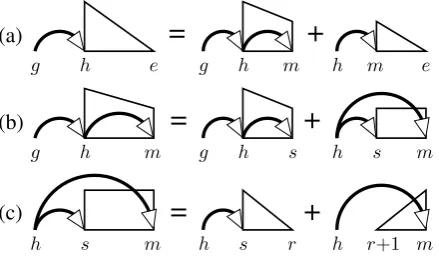
Figure 4: The dynamic-programming structures and derivations of Model 0. For brevity, we elide the right-headed versions. Note that (c) and (d) differ from (a) and (b) only in the position ofg.
still defined by a span and split point, so the parser requiresO(n3)time andO(n2)space.
4 New third-order parsing algorithms
In this section we describe our new third-order de-pendency parsing algorithms. Our overall method is characterized by the augmentation of each span with a “grandparent” index: an index external to the span whose role will be made clear below. This section presents three parsing algorithms based on this idea: Model 0, a second-order parser, and Models 1 and 2, which are third-order parsers.
4.1 Model 0: all grandchildren
The first parser, Model 0, factors each dependency tree into a set of grandchild parts—pairs of de-pendencies connected head-to-tail. Specifically, a grandchild part is a triple of indices (g, h, m) where(g, h)and(h, m)are dependencies.3
[image:3.595.92.265.63.179.2]In order to parse this factorization, we augment both complete and incomplete spans with grand-parent indices; for brevity, we refer to these aug-mented structures asg-spans. Formally, we denote a complete g-span asCh,eg , whereCh,eis a normal complete span andgis an index lying outside the range [h, e], with the implication that (g, h) is a dependency. Incomplete g-spans are defined anal-ogously and are denoted asIh,mg .
Figure 4 depicts complete and incomplete g-spans and provides a graphical specification of the
OPTIMIZEALLSPANS(x)
1. ∀g, i Ci,ig = 0 /base case
2. forw= 1. . .(n−1) /span width
3. fori= 1. . .(n−w) /span start index
4. j=i+w /span end index
5. forg < iorg > j /grandparent index
6. Ii,jg = maxi≤r<j{Ci,rg +C i j,r+1}+
SCOREG(x, g, i, j) 7. Ij,ig = maxi≤r<j{Cj,rg +1+C
j i,r} + SCOREG(x, g, j, i)
8. Ci,jg = maxi<m≤j{I g i,m+C
i m,j} 9. Cj,ig = maxi≤m<j{Ij,mg +C
j m,i} 10. endfor
[image:4.595.308.528.64.193.2]11. endfor 12.endfor
Figure 5: A bottom-up chart parser for Model 0. SCOREG is the scoring function for grandchild
parts. We use the g-span identities as shorthand for their chart entries (e.g.,Ii,jg refers to the entry containing the maximum score of that g-span).
Model 0 dynamic-programming algorithm. The algorithm resembles the first-order parser, except that every recursive construction must also set the grandparent indices of the smaller g-spans; for-tunately, this can be done deterministically in all cases. For example, Figure 4(a) depicts the de-composition of Ch,eg into an incomplete half and a complete half. The grandparent of the incom-plete half is copied fromCh,eg while the grandpar-ent of the complete half is set toh, the head ofm as defined by the construction. Clearly, grandchild parts(g, h, m)can be read off of the incomplete g-spans in Figure 4(b,d). Moreover, since each derivation copies the grandparent indexginto suc-cessively smaller g-spans, grandchild parts will be produced forallgrandchildren ofg.
Model 0 can be parsed by adapting standard top-down or bottom-up chart parsing techniques. For concreteness, Figure 5 provides a pseudocode sketch of a bottom-up chart parser for Model 0; although the sketch omits many details, it suf-fices for the purposes of illustration. The algo-rithm progresses from small widths to large in the usual manner, but after defining the endpoints
(i, j) there is an additional loop that enumerates all possible grandparents. Since each derivation is defined by three fixed indices (the g-span) and one free index (the split point), the complexity of the algorithm isO(n4)time andO(n3)space.
Note that the grandparent indices cause each
g-(a)
=
+
g
g h e h m h m e
(b)
=
+
g h m g h s h s m
(c)
=
+
h
h s m s r h r+1 m
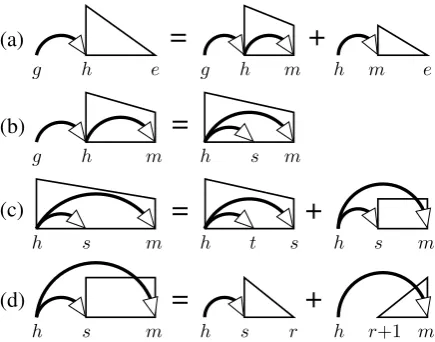
Figure 6: The dynamic-programming structures and derivations of Model 1. Right-headed and right-grandparented versions are omitted.
span to have non-contiguous structure. For ex-ample, in Figure 4(a) the words betweengandh will be controlled by some other g-span. Due to these discontinuities, the correctness of the Model 0 dynamic-programming algorithm may not be immediately obvious. While a full proof of cor-rectness is beyond the scope of this paper, we note that each structure on the right-hand side of Fig-ure 4 lies completely within the structFig-ure on the left-hand side. This nesting of structures implies, in turn, that the usual properties required to ensure the correctness of dynamic programming hold.
4.2 Model 1: all grand-siblings
We now describe our first third-order parsing al-gorithm. Model 1 decomposes each tree into a set of grand-sibling parts—combinations of sib-ling parts and grandchild parts. Specifically, a grand-sibling is a 4-tuple of indices (g, h, m, s) where(h, m, s)is a sibling part and(g, h, m)and
(g, h, s)are grandchild parts. For example, in Fig-ure 1, the words “must,” “report,” “sales,” and “immediately” form a grand-sibling part.
In order to parse this factorization, we intro-duce sibling g-spansSm,sh , which are composed of a normal sibling spanSm,s and an external index
[image:4.595.72.293.70.249.2](a)
=
+
gg h e h m h m e
(b)
=
g h m h s m
(c)
=
+
h
h s m t s h s m
(d)
=
+
h
[image:5.595.72.290.62.233.2]h s m s r h r+1 m
Figure 7: The dynamic-programming structures and derivations of Model 2. Right-headed and right-grandparented versions are omitted.
Like Model 0, Model 1 can be parsed via adap-tations of standard chart-parsing techniques; we omit the details for brevity. Despite the move to third-order parts, each derivation is still defined by a g-span and a split point, so that parsing requires onlyO(n4)time andO(n3)space.
4.3 Model 2: grand-siblings and tri-siblings
Higher-order parsing algorithms have been pro-posed which extend the second-order sibling fac-torization to parts containing multiple siblings (McDonald and Pereira, 2006, also see Section 6 for discussion). In this section, we show how our g-span-based techniques can be combined with a third-order sibling parser, resulting in a parser that captures both grand-sibling parts and tri-sibling
parts—4-tuples of indices (h, m, s, t) such that both(h, m, s)and(h, s, t)are sibling parts.
In order to parse this factorization, we intro-duce a new type of dynamic-programming struc-ture: sibling-augmented spans, or s-spans. For-mally, we denote an incomplete s-span as Ih,m,s whereIh,mis a normal incomplete span andsis an index lying in the strict interior of the range[h, m], such that(h, m, s)forms a valid sibling part.
Figure 7 provides a graphical specification of the Model 2 parsing algorithm. An incomplete s-span is constructed by combining a smaller in-complete s-span, representing the next-innermost pair of modifiers, with a sibling g-span, covering the region between the outer two modifiers. As in Model 1, sibling g-spans are crucial for propa-gating grandparent indices, while allowing the re-covery of tri-sibling parts(h, m, s, t). Figure 7(b)
shows how an incomplete s-span can be converted into an incomplete g-span by exchanging the ternal sibling index for an external grandparent in-dex; in the process, grand-sibling parts(g, h, m, s) are enumerated. Since every derivation is defined by an augmented span and a split point, Model 2 can be parsed inO(n4)time andO(n3)space.
It should be noted that unlike Model 1, Model 2 produces grand-sibling parts only for the outer-most pair of grandchildren,4similar to the
behav-ior of the Carreras (2007) parser. In fact, the re-semblance is more than passing, as Model 2 can
emulatethe Carreras (2007) algorithm by
“demot-ing” each third-order part into a second-order part:
SCOREGS(x, g, h, m, s) =SCOREG(x, g, h, m)
SCORETS(x, h, m, s, t) =SCORES(x, h, m, s)
where SCOREG, SCORES, SCOREGS and SCORETS are the scoring functions for grand-children, siblings, grand-siblings and tri-siblings, respectively. The emulated version has the same computational complexity as the original, so there is no practical reason to prefer it over the original. Nevertheless, the relationship illustrated above highlights the efficiency of our approach: we are able to recover third-order parts in place of second-order parts, at no additional cost.
4.4 Discussion
The technique of grandparent-index augmentation has proven fruitful, as it allows us to parse ex-pressive third-order factorizations while retaining an efficient O(n4) runtime. In fact, our third-order parsing algorithms are “optimally” efficient in an asymptotic sense. Since each third-order part is composed of four separate indices, there are
Θ(n4) distinct parts. Any third-order parsing
al-gorithm must at least consider the score of each part, hence third-order parsing isΩ(n4)and it fol-lows that the asymptotic complexity of Models 1 and 2 cannot be improved.
The key to the efficiency of our approach is a fundamental asymmetry in the structure of a di-rected tree: a head can have any number of mod-ifiers, while a modifier always has exactly one head. Factorizations like that of Carreras (2007) obtain grandchild parts by augmenting spans with the indices of modifiers, leading to limitations on
the grandchildren that can participate in the fac-torization. Our method, by “inverting” the modi-fier indices into grandparent indices, exploits the structural asymmetry.
As a final note, the parsing algorithms described in this section fall into the category of projective
dependency parsers, which forbid crossing depen-dencies. If crossing dependencies are allowed, it is possible to parse a first-order factorization by finding the maximum directed spanning tree (Chu and Liu, 1965; Edmonds, 1967; McDonald et al., 2005b). Unfortunately, designing efficient higher-order non-projective parsers is likely to be chal-lenging, based on recent hardness results (McDon-ald and Pereira, 2006; McDon(McDon-ald and Satta, 2007).
5 Extensions
We briefly outline a few extensions to our algo-rithms; we hope to explore these in future work.
5.1 Probabilistic inference
Many statistical modeling techniques are based on partition functions and marginals—summations over the set of possible trees Y(x). Straightfor-ward adaptations of the inside-outside algorithm (Baker, 1979) to our dynamic-programming struc-tures would suffice to compute these quantities.
5.2 Labeled parsing
Our parsers are easily extended to labeled depen-dencies. Direct integration of labels into Models 1 and 2 would result in third-order parts composed of three labeled dependencies, at the cost of in-creasing the time and space complexities by fac-tors of O(L3) and O(L2), respectively, whereL bounds the number of labels per dependency.
5.3 Word senses
If each word inx has a set of possible “senses,” our parsers can be modified to recover the best joint assignment of syntax and senses for x, by adapting methods in Eisner (2000). Complex-ity would increase by factors of O(S4) time and
O(S3) space, where S bounds the number of
senses per word.
5.4 Increased context
If more vertical context is desired, the dynamic-programming structures can be extended with ad-ditional ancestor indices, resulting in a “spine” of
ancestors above each span. Each additional an-cestor lengthens the vertical scope of the factor-ization (e.g., from grand-siblings to “great-grand-siblings”), while increasing complexity by a factor ofO(n). Horizontal context can also be increased by adding internal sibling indices; each additional sibling widens the scope of the factorization (e.g., from grand-siblings to “grand-tri-siblings”), while increasing complexity by a factor ofO(n).
6 Related work
Our method augments each span with the index of the head that governs that span, in a manner superficially similar to parent annotation in CFGs (Johnson, 1998). However, parent annotation is
a grammartransformation that is independent of
any particular sentence, whereas our method an-notates spans with indices into the current sen-tence. These indices allow the use of arbitrary fea-tures predicated on the position of the grandparent (e.g., word identity, POS tag, contextual POS tags) without affecting the asymptotic complexity of the parsing algorithm. Efficiently encoding this kind of information into a sentence-independent gram-mar transformation would be challenging at best.
Eisner (2000) defines dependency parsing mod-els where each word has a set of possible “senses” and the parser recovers the best joint assignment of syntax and senses. Our new parsing algorithms could be implemented by defining the “sense” of each word as the index of its head. However, when parsing with senses, the complexity of the Eisner (2000) parser increases by factors ofO(S3)time andO(S2) space (ibid., Section 4.2). Since each word has n potential heads, a direct application of the word-sense parser leads to time and space complexities ofO(n6)andO(n4), respectively, in contrast to ourO(n4)andO(n3).5
Eisner (2000) also uses head automata to score or recognize the dependents of each head. An in-teresting question is whether these automata could be coerced into modeling the grandparent indices used in our parsing algorithms. However, note that the head automata are defined in a sentence-independent manner, with two automata per word in the vocabulary (ibid., Section 2). The automata are thus analogous to the rules of a CFG and
at-5
tempts to use them to model grandparent indices would face difficulties similar to those already de-scribed for grammar transformations in CFGs.
It should be noted that third-order parsers have previously been proposed by McDonald and Pereira (2006), who remarked that their second-order sibling parser (see Figure 3) could easily be extended to capture m > 1 successive modi-fiers inO(nm+1)time (ibid., Section 2.2). To our knowledge, however, Models 1 and 2 are the first third-order parsing algorithms capable of model-ing grandchild parts. In our experiments, we find that grandchild interactions make important con-tributions to parsing performance (see Table 3).
Carreras (2007) presents a second-order parser that can score both sibling and grandchild parts, with complexities ofO(n4)time andO(n3)space. An important limitation of the parser’s factoriza-tion is that it only defines grandchild parts for outermost grandchildren: (g, h, m)is scored only whenmis the outermost modifier ofhin some di-rection. Note that Models 1 and 2 have the same complexity as Carreras (2007), but strictly greater expressiveness: for each sibling or grandchild part used in the Carreras (2007) factorization, Model 1 defines an enclosing grand-sibling, while Model 2 defines an enclosing tri-sibling or grand-sibling.
The factored parsing approach we focus on is sometimes referred to as “graph-based” parsing; a popular alternative is “transition-based” parsing, in which trees are constructed by making a se-ries of incremental decisions (Yamada and Mat-sumoto, 2003; Attardi, 2006; Nivre et al., 2006; McDonald and Nivre, 2007). Transition-based parsers do not impose factorizations, so they can define arbitrary features on the tree as it is being built. As a result, however, they rely on greedy or approximate search algorithms to solve Eq. 1.
7 Parsing experiments
In order to evaluate the effectiveness of our parsers in practice, we apply them to the Penn WSJ Tree-bank (Marcus et al., 1993) and the Prague De-pendency Treebank (Hajiˇc et al., 2001; Hajiˇc, 1998).6 We use standard training, validation, and test splits7 to facilitate comparisons. Accuracy is
6For English, we extracted dependencies using Joakim Nivre’s Penn2Malt tool with standard head rules (Yamada and Matsumoto, 2003); for Czech, we “projectivized” the training data by finding best-match projective trees.
7For Czech, the PDT has a predefined split; for English, we split the Sections as: 2–21 training, 22 validation, 23 test.
measured with unlabeled attachment score (UAS): the percentage of words with the correct head.8
7.1 Features for third-order parsing
Our parsing algorithms can be applied to scores originating from any source, but in our experi-ments we chose to use the framework of structured linear models, deriving our scores as:
SCOREPART(x, p) = w·f(x, p)
Here, f is a feature-vector mapping and w is a vector of associated parameters. Following stan-dard practice for higher-order dependency parsing (McDonald and Pereira, 2006; Carreras, 2007), Models 1 and 2 evaluate not only the relevant third-order parts, but also the lower-order parts that are implicit in their third-order factoriza-tions. For example, Model 1 defines feature map-pings for dependencies, siblings, grandchildren, and grand-siblings, so that the score of a depen-dency parse is given by:
MODEL1SCORE(x, y) =
X
(h,m)∈y
wdep·fdep(x, h, m)
X
(h,m,s)∈y
wsib·fsib(x, h, m, s)
X
(g,h,m)∈y
wgch·fgch(x, g, h, m)
X
(g,h,m,s)∈y
wgsib·fgsib(x, g, h, m, s)
Above,yis simultaneously decomposed into sev-eral different types of parts; trivial modifications to the Model 1 parser allow it to evaluate all of the necessary parts in an interleaved fashion. A similar treatment of Model 2 yields five feature mappings: the four above plusftsib(x, h, m, s, t), which represents tri-sibling parts.
The lower-order feature mappingsfdep,fsib, and fgch are based on feature sets from previous work
(McDonald et al., 2005a; McDonald and Pereira, 2006; Carreras, 2007), to which we added lexical-ized versions of several features. For example,fdep
contains lexicalized “in-between” features that de-pend on the head and modifier words as well as a word lying in between the two; in contrast, pre-vious work has generally defined in-between fea-tures for POS tags only. As another example, our
second-order mappingsfsibandfgchdefine lexical
trigram features, while previous work has gener-ally used POS trigrams only.
Our third-order feature mappingsfgsib andftsib
consist of four types of features. First, we define
4-gram featuresthat characterize the four relevant indices using words and POS tags; examples in-clude POS 4-grams and mixed 4-grams with one word and three POS tags. Second, we define
4-gram context features consisting of POS 4-grams
augmented with adjacent POS tags: for exam-ple, fgsib(x, g, h, m, s) includes POS 7-grams for the tags at positions(g, h, m, s, g+1, h+1, m+1). Third, we definebacked-off featuresthat track bi-gram and tribi-gram interactions which are absent in the lower-order feature mappings: for exam-ple,ftsib(x, h, m, s, t)contains features predicated on the trigram (m, s, t) and the bigram (m, t), neither of which exist in any lower-order part. Fourth, noting that coordinations are typically an-notated as grand-siblings (e.g., “report purchases and sales” in Figure 1), we define coordination featuresfor certain grand-sibling parts. For exam-ple, fgsib(x, g, h, m, s) contains features examin-ing the implicit head-modifier relationship(g, m) that are only activated when the POS tag ofsis a coordinating conjunction.
Finally, we make two brief remarks regarding the use of POS tags. First, we assume that input sentences have been automatically tagged in a pre-processing step.9 Second, for any feature that de-pends on POS tags, we includetwocopies of the feature: one using normal POS tags and another using coarsened versions10of the POS tags.
7.2 Averaged perceptron training
There are a wide variety of parameter estima-tion methods for structured linear models, such as log-linear models (Lafferty et al., 2001) and max-margin models (Taskar et al., 2003). We chose the averaged structured perceptron (Freund and Schapire, 1999; Collins, 2002) as it combines highly competitive performance with fast training times, typically converging in 5–10 iterations. We train each parser for 10 iterations and select
pa-9For Czech, the PDT provides automatic tags; for English, we used MXPOST (Ratnaparkhi, 1996) to tag validation and test data, with 10-fold cross-validation on the training set. Note that the reliance on POS-tagged input can be relaxed slightly by treating POS tags as word senses; see Section 5.3 and McDonald (2006, Table 6.1).
10For Czech, we used the first character of the tag; for En-glish, we used the first two characters, exceptPRPandPRP$.
Beam Pass Orac Acc1 Acc2 Time1 Time2
0.0001 26.5 99.92 93.49 93.49 49.6m 73.5m 0.001 16.7 99.72 93.37 93.29 25.9m 24.2m 0.01 9.1 99.19 93.26 93.16 6.7m 7.9m
Table 1: Effect of the marginal-probability beam on English parsing. For each beam value, parsers were trained on the English training set and evalu-ated on the English validation set; the same beam value was applied to both training and validation data.Pass= %dependencies surviving the beam in training data,Orac = maximum achievable UAS on validation data, Acc1/Acc2= UAS of Models 1/2 on validation data, andTime1/Time2 = min-utes per perceptron training iteration for Models 1/2, averaged over all 10 iterations. For perspec-tive, the English training set has a total of 39,832 sentences and 950,028 words. A beam of 0.0001 was used in all experiments outside this table.
rameters from the iteration that achieves the best score on the validation set.
7.3 Coarse-to-fine pruning
In order to decrease training times, we follow Carreras et al. (2008) and eliminate unlikely de-pendencies using a form of coarse-to-fine pruning (Charniak and Johnson, 2005; Petrov and Klein, 2007). In brief, we train a log-linear first-order parser11and for every sentencexin training, val-idation, and test data we compute the marginal probabilityP(h, m|x)of each dependency. Our parsers are then modified to ignore any depen-dency(h, m)whose marginal probability is below
0.0001×maxh0P(h0, m|x). Table 1 provides in-formation on the behavior of the pruning method.
7.4 Main results
Table 2 lists the accuracy of Models 1 and 2 on the English and Czech test sets, together with some relevant results from related work.12 The mod-els marked “†” arenotdirectly comparable to our work as they depend on additional sources of in-formation that our models are trained without— unlabeled data in the case of Koo et al. (2008) and
11For English, we generate marginals using a projective parser (Baker, 1979; Eisner, 2000); for Czech, we generate marginals using a non-projective parser (Smith and Smith, 2007; McDonald and Satta, 2007; Koo et al., 2007). Param-eters for these models are obtained by running exponentiated gradient training for 10 iterations (Collins et al., 2008).
Parser Eng Cze
McDonald et al. (2005a,2005b) 90.9 84.4 McDonald and Pereira (2006) 91.5 85.2 Koo et al. (2008), standard 92.02 86.13
Model 1 93.04 87.38
Model 2 92.93 87.37
[image:9.595.325.510.61.164.2]Koo et al. (2008), semi-sup† 93.16 87.13 Suzuki et al. (2009)† 93.79 88.05 Carreras et al. (2008)† 93.5
Table 2: UAS of Models 1 and 2 on test data, with relevant results from related work. Note that Koo et al. (2008) is listed with standard features and semi-supervised features.†: see main text.
Suzuki et al. (2009) and phrase-structure annota-tions in the case of Carreras et al. (2008). All three of the “†” models are based on versions of the Car-reras (2007) parser, so modifying these methods to work with our new third-order parsing algorithms would be an interesting topic for future research. For example, Models 1 and 2 obtain results com-parable to the semi-supervised parsers of Koo et al. (2008), and additive gains might be realized by applying their cluster-based feature sets to our en-riched factorizations.
7.5 Ablation studies
In order to better understand the contributions of the various feature types, we ran additional abla-tion experiments; the results are listed in Table 3, in addition to the scores of Model 0 and the emu-lated Carreras (2007) parser (see Section 4.3). In-terestingly, grandchild interactions appear to pro-vide important information: for example, when Model 2 is used without grandchild-based features (“Model 2, no-G” in Table 3), its accuracy suffers noticeably. In addition, it seems that grandchild interactions are particularly useful in Czech, while sibling interactions are less important: consider that Model 0, a second-order grandchild parser with no sibling-based features, can easily outper-form “Model 2, no-G,” athird-order sibling parser with no grandchild-based features.
8 Conclusion
We have presented new parsing algorithms that are capable of efficiently parsing third-order factoriza-tions, including both grandchild and sibling inter-actions. Due to space restrictions, we have been necessarily brief at some points in this paper; some additional details can be found in Koo (2010).
Parser Eng Cze
Model 0 93.07 87.39 Carreras (2007) emulation 93.14 87.25 Model 1 93.49 87.64 Model 1, no-3rd 93.17 87.57
Model 2 93.49 87.46 Model 2, no-3rd 93.20 87.43
[image:9.595.79.287.62.176.2]Model 2, no-G 92.92 86.76
Table 3: UAS for modified versions of our parsers on validation data. The term no-3rd indicates a
parser that was trained and tested with the third-order feature mappingsfgsib andftsib deactivated,
though lower-order features were retained; note that “Model 2, no-3rd” is not identical to the
Car-reras (2007) parser as it defines grandchild parts for the pair of grandchildren. The termno-G indi-cates a parser that was trained and tested with the grandchild-based feature mappingsfgch and fgsib
deactivated; note that “Model 2, no-G” emulates the third-order sibling parser proposed by McDon-ald and Pereira (2006).
There are several possibilities for further re-search involving our third-order parsing algo-rithms. One idea would be to consider extensions and modifications of our parsers, some of which have been suggested in Sections 5 and 7.4. A sec-ond area for future work lies in applications of de-pendency parsing. While we have evaluated our new algorithms on standard parsing benchmarks, there are a wide variety of tasks that may bene-fit from the extended context offered by our third-order factorizations; for example, the 4-gram sub-structures enabled by our approach may be useful for dependency-based language modeling in ma-chine translation (Shen et al., 2008). Finally, in the hopes that others in the NLP community may find our parsers useful, we provide a free distribu-tion of our implementadistribu-tion.2
Acknowledgments
References
Giuseppe Attardi. 2006. Experiments with a Multilan-guage Non-Projective Dependency Parser. In Pro-ceedings of the 10th CoNLL, pages 166–170.
Asso-ciation for Computational Linguistics.
James Baker. 1979. Trainable Grammars for Speech Recognition. InProceedings of the 97thmeeting of the Acoustical Society of America.
Xavier Carreras, Michael Collins, and Terry Koo. 2008. TAG, Dynamic Programming, and the Per-ceptron for Efficient, Feature-rich Parsing. In Pro-ceedings of the 12th CoNLL, pages 9–16.
Associa-tion for ComputaAssocia-tional Linguistics.
Xavier Carreras. 2007. Experiments with a Higher-Order Projective Dependency Parser. In Proceed-ings of the CoNLL Shared Task Session of EMNLP-CoNLL, pages 957–961. Association for Computa-tional Linguistics.
Eugene Charniak and Mark Johnson. 2005. Coarse-to-fine N-best Parsing and MaxEnt Discriminative Reranking. InProceedings of the 43rdACL.
Y.J. Chu and T.H. Liu. 1965. On the Shortest Ar-borescence of a Directed Graph. Science Sinica, 14:1396–1400.
John Cocke and Jacob T. Schwartz. 1970. Program-ming Languages and Their Compilers: Preliminary Notes. Technical report, New York University.
Michael Collins, Amir Globerson, Terry Koo, Xavier Carreras, and Peter L. Bartlett. 2008. Exponenti-ated Gradient Algorithms for Conditional Random Fields and Max-Margin Markov Networks. Journal of Machine Learning Research, 9:1775–1822, Aug.
Michael Collins. 2002. Discriminative Training Meth-ods for Hidden Markov Models: Theory and Exper-iments with Perceptron Algorithms. InProceedings of the 7thEMNLP, pages 1–8. Association for
Com-putational Linguistics.
Jack R. Edmonds. 1967. Optimum Branchings. Jour-nal of Research of the NatioJour-nal Bureau of Standards, 71B:233–240.
Jason Eisner. 1996. Three New Probabilistic Models for Dependency Parsing: An Exploration. In Pro-ceedings of the 16th COLING, pages 340–345. As-sociation for Computational Linguistics.
Jason Eisner. 2000. Bilexical Grammars and Their Cubic-Time Parsing Algorithms. In Harry Bunt and Anton Nijholt, editors,Advances in Probabilis-tic and Other Parsing Technologies, pages 29–62. Kluwer Academic Publishers.
Yoav Freund and Robert E. Schapire. 1999. Large Margin Classification Using the Perceptron Algo-rithm. Machine Learning, 37(3):277–296.
Jan Hajiˇc, Eva Hajiˇcov´a, Petr Pajas, Jarmila Panevova, and Petr Sgall. 2001. The Prague Dependency Tree-bank 1.0, LDC No. LDC2001T10. Linguistics Data Consortium.
Jan Hajiˇc. 1998. Building a Syntactically Annotated Corpus: The Prague Dependency Treebank. In Eva Hajiˇcov´a, editor, Issues of Valency and Meaning. Studies in Honor of Jarmila Panevov´a, pages 12–19.
Mark Johnson. 1998. PCFG Models of Linguistic Tree Representations. Computational Linguistics, 24(4):613–632.
Tadao Kasami. 1965. An Efficient Recognition and Syntax-analysis Algorithm for Context-free Lan-guages. Technical Report AFCRL-65-758, Air Force Cambridge Research Lab.
Terry Koo, Amir Globerson, Xavier Carreras, and Michael Collins. 2007. Structured Prediction Mod-els via the Matrix-Tree Theorem. In Proceedings of EMNLP-CoNLL, pages 141–150. Association for Computational Linguistics.
Terry Koo, Xavier Carreras, and Michael Collins. 2008. Simple Semi-supervised Dependency Pars-ing. InProceedings of the 46thACL, pages 595–603. Association for Computational Linguistics.
Terry Koo. 2010. Advances in Discriminative Depen-dency Parsing. Ph.D. thesis, Massachusetts Institute of Technology, Cambridge, MA, USA, June.
John Lafferty, Andrew McCallum, and Fernando Pereira. 2001. Conditional Random Fields: Prob-abilistic Models for Segmenting and Labeling Se-quence Data. In Proceedings of the 18th ICML,
pages 282–289. Morgan Kaufmann.
Mitchell P. Marcus, Beatrice Santorini, and Mary Ann Marcinkiewicz. 1993. Building a Large Annotated Corpus of English: The Penn Treebank. Computa-tional Linguistics, 19(2):313–330.
David A. McAllester. 1999. On the Complexity Analysis of Static Analyses. In Proceedings of the 6th Static Analysis Symposium, pages 312–329.
Springer-Verlag.
Ryan McDonald and Joakim Nivre. 2007. Character-izing the Errors of Data-Driven Dependency Parsers. InProceedings of EMNLP-CoNLL, pages 122–131. Association for Computational Linguistics.
Ryan McDonald and Fernando Pereira. 2006. Online Learning of Approximate Dependency Parsing Al-gorithms. InProceedings of the 11th EACL, pages
81–88. Association for Computational Linguistics.
Ryan McDonald, Koby Crammer, and Fernando Pereira. 2005a. Online Large-Margin Training of Dependency Parsers. In Proceedings of the 43rd ACL, pages 91–98. Association for Computational Linguistics.
Ryan McDonald, Fernando Pereira, Kiril Ribarov, and Jan Hajiˇc. 2005b. Non-Projective Dependency Parsing using Spanning Tree Algorithms. In Pro-ceedings of HLT-EMNLP, pages 523–530. Associa-tion for ComputaAssocia-tional Linguistics.
Ryan McDonald. 2006. Discriminative Training and Spanning Tree Algorithms for Dependency Parsing. Ph.D. thesis, University of Pennsylvania, Philadel-phia, PA, USA, July.
Joakim Nivre, Johan Hall, Jens Nilsson, G¨uls¸en Eryiˇgit, and Svetoslav Marinov. 2006. Labeled Pseudo-Projective Dependency Parsing with Sup-port Vector Machines. In Proceedings of the 10th CoNLL, pages 221–225. Association for Computa-tional Linguistics.
Slav Petrov and Dan Klein. 2007. Improved Inference for Unlexicalized Parsing. InProceedings of HLT-NAACL, pages 404–411. Association for Computa-tional Linguistics.
Adwait Ratnaparkhi. 1996. A Maximum Entropy Model for Part-Of-Speech Tagging. InProceedings of the 1st EMNLP, pages 133–142. Association for
Computational Linguistics.
Libin Shen, Jinxi Xu, and Ralph Weischedel. 2008. A New String-to-Dependency Machine Translation Algorithm with a Target Dependency Language Model. InProceedings of the 46thACL, pages 577– 585. Association for Computational Linguistics.
David A. Smith and Noah A. Smith. 2007. Proba-bilistic Models of Nonprojective Dependency Trees. InProceedings of EMNLP-CoNLL, pages 132–140. Association for Computational Linguistics.
Jun Suzuki, Hideki Isozaki, Xavier Carreras, and Michael Collins. 2009. An Empirical Study of Semi-supervised Structured Conditional Models for Dependency Parsing. In Proceedings of EMNLP, pages 551–560. Association for Computational Lin-guistics.
Ben Taskar, Carlos Guestrin, and Daphne Koller. 2003. Max margin markov networks. In Sebastian Thrun, Lawrence K. Saul, and Bernhard Sch¨olkopf, editors,
NIPS. MIT Press.
Hiroyasu Yamada and Yuji Matsumoto. 2003. Statis-tical Dependency Analysis with Support Vector Ma-chines. InProceedings of the 8thIWPT, pages 195–
206. Association for Computational Linguistics.