Proceedings of the 2012 Student Research Workshop, pages 19–24,
Query classification using topic models and support vector machine
Dieu-Thu Le University of Trento, Italy [email protected]
Raffaella Bernardi University of Trento, Italy [email protected]
Abstract
This paper describes a query classification system for a specialized domain. We take as a case study queries asked to a search engine of an art, cultural and history library and clas-sify them against the library cataloguing cate-gories. We show how click-through links, i.e., the links that a user clicks after submitting a query, can be exploited for extracting informa-tion useful to enrich the query as well as for creating the training set for a machine learn-ing based classifier. Moreover, we show how Topic Model can be exploited to further enrich the query with hidden topics induced from the library meta-data. The experimental evalua-tions show that this system considerably out-performs a matching and ranking classifica-tion approach, where queries (and categories) were also enriched with similar information.
1 Introduction
Query classification (QC) is the task of automati-cally labeling user queries into a given target tax-onomy. Providing query classification can help the information providers understand users’ needs based on the categories that the users are searching for. The main challenges of this task come from the na-ture of user queries, which are usually very short and ambiguous. Since queries contain only several to a dozen words, a QC system often requires either a rather large training set or an enrichment of queries with other information (Shen et al., 2006a), (Broder et al., 2007).
This study will focus on QC in art, culture and history domain, using the Bridgeman art library1, al-though our framework is general enough to be used in different domains. Manually creating a training
1
http://www.bridgemanart.com/
set of queries to build a classifier in a specific do-main is very time-consuming. In this study, we will describe our method of automatically creating a training set based on the click-through links and how we build an SVM (Support Vector Machine) classifier with the integration of enriched informa-tion. In (Le et al., 2011), it has been shown that click-through information and topic models are use-ful for query enrichment when the ultimate goal is query classification. We will follow this enrichment step, but integrate this information into a SVM clas-sifier instead of using matching and ranking between queries and categories as in (Le et al., 2011).
The purpose of this paper is to determine (1) whether the query enrichment with click-though in-formation and hidden topics is useful for a machine learning query classification system using SVM; and (2) whether integrating this enriched information into a machine learning classifier can perform bet-ter than the matching and ranking system.
In the next section, we will briefly review the main streams of related work in QC. In section 3, we will describe the Bridgeman art library. Sec-tion 4 accounts for our proposed query classifica-tion framework. In secclassifica-tion 5, we will present our experiment and evaluation. Section 6 concludes by discussing our main achievements and proposing fu-ture work.
2 Related work
Initial studies in QC classify queries into several different types based on the information needed by the user. (Broder, 2002) considered three different types of queries: informational queries, navigational queries and transactional queries. This stream of study focuses on the type of the queries, rather than topical classification of the queries.
Another stream of work deals with the problem
of classifying queries into a more complex taxon-omy containing different topics. Our study falls into this second stream. To classify queries consider-ing their meanconsider-ing, some work considered only in-formation available in queries (e.g., (Beitzel et al., 2005) only used terms in queries). Some other work has attempted to enrich queries with information from external online dataset, e.g., web pages (Shen et al., 2006a; Broder et al., 2007) and web direc-tories (Shen et al., 2006b). Our work is similar to their in the idea of exploiting additional dataset. However, instead of using search engines as a way of collecting relevant documents, we use the meta-data of the library itself as a reference set. Further-more, we employ topic models to analyze topics for queries, rather than enriching queries with words se-lected from those webpages directly as in (Shen et al., 2006a; Broder et al., 2007).
The context of a given query can provide use-ful information to determine its categories. Previ-ous studies have confirmed the importance of search context in QC. (Cao et al., 2009) considered the con-text to be both previous queries within the same ses-sion and pages of the clicked urls. In our approach, we will also consider click through information to enrich the queries and analyze topics.
In (Le et al., 2011), queries and categories are en-riched with both information mined from the click-through links as well as topics derived from a topic model estimated from the library metadata. Sub-sequently, the queries are mapped to the categories based on their cosine similarity. Our proposed ap-proach differs from (Le et al., 2011) in three re-spects: (1) we enrich the queries, but not the cat-egories (2) we employ a machine learning system and integrate this enriched information as features to learn an SVM classifier (3) we assume that the cate-gory of a query is closely related to the catecate-gory of the corresponding click-through link, hence we au-tomatically create a training data for the SVM clas-sifier by analyzing the query log.
3 Bridgeman Art Library
Bridgeman Art Library (BAL)2is one of the world’s top image libraries for art, culture and history. It contains images from over 8,000 collections and
2http://www.bridgemanart.com
more than 29,000 artists, providing a central source of fine art for image users.
Works of art in the library have been annotated with titles and keywords. Some of them are catego-rized into a two-level taxonomy, a more fine-grained classification of the Bridgeman browse menu. In our study, we do not use the image itself but only the in-formation associated with it, i.e., the title, keywords and categories. We will take the 55 top-level cate-gories from this taxonomy, which have been orga-nized by a domain expert, as our target taxonomy.
4 Building QC using topic models and SVM
Following (Le et al., 2011), we enrich queries both with the information mined from the library via click-through links and the information collected from the library metadata via topic modeling. To perform the query enrichment with topics derived from the library metadata, there are several impor-tant steps:
•Collecting and organizing the library metadata as a reference set: the library metadata contains the in-formation about artworks that have been annotated by experts. To take advantage of this information automatically, we collected all annotated artworks and organized them by their given categories. • Estimating a topic model for this reference set: This step is performed using hidden topic analysis models. In this framework, we choose to use latent dirichlet allocation, LDA (Blei et al., 2003b). •Analyzing topics for queries and integrating topics into data for both the training set and new queries: After the reference set has been analyzed using topic models, it will be used to infer topics for queries. The topic model will then be integrated into the data to build a classifier.
4.1 Query enrichment via click-through links
We automatically extracted click-through links from the query log (which provides us with the title of the image that the user clicks) to enrich the query, represented as a vector −→qi, with the title of one
randomly-chosen click-through associated with it. To further exploit the click-through link, we find the corresponding artwork and extract its keywords: −
→q
i∪
− →
in the title and keywords respectively.
4.2 Hidden Topic Models
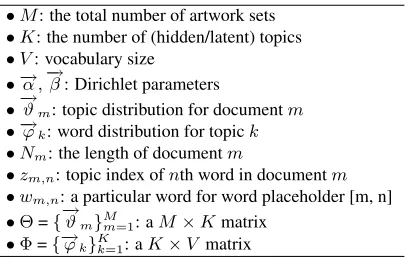
The underlying idea is based upon a probabilis-tic procedure of generating a new set of artworks, where each set refers to titles and keywords of all artworks in a category: First, each set −→wm
= (wm,n)Nm
n=1 is generated by sampling a distribu-tion over topics −→ϑm from a Dirichlet distribution (Dir(−→α)), where Nm is the number of words in
that set m. After that, the topic assignment for each observed word wm,n is performed by
sam-pling a word place holder zm,n from a
[image:3.612.87.290.335.466.2]multino-mial distribution (M ult(−→ϑm)). Then a wordwm,nis picked by sampling from the multinomial distribu-tion (M ult(−→ϕzm,n)). This process is repeated until allK topics have been generated for the whole col-lection.
Table 1: Generation process for LDA
•M: the total number of artwork sets •K: the number of (hidden/latent) topics •V: vocabulary size
• −→α ,−→β: Dirichlet parameters
•−→ϑm: topic distribution for documentm
• −→ϕk: word distribution for topick
•Nm: the length of documentm
•zm,n: topic index ofnth word in documentm
•wm,n: a particular word for word placeholder [m, n]
•Θ={−→ϑm}Mm=1: aM×Kmatrix
•Φ={−→ϕk}Kk=1: aK×V matrix
In order to estimate parameters for LDA (i.e., the set of topics and their word probabilities Φ and the particular topic mixture of each document Θ), different inference techniques can be used, such as variational Bayes (Blei et al., 2003b), or Gibbs sampling (Heinrich, 2004). In this work, we will use Gibbs sampling following the descrip-tion given in (Heinrich, 2004). Generally, the topic assignment of a particular wordt is computed as:
p(zi=k|−→z¬i,−→w) =
n(k,t)¬i+βt
[PV v=1n
(v)
k +βv]−1
n(m,k)¬i+αk
[PK j=1n
(j)
m +αj]−1 (1)
where n(k,t)¬i is the number of times the word t is assigned to topick except the current assignment;
PV v=1n
(v)
k −1is the total number of words assigned
to topickexcept the current assignment;n(m,k)¬iis the number of words in setmassigned to topickexcept
the current assignment; and PK
j=1n (j)
m −1 is the
total number of words in set m except the current word t. In normal cases, Dirichlet parameters−→α, and−→β are symmetric, that is, allαk(k = 1..K)are the same, and similarly forβv(v= 1..V).
4.3 Hidden topic analysis of the Bridgeman metadata
The Bridgeman metadata contains information about artworks in the library that have been anno-tated by the librarians. We extracted titles and key-words of each artwork, those for which we had a query with a click-through link corresponding to it, and grouped them together by their sub-categories. Each group is considered as a document −→wm = (wm,n)Nm
n=1, with the number of total documentsM = 732 and the vocabulary sizeV = 136K words. In this experiment, we fix the number of topicsK = 100. We used the GibbsLDA++ implementation3to estimate this topic model.
4.4 Building query classifier with hidden topics
Let Q0 = {−→qi0}ii==1N be the set of all queries riched via the click-through links, where each en-riched query is−→qi0 =−→qi ∪−→ti ∪−kw−→i. We also per-formed Gibbs sampling for all−→qi0 in order to esti-mate its topic distribution −→ϑi = {ϑi,1, . . . , ϑi,K}
where the probabilityϑi,k of topick in−→qi0 is
com-puted as:
ϑi,k = n (k)
i +αk
PK
j=1n (j)
i +αj
(2)
wheren(ik)is the number of words in queryi
as-signed to topic k and n(ij) is the total number of words appearing in the enriched queryi.
In order to integrate the topic distribution −→ϑi =
{ϑi,1, . . . , ϑi,K} into the vector of words −→qi0
= {wi,1, wi,2, . . . , wi,Ni}, following (Phan et al., 2010), we only keep topics whoseϑi,kis larger than a thresholdcut-off and use ascale parameter to do the discretization for topics: the number of times topickintegrated to−→qi0 is round(ϑi×scale). After that, we build a Support Vector Machine classifier using SVM light V2.204.
3
http://gibbslda.sourceforge.net/
5 Evaluation
In this section, we will describe our training set, gold standard and the performance of our system in com-parison with the one in (Le et al., 2011).
5.1 Training set
Manually annotating queries to create a training set in this domain is a difficult task (e.g., it requires the expert to search the query and look at the picture cor-responding to the query, etc.). Therefore, we have automatically generated a training set by exploiting a 6-month query log as follow.
First, each query has been mapped to its click-through information to extract the sub-category as-sociated to the corresponding image. Then, from this sub-category, we obtained its corresponding top-cateogry (among the 55 we consider) as defined in BAL taxonomy. The distribution of queries in different categories varies quite a lot among the 55 target categories reflecting the artwork distribution (e.g., there are many more artworks in the library be-longing to the category “Religion and Belief” than to the category“Costume and Fashion”). We have preserved such distribution over the target categories when selecting randomly the 15,490 queries to build our training set. After removing all punctuations and stop words, we obtained a training set containing 50,337 words in total. Each word in this set serves as a feature for the SVM classifier.
5.2 Test set
We used the test set of 1,049 queries used in (Le et al., 2011), which is separate from the training set. These queries have been manually annotated by a BAL expert (up to 3 categories per query). Note that these queries have also been selected automatically while preserving the distribution over the target cat-egories observed in the 6-month query log. We call this the “manual” gold standard. In addition, we also made use of another gold standard obtained by map-ping the click-through information of these queries with their categories, similar to the way in which we obtain the training set. We call this the “via-CT” gold standard.
5.3 Experimental settings
To evaluate the impact of click-though information and topics in the classifier, we designed the
follow-ing experiments, whereQR is the method without any enrichment andQR-CT-HT is with the enrich-ment via both click-through and hidden topics.
Setting Query enrichment QR −→q
QR-HT −→q ⊕HT
QR-CT −→q0=→−q +−→t +−kw→ QR-CT-HT −→q0⊕HT
• −→q: query
• −→q0: query enriched with click-through information •−→t: click-through image’s title
[image:4.612.323.528.109.231.2]•−kw→: click-through image’s keywords •HT: hidden topics from Bridgeman metadata
Table 2: Experimental Setting
Setting
Hits
ManualGS via-CT
# 1 # 2 # 3 P
T op3 GS
QR 207 80 24 311 231
QR-HT 212 81 25 318 235
QR-CT 243 107 38 388 266
[image:4.612.313.550.273.361.2]QR-CT -HT 289 136 49 474 323
Table 3: Results of query classification: number of cor-rect categories found (for 1,049 queries)
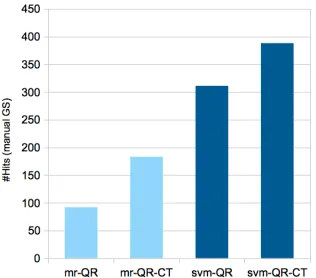
Figure 1: The impact of click-through information with matching-ranking (mr) and our approach (svm)
[image:4.612.349.507.419.558.2]par-ticular, it increases the number of correct categories found from 311 to 388 (compared with themanual GS) and from 231 to 266 (using thevia-CT GS).
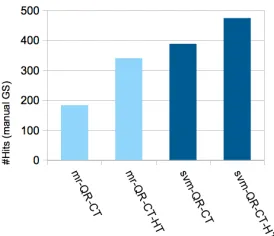
[image:5.612.116.253.305.423.2]To answer our second research question, namely whether integrating the enriched information into a machine learning classifier can perform better than the matching and ranking method, we also compare the results of our approach with the one in (Le et al., 2011). Figure 1 shows the impact of the click-through information for the SVM classifier (svm) in comparison with the matching and ranking approach (mr). Figure 2 shows the impact of the hidden topics in both cases. We can see that in both cases our clas-sifier outperforms the matching-ranking one con-siderably (e.g., from 183 to 388 correct categories found in the QR-CT-HT method).
Figure 2: The impact of hidden topics with matching-ranking (mr) and our approach (svm)
However, in the case where we use only queries without click-through information, we can see that hidden topics do not bring a very strong impact (the number of correct categories found only slightly in-creases by 7 - using the “manual” gold standard). The result might come from the fact that this topic model was built from the metadata, using only click-through information, but has not been learned with queries.
6 Conclusion
In this study, we have presented a machine learn-ing classifier for query classification in an art im-age archive. Since queries are usually very short, thus difficult to classify, we first extend them with their click-through information. Then, these queries are further enriched with topics learned from the
BAL metadata following (Le et al., 2011). The re-sult from this study has confirmed again the effect of click-through information and hidden topics in the query classification task using SVM. We have also described our method of automatically creat-ing a traincreat-ing set based on the selection of queries mapped to the click-through links and their corre-sponding available categories using a 6-month query log. The result of this study has shown a consid-erable increase in the performance of this approach over the matching-ranking system reported in (Le et al., 2011).
7 Future work
For future work, we are in the process of enhancing our experimentation in several directions:
Considering more than one click-through image per query: In this work, we have considered only one category per query to create the training set, while it might be more reasonable to take into ac-count all click-through images of a given query. In future work, we plan to enrich the queries with either all click-through images or with the most relevant one instead of randomly picking one click-through image. In many cases, a click-through link is not necessarily related to the meaning of a query (e.g., when users just randomly click on an image that they find interesting). Thus, it might be useful to filter out those click-through images that are not relevant.
Enriching queries with top hits returned by the BAL search engine: In the query logs, there are many queries that do not have an associated click-through link. Hence, we plan to exploit other en-richment method that do not rely on those links, in particular we will try to exploit the information com-ing from the top returned hits given by the library search engine.
Analyzing queries in the same session:It has been shown in some studies (Cao et al., 2009) that analyz-ing queries in the same session can help determine their categories. Our next step is to enrich a new query with the information coming from the other previous queries in the same session.
Steyvers, 2004). In the future, we will explore ways to optimize these input values to see the effect of dif-ferent topic models in our query classification task.
Exploiting visual features from the BAL images:
The BAL dataset provides an interesting case study in which we plan to further analyze images to enrich queries with their visual features. Combining text and visual features has drawn a lot of attention in the IR research community. We believe that exploiting visual features from this art archive could lead to in-teresting results in this specific domain. A possible approach would be extracting visual features from the click-through images and representing them to-gether with textual features in a joint topic distribu-tion (e.g., (Blei et al., 2003a; Li et al., 2010)).
Comparing system with other approaches:In the future, we plan to compare our system with other query classification systems and similar techniques for query expansion in general. Furthermore, the evaluation phase has not been carried out thoroughly since it was difficult to compare the one-class output with the gold-standard, where the number of correct categories per query is not fixed. In the future, we plan to exploit the output of our multi-class classi-fier to assign up to three categories for each query and compute the precision atn.
Acknowledgments
This work has been partially supported by the GALATEAS project (http://www.galateas.eu/ – CIP-ICT PSP-2009-3-25430) funded by the Euro-pean Union under the ICT PSP program.
References
Steven M. Beitzel, Eric C. Jensen, Ophir Frieder, and David Grossman. 2005. Automatic web query clas-sification using labeled and unlabeled training data. In In Proceedings of the 28th Annual International ACM SIGIR Conference on Research and Development in Information Retrieval, pages 581–582. ACM Press. David M. Blei, Michael I, David M. Blei, and Michael I.
2003a. Modeling annotated data. InIn Proc. of the 26th Intl. ACM SIGIR Conference.
David M. Blei, Andrew Y. Ng, and Michael I. Jordan. 2003b. Latent dirichlet allocation. J. Mach. Learn. Res., 3:993–1022, March.
Andrei Z. Broder, Marcus Fontoura, Evgeniy Gabrilovich, Amruta Joshi, Vanja Josifovski, and
Tong Zhang. 2007. Robust classification of rare queries using web knowledge. InProceedings of the 30th annual international ACM SIGIR conference on Research and development in information retrieval, SIGIR ’07, pages 231–238, New York, NY, USA. ACM.
Andrei Broder. 2002. A taxonomy of web search. SIGIR Forum, 36:3–10, September.
Huanhuan Cao, Derek Hao Hu, Dou Shen, Daxi Jiang, Jian-Tao Sun, Enhong Chen, and Qiang Yang. 2009. Context-aware query classification. InSIGIR’09, The 32nd Annual ACM SIGIR Conference.
Thomas L Griffiths and Mark Steyvers. 2004. Find-ing scientific topics. Proceedings of the National Academy of Sciences of the United States of America, 101 Suppl 1(Suppl 1):5228–5235.
Gregor Heinrich. 2004. Parameter estimation for text analysis. Technical report.
Dieu-Thu Le, Raffaella Bernardi, and Edwin Vald. 2011. Query classification via topic models for an art im-age archive. InRecent Advances in Natural Language Processing, RANLP, Bulgaria.
Li-Jia Li, Chong Wang, Yongwhan Lim, David Blei, and Li Fei-Fei. 2010. Building and using a semantivisual image hierarchy. InThe Twenty-Third IEEE Confer-ence on Computer Vision and Pattern Recognition, San Francisco, CA, June.
Xuan-Hieu Phan, Cam-Tu Nguyen, Dieu-Thu Le, Le-Minh Nguyen, Susumu Horiguchi, and Quang-Thuy Ha. 2010. A hidden topic-based framework towards building applications with short web documents.IEEE Transactions on Knowledge and Data Engineering, 99(PrePrints).