Automatic Term Ambiguity Detection
Tyler Baldwin Yunyao Li Bogdan Alexe Ioana R. Stanoi
IBM Research - Almaden
650 Harry Road, San Jose, CA 95120, USA
{tbaldwi,yunyaoli,balexe,irs}@us.ibm.com
Abstract
While the resolution of term ambiguity is important for information extraction (IE) systems, the cost of resolving each in-stance of an entity can be prohibitively expensive on large datasets. To combat this, this work looks at ambiguity detec-tion at the term, rather than the instance, level. By making a judgment about the general ambiguity of a term, a system is able to handle ambiguous and unambigu-ous cases differently, improving through-put and quality. To address the term ambiguity detection problem, we employ a model that combines data from lan-guage models, ontologies, and topic mod-eling. Results over a dataset of entities from four product domains show that the proposed approach achieves significantly above baseline F-measure of 0.96.
1 Introduction
Many words, phrases, and referring expressions are semantically ambiguous. This phenomenon, commonly referred to as polysemy, represents a problem for NLP applications, many of which in-herently assume a single sense. It can be particu-larly problematic for information extraction (IE), as IE systems often wish to extract information about only one sense of polysemous terms. If nothing is done to account for this polysemy, fre-quent mentions of unrelated senses can drastically harm performance.
Several NLP tasks, such as word sense disam-biguation, word sense induction, and named en-tity disambiguation, address this ambiguity prob-lem to varying degrees. While the goals and initial data assumptions vary between these tasks, all of them attempt to map an instance of a term seen in context to an individual sense. While making
a judgment for every instance may be appropri-ate for small or medium sized data sets, the cost of applying these ambiguity resolution procedures becomes prohibitively expensive on large data sets of tens to hundreds of million items. To combat this, this work zooms out to examine the ambigu-ity problem at a more general level.
To do so, we define an IE-centered ambiguity detection problem, which ties the notion of am-biguity to a given topical domain. For instance, given that the terms Call of Juarez and A New Beginning can both reference video games, we would like to discover that only the latter case is likely to appear frequently in non-video game con-texts. The goal is to make a binary decision as to whether, given a term and a domain, we can expect every instance of that term to reference an entity in that domain. By doing so, we segregate ambiguous terms from their unambiguous coun-terparts. Using this segregation allows ambiguous and unambiguous instances to be treated differ-ently while saving the processing time that might normally be spent attempting to disambiguate in-dividual instances of unambiguous terms.
Previous approaches to handling word ambigu-ity employ a variety of disparate methods, vari-ously relying on structured ontologies, gleaming insight from general word usage patterns via lan-guage models, or clustering the contexts in which words appear. This work employs an ambiguity detection pipeline that draws inspiration from all of these methods to achieve high performance.
2 Term Ambiguity Detection (TAD)
A term can be ambiguous in many ways. It may have non-referential senses in which it shares a name with a common word or phrase, such as in the filmsBraveand2012. A term may have refer-ential sensesacross topical domains, such asThe Girl with the Dragon Tattoo, which may reference either the book or the film adaptation. Terms may
also be ambiguouswithin a topical domain. For instance, the term Final Fantasymay refer to the video game franchise or one of several individual games within the franchise. In this work we con-cern ourselves with the first two types of ambigu-ity, as within topical domain ambiguity tends to pose a less severe problem for IE systems.
IE systems are often asked to perform extrac-tion over a dicextrac-tionary of terms centered around a single topic. For example, in brand manage-ment, customers may give a list of product names and ask for sentiment about each product. With this use case in mind, we define theterm ambigu-ity detection(TAD) problem as follows: Given a term and a corresponding topic domain, determine whether the term uniquely references a member of that topic domain. That is, given a term such asBrave and a category such as film, the task is make a binary decision as to whether all instances of Brave reference a film by that name.
2.1 Framework
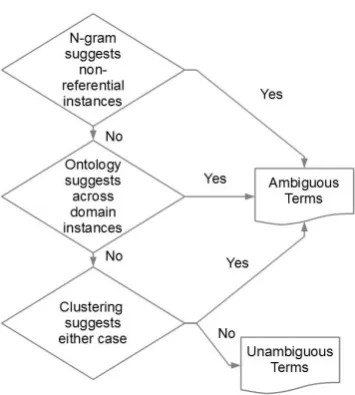
Our TAD framework is a hybrid approach consist-ing of three modules (Figure 1). The first module is primarily designed to detect non-referential am-biguity. This module examines n-gram data from a large text collection. Data from The Corpus of Contemporary American English (Davies, 2008 ) was used to build our n-grams.
The rationale behind the n-gram module is based on the understanding that terms appearing in named entity contexts are likely to be non-referential, and terms that can be non-referential are ambiguous. Therefore, detecting terms that have non-referential usages can also be used to detect ambiguity. Since we wish for the ambigu-ity detection determination to be fast, we develop our method to make this judgment solely on the n-gram probability, without the need to examine each individual usage context. To do so, we as-sume that an all lowercased version of the term is a reasonable proxy for non-named entity usages in formal text. After removing stopwords from the term, we calculate the n-gram probability of the lower-cased form of the remaining words. If the probability is above a certain threshold, the term is labeled as ambiguous. If the term is below the threshold, it is tentatively labeled as unambiguous and passed to the next module. To avoid making judgments of ambiguity based on very infrequent uses, the ambiguous-unambiguous determination
threshold is empirically determined by minimiz-ing error over held out data.
The second module employs ontologies to de-tect across domain ambiguity. Two ontologies were examined. To further handle the common phrase case, Wiktionary1was used as a dictionary.
Terms that have multiple senses in Wiktionary were labeled as ambiguous. The second ontology used was Wikipedia disambiguation pages. All terms that had a disambiguation page were marked as ambiguous.
The final module attempts to detect both non-referential and across domain ambiguity by clus-tering the contexts in which words appear. To do so, we utilized the popular Latent Dirichlet Allo-cation (LDA (Blei et al., 2003)) topic modeling method. LDA represents a document as a distri-bution of topics, and each topic as a distridistri-bution of words. As our domain of interest is Twitter, we performed clustering over a large collection of tweets. For a given term, all tweets that contained the term were used as a document collection. Fol-lowing standard procedure, stopwords and infre-quent words were removed before topic modeling was performed. Since the clustering mechanism was designed to make predictions over the already filtered data of the other modules, it adopts a con-servative approach to predicting ambiguity. If the category term (e.g., film) or a synonym from the WordNet synset does not appear in the 10 most heavily weighted words for any cluster, the term is marked as ambiguous.
A term is labeled as ambiguous if any one of the three modules predicts that it is ambiguous, but only labeled as unambiguous if all three mod-ules make this prediction. This design allows each module to be relatively conservative in predicting ambiguity, keeping precision of ambiguity predic-tion high, under the assumppredic-tion that other modules will compensate for the corresponding drop in re-call.
3 Experimental Evaluation
3.1 Data Set
Initial Term SetsWe collected a data set of terms from four topical domains: books, films, video games, andcameras. Terms for the first three do-mains are lists of books, films, and video games respectively from the years 2000-2011 from db-pedia (Auer et al., 2007), while the initial terms
Tweet Term Category Judgment
[image:3.595.108.496.62.105.2]Woke up from a nap to find a beautiful mind on. #win A Beautiful Mind film yes I Love Tyler Perry ; He Has A Beautiful Mind. A Beautiful Mind film no I might put it in the top 1. RT @CourtesyFlushMo Splice. Top 5 worst movies ever Splice film yes Splice is a great, free replacement to iMove for your iPhone, Splice film no
Table 1: Example tweet annotations.
Figure 1: Overview of the ambiguity detection framework.
forcamerasincludes all the cameras from the six most popular brands on flickr2.
Gold Standard A set of 100 terms per domain were chosen at random from the initial term sets. Rather than annotating each term directly, am-biguity was determined by examining actual us-age. Specifically, for each term, usage examples were extracted from large amounts of Twitter data. Tweets for thevideo gameandfilmcategories were extracted from the TREC Twitter corpus.3 The
less common book and camera cases were ex-tracted from a subset of all tweets from September 1st-9th, 2012.
For each term, two annotators were given the term, the corresponding topic domain, and 10 ran-domly selected tweets containing the term. They were then asked to make a binary judgment as to whether the usage of the term in the tweet referred to an instance of the given category. The degree of ambiguity is then determined by calculating the percentage of tweets that did not reference a mem-ber of the topic domain. Some example judgments are given in Table 1. If all individual tweet judg-ments for a term were marked as referring to a
2http://www.flickr.com/cameras/ 3http://trec.nist.gov/data/tweets/
Configuration Precision Recall F-measure
Baseline 0.675 1.0 0.806
NG 0.979 0.848 0.909
ON 0.979 0.704 0.819
CL 0.946 0.848 0.895
[image:3.595.91.269.144.342.2]NG + ON 0.980 0.919 0.948 NG + CL 0.942 0.963 0.952 ON + CL 0.945 0.956 0.950 NG + ON + CL 0.943 0.978 0.960
Table 2: Performance of various framework con-figurations on the test data.
member of the topic domain, the term was marked as fully unambiguous within the data examined. All other cases were considered ambiguous.4
Inter-annotator agreement was high, with raw agreement of 94% (κ = 0.81). Most disagree-ments on individual tweet judgdisagree-ments had little ef-fect on the final judgment of a term as ambiguous or unambiguous, and those that did were resolved internally.
3.2 Evaluation and Results
Effectiveness To understand the contribution of the n-gram (NG), ontology (ON), and clustering (CL) based modules, we ran each separately, as well as every possible combination. Results are shown in Table 2, where they are compared to a majority class (ambiguous) baseline.
As shown, all configurations outperform the baseline. Of the three individual modules, the n-gram and clustering methods achieve F-measure of around 0.9, while the ontology-based module performs only modestly above baseline. Unsur-prisingly, the ontology method is affected heav-ily by its coverage, so its poor performance is pri-marily attributable to low recall. As noted, many IE tasks may involve sets of entities that are not found in common ontologies, limiting the ability of the ontology-based method alone. Additionally, ontologies may be apt to list cases of strict ambi-guity, rather than practical ambiguity. That is, an ontology may list a term as ambiguous if there are
4The annotated data is available at http:
[image:3.595.315.517.147.241.2]several potential named entities it could refer to, even if the vast majority of references were to only a single entity.
Combining any two methods produced substan-tial performance increases over any of the individ-ual runs. The final system that employed all mod-ules produced an F-measure of 0.960, a significant (p < 0.01) absolute increase of 15.4% over the baseline.
Usefulness To establish that term ambiguity de-tection is actually helpful for IE, we conducted a preliminary study by integrating our pipeline into a commercially available rule-based IE sys-tem (Chiticariu et al., 2010; Alexe et al., 2012). The system takes a list of product names as input and outputs tweets associated with each product. It utilizes rules that employ more conservative ex-traction for ambiguous entities.
Experiments were conducted over several mil-lion tweets using the terms from the video game and camera domains. When no ambiguity detec-tion was performed, all terms were treated as un-ambiguous. The system produced very poor pre-cision of 0.16 when no ambiguity detection was used, due to the extraction of irrelevant instances of ambiguous objects. In contrast, the system pro-duced precision of 0.96 when ambiguity detection was employed. However, the inclusion of disam-biguation did reduce the overall recall; the system that employed disambiguation returned only about 57% of the true positives returned by the system that did not employ disambiguation. Although this reduction in recall is significant, the overall impact of disambiguation is clearly positive, due to the stark difference in precision. Nonetheless, this limited study suggests that there is substantial room for improvement in the extraction system, al-though this is out of the scope of the current work.
4 Related Work
Polysemy is a known problem for many NLP-related applications. Machine translation systems can suffer, as ambiguity in the source language may lead to incorrect translations, and unambigu-ous sentences in one language may become am-biguous in another (Carpuat and Wu, 2007; Chan et al., 2007). Ambiguity in queries can also hin-der the performance of information retrieval sys-tems (Wang and Agichtein, 2010; Zhong and Ng, 2012).
The ambiguity detection problem is similar to
the well studied problems of named entity dis-ambiguation (NED) and word sense disambigua-tion (WSD). However, these tasks assume that the number of senses a word has is given, essen-tially assuming that the ambiguity detection prob-lem has already been solved. This makes these tasks inapplicable in many IE instances where the amount of ambiguity is not known ahead of time. Both named entity and word sense disambigua-tion are extensively studied, and surveys on each are available (Nadeau and Sekine, 2007; Navigli, 2009).
Another task that shares similarities with TAD is word sense induction (WSI). Like NED and WSD, WSI frames the ambiguity problem as one of determining the sense of each individual in-stance, rather than the term as a whole. Unlike those approaches, the word sense induction task attempts to both figure out the number of senses a word has, and what they are. WSI is unsupervised, relying solely on the information that surrounds word mentions in the text.
Many different clustering-based WSI methods have been examined. Pantel and Lin (2002) em-ploy a clustering by committee method that itera-tively adds words to clusters based on their sim-ilarities. Topic model-based methods have been attempted using variations of Latent Dirichlet Al-location (Brody and Lapata, 2009) and Hierarchi-cal Dirichlet Processes (Lau et al., 2012). Sev-eral graph-based methods have also been exam-ined (Klapaftis and Manandhar, 2010; Navigli and Crisafulli, 2010). Although the words that sur-round the target word are the primary source of contextual information in most cases, additional feature sources such as syntax (Van de Cruys, 2008) and semantic relations (Chen and Palmer, 2004) have also been explored.
5 Conclusion
This paper introduced the term ambiguity detec-tion task, which detects whether a term is am-biguous relative to a topical domain. Unlike other ambiguity resolution tasks, the ambiguity detec-tion problem makes general ambiguity judgments about terms, rather than resolving individual in-stances. By doing so, it eliminates the need for ambiguity resolution on unambiguous objects, al-lowing for increased throughput of IE systems on large data sets.
task is based on a combined model with three dis-tinct modules based on n-grams, ontologies, and clustering. Our initial study suggests that the com-bination of different modules designed for differ-ent types of ambiguity used in our solution is ef-fective in determining whether a term is ambigu-ous for a given domain. Additionally, an exami-nation of a typical use case confirms that the pro-posed solution is likely to be useful in improving the performance of an IE system that does not em-ploy any disambiguation.
Although the task as presented here was mo-tivated with information extraction in mind, it is possible that term ambiguity detection could be useful for other tasks. For instance, TAD could be used to aid word sense induction more gener-ally, or could be applied as part of other tasks such as coreference resolution. We leave this avenue of examination to future work.
Acknowledgments
We would like to thank the anonymous review-ers of ACL for helpful comments and suggestions. We also thank Howard Ho and Rajasekar Krishna-murthy for help with data annotation and Shivaku-mar Vaithyanathan for his comments on a prelim-inary version of this work.
References
Bogdan Alexe, Mauricio A. Hern´andez, Kirsten Hil-drum, Rajasekar Krishnamurthy, Georgia Koutrika, Meenakshi Nagarajan, Haggai Roitman, Michal Shmueli-Scheuer, Ioana Roxana Stanoi, Chitra Venkatramani, and Rohit Wagle. 2012. Surfacing
time-critical insights from social media. In
SIG-MOD Conference, pages 657–660.
S¨oren Auer, Christian Bizer, Georgi Kobilarov, Jens Lehmann, Richard Cyganiak, and Zachary Ives. 2007. Dbpedia: a nucleus for a web of open data. InProceedings of the 6th international The seman-tic web and 2nd Asian conference on Asian semanseman-tic web conference, ISWC’07/ASWC’07, pages 722– 735, Berlin, Heidelberg. Springer-Verlag.
David Blei, Andrew Ng, and Micheal I. Jordan. 2003.
Latent dirichlet allocation. Journal of Machine
Learning Research, 3:993–1022, January.
Samuel Brody and Mirella Lapata. 2009. Bayesian
word sense induction. In Proceedings of the 12th
Conference of the European Chapter of the Asso-ciation for Computational Linguistics, EACL ’09, pages 103–111, Stroudsburg, PA, USA. Association for Computational Linguistics.
Marine Carpuat and Dekai Wu. 2007. Improving sta-tistical machine translation using word sense
disam-biguation. In Proceedings of the 2007 Joint
Con-ference on Empirical Methods in Natural Language Processing and Computational Natural Language Learning (EMNLP-CoNLL), pages 61–72.
Yee Seng Chan, Hwee Tou Ng, and David Chiang. 2007. Word sense disambiguation improves statisti-cal machine translation. InProceedings of the 45th Annual Meeting of the Association of Computational Linguistics, pages 33–40, Prague, Czech Republic, June. Association for Computational Linguistics.
Jinying Chen and Martha Palmer. 2004. Chinese verb sense discrimination using an em clustering model with rich linguistic features. InProceedings of the 42nd Annual Meeting on Association for Computa-tional Linguistics, ACL ’04, Stroudsburg, PA, USA. Association for Computational Linguistics.
Laura Chiticariu, Rajasekar Krishnamurthy, Yunyao Li, Sriram Raghavan, Frederick Reiss, and Shivaku-mar Vaithyanathan. 2010. SystemT: An algebraic approach to declarative information extraction. In
ACL, pages 128–137.
Mark Davies. 2008-. The corpus of
contempo-rary american english: 450 million words,
1990-present. Avialable online at: http://corpus.
byu.edu/coca/.
Ioannis P. Klapaftis and Suresh Manandhar. 2010. Word sense induction & disambiguation using
hi-erarchical random graphs. In Proceedings of the
2010 Conference on Empirical Methods in Natural Language Processing, EMNLP ’10, pages 745–755, Stroudsburg, PA, USA. Association for Computa-tional Linguistics.
Jey Han Lau, Paul Cook, Diana McCarthy, David New-man, and Timothy Baldwin. 2012. Word sense in-duction for novel sense detection. InProceedings of the 13th Conference of the European Chapter of the Association for Computational Linguistics, EACL ’12, pages 591–601, Stroudsburg, PA, USA. Asso-ciation for Computational Linguistics.
David Nadeau and Satoshi Sekine. 2007. A survey of named entity recognition and classification. Lin-guisticae Investigationes, 30(1):3–26.
Roberto Navigli and Giuseppe Crisafulli. 2010. Induc-ing word senses to improve web search result
clus-tering. InProceedings of the 2010 Conference on
Empirical Methods in Natural Language
Process-ing, EMNLP ’10, pages 116–126, Stroudsburg, PA,
USA. Association for Computational Linguistics.
Roberto Navigli. 2009. Word sense disambiguation:
A survey. ACM Comput. Surv., 41(2):10:1–10:69,
February.
ACM SIGKDD international conference on Knowl-edge discovery and data mining, KDD ’02, pages 613–619, New York, NY, USA. ACM.
Tim Van de Cruys. 2008. Using three way data for
word sense discrimination. In Proceedings of the
22nd International Conference on Computational Linguistics - Volume 1, COLING ’08, pages 929– 936, Stroudsburg, PA, USA. Association for Com-putational Linguistics.
Yu Wang and Eugene Agichtein. 2010. Query ambigu-ity revisited: Clickthrough measures for
distinguish-ing informational and ambiguous queries. InHuman
Language Technologies: The 2010 Annual Confer-ence of the North American Chapter of the Associa-tion for ComputaAssocia-tional Linguistics, pages 361–364, Los Angeles, California, June. Association for Com-putational Linguistics.
Zhi Zhong and Hwee Tou Ng. 2012. Word sense disambiguation improves information retrieval. In