Large-Scale Syntactic Language Modeling with Treelets
Adam Pauls Dan Klein Computer Science Division University of California, Berkeley
Berkeley, CA 94720, USA
{adpauls,klein}@cs.berkeley.edu
Abstract
We propose a simple generative, syntactic language model that conditions on overlap-ping windows of tree context (ortreelets) in the same way that n-gram language models
condition on overlapping windows of linear context. We estimate the parameters of our model by collecting counts from automati-cally parsed text using standardn-gram
lan-guage model estimation techniques, allowing us to train a model on over one billion tokens of data using a single machine in a matter of hours. We evaluate on perplexity and a range of grammaticality tasks, and find that we per-form as well or better thann-gram models and
other generative baselines. Our model even competes with state-of-the-art discriminative models hand-designed for the grammaticality tasks, despite training on positive data alone. We also show fluency improvements in a pre-liminary machine translation experiment.
1 Introduction
N-gram language models are a central component
of all speech recognition and machine translation systems, and a great deal of research centers around refining models (Chen and Goodman, 1998), ef-ficient storage (Pauls and Klein, 2011; Heafield, 2011), and integration into decoders (Koehn, 2004; Chiang, 2005). At the same time, becausen-gram
language models only condition on a local window of linear word-level context, they are poor models of long-range syntactic dependencies. Although sev-eral lines of work have proposed generative syntac-tic language models that improve onn-gram
mod-els for moderate amounts of data (Chelba, 1997; Xu et al., 2002; Charniak, 2001; Hall, 2004; Roark,
2004), these models have only recently been scaled to the impressive amounts of data routinely used by
n-gram language models (Tan et al., 2011).
In this paper, we describe a generative, syntac-tic language model that conditions on local con-text treelets1 in a parse tree, backing off to smaller treelets as necessary. Our model can be trained sim-ply by collecting counts and using the same smooth-ing techniques normally applied to n-gram
mod-els (Kneser and Ney, 1995), enabling us to apply techniques developed for scalingn-gram models out
of the box (Brants et al., 2007; Pauls and Klein, 2011). The simplicity of our training procedure al-lows us to train a model on a billion tokens of data in a matter of hours on a single machine, which com-pares favorably to the more involved training algo-rithm of Tan et al. (2011), who use a two-pass EM training algorithm that takes several days on several hundred CPUs using similar amounts of data.
The simplicity of our approach also contrasts with recent work on language modeling with tree sub-stitution grammars (Post and Gildea, 2009), where larger treelet contexts are incorporated by using so-phisticated priors to learn a segmentation of parse trees. Such an approach implicitly assumes that a “correct” segmentation exists, but it is not clear that this is true in practice. Instead, we build upon the success ofn-gram language models, which do not
assume a segmentation and instead score all over-lapping contexts.
We evaluate our model in terms of perplexity, and show that we achieve the same performance as a state-of-the-artn-gram model. We also evaluate our
model on several grammaticality tasks proposed in
1We borrow the termtreeletfrom Quirk et al. (2005), who
use it to refer to an arbitrary connected subgraph of a tree.
(a)The index fell 109.85 Monday . (b) ROOT S-VBDˆROOT NP-NN DT-the The NN index VP-VBDˆS VBD fell CD-DC 109.85 NNTP Monday . . (c) ROOT S-VBDˆROOT NP-NN DT-the The NN index VP-VBDˆS VBD fell CD-DC 109.85 NNTP Monday . . 5-GRAM
The board ’s will soon be feasible , from everyday which Coke ’s cabinet hotels .
They are all priced became regulatory action by difficulty caused nor Aug. 31 of Helmsley-Spear : Lakeland , it may take them if the 46-year-old said the loss of the Japanese executives at him : But 8.32 % stake in and Rep. any money for you got from several months , ” he says .
TREELET
Why a$1.2 million investment in various types of the bulk of TVS E. August ?
“ One operating price position has a system that has Quartet for the first time , ” he said . He may enable drops to take , but will hardly revive the rush to develop two-stroke calculations . ” The centers are losses of meals , and the runs are willing to like them .
Table 1: The first four samples of length between 15 and 20 generated from the 5-GRAMand TREELETmodels.
rule context would need its own state in the gram-mar), and extensive pruning would be in order.
In practice, however, language models are nor-mally integrated into a decoder, a non-trivial task that is highly problem-dependent and beyond the scope of this paper. However, we note that for machine translation, a model that builds target-side constituency parses, such as that of Galley et al. (2006), combined with an efficient pruning strategy like cube pruning (Chiang, 2005), should be able to integrate our model without much difficulty.
That said, for evaluation purposes, whenever we need to query our model, we use the simple strategy of parsing a sentence using a black box parser, and summing over our model’s probabilities of the 1000-best parses.4 Note that the bottleneck in this case
is the parser, so our model can essentially score a sentence at the speed of a parser.
5 Experiments
We evaluate our model along several dimensions. We first show some sample sentences generated by our model in Section 5.1. We report perplexity
re-4We found that using the 1-best worked just as well as the
1000-best on our grammaticality tasks, but significantly overes-timated our model’s perplexities.
sults in Section 5.2. In Section 5.3, we measure its ability to distinguish between grammatical En-glish and various types of automatically generated, or pseudo-negative,5 English. We report machine
translation reranking results in Section 5.4.
5.1 Generating Samples
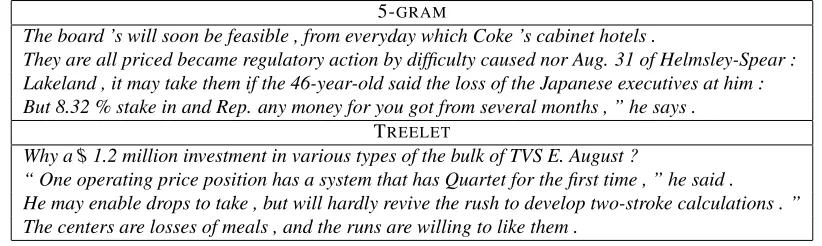
Because our model is generative, we can qualita-tively assess it by generating samples and verifying that they are more syntactically coherent than other approaches. In Table 1, we show the first four sam-ples of length between 15 and 20 generated from both model and a 5-gram model trained on the Penn Treebank.
5.2 Perplexity
Perplexity is the standard intrinsic evaluation metric for language models. It measures the inverse of the per-word probability a model assigns to some held-out set of grammatical English (so lower is better). For training data, we constructed a large treebank by concatenating the Penn Treebank, the Brown Cor-pus, the 50K BLLIP training sentences from Post (2011), and the AFP and APW portions of English
5We follow Okanohara and Tsujii (2007) in using the term
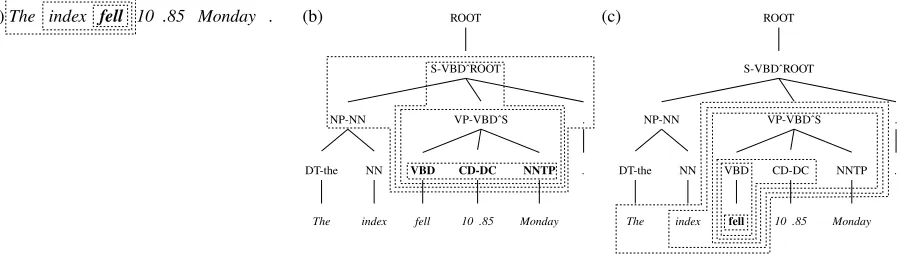
[image:2.612.83.535.66.193.2]pseudo-negative to highlight the fact that automatically gener-ated negative examples might not actually be ungrammatical. Figure 1: Conditioning contexts and back-off strategies for Markov models. The bolded symbol indicates the part of the tree/sentence being generated, and the dotted lines represent the conditioning contexts; back-off proceeds from the largest to the smallest context. (a) A trigram model. (b) The context used for non-terminal productions in our treelet model. For this context,
P=VP-VBDˆS,P0=S-VBDˆROOT, andr0=S-VBDˆROOT→NP-NN VP-VBDˆS . (c) The context used for terminal productions in our treelet model. Here,P=VBD,R=CD-DC,r0=VP-VBDˆS→VBD CD-DC NNTP,w−1=index, andw−2=The. Note that the
tree is a modified version of a standard Penn Treebank parse – see Section 3 for details.
the literature (Okanohara and Tsujii, 2007; Foster et al., 2008; Cherry and Quirk, 2008) and show that it consistently outperforms ann-gram model as well
as other head-driven and tree-driven generative base-lines. Our model even competes with state-of-the-art discriminative classifiers specifically designed for each task, despite being estimated on positive data alone. We also show fluency improvements in a pre-liminary machine translation reranking experiment.
2 Treelet Language Modeling
The common denominator of mostn-gram language
models is that they assign probabilities roughly ac-cording to empirical frequencies for observed n
-grams, but fall back to distributions conditioned on smaller contexts for unobservedn-grams, as shown
in Figure 1(a). This type of smoothing is both highly robust and easy to implement, requiring only the col-lection of counts from data.
We would like to apply the same smoothing tech-niques to distributions over rule yields in a con-stituency tree, conditioned on contexts consisting of previously generated treelets (rules, nodes, etc.). Formally, letT be a constituency tree consisting of
context-free rules of the formr = P → C1· · ·Cd,
whereP is the parent symbol of rule r and C1d =
C1. . . Cdare its children. We wish to assign
proba-bilities to trees2
2A distribution over trees also induces a distribution over
sentencesw1` given by p(w`1) =
P
T:s(T)=w`
1p(T), where
p(T) = Y
r∈T
p(C1d|h)
where the conditioning contexthis some portion of
the already-generated parts of the tree. In this paper, we assume that the children of a rule are expanded from left to right, so that when generating the yield
C1d, all treelets above and left of the parent P are
available. Note that a raw PCFG would condition only onP, i.e.h=P.
As in then-gram case, we would like to pickh
to be large enough to capture relevant dependencies, but small enough that we can obtain meaningful es-timates from data. We start with a straightforward choice of context: we condition onP, as well as the
ruler0that generatedP, as shown in in Figure 1(b).
Conditioning on the parent rule r0 allows us to
capture several important dependencies. First, it captures both P and its parent P0, which predicts
the distribution over child symbols far better than just P (Johnson, 1998). Second, it captures
posi-tional effects. For example, subject and object noun phrases (NPs) have different distributions (Klein and Manning, 2003), and the position of an NP relative to a verb is a good indicator of this distinction. Fi-nally, the generation of words at preterminals can condition on siblings, allowing the model to capture, for example, verb subcategorization frames.
We should be clear that we are not the first
to use back-off-based smoothing for syntactic lan-guage modeling – such techniques have been ap-plied to models that condition on head-word con-texts (Charniak, 2001; Roark, 2004; Zhang, 2009). Parent rule context has also been employed in trans-lation (Vaswani et al., 2011). However, to our knowledge, we are the first to apply these techniques for language modeling on large amounts of data.
2.1 Lexical context
Although it is tempting to think that we can replace the left-to-right generation ofn-gram models with
the purely top-down generation of typical PCFGs, in practice, words are often highly predictive of the words that follow them – indeed, n-gram models
would be terrible language models if this were not the case. To capture linear effects, we extend the context for terminal (lexical) productions to include the previous two wordsw−2andw−1in the sentence in addition tor0; see Figure 1(c) for a depiction. This
allows us to capture collocations and other lexical correlations.
2.2 Backing off
As withn-gram models, counts for rule yields
con-ditioned onr0are sparse, and we must choose an
ap-propriate back-off strategy. We handle terminal and non-terminal productions slightly differently.
For non-terminal productions, we back off from
r0 to P and its parent P0, and then to just P.
That is, we back off from a rule-annotated gram-mar p(C1d|P, P0, r0) to a parent-annotated gram-mar (Johnson, 1998) p(C1d|P, P0), then to a raw PCFGp(C1d|P). In order to generalize to unseen rule yields C1d, we further back off from the
ba-sic PCFG probabilityp(C1d|P)top(Ci|Cii−−31, P), a 4-gram model over symbols C conditioned on P,
interpolated with an unconditional 4-gram model
p(Ci|Cii−−31). In other words, we back off from a raw PCFG to
λ d Y
i=1
p(Ci|Cii−−31, P) + (1−λ) d Y
i=1
p(Ci|Cii−−31)
whereλ= 0.9is an interpolation constant.
For terminal (i.e lexical) productions, we first remove lexical context, backing off from
p(w|P, R, r0, w−1, w−2) to p(w|P, R, r0, w−1) and then p(w|P, R, r0). From there, we back off to
p(w|P, R)whereRis the sibling immediately to the
right ofP, then to a raw PCFGp(w|P), and finally to a unigram distribution. We chose this scheme be-causep(w|P, R) allows, for example, a verb to be generated conditioned on the non-terminal category of the argument it takes (since arguments usually im-mediately follow verbs). We depict these two back-off schemes pictorially in Figure 1(b) and (c).
2.3 Estimation
Estimating the probabilities in our model can be done very simply using the same techniques (in fact, the same code) used to estimate n-gram language
models. Our model requires estimates of four distri-butions: p(C1d|P, P0, r0), p(w|P, R, r0, w−1, w−2),
p(Ci|Cii−−n1+1, P), and p(Ci|Cii−−n1+1). In each case, we require empirical counts of treelet tuples in the same way that we require counts of word tuples for estimatingn-gram language models.
There is one additional hurdle in the estimation of our model: while there exist corpora with human-annotated constituency parses like the Penn Tree-bank (Marcus et al., 1993), these corpora are quite small – on the order of millions of tokens – and we cannot gather nearly as many counts as we can forn
-grams, for which billions or even trillions (Brants et al., 2007) of tokens are available on the Web. How-ever, we can use one of several high-quality con-stituency parsers (Collins, 1997; Charniak, 2000; Petrov et al., 2006) to automatically generate parses. These parses may contain errors, but not all parsing errors are problematic for our model, since we only care about the sentences generated by our model and not the parses themselves. We show in our experi-ments that the addition of data with automatic parses does improve the performance of our language mod-els across a range of tasks.
3 Tree Transformations
ROOT
S-VBˆROOT
PRP-he
He
VP-VBˆS
VB
reset
NP-NNS
JJ
opening
NNS
arguments
PP-for
IN-for
for NNT
today .
[image:4.612.87.298.63.198.2].
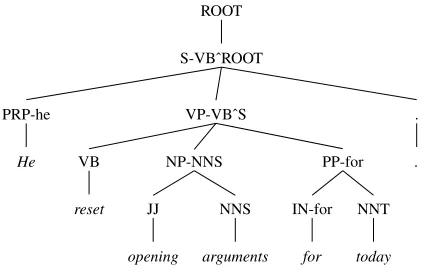
Figure 2: A sample parse from the Penn Treebank after the tree transformations described in Section 3. Note that we have not shown head tag annotations on preterminals because in that case, the head tag is the preterminal itself.
number of transformations of Treebank constituency parses that allow us to capture such dependencies. We list the annotations and deletions in the order in which they are performed. A sample transformed tree is shown in Figure 2.
Temporal NPs Following Klein and Manning (2003), we attempt to annotate temporal noun phrases. Although the Penn Treebank annotates temporal NPs, most off-the-shelf parsers do not retain these tags, and we do not as-sume their presence. Instead, we mark any noun that is the head of a NP-TMP constituent at least once in the Treebank as a temporal noun, so for exampletodaywould be tagged as NNT andmonthswould be tagged as NNTS.
Head Annotations We annotate every non-terminal or preterminal with its head word if the head is a closed-class word3and with its head tag otherwise. Klein and Manning (2003) used head tag annotation extensively, though they applied their splits much more selectively.
NP Flattening We delete NPs dominated by other NPs, unless the child NPs are in coordi-nation or apposition. These NPs typically oc-cur when nouns are modified by PPs, as in
(NP(NP (NNstock) (NNSsales)) (PP(INby) (NNStraders))). By
removing the dominated NP, we allow the production NNS→salesto condition on the presence of a modifying PP (here a PP head-annotated withby).
Number Annotations Numbers are divided into five classes: CD-YR for numbers that consist of four digits (which are usually years); CD-NM for entirely numeric numbers; DC for numbers that have a decimal;
CD-3We define the following to be closed class words: any
punc-tuation; all inflections of the verbsdo,be, andhave; and any word tagged with IN, WDT, PDT, WP, WP$, TO, WRB, RP, DT, SYM, EX, POS, PRP, AUX, or CC.
MX for numbers that mix letters and digits; and CD-AL for numbers that are entirely alphabetic.
SBAR Flattening We remove any sentential (S) nodes immediately dominated by an SBAR. S nodes under SBAR have very distinct distributions from other senten-tial nodes, mostly due to empty subjects and/or objects.
VP Flattening We remove any VPs immediately domi-nating a VP, unless it is conjoined with another VP. In the Treebank, chains of verbs (e.g.will be going) have a sep-arate VP for each verb. By flattening such structures, we allow the main verb and its arguments to condition on the whole chain of verbs. This effect is particularly important for passive constructions.
Gapped Sentence Annotation Collins (1999) and Klein and Manning (2003) annotate nodes which have empty subjects. Because we only assume the presence of automatically derived parses, which do not produce the empty elements in the original Treebank, we must identify such elements on our own. We use a very simple procedure: we annotate all S or SBAR nodes that have a VP before any NPs.
Parent Annotation We annotate all VPs with their par-ent symbol. Because our treelet model already conditions on the parent, this has the effect of allowing verbs to con-dition on their grandparents. This was important for VPs under SBAR nodes, which often have empty objects. We also parent-annotated any child of the ROOT.
Unary Deletion We remove all unary productions ex-cept the root and preterminal productions, keeping only the bottom-most symbol. Because we are not interested in the internal labels of the trees, unaries are largely a nuisance, and their removal brings many symbols into the context of others.
4 Scoring a Sentence
Computing the probability of a sentencew`1 under
our model requires summing over all possible parses ofw`1. Although our model can be formulated as a
straightforward PCFG, allowingO(`3)computation of this sum, the grammar constant for this PCFG would be unmanageably large (since every parent rule context would need its own state in the gram-mar), and extensive pruning would be in order.
5-GRAM
The board ’s will soon be feasible , from everyday which Coke ’s cabinet hotels .
They are all priced became regulatory action by difficulty caused nor Aug. 31 of Helmsley-Spear : Lakeland , it may take them if the 46-year-old said the loss of the Japanese executives at him : But 8.32 % stake in and Rep. any money for you got from several months , ” he says .
TREELET
Why a$1.2 million investment in various types of the bulk of TVS E. August ?
[image:5.612.100.511.61.184.2]“ One operating price position has a system that has Quartet for the first time , ” he said . He may enable drops to take , but will hardly revive the rush to develop two-stroke calculations . ” The centers are losses of meals , and the runs are willing to like them .
Table 1: The first four samples of length between 15 and 20 generated from the 5-GRAMand TREELETmodels.
2005), should be able to integrate our model without much difficulty.
That said, for evaluation purposes, whenever we need to query our model, we use the simple strategy of parsing a sentence using a black box parser, and summing over our model’s probabilities of the 1000-best parses.4 Note that the bottleneck in this case is the parser, so our model can essentially score a sentence at the speed of a parser.
5 Experiments
We evaluate our model along several dimensions. We first show some sample generated sentences in Section 5.1. We report perplexity results in Sec-tion 5.2. In SecSec-tion 5.3, we measure its ability to distinguish between grammatical English and var-ious types of automatically generated, or pseudo-negative,5 English. We report machine translation reranking results in Section 5.4.
5.1 Generating Samples
Because our model is generative, we can qualita-tively assess it by generating samples and verifying that they are more syntactically coherent than other approaches. In Table 1, we show the first four sam-ples of length between 15 and 20 generated from our model and a 5-gram model trained on the Penn Tree-bank.
4We found that using the 1-best worked just as well as the
1000-best on our grammaticality tasks, but significantly overes-timated our model’s perplexities.
5We follow Okanohara and Tsujii (2007) in using the term
pseudo-negative to highlight the fact that automatically gener-ated negative examples might not actually be ungrammatical.
5.2 Perplexity
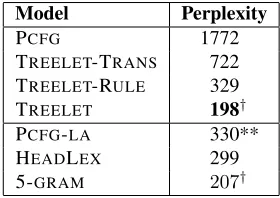
Perplexity is the standard intrinsic evaluation metric for language models. It measures the inverse of the per-word probability a model assigns to some held-out set of grammatical English (so lower is better). For training data, we constructed a large treebank by concatenating the WSJ and Brown portions of the Penn Treebank, the 50K BLLIP training sentences from Post (2011), and the AFP and APW portions of English Gigaword version 3 (Graff, 2003), total-ing about 1.3 billion tokens. We used the human-annotated parses for the sentences in the Penn Tree-bank, but parsed the Gigaword and BLLIP sentences with the Berkeley Parser. Hereafter, we refer to this training data as our 1B corpus. We used Section 0 of the WSJ as our test corpus. Results are shown in Table 2. In addition to our TREELETmodel, we also
show results for the following baselines:
5-GRAM A 5-gram interpolated Kneser-Ney model.
PCFG-LA The Berkeley Parser in language model mode.
HEADLEX A head-lexicalized model similar to, but more powerful6than, Collins Model 1 (Collins, 1999).
PCFG A raw PCFG.
TREELET-TRANS A PCFG estimated on the trees after
the transformations of Section 3.
TREELET-RULE The TREELET-TRANSmodel with the
parent rule context described in Section 2. This is equiv-alent to the full TREELETmodel without the lexical con-text described in Section 2.1.
6Specifically, like Collins Model 1, we generate a rule yield
conditioned on parent symbolPand head wordhby first
gen-erating its head symbolCh, then generating the head words and
symbols for left and right modifiers outwards fromCh. Unlike
Model 1, which generates each modifier head and symbol con-ditioned only onCh,h, andP, we additionally condition on the
Model Perplexity
PCFG 1772
TREELET-TRANS 722 TREELET-RULE 329
TREELET 198†
PCFG-LA 330**
HEADLEX 299
[image:6.612.116.256.60.159.2]5-GRAM 207†
Table 2: Perplexity of several generative models on Sec-tion 0 of the WSJ. The differences between scores marked with†are not statistically significant. PCFG-LA(marked with **) was only trained on the WSJ and Brown corpora because it does not scale to large amounts of data.
We used the Berkeley LM toolkit (Pauls and Klein, 2011), which implements Kneser-Ney smoothing, to estimate all back-off models for both
n-gram and treelet models. To deal with unknown
words, we use the following strategy: after the first 10000 sentences, whenever we see a new word in our training data, we replace it with a signature7 10% of the time.
Our model outperforms all other generative mod-els, though the improvement over then-gram model
is not statistically significant. Note that because we use ak-best approximation for the sum over trees,
all perplexities (except for PCFG-LAand 5-GRAM)
are pessimistic bounds.
5.3 Classification of Pseudo-Negative Sentences
We make use of three kinds of automatically gener-ated pseudo-negative sentences previously proposed in the literature: Okanohara and Tsujii (2007) pro-posed generating pseudo-negative examples from a trigram language model; Foster et al. (2008) create “noisy” sentences by automatically inserting a sin-gle error into grammatical sentences with a script that randomly deletes, inserts, or misspells a word; and Och et al. (2004) and Cherry and Quirk (2008) both use the 1-best output of a machine translation system. Examples of these three types of pseudo-negative data are shown in Table 3. We evaluate our model’s ability to distinguish positive from pseudo-negative data, and compare against generative base-lines and state-of-the-art discriminative methods.
7We use signatures generated by the Berkeley Parser.
These signatures capture surface features such as capitalization, presents of digits, and common suffixes. For example, the word vexingwould be replaced with the signature UNK-ing.
Noisy There was were many contributors. Trigram For years in dealer immediately . MT we must further steps .
Table 3: Sample pseudo-negative sentences. We would like to use our model to make grammat-icality judgements, but as a generative model it can only provide us with probabilities. Simply thresh-olding generative probabilities, even with a separate threshold for each length, has been shown to be very ineffective for grammaticality judgements, both for
n-gram and syntactic language models (Cherry and
Quirk, 2008; Post, 2011). We used a simple measure for isolating the syntactic likelihood of a sentence: we take the log-probability under our model and subtract the log-probability under a unigram model, then normalize by the length of the sentence.8 This measure, which we call thesyntactic log-odds ratio
(SLR), is a crude way of “subtracting out” the se-mantic component of the generative probability, so that sentences that use rare words are not penalized for doing so.
5.3.1 Trigram Classification
To facilitate comparison with previous work, we used the same negative corpora as Post (2011) for trigram classification. They randomly selected 50K train, 3K development, and 3K positive test sen-tences from the BLLIP corpus, then trained a tri-gram model on 450K BLLIP sentences and gener-ated 50K train, 3K development, and 3K negative sentences. We parsed the 50K positive training ex-amples of Post (2011) with the Berkeley Parser and used the resulting treebank to train a treelet language model. We set an SLR threshold for each model on the 6K positive and negative development sentences. Results are shown in Table 4. In addition to our generative baselines, we show results for the dis-criminative models reported in Cherry and Quirk (2008) and Post (2011). The former train a latent PCFG support vector machine for binary classifica-tion (LSVM). The latter report results for two
bi-nary classifiers: RERANK uses the reranking
fea-tures of Charniak and Johnson (2005), and TSGuses
8Och et al. (2004) also report using a parser probability
[image:6.612.326.522.61.97.2]Generative
BLLIP 1B
PCFG 81.5 81.8
TREELET-TRANS 87.7 90.1 TREELET-RULE 89.8 94.1
TREELET 88.9 93.3
PCFG-LA 87.1* –
HEADLEX 87.6 92.0
5-GRAM 67.9 87.5
Discriminative
BLLIP 1B
LSVM 81.42** –
TSG 89.9 –
[image:7.612.115.261.56.216.2]RERANK 93.0 –
Table 4: Classification accuracy for trigram pseudo-negative sentences on the BLLIP corpus. The number reported for PCFG-LAis marked with a * to indicate that this model was trained on the training section of the WSJ, not the BLLIP cor-pus. The number reported for LSVM(marked with **) was eval-uated on a different random split of the BLLIP corpus, and so is not directly comparable.
indicator features extracted from a tree substitution grammar derivation of each sentence.
Our TREELET model performs nearly as well as
the TSGmethod, and substantially outperforms the
LSVMmethod, though the latter was not tested on
the same random split. Interestingly, the TREELET
-RULEbaseline, which removes lexical context from
our model, outperforms the full model. This is likely because the negative data is largely coherent at the trigram level (because it was generated from a tri-gram model), and the full model is much more sen-sitive to trigram coherence than the TREELET-RULE
model. This also explains the poor performance of the 5-GRAMmodel.
We emphasize that the discriminative baselines arespecificallytrained to separate trigram text from natural English, while our model is trained on pos-itive examples alone. Indeed, the methods in Post (2011) are simple binary classifiers, and it is not clear that these models would be properly calibrated for any other task, such as integration in a decoder.
One of the design goals of our system was that it be scalable. Unlike some of the discriminative baselines, which require expensive operations9 on
9It is true that in order train our system, one must parse large
amounts of training data, which can be costly, though it only needs to be done once. In contrast, even with observed train-ing trees, the discriminative algorithms must still iteratively per-form expensive operations (like parsing) for each sentence, and a new model must be trained for new types of negative data.
Model Pairwise Independent
WSJ 1B WSJ 1B
PCFG 79.1 77.0 58.9 58.6
TREELET-RULE 90.3 94.4 63.8 66.2
TREELET 90.7 94.5 63.4 65.5
5-GRAM 86.3 93.5 55.7 60.1
HEADLEX 90.7 94.0 59.5 62.0
PCFG-LA 91.3 – 59.7 –
Foster et al. (2008) – – 65.9 – Table 5: Classification accuracies on the noisy WSJ for mod-els trained on WSJ Sections 2-21 and our 1B token corpus. “Pairwise” accuracy is the fraction of correct sentences whose SLR score was higher than its noisy version, and “independent” refers to standard binary classification accuracy.
each training sentence, we can very easily scale our model to much larger amounts of data. In Ta-ble 4, we also show the performance of the ative models trained on our 1B corpus. All gener-ative models improve, but TREELET-RULEremains
the best, now outperforming the RERANK system,
though of course it is likely that RERANKwould
im-prove if it could be scaled up to more training data.
5.3.2 “Noisy” Classification
We also evaluate the performance of our model on the task of distinguishing the noisy WSJ sen-tences of Foster et al. (2008) from their original versions. We use the noisy versions of Section 0 and 23 produced by their error-generating proce-dure. Because they only report classification re-sults on Section 0, we used Section 23 to tune an SLR threshold, and tested our model on Section 0. We show the results of both independent and pair-wise classification for the WSJ and 1B training sets in Table 5. Note that independent classification is much more difficult than for the trigram data, be-cause sentences contain at most one change, which may not even result in an ungrammaticality. Again, our model outperforms then-gram model for both
types of classification, and achieves the same per-formance as the discriminative system of Foster et al. (2008), which is state-of-the-art for this data set. The TREELET-RULE system again slightly
outper-forms the full TREELETmodel at independent
clas-sification, though not at pairwise classification. This probably reflects the fact that semantic coherence can still influence the SLR score, despite our efforts to subtract it out. Because the TREELET model
[image:7.612.326.527.61.163.2]seman-French German Chinese
5-GRAM 44.8 37.8 60.0
[image:8.612.95.277.62.98.2]TREELET 57.9 66.0 83.8
Table 6: Pairwise comparison accuracy of MT output against a reference translation for French, German, and Chinese. The BLEU scores for these outputs are 32.7, 27.8, and 20.8. This task becomes easier, at least for our TREELETmodel, as translation quality drops. Cherry and Quirk (2008) report an accuracy of 71.9% on a similar experiment with German a source language, though the translation system and training data were different so the numbers are not comparable. In particular, their transla-tions had a lower BLEU score, making their task easier.
tic coherence and thus more likely to misclassify semantically coherent but ungrammatical sentences. For pairwise comparisons, where semantic coher-ence is effectively held constant, such sentcoher-ences are not problematic.
5.3.3 Machine Translation Classification
We follow Och et al. (2004) and Cherry and Quirk (2008) in evaluating our language models on their ability to distinguish the 1-best output of a machine translation system from a reference translation in a pairwise fashion. Unfortunately, we do not have access to the data used in those papers, so a di-rect comparison is not possible. Instead, we col-lected the English output of Moses (Hoang et al., 2007), using both French and German as source lan-guage, trained on the Europarl corpus used by WMT 2009.10 We also collected the output of Joshua (Li et al., 2009) trained on 500K sentences of GALE Chinese-English parallel newswire. We trained both our TREELET model and a 5-GRAM model on the
union of our 1B corpus and the English sides of our parallel corpora.
In Table 6, we show the pairwise comparison ac-curacy (using SLR) on these three corpora. We see that our system prefers the reference much more of-ten than the 5-GRAM language model.11 However,
we also note that the easiness of the task is corre-lated with the quality of translations (as measured in BLEU score). This is not surprising – high-quality translations are often grammatical and even a
per-10http://www.statmt.org/wmt09
11We note that then-gram language model used by the MT
system was much smaller than the 5-GRAMmodel, as they were only trained on the English sides of their parallel data.
fect language model might not be able to differenti-ate such translations from their references.
5.4 Machine Translation Fluency
We also carried out reranking experiments on 1000-best lists from Moses using our syntactic language model as a feature. We did not find that the use of our syntactic language model made any statis-tically significant increases in BLEU score. How-ever, we noticed in general that the translations fa-vored by our model were more fluent, a useful im-provement to which BLEU is often insensitive. To confirm this, we carried out an Amazon Mechan-ical Turk experiment where users from the United States were asked to compare translations using our TREELET language model as the language model
feature to those using the 5-GRAMmodel.12We had
1000 such translation pairs rated by 4 separate Turk-ers each. Although these two hypothesis sets had the same BLEU score (up to statistical significance), the Turkers preferred the output obtained using our syntactic language model 59% of the time, indicat-ing that our model had managed to pick out more fluent hypotheses that nonetheless were of the same BLEU score. This result was statistically significant withp <0.001using bootstrap resampling.
6 Conclusion
We have presented a simple syntactic language model that can be estimated using standardn-gram
smoothing techniques on large amounts of data. Our model outperforms generative baselines on several evaluation metrics and achieves the same perfor-mance as state-of-the-art discriminative classifiers specifically trained on several types of negative data.
Acknowledgments
We would like to thank David Hall for some modeling suggestions and the anonymous reviewers for their com-ments. We thank both Matt Post and Jennifer Foster for providing us with their corpora. This work was partially supported by a Google Fellowship to the first author and by BBN under DARPA contract HR0011-12-C-0014.
12We used translations from the baseline Moses system of
Section 5.3.3 with German as the input language. For each lan-guage model, we tookk-best lists from the baseline system and
References
Thorsten Brants, Ashok C. Popat, Peng Xu, Franz J. Och, Jeffrey Dean, and Google Inc. 2007. Large lan-guage models in machine translation. InProceedings of the Conference on Empirical Methods in Natural Language Processing.
Eugene Charniak and Mark Johnson. 2005. Coarse-to-fine n-best parsing and maxent discriminative rerank-ing. InProceedings of the Association for Computa-tional Linguistics.
Eugene Charniak. 2000. A maximum-entropy-inspired parser. InProceedings of the North American chapter of the Association for Computational Linguistics. Eugene Charniak. 2001. Immediate-head parsing for
language models. InProceedings of the Association for Computational Linguistics.
Ciprian Chelba. 1997. A structured language model. In Proceedings of the Association for Computational Lin-guistics.
Stanley F. Chen and Joshua Goodman. 1998. An empir-ical study of smoothing techniques for language mod-eling. InProceedings of the Association for Computa-tional Linguistics.
Colin Cherry and Chris Quirk. 2008. Discriminative, syntactic language modeling through latent SVMs. In Proceedings of The Association for Machine Transla-tion in the Americas.
David Chiang. 2005. A hierarchical phrase-based model for statistical machine translation. InThe Annual Con-ference of the Association for Computational Linguis-tics.
Michael Collins. 1997. Three generative, lexicalised models for statistical parsing. InProceedings of As-sociation for Computational Linguistics.
Michael Collins. 1999. Head-Driven Statistical Models for Natural Language Parsing. Ph.D. thesis, Univer-sity of Pennsylvania.
Jennifer Foster, Joachim Wagner, and Josef van Genabith. 2008. Adapting a wsj-trained parser to grammatically noisy text. InProceedings of the Association for Com-putational Linguistics: Short Paper Track.
Michel Galley, Jonathan Graehl, Kevin Knight, Daniel Marcu, Steve DeNeefe, Wei Wang, and Ignacio Thayer. 2006. Scalable inference and training of context-rich syntactic translation models. InThe An-nual Conference of the Association for Computational Linguistics (ACL).
David Graff. 2003. English gigaword, version 3. In Lin-guistic Data Consortium, Philadelphia, Catalog Num-ber LDC2003T05.
Keith Hall. 2004. Best-first Word-lattice Parsing: Tech-niques for Integrated Syntactic Language Modeling. Ph.D. thesis, Brown University.
Kenneth Heafield. 2011. Kenlm: Faster and smaller language model queries. InProceedings of the Sixth Workshop on Statistical Machine Translation. Hieu Hoang, Alexandra Birch, Chris Callison-burch,
Richard Zens, Rwth Aachen, Alexandra Constantin, Marcello Federico, Nicola Bertoldi, Chris Dyer, Brooke Cowan, Wade Shen, Christine Moran, and On-dej Bojar. 2007. Moses: Open source toolkit for sta-tistical machine translation. InProceedings of the As-sociation for Computational Linguistics: Demonstra-tion Session,.
Mark Johnson. 1998. PCFG models of linguistic tree representations.Computational Linguistics, 24. Dan Klein and Chris Manning. 2003. Accurate
unlexi-calized parsing. InProceedings of the North American Chapter of the Association for Computational Linguis-tics (NAACL).
Reinhard Kneser and Hermann Ney. 1995. Improved backing-off for m-gram language modeling. InIEEE International Conference on Acoustics, Speech and Signal Processing.
Philipp Koehn. 2004. Pharaoh: A beam search decoder for phrase-based statistical machine translation mod-els. In Proceedings of The Association for Machine Translation in the Americas.
Zhifei Li, Chris Callison-Burch, Chris Dyer, Juri Gan-itkevitch, Sanjeev Khudanpur, Lane Schwartz, Wren N. G. Thornton, Jonathan Weese, and Omar F. Zaidan. 2009. Joshua: an open source toolkit for parsing-based machine translation. In Proceedings of the Fourth Workshop on Statistical Machine Translation. M. Marcus, B. Santorini, and M. Marcinkiewicz. 1993.
Building a large annotated corpus of English: The Penn Treebank. InComputational Linguistics. Franz J. Och, Daniel Gildea, Sanjeev Khudanpur, Anoop
Sarkar, Kenji Yamada, Alex Fraser, Shankar Kumar, Libin Shen, David Smith, Katherine Eng, Viren Jain, Zhen Jin, and Dragomir Radev. 2004. A Smorgas-bord of Features for Statistical Machine Translation. InProceedings of the North American Association for Computational Linguistic.
Daisuke Okanohara and Jun’ichi Tsujii. 2007. A discriminative language model with pseudo-negative samples. InProceedings of the Association for Com-putational Linguistics.
Adam Pauls and Dan Klein. 2011. Faster and smaller
n-gram language models. InProceedings of the
Asso-ciation for Computational Linguistics.
Slav Petrov, Leon Barrett, Romain Thibaux, and Dan Klein. 2006. Learning accurate, compact, and inter-pretable tree annotation. InProceedings of COLING-ACL 2006.
of the Conference on Neural Information Processing Systems.
Matt Post. 2011. Judging grammaticality with tree sub-stitution grammar. InProceedings of the Association for Computational Linguistics: Short Paper Track. Chris Quirk, Arul Menezes, and Colin Cherry. 2005.
De-pendency treelet translation: Syntactically informed phrasal smt. In Proceedings of the Association of Computational Linguistics.
Brian Roark. 2004. Probabilistic top-down parsing and language modeling.Computational Linguistics. Ming Tan, Wenli Zhou, Lei Zheng, and Shaojun Wang.
2011. A large scale distributed syntactic, semantic and lexical language model for machine translation. InProceedings of the Association for Computational Linguistics.
Ashish Vaswani, Haitao Mi, Liang Huang, and David Chiang. 2011. Rule markov models for fast tree-to-string translation. InProceedings of the Association for Computations Linguistics.
Peng Xu, Ciprian Chelba, and Fred Jelinek. 2002. A study on richer syntactic dependencies for structured language modeling. InProceedings of the Association for Computational Linguistics. Association for Com-putational Linguistics.