Bilingual Data Cleaning for SMT using Graph-based Random Walk
∗Lei Cui†,Dongdong Zhang‡,Shujie Liu‡,Mu Li‡, andMing Zhou‡
†School of Computer Science and Technology Harbin Institute of Technology, Harbin, China
‡Microsoft Research Asia, Beijing, China
{dozhang,shujliu,muli,mingzhou}@microsoft.com
Abstract
The quality of bilingual data is a key factor in Statistical Machine Translation (SMT). Low-quality bilingual data tends to pro-duce incorrect translation knowledge and also degrades translation modeling per-formance. Previous work often used su-pervised learning methods to filter low-quality data, but a fair amount of human labeled examples are needed which are not easy to obtain. To reduce the re-liance on labeled examples, we propose an unsupervised method to clean bilin-gual data. The method leverages the mu-tual reinforcement between the sentence pairs and the extracted phrase pairs, based on the observation that better sentence pairs often lead to better phrase extraction and vice versa. End-to-end experiments show that the proposed method substan-tially improves the performance in large-scale Chinese-to-English translation tasks.
1 Introduction
Statistical machine translation (SMT) depends on the amount of bilingual data and its quality. In real-world SMT systems, bilingual data is often mined from the web where low-quality data is in-evitable. The low-quality bilingual data degrades the quality of word alignment and leads to the in-correct phrase pairs, which will hurt the transla-tion performance of phrase-based SMT systems (Koehn et al., 2003; Och and Ney, 2004). There-fore, it is very important to exploit data quality in-formation to improve the translation modeling.
Previous work on bilingual data cleaning often involves some supervised learning methods. Sev-eral bilingual data mining systems (Resnik and
∗
This work has been done while the first author was visit-ing Microsoft Research Asia.
Smith, 2003; Shi et al., 2006; Munteanu and Marcu, 2005; Jiang et al., 2009) have a post-processing step for data cleaning. Maximum en-tropy or SVM based classifiers are built to filter some non-parallel data or partial-parallel data. Al-though these methods can filter some low-quality bilingual data, they need sufficient human labeled training instances to build the model, which may not be easy to acquire.
To this end, we propose an unsupervised ap-proach to clean the bilingual data. It is intuitive that high-quality parallel data tends to produce better phrase pairs than low-quality data. Mean-while, it is also observed that the phrase pairs that appear frequently in the bilingual corpus are more reliable than less frequent ones because they are more reusable, hence most good sentence pairs are prone to contain more frequent phrase pairs (Fos-ter et al., 2006; Wuebker et al., 2010). This kind of mutual reinforcement fits well into the framework of graph-based random walk. When a phrase pair pis extracted from a sentence pairs,sis consid-ered casting a vote forp. The higher the number of votes a phrase pair has, the more reliable of the phrase pair. Similarly, the quality of the sentence pairsis determined by the number of votes casted by the extracted phrase pairs froms.
In this paper, a PageRank-style random walk al-gorithm (Brin and Page, 1998; Mihalcea and Ta-rau, 2004; Wan et al., 2007) is conducted to itera-tively compute the importance score of each sen-tence pair that indicates its quality: the higher the better. Unlike other data filtering methods, our proposed method utilizes the importance scores of sentence pairs as fractional counts to calculate the phrase translation probabilities based on Maxi-mum Likelihood Estimation (MLE), thereby none of the bilingual data is filtered out. Experimen-tal results show that our proposed approach sub-stantially improves the performance in large-scale Chinese-to-English translation tasks.
2 The Proposed Approach
2.1 Graph-based random walk
Graph-based random walk is a general algorithm to approximate the importance of a vertex within the graph in a global view. In our method, the ver-tices denote the sentence pairs and phrase pairs. The importance of each vertex is propagated to other vertices along the edges. Depending on dif-ferent scenarios, the graph can take directed or undirected, weighted or un-weighted forms. Start-ing from the initial scores assigned in the graph, the algorithm is applied to recursively compute the importance scores of vertices until it converges, or the difference between two consecutive iterations falls below a pre-defined threshold.
2.2 Graph construction
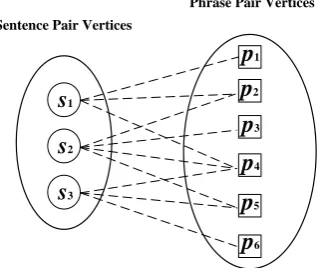
Given the sentence pairs that are word-aligned automatically, an undirected, weighted bipartite graph is constructed which maps the sentence pairs and the extracted phrase pairs to the ver-tices. An edge between a sentence pair vertex and a phrase pair vertex is added if the phrase pair can be extracted from the sentence pair. Mutual re-inforcement scores are defined on edges, through which the importance scores are propagated be-tween vertices. Figure 1 illustrates the graph struc-ture. Formally, the bipartite graph is defined as:
G= (V, E)
whereV =S∪P is the vertex set,S = {si|1 ≤
i ≤ n} is the set of all sentence pairs. P =
{pj|1 ≤ j ≤ m} is the set of all phrase pairs
which are extracted from S based on the word alignment. E is the edge set in which the edges are betweenS andP, therebyE ={hsi, pji|si ∈
S, pj ∈P, φ(si, pj) = 1}.
φ(si, pj) =
(
1 ifpjcan be extracted fromsi 0 otherwise
2.3 Graph parameters
For sentence-phrase mutual reinforcement, a non-negative scorer(si, pj) is defined using the
stan-dard TF-IDF formula:
r(si, pj) =
(P P F(si,pj)×IP F(pj)
p0∈{p|φ(si,p)=1}P F(si,p0)×IP F(p0) ifφ(si, pj) = 1
0 otherwise
Sentence Pair Vertices
Phrase Pair Vertices
s1
s2
s3
p1
p3
p4
p5
p6
p2
Figure 1: The circular nodes stand for S and square nodes stand for P. The lines capture the sentence-phrase mutual reinforcement.
whereP F(si, pj) is the phrase pair frequency in
a sentence pair andIP F(pj)is the inverse phrase
pair frequency ofpjin the whole bilingual corpus.
r(si, pj)is abbreviated asrij.
Inspired by (Brin and Page, 1998; Mihalcea and Tarau, 2004; Wan et al., 2007), we com-pute the importance scores of sentence pairs and phrase pairs using a PageRank-style algorithm. The weights rij are leveraged to reflect the
rela-tionships between two types of vertices. Letu(si)
andv(pj)denote the scores of a sentence pair
ver-tex and a phrase pair verver-tex. They are computed iteratively by:
u(si) = (1−d) +d×
X
j∈N(si)
rij
P
k∈M(pj)rkj
v(pj)
v(pj) = (1−d) +d×
X
j∈M(pj)
rij
P
k∈N(si)rik
u(si)
wheredis empirically set to the default value 0.85 that is same as the original PageRank, N(si) =
{j|hsi, pji ∈ E}, M(pj) = {i|hsi, pji ∈ E}.
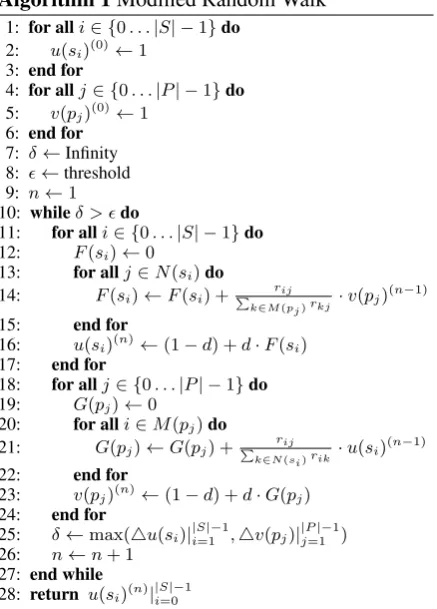
The detailed process is illustrated in Algorithm 1. Algorithm 1 iteratively updates the scores of sen-tence pairs and phrase pairs (lines 10-26). The computation ends when difference between two consecutive iterations is lower than a pre-defined thresholdδ(10−12in this study).
2.4 Parallelization
[image:2.595.335.495.68.202.2]Algorithm 1Modified Random Walk
1: for alli∈ {0. . .|S| −1}do
2: u(si)(0)←1
3: end for
4: for allj∈ {0. . .|P| −1}do
5: v(pj)(0)←1
6: end for
7: δ←Infinity 8: ←threshold 9: n←1
10: whileδ > do
11: for alli∈ {0. . .|S| −1}do
12: F(si)←0
13: for allj∈N(si)do
14: F(si)←F(si) + P rij
k∈M(pj)rkj ·v(pj)
(n−1)
15: end for
16: u(si)(n)←(1−d) +d·F(si)
17: end for
18: for allj∈ {0. . .|P| −1}do
19: G(pj)←0
20: for alli∈M(pj)do
21: G(pj)←G(pj) +P rij
k∈N(si)rik·u(si)
(n−1)
22: end for
23: v(pj)(n)←(1−d) +d·G(pj)
24: end for
25: δ←max(4u(si)|i|S=1|−1,4v(pj)||jP=1|−1)
26: n←n+ 1
27: end while
28: return u(si)(n)||iS=0|−1
based on the iterative computation in the Sec-tion 2.3. Before the iterative computaSec-tion starts, the sum of the outlink weights for each vertex is computed first. The edges are randomly par-titioned into sets of roughly equal size. Each edge hsi, pji can generate two key-value pairs
in the format hsi, riji and hpj, riji. The pairs
with the same key are summed locally and ac-cumulated across different machines. Then, in each iteration, the score of each vertex is up-dated according to the sum of the normalized inlink weights. The key-value pairs are gener-ated in the format hsi,P rij
k∈M(pj)rkj ·v(pj)i and
hpj,P rij
k∈N(si)rik ·u(si)i. These key-value pairs are also randomly partitioned and summed across different machines. Since long sentence pairs usu-ally extract more phrase pairs, we need to normal-ize the importance scores based on the sentence length. The algorithm fits well into the MapRe-duce programming model (Dean and Ghemawat, 2008) and we use it as our implementation.
2.5 Integration into translation modeling After sufficient number of iterations, the impor-tance scores of sentence pairs (i.e.,u(si)) are
ob-tained. Instead of simple filtering, we use the
scores of sentence pairs as the fractional counts to re-estimate the translation probabilities of phrase pairs. Given a phrase pairp = hf ,¯ ¯ei,A( ¯f) and
B(¯e) indicate the sets of sentences that f¯and ¯e
appear. Then the translation probability is defined as:
PCW( ¯f|e¯) =
P
i∈A( ¯f)∩B(¯e)u(si)×ci( ¯f ,¯e)
P
j∈B(¯e)u(sj)×cj(¯e)
where ci(·) denotes the count of the phrase or
phrase pair in si. PCW( ¯f|¯e) and PCW(¯e|f¯) are
named as Corpus Weighting (CW) based transla-tion probability, which are integrated into the log-linear model in addition to the conventional phrase translation probabilities (Koehn et al., 2003).
3 Experiments
3.1 Setup
We evaluated our bilingual data cleaning ap-proach on large-scale Chinese-to-English machine translation tasks. The bilingual data we used was mainly mined from the web (Jiang et al., 2009)1, as well as the United Nations parallel
cor-pus released by LDC and the parallel corcor-pus re-leased by China Workshop on Machine Transla-tion (CWMT), which contain around 30 million sentence pairs in total after removing duplicated ones. The development data and testing data is shown in Table 1.
Data Set #Sentences Source
[image:3.595.73.292.70.375.2]NIST 2003 (dev) 919 open test NIST 2005 (test) 1,082 open test NIST 2006 (test) 1,664 open test NIST 2008 (test) 1,357 open test CWMT 2008 (test) 1,006 open test In-house dataset 1 (test) 1,002 web data In-house dataset 2 (test) 5,000 web data In-house dataset 3 (test) 2,999 web data
Table 1: Development and testing data used in the experiments.
A phrase-based decoder was implemented based on inversion transduction grammar (Wu, 1997). The performance of this decoder is simi-lar to the state-of-the-art phrase-based decoder in Moses, but the implementation is more straight-forward. We use the following feature functions in the log-linear model:
1Although supervised data cleaning has been done in the
dev NIST 2005 NIST 2006 NIST 2008 CWMT 2008 IH 1 IH 2 IH 3
baseline 41.24 37.34 35.20 29.38 31.14 24.29 22.61 24.19
(Wuebker et al., 2010) 41.20 37.48 35.30 29.33 31.10 24.33 22.52 24.18
-0.25M 41.28 37.62 35.31 29.70 31.40 24.52 22.69 24.64
-0.5M 41.45 37.71 35.52 29.76 31.77 24.64 22.68 24.69
-1M 41.28 37.41 35.28 29.65 31.73 24.23 23.06 24.20
[image:4.595.74.522.61.138.2]+CW 41.75 38.08 35.84 30.03 31.82 25.23 23.18 24.80
Table 2: BLEU(%) of Chinese-to-English translation tasks on multiple testing datasets (p <0.05), where ”-numberM” denotes we simply filternumbermillion low scored sentence pairs from the bilingual data and use others to extract the phrase table. ”CW” means the corpus weighting feature, which incorporates sentence scores from random walk as fractional counts to re-estimate the phrase translation probabilities.
• phrase translation probabilities and lexical
weights in both directions (4 features);
• 5-gram language model with Kneser-Ney smoothing (1 feature);
• lexicalized reordering model (1 feature);
• phrase count and word count (2 features).
The translation model was trained over the word-aligned bilingual corpus conducted by GIZA++ (Och and Ney, 2003) in both directions, and the diag-grow-final heuristic was used to re-fine the symmetric word alignment. The language model was trained on the LDC English Gigaword Version 4.0 plus the English part of the bilingual corpus. The lexicalized reordering model (Xiong et al., 2006) was trained over the 40% randomly sampled sentence pairs from our parallel data. Case-insensitive BLEU4 (Papineni et al., 2002) was used as the evaluation metric. The parame-ters of the log-linear model are tuned by optimiz-ing BLEU on the development data usoptimiz-ing MERT (Och, 2003). Statistical significance test was per-formed using the bootstrap re-sampling method proposed by Koehn (2004).
3.2 Baseline
The experimental results are shown in Table 2. In the baseline system, the phrase pairs that appear only once in the bilingual data are simply dis-carded because most of them are noisy. In ad-dition, the fix-discount method in (Foster et al., 2006) for phrase table smoothing is also used. This implementation makes the baseline system perform much better and the model size is much smaller. In fact, the basic idea of our ”one count” cutoff is very similar to the idea of ”leaving-one-out” in (Wuebker et al., 2010). The results show
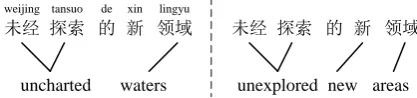
未经 探索 的 新 领域
uncharted waters
未经 探索 的 新 领域
unexplored new areas weijing tansuo de xin lingyu
Figure 2: The left one is the non-literal translation in our bilingual corpus. The right one is the literal translation made by human for comparison.
that the ”leaving-one-out” method performs al-most the same as our baseline, thereby cannot bring other benefits to the system.
3.3 Results
We evaluate the proposed bilingual data clean-ing method by incorporatclean-ing sentence scores into translation modeling. In addition, we also com-pare with several settings that filtering low-quality sentence pairs from the bilingual data based on the importance scores. The last N = { 0.25M, 0.5M, 1M}sentence pairs are filtered before the
[image:4.595.311.520.227.276.2]trans-lation performance is unstable since both non-parallel sentence pairs and non-literal but non-parallel sentence pairs are filtered. Therefore, we use the importance score of each sentence pair to estimate the phrase translation probabilities. It consistently brings substantial improvements compared to the baseline, which demonstrates graph-based random walk indeed improves the translation modeling performance for our SMT system.
3.4 Discussion
In (Goutte et al., 2012), they evaluated phrase-based SMT systems trained on parallel data with different proportions of synthetic noisy data. They suggested that when collecting larger, noisy par-allel data for training phrase-based SMT, clean-ing up by tryclean-ing to detect and remove incor-rect alignments can actually degrade performance. Our experimental results confirm their findings on some datasets. Based on our method, some-times filtering noisy data leads to unexpected re-sults. The reason is two-fold: on the one hand, the non-literal parallel data makes false positive in noisy data detection; on the other hand, large-scale SMT systems is relatively robust and tolerant to noisy data, especially when we remove frequency-1 phrase pairs. Therefore, we propose to integrate the importance scores when re-estimating phrase pair probabilities in this paper. The importance scores can be considered as a kind of contribution constraint, thereby high-quality parallel data con-tributes more while noisy parallel data concon-tributes less.
4 Conclusion and Future Work
In this paper, we develop an effective approach to clean the bilingual data using graph-based ran-dom walk. Significant improvements on several datasets are achieved in our experiments. For future work, we will extend our method to ex-plore the relationships of sentence-to-sentence and phrase-to-phrase, which is beyond the existing sentence-to-phrase mutual reinforcement.
Acknowledgments
We are especially grateful to Yajuan Duan, Hong Sun, Nan Yang and Xilun Chen for the helpful dis-cussions. We also thank the anonymous reviewers for their insightful comments.
References
Sergey Brin and Lawrence Page. 1998. The anatomy of a large-scale hypertextual web search engine.
Computer networks and ISDN systems, 30(1):107– 117.
Jeffrey Dean and Sanjay Ghemawat. 2008. Mapre-duce: simplified data processing on large clusters.
Communications of the ACM, 51(1):107–113.
George Foster, Roland Kuhn, and Howard Johnson. 2006. Phrasetable smoothing for statistical machine
translation. InProceedings of the 2006 Conference
on Empirical Methods in Natural Language Pro-cessing, pages 53–61, Sydney, Australia, July. As-sociation for Computational Linguistics.
Cyril Goutte, Marine Carpuat, and George Foster. 2012. The impact of sentence alignment errors on phrase-based machine translation performance. In
Proceedings of AMTA 2012, San Diego, California, October. Association for Machine Translation in the Americas.
Long Jiang, Shiquan Yang, Ming Zhou, Xiaohua Liu, and Qingsheng Zhu. 2009. Mining bilingual data from the web with adaptively learnt patterns. In Pro-ceedings of the Joint Conference of the 47th Annual Meeting of the ACL and the 4th International Joint Conference on Natural Language Processing of the AFNLP, pages 870–878, Suntec, Singapore, August. Association for Computational Linguistics.
Philipp Koehn, Franz Josef Och, and Daniel Marcu. 2003. Statistical phrase-based translation. In Pro-ceedings of HLT-NAACL 2003 Main Papers, pages 48–54, Edmonton, May-June. Association for Com-putational Linguistics.
Philipp Koehn. 2004. Statistical significance tests for machine translation evaluation. In Dekang Lin and
Dekai Wu, editors, Proceedings of EMNLP 2004,
pages 388–395, Barcelona, Spain, July. Association for Computational Linguistics.
Rada Mihalcea and Paul Tarau. 2004. Textrank: Bringing order into texts. In Dekang Lin and Dekai
Wu, editors, Proceedings of EMNLP 2004, pages
404–411, Barcelona, Spain, July. Association for Computational Linguistics.
Dragos Stefan Munteanu and Daniel Marcu. 2005. Im-proving machine translation performance by
exploit-ing non-parallel corpora. Computational
Linguis-tics, 31(4):477–504.
Franz Josef Och and Hermann Ney. 2003. A sys-tematic comparison of various statistical alignment
models. Computational Linguistics, 29(1):19–51.
Franz Josef Och. 2003. Minimum error rate train-ing in statistical machine translation. In Proceed-ings of the 41st Annual Meeting of the Association for Computational Linguistics, pages 160–167, Sap-poro, Japan, July. Association for Computational Linguistics.
Kishore Papineni, Salim Roukos, Todd Ward, and Wei-Jing Zhu. 2002. Bleu: a method for automatic
evaluation of machine translation. In Proceedings
of 40th Annual Meeting of the Association for Com-putational Linguistics, pages 311–318, Philadelphia, Pennsylvania, USA, July. Association for Computa-tional Linguistics.
Philip Resnik and Noah A Smith. 2003. The web
as a parallel corpus. Computational Linguistics,
29(3):349–380.
Lei Shi, Cheng Niu, Ming Zhou, and Jianfeng Gao. 2006. A dom tree alignment model for mining paral-lel data from the web. InProceedings of the 21st In-ternational Conference on Computational Linguis-tics and 44th Annual Meeting of the Association for Computational Linguistics, pages 489–496, Sydney, Australia, July. Association for Computational Lin-guistics.
Xiaojun Wan, Jianwu Yang, and Jianguo Xiao. 2007. Towards an iterative reinforcement approach for si-multaneous document summarization and keyword extraction. InProceedings of the 45th Annual Meet-ing of the Association of Computational LMeet-inguistics, pages 552–559, Prague, Czech Republic, June. As-sociation for Computational Linguistics.
Dekai Wu. 1997. Stochastic inversion transduction grammars and bilingual parsing of parallel corpora.
Computational Linguistics, 23(3):377–403.
Joern Wuebker, Arne Mauser, and Hermann Ney.
2010. Training phrase translation models with
leaving-one-out. InProceedings of the 48th Annual
Meeting of the Association for Computational Lin-guistics, pages 475–484, Uppsala, Sweden, July. As-sociation for Computational Linguistics.
Deyi Xiong, Qun Liu, and Shouxun Lin. 2006. Max-imum entropy based phrase reordering model for
statistical machine translation. In Proceedings of