Fast and Robust Compressive Summarization
with Dual Decomposition and Multi-Task Learning
Miguel B. Almeida∗† Andr´e F. T. Martins∗†
∗Priberam Labs, Alameda D. Afonso Henriques, 41, 2o, 1000-123 Lisboa, Portugal
†Instituto de Telecomunicac¸˜oes, Instituto Superior T´ecnico, 1049-001 Lisboa, Portugal
{mba,atm}@priberam.pt
Abstract
We present a dual decomposition frame-work for multi-document summarization, using a model that jointly extracts and compresses sentences. Compared with previous work based on integer linear pro-gramming, our approach does not require external solvers, is significantly faster, and is modular in the three qualities a sum-mary should have: conciseness, informa-tiveness, and grammaticality. In addition, we propose a multi-task learning frame-work to take advantage of existing data for extractive summarization and sentence compression. Experiments in the TAC-2008 dataset yield the highest published ROUGE scores to date, with runtimes that rival those of extractive summarizers.
1 Introduction
Automatic text summarization is a seminal prob-lem in information retrieval and natural language processing (Luhn, 1958; Baxendale, 1958; Ed-mundson, 1969). Today, with the overwhelming amount of information available on the Web, the demand for fast, robust, and scalable summariza-tion systems is stronger than ever.
Up to now, extractive systems have been the most popular in multi-document summarization. These systems produce a summary by extracting a representative set of sentences from the origi-nal documents (Kupiec et al., 1995; Carbonell and Goldstein, 1998; Radev et al., 2000; Gillick et al., 2008). This approach has obvious advantages: it reduces the search space by letting decisions be made for each sentence as a whole (avoiding fine-grained text generation), and it ensures a grammat-ical summary, assuming the original sentences are well-formed. The typical trade-offs in these
mod-els (maximizing relevance, and penalizing redun-dancy) lead to submodular optimization problems (Lin and Bilmes, 2010), which are NP-hard but ap-proximable through greedy algorithms; learning is possible with standard structured prediction algo-rithms (Sipos et al., 2012; Lin and Bilmes, 2012). Probabilistic models have also been proposed to capture the problem structure, such as determinan-tal point processes (Gillenwater et al., 2012).
However, extractive systems are rather limited in the summaries they can produce. Long, partly relevant sentences tend not to appear in the sum-mary, or to block the inclusion of other sen-tences. This has motivated research in compres-sive summarization(Lin, 2003; Zajic et al., 2006; Daum´e, 2006), where summaries are formed by compressed sentences (Knight and Marcu, 2000), not necessarily extracts. While promising results have been achieved by models that simultaneously extract and compress (Martins and Smith, 2009; Woodsend and Lapata, 2010; Berg-Kirkpatrick et al., 2011), there are still obstacles that need to be surmounted for these systems to enjoy wide adoption. All approaches above are based on in-teger linear programming(ILP), suffering from slow runtimes, when compared to extractive sys-tems. For example, Woodsend and Lapata (2012) report 55 seconds on average to produce a sum-mary; Berg-Kirkpatrick et al. (2011) report sub-stantially faster runtimes, but fewer compressions are allowed. Having a compressive summarizer which is both fast and expressive remains an open problem. A second inconvenience of ILP-based approaches is that they do not exploit the modu-larity of the problem, since the declarative specifi-cation required by ILP solvers discards important structural information. For example, such solvers are unable to take advantage of efficient dynamic programming routines for sentence compression (McDonald, 2006).
This paper makes progress in two fronts:
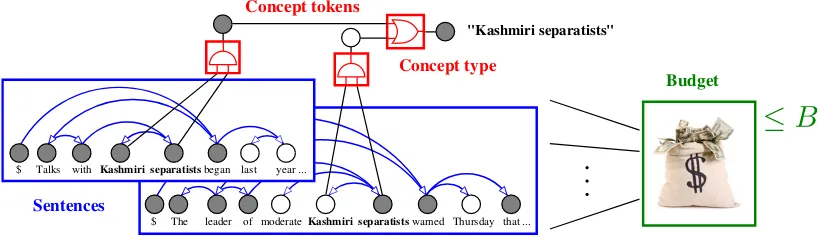
• We derive adual decompositionframework for extractive and compressive summarization (§2– 3). Not only is this framework orders of mag-nitude more efficient than the ILP-based ap-proaches, it also allows the three well-known metrics of summaries—conciseness, informa-tiveness, and grammaticality—to be treated sep-arately in a modular fashion (see Figure 1). We also contribute with a novelknapsack factor, along with a linear-time algorithm for the corre-sponding dual decomposition subproblem. • We proposemulti-task learning(§4) as a
prin-cipled way to train compressive summarizers, using auxiliary data for extractive summariza-tion and sentence compression. To this end, we adapt the framework of Evgeniou and Pon-til (2004) and Daum´e (2007) to train structured predictors that share some of their parts.
Experiments on TAC data (§5) yield state-of-the-art results, with runtimes similar to that of extrac-tive systems. To our best knowledge, this had never been achieved by compressive summarizers.
2 Extractive Summarization
Inextractive summarization, we are given a set of sentencesD:= {s1, . . . , sN}belonging to one
or more documents, and the goal is to extract a subsetS⊆Dthat conveys a good summary ofD
and whose total number of words does not exceed a prespecified budgetB.
We use an indicator vectory:=hyniNn=1to rep-resent an extractive summary, where yn = 1 if sn ∈ S, and yn = 0 otherwise. Let Ln be the
number of words of thenth sentence. By
design-ing a quality score functiong:{0,1}N →R, this
can be cast as a global optimization problem with a knapsack constraint:
maximize g(y)
w.r.t. y∈ {0,1}N
s.t. PNn=1Lnyn≤B. (1)
Intuitively, a good summary is one which selects sentences that individually convey “relevant” in-formation, while collectively having small “re-dundancy.” This trade-off was explicitly mod-eled in early works through the notion of max-imal marginal relevance (Carbonell and Gold-stein, 1998; McDonald, 2007). An alternative
are coverage-based models (§2.1; Filatova and Hatzivassiloglou, 2004; Yih et al., 2007; Gillick et al., 2008), which seek a set of sentences that covers as many diverse “concepts” as possible; re-dundancy is automatically penalized since redun-dant sentences cover fewer concepts. Both models can be framed under the framework of submodular optimization (Lin and Bilmes, 2010), leading to greedy algorithms that have approximation guar-antees. However, extending these models to allow for sentence compression (as will be detailed in §3) breaks the diminishing returns property, mak-ing submodular optimization no longer applicable.
2.1 Coverage-Based Summarization
Coverage-based extractive summarization can be formalized as follows. LetC(D) :={c1, . . . , cM}
be a set of relevant concept types which are present in the original documentsD.1 Letσmbe a
relevance score assigned to themth concept, and
let the setIm⊆ {1, . . . , N}contain the indices of
the sentences in which this concept occurs. Then, the following quality score function is defined:
g(y) =PMm=1σmum(y), (2)
whereum(y) := Wn∈Imynis a Boolean function
that indicates whether themth concept is present in the summary. Plugging this into Eq. 1, one ob-tains the following Boolean optimization problem:
maximize PMm=1σmum
w.r.t. y∈ {0,1}N, u∈ {0,1}M
s.t. um =Wn∈Imyn, ∀m∈[M]
PN
n=1Lnyn≤B, (3)
where we used the notation[M] := {1, . . . , M}.
This can be converted into an ILP and addressed with off-the-shelf solvers (Gillick et al., 2008). A drawback of this approach is that solving an ILP exactly is NP-hard. Even though existing commer-cial solvers can solve most instances with a mod-erate speed, they still exhibit poor worst-case be-haviour; this is exacerbated when there is the need to combine an extractive component with other modules, as in compressive summarization (§3).
2.2 A Dual Decomposition Formulation We next describe how the problem in Eq. 3 can be addressed withdual decomposition, a class of op-timization techniques that tackle the dual of com-binatorial problems in a modular, extensible, and parallelizable manner (Komodakis et al., 2007; Rush et al., 2010). In particular, we employ al-ternating directions dual decomposition (AD3; Martins et al., 2011a, 2012) for solving a linear re-laxation of Eq. 3. AD3resembles the subgradient-based algorithm of Rush et al. (2010), but it enjoys a faster convergence rate. Both algorithms split the original problem into several components, and then iterate between solving independent lo-cal subproblemsat each component and adjusting multipliers to promote an agreement.2 The
differ-ence between the two methods is that the AD3 lo-cal subproblems, instead of requiring the compu-tation of a locally optimal configuration, require solving a localquadraticproblem. Martins et al. (2011b) provided linear-time solutions for several logic constraints, with applications to syntax and frame-semantic parsing (Das et al., 2012). We will see that AD3can also handle budget and knapsack constraints efficiently.
To tackle Eq. 3 with dual decomposition, we split the coverage-based summarizer into the fol-lowingM+ 1components (one per constraint):
1. For each of the M concepts in C(D), one
component for imposing the logic constraint in Eq. 3. This corresponds to the OR-WITH -OUTPUT factor described by Martins et al. (2011b); the AD3subproblem for themth factor can be solved in timeO(|Im|).
2. Another component for the knapsack con-straint. This corresponds to a (novel) KNAP -SACK factor, whose AD3 subproblem is solv-able in timeO(N). The actual algorithm is
de-scribed in the appendix (Algorithm 1).3
3 Compressive Summarization
We now turn to compressive summarization, which does not limit the summary sentences to be verbatim extracts from the original documents;
in-2For details about dual decomposition and Lagrangian re-laxation, see the recent tutorial by Rush and Collins (2012).
3The AD3 subproblem in this case corresponds to
com-puting an Euclidean projection onto the knapsack polytope (Eq. 11). Others addressed the related, but much harder, inte-ger quadratic knapsack problem (McDonald, 2007).
stead, it allows the extraction ofcompressed sen-tences where some words can be deleted.
Formally, let us express each sentence of D
as a sequence of word tokens, sn := htn,`iLn`=0,
where tn,0 ≡ $ is a dummy symbol. We rep-resent a compression ofsn as an indicator
vec-tor zn := hzn,`i`Ln=0, where zn,` = 1 if the `th
word is included in the compression. By conven-tion, the dummy symbol is included if and only if the remaining compression is non-empty. A com-pressive summary can then be represented by an indicator vector z which is the concatenation of N such vectors,z =hz1, . . . ,zNi; each position
in this indicator vector is indexed by a sentence
n∈[N]and a word position`∈ {0} ∪[Ln].
Models for compressive summarization were proposed by Martins and Smith (2009) and Berg-Kirkpatrick et al. (2011) by combining extraction and compression scores. Here, we follow the lat-ter work, by combining a coverage score function
gwith sentence-level compression score functions h1, . . . , hN. This yields the decoding problem:
maximize g(z) +PNn=1hn(zn)
w.r.t. zn∈ {0,1}Ln, ∀n∈[N]
s.t. PNn=1PLn`=1zn,` ≤B. (4)
3.1 Coverage Model
We use a coverage function similar to Eq. 2, but taking a compressive summaryzas argument:
g(z) =PMm=1σmum(z), (5)
where we redefine um as follows. First, we
parametrize each occurrence of the mth concept
(assumed to be a k-gram) as a triple hn, `s, `ei,
wherenindexes a sentence,`sindexes a start
po-sition within the sentence, and`e indexes the end
position. We denote byTmthe set of triples
repre-senting all occurrences of themth concept in the original text, and we associate an indicator vari-ablezn,`s:`e to each member of this set. We then
defineum(z)via the following logic constraints:
• Aconcept typeis selected ifsomeof itsk-gram
tokens are selected:
um(y) :=Whn,`s,`ei∈Tmzn,`s:`e. (6)
• A k-gram concept token is selected if all its words are selected:
Sentences
$ The leader of moderate Kashmiri separatists warned Thursday that ... $ Talks with Kashmiri separatists began last year ...
"Kashmiri separatists"
Budget Concept tokens
[image:4.595.94.503.63.181.2]Concept type
Figure 1: Components of our compressive summarizer. Factors depictedin bluebelong to the compres-sion model, and aim to enforce grammaticality. The logic factorsin redform the coverage component. Finally, the budget factor,in green, is connected to the word nodes; it ensures that the summary fits the word limit. Shaded circles represent active variables while white circles represent inactive variables.
We set concept scores asσm :=w·Φcov(D, cm),
where Φcov(D, cm) is a vector of features
(de-scribed in§3.5) andwthe corresponding weights.
3.2 Compression Model
For the compression score function, we follow Martins and Smith (2009) and decompose it as a sum of local score functions ρn,` defined on
de-pendency arcs:
hn(zn) :=PLn`=1ρn,`(zn,`, zn,π(`)), (8)
where π(`) denotes the index of the word which
is the parent of the `th word in the dependency tree (by convention, the root of the tree is the dummy symbol). To model the event that an arc is “cut” by disconnecting a child from its head, we definearc-deletion scoresρn,`(0,1) := w·Φcomp(sn, `, π(`)),whereΦcomp is a feature map, which is described in detail in§3.5. We set
ρn,`(0,0) =ρn,`(1,1) = 0, andρn,`(1,0) =−∞,
to allow only the deletion of entire subtrees. A crucial fact is that one can maximize Eq. 8 efficiently with dynamic programming (using the Viterbi algorithm for trees); the total cost is linear inLn. We will exploit this fact in the dual
decom-position framework described next.4
3.3 A Dual Decomposition Formulation In previous work, the optimization problem in Eq. 4 was converted into an ILP and fed to an off-the-shelf solver (Martins and Smith, 2009; Berg-Kirkpatrick et al., 2011; Woodsend and Lapata, 2012). Here, we employ the AD3 algorithm, in a 4The same framework can be readily adapted to other compression models that are efficiently decodable, such as the semi-Markov model of McDonald (2006), which would allow incorporating a language model for the compression.
similar manner as described in§2, but with an ad-ditional component for the sentence compressor, and slight modifications in the other components. We have the followingN+M+PMm=1|Tm|+ 1
components in total, illustrated in Figure 1:
1. For each of the N sentences, one component
for thecompression model. The AD3quadratic subproblem for this factor can be addressed by solving asequence of linear subproblems, as de-scribed by Martins et al. (2012). Each of these subproblems corresponds to maximizing an ob-jective function of the same form as Eq. 8; this can be done inO(Ln) time with dynamic
pro-gramming, as discussed in§3.2.
2. For each of the M concept types in C(D),
oneOR-WITH-OUTPUTfactor for the logic con-straint in Eq. 6. This is analogous to the one described for the extractive case.
3. For each k-gram concept token in Tm, one AND-WITH-OUTPUT factor that imposes the constraint in Eq. 7. This factor was described by Martins et al. (2011b) and its AD3 subprob-lem can be solved in time linear ink.
4. Another component linked to all the words im-posing that at most B words can be selected;
this is done via a BUDGET factor, a particular case ofKNAPSACK. The runtime of this AD3 subproblem is linear in the number of words.
In addition, we found it useful to add a second BUDGET factor limiting the number of sentences that can be selected to a prescribed valueK. We
3.4 Rounding Strategy
Recall that the problem in Eq. 4 is NP-hard, and that AD3 is solving a linear relaxation. While there are ways of wrapping AD3in an exact search algorithm (Das et al., 2012), such strategies work best when the solution of the relaxation has few fractional components, which is typical of pars-ing and translation problems (Rush et al., 2010; Chang and Collins, 2011), and attractive networks (Taskar et al., 2004). Unfortunately, this is not the case in summarization, where concepts “compete” with each other for inclusion in the summary, lead-ing to frustrated cycles. We chose instead to adopt a fast and simple rounding procedure for obtaining a summary from a fractional solution.
The procedure works as follows. First, solve the LP relaxation using AD3, as described above. This yields a solutionz∗, where each component
lies in the unit interval[0,1]. If these components
are all integer, then we have a certificate that this is the optimal solution. Otherwise, we collect the
Ksentences with the highest values ofzn,∗0
(“pos-teriors” on sentences), and seek the feasible sum-mary which is the closest (in Euclidean distance) toz∗, while only containing those sentences. This
can be computed exactly in timeO(BPKk=1Lnk),
through dynamic programming.5
3.5 Features and Hard Constraints
As Berg-Kirkpatrick et al. (2011), we used stemmed word bigrams as concepts, to which we associate the following concept features (Φcov):
indicators for document counts, features indicat-ing if each of the words in the bigram is a stop-word, the earliest position in a document each con-cept occurs, as well as two and three-way conjunc-tions of these features.
For the compression model, we include the fol-lowing arc-deletion features (Φcomp):
• the dependency label of the arc being deleted, as well as its conjunction with the part-of-speech tag of the head, of the modifier, and of both; • the dependency labels of the arc being deleted
and of its parent arc;
• the modifier tag, if the modifier is a function word modifying a verb ;
5Briefly, if we link the roots of theKsentences to a super-root node, the problem above can be transformed into that of finding the best configuration in the resulting binary tree subject to a budget constraint. We omit details for space.
• a feature indicating whether the modifier or any of its descendants is a negation word;
• indicators of whether the modifier is a temporal word (e.g.,Friday) or a preposition pointing to a temporal word (e.g.,on Friday).
In addition, we included hard constraints to vent the deletion of certain arcs, following pre-vious work in sentence compression (Clarke and Lapata, 2008). We never delete arcs whose de-pendency label isSUB,OBJ,PMOD,SBAR,VC, or
PRD(this makes sure we preserve subjects and ob-jects of verbs, arcs departing from prepositions or complementizers, and that we do not break verb chains or predicative complements); arcs linking to a conjunction word or siblings of such arcs (to prevent inconsistencies in handling coordinative conjunctions); arcs linking verbs to other verbs, to adjectives (e.g.,make available), to verb parti-cles (e.g.,settle down), to the wordthat(e.g.,said that), or to the wordtoif it is a leaf (e.g.,allowed
to come); arcs pointing to negation words, cardinal
numbers, or determiners; and arcs connecting two proper nouns or words within quotation marks.
4 Multi-Task Learning
We next turn to the problem of learning the model from training data. Prior work in compressive summarization has followed one of two strategies: Martins and Smith (2009) and Woodsend and La-pata (2012) learn the extraction and compression models separately, and then post-combine them, circumventing the lack of fully annotated data. Berg-Kirkpatrick et al. (2011) gathered a small dataset of manually compressed summaries, and trained with full supervision. While the latter approach is statistically more principled, it has the disadvantage of requiring fully annotated data, which is difficult to obtain in large quantities. On the other hand, there is plenty of data contain-ing manually written abstracts (from the DUC and TAC conferences) and user-generated text (from Wikipedia) that may provide useful weak supervi-sion.
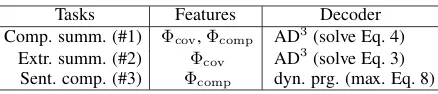
Tasks Features Decoder Comp. summ. (#1) Φcov,Φcomp AD3(solve Eq. 4)
Extr. summ. (#2) Φcov AD3(solve Eq. 3)
[image:6.595.72.291.60.107.2]Sent. comp. (#3) Φcomp dyn. prg. (max. Eq. 8)
Table 1: Features and decoders used for each task.
al., 2007), and for all of them we assume feature-based models that decompose over “parts”:
• For the compressive summarization task, the parts correspond toconcept features(§3.1) and toarc-deletion features(§3.2).
• For the extractive summarization task, there are parts forconcept featuresonly.
• For the sentence compression task, the parts correspond toarc-deletion featuresonly.
This is summarized in Table 1. Features for the three tasks are populated into feature vectors
Φ1(x, y), Φ2(x, y), and Φ3(x, y), respectively, where hx, yi denotes a task-specific input-output
pair. We assume the feature vectors are allD di-mensional, where we place zeros in entries cor-responding to parts that are absent. Note that this setting is very general and applies to arbi-trary structured prediction problems (not just sum-marization), the only assumption being that some parts are shared between different tasks.
Next, we associate weight vectorsv1,v2,v3 ∈
RD to each task, along with a “shared” vectorw.
Each task makes predictions according to the rule:
b
y:= arg max
y (w+vk)·Φk(x, y), (9)
where k ∈ {1,2,3}. This setting is
equiva-lent to the approach of Daum´e (2007) for domain adaptation, which consists in splitting each fea-ture into task-component feafea-tures and a shared feature; but here we do not duplicate features ex-plicitly. To learn the weights, we regularize the weight vectors separately, and assume that each task has its own loss functionLk, so that the
to-tal lossLis a weighted sumL(w,v1,v2,v3) :=
P3
k=1σkLk(w+vk). This yields the following
objective function to be minimized:
F(w,v1,v2,v3) =
λ
2kwk
2+ 3
X
k=1
λk
2 kvkk
2
+ 1
N
3
X
k=1
σkLk(w+vk), (10)
whereλand theλk’s are regularization constants,
andNis the total number of training instances.6 In
our experiments (§5), we let theLk’s be structured
hinge losses (Taskar et al., 2003; Tsochantaridis et al., 2004), where the corresponding cost functions are concept recall (for task #2), precision of arc deletions (for task #3), and a combination thereof (for task #1).7 These losses were normalized, and
we setσk = N/Nk, where Nk is the number of
training instances for the kth task. This ensures
all tasks are weighted evenly. We used the same rationale to setλ=λ1 =λ2 =λ3, choosing this value through cross-validation in the dev set.
We optimize Eq. 10 with stochastic subgradient descent. This leads to update rules of the form
w ← (1−ηtλ)w−ηtσk∇˜Lk(w+vk) vj ← (1−ηtλj)vj−ηtδjkσk∇˜Lk(w+vk),
where∇˜Lkare stochastic subgradients for thekth
task, that take only a single instance into account, andδjk = 1if and only ifj = k. Stochastic
sub-gradients can be computed via cost-augmented de-coding (see footnote 7).
Interestingly, Eq. 10 subsumes previous ap-proaches to train compressive summarizers. The limitλ→ ∞(keeping theλk’s fixed) forcesw→
0, decoupling all the tasks. In this limit, inference
for task #1 (compressive summarization) is based solely on the model learned from that task’s data, recovering the approach of Berg-Kirkpatrick et al. (2011). In the other extreme, settingσ1 = 0 sim-ply ignores task #1’s training data. As a result, the optimal v1 will be a vector of zeros; since tasks #2 and #3 have no parts in common, the objective will decouple into a sum of two independent terms
6Note that, by substitutingu
k:=w+vkand solving for
w, the problem in Eq. 10 becomes that of minimizing the sum of the losses with a penalty for the (weighted) variance of the vectors{0,u1,u2,u3}, regularizing the difference towards
their average, as in Evgeniou and Pontil (2004). This is sim-ilar to the hierarchical joint learning approach of Finkel and Manning (2010), except that our goal is to learn a new task (compressive summarization) instead of combining tasks.
7Let Y
k denote the output set for thekth task. Given a task-specific cost function ∆k : Yk × Yk → R, and letting hxt, ytiT
t=1 be the labeled dataset for this
task, the structured hinge loss takes the formLk(uk) :=
P
tmaxy0∈Yk(uk·(Φk(xt, y0)−Φk(xt, yt)) + ∆k(y0, yt)).
The inner maximization overy0is called thecost-augmented
decoding problem: it differs from Eq. 9 by the inclusion of the cost term∆k(y0, yt). Our costs decompose over the model’s factors, hence any decoder for Eq. 9 can be used for the maximization above: for tasks #1–#2, we solve a relaxation by running AD3without rounding, and for task #3
involvingv2 andv3, which is equivalent to train-ing the two tasks separately and post-combintrain-ing the models, as Martins and Smith (2009) did.
5 Experiments 5.1 Experimental setup
We evaluated our compressive summarizers on data from the Text Analysis Conference (TAC) evaluations. We use the same splits as previ-ous work (Berg-Kirkpatrick et al., 2011; Wood-send and Lapata, 2012): the non-update portions of TAC-2009 for training and TAC-2008 for test-ing. In addition, we reserved TAC-2010 as a dev-set. The test partition contains 48 multi-document summarization problems; each provides 10 related news articles as input, and asks for a summary with up to 100 words, which is evaluated against four manually written abstracts. We ignored all the query information present in the TAC datasets.
Single-Task Learning. In the single-task exper-iments, we trained a compressive summarizer on the dataset disclosed by Berg-Kirkpatrick et al. (2011), which contains manual compressive sum-maries for the TAC-2009 data. We trained a struc-tured SVM with stochastic subgradient descent; the cost-augmented inference problems are re-laxed and solved with AD3, as described in§3.3.8
We followed the procedure described in Berg-Kirkpatrick et al. (2011) to reduce the number of candidate sentences: scores were defined for each sentence (the sum of the scores of the concepts they cover), and the best-scored sentences were greedily selected up to a limit of 1,000 words. We then tagged and parsed the selected sentences with TurboParser.9 Our choice of a dependency parser
was motivated by our will for a fast system; in par-ticular, TurboParser attains top accuracies at a rate of 1,200 words per second, keeping parsing times below 1 second for each summarization problem.
Multi-Task Learning. For the multi-task ex-periments, we also used the dataset of Berg-Kirkpatrick et al. (2011), but we augmented the training data with extractive summarization and sentence compression datasets, to help train the
8We use the AD3 implementation in http://www.
ark.cs.cmu.edu/AD3, setting the maximum number of iterations to 200 at training time and 1000 at test time. We extended the code to handle the knapsack and budget factors; the modified code will be part of the next release (AD32.1).
9http://www.ark.cs.cmu.edu/TurboParser
compressive summarizer. For extractive sum-marization, we used the DUC 2003 and 2004 datasets (a total of 80 multi-document summariza-tion problems). We generated oracle extracts by maximizing bigram recall with respect to the man-ual abstracts, as described in Berg-Kirkpatrick et al. (2011). For sentence compression, we adapted the Simple English Wikipedia dataset of Wood-send and Lapata (2011), containing aligned sen-tences for 15,000 articles from the English and Simple English Wikipedias. We kept only the 4,481 sentence pairs corresponding to deletion-based compressions.
5.2 Results
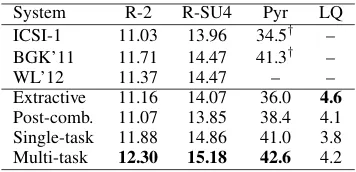
Table 2 shows the results. The top rows refer to three strong baselines: the ICSI-1 extractive coverage-based system of Gillick et al. (2008), which achieved the best ROUGE scores in the TAC-2008 evaluation; the compressive summa-rizer of Berg-Kirkpatrick et al. (2011), denoted BGK’11; and the multi-aspect compressive sum-marizer of Woodsend and Lapata (2012), denoted WL’12. All these systems require ILP solvers. The bottom rows show the results achieved by our implementation of a pure extractive system (similar to the learned extractive summarizer of Berg-Kirkpatrick et al., 2011); a system that
post-combinesextraction and compression components
trained separately, as in Martins and Smith (2009); and our compressive summarizer trained as a
sin-gle task, and in themulti-tasksetting.
The ROUGE and Pyramid scores show that the compressive summarizers (when properly trained) yield considerable benefits in content coverage over extractive systems, confirming the results of Berg-Kirkpatrick et al. (2011). Comparing the two bottom rows, we see a clear benefit by train-ing in the multi-task setttrain-ing, with a consistent gain in both coverage and linguistic quality. Our ROUGE-2 score (12.30%) is, to our knowledge, the highest reported on the TAC-2008 dataset, with little harm in grammaticality with respect to an extractive system that preserves the original sentences. Figure 2 shows an example summary.
5.3 Runtimes
it-System R-2 R-SU4 Pyr LQ ICSI-1 11.03 13.96 34.5† – BGK’11 11.71 14.47 41.3† –
WL’12 11.37 14.47 – –
Extractive 11.16 14.07 36.0 4.6
[image:8.595.92.270.61.147.2]Post-comb. 11.07 13.85 38.4 4.1 Single-task 11.88 14.86 41.0 3.8 Multi-task 12.30 15.18 42.6 4.2 Table 2: Results for compressive summarization. Shown are the ROUGE-2 and ROUGE SU-4 re-calls with the default options from the ROUGE toolkit (Lin, 2004); Pyramid scores (Nenkova and Passonneau, 2004); and linguistic quality scores, scored between 1 (very bad) to 5 (very good). For Pyramid, the evaluation was performed by two annotators, each evaluating half of the problems; scores marked with†were computed by different
annotators and are not directly comparable. Lin-guistic quality was evaluated by two linguists; we show the average of the reported scores.
Solver Runtime (sec.) ROUGE-2
ILP Exact 10.394 12.40
LP-Relax. 2.265 12.38
AD3-5000 0.952 12.38
AD3-1000 0.406 12.30
AD3-200 0.159 12.15
Extractive (ILP) 0.265 11.16 Table 3: Runtimes of several decoders on a Intel Core i7 processor @2.8 GHz, with 8GB RAM. For each decoder, we show the average time taken to solve a summarization problem in TAC-2008. The reported runtimes of AD3 and LP-Relax include the time taken to round the solution (§3.4), which is 0.029 seconds on average.
erations of AD3in{200,1000,5000}, and clocked the time spent by GLPK to solve the exact ILPs and their relaxations. Table 3 depicts the results.10
We see that our proposed configuration (AD3 -1000) is orders of magnitude faster than the ILP solver, and 5 times faster than its relaxed variant, while keeping similar accuracy levels.11 The gain
when the number of iterations in AD3is increased to 5000 is small, given that the runtime is more
10Within dual decomposition algorithms, we verified ex-perimentally that AD3is substantially faster than the
subgra-dient algorithm, which is consistent with previous findings (Martins et al., 2011b).
11The runtimes obtained with the exact ILP solver seem slower than those reported by Berg-Kirkpatrick et al. (2011). (around 1.5 sec. on average, according to their Fig. 3). We conjecture that this difference is due to the restricted set of subtrees that can be deleted by Berg-Kirkpatrick et al. (2011), which greatly reduces their search space.
Japan dispatched four military ships to help Russia res-cue seven crew members aboard a small submarine trapped on the seabed in the Far East. The Russian Pacific Fleet said the crew had 120 hours of oxygen reserves on board when the submarine submerged at midday Thursday (2300 GMT Wednesday) off the Kam-chatka peninsula, the stretch of Far Eastern Russia fac-ing the Berfac-ing Sea. The submarine, used in rescue, research and intelligence-gathering missions, became stuck at the bottom of the Bay of Berezovaya off Rus-sia’s Far East coast when its propeller was caughtin a fishing net. The Russian submarine had been tending an underwater antenna mounted to the sea floorwhen it became snagged on a wire helping to stabilize a ventila-tion cable attached to the antenna. Rescue crews low-ered a British remote-controlled underwater vehicle to a Russian mini-submarine trappeddeepunder the Pacific Ocean, hoping to free the vessel and its seven trapped crewmenbefore their air supply ran out.
Figure 2: Example summary from our compres-sive system. Removed text isgrayed out.
than doubled; accuracy starts to suffer, however, if the number of iterations is reduced too much. In practice, we observed that the final rounding pro-cedure was crucial, as only 2 out of the 48 test problems had integral solutions (arguably because of the “repulsive” nature of the network, as hinted in§3.4). For comparison, we also report in the bot-tom row the average runtime of the learned extrac-tive baseline. We can see that our system’s runtime is competitive with this baseline. To our knowl-edge, this is the first time a compressive sum-marizer achieves such a favorable accuracy/speed tradeoff.
6 Conclusions
We presented a multi-task learning framework for compressive summarization, leveraging data for related tasks in a principled manner. We decode with AD3, a fast and modular dual decomposition algorithm which is orders of magnitude faster than ILP-based approaches. Results show that the state of the art is improved in automatic and manual metrics, with speeds close to extractive systems.
con-straints (Clarke and Lapata, 2007), or lexical pref-erences (Woodsend and Lapata, 2012). Our multi-task approach may be used to jointly learn pa-rameters for these aspects; the dual decomposi-tion algorithm ensures that optimizadecomposi-tion remains tractable even with many components.
A Projection Onto Knapsack
This section describes a linear-time algorithm (Al-gorithm 1) for solving the following problem:
minimizekz−ak2
w.r.t. zn∈[0,1], ∀n∈[N],
s.t. PNn=1Lnzn≤B, (11)
wherea ∈ RN andLn ≥ 0,∀n ∈ [N]. This
in-cludes as special cases the problems of projecting onto a budget constraint (Ln = 1,∀n) and onto
the simplex (same, plusB = 1).
Letclip(t) := max{0,min{1, t}}. Algorithm 1
starts by clipping a to the unit interval; if that
yields a z satisfying PNn=1Lnzn ≤ B, we are
done. Otherwise, the solution of Eq. 11 must sat-isfyPN
n=1Lnzn = B. It can be shown from the
KKT conditions that the solution is of the form
z∗n:= clip(an+τ∗Ln)for a constantτ∗lying in a
particular interval of split-points (line 11). To seek this constant, we use an algorithm due to Pardalos and Kovoor (1990) which iteratively shrinks this interval. The algorithm requires computing medi-ans as a subroutine, which can be done in linear time (Blum et al., 1973). The overall complexity inO(N)(Pardalos and Kovoor, 1990).
Acknowledgments
We thank all reviewers for their insightful com-ments; Trevor Cohn for helpful discussions about multi-task learning; Taylor Berg-Kirkpatrick for answering questions about their summarizer and for providing code; and Helena Figueira and Pedro Mendes for helping with manual evaluation. This work was partially supported by the EU/FEDER programme, QREN/POR Lisboa (Portugal), under the Discooperio project (contract 2011/18501), and by a FCT grant PTDC/EEI-SII/2312/2012.
References
G. Bakır, T. Hofmann, B. Sch¨olkopf, A. Smola, B. Taskar, and S. Vishwanathan. 2007. Predicting
Structured Data. The MIT Press.
Algorithm 1Projection Onto Knapsack. 1: input:a:=haniN
n=1, costshLniNn=1, maximum costB
2:
3: {Try to clip into unit interval:} 4: Setzn←clip(an)forn∈[N] 5: ifPN
n=1Lnzn≤Bthen
6: Returnzand stop. 7: end if
8:
9: {Run Pardalos and Kovoor (1990)’s algorithm:} 10: Initialize working setW← {1, . . . , K} 11: Initialize set of split points:
P← {−an/Ln,(1−an)/Ln}Nn=1∪ {±∞}
12: InitializeτL← −∞,τR← ∞,stight←0,ξ←0.
13: whileW6=∅do
14: Computeτ←Median(P)
15: Sets←stight+ξτ+Pn∈WLnclip(an+τ Ln)
16: Ifs≤B, setτL←τ; ifs≥B, setτR←τ
17: Reduce set of split points:P←P∩[τL, τR]
18: Define the sets:
WL :={n∈W|(1−an)/Ln< τL}
WR :={n∈W| −an/Ln> τR}
WM :=
n∈W
−Lnan ≤τL∧ 1−an
Ln ≥τR
19: Update working set:W←W\(WL∪WR∪WM)
20: Update tight-sum:
stight←stight+Pn∈WLLn(1−an)−
P
n∈WRLnan
21: Update slack-sum:ξ←ξ+Pn∈WML
2 n 22: end while
23: Defineτ∗←(B−PN
i=1Liai−stight)/ξ
24: Setzn←clip(an+τ∗Ln), ∀n∈[N] 25: output:z:=hzniN
n=1.
P. B. Baxendale. 1958. Machine-made index for tech-nical literature—an experiment. IBM Journal of
Re-search Development, 2(4):354–361.
Taylor Berg-Kirkpatrick, Dan Gillick, and Dan Klein. 2011. Jointly learning to extract and compress. In
Proc. of Annual Meeting of the Association for
Com-putational Linguistics.
Manuel Blum, Robert W Floyd, Vaughan Pratt, Ronald L Rivest, and Robert E Tarjan. 1973. Time bounds for selection. Journal of Computer and
Sys-tem Sciences, 7(4):448–461.
J. Carbonell and J. Goldstein. 1998. The use of MMR, diversity-based reranking for reordering documents and producing summaries. InSIGIR.
Y.-W. Chang and M. Collins. 2011. Exact decoding of phrase-based translation models through lagrangian relaxation. InProc. of Empirical Methods for
Natu-ral Language Processing.
James Clarke and Mirella Lapata. 2007. Modelling compression with discourse constraints. InProc. of Empirical Methods in Natural Language Process-ing.
Program-ming Approach. Journal of Artificial Intelligence
Research, 31:399–429.
T. Cohn and M. Lapata. 2008. Sentence compression beyond word deletion. InProc. COLING.
D. Das, A. F. T. Martins, and N. A. Smith. 2012. An Exact Dual Decomposition Algorithm for Shallow Semantic Parsing with Constraints. InProc. of First Joint Conference on Lexical and Computational
Se-mantics (*SEM).
H. Daum´e. 2006. Practical Structured Learning
Tech-niques for Natural Language Processing. Ph.D.
the-sis, University of Southern California.
H. Daum´e. 2007. Frustratingly easy domain adapta-tion. InProc. of Annual Meeting of the Association
for Computational Linguistics.
H. P. Edmundson. 1969. New methods in automatic extracting. Journal of the ACM, 16(2):264–285.
T. Evgeniou and M. Pontil. 2004. Regularized multi– task learning. In Proc. of ACM SIGKDD Inter-national Conference on Knowledge Discovery and
Data Mining, pages 109–117. ACM.
Elena Filatova and Vasileios Hatzivassiloglou. 2004. A formal model for information selection in multi-sentence text extraction. In Proc. of International
Conference on Computational Linguistics.
J.R. Finkel and C.D. Manning. 2010. Hierarchical joint learning: Improving joint parsing and named entity recognition with non-jointly labeled data. In
Proc. of Annual Meeting of the Association for
Com-putational Linguistics.
J. Gillenwater, A. Kulesza, and B. Taskar. 2012. Dis-covering diverse and salient threads in document collections. InProc. of Empirical Methods in
Natu-ral Language Processing.
Dan Gillick, Benoit Favre, and Dilek Hakkani-Tur. 2008. The icsi summarization system at tac 2008.
InProc. of Text Understanding Conference.
K. Knight and D. Marcu. 2000. Statistics-based summarization—step one: Sentence compression.
InAAAI/IAAI.
N. Komodakis, N. Paragios, and G. Tziritas. 2007. MRF optimization via dual decomposition: Message-passing revisited. InProc. of International
Conference on Computer Vision.
J. Kupiec, J. Pedersen, and F. Chen. 1995. A trainable document summarizer. InSIGIR.
H. Lin and J. Bilmes. 2010. Multi-document summa-rization via budgeted maximization of submodular functions. InProc. of Annual Meeting of the North American chapter of the Association for
Computa-tional Linguistics.
H. Lin and J. Bilmes. 2012. Learning mixtures of sub-modular shells with application to document sum-marization. InProc. of Uncertainty in Artificial
In-telligence.
C.-Y. Lin. 2003. Improving summarization perfor-mance by sentence compression-a pilot study. Inthe
Int. Workshop on Inf. Ret. with Asian Languages.
Chin-Yew Lin. 2004. Rouge: A package for auto-matic evaluation of summaries. In Stan Szpakowicz Marie-Francine Moens, editor, Text Summarization Branches Out: Proceedings of the ACL-04 Work-shop, pages 74–81, Barcelona, Spain, July.
H. P. Luhn. 1958. The automatic creation of literature abstracts. IBM Journal of Research Development, 2(2):159–165.
A. F. T. Martins and N. A. Smith. 2009. Summariza-tion with a Joint Model for Sentence ExtracSummariza-tion and Compression. InNorth American Chapter of the As-sociation for Computational Linguistics: Workshop
on Integer Linear Programming for NLP.
A. F. T. Martins, M. A. T. Figueiredo, P. M. Q. Aguiar, N. A. Smith, and E. P. Xing. 2011a. An Aug-mented Lagrangian Approach to Constrained MAP Inference. InProc. of International Conference on
Machine Learning.
A. F. T. Martins, N. A. Smith, P. M. Q. Aguiar, and M. A. T. Figueiredo. 2011b. Dual Decomposition with Many Overlapping Components. In Proc. of Empirical Methods for Natural Language Process-ing.
Andre F. T. Martins, Mario A. T. Figueiredo, Pedro M. Q. Aguiar, Noah A. Smith, and Eric P. Xing. 2012. Alternating Directions Dual Decomposition.
Arxiv preprint arXiv:1212.6550.
R. McDonald. 2006. Discriminative sentence com-pression with soft syntactic constraints. InProc. of Annual Meeting of the European Chapter of the
As-sociation for Computational Linguistics.
R. McDonald. 2007. A study of global inference algo-rithms in multi-document summarization. InECIR.
A. Nenkova and R. Passonneau. 2004. Evaluating content selection in summarization: The pyramid method. InProceedings of NAACL, pages 145–152.
Panos M. Pardalos and Naina Kovoor. 1990. An al-gorithm for a singly constrained class of quadratic programs subject to upper and lower bounds.
Math-ematical Programming, 46(1):321–328.
D. R. Radev, H. Jing, and M. Budzikowska. 2000. Centroid-based summarization of multiple docu-ments: sentence extraction, utility-based evaluation, and user studies. Inthe NAACL-ANLP Workshop on
A.M. Rush and M. Collins. 2012. A Tutorial on Dual Decomposition and Lagrangian Relaxation for In-ference in Natural Language Processing. Journal of
Artificial Intelligence Research, 45:305–362.
A. Rush, D. Sontag, M. Collins, and T. Jaakkola. 2010. On dual decomposition and linear programming re-laxations for natural language processing. InProc. of Empirical Methods for Natural Language
Pro-cessing.
Frank Schilder and Ravikumar Kondadadi. 2008. Fast-sum: Fast and accurate query-based multi-document summarization. InProc. of Annual Meeting of the
Association for Computational Linguistics.
R. Sipos, P. Shivaswamy, and T. Joachims. 2012. Large-margin learning of submodular summariza-tion models.
B. Taskar, C. Guestrin, and D. Koller. 2003. Max-margin Markov networks. InProc. of Neural
Infor-mation Processing Systems.
B. Taskar, V. Chatalbashev, and D. Koller. 2004. Learning associative Markov networks. InProc. of
International Conference of Machine Learning.
I. Tsochantaridis, T. Hofmann, T. Joachims, and Y. Al-tun. 2004. Support vector machine learning for in-terdependent and structured output spaces. InProc.
of International Conference of Machine Learning.
K. Woodsend and M. Lapata. 2010. Automatic gener-ation of story highlights. InProc. of Annual Meet-ing of the Association for Computational LMeet-inguis- Linguis-tics, pages 565–574.
Kristian Woodsend and Mirella Lapata. 2011. Learn-ing to simplify sentences with quasi-synchronous grammar and integer programming. InProc. of
Em-pirical Methods in Natural Language Processing.
Kristian Woodsend and Mirella Lapata. 2012. Mul-tiple aspect summarization using integer linear pro-gramming. InProc. of Empirical Methods in
Natu-ral Language Processing.
Wen-tau Yih, Joshua Goodman, Lucy Vanderwende, and Hisami Suzuki. 2007. Multi-document summa-rization by maximizing informative content-words.
InProc. of International Joint Conference on
Artifi-cal Intelligence.
D. Zajic, B. Dorr, J. Lin, and R. Schwartz. 2006. Sentence compression as a component of a multi-document summarization system. Inthe ACL DUC