WHAT’S WORKING MEMORY TO DO WITH IT? A CASE STUDY ON TEENAGERS
Effective teachers recognise that as their students grow, the way in which their students learn changes. This is related to different developmental stages of the brain that occur as a child becomes an adult. This article discusses the concept of working memory and explores how working memory changes during adolescence. The research presented here used an approach to measuring working memory using electroencephalography (EEG) to examine differences in the capacity for using working memory between older and younger adolescent students at a school in Western Australia. The differences in the neurological processes related to working memory in adolescents of different ages were examined with implications for teachers in secondary schools.
Working Memory
Working memory (WM) has become a specialised area of brain research and in the large number of published studies using fMRI and EEG have contributed to our understanding of causes of the role WM plays in for example, autism, dyslexia, and dyscalculia. Can we improve or train WM, as some suggest, or is this a fixed biological variable that will limit our capacity to learn? One definition describes WM as a cognitive system that allows for the temporary storage and manipulation of information (Baddeley, 2003). This capacity to store, attend to and process information varies between individuals. As children mature, their WM increases over time so older children can ‘hold’ more bits of information than younger children. These changes are related to the development and organisation of the prefrontal cortex of the brain (Luciana, Conklin, Hooper, & Yarger, 2005).
Figure 1. A simple diagram showing the main lobes and regions of the human brain along with the specific location of the prefrontal cortex. Image adapted from Igou (2013).
In early adolescence, large alterations in hormone levels and physical changes occur which are related to the onset of puberty. These significant changes in hormonal events can lead to numerous changes in social, academic and environmental factors experienced in adolescence many of which may influence the education of an adolescent (Blakemore, et al., 2010). Distinct changes occur within the brain which are especially evident in the prefrontal cortex, an area associated with tasks such as decision making, planning cognitive behaviour,
expression of personality and moderating social behaviour (Blakemore, et al., 2010; Carter, 2010; Finn, Sheridan, Kam, Hinshaw, & D'Esposito, 2010). These changes include an increase in the efficiency in which messages can transfer along the neurons within the brain as a result of myelination of neurons and physiological ‘pruning’ of neurons to remove unnecessary synaptic connections (Blakemore, et al., 2010; Carter, 2010; Dosenbach et al., 2010; Klingberg, et al., 2002).
Working Memory and Education
young children with poor WM skills seems to be warranted. Students not making progress may be subject to assessments for learning difficulties, such as the WISC tests and the Stanford-Binet Intelligence scales as used by school psychologists. Some of these tests may include a WM component, although WM is rarely specifically identified as a factor related to learning difficulties (Naglieri, 2009; O'Donnell, 2009; Phye & Pickering, 2006).
Electroencephalography (EEG)
Due to technologies such as EEG, we can now record the electromagnetic activity of the brain emitted through the scalp to give a clearer understanding of which/when
[image:3.595.86.246.362.577.2]neuroanatomical structures are active during different mental occurrences (Picton et al., 2000).
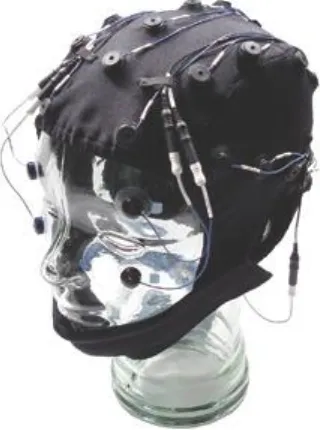
Figure 2. A Compumedics ‘Quick Cap’ headset as was used in the research for collection of EEG data. Image adapted from Compumedics Neuromedical Supplies (2005).
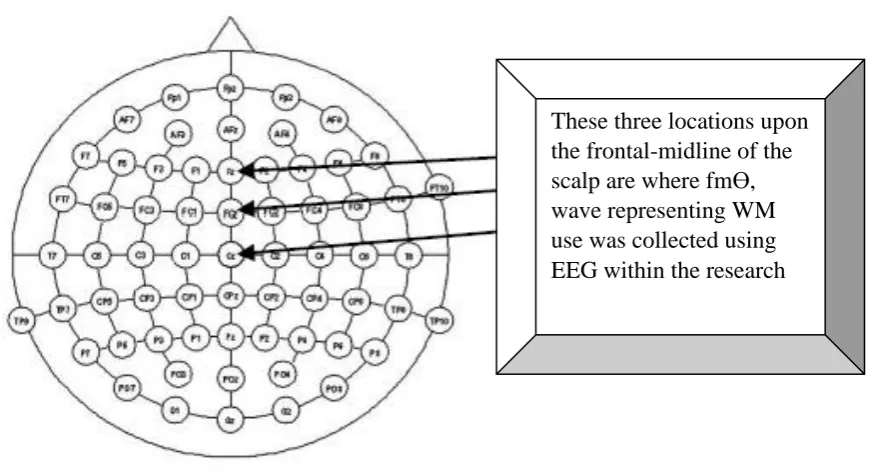
Figure 3. A map of the locations of possible approximate EEG electrode locations on the human head. The research examined electrical information for fmϴ at the three locations indicated (Fz, FCz & Cz) for a measure of WM use. Image adapted from Viklund (2008).
Introducing the Research
This was conducted as a small scale case study as part of the work for a master’s thesis with a
small sample of students at the school of the first author having met ethics’ approval at The University of Western Australia. The research sought to validate the fmϴ technique for measurement of WM anddetermine whether there are differences in WM between older and younger teenagers. Two research questions of the research were as follows:
- Could a measure of WM using EEG be validated with the comparison of results to a traditional WM test?
- Were there differences in WM between older and younger adolescents?
To achieve this, a small exploratory case study was completed to investigate the effects of age on WM in adolescent males. A WM task was given to two groups of adolescent male students while EEG was simultaneously recorded to give two measures of WM, one measure from a traditional WM task and one from EEG.
Participants
The research included 20 male students aged 12-13 and 20 male students aged 15-16 attending a Western Australian Independent Secondary School (n = 40). All participants were students of the first author who was a teacher at the school.
Methodology
The WM task used within the research was a modified Sternberg (1966) task, using ‘response time latencies’. The Sternberg task presents a set of stimulus to be stored in WM to the participant, then presents a ‘probe’ stimulus that the participant is required to recall whether
or not was present in the preceding set of stimulus (Sternberg, 1966). The modified Sternberg task along with the EEG recording took place within the school day and took approximately one hour. A 32 channel EEG Compumedics Quick-Cap headset was to be worn by the participant attached to a monopolar digital amplifier to while the modified Sternberg WM task was completed. Electroconductive gel was used to allow for the conduction of electrical activity from the participants’ scalps and the accurate measure of
WM as EEG. With EEG being recorded, student participants completed a multimedia-based modified Sternberg task on a desktop computer, having to press computer keys to indicate their responses as to whether the probe stimulus was present in a preceding set of stimuli.
Results
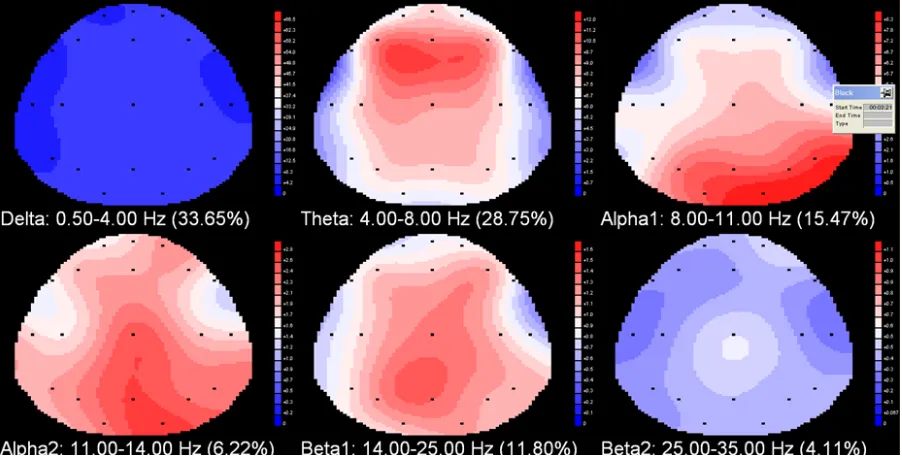
Figure 4. This figure shows an 6 images of the common electrical brainwave activities of different frequencies from a student participant in the research, notice the relatively high measurement of fmϴ, indicative of greater WM near the frontal midline of the scalp. The images are produced by a fast Fourier transform average of EEG taken from the time in which WM is in use by the participant.
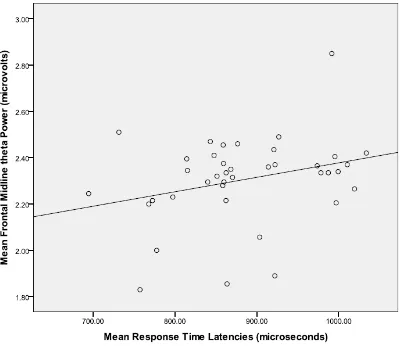
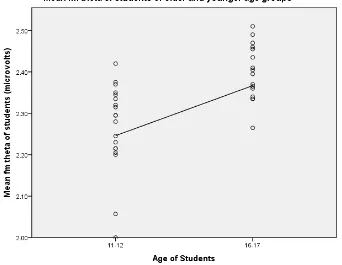
Data were collected and analysed from all participants, then averaged for each of the separate age groups of students. A low, but statistically significant correlation was found between the mean fmϴ power obtained by EEG and the response-time latency measures of WM as obtained by the modified Sternberg task (see Figure 4). A statistical model for analysis of variance was applied to the data collected to determine whether or not there was a difference in WM between the two adolescent age groups. The results showed that older adolescent students demonstrated higher levels of WM than younger adolescent students with a medium effect size given as the difference in WM between the two age groups (see Figure 5).
Figure 7. The mean fmϴ of each student age group. The graph indicates that the male students of the older age group showed a greater mean fmϴ, indicative of greater WM.
Analysis
The results of the research indicated that younger adolescent students had a lower mean fmӨ
power as a measurement of WM usage during a modified Sternberg task. The results of the research appeared to validate EEG as a measure of WM. The lower mean measure of fmӨ the younger adolescent students suggests that the restructuring that occurs in the prefrontal cortex of younger adolescent students results in a lower WM than the older adolescents. The data suggests that older adolescent students have completed the restructuring of the prefrontal cortex to a greater extent which has allowed for more efficient transfer of messages
associated with WM processes (Carter, 2010; Choudhury, et al., 2008).
from adolescents throughout their entire adolescent period to give a greater insight into WM development over time with a simultaneous study of prefrontal cortex development.
Similarly, the variable of gender as well as age could be considered in future studies of WM measured by fmӨ. It is well understood that frontal lobe grey matter peaks at different ages for males and females during the teenage years (Choudhury, et al., 2008). With a simple means to determine the stages of prefrontal reorganisation and an immediate relationship to WM processes, future research could examine whether the peaks in frontal lobe grey matter between males and females has a measureable influence on WM processes. In the research undertaken here, only male students participated for pragmatic purposes, and including females in the study would be a next step as well as students older and younger than early and mid-adolescents.
Relating the Research to Education
These results highlight the differences in WM that exist between adolescents of two different age groups. It has shown that WM increases with age and how this may be related to
neurological development that occurs during adolescence. Increases in WM are almost
intuitively exploited by teachers as they (and the curriculum) place greater cognitive demands on older students. Some students, however, seem to persistently struggle at school and their scholastic achievements limited by their WM capacity.
Deficiencies in WM could be addressed by schools with the adoption of helpful strategies for use by teachers within the classroom including techniques related to the reduction in the amount of material presented both verbally and visually to students and increasing the meaningfulness and familiarity of the material presented to students (Gathercole, 2008). These guidelines can often take the form of simple learning tools that can be integrated into classroom materials to assist students with limited WM such as younger adolescents.
encouraged to take advantage of this within the classroom. For example, as teachers of older adolescents introduce concepts or new topics, they ask students what they already know about related topics or events as a way of both focusing students on a new topic, gaining attention and eliciting students’ responses and thoughts. In this way, teachers develop and use
metacognition related to what is already ‘stored’ in WM. Metacognitive thinking has been shown to have a positive impact in many areas of education including standardised testing, reading comprehension and writing and has been shown to be useful as a strategy for maximising WM within students (see, for example, Goswami & Bryant, 2007).
Could teachers structure lessons or teaching and learning programs differently to account for differences in WM? Is it possible to accommodate the different WM needs of students through individualized education programs? Are teachers (and pre-service teacher educators) aware of differences in WM in school students? Is this sort of knowledge about child
development or educational neuroscience included as part of a teacher education program in Australia? Given that the focus of most teachers will be the students they teach, it would be reasonable to expect that they are most fully briefed about the students in their classrooms and better understand how to support learning of all. In the future, perhaps teachers would have access not only to NAPLAN scores, but also information about attention, WM and general motivation. Whilst educational neuroscience has yet to reach teacher education in Australia, the interest in brains and learning has provided opportunities for neuromyths to flourish and programs to be introduced into schools, advertised as ‘brain-based’ that lack both
science and evidence for their effectiveness (Oliver, 2011).
WM appears to be a misunderstood quantity that is not effectively considered within schools as a limiting factor for the effective education of students. This research has demonstrated how WM can be measured in adolescent students using EEG and that the differences in WM exist in male students of different ages. It is hoped that by highlighting the nature of WM as a process that develops throughout the age of a student and the importance of WM for effective learning, teachers may be interested to reflect on the potential and limitation of students’ WM in our classrooms.
Teachers increasingly understand the value of teaching their students how they think. The functionality of new computer based multimedia and the accessibility of the internet may provide teachers with resources that may promote attention, working memory and , are simple to use and easily adapted to the classroom.
Educational Neuroscience programs are being developed that may assist in students gaining an understanding of their brain function. Two such educational neuroscience programs developed in the US are BrainU (http://brainu.org/resources/MNSTDS) and Neuroscience for Kids
(http://faculty.washington.edu/chudler/neurok.html).
The Sternberg test, as has been adapted by the research to obtain a measure of working memory is available online at Millisecond Software
(http://www.millisecond.com/download/library/Sternberg/https://faculty.washington.edu/chudler/ja va/ready.html)
The Stroop test is widely used in psychological fields as a demonstration of interference in the reaction time of a task and is available from the University of Washington with no specialized equipment. (https://faculty.washington.edu/chudler/java/ready.html)
http://www.psychologytoday.com/blog/fulfillment-any-age/201206/the-13-top-online-psychology-games
Annable, J. (2012). Becoming self-editors: Using metacognition to improve students' grammar knowledge. English Journal,101(3), 89-91.
Goswami, U., & Bryant, P. (2007). Children's cognitive development and learning. In R. Alexander, C. Doddington, J. Gray, L. Hargreaves & R. Kershner (Eds.), The Cambridge Primary Review Research Surveys, London: Routledge.
Hughes, C. (1998). Executive function in preschoolers: Links with theory of mind and verbal ability. British Journal of Developmental Psychology, 16(2), 233-253.
Teachers increasingly understand the value of teaching their students how they think. The functionality of new computer based multimedia and the accessibility of the internet may provide teachers with resources that may improve attention and working memory. For example, see the Cogmed program at http://www.cogmed.com/about-working-memory
Educational Neuroscience programs are being developed that may assist in students gaining an understanding of their brain function. Two such educational neuroscience programs developed in the US are BrainU (http://brainu.org/resources/MNSTDS) and Neuroscience for Kids
(http://faculty.washington.edu/chudler/neurok.html).
The Sternberg test, as has been adapted by the research to obtain a measure of working memory is available online at Millisecond Software
(http://www.millisecond.com/download/library/Sternberg/https://faculty.washington.edu/chudler/ja va/ready.html)
The Stroop test is widely used in psychological fields as a demonstration of interference in the reaction time of a task and is available from the University of Washington with no specialized equipment. (https://faculty.washington.edu/chudler/java/ready.html)
Adams, A., & Gathercole, S. (2000). Limitations in working memory: Implications for language development. International Journal of Language & Communication Disorders, 35(1), 95-116.
Alloway, T. P., & Alloway, R. G. (2010). Investigating the predictive roles of working memory and IQ in academic attainment. Journal of Experimental Child Psychology, 106(1), 20-29.
Alloway, T. P., Gathercole, S. E., Kirkwood, H., & Elliott, J. (2008). Evaluating the validity of the Automated Working Memory Assessment. Educational Psychology, 28(7), 725-734.
Annable, J. (2012). Becoming self-editors: Using metacognition to improve students' grammar knowledge. English Journal,101(3), 89-91.
Baddeley. (2003). Working memory: Looking back and looking forward. Nature Reviews Neuroscience, 4(10), 829-839.
Blakemore, S.-J., Burnett, S., & Dahl, R. E. (2010). The role of puberty in the developing adolescent brain. Human Brain Mapping, 31(6), 926-933.
Buzsáki, G. (2006). Rhythms of the Brain (pp. 277-333). New York: Oxford University Press.
Carter, R., Frith, C. (2010). Mapping the Mind. Berkeley: University of California Press.
Choudhury, S., Charman, T., & Blakemore, S.-J. (2008). Development of the teenage brain. Mind, Brain & Education, 2(3), 142-147.
Compumedics Neuromedical Supplies. (2005) Compumedics Neuromedical Supplies Online Catalog Retrieved 20 June, 2014 from www.neuroscan.com
Crone, E. A., Wendelken, C., Donohue, S., Leijenhorst, L. v., & Bunge, S. A. (2006). Neurocognitive development of the ability to manipulate information in working memory. Proceedings of the National Academy of Sciences of the United States of America, 103(24), 9315-9320.
D'Esposito, M. (2007). From cognitive to neural models of working memory. Philosophical Transactions: Biological Sciences, 362(1481), 761-772.
Dosenbach, N. U. F., Nardos, B., Cohen, A. L., Fair, D. A., Power, J. D., Church, J. A., et al. (2010).
Prediction of individual brain maturity using fMRI. Science, 329(5997), 1358-1361.
Dubinsky, J., Roehrig, G., Varma, S. (2013) Infusing Neuroscience Into Teacher Professional Development. Educational Researcher, 42 317-329.
Finn, A. S., Sheridan, M. A., Kam, C. L. H., Hinshaw, S., & D'Esposito, M. (2010). Longitudinal evidence for functional specialization of the neural circuit supporting working memory in the human brain. The Journal of Neuroscience, 30(33), 11062-11067.
Fry, A., & Hale, S. (1996). Processing Speed, Working Memory, and Fluid Intelligence: Evidence for a Developmental Cascade. Psychological Science, 7 (4), 237-241
Gathercole, S., Packiam Alloway, T. (2008). Working Memory and Learning: A Practical Guide for Teachers. Los Angeles: SAGE Publications
Goswami, U., & Bryant, P. (2007). Children's cognitive development and learning. In R. Alexander, C. Doddington, J. Gray, L. Hargreaves & R. Kershner (Eds.), The Cambridge Primary Review Research Surveys, London: Routledge.
Holmes, J., & Gathercole, S. E. (2013). Taking working memory training from the laboratory into schools. Educational Psychology, 111.
Hughes, C. (1998). Executive function in preschoolers: Links with theory of mind and verbal ability. British Journal of Developmental Psychology, 16(2), 233-253.
Hsieh, L & Ranganath, C. (2014) Frontal midline theta oscillations during working memory maintenance and episodic encoding and retrieval. Neuroimage. 85(2), 721-729
Igou, S. (2013). Brain Injury Retrieved 16 October, 2013 from www.braininjury.com
Kawasaki, M., Kitajo, K., & Yamaguchi, Y. (2010). Dynamic links between theta executive functions and alpha storage buffers in auditory and visual working memory. European Journal of Neuroscience, 31(9), 1683-1689. 79
Kropotov, J. (2009). Quantitative EEG, Event-Related Potentials and Neurotherapy (pp. 77-95). San Diego, Burlington, London: Academic Press.
Luciana, M., Conklin, H. M., Hooper, C. J., & Yarger, R. S. (2005). The development of nonverbal working memory and executive control processes in adolescents. Child Development, 76(3), 697-712.
Mitchell, D. J., McNaughton, N., Flanagan, D., & Kirk, I. J. (2008). Frontal-midline theta from the perspective of hippocampal "theta". Progress in Neurobiology, 86(3), 156-185.
Naglieri, J., &Goldstein, S. (2009). Practitioner's Guide to Assessing Intelligence and Achievement Hoboken: Wiley.
Niedermeyer, E., Naidu, S. B., & Plate, C. (1997). Unusual EEG theta rhythms over central region in Rett Syndrome: Considerations of the underlying dysfunction. Clinical EEG and Neuroscience, 28(1), 36-43.
O'Donnell, L. (2009). The Wechsler intelligence scale for children - Fourth edition. Practitioner's Guide to Assessing Intelligence and Achievement(7), 153-190.
Oliver, M. (2011). Towards an understanding of neuroscience for educators. Studies in Science Education. 47(2), 207-231.
Owen, A. M., Evans, A. C., & Petrides, M. (1996). Evidence for a two-stage model of spatial working memory processing within the lateral frontal cortex: A positron emission tomography study. Cerebral Cortex, 6(1), 31-38.
Sauseng, P., Griesmayr, B., Freunberger, R., & Klimesch, W. (2010). Control mechanisms in working memory: A possible function of EEG theta oscillations. Neuroscience & Biobehavioral Reviews, 34(7), 1015-1022.
Schneider, W. (2008). Memory Development. In U. Goswami (Ed.), Blackwell Handbook of Childhood Cognitive Development (pp. 236-256). Malden: Blackwell Publishers.
Smith, E. E., & Jonides, J. (1997). Working Memory: A view from neuroimaging. Cognitive Psychology, 33(1), 5-42. 86.
St Clair-Thompson, H., Stevens, R., Hunt, A., & Bolder, E. (2010). Improving children's working memory and classroom performance. Educational Psychology, 30(2), 203-219.
Viklund. A. (2008). Clinical Neuroscience Research Team (University of Surrey) Retrieved 20 February, 2011, from http://www.fahs.surrey.ac.uk/cnrt/facilities/eeg.html
Wang, S., & Gathercole, S. E. (2013). Working memory deficits in children with reading difficulties: Memory span and dual task coordination. Journal of Experimental Child Pychology, 115(1), 188-197.
Woo, T. U., Pucak, M. L., Kye, C. H., Matus, C. V., & Lewis, D. A. (1997). Peripubertal refinement of the intrinsic and associational circuitry in monkey prefrontal cortex. Neuroscience, 80(4), 1149-1158.