Derivatisable Cyanobactin Analogues: A Semisynthetic
Approach
Emilia Oueis,
[a]Catherine Adamson,
[a]Greg Mann,
[a]Hannes Ludewig,
[a]Philip Redpath,
[b]Marie Migaud,
[b]Nicholas J. Westwood,*
[a]and James H. Naismith*
[a, c]Ribosomally synthesised and post-translationally modified pep-tides (RiPPs) make up a wide group of natural compounds with various biological activities.[1]The biosynthetic pathway of
RiPPs involves the action of many tailoring enzymes on a spe-cific precursor peptide to yield the highly modified final prod-uct. Cyanobactins are a large family of RiPPs that includes pa-tellamides, ulithiacyclamides, and trunkamides (Scheme 1) and that are produced by a diverse selection of cyanobacteria.[2]
Amongst the best-studied cyanobactins are the patellamides: cyclic octapeptides produced by Prochloron didemni, the cya-nobacterial symbiont of Lissoclinum patella. The biosynthetic pathway of patellamides consists of a seven-gene cluster (patA–G; Figure 1) that encodes the precursor peptide (PatE) as well as the altering enzymes. Common modifications of patell-amides include heterocyclisation, oxidation, epimerisation and macrocyclisation.[3]
Cyanobactins, including patellamides, have diverse and valu-able biological activities.[2b] Patellamides B, C and D have
shown a reversal of the multidrug resistance seen for vinblas-tine, colchicine and adriamycin treatment in the CEM/VLB100
human leukemic cell line,[4]and patellamide D is cytotoxic
to-wards fibroblast (MRC5V1) and bladder calcinoma (T24) tumour cell lines.[5] However, the development of these
com-pounds requires large-scale synthesis in order to identify their exact biological targets and ascertain structure–activity rela-tionships to fine-tune their properties. The chemical synthesis of such compounds is challenging, even more so (>16 syn-Many natural cyclic peptides have potent and potentially
useful biological activities. Their use as therapeutic starting points is often limited by the quantities available, the lack of known biological targets and the practical limits on diversifica-tion to fine-tune their properties. We report the use of en-zymes from the cyanobactin family to heterocyclise and mac-rocyclise chemically synthesised substrates so as to allow larger-scale syntheses and better control over derivatisation. We have made cyclic peptides containing orthogonal reactive
groups, azide or dehydroalanine, that allow chemical diversifi-cation, including the use of fluorescent labels that can help in target identification. We show that the enzymes are compati-ble and efficient with such unnatural substrates. The combina-tion of chemical synthesis and enzymatic transformacombina-tion could help renew interest in investigating natural cyclic peptides with biological activity, as well as their unnatural analogues, as therapeutics.
Scheme 1.Structures of cyanobactin metabolites. [a]Dr. E. Oueis, Dr. C. Adamson, G. Mann, H. Ludewig, Prof. N. J. Westwood,
Prof. J. H. Naismith
Biomedical Sciences Research Complex, University of St. Andrews North Haugh, St. Andrews, KY16 9ST (UK)
E-mail: [email protected] [email protected] [b]Dr. P. Redpath, Prof. M. Migaud
John King Medicinal Chemistry Laboratory School of Pharmacy, Queen’s University 97 Lisburn Road, Belfast, BT9 7BL (UK) [c] Prof. J. H. Naismith
State Key Laboratory of Biotherapy, Sichuan University Chengdu, Sichuan (China)
Supporting information for this article is available on the WWW under http://dx.doi.org/10.1002/cbic.201500494.
thetic steps) for those containing thiazoline and/or oxazoline moieties.[6]
Biochemical studies have shown that PatGmac
(macrocyclisa-tion domain of PatG) tolerates significant diversity in the amino acids in the core peptide,[8]as long as the core peptide
ends with a five-membered heterocyclic ring (either the natu-rally occurring thiazoline/oxazoline motif orcis-proline) and is flanked by a C-terminal macrocyclisation signature AYD.[9]More
recently, an engineered heterocyclase that can completely pro-cess peptide substrates lacking the leader peptide has been re-ported.[10] Taking advantage of this efficient biosynthetic
ma-chinery, we show that pairing chemical and enzymatic synthe-ses is efficient for the generation of unnatural patellamide-like cyclic peptides. We report herein the macrocyclisation of syn-thetic peptides that contain unnatural amino acids by using PatGmac as well as the selective derivatisation of the
subse-quent cyclic peptides. We also report the synthesis of a patell-amide-like cyclic peptide containing both a heterocycle and an unnatural amino acid in a one-pot procedure.
The introduction of bio-orthogonal or specific reacting groups on the side chains of linear/cyclic peptide residues would be highly desirable, as they would allow regiospecific and facile derivatisation. This approach has been previously used to study binding and/or activity,[11]to link a fluorescent
probe in order to investigate biological processes or pharma-cokinetic behaviour,[12] and to connect other building blocks
for activity enhancement or drug delivery,[13]among others.
Al-though orthogonal reacting groups have been previously in-troduced in vivo on precursor peptides of RiPPs through stop-codon suppression (SCS) and supplementation-based incorpo-ration (SPI),[14]these strategies lack the control for better
selec-tivity, specificity and flexibility that chemical synthesis permits. Three patellamide-like cyclic peptides were made with either an azidoalanine A(N3) or a dehydroalanine (Dha) reactive
group. The azide moiety is a well known bio-orthogonal group that reacts with alkynes both ex and in vivo.[15] Although not
fully bio-orthogonal, Dha is extensively used for bioconju-gation purposes.[16]The two groups, A(N
3) and Dha, were
intro-duced at different positions (4 and 2, respectively) in their re-spective core peptides to explore whether their incorporation
presented any challenges for PatGmacprocessing. For simplicity,
we made the first two compounds from peptides that lacked any cysteine residues, and therefore heterocycles. Having es-tablished a suitable approach, we advanced to adding the azide to a cysteine-containing peptide. We were able to enzy-matically heterocyclise the cysteine to a thiazoline within the sequence and then macrocyclise the resulting product in a one-pot process, to make a genuine patellamide analogue.
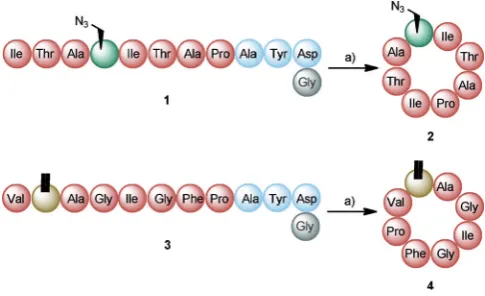
The synthetic precursor peptides1 (ITAA(N3)ITAPAYD/G) and
3 (VDhaAGIGFPAYDG; Schemes S1–S2; Figures S2–S5 in the Supporting Information) were incubated in the presence of PatGmac. The corresponding cyclic peptides cyclo(-ITAA(N3
)IT-AP-) (2) and cyclo(-VDhaAGIGFP-) (4) were obtained in 45 and 63% purified yield, respectively (Scheme 2). To prove their macrocyclic structure, peptides 2and4 were extensively ana-lysed by NMR spectroscopy and MS2(Supporting Information).
Furthermore, the Dha group was found to be highly stable under the macrocyclisation reaction conditions (Figures S31– S32).
Purified cyclic peptide2 was then reacted with cyclooctyne
5in a copper-free, strain-promoted azide–alkyne cycloaddition (Scheme 3).[17] The product,6, was obtained in 95% yield. We
used the same procedure to treat2with cyclooctyne7 (DBCO-Cy5), which contains the fluorescent cyanine tag (Cy5; Scheme 2), and the cyclic peptide–Cy5 conjugate 8 was ob-tained in 30 % yield.
The measured maximum absorbance (l=649 nm) and emis-sion (l=671 nm) properties of conjugate 8 were in good agreement with those of the parent Cy5 molecule (Figure S33). As these types of compounds could potentially be used for target identification by fluorescence microscopy, conjugate 8
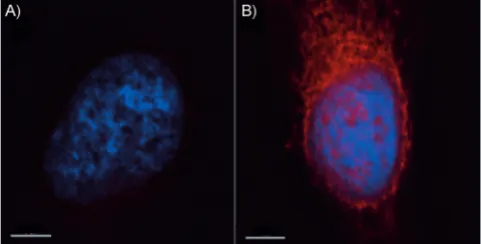
[image:2.595.305.548.312.460.2](dark blue colour) was tested to ensure there was no unex-pected behaviour (such as quenching or precipitation) in cells. When incubated with permeabilised HeLa cells, a diffuse stain-ing pattern of 8 (red colour) throughout the cytoplasm and nucleus was visualised by fluorescent microscopy (Figure 2); this showed that the molecule behaves as expected in biologi-cal buffers.
Figure 1.A) Thepatgene cluster codes for PatA, which cleaves N-terminal to core peptide, PatB and PatC (unknown function), PatD, which heterocy-clases cysteine (serine, threonine) residues in the core peptide, PatE (precur-sor peptide), PatF (inactive prenylase[7]) and PatG, which cleaves and macro-cyclises to the core peptide and oxidises thiazolines. B) PatE precursor pep-tide with its key regions highlighted.
Scheme 2.Macrocyclisation of the unnatural amino acid-containing precur-sor peptides1and3with PatGmac affords cyclic peptides2(45% yield) and
Cyclic peptide4underwent a thio-Michael addition with the cysteine-containing glutathione peptide9 (Scheme 4) with an excess of triethylamine in water and methanol.[18] The
corre-sponding compound10was obtained in 43% yield. Following the successful addition of glutathione, we investigated wheth-er the reaction could be carried out directly aftwheth-er the
macro-cyclisation reaction as a one-pot process. Once peptide 3has been fully macrocyclised, 100 equivalents of mercaptoethanol were directly added into the reaction mixture, and this was left at 378C overnight. The reaction was judged to be complete by MS, and the final compound 11 was obtained in 60% yield. The final product purifies as two separable peaks, which we at-tribute to different diastereoisomers (Figure S34).
As PatGmacprocesses substrates with unnatural amino acids
at similar rates to other sequences,[9]we next tested the
feasi-bility of introducing heterocycles into such unnatural sub-strates. The proline residue in peptide 1 was replaced with a cysteine (peptide 12) that could be enzymatically heterocy-clised. Like PatGmac, the heterocyclase enzymes of the
cyano-bactin pathways (known as the D enzymes)[3a,19] have been
shown to be tolerant of a wide range of sequences within the core peptide.
We incubated peptide 12 overnight with the engineered heterocyclase LynDfusion (from the aestuaramide pathway (Lyngbyasp.)) in the presence of ATP and MgCl2. The fully
[image:3.595.48.289.493.615.2]het-erocyclysed product13 was detected by MS but not isolated (Scheme 5; Figures S35–S36). Subsequent addition of PatGmac Scheme 3.Copper-free azide–alkyne cycloaddition of2with strained cyclooctynes affords conjugates6(95% yield) and8(30% yield). a) CH3CN, H2O.
to the reaction mixture afforded the patellamide-like analogue
14cyclo(-ITAA(N3)ITAhetC-) in 58 % yield.[20]
Milligram quantities of cyanobactin derivatives with fluores-cent components will greatly facilitate the target identification of many of these natural biologically active products.[2b]Target
identification will not only provide a basis for redesign of the natural product but could also disclose new opportunities for therapy. The expense and complexity of these labels means in practical terms that they are better introduced late in the syn-thesis. In the case of macrocyclic peptides, this means ideally after the macrocycle is made. Introducing chemical diversity to probe or fine tune the pharmacokinetic and biological
proties of natural products is likewise most desirable when per-formed as a final step on a common scaffold.
We have demonstrated that both the heterocyclases and macrocyclases from the patellamide (and a related) pathway can be used in vitro with entirely synthetic substrates that con-tain such chemically reactive unnatural amino acids. Moreover, we have shown that the resulting macrocycles can be deriva-tised with high efficiency. The ability to combine the diversity of chemical synthesis with the exquisite catalysis of enzymes is well known and recognised to be powerful in developing natu-ral products into therapeutics.[21]This approach can be
extend-ed to peptidic macrocycles and might likewise enable their fur-ther development.
Acknowledgements
We thank Andrew Bent for help and discussions. This work was supported by the European Research Council (339367), UK Bio-technology and Biological Sciences Research Council (K015508/1) and the Wellcome Trust (Triple TOF 5600 mass spectrometer (094476), the MALDI TOF-TOF Analyser (079272AIA), 700 NMR and supported G.M. (097831)). J.H.N. is a Royal Society Wolfson Merit Award Holder and 1000 talent scholar at Sichuan Universi-ty.
Keywords: click chemistry · cyclic peptides · enzymatic
reactions·macrocyclisation·patellamides
Scheme 4.Thio-Michael addition of thiol derivatives to cyclic peptide4. a) Et3N, H2O/MeOH (43%); b) Enzymatic reaction, bicine/NaCl buffer (pH 8.1), 378C (60%).
[1] P. G. Arnison, M. J. Bibb, G. Bierbaum, A. A. Bowers, T. S. Bugni, G. Bulaj, J. A. Camarero, D. J. Campopiano, G. L. Challis, J. Clardy, P. D. Cotter, D. J. Craik, M. Dawson, E. Dittmann, S. Donadio, P. C. Dorrestein, K.-D. Entian, M. A. Fischbach, J. S. Garavelli, U. Gçransson et al.,Nat. Prod. Rep.2013,30, 108– 160.
[2] a) M. Jaspars,Chem. Commun.2014,50, 10174 – 10176; b) K. Sivonen, N. Leikoski, D. Fewer, J. Jokela,Appl. Microbiol. Biotechnol.2010,86, 1213 – 1225.
[3] a) J. Koehnke, A. F. Bent, W. E. Houssen, G. Mann, M. Jaspars, J. H. Nai-smith,Curr. Opin. Struct. Biol.2014,29, 112 –121; b) E. W. Schmidt, J. T. Nelson, D. A. Rasko, S. Sudek, J. A. Eisen, M. G. Haygood, J. Ravel,Proc. Natl. Acad. Sci. USA2005,102, 7315– 7320.
[4] a) A. B. Williams, R. S. Jacobs,Cancer Lett.1993,71, 97– 102; b) X. Fu, T. Do, F. J. Schmitz, V. Andrusevich, M. H. Engel,J. Nat. Prod.1998,61, 1547 –1551.
[5] B. M. Degnan, C. J. Hawkins, M. F. Lavin, E. J. McCaffrey, D. L. Parry, A. L. Van den Brenk, D. J. Watters,J. Med. Chem.1989,32, 1349 –1354. [6] a) Y. Hamada, M. Shibata, T. Shioiri,Tetrahedron Lett. 1985,26, 6501 –
6504; b) U. Schmidt, H. Griesser,Tetrahedron Lett.1986,27, 163 –166; c) P. Garca-Reynaga, M. S. VanNieuwenhze,Org. Lett.2008,10, 4621 – 4623.
[7] A. F. Bent, J. Koehnke, W. E. Houssen, M. C. M. Smith, M. Jaspars, J. H. Naismith,Acta Crystallogr. Sect. F Struct. Biol. Cryst. Commun.2013,69, 618– 623.
[8] a) J. A. McIntosh, C. R. Robertson, V. Agarwal, S. K. Nair, G. W. Bulaj, E. W. Schmidt,J. Am. Chem. Soc.2010,132, 15499 –15501; b) D. Sardar, Z. Lin, E. W. Schmidt,Chem. Biol.2015,22, 907 –916.
[9] J. Koehnke, A. Bent, W. E. Houssen, D. Zollman, F. Morawitz, S. Shirran, J. Vendome, A. F. Nneoyiegbe, L. Trembleau, C. H. Botting, M. C. M. Smith, M. Jaspars, J. H. Naismith,Nat. Struct. Mol. Biol.2012,19, 767 –772. [10] J. Koehnke, G. Mann, A. F. Bent, H. Ludewig, S. Shirran, C. Botting, T.
Lebl, W. E. Houssen, M. Jaspars, J. H. Naismith,Nat. Chem. Biol.2015,11, 558– 563.
[11] a) M. S. Islam, M. I. Bhuiyan, M. N. Islam, T. Nsiama, N. Oishi, T. Kato, N. Nishino, A. Ito, M. Yoshida,Amino Acids2012,42, 2103 – 2110; b) H. N. Gopi, K. C. Tirupula, S. Baxter, S. Ajith, I. M. Chaiken, ChemMedChem 2006,1, 54–57.
[12] J. D. Ochocki, D. G. Mullen, E. V. Wattenberg, M. D. Distefano, Bioorg. Med. Chem. Lett.2011,21, 4998 –5001.
[13] a) T. P. Carberry, R. Tarallo, A. Falanga, E. Finamore, M. Galdiero, M. Weck, S. Galdiero,Chem. Eur. J.2012,18, 13678 – 13685; b) Q. Wan, J. Chen, G. Chen, S. J. Danishefsky,J. Org. Chem.2006,71, 8244 – 8249.
[14] a) R. S. Al Toma, A. Kuthning, M. P. Exner, A. Denisiuk, J. Ziegler, N. Budisa, R. D. Sìssmuth,ChemBioChem2015,16, 503 –509; b) F. Oldach, R. Al Toma, A. Kuthning, T. Caetano, S. Mendo, N. Budisa, R. D. Sìss-muth,Angew. Chem. Int. Ed.2012, 51, 415– 418;Angew. Chem.2012, 124, 429–432.
[15] N. J. Agard, J. M. Baskin, J. A. Prescher, A. Lo, C. R. Bertozzi,ACS Chem. Biol.2006,1, 644 –648.
[16] a) G. J. L. Bernardes, J. M. Chalker, J. C. Errey, B. G. Davis,J. Am. Chem. Soc.2008,130, 5052 –5053; b) J. M. Chalker, L. Lercher, N. R. Rose, C. J. Schofield, B. G. Davis, Angew. Chem. Int. Ed. 2012, 51, 1835 –1839; Angew. Chem.2012, 124, 1871 – 1875; c) R. Nathani, P. Moody, M. E. B. Smith, R. J. Fitzmaurice, S. Caddick, ChemBioChem 2012, 13, 1283 – 1285; d) B. Li, J. P. J. Yu, J. S. Brunzelle, G. N. Moll, W. A. van der Donk, S. K. Nair,Science2006,311, 1464– 1467.
[17] N. J. Agard, J. A. Prescher, C. R. Bertozzi,J. Am. Chem. Soc.2004,126, 15046 –15047.
[18] B. N. Naidu, M. E. Sorenson, T. P. Connolly, Y. Ueda,J. Org. Chem.2003, 68, 10098 – 10102.
[19] J. A. McIntosh, M. S. Donia, E. W. Schmidt,J. Am. Chem. Soc.2010,132, 4089 –4091.
[20] The stereochemistry of the alanine residue next to the heterocycle is unknown, as epimerisation is known to happen at some point during the biosynthesis. What we can confirm from the NMR data is the ab-sence of any mixture of two diasteriomers.
[21] E. Garca-Junceda, J. F. Garca-Garca, A. Bastida, A. Fernndez-Mayoralas, Bioorg. Med. Chem.2004,12, 1817– 1834.