INFORMATION & COMMUNICATIONS TECHNOLOGY IN EDUCATION |
RESEARCH ARTICLE
“I want to be a furious leopard with magical wings
and super power”: Developing an ethico-interpretive
framework for detecting Chinese students’ funds of
identity
Adam Poole1*
Abstract: The Avatar Project was a two-week English project in which Chinese high
school students in an internationalised school in Shanghai China explored the topic
of cultural and individual identity. The project synthesised prospective education
with the Funds of Identity approach, both of which have particular relevance within
an internationalised teaching context. During the project, students created three
identity texts: a written reflection, a word cloud and an avatar which were later used
as data for this article. This article presents findings from the project and critically
evaluates the effectiveness of avatars and word clouds as strategies for detecting
students’ funds of identity. A multimodal approach to data collection and analysis
was adopted in order to ensure that the interpretation of students’ work remained
situated within their lived experience. The project revealed the existence of social,
practical, institutional and cultural funds of identity. However, it also detected more
problematic forms of funds of identity related to political and philosophical beliefs
which I label ideological and existential funds of identity. While avatars and word
*Corresponding author: Adam Poole,Department of Education, University of Nottingham Ningbo China, Ningbo, China
E-mail: [email protected] Reviewing editor:
Shuyan Wang, University of Southern Mississippi, USA
Additional information is available at the end of the article
ABOUT THE AUTHOR
Adam Poole is a doctoral student in the Department of Education at the University of Nottingham, Ningbo. His doctoral research focuses on international education, specifically the way expatriate teachers in an internationalised school in Shanghai, China make sense of and put into practice the International Baccalaureate Learner Profile. Adam is also developing approaches to Funds of Knowledge and Funds of Identity for the Chinese context. His current research builds on a number of theoretical approaches by providing evidence to support the use of avatars as a strategy for uncovering students’ funds of identity.
PUBLIC INTEREST STATEMENT
Despite having worked as a teacher in China for over eight years and identifying closely with constructivist teaching approaches, engaging with the literature on Funds of Identity and Funds of Knowledge has made me conscious of my own deficit thinking. Rather than viewing my students as complex individuals with interesting and dynamic out-of-schools lives, I have found that I often reduce them to a set of traits that take on the form of uncontested axiomatic truths: Chinese students are passive, uncritical and over-reliant on the instructor (Grimshaw, 2007). This project made use of my students’ funds of identity as a way to bring their out-of-school identities into the classroom and also to expose and transform my deficit thinking. Given that globalisation has resulted in increased global mobility and cultural heterogeneity, it is imperative that both national and international educators actively research into their students’ cultures and lived experience in order to construct a more inclusive and socially just form of education.Received: 13 March 2017 Accepted: 03 April 2017
clouds were effective in drawing out students’ out-of-school identities, the written
reflections were ultimately more useful in revealing students’ funds of identity and
also ensuring that any interpretations remained within the participants’ horizon of
intended meaning. The project also brought about significant transformation in the
way I viewed my students.
Subjects: Multicultural Education; Bilingualism/ESL; School Psychology; English; Counselling
Keywords: funds of identity; funds of knowledge; avatars; Chinese students; prospective education; internationalised education
1. Introduction
There is a growing consensus that education in the twenty-first century requires a new set of com-petencies and modes of learning that are better suited to a mobile-centric society in the digital age (Patiño & Guitart, 2014; Subero, Vujasinović, & Esteban-Guitart, 2016). However, despite rapid tech-nological advances, educational practices still continue to take the form of what Kozulin (1998) calls retrospective education. Retrospective education is defined as the transmission of a solid and un-questionable cultural tradition from generation to generation (Subero et al., 2016). In contrast, Kozulin also proposes prospective education which is located within a networked society and calls for the collaborative development of new competencies, knowledge and understanding that are product orientated which can be seen as a process of authoring and not just reproduction (Kozulin,
1998). The potential that new technology and students’ digital literacies could play in this project is potentially quite revolutionary despite still being largely excluded from many classrooms (Honan,
2008). One approach that resonates with the notion of prospective education is the Funds of Identity approach which is based on the simple premise that people have and accumulate not only their household’s funds of knowledge, but also life experiences that ultimately help to them to define themselves (Subero et al., 2016). Funds of Identity is particularly suited to the prospective classroom as identity can be used as a lens through which to absorb and create new information and identities (Esteban-Guitart & Moll, 2014) and to bring about transformative educational practices in order to make teachers more sensitive to the lived reality of their learners (Jovés, Siqués, & Esteban-Guitart,
2015). In continuation of the Funds of Knowledge project, ethnographic research into and subse-quent use of students’ funds of identity is designed to enable teachers to design social justice pro-grammes for immigrant students, something that is becoming increasingly imperative in a globalised world in which non-dominant cultures, identities and epistemologies are marginalised within the main stream classroom (Subero et al., 2016).
I often reduce them to a set of traits that take on the form of uncontested axiomatic truths: Chinese students are passive, uncritical and over-reliant on the instructor (Grimshaw, 2007). Consequently, approaches like Funds of Knowledge and Funds of Identity, which emphasise “situated, collabora-tive forms of design” (Zavala, 2016) can be appropriated and adapted to destabilise colonising west-ern epistemologies within the context of intwest-ernationalised education. Currently, however, within a nexus of retrospective asymmetrical power relations, Chinese students’ ways of knowing are still routinely excluded and are discursively reconstructed as an “indigenous perspective” (Gutiérrez, Engeström, & Sannino, 2016). This project thus situates digital literacy within the context of prospec-tive education and develops a Funds of Identity approach as a way to bring students’ out-of-school identities into the ESL (English as a Second Language) classroom. In addition, this paper builds on my previous studies in the Chinese context (Poole, 2016b, 2016c, 2017) by offering empirical evi-dence to support the construction of a Funds of Identity approach that is commensurate with the cultural and political norms1 that underpin the Chinese context. In writing this paper, I aim to de-scribe and critically evaluate the Avatar Project as a form of prospective education and a vehicle for social justice as well as exploring the extent to which my own thinking about my students was transformed as a result of participating in the project.
I first begin by outlining the literature on Funds of Identity which informs my theoretical approach. I also underscore the methods used for identifying funds of identity in order to justify my choice of word clouds and avatars as the main instrument for data collection. I then present examples of students’ work and highlight the funds of identity which were identified. Finally, I evaluate the ex-tent to which word clouds and avatars were successful in achieving the aims of the project and end by highlighting limitations of the study and implications for practice and future research.
2. Literature review
This section offers a brief review of Funds of Identity in order to show how the concept is operation-alised in this paper. As the purpose of this article is to develop an ethically situated methodology for identifying students’ funds of identity, my main focus is necessarily orientated towards aspects re-lated to methodology and, most significantly, methods, while paying less attention to the concep-tual and theoretical aspects of the Funds of Identity approach. The reader can find a more developed interpretation of identity by consulting Esteban-Guitart (2016), Esteban-Guitart and Moll (2014) and Nogueira (2014). They can also find two systematic reviews of Funds of Knowledge by consulting Hogg (2011) and Llopart and Esteban-Guitart (2016). Llopart and Esteban-Guitart (2016) is a particu-larly useful text as it continues the work of Hogg by reviewing the literature between 2011 and 2015.
2.1. Funds of identity
(Esteban-Guitart & Moll, 2014; Nogueira, 2014) and refined a methodological approach (Jovés et al.,
2015; Subero et al., 2016). This gradual development can be seen to culminate in the recent publica-tion of Funds of identity: connecting meaningful learning experiences in and out of school (Esteban-Guitart, 2016) which signifies that Funds of Identity, once an adjunct of Funds of Knowledge, is now a concept and an approach in its own right. Esteban-Guitart’s work also sets out a clear pedagogical agenda for utilising students’ funds of identity for educational purposes which involves linking the learning experiences, practices and lifestyles of learners both in and out of school to create continui-ties between learners and school, and family and social contexts that make up their lives (Esteban-Guitart, 2016). As part of the evolution of the Funds of Identity approach, the term digital funds of identity has been proposed in recognition of the fact that increasingly twenty-first century society is mobile-centric in nature—that is, a networked learning ecology that has arisen from the massive penetration of digital media in everyday life (Patiño & Guitart, 2014). It is this conceptualisation of funds of identity, in their digital form, that is most applicable to my own project.
Funds of Identity is predicated upon a developmental interpretation of culture in which material and symbolic tools mediate the way individuals relate to their environments (Lightfoot, Cole, & Cole,
2009). In relation to my own study, physical tools include digital devices such as smart phones, lap-tops and tablets as well as observable forms of behaviour, such as the use of digital devices within an educational and social setting. Meanwhile, symbolic tools in this study refer to students’ identities and the way students define themselves individually as well as socially. Identity is thus mediated by material and symbolic tools: it is embedded in tangible, historical cultural factors, such as social in-stitutions, artefacts and cultural beliefs (Esteban-Guitart, 2011; Esteban-Guitart & Moll, 2014). This conceptualisation appears to have stuck as judged by recent studies (Jovés et al., 2015; Nogueira,
2014; Subero et al., 2016) which adopt a Vygotskian perspective. For the purposes of this project, identity was understood in Vygotskian terms although it has been suggested elsewhere that identity could be reconceptualised as digital identity in order to reflect social interaction as increasingly me-diated by digital devices, giving rise to new ontologies and epistemologies (Poole, 2017).
2.2. Strategies for identifying funds of identity
Because researchers working with a Funds of Identity approach are primarily concerned with the individual and the way they negotiate identity, it follows that the strategies employed for detecting funds of identity are fundamentally different from those adopted by Funds of Knowledge research-ers. Within the original Funds of Knowledge approach, the resources, knowledge and family skills of adults were located within the household which was taken as the main unit of analysis (Moll et al.,
1992). In contrast, researchers working with a Funds of Identity approach focus on specific knowl-edge banks and specific skills which may or may not be in continuity with the funds of knowlknowl-edge available in the household (Esteban-Guitart & Moll, 2014; Jovés et al., 2015; Subero et al., 2016).
conduct interviews in a creative and unintimidating manner that is responsive to the participants’ own meanings and associations (Subero et al., 2016). In addition, these visual methods are also supple-mented by a self definition task in which learners are encouraged to answer the question “who are you?” and to fill in a shortened version of the Twenty Statement Test (Hartley, 1970) which helps to distinguish between the roles that people play and who they really are or want to be (Saubich & Esteban, 2011). This multimodal approach to identifying Funds of Identity, which combines visual and written modes, provided the inspiration for my own contribution to funds of identity, namely the use of avatars and word clouds as strategies for drawing on existing funds of identity and a process by which students can construct new identities. However, the strategies above have been critiqued for not necessarily generating new knowledge according to a prospective paradigm of education (Subero et al., 2016). While the methods proposed above are designed to draw on existing funds of identity, avatars could facilitate the creation of new identities and therefore new knowledge.
3. Towards an ethico-interpretative framework
While visual strategies for drawing on students’ funds of identity are able to facilitate the flow of lived experience, teachers are likely to rechannel this flow due to the existence of teacher frames of reference which are mobilised in the process of meaning making. Because these frames operate on a tacit, unconscious level in the form of assumptions, beliefs and subjective truths, what Stigler and Hiebert (1998) refer to as cultural scripts for teaching and learning, teachers are unlikely to be aware of the existence of these scripts which makes their transformation practically impossible (Pajares,
1992). This distortion, moreover, is compounded in an international teaching context because the teacher and the curriculum are often western, while the students and the culture of learning are Chinese. Research has shown that there is an epistemological and axiological difference between Socratic and Confucian cultures which also shapes the way individuals perceive “good” teaching (Jin & Cortazzi, 2006; Liu & Feng, 2015; Stigler & Hiebert, 1998; Tan, 2015). An ethical concern that ap-pears not to have been addressed in the Funds of Identity literature is the fact that good-intentioned teachers may still unwittingly reinscribe asymmetrical power structures and also further entrench their deficit thinking by imposing their own deficit-laden interpretations on students’ identities. Given that it is impossible for the interpreter to place a phenomenological bracket around their be-liefs and assumptions: How can teachers make ethical use of students’ funds of identity without reinscribing deficit thinking and therefore committing symbolic violence?
3.1. The hermeneutic circle
This leads me to propose two mechanisms by which ethical interpretation can be maximised. The first is an interpretative framework, based on Gadamer’s hermeneutic circle (2004) and the second is a collaborative methodological approach based on Participatory-Based research (Bang & Vossoughi, 2016). Both of these mechanisms are commensurate with the ethical–epistemological ethos that underpins this project, which is to place the students’ lived experience at the forefront of everything that is done.
being assimilated into the lived experience of teachers. The issue still remains, however: How does a teacher know when they have arrived at the “right” interpretation? Within Gadamean hermeneutics, tradition functions as a yardstick of sorts by which judgements are made about meaning (2004). Within the ethico-epistemological imperative of my own project, tradition is reconfigured as the lived experience of the interpreter (the teacher) which could be likened to an experiential form of tradition of the self. However, in order to ensure fidelity to a participatory research methodology, it is necessary to adapt Gadamer’s ideas to also reflect the learners’ tradition; therefore, the yardstick is also the learner’s own lived experience: it is their tradition (cultural and experiential) that should be used as the main mediating interpretative frame (illustrated by Figure 1).
The diagram is a simple representation of this process. The overlapping section is where negoti-ated meaning between student and teacher is constructed. It is also the realm where transforma-tion of a teacher’s deficit thinking occurs. Finally, it is the realm where students’ out-of-school identities are valorised by teacher legitimisation. The model recognises that no interpretation can be value free, but emancipatory learning is more likely to take place if teachers ground their interpreta-tions of students’ identity texts in the tradition of the students’ lived experience.
4. Methodology
In order to ensure that the data collected for the project were ethically valid, it was necessary to appropriate a methodology that placed the participants’ lived experience at the centre of the re-search project. One such approach is Participatory Design Rere-search (Bang & Vossoughi, 2016; Gutiérrez et al., 2016; Zavala, 2016). Inspired by Participant-based research, Participatory Design Research is a recent methodological innovation for undertaking social justice research which, amongst other things, seeks to develop educational interventions that result in sustained and posi-tive outcomes for the participants. Rather than undertaking research on participants, Participatory Design Research forces researches to reflect on their ontological, epistemological and axiological assumptions in order to bring about transformational thinking that repositions the researched as equal participants. Research is thus done with rather than on at-risk and marginalised participants. By critically reflecting on their exposed deficit thinking, teachers and researches become aware that structural critiques of systems of power are a necessary component within processes of partnering and learning (Bang & Vossoughi, 2016). In order to prevent “normatively powered dynamics being reinscribed in the roles and relations between researchers and the researched”, participatory meth-odologies intentionally work to “disrupt or create new roles and relations to achieve transformative ends” (Bang & Vossoughi, 2016, p. 173). Validity within this ethico-interpretative imperative is recon-stituted as idiographic in nature and is therefore not designed to be representative of all Chinese students. Moreover, generalisability would undermine the very purpose of the study which is to ex-plore Chinese students as individuals rather than as collective members of a group.
4.1. Data collection and analysis
It was decided to forgo interviews as the main method of data collection and instead focus on students’ work as the main unit of data analysis. Such an approach is adopted as a strategy by researchers in the Funds of Identity tradition (Esteban-Guitart, Pallisera, Fullana Noell, & Gifre Monreal, 2017). This study, however, adopted a number of new strategies for uncovering students’ Figure 1. Ethico-interpretative
funds of identity by employing written identity texts, word clouds and avatars as the main instruments for data collection. Avatars in particular are able to facilitate the creation of new identities, thereby fulfilling one of the main tenets of prospective education which is to create new knowledge. Another advantage of focusing on visual work is that it allows researchers to conduct interviews in a creative and unintimidating manner that is responsive to the participants’ own meanings and associations (Subero et al., 2016). This is essential if teachers are to draw upon students’ funds of identity ethically in order to bring about transformative education that is both prospective and socially just. Validity in this study, then, is understood in ethical terms as fidelity to the participants’ lived experience. However, a major disadvantage of this approach, as pointed out earlier, is the fact that visual data, due to its polysemic nature, requires an interpretative framework in order to be analysed. Utilising an a priori framework, however, is problematic because it could reinscribe normative ways of knowing by imposing a framework of analysis that was developed with other contexts in mind. Such an approach thus might reinscribe the hierarchical relation of power that privileges academic over local (Zavala, 2013).
Despite these concerns, I appropriated a number of categories from previous Funds of Identity studies as a way to provisionally group and identify students’ funds of identity during data analysis. Funds of identity can be divided into five categories: geographic, social, cultural, institutional and practical. Because narratives of identity are social products, it therefore follows that they are insepa-rable from the social, institutional, cultural and geographic forces that make up funds of identity (Jovés et al., 2015). As my own study also adopts a sociocultural perspective (vis-à-vis culture and identity), these five categories were used as a guiding framework during data analysis for identifying students’ funds of identity. In addition, a semi-grounded approach was adopted that drew upon unexpected themes that emerged during data collection and analysis. Two additional categories emerged during data collection and analysis: ideological and existential funds of identity.
4.2. Research site
The research site is a recently opened K-12 bilingual school in Shanghai, China. In addition to offer-ing the compulsory nine-year Chinese curriculum from grades 1–9, the school also offers interna-tional curricula from grades 10–12 in the form of the IGCSE (Internainterna-tional General Certificate of Secondary Education) and IBDP (International Baccalaureate Diploma Programme). The school also employs international teachers to deliver these courses. Despite the rhetorical emphasis on student-centred learning and international education, the school’s culture of learning can be described as examination-orientated. The compulsory Chinese curriculum, for example, terminates in grade 9 with a high-stakes external examination known as the Zhong Kao, a high school entrance tests that decides students’ eligibility to enter a local high school. The high schools students also sit eight in-ternal examinations a year. Overall, the school is characterised by a retrospective approach to edu-cation that values fixed bodies of knowledge that can be transmitted from teacher to student and quantitatively assessed.
4.3. Participants
The participants were all Han Chinese high school students in Grade 10, aged between 15–16 years of age. In total, 31 participants took part in the project. The students were from two classes, class 1 (17 participants) and class 2 (14 participants). Ethical approval was sought and granted by the vice Principal of the school. The project followed informed consent rules as defined by Smith (2003) by informing participants about the purpose of the research, their right to withdraw and the use to which their work would be used. Informed consent was given by all of the participants who were also asked to fill out a consent form. In order to ensure that the findings had enough depth and to gener-ate “thick description” (Denzin, 1989), it was decided to primarily focus on a few examples of stu-dents’ work in detail. Pseudonyms were used to ensure anonymity.
5. Findings and discussion
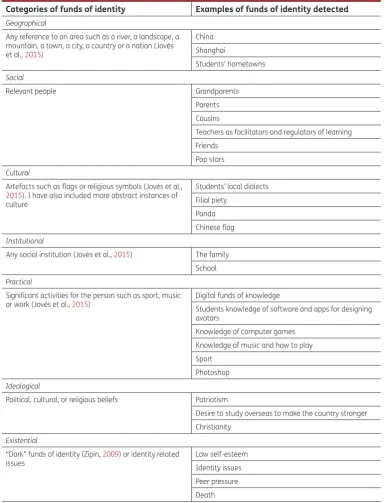
a more traditional written assignment. Appendix 1 provides more information about the project. Meanwhile, Table 1 summarises the funds of identity identified during the project.
[image:8.609.178.565.242.745.2]Given length restrictions, I only focus on a number of individual examples in order to show how the ethico-interpretative framework I am developing can be applied and to provide an in-depth explora-tion of students’ funds of identity. This level of depth is also necessary to show how my own thinking about my students was transformed as a result of doing the project. In addition to the five catego-ries that were used for data analysis, the project also identified two new forms of funds of identity: ideological and existential, which appear to be subdivisions of cultural funds of identity (to be dis-cussed in more detail in the discussion section).
Table 1. Summary of funds of identity detected during the Avatar Project
Categories of funds of identity Examples of funds of identity detected
Geographical
Any reference to an area such as a river, a landscape, a mountain, a town, a city, a country or a nation (Jovés et al., 2015)
China Shanghai
Students’ hometowns
Social
Relevant people Grandparents
Parents Cousins
Teachers as facilitators and regulators of learning Friends
Pop stars
Cultural
Artefacts such as flags or religious symbols (Jovés et al., 2015). I have also included more abstract instances of culture
Students’ local dialects Filial piety
Panda Chinese flag
Institutional
Any social institution (Jovés et al., 2015) The family School
Practical
Significant activities for the person such as sport, music
or work (Jovés et al., 2015) Digital funds of knowledgeStudents knowledge of software and apps for designing avatars
Knowledge of computer games Knowledge of music and how to play Sport
Photoshop
Ideological
Political, cultural, or religious beliefs Patriotism
Desire to study overseas to make the country stronger Christianity
Existential
“Dark” funds of identity (Zipin, 2009) or identity related
issues Low self-esteemIdentity issues
5.1. Word clouds
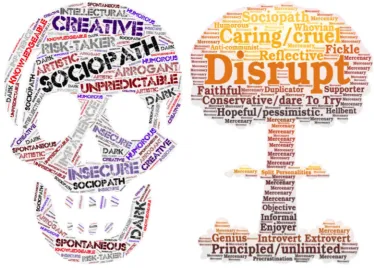
The first stage of the project involved students creating identity texts in the form of word clouds. Word clouds enable the user to construct multimodal texts that combine image and words and can provide a glimpse into the way participants perceive themselves. Figure 2 is an example taken from the participants’ work. Overall, the students tended to incorporate more personal traits in their word clouds rather than social or cultural aspects. Mercenary’s word cloud is worth discussing in order to show how visual texts can be interpreted and to underscore the need to employ a secondary modal-ity in order to ensure that the teacher’s interpretation is within the student’s horizon of meaning.
[image:9.609.179.554.101.369.2]Mercenary’s identity word cloud clearly shows the presence of both “light” and “dark” funds of identity. The two most prominent terms are “mercenary” which makes up the majority of the basic graphical image of the mushroom cloud and “disrupt” which appears in the centre of the image in large font and immediately draws the viewer’s gaze. A mercenary is a professional soldier hired to serve in a foreign army. The theme of not being loyal to one’s country is also reflected in other terms such as “anti-communist” and “fickle” which also play out in the constant use of opposites, such as hopeful/pessimistic, caring/cruel and introvert/extrovert. The multimodal aspect of the text is also significant. The image of the mushroom cloud connotes devastating destruction which corresponds to violent words like “disrupt” and “sociopath” but also clashes with more positive words like caring and hopeful. However, Mercenary’s interaction and behaviour in class is almost the complete antith-esis of his word cloud. Whereas the word cloud presents an individual who is anti-authority and something of a rebel, the student himself is usually very respectful and hardworking, always meet-ing assignment deadlines and referrmeet-ing to his teachers as “sir” or “miss”. In order to fully understand the significance of this identity text for Mercenary, it was necessary to ask Mercenary to explain the significance of the word cloud for him to which he explained that:
The mushroom cloud represents a nuclear explosion and a nuclear explosion is about the high-tech area and also the military field. I enjoy these two fields. I enjoy studying and watching these two fields, and that’s why I chose it because it can represent my daily hobbies. First I should say that I write disrupt in a different colour and it is the biggest so that’s why disrupt can explain the division of words afterwards. “Conservative” and “dare to try” are actually for two completely different situations and at these two situations my attitude will be either conservative or dare to try.
What was implicit in the word cloud is now made explicit in the supplementary reflection: the exist-ence of practical funds of identity, as suggested by “high-tech” and “military” as well as social funds of identity in the form of “sociopath”, although this might be labelled “anti-social funds of identity” or dark funds of knowledge due to its negative meaning. Overall, word clouds were effective in draw-ing out students’ perceptions of themselves as individuals, but were not so effective in detectdraw-ing social funds of identity, perhaps due to their slightly restrictive form which forces the user to use single words, such as adjectives and nouns, which encourages more introspection.
5.2. Written identity texts
In contrast to the word clouds, the written identity texts were able to detect more general forms of funds of identity and also revealed two new categories that I provisionally label ideological and exis-tential. In my haste to bring prospective education into my classroom and to “make it new”, I over-looked the potential that more traditional forms of literacy could play in detecting funds of identity.
5.2.1. Social funds of identity
The written identity texts revealed that students defined their identity in terms of many social roles, such as a “teenager”, “son or daughter”, “student”, or “Chinese”. This finding is not particularly sur-prising given the age and the cultural background of the students. Firstly, the students are all teen-agers who are studying the IBDP and are therefore preparing to study overseas. Secondly, they are all Han Chinese students and therefore share a common Confucian culture, which emphasises filial piety, and therefore respect for parents (Tan, 2013). This is also reflected in the students’ written work, which also similarly emphasised the social aspect of identity. Ruby’s writing, for example, highlights the many roles that comprise her identity as she perceives it. As she writes:
I am a 16 years old Chinese. In my family, I am a daughter, granddaughter (used to be a great granddaughter but not anymore). Also, a niece and a cousin. In school, I am a student and a member of my clubs and students’ union … I used to be a hostess, a scriptwriter, an organizer, a candidate and I am going to be an IB learner and maybe a leader of a club.
What is surprising, however, was the way Ruby’s identity can be seen to play out across temporal, physical and social contexts. Rather than embodying one identity, she perceives her identity as em-bodied in a number of roles within the social institutions of the family and the school. For example, in her family she is a daughter, a granddaughter, a niece, but she is also a cousin, a peer or an equal. Similarly, in school she is a student and a member of a club, but she is also an organiser and, poten-tially, a leader of a club. Future identities are also valid ways of being in defining the self, and Ruby’s narrative shows how they can be integrated to form a mosaic that makes up a whole.
5.2.2. Ideological and institutional funds of identity
Another surprising insight that emerged from the data was a strong emphasis on patriotism, familial obligation as well as social obligation to the country. This is illustrated in Annette’s written assign-ment about her identity:
The two main themes that emerge from Annette’s narrative are her role as a student and her rela-tionship to her family and to the country. There is a sense in which she feels an obligation or debt to both her family for giving her the opportunity to attend “advanced education”—that is, an interna-tional education2 that will lead to an overseas university—and also the country, towards China, which she feels a responsibility to improve and develop. Although “better” is ambiguous here, it echoes the discourse on human capital development in which Chinese citizens are encouraged to study and work overseas in order to accumulate “western” knowledge and practices which are then used to strengthen the country on their return, and suggests that advanced education is synony-mous with international education (Law, 2014). The Chinese expression for this is “Zhuanye Waiyu Fuhexing Rencai” which has been translated as human resources who possess both knowledge in specialised areas and strong competence in a foreign language (translation from Feng, 2007, p. 16).
5.2.3. Existential funds of identity
In contrast to the more matter-of-fact tone that characterised the majority of the participants’ writ-ten work about their identity, a few writwrit-ten assignments also revealed the presence of what could be called existential funds of identity or what Zipin calls dark funds of knowledge (2009). The funds of identity identified here are described as existential because identity is perceived to be problematic. In relation to existential philosophy, identity is constituted neither by nature nor by culture, but through an individual’s existence in and of the world (Crowell, 2016). Existential funds of identity can be detected in Maximus’s reflection:
About two years ago, I bought a book called The History of Western Philosophy. But I never opened it once. Because I soon realized one thing, that the human world is a restriction. It drains your brain out and shapes it however it wants. Over the past few years, every time I think deep into the discovery of myself and the world, I realize terribly that every single move in our lives is made not by us but by the outside world. You go to school because the outside world told you so.
It is worth explicating Maximus’s extract in some detail in order to tease out its identity resonances. There is an interesting juxtaposition between the book of philosophy which contains the sum of all of western philosophy and the more intuitive epiphany that Maximus has that the human world is a restriction. Two forms of knowing, or epistemologies, are thus juxtaposed: the fixed certainty of western knowledge and the kind of revelation that can only come to an individual as a result of lived experience. Significantly, Maximus does not open the book because it is a product of the “human world” and also because he comes to his own personal philosophical conclusion through experience and therefore does not require the book which itself is the product of a philosophical tradition that is alien to him.3 The book sitting unopened on the bookshelf is a form of resistance, “a gesture of protest against academic philosophy, its anti-system sensibility, its flight from the ‘iron cage’ of reason” (Crowell, 2016). The insight that Maximus comes to is not transcendental or cathartic but rather terrible in its implications, for there is a sense of resignation and fatality: the decisions that we make are not our own, but the result of the “outside world”, those societal forces and individuals that dictate and shape our actions and beliefs. The shift to the second person “you” in the final line has the effect of shifting the gaze from Maximus to the reader, as if he is now not only addressing his peers from his class but also anyone and everyone who has ever gone to school. It is also tempt-ing to interpret Maximus’s rejection of western philosophy from a post-colonial perspective, whereby he asserts Chinese agency in the face of globalisation as a form of westernisation. However, there is nothing in the text itself to support this reading—therefore, it falls outside of the text’s horizon of meaning (that is, the lived experience of the student) and is therefore ethically invalid.4
5.3. Students’ avatars
embodied more personal traits rather than social or collective funds of identity and tended to be humorous in nature, as illustrated by the three avatars in Figure 3.
The avatars also revealed that many students were conscious of their physical appearance and used avatars as a way to project a “perfect” version of themselves as revealed by comments such as “I don’t really want to make my avatar too realistic, so I think a cartoon avatar might fit my imagina-tion” (Jenna) and “I want to be a muscle man who looks very very strong, with Chinese KUNG FU. But this software could not change my body” (TuTu). The software for creating avatars, therefore, plays a significant role in mediating students’ identities. I was surprised that the male students were also conscious of their body image, assuming that this was an issue that primarily affected female stu-dents. Once again, the existence of “dark” funds of identity could offer opportunities to explore more problematic areas of knowing and being that resonate with students’ lived experience as young adults.
Even though students did not appear to embody social funds of identity in their avatars, the pro-cess of creating them offered many opportunities for social interaction, as illustrated by Juliet’s written reflection:
When I was making it, I also made the decision through my friends’ help. Although it is a project I can do by myself, I think I also need to get the opinions and the comprehensions from my friends to me, so I can objectively and clearly know who I am. When I was tangling which hairstyle was more suitable for me, my friends gave me a suggestion and I know how my appearance and characteristics are in other people’s eyes.
I also observed many instances of in-class interaction between students where individuals took on the role of an expert or a helper, thereby assisting students along their zone of proximal develop-ment. All the while, I remained more of a spectator than a facilitator, an experience which I initially found uncomfortable as it required me to assume a new role that was disempowered in nature.
[image:12.609.180.522.99.354.2]Identifying funds of identity using visual data, however, proved to be more difficult than antici-pated when it came to more abstract representations of identity as illustrated by Figure 4.
In contrast to the more humorous avatars presented above, a few students produced avatars that were quite morbid in nature (such as Annabelle’s avatar) or heavily symbolic (such as Skyrim and Valerie’s avatars), both of which are indicative of non-verdical change—human desire to change oneself (Yee, 2007). Both Skyrim and Valerie’s avatars, for example, embody the theme of appear-ance and reality. Skyrim’s avatar appears very daunting and intimidating which is accentuated by the use of dark colours and the low camera angle. In contrast, Valerie’s avatar appears to show a leopard with wings hovering above bright colourful cushions, conveying a feeling of freedom and optimism. However, when their avatars were interpreted in conjunction with their explanations, a very different interpretation emerged. In slightly different ways, both of their avatars projected an idealised or non-verdical version of their self which was at odds with the way they actually perceived themselves. I quote both students at some length:
As you can see, my avatar is under a black, well-made armor, and the shot is actually looking up. This gives my avatar a daunting presence rather than a friendly one. This actually reveals the introversion part of myself, the armor virtually cut off the connection between myself and the outside world. I prefer to hide my real feelings inside than sharing them with others, but I want to have an aggressive or extrovert appearance in front of others (Skyrim, my italics)
Those cushions on the cat are colourful, regarding to all those daily stuff fall on me. Those things appear to be colourful, pleasant and easy, but not to me. They are burdens that push me into escaping sleep. I am scared and tired. The leopard standing on the cushions is half-transparent, saying it is only an image in my cat’s sleep. I want to be a furious leopard with magical wings and super power to cope with all those things, but I am still only an escaper. I have those dreams of being capable, capable from the inside. But they are always dreams, and I am still the one sleeping with cushions on me (Valerie, my italics)
[image:13.609.180.522.100.352.2]Valerie’s avatar continues the theme of the cat established in her word cloud which also took the shape of a cat and included traits such as “lazy”, but develops it by projecting an idealised version of herself as a leopard—again, a member of the cat family, but diametrically opposed. Rather than a passive, sleeping and dreaming cat, the leopard is furious and powerful, a transcendental version of the cat. Valerie’s avatar also draws on parts of her written identity text in which she used an image of a box to symbolise restriction: “I have made so many restrictions on myself that I am basically Figure 4. Left to right, from top
living in a box or something and I shall say that I definitely need some air”. However, in the avatar, restriction is symbolised in the form of colourful cushions that appear to be bright and attractive to the outsider (perhaps the teacher or parents) but from her lived experience, take on the form of an existential weight that only she can feel. Once again, this underscores the need to make use of mul-timodal forms of data in order to ground the act of interpretation in students’ lived experience. The juxtaposition of the sleeping cat with the furious leopard symbolises Valorie’s struggle for catharsis, suggesting the slow negotiation of a new, emergent identity that has yet to become inchoate. Ethical interpretation aside, there is a very real practical and ethical consideration that needs to be addressed here: the fact that there is a very real young adult behind these identity texts whose re-peated references to stress, tiredness, apathy and fear suggest that she may be experiencing very real psychological distress. How then should these existential funds of identity be used by the teach-er? Should they be used for pedagogical purposes? Should they be used as the basis for intervention? Although it was not my intention to use avatars for this purpose, my findings suggest that they may in fact be effective for pastoral and wellbeing purposes.
Finally, the use of symbolism and more abstract representations of identity also made interpreting seemingly straightforward avatars problematic. Juliet’s avatar, for example, appears to give the impression of “light” funds of identity due to the bright blue background and the affirmative words in the speech bubble. However, when juxtaposed with her reflection, a more complex and complete picture emerged:
Firstly, the eyes can represent some information about myself. In real life, obviously, I do not have super big eyes, but in this picture, it contains some meanings which are symbolizing the expectation to the future […] Thirdly, I will focus on the sentence I wrote, “try your best”, it has just three words but it means the encouragement to myself. Because I can also be depressed when I am learning, so I have lots of pressure, I think I need some power which is originated in myself. It is a powerful way to motivate myself.
Overall, while avatars were effective in drawing out or unlocking students’ funds of identity, their interpretation nevertheless needed to be situated within the students’ horizon of meaning in order to capture easily missed identity resonances.
6. Discussion
categories could function as a normative framework that could be applied to other contexts. A ca-veat to this suggestion, however, is that the researcher needs to remain open and responsive to new, emerging categories, and also to be conscious of the cultural assumptions that underpin the re-search context. In the case of ideological and existential funds of identity, rather than suggesting new categories, they appear to represent sub-divisions or an enrichment of cultural funds of identity. As Lightfoot et al. (2009) point out, material and symbolic tools are historically accumulated and passed on through social processes, providing resources for the developing child or young adult. Therefore, ideology could be understood as a symbolic tool embedded in cultural objects such as the curriculum, books or symbolic routines in the school, such as the flag raising ceremony. Similarly, existential funds of identity could be said to be cultural in nature, although they also appear to be social too, as illustrated by Skyrim’s avatar in which he presents an enhanced version of himself as he wants to be seen by others which is at odds with the way he actually sees himself. Avatars can thus be mobilised as a form of social camouflage.
In terms of their practical utility, however, digital strategies for detecting and constructing funds of identity were not as effective as I had previously theorised (2017). One of the biggest constraints appears to be due to the nature of the software, which often forced students to make certain com-promises about the appearance of their avatars. This suggests that students need to be given more time to experiment with avatars in order to find software that is capable of creating a visual repre-sentation that aligns with their intentions or perceived self-image. Another complication illustrated by Skyrim and Juliet’s avatars is the fact that avatars often take on a symbolic meaning that is idi-osyncratic to their creators. This results in avatars that appear to represent one thing, but actually hold very different identity resonances for their creators. This points to the need to triangulate digital funds of identity with more traditional forms of literacy, such as a written reflection, in order to es-tablish an interpretative framework that is rooted in students’ lived experience. Ultimately, the writ-ten reflection proved to be the most effective strategy for making sense of students’ digital funds of identity as well as transforming my perception of the participants from Chinese students to complex individuals. Avatars and word clouds, therefore, appear to function most effectively as conduits for channelling what could be labelled “raw” funds of identity which subsequently need some explica-tion and interpretaexplica-tion in the form of students’ own written reflecexplica-tions. This finding suggests that any form of visual strategy needs to be multimodal in nature in order to ensure that a teacher’s understanding remains firmly within the student’s horizon of intended meaning.
student-centred, but also confronting issues of power and control. Rather than viewing student spontaneity as a loss of control or a form of disrespect, prospective teachers need to situate this within a context of creative-play in which the traditional asymmetrical power relations between teacher and student are inverted. In addition to my role as a teacher, the discovery of existential funds of identity also forced me to question my role as an educator in general: Am I a teacher, a counsellor or both? And what should I do when existential funds of identity are identified? On the one hand, it is tempting to encourage students to address their inner world issues in order to assist them in negotiating a complex yet potentially cathartic process of identity formation. On the other hand, these issues are very real to the students and it has to be asked to what extent is a teacher qualified to deal with the psychological and affective aspects of their learners’ development? All of these questions call for a reevaluation of my identity as an educator within the prospective class-room. They are also issues that I had not foreseen going into the project and which future research will need to address.
7. Conclusion
Acknowledgements
I would like to thank my two classes for agreeing to participate in this study. Without their enthusiastic commitment to a new way of learning, this project would never have been successful.
Funding
The author received no direct funding for this research. Author details
Adam Poole1
E-mail: [email protected]
ORCID ID: http://orcid.org/0000-0001-5948-0705
1 Department of Education, University of Nottingham Ningbo China, Ningbo, China.
Citation information
Cite this article as: “I want to be a furious leopard with magical wings and super power”: Developing an ethico-interpretive framework for detecting Chinese students’ funds of identity, Adam Poole, Cogent Education (2017), 4: 1316915.
Notes
1. For example, an approach that acknowledges certain political restrictions, particularly in relation to ethnic mi-norities, but still attempts to work within these restraints by drawing on the possibilities offered by students’ lived experience.
2. Member checking confirmed that my interpretation was within Annette’s intended horizon of meaning. 3. Member checking confirmed that both of these
interpre-tations were within Maximus’s horizon of meaning. 4. However, this time member checking confirmed that
this interpretation fell outside of Maximus’s horizon of meaning.
References
Amanti, C. (2005). Beyond a beads and feathers approach. In
N. González, L. C. Moll, & C. Amanti (Eds.), Funds of knowledge: Theorizing practices in households, communities, and classrooms (pp. 131–141). Mahwah, NJ: Lawrence Erlbaum Associates.
Andrews, J., & Yee, W. C. (2006). Children’s “funds of
knowledge” and their real life activities: Two minority ethnic children learning in out-of-school contexts in the UK. Educational Review, 58, 435–449.
https://doi.org/10.1080/00131910600971909
Bang, M., & Vossoughi, S. (2016). Participatory design research
and educational justice: Studying learning and relations within social change making. Cognition and Instruction, 34, 173–193.
https://doi.org/10.1080/07370008.2016.1181879
Crowell, S. (2016). Existentialism. In E. N. Zalta (Ed.), The
Stanford encyclopedia of philosophy. Retrieved February 21, 2017, from https://plato.stanford.edu/archives/ spr2016/entries/existentialism/
Debesay, J., Nåden, D., & Slettebø, Å. (2008). How do we close
the hermeneutic circle? A Gadamerian approach to justification in interpretation in qualitative studies. Nursing Inquiry, 15, 57–66.
https://doi.org/10.1111/nin.2008.15.issue-1
Denzin, N. K. (1989). Interpretive interactionism. Newbury Park,
CA: Sage.
Esteban-Guitart, M. (2011). The consumer capitalista society
and its effects on identity: A macro cultural approach. Psicología Política, 21, 159–170.
Esteban-Guitart, M. (2016). Funds of Identity. New York, NY:
Cambridge University Press.
https://doi.org/10.1017/CBO9781316544884
Esteban-Guitart, M., & Moll, L. C. (2014). Funds of identity: A
new concept based on the funds of knowledge approach. Culture & Psychology, 20, 31–48.
https://doi.org/10.1177/1354067X13515934 Esteban-Guitart, M., Monreal i Bosch, P., Perera, S., & Bastiani
Gómez, J. (2016). Schooling and identity: A qualitative
analysis of self-portrait drawings of young indigenous people from Chiapas, Mexico. Frontiers in Psychology, 2016, 2083. doi:10.3389/fpsyg.2016.02083 Esteban-Guitart, M., Pallisera, M., Fullana Noell, J., & Gifre
Monreal, M. (2017). Más allá de la palabra escrita. La
utilización de recursos visuales como estrategia metodológica en ciencias sociales y de la educación [Beyond the text. Using visual resources as a
methodological strategy in education and social sciences]. REMA: Revista Electrónica de Metodología Aplicada, 22, 1–22.
Feng, A. (Ed.). (2007). Bilingual education in China: Practices,
policies, and concepts (Vol. 64). Clevedon: Multilingual Matters/Channel View Publications.
Gadamer, H. G. (2004). Truth and method. London: Continuum.
Gonzalez, N., Moll, L. C., & Amanti, C. (Eds.). (2005). Funds of
knowledge: Theorizing practices in households, communities and classrooms. Mahwah, NJ: Lawrence Erlbaum Associates.
Grimshaw, T. (2007). Problematizing the construct of ‘the
Chinese learner’: Insights from ethnographic research. Educational Studies, 33, 299–311.
https://doi.org/10.1080/03055690701425643
Gutiérrez, K. D., Engeström, Y., & Sannino, A. (2016). Expanding
educational research and interventionist methodologies. Cognition and Instruction, 34, 275–284.
https://doi.org/10.1080/07370008.2016.1183347
Hartley, W. S. (1970). Manual for the twenty statements
problem. Kansas City, MO: Greater Kansas City Mental Health Foundation.
Hayden, M. (2016). Institutional Interpretations of
International Education in National Contexts. Sage library of educational thought and practice: International education (Vol. 2, pp. i–xiv). London: Sage.
Hogg, L. M. (2011). Funds of knowledge: An investigation of
coherence within the literature. Teaching and Teacher Education, 27, 666–677.
https://doi.org/10.1016/j.tate.2010.11.005
Honan, E. (2008). Barriers to teachers using digital texts in
literacy classrooms. Literacy, 42, 36–43. https://doi.org/10.1111/j.1467-9345.2008.00480.x
Hughes, M., & Pollard, A. (2006). Home–school knowledge
exchange in context. Educational Review, 58, 385–395. https://doi.org/10.1080/00131910600971784
Jin, L., & Cortazzi, M. (2006). Changing practices in chinese
cultures of learning. Language, Culture and Curriculum, 19, 5–20. https://doi.org/10.1080/07908310608668751
Jovés, P., Siqués, C., & Esteban-Guitart, M. (2015). The
incorporation of funds of knowledge and funds of identity of students and their families into educational practice. A case study from Catalonia, Spain. Teaching and Teacher Education, 49, 68–77.
https://doi.org/10.1016/j.tate.2015.03.001
Kozulin, A. (1998). Psychological tools. A sociocultural approach
to education. Cambridge, MA: Harvard University Press.
Law, W. (2014). Understanding China’s curriculum reform for
the 21st century. Journal of Curriculum Studies, 46, 332–360. https://doi.org/10.1080/00220272.2014.883431
Lightfoot, C., Cole, M., & Cole, S. R. (2009). Social and emotional
development in adolescence. The development of children (p. 6). HealthyFamilies BC.
Liu, S. N., & Feng, D. M. (2015). How culture matters in
Llopart, M., & Esteban-Guitart, M. (2016). Funds of knowledge in 21st century societies: Inclusive educational practices for under-represented students. A literature review. Journal of Curriculum Studies, 1–17.
https://doi.org/10.1080/00220272.2016.1247913
Moll, L. C., Amanti, C., Neff, D., & Gonzalez, N. (1992). Funds of
knowledge for teaching: Using a qualitative approach to connect homes and classrooms. Theory Into Practice, 31, 132–141.
https://doi.org/10.1080/00405849209543534
Nogueira, A. L. H. (2014). Emotional experience, meaning, and
sense production: Interweaving concepts to dialogue with the funds of identity approach. Culture & Psychology, 20, 49–58.
https://doi.org/10.1177/1354067X13515939
Pajares, M. F. (1992). Teachers' beliefs and educational
research: cleaning up a messy construct. Review of Educational Research, 62, 307–332.
https://doi.org/10.3102/00346543062003307
Patiño, J. G., & Guitart, M. E. (2014). Some of the challenges
and experiences of formal education in a Mobile-Centric Society (MCS). Digital Education Review, 25, 64–86.
Poole, A. (2016a). ‘Complex teaching realities’ and ‘deep
rooted cultural traditions’: Barriers to the implementation and internalization of formative assessment in China. Cogent Education, 3, 1156242.
Poole, A. (2016b). Digital funds of identity: Funds of knowledge
2.0 for the digital generation. Conference proceedings for IAFOR. Retrieved February 09, 2017, from http://papers. iafor.org/papers/ece2016/ECE2016_31021.pdf[accessed
Poole, A. (2016c). Possibilities-within-constraints:
Implementing the funds of knowledge concept in the People’s Republic of China. Frontiers of Education in China, 11, 187–216.
Poole, A. (2017). Funds of knowledge 2.0: Towards digital funds
of identity. Culture, Learning and Social Interaction. doi:10.1016/j.lcsi.2017.02.002
Razfar, A. (2012). ¡Vamos a jugar counters! learning
mathematics through funds of knowledge, play, and the third space. Bilingual Research Journal, 35, 53–75. https://doi.org/10.1080/15235882.2012.668868
Saubich, X., & Esteban, M. (2011). Bringing funds of family
knowledge to school. The living Morocco project. REMIE Multidisciplinary Journal of Educational Research, 1, 79–103.
Schwartz, L. H. (2015). A funds of knowledge approach to the
appropriation of new media in a high school writing classroom. Interactive Learning Environments, 23, 595–612. https://doi.org/10.1080/10494820.2015.1064448
Smith, D. (2003). Five principles for research ethics. Monitor on
Psychology, 34, 56.
Stigler, J. W., & Hiebert, J. (1998). Teaching is a cultural activity.
American Educator, 22, 4–11.
Subero, D., Vujasinović, E., & Esteban-Guitart, M. (2016).
Mobilising funds of identity in and out of school. Cambridge Journal of Education, 9, 1–17. https://doi.org/10.1080/0305764X.2016.1148116
Sugarman, S. (2010). Seeing past the fences: Finding funds of
knowledge for ethical teaching. The New Educator, 6, 96–117.
https://doi.org/10.1080/1547688X.2010.10399592
Tan, C. (2013). Learning from Shanghai (Vol. 21). Singapore:
Springer Science & Business Media. https://doi.org/10.1007/978-981-4021-87-6
Tan, C. (2015). Education policy borrowing and cultural scripts
for teaching in China. Comparative Education, 51, 196– 211. https://doi.org/10.1080/03050068.2014.966485
Yee, N. (2007). The Proteus effect: Behavioral modification via
transformations of digital self-representation (Doctoral dissertation). Stanford, CA: Stanford University.
Zavala, M. (2013). What do we mean by decolonizing research
strategies? Lessons from decolonizing, Indigenous research projects in New Zealand and Latin America. Decolonization: Indigeneity Education & Society, 2(1).
Zavala, M. (2016). Design, participation, and social change:
What design in grassroots spaces can teach learning scientists. Cognition and Instruction, 34, 236–249. https://doi.org/10.1080/07370008.2016.1169818
Zipin, L. (2009). Dark funds of knowledge, deep funds of
Appendix 1
Over-view of the A
vat ar P ro jec t Lesson sequenc e Description English-specific skills
Existing skills and knowledge
New skills and knowledge
1. R esear ching definitions of iden tit y This ac tiv ity f unc
tioned as sc
aff
olding f
or the
rest of the pr
ojec t b y in tr oducing studen ts to
the concept of iden
tit
y and getting them to
resear
ch its meaning and to arriv
e at their
own meaning
Receptiv
e
: Skimming, sc
anning
Studen
ts used their digit
al f
unds of
kno
wledge to sear
ch the in
ternet f
or
definitions of iden
tit y Studen ts s yn thesised r esear ched
definitions in or
der to construc
t their
own definition of iden
tit y Pr oduc tiv e : par aphr asing In ter cultur al : e
xploring ideas f
rom diff er en t cultur es 2. R ound-t able discussion
of definitions of iden
tit
y
This ac
tiv
ity consolidat
ed the first ac
tiv ity . Studen ts w er e encour
aged to shar
e their
definitions which w
er
e w
ritt
en up on the
boar
d and then turned in
to a W
or
d Cloud
which w
as lef
t on displa
y f
or the r
emainder
of the pr
ojec t Receptiv e : list ening f or det ails Studen ts shar
ed the new kno
wledge
gener
at
ed in sequence 1. The
y also used
their o
wn e
xperiences as a sour
ce of
kno
wledge. The studen
ts also used their
kno
wledge f
rom their Theory of Kno
wledge
class
Studen
ts w
ork
ed together to
co-construc
t a definition(s) of iden
tit y. Studen ts cr eat ed w or
d clouds as a
w
ay to consolidat
e new kno
wledge
using new t
echnology Pr oduc tiv e : giv ing inf ormation Social skills : w
orking in a gr
oup;
negotiating meaning
3. R
eading t
exts on a
vat
ars
Studen
ts r
ead tw
o on-line articles about
av
at
ars f
rom the New Y
ork Times Mag
azine
and the W
all Str
eet Journal. These t
exts
w
er
e designed to pr
ov
ide the studen
ts with
back
gr
ound inf
ormation on a
vat
ars and also
to sho
w ho
w the
y r
elat
e to the topic of
indiv idual iden tit y Receptiv e : loc
ating topic sen
tences,
iden
tifying main poin
ts, r
ecognising
regist
er
Studen
ts used kno
wledge f
rom sequence 2
to help them negotiat
e the tw
o r
eading
te
xts
Studen
ts understood the connec
tion
betw
een a
vat
ars and iden
tit
y and
some of the wider applic
ations of
av
at
ars in educ
ation, business and
people’s social liv
es
Pr
oduc
tiv
e
: summary w
riting 4. A vat ar tutorial Studen ts e xplor ed pot en
tial apps and
sof tw ar e f or cr eating a vat ars. Studen ts w er e ask
ed to v
olun
teer to t
alk to the r
est of the
class about a number of apps f
or cr eating av at ars Pr oduc tiv e
: speaking – giv
ing
instruc
tions, asking questions, seeking
clarific
ation
This sequence dr
ew on studen
ts’ digit
al
funds of kno
wledge, f amiliarit y with cr eating a vat ars
This sequence pr
ov ided import an t sc aff olding f or studen ts unf amiliar with a vat
ars and sof
tw ar e f or cr eating them
I also sho
w studen ts m y o wn att empts at cr eating a vat
ars and e
xplain m
y in
terpr
et
a-tion of them. This models language struc
tur
es f
or sequence 6
Receptiv e : list ening f or det ails 5. Studen ts cr eat e a vat ars Studen
ts used a digit
al de
vice (laptop, smart
phone, t
ablet) to cr
eat
e an a
vat
ar
n/a
Studen
ts put in
to pla
y their digit
al f
unds of
kno
wledge and the skills and ad
vice
gener
at
ed f
rom the tutorial session
Studen
ts construc
ted a digit
al
self-portr
ait b
y using their f
unds of iden tit y 6. Studen ts pr oduce an explanation Studen ts w rot
e a commen
tary about their
av at ar Pr oduc tiv e : studen ts pr oduce an accompan ying r ef ec tion The pr ojec t construc ted tr ansf orma -tiv e kno wledge f
or both t
eacher and
studen
ts
The a
vat
ar and the r
eflec
tion w
er
e
designed as one multi-modal t
ext in
or
der to gener
at
e new kno
wledge and
ac
t as a f
ramew
ork f
or the in
terpr
et
a-tion of the a
vat
© 2017 The Author(s). This open access article is distributed under a Creative Commons Attribution (CC-BY) 4.0 license. You are free to:
Share — copy and redistribute the material in any medium or format
Adapt — remix, transform, and build upon the material for any purpose, even commercially. The licensor cannot revoke these freedoms as long as you follow the license terms. Under the following terms:
Attribution — You must give appropriate credit, provide a link to the license, and indicate if changes were made. You may do so in any reasonable manner, but not in any way that suggests the licensor endorses you or your use. No additional restrictions
You may not apply legal terms or technological measures that legally restrict others from doing anything the license permits.
Cogent Education (ISSN: 2331-186X) is published by Cogent OA, part of Taylor & Francis Group.
Publishing with Cogent OA ensures:
• Immediate, universal access to your article on publication
• High visibility and discoverability via the Cogent OA website as well as Taylor & Francis Online • Download and citation statistics for your article
• Rapid online publication
• Input from, and dialog with, expert editors and editorial boards • Retention of full copyright of your article
• Guaranteed legacy preservation of your article
• Discounts and waivers for authors in developing regions