2FOQHF 0BRSOP ;BLRSON
. =IFRJR <TCMJSSFE GOQ SIF /FHQFF OG 9I/ BS SIF
>NJUFQRJSW OG <S .NEQFVR
',++
1TLL MFSBEBSB GOQ SIJR JSFM JR BUBJLBCLF JN <S .NEQFVR ;FRFBQDI ;FPORJSOQW
BS-ISSP-%%QFRFBQDI#QFPORJSOQW$RS#BNEQFVR$BD$TK%
9LFBRF TRF SIJR JEFNSJGJFQ SO DJSF OQ LJNK SO SIJR JSFM-ISSP-%%IEL$IBNELF$NFS%'&&()%,*,*
I George Eastop Ralston hereby certify that this thesis has been
composed by myself, that it is a record of my own work, and that it
has not been accepted in partial or complete fulfilment of any other degree or professional qualification.
Signed Date
I was admitted to the Faculty of Science of the University of St.
Andrews under Ordinance General No.12 on 1 1°13 and as a IJ 1 BSS
Date ..
"
Signed
I hereby certify that the candidate has fulfilled the conditions
of the Resolution and Regulations appropriate to the Degree of Ph.D.
Signature of Supervisor Date...“- * 1'71
A UNRESTRICTED
In submitting this thesis to the University of St. Andrews I understand that I am giving permission for it to be made available for
use in accordance with the regulations of the University Library for
the time being in force, subject to any copyright vested in the work
not being affected thereby. I also understand that the title and
abstract will be published, and that a copy of the work may be made
It seems that most people one meets express an interest in
memory. Everyone it appears has a"poor one" but knows someone who has
a "good one"; and advertisements in the Guardian promise us better
ones. My own interest in the subject began when, as an undergraduate at the University of Strathclyde I was introduced to the subject by Dr
Terry Mayes. The intricacies of the experimental work fascinated me :
how we began with this immense monster called memory and how Cognitive psychologists were attempting to devise means of investigating it; how vast amounts of experimental work would be carried out presenting
seemingly convincing results for one theory only to be met by results
which demanded that the theory be modified or abandoned. As the
theories came and went our knowledge about memory continued to grow.
One of the theories presently in vogue is the Working Memory
framework of Baddeley and Hitch (1974). I became interested in one particular aspect of this framework, namely the Visuo-Spatial Sketch
Pad after reading the Baddeley and Lieberman (1981) paper. It
appeared that this slave system had not been examined to any great extent. This was too much of a challenge for me to resist.
This thesis represents both my philosophy on exploring memory,
and in fact any other area of psychology, and my attempts to
investigate one area of human memory. It is essentially made up of two halves. In the first half a literature review is presented. The chapters presenting this review all take an essentially historical
asking myself....Just as the sight of an object begets the desire for it, so hearing about some unforeseen event often makes me want to know more and to understand it better. Or else fresh discoveries about facts that I either did not know or did not care about will arouse my interest.
This study set out to investigate the visuo-spatial component of
Baddeley and Hitch's (1974) Working Memory framework. The development of our understanding of this component has been less dramatic than
that of its verbal counterpart, the Articulatory Loop. The primary reason for this can be said to be the lack of techniques for
investigation (Logie, 1986). This thesis presents one attempt to try
to explore the nature of this code and to reveal possible new
techniques of investigation. The following are three possible areas of investigation :
1. Is the system spatially or visually based?
2. Does movement have a role in the system?
3. How is information stored?
The latter two issues are investigated here. Experiments 1-4 set
out to explore the possibility that movement may be involved in the
code. These experiments supported the idea that movement has a role
to play in spatial coding and more specifically demonstrated that arm
movements which are not compatible with the presentation of spatial
material can cause disruption. In addition it was shown that when movement identical to that involved in presentation is encouraged at recall subjects show marked improvement in performance. Together
these results very strongly suggest that movement should be given
the lack of investigative techniques in the field of visuo-spatial
short term memory. The fact that movement has been shown to be
important suggests that techniques employed to investigate kinaesthetic memory will aid us in exploring visuo-spatial coding.
The second issue in this thesis explored further the nature of
the internal code. Research into the nature of coding in
visuo-spatial memory had previously argued for the presence of a
sequential component. Experiments 1-4 in this thesis had shown that movement had an important role to play in coding. The fact that
movement by its very nature would appear to be sequential suggested that there was a strong sequential element in coding within
visuo-spatial memory. However, concern was expressed that the
materials and presentation format used may have led to sequential coding. This was first explored in experiments 5-8. The results
supported the view that the material and presentation format used had
led to sequential coding. This was further explored by Experiments 9 and 10 which illustrated that while it may be important under certain conditions, sequentiality is not always a dominant element in coding within the Visuo-Spatial Sketch Pad.
This thesis has explored two of the central issues currently interesting theorists of Working Memory and has put forward
suggestions for techniques which may in the future help us to advance our knowledge of the visuo-spatial component of the Working Memory
CHAPTER 1 THE EVOLUTION OF HUMAN MEMORY 2
CHAPTER 2 WORKING MEMORY 41
CHAPTER 3 IMAGERY 69
CHAPTER 4 THE VISUO -SPATIAL SCRATCH PAD 96 CHAPTER 5 THE ROLE OF MOVEMENT IN VISUO-SPATIAL MEMORY 117 CHAPTER 6 INVESTIGATING THE ROLE OF MOVEMENT IN THE VSSP 132 CHAPTER 7 EXPLORING THE NATURE OF THE INTERNAL CODE IN
VISUAL WORKING MEMORY 159
CHAPTER 8 DOES THE CODE HAVE A SEQUENTIAL(TEMPORAL) ELEMENT 173 CHAPTER 9 IMPORTANCE OF MATERIALS AND FORMAT ...204
CHAPTER 10 CONCLUSION 220
CHAPTER 1 : THE EVOLUTION OF HUMAN MEMORY
1.1 INTRODUCTION 3
1.2 A UNITARY SYSTEM OR A DICHOTOMY 3
1.2.1 TWO COMPONENT TASKS 4
1.2.2 NEUROPSYCHOLOGICAL EVIDENCE 8
1.2.3 CODING 11
1.3 THE MODAL MODEL 15
1.3.1 THE SENSORY REGISTER 16
1.3.2 THE SHORT-TERM STORE 17
1.3.3 THE LONG-TERM STORE 18
1.4 COMPLICATIONS WITH THE DICHOTOMOUS VIEW 19
1.4.1 NEUROPSYCHOLOGICAL EVIDENCE 19
1.4.2 RECENCY EFFECTS IN LTM 21
1.4.3 CODING 24
1.5 LEVELS OF PROCESSING 25
CHAPTER 1 THE EVOLUTION OF HUMAN MEMORY
1.1 INTRODUCTION
In the Preface, it was suggested that in order to fully
comprehend the evolution of cognitive research into human memory it is necessary to take a historical perspective. Thus, to introduce the
Visuo-Spatial Sketch Pad (VSSP) and present the imagery research in this thesis in a coherent manner, we must begin with an indication of
the reasons behind the original conceptualisation of multi-store
models of human memory proposed by Atkinson and Shiffrin (1968), among
others (Cf. Waugh and Norman, 1965). It will be shown that although these dichotomous approaches were originally convincing, a number of
problems arose, and that these problems were sufficiently damaging to
require a radical reconceptualisation. The two main alternative approaches that resulted from this reconceptualisation will then be discussed; first, the Levels of Processing Approach of Craik and
Lockhart (1972) and in the following chapter the Working Memory framework of Baddeley and Hitch (1974).
1.2 A UNITARY SYSTEM OR A DICHOTOMY?
It was the question of whether memory should be viewed in terms of a unitary system or as a dichotomous one which was the biggest
influence on memory research from the early 60s until the 70s. The
dichotomous theory was originally postulated by Galton (1883), further
proposed by James (1890) and brought into current vogue by Broadbent's
unitary concept of memory. In the beginning, the vast amount of research that followed appeared to support the dichotomous approach.
There were three main areas of corroborative evidence : The two
component tasks; neuropsychological research; and coding.
1.2.1 TWO COMPONENT TASKS
The results from a number of tasks suggest that the solving of those tasks involves two memory components, a labile Short-Term
component and a relatively stable Long-Term component. In the case of
free-recall tasks, for example, the first reason for assuming two separate mechanisms may be found in a very prominent and reliable
characteristic of free recall - the serial position curve or function.
In a typical experiment subjects are asked to learn a list of twelve or thirteen items. When asked to recall, it has been found that performance is superior for items that are presented at the beginning
Or at the end of the list, compared with those presented in the middle. The greater recall shown for items presented at the beginning
of the list is known as the "primacy" effect and the greater recall
shown for items presented at the end of the list is termed the "recency" effect (e.g., Glanzer and Cunitz,1966).
The dichotomous theory of memory appeared to provide a clear structural interpretation of this finding. If items are to achieve a
long-term memory representation then it was felt that information must be maintained in the Short-Term Store (STS) by rehearsal. The hypothesis is that the recall of the most recently presented items in a list are most likely to be from the STS, while recall of items
an interpretation the primacy effect in serial learning is due to items at the beginning of a list having already been transferred to
the LTS through rehearsal. The recency effect reflects the fresh storage of items from the limited capacity store. This hypothesis
suggested that one might be able to obtain useful data about the
nature of the STS by careful study of the serial position curve. If
the primacy and recenoy effects in a serial position curve can be
independently manipulated this would provide strong support for the
idea that each is based on a different memory structure.
As a starting point one can examine the effects of rehearsal on
the two ends of the serial position curve, since the assertion
provided above would predict different results in these two cases.
For example, since the transfer of information from STS to LTS
requires rehearsal time, by manipulating the rate of presentation of the stimuli one could affect the amount of information stored and
recalled from LTS, thus affecting the primacy part of the curve but not the recency part.
An early study by Murdock (1962) reports just this effect.
Murdock explored the serial position effect of free-recall where
subjects received lists of unrelated words of either 10,15,20,30, or 40 words long at two presentation rates. Each list was presented just
once, and was followed by a recall period in which the subjects were asked to recall as many of the words from the list as possible. As
one might expect from the foregoing assertion, there were major
effects of both list length and presentation rate on the early and middle items in the list. For example, a 10-word list presented at a
accuracy for the first item in the list. This can be compared with the 25% accuracy for the first word of a 40-word list presented at the faster rate of one item per sec. Neither the length of the list nor
the presentation rate had an effect on the later items in the lists.
List length (Murdock, 1963; Phillips, Shiffrin and Atkinson 1967) and presentation rate (Glanzer and Cunitz, 1966; and Raymond, 1969)
have both been shown to be variables which are capable of influencing
rehearsal. If only a few items are presented, the subject may have time between each presentation to re-rehearse the entire list up to
that point in a cumulative fashion while waiting for the next item to occur. For the longer lists, however, there would not be time for
this even at the slower rate of presentation. In general then, the longer the list, the less rehearsal we would expect each item to receive. Similarly, the faster rate of presentation would also
decrease the opportunity for rehearsal as the list was being presented. The curves show the effects of rehearsal on LTS (the early
portions of the curve) without a similar effect on STS (the recency
portion of the curves). When rehearsal is affected by these variables the normal u-shape curve alters such that the primacy section flattens
out while the recency effect remains unaltered. These later items would show a uniformly high level of recall, regardless of rehearsal
opportunity, because they are still "fresh" in the STS and, being at
Several studies have also shown that recency effects can be
manipulated without producing substantial effects on the earlier portions of the curve. One can do this, for example, simply by
delaying recall (Glanzer and Cunitz, 1966; Raymond, 1969) or by
filling the interval between the end of a list and a recall signal
with a verbal task which would displace the most recent items from the STS. When this is done, one finds a loss of the recall advantage for
items at the end of a list.
Another task which would appear to provide support for a dichotomous system is the short-term paired-associate learning task. This procedure is characterised by the fact that each item is really a
compound; that is, it has two parts. For example, given room/car, the subjects learn to report the second part of the item when given the
first. Thus given "room", they respond "car". Peterson and his
colleagues (Peterson, Brewer and Bertucco, 1963; Peterson, Hillner and
Saltzman, 1962) carried out a number of such tasks which were designed to explore the interaction of short-term storage and a long-term learning mechanism. They found that the primacy part of the curve was
affected by the duration of presentations (Peterson, 1963), the number
of repetitions (Peterson and Peterson, 1962) and the duration of the
spacing interval between repetitions (Peterson, Peterson, Hillner and Saltzman, 1962; Peterson, Wampler, Kirkpatrick and Saltzman, 1963;
Greeno, 1964), while the recency part decreases as a function of time
and/or the action of other information (Peterson, 1963). The early and late sections of the retention curve were clearly differentially
Long-Term learning mechanism.
Other tasks such as the serial probe task (e.g., Waugh and
Norman, 1965), the serial memory span (Baddeley and. Levy, 1971; Craik, 1970) and the Brown/Peterson (1958/1959) task together with those described above, provide support for a labile STS as reflected in the
recency part of the retention curve and a stable LTS as seen in the
primacy part.
1.2.2 NEUROPSYCHOLOGICAL EVIDENCE
The most oft cited neuropsychological evidence supporting the
dichotomous or duplex hypothesis comes from brain damaged patients who
have been left with unique memory deficits. Possibly the most famous case is a patient known as H.M. (Milner, 1966; 1969; 1970). At the age of 28 H.M. underwent brain surgery for his epilepsy. This
involved bilateral lesions of the hippocampus and parahippocampal gyrus on the medial aspect of the temporal lobes. The operation left
H.M. with a severe, lasting and very generalised memory disorder which was unaccompanied by any other intellectual change (Milner,
Corkin, and Teuber, 1968). The acquisition of new long-term traces was almost impossible. He could be introduced to the same person
several times during the same day and still fail to recognise him/her.
Neither was it possible for him to remember a simple list of numbers, nor even his new home address several years after he had moved. H.M.
showed no loss of previously acquired knowledge or skill; nor did he
lobe lesions it is argued are hard to reconcile with any unitary
process theory of memory and point towards a dichotomy.
Further neuropsychological evidence for more than one memory
system came from Drachman and Arbit (1966) who also studied patients
with bilateral lesions of the hippocampal complexes in order to provide support for memory as a multiple process. Such patients had been shown to develop an isolated memory defect, with preservation of other cognitive functions (Scoville and Milner,1957)• Like H.M. not
all aspects of memory were found to be equally affected. Although
finding it impossible to undergo long-term learning, the subjects
could quite easily recall relatively small quantities of information
perfectly for several seconds or minutes, provided they were not
distracted. As Drachman and Arbit (1966) said, this dissociation of
intact and impaired memory functions suggests that one memory mechanism, dependent on the intactness of the hippocampal regions, is
damaged while another anatomically independent mechanism is spared. They set out to establish whether there were indeed two phases of
memory, one of which is markedly impaired by such lesions and the
other left intact, or whether there is merely a general impairment of all memory functions. Confirmation of the "dualistic" concept of
memory would be found if it could be demonstrated that there are different levels of performance in two distinct categories of memory
tests. Five patients with memory defects due to bilateral lesions of hippocampal regions were compared with a group of twenty normal
control subjects. Two memory tasks were devised in which the length
of a "memorandum" could be gradually increased from subspan to
(IMS) were normal compared to the control subjects. However, the
learning of supraspan memoranda, even after multiple repetitions,
yielded different results, with patients exhibiting severe
impairments. Drachman and Arbit (1966) present these results as
strong support for the dualistic concept of memory.
Further neuropsychological support for the two store view comes
from an extensive study carried out by Baddeley and Warrington (1970).
They set out to compare the performance of amnesic and normal control subjects using a number of standard laboratory memory tasks which vary
in the degree to which performance is said to depend on STS and LTS. The central aim was to test the hypothesis that amnesic subjects have
a normal STS, but impaired LTS. This would provide information about
the relative contribution of STS and LTS to the various tasks and
should thus help interpretation of the performance of normal subjects. Six patients were employed in this experiment with two criteria being used to select them. First, a clinically diagnosed amnesia - the
patient did not remember such simple pieces of information as the day
of the week, where they were and how long they had been in hospital.
Second, patients with any sign of intellectual impairment other than a memory defect were excluded. Of these six patients four suffered from
a disorder known as Korsakoff's syndrome. This is thought to be due
to many years of chronic alcoholism and the inadequate diet associated with it which in turn leads to vitamin B deficiency, the result being
brain damage. Baddeley and Warrington (1970) found that when examining the recency effect in free recall, the rate of short-term
forgetting, short-term paired-associate retention and digit span,
comparable controls. Thus amnesic patients are no more distractable
than normal subjects and are no more dependent on rehearsal. Their level of performance was impaired on the free-recall task employed but
only in the early portion of the curve. There was no recency effect. The amnesic subjects were also impaired on a questionnaire they filled out concerning recall of recent events and on other experiments
involving long-term learning and recall leading Baddeley and
Warrington to conclude that they had an LTS defect. Baddeley and
Warrington (1970) state, then, that their amnesic subjects do appear
to have normal STS and impaired LTS, a result consistent with the studies of Drachman and Arbit (1966) and those involving H.M., all of
which support a dichotomous view of memory.
1.2.3 CODING
Conrad (1962, 1964) investigated intrusion errors in the
immediate recall of lists of six letters drawn from the following 10
letters : BCPTV,FMNSX. He found that confusions were high within the two groups and relatively law between them. This was true even though
the letters were presented VISUALLY at the rate of .75sec/letter, under conditions where the probability of perceptual error was known
to be negligible. Three conclusions were drawn from this study : (a)
Short-Term storage is acoustic (or speech-motor). (b) Acoustically
similar items are represented by similar traces. (c) Partial forgetting of an item is possible, producing intrusion errors that
share the unforgotten property common to both the original item and the intrusion. Wickelgren (1965) set out to investigate these ideas. He extended Conrad's study, employing all 26 letters in the English
letters, and between letters and digits, based on ANY vowel or
consonant acoustic similarity. In support of Conrad's conclusions Wickelgren found that intrusions among letters, and letters and
numbers, tended to follow acoustic similarity. From this he concluded that STS appears to use an "auditory or speech-motor code" (p.102).
Baddeley (1966a) substantiated this claim in three experiments
when he examined STM for word sequences as a function of acoustic, semantic and formal similarity. The first experiment compared
acoustic and semantic similarity for auditorily presented word
sequences. The second compared what he termed formal similarity
(i.e., similar letter structure, e.g., rough/cough) with acoustically
similar but formally dissimilar word sequences (e.g., brought, sort,
taut). Finally, the third experiment used visual instead of auditory presentation to replicate experiment one. In all of these experiments
a large and significant adverse effect of acoustic similarity was
shown and neither semantic nor formal similarity had an effect of comparable magnitude. The relative unimportance of semantic similarity shown in Baddeley's experiment together with the failure of
Baddeley and Dale (1966) to find an effect of semantic similarity among stimuli on STM for paired-associates suggests that subjects show
remarkable consistency and uniformity in using an almost exclusively acoustic coding system for the short-term remembering of disconnected
words.
The evidence presented thus far is exclusively related to coding
in STS, indicating a speech based system, but what of coding in LTS?
Baddeley (1966b) set out to test the hypothesis that LTS would be
similarity would cause impairment, but semantic similarity would have
no effect. In his first experiment subjects attempted to learn one of
four lists of 10 words. List A was comprised of ten acoustically
similar words (e.g., man, can, cab, cad). List B was a control list comprising acoustically relatively dissimilar words which were matched
with List A for frequency of occurrence in the language using the
Thorndike and Lorge (1944) norms (e.g., pit, few, cow, pen). List C
comprised ten semantically similar adjectives (e.g., great, large, huge, big) and List D, adjectives of equal frequency of occurrence but
with dissimilar meanings served as a control list (e.g., good, huge,
hot, safe). These lists were learned for four trials, after which subjects spent twenty minutes on a task involving immediate memory for digits. They were then asked to recall the word list. It was found
that the acoustically similar list was learned relatively slowly, but,
unlike the other three lists, showed no forgetting. Experiment II Showed that this latter paradox, a result which is in conflict with
previous studies (Underwood, 1949; Baddeley, 1966a), can be explained
by assuming that the learning score depends on both LTS and STS, but
the subsequent retest depends only on LTS. This suggested that the testing procedure adopted confounded the effects of LTS and STS during
the learning phase, and that this, in turn, may influence the
subsequent recall score. Baddeley (1966b) concluded that such
conventional procedures cannot be expected to give a satisfactory answer to the question of the relative importance of semantic and
acoustic factors in LTS. The final experiment thus repeated Experiment I but attempts were made to minimize the effects of STS
proved to be impaired by semantic similarity but not by acoustic
similarity a result also found by Underwood (1951), among others (Underwood and Goad, 1951; Baddeley and Dale, 1966; Kintsch and
Buschke, 1969).
It was suggested that this effect could be generalised beyond serial and paired-associate learning. This task was taken up by Sachs
(1967, 1974). In the 1967 study, Sachs reported an experiment in which subjects listened to passages and then attempted to recognise
changes in sentences they had heard. With this method, subjects are instructed to try to remember as much about the original form of the
sentences as they can, while at the same time to perform the semantic
processing necessary to succeed at recognising semantic changes in the sentences. By comparing recognition for semantically changed
sentences and for various sorts of paraphrases of the original
sentences, conclusions can be reached about the wording in memory and about the characteristics of the encoding of the linguistic material
at different points in time. Sachs found that paraphrases of
sentences were poorly identified as different from the original sentences after 80 syllables of interpolated linguistic material had been heard. Changes in the meaning of the sentence, on the other
hand, were well recognised at that and longer intervals. These
findings were taken as support of the idea that linguistic material becomes semantically encoded. In that study, however, the shortest
time interval between the original presentation and recognition test
was 27sec. Sachs (1974) therefore suggested that no conclusion could
be reached about the characteristics of the encoding between these two
1- -
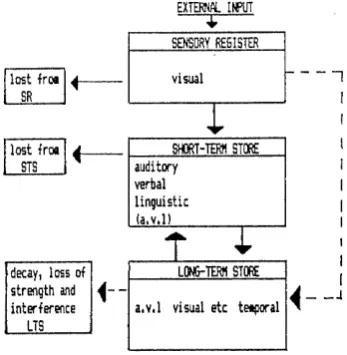
decay, loss of strength and interference LTS lost from SR lost from STS SENSORY REGISTER visual SNORT-TERM STORE auditory verbal linguistic ta.v.1) LONGTERM STORE
a,v.1 visual etc temporal
found as before that paraphrases were poorly detected within 10 secs of interpolated discourse, which suggests that formal aspects of
discourse do not normally enter LTS. Thus, there would appear to be
more evidence for the dichotomous argument in Short-Term and Long-Term
Memory.
1.3 THE MODAL MODEL.
The evidence generated throughout the 1960s seemed then to
indicate a clear dichotomy between Long-Term and Short-Term Memory. Many different models were developed (e.g, Waugh and Norman, 1965;
Norman, 1970), all of which had common themes. The most detailed and
explicit of these models was one which arose from Broadbent's 1958 formulation and was postulated by Atkinson and Shiffrin (1968) (see
Figure 1.1). According to Atkinson and Shiffrin's model the basic structural features comprise three memory stores. These are the
Sensory Register (SR), the STS and the LTS. All of these stores are
felt to be structurally distinct because they preserve information in
different formats, for different durations and also because they lose
information in different ways.
MOM.
FIRM 1.1. Flow diagram of the three memory stores in Atkinson and Shiffrin's (196e) model of episodic memory.
—
[image:26.406.110.284.385.563.2]1.3.1 THE SENSORY REGISTER
According to this model when external information enters the
memory system via the various senses it proceeds first to the SR. While they made provision for other systems, Atkinson and Shiffrin
(1968) only postulated the visual system, gathering support from the
work of Sperling (1960) among others (Averbach and Coriell, 1961;
Estes and Taylor, 1964; 1966). They argued that the particular features of visual registration allows us to positively identify this
system as a distinct component of memory. Information is neither
recognised nor identified until after it has passed through the
register. They felt that the entry of information into the register is passive and that such entry is obligatory as it cannot be avoided if the senses are functioning properly. Furthermore, there are no
control processes involved in the register and although all sensory
information is accepted in a complete and "more or less photographic trace" (p.95) it deoays during a period of several hundred
milliseconds. Information, it is surmised, may be lost in one of two ways. It may either decay spontaneously, simply dissipating with the onslaught of time; or new information from the senses writes over
already registered information, erasing it. But what of transfer to
higher order systems? In the case of the transfer of visual
information Atkinson and Shiffrin (1968) postulated that it goes to an
auditory-verbal-linguistic STS by means of a selective scanning process carried out at the discretion of the subject. While the elements in the register are scanned, a "matching program of some
sort" (p.96) is carried out against information in the LTS and the
STS. However, the links between the SR and the LTS do not, Atkinson and Shiffrin (1968) stress, indicate that information is transferred
directly to the LTS from the register. The function of the SR is to preserve incoming information for a sufficient period allowing the
cognitive system, meanwhile, to run off subroutines that select from its sensory inputs those that will be further processed and entered
into the STS. The idea that information travelled from the SR into
the STS before gaining access to the LTS will later be revealed as a
fatal flaw in the argument for flow diagram models of the fractionation of Short- and Long-Term memory systems.
1.3.2 THE SHORT-TERM STORE
The STS is presented by Atkinson and Shiffrin (1968) as a
"working memory", by which they mean that conscious mental activities
are performed there. Information enters the STS from both the SR and the LTS. Consciousness is viewed as a function that is unique to the
STS and it is argued that information cannot undergo conscious processing in either the sensory register or the LTS. Unlike the sensory register, information in the STS can be maintained
indefinitely provided it is given constant attention through rehearsal. The degree of transfer to LTS and the amount of learning
correlates highly, Atkinson and Shiffrin (1968) say, with the length
of maintenance rehearsal. In order to manipulate information the STS
was believed to have a number of control processes or strategies
available to it. Although a range of such strategies was postulated,
completely in 15 to 30 secs. What function does the STS serve that
contrasts it with the Sensory Register and the LTS? The function of
the STS is best described by Lachman, Lachman and Butterfield (1979) "it is to briefly hold small amounts of carefully selected information
from the SR and the LTS in order for people to execute the optional
conscious processes necessary to tailor their behaviour to the changing demands of their environment" (p.222).
1.3.3 THE LONG-TERM STORE
This store differs from the preceding ones in that information
stored here does not decay and become lost in the same way. Although information stored in the SR and STS is eventually lost, information
in the LTS is felt to be permanent, even though it may be temporarily
irretrievable. Atkinson and Shiffrin (1968) emphasised that although most of the studies in the field had been concerned with storage in the auditory-verbal-linguistic mode, it is intuitively obvious that
there is long-term memory in each of the other sensory modalities, as
one can recognise stimuli presented to those senses. They even allowed for the possibility that there may be information in the LTS which is not classifiable into any of the sensory modalities, an example being temporal memory. In order to do their mental work
people must have recourse to a vast repository of information, and they must be able to call on mental rules. The function, then, of the
LTS is to keep information and rules for its processing when they are
not being used. This storage need not be conscious since we do not
need to use all our knowledge nor all of our cognitive subroutines all
1.4 COMPLICATIONS WITH THE DICHOTOMOUS VIEW
In the early 1970s through extensive empirical research a number
of problems arose with the modal model. Three phenomena are commonly
viewed as combining to cause the gravest difficulties for an Atkinson
and Shiffrin flow type formulation of human memory Neuropsychological evidence, Long-Term recency effects and coding
findings (Baddeley, 1983).
1.4.1 NEUROPSYCHOLOGICAL EVIDENCE
Within the dichotomous view of human memory as presented by
Atkinson and Shiffrin (1968) the STS was viewed as essential to
Long-Term learning. The evidence presented earlier in section 1.2.2 shows that the ^classical amnesic syndrome" patient (Warrington and
Wieskrantz, 1973) has a normal STS and an impaired LTS, evidence which is not inconsistent with the Atkinson and Shiffrin (1968) type formulation. However, there is also evidence from the
neuropsychological literature which undermines such a view of memory.
This comes in the guise of another form of amnesia which results in an
impaired STS and normal LTS! The work carried out on this type of
amnesia is exemplified by research conducted by Warrington and
Shallice (Warrington and Shallice, 1969; 1970; Shallice and Warrington, 1972) with a single patient K.F., work that is supported
by the results of studies carried out with other patients by Warrington, Logue and Pratt (1971) and Saffran and Marin (1972). K.F.
incurred damage in the left parieto-occipital region from a motorcycle accident. This resulted in his being mildly aphasic with word
was reading. K.F. did not suffer from general amnesia and he was
quite capable of discussing events of current interest. His disability is described by Shallice and Warrington (1970) as a defect of STS capacity. They found that with both a free recall experiment
and the Brown/Peterson task the "STS involvement was close to
zero"(p.268). The results indicated a dramatic reduction in the
recency effect in free-recall and no decline in performance in the
Brown/Peterson experiment. Warrington and Shallice (1969) have shown that K.F.'s performance on several LTM tasks, the Wechsler P.A task, a
10-word learning task (Stevenson, 1968) and the Warrington and
Weiskrantz(1968) incomplete word learning task, is approximately
normal. This would appear to indicate that his LTS is unaffected. Overall, the findings from these experiments indicate that K.F. has a
defective STS while his performance on LTM tasks is normal.
Warrington, Logue and Pratt (1971) in their study also conclude that K.F has a STS impairment. They also investigated this phenomenon in two further patients (J.B and W.H), finding comparable data which
supported and confirmed their interpretation of an STS deficit. Further support from case studies comes from Saffran and Marin (1975)
with their patient I.L. who suffered from mild conduction aphasia.
They conducted four experiments to explore the immediate memory for
word lists and sentences with this patient. They found that I.L's performance mirrored the performance one would expect with delayed
rather than immediate recall. There was a primacy effect present but
no evidence for a recency effect. They also found that the subject's
In summary, then the neuropsychological evidence presented above
Shows there are subjects like K.F. who have defective STS systems while their performance on LTM tasks is normal. This provides very
damaging evidence for flow diagram models (Waugh and Norman, 1965; Atkinson and Shiffrin, 1968; Murdock, 1967; Bower, 1967) in which
information must enter STS before reaching the LTS. According to such
models, if the STS system were defective one would expect impairment on LTM tasks, since the input to the LTS would be reduced.. Clearly
then flow-diagram models are fatally flawed. However, such
neuropsychological evidence does not on its own necessarily sound the
death knell for dichotomous approaches to memory. While the evidence presented here spells the end of the flow-diagram postulation it,
along with the evidence presented in section 1.2.2, provides strong
support for a double dissociation of function : that is, that there
are at least two stores, the STS and LTS, which are able to operate independently. In fact Shallioe and Warrington (1970) put forward a
dichotomous model, in which the inputs to STS and LTS are in parallel rather than in series.
1.4.2 RECENCY EFFECTS IN LTM
As discussed earlier evidence presented by Glanzer and his
colleagues (1969, 1972) suggested that the serial position curve for
free recall was actually a composite of two curves, reflecting output from two memory systems. It was argued that the recency portion of
the serial position curve reflects short-term processes, while the
initial and middle positions of the curve were considered to reflect
have precluded an explanation in terms of STS. Tzeng (1973) employed
a procedure that was a mixture of Brown/Peterson and free-recall
paradigms. Subjects were presented with four lists, each of which
consisted of 10 unrelated words. Before and after the presentation of
each to-be-recalled word, there was a 20-sec period of counting
backward activity, a task generally assumed to displace any
information in STS. At the end of each 10-word list, subjects were
asked to free-recall the words in the list. After four lists, they
were asked to free recall all the words from the four lists. It was
found that not only did the initial recall show a pronounced positive
recency effect, but so did the final recall! Similar phenomena were
observed by Bjork and Whitten (1974), Dalezman (1972), (reported in
Baddeley and Warrington,1974), Aldridge and Farrell (1977), Poltrook
and Mcleod (1977), Baddeley and Hitch (1977) and also the unpublished
data from a study on anagram solving (Baddeley, 1963, reported in
Baddeley and Hitch, 1974). A more ecologically valid example of this
effect has been shown in the well-known Baddeley and Hitch (1977)
"Rugby Club and Beer" experiment. They chose to ask members of a
rugby club to name the teams they had played against that season.
Since most games were not organised on a league basis and were not
obviously associated with a specific geographical location, it was
felt that complex modes of retrieval of information would be less
common than, say, ordinal retrieval. Subjects were offered what they
called an "Honorarium" of one pint of beer for participating and
strangely enough virtually all members of the team volunteered. The
results showed that there was a clear tendency for the most recent
games to be the best recalled, once again illustrating the presence of
1.4.3 CODING
From the work of Conrad (1964) and Baddeley (1966) among others
it was initially thought that the STS coded speech based information
and the LTS maintained semantic information. However, experiments by Shulman (1970, 1971, 1972) suggested that semantic codes could also be
held in the STS. In Shulman's studies, subjects were presented with a
list of 10 words. Following this list, a "probe', word was presented, and the subject's task was to say whether it was identical with one of
the list items, a synonym or a homonym. Shulman's studies are based
on Glanzer's (1972) account of the serial position curve. That is, accuracy of recalling the last few items was supposedly an index of
the contents of the STS, while recall of the earlier items supposedly came only from the LTS. Shulman assumed that correct identification
of a homonym requires the use of acoustic information - presumably from the STS. Similarly, he assumed that correct identification of a
synonym requires the use of semantic information which, according to multistore theory, should only be available from the LTS. If all this
were true, homonym probes should have been judged more accurately for
the later than the earlier ones. Synonym probes should have been
judged more accurately for earlier than later ones. These predictions from the three-store model were not supported by Shulman's data. The
serial position effects were quite similar for homonyms and synonyms,
and a pronounced recency effect for synonyms suggested that people
Shulman's studies are therefore cited as evidence against a
distinction between the short- and long-term stores (Craik and Lockhart, 1972; Postman, 1975). But the three store formulation's
problems relating to coding however, did not end there. Although the
STS was supposed to hold acoustic codes alone, Kroll, Parkinson and their associates found evidence that it holds visual codes (Kroll, 1972; Kroll and Kellicut, 1972; Kroll, Parks, Parkinson, Beiber and
Johnson, 1970; Parkinson, 1972; Parkinson, Parks and Kroll, 1971;
Salzberg, Parks, Kroll and Parkinson, 1971). Their subjects were asked to remember a letter while repeating other letters that were
spoken to them - that is, while shadowing the other letters.
According to the three-store model, the to-be-remembered letter should be transferred to the STS for rehearsal, and this transfer would
require conversion to an acoustic code regardless of how the letter is presented. If that were true, shadowing ought to have had the same
effect on memory for letters presented visually as for those presented
verbally. The experiments by Kroll and Parkinson and their colleagues
showed that shadowing interfered less when the to-be-remembered letter was presented visually. This suggests that visually presented letters
need not be recoded into pure acoustic information.
The original claim of the STS theory was satisfyingly strong.
The STS required an exclusively acoustic code. By 1972, the data
required that the claim be hedged. In addition to acoustic codes, the
STS had to accept semantic and visual codes, and there was evidence for articulatory coding as well (Levy, 1971; Peterson and Johnson,
1971). As a distinguishing characteristic of the STS was said to be
suggestion that it accepted semantic, visual, and articulatory codes
as well cast doubt on the idea that it was a separate entity at all.
To summarise then, initially a great deal of evidence from the
work on coding, on neuropsychological research and from two component
task studies appeared to strongly support the dichotomous approach. After a time, however, certain anomalies in these areas led to serious
criticism of this approach. While the Atkinson and Shiffrin (1968) type model could withstand each of the criticisms directed against it
individually, the combination of so many major problems associated with it each requiring a radical reworking of the approach if it was to survive, eventually necessitated a change in direction
theoretically. Thus the criticisms illustrated here led to the
discussion of new models and frameworks. One of these, the Levels of Processing approach of Craik and Lockhart (1972) is presented in the
next section.
1.5 LEVELS OF PROCESSING
It has been postulated by Triesman (1964) and Sutherland (1968)
among others (e.g., Selfridge and Neisser, 1960) that perception involves the rapid analysis of stimuli at several different levels.
Craik and Lockhart (1972) have proposed a more flexible approach to
memory adopting just such a levels analysis and rejecting the multistore concept. This framework is termed the Levels of Processing
paradigm. While they believe that the multistore approach is unsatisfactory in many respects they accept that studies investigating such models have indicated certain basic findings which any model or
stimuli are encoded in different ways within the memory system, with a word being coded at different times in terms of its visual, phonemic or semantic features. It is also clear that differently coded representations exist for different lengths of time. They also
believe in the importance of a limited capacity mechanism operating
within the system and finally that we should not forget the parts
played by perceptual, attentional and rehearsal processes. While they
concede that the inconsistencies described earlier could be accommodated by a multistore theory, through allocating additional
stores to the model (Morton, 1970; Sperling, 1970) they argue that it is more useful to concentrate on the encoding operations themselves
and to consider the notion that rates of forgetting are a function of
the type and depth of encoding.
Within this framework the initial stages deal with physical or
sensory analysis, while later stages deal with pattern recognition and the extraction of meaning. The basic tenet of this framework is that of a series of stages (or levels) of processing. This is referred to
as "depth of processing, where the deeper the information is processed the greater the amount of semantic analysis. Once the information has
been coded it may be subject to further analysis through what Craik
and Lockhart (1972) term enrichment or elaboration. The example they
provide is of a word, that when recognised, activates various
associations and images from the subject's .past learning. Such
elaboration, it is stressed, is not restricted to verbal material. Craik and Lockhart (1972) argue that similar stages of processing
exist in the perceptual analysis of taste,touch,smell and so on. The
with perception of pattern recognition and finally to semantic levels.
It is argued that one of the results of such a perceptual
analysis is the memory trace. Its coding and its life expectancy are essentially byproducts of perceptual processing (Morton, 1970). The
persistence of the memory trace is thought to be directly related to the depth to which it is analysed. More specifically, the deeper the
trace is analysed, the more enriched or elaborate and persistent it turns out to be. However, one may wish to ask why this is seen as
different from a multistore approach, for, as Craik and Lockhart
(1972) themselves point out, we could simply draw a box around primary analysis and call it sensory memory and a box around -intermediate
analysis and call it short-term memory. This, however, they say, is
over simplistic.
Craik and Lockhart (1972) refer to perception as a continuum of
analysis which extends from a physical level through pattern
recognition and stimulus elaboration to semantic levels. Since memory is viewed as a byproduct of the perceptual analysis it is also viewed
as a continuum which extends from "the transient products of sensory analysis to the highly durable products of semantic-associate operations" (Craik and Lockhart, 1972, p.676). The memory trace is
believed to be a function of depth, the amount of attention allocated
to the stimulus, its compatibility with the existing cognitive
structures and the time available for processing at each level. Each
of these factors plays a part in determining the depth to which information is processed. Thus stimuli that are highly familiar and
meaningful are, by definition, compatible with the present cognitive
level more rapidly than less meaningful stimuli and will be well retained. There is, however, another way in which stimuli can be
retained, which is by recirculation of information at a certain level
of processing. Craik and Lockhart (1972) view phrases such as
"retention of the items in primary memory", "keeping the items in
consciousness", "continued attention to certain aspects of the stimulus" and "holding the items in the rehearsal buffer" as all
referring to the same concept : that of maintaining information at
one level on the processing continuum. They refer to this as primary memory. The idea of a limited-capacity central processor, discussed
by Moray (1967), is incorporated into the levels framework. When the
processor is deployed to maintain information at one level, the phenomenon of short-term memory will appear. This processor is felt to be neutral in terms of coding characteristics and the primary
memory code is dependent on the modality within which the processor is operating at the time. It is also noted that while limited capacity
is said to be a function of the processor itself, its capacity is
dependent on the particular level at which the processor is operating. Put simply, at deeper levels it is possible for the subject to employ
the learned rules and past knowledge and, as such, the material is more efficiently dealt with and more can be retained. That is, the
rate of forgetting will be slower for information that was coded at a
deeper level. Thus, although primary memory retention is continuous
processing, such processing merely prolongs an item's current level of analysis without leading to a move to a deeper level of processing.
to oneself amounts to recirculating its acoustic code, thereby lengthening its normal life. If a person were to form a mnemonic
while recirculating the number, so that they could remember it far into the future, the levels approach would state that they had
processed the number at a semantic level. The recirculation itself would have been said to contribute nothing to the increased
memorability of the number. This recirculation was termed Type I
processing and is contrasted with Type II which involves the deeper analysis of the stimulus. It is only this second type of processing
which leads to improved memory performance.
To summarise then, there was a move away from conceptualising
memory in terms of a series of rigid separate boxes dealing mainly
with the storage of information. The need to see memory not as existing in a vacuum, but as a concept which is functionally
integrated with other information processing tasks, such as pattern recognition and perception was recognised.
One basic paradigm was employed to explore the Levels of Processing framework, with slight variations adopted for certain
experiments. This involves asking subjects a series of questions. Three types of question may be asked in this initial encoding phase :
(a) e.g., "Is the word printed in capital letters?"; (b) e.g., "Does the word rhyme with TRAIN?"; (c) e.g., "Would the word fit the
following sentence frame : "The girl placed the .... on the table?".
The purpose of such questions are to induce the subjects to process
the words presented subsequently to one of several levels of analysis Thus the questions were chosen to necessitate processing to a
appearance); to a phonemic level (e.g., questions about rhyming); or
to a relatively deep level (e.g, questions about the words meaning). The comparison of retention of the presented words across different
orienting tasks, it is argued, "provides a relatively pure measure of
the memorial consequences of different processing activities" (Craik and Lockhart, 1972, p.677).
Experiments involving the incidental learning of sentences (Bobrow and Bower, 1969; Rosenberg and Schiller, 1971) have shown that
recall after an orienting task that required processing the sentence to a semantic level was substantially superior to recall of words from
equivalently exposed sentences which were processed nonsemantically.
Schulman (1971) had subjects scan a list of words for targets defined either structurally (such as words containing the letter A) or
semantically (such as words denoting living things). After the scanning task, subjects were given an unexpected test of recognition
memory. Performance for the semantically defined target words was
significantly better than that for the structurally defined words.
Such findings support the notion that memory performance is a
positive function of the level of processing required by the orienting
task. From such findings it is also stated that the better memory performance is, the deeper the stmulus must have been processed. However these suggestions present the Levels of Processing approach
with its first major problem, namely circularity. If one is employing
the performance at recall to indicate the depth to which the information is processed, and then using the supposed depth of
processing to explain the recall performance, one is most definitely
framework is to have any opportunity to extend its influence within human memory research is an adequate index of depth.
In the initial postulation of this theory Craik and Lockhart
(1972) suggested that, when other things were held constant, deeper
levels of processing would require longer processing times. Thus,
processing time was put forward as a possible index of depth. Craik
and Tulving (1975) set out to explore this idea in greater detail. They employed the orienting task paradigm described above with
subjects making their decisions by pressing one key for YES and another for NO. In several of the experiments the subjects were given
an incidental memory test, while in others they were aware that a memory test would be given.
Experiments 1 and 2 showed that with an incidental and recognition paradigm (a) different encoding questions were associated
with different response latencies (b) positive and negative responses were equally fast, (c) recognition increased to the extent that the
encoding questions deals with more abstract, semantic features of the
word, and (d) words given a positive response were associated with higher recognition performance, but only after rhyme and category
questions. This pattern of data supported the notion that memory performance may simply be a function of processing TIME. Experiments
3 and 4 extended the generality of these findings by showing that the
same pattern of results holds in recall and under intentional learning
conditions. Craik and Tulving (1975) found that intentional recall was superior to incidental recall, but that decision times did not differ between intentional and incidental conditions. This was
of processing and depth is indexed by decision time, then clearly
differences in recall should be associated with differences in initial
response latency. Another finding which was inconsistent with the hypothesis was that words given a YES response in the initial task were better recalled and recognised than words given a NO response,
although reaction times to YES and NO responses were identical. This
suggests that reaction time is not an adequate index of depth.
Craik and Tulving (1975) carried out another experiment, to
directly test the TIME hypothesis. Subjects were given either a complex structural task or they had to compare a vowel consonant pattern, CVVC, with a word, e.g., cool, to see if they matched. The
semantic task was the sentence task employed previously. They found
that the non-semantic task took longer to accomplish but that the deeper sentence task gave rise to higher levels of recognition. This
showed that it is the depth of processing and not the amount of
processing time which determines memory performance.
One constant feature of Experiments 1-4 was the superior recall or recognition of words given a YES response in the initial perceptual
phase. This result was also reported by Schulman (1974). If high
levels of retention are associated with "rich" or "elaborate"
encodings of the word (rather than deep encodings), the differences in
retention between positive and negative words become understandable.
In many cases where a positive response is made, the encoding question and the target word can form a coherent, integrated unit, e.g., "A
four footed animal?" (bear). However, integration of the question and target word would be much less likely in the negative case : "A four
Baddeley (1978) terms Compatibility, (or, alternatively, greater degrees of elaboration of the target word) may lead to better
retention in the subsequent test. This factor of integration or congruity (Schulman, 1974) between target word and question would also apply to rhyme questions but not to questions about typescript : If
the target word is in capital letters (a YES decision), the words' encoding would be elaborated no more than if the word had been
presented in lowercase type (a NO decision). This analysis is based
on the premise that effective elaboration of an encoding requires
further descriptive attributes which are salient, or applicable to the
event, or specify the event more uniquely. While positive semantic and rhyme decisions fit this description, negative semantic and rhyme
decisions and both types of case decision do not. In line with this
analysis was the finding from Experiments 1-4 that while positive decisions are associated with higher retention levels for semantic and rhyme questions, words eliciting positive and negative decisions are
equally well retained after typescript judgements. If the preceding argument is valid, then questions leading to equivalent elaboration
for positive and negative decisions should be followed by equivalent levels of retention, e.g., "Is the object bigger than a chair?"
(house-positive, , mouse-negative). In the experiment designed to explore this, eight descriptive dimensions were used (e.g., length,
weight). Craik and Tulving (1975) found that when positive and negative decisions are equally well encoded, the respective sets of
target words are equally well recalled. The results of this study suggest that it is not the type of response given to the presented
This finding was supported by another experiment which demonstrated
that more complex and elaborate sentence frames lead to higher recall,
but only in the case of positive target words.
This series of results, then, confirm and extend the findings of other investigators, notably the series of studies by Hyde, Jenkins
and their colleagues (Hyde, 1973; Hyde and Jenkins, 1969; 1973; Till
and Jenkins, 1973; Walsh and Jenkins, 1973) and by Schulman (1971, 1974). It is clear that the level of recall or recognition of a word
event is not dependent upon the intention to learn, the amount of time
spent making judgements about the items, or even the amount of rehearsal the items receive (Craik and Watkins, 1973). The crucial
variables are qualitative nature of the task and the kind of
operations carried out on the items; that is, the DEGREE OF STIMULUS ELABORATION and semantic coding.
The Levels of Processing framework then provided an innovative
way of conceptualising memory. It shifted the emphasis away from viewing memory in terms of rigid stores, to stressing its importance
in relation to other information processing tasks. But while doing this the Levels of Processing approach itself came under heavy attack.
1.6 CRITICISMS OF THE LEVELS OF PROCESSING FRAMEWORK
Although the Levels of Processing framework provided a welcome
addition to experimental research in human memory it did start to receive some very damaging critiques, both in terms of its underlying
assumptions, and its value as a theoretical framework (Nelson, 1977;
Eysenck, 1978; Baddeley, 1978). Within this section several of the
The most serious of the criticisms levelled at the Craik and
Lockhart (1972) formulation is undoubtedly that it lacks an independent index of depth. As seen in the previous section Craik and
Tulving (1975) explored the possibility that TIME may be this index.
This was not found to be the case and further, the Levels of
Processing framework was seen to require the inclusion of concepts of compatibility and elaboration for which there are also no means of
independent assessment. These are major flaws of the Levels of
Processing approach as a theoretical framework. As Popper(1959) states "All statements of empirical science...must be such that TO
VERIFY THEM AND TO FALSIFY THEM must both be logically possible".
Falsification is impossible if one of the empirical orderings is
defined in terms of the other (i.e.,circular ordering). As has been
noted above the only ordering for depth of processing so far has been circular, with various kinds of processing being ordered in TERM OF THEIR EFFECT ON MEMORY. As a result of this ordering it is not
possible to falsify, and thus impossible to test, the principle that deeper processing facilitates memory. In brief, "until such
falsification becomes possible, statements about such-and-such a
result being in accord with the deeper-processing principle are scientifically meaningless" (Nelson, 1977, p.165). While this is a
crushing blow to the levels theorists their problems don't end there,
as Baddeley (1978) points out. Research has revealed doubts about several prominent principles in this theory. Two of these will be
1.Memory is unaffected by repetition at a constant depth of
processing.
2.Memory increases as the depth of processing increases.
One of the central foundations of the Levels of Processing
framework concerns the relationship between rehearsal and learning.
In the original levels approach maintenance rehearsal did not increase memory performance. However, if the material presented is processed
to a deeper level then learning does occur. This is made clear by Craik and Lockhart (1972): "Type I processing, that is, repetition of
analyses which have already been carried out, may be contrasted with Type II processing which involves deeper analysis of the stixelus.
Only this second type of rehearsal should lead to improved memory
performance" (p.676). The evidence for this is quite extensive (Craik
and Watkins, 1973; Jacoby, 1973; Jacoby and Bartz, 1972; Woodward,Bjork and Jongward, 1973; Modigliani and Seamon, 1974),
evidence which supports various versions of the principle that sheer repetition, especially at the phonemic depth of processing, has no
effect on memory.
A number of studies have shown, however, that repetition can
enhance learning. Mechanic (1964) in a study comparing intentional and incidental learning, where subjects were presented with nonsense
syllables and instructed to read each syllable as many times as possible within a set time interval, found subsequent recall to be a
The enhancement of learning through repetition has been fUrther explored by Nelson (1977). In his first experiment an incidental learning task required the subject to make a YES-NO classification for
a series of words (e.g., "Does the word contain an n sound?"). The
major finding from this experiment is that incidental recall increases with the number of repetitions at the phonemic depth of processing.
This result is inconsistent with the principle that repetition at a
constant depth of processing has no effect on memory performance. Moreover, although Tulving (1966) found no effect of phonemic
repetition, two other studies found a trend in the direction of
facilitation (Postman and Adams, 1958; Salzman and Atkinson, 1954) and several other experiments have found reliable facilitative effects of
phonemic repetition on incidental recall (Brown, 1954; Craik and Tulving, 1975 ; Mechanic, 1962; Mechanic and D'Andrea, 1966; Mechanic and Mechanic, 1967).
It is possible to explain the results of Mechanic (1964) and
Nelson (1977) from within a Levels Framework. Craik and Tulving
(1975) have stated that any word that is presented is likely to access its semantic representation in LTM, even though .the subject is only
required to make phonemic judgements. It is not beyond the bounds of possibility that repetitions may gain entry to a different component
of the complex network of semantic associations that probably
represent the full meaning of any given word to a particular subject. This may then generate a more elaborate code for that item, which in turn would make it easier to recall. One may then wish to postulate
meaningful associations to the nonsense syllables they were vocalising; the greater the number of repetitions, the greater the probability of a meaningful association occurring. As Baddeley (1978)
points out, the lack of an independent method of measuring involuntary
semantic elaboration makes circularity a major weakness of this argument. Although the literature review by Craik and Lockhart (1972)
is quite impressive, they do appear to have overlooked all of the pre-1972 studies of phonemic repetition in incidental recall (except
for Tulving, 1966). As Nelson (1977) suggests, this isl rather
unfortunate because knowledge of those results (of facilitation via phonemic repetition) would have meant that Craik and Lockhart would
not have included the principle that same-depth repetitions has no effect on memory performance.
The other major assumption that has come under attack is the fact
that in the original formulation deep coding was thought to be necessary for durable traces. There were a number of studies which
appeared suggesting that superficial aspects of the to-be-recalled information may also be retained. Kirsner (1973) gave subjects a continuous recognition memory test in which each word was presented
twice, either in the same print or in different print on two different occasions. Her results showed that recognition performance was
facilitated to a small but statistically significant extent in the
same-print condition. This result was extended to nonsense strings of
5 to 7 letters instead of words. This manipulation increased the same-print advantage. Craik and Kirsner (1974) in an experiment examining the effect of speaker's voice on word recognition found that
re-presented in the same voice. These two experiments indicate that in same circumstances the physical features of verbal stimuli do persist in memory for several minutes. This has been substantiated by
studies on interference in long term learning (Nelson and Borden, 1973; Nelson and Brooks, 1973) and on studies on the reading of
orthographically transcribed text (Kolers, 1975, 1976).
It is clear that simple generalisations about the relation
between encoding and subsequent retention are unlikely to prove adequate.
How, then, do Craik and Lockhart (1972) deal with the criticisms directed against their formulation? Their main defence consists of
stating that depth of processing should be regarded not as a theory,
but instead as a theoretical framework or paradigm (Craik and Tulving,
1975, p.269). This would apparently allow major alterations to take place without causing problems for the overall formulation. However,
a paradigm typically is viewed as PRESUPPOSING a theory. Kuhn writes, "I take a paradigm to be...in the first place, a fundamental scientific achievement...which includes... a theory.... " (1963,
p.358). Although the depth of processing view has displayed some of
the characteristics of a paradigm, such as contributing to a change in language (from structure language to process language) and a change in
research topics (from investigations of serial position curves to
investigations of incidental memory), the crucial issue concerns the degree to which the depth of processing view contributes to scientific