http://wrap.warwick.ac.uk
Original citation:
Davis, J. A., Mudalige, G. R., Hammond, Simon D., Herdman, J. A., Miller, I. and Jarvis,
Stephen A. (2011) Predictive Analysis of a Hydrodynamics Application on Large-Scale
CMP Clusters. In: International Supercomputing Conference (ISC11). Lecture Notes in
Computer Science (R&D), 26 (3-4). Hamburg, Germany: Springer, pp. 175-185.
Permanent WRAP url:
http://wrap.warwick.ac.uk/45664
Copyright and reuse:
The Warwick Research Archive Portal (WRAP) makes this work by researchers of the
University of Warwick available open access under the following conditions. Copyright ©
and all moral rights to the version of the paper presented here belong to the individual
author(s) and/or other copyright owners. To the extent reasonable and practicable the
material made available in WRAP has been checked for eligibility before being made
available.
Copies of full items can be used for personal research or study, educational, or not-for
profit purposes without prior permission or charge. Provided that the authors, title and
full bibliographic details are credited, a hyperlink and/or URL is given for the original
metadata page and the content is not changed in any way.
Copyright statement:
"The final publication is available at Springer via
http://dx.doi.org/10.1007/s00450-011-0164-2
"
A note on versions:
The version presented here may differ from the published version or, version of record, if
you wish to cite this item you are advised to consult the publisher’s version. Please see
the ‘permanent WRAP url’ above for details on accessing the published version and note
that access may require a subscription.
(will be inserted by the editor)
Predictive Analysis of a Hydrodynamics Application on Large-Scale
CMP Clusters
J.A. Davis · G.R. Mudalige · S.D. Hammond · J.A. Herdman · I. Miller · S.A. Jarvis
Abstract We present the development of a predictive per-formance model for the high-perper-formance computing code Hydra, a hydrodynamics benchmark developed and main-tained by the United Kingdom Atomic Weapons Establish-ment (AWE). The developed model elucidates the parallel computation of Hydra, with which it is possible to predict its run-time and scaling performance on varying large-scale chip multiprocessor (CMP) clusters. A key feature of the model is its granularity; with the model we are able to sepa-rate the contributing costs, including computation, point-to-point communications, collectives, message buffering and message synchronisation. The predictions are validated on two contrasting large-scale HPC systems, an AMD Opteron/ InfiniBand cluster and an IBM BlueGene/P, both of which are located at the Lawrence Livermore National Laboratory (LLNL) in the US. We validate the model on up to 2,048 cores, where it achieves a>85% accuracy in weak-scaling studies. We also demonstrate use of the model in expos-ing the increasexpos-ing costs of collectives for this application, and also the influence of node density on network accesses, therefore highlighting the impact of machine choice when running this hydrodynamics application at scale.
Keywords Hydrodynamics, Performance Modelling, High Performance Computing, Multi-core
J.A. Davis, S.D. Hammond, S.A. Jarvis Performance Computing and Visualisation Department of Computer Science
University of Warwick, Coventry, CV4 7AL, UK E-mail: [email protected]
G.R. Mudalige
Oxford eResearch Centre
University of Oxford, Oxford, OX1 3QG, UK J.A. Herdman, I. Miller
Atomic Weapons Establishment Aldermaston, Reading, RG7 4PR, UK
1 Introduction
Hydrodynamics applications represent a significant part of the high-performance computing (HPC) workload at organ-isations such as AWE in the UK and the national laboratories in the U.S. For this reason, benchmark codes representative of these applications, such as SAGE from Los Alamos Na-tional Laboratory (LANL) (Kerbyson et al., 2001) and Hy-dra from AWE, provide a key tool for evaluating HPC sys-tems during design, procurement, installation and mainte-nance. The development of such HPC codes, the evaluation of their performance on candidate systems and, sustaining performant execution, is a costly and time consuming exer-cise. To aid in these activities research has been conducted into developing accurate performance modelling tools and techniques for application analysis (Sundaram-Stukel and Vernon, 1999; Hoisie et al., 2000; Kerbyson et al., 2001; Mathis and Kerbyson, 2004; Mudalige et al., 2008).
In this paper we detail the development of an analytic performance model for Hydra, a hydrodynamics benchmark application developed and maintained by AWE. To this end we elucidate the parallel computational operation of Hydra, validate the model on two contrasting HPC systems and ap-ply the model to assess the impact of application compo-nents, and machine architecture, on run-time. Specifically, we make the following contributions:
– An analytic performance model is developed for AWE’s hydrodynamics benchmark, reflecting its functional be-haviour and operation on large parallel HPC systems. The model allows us to predict the time to solution of the application with only a concise set of application and machine parameters. This is the first predictive perfor-mance model for Hydra and represents a significant ad-vance to AWE’s ability to assess application/architecture capabilities for this class of application.
com-2 J.A. Davis et al.
modity AMD/InfiniBand system, both located at LLNL. The model predicts execution time on up to 2,048 pro-cessor cores with>85% accuracy. These systems repre-sent two contrasting HPC architectures, and demonstrate the versatility of the model across CMP platforms. – The model is utilised to assess the impact of component
costs including computation, point-to-point communica-tions, collectives, message buffering and message syn-chronisation, and their relationship with HPC machine architectures, thus illustrating how the model may be put into use by AWE scientists.
– Using the performance model we also investigate the po-tential impact on this code of increasing cores per die, for both the BlueGene and the AMD/InfiniBand archi-tectures. Our study investigates 2x, 4x and 8x the current core density, and exposes the potential cost of increased network accesses.
The remainder of the paper is organised as follows: Sec-tion 2 provides background on the Hydra applicaSec-tion, cluding a summary of its application, problem sizes of in-terest, parallel decomposition and previous related work on the performance modelling of this class of application; Sec-tion 3 presents the analytic model for Hydra; SecSec-tions 4 and 5 provide a validation of the model on two HPC sys-tems of interest and demonstrate how the granularity of the model can be used in scaling studies and in architectural as-sessment. Section 6 concludes the paper.
2 Background
Predicting the dynamic behaviour of materials as they flow under the influence of high pressure and stress is of consid-erable importance to understanding weapons. Without re-course to underground testing, access to experimental hy-drodynamics facilities and supporting high-performance sim-ulation have an important role in providing data to assess weapon safety and performance. Hydra is a benchmark 3D Eulerian structured mesh hydrocode, with which the explo-sive compression of materials, shock waves, and the behav-iour of materials at the interface between components can be investigated. The Hydra benchmark code simulates a cube of mixed materials under stress by discretising the data onto a 3D grid of cells given by Nx×Ny×Nzand utilising message
passing for parallelisation. Thus, in a typical SPMD fash-ion, the 3D cube of data is decomposed onto a number of processing elements (PEs) during execution.
The decomposition attempts to distribute the problem as evenly as possible between the available PEs. Thus, given P processing elements, the problem will be decomposed on to a processor grid of Px×Py×Pzsuch that a block of cells of
size Nx/Px×Ny/Py×Nz/Pzwill be held within a single PE.
The decomposition is achieved by finding the factors of P where the grid is partitioned successively, favouring
decom-Cores Case Decomposition
2048 P is a power of 2 16×8×16
1000 P has an integer cube root 10×10×10
1650 P has three factors 10×11×15
817 P has only two factors 1×19×43
[image:3.595.315.521.84.152.2]2003 P is a prime number 1×1×2003
Table 1 Sample Px, Pyand Pzvalues at scale
position in the dimension with the highest cell count. In the case of a cubic grid, the application favours the order z, y,
x with the exception of powers of 2, where the order is
ad-justed to y, z, x. Table 1 illustrates example decompositions for various cases of P.
Once the data has been decomposed a PE will itera-tively solve its allocated sub-grid of cells. A Hydra iteration consists of a number of bulk-synchronous-type steps. These steps belong to one of three operations: (1) a computation by a PE on its local sub-grid, (2) near-neighbour communica-tions in all three dimensions, (3) collective communicacommunica-tions between all the PEs. The specifics of these steps are dis-cussed in detail as part of the model development process in Section 3.1. Hydra performs a number of iterations, depend-ing on a predetermined simulation time, with each iteration taking a variable proportion of the simulation time depen-dent on the simulation parameters. Typical simulation times for the problem sizes documented here are approximately 10 micro-seconds.
2.1 Related Work
Application performance modelling has been refined and adapted over several generations of systems and applica-tions, and regularly features in articles examining the per-formance of the world’s largest computers. The most no-table use of application performance modelling to architec-ture and machine comparison is provided by LANL’s Perfor-mance Architecture Laboratory (PAL). PAL detail the de-velopment of performance models for a range of applica-tions related to LANL’s key high-performance computing workloads. The performance models themselves are used in the comparison of (i) the effectiveness of high-performance computing systems (including potential future architectures) (Mathis et al., 2000; Petrini et al., 2003; Hoisie et al., 2006), (ii) the behaviour of systems during installation and upgrade (Kerbyson et al., 2002; Barker et al., 2009) and (iii) differ-ent possible hardware optimisations (Johnson et al., 2008; Kerbyson et al., 2008), amongst others.
com-munication patterns) we have had to develop an entirely new model, full details of which we provide here; (2) we com-pare and validate this model on two recent high performance compute clusters installed at LLNL; (3) the model is vali-dated against 3D domain decomposition, as opposed to the 2D decomposition seen in Kerbyson et al. (2001); (4) our model allows us to expose several attributes of the appli-cation including point-to-point communiappli-cation, collectives, message packing and unpacking and a breakdown of com-putation into 10 component terms. Therefore, the model is comprehensive, and we include a complete description in this paper.
3 A Predictive Model for Hydra
Hydra proceeds by performing one of three operations – lo-cal computation, near-neighbour communication and collec-tive communication – in a bulk-synchronous fashion. An it-eration of Hydra employs several parallel functions, each of which consists of a number of the above operations. An aim of this work is to capture the time to solution by modelling the critical-path run-time of the code as demonstrated in pre-vious analytic modelling research (Mudalige et al., 2008). We develop a general analytic model for the first two key operations (local computation, near-neighbour communica-tion) before applying these to specific segments of the Hydra code. To obtain platform agnostic generalised expressions, we assume that the parallel system consists of number of nodes each with C cores sharing a block of memory and a single Network Interface Controller (NIC). The total num-ber of processor cores is denoted by P. The modelling of collective operations is particular to a target platform, due to their platform specific behaviour.
A local computation performed by a processor forms the simplest of the three operations. It consists only of compu-tation over the block of cells, sized Nx/Px×Ny/Py×Nz/Pz
(=nxnynz) held within a processor. We model this by
de-veloping a parameter wg,f, which denotes the time (work,
or grind time) to compute a grid cell; we term this wg. The
subscripted f denotes the name of the function ( f ) during which this grind time is observed. Thus a local computation can be simply modelled as:
Tcomp,f = (wg,f).(nxnynz) (1)
For clarity the model terms are summarised in Table 2.
3.1 A Hydra Iteration
A Hydra iteration (see Figure 1) consists of a number of functional blocks. Through profiling and code analysis we identify the parallel functions of interest: (1)mdt, a func-tion that calculates the time step durafunc-tion, (2)mlagh, a La-grangian hydro phase, (3) lartvis, for the calculation of
1 BEGIN ITERATION
2 MDT
3 COMPUTE
4 LARTVIS
5 EXCHANGE( LARTVIS )
6 COMPUTE
7 ALLGATHERS
8
9 MLAGH
10 EXCHANGE(MLAGH( 1 ) )
11 LOOP ( i )
12 COMPUTE
13 EXCHANGE(MLAGH( 2 ) )
14 ALLGATHERS
15 I F ( i ! = 0 )
16 LARTVIS
17 EXCHANGE( LARTVIS )
18 COMPUTE
19 END I F
20 END LOOP
21
22 MADV
23 COMPUTE
24 EXCHANGE(MADV)
25 MADVX
26 COMPUTE
27 MADVMX
28 EXCHANGE(MADVM)
29 COMPUTE
30 REPEAT LINES 24−29 FOR MADVY,MADVZ
31 I F (KAPPA)
32 LARTVIS
33 EXCHANGE( LARTVIS )
34 COMPUTE
35 END I F
[image:4.595.297.494.91.382.2]36 END ITERATION
Fig. 1 Outline of a single Hydra iteration
artificial viscous pressure and, (4)madv, used for the com-putation of the advection of materials in three dimensions. These functions account for over 90% of the parallel run-time of the code, and thus form the target areas of interest for performance analysis and optimisation. The remaining 10% of run-time is spent in utility functions and in perform-ing disk I/O, which we ignore in this model.
mdt(line 2, Figure 1) consists of (1) computation over its local grid cells (Tcomp,mdt), (2) the calculation of viscous
pressure (Tlartvis) and (3) 23 MPI allgather collectives
(de-fined as Tallgather). We can model the time to execute
func-tionmdtas:
Tmdt=Tcomp,mdt+Tlartvis+ (23.Tallgather) (2)
Tlartvis=Texch,lartvis+Tcomp,lartvis (3)
lartvisconsists of (1) a near-neighbour exchange and (2)
a local computation for the calculation of viscous pressure.
mlagh can be modelled in a similar manner to that of
mdt. There are two notable differences: (1)mlaghhas two near-neighbour exchanges; (2) there are a number of itera-tions within the function (itermlagh), which varies according
to the period of simulation that the iteration represents, thus:
Tmlagh=Texch,mlagh(1)+
(itermlagh).(Tcomp,mlagh+Texch,mlagh(2)+
4 J.A. Davis et al.
Term Definition Term Definition
Compute Comms.
P Total number of processing elements (cores) Texch,f Time for near-neighbour exchange for function f
n{x|y|z} Number of local grid cells in x,y,z Tallgather Time to perform an allgather
Tcomp,f Compute time for function f C Cores per node
iterf Number of iterations within function f Nodes{x|y|z} Nodes in x,y,z dimension
Talloc−dealloc Time for array setup inter{x|y|z}_link Number of inter-node comms in an x, y, or z row Tmdt Wall time ofmdt intra{x|y|z}_link Number of intra-node comms in an x, y, or z row
Tmlagh Wall time ofmlagh Tinter{x|y|z}(msg) Time for inter-node comms (size msg) in x|y|z
Tlartvis Wall time oflartvis Tintra{x|y|z}(msg) Time for intra-node comms (size msg) in x|y|z
Tmadv Wall time ofmadv Tcomm,inter,n(msg) Time to comm n messages (size msg) on ext. link
Tmadv{x|y|z} Wall time ofmadv{x,y,z}subroutine Tcomm,intra,n(msg) Time to comm n messages (size msg) on int. link
[image:5.595.42.523.77.241.2]Tmadvm{x|y|z} Wall time ofmadvm{x,y,z} Tpack,msg Time to pack an MPI message of size msg κ Control parameter, 1 or 0 Tunpack,msg Time to unpack an MPI message of size msg
Table 2 Terms for compute and communication model
mlagh(1)and mlagh(2)distinguish the two different near-neighbour message exchanges (see lines 10, 13 of Figure 1). The functionmadvconsists of some local computation followed by calls to three subroutines:madvx, madvyand
madvz. A near-neighbour exchange precedes each of these
subroutines; at the end of madv, viscous pressure may be recalculated (κis an input parameter set to true (1) or false (0) in the input deck).
Tmadv=Tcomp,madv+
3.Texch,madv+Tmadvx+Tmadvy+Tmadvz+
(κ.Tlartvis) (5)
We define madvx, madvy and madvz as:
Tmadv{x|y|z}=Tcomp,madv{x|y|z}+Tmadvm{x|y|z} (6)
Tmadvm{x|y|z}=Texch,madvm{x|y|z}+
Tcomp,madvm{x|y|z} (7)
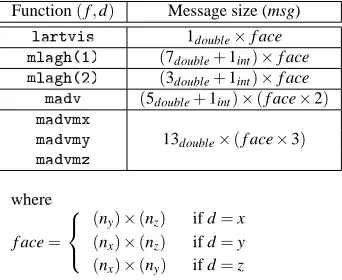
The specific message sizes sent during each near-neighbour communication operation are detailed in Table 3.
3.2 Communication Models
Hydra possesses multiple communication phases as high-lighted in 3.1, consisting of either point-to-point near-neigh-bour communication or collective operations.
While these phases communicate different collections of data, the patterns of communication are very similar be-tween the phases and thus we are able to represent a single phase using an abstract communication model. This is then applied across all phases in combination with knowledge of the amount of data to be sent. Likewise, the collective com-munications are primarily the same type,MPI_AllGather, and thus we can substitute a single model for this collective wherever it appears within the Hydra model as a whole.
Since the communication performance will vary between differing machines, we make use of a benchmark applica-tion such as SkaMPI (Reussner et al., 1998). This allows us to record important characteristics of the network and un-derstand the impact of setup costs and bandwidth.
1 LOOP DIMENSION={x , y , z }
2 PACKING
3 MPI_ISEND / IRECV b o t h f a c e s i n DIMENSION
4 MPI_WAITALL ( Near−N e i g h b o u r )
5 UNPACKING
6 END LOOP
Fig. 2 Typical point-to-point phase
3.2.1 Near Neighbour Point-to-Point
On an individual PE, neighbouring cells will either be stored locally or on a near neighbour PE, as per the 3D decompo-sition. These are termed internal boundaries. Cells that exist on the very edge of the data grid have no neighbouring cell in one or more directions and these are termed external bound-aries. A near-neighbour communication operation involves a processing element exchanging each of its six faces to the lo-cal grid boundaries with its respective neighbours, and con-sists of non-blocking MPI send/receives in each direction. The six message exchanges are done in each of the three dimensions, first in the x-dimension and then followed by the y and z dimensions respectively. Due to the use of non-blocking MPI communication primitives, anMPI_Waitall is called to synchronise the end of the communication opera-tions with all near neighbours along a dimension axis before proceeding to the next dimension.
Within a single Hydra cycle there exist eleven different point-to-point communication instances, yet due to the sim-ilarity between some of these calls, we define these as five distinct exchanges: Texch,lartvis(lines 4, 16, 32), Texch,mlagh(1)
(line 10), Texch,mlagh(2)(line 13), Texch,madv(line 24, and twice
for line 30), and Texch,madvm{x|y|z}(line 28, and twice for line
X internal links
Pz = 5
Y internal links Y external link
Z external links
Px =4
Py = 8
(a) 128 Processor cores :Px=4,Py=8,Pz=4
X internal links Y external links
Z external links
Px =16
Py = 16
Pz = 16
[image:6.595.38.537.75.285.2](b) 4096 Processor cores :Px=16,Py=16,Pz=16
Fig. 3 Number of external and internal links on a 16 core CMP/SMP-node system
Function(f,d) Message size (msg)
lartvis 1double×f ace
mlagh(1) (7double+1int)×f ace mlagh(2) (3double+1int)×f ace
madv (5double+1int)×(f ace×2) madvmx
madvmy 13double×(f ace×3)
madvmz
where
f ace=
(ny)×(nz) if d=x
(nx)×(nz) if d=y
(nx)×(ny) if d=z
Table 3 Message sizes (msgsize) for message exchange
As the data to be exchanged are not stored in contiguous memory, a packing operation needs to be performed before it is sent via MPI; similarly an unpacking operation needs to be performed after message reception. The pseudocode for near-neighbour communication is detailed in Figure 2.
As our assumed parallel system consists of nodes each made up of C cores sharing a NIC, the MPI task alloca-tion becomes crucial when determining which communi-cations are performed between cores on the same proces-sor (intra-node) and between cores on different procesproces-sors (inter-node). Assuming a Node-Fill Rank assignment, the MPI ranks are assigned along the logical x-dimension of Hydra’s decomposition before repeating in the y-dimension (until there are Pyrows), before finally repeating across each xy-plane in the z-dimension. As a result the number of
in-ter/intra connections within a given dimension is a function of Px,Py,Pzand C, the number of cores per node. This
opera-tion is summarised in equaopera-tions (8)-(12):
Nodesx=min(⌈(Px/C)⌉,Px) (8)
Nodesy=min(⌈((PxPy)/C)⌉,Py) (9)
Nodesz=min(⌈((PxPyPz)/C)⌉,Pz) (10)
inter{x|y|z}_link=Nodes{x|y|z}−1 (11)
intra{x|y|z}_link= (P{x|y|z}−inter{x|y|z}_link−1)/Nodes{x|y|z}
(12)
Where inter{x|y|z}is the number of inter-node communica-tions in an x, y or z row respectively and intra{x|y|z} is the number of intra-node communications in an x, y or z row per node.
We illustrate the external and internal links for a sys-tem with 128 processor cores, configured as 8 nodes with 16 cores in each, in Figure 3. Here there are 3 internal x-links communicating within a node. In the y-dimension there are also 3 internal links as well as a single external link. As there is only one NIC per node, we can expect some con-tention on the NIC for communicating in the y-dimension. That is, there are 4 cores attempting to exchange messages in the y-dimension with their off-node neighbours. In the z-dimension all communications are off-node. Thus there are 16 cores per node attempting to access the NIC simultane-ously during message exchanges in the z-dimension.
Given that there are message exchanges contending for the NIC, we adopt the following notation to denote the time to exchange n simultaneous messages of size msg over an external link: Tcomm,inter,n(msg).
[image:6.595.76.247.319.459.2]6 J.A. Davis et al.
DawnDev (BlueGene/P) Hera
Processor PowerPC 450(d) AMD 2.3GHz Opteron
Compute Nodes 1,024 847
Cores/Node 4 16
Total Cores 4,096 13,552
Memory/Node (GB) 4 32
Interconnect BlueGene 4xDDR-InfiniBand
torus and tree switch
Theoretical 13.9 127.2
peak (TFLOP/s)
O/S IBM CNK CHAOS 4.3
Compilers IBM XL 11.0 Fortran, PGI 8.0
9.0 C
[image:7.595.40.275.71.207.2]MPI IBM BlueGene MPI OpenMPI 1.3.2
Table 4 Experimental machines
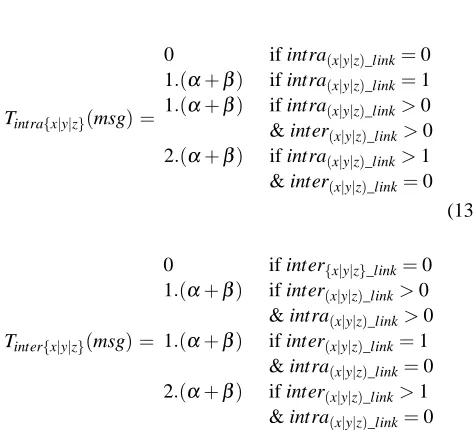
Tintra{x|y|z}(msg) =
0 if intra(x|y|z)_link=0 1.(α+β) if intra(x|y|z)_link=1 1.(α+β) if intra(x|y|z)_link>0 & inter(x|y|z)_link>0 2.(α+β) if intra(x|y|z)_link>1 & inter(x|y|z)_link=0
(13)
Tinter{x|y|z}(msg) =
0 if inter{x|y|z}_link=0
1.(α+β) if inter(x|y|z)_link>0 & intra(x|y|z)_link>0 1.(α+β) if inter(x|y|z)_link=1
& intra(x|y|z)_link=0 2.(α+β) if inter(x|y|z)_link>1
& intra(x|y|z)_link=0
whereα=Tcomm,intra,n(msg)or Tcomm,inter,n(msg)as
appro-priate (these values are derived from SKaMPI benchmarks (Reussner et al., 1998)) andβ=Tpack,msg+Tunpack,msg.
Based on these definitions we can complete the defini-tion for a near-neighbour exchange Texch,f.
Texch,f =Tintrax(msgsize(f,x)) +Tintray(msgsize(f,y)) + Tintraz(msgsize(f,z)) +Tinterx(msgsize(f,x)) +
Tintery(msgsize(f,y)) +Tinterz(msgsize(f,z)) +
(14)
3.2.2 MPI Collectives
MPI_AllGatheris the primary MPI collective used within
Hydra, frequently within mdt and with more limited use withinmlagh.
In many respects theMPI_AllGatheris similar to that of an MPI_AllRedue. However, for MPI_AllGather, as the number of communication steps scale with P, so the amount of data does also. We assume a pair-wise exchange, where the ranks are split into pairs and exchange data. New pairs are formed on a tree-like basis until all ranks have received from all other ranks, directly or indirectly as de-scribed in Benson et al. (2003). This results in a log2
ar-rangement, where the amount of data sent doubles per step:
Tallgather(dts) = (
(log2C)−1
∑
i=0Tcomm,intra,n(2i∗dts)) +
( (log2P)−1
∑
i=log2CTcomm,inter,n(2i∗dts)) (15)
Where dts is the size of the datatype in bytes.
3.3 Hydra Model Summary
The Hydra model therefore consists of several microbench-marks combined through equations 1 through 15. The cost of execution is calculated as the sum of computation, near-neighbour point-to-point communication (including packing and unpacking costs for message exchange) and the global collectives:
Twalltime,Hydra=Tcomp,alloc−dealloc+Tmdt+
Tmlagh+Tmadv (16)
Where Tcomp,alloc−dealloc is a microbenchmark for memory
allocation/deallocation.
4 Model Validation and Projections
4.1 Machines
Table 4 summarises the key architectural features of the ex-perimental systems used in this study – an IBM BlueGene/P (DawnDev) and an AMD/InfiniBand system (Hera), both lo-cated at LLNL. DawnDev is the development system for Dawn, which itself is the initial delivery system for Sequoia, a 20 PFLOP/s system to be delivered at LLNL starting in 2011 for deployment in 2012. DawnDev is an IBM Gene/P system and thus follows the tradition of IBM Blue-Gene architectures: a large number of lower performance processors (quad-core Power PC 450d running at 850MHz), a small amount of memory per node (4GB per node, 1GB per core), and a proprietary BlueGene torus high-speed in-terconnect. The BlueGene architecture is recognised as be-ing highly scalable, with a relatively low power footprint. Hera on the other hand utilises densely packed nodes that consist of high-performance multi-core CPUs – four-way 2.3GHz AMD Opteron quad-core CPUs (16-cores per node) with 32 GB memory per node (2 GB per core). Hera uses the InfiniBand DDR high-speed interconnect and exemplifies a typical large capacity resource (127 TFLOP/s peak).
4.2 Model Validation
[image:7.595.40.277.225.440.2]503problem size 753problem size
DawnDev Hera DawnDev Hera
Cores Execution Prediction Error Execution Prediction Error Execution Prediction Error Execution Prediction Error
(sec) (sec) (%) (sec) (sec) (%) (sec) (sec) (%) (sec) (sec) (%)
32 - - - 253.3 259.55 2.44 - - - 806.94 783.36 -2.92
64 505.23 484.37 -4.13 291.58 287.76 -1.33 1665.8 1561.46 -6.26 901.91 832.89 -7.65
128 525.15 485.77 -7.15 295.74 302.07 2.1 1702.63 1562.87 -8.21 905.04 859.41 -5.04
256 534.24 487.44 -8.76 310.06 319.77 3.1 1718.68 1564.53 -8.97 974.75 888.32 -8.87
512 528.76 494.53 -6.47 325.15 339.31 4.33 1707.78 1577.7 -7.62 1002.52 918.38 -8.39
1024 544.43 497.75 -8.57 337.54 363.9 7.78 1729.02 1580.92 -8.57 1039.3 953.54 -8.25
[image:8.595.44.540.80.183.2]2048 584.97 503.04 -14.01 398.1 413.01 3.71 1779.78 1586.21 -10.88 1172.02 1013.88 -13.49
Table 5 Model validations, weak-scaled, 503and 753meshes per core
0 100 200 300 400 500 600 700
32 64 128 256 512 1024 2048 4096 8192
W
all
time
(s)
Processing Elements Max Compute
Min PointToPoint Min Collectives
(a) Hera
0 100 200 300 400 500 600 700
64 128 256 512 1024 2048 4096 8192
W
all
time
(s)
Processing Elements Max Compute
Min PointToPoint Min Collectives
(b) DawnDev
Fig. 4 Breakdown of weak-scaled 503per core problem sizes
during execution; we also use the SKaMPI benchmark to measure point-to-point and collective communication costs for both contended and non-contended communication. The benchmarks are used to prime the performance model (de-tails of this process have been previously documented; see Mudalige et al. (2008); Hammond et al. (2009)).
We conduct weak- and strong-scaling studies on a range of problem sizes; for the sake of brevity, we provide a sam-ple of results that demonstrate the capability and accuracy of the performance model. In Table 5 we provide the results of weak-scaling studies on 503and 753data sets on DawnDev
and Hera. As this is a weak-scaling study, the total execution time gradually increases with the number of cores, up to a maximum of 1779.78 seconds for a 2,048-core run (Dawn-Dev, 753). The model predictions are also shown, demon-strating a model accuracy exceeding 85%. In Figure 4 we demonstrate the ability of the model to expose component costs that contribute to the wall-clock time and project out to 8,192 cores on both the Hera and DawnDev machines.
The increasing cost of collectives is clear to see, and with this information we are able to assess future code
develop-ment directions as well as the impact of choosing one ma-chine type over another. The impact of collectives is less marked on DawnDev as the IBM BlueGene/P has a dedi-cated collective network capable of delivering low latency and high bandwidth for fan-in/fan-out collectives.
5 Analysis of Future Architectures
A trend of recent processor developments has been growth in the number of cores per socket. Recent processor releases may contain as many as 16-cores per single processor die and predictions are for future designs to have higher core densities still. Whilst providing significant increases in theo-retical performance and the potential for greater parallelism at lower cost, the utilisation of more cores per individual die is not without its problems, including higher contention for memory bandwidth and, importantly for a 3D-hydrocode such as Hydra, increased contention for network accesses.
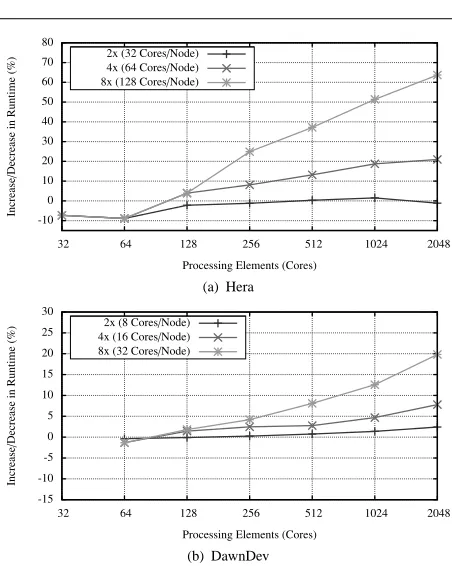
The model developed in this paper is parameterised to accomodate for contention on compute nodes which arises from the use of multiple processing-elements (cores) per node. The number of cores parameter, C, permits flexible evaluation of potential future platforms which may contain significantly higher numbers of cores per node. In Figure 5 we present projections for potential future systems in which the per-core performance is identical to that of the existing benchmarked machines but in which the number of cores per node has been increased by 2x, 4x and 8x.
In these configurations the utilisation of higher core den-sities results in degraded runtime; this may be advantageous if the higher core counts enable more parallelism to be used in the machine (through increased throughput or, alterna-tively, strong-scaling operations). The projections in Fig-ure 5 demonstrate that performance may degrade from 25 to 70% on DawnDev and Hera respectively. The lower fig-ure for DawnDev is an indication of the higher interconnect performance versus compute in the BlueGene/P design.
[image:8.595.52.269.202.458.2]oppor-8 J.A. Davis et al.
-10 0 10 20 30 40 50 60 70 80
32 64 128 256 512 1024 2048
Increase
/
Decrease
in
Runtime
(%)
Processing Elements (Cores)
2x (32 Cores/Node)
4x (64 Cores/Node)
8x (128 Cores/Node)
(a) Hera
-15 -10 -5 0 5 10 15 20 25 30
32 64 128 256 512 1024 2048
Increase
/
Decrease
in
Runtime
(%)
Processing Elements (Cores) 2x (8 Cores/Node)
4x (16 Cores/Node) 8x (32 Cores/Node)
[image:9.595.47.273.71.354.2](b) DawnDev
Fig. 5 Predicted increase/decrease in run-time for increased core
den-sities per node (weak-scaled, 503per core)
tunity to engineer their codes to minimise the impact of such machine designs before they are deployed.
6 Conclusions
We present the development of a predictive performance model for the high-performance computing code Hydra, a hydrodynamics benchmark developed and maintained by the United Kingdom Atomic Weapons Establishment (AWE). The model allows us to predict the time to solution of the ap-plication with only a concise set of apap-plication and machine benchmarks. This is the first predictive performance model for Hydra and represents a significant advance to AWE’s ability to assess application/architecture capabilities for this class of application. We validate the analytic model on two large-scale HPC system architectures – an IBM BlueGene/P and a commodity AMD/InfiniBand based system. The model predicts execution time on up to 2,048 processor cores with
>85% accuracy. These systems represent two contrasting HPC architectures, and demonstrate the versatility of the model across CMP platforms. The model is utilised to as-sess the impact of component costs including computation, point-to-point communications and collectives and their re-lationship with HPC machine architectures, thus illustrating how the model may be put into use by AWE scientists.
Acknowledgements Access to the AWE Hydra benchmark was
pro-vided under grants CDK0660 (The Production of Predictive Models for Future Computing Requirements) and CDK0724 (AWE Technical Outreach Programme) from the United Kingdom Atomic Weapons
Es-tablishment. We are grateful to Scott Futral, Jan Nunes and the Liver-more Computing Team for access to, and help in using, the DawnDev and Hera machines located at LLNL. We also acknowledge support of the Centre for Scientific Computing at the University of Warwick and the UK Science Research Investment Fund.
References
K.J. Barker, K. Davis, and D.J. Kerbyson. Performance Modeling in Action: Performance Prediction of a Cray XT4 System During Up-grade. In IEEE International on Parallel and Distributed Processing
Symposium (IPDPS 2009), May 2009.
G. Benson, C.W. Chu, Q. Huang, and S. Caglar. A comparison of MPICH allgather algorithms on switched networks. Recent
Ad-vances in Parallel Virtual Machine and Message Passing Interface,
pages 335–343, 2003.
S.D. Hammond, G.R. Mudalige, J.A. Smith, S.A. Jarvis, J.A. Herd-man, and A. Vadgama. WARPP - A Toolkit for Simulating High-Performance Parallel Scientific Codes. In Proc. 2nd International
Conference on Simulation Tools and Techniques, March 2009.
A. Hoisie, H. Lubeck, and H.J. Wasserman. Performance and Scala-bility Analysis of Teraflop-Scale Parellel Architectures using Mul-tidimentional Wavefront Applications. Int. J of High Performance
Computing Applications, 14(4):330–346, Winter 2000.
A. Hoisie, G. Johnson, D.J. Kerbyson, M. Lang, and S. Pakin. A Performance Comparison Through Benchmarking and Modeling of Three Leading Supercomputers: Blue Gene/L, Red Storm, and Pur-ple. In Proceedings of the 2006 ACM/IEEE conference on
Super-computing (SC 2006), pages 74–84, 2006.
G. Johnson, D. J. Kerbyson, and M. Lang. Optimization of Infiniband for Scientific Applications. In IEEE International Parallel and
Dis-tributed Processing Symposium (IPDPS 2008), April 2008.
D.J. Kerbyson, H.J. Alme, A. Hoisie, F. Petrini, H.J. Wasserman, and M. Gittings. Predictive Performance and Scalability Modelling of a Large-Scale Application. In Proceedings of the 2001 ACM/IEEE
conference on Supercomputing(SC 2001), 2001.
D.J. Kerbyson, A. Hoisie, and H.J. Wasserman. Use of Predictive Per-formance Modeling During Large-Scale Systems Installation. In
1st Int. Workshop on Hardware/Software Support for Parallel and Distributed Scientific and Engineering Computing, 2002.
D.J. Kerbyson, M. Lang, and G. Johnson. Infiniband Routing Table Optimizations for Scientific Applications. Parallel Processing
Let-ters, 18(4):589–608, 2008.
M.M. Mathis and D.J. Kerbyson. Performance Modeling of Unstruc-tured Mesh Particle Transport Computations. In Proceedings of
In-ternational Parallel and Distributed Processing Symposium (IPDPS 2004), Santa Fe, NM, April 2004.
M.M. Mathis, N.M. Amato, and M.L. Adams. A General Performance Model for Parallel Sweeps on Orthogonal Grids for Particle Trans-port Calculations. Technical reTrans-port, Texas A&M University, 2000. G.R. Mudalige, M.K. Vernon, and S.A. Jarvis. A Plug-and-Play Model
for Evaluating Wavefront Computations on Parallel Architectures. In IEEE International Parallel and Distributed Processing
Sympo-sium (IPDPS 2008), April 2008.
F. Petrini, D.J. Kerbyson, and S. Pakin. The Case of the Missing Super-computer Performance: Achieving Optimal Performance on the 8, 192 Processors of ASCI Q. In Proceedings of the 2003 ACM/IEEE
conference on Supercomputing (SC 2003), pages 55–62, 2003.
R. Reussner, P. Sanders, and M. Muller. SKaMPI: A Detailed, Accurate MPI Benchmark. Recent advances in Parallel Virtual Machine and
Message Passing Interface, pages 52–59, 1998.
D. Sundaram-Stukel and M.K. Vernon. Predictive Analysis of a Wave-front Application Using LogGP. In Proceedings of Principles and