University of Warwick institutional repository: http://go.warwick.ac.uk/wrap
A Thesis Submitted for the Degree of PhD at the University of Warwick
http://go.warwick.ac.uk/wrap/50029
This thesis is made available online and is protected by original copyright. Please scroll down to view the document itself.
ATTENTION CAPTURE BY MULTIPLE
EVENTS USING DYNAMIC DISPLAYS
i Attention Capture by Multiple Events Using Dynamic Displays
Meera Mary Sunny
A thesis submitted in partial fulfilment of the requirements for the Degree of
Doctor of Philosophy in Psychology
Supervisor
Dr. Adrian von Mühlenen Second supervisor Dr. Derrick G. Watson
Department of Psychology University of Warwick
ii TABLE OF CONTENTS
TABLE OF CONTENTS ... II
ACKNOWLEDGEMENTS ... VII
DECLARATION ... VIII
NOTE ON INCLUSION OF PUBLISHED WORK ... IX
ABSTRACT ... X
LIST OF TABLES AND FIGURES ... XI
TABLES ... XI
FIGURES ... XII
CHAPTER 1: INTRODUCTION AND LITERATURE REVIEW ... 1
INTRODUCTION ...2
VISUAL SEARCH ...5
ORIENTING OF ATTENTION ...8
Studies using the Cueing Paradigm ... 9
Studies using the Visual Search Paradigm ... 15
The role of the Attentional Window in capture ... 23
TOP-DOWN EFFECTS ON ATTENTION CAPTURE ... 26
Contingent Involuntary Orienting... 28
ATTENTION CAPTURE BY DYNAMIC DISCONTINUITIES ... 30
iii
Motion and the Onset of motion ... 42
CHAPTER 2: PILOT STUDY – ATTENTION CAPTURE WITH MULTIPLE DYNAMIC EVENTS. ... 48
INTRODUCTION ... 49
PILOT EXPERIMENT 1 ... 51
Method ... 52
Results ... 54
Discussion ... 56
PILOT EXPERIMENT 2 ... 57
Method ... 57
Results ... 58
Discussion ... 59
OVERVIEW OF THE EMPIRICAL CHAPTERS ... 61
CHAPTER 3: MOTION ONSET DOES NOT CAPTURE ATTENTION WHEN SUBSEQUENT MOTION IS “SMOOTH" ... 63
INTRODUCTION ... 64
EXPERIMENT 3 ... 67
Method ... 67
Results ... 70
Discussion ... 73
EXPERIMENT 4 ... 75
iv
Results ... 76
Discussion ... 77
GENERAL DISCUSSION ... 78
CHAPTER 4: THE ROLE OF MOTION, FLICKER AND ABRUPT DISPLACEMENT IN ATTENTION CAPTURE ... 81
INTRODUCTION ... 82
EXPERIMENT 5 ... 84
Method ... 85
Results ... 88
Discussion ... 91
EXPERIMENT 6 ... 91
Method ... 92
Results ... 93
Discussion ... 95
EXPERIMENT 7 ... 96
Method ... 97
Results ... 97
Discussion ... 99
EXPERIMENT 8 ... 100
Method ... 100
Results ... 101
Discussion ... 103
v
Method ... 106
Results ... 107
Discussion ... 108
GENERAL DISCUSSION ... 110
Conclusion ... 113
CHAPTER 5: A CHANGE IN THE DIRECTION OF MOTION CAPTURES ATTENTION, BUT ONLY WHEN IT IS UNIQUE. ... 114
INTRODUCTION ... 115
EXPERIMENT 10 ... 118
Method ... 118
Results ... 121
Discussion ... 123
EXPERIMENT 11A &11B ... 125
Method ... 126
Results ... 127
Discussion ... 128
EXPERIMENT 12 ... 130
Method ... 130
Results ... 131
Discussion ... 133
GENERAL DISCUSSION ... 134
vi
INTRODUCTION ... 137
PRIORITY TAG MODEL ... 141
EXPERIMENT 13 ... 144
Method ... 144
Results ... 148
Discussion ... 152
EXPERIMENT 14 ... 153
Method ... 154
Results ... 155
Discussion ... 158
EXPERIMENT 15 ... 159
Method ... 160
Results ... 160
Discussion ... 164
GENERAL DISCUSSION ... 167
CHAPTER 7: GENERAL DISCUSSION ... 169
SUMMARY OF THE EMPIRICAL CHAPTERS ... 170
THEORIES OF CAPTURE ... 176
Behavioural-urgency and Animacy ... 176
Unique Event Account ... 177
New Object Account ... 178
CONCLUSIONS... 181
vii ACKNOWLEDGEMENTS
It is a beautiful feeling to thank all the people who have been instrumental in the completion of this thesis. It would not be an exaggeration to say that this work would not have been possible if not for some of them. I would like to take this opportunity to thank a few of those wonderful people.
Adrian, thanks for being a really wonderful supervisor and a friend. Thank you for your immense patience and kindness. If I list the things for which I have to thank you, there will be no end to that list. I thank you for letting me giving it a go, for listening to vague ideas and believing that they can be better. However, if there is one single thing that I have to thank you for, it would be for the freedom to disagree. Derrick, thanks for all the help you have given and for being a great listener. Your little influence has had great impact. (Also, thanks for not kicking out even the really annoying me. The zoo will be missed greatly.)
J, thank you for understanding; for being there; for loving me so much, in spite of all the madness that comes with this package!
I would like to thank the Attention Group: Elizabeth, Melina and especially Paolo for their support and help during various stages of my PhD. I would especially like to thank Liz Blagrove for all her support and encouragement and for being someone to look up to.
Thanks to my lab-mates: Debbie, Hayley, James, Julie, Lauren and Tanya – it was always a pleasure working with you all around; my housemates: Saima, Ying and Umar for a really wonderful year together; fellow postgrads – for all their help and for volunteering to be my participants; my friends, Setu, Shruti, Krishnan and Shail for all the good times and pleasant memories; Philia for being the best friend anyone can ever ask for. Thank you.
viii DECLARATION
ix NOTE ON INCLUSION OF PUBLISHED WORK
Chapter 3 of this thesis has previously been published during the period of my PhD registration, and the copyright of this paper resides with the publishers (the
reproduction of the paper as a chapter in this thesis is permitted in the terms of the copyright agreement. The paper is:
Sunny, M. M., & von Mühlenen, A. (2011). Motion onset does not capture attention when subsequent motion is “smooth.” Psychonomic Bulletin & Review, 18(6), 1050-1056.
x ABSTRACT
Being able to select relevant visual information from among irrelevant information is critical for the successful accomplishment of many day to day activities. However, the locus of attentional selection is not always under the control of the observer. Certain events and stimuli in the visual environment have been shown to control selection against observers’ intentions and goals. These are said to capture attention in an automatic and stimulus driven manner. The events and stimuli that capture attention can be static (colour, shape, size, etc.) or dynamic (motion, flicker, etc.).
xi LIST OF TABLES AND FIGURES
Tables
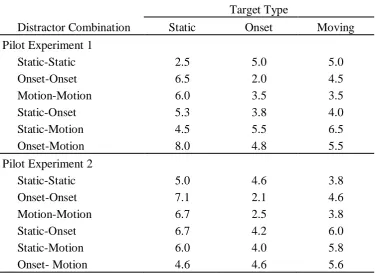
Table 2.1. Mean Percentage Error in Pilot Experiments 1 and 2...55
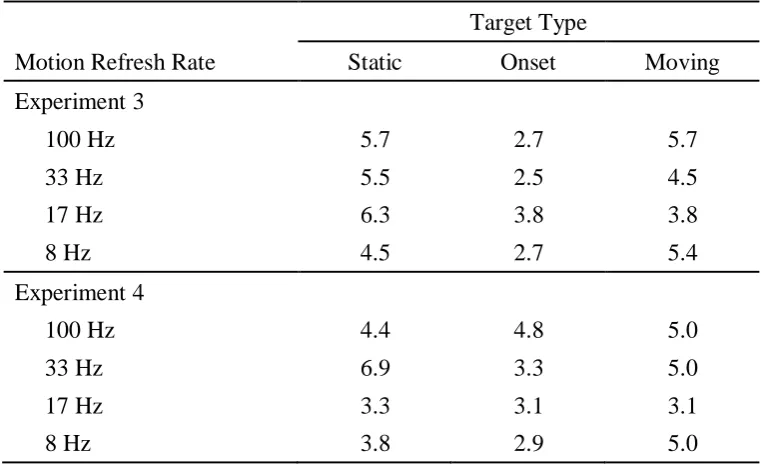
Table 3.1. Mean Percentage Errors in Experiments 3 and 4………..….…..72
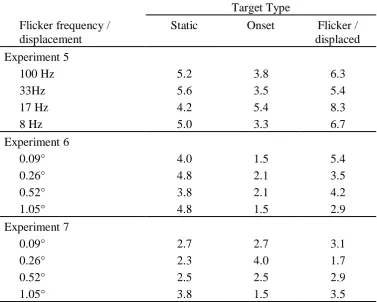
Table 4.1. Mean Percentage Errors for various refresh rates in Experiments 5 and displacements in Experiments 6 and 7…………89
Table 4.2. Mean Percentage Errors in Experiment 8 and 9……….…103
Table 5.1. Mean Percentage Errors in Experiment 10………...123
Table 5.2. Mean Percentage Errors in Experiment 11………..…...128
Table 5.3. Mean Percentage Errors in Experiment 12 for each target type and display size………...….132
xii Table 6.2. Summary of eight regression analyses predicting RT in Experiment 13 for Priority tag models (m), with the factors expected number of comparisons a, target
type b, and the constant c…………..151
Table 6.3. Number of trials (N) and Mean Percentage Errors (%) for each
combination of target type and number of onsets in Experiment 14………....156
Table 6.4. Summary of eight regression analyses predicting RT in Experiment 14 for priority tag models (m), with the factors number of inspected items (a), onset target
(b), and the constant c………...157
Table 6.5. Number of trials (N) and Mean Percentage Errors (%) for each
combination of target type and number of onsets in Experiment 15………....162
Table 6.6. Summary of eight regression analyses predicting RT in Experiment 15 for priority tag models (m), with the factors number of inspected items (a), onset target
(b), and the constant c………...163
Figures
xiii invalid trial it pointed to a wrong location. The proportion of valid and invalid trials in an experiment determines the overall informativeness of the cue…………..……10
Figure 1.2. Example of the display using additional singleton paradigm in which a shape singleton defines the target. In the left panel, there is no additional singleton, but in the right panel there is an additional singleton (represented by the dotted circle –a colour singleton)...22
Figure 1.3. Example display taken from Yantis and Jonides (1984) for display size 4 and with gradual and abrupt onset stimuli. Participants are first informed the identity of the target. The place-holder display is presented for 1000ms, which then gradually changes to letters over 80ms. An abrupt onset letter is added to the final display. Dashes represent fading line segments………...…31
Figure 1.4. Example display from Rauschenberger and Yantis (2001). The subjective square was perceptually old, perceptually new, or absent. On half of the trials, the square was absent; on the other half, it was present. When present, they were either new or old with equal probability……….………..34
xiv
Figure 2.2. Mean correct RT in Pilot Experiment 1 as a function of distractor
combination, with separate lines for static, onset and motion target types………….54
Figure 2.3. Mean correct RT in Pilot Experiment 2 as a function of distractor
combination, with separate lines for static, onset and motion onset targets……...…58
Figure 3.1. Example display from Experiment 3. Stimulus movement began when the placeholders changed to the letter stimuli……….69
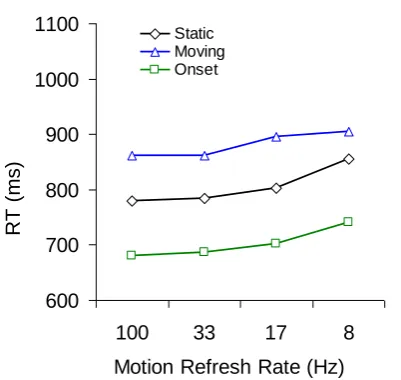
Figure 3.2. Mean correct RTs as a function of motion refresh rate in Experiment 3, with separate lines for each target type………...71
Figure 3.3. Example display from Experiment 4, with continuous motion…….…..76
Figure 3.4. Mean correct RTs as a function of motion refresh rate in Experiment 4, with separate lines for each target type………...77
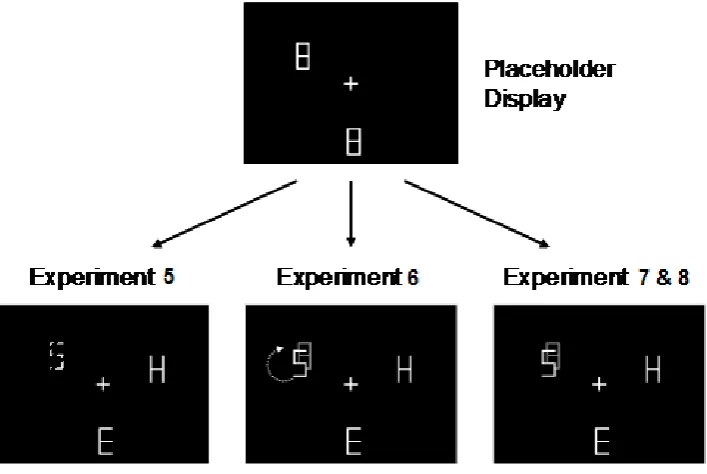
Figure 4.1. Example display for Experiment 5-8. Stimulus flicker (indicated by cross hatch) in Experiment 5 or stimulus displacement in Experiment 6-8 began at display transition when the placeholders changed to letters. The size of the (initial)
xv search displays (Experiment 6, 7 & 8) indicate the displacement and were not
visible………...………...87
Figure 4.2. Mean Inverse-efficiency scores as a function of flicker frequency in Experiment 5, with separate lines for each target type………...90
Figure 4.3. Mean correct RTs as a function of initial displacement in Experiment 6, with separate lines for each target type………...95
Figure 4.4. Mean correct RTs as a function of displacement in Experiment 7, with separate lines for each target type………98
Figure 4.5. Mean correct RTs as a function of display size in Experiment 8, with separate lines for each target type……….102
Figure 4.6. Example display for Experiment 9. Stimulus displacement by 0.52° occurred 60 ms before display transition. The grey placeholder in the displaced display was not visible………..106
xvi
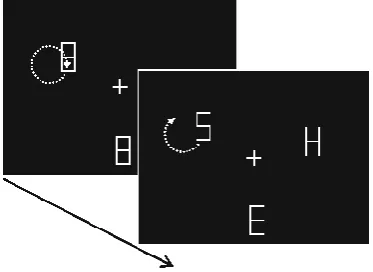
Figure 5.1. Example display in Experiment 10. Stimulus movement began when the placeholders changed to the letter stimuli. Here, the target letter 'H' is an onset, 'S' is moving and 'E' is static………..120
Figure 5.2. Mean correct RTs as a function of motion refresh rate in Experiment 10, with separate lines for each target type……….122
Figure 5.3. Mean correct RTs as a function of motion refresh rate in Experiment 11, with separate lines for each target type……….128
Figure 5.4. Mean correct RT as a function of display size (3, 5 or 7) in Experiment 12, with separate lines for target that was static or had a motion onset………...132
Figure 6.1. Expected number of comparisons y as a function of number of onsets x
with separate lines for onset and no-onset targets. There are six graphs for different numbers of priority tags m………145
xvii
Figure 6.3. The markers show the mean correct RTs for static (no-onset) and onset targets in Experiment 13. The lines and R2 show the result of a multiple regression analysis, predicting RT based on the 1-tag model, which provided the best fit…...149
Figure 6.4. The markers show the mean correct RTs for static and onset targets in Experiment 14. The lines and R2 show the best fit from a multiple regression
analysis, predicting RT based on the 1-tag model……….…...155
2
[Attention] is the taking possession by the mind, in clear and vivid form, of
one out of what seem several simultaneously possible objects or trains of thought
[…] It implies withdrawal from some things in order to deal effectively with
others…
- William James (1890, pp. 403-404)
Introduction
Vision plays a very important role in our day to day life, guiding interactions with the outside world. As effortless as it may seem, the task of navigating through an ever changing and sometimes unpredictable environment is not easy. The visual and other perceptual systems have evolved over the years to efficiently deal with this seemingly difficult task. This efficiency is achieved by selecting only a small proportion of all the available information for further
processing. The process by which selection of the relevant information is achieved is referred to as Attention. There are two broad areas of research in this domain that are important to the current thesis. The first concerns the stage at which attentional selection takes place and second concerns the actual mechanisms of selection.
3 selection was necessary because of the severe capacity limitation faced by the faculty of higher processing. He used a dichotic listening task in which two different sets of messages were played to each ear and the participants were asked to shadow one of them (i.e., by repeating the message aloud while listening). In this task, it is assumed that attention was necessary to select information that is presented to one ear (or channel) while ignoring the other. Participants were then tested on different aspects of the information presented to the unattended channel. It was found that they were unable to report the semantic content of the messages, but could remember if the speaker was male or female. He proposed the filter theory, according to which stimuli are selected for higher order processing early in the processing stage. According to him, selection was based on the basic physical properties of the auditory stimuli like pitch, loudness etc. This view also suggests that the information that is not selected is not processed at all and is lost forever.
Other studies, however, attributed the findings from shadowing
4 ignored, but just attenuated, i.e., fewer resources are allocated to its processing. Thus the filter was set by assigning a lower threshold for the relevant stimuli as compared to the irrelevant. However, when a stimuli that is contextually relevant, like one’s own name, is present in the attenuated stream, it automatically passes through the threshold and is processed. Neisser and colleagues provided further evidence for such exceptions to the attentional filter. Using a selective reading methodology, Neisser (1969) showed that even words that were frequently repeated often went unnoticed, whereas participants own names were picked up.
In contrast to the early selection view, the late selection view (Deutsch & Deutsch, 1963; Norman, 1969) proposes that all stimuli undergo a preliminary processing on their content, which aids in selection. The proponents of this view argued that there was no processing limitation until the level of categorization and that such limitation applies only to higher cognitive functions such as memory. Thus, they claim that attention is required only for the creation of a long term representation, and not processing. Even though the late selection view better explains the reason why some unattended information was later recognized and why unattended stimuli can often be processed up to a semantic level, it has not received as much empirical support as the early selection view (for example, see Lachter, Forster & Ruthruff, 2004). However, a redefinition of the mechanisms of attentional selection has made it possible to understand attentional selection in a more pragmatic way. For example, the concept of a pre-attentive stage
5 Visual Search
Visual search has become one of the most commonly used paradigms to study visual selective attention. The general appeal of this paradigm is its relative simplicity that nonetheless allows for a detailed study of the mechanisms that underlie selection. In a visual search task, participants are typically asked to search for a specific stimulus (the target) in a display containing a number of other irrelevant items (distractors). The time taken to complete the search (Reaction Times or RT) and error rates are measured over a large number of trials. The basic assumption that defines the use of these measures is that RT is linearly related to the amount of information transmitted (Hick, 1952; Hyman, 1953). That is, given a perfect correlation between stimulus and performance, RT is assumed to
increase by a constant for each additional unit of processing required and that the slope reflects the efficiency of processing. Thus, the difference in RT between two tasks that differ only on levels of processing is equivalent to the time it takes to complete the additional processing. Another advantage of the methodology lies in its versatility. As Nakayama and Martini (2011) point out, a wide range of stimuli (letter, numbers, faces, Gabor patches etc.) can be combined with a number of different features (colour, shape, size, contrast, movement etc.) to generate search displays. This versatility can be very helpful in dissecting the different processes involved in attentional selection.
6 attentive. Treisman, Sykes and Gelade (1977) proposed that all the information was categorized based on primitive features like colour, shape, orientation, etc. at the pre-attentive stage. In FIT, Treisman and Gelade (1980) explain how visual search proceeds either in a parallel or in a serial manner depending on the relationship between the target and the distractors. They showed that the search for a target that is defined by a single feature (for example, determining if a red X is present among green Xs) can be accomplished at the pre-attentive level. That is, a spatial allocation of attention was not necessary for such a task. Such a search is also known as a feature search. In a feature search, RTs are not affected by the number of items in the display (display size). Thus, when RTs are plotted as a function of display size, they yield flat search slopes and search is considered to be parallel.
In contrast, when the target was defined by a conjunction of features (for example, a Red X among Green Xs and Red Os), search cannot be accomplished at the pre-attentive level as targets and distractors share common colour and form features. Hence, attention has to be allocated to the location of each object in a serial manner in order to find the target. Therefore, RTs increase as a function of display size in a conjunction search task, giving a steep search slope. According to Feature Integration Theory (FIT), the increase in slope reflects the additional level of processing that is required to find the target in a conjunction search task as compared to a feature search task.
7 FIT. For example, according to FIT, all conjunction searches should produce steep search slopes. However, many studies have shown that not all conjunction
searches proceed in a serial manner. For example, a conjunction of motion and form was found to be more parallel than serial, and the addition of stereo depth enabled its conjunction with motion or colour to be parallel (McLeod, Driver & Crisp, 1988; Nakayama & Silverman, 1986; Steinman, 1987). These findings imply that, even for a conjunction target, the visual system is able to narrow search down to a relevant subset of features based on information available at the pre-attentive stage. Feature Integration theory cannot account for this finding.
The Guided Search Model (Wolfe, Cave & Frenzel, 1989) better accounts for the inconsistencies in the findings between FIT and findings from later studies. This model advocates that pre-attentive salience computations carried out during a conjunction search task can be effectively used to guide visual attention. In
8 Thus, even though FIT assumes a strict dichotomy between serial and parallel search processes, other theories of attention have largely ignored such a dichotomy suggesting that pre-attentive salience computations can always guide attention. Attentional Engagement Theory (Duncan & Humphreys, 1989, 1992), for example, suggests that as the difference between targets and distractors increases, search efficiency also increases. According to AET, salience
computations are used to segment parts of the display that are different from the rest. Duncan and Humphreys (1989) laid out two necessary conditions for an efficient search. First, the target should be different from the distractors in one dimension and second, the distractors should be more or less homogeneous in that dimension.
The theories of attention clarify the role of pre-attentive computations in the eventual guidance of attention. They specify the means by which information in the visual environment is registered by the visual system as its constituent features. Moreover, they also show how attentional processes can make use of this information to select objects for further processing.
Orienting of Attention
9 endogenous control of attention, while the latter is referred to as bottom-up or exogenous control. Though in real life attention is allocated by a combination of these two factors, it is useful to separate them out in order to make the study of these mechanisms more efficient. Two major paradigms that are extensively used to study the orienting of attention are the cueing paradigm and the visual search paradigm.
Studies using the Cueing Paradigm
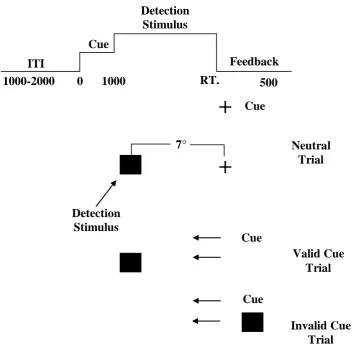
The orienting of attention proceeds endogenously when observers actively control the allocation of their attention to an object or location. Most of our goal-driven everyday behaviour, like driving or playing a sport, proceeds smoothly as a result of successful endogenous selection. In the classic study on endogenous cueing by Posner (1980), a central arrow cue was used to trigger attention to a desired location (See Figure 1.1). The nature of these cues is often considered symbolic because the cue in itself does not trigger attention to the location of the target. It is the assigned meaning of the cue understood by the observer that renders them meaningful. The cues could be arrows, words or digits, which inform the observer where the target will appear (Jonides, 1981; Posner 1980; Theeuwes, 1989). When the cue correctly points to the location of the target that follows, it is considered a valid cue and when it doesn’t, an invalid cue.
10 considered overall un-informative. Since the cue points to an incorrect location as much as it points to the correct, using the cue to guide search does not benefit performance.
Figure 1.1. Example display taken from Posner (1980). The trials started with a central fixation cross. In a neutral trial, the central cue did not provide any information regarding the upcoming target. In the valid trial, the fixation cross changed into an arrow that correctly pointed to the target location, whereas in the invalid trial it pointed to a wrong location. The proportion of valid and invalid trials in an experiment determines the overall informativeness of the cue.
500 RT.
0
1000-2000 1000
Cue
Valid Cue Trial Cue
Invalid Cue Trial Feedback
ITI
Cue
Detection Stimulus
+
CueDetection Stimulus
+
7° Neutral
11 In contrast, when there are more valid cues than invalid cues in an
experiment (for example, a cue validity of 80%), the cue is considered overall informative. That is, using the cue to guide search will result in correct selection more often than not. It was shown that when the cues are informative, valid cues benefit performance in terms of producing faster RTs and higher accuracy and invalid cues cost performance in terms of slower RTs and higher error rates (Jonides, 1981; Posner, 1980). This cost and benefit pattern between valid and invalid cues show that participants shift their attention to the location indicated by the cue.
Interestingly, when the cues are valid in a lesser proportion of trials (for example, at 20% cue validity), a reversal of the cueing benefit is observed; i.e., the target is detected faster in the invalid trials as compared to the valid trials. This further suggests that the performance benefit that occurs with an endogenous cue results from participants’ internalisation of the information contained in the cue. They are able to actively decide whether or not they let attention be guided to a location based on the informative value of an endogenous cue. Moreover, even in the absence of explicit information regarding cue validity, observers are able to efficiently use or ignore a symbolic cue depending on its overall validity (Jonides, 1981; Müller & Rabbitt, 1989; Posner, 1980; Posner & Cohen, 1984).
12 Jonides, 1981; Tsal, 1983). It has been suggested that it takes time for the
participants to process the information contained in the cue and actively allocate attention based on this information.
However, attentional allocation is not always as straightforward or successful as it seems. Sometimes, events and stimuli in the visual field
automatically draw our attention to themselves. Such a shift of attention that is automatic and inconsistent with, or against, the intentions of the observer is called exogenous control of attention. The stimuli that elicit such an involuntary
orienting are said to have captured attention. Exogenous control has been
extensively studied using luminance cues. The reflexive nature of the exogenous cue means that it affects performance even when the cue is uninformative of the target location; for example at a cue validity of 50% (Posner, 1980; Jonides, 1981).
As opposed to a central arrow, exogenous cues often consist of a brief luminance patch flashed in the periphery near a possible target or distractor location. The presentation of the cue is followed by target presentation, either at the same location as the cue (valid cue) or at a different location (invalid cue). Independent of cue validity, valid exogenous cues lead to an improvement in performance (in terms of faster RT and better accuracy) while invalid exogenous cues lead to a cost, when compared with neutral cues. This suggests that the cue involuntarily (automatically) draws attention to its location, giving an RT
13 1981). This RT cost is attributed to the additional time it takes to disengage
attention from the cued location, and allocate it to the target location.
Even though exogenous cues are thought to capture attention, complete automaticity of any mental process is established using three criteria – first, minimal use of mental resources; second, resistance to suppression; and third, lack of sensitivity to changes in expectancy (Hasher & Zacks, 1979; Shiffrin &
Schneider, 1977). Jonides (1981) tested the automaticity of attentional allocation using both endogenous and exogenous cues. He asked participants to determine the presence of L or R among other letters of the alphabet. Both types of cues were valid on 70% of the trials and invalid on 30%. The performance in the search task was analysed over three different experiments that manipulated load,
suppressibility and cue-validity. He found that an additional memory task interfered with the effectiveness of the symbolic cue, but not the peripheral cue, suggesting that the exogenous cue use little mental resources.
14 unaware of the effect of such cues (Danziger, Kingstone, & Rafal, 1998;
McCormick, 1997).
Further emphasizing the reflexive nature of the exogenous cue, it has been shown to have a shorter time course of activation as compared to endogenous cues (Jonides 1981; Muller & Rabbitt, 1989; Posner, 1980). Peripheral luminance cues can affect performance with a CTOA as short as 25 ms, reaching their maximum effectiveness at ~100 ms. The slow rising benefit in performance that comes from the symbolic cue is more sustained as compared to the peripheral cue (Cheal & Lyon, 1991).
Endogenous and exogenous cues have differential effects on attentional engagement and inhibitory mechanisms (Posner & Cohen, 1984). For example, a peripheral exogenous cue with a longer CTOA (> 300 ms) leads to faster RTs with invalidly cues targets as compared to validly cued targets. This phenomenon is known as Inhibition of Return (IOR). IOR with central cues follows a
significantly slower time course (typically only after about 600 ms). This and other differences (for example, see Briand & Klein, 1987; Funes, Lupiáñez, & Milliken, 2007; Klein, 1994) between the two types of cues clearly suggest that they are separate mechanisms of attentional control (Briand & Klein, 1987; Friedrich, Egly, Rafal, & Beck, 1998; Muller & Humphreys, 1991), one controlled by the observer, while the other by the stimulus features.
15 thus one can say that luminance cues capture attention. However, using a cueing paradigm, it is difficult to estimate the different features that might capture attention. Moreover, some symbolic cues, like a gaze cue or a central arrow cue have been shown to elicit automatic responses (Friezen & Kingstone, 1998; Ristic & Kingstone, 2006). Thus, using a cueing paradigm one cannot clearly separate top-down and bottom-up effects. In such instances an entirely different paradigm might be required to determine the nature of purely bottom-up capture of
attention.
Studies using the Visual Search Paradigm
In contrast to the cueing paradigm, a visual search paradigm offers more flexibility in the type of stimuli that can be tested for attention capture. For example, using a visual search paradigm, it is possible to test the attentional effects of colour changes, motion or the sudden appearance of a new object among old objects (abrupt onset) etc. (Jonides & Yantis, 1988; Hillstrom & Yantis, 1994; Theeuwes, 1990). The visual search paradigm also enables pitting different types of stimuli against each other, like an object that starts moving (motion onset) and an abrupt onset (Christ & Abrams, 2008).
The research on stimulus-driven attention capture has been primarily driven by two types of feature singletons (also referred to as feature
16 another dimension. For example, a red circle among other circles which are all green is a singleton in the dimension of colour. Even when the green coloured objects have different shapes, the red circle is a singleton in the dimension of colour.
A singleton is also conceptualised as a discontinuity of a feature by emphasising that pre-attentive salience computations will prioritise the singleton because it is different from the other items in the display. Singletons that are defined as a discontinuity of non-dynamic object properties like colour, shape, size or luminance can be categorised as static singletons. Some feature
discontinuities are dynamic in nature. For example, singletons that are defined as moving among stationary or vice-versa; or by the sudden appearance or
disappearance of objects in the search space; or by transient luminance changes like flicker can be considered dynamic discontinuities (for example, see Pinto, Olivers & Theeuwes, 2006).
Most of the theories of search (Duncan & Humphreys, 1989; Treisman & Gelade, 1980; Wolfe, Cave & Frenzel, 1989) would predict that a feature
singleton can be efficiently detected at the pre-attentive stage. The salience
17 feature singleton should produce a flat search slope even when it is irrelevant to the search task.
Irrelevant Singleton Paradigm. In the experiments that use a visual search
task to study attention capture, task irrelevance of the feature singleton is ensured using what is known as a 1/d paradigm. In a 1/d paradigm, the probability of the feature singleton being the target is a function of the display size (d). That is, in a display with 5 items, the singleton will be the target only on 20% of the trials (i.e. in only 1/5 trials and in a display with d items, only 1/d trials). The 1/d paradigm ensures that a flat search slope indicates bottom-up capture and not efficient guidance resulting from top-down strategizing. Most studies using this paradigm make use of a search task where attentional guidance is difficult. For example, Yantis and Egeth (1999) had participants search for a vertical bar among bars slanted at an angle of 30° in either direction of the target. In the first baseline experiment, they showed that such a search proceeds in a serial manner. This was indicated by RTs that increased as a function of display size.
In three other experiments, they examined how a colour singleton that was either predictive or non-predictive of the target affects search times for a target defined by orientation. A colour singleton was either present or absent, but when present it always coincided with the target making it fully task relevant.
18 This speaks against automaticity, showing that irrelevant colour singleton fails to capture attention in a purely bottom-up manner. They also showed a similar pattern for a singleton defined by motion, demonstrating a failure to capture attention. However, search was efficient when the target was either a size or a luminance singleton. The sensitivity of the search task to the overall
probability of a singleton being the target or not speaks in favour of a top-down determinant in allocating attention and not bottom-up capture.
Other studies that have used the irrelevant singleton paradigm also failed to find evidence supporting purely stimulus-driven attention capture with many types of feature singletons. For example, Folk and Annette (1994) varied the feature contrast between the irrelevant singleton and the rest of the display (by adding texture to the display to decrease the contrast and comparing it with trials with no such texture) to examine if this mediates attention capture. They did not find a reduction in search slopes even when there was a background texture.
The results suggest that even though feature discontinuities that are defined locally may affect guidance, they do not capture attention. Other studies showed that motion, shape and colour singletons that were irrelevant to search did not capture attention (Hillstrom & Yantis, 1994; Lamy & Tsal, 1999). However, abrupt onset singletons captured attention, and motion captured attention when it indicated the appearance of a new object, suggesting a special role for new objects in attention capture.
19 example, a size, luminance or abrupt onset singleton might capture attention while a colour and motion singleton does not (Jonides & Yantis, 1988; Theeuwes 1990). These findings also suggest that the various feature dimensions may be processed differently by the visual system, hinting at more than one mechanism to process local featural differences.
Additional Singleton Paradigm. Even though the 1/d paradigm ensures
that the singleton does not predict the target location, it still coincides with the target in some trials. Thus, even though the singleton status is irrelevant to search, the singleton is still a relevant object in the search context. Hence, for a search that proceeds in order of salience, it might make sense to start the search with the singleton even though it does not reliably predict the target. In other words, even though it might be more efficient to ignore the singleton status of an object in a search display, it might be easier to start searching with the salient item, especially since it could be the target on some of the trials.
A stricter criterion to determine capture by a singleton would be to use a paradigm where the singleton is never the target. In such studies, the singleton is presented only on a proportion of the trials and is never the target. The capture effect of such a singleton is indicated by an increase in RT when it is present as compared to when it is absent. This increase is attributed to the singleton capturing attention. Moreover, the information available after salience
20 search. Conversely, if two dimensions can be processed independently, then one might expect little interference by a singleton in an irrelevant dimension.
Pashler (1988) tested the extent to which two dimensions can be processed separately. He tested whether features that varied along an irrelevant dimension produce interference and if so, how much of it depends on participants' knowledge about the identity of the target. He asked participants to determine the side of the display on which a feature singleton appeared. In four experiments, he used the dimensions of shape and colour and looked at how the pre-knowledge of one dimension (the target dimension) interacted with the homogeneity or
heterogeneity of the other dimension (the distractor dimension). He found that prior knowledge of the identity of the target had no significant effect on the detection of a singleton target in spite of a random variation in an irrelevant dimension.
21 The additional singleton paradigm measures the cost of having an additional singleton in an irrelevant dimension on search. For example, Theeuwes, (1990) used search displays where the target was defined and reported along separate dimensions. This arrangement ensured that participants had to attend to the location of the target to make a response (Bravo & Nakayama, 1992; Duncan, 1985; Mounts & Melara, 1999). Participants searched for a left or right oriented 'T' among H).
The response was based on the direction in which the T was pointed. Additionally, the targets and the distractors were presented inside either a unique or a non-unique surrounding defined either by shape (Experiment 1) or by colour (Experiment 2). The probability of the target being inside a singleton was only at chance. In the control condition, however, the singleton always predicted the location of the target. The results showed that colour and shape singletons (as defined by the unique surround) failed to capture attention when they were irrelevant to the search task (Expt. 1 & 2), but when they served as a reliable cue (Control), they captured attention. In two further experiments, he tested if a unique change leads to capture. He used the same stimuli as in Experiment 1 and 2, but now the unique surround changed to a non-unique surround 250 ms after the onset of the search display. He found that only an abrupt change in shape tends to yield flat search slopes, not an abrupt change in colour.
22 line segment that was presented inside a predefined singleton (again, defined by the surround) target. The target would consistently be presented in a singleton defined by a specific dimension (colour, luminance etc), but the specific feature (red, green etc if the dimension was colour) varied randomly from trial to trial.
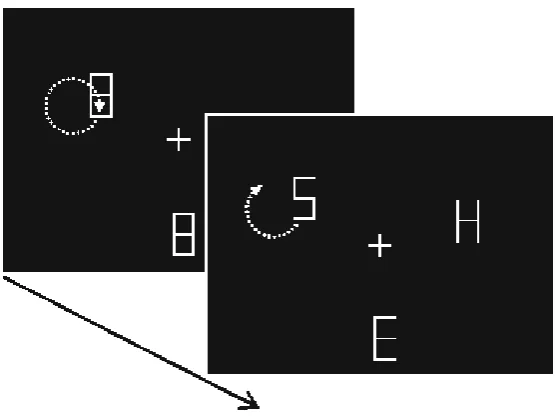
Figure 1.2. Example of the display using additional singleton paradigm in which a shape singleton defines the target. In the left panel, there is no additional singleton, but in the right panel there is an additional singleton (represented by the dotted circle –a colour singleton).
23 shape was the relevant dimension, one of the distractors would randomly be a colour singleton). The target was always presented in the relevant singleton.
He found strong interference by a colour singleton distractor when searching for a form singleton target, but not vice versa. Additionally, this interference from an irrelevant singleton occurred when the irrelevant dimension was overall more salient than the relevant dimension, but not when it was less salient (i.e., when a shape singleton was presented as an irrelevant distractor singleton, it interfered with search only when the targets and distractors were less salient colour singletons like yellowish red vs. yellowish green making the dimension of form overall more salient than the dimension of colour). He also showed that this bottom-up capture did not go away with increased practice (Theeuwes, 1992). These results suggest that attention capture is strongly salience based and thus stimulus-driven. The persistence of capture in spite of training suggests a robust effect that cannot be easily controlled in a top-down manner. To summarize, the findings from the additional singleton paradigm shows that a saliency map supersedes any top-down featural prioritisation during attentional allocation.
The role of the Attentional Window in capture
24 distractor interference is not new. For example, LaBerge, Brown, Carter and Bash (1991) showed that distractor letters that appeared on either side of a central target letter (flankers) interfered less with target detection when participants were in a focused attentional state. Many later studies have shown that singletons do not capture attention when attention is focused at a location (Belopolsky, Zwaan, Theeuwes, & Kramer, 2007; Theeuwes, 1991; Theeuwes, van der Burg, & Belopolsky, 2008; Yantis & Jonides, 1990). For example, Yantis and Jonides (1990) used a endogenous cueing task with 80% cue validity. In some of the trials, an abrupt onset was also shown in the display. If the onset captured attention in spite of the intention of the observer to attend only to the cued location, it suggests that capture by onsets is highly automatic. However, they found that abrupt onsets failed to capture attention when attention was already allocated to another
location.
25 other half, either the un-cued target or the distractor had an abrupt onset. They found that the presence of an un-cued target slowed reaction times, irrespective of whether it had an abrupt onset or not. This suggests that when attention is already focused on a particular location, an onset does not capture attention.
A better comparison between top-down control and bottom-up capture could be obtained when the onset is presented before such an attentional state is maintained. Theeuwes (1991b) compared the effect of the central cue-display onset asynchrony and peripheral cue-target onset asynchrony on attention capture by abrupt onsets and offsets. He used three central cue-to-target onset
asynchronies (CTOA) (-600, -300 and 200) and four peripheral onset or offset CTOA (-160, -80, 0 and 80) and found that abrupt onsets did not capture attention when attention was already focused elsewhere in the display (-600 and -300). However, when attention was distributed (200 ms), search consistently started at the location of the onset. Additionally, irrespective of the CTOA after which the onset stimulus was presented, abrupt onsets failed to have an attentional effect under focused attention.
Some researchers have viewed this as evidence for top-down set for
26 showed that when participants were engaged in an RSVP (a Rapid Serial Visual Presentation task in which individual visual stimuli are presented very rapidly in the same spatial position, and participants are asked to detect a target stimulus defined by a certain feature like a red letter among green distractor letters) task where the target was defined as a colour singleton, an irrelevant colour singleton presented in the periphery caused an attentional blink to a subsequent target. This has been interpreted as attention capture by the irrelevant singleton. However, a central distractor designed to engage attention in the RSVP stream prevented subsequent capture by a distractor in the periphery. Thus, they argued that rather than having a focused attentional state, attentional engagement is necessary for overriding bottom-up capture (Folk, Ester, & Troemel, 2009).
Top-down effects on attention capture
Contrary to the claim of Theeuwes (1991, 1992) that capture is entirely determined by bottom-upsalience computations, Bacon and Egeth (1994) showed that top-down control can prevent bottom-up capture. They suggested that
27 known, they have to rely on pre-attentive salience computations to detect the singleton in the display. In such a scenario, another salient item in the display is more likely to capture attention. They called the former type of search a feature search mode and the latter a singleton detection mode. These two search modes might be inherently top-down or bottom-up. That is, in a feature search mode, participants are intentionally looking for a known target and they are successful, whereas in a singleton detection mode, they have to rely on the information from the stimulus to guide their attention.
Bacon and Egeth (1994) further showed that participants could be forced to do a feature search in a task where they would otherwise engage in singleton detection. They did this by making the relevant feature a non-singleton and then by having singleton distractors defined in the irrelevant dimension. These ensured that a singleton detection mode was not sufficient to detect the singleton target in an efficient manner. An efficient search was possible only by adopting a feature search mode. The results suggested that there was cross-dimensional interference (e.g., interference by a colour singleton when the relevant feature is shape) only under a singleton detection mode, but not under a feature search mode.
28 additional singleton paradigm to propose a model which argues that when
attention is diffused, visual selection is completely stimulus-driven and that successful top-down control, when it occurs, is a result of a massive recurrent feedback processing that overrides the stimulus-driven selection (see Theeuwes, 2010, for a review).
Contingent Involuntary Orienting
Further evidence of top-down influence on attention capture was proposed by the contingent involuntary orienting hypothesis (Folk, Remington & Johnston, 1992; Folk, Remington & Wright, 1994). According to the contingent capture account, capture is always goal driven. Contingent capture studies make use of a pre-cueing paradigm where a feature cue was presented at the location of the target, either matching with the target feature or not. Within a block, the cue was either 100% valid or 100% invalid. It was found that when the search display is preceded by an irrelevant colour cue, colour captured attention and an onset did not; when the cue was an onset, the capture effect was reversed – an irrelevant onset captured attention, colour did not. This was also found to be true for a motion cue. That is, when there is more than one feature discontinuity, one of which is relevant, it interferes with selection.
The results suggest that attention capture by a particular feature is contingent on the relevance of the feature to the task at hand. That is, if the
observer is required to constantly monitor a certain type of feature discontinuity in order to efficiently detect the target, then such a discontinuity will capture
29 (1994) search modes and speak in favour of capture being determined by top-down goals of the observer. The use of the pre-cueing paradigm have made it difficult to determine if the absence of capture for a non-matching cue in fact results from the inability to transfer the attention from the cue to the target (see Rauschenberger, 2003 for an analysis between capture effects using auto- and allo-cues). Others have suggested that the CTOA of 150 ms that is generally used in the pre-cueing studies make it difficult to measure the capture effects, if quick disengagement follows (see Theeuwes, Olivers & Belopolsky, 2010, for this and other difficulties posed by the paradigm and other interpretations of their
findings).
The debate about selection being stimulus-driven or goal-driven is far from being resolved. More recently, it has been argued that the interference from an irrelevant additional singleton results from non-spatial filtering costs and does not reflect attention capture (Folk, Remington & Wu, 2009; Wykowska &
30 Attention Capture by Dynamic Discontinuities
Abrupt Onsets
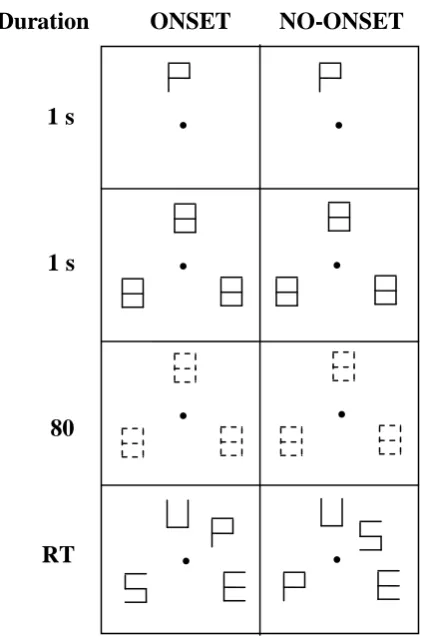
A dynamic singleton that is quite robust in its attentional effects is an onset singleton (i.e., the sudden appearance of a new object among old objects). Many electrophysiological and psychophysical studies in the early 1970's showed that the visual system is differentially sensitive to transient and sustained visual events like abrupt onset and offset or relative motion (Fukada & Saito, 1971; Cleland, Levick, & Sanderson, 1973; Kulikowski & Tolhurst, 1973; Tolhurst, 1975). Yantis and Jonides (1984) systematically tested the attentional effects of an abrupt onset as compared to a gradual onset. They adopted the so-called 'no-onset procedure' as described by Todd and van Gelder (1979). In their study, the search display was preceded by a preview display that consists of figure-8 place-holders (an object that is made up of 7 line segments, that looks like a digital 8; letters of the alphabet can be made from these by removing corresponding line segments) for a short time (1000 ms) (see Figure 1.3). Then, the irrelevant line segments from the figure-8 stimulus are gradually removed (gradual onset) to reveal the search display.
31 find an abrupt onset target was unaffected by changes in display size, suggesting that attention is automatically allocated to an abrupt onset in spite of the onset feature being irrelevant to the search task.
Figure 1.3. Example display taken from Yantis and Jonides (1984), for display size 4 and with gradual and abrupt onset stimuli. Participants are first informed of the identity of the target. The place-holder display is presented for 1000ms, which then gradually changes to letters over 80ms. An abrupt onset letter is added to the final display. Dashes represent fading line segments. In the above example, the target letter is P and in the onset condition, is an onset while in the no-onset condition, it is not.
Duration ONSET NO-ONSET
1 s
RT 80
1 s
.
.
.
.
.
.
32 As far as abrupt onsets are concerned, they capture attention as long as attention is not already focused on a target location. They have been tested extensively and are shown to fulfil all the three criterions of automaticity, vis-à-vis minimal use of mental resources, resistance to suppression and lack of sensitivity to changes in expectancy (Yantis & Jonides, 1988). However, the mechanism underlying the onset effect (i.e., the finding that onsets are prioritised over other objects) is a matter of some controversy. The most popular and the most tested is the new object account which proposes that the abrupt onsets capture attention because they signal a new object in the visual field.
New Object Account. The argument made in favour of the perceptual
newness draws substantially from the concept of object files (Kahneman,
Treisman & Gibbs, 1992). According to Kahneman et al. (1992), for every object that is perceived, a corresponding object file is created and maintained by the visual system. These object files are updated periodically and any changes that happen to an existing object are updated in the object file. Even though they do not make a strong claim as to whether attention is required for updating, they confer that the object files are automatically updated when attention is allocated to the object. In the context of abrupt onsets, it has generally been argued that the sudden appearance of a new object in the visual field requires the creation of a corresponding object file and that this automatically draws attention to the location of the new object (Christ & Abrams, 2006; Yantis & Jonides, 1990).
33 motion can be used as an effective cue to guide attention when it is task relevant, but that an irrelevant motion does not capture attention. In Experiment 2, they tested the possibility that new objects that are not associated with an abrupt onset could capture attention. They used a global/local task (for example, see Navon, 1977) and asked participants to indicate the identity of the global letter. There was always a unique letter among the letters that made up the local level, which was either compatible or incompatible with the global letter. Moreover, the unique letter either had an onset, motion or in the baseline condition, neither of these. They found stronger compatibility effects when the unique letter was moving or had an abrupt onset as compared to the baseline condition.
When motion started before the letters were revealed, the compatibility effects disappeared, showing that only events associated with the appearance of a new object captured attention. Lending further support to the new object account, Christ and Abrams (2006) found that attention was captured involuntarily when an object was segregated from a group of objects. They used different types of motion, namely, motion onset, continuous motion, and motion offset and found that irrespective of type of motion used to segregate objects, a newly segregated target was found significantly faster (more than 100 ms on average) than a target that remained in the old group. This gives some support for a preferential
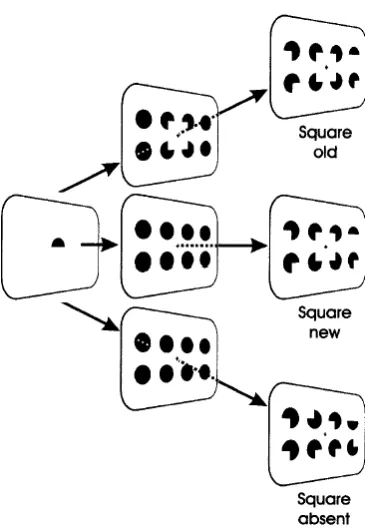
34 Figure 1.4. Example display from Rauschenberger and Yantis (2001). The subjective square was perceptually old, perceptually new, or absent. On half of the trials, the square was absent; on the other half, it was present. When present, they were either new or old with equal probability.
[image:53.595.252.435.101.367.2]35 In some trials, they were presented along with the search display making it a new object, while in other trials there was no subjective square present. They found that only when the subjective square present in the display was new, it resulted in slower response times, but did not when it was old, suggesting that the perceptual newness of the illusory object captured attention. However, it has been shown that there is object precedence in search irrespective of its newness. For example, Yeshurun, Kimchi, Shashoua and Carmel (2009) showed that search performance was better when the target appeared inside the perceptual object than outside. This benefit did not go away when the target presentation was followed by display offset, suggesting that attention was allocated to the location of the perceptual object in an involuntary fashion.
In line with the idea of object files, Wong, Peterson and Hillstrom (2007) tested to see if changes in semantic or structural information were as efficient as an abrupt onset in producing an oculomotor capture. They used search displays that consisted of six uniquely shaped stimuli. Participants were asked to move their eyes to a colour singleton and make a response based on the direction in which the target 'c' presented inside was pointing. Simultaneous with target presentation, one of the two events occurred: There could be an abrupt onset in any random location in the display, or one of the unique shapes morphed into another (changed the shape over a sequence of frames).
36 morph. There was no difference in detection efficiency between the morph and the onset. However, when occulo-motor capture was measured, an onset reliably elicited an eye movement towards itself, whereas the morphs did not. This shows that although changes in semantic information could warrant attentional capture, they do not capture the eyes as reliably as an abrupt onset.
It has been well established that the eyes follow attention (Itti & Koch, 2001). Considerable evidence has accrued showing that abrupt onsets capture the eyes even when they are completely task irrelevant (Mulckhuyse, van Zoest & Theeuwes, 2008; Theeuwes, Kramer, Irwin & Zelinsky, 1999). For example, Theeuwes et al. (1999) asked participants to saccade to a colour/luminance singleton target. An abrupt onset distractor was also presented in the search display. They found that on a significant proportion of trials (30 to 40%), participants erroneously initiated an eye movement towards the onset.
Mulckhuyse et al. (2008) also pointed out that top-down and bottom-up factors work together to ensure efficient processing after the initial capture response. That is, quick disengagement is often efficiently executed after the erroneous oculomotor response (see also, Theeuwes, Kramer, Hahn and
Irwin,1998). Furthermore, Kramer, Cassavaugh, Irwin, Peterson and Hahn (2001) examined the oculomotor effect of single or multiple onset distractors on a
37 Yantis and Gibson (1994) suggested that 'newness' can be rather
perceptual in the sense that when an existing object disappeared for about 100 ms and reappeared again it has the same effect as an abrupt onset. However, this does not agree with the findings of Kahneman, Treisman and Gibbs (1992) who
showed that even a temporal gap of 590 ms between object fields did not interfere with object continuity. In spite of overwhelming evidence supporting the new object account, there have been criticisms.
Role of Luminance. The most prominent of the criticisms against the new
object account is that an abrupt onset is accompanied by a large local increase in luminance, whereas the luminance decrease accompanying the transformation of figure-8 to letters is relatively smaller. For example, if a letter, say 'S' is
38 On a related note Miller (1989) pointed out that, instead of undermining the ability of an abrupt onset to capture attention, this finding indicates possible attentional effects of an abrupt offset. Watson and Humphreys (1995) however showed that abrupt onsets and offsets have equivalent effects on attention. They used stimuli with onsets or offsets, but without an accompanying new object (i.e., only part of the stimulus underwent offset or onset). They found that both onsets and offsets had very similar effects on search performance, suggesting that an increase or decrease in luminance does not differentially affect performance. The finding implies that as long as the overall change is kept constant, the direction of change does not affect attention.
In order to further differentiate between the effects of luminance changes and those of new objects, Franconeri, Hollingworth and Simons (2005) used a paradigm that made it possible to introduce new objects by removing any abrupt luminance changes. They used occluders that changed size (either expanded or contracted) and the abrupt onset could occur either behind the occluder or in front of the occluder. They found that abrupt onsets received an RT benefit only when it appeared in front of the occluder, but not when it appeared behind it. Thus it was shown that a luminance transient was necessary for an abrupt onset to capture attention.
39 changed the status of the place-holders as old objects, removing any difference between the old and the new. However, Chua (2009) used an occluder that hid the objects only for about 10 ms, likely removing any possible disruption to object continuity. Their findings closely resembled that of Franconeri et al., suggesting that luminance changes were necessary for onsets to capture attention. However, they also extended these findings to show that when the context facilitated the encoding of the new object, it captured attention. (See also Chua, 2011, where capture was observed when the encoding of the old objects was facilitated and absent when such an encoding was difficult or impossible.)
On the other side of the argument, a luminance transient was deemed neither necessary, nor sufficient, to produce capture by abrupt onsets and makes a strong argument in favour of the new object account (Yantis, 1993; Yantis & Gibson 1994; Yantis & Jonides 1994). For example, it has been shown that onsets capture attention even when they are equiluminant with the background (Davoli, Suzko & Abrams, 2007; Yantis & Hillstrom, 1994). Moreover, Gellatly, Cole and Blurton (1999) showed that when stimuli are matched in luminance to the
background, the onset effect was considerably reduced, but not eliminated. Enns, Austen, Di Lollo, Rauschenberger and Yantis (2001) showed that the attentional effect of huge luminance changes does not compare to those produced by an abrupt onset. They used a visual search task to assess the effect of a change in luminance on capture by abrupt onsets.
40 change in luminance was larger for the luminance change stimuli as compared to abrupt onsets. Despite this, abrupt onsets were more effective in capturing attention. Even though these findings do not offer direct support for the new object account, it shows that the capture effect remains relatively unaffected even in the absence of luminance changes.
In summary, the case for luminance transients in attention capture by abrupt onsets is not a strong one. Even though matching stimulus luminance with the background leads to a reduction in the capture effect, it is not abolished (Christ & Abrams, 2008; Davoli et al., 2007; Gellatly et al., 1999). In contrast, when the appearance of the new object is hidden from the observer, onsets were treated as equivalent to a no-onset (Franconeri et al., 2005; Chua, 2009). From these
findings, it is clear that low level luminance changes have a role in onset capture, but the appearance of a new object seems to have a bigger role.
Role of Masking. Another opposition to the new object account as an
explanation of onset capture was provided by Gibson (1996a). He argued that in a standard display with an abrupt onset, the placeholders act as pre-masks, making the abrupt onset the only item that is not masked. Thus, the better visual quality of the abrupt onset leads to capture because it is better encoded and is available for processing before the no-onsets are. Participants were asked to find a predefined target letter among distractor letters. Gibson (1996a) used three different
41 search display. Finally, in the onset condition, there were no placeholders, so that all the elements in the placeholder condition had an abrupt onset. The final search displays were identical in all the three conditions.
The results showed that participants were fastest in the onset condition, followed by dim placeholder condition. The slowest RTs were found in the bright condition. In a second experiment, he combined bright and dim placeholders with either an onset or no-onset target. In the dim placeholder condition, onsets did not capture attention but strong capture was observed when the placeholders were bright. The results overall suggests that attention was automatically guided to the stimulus that had a better visual quality. However, Yantis and Jonides (1996) reinterpreted the advantage of an all onset display in terms of a faster processing associated with capture by onsets (see also Gibson (1996b), who provides further evidence for a masking explanation).
42 1996a). Even though evidence has been provided suggesting that this explanation is unlikely, it is disputable (Gibson, 1996b; Yantis & Jonides, 1996).
Motion and the Onset of motion
A moving object among other stationary object represents a dynamic discontinuity that might capture attention. One of the earliest studies that made use of motion as a feature in visual search was conducted by Nakayama and Silverman (1986). They examined if the conjunction of a static feature like colour and a dynamic feature, like motion also resulted in a standard serial search. They used two different colours and two different motion directions, combining a particular colour with a specific direction of motion. The target was defined as the item that violated this association. The results from this study showed that such a conjunction resulted in a particularly difficult serial search because search slopes increased with increasing display size. However, when they used a stereoscopic method to induce depth in the display, and presented the two directions of motion at separate depths, the search turned out to be parallel. This finding indicates that a discontinuity in motion at a certain depth (all the distractors moved in one direction while the target moved in the opposite direction) can be detected automatically by the visual system.
43 and stationary X's. They also replicated this finding with moving 'R' among
stationary 'P' and moving 'Q' which, in the absence of motion, is a serial search. This shows that adding the property of motion leads to a clear grouping of the items in the display based on motion. Hence what has been a conjunction search at the level of features ceases to be so when motion is one of the defining properties of the target. It also indicates that motion in the visual field can be detected pre-attentively.
The most popular accounts of capture by motion come from hypotheses regarding behavioural urgency and animacy (Abrams & Christ, 2003; Franconeri & Simons, 2003; Pratt, Radulescu, Guo, & Abrams, 2010). The results in favour of capture by motion are not clear cut. Most of the studies that tested the effects of motion per se did not find capture (Hillstrom & Yantis, 1994; Folk, Remington & Wright, 1994). For example, Hillstrom and Yantis (1994) tested if a motion singleton captured attention. They used search displays where one of the search items possessed a motion attribute while the others did not. When motion reliably predicted target location, search was efficient – as evidenced by a flat search slope. However, when motion was task irrelevant, then reaction times increased as a function of display size. Thus, it is evident that even though motion can reliably be used to guide attention when required, it did not interfere with top-down goals and hence, did not capture attention in a bottom-up manner.
44 of a forthcoming moving target. They used different types of static and dynamic targets and paired them with a motion cue. A 100% invalid motion pre-cue interfered with the processing of a target defined by motion, but not colour or onset. There were also significant RT benefits when the cue was 100% valid. This shows that motion triggers a contingent involuntary orienting to the location of the cue and hinders performance when the cue is invalid and aids it when it is valid. However, as noted before, there are methodological concerns with the use of pre-cues.
Preliminary evidence in favour of capture by motion was given by Franconeri and Simons (2003), who tested the range of dynamic stimuli that might capture attention. In three experiments, they compared the attention capturing effects of eight types of discontinuities – one static (colour) and seven dynamic (abrupt onset, linear motion, jitter motion, looming motion, receding motion, disocclusion and motion over occlusion). They used displays with figure-8 placeholders and motion started 150 ms before the search display was revealed. They found that all dynamic discontinuities except receding motion capture attention – as evidenced by their respective search slopes. Colour did not capture attention.
45 example, see the Unique Event Account – von Mühlenen et al. (2005)). Even though other studies have found evidence supporting capture by looming motion (Franconeri & Simons, 2005; von Mühlenen & Lleras, 2007; Skarratt, Cole & Gellatly, 2009), researchers have found it difficult to replicate attention capture by motion when it did not start just before or during the presentation of the search display (von Mühlenen, etal., 2005).
For example, Abrams and Christ (2003) used displays similar to that used by Franconeri and Simons (2003). Figure-8 placeholders started moving at the beginning of the trial and continued moving even after the search display was revealed by shedding the relevant line segments. They did not find attention capture by motion. Instead, however, they proposed that the onset of motion in a display is salient enough to capture attention. Their display consisted of four figure-8 placeholders, two of which moved and two that did not. After 3200 ms, the search display was revealed by shedding relevant line segments (I will refer to this as display transition).