A Thesis Submitted for the Degree of PhD at the University of Warwick
http://go.warwick.ac.uk/wrap/36380
This thesis is made available online and is protected by original copyright. Please scroll down to view the document itself.
observational study
by
Richard Kiely
A thesis submitted in partial fulfilment of the
requirements for the degree of Doctor of Philosophy
University of Warwick
Centre for English Language Teacher Education
Page ii
vii
x
xi
xii
xiii
xiv
xv
1 Table of contents
Chapter 1
Table of contents List of figures List of Appendices Acknowledgements
Declaration of published work Abstract
Abbreviations Data Conventions Introduction
Chapter 2 Discourses of Programme Evaluation in English 10 Language Teaching
2.1 Introduction - a conceptual map 10
2.2 Evaluation - Three phases 12
2.3 Domains of language programme evaluation 15
2.4 Evaluation in ELT - Two research traditions 18
2.5 Programme theory in ELT 19
2.6 The Bangalore evaluation and the development of
ELT evaluation theory 24
a) The role of experimental design 26
b) The measurement of outcomes 29
c) The need to describe component parts of the
programme 31
d) The need to involve programme participants in the
programme 36
2.7 Programme evaluation by teachers 38
Page
a) Action research 41
b) Reflective practice 43
c) Classroom ethnography 44
d) Teacher evaluation in the appraisal tradition 45
2.9 Teacher Inquiry - Summary 47
2.10 Summary 48
Chapter 3 Pilot study - teachers evaluating an EAP 52
programme
3.1 Introduction 52
3.2 Institutional context 52
3.3 The programme 56
3.4 Research methodology 57
3.5 The evaluation of the programme 59
a) Stage 1 - Baseline evaluation - establishing the
pedagogy 59
b) Stage 2 - Formative evaluation - taking stock and
moving on 61
c) Stage 3 - Sunirnative evaluation - preparing for next
time 68
3.6 Lessons from the Pilot Study 70
a) Wider implications 70
b) The study of evaluation - methodological implications 70
c) The study of evaluation - conceptual foci 72
3.7 Summary 76
Chapter 4 Research design and methodology 77
Page
4.2 Evaluation and Research 77
4.3 Research approach 1 - Issues of ontology and
epistemology 79
4.4 Research approach 2 - Case study 84
4.5 Research approach 3 - Ethnography 88
4.6 Research strategy 1 - Procedures and instruments 90
a) Classroom observation 91
b) Interviews 93
c) Recording of one group of students holding an
evaluation discussion 95
d) Documentation 96
4.7 Research strategy 2 - Data analysis and interpretation 97
4.8 Validity as a research issue 101
4.9 Validity as an evaluation issue 104
4.10 Summary of research design 107
4.11 Summary 109
Chapter 5 Programme constructs and evaluation processes 110
5.1 Introduction 110
5.2 The programme - three perspectives 111
a) The specification of the institution 111
b) The construct of the teacher 112
c) The series of classroom activities 113
d) Constructs in conflict 116
5.3 The formal evaluation event 117
a) The evaluation 117
b) Commitment of the teacher 122
c) Language skills development 124
Page
e) The role of the teacher 132
5.4 The values underpinning the programme 136
5.5 Some consequences of the evaluation 143
a) Characterisations of vocabulary 144
b) Programme improvement and teacher development 149
5.6 Summary 153
Chapter 6 The role of the institution - sleeping partner or 157 remote control?
6.1 Introduction 157
6.2 The institution in the programme - issues of
positioning and representation 158
a) Boundary management 160
b) Role and status of teachers 162
c) Role of students 164
6.3 The programme in the institution - the inevitably
gapped ioop 166
a) The customising of NOT 166
b) Evaluation and programme development 168
c) Evaluation and innovation - long and short cycles 170
6.4 The wider agenda - evaluation, quality, and the
framing of the teacher-manager relationship 174
a) The evaluation policy 175
b) Quality management in higher education 179
6.5 Summary 184
Chapter 7 'In fact I can't really lose' - the case of Laure 185
7.1 Introduction 185
Page
7.2 The social dimension of learning in the programme 189
7.3 The materials: Laure's likes and dislikes 192
7.4 Negotiating an essay title 199
7.5 A note of paradigm and method 205
7.6 Summary 210
Chapter 8 Conclusion: Rethinking, repositioning and 211
rewiring evaluation
8.1 Introduction 211
8.2 The different traditions of programme enquiry 213
8.3 Institutional policy and evaluation design 216
8.4 An ethical framework 219
8.5 Evaluation and teaching 221
8.6 Programme evaluation: towards an integrated
management strategy 223
8.7 Limitations of this study 225
8.7 Concluding remarks 226
Endnotes 227
Bibliography 231
Page 11 14 23 48 49 54 62 64 80 82 83 86 89 Figures 2.1 2.2 2.3 2.4 2.5 4.2 4.3 4.4 4.5 3.1 3.2 3.3 4.1 Chapter 2
Discourses of Programme Evaluation in English Language Teaching
Conceptual map of Chapter 2
Summary of three conceptions of valuation
Four evaluation accounts of ELT programme theory
Features of different teacher inquiry traditions
Multi-functional evaluation
Chapter 3
Pilot study - teachers evaluating an EAP programme
Departmental approach to evaluation of programmes
Group discussion stage of NUT - CS 1:5
Plenary discussion stage of NOT - CS2:5
Chapter 4
Research design and methodology
Assumptions underlying inquiry in the social sciences
(after Cohen and Manion 1994:9)
Naturalism and positivism (after Lincoln and Guba
1985:37)
Summary of values underpinning research design
Features of case study approach related to this study
Reasons for using ethnography as form of naturalistic
Page
4.6 Summary of data collected on two programmes (CS1
& CS2) 90
4.7 Strategies for analysis of ethnographic data (after
Goetz and LeComptel98l' Lincoln and Guba 1985) 99
4.8 Techniques for establishing trustworthiness 102
4.9 Techniques for development of researcher role 103
4.10 Determining evaluation validity (from Messick
1989:20) 105
4.11 Summary of research design for main study 107
Chapter 5
Programme constructs and evaluation processes
5.1 Construct of the programme as represented in the 111
module guide
5.2 Construct of the module as represented by the teacher 112
5.3 Programme materials - weeks 1-12 115
5.4 Programme materials - weeks 1-5 (pre-evaluation
event) 115
.5.5 Programme materials - weeks 6-12 (post-evaluation
event) 115
5.6 Profile of the participants in the audio recorded small
group discussion 118
5.7 Content analysis of the recorded small group
discussion 119
5.8 Content analysis of the plenary feedback session
(CS2:5) 120
5.9 Anna's response to evaluation feedback on vocabulary
6.1
6.2
6.3
158
165
167
182
199
213
215
217
225 7.1
8.3
8.4 8.1
8.2
The role of the institution - sleeping partner or remote control?
Summary of the off-campus examination episode
Stakeholder alliances
Comparison of recommended procedure and actual
evaluation
Models of universities as organisations
Chapter 7
'In fact I can't really lose' - the case of Laure Schedule for coursework assessment
Chapter 8
Conclusion: Rethinking, repositioning and rewiring evaluation
Summary of research foci, key findings, and further
exploration
Examples of different programme inquiry traditions in
action
Summary of evaluation policy development
Appendix 1 Data used for this study 247
Appendix 2 Questionnaire on Evaluation for teachers
of EAP 248
Appendix 3 Interview schedule 1 - Teacher 252
Interview schedule 2- Students 253
Interview schedule 3 - Manager 254
Appendix 4 CS2 - Interviews with teacher, coordinator
and students 255
Appendix 5 CS2 - Classroom materials 256
Appendix 6 Evaluation policy of the institution 259
Evaluation policy of the department 263
Appendix 7 Writing task CS2:1 264
Many people have helped me in completing this thesis. I would like to express thanks to:
Dr. Pauline Rea-Dickins, who as a colleague and friend over many years as well as
supervisor, made it all possible;
Anna and Millie, the teachers who gave me time and access to their classrooms and
pedagogy;
the different professional communities I have been fortunate to work with, especially
Applied Linguistics colleagues at Thames Valley University, University College
Chichester, and the University of Warwick, and the EAP students who so willingly shared
their experience with me;
A version of Chapter 3 has been published as:
Kiely, R. 1998 Programme evaluation by teachers: issues of policy and practice. in Rea-Dickins, P. and K. Germaine 1998 (Eds.) Managing Evaluation and Innovation in Language Teaching: Building Bridges. Harlow: Addison Wesley Longman pp. 78-104
A version of Chapter 5, Section 5.5 has been published as:
Kiely, R. 1999 Classroom evaluation: a platform for teacher development, in J. Edge & K. Richards (Eds.) 1999 Proceedings of Teachers Develop Teachers' Research Conference (TDTR4) Leuven Belgium. CD - ROM
The data collected and analysedfor this study has generated the following articles:
Kiely, R. 1999a Evaluation by teachers. IATEFL Issues 147 pp. 14-16
language education, from language proficiency assessment to materials selection to project management. In this study evaluation is taken as programme inquiry for the purposes of accountability and development (Rea-Dickins and Germaine 1992; Weir and Roberts 1994). The context of evaluation is EAP programmes in higher education, where a policy of programme evaluation by teachers provides base data for the institution's quality management system.
Evaluation in this sense is a complex process, embedded in and potentially destabilising for the prevailing social order in classrooms, departments, and institutions. To capture this complexity and embeddedness, a qualitative methodology is developed from
naturalistic inquiry and ethnography to study two EAP programmes and their evaluations. The classroom observation and interview data are used to explore the operation of the evaluation policy, its consequences in terms of programme improvement and teacher development, its quality assurance functions, and its impact on the programme experience of one particular student.
The study shows that in this context the evaluation policy has beneficial and problematic consequences. It looks good, and thus enables a case to be made for rigorous quality management. It provides a space for students to negotiate the programme, and for the teacher, opportunities for reflection and development. However, the policy also risks being seen by teachers as intrusion, compromising teacher autonomy, and aggravating teacher-manager problems. Students provide feedback on teaching and inputs (including the teacher) rather than on learning or opportunities for learning in terms of the values underpinning the programme. The strong students can use the evaluation strategically, to further their own preferences, at the expense of the weaker students who are
marginalised.
The concluding chapter outlines some ways forward for this approach to evaluation in this context. These include realigning purposes and methods, building on teacher ownership of and responsibility for programmes, linking evaluation in the classroom to other forms of educational inquiry, and managing the programme in its widest sense in an ethical framework.
Key words
BALEAP BASELT BEP CARN CLT cS1 CS2 CTP DflD EAP ELT ELTJ ERASMUS ESP HEFC HEFCE MBA NOT ODA OFSTED QAA SA SAD SLA TBL TQA
British Association of Lecturers in English for Academic Purposes
British Association for State English Language Teaching
Bilingual Education Project
Classroom Action Research Network
Communicative Language Teaching
Case Study 1
Case Study 2
Communicational Teaching Project
Department for International Development
English for Academic Purposes
English Language Teaching
English Language Teaching Journal
European student exchange programme
English for Specific Purposes
Higher Education Funding Councils
Higher Education Funding Council for England
Master of Business Administration
Nominal Group Technique
Overseas Development Administration
Office for Standards in Education
Quality Assurance Agency
Self Access
Self Assessment Document
Second Language Acquisition
Task-based Learning
i) To preserve the anonymity of informants, the names of all teachers and student
have been changed. In addition, the teachers are referred as female, regardless of
real gender.
ii) The two EAP programmes studied are referred to as Case Study 1 (CS 1) and Case
Study 2 (CS2).
iii) Fieldnotes (classroom observation notes augmented by headnotes) are referred to
throughout as classroom notes. The actual words of speakers are in unmarked
font, while my observations are in italics.
iv) The interviewer (hit.) in the interview extracts quoted is, in all cases, myself.
v) The transcription of spoken English in the classroom notes and interview extracts
is designed to facilitate easy reading, especially by teacher and student informants.
To achieve this goal, I have punctuated the text and corrected some minor
infelicities. I hope however, I have maintained the voice and character of the
original.
vi) The code for data in the text (e.g. CS2:5) refers to the programme (C52) and the
session / week (Week 5)
vii) The code for classroom materials (e.g. 5/3/3) refers to the date, month, and place
Introduction
This study is about programme evaluation as carried out by English Language
teachers in their own classrooms. The focus on this particular topic is determined by
my own professional experience. As a teacher, programme coordinator, and project
leader in the UK higher education sector, I became aware of a tension between the
theory and practice of evaluation; between the literature on the properties and
potential on the one hand, and the uncertainties and discontinuities which characterise
practice on the other. The central thesis of this study is that the potential of evaluation
is equally the source of the problems with practice: the use of evaluation for both
pedagogic and management purposes - improvement to teaching and learning on the
one hand, and for quality assurance and administrative purposes on the other - runs
the risk of compromising both tasks. This thesis is explored:
i) through analyses of the discourses of evaluation, in English Language
Teaching (henceforth ELT), Applied Linguistics and in educational and social
prograrnnies more generally, as represented in the literature; and
ii) through the empirical study of two English for Academic Purposes
(henceforth EAP) programmes where evaluation, as set out in institutional and
departmental policies, is carried out by teachers.
Over recent decades there has been an increasing interest in evaluation in ELT,
corresponding to a similar trend across the whole range of educational programmes,
and indeed social programmes and services in general. In the public sector, led by
initiatives in the United States and Britain, there has been a sustained effort to bring
transparency and accountability to activities funded from the public purse. A central
down of the public sector generally by imposition of features of the market economy.
In the private sector, providers of services have been motivated to understand better
the needs and wants of their clients. The goal here has been effectiveness - rendering
the service provided more finely-tuned to the particular needs of clients and
user-groups. Together these twin concerns - efficiency and effectiveness - have come to
characterise quality. The management task in providing services in the health, social
services, and training fields as well as in the general education and ELT fields, is to
evaluate all aspects of the programme in question, so as to a) continuously improve it,
and b) be able to demonstrate to those outside the day to day operations that there is
appropriate regard for the exigencies of efficiency and effectiveness.
This trend has had implications for characterisations of evaluation. In the 1970's
evaluation focussed on policy formulation and accountability:
Educational evaluation is the process of delineating, obtaining and providing useful information for judging decision alternatives.
Stufflebeam et a! 1971: 43
Systematic educational evaluation consists of a formal assessment of the worth of educational phenomena.
Popham 1975
By the 1990's it had become a means of relating policy to practice and vice versa, and
of understanding how these are constantly changing. In the words of Norris:
Evaluation has emerged as the major practical expression of the application of theories and methods from applied social science to the problems posed by piecemeal social engineering.
Norris 1990: 1
Mitchell illustrates how evaluation as a form of inquiry into whole programmes might
Evaluation is about inferring the most likely relationships among a whole network of complex events, from a wide range of quantitative and qualitative evidence, not about determining strong causal relationships between small numbers of events. It is about the monitoring of intended events and their effects, but also about the identification of the unexpected, and the proposal of untried solutions.
Mitchell 1990:11
Rea-Dickins elaborates on the potential links between evaluation, quality and
programme management:
In addition to focussing on the evaluation of quality processes in language teaching, there will be greater appreciation of the different role(s) of the evaluator(s), both internal and external, and of the relationships that hold between practitioners, sponsors and other relevant stakeholders. If evaluation in ELT is to be effective, we will see a stronger integration of evaluation within practice, as part of an individual's professionalism and an increase in collaborative activity where teachers (and other relevant participants) are actively engaged in the monitoring process.
Rea-Dickins 1994:84
Pennington links 'monitoring' to 'understanding' in the context of language
programmes:
Language programme evaluation is then, less a set of figures or documents than it is a set of activities. These activities involve people and their
interaction in gaining increased understandings which allow them to function more effectively in their work environment. At the same time as these
activities make it possible for people to adapt to their environment, they also open up the way for changing the environment, so that it better suits their needs and purposes. Thus, evaluation at its most basic level is the process of interaction that dynamically relates to people, processes and things that make up a language programme in a process of mutual enlightenment, adaptation, and betterment.
Pennington 1998:205
Legutke and Thomas shows how evaluation activity in the classroom is a requirement
Engaging learners in communicative encounters, especially if their aim is to explore emotional content and experiences, can become too bound up in itself unless this activity also reaches an evaluation stage. Trying to understand what has happened while undertaking a particular task, why it was suggested by the teacher, and contributing actively to the evaluation of learning arrangements,
sequences, resources and input materials by means of reflection and meta-communicative discourse - all these are considered indispensable learner activities in ELT.
Legutke and Thomas 1991:65
These glimpses of different discourses of evaluation illustrate its potential for the
development of individual programmes and learning experiences on the one hand, and
the wider field of ELT on the other. However, practice is equally determined by
negative elements of evaluation, for example, in how it recasts the role of the teacher
in language programmes. First, as evaluation within the programme shifts from a
focus of assessment of learning outcomes, or testing, to some form ofjudgement of
the teaching-learning process as a whole, the teacher's performance rather than that of
the students, becomes the focus of attention. Second, it commits the teacher to
engaging with students as part of the process of programme design, and selection of
materials and teaching activities. Thus, the teacher's control over the performance to
be judged is diluted. Third, the interactions involved in this are documented to allow
the institution to assure quality, which may mean a transfer of ownership on the
programme from the teacher to the institution. Parton (writing about evaluation
practices in the field of social work) illustrates how the monitoring implicit in
evaluation constitutes a shift of ownership:
The increased emphasis on management, evaluation, monitoring and
constraining professionals to write things down, is itself a form of government of them, [...]. It forces them to think about what they are doing and hence makes them accountable against certain norms. In the process, power flows to the centre or agent who determines the professionals' inscriptions,
accumulates them analyses them in their aggregate form, and can compare and evaluate the activities of others who are entries in the chart.
Parton's view has resonances for current trends in British education, where agencies
such as the Office for Standards in Education (OFSTED), the Higher Education
Funding Councils (HEFCs), and the Quality Assurance Agency (QAA) determine
how their legislated responsibilities can be discharged. The procedures of these
agencies inform policy within educational institutions, which in turn shapes, and
improves, practice within classrooms. The question is whether this role for evaluation
in educational management realises the potential suggested by Mitchell, Rea-Dickins,
and Pennington (op.cit.) or leads to the compromised professionalism suggested by
Parton, and the attendant conflicts of interest and rifts between policy and practice.
This study takes evaluation as social action, both reflecting ideologies and ontological
axioms, and creating cultures and discourses within communities of practice. It takes
an empathetic perspective to inherently conflicting positions, seeking to reveal both
the theoretical coherence of each, and the ultimate incoherence which emerges when
they are integrated in policy and practice. The research strategy reflects the search for
cultural understanding, and develops a reflective, ethnographic approach which
revisits issues of research design as an integral part of the data analysis and
interpretation process. Thus, the research questions guiding the study of evaluation
are set out initially in Chapter 2, refined as a result of the pilot study in Chapter 3, and
operationalised further in Chapter 4 - the research methodology chapter - in relation to
data construction and analysis processes relevant to the research foci and questions.
Chapter 2 of this study surveys the discourses which have informed evaluation as a
curriculum development and management tool in ELT in recent decades. It examines
how the 'phases' in evaluation theory development in the social sciences generally
have been interpreted in the different 'domains' of evaluation practice - mainstream
education programmes, foreign language programmes based on SLA traditions of
research, and ELT projects. Through a focus on the evaluation of the
Communicational Teaching Project - the Bangalore project - the evolution of
description of programme processes and the involvement of programme participants
-are linked to the development of qualitative approaches. Finally, the traditions of
inquiry used by teachers - action research, reflective practice, classroom ethnography
and teacher appraisal - are examined, to determine overlaps and distinctions in this
diversity of concepts and labels.
Chapter 3 reports on a pilot study which explores, on the one hand, the extent to
which the discordant discourses outlined above are evident in the evaluation of one
specific programme, and on the other, how a qualitative research strategy appropriate
for the issues and concepts focussed on might be elaborated. The study sets out the
institutional and programme contexts, and documents the process of evaluation
-baseline at the outset, formative in the fifth week, and summative in the twelfth and
final week. Finally, a range of issues are considered: the methodological implications
of this pilot for the main study, the merging of evaluation and pedagogy, the students'
perception of their role, and the contribution of the institutional policy. This
discussion of the pilot study serves to refine the research questions outlined in the
preceding chapter.
Chapter 4 develops in detail the research strategy for the main study. The differences
between research and evaluation as traditions of inquiry are explored, and the
paradigm debate common to both, is discussed to elaborate a methodology which in
this case matches ontological and epistemological positions and research focus and
purpose. The resulting research approach emphasises the local, the particular, the
coherence of cultural practices forged by conflicts and interests within communities
of practice. Each case - programme, learning activity, teacher, student - represents
itself, explores links between abstracted issues, and provides resonances for readers to
consider in relation to their own circumstances. The research design is informed by
naturalistic inquiry, and the processes of data collection and analysis by ethnography.
These approaches to inquiry underpin the validity of the research, both in terms of
Chapter 5 explores the ways in which the programme is the evaluand. Exploring the
nature of the programme three constructs are set out: the institutional specification
from the module guide, the teacher's concept from interview and classroom
observation data, and the classroom process, as determined by analysis of the
materials and activities of the complete 36-hour programme. The evaluation event is
then examined in relation to three programme constructs. This involves exploration of
issues which, from the data, seem to shape the evaluation. A detailed analysis of one
classroom activity illustrates how it informs evaluations of the programme, both
formally in the evaluation event, and informally as in the interview data. Finally, there
is a discussion of the consequences of the evaluation, both in terms of changes to the
programme, and changes in teacher thinking. The latter permits some discussion on
how this consequence might illustrate some ways in which evaluation links to teacher
development.
Chapter 6 engages with another consequence of the evaluation: the extent to which it
discharges its quality assurance function for the institution as a whole. The focus on
the institution is realised first through an analysis of the representations of the
institution within the programme, i.e. in the classroom. Then the relationship between
the programme and the department within which it is located - the unit with formal
responsibility for quality assurance - is analysed. The issues raised lead to quality
management debates in the wider higher education sector, and there is tentative
linking of factors observed in the evaluation of the programme in question, and
perspectives from this wider debate. The issue is the extent to which policy and
practice in relation to evaluation and quality management constitute a shared agenda,
where different stakeholders seek collaboratively to develop teaching and learning,
and conversely, the extent to which there is no shared agenda, and positions taken
Chapter 7 looks at the experience of one student, Laure, within the programme. The
data provide a detailed account of her participation both in the programme and in the
evaluation event. The discussion of what Laure expects from the programme, and her
response to a range of materials and learning activities problematises the issue of
students as programme evaluators. The analysis of how Laure negotiates an essay title
suggests on the one hand a strategy of avoidance, together with poor learning
strategies. Her positive evaluation of the programme is seen as linked to her ultimate
success in it - an over-arching strategy of being positive and engaging may prevent
her from becoming discouraged through an appreciation of her English language
problems in terms of the programme objectives. Drawing such conclusions, even
tentatively, is discussed as a research problem, which can be best resolved through
analysis of data from a theoretical ethnographic perspective.
Chapter 8 draws some tentative conclusions from the study, and explores the lessons
which might be extrapolated for policy makers and practitioners in evaluation
contexts such as that described in this study. The lessons are not set out as
generalisations; rather principles which readers might see as resonating with aspects
of their situation, and capable of illuminating the way forward. The lessons relate to
five aspects of evaluation theory, policy and practice informed by both the library and
empirical elements of this study:
• The different traditions of programme inquiry
• Institutional policy and evaluation design
• An ethical framework
• Evaluation and teaching
• Programme evaluation: towards an integrated management strategy.
This study as a whole holds evaluation - the topic of the study - and research - the
method of understanding - as separate entities. This dichotomy is both for facility of
inquiry, and for exploration in a metaphorical sense of the potential of programme
evaluation by teachers in ELT, as currently constructed, is comprehensively
represented; second, whether the method of inquiry is appropriate; and third, whether
the merging of topic and method in this study establishes a credible argument for
Discourses of Programme Evaluation in English Language Teaching
2.1 Introduction - a conceptual map
This chapter examines the development of evaluation theory in the field of English
Language Teaching. It looks at the diverse purposes of evaluation, and the domains in
which evaluation theory and practice have been developed: social programmes
generally, language programmes, and specifically English language teaching
programmes. The impact of different research traditions on evaluation theory and
practice, the role of evaluation in the development of an integrated programme theory
for ELT, and some problematic issues in the conception of programme in the ELI
field are explored. The detail of evaluation theory and practice development is
examined through a critical review of a well-known evaluation in recent decades - the
Davies-Beretta evaluation of the Bangalore Communicational Teaching Project. Four
central issues - the role of experimental design; the measurement of outcomes; the
need to describe component parts of the programme; and the need to involve
participants in the evaluation - are examined, both in terms of what was done in the
Bangalore evaluation and what was done in subsequent evaluations. The Bangalore
evaluation is seen as a stimulus in the field of ELT for the development of evaluation.
It is appropriate then that the main developments in evaluation through the 80's and
90's are located in a discussion of the key issues in the Bangalore evaluation.
This literature is important in that it frames, conceptually and methodologically, the
specific form of evaluation studied in this thesis: programme evaluation by teachers.
Other traditions of classroom inquiry - action research, reflective practice and
classroom ethnography - and teacher evaluation within the teacher appraisal tradition
which contribute to the detail within this evaluation frame are discussed. These
traditions are relevant because they inform and develop the language curriculum in
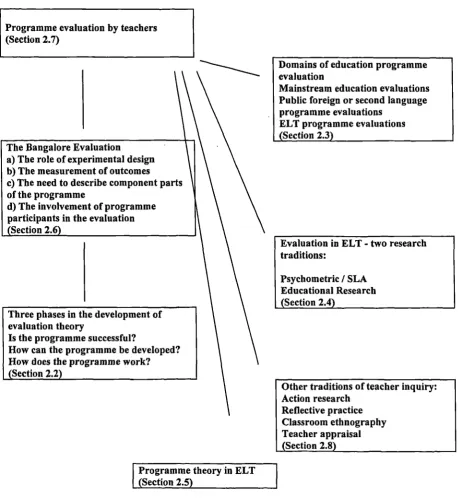
Domains of education programme evaluation
Mainstream education evaluations Public foreign or second language programme evaluations
ELT programme evaluations (Section 2.3)
Evaluation in ELT- two research traditions:
of evaluation to develop a better understanding of evaluations carried out by teachers
within their own programmes. This in turn identifies issues which will be the focus of
the empirical parts of this study. Figure 2.1 represents a summary of the conceptual
structure of this chapter.
Programme evaluation by teachers (Section 2.7)
The Bangalore Evaluation
a) The role of experimental design b) The measurement of outcomes c) The need to describe component parts of the programme
d) The involvement of programme participants in the evaluation (Section 2.6'
Psychometric / SLA Educational Research
Three phases in the development of evaluation theory
Is the programme successful?
How can the programme be developed? How does the programme work?
Other traditions of teacher inquiry: Action research
Reflective practice Classroom ethnography Teacher appraisal (Section 2.8)
[image:27.595.60.519.181.681.2]Programme theory in ELT (Section 2.5)
2.2 Evaluation - Three phases
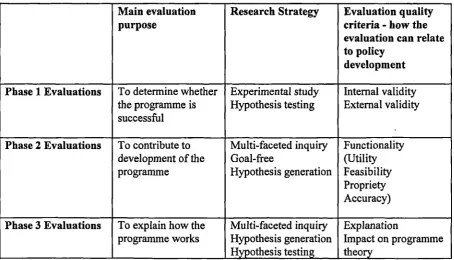
Developments in the evaluation of social programmes can be represented in three
phases (see Figure 2.2). In some ways these phases represent historical developments,
and are often represented in a chronological sequence - Brown (1989); Beretta
(1992a); Lynch (1996); Pawson and Tilley (1997). Here, the phasing is seen as a
gradual improvement of the theory through focussing on the perceived weaknesses of
the "preceding" approach. The phases, or conceptions, also represent a paradigm
debate, where the purposes and underlying epistemologies in evaluation are not areas
of consensus, but part of an ongoing search for a theory and practice which meets the
needs of all evaluation stakeholders (see Chapter 4 below).
The first phase views evaluation as a process of determining whether a given
programme, or a specific innovation within that, is successful or not. Answering this
question contributes to policy development within the programme area. The research
designs combine a positivist epistemology and experimental methodology. The
potential impact of the innovation to be evaluated is considered wholly knowable and
reducible to a set of measurable criteria. Thus actual impact can be determined
through comparison of an experimental group which experienced the innovation, and
a control group which did not. Beretta (1992a) summarises a range of evaluations
designed and carried out along these principles in foreign or second language
programmes, and perhaps the most significant of such studies - the evaluation of the
Bangalore Project is discussed in detail in 2.6 below.
Second phase evaluations emphasise the developmental function of evaluation. This
concern is evident in the report on standards for evaluation published by the US Joint
Committee on Standards for Educational Evaluation (quoted in Weir and Roberts
1994: 20-24), which called for "evaluations that have four features, utility, feasibility,
propriety and accuracy, ... in that particular order". This clearly underlines the shift in
focus from accuracy - internal and external validity, and reliability - in the view set
paradigm as well. Pawson & Tilley (1997) cites the centrality of craft here,
represented in the work of Patton (1982; 1995) as involving "skill; discipline; clarity;
creativity; competence; care; etc" (1997:13). It also brings into the process of
evaluation, a set of questions regarding use of the findings. Developmental evaluation
theory is therefore concerned with the reporting of findings, the framing of critical
debate on these findings, and ultimately the taking of appropriate action (Rea-Dickins
1 994a). This functional, pragmatic approach to evaluation is represented in the ELT
field in publications such Rea-Dickins & Germaine (1992), Weir and Roberts (1994),
and publications related to evaluation practice such as Mackay (1994a); Mackay et al
(1995); PRODESS Guidelines (Kiely et a! 1995).
The third phase is represented in the evaluation theory of Norris (1990) and Pawson
and Tilley (1997). Here the concern is not just with accuracy or functionality, but with
explanation: the task for the evaluator is to explore and establish links between the
specific components or innovations in the programme. These links inform on
"patterns of reasoning and volition" (Pawson and Tilley 1997:57) across the project
context, and provide the policy-maker, not with a simple answer to cause and effect
questions, not with description of the contribution of programme inputs, but rather an
account of how the innovations have led to changes in the programme. With this
explanation remit, evaluation in this phase assumes the purpose of research as well as
its methodology. It is the study of programme implementation, potentially different
from the programme design or rationale. This approach to evaluation is evident in one
particular strand of language programme evaluation: the work of Mitchell (1989;
1990; 1992). She combines a strong theoretical orientation with a grounded
qualitative approach, which seeks to represent the process, and account for it
theoretically, as a requirement for answering the specific questions of policy-makers.
l'his three-phase view of theory development in evaluation, summarised in Figure 2.2
below, is important for this study in a number of ways: first, the diversity of
Main evaluation Research Strategy Evaluation quality
purpose criteria - how the
evaluation can relate to policy
development
Phase 1 Evaluations To determine whether Experimental study Internal validity the programme is Hypothesis testing External validity successful
Phase 2 Evaluations To contribute to Multi-faceted inquiry Functionality development of the Goal-free (Utility programme Hypothesis generation Feasibility
Propriety Accuracy)
Phase 3 Evaluations To explain how the Multi-faceted inquiry Explanation
[image:30.595.60.515.107.367.2]programme works Hypothesis generation Impact on programme ____________________ ____________________ Hypothesis testing theory
Figure 2.2: Summary of three conceptions of evaluation
understanding the perceptions of those involved in the programme evaluation studies
in this thesis. Second, phases 2 and 3 conceive of programme implementation as
different from programme design, a view which corresponds to recent work on how
teaching differs from curriculum or syllabus design (e.g. Woods 1996) and is
especially useful in the context of programme evaluation by teachers. Third, the
developmental focus of phase 2 evaluation emphasises the central role of
practitioners: i.e. those who can effect improvements to the programme. Fourth, the
explanation remit of phase 3 evaluation illustrates how evaluation contributes to
policy development through understanding of how the programme actually works.
Finally, each phase conceives of an audience, increasing as additional functions are
included: Phase 1 - managers and makers; Phase 2- managers and
policy-makers, and practitioners; and Phase 3 - managers and policy-policy-makers, practitioners,
2.3 Domains of programme evaluation
In addition to the chronologically-structured influences on ELT evaluation theory and
practice, there are influences from three different domains in which evaluations are
carried out, and what might be labelled communities ofpractice established.
a) Evaluation of social programmes in education and other fields where
public resources are invested;
b) Evaluation of foreign and second language education programmes;
c) Evaluation of English language teaching programmes.
First, more evaluations are carried out in a) than in b) or c) as these incorporate a huge
amount of public sector activity and investment. Language programmes are a
relatively small group of the public sector social programmes which are routinely
evaluated. For example, the Burstall study of French in the primary school curriculum
(Burstall et al 1974) was, by the early nineties, the only publicly-funded, large-scale
evaluation study of foreign languages in the UK primary curriculum. One impact of
the low volume of progranune evaluation in language education has been a difficulty
in the development of a programmatic approach, i.e. a series of linked studies, to the
issues which relate to language programme success of otherwise. This in turn has
resulted in a reliance on language tests developed in the psychometric tradition of
evaluation as indicators of overall programme quality; and on classroom research
studies in the psycholinguistic tradition investigating SLA questions.
Second, there is a shared tradition of applied research and evaluation in the work
carried out in education a) and b) - which is not so evident in c). This is illustrated by
the profile of work of a university school of education, and by the perspectives on
evaluation/research studies, as Norris points out "The way we think about evaluation
is heavily conditioned by different conceptions of applied research and its relationship
with the politics of educational administration and policy" (1990:11). In the specific
evaluation agenda permeates the discussion in the papers in the special second
language programme evaluation edition of the journal Language, Culture and
Curriculum in 1990 (Harris; Mitchell; Uliman; Swain eta!; Gardner et al). This
linkage differs from the more applied, context-bound evaluations which characterise a
substantial proportion of evaluations of English Language programmes. These
describe a range of programme activities without engaging with a cumulative body of
theory. Bowers (1983); (Swales 1989); Mackay (1994b) label such evaluations as War
Stories and Romances to represent the descriptive aspect of such evaluations. The
discussion below on the nature of programme theory in ELT explores why it has been
difficult (for evaluators and others) to develop a cumulative body of theory, or indeed
draw upon the existing knowledge in social science and educational evaluation.
Third, a good deal of ELT programme evaluation has been carried out in the
education systems of countries other than that of the sponsors and evaluators:
programmes which are part of aid projects have evaluations commissioned by the
Department for International Development (DfID, formerly Overseas Development
Administration - ODA) of the UK Government and The British Council, and carried
out by UK evaluators. Evaluations often have to be carried out in a manner Which
looks at the English Language programme, but not at the educational policy context or
management culture within which it is implemented. The effect of this distance
between programme evaluation and educational policy has been to concentrate on
'neutral' theoretical issues, and issues of practice, without engaging with issues of
educational policy and values1 . This feature of ELT evaluations has meant that
evaluation research has not been able to engage with the issues of attitudes and values
which proved so important in foreign and second language programme evaluation
work within the UK.
Fourth, in ELT there is a significant tertiary and private sector within which
programmes are designed and implemented. These are 'evaluated' by market forces,
education programmes. There is a certain amount of external evaluation through
inspection mechanisms, e.g. British Association of State English Language Teaching
(BASELT) and British Association of Lecturers in English for Academic Purposes
(BALEAP) recognition schemes where the focus tends to be on institutional capacity
to deliver programmes rather than on the nature of specific programmes. This is
evaluation in the inspection tradition, increasingly with an important developmental
purpose (Wilcox 1992; Blue and Grundy 1996). There is little engagement with
theory building, as recognized by the Applied Linguistics and Education fields; rather
the inspection process may be seen as constituting an alternative body of programme
theory, professional rather than intellectual, which often sits ill with the latter. This
particular divide is evident in the debates in the professional journal ELTJ - Swan
(1985) and Widdowson (1985); Prodromou (1996a; 1996b) and McCarthy and Carter
(1995; 1996); Senior (1997a; 1997b) and Hatfield (1997).
In conclusion, this range of influences on evaluation practice within the ELT context
has provided a diversity of conceptions of evaluation, and of approaches to
implementing them, but limited empirical verification of suitability of approach for
task. And without a range of studies investigating which features of programmes
contribute to learning and how, the programme theory is only partially developed. It
tends to be characterised by strong theoretical foundations, particularly from Applied
Linguistics, well developed structures for practice - the craft elements of classroom
practice - but weak on policy issues: how a programme in a given context can be
designed, implemented, understood and improved. The issue of student-student
interaction in the language classroom illustrates this: there is a strong case for
including such interaction in the curriculum from SLA theory (for example, Long and
Porter 1985), from educational studies (for example Barnes 1976); there is a range of
task types and published materials which teachers can use to promote interaction, and
the training of teachers routinely draws attention to techniques for interactive
activities. There are, however, few published studies which explore how such a
types of learners such as young children; different physical contexts such as large
classes; contexts with specific goals such as examination classes; specific cultural or
ideological contexts such as classrooms in lockstep educational traditions, etc2.
This account of evaluation activity in different educational domains illustrates the
problem for the ELT evaluator: there is a wealth of ideas about evaluation, and for
carrying out evaluations, but little empirical evidence to signal the issues to focus on.
A further complication is the two dominant research traditions which influence both
conceptions of programme and investigative activity in the ELT field.
2.4 Evaluation in ELT - Two research traditions
Theoretical input into the design and implementation of English language teaching
programmes comes in equal measure from two very different epistemological
traditions: linguistics and applied linguistics on the one hand, and curriculum
processes within education on the other. These traditions embody a diversity of
research methodologies, but two have been particularly influential in shaping the
paradigm debate in programme theory in ELT. On the one hand, experimental and
quantitative methods from psychology became in the 1970's, the dominant approach
in the study of SLA within applied linguistics, most notably by Krashen and
colleagues (Krashen 1982; Krashen and Terrell 1983). On the other, the work of
Stenhouse and others in general education in Britain in the same period highlighted
the role of the teacher in developing the curriculum in the classroom through
negotiation (Stenhouse 1975). This was complemented by the work of Barnes who
linked this epistemology of the classroom to the role of interaction in learning (Barnes
1976). These two traditions of programme research and development resulted in a
common design - communicative language teaching. The key features of this
classroom methodology are still very much part of the orthodoxy: learning through
communication, involving contexts of language use relevant to the learners in the
This conjunction of quite different ideas in programme design poses two problems for
evaluation. Firstly, what kind of knowledge is the evaluation of the practice trying to
inform - a psycholinguistic account of second language acquisition, or an account of
pedagogic processes in the classroom. Secondly, which research methodology is most
appropriate for the examination of programme practice: a quantitative approach which
assumes that an adequate description has been elaborated, or a qualitative approach
which holds that the process is not describable in generalisable terms, and the
research task is to describe in context in such a way as to account for the contribution
of the different features. These problems have defmed the paradigm debate in
evaluation in English Language Teaching. In many ways, this debate corresponds to
the classic divide between experimentalists seeking to determine, in a generalisable
way, which factors in a programme cause effects, and naturalists constructing an
account where the goal is to establish links between different elements of a particular
programme.
2.5 Programme theory in ELT
A feature of social programmes is that they are always based on a programme theory
-"a set of understandings about how certain inputs and actions lead to certain results"
(Pawson and Tilley 1997:215). The programme theory may be elaborated formally in
the traditional domains of sociology, psychology or anthropology, or it may be more
akin to a theory of practice as described by Schön (1983): knowledge from experience
that there are patterns to human actions and reactions. It is interesting that Schön's
work on reflective practice has been a significant influence in the development of
teaching and teacher education in ELT over the past decade. His account of
professional action derives from his thesis that those implementing programmes are
not just rolling out a plan designed by experts - technical rationality - but rather are
acting out a tacit theory - knowing in action - or are working with a more aware
account of praxis - reflecting in practice (Schön 1983 :50-69). This analysis is
especially pertinent to programme theory in ELT, where, as discussed above, the
A basic problem in understanding evaluation in ELT is the lack of consensus over
what comprises a programme. At one level the answer to the question "What is a
good language programme?" has two answers - one reflecting theory which describes
a defensible construct, and another reflecting practice, which looks to what succeeds
in the market place. A quick glance at the papers presented at a major professional
conference such as IATEFL illustrates the range of components which informs
programme theory in ELT: analysis of syntax, cognitive accounts of learning
processes, sociological perspectives on groups and classroom interaction,
neurolinguistic programming, the role of drama and the verbal arts, ethnography for
the language learner, quality assurance procedures from management studies, etc.
This diversity of sources of information and inspiration prevailing in ELT practice
testifies to the complexity of language teaching, to the difficulties teachers face when
trying to achieve language competence outcomes. The parameters of the theory in the
field have traditionally been more limited and perhaps, manageable, but the effect
here is reductionist - a narrow defining of the field such that programmes with
theoretical integrity can be designed, and evaluated.
The notion of theoretical integrity of foreign language programmes was established
with Audiolingualism, in the 1940's and 50's. Skinner (1957) set out the basic theory
of learning - behaviourism - and the principles of contrastive analysis of the first
language and the target language which could generate a programme of learning for
the classroom and the language laboratory, with little or no planning or creative
contribution from the teacher. Chomsky (1959) demonstrated that language form and
language use were too complex to be learned thus, starting the new search for a
language programme theory. In the communicative era, new understandings about
language use and language acquisition led the search for the theory, with Wilkins
(1976), Widdowson (1978), Canale and Swain (1980) and Breen and Candlin (1980)
being key milestones. However, the essential coherence of Audiolingualism became
(Krashen and Terrell 1983), derived from his empirical work on the Monitor model,
and perhaps even more seminally, determined the nature of method elaborated by
Richards and Rodgers (1986).
Richards and Rodgers' analysis exemplifies the technical rationality approach (Schön
1983). They introduce a core area of basic theory - of language and of learning, an
elaborate design field where the real world factors are systematically taken into
account, and finally implementation in terms of teaching acts and learning acts
(Richards and Rogers 1986). It is an account of programme theory with the needs of
the programme evaluator in mind - there is a chapter about comparing methods, a
central concern of a programme evaluator in the technical rationality/positivistic
paradigm. Richards (1984) develops in some detail the relevance of this analysis to
programme evaluation. Yet, as the discussion of the evaluation of the Bangalore
Project (see 2.6 below) illustrates, it is the experience of the evaluators that
illuminates most clearly the shortcomings of this programme theory.
Theoretical work on communicative language teaching also generated basic
programme theories during the 1970's. Some accounts such as Munby (1978) proved
limited and short-lived. Others, such as Widdowson (1978), Canale and Swain (1980)
and Breen and Candlin (1980) have proved more enduring, and have been the basis
for a series of debates about the nature of language programmes throughout the
1980's and 90's. As Legutke and Thomas (1991) point out, however, these
programme theories are essentially a set of hypotheses which need to be tested in the
real world of language courses and classrooms. The specific contribution of Legutke
and Thomas is to set out a description of language teaching, where practice in terms
of teaching and learning acts is related to the key theoretical constructs of the
communicative curriculum. This programme theory differs from that of Richards and
Rogers in two key respects. It starts with the holistic nature of educational
development and the place of language learning within that. Second, it accords a
-capacity to participate in and benefit from curricular tasks - is a key element in the
design and implementation of the programme. All participants in the programme are
evaluators - making judgements about the value of the learning tasks, and taking
developmental action as part of the process3 . These features of the programme theory
point to the requirements for programme research and evaluation: it is a task of
description and explanation, informed by all possible perspectives on the classroom
experience.
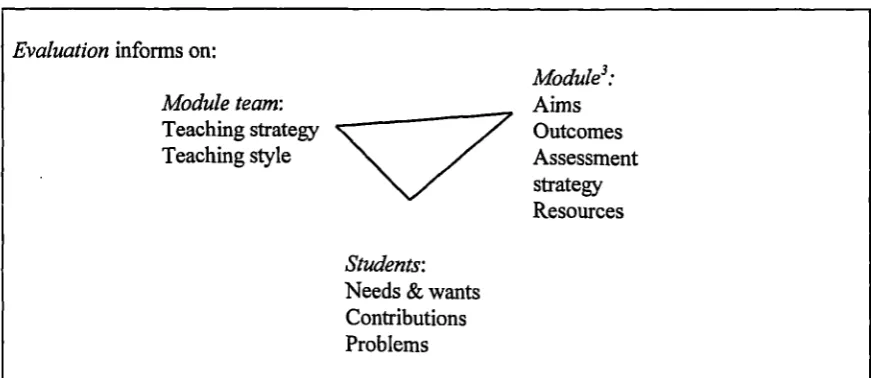
In addition to Legutke and Thomas' account, one might list a range of published
coursebooks, professional groups' inspection schemes, institutional programmes 4, or
individual teachers' approaches as programme theories within ELT. The experience
of evaluation in the field illustrates the diversity of conceptions of the components of
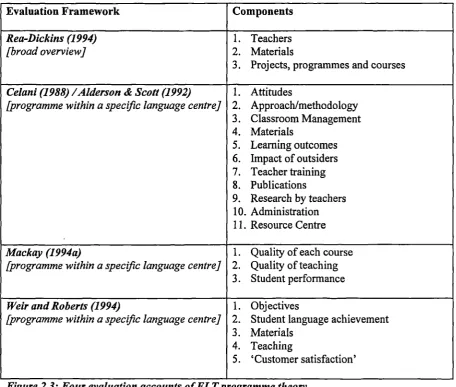
ELT programmes, as illustrated in Figure 2.3 below.
The first point about these conceptual frameworks is that they are designed for
evaluation purposes. Rea-Dickins, in a review article, is focussing on the components
of programmes that have been the focus of evaluations. In the case of the Brazilian
ESP project the framework represents a merging of what teachers and others might
consider as components of a programme's success, and what can be determined
through data. Mackay is elaborating an evaluation approach to on-going quality
management and assurance. In the case of Weir and Roberts, the conceptual
framework relates closely to calendar time, so that findings can be factored in to a
cycle of programme development. A common component to all is teachers! teaching/
classroom management, though from the other elements in each framework, it is clear
that there is no shared view of what teaching actually involves: how does teaching
relate to materials? how does it relate to learning outcomes? does it include tasks, or
are tasks within the category of materials? The discussion on classroom observation
in evaluation in ELT below looks more closely at how teaching is conceived of as a
Chapter 2
Evaluation Framework Components
Rea-Dickins (1994) 1. Teachers
[broad overview] 2. Materials
3. Projects, programmes and courses
Celani (1988) /Alderson & Scott (1992) 1. Attitudes
[programme within a spec j/Ic language centre] 2. Approach/methodology 3. Classroom Management 4. Materials
5. Learning outcomes 6. Impact of outsiders 7. Teacher training 8. Publications
9. Research by teachers 10. Administration 11. Resource Centre
Mackay (1994a) 1. Quality of each course
[programme within a specific language centre] 2. Quality of teaching 3. Student performance
Weir and Roberts (1994) 1. Objectives
[programme within a spec?flc language centre] 2. Student language achievement 3. Materials
4. Teaching
[image:39.595.59.516.90.477.2]5. 'Customer satisfaction'
Figure 2.3: Four evaluation accounts of ELTprogramme theory
The concept of programme is central to this study, and is investigated empirically as
an integral part of the task of researching programme evaluation. Chapter 5 explores
in detail what constitutes the programme evaluated. The next section looks more
closely at the practice of language programme evaluation in recent decades. The
starting point for this discussion is the evaluation of the Bangalore CTP project. The
four evaluation issues profiled by this evaluation are then traced through a range of
evaluations in the 1 980s and 1 990s. These are: the role of experimental design; the
measurement of outcomes; the description of the component parts of the programme;
One reason for the importance of the Bangalore evaluation to the development of
evaluation in the English Language Programme field is the extent to which the
evaluation issues have been documented by one of the evaluators - the discussion here
draws on Beretta (1986a; 1986b; 1986c; 1987; 1989a; 1989b; 1990a; 1992a; 1992b),
the related Applied Linguistics / ELT literature - Greenwood (1985); Brunifit (1984a;
1984b); Prabhu (1987), and the evaluation literature where the Bangalore evaluation
is considered in detail - Rea-Dickins and Germaine (1992), Weir and Roberts (1994),
and Lynch (1996).
2.6 The Bangalore evaluation and ELT evaluation research
The Bangalore project developed from a second language pedagogy theory elaborated
by Prabhu from theoretical work on language use, and a psycholinguistic account of
language learning. The key feature of this theory is that a second language would be
most successfully learnt through exchanging meanings, rather than through a focus on
grammatical forms. The teacher's role is to engage learners in the classroom in a
series of tasks which involve the expression in the target language of meanings
already clear through another medium - the classic example being the railway
timetable, a database from which a range of verifiable propositions can be articulated.
Classroom activities involve cognitive manipulations of the database, with a distinct
drilling structure, and interaction is teacher-learner only (lesson transcript
exemplifying this methodology is set out in Prabhu 1987).
This programme and its evaluation are important in ELT for a number of reasons:
. It was constructed round the idea of a complete teaching method (See Section 2.5
above), and thus was seen by curriculum theorists (Brumfit 1 984a) and
It involves the application in the classroom of a developed, mainstream body of
theory (Prabhu 1987), set in the mainstream psycholinguistic tradition of the study
of SLA;
It placed the notion of task at the centre of communicative language teaching, and
contributed to a sustained discussion on the nature of tasks for language learning;
It constitutes an example of implementation of task-based learning in ELT, in an
era when TBL is the subject of widespread inquiry and research (Candlin and
Murphy 1987: Nunan 1989b; Skehan 1996)
It was implemented at a point where there was a widespread sense of change in
English language teaching, based on a single set of methodological principles
(learning through communication) supported by developments in the theory of
communicative functions (pragmatics, speech act theory) in British Applied
Linguistics (Wilkins 1976; Widdowson 1978; Munby 1978) on the one hand, and
by developments in the theory of naturalistic second language learning in
American Applied Linguistics (Krashen 1982; Krashen and Terrell 1983);
It was supported by a prestigious sponsor in English language teaching - The
British Council, and through this support the project was visited by key people in
the development of theory and practice, which ensured a significant impact on
ELT conferences and publications.
An evaluation of the project was commissioned:
To assess through appropriate tests, whether there is any demonstrable difference in terms of attainment in English between classes of children who have been taught on the CTP and their peers who have received normal instruction in the respective schools.
The evaluation was carried out, using an experimental, comparative design, in the
final months of the project. The discussion below examines four aspects of the
evaluation approach, as evident from the responses to the evaluation, and from the
evaluation literature published in the following decades.
a) The role of experimental design
The experimental approach to evaluation of social programmes has long been seen as
the most objective, and ultimately permitting the most generalisable conclusions. In
ontological terms, the approach takes the view that social processes mirror processes
in the natural world - the agricultural-botany paradigm in Parlett and Hamilton's
seminal critique, which "utilises a hypthetico-deductive methodology derived from
the experimental and mental-testing traditions in psychology" (Parlett and Hamilton
1972:2). Once the variables in the programme to be evaluated have been described,
and a method for quantifying their effects has been elaborated, a comparative study
can proceed. This issue is important because it represents an orthodoxy in social
programme evaluation: it has a credibility which is important for those who
commission evaluations. The key implication for evaluations in ELT is the view that
one classroom can be considered the same as another, except for the specified
variables, which distinguish experimental from control classrooms. In the Bangalore
evaluation, the specified variable was method: experimental classrooms used the
task-based, procedural syllabus, while the control classrooms used conventional
grammar-based teaching methods and materials.
The Bangalore evaluation focussed on outcomes, with an assumption that the
outcomes relate to two different teaching methods: the evaluators sought a design
"which would be experimentally valid, [..with.. tests which would be equally fair to
both teaching methods" (Beretta and Davies 1985: 122). In their rationale for this
approach to the evaluation, Beretta and Davies acknowledge that previous method
The inconclusiveness of these studies does not mean that the research is a waste of time. The studies gradually revealed that the 'methods' are not clearly defmed entities that can be juxtaposed and compared. It would be a waste of time if that lesson had not been learnt.
Stem 1983: 71
Beretta later (1986a;1992b) acknowledges the lesson about methods:
results from such an inquiry [a testing comparison] would not be very helpful. They would neither indicate that a teaching method worked, nor even that the teaching approach existed.
Beretta 2992x264
Two major surveys of programme evaluation in ELT - (Beretta 1992a; Rea-Dickins
1994) consign the experimental approach to the archives. Alderson (1992) in
discussing the issue of experimental design concludes that while it may have a role in
research projects, it is not appropriate for evaluations in ELT5:
Although their aims were clearly evaluative in nature, their time span, the nature of the questions being asked and the resources invested in the projects make them appear less relevant to the sorts of evaluations that are typically commissioned.
Alderson 1992: 283
Pawson and Tilley's (1997) critique of experimental design has a clear ontological
basis: the outcomes of social interventions are never wholly predictable, and any
evaluation of a treatment which compares predicted outcomes is likely to provide
inconsistent results. The human response to a given situation is mediated by a number
of individual and contextual factors, and if these are not explored in the context of the
evaluation, the measures of predicted outcomes versus others are not very useful. It
amounts to a reliance on successionist rather than generative logic (1997:32), an
expectation that people behave in response to a social situation as predictably as
litmus paper responds to an acid or alkaline solution.
Harris defends the positivistic, experimental approach, particularly for evaluations