A Thesis Submitted for the Degree of PhD at the University of Warwick
Permanent WRAP URL:
http://wrap.warwick.ac.uk/109571
Copyright and reuse:
This thesis is made available online and is protected by original copyright.
Please scroll down to view the document itself.
Please refer to the repository record for this item for information to help you to cite it.
Our policy information is available from the repository home page.
T H E BRITISH LIBRARY
BRITISH THESIS SERVICE
COPYRIGHT
Reproduction of this thesis, other than as permitted under
the United Kingdom Copyright Designs and Patents Act
1988, or under specific agreement with the copyright
holder, is prohibited.
This copy has been supplied on the understanding that it
is copyright material and that no quotation from the thesis
may be published without proper acknowledgement.
REPRODUCTION QUALITY NOTICE
The quality of this reproduction is dependent upon the
quality of the original thesis. Whilst every effort has been
made to ensure the highest quality of reproduction, some
pages which contain small or poor printing may not
reproduce well.
Previously copyrighted material (journal articles, published
texts etc.) is not reproduced.
Trade Policy And General Equilibrium
Under Different Market Regimes
With Numerical Applications To Turkey
by
Roberto A. De Santis
M .Sc. (Warwick), Laurea (Bari)
A Thesis
Submitted for the Qualification of Doctor of Philosophy
Department of Economics
University of Warwick
Quando Io ebbi concluso quel corso di studi, al cui termine
si era accolti nel numero dei dotti, io cominciai a pensare in modo
del tutto opposto. Compresi infatti di trovarmi avviluppato in tanti
dubbi e tanti errori da arrivare a credere che tutto il mio impegno
per istruirm i non mi avesse dato altro vantaggio che quello di
farm i scoprire sempre piu ’ profondamente la mia ignoranza.
Summary
Table of Contents:
Sum m ary iii
A ck n o w le d g e m e n t viii
C hapter 1: Introduction and O utline 1
C hapter 2: W h y Exporting C ountries A gree to Voluntary Export
Restraints: T h e O lig o p o listic P ow er o f the Foreign S u p p lier 7
[2.1] Introduction 7
[2.2] A model with imperfect competition and identical firms 12
[2.2.1] Technology and cost function 13
[2.2.2] Numebr of firms 15
[2.2.3] Domestic and foreign demand functions 15
[2.2.4] Price mark-ups and firms’ perceived elasticities 17
[2.2.5] Rents and the supply price o f exports 20
[2.2.6] Representative household income 21
[2.3] Analytical results 21
[2.3.1 ] The impact on the export producer price and
the average cost 21
[2.3.2] The impact on the number o f firms 22
12.3.3] The impact on the price-cost margin 24
[2.3.5] The impact on the cost o f primary and intermediate inputs 26
[2.3.6] The impact on output and trade volume 27
[2.3.7] The impact on welfare 28
[2.4] An AGE model for Turkey 30
[2.4.1 ] Benchmark and calibration 31
[2.4.2] The elimination of VERs scenarios 37
[2.4.2.1] The impact on Turkish industry and
incumbent firms’ variables 37
[2.4.2.2] The impact on Turkey’s social welfare 42
[2.5] Conclusions 45
Chapter 3: O ptim al Export Tax, W elfare, Industry C oncentration and
Firm Size: A General Equilibrium A n alysis 47
[3.1] Introduction 47
[3.2] Optimal export tax and industry concentration 49
[3.3] A GE model with fixed (or sunk) costs and segmented markets 53
[3.3.1] Mark-up pricing 54
[3.3.2] Technology and number o f firms 54
[3.3.3] Domestic and foreign demand function 56
[3.3.4] Representative household income 57
|3 .4 | Analytical results 58
[3 .4 .1 1 The impact of RHK export tax on foreign demand elasticity
and industry concentration 58
13.4.2] The impact o f RHK export tax on firm size 60
[3.4.3] The impact on welfare 61
[3.5] Numerical results 63
[3.5.2] The benchmark data set 64
[3.5.3] Scenarios 65
[3.6] Conclusions 70
Chapter 4: T h e Im pact o f a C ustom s U n ion w ith the E U on T u rk ey’s
W elfare, E m p loym en t and In com e Distribution:
an A G E A n a ly sis 72
[4.1 ] Introduction 72
[4.2] Model Specification 77
[4.2.1 ] Technology and factor demand 78
[4.2.2] Treatment o f traded goods and foreign sector closure 79
[4.2.2.1] Imports 79
[4.2.2.2J Exports and VERs 80
[4.2.2.3] Foreign sector closure 82
[4.2.3] Households’ revenues and consumption 82
[4.2.3.1] Households’ revenues 82
[4.2.3.2] Households’ consumption 83
[4.2.4] Government revenues and expenditures 84
[4.2.5] Savings and investment decisions 84
[4.2.6] Welfare and inequality measures 85
[4.3] Features and properties o f the benchmark 87
[4.4] The revenue-neutral tariff reform scenarios 93
[4.5] Conclusions 105
A p p en d ices
Appendix 2. A: Price elasticities in Bertrand and Cournot 111
Appendix 2.B: Numerical model: the case o f VERs 117
Appendix 2.C: A Social Accounting Matrix for Turkey 124
Appendix 2.D: The GAM S code: the case o f VERs 149
Appendix 3. A: Numerical model: the case o f an export tax 165
Appendix 3.B: The GAM S code: the case o f an export tax 171
Appendix 3.C: Calibration o f the foreign demand elasticity 181
Appendix 4 .A: Numerical model: the CU agreement 183
Appendix 4.B: The measurement o f inequality 191
Appendix 4.C: The GAMS code: the CU agreement 193
Appendix 4.D: Results o f the sensitivity analysis 203
Acknowledgement
I am indebted to my thesis advisor John Whalley, not only for valuable suggestions, but
also for his ability in gently pressurising me, and in teaching me how to focus more
sharply on significant issues. 1 also thank my thesis advisor Jeffery Round for having
helped me in compiling the Social Accounting Matrix for Turkey, and for valuable
suggestions especially on the fourth chapter o f the thesis concerning income
distribution issues. In addition, I have benefited from comments and discussions with
David Collie, Norman Ireland, Gemot Klepper, Carlo Perroni and Alasdair Smith.
With regard to the compilation o f the SAM, I would like to thank Gazi Ozhan
for his collaboration, and the keen support from authorities and experts o f the State
Institute o f Statistics and the State Planning Organisation o f the Republic o f Turkey.
Financial support from World Bank regarding the SAM project, and the UK
Econom ic Social Research Council for my graduate studies, is gratefully
acknowledged.
I ow e a debt o f gratitude to Leslie Stratta for advising me, from time to time,
on matters o f English style.
Finally, I would like to thank my wife, Antonella, who has constantly helped
CHAPTER 1
Introduction and Outline
The aim o f this thesis is to analysis a set o f trade policy issues within a GE framework.
Although tariffs and quotas are often used as a source o f government revenues,
especially by developing countries, issues such as the econom ic impact o f optimal
export taxes and export quota have been relatively neglected by the contemporary
econom ic literature. In fact, the “new trade theory” and, to a certain extent, the
“strategic trade theory” concentrated their analysis on import tariffs and subsidies.1 For
example, in a seminal paper by Krugman (1979), he argues that there are mutual gains
from trade as, by enlarging markets, international trade w ould allow both a greater
variety o f goods and a greater scale o f production.2 Whereas, in a strategic duopoly
Cournot game, Brander and Spencer (1985) show that governments could enhance the
welfare o f their nations by subsidising the exporting firm. In contrast, Eaton and
Grossman (1986) find that the Brander-Spencer policy conclusion would be the
1 The “new trade theory” began with models facing imperfect competition and increasing returns to scale. Alongside the gains from trade due to the conventional comparative advantage, several authors argue that, by enlarging markets, international trade raises competition and allows greater exploitation of economies of scale (Krugman, 1979, 1981; Lancaster, 1980; Dixit and Norman, 1980; Helpman, 1981; Ethier, 1982). The “strategic trade theory” began with work by Brander and Spencer (1983, 1985), where they argue that governments could raise national incomes at other countries' expense by suppoiting national firms in international competition.
opposite, if the domestic firm and the foreign firm behave in a Bertrand fashion. In this
case, they argue that an export tax is required for the profit-shifting m otive to exist.
However, if domestic consumption is introduced in this modelling framework, the
impact o f an export tax on welfare is no longer unambiguous, depending upon the
precise forms o f the demand and cost functions (Eaton and Grossman, 1986). It must
be stressed that the analyses o f Brander-Spencer and Eaton-Grossman focused only on
the profit-shifting motive, and neglected the effects o f trade policies on terms o f trade
(Rodrik, 1989). In addition, their analyses are based upon a strategic game among two
firms, the domestic firm and the foreign firm. By so doing, they exclude a priori the
effects o f trade policies on the degree o f competition among domestic firms and on
firms’ domestic production.
Similarly, Harris (1985) and Krishna (1989) use a duopoly model with Bertrand
competition and differentiated products to show that a VER induces the domestic firm
o f the importing country to becom e an industry price leader, and therefore obtain the
profits o f a Stackelberg leader, as the foreign firm makes the credible commitment that
it w ill not increase the level o f exports when the dom estic firm increases its price.
Hence, the imposition o f a VER at or close to the free trade level increases prices and
profits to both the domestic and the foreign firms. However, their models examine the
VER effects on an importing economy and limit the analysis o f the exporting country
simply to the firm’s profits.
I examine the impact o f export quota (Chapter 2) and optimal export taxes
(Chapter 3) in a GE setting when firms produce for the export market as w ell as for the
domestic market. Three key assumptions are postulated: (i) imperfect competition and
increasing returns to scale; (ii) trade policies have a direct influence on firm s’ domestic
production decisions; (iii) foreign trade is all intraindustry. If the first assumption has
been adopted in order to derive the number o f firms in equilibrium, the second
assumption has been introduced in order to analyse VERs in a context o f a strategic
segmented (Chapter 3). The third assumption has been required in order to distinguish
the price vector o f domestic goods from the price vectors o f exports and imports.
Within this modelling framework, I examine the economic impact o f export taxes,
which are believed to be optimal in a PE framework, and export quotas in the form o f
VER agreements, the former under the assumption o f constant conjectures, the latter
under both Cournot and Bertrand competition. It is important to stress that Eaton and
Grossman (1986) show that the form o f optimal trade policies depends critically on the
nature o f the competition between firms; whereas Venables (1994), by using a
numerical multi-regional PE model, shows that the impact o f trade policies is not
significantly important to the different equilibrium concepts employed.
Given the complexity o f the GE analysis, under the assumptions that markets
are segmented, technology exhibits internal economies o f scale, and trade is
intraindustry, I also employ numerical GE models to verify if the qualitative effects
lead to quantitative aspects o f significant magnitude; and if the analytical ambiguity o f
the policy effects on som e o f the variables, such as welfare and firm size, can be
numerically resolved. The empirical analysis has been applied to Turkey firstly, because
it is a middle income developing country, which periodically renews VER agreements
on textiles and apparel with the EU (GATT, 1994) and within the Multifibrc
Arrangement (MFA) scheme; secondly, because o f a long tradition o f planning, the
State Institute o f Statistics o f Turkey periodically estimates reliable Input-Output
tables for the nation as a whole, which are a fundamental data set for the compilation
o f a benchmark needed for the calibration o f Applied General Equilibrium (AGE)
models.1
A third issue, which is a hot topic among economists and policy-makers, has
been examined: that is, the impact o f regional agreements on income distribution and 3
employment. Given the complexity o f the GE analysis in a multi-household, multi
labour, multi-sectoral framework, I follow the traditional computational GE
methodology to numerically quantify the economic impact o f the recent CU agreement
between Turkey and the European Union (EU) on income distribution and employment
in Turkey. The technique employed follows the Arrow-Debreu G E framework,
elaborated in Arrow and Hahn (1971), where each consumer has an initial endowment
and a set o f preferences; producers maximise profits with constant returns to scale
technology; and where the standard features o f excess demand functions (i.e.
continuity, non-negativity and homogeneity o f degree zero) and the Walras law (i.e.
total value o f all expenditures o f households and firms is equal to total sales) apply.
It is vital to stress that both the analytical models in Chapter 2 and Chapter 3,
and the three AGE models in the three chapters, are static single country open
econom y models, where dynamic features and retaliation issues are neglected.
The motivation behind each o f these studies is simple. The first model is
motivated by the fact that a clear answer is still not given as to why small exporting
countries agree to voluntary restrain their exports. It is generally accepted that
exporting countries receive quota rents, and they are fearful about other forms o f
protection by the competing importing country (Rosendorff, 1996). However, this
argument cannot explain the MFA scheme, where a large number o f small exporting
countries periodically renew the level o f export quotas for each individual country. In
addition, numerical results based on multircgional AGE models indicate that several
developing countries suffer welfare losses from the MFA scheme (Trela and Whalley,
1990; Francois, el al., 1995; Yang, et al., 1997). I show that incumbent firms keep
renewing VERs agreements because these arc an instrument to protect these firms
from domestic competition, and therefore to protect their monopoly power in both
domestic and export markets. In addition, the numerical findings indicate that, as a
m odest welfare loss under both quantity setting and price setting oligopolies, and this
loss is larger, the smaller the country.
The second model concerns export taxes. The standard PE literature with
imperfect competition (Rodrik, 1989; Helpman and Krugman, 1989; RHK,
henceforth) argues that a positive optimal export tax policy can be pursued. However,
the estimated optimum tax rates are generally very high, normally around 30-40%.
P olicy suggestions o f this kind are obviously not w elcom e among policy-makers and
industry associations. In addition, export taxes are not typically adopted to raise the
welfare o f a nation. I show that the RHK export tax in a GE framework has an
ambiguous impact on welfare and that the Rodrik’s formula is upwardly biased.
Numerical estimates for Turkey indicate that the introduction o f the RHK export tax
leads to a social welfare loss, which is much larger if part o f firms’ costs is sunk.
The third model has been constmcted to analyse the impact o f the recent CU
agreement between Turkey and the EU on income distribution and employment in
Turkey.4 Trade and income distribution, and trade and employment are now two hot
topics among trade theorists (Krugman, 1995, 1997; Wood, 1994)). Thus, 1 build a
multi-household model to quantify the impact o f this regional policy on income
distribution and employment in Turkey, by employing two alternative assumptions on
real wages, one fixed and one flexible, as also suggested by Krugman (1995). The
numerical results indicate that despite the validity o f the Stolper-Samuelson theorem,
overall income inequality rises in the scenario with fixed wages, suggesting that an
analysis based only on the functional distribution o f income and under the assumption
o f flexible wages might be misleading. In addition, the computed estim ates indicate
that 148000 new jobs would be created, as a result o f the CU.
The thesis consists o f five chapters in all. Chapter 1 introduces the general aim
o f the thesis. Chapter 2 studies the econom ic implications o f the elimination o f a VER
for an exporting country. Chapter 3 examines the economic implications o f what is
believed to be a PE optimal export tax in a GE framework. Chapter 4 analysis the
econom ic implications, the income distribution effects, and the impact on employment
o f the 1996 CU agreement between Turkey and the EU, applying a multi-household,
multi-labour GE model to the Turkish economy, and Chapter 5 provides a summary,
som e conclusions and the perspectives for future research. The appendices related to
CHAPTER 2
Why Exporting Countries Agree to Voluntary Export Restraints:
The Oligopolistic Power of the Foreign Supplier
[2.1] Introduction
The econom ic literature on VERs was developed in the eighties, when such
agreements started to be used internationally as an instrument to protect the domestic
econom y from international competition, without breaking the GATT rules. The
standard analysis o f a VER, in the context o f perfectly competitive markets, identifies
three effects: the higher price paid by consumers o f the importing country, the transfer
o f rents associated with artificially high prices from the importing to the exporting
country, and the lower supply price for exports, as the marginal revenue product
decreases.5 It can be shown that the global welfare loss for a two-country econom y as
a whole is represented by the loss in the consumer surplus faced by the importing
country, plus the loss in the producer surplus faced by the exporting country. In an
imperfectly competitive market Harris (1985), Krishna (1989) and Rosendorff (1996)
show that a further effect arises since quantitative restrictions may increase the market
power o f some firms. However, their models examine the VER effects on an importing
econom y and limit the analysis o f the exporting country simply to the firm’s profits.
Harris (1985) and Krishna (1989) use a duopoly model with Bertrand competition and
differentiated products in a partial equilibrium setting to show that a VER induces the
domestic firm o f the importing country to become an industry price leader (assumed in
Harris, but derived endogenously by Krishna), and therefore obtain the profits o f a
Stackelberg leader, as the foreign firm makes the credible commitment that it will not
increase the level o f exports when the domestic firm increases its price. Hence, the
imposition o f a VER at or close to the free trade level increases prices and profits to
both the domestic and the foreign firms.6 Roscndorff claims that an exporting country
agrees a VER for fear o f antidumping actions or other forms o f administered
protection by the importing country.7 Su/.umura and Ishikawa (1997) extend the
Harris’s result to the welfare implications o f a VER. They show that, whether the
duopolists com pete in prices or quantities, a VER set equal to the free-trade level o f
exports enhances the welfare o f the importing country if, and only if, it reduces the
profits o f the exporting firm. Kemp, et al. (1997) show that the Su/.umura-Ishikawa
proposition survives in a general equilibrium setting if, and only if, the two goods arc
substitutes, the ow n price elasticities are larger than the cross price elasticities, and the
price effects outweigh the incom e effects o f the trade policy.
Most o f the literature on VERs focuses upon the effect o f a VER on an
importing econom y. The implication for an exporting country have been mainly
analysed with empirical models, de Melo and Winters (1993), for example, argue that
with a VER the contraction in the restrained industry is associated with spillovers o f
exports to unrestricted markets.8 Applying a partial equilibrium econometric model to
the Taiwan footwear industry, they also found that this country suffered a welfare loss
as a consequence o f a VER. Trela and Whalley (1990) report estimates o f national and
global welfare costs o f both developed country tariffs and bilateral quotas on textiles
and apparel using an AGE model with constant returns to scale. When bilateral quotas
alone are removed, results clearly show that the developed countries and the vast
majority o f developing countries gain. Based on 1986 data, the total gain has been
estimated to be o f around $ 22 billion. On aggregate, developing countries gain around
$ 3 billion.9 Similar results for developing countries are found by Yang (1994) and
Yang, eta l. (1997).
Francois, et al. (1995), by using various types o f multiregional AGE models
characterised by perfect competition, or imperfect competition, or endogenous capital
stock, found that the elimination o f the MFA would result in welfare gains for most o f
developing countries, and for developing countries as a whole."’ In contrast, Harrison,
et al. (1997), by using a similar modelling approach, found that the elimination o f the
MFA would result in welfare gains for few countries, and in losses for developing
countries as a whole. They argue that this aggregate welfare loss is due to the transfer
o f MFA quota rents from developing to industrialised countries. Only in the long run,
after capital stock has optimally adjusted, do they estimate an aggregate welfare gain
for developing countries as a whole. Similar results have been also obtained by Hertcl, *
* However, in a previous study, by investigating the effects of VERs on resource allocation in the Korean leather footwear industry, de Melo and Winters (1990) estimate that die reduction of the industry size is mainly due to the difficulty of switching sales towards markets which are not constrained by VERs.
9 In a subsequent study, Trela and Whalley (1995) focus their attention upon the extra costs on exporting countries of their own internal quota-allocation procedures. Since quotas are typically alhxaitcd to established rather than new and more efficient firms, the cost of quota restriction in their model is estimated to be $ 23 billion per year compared to the $ 3 billion without internal quota- allocation schemes.
et al. (1995). These empirical findings support the dominant view that several
exporting countries, especially small countries, are forced, rather than agree
voluntarily, to export restraints.
This paper explores the economic effects o f a VER on a foreign supplier when
the VER also modifies the degree o f competition in the exporting country’s domestic
market, under both Bertrand and Cournot conjectures. 1 show that the elimination o f a
VER certainly leads to a more efficient allocation o f resources, favouring the
expansion o f the previously restrained industry. However, the elimination o f an export
quota causes an increase in the producer price o f exports, w hich brings about a rise in
the com posite producer price. The export expansion and the higher average cost allow
less efficient firms to break even. As the number o f the com peting symmetric firms
within the industry increases, the firms’ perceived elasticity o f export demand rises.
As a result, the power o f incumbent firms declines regardless o f the firms’
conjectures. However, the smaller the country, the larger the possibility that the
monopoly power in the domestic market declines more than in the export market.
With regard to the impact on firm size, it positively depends upon the size o f export
growth for the industry as a whole, and on the impact on firm s’ domestic production,
and negatively on the extent o f new entry.
From the social point o f view , I show that the elim ination o f a VER has two
positive, two negative and two indeterminate effects on the welfare o f the exporting
country. The positive effects are due to the increase in the producer price o f exports,
as foreign consumers are more sensitive to price changes, rather than to quota
premium variation (export producer price effect);11 and to increased product diversity,
as domestic brands enter in pursuit o f positive profits (variety effect). The negative
effects on welfare are due to the loss o f the economic rent (ren t loss effect), and the
greater cost o f purchasing intermediate inputs (increased intermediate inputs cost
effect). In fact, I show that the impact on the costs o f intermediate inputs might be
substantial and might be larger than the rise in the producer price o f exports. The
impact on the consumer price index (consumer price effect) and on total production
(global efficiency effect) cannot b e classified. Thus, the welfare implications o f VERs
on an exporting economy are analytically indeterminate.
In order to comprehend the significance o f the analytical results, to understand
better the uncertain outcome on welfare and firm size, and to examine how sensitive
the results are to alternative equilibrium concepts, an AGE model with the restrained
sectors facing increasing returns to scale, identical firms, and free entry/exit has been
built. This model studies the m ain effects o f the elimination o f VERs on welfare,
output, resource allocation, average cost, firm size, concentration o f the industry and
price cost margin, under both Bertrand and Cournot conjectures. The model has been
applied to the Turkish textiles and apparel industries, which have been subject to
VERs in relation to the European market since 1982 for textiles and 1986 for apparel,
and since then periodically renewed and now broken as a consequence o f the recent
customs union agreement (G ATT, 1994). The numerical results clearly indicate that
regardless o f market conjectures, as a consequence o f the elimination o f VERs, the
contraction o f industry concentration is substantial, whilst it is modest regarding the
negative impact on price cost margins. In addition, it supports the hypothesis that the
negative welfare effects dominate the positive effects with trade, thus decreasing the
aggregate welfare o f a nation, although by a small amount. It also confirms the
analytical result that the sm aller the country the larger the negative econom ic
implications o f the abrogation o f VERs for incumbent firms. Similarly, there is a
larger welfare loss for the nation as a whole. The quantitative results are less sensitive
to equilibrium concepts. H ow ever, incumbent firms would be worse o f f in terms o f
new entry, size and average co st under Bertrand conjectures, as they are inherently
policy-makers o f exporting countries, reach agreements about VERs for rational
econom ic reasons.
[2.2) A model with imperfect competition and symmetric firms
A V E R is an entry barrier in the market for exports. It favours the concentration o f the
industry, and allows established firms, especially those which receive the export
licence, to better exploit econom ies o f scale by producing at lower average cost. Since
the break-even price for potential entrants is the average cost, a VER can also be
regarded as an effective entry barrier in the domestic market. Thus, the voluntary
acceptance o f export restraints not only generates forms o f oligopoly in the market for
exports, but also m odifies the degree o f competition in the foreign supplier’s domestic
market. I model the oligopolistic behaviour o f firms as a noncooperative game, where
the stable solution is represented by a Nash equilibrium in prices or quantities. To
justify that, it can be argued that a VER may facilitate the learning process o f each
established firm with regard to the reaction functions o f other competing firms, such
that each incumbent firm chooses the amount o f output (exported and sold in the
dom estic market) in order to maximise its ow n profit, given the output or the price
choice o f other competing firms. So a VER may serve as an institution to protect an
established domestic oligopoly o f an exporting country, which behaves in a Cournot
or Bertrand fashion.
The model presented in this section is an intraindustry GE model with
increasing returns to scale, segmented markets and symmetric firms used to study the
impact o f the elimination o f a VER on the average cost, the number o f firms, firm
size, industrial output, price cost margin and welfare, under both Bertrand and
Cournot conjectures. I also assume the existence o f sectors not subject to VERs,
indexed with crs, w hilst the sectors subject to VERs are indexed with i. To represent
all sectors o f the econom y, I use j = i u c r s .
To model domestic and foreign trade, I assume that each firm in sector i and
each industry crs em ploy factors and intermediate inputs to produce two imperfect
substitute goods, one sold in the domestic market and the other exported. The
representative consumer gains utility from the consumption o f domestic goods
produced by the industry crs and their imperfect substitute imports, and from the
consumption o f a variety o f domestic goods produced by the sectors o f differentiated
products and a variety o f imperfect substitute imports. A lso the sectoral intermediate
demand, which is defined as a Leontief specification o f sectoral output, is satisfied
with the supply o f domestic goods and imports.
(2.2.1) Technology and cost function
The production function o f a single representative firm, © , is additively separable in
<!>, and <t>2 , and such that 3 20/(5<I>ld<I)2) > 0 :
(
2
.1
)y,
=©[«!», (*„ ),0 2
(/„ *,)]= 0 i f /, < l[ or k, < k [
where y, represents com posite production o f dom estic goods and exports; x Jt denote
intermediate inputs, assumed to be net complements; /, and k, represent labour and
capital inputs; and i f and k f the fixed factor inputs needed to start the production
process. Due to the presence o f fixed setup costs, the production sets are not-convex.
I II
<1>2 is locally assumed to be twice differentiable, so that <1> 2 > 0 and <t2 < 0 .
The production possibility frontier o f each firm is represented by
which locally is a separable, differentiable transformation curve o f domestic goods (d: )
and exports ( e ,). The transformation curve is locally assumed to be twice differentiable
•t «•
with respect to dt and e ,, such that i2 (di) < 0 and Q (e ,) < 0 .
The fixed factor inputs, i f and k f , multiplied by their respective returns,
determine the firm’s fixed cost. It is important to emphasise the benefits for each firm
o f raising production, as each firm would bear a reduced fixed cost element per unit o f
output. The total cost faced by each firm is the sum o f variable and fixed costs, hence
the average cost ( aci ) to produce one unit o f output is
where pj denotes the price vector o f final and intermediate goods. The factor demands
o f each firm and the marginal cost equation can be derived by solving a standard dual
problem. The marginal cost is independent o f output, and is a function o f factor prices
and sector specific parameters.
The production function and the transformation curve for sectors facing perfect
competition and constant returns to scale take respectively the following form:
where Ycrs denotes com posite output, Dcr, domestic output, Ec„ exports, Lcrs labour,
and Kc„ capital for the industry as a whole. 0 " ' is globally linear homogenous,
additively separable in and <t>2r', and such that 3 20 rr'/(d<t>"'d<t>',” ) > 0 . <t>™ is
twice differentiable. Q e" is globally linear homogenous, separable, differentiable and
concave. (2.3)
(2.4)
12.2.2] Number o f firm s
The model is characterised by free entry/exit. One key feature o f the model is the
definition of the profit function:
(2.6) K, = pd,d, + pe,e, - c,(d, + e i) - f ,
where it, denotes pure profits net o f rents from VERs, pd, the domestic price, pet
the producer price o f exports, c, the marginal cost and f the fixed cost. It does not
include rents from VERs, because entry in the export market is restricted to those
owning the licence to export. So economic rents can be still made by firms with the
licence to export. In summary, the number o f firms is endogenously determined by the
zero profit condition: = 0 .
[2.2.3] Domestic and foreign demand functions
Armington (1969) argues that goods produced by industries located in different
countries, but which compete in the same market, are imperfect substitute. The
Armington specification is typically a CES function o f domestically produced goods
and imports. Thus approach is very useful to derive the demand for domestic goods
(Di ) and the demand for imports ( A f,) by solving the Armington-dual problem:
(2.7) D,=<p,E'M ' V ' G ,
(2.8) Af, = (1 - < P ,) “' p w m ? 1 p-‘ Qt,
(2.9) Q , = f { H R , Pi ) + X,
where Q, is the sum in quantities o f final demand ( / ) and intermediate demand ( X, ),
HR denotes the representative consumer income, p w m t the fixed world price o f
substitution between imports and domestic goods, p, = [c ppd) '■ '*,
X, - 2 ^ apY, ■ (2.9) is the equilibrium condition in the goods market. The Marshallian j
demand functions, / , are derived by solving a three stages utility maximisation
problem, with the representative consumer lacing a convex indifference curve a la
Dixit-Stiglitz (Dixit and Stiglitz, 1977). In the first stage, consumers allocate income
between goods which are produced by the differentiated industries; in the second
stage, they allocate incom e between imports and domestic competing goods; and, in
the third stage, they allocate income between the differentiated domestic products and
the differentiated imports.
An oligopolistic profit maximising firm is characterised by a decreasing
marginal revenue curve in the domestic market as well as in the market for exports.
This implies that domestic demand and export demand ought to he downward sloping.
The solution o f the Armington-dual problem leads to the desired downward sloping
domestic demand curve |s e e (2.7)], whilst the industry export demand function ( £ , ) is
assumed negative and iso-elastic;
(2.10) E, = AiPwe~% ,
where pwe, is the price paid by foreign consumers for goods under VER, T), the
absolute value o f the foreign price elasticity and A, a positive constant.
The Armington specification and an infinitely elastic export demand function
are postulated for sectors facing perfect competition and constant returns to scale. 12
/2.2.41 Price mark-ups and firm s' perceived elasticities
The fact that the domestic market and the export market are segmented implies that
firms maximise (2.6) with respect to both dt and e ,. The profit maximising conditions
result in the Lemer mark-ups formula:
where X, and 8, represent the firm’s perceived price elasticities o f domestic demand
and export demand, respectively.
x, can be derived by considering the consumer three-stage budgeting
procedure. To derive 8 ,, I also assume that a hypothetical foreign consumer purchases
different brands o f the industry under VER.
In the third stage o f the budgeting procedure, the representative domestic
consumer maximises the following subutility function subject to the budget devoted to
the purchase o f domestic goods:
where , which is greater than one, is the elasticity o f substitution among n domestic
varieties; are demand parameters describing the consumer preferences for a brand s
represents the price index (or unit expenditure function).
Similarly, the foreign consumer in the purchase o f brands subject to a VER
faces the following problem
(2.11) p d t 1 - —r - C,,1 k
(2.12)
n
"*«\Ei = Z^y„ *<•
«is 4=1
•lMlH)
where , which is greater than one, is the elasticity o f substitution among n exported
brands; Y„ are demand parameters describing the preferences o f the foreign consumer
for a brand s exported by sector i, e„ ; pwe^ denote their price, and
Utihty maximisation implies that the demand for product varieties is a negative
function o f the price o f the varieties and a positive function o f the aggregate price
index. In fact, the first order conditions yield:
As a result, (2.10) and (2.14) imply that > T),.
As already described in section [2.2.3], domestic demand and export demand
have different characteristics. Domestic demand is derived by solving a dual problem,
whilst export demand is assumed to be iso-elastic. So two different approaches have
been employed to derive x, and 8, under both Cournot and Bertrand competition, x,
has been obtained following Harrison, et al. (1994), who in their model employ the
Armington specification;13 whereas 8, has been obtained following Smith and
Venables (1988), where a iso-elastic demand function is postulated. Under both
Bertrand and Cournot conjectures, the profit maximising conditions take the form o f
(2.11) and (2.12). However, if firms maximise profits given rivals’ prices (i.e. Bertrand
competition), then X( and 8, take the form,
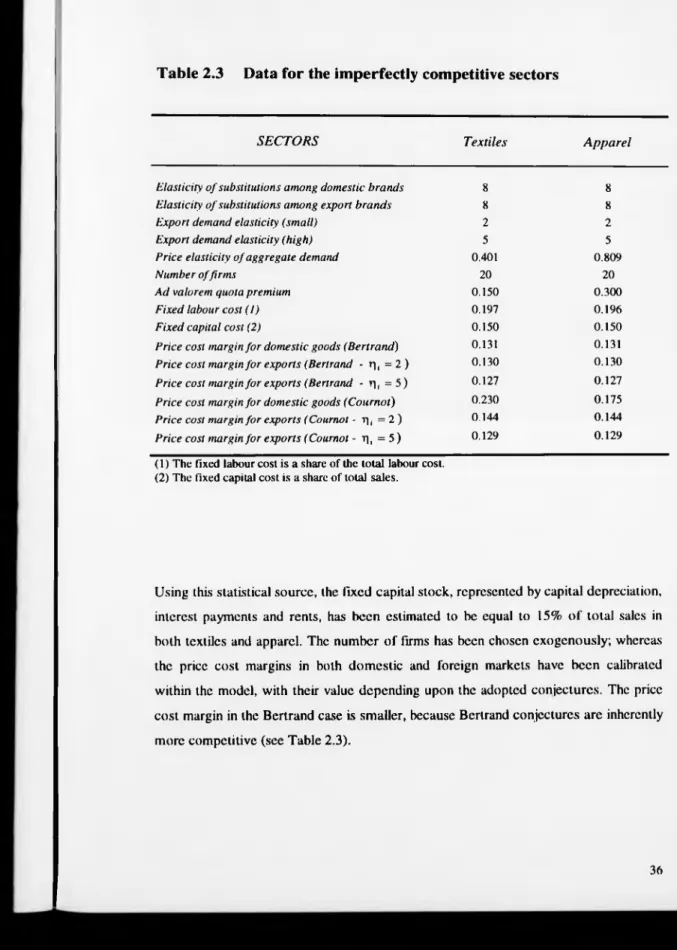
13 Harrison, et al. (1994) derive the price elasticity of demand under Cournot conjectures and under the assumption that the price elasticity of aggregate demand (%,) is unity, whilst I assume that x, is endogenously specified. The Bertrand formula is my derivation.
n
~ ~ (!-£,) 'pwe, = pweh is the price o f the aggregate, £ ,.
4=1
(2.13) dis = P > A M 1 pd« 4' >
change. Whereas the direction o f the change o f the variables would remain
substantially similar.15
[2.2.51 Rents and the supply price o f exports
The policy experiment performed in this study is the evaluation o f the impact o f the
elimination o f a VER, when rents accrue to firms. So I assume that the industry
associations o f an exporting country already agreed with an importing country to
restrain their level o f exports. This implies that the government does not intervene in
allocating export licenses and is not the recipient o f the rents. The rents accrue to the
private sector, and each firm receives a rent (ver;) which is equal to the ad valorem
quota premium parameter (qr, ) times exports, evaluated at pe, \
(2.19) verj = q ^ p e ^ j
The producer price o f exports (p e, ) is equal to the agreed price adjusted by
qr,:
(2.20) pe, = pwe>
1 + '
As I am interested in examining the econom ic implications o f the elimination o f
VERs, qr{ is assumed to be exogenous. When qr, is zero, the rent disappears and
pe, = p w e,.
¡2.2.6] Representative household income
The sources o f household income are value added, pure profits, plus the economic
rents which originate from sales on foreign markets:
where the first term represents the value added, that is the value o f production minus
the c o s t o f intermediate inputs. In order to study the impact o f VERs alone, it is
assumed free entry/exit, so that the number o f firms adjusts until pure profits are zero.
[2.3] Analytical results
¡2.3.1 ] The impact on the export producer price and the average cost
If the VER agreement is broken and the country can have an impact on its terms of
trade, the immediate effect is a lower level o f pwe, and an increase o f the demand for
exports (2.10). However, the producer price o f exports rises if foreign consumers are
more sensitive to price changes, rather than to ad valorem quota premium variation. In
fact, b y using (2.10) and (2.20), p e { can be written as
Since consumers are more sensitive to changes o f prices gross o f equivalent taxes,
rather than to the variation o f the equivalent tax rate itself, I argue that the elimination
(2.21)
(
2
.22
) p e ^ A ^ E ^ i l + qn)'1.By differentiating the latter expression with respect to qrt, then
(2.23)
o f a VER raises the producer price o f exports. Obviously, the smaller the country (that
is the larger rj, ), the greater the negative impact on p e ,. In summary, pe, under free
trade is greater than its value under VER, but smaller than pwe, under VER.
The composite producer price (p y, ) is equal to
(2.24) py, = ^ - p d , + ^ - p e ,.
Since qr; has a secondary impact on pd, and D,, then also py, rises as a consequence
o f the VER abrogation. Given the zero profit condition, then, dac, /dqr, < 0 . In
summary:
PROPOSITION 2.1: The elimination o f a VER increases the producer price o f
exports. The liberalisation process is thus associated with a rise in the average cost,
which is larger, the smaller the country.
[2.3.2] The impact on the number o f firm s
The profit maximisation conditions can be also written as:
(2.25) +
(2.26) p e , [ l - ( l + X,X",Tl, ) ’ l ] = c ,,
where to, is the absolute value o f the price elasticity o f domestic demand and X, the
firm s’ conjectural variation parameter, which for sim plicity is assumed to be equal in
both markets.16 By multiplying (2.25) by D, and (2.26) by E, , and rearranging, the
zero profit condition and the assumption that the marginal cost is independent o f
output yield
(2.27) [ l + A., pd,D, ! p et£ , j |
i ft . *1, J]
1/2
The reduced form for n, is very simple to interpret. Firstly, an expansion o f
domestic sales or export sales invites entry; secondly, markets, which are characterised
by a greater price elasticity, fear more competition, than those characterised by a
smaller price elasticity; thirdly, the larger the fixed cost to produce one unit o f output,
the smaller the number o f firms in equilibrium; finally, markets, which are characterised
by a lower degree o f competition (i.e. a larger ~k, ), allow a larger number o f firms in
equilibrium, which cooperate to a certain extent.
The total differential o f (2.27) with respect to qr: yields
(2.28) i f
f
pd,D, ^
pe,E,
f 1d(pd,D
¡)pd,D, dm,
1d(pe,E,
)2
[l+ k,ta,
t|, J CO ,dqr,
CO,2dqr
; T | ,dqr\
Given the secondary impact o f qr, on the variables related to domestic production and
domestic consumption, the elimination o f a VER, by raising export sales, determines
the entry o f new firms: d n jd q r, < 0 . So,
PROPOSITION 2.2: The elimination o f a VER raises the number o f fir m s in
equilibrium.
It Is important to stress that markets characterised by an infinite demand elasticity do
not determine the number o f firms in equilibrium. This feature is important to explain
the empirical finding in section [2.4.2.1], where a third unrestricted export market is
/2 .3 .3 ] T h e im p a c t o n th e p r ic e - c o s t m a rg in
(2.16) and (2.18) clearly show that, with the elimination of a VER, as the number of
firms rises, each producer faces a more elastic export demand curve, under both
Cournot and Bertrand competition. This implies that with the elimination o f a VER,
the price cost margin in the export market declines. In contrast, the impact on z, also
depends upon the impact on T, and Xt- However, by differentiating (2.15 ) -( 2 .18) by
qr, , the incumbent firms’ power in the domestic market would also fall, and at a larger
rate than the drop in the export market, if
(2.29) / X, - e , \ d*¥, +, dy,
dqr, dqrt J> (Ç, - h
under Bertrand conjectures, and if
J__ lW , T,
dXi]
-tli)
dn,Xt
ejctyr,
x i dqr,J
dqr,under Cournot conjectures. It is clear that, given the curvature o f the foreign
consumer’s preferences ), the smaller the country (that is, the larger rj, ) the greater
the possibility that the price cost margin would fall more in the domestic market as a
result o f a VER abrogation. (2.30)
Ç i e i
r j ___l ì dnl
Ixi E J dqr, ni
PROPOSITION 2.3: The elimination o f a VER leads to a fa ll o f incumbent firm s’
monopoly power in the export market. The im pact on the monopoly pow er in the
domestic market is ambiguous. However, the sm aller the country, the greater the
possibility that the price cost margin would decline more in the domestic market than
[ 2 . 3 .4 ] The im p a c t o n f i r m s iz e
The impact on firm siz e is ambiguous. Since d Y Jd q r; = y,(d n ,/d q r,) + n ,(d y,/d q r,),
where Y, = nly l; and since, by aggregating firm s’ domestic output and exports, the
total derivative o f production for the industry as a w hole with respect to qr: is
dYJdqr, = Q l)(d D fid q rl ) + £ lk (d E Jd q rl ) , w here Q.,, and S2( respectively denote
the partial derivative o f composite production with respect to domestic output and
exports for the industry as a whole, the latter tw o expressions can be rearranged as
. . . dy, Qf dE, 1 / _ , \ d n , _ dd,
(2.31) - 7 ^ = —~ - T ^--- ( y ,- £ 2 D4 ) - ^ + £2D—
dqr, n, dqr; n, dqr; dqr;
With the elimination o f the quota premium, the first term represents the positive
impact o f an export expansion for the industry as a whole. The second term denotes
the negative impact o f returns to scale, as a larger number o f firms results in the less
efficient exploitation o f fixed inputs (note that £2„d, < y ,, i f 0 ^ < 1, where 0 W
denotes the elasticity o f composite production with respect to domestic output.).17
Finally, the third term denotes the capability o f firms to sell in the domestic market
after new entry has occurred. I expect it to b e negative, since given the domestic
demand, a larger number o f firms implies a fall in per firm domestic production.
Hence, despite the benefits from export expansion, the size o f incumbent firms might
not expand.
PROPOSITION 2.4: The elimination o f a VER raises the size o f incumbent firm s i f
and only if, export expansion outweighs the negative effects o f both inefficiently
exploiting economies o f scale and o f trading in the domestic market.
On the basis o f the results on average cost, number o f firms, price cost margin
and firm size, w hich are summarised by the first four propositions, incumbent firms
w ill lobby the government or industry associations to keep signing VERs
agreements.18
[2.3.5] The impact on the cost o f primary and intermediate inputs
The lower price cost margin in the export market is obtainable only if the marginal
cost increase is larger than the rise in the producer price o f exports (2.12). Since the
model assumes the factor inputs to be homogenous among sectors, the impact on
factor returns should not be large. This implies that the rise in the marginal cost is
mainly due to the substantial rise in the intermediate inputs costs. This finding is very
important when I w ill analyse the VER implication on welfare in section [2.3.7].
PROPOSITION 2.5: The elimination o f a VER raises slightly the cost o f primary
factor inputs, and substantially the cost o f intermediate inputs. The intermediate
inputs cost rise m ight be larger than the rise in the export producer price.
To prove Proposition 2.5, it is necessary to subgroup the marginal cost into
two components: the marginal cost related to the primary factor inputs ( v ,) and the
marginal cost related to intermediate inputs ( in t,). Rearranging (2.10),
(2.32) v( + int, = pei {l - 1/|6( | } .
From Proposition 2.6, d Y J d q r ,< 0, which im plies that dLJdqr: < 0 and
d K Jd q r; < 0 , where L, = « ,/,, and K, = n,k,. Consequently, d v jd q r , < 0 . By using
the chain rule, d b jd q r , < (d b jd n , \d n , /dqr, ) . Since d n jd q r; < 0 (from Proposition
2.2) and d&Jdn, < 0 , then d b ,/d q r,> 0 . The latter finding, plus the fact that
dpe, / dqr, < 0 , imply that d cjdqr, < 0 . Consequently, if primary factor inputs are
homogenous among sectors and the reduction o f qr, just slightly varies v ,, then
d int ,/dqr, < 0 . In addition, the total differential o f (2.32) with respect to qr, is
(2.33) dv, - +d int
dqr, dqr, 1 1 dqr,
The latter expression can be rearranged as
(2.34) dv, , d in t, (pe, - c , ) qn qr, dpe, dpe,
dqr, dqr, qr, [I8 * I d<lr. Pe, d4rt J d<l ri
Since dpe,/dqr, < 0 and d\8,\/dqr, < 0 , then the first term on the right is positive, if
the export producer price elasticity with respect to qr, is in absolute value larger that
the elasticity o f the inverse o f the price cost margin in the export market with respect
, then dint,/dqr, > dpe,/ dqr, . In other dv, (pe, - c,
to qr . If — - < -—----^ dqr. qr,
qr, 4|6,| qr dpe,
|8,| dqr, pe, dqr,
words, if the cost o f primary factor inputs is just slightly affected, and the fall in the
price cost margin in the export market is smaller than the rise in the producer price o f
exports, the rise in the intermediate inputs cost would be larger than the rise in the
producer price o f exports.
[2.3.6] The impact on output and trade volume
Given the characteristics o f the transformation function (2.2), at industry level
dY, n dD, n dE,
(
2
.35
)+
dqr, dqr, dqr,
The first term represents the effect on domestic demand, and the second term the
effect on exports. Given the secondary effect on D ,, and sin ce dE, /dqr, < 0 , then
The trade balance can be written as
(2.36) Y , P weiEt + Y j P e'r>Ecr, = Y , P wmj M i •
i ers j
The derivative o f (2.36) with respect to qr{ yields
(2.37) X pwe< dE,Mqr, + ^ JE,dpwei/dqri + ' £ p e cr,d E m /dqrl dMJdqr, ,
i i ers j
where, with the elimination o f VERs, the first term denotes the positive quantity effect
due to export expansion, the second term denotes the negative terms o f trade effect,
the third term represents the negative effect o f other sectoral exports, as resources are
reallocated, and the last term denotes the impact on imports.
PROPOSITION 2.6: The elimination o f a VER leads to the growth o f a previously
restrained industry. The im pact on trade volume is positive i f and only i f the quantity
effect dominates the negative terms o f trade effect and the negative effects on other
industrial exports.
These latter tw o results, easily obtainable with models facing constant returns
to scale, are consistent with the general thinking about the effects o f the elimination o f
a VER on an exporting country.
¡2.3.71 The impact on welfare
The sign o f the welfare change can be measured by the ratio between the change in
difference between the change in income (d H R ) and the change in the consumer price
If the numeraire o f the model is the Laspeyre’s price index o f domestic goods,
the total differential o f household income, under the zero profit condition, yields:
The sum o f the first three terms yields the global efficiency effect. The first term
denotes the negative production effect in the unrestricted sectors, as resources are
reallocated to their detriment; the second term denotes the firm’s value added effect.
This is indeterminate, since, from Proposition 2.4, the impact on firm output is
ambiguous. The third term denotes the market structure effect, w hich has a twofold
effect on welfare: (i) a negative effect arises if econom ies o f scale are exploited less
efficiently; (ii) a positive effect arises if a firm, by perceiving a more elastic domestic
demand curve, decreases the price o f the ith domestic com m odities, resulting in an
expansion o f domestic consumer surplus. Hence, the global efficiency effect is
indeterminate. The fourth term represents the gain from an increase in the producer
price o f exports, as described by Proposition 2.1, which generates a positive income
effect (export producer price effect). The fifth term represents the loss from an
increase in the cost o f intermediate inputs, as described by Proposition 2.5 (increased
intermediate inputs cost effect). The sixth term represents the loss from the annulment
o f the econom ic rent (rent loss effect). The last term represents the gains from variety,
19 v[p<'HR} is the household’s indirect utility function, where p t is the price vector of consumption
goods. The total differential of v \ p ,, Hit] is d v \p ,, HR] - (dV/dHR)dHR + (dV/dp, )dp, . Using index ( ^ Q jd p j ).19
i
(2.38)
the Roy’s identity, the latter expression can be written as dv[pr ///?] = (3V/dHR) dHR- £ Qj dp1 ,
j