Exploring the Value Co-Creation
Activities of HR professionals in an
HR shared service center
F. Valk
MSC IN BUSINESS ADMINISTRATION
HUMAN RESOURCE MANAGEMENT
Supervisor:
Dr. Meijerink
Dr. Loohuis
1
Prologue
Completing a master's thesis was an intensive process and with the writing of this prologue I put the last hand on my thesis. I have definitely learned a lot. Once, a personality test described me as a person who “likes to work on short term goals” and “always keep looking for new opportunities”. This master thesis was completely in contrary. Nevertheless, I have completed this thesis and I am proud of the final result. Of course, I would like to thank a few people who certainly contributed to this thesis.
First of all, I would like to express my appreciation and gratitude to my supervisor, Dr. Jeroen Meijerink, for his great support, insightful comments and inspiration during the process. I also would like to thank the staff of P-Direkt for their excellent cooperation. Especially, I would like to thank Marcel Gieske for all the opportunities I received from P-Direkt to conduct my research. Besides this, I will congratulate him with the great team he works with. All K&U (klant en uitvoering) employees are really friendly, helpful and they perform a really good job. Therefore Marcel, you are doing a good job with managing them.
Furthermore, I would like to thank my sister, Daniëlle, who have many times been my translater. Even as my friend Janique, and my housemates Jet, Machteld and Jet. And last but not least, dad, mom and my boyfriend Jeroen, thank you for your support during my master. Jeroen, thank you for your trust that this process would be successful. Mom and dad, thank you for the perseverance that I learned from you.
Finally, I would like to end this prologue and this thesis with the statement of my brother (he is the only family member I did not call yet). He would say when he finished something: “poar neem’n”, which means let’s take a few drinks!
2
Abstract
There is a considerable gap between the high rating of importance and the lower rating of
knowledgeon co-creation (Bowen, 2016). Just as in marketing research, it is stated that value is
3
Table of content
Abstract ... 1
1. Introduction ... 5
2. Theoretical framework ... 6
2.1 Conceptualizing HR service value for employees ... 6
2.2 Employees create the value of HR services ... 6
2.3 HR professionals co-creates value ... 7
2.4 Ways of activities to co-create value ... 8
2.4.1 Increasing personal resources ... 8
2.4.2 Providing contextual resources ... 9
2.4.3 Service personalization ... 9
2.4.4 Integration of services ... 9
3. Methodology ... 11
3.1 The research setting ... 11
3.2 Observations as first data collection method ... 11
3.3 Surveys as second data collection method ... 12
3.4 Replaying phone calls in addition to the surveys ... 13
4. Results ... 15
4.1 Case description ... 15
4.2 Forms of co-creation ... 15
4.2.1 Provided personal resources as a form of co-creation activity ... 16
4.2.2 Service personalization as a form of co-creation activity ... 17
4.2.3 Integration as a form of co-creation activity ... 19
4.2.4 Influence of contextual resources on co-creation activities... 20
4.2.5 Additional co-creation activities ... 20
4.2.6 Illustration of the co-creation activities ... 22
4.3 Satisfaction of calls rated by employees ... 24
4.3.1 Influences from the co-creation activities on the extent of satisfaction ... 24
4.3.2 Other influences in the extent of satisfaction ... 27
5. Discussion ... 28
4
5.2 Practical implications ... 30
5.3 Limitations and future research ... 31
5.4 Conclusion ... 32
6. References ... 33
5
1.
Introduction
There is proof that the usage of Human Resource (HR) services by employees positively affects the value of HR services for employees (Meijerink, Bondarouk, and Lepak, 2015). Value can be defined as the utility perceived and determined by the customer (Bowen, 2016). The customers of HR services within a company are the employees. In recent years, many studies focused on what HR services provide. Several researches pointed out that improvements in perceived HR service value for employees will result in higher levels of perceived organizational support and job satisfaction (Chiang and Wu, 2014; Hallowell, Schlesinger, and Zornitsky, 1996) higher levels of effective commitment of employees (Gilbert, De Winne, and Sels, 2011; Gould-Williams and Davies, 2005), increased performance (Bednall, Sanders, and Runhaar, 2014; Bos-Nehles, Van Riemsdijk, and Looise, 2013) and higher levels of intention to stay with the organization (Wildes, 2007; Wildes and Parks, 2005). Also Tsui, Pearce, Porter and Tripoli (1997) as cited by Meijerink et al. (2015) demonstrated the importance of HR services value. They presented that a negative balance in quality-sacrifice trade-off for employees has a negative influence on task performance and increases absenteeism among employees. These studies imply that there is interest in research about the effects of HR service value.
The priority on value creation within the HR service process has also increased. Ulrich (1997) as cited by Caldwell (2003) emphasized that HR professionals should have more focus on value creation instead of their traditional role as the ‘caretakers’ of administrative systems. In addition, Farndale, Scullion, and Sparrow (2010, p.167) argued for “the growing need to lose HR activities that do not add value to the business”. This is important because value creation is the core purpose and central process of economic exchange (Vargo, Maglio and Akaka, 2008). In general, it is assumed that the HR professionals are the value creators within HR (Conner and Ulrich, 1996; Vargo and Akaka, 2009; Vargo and Lusch, 2008). However, within marketing, there is proof that the recipient of services is the value creator and the supplier is the co-creator of value (Grönroos, 2008, 2011; Vargo and Lusch, 2004, 2008). Within a company, the recipient of HR services is the employee and the supplier is the HR professional. This implies that the employee creates value and the HR professional co-creates value. Theory and research into the co-creation of value in service is still developing. Ostrom, Parasuraman, Bowen, Patricio, and Voss (2015) as cited by Bowen (2016) reported a considerable
gap between the high rating of “importance” and the lower rating of “knowledge” on co-creation.
Considering that within HR, there is a lack of knowledge of the ways in which HR professionals can co-create value with employees and which of these ways of co-creation provides HR service value to employees. This finding is a cause for investigation. Therefore, the purpose of this current study is to analyze in which ways HR professionals co-create value of HR services for employees. To investigate
this lack of knowledge, the following research question is conducted: “In which ways do HR
professionals co-create value of HR services for employees?”
6
2.
Theoretical framework
2.1 Conceptualizing HR service value for employees
Before clarifying who creates HR service value, the concept of HR service and the concept of HR service value for employees are examined. This is used to investigate who creates and who co-creates value, and how this value can be created or co-created. In contrast to the field of HR, in the field of marketing considerable research on value creation has already been done. Results of these studies are, in this study, applied to HR.
First, the notion HR service in general will be conceptualized. HR services are offers of HR practices to employees that enable employees to fulfill their needs and increase their skills, motivation, attitude or behavior (Kuvaas, 2008). Per aspect, different HR practices can be effective to achieve an increased value to HR services. To choose the right practices is essential for organizations, because HR practices shape employee’s perception, attitude and behavior (Wright, McMahan, Gerhart, and Snell, 1997). Wright, et al. (1997) distinguished three forms of different HR practices, namely transactional HR practices, traditional HR practices and transformational HR practices. Transactional HR practices are those which are most directly related to the administrative component of HR (Wright et al., 1997). Carrig (1997) mentioned benefit administration and record keeping as examples of this practice. These activities will contribute to the motivation of the employee. Traditional HR practices are those which are focused on managing workers and the work context, and serve a supportive role in the operating infrastructure. Carrig (1997) conceptualized these practices as policy-related practices. Examples of these practices are those which tend to explicitly focus on acquiring, supporting, guiding, and rewarding the actions of workers, such as recruitment, selection, training, performance appraisals, compensation, and more. These activities can positively contribute to employees’ skills, motivation, attitude and behavior. Transformational practices are those which are focused more on macro or strategic organizational objectives. Carrig (1997) mentioned strategic planning and organizational development as examples of this practice. These activities can contribute to the attitude or behavior of the employee.
Within this research, value is identified as the utility from a product or service, which is perceived and determined by the customer (Bowen, 2016). Service value within HR is defined as a suitable concept for capturing both the quality and the nonmonetary costs of HR services. Thereby, service value shows users’ overall assessment of the utility of a service, based on the observation of what is received and what is delivered (Zeithaml, 1988). In other words, a tradeoff is made by the service recipient between the quality of a service and the costs. In this study, the HR service recipients are the employees, since they make use of the HR services. Therefore, the value of HR services is focused on employees. For instance, the use of the service should give benefits to the employee, such as more skills. The quality of a service has been defined as the delivered value through use and with quality comes costs, which can be viewed as the exchange value (Lepak, Smith and Taylor, 2007). Focusing on the employees, costs can be explained by the fact that employees have to deliver effort, time, and energy for obtaining and consuming value (Dodds, Monroe, and Grewal, 1991).
2.2 Employees create the value of HR services
7 Just as in marketing research studies, in this HR research it is assumed that the customer is the value creator and the value is created during the use of a service. The value that is created during the use of a service is defined as value-in-use. A marketing theory of Vargo, Maglio and Akaka (2008) supposed this reasoning by arguing that when customers do not make use of the good or service, it has no value, so customers have to be the value creators. Suppliers apply their knowledge and skills in the production and branding of the product or service, and customers apply their knowledge and skills in the use of it in the context of their own lives. From this the question arises how value can be created by service recipients during value-in-use. Grönroos (2011) explained that customer's and supplier's practices move partly as parallel processes. All of these processes include interactions. From a value creating perspective, the processes are communicative interactive processes (Ballantyne and Varey, 2006) that can fuse into one integrated process, where both parties are active and can directly influence each other. It includes that the service supplier performs as an integrated part of the recipient’s process, and the service recipient performs as an integrated part of the supplier's process. Therefore, it can be concluded that value-in-use can be created by the integration of the necessary resources from the supplier and the recipient of the service. Although, value-in-use has different meanings to different people and therefore is inherently differentiated (Vargo, Maglio and Akaka, 2008). This can be explained by the fact that the extent of value will be determined by the customer. As Payne, Storbacka, and Frow (2008) stated: the more a customer understands about the possibilities, the greater the value that can be created.
Within HR research, it is concluded that value is created during value-in-use and that the value will be created by integrating resources (Bowen, 2016). When the theory of Vargo, Maglo and Akaka is applied to HR service value, it is stated that when an employee has no knowledge about the subject that is discussed during the training, the training has less value. Another example of a HR practice is performance management, which can consist of a performance appraisal. When an employee is unprepared and is not concerned about his current work attitude, the feedback has less value. The extent to which an employee applies his feedback, determines the value of the feedback. Moreover, if HR professionals increase the involvement of an employee and therefore increase his empowerment, this will have no value if the employee is not concerned about his current level. Again the extent to which an employee applies this empowerment, determines the value of the delivered practice. From this it can be concluded that employees create value and determine how much the value will be.
2.3 HR professionals co-creates value
8 Bowen (2016) described the value creation process within HR. He stated that the role of service providers should be perceived only as how companies could support recipient’s ongoing activity and experience-making structures. This reflects that HR professionals support a service during the use. The support can be exercised by HR professionals adopting a trainer or educator role (Meijerink et al., 2015). When adopting such role, HR professionals can give instructions for an optimal use of a service. Another example within marketing is given by Payne et al. (2008). His findings present that customers receive clear ‘scripts’ from suppliers to communicate expectations on how they could actively participate in value creation. If the user does not act on these instructions, the value will not increase. Therefore, it means that the trainer can only support and thus co-create value. Another example of HR professionals who support a service is the involvement of employees in more processes which enhance their empowerment. In this case, HR professionals can point to aspects in which it will be beneficial to apply the empowerment. However, if employees do not make use of this support, the value of HR services will not be increased. This confirms that the HR professionals can only support and so only can co-create value to HR services.
2.4 Ways of activities to co-create value
The value that can be created out of services should be reflected in the value proposition (Grönroos, 2011), because a value proposition reflects what the supplier promised to customers. The value proposition is important, because it determines the value of a service to a great extent. If the proposal or delivered service is not clear for the employees, HR professionals could adopt the role of a teacher to support in the use of a HR practice. Adopting this role, HR professionals should support in obtaining competences or be able to teach the customer certain behavior. Besides that a proper value proposition can gain competitive advantage (Vargo and Lusch, 2004), Meijerink et al. (2015) found that when HR service providers offer a better value proposition, it will lead to an increasing usage of HR services by employees. Next to this, it is argued that the value proposal should be adjusted to the customer. If value proposal should be adjusted to the customer, it will increase the value of the provided service. Furthermore, if the value proposal of the service should be adjusted to the customer, also the service has to be adjusted to the customer in order to create value. Regarding the different ways of adjusting a service, this study suggests several activities which can be performed by HR professionals to co-create value or in other words, to support employees in creating value-in-use out of provided HR services.
2.4.1 Increasing personal resources
9
2.4.2 Providing contextual resources
Vargo, Maglio and Akaka (2008) suggest that the context in which the value is created is as determining for value creation as the provided resources and services. In their study, Vargo, Maglio and Akaka (2008) made a distinction between social, ecological and governmental influences on co-creation. Although the social, ecological, and governmental influences are often seen as uncontrollable to the process of value creation. In contrast, Vargo, Maglio and Akaka (2008) state that the contextual nature of co-created value suggests otherwise. Controlling all elements of the environment is not possible, but there are some contextual resources which are. An example of a contextual resource might be certain required materials, like systems in which value can be created, and the access to these systems. This systems are needed for HR professional in order to deliver HR services and, therefore, to create value. Further in order to create value, an employee needs time and space, which should be facilitated by the managers. This shows that individuals need different resources in order to create value. This extent to which individuals need contextual resources influence the way of value creation. Therefore, it can be assumed that contextual resources influence the extent of value co-creation.
2.4.3 Service personalization
Lewis and Bridger (2001) and Windham and Orton (2001) found that within marketing there had been a trend over the preceding decade toward greater individuality, which prompts customers to create more individualized, experiential and differentiated goods and services. According to Payne, et al. (2008), personalizing the co-creation experience includes stimulating individualized interactions and experience outcomes. Within HR, personalized co-creation experience can be recognized in the way HR professionals interact with experiential environment of the employee. The interaction that HR professionals provide should be adjusted to the preferences and lifestyle of the employee in order to create personalized value. The more transactional HR practices are, the more HR professionals can adjust to the preferences and lifestyle of the employee. This can be explained
by the fact that the administrative objectives of HR are easier to individualize than the strategic
organizational objectives. This situation requires that HR professionals should continually pay attention to opportunities based on changes in employee’s preferences and lifestyle. Therefore, it remains necessary to understand co-creation experiences so that HR professionals can co-shape consumer expectations and experiences along with their customers (Prahalad and Ramaswamy, 2004). As Payne et al. (2008, p. 92) pointed out: “successful value co-creation requires the ability to manage expectations, communications and promises between both parties throughout the co-creation process”. According to Prahalad and Ramaswamy (2004), high-quality interactions, which enable an individual customer to create unique experiences with the company, is the key to create competitive advantage. For the purposes of this study it is assumed that the extent of value creation is influenced by the extent to which co-creation is personalized, so adjusted to the preferences and lifestyles of the employees.
2.4.4 Integration of services
10 process. Thereby, synergy can contribute to the generation of new knowledge in regard to the roles that people perform in organizational competitive advantage (Wright, Dunford, and Snell 2001). This clarifies why suppliers provide value propositions to employees which deliver offers that integrate with the customers’ various practices and processes (Grönroos, 2011). On this basis, I argue that synergy can also originate when HR resources and services integrate. As stated in chapter 2.4.1, 2.4.2 and 2.4.3, an increase in personal resources, contextual resources and service personalization all have influence on value creation. Therefore, these elements should integrate and adjust to each other to create the optimal value and synergy should originate. Based on these assumptions, the following typologies are proposed:
Typology 1: HR professionals co-create value by increasing personal resources.
Typology 2: HR professionals co-create value by providing resources and services which are personalized to employees preferences and lifestyles.
Typology 3: HR professionals co-create value by providing resources and services which are adjusted to the contextual resources.
11
3.
Methodology
This study aims to explore in which ways HR professionals co-create value for and with employees. To get to know how I conducted this study, this chapter presents the research setting of the study and the different data collection methods which are used to answer the research question.
3.1 The research setting
I conducted this study among HR professionals of P-Direkt. P-Direkt is the HR related shared service centre which is part of the Dutch Ministry of Internal Affairs. The role of HR professionals at the shared service centre is to support employees of the government during the use of a service. The support is provided by phone. This direct contact is useful because this study also assumes that value is created and co-created during the use of a service. Because HR professionals provide services to employees and have direct contact with employees, it is useful to take the HR professionals from the shared service centre into account. Departmental managers and HR partners of ministries do not have direct contact with the employees, because they do not provide HR services to employees, but instead partner with line manager. This clarifies why departmental managers and HR partners do not create value, and therefore, are not taken into account as value co-creators.
P-Direkt is the HR service provider for all Dutch ministries, (except for the defence department) and therefore, P-Direkt provides services to a wide audience. P-Direkt services a wide audience because different services are requested among departments of ministries and employees. Next to the different services which P-Direkt provides, the function of the employee who calls is taken into account by HR professionals. Executive employees, and for instance prison guards, often ask for more operational services than policy-making employees. This shows that different services are provided to different employees. The effect of a wide audience is that P-Direkt gets many different questions from employees with many different backgrounds. This reduces the risk that forms of co-creation would be overlooked.
For this research, a case study is used, because this type of study explores how the phenomenon in question (i.e. co-creation) manifests in its context. This study concerns an investigation on how HR professionals of P-Direkt perform in their context in order to co-create value for employees of ministries. The name "case study" draws attention to what can be learned specifically about the single case (Stake, 2005). In this study, a case study – and therefore the context – is needed to explain what co-creation is. The reason is that employees create value during the use of a service. Resources that are provided by HR professionals supports in this and thereby, HR professionals co-create value. When employees did not make use of a service, value could not be co-co-created by HR professionals. This shows that the context is needed to explain value co-creation. Furthermore, systems and access to systems for HR professionals should be needed to provide certain personal resources and to personalize services. These contextual resources are needed for HR professionals to create value.
3.2 Observations as first data collection method
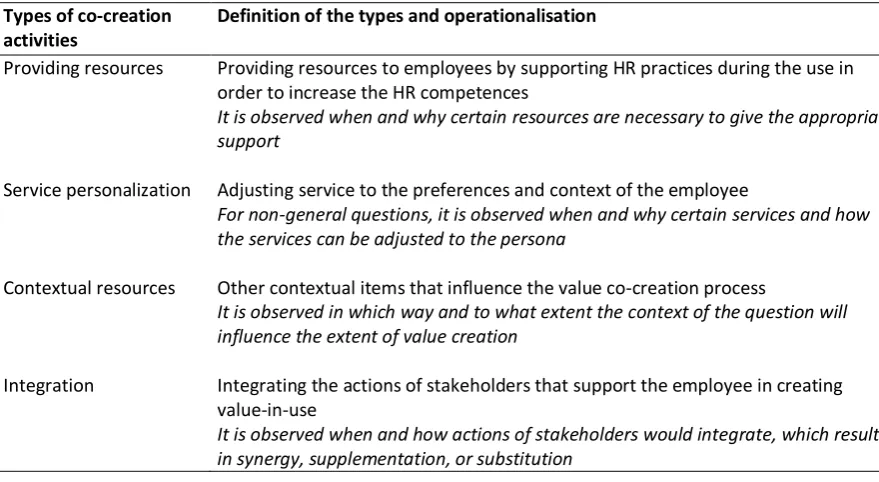
12 observations, because co-creating is a form of behaviour and real-life observations gave the possibility to ask questions after phone calls. These questions were needed to uncover why certain behavior was performed. In total, 75 calls made by 16 HR professionals in different locations were observed. The HR professionals are not mentioned by name because of privacy reasons. These calls were observed by two researchers who relied on a jointly developed data collection protocol. This data collection protocol was developed to identify the different forms of co-creation. The observation protocol consists of the four forms of co-creation which are described in the theoretical framework. The protocol is attached in appendix I. Table 1 indicates the operationalization of these co-creation types.
Table 1: Operationalization of co-creation types
Types of co-creation activities
Definition of the types and operationalisation
Providing resources Providing resources to employees by supporting HR practices during the use in
order to increase the HR competences
It is observed when and why certain resources are necessary to give the appropriate support
Service personalization Adjusting service to the preferences and context of the employee
For non-general questions, it is observed when and why certain services and how the services can be adjusted to the persona
Contextual resources Other contextual items that influence the value co-creation process
It is observed in which way and to what extent the context of the question will influence the extent of value creation
Integration Integrating the actions of stakeholders that support the employee in creating
value-in-use
It is observed when and how actions of stakeholders would integrate, which result in synergy, supplementation, or substitution
Additionally, several questions are taken into account during the observations to obtain more knowledge about why an HR professional responds in a certain way and why the HR professional performs certain behaviours. The following questions are taken into account:
1. Why this specific type of help is chosen? 2. On what basis is support provided? 3. Why are certain specific questions asked?
4. Why it is chosen to provide additional information about a certain topic?
5. Why it is chosen not to provide certain information?
3.3 Surveys as second data collection method
13 automatically sent by P-Direkt. Automatically sent surveys give the opportunity to gain many respondents, because the centre receives calls every day and therefore, many employees would receive the survey. Since there is no action required from the employees to take part in this survey because the survey sent automatically, it was more likely that employees would participate. Additionally, it is proved that the method of surveys has a high validity and reliability and therefore, is used a lot for quantitative data collection (Ward, Gott and Hoare, 2015; Bauer, Truxillo, Paronto, Weekley, and Campion, 2004).
[image:14.595.72.517.451.533.2]Instead of measuring value, this study measures the satisfaction of employees of ministries regarding the provided service. This can be explained by the findings of Cronin, Brady, and Hult (2000). They found a significant correlation between service value and satisfaction. Because service value expresses itself in satisfaction, this study measures satisfaction. The Dutch Ministry of Internal Affairs already conducted surveys before this study to measure the satisfaction of the employees of ministries with the provided service of HR professionals. Conducting surveys is an appropriate data collection method for measuring satisfaction, because it can properly quantify the extent of satisfaction. For this survey, a 4-points scale was used to measure the satisfaction of customer friendliness and the knowledge of the HR professional, whereby 1 is considered as highly disagree and 4 as highly agree. Additionally, employees were asked to rate the overall service. Only this total rate is used for the distribution of satisfied and dissatisfied employees, because the item gives the overall view of satisfaction of employees, while the other items only measure a segment of the service. Considering the surveys, it is shown that when employees are dissatisfied, they are generally dissatisfied about all the segments. This indicates that the item which measures the overall service gives a proper view of the total image. Because the rating of the complete service measures the overall picture, it is allowed to use only this item. Table 2 indicates the operationalization of the item which is used from the survey.
Table 2: Operationalization of the survey item
Survey item Definition of item and operationalisation
The overall service The overall satisfaction of the service rated by the employees
The overall service was rated between 1 and 10. This rating helps to divide satisfied
employees from dissatisfied employees. Employees who rated less than an 8 are identified as dissatisfied employees and employees who rated at least an 8 are identified as satisfied employees.
The case that an 8 is recognized as satisfaction and a 7 is recognized as dissatisfaction is determined by P-Direkt, because the service of P-Direkt is on average rated with an 8 and P-Direkt strives to keep at least this average. A 7 can be seen as sufficient, but because P-Direkt delivers the service for a longer period of time, the ambition level is an 8. Therefore, when employees rate less, it will be seen as insufficient. The survey is attached in appendix II.
3.4 Replaying phone calls in addition to the surveys
14 calls were classified as dissatisfied. However, this study chose for theoretical sampling instead of a random sampling in order to get the same number of satisfied respondents as dissatisfied respondents. Because of this reason, new calls – by which it turned out that employees were dissatisfied – were replayed so that the findings concerning the calls that were rated as insufficient could be confirmed. Therefore, surveys from twenty dissatisfied respondents were added to the data.
All calls were replayed one by one and for every call I noted which forms of co-creation were applied and which forms of co-creation were not applied. This shows the relation between the surveys and the replayed calls, because the surveys show the satisfaction level and with use of the recorded calls, it could be observed which behavior and therefore which forms of co-creation were applied by those who indicated to be satisfied and to those who indicated to be dissatisfied. It was possible to replay phone calls, because all phone calls from employees to P-Direkt are recorded by P-Direkt. Only phone calls for which a survey is filled in after the phone call were replayed. This method ‘replaying phone calls’ is chosen, because during the calls it is observable which behaviour is shown by a HR professional. The surveys only show the subjective opinion of the caller’s satisfaction and it do not measure the ways in which HR professionals co-create value. Although, callers may not have been in a good mood or may have been in a rush, which can have an influence on the value co-creation. These influences can be recognized during replaying calls and it can be recognized to what extent the co-creation activities are adjusted to employee’s preferences.
15
4.
Results
This chapter presents the results of the case study. The first part concerns the description of the P-Direkt case. The second part describes the outcomes of the first data analysis. This will indicate how HR professionals of P-Direkt co-create value for employees of the Dutch Central Government. In the second part of the results, the surveys will be discussed and linked to the replayed calls which are replayed to observe which forms of co-creation are applied.
4.1 Case description
P-Direkt supports employees of all ministries, except defense, by arranging HR related issues and it operates from within the Ministry of Internal Affairs providing services both to this ministry and to the other ministries. These provided services concern, for instance, explanation of the payroll and support within the P-Direktportal which include self-services which allow employees to arrange their leave days, declare travel expenses, etc. This support can be requested by phone, e-mail or through the P-Direktportal. The P-Direktportal is the personal online account in which personal HR issues have to be arranged. P-Direkt delivers its support by phone, e-mail, P-Direktportal, and by the government portal. The government portal is a website where general HR related information can be found. Over a 120.000 government employees make use of this portal (P-Direkt, 2017).
At P-Direkt, 75 observations were conducted to identify which forms of co-creation are performed by HR professionals of the shared service center. There are several factors which influence the way and extent of co-creation and one of these influences is the context in which P-Direkt is settled. In some circumstances creation by HR professionals is a must and in other circumstances co-creation is not possible. For instance, HR professionals have to make resignation forms when an employee leaves, because managers and employees are not allowed to do that by themselves. This situation reflects that co-creation is a must. Vice versa, when a HR professional is not allowed to provide certain information, co-creation is not possible. Co-creation is also not possible when a HR professional is not able to manage tasks that an employee is allowed to do by himself.
Another influencing factor which is reflected in the context is the instructions of P-Direkt to its own employees in the way of communicating. The way in which HR professionals should interact with employees is strictly defined by the Dutch Ministry of Internal Affairs. This is shown by the conversation protocol which is issued to every HR professional. This protocol describes that HR professionals may not use diminutives. Another prescribed rule is that HR professionals should ask if all the questions of the caller have been answered. This can result in more co-creation, because the HR professional allows the employee to ask more questions on which the HR professional can provide support.
4.2 Forms of co-creation
16
4.2.1 Provided personal resources as a form of co-creation activity
Regarding the replayed phone calls, it is shown that HR professionals do not strive to increase employees’ knowledge and skills. Instead of that, they mostly adjust their support on the knowledge and skills of the employee. This is done by asking if employees are familiar with the HR portal and related applications. If they are, they receive a more specific and focused service than employees who are not familiar with the system, because HR professionals anticipate on the current knowledge and skills of the employee. The resources can, for instance, be provided in the form of a reference to an instruction manual or by guidance through the HR portal. Because the resources can be provided in different ways, this study divides the provided resources into three different types. The first type of providing resources is the most intensive type of support, which I call “step-by-step guidance”. This type is demonstrated when a HR professional guides an employee through the government portal and explicitly explains which button has to be touched and why. Next to this, the HR professional can provide additional information, he can make simulations of certain choices, appoints consequences and give examples of certain situations. This often occurs when an employee has less knowledge about the HR system. During the observations, HR professional #7 demonstrated an example of this type, because he instructed an employee to where she should add a receipt on the portal (i.e. in contact form - is different from travel declaration process):
“You have to login into the portal and you have to click on the button “declarations”. After that, the system will ask for which reason you will declare a receipt. You choose for the option “business trip” and you fill in the amount. Then youhave to click on "add", otherwise the application will be sent
without attachment”.
The second type is less intensive, but still personal. This type is called “indication support” and is demonstrated when a HR professional explains what an employee has to do and why. However, for this type the HR professional does not guide to where the employee could find or has to perform a certain activity. HR professional #1 demonstrated an example of this:
”I’m looking at your salary and I see that your salary is corrected right. Indeed, your bonus is paid and therefore your salary should be higher. However, the purchased bicycle from last month is compensated with your bonus. This clarifies why the paid amount at your account is less than the
month before”.
Through the way of asking, the HR professional recognized that the employee was familiar with the system, and therefore, he did not provide information about the system, but immediately looked at the employee's open leave and indicated which leave the employee should use.
The third type is the least intensive type, which I call “Do it yourself manual”. This type is demonstrated when a HR professional refers to an instruction manual in the government portal. This type is also demonstrated when a HR professional is not able to provide support and, therefore, refers to another party who could help an employee. An example is given by HR professional #1 and HR professional #6.
HR professional #1 tells the employee to go the government portal and to read the instruction manual on that page.
17 Based on the question and knowledge of the employee, the intensity of providing personal resources is determined. Regarding the extent of value creation, it can be suggested that support, that benefits the employee, will create value. Because providing personal resources is recognized as support for employees, it is reasonable that providing personal resources can be seen as a form of co-creation. However, the personal resources do not have to be increased by HR professionals in other to create value. This includes that typology 1, HR professionals co-create value by increasing personal resources, is not confirmed, because just providing appropriate personal resources supports in co-creation.
4.2.2 Service personalization as a form of co-creation activity
It is shown that services are personalized by HR professionals of P-Direkt. The extent to which services are personalized is mostly based on the generality of the question. For instance, the way in which someone has to register for leave days is similar for everyone. However, some processes differ between departments and therefore different information has to be provided. Because rules and processes differ between departments, some HR professionals state that they first pay attention to who the user is and for which department the user works and then analyse the question, while others first listen to the question of the user and then pay attention to the background of the user. Therefore, it can be concluded that the extent of service personalization is in most situations dependent on the question and the context.
Regarding personalization of the service: this study divides three types of service personalization. The difference is based on the several preferences regarding the question. This can be explained by the case in which employees are in a hurry. Then they probably prefer to get a quick and clear response. When HR professionals anticipate on this type of case by given a quick and clear response, a service is personalized. Considering these different types: the first type is what I call “legal counselling”. This type regards services focused on the legal context, which is shown when services are adjusted to rules and regulations. For instance, based on some legal rules you would choose for certain leave. HR professional #1 gives an example of this:
“It will be wisely to choose for the first category of leave, because the other leave option is valid for a longer time”.
The second type is what I call “emotional mirroring”. This type regards services focused on the emotional context, which includes that when an employee shows certain behavior, the HR professional mirrors that certain behavior. Moreover, it is demonstrated that a HR professional responds to the mood of the employee. HR professional #5 gives an example of this. He talked with an employee who has parental leave every Thursday. Although, the next Thursday was Ascension Day, which is a national holiday. On national holidays, government employees are not paid. This makes the employee sad, because when it was no national day off, he would get paid. Therefore, the HR professional responded at follows:
“If you had chosen to take your parental leave on Monday, you had missed hours on Easter Monday. I understand your situation, but unfortunately it’s a rule within the government”.
18 The third type is what I call “operational adjusting”. This type regards services focused on the operational context. This is demonstrated by the case that managers often expect a well-considered explanation, while government employees who do not have a HR function are previously satisfied with an answer without full explanation. Therefore, the service will be adjusted on the operational context of the persona. An example of this is demonstrated by HR professional #12 and #13. HR professional #13 supported a government employee who did not have a HR function. This can be a prison guard or a labour inspector. The employee asked:
“My declaration has not been approved by my manager, can I retrieve my application?”
It seemed that the respondent had satisfaction with the response: “You can find you application in your personnel dossier, which is attached in your P-Direkt portal”. Then the employee did not ask what was wrong, but instead of that, he thanked the HR professional for his response. In contrast, HR professional #12 supported a manager, who also entered a declaration:
“”I have entered a declaration, but this has been withdrawn by the HR supporter according to the manager's form. What went be wrong here?”
The HR professional looked for the declaration in the system. Thereafter, he explained that the declaration has not been approved because it was not clear which employment the employee performs. The HR professional found this reason in the memo. However, the manager did not agree with the response. She asked for more details and wanted to know in detail why the current description was not correct. This example shows that a manager often desires a more detailed response, while a not HR employee often desires a concise response.
Another example can be explained by the case that a difference is shown by providing services to employees who are in a hurry and to them who are not. Employees who are not in a hurry can be supported by the step-by-step guidance (as explained in chapter 4.2.1). Employees who are in a hurry can be supported as HR professional #3 did:
“If you work for six hours more, you have to correct the compensation leave hours within the P-Direkt portal”.
After the call from HR professional #3, the HR professional mentioned that she anticipated on the behavior of employee: the employee was in a hurry, and therefore, she only mentioned required information.
19
4.2.3 Integration as a form of co-creation activity
Stakeholders who are involved in the value creation process are often supervisors or HR support staff connected to departments of ministries. When stakeholders as departmental supervisors or HR supporters integrate during the use of a service, they will create more value. Therefore, integration of stakeholders can be recognized as a form of co-creation. The way in which these two types of stakeholders contribute to value co-creation will be described in this subchapter.
At first, departmental supervisors of employees who using a service are recognized as a type of stakeholders. This type of integration is what I call “supervisor involvement”. For instance, when an employee resigns, the supervisor is involved. The supervisor can apply for a resignation form, which supports in the efficiency of the resignation process. Furthermore, the supervisor has to agree with fees of employees. This is also shown by the interaction of HR professional #15. He stated:
“You should ask your supervisor to apply your fee as soon as possible, so that you get your money this month”.
Because the action of the supervisor supports during the use of a service, the integration can be seen as a co-creation activity. The second type of stakeholder is the departmental HR supporters. This type of stakeholder is what I call “departmental HR involvement”. This name refers to the fact that the departmental HR supporters are involved when the service is related to the department and HR professional cannot provide support. This situation is recognizable in the observations of HR professional #10. She got the question how child benefits based on a 40 hours working week should be settled, because regular contracts are based on 36 hours a week. The HR professional stated:
“Your departmental HR supporter should send a year schedule which shows your working hours. This schedule serves as evidence and you can sent this evidence to the tax authorities.”
Through the integration, the service will afford more value and this support during the use of the service shows that value will be co-created.
20
4.2.4 Influence of contextual resources on co-creation activities
Considering the contextual resources, this factor is not seen as a way of co-creation, but it is recognized as a factor to which provided services should be adjusted. As chapter 2.4.4 explains, HR professionals need certain contextual resources in order to provide a service. An example is the P-Direkt portal, which is the system in which (personal) HR related issues are organized. The arrangement of that system is determinative for the way of co-creation, and therefore, it has an influence on the way of co-creation. However, contextual resources cannot be seen as one of the value co-creation activities. The reason is that the factor “contextual resources” is not recognized as a way in which HR professionals are able to co-create value, because contextual resources are required for value creation or, in other words, required for providing services. Without the certain resources there will be no service. The required contextual resources differ per context. The contextual resources for this study will be explained in this subchapter.
At first, the government can be seen as the agency who offers the contextual resources, because they offer systems to P-Direkt. This is shown in the previous example above. Next to this, there are recognized two additional agencies who offer contextual resources: the backoffice of P-Direkt and the managers. The backoffice of P-Direkt provides contextual resources by providing specialized information which might be needed to support P-Direkt, so that P-Direkt can provide its service. HR professional 4 shows an example of this. He gets a call from an employee who has an exceptional situation: he owns a mobility card and he travels abroad daily. Because for this exceptional situation there is no standard, a form is sent to the backoffice. A backoffice employee will handle the form and he or she will adjust employees’ data or settings in the P-Direkt portal, so that it will be possible to declare the daily travel in the Netherlands and outside. This example shows why P-Direkt needs the backoffice in order to create value in certain circumstances.
The third agency, the managers, provides contextual resources by providing agreement forms for leave days and fees. P-Direkt needs all contextual resources, which are described in the examples, to perform a good job and to co-create value to HR services for employees. Additionally, the contextual resources determine the extent of providing personal resources and the empowerment of employees. This can be explained as follows. As just described, the HR system is provided by the government. Because the facilities of the HR system determine to what extent personal resources can be provided, the extent of personal resources is dependent on the government. The facilities of the HR system also determine to what extent the employee is empowered in co-creation, which shows that again a contextual resource has influence. This empowerment will be further explained in the next paragraph. Because the provided resources are dependent on the question and on the context of the problem, the provided resources should be adjusted to both factors. This means that typology 3, HR professionals co-create value by providing resources and services which are adjusted to the contextual resources, is confirmed.
4.2.5 Additional co-creation activities
During the observations two additional co-creation activities were recognized. These activities are empowering employees and relational interaction. Empowering the employee in the co-creation process includes involving the customer in co-creating the service. Thereby, the employee gets the role of a co-creator. This is shown by the fact that employees are responsible for their own data. This means that employees have to fill in data by themselves, change it when needed, and apply their
own leave days within their P-Direkt portal. Because, when employees are able to perform some
21 service works well for the employee and the employee can contribute in value co-creation. However, whether employees can be empowered in the co-creating process depends on the problem. Hereby, three different types of empowerment can be distinguished. The first type is what I call “required empowerment”. This type is demonstrated in the example above, which explains that certain activities have to be performed by employees because HR professionals do not perform activities that employees can do by themselves. An example of certain activity is applying leave days. To apply leave days, employees should log in in their P-Direktportal and they should fill in how many leave days and which kind of leave is used. HR professionals can only advise which kind of leave is beneficial to use.
The second type is what I call “accessible empowerment”. This type is demonstrated when employees have the choice to empower in the co-creation process. An example can be given by illustrating a call of HR professional #10. A departmental HR supporter called with question: What is the salary of a trainee so that she gets to know if she has to stop her student funding? The response of the HR professional is as follows:
“I can forward the question to the backoffice, but it may take up to 5 days for your reply. You can also ask your p-advisor on location”
This example shows that it is accessible to empower in the co-creation process, but it is not a must because P-Direkt can also provide response without subsequent action of the employee. Furthermore, every employee should ask in the end of the conversation if the caller has more questions. This enables the employee to create more value.
The extent of co-creation is, just as the other factors, related to the provided resources by HR professionals. Because when a HR professional provides (additional) information on how an employee can perform a certain activity, an employee will be more able to co-create value. For example, when a HR professional indicates that an employee can send a form by himself so that the case will be handled more quickly instead of waiting for his manager, the value of co-creation will be higher. From this reasoning, it can be concluded that the extent of co-creating value is dependent on the provided resources by HR professionals. In summary, despite not being necessary for HR professionals to empower employees in the value creation process in order create value, it is possible that (more) value will be created because of the empowerment of employees.
The second additional form of co-creation is relational interaction. Relational interaction is the communication whereby quickly a relationship is built between the HR professional and the employee. When HR professionals build on a relationship with the employee, the employee often indicated to be more satisfied. Building a relationship out of a phone call can be performed in different ways. This study recognizes three ways of relational interaction: showing recognition,
taking time and providing additional information. Showing recognition is demonstrated by HR
professional #13:
"I understand your frustration and it's indeed annoying"
22 When there are many silent periods during a call (i.e. no communication which contributes to relationship building), there will probably no relational interaction. Sometimes HR professionals do not tell what they check out or going to do and this results in silent periods. Although, when a HR professional tells what he is going to do and he puts the employee on hold, the employee feels more understood. Therefore, it is important to show understanding and recognition during the use of a service. When employees are understood and they feel good about a service, more value is created from the service. HR professionals #12 gives an example of this repeating:
"Is it true that you change function and department?"
The second type of relational interaction is “taking time”. This is revealed by the fact that when HR professionals take time and put effort in employees, they will feel more appreciated and therefore, more value will be created. HR professional #5 demonstrated an example of this:
“Do you like me to stay on the phone while you fill in the application? Then you have the possibility to ask more questions if needed”
The feeling of appreciation is also recognizable when HR professionals tell what they check out during a call and thereby show that a service is personalized. When a HR professional does not mentioned which data and documents are checked, service personalization may be not remarkable and employees can feel less appreciated. In this case is shown that relational interaction influences the effect of service personalization.
The third type of relational interaction is “providing additional information”. When additional information is provided, employees feel more appreciated. Next to information, also (personal) resources can contribute to the feeling of the employee. This shows that the provided personal resources – another secondary type – can be related to relational interaction. When, for example, additional information is provided, or an explanation why certain proceedings are not performed by HR professionals, results show that it improves the trusting relationship with employees. HR professional #8 demonstrated examples of this:
“Do not forget to click on the red button on the right side". “What you can do for example is ....”
Because the employee feels more appreciated when he gets additional information, more value can be created. These examples show that relational interaction contributes to the value-in-use, and therefore, can be seen as a form of co-creation.
4.2.6 Illustration of the co-creation activities
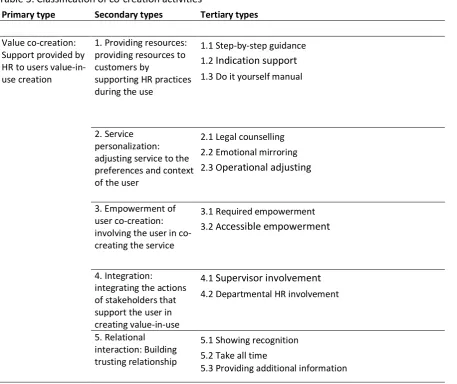
23 Table 3: Classification of co-creation activities
Primary type Secondary types Tertiary types
Value co-creation: Support provided by HR to users value-in-use creation
1. Providing resources: providing resources to customers by
supporting HR practices during the use
1.1 Step-by-step guidance
1.2 Indication support
1.3 Do it yourself manual
2. Service
personalization: adjusting service to the preferences and context of the user
2.1 Legal counselling 2.2 Emotional mirroring
2.3 Operational adjusting
3. Empowerment of user co-creation: involving the user in co-creating the service
3.1 Required empowerment
3.2 Accessible empowerment
4. Integration:
integrating the actions of stakeholders that support the user in creating value-in-use
4.1 Supervisor involvement
4.2 Departmental HR involvement
5. Relational
interaction: Building trusting relationship
5.1 Showing recognition 5.2 Take all time
5.3 Providing additional information
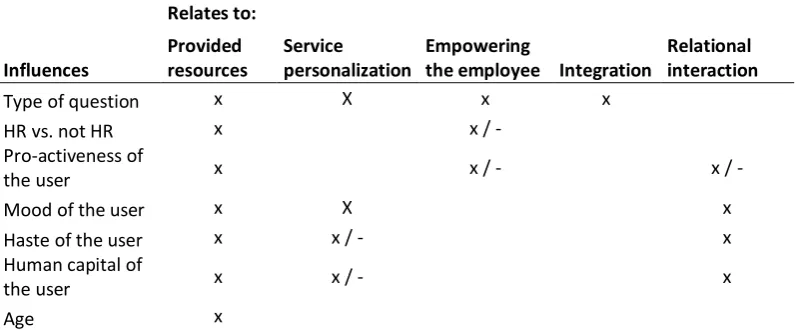
The first part of the results points out that several factors, among which the type of question, determine the way of co-creation, i.e. which forms of co-creation can be applied. This includes that it is hard to determine when certain influences, as the type of question, are related to co-creation activities and when they are not. The consideration is hard because in a lot of situations the influences might affect co-creation activities, but it is not necessarily the case. The different influences are shown in table 3, but first they will be explained one by one.
24 When, for example, an employee shows a bad mood or little interest, it seems that HR professionals show less effort in service personalization. Further, the mood of the employee can also influence the relational interaction. Even when an employee shows a bad mood, the HR professional can show a positive relational interaction. Fourthly, if employees show they are in a hurry, it may be possible that services will be less personalized in order to provide support quickly. However, this will not always be the case, because the way in which the service should be personalized, mostly depends on the question. Fifthly, when an employee has a limited knowledge about the question, and therefore, a low degree of human capital – which is the knowledge that exists through experience with a product or service together with the general knowledge (Priem, 2007) – it is presumable that a HR professional provides more personal resources. This can be expressed in the way in which HR professionals guide employees in a short time through the system. When employees should find their way by themselves, it takes a lot of time and energy, which can cause frustration. When a HR professional guides an employee, the employee will find the requested issue in no time. This will result in satisfaction. When an employee is already familiar with the system, the guidance is not required, and therefore, less personal resources will be provided. Lastly, the age of the employee may have an influence on the provided resources, but again, this is not necessary. In general, older employees show less knowledge about processes, but results show that this is not always the case. Table 4 shows an overview of which factors influence which form of co-creation.
Table 4: The influences on the types of co-creation
Relates to:
Influences
Provided resources
Service
personalization
Empowering
the employee Integration
Relational interaction
Type of question x X x x
HR vs. not HR x x / -
Pro-activeness of
the user x x / - x / -
Mood of the user x X x
Haste of the user x x / - x
Human capital of
the user x x / - x
Age x
4.3 Satisfaction of calls rated by employees
In the first data analysis, the different forms of co-creation are identified. But, it is still not known if the different co-creation activities deliver value. Therefore, surveys were analyzed and calls from the associated surveys were replayed to get to know which co-creation activities deliver value. The surveys measure the satisfaction level of employees. This satisfaction level was measured using a single item, because the item gives the overall view of satisfaction of employees. From replaying calls is observed which forms of co-creation are applied and which forms of co-creation are not applied. Therefore, this subchapter will give insights in which factors influence the extent of satisfaction.
4.3.1 Influences from the co-creation activities on the extent of satisfaction
25 influence the extent of satisfaction of employees. Table 5 shows in how many calls certain forms of co-creation were applied and if employees were satisfied with their support or not. Considering the provided resources, during almost all calls resources are provided. Because the provided resources are adjusted to the question and the knowledge of the employee, in some calls step-by-step guidance is provided and in some calls do it yourself manuals are provided. During replaying the calls, it turned out that the level of satisfaction did not differ between employees who received step-by-step guidance and those who received a do it yourself manual. Because almost all employees receive resources, it cannot be concluded that employees seem satisfied when resources are provided.
Furthermore, there is no observed difference in the extent of satisfaction of employees whose service is personalized and for those for which it was not possible to personalize the service. Table 5 shows that for more respondents the service is personalized (23), but it is shown that many of those respondents are still dissatisfied (14). The difference of respondents for who the service is not personalized (19), by which 5 respondents seem satisfied and 14 respondents seem dissatisfied, compared to those who received a personalized service is therefore small. As has been explained in chapter 4.1, certain co-creation activities are not always possible, which also includes that personalizing a service is not always possible. Even when a service is personalized to the legal context, the emotional context or the operational context, no difference in satisfaction is recognizable. However, when a service had to be personalized and it did not happen, it might result in dissatisfaction.
In the situation that employees are empowered to co-create value, there is no observed difference between employees who are satisfied and those who are dissatisfied. Even when employees are required to empower in the co-creation process in order to create value or employees are not required to empower in the co-creation process, table 5 shows no difference in satisfaction. It is shown that 22 of the 42 respondents empowered in the co-creation process and 20 respondents did not empower in the co-creation process. From both groups, one third of respondents seem satisfied. However, when an employee has to empower but it is not possible, which can happen when they have to arrange leave days but the system does not work, it will lead to dissatisfaction. Although, this will be the case in only exceptional situations.
It might be expected that when integration is possible (regardless of the stakeholder), employees will be satisfied. The main reason of this expectation is the fact that in many cases the backoffice is the other stakeholder, and they provide more specific information. With more specific information, the employee will generally be more satisfied. However, when a HR professional provides sufficient information by himself, results show that employees are also satisfied. This shows that in some situations no other stakeholder than the HR professional is needed to create the desired value. This clarifies why there is no observed difference between respondents for who integration was possible and for those for which integration was not present. For 19 respondents by which integration is applied, 14 respondents seem dissatisfied. For 23 respondents by which integration is applied, also 14 respondents seem dissatisfied. The difference in proportion is too small to make a statement of this.
26 While analyzing the calls of employees who in the survey indicated dissatisfaction, it is noticeable that in 13 of the 28 calls, the HR professionals created no relational interaction. This is much compared to employees who indicated to be satisfied. Thereof, only 2 of the 14 created no relational interaction. Considering the different types of building a relational interaction, it turns out that by employees who indicated to be dissatisfied and no relational interaction exist, there is often a lack of showing recognition (the first type of relational interaction as described in table 3). Thereby, it is shown that there often existed silent periods during a call. Chapter 4.2.5 already explained that silent periods during a call might be a reason of no relational interaction. A lack of taking time (the second type of relational interaction) turned out to be occasionally the reason why no relational interaction exists. In that situations, HR professionals are too rushed. Providing additional information (the third type of relational interaction) is not always possible and not required during a call, but it is seen as an extension to the service. That is why it is not required for relational interaction and therefore it is not required for satisfaction. Nevertheless, from the results can be concluded that ensuring a relational interaction makes employees generally satisfied. Even when a HR professional cannot provide help, employees indicate to be satisfied when the HR professional creates a positive relational interaction. In that case, a trusting relationship can be created by an explanation why the HR professional cannot provide help or who the employee has to contact.
[image:27.595.67.594.517.593.2]In summary, only relational interaction has a noticeable influence as co-creation activity on the extent of satisfaction. To show this, table 5 presents an overview of each type of co-creation which shows the number of satisfied and dissatisfied employees versus the number of HR professionals that did or did not engage in the co-creation activity. As the table shows, personal resources will mostly be provided. Service personalization is often provided when employees seem satisfied. Although, when the results are analyzed, it shows that satisfied people asked in general more specific questions which could be more personalized. Considering the empowerment of employees in the co-creating process and integration, there is no observed difference. However, when HR professionals do not create a relational interaction, the table shows that almost no respondent is satisfied. Therefore, it can be concluded that a positive relational interaction is necessary to create satisfaction.
Table 5: Influences of co-creation activities on satisfaction
Providing resources Service
personalization
Empowering the
employee Integration
Relational interaction**
Applied Not applied Applied Not applied Applied Not applied Applied Not applied Applied Not applied
Satisfied 12 2 9 5 7 7 5 9 12 2
Dissatisfied 25 3 14 14* 15 13 14 14 15 13
* During twelve out of the fourteen calls, service personalization was not possible
27
4.3.2 Other influences in the extent of satisfaction