Exploring the Future Development in Employee
Involvement: Person-Environment Fit and the
Future of Job-Crafting
Author: Lianne Rietveld University of Twente P.O. Box 217, 7500AE Enschede
The Netherlands
ABSTRACT
The purpose of this study was to investigate the effect of both high and low
Person-Environment fit on the willingness of employees to engage in job crafting within five
years from now. Data for this research was obtained through conducting a Delphi
method, which consisted of two predetermined rounds. The subjects of this study
were employees who work in the fields of education, banking, governments, care and
the hotel and catering industry. Over the whole Delphi method a response rate of 89,5
percent was yielded. The employees filled in two questionnaires, on which responses
were indicated on a 7-point Likert scale. A Mann-Whitney U test was used for
analyzing the data. It was found that most employees are inclined to show proactive
behavior in designing their work environment within five years from now. However,
the perceived degree of Person-Environment fit does not provide a clear indication on
whether employees perceiving a low Person-Environment fit will engage more in job
crafting within five years from now, than employees perceiving a high
Person-Environment fit.
Supervisors:
Dr. J.G. Meijerink, Dr. A.A.M. Wognum
Keywords
Future of Job crafting, Person-Environment fit, Person-Job fit, Person-Organization fit, Person-Group fit, Delphi method.
Permission to make digital or hard copies of all or part of this work for personal or classroom use is granted without fee provided that copies are not made or distributed for profit or commercial advantage and that copies bear this notice and the full citation on the first page. To copy otherwise, or republish, to post on servers or to redistribute to lists, requires prior specific permission and/or a fee.
5th IBA Bachelor Thesis Conference, July 2nd, 2015, Enschede, The Netherlands.
1. INTRODUCTION
The focus of this paper is on the future of job crafting, especially adressing the expectations of the employees involved in the job crafting process. Whereas the job demand theory used to be the guiding principle when it came to shaping a job, nowadays there is more a shift towards actively shaping a job by employees themselves. This phenomenon is known as job crafting and can be defined as the physical and cognitive changes individuals make in the task or relational boundaries of their work (Wrzesniewski, & Dutton, 2001).
A future perspective on job crafting is relevant because of the expected changes on the labor market. Centraal Planbureau (CPB, 2012) made an estimation of the Dutch economy up to and including 2017. With the current situation of a wide labor market, where there is more supply than demand, there is an increase of long-term unemployment. CPB (2012) found that the current unemployment rates will decline partly due to the demographic ageing, however they will still be above the balance level in 2017. UWV also published a forecast of the labor market in the Netherlands in 2014. They say that due to the demographic ageing, the working population will decline after 2015. Because of this shrink, less people will be available to perform work (UWV, 2014). At the same time employers increased the quality requirements on employees. This will mean that it will be harder for employers to find sufficiently skilled employees (UWV 2014). Therefore, more knowledge on the future expectations on job crafting seems eligible. The reason for this is that employees are expected to be flexible and adaptive when it comes to the quick changes and requirements of their jobs. When employers know how employees will proactively engage in shaping their own job’s in the future, this gives implications for managers to attract and retain the right employees.
Wrzesniewski and Dutton (2001) argue that job crafting influences both the meaning of the work and one’s work identity. Eventually this will have an impact on the organization and different literature found both desirable and undesirable outcomes of job crafting. Research showed that job crafting relates positively with work engagement, job satisfaction, resilience and thriving (Berg, Dutton, & Wrzesniewski, 2008), but was also shown to produce negative outcomes such as altered connections to others, or task boundaries in ways that are at odds with organizational objectives (Wrzesniewski, Dutton, 2001). Job crafting will most often result from situations in which employees feel that their needs are not being met in their job as it is currently designed (Wrzesniewski, Dutton, 2001).
Because of this impact on the organization and the relation with the needs of the employee, job crafting will have an effect on the Person-Environment fit. Boselie (2010) defines Person-Environment fit as the degree of alignment between employees on the one hand and the job and the organization of the other hand. A good match between an individual and the organizational environment results in high job performance, employee satisfaction and retention of employees (Boselie, 2010). When employees perceive a misfit between themselves and their environment at work, job crafting might help solving this problem, since it involves employees making changes to their job tasks, and work relationships to better meet their individual needs, thus creating a better alignment between the organization and themselves. However, to my knowledge the relationship between Person-Environment fit and job crafting has not been studied so far. Further research is necessary because in times of continues change and complexity, it is important for organizations and employees to build and
maintain a strong fit between employees and their organization (Boselie, 2010). Job crafting might play a valuable part here, since the positive outcomes mentioned above influence the corporate culture.
This leads to the following research question: “ What are the differences between the expectations of employees with high versus low Person-Environment fit regarding the types of job crafting that will occur five years from now?”
More information on this linkage between Person-Environment fit and the future of job crafting might provide some new insights or opportunities for future research. For example, new insights for managers, when they know how employees with either high or low Person-Environment fit will engage in job crafting in the future. The managers might then know how to anticipate on the job crafting processes of their employees. This in order to sustain or even strengthen the future relationship between the employee and the organization.
2. THEORY
2.1 Job Crafting
Job crafting is about actively changing one’s job. The core idea of job crafting is that with some slight adaptations you can tailor your own job, in such a way that your job connects with your talents and motivations resulting in higher productivity and commitment (Visser, Tjepkema & Spruyt, 2012). According to Wrzesniewski and Dutton (2001) employees can engage in job crafting in three ways. The first job crafting type is task crafting which involves employees changing the form or number of activities an employee engages in while doing the job. Task crafting can be done in three different ways (Berg, Dutton, & Wrzesniewski, 2013) this to cultivate greater task variety, identity, and significance, thereby enhancing the meaningfulness employees are likely to derive from their work. First, employees can add tasks that they find meaningful into their jobs. Second, employees can decide to allocate more time, energy, and attention to tasks that are already part of their jobs. Third, employees can find ways to reengineer existing tasks to make them more meaningful.
Second, employees can also engage in cognitive crafting, which refers to changes in cognitive boundaries of how one sees the job. Cognitive job crafting does not involve changing anything physical or objective about the job, it is about altering how employees think about their tasks, relationships, or jobs as a whole (Berg, et al., 2013). Berg, et al. (2013) propose three ways in which employees can engage in cognitive job crafting. First, employees can expand their perceptions of the impact or purpose of their jobs as a whole. Second, employees may narrow their mental scope of the purpose of their job on specific tasks and relationships that are significant or valuable to them. Berg, et al. (2013) think that this technique may be most useful for employees who dislike a substantial portion of the tasks and/or relationships that make up their jobs but do find some specific parts of their jobs to be meaningful. Finally, employees can take advantage of existing components of their jobs by drawing mental connections between specific tasks or relationships and interests, outcomes, or aspects of their identities that are meaningful to them (Berg, et al., 2013)
which crafting relationships can facilitate meaningfulness at work. First, employees can craft their jobs by forging relationships with others who enable them to feel a sense of pride, dignity, or worth. Second, employees can craft their work relationships by changing the nature of each relationship to be about a new, more meaningful purpose. For example, engaging in more personal contact, instead of only work related contact. Finally, employees can craft their existing relationships by providing others with valuable help and support in carrying out their jobs (Berg, et al., 2013)
Over the last decade, more attention has been paid towards job crafting, with more rapid changes in the workplace and more flexibility, it looks like job crafting will gain more importance in the future. This in order for employees to adapt to the changes and mold their work in such a way that it still corresponds with their needs. As such, it is relevant to explore how employees expect to engage in job crafting in the future. However, it is most likely that employees differ in the extent to which they expect to craft their future jobs, since employees differ in their level of motivation for job crafting. Namely, Wrzesniewski and Dutton (2001) found that the motivation for job crafting arises from three individual needs. First, employees want to assert some control over their jobs in order to avoid alienation from the work (Braverman, 1974). Secondly, employees want to create a positive self-image in their work. Finally, job crafting allows employees to fulfill a basic human need for connection to others (Baumeister & Leary, 1995). When employees work in jobs that fulfill their needs for control, positive image, and connection, they may not be motivated to job craft, since their needs are met by their current work situation (Caldwell & O’Reilly, 1990). On the other hand, when employees experience misfit between their work and personal preferences, employees might want to take back control over themselves and their job, this can be done by actively changing something in their tasks, cognition or their relations. To better understand how this works, first the concept of Person-Enivironment fit will be discussed. In particular it is expected that the current Person-Environment fit of an employee will have an influence on expectations of employees to engage in job crafting activities in the future.
Tims, & Bakker (2010) already made the proposition that Person-Job misfit leads to job crafting behavior. However, this proposition has not been tested yet. They state that when an employee experiences a misfit, job crafting might be a good way to accomplish a restored balance. In 2001, Frese and Fay already found that negativity at work, such as job dissatisfaction, is often the reason for employees to engage in proactive behavior. In the section on Person-Environment these future expectations on job crafting will be stated in the form of different hypotheses.
2.2 Person-Environment Fit
Person-Environment fit, refers to the extent to which employees fit with the organizational environments they operate in (Bretz & Judge, 1994; Boon, 2008). The ASA-framework by Schneider (1987) tries to describe this link between the Person-Environment fit. ASA stands for attraction, selection and attrition. This framework implies that persons who find themselves with the same interests are attracted to a company who shares the same values. The company on the other hand will select the people of whom they think are compatible for the job and have common personal attributes. When people feel that they do not fit with the environment, this may result in attrition and the person may leave the job (Schneider, 1987; Boon, 2008). However, attrition is not the only option when employees perceive a misfit. Research showed that employees
are no longer passive receivers of information from the environment (Daniels, 2006). When employees perceive a misfit, they will first try to restore the balance before they decide to leave the organization (Edwards, Caplan, & Van Harrison, 1998; Kozlowski, 2012). Wanous (1980) found that the better the fit between individual expectations and the reality of organizational life, the higher the job satisfaction and the longer the tenure.
Different factors play a role in creating a Person-Environment fit. From the individual’s viewpoint this might be psychological needs, values, goals, abilities, or personality. Environmental aspects might include job demands, cultural values, and rewards (Cable & Edwards, 2004). There are different perspectives from which you can look at the fit; The demand-abilities fit, where employees supplies meet organizational demand and the needs-supplies fit, where organizational supplies meet employees’ demands (Kristof, 1996). Employees will try to fulfill their needs and goals, this might be done by altering different boundaries of their work and thus, provides opportunities to engage in different types of job crafting, The following three subsections, which together make up for Person-Environment fit, will further elaborate on this relationship between the needs and goals within Person-Environment fit and the future expectations on job crafting.
2.2.1 Person-Organization Fit
Person-Organization fit is defined as the degree of alignment between individual employees and their organizations in terms of sharing the same norms and values (Boselie, 2010). Person-Organization fit occurs when (1) at least one entity provides what the other needs, or (2) they share similar fundamental characteristics, or (3) both (Kristof, 1996; Boon, 2008; Boselie, 2010). Although there is no empirical support, it is assumed that people who match the organization’s culture will outperform those that do not (Boselie, 2010).
Person-Organization fit partly deals with the needs-supplies fit, this needs-needs-supplies fit is achieved when organizational supplies meet employees’ demands (Kristof, 1996). Examples of organizational supplies are financial, physical, and psychological resources as well as the task-related, interpersonal, and growth opportunities that are demanded by employees (Kristof, 1996).
2.2.2 Person-Job Fit
Besides Organization fit, there is the concept of Person-Job fit. This is the degree of alignment between individual employees and their job (Boselie, 2010). The general idea behind Person-Job fit is that the most qualified candidate is most likely to show the best job performance.
Boon (2008) states that Person-Job fit focuses on the needs and qualities that are directly linked to the characteristics of the job. These qualities consist of knowledge, skills and abilities, the so-called KSAs. For a fit to occur it is also important that the job is in line with the interests of the employee, which will result in job engagement and job satisfaction (Kristof, Zimmerman, & Johnson, 2005; Boon 2008; Boselie, 2010). Individual and work characteristics may contribute to active adaptations of employees’ activities towards their personal knowledge, skills and abilities on the one hand and their needs on the other hand in order to restore the perceived misbalance in Person-Job fit.
A low Person-Job fit is present when the knowledge, skills and abilities that the employee possesses are not equal to the requirements for fulfilling the tasks of the job. Therefore employees are expected to engage in task crafting, in that they will adjust their tasks in such a way that their tasks will better fit their knowledge, skills and abilities. This leads to the assumption of the following hypothesis: Employees who currently experience a low Person-Job fit will report to engage in task crafting within five years from now.
2.2.3 Person-Group Fit
The last type of Person-Environment fit is Person-Group fit, which refers to an individual’s perception of belongingness and companionship with a group, team or department (Kristof-Brown, Jansen, & Colbert, 2002).
When it comes to the relations that are part of the job, “if an individual shares similar values or personality dimensions with other team members, or he/she contributes a set of abilities that help the team perform its task and improve the team’s overall effectiveness, we can view him or her as having high person-group fit” (Xu, 2014).
Experiencing a strong Person-Organization fit and Person-Job fit, but weak Person-Group fit, may increase the emphasis of Person-Group fit, thereby motivating individuals to change groups (Ostroff, Shin, & Feinberg, 2002). This gives the motivation to engage in relational crafting, since employees are enabled to decide with whom they want to have contact. When the values of the group are not equal to the values of the employee, this might provide a low Person-Group fit. Employees will most probably engage in relational crafting because this provides the employees with the possibility to connect to the people who have the same values and interests. Furthermore, with a low Person-Group fit, the antecedent for basic need of human contact is not completely fulfilled, which will trigger employees to actively change something about their relationships, this to restore the Person-Group fit. Therefore, it is hypothesized that; Employees who currently experience a low Person-Group fit will report to engage in relational crafting within five years from now.
3. METHOD
To realize the goal of this study, two methodologies were used: First of all a Delphi study to map the future expectations of employees towards job crafting. Secondly, a survey was used to determine the Person-Environment fit of the employees.
3.1 Delphi Study
Future aspects are hard to research, since it is impossible to know beforehand what will happen in the future, or to even make small predictions about the future. However, one method has shown to be useful for future investigations, this is the Delphi method. The Delphi method is useful for forecasting, as expert opinions are the only source of information available (Cuhls, 2003), this is the reason for relying on the Delphi method to have a look into the future expectations on job crafting. This method uses expert opinion to obtain the most reliable consensus of opinion of a group about a subject on which there has not been a consensus yet (Dalkey, & Helmer, 1963). For this particular research paper, the goal is to reach a consensus about future expectations of employees towards different types of job crafting. To reach this consensus, a series of questionnaires interspersed with controlled opinion feedback is being carried out (Dalkey, & Helmer, 1963). Due to the restricted timeframe of this research, I relied on two rounds to arrive at a consensus. In the first round the Person-Environment fit of the participants and their intention to proactively change something about their work stood central. In the second and final round all the intentions related to job crafting were analyzed and the participants were asked to rate the degree to which they ought to engage in this proactive behavior.
One of the fundaments on which the Delphi method relies, is the identification of the experts. After those experts had agreed to participate in the Delphi study, the first round was carried out. When the data of the first round had been analyzed, the second and final round of the study was sent out to eventually arrive at the goal of the study, a consensus about the future expectations on job crafting regarding the different degrees of Person-Environment fit.
3.1.1 The Experts
The chosen experts are key in a Delphi study; therefore it is important to select them, based on a few characteristics. The characteristics to identify the experts in this study were; the expert should have a permanent position within the organization, this ensures that the expert has some sort of certainty and has more of the ability and time to make change happen. Furthermore, the expert must work one year on the current job position, at least. This tells us that the expert is used to the specific requirements related to that job position and thus that the expert has gained a few insights on where they can change something about their work. Due to possible differences in expectations towards the future of job crafting between both fulltime and part-time employees, experts of both sides have been included in the Delphi study. To ensure heterogeneity, there needs to be a variety in age and in the industry sectors. When a consensus is being reached between multiple industry sectors, this may mean that the found expectations are not only applicable to only one industry, and that the expectations might become important in the future. Thus, a broad view on the future expectations of job crafting is being obtained. However, Delphi works with a relatively small number of respondents and due to the limited amount of time for this research, it was decided that the experts had to be a worker, rather than a manager. This means that the experts do have some sort of overlap, and therefore it might be easier to reach consensus on the future of job crafting.
first questionnaire there is a short letter in which the project and its goals are described, the amount of rounds and time commitment is being mentioned, and finally there is a promise of anonymity. Those are the conditions for carrying out a Delphi study, as mentioned in the paper of Gordon (1994). Anonymity is an important element of the Delphi study, since the experts should be enabled to express their opinions without feeling the pressure of peers (Gordon, 1994).
The experts in this Delphi study are working in the fields of banking, governments, education, care and the hotel and catering industry. Of the 31 employees that were approached to participate, 27 employees agreed to participate in the Delphi study, 19 of them eventually returned the first questionnaire, which resulted in a response rate of 70,4 percent. 26,3 percent of the experts were male, the average age of the experts is approximately 49 years old, and the tenure is approximately 15,5 years. 47,3 percent of the experts works fulltime. Remarkably, all male experts work fulltime and 71,4 percent of the female experts works part-time.
3.1.2 Round One
The first round of the Delphi study can be seen as the divergent phase in which it is the goal to collect as much diverse opinions as possible, about the future expectations on job crafting. To arrive at these diverse opinions, multiple open-ended questions about the three different types of job crafting were being asked. Based upon the interview protocol of Berg, Wrzesniewski, & Dutton (2010) those questions were formulated. Their third layer of questions focused on desired (but not yet enacted) crafting, and thus represents a future element. As being mentioned earlier, job crafting exists of three different types, task, relational and cognitive, for content validity to hold, it is important that all three types are included in the questionnaire. Face validity has been assessed by asking questions in which the experts got the opportunity to change something about their job description, their relationships with colleagues and third parties, and about the meaning of their job. Furthermore, it is also possible that new types of job crafting will occur in the future, therefore a general question about possible changes in the work environment is included, consequently this triggers the experts to think beyond the current types of job crafting. The questions that were asked in the first questionnaire are included in Appendix A.
Since steering the experts towards a certain direction with answering the open questions is unfavorable, broad questions were being asked without providing examples of ways to engage in a certain type of job crafting. This gives the experts the possibility to think about the possible changes they want to make in their work or about which they have already thought, without being influenced by the researcher.
Besides the open-ended questions, round one also consisted of a survey to see how the experts perceive their Person-Environment fit.
3.1.2.1 The Person-Environment Fit Survey
In order to study the current Person-Environment fit of employees, the Perceived Person-Environment Fit Scale (PPEFS) by Chuang, Shen, & Judge (2015) was used. This scale was chosen because analyses and tests have revealed that the PPEFS have good psychometric properties (reliability, convergent validity, discriminant validity, and criterion-related validity) (Chuang, et al., 2015). Another reason for working with the PPEFS is the restricted time frame for this research; surveys have the advantage of being a simple, clear and quick way to yield responses and to analyze the data. Since the focus of this paper is on future expectations of job crafting, it is
sufficient to say whether the employees perceive a high or low fit by using an established survey. One of the advantages of quantitative measurements is that it makes observations more explicit (Babbie, 2013).
Chuang, et al. (2015) developed this theory-driven and systematically validated multidimensional instrument, which consists of four measures: The Person-Job Fit Scale (PJFS), the Organization Fit Scale (POFS), the Person-Group Fit Scale (PGFS), and the Person-Supervisor Fit Scale (PSFS). This instrument consists of multiple items that need to be rated on a 7-point scale (Chuang, et al., 2015)
Nunnally (1976) states that for newly developed scales, the reliability values have to be above .70. For this scale the reliability estimates were .84 for PJFS, .91 for POFS, .89 for PGFS, and .90 for PSFS (Chuang, et al., 2015). Babbie (2013, p .190) states that one way to help ensure reliability is by using measures that have proved their reliability in previous research. However, changes in society and outdated topics might be a threat for reliability. Since the PPEFS has been published in 2015, we might assume that this instrument measures the right aspects of Person-Environment fit that are in place in the current working environments.
When using scales of different fit types from different sources, this may cause that the effects of the various types of Person-Environment fit vary not only because of the true variance of the fit construct but also because of the distinct methods (Chuang, et al., 2015). Therefore, this survey, that addresses all the relevant Person-Environment constructs of this paper, seems to be plausible for determining the Person-Environment fit of an employee.
The ASA framework of Schneider (1978) states that people who perceive a misfit between their values and the values of the organization will eventually leave the organization. Therefore ratings of one or two on the scales are not expected. It is expected that employees who work in an organization do fit to a higher degree to the different components of Person-Environment fit. Therefore I decided to establish the cut-off point, between low and high fits, as being low (below 5,5) and high (5,5 and above).
3.1.2.2 Analysis of Round One
Analyzing the first round of data it appeared that the two different questionnaires, in which the open-ended questions and the survey had been switched, had no significant differences in the outcomes. All experts provided multiple answers on the questions. The only question that sometimes remained unanswered was the last one about other non-existing types of job crafting.
In order to analyze the open-ended questions of the first questionnaire, I relied on coding. Coding is the process whereby raw data are transformed into standardized form suitable for machine processing and analysis (Babbie, 2010. p. 300). Coding is necessary because the data from the questionnaire was logically very function-specific. Since the second questionnaire needs to be applicable to all experts, it is important to convert the function-specific data into new general statements for the second round.
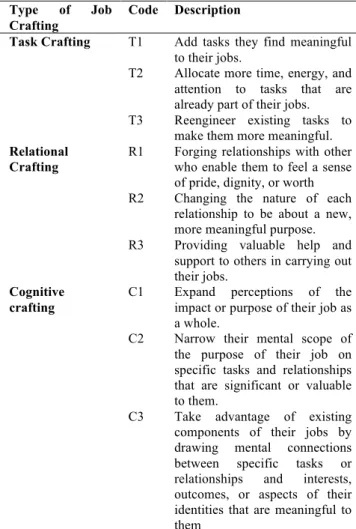
In the first place codes were derived from theory see Table 1. From the theory section it became clear that employees can engage in each type of job crafting in three different manners. Therefore the behaviors in which the experts think they will engage were categorized by the description of these different manners. Not all actions could be easily placed into these pre-established codes. However, this is not problematic because coding consists of two more aspects: (1) each unit can have more than one code, (2) hierarchical codes (one included within another) can be used (Babbie, 2010. p. 398). To illustrate this, one of the experts mentioned that ‘changing the configuration of the team in order to live up to all the ambitions’, was something that the expert would want to change in the upcoming five years. This statement is rooted in relational crafting, with a focus on providing valuable help and support to others in carrying out their jobs, thus code R3. However, this statement also deals with cognitive crafting, this by drawing a mental connection between the relationships and outcomes that are meaningful to them, thus code C3.
Multiple experts mentioned that they want to change something in the communication, this in processes within the organization, with colleagues, with third parties. The first one got code T2, since the experts want to allocate ‘more time into the communication process within the company’. The latter two were coded with R2, because these statements were more about changing the nature of each relationship, ‘better communication between the colleagues’.
Eventually all the statements were classified by means of Table 1, since the answers on the last question could also be traced back to the three existing types of job crafting. However, more distinctions could be made in the case of relational crafting. Since the relations can occur with colleagues, but also with third parties such as the patients, the citizens and suppliers. Finally, to account for consistency in the codes over time, the classification was done at one point and five days later the data was classified once again. Of the 86 statements, 4 were replaced, which means that there is consistency over time in
95,3 percent of the cases. Unfortunately inter-rater reliability has not been accounted for, thus other people did not code the statements. However, the pre-established coding system was developed in consultation with another person.
Naturally the Perceived Person-Environment Fit Scale also had to be analyzed. This was done through calculating the means for each Fit Scale. When the mean was below 5,5 the expert was indicated with a low fit, when the mean was 5,5 or above, the expert was indicated with a high fit.
Table 1: Codes for job crafting, based upon Berg, Dutton, & Wrzesniewski (2013)
Type of Job Crafting
Code Description
Task Crafting T1 Add tasks they find meaningful to their jobs.
T2 Allocate more time, energy, and attention to tasks that are already part of their jobs. T3 Reengineer existing tasks to
make them more meaningful. Relational
Crafting
R1 Forging relationships with other who enable them to feel a sense of pride, dignity, or worth R2 Changing the nature of each
relationship to be about a new, more meaningful purpose. R3 Providing valuable help and
support to others in carrying out their jobs.
Cognitive
crafting C1 Expand perceptions of the impact or purpose of their job as a whole.
C2 Narrow their mental scope of the purpose of their job on specific tasks and relationships that are significant or valuable to them.
C3 Take advantage of existing components of their jobs by drawing mental connections between specific tasks or relationships and interests, outcomes, or aspects of their identities that are meaningful to them
3.1.3 Creating the Questionnaire of Round two
Based upon the classification of the first round of data, a new questionnaire was established for the second round of this Delphi study. The goal of this second round is to reach consensus about the future expectations on job crafting and eventually to answer the research question. This through confronting the experts with each other’s ideas and insights (Dalkey, & Helmer, 1963; Bijl, 1991; Kieft, 2011). That is the reason why a first round was conducted, in which the multiple opinions of the experts were collected.
converging effect, facilitating choices by restricting the choices (van Houten, & van der Zee, 1980; Kieft, 2011). Since the experts, in this round, do not have to think of behaviors themselves, but they are provided with the expectations of other experts and they have to indicate whether they will also engage in this behavior in five years from now.
From the first round it became clear that most experts expect that they will engage more in task crafting and relational crafting as compared to cognitive crafting. This resulted in more statements on these first two types of job crafting. Since most diverse answers were given about relational crafting, the second questionnaire addressed most of its statements to this type of job crafting. The experts indicated a distinction between relationships within the company and with third parties, therefore statements had to address both types of relationships. Eventually, this resulted in twelve statements on relationships within the company and four statements about the relationships with third parties. The second questionnaire included eleven statements on job crafting, especially when it came to allocating more time and energy to tasks and reengineering them. Finally there were four statements about cognitive crafting, since the experts did not really indicate that they would change something about the meaning of their job. The full second questionnaire, consisting of 31 statements, can be found in Appendix B.
Due to the fact that the function specific outcomes from the first round were transformed in more general statements, in order to make the second questionnaire applicable to all experts, it was possible to compare this second questionnaire to the Job Crafting Scale of Tims, Bakker, and Derks (2011). Since the statements in the second questionnaire did have some overlap with the thoroughly developed and validated Job Crafting Scale (Tims, et al., 2011), this indirectly means that the items on the second questionnaire do, to some degree, account for validity and reliability.
The statements have to be scaled to the degree to which the experts think that they will engage in this proactive behavior in order to craft their job in the coming five years. Like the statements on Person-Environment fit from the first round, the statements on the second questionnaire also need to be ranked on a Likert scale from one to seven. This makes comparison easier in the final phase of the analysis. In the analysis the outcomes will eventually be compared to the perceived degree of Person-Environment fit by the experts. Consequently there will be looked at the degree at which the Person-Environment fit impacts the willingness to engage in job crafting behavior.
Besides scoring the statements on a 7-point Likert scale, it was also a possibility that the experts already engage in the behavior mentioned in the statements. Therefore, the experts were also provided with the opportunity to indicate their current behavior. When the experts already engage in this behavior, this means that the experts to some extent already engage in job crafting and that they are motivated to show proactive behavior.
3.1.3.1 Analysis of Round Two
Whereas coding was the main action in the first round due to the qualitative structure of the questionnaire, the second questionnaire had a more quantitative nature. Therefore a different method for analyzing the results is in place. Standards for consensus in Delphi research have never been rigorously established (Mitchell, 1991; von der Gracht, 2012). Moreover, there are a few criticisms towards measuring consensus in Delphi studies. De Meyrick (2003) indicated that there is uncontrolled growth in the ways to measure consensus in
Delphi studies, this means that there is not one specific method to measure the degree of consensus. Furthermore, Williams and Webb (1994) found that many researchers do not attempt to set a consensus level prior to beginning their survey. Von der Gracht (2012) provides his readers with multiple measures of consensus, from this paper it became clear that many Delphi studies use the interquartile range (IQR) in order to quantify consensus among an expert panel.
The IQR is the measure of dispersion for the median and consists of the middle 50 percent of the observations (Sekaran, 2003; von der Gracht, 2012). The IQR is a frequently used measure in Delphi studies, and it is generally accepted as an objective and rigorous way of determining consensus (von der Gracht, 2012). The range of the IQR depends on the number of response choices, which is seven in this second questionnaire. Von der Gracht (2012) suggests an IQR of 2 or less on a 10-unit scale, and an IQR of 1 or less for 4- or 5-unit scales. De Vet, Brug, de Nooijer, Dijkstra, & de Vries (2005) used a 7-point Likert scale in their research, they obtained consensus when the IQR was one or below. Based upon the information from other literature, I decided to determine the IQR at the level of 1,25 or less to decide on consensus. Which is in the middle of the IQRs of 1 and 2 suggested by von der Gracht (2012) with more tendency towards 1 due to the research of de Vet, et al. (2005)
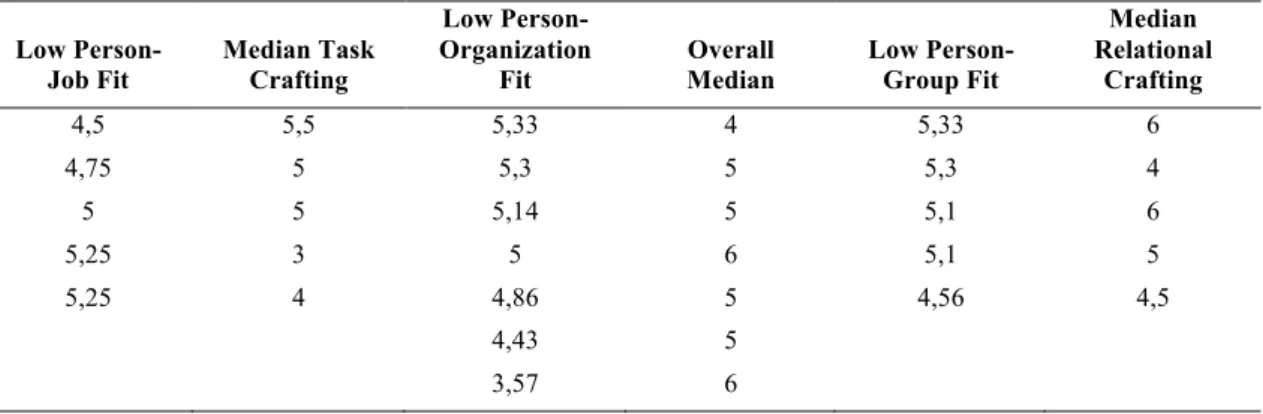
Analyzing the second questionnaire, the median for each type of job crafting was determined per expert. Resulting in three medians per expert; the overall median, the median of the items related to task crafting and the median of items on relational crafting. The use of median score, based on Likert scales, is strongly favored in literature (Hill & Fowles, 1975; Eckman, 1983; Jacobs, 1996; Hsu, & Sandford, 2007; McLeod, 2008; von der Gracht, 2012). Than, for each dimension of Person-Environment fit a ranking will be made of the experts and their median from a high to a low degree of fit (See Appendix C). With the cut-off point of 5,5 dividing the two groups. Thus for Person-Organization fit, the overall median of the whole questionnaire will be determined per expert. For Person-Job fit, the median of the items on task crafting will be indicated, and for Person-Group fit the median of the items on relational crafting will be calculated.
To see whether there is a consensus within the groups with either a high or a low fit, the IQR was determined. With an IQR of 1,25 or less indicating that there is consensus within the group.
4. RESULTS
4.1 Round one
4.1.1 Questionnaire
Analyzing the first round of the Delphi study, first the answers on the open-ended questions on job crafting were analyzed.
4.1.1.1 Task Crafting
The majority of the given answers on task crafting was found to be classified in the T2, thus allocating more time, energy and attention into existing tasks. After that the experts were most likely to reengineer their existing tasks instead of adding new tasks. However, I noticed that, in order for the experts to allocate more time into existing tasks, they first have to reengineer them to create space to allocate more time and energy to those specific tasks. Of the experts who want to add tasks, these tasks seem to have both relational and cognitive crafting components in them. For example, the experts who have a supportive role (e.g. general practitioner assistant, nurse) want to take over existing tasks of the specialist in order to help them out, be more supportive and to get a larger responsibility.
It was also found that experts who work in companies where they use a generic job description, employees are less inclined to change something about their tasks. This might be due to the fact that in generic job descriptions there is more emphasis on the nature and complexity of the tasks instead of the specific activities and tasks that are part of the job. This provides the experts with more opportunities to fit their job to their own insights and their characteristics. Therefore those experts might not really think about things they want to change because they already have more leeway to change something about their tasks, so change will proceed gradually.
Another thing that was mentioned by multiple experts, especially in the caring industry, is that the administrative tasks come at the cost of the time they have with their patients. Since most of the experts have considerable experience in their field, tenure of multiple years, they experienced that these administrative tasks are prevailing. For the future they would like to get back to basic.
4.1.1.2 Relational Crafting
The answers on the question about relational crafting could be placed most often in the category of R2, where the experts most often want to change the nature of each relationship to be more meaningful. Those relationships are not only focused on their direct colleagues, but also on the target group for which they provide services, such as the citizens of their municipality, their patients, their students and clients. What comes up is that the experts want their target group to participate in the process, this in order to provide better services. For example they want to involve their citizens in the policy process to create a better reach.
Changing the nature of the relationships with their colleagues, most experts want to establish a better cooperation with them. For example by creating more attention for teambuilding, and thus reducing the rivalry. Furthermore, some experts indicate that they want to transfer their acquired knowledge to colleagues and accompany the starters.
4.1.1.3 Cognitive Crafting
When it comes to cognitive crafting, there is not much that the experts want to change. They say that changing something about the tasks will not give their job more meaning, but will provide more of a challenge. This seems to be something most experts aim for, having a challenge in their job. Furthermore
narrowing the scope of their job on specific tasks, such as focusing on the patients, gives the experts the opportunity to deal with the increasingly administrative tasks.
4.1.1.4 Other Findings
Finally, the question about changing something other than tasks, relations or cognition, did not come up with very new insights. Most answers could be traced back to the existing codes. Especially the ones about the communication, were a bit harder to classify. For example, a few experts mentioned that they want to change something about the communication. Eventually this will have a positive impact on the relations and might ensure that the noses point in the same direction. Therefore the communication point is taken into account for the second round of data collection.
One expert thinks that the abolishment of the new ways of working (Nieuwe werken) will ensure better cooperation, since the expertise and knowledge of the team will then be raised. All team members will then know where each team member is working on, instead of working individually on reaching their own targets. However, from the theory section it became clear that there are more rapid changes in the workplace, which require more flexibility from the employees. The new ways of working are partly characterized by flexibility. Therefore, it might be assumed that the new ways of working will continue to exist in the future. Besides that, abolishing the new ways of working is not something an employee can achieve on its own. Therefore there will be no statement about the abolishment of the new ways of working, but there will be a statement about the cooperation with colleagues.
4.1.2 The Survey
After the open questions were analyzed, it was important to determine the degree of fit of each of the experts to the components of Person-Environment fit. As mentioned in the theory section, the ASA framework states that when employees experience that they do not have the same values as the company, that they will leave the company. There seems to be an agreement with the ASA framework of Schneider (1987) since none of the experts scored a statement with one or two. Besides that, barely any statement was scored with three or four points, which indicates that the overlap between the values of the employee and its work environment are quite balanced. However, there still exists a wide space where employees have the opportunity to change something about their work environment to make sure that the values of the employee and the values of the company are more aligned where needed.
The experts who perceived somewhat lower scores on the scales mentioned that they do think about changing jobs. This due to the fact that they want to pursue more of a challenge in their job and they do not see that happening in their current position. One of the reasons for staying within the company is that this provides the experts with certainty and with income.
Even the experts, who scored very high on all the components of the scale, still have things they would like to change. Especially these experts seem to be the ones who want to add new tasks to their current job description.
4.2 Round two
For the second round of the Delphi study, I yielded 17 responses out of the 19 experts who participated in the first round, thus representing a response rate of 89,5 percent. This will most likely cause no problems with analyzing the data. For the reason that there were other experts who work in the same industry.
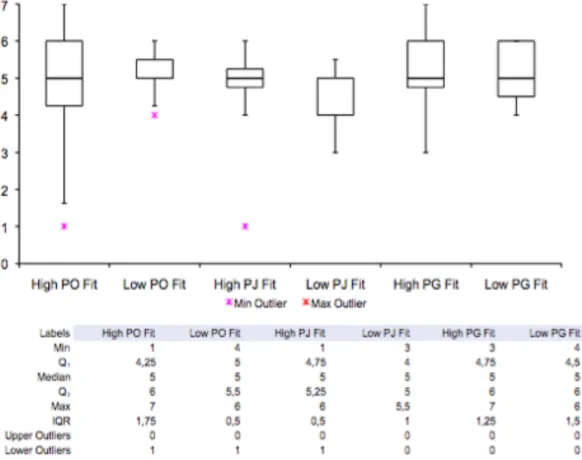
Figure 1 gives the graphical representation of the high and low Person-Job -, Person-Organization – and Person-Group fit and the distribution of the degree to which the experts in these groups are willing to engage in job crafting.
4.2.1 Person-Organization Fit and Job Crafting
Starting with the Person-Organization fit, from theory it became clear that Person-Organization fit depends both on the values of the employee and the values of the organization. Depending on those different values and needs of the employee, the employee will try to balance the Person-Organization fit by engaging in the type of job crafting that addresses this particular value or need, at least that is expected. Therefore Person-Organization fit looks at the median over the whole questionnaire. This resulted in the dispersions that are displayed in Figure 1. In the group of experts who perceive high Person-Organization fit (n
=10), there has not been reached consensus (IQR = 1,75) about the future of job crafting. This might especially be due to the statements on cognitive crafting, where the experts with high Person-Organization fit indicated that they are not really thinking about changing the meaning of their job. However, consensus has been reached in the group of experts who perceive a low Person-Organization fit (n = 7, IQR = 0.5). They
also show that they are willing to change something in their work environment to restore the balance.
Figure 1 shows that the medians of both groups are equal (Mdn = 5). The Mann-Whitney U test support the finding that both groups are equal, indicating that the willingness to engage in job crafting behavior for employees with high Person-Organization fit (Mdn = 5) is the same as for employees with a low Person-Organization fit (Mdn = 5), U = 35,5, Z = -.05, p = 1,040, r = .01.
4.2.2 Person-Job Fit and Task Crafting
Looking at Figure 1, both groups in the Person-Job fit reached a consensus, with an IQR of 0,5 for the group with high fit (n
=12) and an IQR of 1 for the group with low fit (n =5).
However, as opposed to the expectation that employees with a low Person-Job fit will report to engage in task crafting within five years, it seems like employees with a higher Person-Job fit will engage to a higher degree in task crafting. One expert with a high Person-Job fit indicates that he/she is not willing to engage in task crafting within five years from now. Than there is one employee, perceiving a low Person-Job fit, who also indicates that he/she is less willing to engage in task crafting within five years from now.
perceiving a high Person-Job fit and a low Person-Job fit.
4.2.3 Person-Group Fit and Relational Crafting
Finally, when it comes to Person-Group fit, one expert indicated on all the statements on relational crafting that he/she was already engaging in this behavior. Therefore this expert was omitted in the graphical representation in Figure 1. Resulting in eleven experts perceiving a high Person-Group fit and five experts perceiving a low Person-Group fit. Consensus has been reached in the group with high Person-Group fit, with an IQR of 1,25. No consensus is found in the group with low Person-Group fit, with an IQR of 1,5. However, the opinions of the experts with high Person-Group fit are much wider dispersed than of the group with experts perceiving a lower Person-Group fit. Of all the statements, it was most often indicated at statements of relational crafting, that the experts already engaged in some of the behaviors at this moment.
The Mann-Whitney U test was conducted to evaluate the hypothesis that employees perceiving a high Person-Group fit are equal to employees perceiving a low Person-Group fit when it comes to engaging in relational crafting. The results of the Mann-Whitney U test showed that this hypothesis had to be retained (U = 26, Z = -.16, p = .873, r = .04).
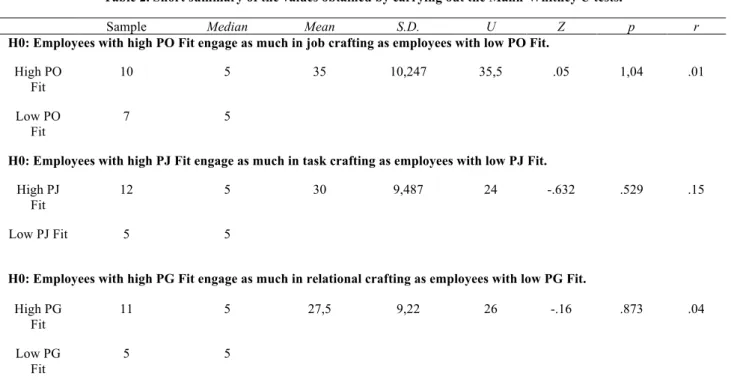
A short summary, of all the values obtained through conducting the Mann-Whitney U test, is represented in Table 2. The sample size per fit is represented, together with the median of the type of job crafting. Together with the values that are necessary for the Mann-Whitney U test, such as mean, standard deviation, the U-, Z- and p-value. Finally, the effect size (r) is also showed, representing the strength of the relationship between the two groups perceiving either high or low fit.
5. DISCUSSION AND CONCLUSION
At the beginning of this paper, there were three hypotheses concluded.
The first hypothesis was: “Employees who currently experience a low Person-Organization fit will report to engage more in job crafting within five years from now, compared to employees who currently experience a high Person-Organization fit.” Since the Mann-Whitney U test in the result section showed that the groups of experts with both high and
low Person-Organization fit are equally inclined to engage in job crafting within five years from now, this first hypothesis has to be rejected. This might result from the fact that the needs of the experts were not addressed on beforehand, therefore it was not clear which needs the experts wished to pursue and thus how they would fulfill those needs by engaging in the different types of job crafting. This might also explain the dispersion of opinions within the group of experts perceiving a high Person-Organization fit, everybody is different and thus has other values on which they focus. However, it seems like all experts will to some degree engage in job crafting behavior in the upcoming five years.
The second hypothesis, stated “Employees who currently experience a low Person-Job fit will report to engage in task crafting within five years from now.” Here too, the output from the Mann-Whitney U test showed that the willingness to engage in task crafting is equal in both groups. Therefore, this hypothesis has to be rejected too. Looking at the two most extreme cases (an overview of the scores on fit and the medians for the types of job crafting can be found in Appendix C) it looks like the experts who perceived a high Person-Job fit are the ones who engage more in task crafting, as opposed to the two experts who perceived the lowest Person-Job fit, they are the ones who state that they are not really willing to engage in behavior to change something in their tasks. However, the expert with a median of 3 on task crafting works so close with her supervisor, that it is really hard to change something about the job without having an effect on the supervisor. Thus providing a possible reason why this expert displayed a lower willingness to engage in task crafting. This finding is supported by literature, namely in order to engage in job crafting, it is important that employees perceive that there are opportunities for job crafting (Wrzesniewski, & Dutton, 2001). Whereas high task interdependence and close monitoring by the supervisor have a negative effect on the perception to craft a job, Wrzesniewski and Dutton (2001) found that flexibility in the workplace might lead to perceived opportunities to craft a job. However, in this research those perceived opportunities for job crafting have not been taken into account.
Table 2. Short summary of the values obtained by carrying out the Mann-Whitney U tests.
Sample Median Mean S.D. U Z p r
H0: Employees with high PO Fit engage as much in job crafting as employees with low PO Fit.
High PO Fit
10 5 35 10,247 35,5 .05 1,04 .01
Low PO
Fit 7 5
H0: Employees with high PJ Fit engage as much in task crafting as employees with low PJ Fit.
High PJ Fit
12 5 30 9,487 24 -.632 .529 .15
Low PJ Fit 5 5
H0: Employees with high PG Fit engage as much in relational crafting as employees with low PG Fit.
High PG
Fit 11 5 27,5 9,22 26 -.16 .873 .04
Low PG
Trying to explain the outliers on Person-Organization and Person-Job fit in Figure 1: It might be the case that the expert, who perceived a high Job fit and a high Person-Organization fit, is not willing to engage in task crafting or job crafting in general, due to the fact that this person works with a generic job description. From the results in the first rounds it already became clear that employees who work by the means of a generic job description have more leeway to change things than employees who do not work based on this description. Therefore it might be the case those employees are less inclined to think about the changes they want to establish, since it is possible to change things gradually and the experts have to think less about whether it is possible to make the change happen.
The final hypothesis was “Employees who currently experience a low Person-Group fit will report to engage in relational crafting within five years from now.” The expert who perceived the highest Person-Group fit already engages in almost all of the relational statements. Whereas the expert who perceived the lowest Person-Group fit is to a lesser degree inclined to engage in proactive relational crafting, with a median of 4,5 (See Appendix C). Than there is an expert who perceived a high Person-Group fit, but who has still the intention to change things in the relations. Resulting from the Mann-Whitney U test, this hypothesis also had to be rejected, since the outcome indicated that both groups are again equal in their willingness to engage in job crafting, in this case addressing relational crafting.
Trying to explain the findings of the research, the characteristics of the experts may also play an important role in the outcomes. Tenure for example, with a mean of 15,5 years, it might be the case that experts who have a higher tenure already did their best trying to proactively change things in their working environment in the past. It is possible that they came across difficulties then, and thus that they are less inclined to show proactive behavior in the future. Furthermore, regarding the mean age of the experts (49 years), it is a fact that people will age and thus, within five years from now, they will be closer to the retirement age (as is the case with the outlier). This provides a possible reason why experts might be less willing to engage in proactive behavior, since they will enjoy these changes for a shorter period of time. Another expert who scored high on Person-Job fit but has a mean of 4 on task crafting, underpinned this with the remark that within five years he/she is diminishing his/her tasks, due to getting closer to the retirement age.
The findings of this research may have some practical and theoretical implications.
First of all, the findings of this research have some practical implications for managers. As being mentioned in theory section, employees are no longer passive receivers of information (Daniels, 2006), this is supported by the fact that the experts showed a tendency to engage in proactive behavior within five years from now. Although there seems to be a weak relationship between the perceived Person-Environment fit and the intention to engage in job crafting behavior in the future, this does not mean that the different components of Person-Environment fit do not have a connection to the types of job crafting. The experts indicated that, within five years from now, they want to engage in behavior to keep up with the level of knowledge, skills and abilities required by their job, which are components of Person-Job fit. Besides that, the experts indicated that relational crafting is something in which, to a certain degree, they will all engage. Which may be caused by the basic human need for belongingness, as is a component of
Person-Group fit. Finally, the needs and values, which are an important part of Person-Organization fit, seem to have implications on the degree to engage in job crafting. Most experts indicated that they are looking for a challenge within their job. Trying to create those challenges, they will engage in the appropriate type of job crafting. Therefore it might be more interesting for managers to map the needs and values of their employees in order to understand the behaviors of their employees, instead of mapping the Person-Environment fit. Thus, changes will happen, however, for the manager to deal with them it might be more interesting for the manager to understand the values and needs of its employees, instead of focusing on the Person-Environment fit.
Of course this paper has some theoretical implications too. Whereas a relationship between the Person-Environment fit and the intention to engage in future job crafting was expected, this did not hold. Still the different variables that make up for Person-Organization, Person-Job and Person-Group fit, did touch upon factors that have part in job crafting. Such as the values and needs of the employees, the knowledge skills and abilities and the human need for contact and belongingness. This implicates that there are more underlying factors which influence the willingness to engage in job crafting behavior, besides the currently known antecedents of job crafting, which are the needs for control, positive image and connection to others.
Concluding, the central question of this paper was
“What are the differences between the expectations of employees with high versus low Person-Environment fit regarding the types of job crafting that will occur five years from now?” From the discussion of the hypotheses it became clear that the degree of fit on the components of Person-Environment fit does not have much influence on engaging in a certain type of job crafting. However, it was found that almost all experts expected to engage in job crafting behavior within five years from now. This is in conformity with the fact that employees are no longer passive perceivers, and that where possible they can actively engage in designing their work environment. Job crafting therefore seems to be an ongoing process and even has the tendency to become more important in the future. Some experts indicated that they already engage in relational crafting at this moment. A factor that seems to influence the willingness to engage in job crafting behavior seems to be the age; people who are reaching the pension age expect to engage a little less in job crafting behavior. Finally, the reason why employees will start to engage in job crafting behavior is dependent upon the specific needs, which the employee tries to fulfill.
6. LIMITATIONS AND FUTURE
RESEARCH
about their job or work environment.
Than there are some limitations concerning the Delphi method; one of them is provided by Gordon (1994) “Because the number of respondents is usually small, Delphis do not (and are not intended to) produce statistically significant results; in other words, the results provided by any panel do not predict the response of a larger population or even a different Delphi panel. They represent the synthesis of opinion of the particular group, no more, no less.” This means that the results found in this paper cannot be generalized to a larger population.
Another limitation of this Delphi study is the fact that a pre-determined number of rounds has been used. With a stipulated number of rounds, a certain amount of Delphi statements may not reach stability and consensus standards (Von der Grachten, 2012). Future research could therefore focus more on the arguments behind the rankings on the questionnaires. This will give more insight in to the reason why people will act like they say they will, and conclusion will be better grounded.
A remark about the age and tenure has been made in the discussion section. This may cause that some experts are not willing to change, due to possible negative experiences while trying to change previously and due to reaching the retirement age employees might not find it feasible to change since they cannot profit from the change on the long-term. Therefore it might be useful for future research to focus more on job crafting among younger workers, who still have many years of work ahead.
During the analysis phase of this research, inter-rater reliability was not taken into account, providing another limitation. This may have resulted in some miscoding with the statements from the first round.
This paper did not take the conditions into account that are necessary in order to engage in job crafting.
Wrzesniewski & Dutton (2001) mention a few contributors of the perceived opportunity to craft a job. They state that a higher degree of task interdependence will result in a lower perception of job crafting. Furthermore they found that the closeness of monitoring or supervision by management also has a negative effect on the perception to craft a job. On the other hand, with more and more flexibility in the workplace this may lead to perceived opportunities to job craft (Wrzesniewski & Dutton, 2001). However, these conditions have not been accounted for in this research. Perhaps experts would argue that these arguments are the reason why they will not engage in the future of job crafting. Letting go of the predetermined number of rounds for a Delphi study will eventually yield more indepth information about job crafting. Such as the reasons why people think that they will or will not engage in this specific behavior.
7. ACKNOWLEDGEMENTS
This paper would not have been possible without the help of many people. First of all, I would sincerely like to thank the employees who participated in this Delphi study and who were willing to spend their valuable time and effort on the two questionnaires.
Than I would like to thank my two supervisors, Dr. J.G. Meijerink and Dr. A.A.M. Wognum for their valuable knowledge and support throughout the whole process. For triggering me to reflect upon my own work, and by helping me to improve it. Furthermore, my fellow student Guus who was a great sparring partner.
Last but definitely not least I would like to thank my family for supporting me, and for listening when I had to blow off steam. Which happened a lot.
8. REFERENCES
Baumeister, R. F., & Leary, M. R. (1995). The need to belong: desire for interpersonal attachments as a fundamental human motivation. Psychological bulletin, 117(3), 497-529.
Berg, J. M., Dutton, J. E., & Wrzesniewski, A. (2008). What is job crafting and why does it matter. Retrieved from the website of Positive Organizational Scholarship on March, 11, 2015.
Berg, J. M., Wrzesniewski, A., & Dutton, J. E. (2010). Perceiving and responding to challenges in job crafting at different ranks: When proactivity requires adaptivity. Journal of Organizational Behavior, 31(2‐3), 158-186.
Berg, J. M., Dutton, J. E., & Wrzesniewski, A. (2013). Job crafting and meaningful work. Purpose and meaning in the workplace, 81-104.
Boland, C.(2011).Boetseer je baan: hoe je lol houdt in je werk zonder van baan te veranderen. Intermediair 48, p. 22–27.
Boon, C. (2008). HRM and Fit: Survival of the Fittest!? (No. EPS-2008-129-ORG). Erasmus Research Institute of Management (ERIM).
Boselie, P. (2010). Strategic Human Resource Managment: a balanced approach. Berkshire: McGraw Hill. Braverman, H. (1974). Labor and monopoly capital: The
degra-dation of work in the twentieth century. New York: Monthly Review Press.
Bretz, R. D., & Judge, T. A. (1994). The role of human resource systems in job applicant decision processes. Journal of Management, 20(3), 531-551.
Cable, D. M., & DeRue, D. S. (2002). The convergent and discriminant validity of subjective fit perceptions.
Journal of Applied Psychology, 87, 875-884. Cable, D.M., & Edwards, J.R. (2004). Complementary and
supplementary fit: A theoretical and empirical integration. Journal of Applied Psychology, 89, 822– 834.
Caldwell, D. F., & O'Reilly, C. A. (1990). Measuring person-job fit with a profile-comparison process. Journal of Applied Psychology, 75(6), 648-657.
CPB. (2012). Juniraming 2012; De Nederlandse Economie tot en met 2017 inclusief begrotingsakkoord 2013.
Retrieved from http://www.cpb.nl/cijfer/scenario- middellange-termijn-de-nederlandse-economie-2013-2017
Chuang, A., Shen, C.-T. and Judge, T. A. (2015), Development of a Multidimensional Instrument of Person– Environment Fit: The Perceived Person–Environment Fit Scale (PPEFS). Applied Psychology:An International Review.
Cuhls, K. (2003). Delphi method. Fraunhofer Institute for Systems and Innovation Research, Germany, 93-113. Dalkey, N., & Helmer, O. (1963). An experimental application
of the Delphi method to the use of experts.