http://wrap.warwick.ac.uk/
Original citation:
Makridakis, Charalambos, Ortner, Christoph and Süli, Endre. (2011) A priori error
analysis of two force-based atomistic/continuum models of a periodic chain. Numerische
Mathematik, Vol.119 (No.1). pp. 83-121.
Permanent WRAP url:
http://wrap.warwick.ac.uk/43923
Copyright and reuse:
The Warwick Research Archive Portal (WRAP) makes this work of researchers of the
University of Warwick available open access under the following conditions. Copyright ©
and all moral rights to the version of the paper presented here belong to the individual
author(s) and/or other copyright owners. To the extent reasonable and practicable the
material made available in WRAP has been checked for eligibility before being made
available.
Copies of full items can be used for personal research or study, educational, or
not-for-profit purposes without prior permission or charge. Provided that the authors, title and
full bibliographic details are credited, a hyperlink and/or URL is given for the original
metadata page and the content is not changed in any way.
Publisher’s statement:
The final publication is available at Springer via
http://dx.doi.org/10.1007/s00211-011-0380-5
note on versions:
The version presented here may differ from the published version or, version of record, if
you wish to cite this item you are advised to consult the publisher’s version. Please see
the ‘permanent WRAP url’ above for details on accessing the published version and note
that access may require a subscription.
(will be inserted by the editor)
A Priori Error Analysis of Two Force-Based
Atomistic/Continuum Models of a Periodic Chain
Charalambos Makridakis · Christoph Ortner · Endre S¨uli
Received: date / Accepted: date
Abstract The force-based quasicontinuum (QCF) approximation is a non-conservative atomistic/continuum hybrid model for the simulation of defects in crystals. We present an a priori error analysis of the QCF method, applied to a one-dimensional periodic chain, that is valid for an arbitrary interaction range, large deformations, and takes coarse-graining into account. Our main tool in this analysis is a new concept of atomistic stress.
Moreover, we formulate a new atomistic/continuum coupling mechanism based on coupling stresses instead of forces and extend the a priori analysis to this new method. We show that the new method has several theoretical advantages over the original QCF method.
This work was supported by the EPSRC Critical Mass Programme “New Frontiers in the Mathematics of Solids” (OxMOS). CM wishes to acknowledge the hospitality of OxMOS while visiting the Oxford Mathematical Institute. The research of CM was partially sup-ported by the FP7-REGPOT project “Archimedes Centre for Modeling, Analysis and Com-putations.” The research of CO was partially supported by the EPSRC grant “Analysis of atomistic-to-continuum coupling methods.”
C. Makridakis
Department of Applied Mathematics, University of Crete, GR 714 09 Heraklion-Crete Tel.: +30 2810 393726
Fax: +30-2810-393701 E-mail: [email protected]
C. Ortner
Mathematical Institute, University of Oxford, Oxford OX1 3LB, UK Tel.: +44 1865 615106
Fax.: +44 (0)1865 273583 E-mail: [email protected]
E. S¨uli
Mathematical Institute, University of Oxford, Oxford OX1 3LB, UK Tel.: +44 1865 273525
Keywords quasicontinuum method · force-base atomistic/continuum coupling·finite deformations· coarse graining·error analysis
Mathematics Subject Classification (2000) 65N12, 65N15, 70C20
1 Introduction
Atomistic/continuum hybrid models are often employed to describe localized defects in a long-range elastic field. While atomistic models are needed to provide accurate descriptions of defects they are usually too expensive compu-tationally to allow sufficiently large-scale simulations that resolve the elastic far-field, which can, instead, be modelled efficiently by a coarse-grained contin-uum model. Methodologies for coupling the two different material descriptions were first described in [16, 15, 24, 31]; more recent examples are [1,11, 32, 14, 28]. The numerical analysis of atomistic/continuum hybrid methods is a topic of active research [4, 5,8, 9, 11, 12, 17–19,23,25,26]. We also mention [22, 21] for recent overviews of the field.
Despite several creative (and sometimes complex) attempts [11,30,32] con-siderable obstacles remain for the formulation of accurate energy-based cou-pling mechanisms. By contrast,force-basedcoupling mechanisms [4, 16, 15, 31] are comparatively simple in their formulation and, more importantly, they do not suffer from the interfacial consistency errors exhibited by most energy-based methods [5, 23]. The force-energy-based quasicontinuum (QCF) method [4] is a prototypical example of a force-based atomistic/continuum hybrid method and is the focus of the present paper.
A series of recent articles [7–10] was devoted to the study of a linearized QCF operator in one dimension. This analysis revealed some unexpected and potentially undesirable (in)stability properties. The fact that the QCF method makes no modification of the forces at the interface gives rise to a hidden coupling mechanism that can only be observed in a weak representation of the operator and has the effect that the QCF operator is generically indefinite and that it is unstable in discrete variants of W1,p-spaces for 1 ≤ p < ∞. Nevertheless, it is possible to prove stability in a discrete W1,∞-space [9], a fact we shall also use in our error analysis.
Section 4.4. We obtain a superconvergence result that is formally of second order.
The second purpose of this paper is to formulate and analyze a new force-based coupling mechanism that does not suffer from the deficiencies of the QCF method mentioned above. Our starting point is the observation that the stress is a more natural concept in continuum mechanics than the force. Indeed, since we have a representation of the atomistic force in its weak form in terms of the atomistic stress function it is natural to couple stresses as opposed to forces (as in the QCF method). This leads to a new stress-based atomistic/continuum coupling mechanism (SAC method) that we analyze in Section 5. Our results for the SAC method are similar to those for the QCF method except that they are valid in a larger deformation regime. Moreover, we show in [20] that the SAC operator is positive definite, which might make an extension of the error analysis to two and three dimensions feasible.
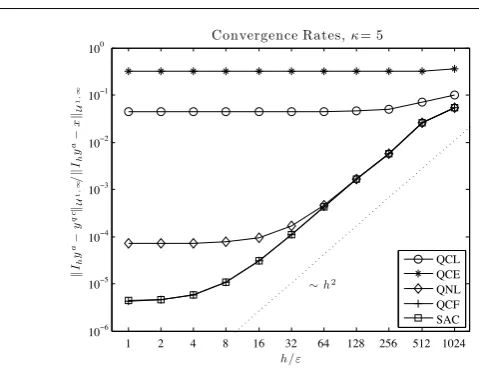
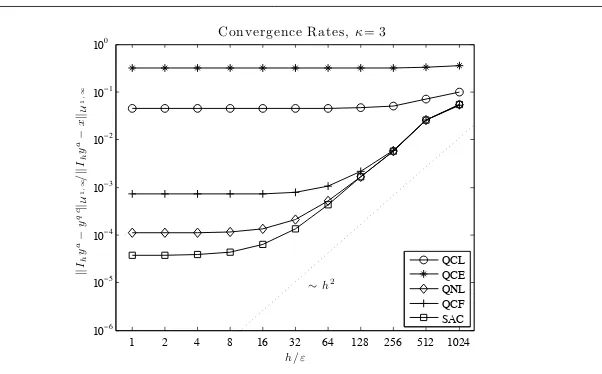
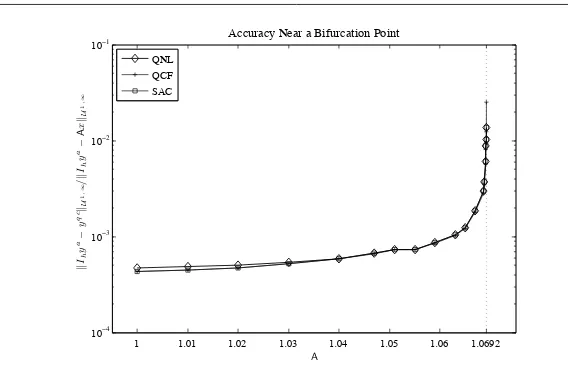
To conclude we present in Section 6 several numerical experiments con-firming our analytical results.
2 Formulation of the QCF Method
2.1 Notation for discrete functions
We begin by briefly introducing some notation for discrete functions. We shall be concerned with functions defined on Z, which we shall denote by v =
(vξ)ξ∈Z ∈RZ. Of particular interest are periodic functions with a period 2N
whereN ∈N,N≥2, is fixed throughout. The set of 2N periodic functions is
denoted byRZ#. We define the reference cell as
L=
−N+ 1, . . . , N .
Throughout, we setε= 1/N.
ForK ⊂Zandp∈[1,∞) we define the (semi-)norms, forv∈RZ,
kvk`pε(K)=
εX
ξ∈K
|vξ|p 1/p
, and kvk`∞
ε (K)=kvk`∞(K)= maxξ∈K|vξ|.
Whenever the set (K) is omitted from this notation, then it is assumed that
K=L. Forp= 2 and K=L the associated inner product is
(v, w)ε=εX ξ∈L
vξwξ forv, w∈RZ.
Using the convention 1 = (1)ξ∈Z, the set of periodic functions with mean zero is denoted by
U =
Forv∈RZwe definev0= (vξ0)ξ∈Z andv00= (vξ00)ξ∈Z, wherevξ0 denotes the backward finite difference andvξ00the centered second difference,
vξ0 =
vξ−vξ−1
ε , and vξ00=
vξ+1−2vξ+vξ−1
ε2 .
(Note that with this notation v00 6= (v0)0.) The first-order discrete Sobolev norms are defined as
kvkU1,p=kv0k`p
ε forv∈R
Z and forp∈[1,∞].
We note thatk · k`pε andk · kU1,p are norms on the spaceU.
Finally, we adopt the convention that all functions v ∈ RZ are identified
with their continuous piecewise affine interpolants with respect to the reference lattice
x= (xξ)ξ∈Z= (εξ)ξ∈Z.
With this convention we have, for v ∈ RZ and ξ ∈ Z, that vξ = v(xξ) and vξ0 =v0(s) fors∈(xξ−1, xξ).
2.2 Atomistic model problem
In order to avoid the complications associated with relaxation effects in bound-ary layers [26], or the analytical difficulties in infinite domains, we pose an atomistic model problem in a periodic domain. Recalling from (1) the defini-tion ofU, which we henceforth call thedisplacement space, we define the set of admissible deformations as
Y =
y∈RZ:y−Ax∈U andy0ξ>0 for allξ∈Z . (2)
The constantA>0 can be thought of as a macroscopic strain. Thus, admissi-ble deformations are orientation-preserving periodic displacements, with zero mean, from the homogeneous latticeAx. We have restricted the set of defor-mations to functions with positive gradient since the energy functional we are about to define only takes arguments with this property.
We assume that each atom interacts with at mostrcut∈Natoms to its left
and right, through a pair potentialφ∈C3(0,+
∞), whereφ(j),j= 0,1,2,3, are
bounded in any interval [δ,+∞),δ >0. We do not need to assume the typical convex-concave structure of Lennard–Jones-type potentials in our analysis. Theinternal stored energy(per period) of a deformationy ∈Y is given by
Φa(y) =εX ξ∈L 1 2
±rcut
X
r=±1
φ Dryξ
, where Dryξ =
yξ+r−yξ
ε .
Here, and throughout, we understand P±rcut
r=±1 as the sum from r=−rcut to
Assuming that all external forces are dead loads (i.e., they do not depend on the deformation), collected into a functiong∈U, thetotal energyis given by
Φatot(y) =Φa(y)−(g, y)ε.
The atomistic problem is to find a local minimizer ofΦa
tot in Y, that is,
Find ya∈argminΦatot(Y), (3)
where “argmin” denotes the set of local minimizers.
Remark 1 It is often asserted that more general external forces of the form g = (g(ξ, yξ))ξ∈Z, which could, for example, model a substrate in a Frenkel–
Kontorova model, are easily incorporated in the analysis. This is indeed the case when the stability analysis is based on positivity of the linearized oper-ator. However, our stability analysis is based on a technique that makes the extension to these more general external forces non-trivial. ut
2.3 The Cauchy–Born approximation
In regions of the domainL where the atomistic deformation is regular (in a sense that we will make precise) we may wish to replace the atomistic model by a continuum model. We begin by discussing the case where an atomistic deformation is smooth everywhere. In that case, the model most commonly encountered is the Cauchy–Born approximation. One way to obtain it is to take a fixed deformation ¯y = Ax+ ¯u, where ¯u ∈ C1(
R) is 2-periodic and
¯
y0>0, and let ¯y(ε)= (¯y(xξ))ξ
∈Zdenote its restriction to the lattice, to obtain
lim ε→0Φ
a(¯y(ε)) =Φc(¯y) :=Z 1
−1
W(¯y0) dx,
where the Cauchy–Born stored energy functionW is given by
W(F) = rcut
X
r=1
φ(Fr). (4)
The proof of this statement is a simple calculus exercise, which we omit. We refer to [2,13] for more sophisticated justifications of the Cauchy–Born model.
2.4 Finite element discretization: the local QC method
repatoms. We will make the same assumption here, as it simplifies some aspects of our analysis. The set of repatoms is denoted by
Lrep=ξ1, . . . , ξM ⊂ L,
where 0< M <2N andξ1< ξ2<· · ·< ξM.
We extend the grid of repatoms periodically, that is, we define (ξm)m∈Z through the conditionξm+M =ξm+ 2N for allm∈Z. We denote the
“physi-cal” positions of the repatoms byXm=xξm =εξm. We define the local mesh
size for elements and for nodes, respectively, by
hm=Xm−Xm−1 and Hm= 21(Xm+1−Xm−1) form∈Z.
We denote byS1
h the space ofpiecewise linear functionswith respect to the grid (Xm)m∈Z. Ifvh∈Sh1then we denote its nodal values byVm=vh(Xm) = vh,ξm, and its gradient in the interval (Xm−1, Xm) byVm0 = (Vm−Vm−1)/hm,
that is,
vh,ξ= Vm−1+Vm0(xξ−Xm−1) forξ=ξm−1, . . . , ξm.
We define the mesh-dependent inner product
(v, w)h= M X
m=1
Hmvξmwξm forv, w∈R
Z.
Clearly, the argumentsv, wneed not be defined on all ofRZ, but only on the
repatom grid Lrep= (ξm)Mm=1. Allowing a slight abuse of notation we will in
fact admit any such familyV = (Vm)M
m=1, etc., of nodal values as arguments
for (·,·)h. For example, we may write (vh, wh)h= (V, W)h, and so forth. Finally, we define the finite element deformation (or, trial) and displace-ment (or, test) spaces associated withY andU, respectively, as
Uh= uh∈Sh1∩RZ#: (uh,1)h= 0 =U ∩Sh1, and
Yh= yh∈Sh1:yh−Ax∈Uh andyh,ξ0 >0 for allξ∈Z =Y ∩Sh1.
For the finite element discretization of the Cauchy–Born model we approx-imate the potential of the external forces (g, y)ε using the mesh-dependent inner product (·,·)h. This gives the total energy functional for the finite ele-ment discretization of the Cauchy–Born model,
Φctot(yh) =Φc(yh)−(g, yh)h foryh∈Yh.
In terms of the vector of nodal valuesY of a functionyh∈Yh the functional Φc
tot can also be written as
Φc
tot(yh) =
M X
m=1
hmW(Ym0)− M X
m=1
where W was defined in (4). We also remark that through our identification of lattice functions with their piecewise affine interpolants the functionalsΦc
andΦc
tot can also be defined onY.
The name often given to this P1 finite element discretization of the Cauchy– Born approximation is thelocal quasicontinuum (QCL) method. Hence, in the QCL method, we aim to find a local minimizer ofΦc
tot inYh, that is:
Find yhc ∈argminΦctot(Yh). (6)
2.5 The force-based QC Method
Having defined the atomistic model and the local QC method, the definition of the QCF method will be relatively straightforward. Beforehand we briefly discuss the concepts of criticality and forces in the atomistic and continuum model.
Ifyais a solution of (3) then it satisfies the first-order criticality condition
hDΦatot(ya), vi= 0 ∀v∈U, (7)
where h·,·i : U∗×U → R denotes the duality pairing between the spaces
U∗ and U and the first variation DΦa
tot(ya) of Φatot at ya is understood to
be an element of U∗ (see Section 2.6.2 for more detail). We call a function ya satifying (7) a critical point of Φa
tot. Upon defining the internal atomistic
forces, normalized by the scaling parameterε, as
fξa(y) :=− 1 ε
∂Φa(y)
∂yξ
, forξ∈Z,
and collecting them into the vectorfa(y) = (fξa(y))ξ∈Z, the criticality
condi-tion can be written more explicitly as
(fa(y) +g, v)ε= 0
∀v∈U. (8)
Similarly, if ych∈Yhis a solution of (6) then it satisfies
DΦc
tot(ych), vh= 0 ∀vh∈Uh. (9)
We call a pointyc
hsatisfying (9) a critical point ofΦctot. In this case,h·,·ialso
denotes the duality pairing betweenU∗
h andUh. If we define the QCL force vectorFc(yh) = (Fc
m(yh))m∈Z (note thatF
c
mare generalized forces acting on degrees of freedomYm, m= 1, . . . , M) by
Fmc(yh) =− 1 Hm
∂Φc(yh)
∂Ym
form∈Z,
then the QCL criticality condition (9) is equivalent to
(Recall that arguments of (·,·)honly need to be defined onLrep.) We also define
theeffective atomistic forceson the degrees of freedomYm, m= 1, . . . , M, by Fa(yh) = (Fa
m(yh))Mm=1,
Fma(yh) =− 1 Hm
∂Φa(yh)
∂Ym ,
and extended periodically form∈Z.
Remark 2 We note that, ifξm, ξm±1 belong toLrepthenFma(yh) =fξm(yh).
To see this, we first observe that in this caseHm=ε. Expanding the partial derivative we obtain
Fma(yh) =− 1 Hm
∂Φa(yh)
∂Ym
=−1εX
η∈L ∂Φa(y)
∂yη
y=yh
∂yh,η ∂Ym
=X η∈L
fηa(yh) ∂yh,η
∂Ym .
If ξm and ξm±1 belong toLrep then ∂y∂Yh,ηm = 0 for η 6=ξ and ∂y∂Yh,ηm = 1 if
η=ξ, which shows thatFa
m(yh) =fξm(yh) is indeed true in this case. ut
To construct the QCF method, we partition the set of repatoms Lrep = La∪ Lc into the degrees of freedom for which we require atomistic accuracy, La, and those for which the accuracy of the continuum model is sufficient,Lc.
Upon defining the QCF force operatorFqc:Y
h→RZ by
Fqc(yh) = Fmqc(yh)
m∈Z where F
qc
m(yh) = (
Fa
m(yh), ifξm∈ La,
Fc
m(yh), ifξm∈ Lc,
extended periodically, the QCF method is defined by the following nonlinear variational problem:
Findyqch ∈Yh s.t. Fqc(yhqc) +g, vhh= 0 ∀vh∈Uh. (11)
Following previous analyses of the QC method [5,8, 9,6] we assume through-out that the atomistic and continuum regions take the form
La=−κ, . . . , κ}, and Lc =Lrep\ La, (12)
whereκ≥1. Moreover, we will normally assume that
{−κ−rcut, . . . , κ+rcut} ⊂ Lrep; (13)
see Figure 1 for a visualisation of La,Lc, and condition (13). Condition (13)
simplifies both the analysis and the implementation of the QCF method, and, more importantly, it guarantees a superconvergence effect that may otherwise be absent (see Remark 7). Namely, we note that (13) implies thatFa
m(yh) = fa
−κ κ κ+rcut
−κ−rcut
0
Fig. 1 Visualisation ofLa (black squares),Lc(white squares), and condition (13), with
κ= 3 andrcut= 2.
For future reference we state explicit formulas forfa
ξ andFmc. For ally∈Y, andr= 1, . . . , rcut, we have|D−ryξ|=−D−ryξ, which implies that
fξa(y) = 1 ε
rcut
X
r=1
φ0(|Dryξ|)−φ0(|D−ryξ|), and (14)
Fc
m(y) = 1 Hm
DW(Ym0+1)−DW(Ym0)
. (15)
Remark 3 (The pointwise formulation)The need for the variational formula-tion (11) of the QCF method is an artifact of the periodic boundary condiformula-tions. Preferrably, we would like to state (11) in the “pointwise” form
Fqc
m(yqch ) +g(Xm) = 0 form= 1, . . . , M.
However, it was shown in [8] that in some cases (Fqc(yh),1)h
6
= 0, that isFqc
does not mapUh toUh, and hence this “pointwise” formulation may lack a solution. In [8], to overcome this difficulty, a projection operator was used, which results in a formulation that is equivalent to our “strong variational formulation” (11). For problems with Dirichlet boundary conditions this effect
does not occur [9]. ut
2.6 Additional Notation
We conclude this section by reviewing some of the notation used in the previ-ous subsection, and introducing additional notation that will be useful in the remainder of the paper.
2.6.1 Interpolant
We note that the standard nodal interpolant does not mapU toUhand hence we define a modified nodal interpolation operatorIh:U →Uhas follows:
Ihu∈Uh s.t. (Ihu)ξm=uξm+C form∈Z,
where the constantCis determined through the condition (Ihu,1)h= 0. With a slight abuse of notation, we also define the nodal interpolation operator on
Y, as
[image:10.595.86.407.80.132.2]Upon noting that Ihu0 coincides with the gradient of the standard nodal in-terpolant ofu, and recalling [26, Thm. A.4, Eq. (74)], we obtain the following interpolation error estimate:
kIhy0−y0k`∞({ξm−1+1,...,ξm})≤
1
2hmky00k`∞({ξm−1+1,...,ξm−1}). (17)
2.6.2 Duality
The spaces of linear functionals acting onU andUhare denoted, respectively, byU∗andUh∗, and both corresponding duality pairings byh·,·i, that is,
hT, vi forT ∈U∗, v∈U, and hT, v
hi forT ∈Uh∗, vh∈Uh.
For example, we understand the first variation of the atomistic functional, DΦa
tot, as an element of U∗. However, it can also be applied to coarse test
functions from Uh and it can then also be understood as an element of Uh∗. The same is true for the first variation of the continuum modelDΦc
tot. A force
vector fa(y) (or the external force vector g) can also be understood as an
element ofU∗ orU∗
h via the interpretation
hfa(y), v
i= (fa(y), v)ε or
hfa(y), v
hi= (fa(y), vh)ε.
We stress, however, that we always understandFqc(yh) as an element ofU∗ h. The topological duals of U1,p and U1,p
h are, respectively, denoted by
U−1,p0 and U−1,p0
h , where 1/p+ 1/p0 = 1, 1 ≤ p≤ ∞. They are equipped with the usual dual norms (or, negative norms)
kTkU−1,p0 = sup
v∈U
kvkU1,p=1
hT, vi and kTkU−1,p0
h = vsup∈U h
kvkU1,p=1
hT, vi.
2.6.3 Local bounds on the deformation gradient and on the potential
It will be convenient on several occasions to roughly estimate deformation gradients below, in order to then get rough bounds on (derivatives of) the interaction potential from above. To this end, we define the following notation:
µaξ(y) = min ζ∈Z
|ζ−ξ|≤rcut−1
y0ζ fory∈RZ, (18)
µqcξ (y) =
µa
ξ(y), if −κ≤ξ≤κ+ 1, y0ξ, otherwise.
(19)
The valueµa
ξ(y) gives a lower bound ony0ζ in the interaction range of the bond (ξ−1, ξ), andµqcξ (y) gives a similar bound, but takes into account that the interaction range is limited to the bond itself in the continuum model.
Given a lower bound µ on the local deformation gradient, we can obtain upper bounds on derivatives of the interaction potential as follows:
φ(j)(µ) := sup
t≥µ|
3 The Atomistic Stress Function
In the language of finite element analysis, (8), (10), (11) might be considered thestrong formulations of the atomistic, QCL and QCF models, whereas, in the present section, we are deriving correspondingweak formulationsin terms of stress functions. Model error estimates for the stress functions will then quickly lead to sharp consistency error estimates in negative norms, which occur naturally in the error analysis.
We remark that negative norm techniques for finite difference methods go back to the work of Tikhonov and Samarskii [33], where they were developed for the construction and analysis of finite difference discretizations of diffusion equations with non-smooth coefficients and on non-uniform meshes.
3.1 Derivation of the stress functions
Recall from Section 2.4 the notationVm=vh(Xm) =vh,ξm andVm0 = (Vm− Vm−1)/hmfor finite element functionsvh∈Sh1. We begin by deriving the weak formulation of the QCL method. A straightforward and standard calculation, starting from (5), gives the following representation of the first variation of Φc. The formula (23) below is obtained from (21) using summation by parts.
Proposition 1 Let yh∈Yh; then,
DΦc(yh), vh= M X
m=1
hmΣcm(yh)Vm0 for allvh∈Uh, (21)
where the Cauchy–Born stress function is given by
Σmc(yh) =DW(Ym0),
The functionDW,expressed in terms ofφ, reads
DW(F) = rcut
X
r=1
rφ0(Fr) forF>0. (22)
Moreover, the forces and stresses of the continuum model (or, QCL model) are related by the formula
Fmc(yh) =Hm−1
Σmc+1(yh)−Σmc (yh)
. (23)
In our next result we obtain an analogous representation of the first vari-ation of the atomistic functional Φa. The main difference is that the stress
Proposition 2 (The Atomistic Stress Function) Let y∈Y; then,
DΦa(y), v
=εX ξ∈L
σξa(y)vξ0 for all v∈U, (24)
where the atomistic stress function σa
ξ(y)is given by
σξa(y) = rcut
X
r=1
ξ−1
X
ζ=ξ−r
φ0 Dryζ. (25)
Moreover, the atomistic forces and stresses are related by the formula
fξa(y) =ε−1
σξa+1(y)−σξa(y)
. (26)
Proof As a first step we rewriteΦa(y) as
Φa(y) =ε
rcut
X
r=1
N X
ζ=−N+1
φ Dryζ,
from which we obtain the following representation ofDΦa(y):
hDΦa(y), vi=ε rcut
X
r=1
N X
ζ=−N+1
φ0 DryζDrvζ. (27)
We now write the long-range finite differencesDrvζ =ε−1(vζ+r−vζ) in terms of the nearest-neighbour differencesv0
ξ,
Drvζ =
vζ+r−vζ
ε =
ζ+r X
ξ=ζ+1
vξ0.
Inserting this formula into (27) we can obtain (24) and (25) by interchanging the order of summation as follows.
If we fix some r > 0, then we observe that the strainv0ξ occurs together with the termφ0(Dryζ) if and only if
ζ+ 1≤ξ≤ζ+r,
or equivalently, the term φ0(Dryζ) occurs together with the strain v0ξ if and only if
ξ−r≤ζ≤ξ−1.
This immediately implies (24) and (25).
To prove (26) we use summation by parts in (24) to arrive at
DΦa(y), v =X
ξ∈L
vξ σξa−σξa+1
=εX ξ∈L
vξ σξa−σ
a ξ+1
Since all periodic test functions with mean zero are admitted, this shows that (26) is correct up to some constantC, that is,
fξa= σaξ+1−σ
a ξ
ε +C. (28)
It follows from the translational invariance ofΦa (see, e.g., [8, Eq. (2)]) that
X
ξ∈L ∂Φa(y)
∂yξ = 0, that is, X
ξ∈L fξa= 0.
Summing (28), and using the periodicity ofσa
ξ, we obtain thatC= 0. ut
3.2 Model error of the Cauchy–Born stress function.
In this section we derive estimates for the difference between the atomistic and continuum stress functions. This result will be a crucial ingredient in the consistency analysis in Section 4.3. We note that at this stage finite element coarsening does not play a role.
Theorem 1 (Model Error Estimate)Recall the definitions ofDW andσa
ξ from, respectively, Propositions 1 and 2. Lety∈RZand letξ∈Zbe such that
µa
ξ(y)>0, whereµaξ is defined in (18); then,
σξa(y)−DW(y0ξ) ≤ε2
±(rcut−1)
X
s=±1
Kξ,s(2)
y0ξ+s−2y0ξ+y0ξ−s
(sε)2
+K
(3)
ξ,s
yξ0+s−yξ0
sε
2 ,
(29) where the decay factors Kξ,s(j),j= 2,3, are defined by
Kξ,s(j)= s
2
2 rcut
X
r=|s|+1
(r− |s|)φ(j) rµa
ξ(y)
, (30)
andφ(j) is defined in (20).
Remark 4 The decay factorsKξ,s(j)describe the rate of decay of the interaction potential. They quantify the observation that, even though the model error estimate does depend nonlocally on second and third finite difference quotients, the impact of longer-range dependence decays rapidly provided the interaction potential decays rapidly as well.
We also note that an inspection of the proof of Theorem 1 shows that the termrµa
ξ(y) may be replaced byry0ξin the definition of the constantK
(2)
ξ,s, but not in the definition of Kξ,s(3). Moreover we will use Kξ,s(2) below in situations
Proof We setµa
ξ :=µaξ(y) andσaξ :=σaξ(y) throughout. Recalling the formulas (22) and (25), we obtain
σξa−DW(y0ξ) = rcut
X
r=1
ξ−1
X
ζ=ξ−r
φ0 Dryζ− rcut
X
r=1
rφ0(ryξ0)
= rcut
X
r=1
ξ−1
X
ζ=ξ−r
φ0 Dryζ−φ0(ry0ξ) .
(31)
We note that the stated model error estimate is second order in ε, and hence we need to expand the difference φ0(Dryζ)−φ0(ry0ξ) to second order. There existsθr,ζ ∈conv{Dryζ, ryξ0}, in particularθr,ζ ≥rµaξ, such that
φ0 Dryζ
−φ0(ryξ0) =φ00(ryξ0) Dryζ−ryξ0
+12φ000(θr,ζ) Dryζ−ryξ0 2
.
Inserting this expansion into (31) yields
σξa−DW(y0ξ) ≤ rcut X r=1 φ00(ry0ξ)
ξ−1
X
ζ=ξ−r
Dryζ−ry0ξ + 1 2 rcut X r=1
ξ−1
X
ζ=ξ−r
φ000(θr,ζ)
Dryζ−ry0ξ 2
=: T1+ T2.
Estimating T2. We split the long-range interactionDryζ into short range interactionsyη0, and then employ the Cauchy–Schwarz inequality to bound
Dryζ−ryξ0 2
= ζ+r
X
η=ζ+1
(yη0 −y0ξ) 2
≤r ζ+r X
η=ζ+1
yη0 −yξ0
2
,
to obtain
T2≤1
2 rcut
X
r=1
ξ−1
X
ζ=ξ−r r
φ000(θr,ζ) ζ+r X
η=ζ+1
y0η−y0ξ
2
.
Next, we change the order of summation from (r, ζ, η) to (η, r, ζ). To this end, we consider the following equivalences,
( 1≤r≤r
cut
ξ−r≤ζ≤ξ−1
ζ+ 1≤η≤ζ+r
)
⇔
1≤r≤rcut
ξ−(r−1)≤η≤ξ+ (r−1) (η−r)∨(ξ−r)≤ζ≤(η−1)∧(ξ−1)
⇔
ξ−(rcut−1)≤η≤ξ+ (rcut−1) |ξ−η|+ 1≤r≤rcut
(η∨ξ)−r≤ζ≤(η∧ξ)−1
where we have used the notation a∧b = min(a, b) and a∨b = max(a, b). Employing (32) we obtain
T2≤
1 2
ξ+(rcut−1)
X
η=ξ−(rcut−1)
y0η−y0ξ
2 Xrcut
r=|ξ−η|+1
(η∧ξ)−1
X
ζ=(η∨ξ)−r
φ000(θr,ζ)
. (33)
Using the fact thatθr,ζ≥rµaξ, we deduce the estimate
|φ000(θr,ζ)| ≤ sup t≥rµa
ξ
|φ000(t)|=φ000(rµa
ξ),
and hence,
(η∧ξ)−1
X
ζ=(η∨ξ)−r
φ000(θr,ζ)
≤ φ000(rµaξ)·
(η∧ξ)−1
− (η∨ξ)−r + 1
= φ000(rµa
ξ)·
r− |η−ξ| .
Settings=η−ξin (33), and noting that all inner terms disappear fors= 0, we obtain
σaξ−DW(yξ0) ≤
±(rcut−1)
X
s=±1
1 2
rcut
X
r=|s|+1
(r− |s|)φ000(rµa
ξ)
y0ξ+s−y0ξ
2
.
Rescaling the term|y0
ξ+s−y0ξ|2 by the factor (εs)2 gives the second group in (29).
Estimating T1. We will use symmetries to carefully estimate the term
T1,r := ξ−1
X
ζ=ξ−r
Dryζ −ryξ0
,
to arrive at a third finite difference. For illustration we briefly consider the special caser= 2. In that case, we have
T1,2= yξ−εyξ−2 −4y0ξ+
yξ+1−yξ−1
ε
= (y0ξ−1+yξ0)−4y0ξ+ (y0ξ+y0ξ+1)
= yξ0+1−2y0ξ+y0ξ−1,
which is indeed a third finite difference. For general r, a similar but more involved calculation, which is carried out in detail below, yields
T1,r = r−1
X
s=1
(r−s) yξ0+s−2y0ξ+y0ξ−s
. (34)
Inserting (34) into the definition of T1, and rescaling the third finite difference
by (sε)2, we obtain
T1≤ε2
rcut
X
r=2
φ00(ryξ0)
r−1
X
s=1
s2(r −s)
yξ0+s−2yξ0+yξ0−s
(sε)2
Exchanging the order of summation, we arrive at the estimate
T1≤ ε2
rcut−1
X
s=1
n s2
rcut
X
r=s+1
(r−s)|φ00(ryξ0)| o
y0
ξ+s−2y0ξ+y0ξ−s
(sε)2
.
Estimating|φ00(ryξ0)|above byφ00(rµaξ) and replacing the first sum froms= 1 to (rcut−1) with a sum from−(rcut−1) to (rcut−1), thus gaining a factor
of 1/2, we obtain the first group in (29).
(Proof of (34)) We rewrite the long-range difference as a sum of discrete strains, to obtain
T1,r= ξ−1
X
ζ=ξ−r
yζ+r−yζ
ε −ry0ξ
= ξ−1
X
ζ=ξ−r ζ+r X
η=ζ+1
(y0η−y0ξ).
Next, we interchange the order of summation,
T1,r=
ξ+(r−1)
X
η=ξ−(r−1)
(yη0 −yξ0)
(η−1)∧(ξ−1)
X
ζ=(η−r)∨(ξ−r)
1 =
ξ+(r−1)
X
η=ξ−(r−1)
(yη0 −yξ0) r− |η−ξ|
.
Combining the terms forη=ξ−sandη=ξ+s,s= 1, . . . , r−1, yields
T1,r= r−1
X
s=1
(yξ0+s−2yξ0 +y0ξ−s)(r−s),
which is precisely the desired formula. ut
4 Analysis of the QCF Method
4.1 Weak form of the QCF method
For our analysis of the QCF method, we first need to derive its “weak” for-mulation, by performing summation by parts on the strong form of the QCF equation (11). However, before we can state the result in a convenient way we need to introduce some additional notation.
We useK, K ∈ {1, . . . , M}to denote the indices of the degrees of freedom corresponding to the interface atoms−κ, κ, that is,
ξK =−κ, and ξK =κ.
The set of indices of finite elements (Xm−1, Xm) that belong, respectively, to
the atomistic and continuum regions are defined as
Ma={K, . . . , K+ 1} and Mc={1, . . . , M} \ Ma.
Note that we think of the interface elements (XK−1, XK) and (XK, XK+1) as
belonging to the atomistic region. Finally, in order to unify the notation, we will also define
Σma(yh) :=σaξm(yh) foryh∈Yh and form∈ Ma. (36)
With this notation, we obtain the following result, which is a nonlinear version of [9, Lemma 1]. Our preparations in Section 3 make it straightforward to generalize the formulation and proof of this result.
Proposition 3 Let yh ∈Yh and define Σma/c =Σma/c(yh). Then, for allvh∈
Uh,
− Fqc(yh), v
hh= X
m∈Ma
εVm0Σma + X
m∈Mc
hmVm0Σmc
−VK−1(ΣKc −ΣKa) +VK+1(Σ c
K+1−Σ a
K+1).
(37)
Proof We begin by inserting (23) and (26) into (11), using nodal notation also in the atomistic region (note that, in view of Remark 2 and (13), we have Fm(yh) =fξm(yh) forξm∈ La), to obtain
−(Fqc(yh), vh)h= X ξm∈La
Vm Σam−Σma+1
+ X
ξm∈Lc
Vm Σcm−Σmc+1
.
We now consider the two “connected components” ofLaandLc and perform
summation by parts in each such component separately.
Letm=K+ 1 and m=K−1 +M, then, using periodicity,
X
ξm∈Lc
Vm(Σmc −Σmc+1) =
m X
m=m
Vm Σmc −Σmc+1
= m X
m=m
VmΣmc − m+1
X
m=m+1
Vm−1Σmc
= m X
m=m+1
hmVm0Σmc −VmΣmc+1+VmΣcm.
Inserting the definitions ofm, m, andMc, we obtain
X
ξm∈Lc
Vm(Σmc −Σmc+1) =
X
m∈Mc
hmVm0Σmc −VK−1ΣcK+VK+1Σ c
K+1.
An analogous calculation in the atomistic region, wherehm=ε, gives
X
ξm∈La
Vm Σam−Σma+1
= X
m∈Ma
εVm0Σma −VK+1Σ a
K+1+VK−1Σ a
K.
Remark 5 Our formulation of Proposition 3 in terms of the continuum and atomistic stress functions reveals that the interface terms in the weak form of the QCF method, first observed in [9], are simply jumps of the stress. In multiphysics continuum mechanics one usually requires that the (normal component of) the jump of the stress vanishes, which would correspond to removing the interface terms from the variational formulation. The analysis in [9] has shown that these terms are the origin of the poor stability properties of the QCF method. Hence, in Section 5 we will investigate a new coupling method where these terms are indeed removed. ut
4.2 Stability
The question of stability of the QCF method is exceedingly subtle and a com-plete investigation would exceed the scope of this paper. The difficulties we are facing are exclusively related to the interface terms appearing in the weak form (37). In the present paper, we will be satisfied to assume that nearest-neighbour interactions strongly dominate all other interactions. Sharper sta-bility analyses are the focus of ongoing research. In [10], for example, several sharp stability estimates are established in a special situation (linearization around the homogeneous deformation y =Ax); however, the methods devel-oped in that reference do not obviously extend to large deformations.
Note that we make no claim in the following theorem, whether γf(yh) is
positive or not. We discuss in Remark 6 whether it is reasonable to expect this, and in our a priori error analysis in Section 4.4 we will formulate this as an assumption.
Theorem 2 Let yh∈Yh; then,
inf uh∈Uh
kuhkU1,∞=1
sup vh∈Uh
kvhkU1,1=1
−DFqc(yh)uh, vhh≥γf(yh), where (38)
γf(yh) = min
ξ∈L 1 2
φ00(y0h,ξ)− rcut
X
r=2
r2φ00 rµqc ξ (yh)
− max
ξ∈{−κ,κ+1} 1 2
rcut
X
r=2
r(r−1)φ00 rµa
ξ(yh)
−εC1(yh), and
C1(yh) = max
ξ={−κ,κ+1}
±(rcut−1)
X
s=±1
|s|−1Kξ,s(3)
yh,ξ0 +s−y0h,ξ
sε .
The decay factorsKξ,s(3) are defined in (30), and the functions φ(j) in (20).
Many of the techniques we use in the proof of this result are closely related to those used in [4,9,8, 26]. We begin by computing a “weak form” of the linearization of Fqc. To this end, recall the definitions of
Ma,Mc from the
Proposition 4 Let yh∈Yh, anduh, vh∈Uh; then,
− DFqc(yh)uh, vhh= X
m∈Ma
M X
n=1
hmHam,nVm0Un0 + X
m∈Mc
M X
n=1
hmHcm,nVm0 Un0
−VK−1
M X
n=1
HcK,n− HaK,n
Un0 +VK+1
M X
n=1
HcK+1,n− H
c
K+1,n
Un0,
(39)
where
Hc
m,n=
D2W(Y0
m), ifm=n,
0, ifm6=n, and
Ham,n=
rcut
X
r=|ξm−ξn|#+1
(ξm∧ξn)−1
X
ζ=(ξm∨ξn)−r
φ00(Dryζ),
with the notation|ξm−ξn|#:= min{|ξm−ξn|,|ξm−ξn+M|,|ξm−ξn−M|}.
Proof It is easy to see that
DΣmc(yh)uh=D2W(Ym0)Um0 ,
which immediately leads to the definition ofHc.
The corresponding formula forDΣa
mis more complicated. For ease of no-tation, we replaceξm byξ,ξn byη, andyh, uh, vh byy, u, v. Linearization of σa
ξ(y) yields
Dσaξ(y), u
= rcut
X
r=1
ξ−1
X
ζ=ξ−r
φ00(Dryζ)Druζ = rcut
X
r=1
ξ−1
X
ζ=ξ−r
φ00(Dryζ) ζ+r X
η=ζ+1
u0η.
Using (32) to rearrange the order of summation, we obtain
Dσaξ(y), u
=
ξ+(rcut−1)
X
η=ξ−(rcut−1)
u0η
( (ξ∧η)−1
X
ζ=(ξ∨η)−r
φ00(Dryζ) )
,
which gives the stated formula forHa
m,n.
Inserting the linearizations ofΣma/cinto the weak form (37) gives the stated weak form of the linearized QCF operator. ut
Our proof of the stability result will be based on the following basic inf-sup stability lemma.
Lemma 1 Let (Jm,n)M
m,n=1⊂Rsatisfy Jm,m>0 form= 1, . . . , M; then,
inf uh∈Uh
kuhkU1,∞=1
sup vh∈Uh
kvhkU1,1=1
M X
m,n=1
hmJm,nUn0Vm0 ≥ min m=1,...,M
1 2
Jmm− X
Proof Fix uh ∈ Uh with kuh0k`∞ = 1, and let p, q ∈ {1, . . . , M} such that
Up0 = maxUn0 andUq0 = minUn0. Then Up0 >0 andUq0 <0, and we can define vh∈Uh via the condition
Vn0 =
(2hp)−1, n=p, −(2hq)−1, n=q,
0, otherwise.
Inserting this test function immediately gives the stated lower bound. ut
To be able to apply the previous lemma, we now need to express the inter-face terms in (39) in terms of gradients as a direct estimate through embedding inequalities would lead to grossly suboptimal bounds. Following [8, Appendix A], we use periodic Heaviside functions to rewriteVK+1andVK−1in terms of
gradients. We will use the fact (see [8, Eq. (A.2)]) that, for allv∈U,
v0= (s, v0)ε, where sξ = (
−1
2(1−εξ)−
ε
4, ξ≥1, 1
2(1 +εξ) + 5ε
4, ξ <1.
(40)
We note that the arbitrary constant factor insis chosen so thats∈U.
Proposition 5 Let yh ∈ Yh and Ham,n,Hcm,n defined as in Proposition 4; then,
− DFqc(yh)uh, vh) = X
m∈Ma
M X
n=1
hm Ham,n+Him,n
Vm0Un0
+ X m∈Mc
M X
n=1
hm Hcm,n+Him,n
Vm0Un0,
(41)
where(Hi
m,n)Mm,n=1 is defined as follows:
Him,n= Sm HcK+1,n− HKa+1,n−Sm HcK,n− HK,na
with Sm= ξm
X
ξ=ξm−1
ε hm
sξ−κ−1, and Sm= ξm
X
ξ=ξm−1
ε hm
sξ+κ+1.
Proof Using (40) we obtain
VK+1= vκ+1=
N X
ξ=−N+1
εsξ−κ−1v0ξ
= M X
m=1
hmVm0 ξm
X
ξ=ξm−1+1
ε hm
sξ−κ−1
= M X
m=1
and similarly,
VK−1=
M X
m=1
hmVm0Sm.
The result follows after inserting these formulas into (39). ut
The final step, before we can state the proof of the stability theorem, is to compute explicit bounds on the coefficientsHa
m,n,Hcm,n, and Him,n.
Lemma 2 Letyh∈Yh, letHam,nbe defined as in Proposition 4, and Him,nas in Proposition 5; then,
Ham,m− X
n6=m
|Ham,n| ≥φ00(Ym0)− rcut
X
r=2
r2φ00 rµa
ξm(yh)
, for allm∈ Ma. (42)
Moreover, recalling the definition of Kξ,s(3) in (30), we have the bound
M X
n=1
Himn
≤ max ξ∈{−κ,κ+1}
2
rcut
X
r=1
r(r−1)φ00(rµa
ξ(yh))
+ε
±(rcut−1)
X
s=±1
2
|s|K (3)
ξ,s
yh,ξ0 +s−y0h,ξ
sε
for allm= 1, . . . , M. (43)
Proof (Proof of (42)) First, we estimate the off-diagonal entries Ha
m,n with n=m+k,k= 1, . . . , rcut−1:
|Ham,m+k| ≤ rcut
X
r=k+1
ξm−1
X
ζ=ξm+k−r
|φ00(Dryζ)| ≤ rcut
X
r=k+1
(r−k)φ00(rµa
ξm(yh)).
The same estimate holds for Ha
m,m−k. Thus, summing over all off-diagonal entries gives
X
n6=m
|Hm,na | ≤ 2 rcut−1
X
k=1
rcut
X
r=k+1
(r−k)φ00(rµaξm(yh))
= rcut
X
r=2
r−1
X
k=1
2(r−k)φ00(rµaξm(yh))
= rcut
X
r=2
r(r−1)φ00(rµaξm(yh)). (44)
Similarly, we can estimate the diagonal entry Ha
mm as follows:
Ha
mm= rcut
X
r=1
ξm−1
X
ζ=ξm−r
φ00(Dryζ)≥φ00(Ym0)− rcut
X
r=2
rφ00(rµa
Combining this with the previous estimate, we obtain the stated lower bound. (Proof of (43)) From the definition of Hi
mn we have
M X
n=1 |Hi
mn| ≤(|Sm|+|Sm|) max m∈{K,K+1}
M X
n=1 |Hc
K+1,n− H
a
K+1,n|. (45)
Next, using the fact that|sξ−κ−1|+|sξ+κ+1| ≤1 for allξ(cf. [8, App. A, Proof
of Thm. 4.4]), we estimate
|Sm|+|Sm| ≤ ε hm
ξm
X
ξ=ξm−1+1
|sξ−κ−1|+|sξ+κ+1|≤ ε
hm ξm
X
ξ=ξm−1+1
1 = 1. (46)
Thus, we are left to estimate|Hc
mn− Hamn|. To this end, we first consider
|Hc
mm− Hamm|= rcut X r=1
r2φ00(rYm0)− rcut X r=1 rcut X r=1
ξm−1
X
ζ=ξm−r
φ00(Dryζ) ≤ rcut X r=2
r(r−1)φ00(rY0 m) +
rcut
X
r=2
ξm−1
X
ζ=ξm−r
φ00(rYm0)−φ00(Dryζ) .
Furthermore, a calculation along the same lines as the estimation of T2in the
proof of Theorem 1 yields
rcut
X
r=2
ξm−1
X
ζ=ξm−r
φ00(rYm0)−φ00(Dryζ) ≤ε
±(rcut−1)
X
s=±1
2
|s|K (3)
ξm,s
yh,ξm0 +s−y0h,ξm
sε . (47)
SinceHc
mn= 0 form6=n, we have
X
n6=m
|Hc
mn− Hmna |= X
n6=m
|Ha
mn|,
and we can use (44) and (47) to deduce that, form∈ {K, K+ 1},
M X
n=1
Ham,n− Hm,nc ≤ 2
rcut
X
r=2
r(r−1)φ00 rµa
ξm(yh)
+ε
±(rcut−1)
X
s=±1
2
|s|K (3)
ξm,s
y0h,ξm+s−yh,ξm0
sε .
(48)
Combining (48), with (45) and (46), we immediately obtain (43). ut
Proof (Proof of Theorem 2)We begin by noting that we have the trivial bound
D2W(Ym0) = rcut
X
r=1
r2φ00(rYm0)≥φ00(Ym0)− rcut
X
r=2
r2φ00(rµqcξm(yh)). (49)
If we now define
Jmn=
Ha
mn+Himn, m∈ Ma, Hc
mn+Himn, m∈ Mc,
then (42), (49), and (48) imply that
Jmm− X
n6=m
|Jmn| ≥2γf(yh) for allm= 1, . . . , M.
Applying Lemma 1 gives the result. ut
Remark 6 To understand how sharp the stability result, Theorem 2, is we consider the case of second-neighbour pair interactions (rcut= 2) with Morse
potential φ(t) = e−2α(t−1)
−2e−α(t−1), and homogeneous deformations y =
Ax, whereA is chosen sufficiently large so that φ00(2A) ≤ 0. In that case it was shown in [6] that the atomistic HessianD2Φa(Ax) and the QCL Hessian
D2Φc(Ax) are positive definite if and only if
φ00(A) + 4φ00(2A)>0.
(As a matter of fact, for the atomistic Hessian anO(ε2) term should be added
to the left-hand side.) By contrast, ifφ00(2A)≤0, then
2γf(Ax) =φ00(A) + 8φ00(2A).
Thus, we see that our result reduces precisely to [8, Thm. 4.4] in the case y = Axand second neighbour interaction with non-positive φ00(2A). In [8,6] it was also discussed in depth how such a stability estimate can break down near bifurcation points, even though the atomistic solution is still stable, and that, as a consequence, a bifurcation point may not be correctly predicted.
However, we mention that the above discussion only concerns the stability estimate but not the actual stability of the method. As a matter of fact, nu-merical evidence is given in [8, Conjecture 1] for stability of the QCF operator as a mapping from U1,∞ to U−1,∞ up to bifurcation points, and we make similar observations in Section 6. ut
4.3 Consistency
In the present section we prove the final ingredient required for the a priori er-ror analysis of the QCF method: the consistency erer-ror estimates. We establish these in two separate lemmas in which we treat, respectively, the consistency error for the internal and external forces. We recall from (16) the definition of the modified nodal interpolantIh:Y →Yh.
In the following lemma, we use the notation L0
Lemma 3 (Consistency of Internal Forces)Suppose that (13)holds and that y∈Y; then,
kFqc(I
hy)−fa(y)kU−1,∞
h = vsup
h∈Uh
kvhkU1,1=1
n Fqc(I
hy), vhh− fa(y), vh)ε o
≤ Eapprox+Emodel,
where the approximation errorEapproxand model errorEmodel are, respectively,
given by
Eapprox=C2 max
m∈Mc
h2mky00k2`∞({ξm−1+1,...,ξm−1}) (50)
with the constantC2= sup{18|D3W(F)|:F≥minξ∈L0cy
0 ξ}, and
Emodel= 2ε2max
ξ∈L0c
±(rcut−1)
X
s=±1
Kξ,s(2)
y0
ξ+s−2yξ0+yξ0−s
(sε)2
+K (3) ξ,s y0
ξ+s−y0ξ
sε 2 , (51)
with decay factorsKξ,s(j) defined in (30).
Proof Let (Ym)m∈Z denote the vector of nodal values of the interpolant Ihy.
Fixvh∈Uh withkvhkU1,1= 1; then, using Proposition 3,
− Fqc(Ihy), vhh+ fa(y), vhε
=
X
m∈Ma
εσaξm(Ihy)v
0 h,ξm+
X
m∈Mc
hmΣmc(Ihy)Vm0 − X
ξ∈L
εσaξ(y)v0h,ξ
+
VK+1 Σc
K+1−Σ a
K+1
−VK−1 ΣKc −ΣKa
=: Tbulk+ Tint.
First, we focus on the bulk terms. From Assumption (13) it follows that Ihyξ =yξ +C for all ξ=ζ+r, ζ ∈ La and r=±1, . . . ,±rcut. This implies
that
σξam(Ihy) =σ
a
ξm(y) for allm∈ Ma, (52)
and hence, Tbulkreduces to
Tbulk=
X
m∈Mc
hmΣmc(Ihy)Vm0 − ξm
X
ξ=ξm−1+1
εσa
ξ(y)v0h,ξ
= X
m∈Mc
ε ξm
X
ξ=ξm−1+1
DW(Ym0)−DW(yξ0)
Vm0 (53)
+ X m∈Mc
ε ξm
X
ξ=ξm−1+1
DW(yξ0)−σξa(y)
Vm0 =: T
(1) bulk+ T
(2) bulk,
where the second equality follows from the fact thatv0
Using the model error estimate from Theorem 1 to estimate the difference DW(yξ0)−σξa(y), we obtain
T(2)bulk≤ X
m∈Mc
ε ξm
X
ξ=ξm−1+1
DW(yξ0)−σξa(y) |v0h,ξ|
≤ kvhkU1,1 max
m∈Mc
max ξ=ξm−1,...,ξm
ε2
±(rcut−1)
X
s=±1
Kξ,s(2)
y0ξ+s−2y0ξ+y0ξ−s
(sε)2
+Kξ,s(3) y0
ξ+s−y0ξ
sε
2
≤ 12EmodelkvhkU1,1, (54)
where the decay factorsKξ,s(j) are defined in (30).
To estimate the differenceDW(Ym0)−DW(yξ0) appearing in T
(1)
bulkwe use
the following expansion:
DW(y0ξ)−DW(Ym0) =D2W(Ym0) yξ0 −Ihy0ξ
+12D3W(θξ) y0ξ−Ihyξ0 2
,
whereθξ ∈conv{Ym0, y0ξ}. Inserting this expansion into the first group in (53) we can estimate
ε ξm X
ξ=ξm−1+1
DW(Ihy0ξ)−DW(yξ0) ≤ ε ξm X
ξ=ξm−1+1
D2W(Ym0) y0ξ−Ihyξ0 +1 2ε ξm X
ξ=ξm−1+1
D3W(θξ)
yξ0 −Ihy0ξ
2
.
SinceIhyξn =yξn+C for alln, and since D
2W(Y0
m) is simply a constant in this sum, it follows that the first term on the right-hand side of the inequality vanishes, and we obtain
Tbulk(1) ≤4C2ky−Ihyk2U1,∞kvhkU1,1.
Using the interpolation error estimate (17) we finally arrive at
T(1)bulk≤ 4C2 max
m∈Mc 1
2hmky00k`∞({ξm−1+1,...,ξm−1})
2
kvhkU1,1
= EapproxkvhkU1,1.
(55)
To estimate the interface terms, we use Lemma 4 and Theorem 1, to obtain
Tint ≤ max
m=K,K+1
Σmc −Σma
(|VK−1|+|VK+1|)≤ 12EmodelkvhkU1,1. (56)
Remark 7 We note that both the model error Emodel and the approximation
errorEapprox are formally of second order, despite the fact that the
approxi-mation space consists only of piecewise linear polynomials. The proof of this fact for Eapprox is related to the well-known fact that, in one dimension, the
finite element approximation of an linear elliptic problem coincides with the interpolant of the exact solution; see, e.g., [3].
The occurence of this superconvergence effect also depends crucially on the assumption (13). Without it we would have been unable to assume that σa
ξm(Ihy) =σ
a
ξm(y) form∈ Ma(see (52)) and would have obtained additional
O(ε) terms in the approximation error estimate. ut
Lemma 4 We have kvhk`∞ ≤ 12kvh0k`1
ε for all vh∈Uh.
Proof This result follows from [26, Lemma A.2]. ut
Our final lemma in this section estimates the error committed by approxi-mating the inner product (g, vh)ε by (g, vh)h in the external forcing term. The following result follows immediately from the estimates in [26] (see in particular Equation (20) and the estimates at the end of Section 3.4).
Lemma 5 (Consistency of External Forces) The consistency error for the external forces is bounded as follows:
(g,·)ε−(g,·)h U−1,∞
h := vsup h∈Uh
kvhkU1,1=1
(g, vh)ε−(g, vh)h ≤ Eext,
where
Eext := max
m∈Mc
h2mmax
kg00k`∞({ξm−1+1,...,ξm−1}),
2kg0k`∞({ξm−1+1,...,ξm−1})+ 2kg
0k
`∞({ξm−1+2,...,ξm}) .
(57)
4.4 A priori error estimate
Combining the technical tools assembled in Section 4.1, 4.2, and 4.3, it is now a relatively straightforward matter to establish an existence result and an a priori error estimate.
Let us first recall the main ingredients: In the consistency analysis of Sec-tion 4.3 we can identify three sources of the consistency error: the model error
Emodel, the approximation errorEapprox, and the error due to approximation
of the external forcesEext, which are, respectively, defined in (51), (50), and
(57). We also recall the definition of the QCF stability constantγf(yh) in (38),
which we extend to ally∈Y using the same formula.
The following theorem should be read as follows: If ya is a “sufficiently
stable” solution of the atomistic model (3), and if ya andg are “sufficiently
smooth” in the continuum region, then there exists a solutionyqch of the QCF approximation (11), with quasi-optimal error estimates forya−yqc
Theorem 3 Let ya
∈Y be a critical point of the atomistic energy Φa tot, that
is, it satifies (7), and suppose that γf(ya)>0. In addition, suppose that (13)
holds.
Under these conditions there exists a constant δ >0, which depends only onmin(ya)0 and onγ
f(ya), such that, if
Emodel+Eapprox+Eext< δ, (58)
then there exists a locally unique solution yhqc ∈Yh of the QCF system (11) satisfying
kyqch −yakU1,∞≤ max
m∈Mc 1 2hmk(y
a)00k
`∞({ξm−1+1,...,ξm−1})
+ 4γf(ya)−1 Emodel+Eapprox+Eext.
(59)
Moreover, we have the superconvergence result
kyqch −IhyakU1,∞ ≤4γf(ya)−1 Emodel+Eapprox+Eext. (60)
Remark 8 1. We call estimate (60) a superconvergence result since all terms on the right-hand side are formally of second order.
2. Upon investigating the proof of the inverse function theorem, Lemma 6, it becomes clear that the factor 4 in (59) and (60) may be replaced by any constant that is strictly greater than 1, at the cost of a smaller constantδ in (58).
3. By far the most stringent condition, and the only condition we consider potentially problematic, is the stability assumptionγf(ya)>0, which we have
discussed in detail in Remark 6. ut
Before we give the proof of the theorem, we need to state two more auxiliary results. The principle underlying the existence proof is the following explicit variant of the inverse function theorem, which is inspired by [29, Section 3].
Lemma 6 ([25], Lemma 1)LetXˆ,Yˆ be Banach spaces,Aˆan open subset of ˆ
X, and letFˆ : ˆA→Yˆ be Fr´echet differentiable. Suppose thatxˆ0∈Aˆsatisfies
the conditions
kFˆ(ˆx0)kYˆ ≤η, (61)
kDFˆ(ˆx0)−1kL( ˆY ,Xˆ)≤σ, (62)
BXˆ(ˆx0,2ησ)⊂A,ˆ (63)
kDFˆ(ˆx1)−DFˆ(ˆx2)kL( ˆX,Yˆ)≤Lkxˆ1−xˆ2kXˆ forkxˆj−xˆ0kXˆ ≤2ησ, (64)
j= 1,2,
and2Lσ2η <1; (65)
then, there exists a locally uniquexˆ∈Xˆ such thatFˆ(ˆx) = 0andkxˆ−xˆ0kXˆ ≤
Motivated by the previous result, we also establish local Lipschitz continu-ity ofDFqc and, as a consequence, Fr´echet differentiability ofFqcinYh. The
proof is a simple calculus exercise and is therefore omitted.
Lemma 7 The operator Fqc is Fr´echet differentiable in Y, and, for each
µ > 0 there exists a constant L = L(µ) such that, for all yh,y¯h ∈ Yh with miny0h≥µ andmin ¯yh0 ≥µ, we have the Lipschitz condition
(DFqc(yh)−DFqc(¯yh))uh, vhh≤Lkyh−y¯hkU1,∞kuhkU1,∞kvhkU1,1
for all uh, vh∈Uh.
Proof (Proof of Theorem 3)For the sake of brevity, we sety=yathroughout
this proof. The argument is a straightforward application of the inverse func-tion theorem. In the notafunc-tion of Lemma 6 we set ˆX = Uh1,∞, ˆY = Uh−1,∞, ˆ
x0= 0, ˆF(uh) =−(Fqc(Ihy+uh) +g,·)h, and ˆA=BXˆ(0,12miny0) so that
min(Ihy0+u0h)≥ 12miny0 for alluh∈A.ˆ
Lemmas 3 and 5 give the following residual estimate
kFˆ(0)kYˆ ≤ kF qc(I
hy)−fa(y)kU−1,∞
h +k(g,·)h−(g,·)εkU− 1,∞
h
≤ Emodel+Eapprox+Eext=:η,
which establishes (61). Next, we note that
min ξ=ξm−1+1,...,ξm
µqcξ (Ihy) =Ym0 ≥ min ξ=ξm−1+1,...,ξm
µqcξ (y) for allm∈ Mc.
Moreover, using the interpolation error estimate (17), we have
|φ00(Ihyξ0)−φ00(yξ0)| ≤C312hmky00k`∞({ξm−1+1,...,ξm}),
whereC3=φ000(minξ∈L0cyξ0), and hence we obtain from the definition ofγf in
(38) that
γf(Ihy)≥γf(y)−C312 max
m∈Mc
hmky00k`∞({ξm−1+1,...,ξm}).
Thus, if
max m∈Mc
hmky00k`∞({ξm−1+1,...,ξm})≤γf(y)/C3=:δ1, (66)
then (62) holds withσ= 2/γf(y). Condition (66) may, equivalently, be written
as
Eapprox< C2δ12,
which will automatically be satisfied if we chooseδ≤C2δ12 in (58).
To satisfy (63), we require that
Lemma 7 now gives us a Lipschitz conditionL=L(µ) required in (64), and we are only left to satisfy the final condition (65), which may be rewritten as
η <(4L)−1γf2.
In summary, if
Emodel+Eapprox+Eext<min
1 4µγf,
1 4L−
1γ2 f, C2δ12
=:δ,
then all conditions of Lemma 6 are satisfied, and the existence of a solution yhqc=Ax+uh as well as the stated estimate (60) follow.
The estimate (59) is an immediate consequence of (60) and the triangle
inequality. ut
5 Formulation and Analysis of a Stress-Based Coupling Mechanism
5.1 Coupling of stresses
The analyses in [8, 9] and our own analysis of the weak form (37) of the QCF method have clearly revealed that the interface terms caused severe technical difficulties and indeed some worrying properties of the QCF method, primarily the lack of positivity of the linearized operator ([9, Thm. 1] and [8, Thm. 4.1]) and the lack ofε-uniform stability in anyU1,p-norm, 1
≤p <∞([9, Thm. 4] and [8, Thm. 4.3]). Therefore, we seek to formulate a new coupling mechanism that overcomes these deficiencies, but retains the high accuracy of the QCF method.
To motivate the new method we remark that, while forces are natural objects in atomistic simulation, the stress (and hence the weak form (21)) is a much more natural concept in continuum mechanics. Thus, it is a natural idea to couple the two weak forms of the equilibrium equations (21) and (24), which leads to the stress-based atomistic/continuum (SAC) method
Find yach ∈Yh s.t. hSac(yach), vhi= (g, vh)h ∀vh∈Uh, (67)
whereSac:Y
h→Uh∗ is defined by
hSac(yh), vhi= X
m∈Ma
εVm0Σma(yh) + X
m∈Mc
hmVm0Σcm(yh). (68)
Here we have used the notationΣc
mdefined in (21),Σma in (36), andMaand Mc in (35).
An alternative motivation for the definition of the operator Sac is that it
can be obtained from the weak form of the QCF method (37) by dropping the atomistic/continuum interface terms, thus weakly imposing equality of normal stresses at the interface between the two models.
5.2 A priori error estimates
We begin by establishing a stability result inU1,∞. For the following results we redefine the setL0
c asL0c=L \ {−κ, . . . , κ+ 1}.
Lemma 8 (Stability) Let yh∈Yh; then,
inf uh∈Uh
kuhkU1,∞=1
sup vh∈Uh
kvhkU1,1 =1
DSac(yh)uh, vh
≥γs(yh), where
γs(yh) =
1 2min
min ξ∈L0 c
D2W(y0
h,ξ), min ξ∈L\L0c
φ00(y0h,ξ)− rcut
X
r=2
r2φ00 rµa
ξ(yh)
.
Proof It is easy to see thatSac is differentiable in Yh. Defining ( Jm,n)M
m,n=1
as
Jm,n=
Ha
mn, m∈ Ma, Hc
mn, m∈ Mc,
we obtain
hDSac(yh)uh, vhi= M X
m,n=1
hmJmnVm0Un0.
The result follows by applying Lemma 1 and using (42). ut
Remark 9 We note that this stability result is valid in a larger region of de-formations than Theorem 2. To see this we show that, under reasonable as-sumptions on the interaction potential, the estimate is sharp when evaluated at a homogeneous deformation.
If we insert the homogeneous deformation y=Ax, and assume that
−φ00(rA) =φ00(rA) forr≥2
(e.g., ifφis a Lennard–Jones or Morse potential), then we obtain
γs(Ax) =
1 2min
D2W(A), φ00(A) + rcut
X
r=2
r2φ00(rA)= 1 2D
2W(A).
Hence, we have shown that DSac(Ax) is stable up to the critical strainA at
whichD2Φ
c(Ax) becomes unstable. ut
Lemma 9 (Consistency) Let y∈Y, and suppose that (13)holds; then,
kSac(Ihy) +fa(y)kU−1,∞
h ≤ E
s
approx(y) +Emodels (y) +Eext,
where the approximation errorEapproxs is given by
Es
approx=C3 max
m∈Mc
h2mky00k`∞({ξm−1+1,...,ξm−1}), (69)
with constant C3 = sup{18|D3W(F)| : F≥minξ∈L0 cy
0
ξ}, and the model error
Es
model is given by
Emodels (y) =ε2max
ξ∈L0c
±(rcut−1)
X
r=±2
Kξ,s(2)
y0
ξ+s−2yξ0+yξ0−s
(sε)2
+K
(3)
ξ,s y0
ξ+s−y0ξ
sε
2 , (70)
with decay factorsKξ,s(j) defined in (30).
Finally, we formulate a counterpart of Lemma 7, again without proof.
Lemma 10 The operator Sac is Fr´echet differentiable in Y
h and, for each µ > 0 there exists a constant L = L(µ) such that, for all yh,y¯h ∈ Yh with miny0
h≥µ andmin ¯yh0 ≥µ, we have the Lipschitz condition
(DSac(yh)−DSac(¯yh))uh, vh≤Lkyh−y¯hkU1,∞kuhkU1,∞kvhkU1,1 ∀uh, vh∈Uh.
Thus, we have all ingredients in place to establish the counterpart of the a priori existence result and error estimate of Theorem 3. The proof of the following theorem can be obtained by repeating the proof of Theorem 3 ver-batim.
Theorem 4 Let ya∈Y be a critical point of the atomistic energy Φa tot, that
is, it satifies (7), and suppose that γs(ya)>0. In addition, suppose that (13)
holds.
Under these conditions there exists a constant δ >0, which depends only onmin(ya)0 and onγ
s(y), such that, if
Es
model(ya) +Eapproxs (ya) +Eext < δ, (71)
then there exists a locally unique solution yac
h ∈ Yh of the stress coupling method (67)satisfying
kyhac−yakU1,∞ ≤ max
m∈Mc 1 2hmk(y
a)00k
`∞({ξm−1+1,...,ξm−1})
+ 4γs(ya)−1 Emodels (ya) +Eapproxs (ya) +Eext.
(72)
Moreover, we have the superconvergence result