A study into the foundation of
Compassion Focused Therapy
Yvonne Koper, S1576372 18 April 2017
Supervisor: Dr. H.R. Trompetter
Second reader: M.P.J. Sommers-Spijkerman, Msc
Psychology
2
Contents
Abstract ... 3
Introduction ... 4
Self-compassion... 4
Emotion regulation systems... 6
Operationalization of emotions ... 8
Experience sampling method ... 10
Aim of this study ... 10
Method ... 12
Participants ... 12
Procedure ... 12
Measurement Instruments... 13
Statistical analysis... 15
Results ... 16
Exploring the average emotional state of the participants ... 16
Comparing the level of Self-compassion to the activation of the contentment system ... 17
Daily hassles as a mediating effect ... 20
Discussion ... 22
Limitations ... 24
Conclusion ... 24
Bibliography ... 26
3
Abstract
Aims: The goal of this study was to test for the theory of Gilbert (2009) about the three emotion
regulation systems (threat, drive and contentment) and the influence of compassion on the
balance of the three emotion regulation systems, which is the foundation for Compassion
Focused Therapy (CFT). The aim consisted of three parts: What is the ratio of activation of the
emotion regulation systems in daily life within people? Do self-compassionate individuals
experience higher frequency of activation in the contentment system? Do people high in
self-compassion have a more activated contentment system, because self-self-compassion reduces the
experience of daily stressors, that in turn might influence the activation of emotion regulation
systems?
Methods: Data was collected using the experience sampling method, of 43 psychology students
from the University of Twente. The activation of the emotion regulation systems was determined
via the emotion quadrant, in which emotions were classified on the level of arousal and the
positive-negative dimension. An ANOVA was done to measure the relation between
self-compassion and the activation of the contentment system.
Results: The results showed that the contentment system was clearly under activated, which
supports part of Gilbert’s theory that most people have an over activated threat and/or drive
system (Drive: 39,3%, threat: 48,3%, contentment: 12,4%).However, there was no relation
found between the level of self-compassion and the experience of low arousal positive emotions
(p=.296). Also, daily hassles did not prove to mediate the relation between self-compassion and
the activation of the contentment system in terms of experienced low-arousal positive emotions.
Therefore, it can be concluded that there was no supporting evidence found in this study for the
propositions regarding the relation of compassion to the activation of the contentment system in
relation to the threat and drive systems in daily life as proposed within the theory of Gilbert
(2009). Nevertheless, there were some methodological limitations, including the emotions
quadrant as a new way of measuring emotions.Also, other researchers did find some supporting
evidence for the theory in earlier studies, and experimental results of CFT showed promising
results. Therefore, further research on the emotion quadrant and the theory of Gilbert (2009)is
4
Introduction
One day can be seen as a sum of situations. A person’s emotional state fluctuates
throughout the day, influenced by the situation and how it is perceived and coped with. For many
years, researchers have been interested in factors that promote coping and subjective well-being
(Leary, Tate, Adams, Allen, & Hancock, 2007). Many people aggravate unpleasant situations by
ruminating excessively about life’s hassles, criticizing themselves for their shortcomings and
fixating on their own problems. Research suggests that using self-compassion, a person may deal
with life’s hassles more positively (Leary, et al. 2007)(Neff, 2003a,b). Being self-compassionate
is associated with patterns of thoughts that generally facilitate people to better cope with negative
events and with the experience of lower negative emotions (Leary et al, 2007). Also, among
students it seems that self-compassion could buffer against negative emotions when experiencing
unpleasant life events. The study by Neff, Hsieh and Dejitterat (2004) suggests that
self-compassion helps facilitate the learning process by freeing individuals from debilitating
consequences of harsh criticism, isolation, and over identification in the face of failure, and
instead provides them with self-kindness, a sense of common humanity, and emotional balance.
Thus, the way a situation is coped with is important for a person’s emotional state of being.
Coping in a self-compassionate way seems to be associated with a more positive emotional state
of being.
Self-compassion
In recent years, the concept of compassion from the Buddhist practices has come under
the attention of Western scientists, because of its potential positive mental health benefits
(Gilbert, McEwan, Matos, Rivis, 2011)(Sprecher, Fehr, 2005)(Hofman, Grosman, Hinton,
2011)(Leary et al.2007). As a result of this compassion has become an extensively researched
and empirically tested construct (MacBeth & Gumley, 2012) (Neff K. , 2003a,b) (Gilbert, et al.,
2012). Gilbert (2009) defines compassion on an operational level, as an evolved motivational
system that involves skills, such as feeling, attention and behavior, and attributes, such as care
for well-being, non-judgement and empathy. By training these skills and attributes, it is argued,
negative psychological symptoms can be alleviated, which is currently one of the objectives of
5
Within this construct of compassion, there is a three-way interaction in the construct of
compassion, namely compassion towards others, compassion from others and compassion
towards oneself. In particular, self-compassion has been proven to be a predictor of a
positive mental health and therefore many researchers have focused on this part of the concept of
compassion the most (Terry & Leary, 2011)(Allen & Leary, 2010)(Leary et al., 2007)( Neff,
Rude, & Kirkpatrick, 2007)(Neff, 2011). According to Neff (2003a), one of the leaders in the
study of self-compassion, self-compassion involves “being open to and moved by one’s own
suffering, experiencing feelings of caring and kindness toward oneself, taking an understanding,
nonjudgmental attitude toward one’s inadequacies and failures, and recognizing that one’s
experience is part of the common human experience” (p. 224). There are three interrelated
components to compassion that are exhibited during times of pain and failure, namely
self-kindness, common humanity and mindfulness. Self-kindness means being kind and
understanding toward oneself in instances of pain or failure rather than being harshly
self-critical. Common humanity means perceiving one’s experience as part of the larger human
experience rather than seeing them as separating and isolating. Lastly, mindfulness means
holding painful thoughts and feelings in balanced awareness rather than over-identifying with
them. In other words, it means being in the here and now whilst acknowledging all that
is happening around us(Neff, 2003a).
Since all three components are interrelated, it is argued that self-compassion as a whole is
a healthy coping mechanism for stressful situations, such as perceived inadequacy, failure, or
general suffering (Barnard & Curry, 2011). People with more self-compassion in general have
less self-criticism, depression symptoms, anxiety, rumination, thought suppression, neurotic
perfectionism, and experience more life satisfaction and social connectedness (Neff et al.,
2007). Reasons for this include that self-compassion evokes kindness, equanimity in relation to
others, and feelings of interconnectedness. This helps individuals find hope and meaning whilst
being affected with the difficulties of daily life (Neff, Rude, & Kirkpatrick, 2007) .
To measure the construct of self-compassion, the majority of research has used the
Self-Compassion Scale developed by Neff (2003a). It measures the level of self-compassion of a
person as a fixed trait that is relatively stable over time. Although lately, the SCS has received
criticism on not entirely measuring the construct of compassion, but counterparts of
6
2016). In general it is an accepted way of measuring the concept of self-compassion and its
psychometric properties and validity have been empirically tested (Barnard et al., 2011)( Neff,
Whittaker, & Karl, 2017).
When a person responds compassionately in a social situation, he or she evokes more
positive emotions and perceives the situation as less stressful (Neff et al., 2007). Therefore, it is
suggested that when compassion is trained it may work as a buffer in developing negative
psychological symptoms (Gilbert, 2009)
Emotion regulation systems
As mentioned above, situations and thoughts influence our emotional state of being and
people with more self-compassion tend to have a more positive emotional state. According to the
theory of Gilbert (2009) our emotional state of being is managed by three emotion regulation
systems. These are the threat system, drive system, and contentment system. Depending on the
situation and the thoughts of a person, one of the systems is activated. Each of the three systems
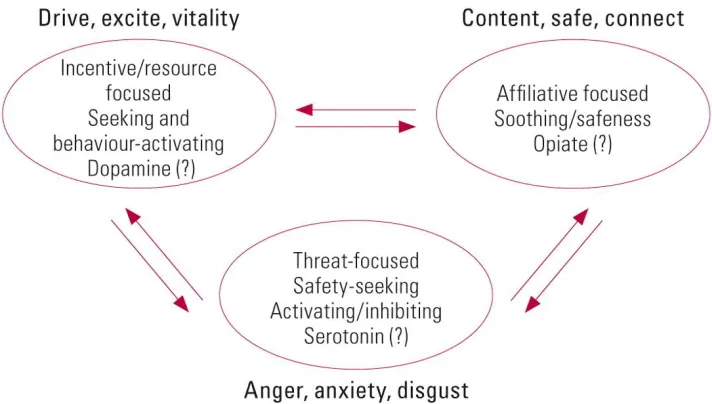
is associated with a different area in the brain and different brain chemistry. In Figure 1. the
relation between the three emotion regulation systems is shown.
When a person thinks in a compassionate way the contentment system is activated. The
purpose of this system is to manage distress and promote bonding. In this case the prefrontal
cortex is active, because the person is thinking in a compassionate way. Also the
parasympathetic nervous system is activated, which releases hormones to sooth the body. The
hormones involved in this system are believed to be opiates and oxytocin (Rockliff et al., 2008;
(Morrone-Strupinsky & Depue, 2004). Feelings associated with this emotional state of being are
safeness, contentment and compassion. Thus, thinking compassionately activates the
contentment system and puts the body and the mind into a content and calm state of
being(Gilbert, 2009).
On the other hand, when a person perceives a situation as stressful and thinks negative or
critical thoughts the threat system is being activated. The person feels threatened and the most
primal system will be activated. This system is important for our survival and is therefore easily
triggered. This system detects whether there is a threat and responds with a range of negative
7
and seek safety, through a fight, flight or freeze response. The system responds to different types
of threats or ‘stressors’ (Gilbert, 2009).
Thirdly, a person’s drive system is activated whenever there is an incentive to take action.
This is an emotional and motivational system that directs us towards a reward or resource.
Common actions include seeking food, shelter and a partner to reproduce. An activated drive
system causes high arousal positive feelings such as excitement, happiness, and amusement, and
gives us energy to attain certain desires and life goals (Gilbert, 2009). Both the drive system and
the threat system activate the sympathetic nervous system to prepare a person for action.
Although on a neurological basis the two are directed by different hormones (the drive system
via dopamine and threat system via serotonin), they both put the body in a state of
[image:7.612.113.469.325.527.2]arousal (Morrone-Strupinsky et al., 2004).
Figure 1: Emotion regulation systems.From Gilbert (2009)
According to Gilbert (2009), the processes described are oversimplifications of complex
processes. Nevertheless, the foundation of Compassion Focused Therapy (CFT) is that many
people have an imbalanced emotion regulation system, because their contentment system is
underdeveloped and/or their threat and drive system is overactive. This imbalance between the
8
person to have a more developed contentment system, so that the three systems are more in
balance. This developed contentment system can be achieved through compassion and ultimately
results in better psychological well-being (Gilbert, 2009).
While CFT has been experimentally shown to be an effective therapy for among others
mood disorders, eating disorder, psychosis and personality disorders (Leaviss, & Uttley, 2014;
Gale, Gilbert, Read, & Goss, 2012; Braehler, Gumley, Harper, Wallace, Norrie, & Gilbert,
2012; Lucre & Corten, 2012). The theoretical basis is not yet well supported by empirical
evidence. The assumption by Gilbert (2009) that a more developed contentment system leads to
a better balance between the three emotion regulation systems has been investigated by
Morrone-Strupinsky and Depue (2004), who managed to give empirical evidence for this on a
physiological level of the contentment system. On an emotional level, however, the working of
the three systems and the optimal balance between them is not entirely clear yet. The other main
assumption Gilbert (2009) makes is that a higher level of compassion leads to a more developed
contentment system, which automatically results in a better balance between the three systems.
This study aims to investigate this important assumption empirically. In order to measure the
activation of the contentment system, it is operationalized as the experience of low
arousal-positive emotions. This will be further explained in the next paragraph.
Operationalization of emotions
Both the drive system and the contentment system are associated with positive emotions
(Gilbert, 2009), even though they are associated with different emotion regulation systems. The
drive system is associated with emotions that put the body into a state of arousal, such as joy and
interest, while the contentment system is associated with emotions that have a calming effect on
the body and sooth the body, such as contentment, safeness and serenity. In order to infer
whether someone’s drive or contentment system is activated by means of measuring emotions, a
more fine-grained classification of emotions is necessary. For the purpose of this study the level
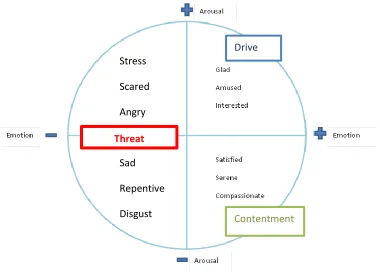
of arousal as a second dimension will be added (Figure 2). When a person experiences low
arousal positive emotions, this is associated with the activation of the contentment system. When
a person experiences high arousal-positive emotions this is associated with the activation of the
9
of emotions and therefore can determine the activation of the different emotion regulation
systems.
Before, emotions have mostly been measured via self-report measures, such as the
Positive and Negative Affect Scale (PANAS; Watson, Clark, & Tellegen, 1988), and the
Modified Differential Emotions Scale (MDES, Galanakis, Stalikas, Pezirkianidis, &
Karakkasidou, 2016). Both questionnaires consist of scale questions about the presence of
several emotions, although, the MDES includes a wider range of emotion-like states, such as
surprise and other less prototypical emotions. When questioning a wide range of emotions it is
difficult to determine the overall emotional state of being on a certain point in time. Therefore
this study has developed an emotions quadrant to measure how a person is feeling at a certain
point in time, thereby determining which emotion regulation system is activated. Other
researchers (Yik, Russell and Steiger, 2011) have introduced a similar measure in the study of
core affect. They introduced a 12 point affect circumplex for core affect, because of its greater
precision and assessment possibilities and it showed promising results. The emotions quadrant,
as shown in Figure 2. is a relatively new way of measuring emotions and will be further explored
[image:9.612.71.451.421.694.2]in the methodology section.
Figure 2: Two dimensional division of emotions Threat
Drive
Contentment Stress
Scared Angry
10
Experience sampling method
In order to understand the pattern of activation of the three emotion regulation systems,
data must be collected for one person over a period of time. Therefore, in this study the
experience sampling method is used, because research suggests that this method is the optimal
way to study a person’s emotional state of being. According to Csikszentmihalyi and Hunter
(2003) the experience sampling method was developed to determine variations in emotional state
over time. The method relies on subjects’ responses to an electronic pager that signals at random
times during the day, thereby collecting up to 49 measurements of each participant at specific
moments in time during an average week (Csikszentmihalyi et al., 2003). This gives the
opportunity to obtain data about a person’s emotional state as the situation occurs, which
minimizes the effects of reliance on memory and reconstruction (Larson & Csikszentmihalyi,
2014). Several studies show that using retrospective self-report measures results in exaggeration
of the symptoms. It seems that the length of the recall interval determines the amount of
distortion (Ebner-Priemer, U.W., & Trull, T.J., 2009). Also, in contrast to self-report measures,
this method improves generalizability of the findings, because the emotional state is measured in
the context of a person’s everyday life (Ebner-Priemer et al., 2009). Moreover, it gives the
opportunity to measure the shift in emotional state within a participant. Within the experience
sampling method, a variable of interest can be assessed repeatedly over time, resulting in time
series that enable researchers to investigate variability of experience and within person processes
(Ebner-Priemer et al., 2009). There have been other ESM studies on the emotional state of a
person (e.g. Csikszentmihalyi et al., 2003), but the emotions quadrant is a new psychometric
measure that is developed for this study in particular.
Aim of this study
The aim of this study was to test the theory of Gilbert (2009) about the emotion
regulation systems on an emotional level. The activation of the emotion regulation systems was
operationalized via the emotions quadrant and the interrelation of the three emotion regulation
systems was examined. As explained above, research suggests that compassion is related to the
activation of the contentment system and thereby having a healthier balance between the three
11
level, in which the contentment system will be operationalized as the experience of low-arousal
positive emotions.
Not only compassion could have an effect on the activation of the contentment system.
Another factor that influences the activation are daily hassles, whereby more daily hassles could
lead to less activation in the contentment system and more activation in the threat or drive
system. As mentioned in the introduction, research suggests that by using self-compassion a
person may deal with life’s hassles more positively (Leary, et al. 2007)(Neff, 2003a,b). Being
self-compassionate is associated with patterns of thoughts that generally facilitate people to
better cope with negative events and with the experience of lower negative emotions (Leary et al,
2007). Also, among students it seems that self-compassion could buffer against negative
emotions when experiencing unpleasant life events (Neff, Hsieh and Dejitterat (2004). Thus, it
seems that having a high level of self-compassion could work as a buffer for these stressors and
thereby leave the contentment system of a person activated. Therefore, daily hassles were added
as an extra variable to this relationship, in order to create a broader understanding of this
relationship and the theory of Gilbert. It was predicted that daily hassles could have a mediating
effect on the relationship between self-compassion and the activation of the contentment system.
This study aimed to investigate the following three questions.
Question 1: What is the ratio of activation of the emotion regulation systems in daily life within
people?
Question 2: Do self-compassionate individuals experience higher frequency of activation in the
contentment system?
Question 3: Do people high in self-compassion have a more activated contentment system,
because self-compassion reduces the experience of daily stressors, that in turn might influence
12
Methods
Participants
The study sample consisted of 43 psychology students from the University of Twente, of
which 79% was female and 21% male. The mean age was 20.71 years (range 18- 25 years). Only
participants who were 18 years or older and studied psychology at the Faculty of Behavioral,
Management and Social Sciences at the University of Twente were included. Students who
recently had gone through a major life event (e.g. death of a relative or illness) or who suffered
from psychopathology (e.g. depression or anxiety) were excluded from this study. Another
important inclusion criterion for this study was the motivation for participation in the study. Only
when the participant showed clear commitment to the study and thought of specific strategies to
comply with the conditions, was the participant included in the study. Participation was
voluntary and the privacy of the participants was assured. Written informed consent and ethical
approval was obtained from all participants.
Procedure
The participants were recruited through flyers and advertisements on the campus of the
University of Twente. Before the start of the experience sampling study, participants were
gathered at a kick-off meeting for a briefing on the study, where they received a letter with
information about the study and installed a mobile app UT Survey (Borgonjen, F., 2015). A
couple of days before the sampling week, the participants were asked to complete a pre-test, an
online questionnaire including the SCS-SF. Via the mobile app, the participants were monitored
for one week. At seven random times during the day they were signaled and asked to complete a
self-report, including the question on the emotion quadrant, the presence of stressors in the past 2
hours and several other experiences occurring at that moment. They completed the self-report
questionnaire in the app and the data was collected directly after the participant completed the
questions. During the week the questionnaires were sent 7 times a day, totaling 49
measurements. After completion of the study and if the participant showed sufficient
commitment, the participant received a reward of 40 euro in gift cards for their participation in
the study. If the response rate was insufficient (< 80%), the participant did not receive monetary
13
one participant who didn’t fill out the pre-test, this participant did conclude the ESM, however
these results were not included in the dataset for analysis.
Measurement Instruments
The data for this study was acquired in a larger study on self-compassion and stress in the
spring of 2015 and 2016. Of all the measures of the larger study, only those that are relevant for
this study will be explained.
Pre-test
Self-compassion
The pre-test consisted of the Dutch version of the Self-Compassion Scale-Short Form
(SCS-SF; Raes, Neff, & van Gucht, 2011)(Neff & Vonk, 2009). This scale (scale 1-7, 1 = zelden
of nooit, 7 = bijna altijd) contains twelve items (e.g., “Als ik een moeilijke tijd meemaak, geef ik
mezelf de zorg die ik nodig heb”) and assesses six different aspects of self-compassion.
Self-Kindness, Common Humanity, and Mindfulness referred to attributes of self-compassion and
Self-Judgement, Isolation and Over Identification referred to the counterparts of the
self-compassion concept. The short scale had a near perfect correlation with the long scale when
examining total scores of other studies (Raes et al., 2011). The scale also has also demonstrated
concurrent validity (e.g., correlates with therapist ratings), discriminate validity (e.g., no
correlation with social desirability), and test-retest reliability (α=.93; Neff et al., 2009).
Therefore, this questionnaire was used to measure construct of self-compassion. Although, there
has been some criticism on the total score of the Self-Compassion Scale (Muris, & Petrocchi.,
2016), latest research by Neff, Whittaker, & Karl (2017) shows that a total SCS score can be
used as an overall measure of self-compassion. Therefore, for this variable the total score on the
SCS-SF was calculated.
Experience Sampling Method (ESM)
Instead of the beepers that are most frequently used in ESM studies, for this study the UT
Survey app (Borgonjen, F., 2015) was developed to monitor the students’ emotional state
14
and could be sent to the processor available to analyze. A drawback is that the mobile app needs
an Internet connection in order to work, therefore students need an Internet connection on their
phone, which is accompanied with some costs. The app was available in the app store and was
compatible for several operating systems. There were a few mobile phones available to lend, if
participants didn’t have a mobile phone of their own. Only one participant needed to lend a
mobile phone. The variables emotions and daily hassles were measured with ESM.
Emotions
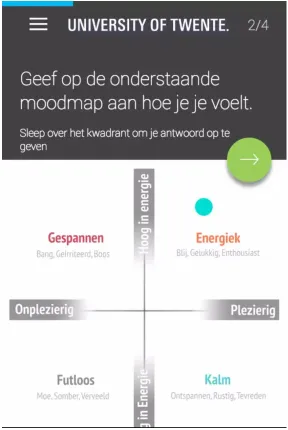
For the assignment with the emotion quadrant, participants had to place a coordinate on
the emotions quadrant that corresponded with the way they felt at that moment in time (See
appendix A for an example). The emotion quadrant is a new form of measuring and was
introduced in the literature review (Figure 1., developed during UTSurvey design, based on Yik,
Russel & Steiger, 2011). The place of the coordinate determined in which emotion regulation
system the participant was at that moment. The operationalization of the emotion quadrant was
as follows; If the coordinate was placed between the axes low arousal and positive emotions, this
participant experienced low arousal-positive emotions and therefore was categorized as being in
the contentment system. If the coordinate was placed between the axes high arousal positive
emotions, this coordinate fell into the category of high arousal-positive emotions and is labeled
as the drive system being activated. Lastly, any coordinate place on the negative axis was
categorized as negative emotions, which was theorized to indicate an activated threat system
(Figure 1.). The sum was taken for the amount of times a person scored in each the categories
over all the measure points. This led to three aggregated variables for the three total scores of the
different categories, namely high arousal-positive emotions, low arousal-positive emotions and
negative emotions. Lastly, percentages were calculated from these total scores.
Another possible variable, that was explored for the measure of the emotion regulation
systems, was based on the experience of a wide range of emotions taken from the MDES
(Galanakis, Stalikas, Pezirkianidis, & Karakasidou, 2016). However, this clustering of the
emotions into categories of the emotion regulation systems was tested negative for reliability.
Therefore, only the measure of the emotion quadrant was used as a dependent variable for this
15 Daily hassles
In order to measure whether a daily hassle was present or not in the past 2 hours, the
following question was asked: ‘What was the most stressful event in the past two hours? Leave
blank if no stress was experienced’. If a participant experienced a hassle over the past two hours,
it was coded as yes. If the participant did not experience a hassle it was coded as no. The sum
was taken from the amount of times a participant experienced a daily hassle, resulting in one
aggregated total score of the amount of hassles over the 49 measurements.
Statistical analysis
The data analysis was done in IBM SPSS Statistics 23. For this research only univariate
statistical analysis were used. For the ease of use, all variables were aggregated to one score
representing one participant.
The data was explored for outliers using descriptive statistics, however the outliers were
not excluded from the data, since the outliers were not obviously due to incorrectly entered or
measured data and they did not change the results or assumptions.
Firstly, the emotion variable was further explored, using the percentages of each category
of the emotion regulation systems. A paired sampled T-Test was done in order to test whether
the difference between the three categories was significant. The paired sample T-Test
hypothesizes that the difference between the three categories is zero. This hypothesis is rejected
when the difference in the activation of the three emotion regulation systems is significant.
Secondly, to explore the relationship between self-compassion and the activation of the
contentment system, the data was first explored within two randomly chosen participants, one
participant high in self-compassion and one participant low in self-compassion. This was
primarily done by plotting the activation of the three emotion regulation systems using SPSS, to
explore the activation of the three emotion regulation systems over the course of the week for the
two participants. In order to test the relationship on group level an ANOVA was performed
between the total score on self-compassion and the percentage of time spent in the low arousal
positive- emotions category.
Lastly, on individual level the pattern of activation of the three emotion regulation
systems was compared to the experience of daily hassles. Moreover, the mediating effect of daily
16
tested using the method of Baron & Kenny (1986). This method first calculates the correlations
of each single relationship. If all the single correlations are significant an ANOVA is done to
check for a mediating effect. Correlations were calculated between the total self-compassion
score, the percentage of the low arousal positive- emotions category reported and the sum of
daily hassles that occurred using the Pearson Correlation Coefficient. If necessary, three
ANOVA’s will be performed with the variables.
Results
Exploring the average emotional state of the participants
Every participant has an overall percentage of time the three categories of emotional state
were activated. When looking at the time all participants spend on average over the course of the
week in the three emotional states (Table 1), it is shown that most of the time was spend in the
drive and threat system. Meaning participants mostly experienced a high level of arousal, with
[image:16.612.66.535.469.553.2]both positive and negative emotions.
Table 1. Average percentages of time spend in each of the emotion regulation systems for all
participants
Emotional state Time present
High arousal - positive emotions 39,3% (Range = 56,2)
Low arousal - positive emotions 12,4 % (Range = 40,9)
Negative emotions 48,3 % (Range = 58,7)
For the average participant, it means that almost half of the time the threat system is
activated. Only 12 percent of the time a person has an activated contentment system. The other
40 percent of the time the person’s drive system was activated.
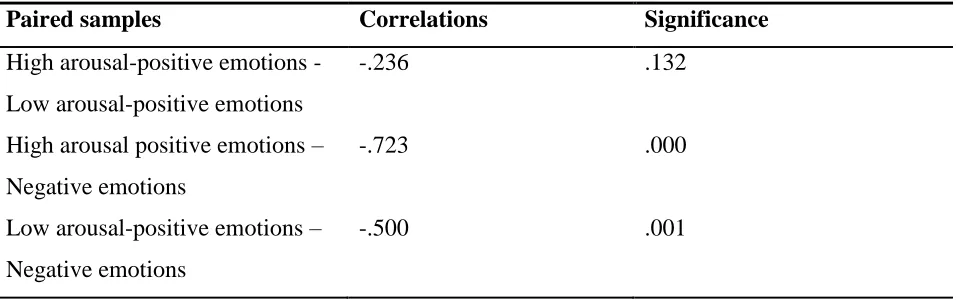
The results from the paired sample t-test show that the large difference in activation
between the three emotional states (Table 2.) is significant for two of the three relations. There is
17
meaning that the threat system was significantly more activated than the contentment system.
[image:17.612.69.554.154.304.2]Moreover, there is a significant difference in activation between high arousal-positive emotions.
Table 2. Paired Samples T-test correlations
Paired samples Correlations Significance
High arousal-positive emotions -
Low arousal-positive emotions
-.236 .132
High arousal positive emotions –
Negative emotions
-.723 .000
Low arousal-positive emotions –
Negative emotions
-.500 .001
Comparing the level of Self-compassion to the activation of the contentment system
Individual level
For exploratory purposes, the fluctuations in activation of the emotion regulation systems
during the measuring week are shown in figure 1 for two participants. For this within subject
exploration a participant with high self-compassion and one with low self-compassion was
randomly chosen.
A) Participant low in self-compassion, N = 49 (SCS = 2.58)
18 Figure 1. Pattern of activation of the emotion regulation systems over the course of the week
The participant with low self-compassion (Figure 1a) has the threat system activated the
most during the week. In particular on Saturday and Sunday, only on Saturday morning and
Sunday evening the participant felt high arousal positive emotions. For the rest of the weekend
this participant experienced predominantly negative emotions.
The participant with a high self-compassion score (Figure 1b), experienced a more varied
activation of the emotion regulation systems. On Friday on and Sunday the contentment system
was mostly activated. On the other days the pattern of activation is more varied. What does stand
out is that on Monday, Thursday, Friday and Saturday, at the first measurement of the day this
participant has an activation of the threat system, meaning that this person experienced negative
emotions in the morning. On the other days there was an activation of the threat system at the
second or third measure point, meaning this participant had an activation of the threat system
later in the morning.
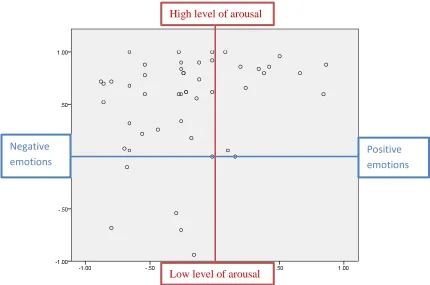
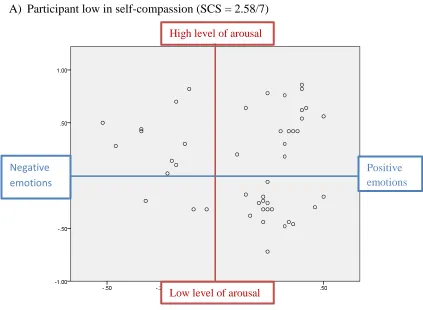
For further exploration, a scatterplot was created from the same data, to see where the
participant placed it coordinate on the emotion quadrant at the measurement points. Within the
scatterplot the division between the three emotion regulation systems is indicated.
Positive emotions
Low level of arousal Negative
emotions
19
A) Participant low in self-compassion (SCS = 2.58/7)
[image:19.612.99.522.91.401.2]B) Participant high in self-compassion (SCS = 5.42/7)
Figure 2: Scatterplot of scores on the emotions quadrant
Overall the participant low in self-compassion (Figure 2a) experienced mostly high
arousal-positive and negative emotions and some low arousal-positive emotions. This participant
had 75,5 % of the measure points an activated threat system, 22,5 % activation in the drive
system and 2 % in the contentment system.
In the participant high in self-compassion (Figure 2b.) the emotion regulation systems of
drive and contentment system were predominantly activated. The participant was 37% of the
time in the contentment system, 34.8 %in the drive system and 28.2 % in the threat system.
Group level
On group level the results from the regression of the score on the SCS on the percentage
of the contentment system show that the relationship is not significant ( p = .296). Meaning there
is no relationship found between the level of self-compassion and the experience of low
arousal-High level of arousal
Low level of arousal
Positive emotions
20
positive emotions. Thus, individuals with a high score on self-compassion don’t score more low
arousal-positive emotions and thereby are not more in the contentment system than individuals
with a low score on self-compassion.
Daily hassles as a mediating effect
Individual level
First, the daily hassles were compared with the emotional state of the same participant
with high and the participant with low self-compassion.
A) Participant low in self-compassion (SCS = 2.58)
[image:20.612.98.544.254.319.2]B) Participant high in self-compassion (SCS = 5.42)
Figure 3. Pattern of activation of the emotion regulation systems and the experience of daily
hassles over the course of the week. A red star means the participant experienced an hassle at
that measure point.
In Figure 3, the relationship between daily hassles and pattern of activation of the
emotion regulation systems is shown to be variable. Sometime the participants had an activated
contentment system at the time a daily hassle occurred and other times the participants were in
the threat or drive system. The participant who is low in self-compassion experienced 20 daily
hassles over the week. The participant who is high self-compassion experienced 30 daily hassles
during the week. On average, at 36 percent of the measure points a participant perceived a
21 Group level
For the mediating effect of daily hassles on the relationship of self-compassion and the
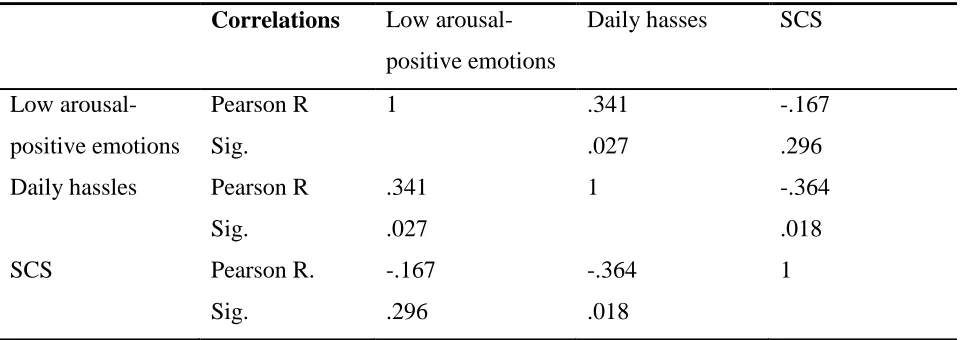
contentment system table 6 shows the correlations for each of the relationships. From the
correlations we can conclude that there is a small, but significant positive correlation between the
variables contentment and daily hassles, meaning that people who experience many daily hassles
also, in general, have an activated contentment system more often. Moreover, there is a small,
but significant negative correlation between the variables daily hassles and self-compassion. This
means that people who experience more daily hassles in general, tend to have less
compassion. Lastly, the negative correlation between the variables of contentment and
[image:21.612.67.548.340.510.2]self-compassion is not significant.
Table 6. Correlations between the variables contentment, daily hassles and self-compassion
Correlations Low
arousal-positive emotions
Daily hasses SCS
Low
arousal-positive emotions
Pearson R
Sig.
1 .341
.027
-.167
.296
Daily hassles Pearson R
Sig.
.341
.027
1 -.364
.018
SCS Pearson R.
Sig. -.167 .296 -.364 .018 1
Since, not all of the three relationships were significant, it could be concluded that there is no
mediating effect of daily hassles on the relationship between self-compassion and the activation
of the contentment system. Which means that self-compassion does not work as a buffer for the
22
Discussion
The aim of this study was to test the theory of Gilbert (2009) of the three emotion
regulation systems that is the foundation of Compassion Focused Theory(CFT). Experimentally
CFT has shown to be an effective therapy for several psychological disorders and people high in
self-criticism (Leaviss, & Uttley, 2014; Gale et al, 2012; Braehler et al, 2012; Lucre & Corten,
2012). However empirically there is not much evidence supporting the theory of Gilbert (2009)
yet, specifically, the assumption by Gilbert (2009) that people with low activation of their
contentment system have imbalanced emotion regulation systems. His second assumption was
that a more developed contentment system leads to a better balance between the three emotion
regulation systems. The third main assumption that Gilbert (2009) makes is that a higher level of
compassion leads to a more developed contentment system. Only on a physiological level
Morrone-Strupinsky and Depue (2004) found some evidence supporting the assumptions of the
foundation of the theory, namely that the contentment system and the drive system are associated
with different nervous systems and different hormones.
In order to test the assumptions on an emotional level, this study first investigated the ratio of
activation of the emotion regulation systems in people. The results showed that indeed the threat
and drive system were significantly activated the most, in almost 90% percent of all the
measurements one of either was activated. The contentment system was significantly under
activated compared to the other two. This shows evidence for the assumption of Gilbert (2009)
that most people have an over activated threat and/ or drive system. As argued above an over
activated threat system, leading to experiencing negative emotions and thinking negative
thoughts could in turn lead to psychological problems in the long term (Leary, et al. 2007).
Therefore, focusing on rebalancing the system by focusing on developing the contentment
system seems to be an accurate goal according to the findings.
Secondly, the relationship between self-compassion and the activation of the contentment
system at an individual and group level was investigated. On the individual level the results for a
participant high in self-compassion did show a more varied activation pattern of the three
emotion regulation systems, in which the contentment system was activated about 37% percent
of the time. Compared to the participant low in self-compassion, who only spent 2% percent of
23
relationship was found between the activation of the contentment system and the level of
self-compassion. Therefore, these results did not support the second assumption of Gilbert (2009)
that people who have more self-compassion also experience more low arousal-positive emotions
and thereby have a more developed contentment system. This is contrary to what other research
predicted, namely that self-compassion could buffer against the experience of negative emotions
and have positive effect on the emotional state of being (Neff et al., 2007).
A reason for the findings not supporting previous findings and the predictions could be that,
in general, the contentment system showed very little activation, meaning that the statistical
analyses were performed on a small part of the total data. Ideally, a larger dataset would also
mean more measure points for the contentment system, thereby giving more accurate results.
Moreover, measuring emotions via an emotion quadrant is a new way of measuring. It was a first
trial of a new approach to the measure of emotions. The advantage of this emotion quadrant
could be that the participant can indicate exactly how it feels in the quadrant and is not bound to
a certain set of descriptive emotions. A disadvantage could be that on the basis of one measure a
prediction is done in which type of emotion regulation system that person is. Ideally this is done
with more than one measure, for example an extra psychological or physiological measure.
However, other options that were explored were difficult to operationalize and cluster.
Therefore, this emotion quadrant may be a good alternative if explored further and tested on
validity and reliability.
Thirdly, it was investigated whether people high in self-compassion had a more activated
contentment system, because it works as a buffer for daily stressors. Earlier studies found that
having a high level of self-compassion is associated with patterns of thoughts that generally
facilitate people to better cope with negative events and with the experience of less negative
emotions (Leary et al, 2007). On an individual level, the pattern of activation of the three
emotion regulation systems and the experience of daily hassles showed no particular pattern of
correlation. The daily hassles occurred with different emotion regulation systems activated.
Unfortunately, also the results on group level did not support the prediction and previous
research either. There was no mediating effect found, meaning that the prediction that
self-compassion works as a buffer for the experience of daily hassles, thereby keeping the
contentment system activated was not supported. A reason for the findings not supporting the
24
small hassles, such as rain outside or missing a train, thereby not influencing the overall mood of
the participant. Therefore, the amount of daily hassles that actually cause stress could have been
inflated. Moreover, the presence of daily hassles in the past two hours of the measurement point
were aggregated to an overall daily hassle score and compared with the total aggregated score of
the amount of times a person was in the contentment system at the precise moment of measure.
In this case two different time elements were compared. Namely, daily hassles in the past two
hours and the activation of the contentment system at the precise moment of measure. It could be
that by eliminating this time element through aggregation.
Limitations
Since the experience sampling method was used, the data that was collected makes it
possible to analyze within subject and between subjects. For this dataset all the data was
aggregated to make univariate analysis between subjects. When aggregating the data, a lot of
data is eliminated. For a more in depth study a mixed model approach is recommended.
Moreover, the sample size was unilateral, it only consisted of bachelor university students, with a
Dutch or German culture background, who were in their twenties. Therefore, the level of
compassion doesn’t affect their emotional state as much as for the people with pathological
problems that are treated with CFT, as the effectiveness of CFT has mostly been for participants
with certain pathology, such as mood disorders and eating disorders (Leaviss, & Uttley, 2014;
Gale et al, 2012).
Conclusion
This study tried to find supporting evidence for the theory of Gilbert (2009) about the
three emotion regulation systems (threat, drive and contentment) and the influence of
compassion on the balance of the three systems, which is the foundation for CFT. Moreover, it
was explored if daily hassles could have a mediating effect on the relation of compassion to the
activation of the contentment system. Even though an imbalance in the three emotion regulation
systems was found, namely an over activated drive and/or threat system, the results were
inconclusive. The relation between self-compassion and the activation of the contentment system
was not found. Also, the effect of daily hassles on this relation could not be supported by the
25
to some measurement issues and this study being the first trial of a new form of measuring
emotions.. Considering that the effectiveness of CFT has experimentally been tested and some
evidence has been found on an physiological level, further research is recommended.
Suggestions for future research are to replicate studies with the emotion quadrant to
provide evidence that the division based on positive and negative and the level of arousal is
complete and a valid way to measure the construct of emotions and to find support on an
emotional level for the theory of Gilbert (2009) on the foundation of CFT. Since the experiments
on Compassion Focused Therapy show promising results, it is worth knowing the working of it
26
Bibliography
Allen, A. B., & Leary, M. R. (2010). Self-compassion, stress, and coping. Social and
Personality Psychology Compass, 4(2), 107–118.
Barnard, L. K., & Curry, J. F. (2011). Self-compassion: Conceptualizations, correlates, &
interventions. Review of General Psychology,15(4), 289-303.
Baron, R. M., & Kenny, D. A. (1986). The moderator-mediator variable distinction in social
psychological research: Conceptual, strategic, and statistical considerations. Journal of
Personality and Social Psychology,51(6), 1173-1182.
Borgenjen, F. (2015). UT Survey [Mobile application software]. Retrieved from:
https://play.google.com/store.
Braehler, C., Gumley, A., Harper, J., Wallace, S., Norrie, J., & Gilbert, P. (2012). Exploring
change processes in compassion focused therapy in psychosis: Results of a feasibility
randomized controlled trial. British Journal of Clinical Psychology,52(2), 199-214.
Gale, C., Gilbert, P., Read, N., & Goss, K. (2012). An Evaluation of the Impact of Introducing
Compassion Focused Therapy to a Standard Treatment Programme for People with
Eating Disorders. Clinical Psychology & Psychotherapy,21(1), 1-12.
Galanakis, M., Stalikas, A., Pezirkianidis, C., & Karakasidou, I. (2016). Reliability and Validity
of the Modified Differential Emotions Scale (mDES) in a Greek
Sample. Psychology,07(01), 101-113.
Gilbert, P., Mcewan, K., Mitra, R., Franks, L., Richter, A., & Rockliff, H. (2008). Feeling safe
and content: A specific affect regulation system? Relationship to depression, anxiety,
stress, and self-criticism. The Journal of Positive Psychology,3(3), 182-191.
Gilbert, P. (2009). Introducing compassion-focused therapy. Advances in Psychiatric
Treatment,15(3), 199-208.
Gilbert, P., McEwan, K., Gibbons, L., Chotai, S., Duarte, J., & Matos, M. (2012). Fears of
compassion and happiness in relation to alexithymia, mindfulness, and self‐criticism.
Psychology and Psychotherapy: Theory, Research and Practice, 85(4), 374-390.
Leary, M. R., Tate, E. B., Adams, C. E., Allen, A. B., & Hancock, J. (2007). Self-compassion
and reactions to unpleasant self-relevant events: The implications of treating oneself
27
Leaviss, J., & Uttley, L. (2014). Psychotherapeutic benefits of compassion-focused therapy: an
early systematic review. Psychological Medicine,45(05), 927-945.
Lucre, K. M., & Corten, N. (2012). An exploration of group compassion-focused therapy for
personality disorder. Psychology and Psychotherapy: Theory, Research and
Practice,86(4), 387-400.
MacBeth, A., & Gumley, A. (2012). Exploring compassion: A meta-analysis of the
association between self-compassion and psychopathology. Clinical Psychology
Review, 32(6), 545-552.
Muris, P., & Petrocchi, N. (2016). Protection or Vulnerability? A Meta-Analysis of the Relations
Between the Positive and Negative Components of Self-Compassion and
Psychopathology. Clinical Psychology & Psychotherapy.
Neff, K. D. (2003a). The development and validation of a scale to measure self-compassion. Self
and Identity, 2, 223–250.
Neff, K. D. (2003b). Self-compassion: an alternative conceptualization of a healthy attitude
toward oneself. Self and Identity, 2, 85–102.
Neff, K. D., Hseih, Y., & Dejitthirat, K. (2005). Self-compassion, achievement goals, and coping
with academic failure. Self and Identity, 4, 263–287.
Neff, K. D., Kirkpatrick, K. L., & Rude, S. S. (2007). Self-compassion and adaptive
psychological functioning. Journal of Research in Personality,41(1), 139-154.
Neff, K. D. (2011). Self-Compassion, Self-Esteem, and Well-Being. Social and Personality
Psychology Compass,5(1), 1-12.
Neff, K. D., Whittaker, T. A., & Karl, A. (2017). Examining the Factor Structure of the
Self-Compassion Scale in Four Distinct Populations: Is the Use of a Total Scale Score
Justified? Journal of Personality Assessment, 1-12.
Terry, M. L., & Leary, M. R. (2011). Self-compassion, self-regulation, and health. Self and
Identity,10(3), 352-362.
Raes, F., Pommier, E., Neff, K. D., & Van Gucht, D. (2011). Construction and factorial
validation of a short form of the Self-Compassion Scale. Clinical Psychology &
28
Watson, D., Clark, L. A., & Tellegen, A. (1988). Development and validation of brief measures
of positive and negative affect: The PANAS scales. Journal of Personality and Social
29
[image:29.612.155.443.174.604.2]