Improving Argument Overlap for Proposition-Based Summarisation
Yimai Fang and Simone Teufel University of Cambridge Computer Laboratory
15 JJ Thomson Avenue
Cambridge CB3 0FD, United Kingdom {yf261,sht25}@cam.ac.uk
Abstract
We present improvements to our in-cremental proposition-based summariser, which is inspired by Kintsch and van Dijk’s (1978) text comprehension model. Argument overlap is a central concept in this summariser. Our new model replaces the old overlap method based on distribu-tional similarity with one based on lex-ical chains. We evaluate on a new cor-pus of 124 summaries of educational texts, and show that our new system outper-forms the old method and several state-of-the-art non-proposition-based summar-isers. The experiment also verifies that the incremental nature of memory cycles is beneficial in itself, by comparing it to a non-incremental algorithm using the same underlying information.
1 Introduction
Automatic summarisation is one of the big artifi-cial intelligence challenges in a world of informa-tion overload. Many summarisers, mostly extract-ive, have been developed in recent years (Radev et al., 2004; Mihalcea and Tarau, 2004; Wong et al., 2008; Celikyilmaz and Hakkani-T¨ur, 2011). Research is moving beyond extraction in various directions: One could perform text manipulation such as compression as a separate step after extrac-tion (Knight and Marcu, 2000; Cohn and Lapata, 2008), or alternatively, one could base a summary on an internal semantic representation such as the proposition (Lehnert, 1981; McKeown and Radev, 1995).
One summarisation model that allows manip-ulation of semantic structures of texts was pro-posed by Kintsch and van Dijk (1978, henceforth KvD). It is a model of human text processing,
where the text is turned into propositions and processed incrementally, sentence by sentence. The final summary is based on those propositions whose semantic participants (arguments) are well-connected to others in the text and hence likely to be remembered by a human reading the text, under the assumption of memory limitations.
Such a deep model is attractive because it provides the theoretical possibility of perform-ing inference and generalisation over propositions, even if current NLP technology only supports shallow versions of such manipulations. This gives it a clear theoretical advantage over non-propositional extraction systems whose informa-tion units are individual words and their connec-tions, e.g. centroids or random-walk models.
We present in this paper a new KvD-based summariser that is word sense-aware, unlike our earlier implementation (Fang and Teufel, 2014). §2 explains the KvD model with respect to sum-marisation. §3 and §4 explain why and how we use lexical chains to model argument overlap, a phenomenon which is central to KvD-style sum-marisation. §6 presents experimental evidence that our model of argument overlap is superior to the earlier one. Our summariser additionally beats several extractive state-of-the-art summar-isers. We show that this advantage does not come from our use of lexical chains alone, but also from KvD’s incremental processing.
alternat-Input Sentences
Propositions
parse attach
Summary Propositions
count Summary
Sentences
“generate”
“forget”
“recall”
Forgotten Propositions
× ×
×
Memory Cycle
◦ ◦ ◦ ◦
◦ ◦ ◦
◦ ◦
[image:2.595.85.506.60.158.2]× × × ×
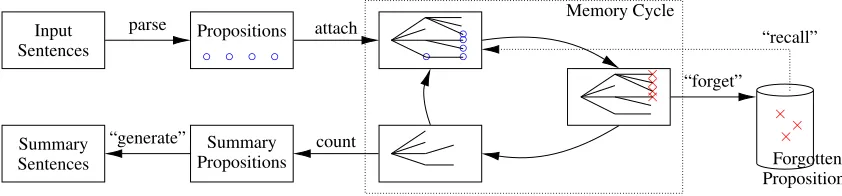
Figure 1: The KvD-inspired incremental summarisation model.
ive data sets are needed. Satisfyingly, we find that on our corpus the lead baseline is surpassable by intelligent summarisers.
2 The KvD Model
The KvD model is a cognitive account of human text comprehension. In our KvD-inspired model (Figure 1), the summariser constructs a list of pro-positions as a meaning representation from a syn-tactic parse of the input text. A batch of new pro-positions (◦ in the figure) are processed for each sentence. At the beginning of a memory cycle, these new propositions are added to a coherence tree, which represents the working memory. They attach to the existing propositions on the tree with which they have the strongest overlap in argu-ments. At the end of a cycle, as a simulation of limited memory, only a few important proposi-tions are carried over to the next cycle, while the others are “forgotten” (represented by×). This se-lection is based on the location of propositions in the tree, using the so-calledleading edge strategy; propositions that are on more recent edges, or that are attached higher, are more likely to be retained. The model attempts all future attachments using only the propositions in working memory, and al-lows to reuse forgotten ones only if this strategy runs into problems (when a new proposition could not otherwise be attached).
KvD suggest that the decision whether a pro-position should be included in the final summary depends on three factors: a) the number of cycles where it was retained in working memory, b) whether it is a generalisation, and c) whether it is a meta-statement (or macro-proposition).
For its explanatory power and simplicity, the model has been well-received not only in the fields of cognitive psychology (Paivio, 1990; Lave, 1988) and education (Gay et al., 1976), but also in the summarisation community (Moens et al., 2003; Uyttendaele et al., 1998; Hahn and Reimer,
1984).
We presented the first computational prototype of the model that follows the proposition-centric processing closely (Fang and Teufel, 2014). Of the factors mentioned above, only the first is mod-elled in this summariser (called FT14). That is, we use the frequency of a proposition being retained in memory as the only indicator of its summary-worthiness. This is a simplification due to the fact that robust inference is beyond current NLP cap-ability. Additionally, macro-propositions depend on domain-specific schema, whereas our system aims to be domain-independent.
Zhang et al. (2016) presented a summar-iser based on a later cognitive model by Kintsch (1998). Instead of modelling importance of pro-positions directly, their summariser computes the importance of words by spreading activation cyc-lically, but extracts at proposition level.
Although the summariser presented in the cur-rent paper, a newer version of FT14, is capable of sub-sentential content selection, we present its output in the form of extracted sentences that con-tain the most summary-worthy propositions. This is different from FT14, where we used a token-based extraction method. A better output would of course be an abstract based on the selected pro-positions, but we currently do not have a language generation module and can therefore evaluate only the content selection ability of our summariser.
3 Argument Overlap
The central mechanism of the KvD model is ar-gument overlap of propositions, and it is key to successful content selection. This is because there are often multiple propositions on the tree where a new proposition could attach, of varying attract-iveness. The task therefore boils down to ranking attachments, for instance by the strength of over-lap, and the position in the tree.
Subtree 1:
DELIVER (GIFT, in: FORM) RANDOMLY (DELIVER) of (FORM, LIGHTNING) of (FORM, FOREST FIRE) of (FORM, LAVA)
BURNING (LAVA)
Subtree 2:
REVOLUTIONISE (DISCOVERY, FIRE-LIGHTING) of (DISCOVERY, ELEMENT)
Subtree 3:
BE (IRON PYRITES, COMPOUND) CONTAIN (COMPOUND, SULPHUR)
New:
TIP (PAPER, with: PHOSPHORUS)
PAPER: FORM?
PHOSPHORUS: ELEMENT?
[image:3.595.112.516.59.195.2]PHOSPHORUS: SULPHUR?
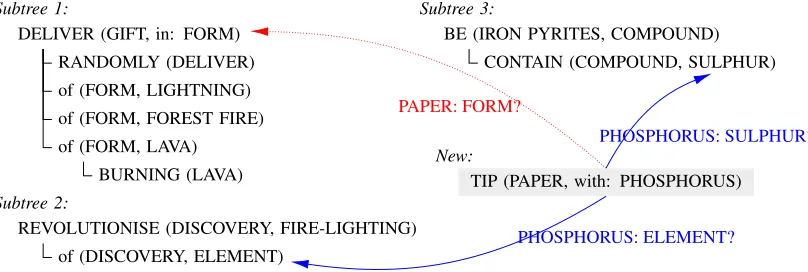
Figure 2: Possible attachments of a new proposition.
sites. Three subtrees in the working memory are shown, containing propositions that correspond to the text pieces 1) [fire was] a gift randomly de-livered in the form of lightning, forest fire or burn-ing lava, 2) fire-lighting was revolutionised by the discovery of the element, and 3) iron pyrites, a compound that contains sulphur, respectively. The new proposition corresponds to the textpaper tipped with phosphorus. It can attach in subtree 2, becausephosphorusis a kind ofelement; it can also attach in subtree 3, because bothphosphorus
andsulphurare chemicals.
The definition of argument overlap is conceptu-ally simple, namely reference of the arguments to the same concept, which can be an entity, an event, or a class of things. In KvD’s manual demonstra-tion of the algorithm, the resoludemonstra-tion of textual ex-pressions to concepts relies on human intelligence. A “perfect” coreference resolver is arguably all we need, but coreference as currently defined ex-cludes generics, abstract concepts, paraphrases, bridging connections (Weischedel et al., 2007) and several other relevant linguistic phenomena. This means an insufficient number of possible overlaps are found by current coreference systems, if no further information is used. How exactly to model argument overlap for a KvD summariser is there-fore open to exploration.
We use other sources of information that ad-dresses topicality and semantic relatedness, in combination with coreference resolution. In FT14, that source was the distributional similarity of words, normalised with respect to their distract-ors in context to achieve numerically comparable overlap scores. In this paper, we argue that us-ing the shared membership in lexical chains as the other source provides a better basis for ranking ar-gument overlap.
FT14’s overlap detection runs into problems in
the situation above (Figure 2). Under FT14’s definition of argument overlap as distributional se-mantic distance, the link betweenpaperandform
is as strong as the other possibilities, which leads to the attachment of the new proposition as a child node of the root proposition of subtree 1 due to higher tree level. This attachment uses the wrong sense of the polysemous wordform(“form/8– a printed document with spaces in which to write”). In our new ranking of attachment sites, lexical chains enable us to reject the spurious attachment, as we will now explain.
4 Our Lexical Chain-Based System
In our new model, argument overlap is computed using lexical chains (Barzilay and Elhadad, 1997), a construct that combines the ideas of topicality and word sense clusters. A lexical chain is an equivalence class of expressions found in the text whose presumed senses in context are related to the same concept or topic. For the example in the last section, in our systemformis correctly re-solved to sense 2, not sense 8, and as form/2
andpaper/1are not members of the same lex-ical chain, the wrong attachment is prevented.
Lexical chain algorithms typically use Word-Net (Miller, 1995) to provide the lexical relations needed, whereby each synset (synonym set) rep-resents a concept. Hypernyms and hyponyms are related to the same topic, and they may be in a coreference relationship with the concept. To a lesser extent, the potential for coreference also holds for siblings of a concept. WordNet relations therefore give information about concept identity and topical relatedness, both of which are aspects of argument overlap.
im-proves over Barzilay and Elhadad’s and Silber and McCoy’s (2002) chain definition by introducing the limitation of “one sense per discourse”, i.e. by enforcing that all occurrences of the same word take the same sense in one document. Initially designed to improve word sense disambiguation accuracy, GM03’s method has been shown to im-prove summarisation quality as well (Ercan and Cicekli, 2008).
In GM03, the edge weight between possible word senses of two word occurrences depends on the lexical relation and the textual distance between them. Each word is disambiguated by choosing the sense that maximises the sum of weights of the edges leaving all its occurrences. Edges that are based on non-selected senses are then discarded. Once the entire text has been pro-cessed, each connected component of the graph represents a lexical chain.
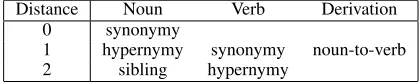
As far as nouns1 are concerned, we follow GM03’s edge weights, but unlike GM03, we also allow verbs to enter into chains. We do this in order to model nominalised event references, and to provide a sufficient number of possible connec-tions. Table 1 provides the distance of relations; weights of verb and derivation relations equal to the weights of noun relations on the same row. In-stead of assigning an overlap value of 1 to all pairs of words in the same chain, the extent of overlap is given asa∑e∈Ede, whereEis the set of edges in the
shortest path between the two words in the graph of lexical relations, de the distance of the lexical
relation of e, and a an attenuation factor we set at 0.7. This models the transition from concept
sameness to broader relatedness. We found empir-ically that the introduction of verbs and the graded overlap value using relation distance improves the performance of our KvD summariser.
Lexical coverage of this algorithm is good: WordNet covers 98.3% of all word occurrences
al-lowed into our lexical chains in the experiment in §6, excluding those POS-tagged as proper nouns. For unknown words, the system’s backoff strategy is to form overlap only if the surface strings match. The structuring of information in a memory tree and the incremental addition of information, in-cluding the concept of “forgetting”, are key claims of the KvD model. But do these manipulations ac-tually add any value beyond the information
con-1Following Silber and McCoy (2002), we create an
addi-tional chain for each named entity, in addition to those chains defined by WordNet synsets.
Distance Noun Verb Derivation 0 synonymy
[image:4.595.311.521.63.105.2]1 hypernymy synonymy noun-to-verb 2 sibling hypernymy
Table 1: Distance of lexical relations.
tained in a global network representingall connec-tions between all proposiconnec-tions in the text? In such a network without forgetting or discourse struc-ture, standard graph algorithms could be used to determine central propositions. This hypothesis is tested in§6.
5 New Corpus of Texts and Summaries
We introduce new evaluation materials, created from the reading sections of Academic Tests of the
Official IELTS Practice Materials(British Council et al., 2012).
The IELTS is a standardised test of English pro-ficiency for non-native speakers. The texts cover various general topics, and resemble popular sci-ence or educational articles. They are carefully chosen to be of the same difficulty level, and understandable by people of any cultural back-ground. Unlike news text, they also presup-pose less external knowledge, such as US politics, which makes it easier to demonstrate the essence of proposition-based summarisation.
Out of all 108 texts of volumes 1–9, we ran-domly sampled 31. We then elicited 4 summar-ies summary for each, written by 14 members of our university, i.e., a total of 124 summaries.2 We asked the summarisers to create natural-sounding text, keeping the length strictly to 100±2 words. They were allowed but not encouraged to para-phrase text.
6 Experiment
6.1 Systems and Baselines
We test 7 automatic summarisers against each other on this evaluation corpus. Our summariser (O) runs the KvD memory cycles and uses lexical chains to determine argument overlap. It is not directly comparable to FT14 due to the difference in generation method, described in §2. In order to be able to compare to FT14 nevertheless, we created a version that uses our new sentence ex-traction module together with an argument
over-2Max number of summaries per person 31, min
O D C M LR TR L 1 .376 .349 .351 .343 .349 .343 .341 2 .122 .094 .088 .092 .087 .094 .100 L .345 .320 .318 .308 .316 .309 .314 SU4 .154 .131 .129 .128 .129 .130 .132
Table 2: ROUGE F-scores by four metrics.
lap module very similar to FT14 but with an even stronger model for semantic similarity, the cosine similarity of word embeddings pre-trained using word2vec (Mikolov et al., 2013) on part of the Google News dataset (∼100 billion words), and we call this system D.
Another variant, C, tests the hypothesis that the recurrent KvD processing is not superior than simpler network analysis. Summariser C con-structs only one graph, where every two propos-itions are connected by an edge whose length is the reciprocal of their argument overlap, and uses betweenness centrality to determine proposition importance. We choose betweenness centrality be-cause we found it to outperform other graph al-gorithms, including closeness centrality and ei-genvector centrality.
We also test against the lead baseline (L) and three well-known lexical similarity-based single document summarisers: MEAD (Radev et al., 2004, M), TextRank (Mihalcea and Tarau, 2004, TR), and LexRank (Erkan and Radev, 2004, LR).
Because the evaluation tool we use is sensit-ive to text length, fair evaluation demands equal length of all summaries tested. We obtain output of exactly 100±2 words from each summariser by iteratively requesting longer summaries, and unless this results in a sentence break within 2 tokens of the 100-word limit, we cut the imme-diately longer output to exactly 100 words.
6.2 Results
For automated evaluation, we use ROUGE (Lin, 2004), which evaluates a summary by compar-ing it against several gold standard summaries. Table 2 shows our results in terms of ROUGE-1, 2, L and SU4. The metrics are based on the co-occurrence of unigrams, bigrams, longest com-mon subsequences, and skip-bigrams (within dis-tance of 4 and including unigrams), respectively. Our summariser outperforms all other summar-isers,3 and is the only summariser that beats the
3We use the paired Wilcoxon test (two-tailed).
Differ-ences between O and each other summariser atp<0.05. All differences between all summarisers other than O are
insig-lead baseline.
The fact that our summariser beats D, our KvD summariser using FT14-style distributional se-mantics for argument overlap, is clear evidence that our method of lexical chaining provides a su-perior model of argument overlap. On this genre, D performs indistinguishably from the other sum-marisers. This is in line with our earlier find-ings for FT14 on DUC (Over and Liggett, 2002) news texts, where the token extraction-based sum-mariser was comparable to extractive sumsum-marisers but was outperformed by MEAD. In a qualitat-ive analysis, we found that a main source of er-ror in FT14’s system was that it favoured related but semantically and pragmatically incompatible terms over compatible paraphrases. This is a side-effect of the use of co-occurrence, which relies on syntagmatic rather than paradigmatic similar-ities, and which is insensitive to word senses. As a result, context-unaware distributional semantics allows too many spurious overlaps.
The fact that summariser C is significantly worse than our summariser shows that the idea of incrementally maintaining a KvD-style struc-tured memory is effective for summarisation, des-pite the simplifications we had to make. This nat-urally points to the direction of modelling incre-mental memory updates for summarisation, which also makes modelling with a recurrent neural net-work plausible in the future.
The current experiment can be seen as a demon-stration of the superiority of KvD proposition-based content selection on a genre of common-sense, naturally occurring texts. This was the case even with a inferior “generation” method, namely sentence extraction. Reading through the propos-itions, we had the impression that they manage to capture relevant information about the text in a much shorter and more modular form than ex-tracted sentences, although this cannot be demon-strated with a surface-based methodology such as ROUGE. Content selection is of course only the first step of summarisation; we are currently work-ing on a grammar-based re-generation from the se-lected propositions.
Acknowledgments
The CSC Cambridge International Scholarship for the first author is gratefully acknowledged.
References
Regina Barzilay and Michael Elhadad. 1997. Using lexical chains for text summarization. Proceedings of the ACL Workshop on Intelligent Scalable Text Summarization.
British Council, IDP Education Australia, and Univer-sity of Cambridge Local Examinations Syndicate. 2012. Official IELTS Practice Materials Volume 1. Paperback with CD. Klett Ernst /Schulbuch.
Asli Celikyilmaz and Dilek Hakkani-T¨ur. 2011. Dis-covery of topically coherent sentences for extractive summarization. InProceedings of the 49th Annual Meeting of the Association for Computational Lin-guistics: Human Language Technologies-Volume 1, pages 491–499. Association for Computational Lin-guistics.
Trevor Cohn and Mirella Lapata. 2008. Sentence compression beyond word deletion. InProceedings of the 22nd International Conference on Computa-tional Linguistics-Volume 1, pages 137–144. Asso-ciation for Computational Linguistics.
Gonenc Ercan and Ilyas Cicekli. 2008. Lexical co-hesion based topic modeling for summarization. In Computational Linguistics and Intelligent Text Pro-cessing, pages 582–592. Springer.
G¨unes Erkan and Dragomir R Radev. 2004. Lexrank: Graph-based lexical centrality as salience in text summarization. Journal of Artificial Intelligence Research, pages 457–479.
Yimai Fang and Simone Teufel. 2014. A summar-iser based on human memory limitations and lexical competition. EACL 2014, page 732.
Michel Galley and Kathleen McKeown. 2003. Im-proving Word Sense Disambiguation in Lexical Chaining. InIJCAI, pages 1486–1488.
Lorraine R Gay, Geoffrey E Mills, and Peter W Air-asian. 1976. Educational research: Competencies for analysis and application. Merrill Columbus, OH.
Udo Hahn and Ulrich Reimer. 1984. Computing text constituency: An algorithmic approach to the gener-ation of text graphs. InProceedings of the 7th An-nual International ACM SIGIR Conference on Re-search and Development in Information Retrieval, SIGIR ’84, pages 343–368, Swinton, UK. British Computer Society.
Walter Kintsch and Teun A. van Dijk. 1978. Toward a model of text comprehension and production. Psy-chological review, 85(5):363–394.
Walter Kintsch. 1998. Comprehension: A paradigm for cognition. Cambridge university press.
Kevin Knight and Daniel Marcu. 2000. Statistics-based summarization-step one: Sentence compres-sion. InAAAI/IAAI, pages 703–710.
Jean Lave. 1988. Cognition in practice: Mind, math-ematics and culture in everyday life. Cambridge University Press.
Wendy G Lehnert. 1981. Plot units and narrative sum-marization.Cognitive Science, 5(4):293–331.
Chin-Yew Lin and Eduard Hovy. 2003. The poten-tial and limitations of automatic sentence extrac-tion for summarizaextrac-tion. InProceedings of the HLT-NAACL 03 on Text summarization workshop-Volume 5, pages 73–80. Association for Computational Lin-guistics.
Chin-Yew Lin. 2004. ROUGE: A package for auto-matic evaluation of summaries. In Text Summar-ization Branches Out: Proceedings of the ACL-04 Workshop, pages 74–81.
Kathleen McKeown and Dragomir R Radev. 1995. Generating summaries of multiple news articles. In Proceedings of the 18th annual international ACM SIGIR conference on Research and development in information retrieval, pages 74–82. ACM.
Rada Mihalcea and Paul Tarau. 2004. Textrank: Bringing order into texts. InEMNLP 2004. Asso-ciation for Computational Linguistics.
Tomas Mikolov, Kai Chen, Greg Corrado, and Jef-frey Dean. 2013. Efficient estimation of word representations in vector space. arXiv preprint arXiv:1301.3781.
George A Miller. 1995. WordNet: a lexical data-base for English. Communications of the ACM, 38(11):39–41.
Marie-Francine Moens, Roxana Angheluta, and Rik De Busser. 2003. Summarization of texts found on the world wide web. InKnowledge-Based Inform-ation Retrieval and Filtering from the Web, pages 101–120. Springer.
Paul Over and W Liggett. 2002. Introduction to duc: an intrinsic evaluation of generic news text summar-ization systems. Proc. DUC. http://wwwnlpir. nist. gov/projects/duc/guidelines/2002. html.
Allan Paivio. 1990. Mental representations. Oxford University Press.
Dragomir Radev, Timothy Allison, Sasha Blair-Goldensohn, John Blitzer, Arda Celebi, Stanko Di-mitrov, Elliott Drabek, Ali Hakim, Wai Lam, Danyu Liu, et al. 2004. MEAD – a platform for multidoc-ument multilingual text summarization. In Proceed-ings of LREC.
Caroline Uyttendaele, Marie-Francine Moens, and Jos Dumortier. 1998. Salomon: automatic abstracting of legal cases for effective access to court decisions. Artificial Intelligence and Law, 6(1):59–79.
Ralph Weischedel, Sameer Pradhan, Lance Ram-shaw, Michelle Franchini, Mohammed El-bachouti, Martha Palmer, Mitchell Marcus, Ann Taylor, Craig Greenberg, Eduard Hovy, Robert Belvin, and Ann Houston. 2007. Co-reference Guidelines for Eng-lish OntoNotes. Technical report, Linguistic Data Consortium.
Kam-Fai Wong, Mingli Wu, and Wenjie Li. 2008. Extractive summarization using supervised and semi-supervised learning. In Proceedings of the 22nd International Conference on Computational Linguistics-Volume 1, pages 985–992. Association for Computational Linguistics.