Membrane Separations: Ultrafiltration. III/ Immunoaf-finity Extraction. Pesticides: Extraction from Water. Appendix 1/ Essential Guides for Isolation/Purifica-tion of Enzymes and Proteins. Essential Guides for Isolation/ Purification of Immunoglobulins. Appendix 2/ Essential Guides to Method Development in Affinity Chromatography.
Further Reading
Godfrey MAJ (1998) ImmunoafRnity extraction in veterin-ary residue analysis}a regulatory viewpoint. Analyst 123: 2501}2506.
Hage DS (1998) Survey of recent advances in analytical applications of immunoafRnity chromatography. Jour-nal of Chromatography B715: 3}28.
Hermanson GT, Mallia AK and Smith PK (eds) (1992) Immobilized AfTnity Ligand Techniques. New York: Academic Press.
Katmeh MF, Aherne GW, Godfrey AJM and Stevenson D (1997) Enzyme immunoafRnity chromatography }a rapid semi-quantitative immunoassay technique for screening the presence of isoproturon in water samples. Analyst121: 481}486.
Katoh S, Terashima M and Shiomi N (1998) Utilization of antipeptide antibodies as afRnity ligands in
immuno-afRnity puriRcation.Journal of Chromatography B715: 147}152.
Kang K, Ryu D, Drohan WN and Orthner CL (1992) Effect of matrices on afRnity puriRcation of protein C. Biotech-nology and Bioengineering39: 1086}1096.
Kaster JA, de Oliveira W, Glasser WG and Velander WH (1993) Optimization of pressure}Sow limits, strength, interparticle transport and dynamic capacity by hydrogel solids content and bead size in cellulose immunosorbents. Journal of Chromatography 648: 79}90.
Orthner CL, Highsmith FA, Tharakan J et al. (1991) Comparison of the performance of immunosorbents prepared by site-directed or random coupling of mon-oclonal antibodies. Journal of Chromatography 558: 55}70.
Phillips TM (1989) High-performance immunoafRnity chromatography. Advances in Chromatography 29: 133}173.
Ubrich N, Rivat C, Vigneron C and Maincent P (1998) Microporous particles designed as stable immuno-sorbents. Biotechnology and Bioengineering 58: 581}586.
Velander WH, Subramanian A, Madurawe RD and Orthner CL (1992) The use of Fab-masking antigens to enhance the activity of immobilised antibodies. Biotech-nology and Bioengineering39: 1013}1023.
Imprint Polymers
P. A. G. Cormack, K. Haupt and
K. Mosbach, Lund University, Lund, Sweden Copyright^ 2000 Academic Press
Introduction
Molecular imprinting is now recognized as one of the most rapid and powerful methods for creating tailor-made synthetic receptors with strong, yet selec-tive, afRnities for a diverse selection of analytes. The imprinting of small organic compounds, metal ions and peptides is well developed and almost rou-tine, and the imprinting of much larger analytes, such as proteins and cells, has also now been demon-strated. The impressive molecular recognition charac-teristics of molecularly imprinted materials, allied to their highly robust physical nature, makes them ideally suited for numerous applications in afRnity separation. This article will outline the general princi-ples behind molecular imprinting and the generic approaches to the preparation of imprinted materials. Particular emphasis will be placed on their role as afRnity materials in separation science.
The Imprinting Principle
Molecular imprinting has been demonstrated in silica and in synthetic organic polymers, but it is organic polymers that have found the most favour and indeed probably have the most to offer to the afRnity separation area. The rest of this article will therefore deal exclusively with molecular im-printing in the latter medium.
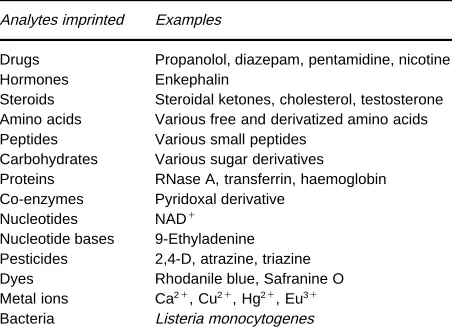
Table 1 A selection of analytes that have been imprinted
Analytes imprinted Examples
Drugs Propanolol, diazepam, pentamidine, nicotine Hormones Enkephalin
Steroids Steroidal ketones, cholesterol, testosterone Amino acids Various free and derivatized amino acids Peptides Various small peptides
Carbohydrates Various sugar derivatives Proteins RNase A, transferrin, haemoglobin Co-enzymes Pyridoxal derivative
Nucleotides NAD> Nucleotide bases 9-Ethyladenine Pesticides 2,4-D, atrazine, triazine Dyes Rhodanile blue, Safranine O Metal ions Ca2>, Cu2>, Hg2>, Eu3>
Bacteria Listeria monocytogenes
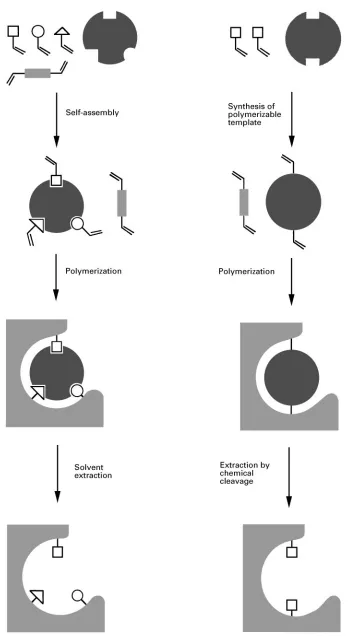
polymerization process, controlling the chemical functionality of the polymer network which forms around it, and since the polymer network is macro-porous and the interactions between the analyte and the polymer are quite labile, the analyte can sub-sequently be extracted from the network via either a simple solvent washing step or by relatively mild chemical treatment. The extraction process reveals binding sites within the polymer network which are complementary to the analyte in terms of their size, shape and functionality, and the polymer can therefore speciRcally rebind the analyte in these cavities. It is this ability to speciRcally rebind an analyte which can be taken advantage of in afR n-ity separations.
Numerous analytes have now been successfully im-printed, the majority of which are small, organic compounds, such as drugs, amino acids, sugars and pesticides (Table 1). Metal ions and larger organic compounds (e.g. peptides) have also been imprinted. Although the imprinting of much larger analytes, for example proteins and cells, is in principle and in practice somewhat more difRcult to achieve, this has now been demonstrated also.
As mentioned already, there are two distinct im-printing approaches that one can follow. TheRrst is the so-called covalent approach (pre-organized ap-proach) in which the interactions between the analyte and the functional monomers in the pre-polymeriz-ation assembly are covalent in nature (this classiR ca-tion generally also includes metal-coordinated analytes). Extraction of the analyte from the network requires these covalent bonds to be cleaved, but they are reformed upon subsequent analyte rebinding. In contrast, non-covalent bonds (e.g. hydrogen bonding, ion pairs and } interactions) exist between the analyte and the functional monomers in the pre-polymerization assembly in the non-covalent
(self-assembly) approach. Rebinding of the analyte to the polymer is also non-covalent in nature.
Both imprinting approaches have their own merits and drawbacks, but what can be said in general is that the covalent approach yields binding sites that are better deRned. However, it does require chemical derivatization of the analyte prior to polymerization, which is not always easy or practical. The non-covalent method, on the other hand, requires no chemical derivatization step, and is therefore much more general in nature and applicable to a consider-ably wider range of analytes. Rebinding kinetics are also much more favourable. Indeed, because of its inherent simplicity, the non-covalent approach tends to be the method of choice, although the overall quality of the binding sites tends to be somewhat poorer.
As for the binding sites themselves, the strength and the selectivity of analyte rebinding has been shown in some cases to be on a par with those of natural receptors such as antibodies. This is quite remarkable in itself. In a typical imprinted polymer, however, there is usually a variety of binding sites with different afRnities for the analyte, and it is only those sites with the strongest afRnities which are comparable to the binding afRnities of antibodies. In analogy with antibody terminology, such polymers are usually termed polyclonal to describe their hetero-geneous populations of binding sites. There is, need-less to say, considerable effort being made to prepare imprinted polymers with homogeneous binding sites, i.e. monoclonal materials.
Besides their impressive molecular recognition properties, molecularly imprinted polymers have sev-eral other attractive features. They are exceedingly robust, and can be utilized under conditions which would be disastrous for enzymes or antibodies. They are stable at elevated temperatures and pressures, they are resistant to many chemical environments and can be used in both aqueous and non-aqueous media. Furthermore they are of low cost, have good shelf-lives and can be re-used time and time again without signiRcant detriment to their properties.
detail, the chemical constitution of molecularly im-printed polymers and general methods for their prep-aration will be brieSy described.
The Preparation of Molecularly
Imprinted Polymers
Success in the preparation and application of molecu-larly imprinted polymers relies upon a good under-standing of both the principles and practicalities be-hind the imprinting process. Although a complete, in-depth guide to the preparation of good quality im-prints for all analytes is far beyond the scope of this article, there are some general guidelines which provide a good basis for success. The generalities are covered here. The speciRc details can be found elsewhere.
Nature of the Analyte
The majority of analytes imprinted to date have been low molecular weight organic compounds of molecu-lar mass 200}300 Da, but with appropriate modiR ca-tion of the imprinting condica-tions much larger analytes can also be imprinted. Various chemical and physical properties of the analyte are of considerable importance; besides having a suitable chemical handle for interaction with a functional monomer, an analyte must be compatible with the functional monomers and crosslinkers used, it must be soluble in the solvent(s) used for imprinting, and it must be stable and inert under the polymerization conditions employed.
Functional Monomers
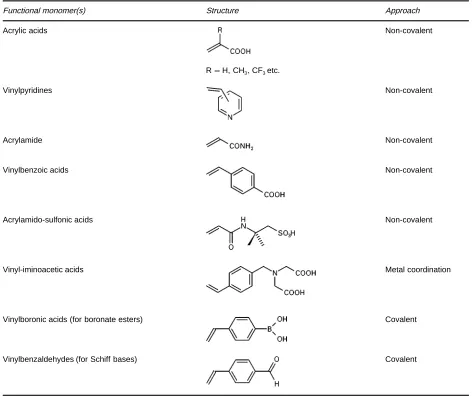
Functional monomers are selected based on their abil-ity to bind reversibly, via either covalent or non-covalent bonds, to the analyte. In non-covalent imprinting approaches, the covalent bonds linking the functional monomers to the analyte need to be reasonably labile to allow removal of the analyte from the polymer matrix under relatively mild conditions. This require-ment is somewhat limiting, and only metal-chelates, boronic acid esters, disulRdes and Schiff bases have been developed to any great extent. The non-covalent approach is much less restricting in this respect, and numerous vinyl-based monomers have been successfully employed (Table 2).
In non-covalent imprinting protocols, the ana-lyte}functional monomer assembly is dynamic in that the functional monomers exist in both the free and the complexed state, and indeed are free to move from one state to another. To push the equilibrium towards assembly formation, it is not unusual to use an excess of functional monomer in the polymeriz-ation mixture (typically two-fold or greater). This
does have the side effect of increasing the level of non-speciRc rebinding of the analyte to the polymer, but at the same time it increases the number of good binding sites, so it is a compromise.
Cross-linking Monomers
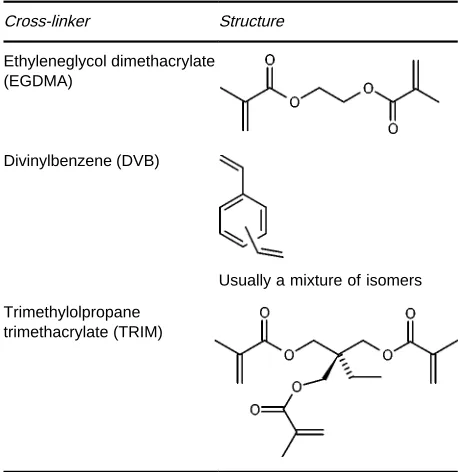
Copolymerization of the functional monomers with an excess of cross linking monomer (usually '50 mol%) yields an insoluble polymer matrix which phase separates from solution as the polym-erization proceeds. High ratios of crosslinking mono-mers are generally required to give the polymer matrix the rigidity necessary to retain the integrity of the binding sites. Usually analyte rebinding is en-hanced considerably as the crosslinking ratio is in-creased up to 80 or 90 mol%. The improvements in recognition thereafter are much less spectacular. Many different crosslinking monomers have been used, including some which act simultaneously as functional monomers, but the three which have found the most favour are ethyleneglycol dimethacryl-ate (EGDMA), divinylbenzene (DVB) and tri-methylolpropane trimethacrylate (TRIM) (Table 3).
Solvents
The solvent, besides acting as the medium in which the polymerization is performed, has an important secondary role as a porogen. It controls the porous structure of the polymer matrix to a large extent, and a good porogen is essential if one wants the porous structure in the polymer to be well developed. Some-times, however, a good porogenic solvent can be a bad solvent for the analyte, so once again a compro-mise is sometimes required. Common imprinting sol-vents include toluene, chloroform and acetonitrile.
In non-covalent imprinting, there is one further solvent effect which is of great importance. Polar solvents destabilize the analyte}functional monomer assembly and it is therefore better to use non-polar solvents, whenever possible, to maximize the concen-tration of the assembly in the pre-polymerization mixture. The same argument applies for analyte re-binding. In spite of this, non-covalent imprints have in some cases still shown good recognition properties in aqueous buffers, which are of course highly polar. One Rnal point of note, which applies to both covalent and non-covalent approaches, is that the best recognition is generally observed when the sol-vent used for both the polymerization and analyte rebinding is the same.
Initiators and Polymerization Conditions
Table 2 A selection of functional monomers commonly used in molecular imprinting
Functional monomer(s) Structure Approach
Acrylic acids Non-covalent
R"H, CH3,CF3etc.
Vinylpyridines Non-covalent
Acrylamide Non-covalent
Vinylbenzoic acids Non-covalent
Acrylamido-sulfonic acids Non-covalent
Vinyl-iminoacetic acids Metal coordination
Vinylboronic acids (for boronate esters) Covalent
Vinylbenzaldehydes (for Schiff bases) Covalent
initiate the polymerization under either thermal or photochemical conditions. Thermal conditions may be preferred in some cases due to limited analyte solubility at lower temperatures, but photochemical initiation at these lower temperatures has certainly been shown to give better results in non-covalent imprinting.
Physical Form of Imprinted Polymers
Molecularly imprinted polymers can be prepared in a variety of forms to suit theRnal application desired. The most common, and indeed the crudest, method for preparing molecularly imprinted polymers is via solution polymerization followed by mechanical or manual grinding of the monolithic block generated, to give small, molecularly imprinted particles. If re-quired, sizing of the particles through sieving and/or sedimentation can then be performed. Besides beingtime consuming and wasteful, this method produces particles of irregular shape which are not ideal for chromatographic applications. The grinding process may also destroy a few of the binding sites. Improved polymerization methods which obviate the need for grinding are therefore being investigated.
One seemingly general method which has been developed, and which overcomes the grinding prob-lem completely, involves the suspension polymeriz-ation of imprinting mixtures in liquid perS uorocar-bon continuous phases. Spherical beads of controlled, regular diameters (down to ca. 5m) can be prepared reproducibly by this technique, and are isolated sim-ply by Rltration. In the same way, imprinted beads can also be obtained via emulsion, seeded emulsion or precipitation polymerization methodologies.
Table 3 Crosslinkers commonly used in molecular imprinting
Cross-linker Structure
Ethyleneglycol dimethacrylate (EGDMA)
Divinylbenzene (DVB)
Usually a mixture of isomers Trimethylolpropane
[image:6.568.68.510.540.684.2]trimethacrylate (TRIM)
Figure 2 Typical chromatograms of an enantiomeric mixture using a polymer imprinted with theL-enantiomer, a polymer imprinted
with theD-enantiomer and a non-imprinted polymer as column packing material.
i.e. in-situ polymerization. This approach is par-ticularly attractive for capillary electrophoresis applications, whereRlling of the capillary can often be problematic.
OneRnal format, which isRnding increasing inter-est, involves imprinted membranes. Generally they are composed either of crosslinked polymers which have been prepared in the standard way, or of linear polymers which have been precipitated in the pres-ence of the analyte. They can be either free-standing or supported.
Applications in Separation Technology
As mentioned earlier, the application of imprinted polymers that has been the most extensively exploredis separation and isolation. Chiral separationshave been a major area of investigation, and indeed molecularly imprinted materials have been employed as chiral matrices in several different separation techniques. A characteristic of imprinted chiral separ-ation matrices is the pre-determined migrsepar-ation or elu-tion order of the enantiomers, which depends only on which enantiomer is used as the template molecule. For instance, when theR-enantiomer is used as the template, it will be retained more by the polymer than theS-enantiomer, and vice versa (Figure 2). The dis-crimination of enantiomers is often very efRcient with molecularly imprinted materials. Highly selec-tive, chirally discriminating recognition sites have been prepared using covalent or non-covalent im-printing protocols, and large separation factors be-tween the enantiomers have been recorded.
For analytes containing two chiral centres, all four stereoisomers may be selectively recognized by the imprinted materials. Thus, for a polymer imprinted against the dipeptide Ac-L-Phe-L-Trp-OMe, the LL
-form can be selectively distinguished from theDD-, the DL- and the LD-isomers. In systems where more than
two chiral centres are involved, such as carbohy-drates, these properties of molecularly imprinted ma-terials become even more signiRcant. For example, in a study where polymers were imprinted against a glu-cose derivative, very high selectivities between the various stereoisomers and anomers were recorded.
Apart from the separation of enantiomers, im-printed polymers are also very useful for the separ-ation of other compounds with closely related struc-tures. An overview of the different separation techniques in which molecularly imprinted polymers have been employed is given below.
Liquid Chromatography
is partly for historical reasons, because liquid chromatography is a convenient method for assessing the quality of an imprint, particularly during the optimization of an imprinting protocol.
Most research has concentrated on chiral resolu-tion, and molecularly imprinted chiral stationary phases have been prepared for a wide range of com-pounds. Many of the early investigations employed amino acid derivatives as model substances. In recent years, however, a great deal of emphasis has also been put on the chiral discrimination of drug compounds. Several studies involving the separation of physio-logically active compounds, e.g. naproxen (a non-steroidal anti-inSammatory drug), ephedrine (an adrenergic agent) and timolol (a -adrenergic antagonist) have been described. Typically, separ-ation factors of between 1.5 and 5 are obtained with imprinted polymers, which is relatively high when compared with other chiral stationary phases. In con-sequence, excellent separations should be possible to achieve in theory, but in practice several factors often lead to rather modest results, especially in terms of resolution. The heterogeneity in the binding site af-Rnities and accessibilities in non-covalently imprinted polymers often leads to band broadening and peak tailing, and thus to a poor column efRciency. Even for non-retained compounds, low plate numbers (2000}5000 m\) are usually obtained. One factor which has a deleterious effect on the sep-aration is the unfavourable shape and size distribu-tion of particles, which leads to poorSow character-istics and low functional capacities. A good strategy to improve the performance of imprinted stationary phases should therefore take into account the follow-ing aspects:
E Optimization of particle size and shape. This can be achieved by using suspension polymerization procedures for instance, which can generate uni-formly sized spherical beads of controlled dimen-sion.
E Optimization of the column packing.
E Optimization of the mobile phase. In many cases, the addition of competitors can improve peak shapes, and carefully designed gradient elution protocols can minimize tailing, especially of the more retained peak.
E Increasing the capacity of the imprinted stationary phase. This can be realized by optimizing the poly-mer recipe. It has been shown that substituting trimethylolpropane trimethacrylate for ethylene-glycol dimethacrylate as the crosslinker leads to higher load capacities, since a lower degree of crosslinking is necessary and more functional monomer can be accommodated in the polymer,
i.e. the number of theoretical binding sites is in-creased.
By these means, improved separation and resolu-tion can already be expected. However, the most important issue is certainly the binding site hetero-geneity, which is undesirable and has to be addressed. In order to obtain a more homogeneous population of binding sites in an imprinted polymer, the pre-polymerization complex between the template and the functional monomers has to be stabilized. Cer-tainly, covalent bonds should give the best results in this respect, but even stronger or multiple non-covalent interactions between monomer and template will afford a more stable complex. For example, acrylamide or triSuoromethylacrylic acid can in some cases be substituted for methacrylic acid, result-ing in a considerably improved separation which can be attributed to the stronger noncovalent bonds for-med by these monomers as compared to methacrylic acid.
Thin Layer Chromatography
Finely ground imprinted polymer coated on to an inert support has been suggested for use in chiral TLC. Although only a limited amount of work has been done in this area, it has been shown that the racemates of a number of amino acids can be re-solved. Problems were encountered due to band broadening, which led to the formation of zones rather than small spots or thin bands. This in turn led to band overlap and poor resolution, and measure-ments of R values were also made more difRcult. However, this method may nevertheless be attrac-tive for the determination of the enantiomeric purity of compounds such as a chiral drugs, owing to its simplicity, its speed and the possibility of running multiple parallel samples. Optimization of particle shape, size and porosity, similarly HPLC, will prob-ably result in considerprob-ably improved shape of the bands.
Capillary Electrophoresis
the capillary is not completelyRlled with polymer and an axialSow-pore is obtained, which allows the sol-vent to be exchanged easily. Entrapping imprinted polymer particles in a polyacrylamide gel formed in-situin the capillary has been suggested as an alter-native way of preparing imprinted capillaries. How-ever, this approach seems to be somewhat less practi-cal since the solvent cannot be exchanged easily and because the lifetime of such capillaries may be rather short due to problems with air bubble formation during operation.
Enantioselective imprinted columns for capillary electrochromatography could be very useful, espe-cially because considerably higher efRciencies can be obtained ('100 000 plates m\) than with HPLC columns. Chiral separations of drugs such as the -adrenergic antagonist propranolol have been achieved within 2 min, and an enantiomeric mixture containing as little as 1% S-enantiomer could be resolved. Since imprinted capillaries can be prepared quickly and easily, and are normally very stable in use over a period of several months, this represents a highly promising development for analytical chiral separations.
Membrane-based Separation
Chromatographic separation techniques are well es-tablished and widely used, however they do have some limitations, especially in the scale-up of separ-ation processes. For larger-scale separsepar-ations, they are therefore often replaced by membrane-based tech-niques, since membranes can be used in continuous mode unlike the batch-wise operation in chromatog-raphy.
Polymeric membranes can be made speciRc for certain target molecules by molecular imprinting. Imprinted membranes have been prepared in dif-ferent ways; they can be cast directly as a thin layer on aSat surface or between two surfaces, and may or may not contain a stabilizing matrix. Alterna-tively they can be prepared by a phase inversion precipitation technique. Although imprinted mem-branes have great potential for applications in separation, especially chiral separation (enantiomeric polishing), they have until now merely been used in model studies and as recognition elements in biomimetic sensors. As an example, molecularly imprinted polymer membranes have been shown to be capable of distinguishing between enantiomers or otherwise closely related molecules. Usually, such membranes facilitate the diffusion of the com-pound which was imprinted relative to other closely related molecules. Thus, a membrane imprinted with 9-ethyladenine showed faster transport of adenosine
than of guanosine. In other applications, selective retention by the membrane of the compound which was imprinted has been observed. For example, chiral discrimination was possible for D,L-phenylalanine,
with the passage of the imprinted enantiomer being retarded.
Solid-phase Extraction
Owing to their ability to bind antigens speciRcally, antibodies have been used in immunoafRnity chromatography and immunoextraction protocols speciRcally to enrich an analyte prior to its quantiR ca-tion in, for example, medical, food and environ-mental analysis. Furthermore, it has been demon-strated that the natural receptors can be success-fully replaced by imprinted polymers. The use of imprinted polymers for sample concentration and clean-up by solid-phase extraction is attractive due to their high speciRcity and stability, and also their com-patibility with both aqueous and organic solvents. Often the work-up of samples in routine analysis involves a solvent extraction step or a solid-phase extraction step with a more general adsorbent, e.g. an ion exchange or hydrophobic resin. This could be replaced by solid-phase extraction with an imprinted polymer. The advantages are an increased selectivity of the extraction step, and a reduced solvent consumption.
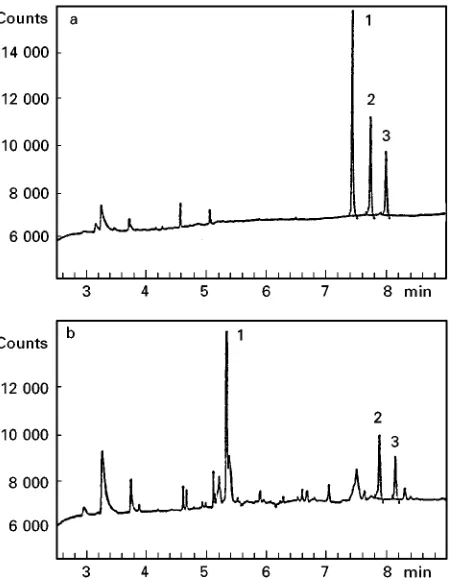
The applicability of this method for analysis has been demonstrated on a number of model compounds such as drugs and herbicides, which can be selectively extracted even from complex samples like beef liver extract, blood serum, urine and bile. For example, the analgesic drug sameridine could be extracted from blood plasma at a concentration of 20 nmol L\, and subsequently quantiRed by GC. In this way, much cleaner chromatograms were obtained as compared to the standard liquid}liquid extraction method (Figure 3), since fewer contaminants were co-extrac-ted with sameridine by the imprinco-extrac-ted polymer-based method.
sub-Figure 3 GC traces of human plasma samples spiked with sameridine and an internal standard, and subjected to (a) solid-phase extraction with an imprinted polymer, and (b) standard liquid}liquid extraction. The peaks are the template molecule (1) (a close structural analogue of sameridine), the analyte sameridine (2) and the internal standard (3). (Adapted with per-mission fromChromatographia (1997) 46, 57).
sequent analysis. This approach was demonstrated very nicely for the sameridine case described above, where a close structural analogue of sameridine was imprinted. The polymer displayed a high afRnity for sameridine as well as for the analogue, but the two compounds could be readily separated by GC and the sameridine quantiRed.
Apart from analytical applications, imprinted poly-mers may also be used for preparative separations, e.g. for product recovery during chemical and enzy-matic syntheses, or from fermentation broths or pro-duction waste streams. However, for the time being at least, the low binding capacity of imprinted poly-mers might limit these applications.
It should also be mentioned here that imprinted polymer particles or beads can be made magnetic, which can be advantageous in both analytical and preparative applications since it enables easy removal of the polymer from the extracted medium.
Conclusions
In summary, molecularly imprinted polymers have much to offer to the area of afRnity separation. Their highly attractive physico-chemical properties allied to their impressive molecular recognition prop-erties make them particularly well suited for applica-tion in a number of important areas, including chromatography, solid-phase extraction, capillary electrophoresis and membrane separations. The peri-od of hitherto unknown expansion, which the mo-lecular imprintingReld is currently enjoying, bodes well for the future, and molecularly imprinted poly-mers will surely play an ever increasing part in af-Rnity separation as the molecular imprinting Reld matures further.
See also: II/Extraction: Solid-Phase Extractions. III/Chiral Separations: Molecular Imprints as Stationary phases; Thin-Layer(Planar)Chromatography.
Further Reading
Ansell RJ, RamstroKm O and Mosbach K (1996) Towards artiRcial antibodies prepared by molecular imprinting. Clinical Chemistry42: 1506.
Bartsch RA and Maeda M (eds) (1998)Molecular and Ionic Recognition with Imprinted Polymers. A.C.S. Sympo-sium Series 703, American Chemical Society, Washing-ton, DC.
Mayes AG and Mosbach K (1997) Molecularly imprinted polymers: useful materials for analytical chemistry? Trends in Analytical Chemistry16: 321.
Mosbach K and RamstroKm O (1996) The emerging tech-nique of molecular imprinting and its future impact on biotechnology.Bio/Technology14: 163.
Sellergren B (1997) Non-covalent molecular imprinting: antibody-like molecular recognition in polymeric net-work materials.Trends in Analytical Chemistry16: 310. Wulff G (1995) Molecular imprinting in cross-linked materials with the aid of molecular templates}a way towards artiRcial antibodies. Angew. Chem. Int. Ed. Engl. 34: 1812.