Abstract— This research aims to slow down the release of ethylene of ‘Nam Dok Mai’ mango during shipment transportation by using titanium dioxide as an absorbent. The result found that the mango begin to the ripening process after stored at 13°C for 12 days (ethylene and carbon dioxide around 0.06910 µL C2H4/kg.hr and 32.10 mg CO2/kg.hr, respectively). Then, the appropriate titanium dioxide was testedby trial at 3, 5 and 10 grams. The result showed that titanium dioxide decreased ethylene but each treatment were not statistically different (p <0.05). Afterward, all fruits were stored at 13°C for 14 days and at 25°C for 4 days, respectively. The physical and chemical properties of fruit were analyzed during storage time. After 14 days at 13°C, firmness, color, titratable acidity, pH, total soluble solids and ripening index of the treatments of titanium dioxide and control treatment were significant different. After 4 days at 25°C, the ripening process of fruit between titanium dioxide treatment and control treatment were not significant differences.
Index Terms—‘Nam Dok Mai’ mango, Titanium dioxide, absorbent, ethylene
I. INTRODUCTION
ango is the tropical fruit which is very important for thailand economic. Mango can be found in many parts of thailand, and the export rate during 2015-2016 was 33 million kilograms and cost 1,223 million baht [1]. ‘Nam dok mai’ mango is one the most famous mango for consumers. Also, there are other mango species that are exported from thailand including ‘Nam dok mai si-thong’ mango, ‘Nam dok mai No.4’ mangos. Its ripe fruits are golden-yellow with deep yellow flesh, nice aroma, fine
Manuscript received December 20, 2018. This work was supported in part by Capacity Building Program for New Researcher 2018 from National Research Council of Thailand (NRCT) for financial support.
Jedsada Chaishome is with Department of Food Engineering, Faculty of Engineering, King Mongkut’s Institute of Technology Ladkrabang, Bangkok, Thailand. (e-mail: [email protected]).
Yossakorn Tunsathitsak, the authors gratefully acknowledge the Capacity Building Program for New Researcher 2018 from National Research Council of Thailand (NRCT) for research funding support. (e-mail: [email protected]).
Panida Boonyaritthongchai is with Postharvest Technology Program, School of Bioresources and Technology, King Mongkut’s University of Technology Thonburi, Bangkok, Thailand. (e-mail: panida.boo @kmutt.ac.th).
Suriyan Supapvanich is with Department of Agricultural Education, Faculty of Industrial Education and Technology, King Mongkut’s Institute of Technology Ladkrabang, Bangkok, Thailand. (e-mail: [email protected]).
texture, sweet with a little bit of sour taste and contain nutritious values [2].
However, the ripening ‘Nam Dok Mai’ mango is soft and fragile, and have low preservation period, special care for shipping is necessary. Most farmers harvest the ‘Nam Dok Mai’ mangos, which are not fully ripe yet. The ripening process of ‘Nam Dok Mai’ mangos can cause independently even without mango tree. Most mangos are sold in Thailand usually harvested from fully matured blossom mango tree, approximately 110-120 days [3]. This ‘Nam Dok Mai’ mangos harvesting period yields good taste and good texture for mango. Nevertheless, the international shipment spends several days. ‘Nam Dok Mai’ mangos need to be harvested while they are not fully ripe yet (90-100 days blossom mango tree). During ‘Nam Dok Mai’ mangos shipping, mangos are put in the corrugated paper box which is supported by sponge sheet. Inside the boxes, the mangos are covered with fruit foam net at 13°C with 85-95% relative humidity in order to prevent their damage from crash. The duration of preservation takes around 15 days [3]. In addition, the condition of mango spoilage is also the key factor of harvesting and distributing the mango. Therefore, the obvious determination of harvesting and distributing way is the key factor to enhance the competitiveness of the domestic and international trade markets [4].
In addition, shipping requires 100% Mature-green mangos. The Plant quarantine law of each country will not allow the import of ripened ‘Nam Dok Mai’ mangos [5]. The effective way to delay the ripening of mangos is to absorb the ethylene (C2H4) that is released from the mangos.
Mango are highly sensitive to ethylene gas (climacteric fruit) which can lead to the spoilage and the reduction of shelf life. The common method to reduce ethylene gas is ventilating the air out of storage room in the volume of 1 room every 1 hour. This method can reduce enough ethylene level [6]. On the other hand, this method requires high energy for continuously cooling all the time. Therefore, the usage of ethylene-adsorbent substances is also good alternative.
Titanium dioxide (TiO2) can absorb ethylene gas that
‘Nam Dok Mai’ mangos release at room temperature (25°C) or storage temperature (13°C) [7]. When titanium dioxide is stimulated by ultraviolet or UV light, photocatalytic will occur. This reaction causes molecule of water and oxygen in the air dispersed and leads to the creation of hydroxyl radical (OH) and superoxide anion (O2) which are highly reactive
oxidized and reduced particle respectively. Hydroxyl radical (OH) and superoxide anion (O2) will adhere ethylene
Ripening Control of Nam Dok Mai Mango
(
Mangifera Indica
Linn.) with Titanium
Dioxide
Jedsada Chaishome, Yossakorn Tunsathitsak, Panida Boonyaritthongchai and Suriyan Supapvanich
molecular. Hydroxyl radical will pull out hydrogen from ethylene to water (H2O) form, and Superoxide anion will
pull carbon atom out of ethylene molecular. These two reactions will gather to be Carbon dioxide (CO2) which
caused the reduction of ethylene gas [8]. The high surface area of TiO2 would increase the rate of adsorption of organic
compounds [9]. Currently, Titanium dioxide has been highly used in many countries, especially Japan and USA due to it has a high photocatalytic ability, cheap cost, no toxic, no chemical reaction and effective light stability [10]. Moreover, scientific research found that Titanium dioxide can absorb ethylene gas released by the fruits with many methods. One method is to using nanoparticle of Titanium at 13°C (TNPs) which can highly reduce ethylene and have effective usability that can be applied in cold storage room [11]. Maneerat and Hayata have developed a polypropylene film coated with TiO2. This product reduces ethylene gas in fruits [13]. There
was some researcher studied the experiment of titanium dioxide photocatalytic oxidation (TPO) with ‘Nam Dok Mai’ mangos. The result shows that it can reduce ethylene, carbon dioxide, and prolongs mango shelf life [8]. Apart from the photocatalytic reaction of TiO2, this method can be used in
the light-independent reaction very well as it can increase the reactive ability (promoter) and support [14]. All in all, TiO2
is suitable for delaying ripening period and prolong mango shelf life. For this reason, creation the packaging for ripening control will increase an exportation values in mango fruit.
As aforementioned, this research aims to study the right amount of Titanium dioxide that needs to inhibit the ripening process of ‘Nam Dok Mai’ mangos at 13°C in order to create a suitable packaging that can control the maturation of 'Nam Dok Mai' mangos.
II. MATERIALSANDMETHODS
A. Preparation of Raw Materials
1) ‘Nam Dok Mai’ mangos at the mature stage (100% Mature-green) were harvested from a commercial orchard in Chachoengsao (Province, Eastern Region, Thailand). The fruits were selected for uniform, size, color, disease free, and mechanical damage. Each mango weighed about 350-500 g, and they were washed for the removal of residual latex. After that, mangos were selected by using a floating technique in 3% salt solution but downward sunk in 1% salt solutions. They were washed thoroughly with tap water, dipped in 1000 ppm benomyl for 5 mins and air dried in ambient temperature.
2) Titanium dioxide (TiO2) is a white powder. Two types
of crystal structure are anatase and rutile. The anatase and rutile were mixed at 3:1 ratio. The average diameter of the particles is about 30 nm with a surface area of 50 m2/g
3) The LDPE film (thickness of 50 µm) was used as a barrier film through the entry and exit of ethylene because it has a high permeability of ethylene. The gas can flow, but the fluid cannot. The LDPE film was cut to be circular shapes with a diameter of 6 cm.
B. Experimental Method
The experimental design was a Completely Randomized Design. Mangos were collected at the Department of Food
Engineering, King Mongkut's Institute of Technology Ladkrabang, at 13°C for total 14 days and 25°C for total 6 days respectively. It consisted of 3 trials.
Measurements of ethylene production and respiration rate
Mangos were put into the trial box and stored in cold storage at 13°C. Mangos were separated into 5 boxes that each of them consisted of 6 fruits. They were incubated for 3 hours. A 1 mL gas sample from each plastic box was injected into the gas chromatograph to measure C2H4 and CO2
concentrations. The results were collected every 3 days for 21 days in order to know the emission rate of ethylene from mangos.
The Experiment on the dose of TiO2 that can adsorb
ethylene for delaying the ripening process of ‘Nam Dok Mai’ mangos
TiO2 was put into the glass plate at 3, 5, and 10 g, then
LDPE film with a thickness of 50 microns was used to cover the glass plate and put into a sealed plastic box. After that, ethylene gas which has a concentration of 0.1 ppm was injected into the box and kept in the cold storage at 13°C for recording the results every 1 hour in order to see the trend of the appropriate quantity of dose to inhibit the maturation of ‘Nam Dok Mai’ mangos
The Experiment on the efficiency of ethylene adsorption
Mangos were put in a corrugated paper box, Mangos were separated into 10 boxes that each of them consisted of 8 fruits. Mangos were divided into two conditions including 10 g of titanium dioxide as an adsorbent (trial sample) and normal condition (control sample) at 13°C for 14 days (Transportation time). After that, They were stored at 25°C for 6 days to determine the maturation of 'Nam Dok Mai' mangos by imaging and quality analysis with 3 duplicates every 2 days for total 6 days.
Measurements of Quality
1) Ethylene production was measured by using gas chromatograph (SHIMADZU GC-8A), and the results were expressed in Newtons (N)
2) Respiration rate was measured by using gas chromatograph (LI-7000 CO2/H2O Analyzer) and the results
were expressed in mg CO2 kg-1h-1
3) The color changes in the fruit pulp was measured by using a Hunter Lab (Color Quest XE) The color was expressed as the values of Lightness (L*), redness (a*) and yellowness (b*)
4) Fruit firmness was measured by using the texture analyzer (TA-XT-plus, Stable Micro System, England). Mangos were cut into 3 equal parts in the shape of a cube. the length of each side was 1 cm. The required force was measured from three different points by pressing a 2 mm diameter cylindrical probe into the flesh of the fruit with the depth and the compression speed of 5 mm and 1 mm/sec respectively. This method was determined that the hardness is the maximum force, and the results were expressed in Newtons (N)
(SUNTEX SP-2100)
6) Total soluble solids (TSS) was measured by using the Hand refractometer 0-28% (ATAGO S-28E) and the results expressed as °Brix
7) Titratable acidity (TA) was measured by filtering out only 20 ml of juice mixed with distilled water 40 ml. After that, it was titrated against 0.1 N NaOH until pH 8.2, and the results expressed as % of citric acid and calculated the titratable acidity from the equation 1.
% TA = (V × 0.1 × 0.064 × 100 ) / F (1) where V is NaoH used (ml) and Fis fruit juice (ml).
8) Ripening index calculated from Total soluble solids divide by titratable acidity.
C. Statistical analysis
The experiment was carried out in a Completely Randomized design (CRD). The data were analyzed by one-way analysis of variance (ANOVA) followed by Tukey’s test with a 95% confidence level (p<0.05).
III. RESULTS AND DISCUSSION
Measurements of ethylene production and respiration rate
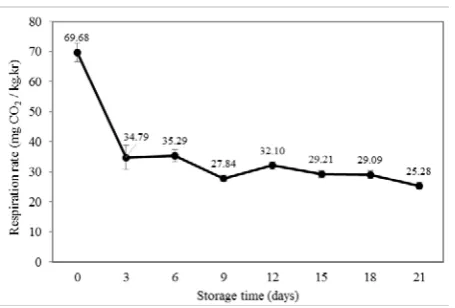
In this experiment, Ethylene production and respiration rate data of ‘Nam Dok Mai’ mangos at 13°C were collected. The data collected every 3 days to design the packaging. Figure 1 expressed color changed of ‘Nam Dok Mai’ mangos every 3 days for 21 days. The data in figure 2 showed that ‘Nam Dok Mai’ mangos are stored at 13°C with the highest ethylene emission at days 15, which has an ethylene emission rate of 0.08978 ppm or 0.06910 µL C2H4 kg-1h-1 and figure
3 showed that mangos had the highest respiration rate at day 12, 32.10 mg CO2kg-1h-1. Usually, the fruits that begin
ripening increases.
[image:3.595.106.489.350.516.2]It was concluded that mangos reached the respiration peaks at day 12 of storage at 13°C and found that ‘Nam Dok Mai’ mangos are stored at 13°C for 15 days initial to skin disease (Figure 1). The shipment transportation of Mature-green ‘Nam Dok Mai’ mangos (maturity 100 %) takes about 14 days. Therefore, it is necessary to use ethylene gas adsorbent to inhibit the ripening process of mango and to prevent disease-free and exhibited no skin before the destination transport.
[image:3.595.314.542.556.710.2]Fig. 1. The color changes of ‘Nam Dok Mai’ mango fruits during storage at 13°C.
Fig. 2. Ethylene production of ‘Nam Dok Mai’ mango fruits during storage at 13°C. Data represent the mean of 5 replications ± CL. Values with significant differences at p < 0.05
[image:3.595.50.289.560.710.2]The Experiment of the dose of TiO2 that can adsorb
ethylene for delaying the ripening process of ‘Nam Dok Mai’ mangos
From the trial of using TiO2 to absorb an ethylene gas
dose 0.1 ppm, it found that, after 3 hours, TiO2 applying on
a dose of 3 5 and 10 g had the ability to absorb maximum ethylene gas, and the results were not significantly different (p<0.05) (Figure 4). There is also a trend similar to the end of the process due to its ability to absorb most of TiO2,
depending on the absorber surface area. In addition, the slight absorption of ethylene from the ‘Nam Dok Mai’ mangos during the ripening process can result in delayed ripening of ‘Nam Dok Mai’ mangos because Ethylene Gas is a plant hormone that stimulates the ripening process of the fruit.
Fig. 4. The reduction of ethylene using TiO2 at 13°C. Data represent the
[image:4.595.336.517.49.201.2]mean of 3 replications ± CL. Values with significant differences at p < 0.05
Fig. 5. ‘Nam Dok Mai’ mangos are stored during cold storage at 13°C for 14 days and kept at 25°C for 6 days (a) trial samples and (b) Control
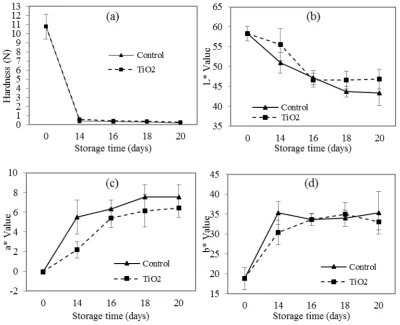
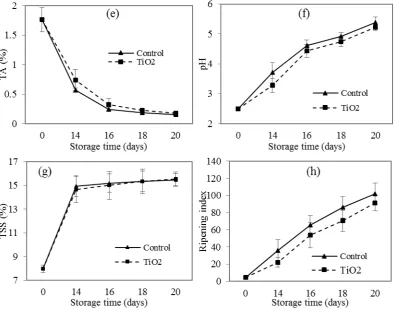
[image:4.595.77.521.248.402.2] [image:4.595.98.499.435.760.2]Fig. 6 (cont.).Physical and chemical properties of ‘Nam Dok Mai’ mangos (a) Firmness, (b) Lightness L*, (c) Redness a*, (d) Yellowness b*,(e) Titratable acidity, (f) pH, (g) Total soluble solids and (h) Ripening index. Data represent the mean of 10 replications ± CL. Values with significant differences at p < 0.05
The Experiment of the efficiency of ethylene adsorption
The experiment of using TiO2 as an ethylene gas
adsorbent after storage of 'Nam Dok Mai' mangos during cold storage at 13°C for 14 days was found to be able to delay ripening of 'Nam Dok Mai 'mangos. Control samples had the less perfect condition than trial samples because there was an initiative of black spots on the surface of control samples. While the trail samples began to develop black spots after storing at room temperature (25°C) for 4 days (figure 5)
The firmness of the trial mangos and the control after storage for 14 days had an average hardness of 0.5808 and 0.3734 N respectively. (Figure 6a). In the control, fruits had significantly lower mean hardness than trial samples (p<0.05). The control mango had lower mean firmness because of the change of the structure in the cell walls and the adhesion between cell walls is reduced [15].
The change of color in mangos have L* (Lightness), a* (Redness) and b* (Yellowness). If L* (lightness) value approaches 100, the sample is very bright, a* positive value indicates that the sample is redder and b* positive value indicates that the sample is yellower. It was found that after storage of 14 days, trial mangos with the L*, a* and b* difference with control significant statistically (p<0.05). The color of trial samples were L* = 55.63, a* =2.07 and b* =29.29 while control mangos were L* = 50.73, a* =6.07, b* =36.07 (Figure 6b-c-d). It was concluded that the trial samples were brighter and trended to approach yellow less than the control. In addition, compared to mango on the start
date of storage, which is L* = 58.31, a* =-0.07 b* =18.75 (Figure 6b-c-d), It was found that the control mango had a higher color difference than the trial samples. Showed that after 14 days storage, the trial mangos were ripening slower than the control.
A parts of titratable acidity was found that the control fruit had acid content significantly lower than trial samples at days 14 of during cold storage (p<0.05), about 0.48% and 0.78%, respectively (Figure 6e). Because titratable acidity is an indicator of sour taste. Therefore, it was concluded that the trial samples were sourer than the control fruits. [16] The pH value of both treatments increased during the storage period. The experimental mango had a pH of 14 at during cold storage significantly less than the control mango (p<0.05) were 3.25 and 3.80, respectively (Figure 6f). Total soluble solids showed that use of titanium dioxide capable adsorbent significantly slow down the increase of total soluble solids (p<0.05). The trial sample and control fruits were 14.04% and 15.34%, respectively (Figure 6g). The increase of total soluble solids is direct variation with the amount of sugar. As a result, theaccumulation of sucrose is significantly increased during the ripening process [16].
In addition, Ripening index of mangos (TSS/TA) showed that the trial samples were significantly lower than the control fruits (p<0.05) during cold storage (Figure 6h). Ripening index of mangos can separate ripening stage of ‘Nam Dok Mai’ mangos and 91% accuracy. [17] Thus, the adsorption of ethylene with TiO2 can delay the maturation of
[image:5.595.102.497.53.364.2]process faster than trial samples that considered from the increase of firmness, total soluble solids and ripening index and the decrease of titratable acidity. Because the control mangos inside the corrugated paper box has a higher ethylene content than the trial samples, effect the pulp of the mangoes to deteriorate, soften and amiss skin.
IV. CONCLUSION
TiO2 could reduce the amount of ethylene in mango fruit
cartons during cold storage. Therefore, it would delay the ripening process and extend the shelf life of mangoes by keeping at 13°C with 90-95% relative humidity for up to 20 days (a control without TiO2 can be stored for only 16 days).
Comparison study of physical and chemical properties showed that mango had a higher ripening period firmness, color, titratable acidity, pH, total soluble solids and ripening index of mangos with TiO2 adsorbent with statistically
significantly different. (p<0.05). REFERENCES
[1] Office of Agricultural Economics. (2018, November 25). Networks [Online]. Available: http:www.oae.go.th.
[2] S. Tong-In, "Problems and obstacles of the export of Nam-dokmai mangoes to the republic of chaina: Acase study of the entrepreneurs in chachoengsao province", Global Business Management; M.B.A. (Global Business Management), Burapha University 2015.
[3] Department of Agriculture, "Good Agricultural Practice (GAP) for Durian- Postharvest management ", National Durian Database 2008. [4] S. Piriyaphansakul and S. Kanlayanarat, "Effects of forced-air
precooling on fruit quality and storage life of ‘namdokmai’ mango (mangifera indica l.)", Division of Postharvest Technology, School of Bioresource and Technology, King Mongkut’s University of Technology Thonburi, -.
[5] P. Boonprasom, P. Rachtanapun and W. Phatnibool, "Production of ethylene absorber for extending postharvest life of mango cv. Nam Dok Mai", Agricultural Science Journal, Vol. 39, No.3, 2008. pp.107-110. [6] J. Siriphanich, "Post harvest biology and plant senescence", Kasetsart
University Kamphaeng Saen Campus, Vol. 1, 2006.
[7] C. Maneerat, Y. Hayata, N. Egashira, K. Sakamoto, Z. Hamai, et al., "Photocatalytic reaction of tio to decompose ethylene in fruit and vegetable storage", Vol. 2003.
[8] B. Charoensap, J. Uthaibutra and W. Kumpoun, "Titanium dioxide photocatalytic oxidation on storage life extension of mangifera indica cv. Nam dork mai", Agricultural Science Journal, Vol. 43, No.3, 2012. pp.331-334.
[9] S.W. Lam, K. Chiang, T.M. Lim, R. Amal and G.K.C. Low, "Electrophoresis–a new approach for the determination of organic matters adsorption on irradiated tio2", Journal of Photochemistry and Photobiology A: Chemistry, Vol. 187, No.1, 2007. pp.127-132. [10] K. Ubolchollakhat, "The synthesis TiO2 nano composite by sol-gel and
precipitated method", Engineering Journal, Chiang Mai University, Vol. 23, No.3, 2016. pp.1-7.
[11] M. Hussain, S. Bensaid, F. Geobaldo, G. Saracco and N. Russo, "Photocatalytic degradation of ethylene emitted by fruits with tio2nanoparticles", Industrial & Engineering Chemistry Research, Vol. 50, No.5, 2011. pp.2536-2543.
[12] P. Champa, K. Whangchai and J. Uthaibutra, "Effects of ozone on ethylene controlling to extend storage life of mango fruit cv.Nam dok mai si thong", Agricultural Science Journal, Vol. 42, No.1, 2011. pp.303-306.
[13] C. Maneerat and Y. Hayata, "Gas-phase photocatalytic oxidation of ethylene with tio2-coated packaging film for horticultural products", Transactions of the ASABE, Vol. 51, No.1, 2008. pp.163.
[14] P. Magalhães, L. Andrade, O.C. Nunes and A. Mendes, "Titanium dioxide photocatalysis: Fundamentals and application on photoinactivation", ADVANCED MATERIALS SCIENCE, Vol. 2017. pp.91-129.
[15] P. Ngamchuachit, "Fresh-cut mango: Physiology and critical factors affecting quality", Journal of Food Technology, Siam University, Vol. 12, No.1, 2017.
[16] S. Teerachaichayut and S. Srivichien, "Study of nitrate content in ‘Pattawia’ pineapple flesh: Comparative analysis by consideration of positions and maturity", Faculty of Agro-Industry, King Mongkut's Institute of Technology Ladkrabang, 2013.