IJITE Vol.01 Issue-02, (June, 2013) ISSN: 2321–1776
DESIGN A NOVEL BASED AES-128- BITS ALGORITHM
FOR LOW POWER
*Christal Ramya.R
**V.Gopi
ABSTRACT
This paper presents the design of an efficient hardware architecture and the implementation of
AES encryption and decryption standard AES-128. All the transformations of both Encryption
and Decryption are simulated using an iterative design approach in order to minimize the
hardware consumption. Xilinx XC3S200 device of Spartan Family is used for hardware
evaluation. This method can make it a very low-complex architecture, especially in saving the
hardware resource in implementing the AES mix column and Inverse Mix columns module. As
the mix column in encryption and inverse mix column in decryption is implemented by new
hardware architecture, in this design, the chip area and power can still be optimized. The new
Mix Column transformation improves the performance of the inverse cipher and also reduces
the complexity of the system.
Index Terms- AES, VLSICryptosystems, power analysis, FPGA, hardware efficiency.
*PG Scholar, Department of Electronics and Communication Engineering, PSN College of Engineering and Technology, Tirunelveli, Tamil Nadu, India
I. INTRODUCTION
The need for privacy has become a high priority for both governments and civilians desiring
protection from signal and data interception. Widespread use of personal communications
devices has only increased demand for a level of security on previously insecure
communications. This security can be achieved by cryptography. The significance of
cryptography functional to electronic data transactions has acquired an inevitable application
during the last few decades. Large volumes of information in various fields, such as financial and
legal files, medical reports, and bank services via Internet, telephone conversations, and
e-commerce transactions are generated and interchanged among millions of users everyday. All
these examples of applications and several others deserve a significant treatment from the
security point of view, not only in the transport of such information but also in its storage.
In this sense, cryptography techniques, particularly at hardware levels, are especially applicable.
Hence; this implementation will find application in wireless security like military
communication and mobile telephony. In cryptography, the AES, also called as Rijndael , is a
block cipher adopted as an encryption standard by the US government, which specifies an
encryption algorithm.. The AES algorithm is supports keys length of128, 192, and 256 bits to
encrypt and decrypt data in blocks of 128 bits, thus the AES-128 implementation requires huge
amount of hardware requirements. Hardware reduction can be achieved by various hardware
implementation techniques. This hardware implementation of the AES algorithm can provide
high performance, low cost for specific applications and reliability, compared to its software
counterparts. This paper discusses the AES Algorithm in section II AES Design in section III,
Implementation details in section IV results and discussions in section V.
II. AES ALGORITHM
The AES algorithm is a symmetric block cipher that processes plain text to cipher in four
dissimilar steps that repeated for N number of rounds. The steps are substitute byte, shift rows,
mix columns and add round key. This N values depends on the key length.10 rounds for AES-
128, 12 rounds for AES-192 and 14 rounds for AES-256 .The current implementation supports
IJITE Vol.01 Issue-02, (June, 2013) ISSN: 2321–1776
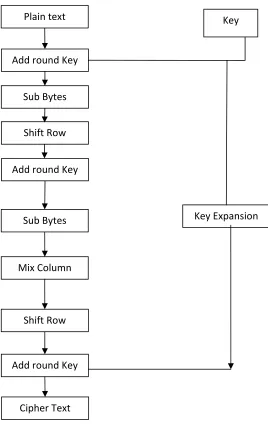
array has four rows and four columns for the AES-128. The flow of operations is as depicted
below. This operation starts from add Round key then the flow continues to sub bytes and shift
rows and the mix column steps. This steps was continued up to 10 rounds
Fig 1: Steps in AES-128 algorithm
A. Sub Bytes phase
Each byte of the state is substituted with an 8-bit value from the S-box. The S-box contains a
transformation
GF(28 ) and an affine transform .The sub
expansion and its inverse is done for decryption. Its implementation has a direct impact on the
overall throughput.
B. Shift Rows
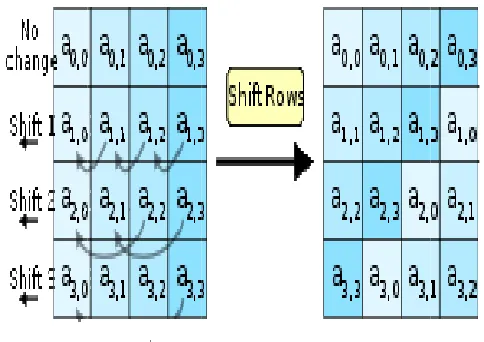
In shift row
depends on the
cyclically shifted over 1, 2, and 3 transformation is done in
GF(28 ) and an affine transform .The sub
expansion and its inverse is done for decryption. Its implementation has a direct impact on the
overall throughput.
Shift Rows phase
shift row operation, each row of the state is shifted
depends on the number of the row. The top row is not shifted and the last three rows are
ically shifted over 1, 2, and 3
done in this procedure. The S
GF(28 ) and an affine transform .The sub
expansion and its inverse is done for decryption. Its implementation has a direct impact on the
Figure 2.
phase
operation, each row of the state is shifted
number of the row. The top row is not shifted and the last three rows are
ically shifted over 1, 2, and 3
Fig 3.ShiftRows phase of each state this procedure. The S
GF(28 ) and an affine transform .The sub bytes operation is re
expansion and its inverse is done for decryption. Its implementation has a direct impact on the
Figure 2.Subbytes phase of
operation, each row of the state is shifted
number of the row. The top row is not shifted and the last three rows are
ically shifted over 1, 2, and 3 bytes, respectively.
Fig 3.ShiftRows phase of each state
this procedure. The S-box is gained by a multiplicative inverse over
bytes operation is re
expansion and its inverse is done for decryption. Its implementation has a direct impact on the
ubbytes phase of
operation, each row of the state is shifted cyclically to the left. The
number of the row. The top row is not shifted and the last three rows are
respectively.
Fig 3.ShiftRows phase of each state
box is gained by a multiplicative inverse over
bytes operation is required for both encryption and key
expansion and its inverse is done for decryption. Its implementation has a direct impact on the
ubbytes phase of each state
cyclically to the left. The
number of the row. The top row is not shifted and the last three rows are
Fig 3.ShiftRows phase of each state
box is gained by a multiplicative inverse over
quired for both encryption and key
expansion and its inverse is done for decryption. Its implementation has a direct impact on the
each state
cyclically to the left. The numb
number of the row. The top row is not shifted and the last three rows are
box is gained by a multiplicative inverse over
quired for both encryption and key
expansion and its inverse is done for decryption. Its implementation has a direct impact on the
number of shift
number of the row. The top row is not shifted and the last three rows are
box is gained by a multiplicative inverse over
quired for both encryption and key
expansion and its inverse is done for decryption. Its implementation has a direct impact on the
IJITE Vol.01 Issue-02, (June, 2013) ISSN: 2321–1776
C. Mix Column phase
In mix column phase a fixed matrix is multiplied with an array of key values. This fixed matrix
consists of 2, 3 and 1 as a number. This architecture is applied in encryption section for
Multiplying with 2. For one there is no change is occurring. The same Colum value is taken as a
result.
In a decryption side
2 and the
D. AddRoundKey phase
AddRound
produced by the key expansion operation. decryption side
the fixed multiplication with 3
D. AddRoundKey phase
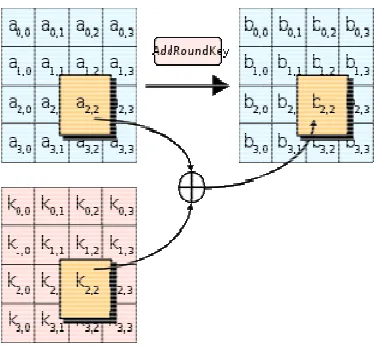
AddRoundKey operation is only a simple logical XOR of the state using a round key which is
produced by the key expansion operation.
the Inverse mix column operation can be done for fixed multiplication with
fixed multiplication with 3
Fig: 6 Inverse mix
D. AddRoundKey phase
Key operation is only a simple logical XOR of the state using a round key which is
produced by the key expansion operation.
Figure
the Inverse mix column operation can be done for fixed multiplication with
fixed multiplication with 3
Inverse mix columns
Key operation is only a simple logical XOR of the state using a round key which is
produced by the key expansion operation.
Figure 7 .Add
the Inverse mix column operation can be done for fixed multiplication with
columns in
Key operation is only a simple logical XOR of the state using a round key which is
.Add Round Key Phase
the Inverse mix column operation can be done for fixed multiplication with
in decryption
Key operation is only a simple logical XOR of the state using a round key which is
Round Key Phase
the Inverse mix column operation can be done for fixed multiplication with
side
Key operation is only a simple logical XOR of the state using a round key which is the Inverse mix column operation can be done for fixed multiplication with
Key operation is only a simple logical XOR of the state using a round key which is the Inverse mix column operation can be done for fixed multiplication with
IJITE Vol.01 Issue-02, (June, 2013) ISSN: 2321–1776
E. Key expansion phase
The key expansion operation generates a key schedule of 11 round-key of 16 bytes. Each of four
consecutive bytes form a word, denoted wi .Taking this into account that the first round-key is
the initial key and to generate every wi (except w0 -w3) the routine uses the previous w i-1 XOR
w i-4 (except i mod 4 = 0).To get the wi, when the I mod 4 0, the operation has four stages, Rot
Word, Sub Word, XOR Rcon [i / 4] and XOR w i-4. For the function Rot Word a word
[a0,a1,a2,a3] is the input then performs a cyclic permutation, and returns the word [a1,a2,a3, a0]
Sub Word is a function that takes a four byte input word and applies the S-box to each of the four
bytes to produce an output word. Rcon[ i / 4 ],contains the values given by[ xi / 4-1
,{00},{00},{00}], with xi / 4-1 being powers of x ( x is denoted as {02}) in the field
GF(28)[5].Every following word,w[i],is obtained by performing XOR of the previous
word,1],and the word Nk(Number of 32-bit words comprising the Cipher Key) positions earlier,
w[i-Nk].
III.AES DESIGN
In this paper AES is implemented in two different styles at the description level (Verilog
HDL).In the first method, each step of the Rijndael algorithm is declared as a module. These
individual modules are then called to the encryption and decryption modules...
IV. IMPLEMENTATION AND RESULTS
Both the programs are simulated using Modelsim6.3f simulator and are synthesized using Xilinx
9.1i.The power analysis can be done using Xpower analysis. This paper compares the following
parameters for the test programs in reference to the compilation report- the power, delay and the
area.
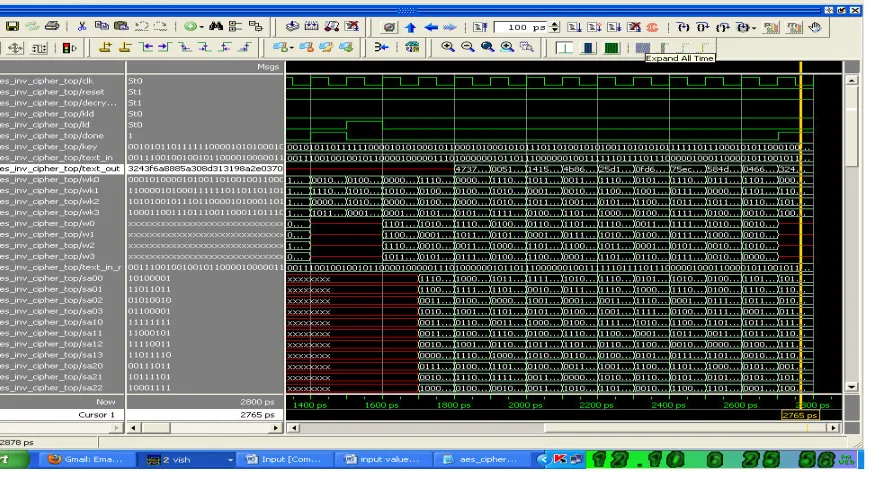
The simulation results for encryption are depicted in figure 8 and the simulation results for
decryption are depicted in figure 9.
Fig 8: Simulation results for encryption.
IJITE Vol.01 Issue-02, (June, 2013) ISSN: 2321–1776
b. Synthesis Result
The following tables show the power, delay and the area analysis report for the given AES architecture.
Table 1: Analysis result for encryption side
Area Power(mw) Delay(ns)
582(10,752) 18.450 3.507
Table 2: Analysis result for decryption side
Area Power(mw) Delay(ns)
885(10,752) 12.565 4.640
V.CONCLUSION
In this mix column technique we can obtain the same output as the Existing AES-128
Algorithm.We optimize the power, area and the delay present in the Architecture.
VI.REFERENCES
1. S. Mathew, F. Sheikh, A. Agarwal, M. Kounavis, S. Hsu, H. Kaul, M. Anders, and R.
Krishnamurthy, “53 Gbps native GF (24)2 composite-field AES-encrypt/decrypt
accelerator for content-protection in 45 nm high-performance microprocessors,” in
Proc. IEEE Symp. VLSI Circuits (VLSIC), 2010, pp. 169–170.
2. V. Rijmen, “Efficient implementation of the Rijndael S-box,” 2000.[Online]. Available:
http://ftp.comms.scitech.susx.ac.uk/fft/crypto/rijndael- sbox.pdf
3. A. Rudra, P. K. Dubey, C. S. Jutla, V. Kumar, J. R. Rao, and P. Rohatgi, “Efficient
rijndael encryption implementation with composite field arithmetic,” in Proc. CHES,
2001, pp. 171–184.
4. J.Wolkerstorfer, E. Oswald, and M. Lamberger, “An ASIC implementation of the AES
S-boxes,” in Proc. RSA Conf., 2002, pp. 67–78.
5. A. Satoh, S. Morioka, K. Takano, and S. Munetoh, “A compact Rijndael hardware
6. N. Mentens, L. Batinan, B. Preneeland, and I. Verbauwhede, “A systematic evaluation of
compact hardware implementations for the Rijndael S-box,” in Proc. Topics Cryptology
(CT-RSA), 2005, vol. 3376/ 2005, pp. 323–333.
7. D. Canright, “A very compact Rijndael S-box,” Naval Postgraduate School, Monterey,
CA, Tech. Rep. NPS-MA-04-001, 2005.
8. X. Zhang and K. K. Parhi, “On the optimum constructions of composite field for the AES
algorithm,” IEEE Trans. Circuits Syst. II, Exp. Briefs, vol. 53, no. 10, pp. 1153–1157,
Oct. 2006.
9. X. Zhang and K. K. Parhi, “High-speed VLSI architectures for the AES algorithm,” IEEE
Trans. Very Large Scale Integr. (VLSI) Syst., vol. 12, no. 9, pp. 957–967, Sep. 2004.
10.C. Paar, “Some remarks on efficient inversion in finite fields,” in Proc. IEEE ISIT, 1995,
pp. 5–8.
11.J. L. Fan and C. Paar, “On efficient inversion in tower fields of characteristic two,” in
Proc. IEEE ISIT, 1997, p. 20.
12.D. R.Wilkins, “Part III: Introduction to Galois Theory,” 2000. [Online]. Available:
http://www.ercangurvit.com/abstractalgebr/galois.pdf
13.M. M. Wong and M. L. D. Wong, “A new common subexpression elimination algorithm
with application in composite field AES S-box,”in Proc. 10th Int. Conf. Inf. Sci. Signal
Process. Their Appl. (ISSPA), 2010, pp. 452–455.
14.M. Chen, “In Greedy Algorithms,” in A Greedy Algorithm With Look Forward Strategy.