sandwich. The reason was to find out if more robust shaped charges give more residual penetration against an ERA sandwich, compared to shaped charges with more penetration performance in RHA targets. It was thought, that the latter ones are more sensitive against disturbances. But the shaped charges with the higher perforation capability have typically higher jet tip veloc-ities and this gives more residual penetration also against ERA targets. In other words the so-called more robust charges gave less performance against the ERA sandwiches than the shaped charges which have higher performance in RHA targets.
Keywords: Shaped Charge, Explosive Reactive Armor, Liner Angle, Liner Wall Thickness
1 Background
Many people had once the opinion that “robust” shaped charges with thicker liners, respectively with larger opening angles, are less disturbed by special armors because they should have a thicker jet with more mass. But with such charges the jet tip velocities are partially remarkably reduced. To prove these conceptual ideas a test series was performed with an explosive reactive armor (ERA) sand-wich. Additionally shaped charges with different diameters were also fired.
2 Test Setup
The shaped charges detonated at a standoff distance of two calibers in front of a 10 mm thick, 608inclined RHA plate. At further 200 mm in line of sight or 100 mm perpendicular distance a symmetric reactive armor sand-wich was arranged which consisted of a 4 mm mild steel front plate, a 2 mm thick layer of high explosive and again a 4 mm mild steel rear plate for all the described ERA tests. To get enough space for achieving flash X-ray pictures of the disturbed jets, a large 10 mm thick mild steel plate was perpendicularly arranged at 400 mm distance behind the ERA sandwich, to catch the spall fragments and deviated jet elements over a large area. The residual penetrations were
3 Shaped Charges with Different Liner Angles
For this investigation 96 mm shaped charges with wave shaper were used. The liner angles were changed from 608, over 758to 908with a constant 2 mm liner wall thickness. The standoff distance of two calibers means here around 200 mm.
Figure 2 shows in the upper line the shaped charge firing number in Schrobenhausen, followed by the shaped charge liner angles 2a, and then the used plate thicknesses. A graphical sketch below presents the geometric conditions in the firing direction with the air gap distances and the target plate angles and finally the achieved residual penetrations. The results are individual tests which have no statistical meaning.
The 608liner achieved 210 mm residual penetration, the 758liner 148 mm and the 908liner 166 mm. The penetration of 210 mm of the standard shaped charge with the 608liner is greater than that of the supposed more robust shaped charges with the greater liner angles.
All these tests were conducted with flash X-ray (FXR) pictures from the incoming and perforating jets, which are presented together with the test setup on the bottom of Figure 3. A make switch in front of the mild steel witness blocks was used. The time differences for the three FXR pictures after the detonation of the high explosive charge are not equal, because the jet tip velocities have been different.
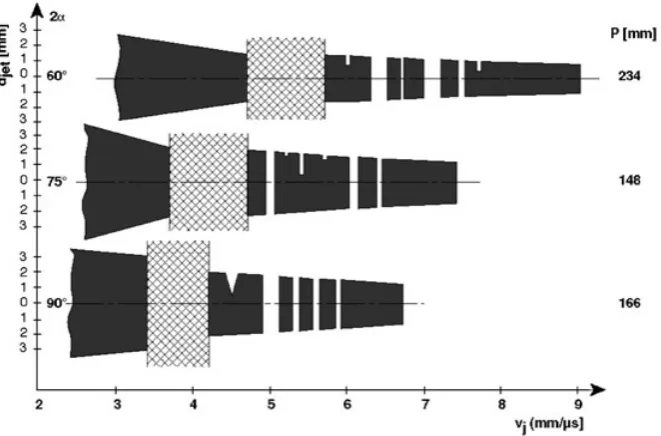
The FXR shadowgraphs can be better compared with each other if they are presented in a time distance diagram together with the jet fan [1] (Fig. 4). From this diagram the jet tip velocities can be easily read out. For the 608liner this is around 9 mm/ms, for the 758liner 7.5 mm/ms and for the 908 liner around 6.5 mm/ms. If the three flash X-ray pictures are carefully compared, then at least no remarkable increase on jet diameter and therefore on jet mass can be recognized by the increase of the liner angle. This fact, changing the liner angle does not increase the jet mass, is also found in later test series and from numerical calculations [2]. A detailed explanation of this behavior should not be discussed here.
The faster jets are at least less disturbed in the tip region compared to the slower jet portions by the used explosive
Figure 1. Test setup to measure the disturbances of the shaped charge jets by flash X-ray and to get the residual penetrations.
Figure 2. Layout of test setup with the achieved result of 3 liner angles of 608, 758and 908.
[image:2.595.138.460.523.716.2]reactive armor. The FXR pictures show that with the decreasing jet tip velocities i.e. increasing liner angles the jets behind the ERA sandwiches are more disturbed.
The contours of the jets in Fig. 4 are drawn out with their partially or fully disturbed regions, achieving also their radii. These analyzed values are summarized in Fig. 5, which shows the clear reduction of jet tip velocities and a small trend of increasing jet diameters from the 608to the 908liner angles.
4 Shaped Charges with Different Liner Wall Thicknesses
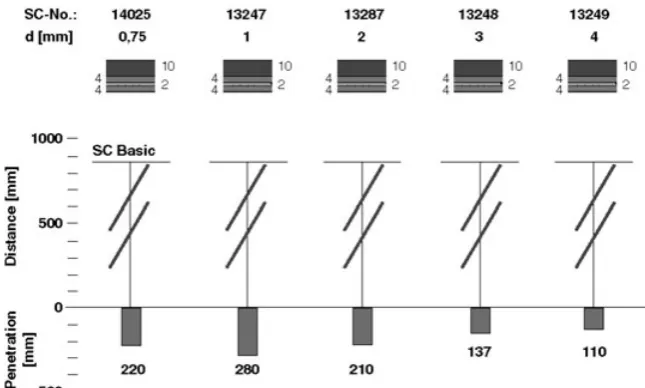
[image:3.595.115.481.60.294.2]The liner wall thickness of the 96 mm shaped charge with the 608cone angle was made smaller and thicker than the 2 mm reference charge and fired against the same test arrangement at standoff distances of two calibers. The maximum penetration was achieved with the 1 mm liner with 280 mm penetration in comparison to 210 mm for the
Figure 4. Disturbed jet after 4/2/4 ERA armor in the time distance plot.
[image:3.595.135.466.350.568.2]2 mm liner thickness (Fig. 6). The penetration performance then decreases for the 0.75 mm liner to 220 mm, but this is still a little better than the 2 mm liner. With thicker liners, 3 mm and 4 mm, the penetration is further decreasing to 137 mm and 110 mm, respectively.
Unfortunately the FXR pictures are no more available from these tests. Therefore, only the penetration values can be interpreted and discussed with the measured jet tip velocities. The tip velocity increased a little from 9 mm/ms of the 2 mm liner to 9.5 mm/ms of the 1 mm liner. A further increase for the 0.75 mm liner is not possible because of the “sound barrier” [3]. For the thin 0.75 mm liner larger inaccuracies are expected which lead to more deviations from the charge axis compared to the 1 mm or 2 mm liners. The tip velocities of the shaped charge jets decrease with the liner wall thicknesses from 1 mm to 4 mm. These smaller jet
tip velocities are the reason for less efficient shaped charge jets against this investigated explosive reactive armor sandwich.
It is also a wrong opinion that thicker liners should give bigger jet diameters. The increase is only minimal and not at all proportional. The loss on jet tip velocity is much more critical for defeating such targets compared to the small increase of jet mass.
[image:4.595.134.457.54.248.2]The residual penetrations are summarized as a function of the jet tip velocities for the two discussed liner parameters in Fig. 7. As mentioned before all values are single test results. Only the 908liner deviates a little from the clear trend, that with decreasing jet tip velocities also the penetration performance decreases behind the used 4/2/4 ERA sand-wich. The diagram shows the importance of high jet tip velocities for shaped charge layout to get maximum residual
[image:4.595.138.461.296.494.2]Figure 6. Test results of the different liner wall thicknesses against light ERA target.
Figure 8. Residual penetration of shaped charges with different diameters against ERA 4/2/4.
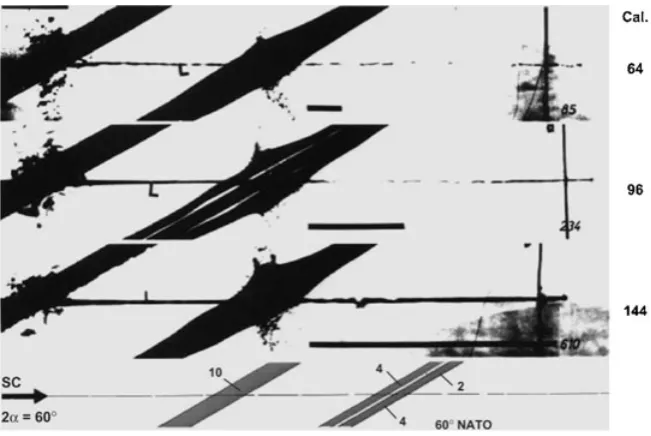
[image:5.595.135.461.489.707.2]From these 3 tests also flash X-ray pictures are available (Fig. 9). These flash X-ray pictures can again be introduced in the time distance plot together with the jet fan (Fig. 10). The small 64 mm shaped charge with wave shaper has a jet tip velocity of 9.5 mm/ms, the 96 mm and 144 mm shaped charges have jet tip velocities around 8.75 mm/ms. The jet of the 64 mm shaped charge is definitely much thinner and remarkably more disturbed as the jet of the 96 mm shaped charge. The flash X-ray picture of the remarkably thicker jet of the 144 mm shaped charge shows that the jet is only on the upper line partially reduced in thickness, while the 96 mm jet
already shows clear “eruptions”, and there are already larger segments missing in the jet of the 64 mm shaped charge.
[image:6.595.118.480.62.269.2]The analyzed flash X-ray pictures with regard to the jet diameters and the introduced disturbances or missing jet portions are summarized again as a function of the jet velocities in Fig. 11. This diagram illustrates very well the effect of the 4/2/4 ERA armor on the different jets of shaped charges with different charge diameters.
Figure 10. Flash X-ray pictures of the different charge sizes of 64 mm, 96 mm and 144 mm in the time distance plot after the 4/2/4 ERA sandwich.
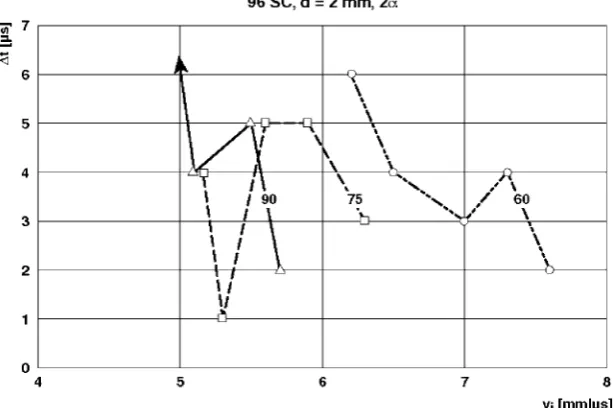
[image:6.595.134.464.334.547.2]Figure 12. Time distance plots for defining the time differences of disturbing sequences of shaped charge jets by ERA sandwiches (or other “moving” targets).
[image:7.595.145.453.504.708.2]function of the jet velocity which have a relatively large scatter. But they are lying roughly in the band between 3ms and 5ms. It is surprising that the disturbance frequencies are more or less equal and any trend for the different shaped charge designs with different cone angles is not visible. They are also not really changing with the shaped charge diameters.
7 Conclusions
So-called robust shaped charges have reduced residual penetrations compared to standard precision shaped charg-es against ERA targets, because their tip velociticharg-es are reduced by changing the liner angle and the liner wall thickness.
Thicker jets from larger caliber shaped charges are less disturbed and give therefore more residual penetration. The disturbing frequencies for the used reactive armor sandwich 4/2/4 device of around 250 kHz is constant for the inves-tigated shaped charges with different liner angles, wall thickness and also shaped charge caliber
8 References
[1] M. Held, Time-Distance Plots for ERA-Design, Propellants, Explos., Pyrotech.2001,26, 258.
[2] J. Carleone, Mechanics of Shaped Charges, inTactical Missile Warheads,AIAA Book, Progress in Astronautics and Aero-nautics, Vol. 155,1993, pp. 357.
[3] M. Held, Liners for Shaped Charges, Journal of Battlefield Technology,2001,4, 1.
[4] M. Held, The Importance of Jet Tip Velocity for the Perform-ance of Shaped Charges against Explosive Reactive Armour, Propellants, Explos., Pyrotech.1994,19, 15.
[5] M. Held, Overview on Reactive Armour,European Armoured Fighting Vehicle Symposium, Cranfield University, Royal Military College of Science School of Engineering and Applied Science, Shrivenham, May 28 – 30,1996, pp. 7/1.
Abbreviations
ERA Explosive reactive armor FXR Flash X-ray
RHA Rolled homogeneous armor SC Shaped charge
[image:8.595.142.459.56.267.2](Received July 7, 2004; Ms 2004/022)