Food products with hygroscopic properties (i.e. powdered food concentrates) are obtained by dehydration either through evaporation or freeze-drying to a low water content. Thus, the characteristic feature of these products is the necessity to rehydrate them before consumption (PN-86/A-94000).
From the modern consumers’ point of view, the ease of the food preparation from their con-centrated forms seems to be the most important characteristic in view of the accessibility of the hygroscopic products, which includes all other properties of these products (depositness, disper-sity, wettability) and convenience (labour- and time consumption) during preparation (Świderski 1999). This characteristic, determined by the proc-ess of water sorption under ambient conditions, affects the reconstitution properties and is very often responsible for the quality assessment level of the ready product (Domian & Lenart 2000).
In the case of the dehydrated products, their ability to rehydrate depends on the state of the thermodynamic system seeking a dynamic bal-ance. The inter-particle reactions, in the process of sorption, are related to factors determining the geometric structure and the chemical nature of the adsorbent surface and also the adsorbate properties (Ościk 1979; Paderewski 1982).
Elements of a porous solid body may be connected and form a rigid skeleton or be composed of sepa-rate grains sticking to one another (Paderewski 1999), which is the case with the powdered food concentrates. Bearing in mind the fact that linked elements of a solid body form the fundamental characteristics of the structure, an attempt to examine the correlation between the properties of the deposit (powdered food) and the utility features seems justified.
The problem of the influence of the surface microstructure on the phase border
physico-chemi-The Influence of the Development of the Specific Surface
of Sorption on the Wettability of Instant Soups
ANETA OCIECZEK and PIOTR PALICH
Department of Hotel and Tourism Management, Faculty of Business Administration,
Gdynia Maritime Academy, Gdynia, Poland
Abstract
Ocieczek A., Palich P. (2007): The influence of the development of the specific surface of sorption on the wettability of instant soups. Czech J. Food Sci., 25: 333–338.
In the present experiment, the sorption isotherms were determined for instant-type soups, giving rise to colloidal
solu-tions and proper solusolu-tions as a consequence of hydration. On the basis of the isotherm course in the range 0.07–0.44 aw,
specific surface was defined for the material under study. Further, the examined foodstuff concentrateswettability
was established by measuring the time from the moment of powder penetration to the continuous phase. On the basis of the results obtained, conclusions were formulated concerning the influence of specific surface of sorption on the wettability of the products examined.
cal properties remains a complex issue. Bearing the above in mind, it would be interesting to start a new study into the dependence of the surface structure on the utility characteristics of porous products with a low water content.
The objective of this work was to determine the relationship between the wettability of the food concentrate and its specific surface of sorption, specified on the basis of the sorption isotherm after BET transformation.
MATERIALS AND METHODS
The tests were run on 4 soup concentrates, so-called “Hot Mug” soups, marked as IA, IIA, IB, IIB (by two leading producers marked as I and II). After the rehydration process, the IA and IIA concentrates former solutions with the features of the solutions proper (Red Beetroot Soup), while the IB and IIB concentrates gave rise to colloidal solutions (Pea Soup).
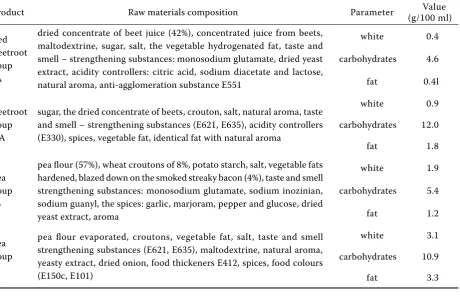
In Table 1, the composition of raw materials and chemical constitution of the products tested are presented.
Taking for granted that the basis for the hygro-scopic adsorbent characteristic is the isotherm of water adsorption, the course of isotherm for the particular products was determined by means of the static-desiccator method with the use of saturated salt solutions (Tyszkiewicz 1987; Świtka 1992).
In order to specify the specific surface, the BET (Chirife et al. 1986; Paderewski 1999; T im-mermannet al. 2001) equation was adopted:
a = vmc p
(1)
ps
(1 – p
) [1 + (c – 1)p ]
ps – vapour pressure of the adsorbed chemical com-pound, which is over the liquid in the balanced state at adsorption temperature (Pa)
Knowing the volume of the vapour adsorbed at a temperature below the boiling temperature and the so-called “water cross-section” (Paderewski 1999), i.e. the surface occupied by one molecule assuming it is of spherical shape:
ω = 1.53 × 10–203
√
(
M)
2 (2)ρc
where:
ω – the water cross-section (m2/molecule) M – molar mass (g/mol)
ρc – density at the test temperature (g/cm3)
The adsorbent specific surface was calculated (Ościk 1979; Paderewski 1982, 1999) with the use of the following equation:
asp = ω vmρc N (3)
M
where:
N – Avogardo number (6.023 × 10²³ molecules/mol) The wettability was determined following PN-78/ A-86030-3 modified by the authors, measuring the wettability time of the concentrates examined till the moment of concentrates penetrate to a continuous phase.
RESULTS AND DISCUSSION
Porous structure products are characterised by the gas or vapour sorption ability, the progress being dependent on their chemical composition and structure (Wisła 1982; Dutkiewicz 1999; Paderewski 1999; Lewicki 2003).
The mechanism of the physical gas and vapour adsorption is reflected in the shape of the sorption isotherms (Figure 1). On the basis of their shape, the process thermodynamics may be determined (en-thalpy, the connection extent) and also the material structure can be examined (Paderewski 1999).
The isotherms of the tested product sorption were characterised by the shape corresponding to II type isotherms according to Brunauers’ classifi-cation, which is typical of compound constitution products and simultaneously contains considerable amounts of low-molecule substances.
A comparative analysis of the results showed that the course of isotherms was similar in all the
ps
ps
where:
a – adsorption (kg/kg)
vm – maximum adsorption respective for the total surface covered with a layer of single-molecule adsorbate (kg/kg)
c – constant, connected in an exponential way with the difference between the adsorption heat on the first and the following layers, deemed steady and equal to the condensation heat
concentrates. In the IA, IIA, IIB concentrates, a dramatic growth of the water content occurred at the water activity level of 0.55 while with IB concentrate, the same phenomenon occurred with 0.70 water activity.
The characteristic feature of the isotherms was the low position of the second part of the isotherm. It can be assumed that these products, to a certain extent, were slightly sensitive to environmental humidity (as in the case of beet sugar). Once this
border was overcome, they started to rapidly absorb moisture and became fully hydrated. In the case of the Beetroot Soup concentrate, the moisture results in dissolution, while with the Pea Soup concentrate, it causes swelling.
According to the opinion of many authors con-cerning the application of the test data, determin-ing the BET equation parameters only for a very narrow area, the sorption isotherm was limited to aw 0.07 to 0.44 (Chirifeet al. 1986; Świtka 1992;
0 10 20 30 40 50 60
0 0.2 0.4 0.6 0.8 1
Water activity
W
at
er
co
nt
en
t(
%
) IA
[image:3.595.66.427.81.259.2]IB IIA IIB
Figure 1. The process of the tested concentrate sorption isotherms
Table 1. Raw material composition and chemical constitution of tested products
Product Raw materials composition Parameter (g/100 ml)Value
Red Beetroot Soup IA
dried concentrate of beet juice (42%), concentrated juice from beets, maltodextrine, sugar, salt, the vegetable hydrogenated fat, taste and smell – strengthening substances: monosodium glutamate, dried yeast extract, acidity controllers: citric acid, sodium diacetate and lactose, natural aroma, anti-agglomeration substance E551
white 0.4
carbohydrates 4.6
fat 0.4l
Beetroot Soup IIA
sugar, the dried concentrate of beets, crouton, salt, natural aroma, taste and smell – strengthening substances (E621, E635), acidity controllers (E330), spices, vegetable fat, identical fat with natural aroma
white 0.9
carbohydrates 12.0
fat 1.8
Pea Soup IB
pea flour (57%), wheat croutons of 8%, potato starch, salt, vegetable fats hardened, blazed down on the smoked streaky bacon (4%), taste and smell strengthening substances: monosodium glutamate, sodium inozinian, sodium guanyl, the spices: garlic, marjoram, pepper and glucose, dried yeast extract, aroma
white 1.9
carbohydrates 5.4
fat 1.2
Pea Soup II
pea flour evaporated, croutons, vegetable fat, salt, taste and smell strengthening substances (E621, E635), maltodextrine, natural aroma, yeasty extract, dried onion, food thickeners E412, spices, food colours (E150c, E101)
white 3.1
carbohydrates 10.9
fat 3.3
[image:3.595.72.533.449.746.2]Paderewski 1999; Timmermannet al. 2001). The sorption isotherm was presented in the system of coordinates (p/p0)/a(1 – p/p0) and p/p0. On the base of the data in the 0.07–0.44 range, the c energetic constant, vm monolayer volume and its respective water activity were calculated (Table 2).
Comparison of the data indicated the tendency where the concentrates from the producer coded as II were characterised by smaller volumes of monolayers. In the IA and IIA Beetroot Soup concentrate samples, specific volumes of a mon-olayer were accompanied by relatively low values of water activity (0.1938 and 0.1899, respectively). In the IB and IIB Pea Soup concentrates, on the other hand, the monolayer was accompanied by relatively greater values of water activity than was the case with Beetroot Soup concentrates (0.3318 and 0.2697, respectively). Translating the volumes of monolayers into the chemical composition of the products tested, their values seem likely to be the related to the biopolymer contents (carbohy-drates and proteins) which are potential donors of the active sorption sites, and the contents of the hydrophobic factor, fat, contributing to the reduction of active sites accessibility (Table 1).
Based on the data published in literature, the quality of the products consolidated as a result of dehydration significantly deteriorates follow-ing water adsorption in amounts greater than the
monolayer volume. Thus, the durability of the concentrates by producer II is likely to be worse than that by the producer coded I.
Further statistical analysis made it possible to calculate the specific sorption expansion. This parameter, being a derivative of the monolayer capacity, revealed much greater values in the case of the products containing considerable amounts of biopolymers able to receive water particles on their surfaces and containing small amounts of the hydrophobic factor (fat) at the same time.
Table 3 presents the results of the measurements of the tested concentrates wettability, showing the times needed to be fully wetted and for the powder to be completely evenly distributed across the water at 80°C.
The data obtained (Tables 2 and 3) shows that the IA and IIA Beetroot Soup concentrates (resulting in solutions proper following rehydration) had similar values of sorption surfaces. The IB and IIB Pea Soup concentrates (colloidal solutions), on the other hand, were characterised by widely variable values of the sorption surfaces (coming up to 104). The size of the sorption surface
[image:4.595.62.533.103.192.2]cor-related negatively with its wettability, expressed as the time needed for the concentrate to penetrate into the continuous phase, regardless of the type of the solution formed by the powder following the rehydration process. The Pearson rate was used
Table 2. BET equation parameters and specific surface of sorption of the tested products
Product vm(m3/kg) a
w cenerg. asp(m2/g)
IA 2.04E-04 0.1938 9.3893 0.7157
IIA 1.87E-04 0.1899 16.376 0.6554
IB 3.66E-04 0.3318 2.7581 1.2861
IIB 2.81E-08 0.2697 4.2251 9.874 × 10⁻⁵
Table 3. Wettability of the tested food concentrates
Product Time of wetting (s) s2 SD CV(S) D CV(D) R
IA 2.24 0.0463 0.2152 9.6060 2.9606 × 10⁻¹⁶ 1.3217 × 10⁻¹⁶ 0.43
IIA 1.16 0.0072 0.0850 7.3108 0 0 0.17
IB 2.91 0.8001 0.8945 30.7383 0 0 1.77
II B 19.44 5.2563 2.2927 11.7935 1.1842 × 10⁻¹⁵ 6.0918 × 10⁻¹⁷ 4.53
R – the range; s2 – variance; SD – standard deviation; CV(S) – coefficient of variation; D – average deviation; CV(D) –
[image:4.595.64.532.635.720.2]to state the intensity and direction of the linear correlation between the specific surface sorption and the wettability time. The value of the Person rate was –0.80 and clearly demonstrated that a negative correlation exists between the two fac-tors examined. This suggests that a small sorption area is the fundamental reason for a longer time of wettability, which eventually determines the powders’ poor ability to rehydrate. In calculating the coefficient, it was determined that 64% of the changeability of the wetting time depended on the expansion of the specific surface sorption and 36% depended on other elements; therefore, despite the occurrence of a reliable tendency indi-cating a connection between the development of specific surface sorption and the wettability, the chemical composition of the powder (molecular mass of the dominating mixture component) had an equally significant importance in the shaping of the powder wetting. In situations when low molecular mass substances (making up the solu-tion proper following rehydrasolu-tion) made-up the dominating powder component, the wettability rate of such a mixture was higher.
The Beetroot Soup concentrates (IA and IIA) produced by means of spray drying of the beetroot broth, and the completion of the resulting powder by flavour enriching additives, were characterised by the presence of low-molecular components of dual structure. The powder produced as a result of the beetroot broth reduction was characterised by an amorphous structure formed due to the rapid dehydration process, but on the other hand, the flavour boosting substances applied had a crystal-line structure. Due to an even distribution of the tested Beetroot Soup concentrate over the polar solvent surface (water), the powder surface gradu-ally became wet, and its particles gravitationgradu-ally dropped down through the water, thus mutually dispersing both systems. Dynamic dissolution of the powder components in the water was observed at the time of the dropping.
The Pea Soup concentrates (IB and IIB), in which starch was subjected to enzymatic modification and the mixture was completed with flavouring substances, were characterised by the presence of low- and high-molecular components of various degree of arrangement (Table 1). Due to an even distribution of the tested Pea Soup concentrate over the water surface, the surface of the con-centrate gradually become moist and the initial gravitational drop of some of the low-molecular
components occurred. Following the full hydra-tion of the high-molecular components which made them swell, they then started to drop down and continued to swell. The process of Pea Soup concentrate wetting (IB and IIB) was longer than in the case of Beetroot Soup concentrate (IA and IIA) due to the presence of high-molecular sub-stances, (e.g. starch) and the smaller surface area available for sorption.
The data obtained allow for the assumption that the raw material composition and the production technology creates the inside structure of food concentrates, thus determining their useful prop-erties (in the test case – the surface area sorption and high-molecular substances determined the ability to rehydrate).
In order to furnish the particles with the proper and required structure (size and shape), food pro-duction technologies apply the agglomeration process. This process facilitates the wetting of the powders, the bulk density and the dispersion ability in the water environment. Another aspect of agglomeration is the reduction of unfavour-able storage changes leading to caking and losing powder properties when affected by humid air (Pijanowskiet al. 1997).
CONCLUSIONS
The IA and IIA concentrates were characterised by a better wettability than the IB or IIB concen-trates. It is to be assumed that it is the develop-ment of the specific surface which determines the rehydration ability.
The wettability assessed on the basis of the time measurement from the moment of the powder even distribution on the solvent surface to the moment of the concentrate penetrating up to the continuous phase depended on the chemical composition of the concentrate. Large amounts of the high-molecule substances prolonged the wettability of the tested concentrates.
References
Chirife J., Suarez C., Iglesias H.A. (1986): The cal-culation of the heat of water sorption in foods on the basis of B.E.T. theory. Journal of Food Technology, 21:103–107.
Dutkiewicz E.T. (1999): Physical Chemistry of Surface. WNT, Warszawa. (In Polish)
Lewicki P.P. (2003): Water as a component of food. Przemysł Spożywczy, 57(5): 8–14, 50. (In Polish) Ościk J. (1979): Adsorption. PWN, Warszawa. (In
Polish)
Paderewski M. (1982): Adsorption and Adsorbers. Wydawnictwo Politechniki Szczecińskiej, Szczecin. (In Polish)
Paderewski M. (1999): Processes of Adsorption in Chemi-cal Engineering. WNT, Warszawa. (In Polish)
Pijanowski E., Dłużewski M., Dłużewska A., Jar- czyk A. (1997): The General of Food Technology. WNT, Warszawa. (In Polish)
PN-78/A-86030-3 Milk and Dairy Products. Milk powder. Test methods. (In Polish)
PN-86/A-94000 Food Concentrate. Names and Defini-tions. (In Polish)
Świderski F. (1999): Science of Commodities Food af-ter Technological Processing. Wydawnictwo SGGW, Warszawa. (In Polish)
Świtka J. (1992): Impact of chosen technological factors on sorption properties of dried creamary products. Scientific WSM Work in Gdynia. (In Polish)
Timmermann E.O., Chirife J., Iglesias H.A. (2001): Water sorption isotherms of foods and foodstuffs: BET or GAB parameters? Journal of Food Engineer-ing, 48: 19–31.
Tyszkiewicz S. (1987): Activity of water of foodstuffs. Definition. Method of the absolute measu-rement. Pat-terns. Przemysł Spożywczy,51-53. (In Polish)
Wisła E. (1982): The influence of modification solid adsorbents texture of the carbon dioxide adsorption. Scientific Work in Kraków. (In Polish)
Received for publication November 21, 2006 Accepted after corrections August 10, 2007
Corresponding author:
Dr. Aneta Ocieczek, Gdynia Maritime Academy, Faculty of Business Administration, Department of Hotel and Tourism Management, Morska Street 81–87, 81-225 Gdynia, Poland