MCWP 2-6
Counterintelligence
U.S. Marine Corps
5 September 2000
To Our Readers
Changes:
Readers of this publication are encouraged to submit suggestions and changes that
will improve it. Recommendations may be sent directly to Commanding General, Marine
Corps Combat Development Command, Doctrine Division (C 42), 3300 Russell Road, Suite
318A, Quantico, VA 22134-5021 or by fax to 703-784-2917 (DSN 278-2917) or by E-mail to
. Recommendations should include the following information:
l
Location of change
Publication number and title
Current page number
Paragraph number (if applicable)
Line number
Figure or table number (if applicable)
l
Nature of change
Add, delete
Proposed new text, preferably double-spaced and typewritten
lJustification and/or source of change
Additional copies:
A printed copy of this publication may be obtained from Marine Corps
Logistics Base, Albany, GA 31704-5001, by following the instructions in MCBul 5600,
Marine Corps Doctrinal Publications Status.
An electronic copy may be obtained from the
Doctrine Division, MCCDC, world wide web home page which is found at the following
uni-versal reference locator:
http://www.doctrine.usmc.mil
.
MCCDC (C 42)
13
Jul
2004
E R R A T U M
to
MCWP 2-6
COUNTERINTELLIGENCE
1. Change the publication short title to read “MCWP 2-6” (vice
MCWP 2-14).
DEPARTMENT OF THE NAVY Headquarters United States Marine Corps
Washington, D.C. 20380-1775
5 September 2000
FOREWORD
Marine Corps Doctrinal Publication (MCDP) 2, Intelligence, and Marine Corps Warfighting Publication (MCWP) 2-1, Intelligence Operations, provide the doctrine and higher order tactics, techniques, and procedures for intelligence operations. MCWP 2-14, Counterintelligence, complements and expands on this information by detailing doctrine, tactics, techniques, and procedures for the conduct of counterintelligence (CI) operations in support of the Marine air-ground task force (MAGTF). The primary target audience of this publication is intelligence personnel responsible for the planning and execution of CI operations. Commanders, planners, and other personnel who use the results from CI operations or provide support to them should also read this publication.
MCWP 2-14 describes aspects of CI operations across the spectrum of MAGTF, naval, joint and multinational operations, including doctrinal fundamentals, equipment, command and control, communications and information systems support, planning, execution, security, and training. MCWP 2-14 provides the information needed by Marines to understand, plan, and execute CI operations in support of the MAGTF across the spectrum of conflict.
MCWP 2-14 supersedes FMFM 3-25, Counterintelligence, dated 22 September 1992.
Reviewed and approved this date.
BY DIRECTION OF THE COMMANDANT OF THE MARINE CORPS
B. B. KNUTSON, JR.
Lieutenant General, U.S. Marine Corps Commanding General
Marine Corps Combat Development Command
C
OUNTERINTELLIGENCE
Table of Contents
Page
Chapter 1. Doctrinal Fundamentals
1001. Objective . . . 1-1
1002. Basic Considerations for CI Activities . . . 1-1
Hostile Objectives . . . 1-1
Adversarial Advantage . . . 1-2
1003. Concepts of CI and Force Protection . . . 1-3
Historical Services Perspective . . . 1-3
Joint Operations and CI . . . 1-3
CI and Intelligence. . . 1-4
CI and Force Protection . . . 1-4
1004. MAGTF CI Operations . . . 1-4
Responsibilities . . . 1-4
CI Process . . . 1-5
CI Execution . . . 1-6
1005. CI Measures. . . 1-7
Active Measures . . . 1-7
Passive Measures . . . 1-7
Types of CI Measures . . . 1-7
1006. CI Support to Operations. . . 1-7
Chapter 2. CI Functions and Services
2001. Counterintelligence Functions. . . 2-1
CI Operations. . . 2-1
CI Investigations . . . 2-2
CI Collections and Reporting . . . 2-2
CI Analysis and Production . . . 2-3
2002. Counterintelligence Services . . . 2-3
2003. CI Support to the Strategic, Operational, and
Tactical Levels of War . . . 2-3
Strategic CI Support . . . 2-4
MCWP 2-14 Counterintelligence
Tactical CI Support . . . 2-5
2004. Garrison Support . . . 2-6
Chapter 3. Organization and Responsibilities
3001. General. . . 3-1
3002. Commanders and Staff Principals . . . 3-1
Commander . . . 3-1
Intelligence Officer . . . 3-1
Operations Officer . . . 3-2
3003. MEF G-2 Section and Intelligence Battalion. . . 3-3
G-2 Operations Officer . . . 3-3
G-2 Plans Officer . . . 3-4
Intel Bn Commander/Intelligence Support Coordinator . . . 3-5
CI/HUMINT Officer . . . 3-7
Collection Management/Dissemination Officer . . . 3-8
Surveillance and Reconnaissance Cell OIC . . . 3-9
Production and Analysis Cell OIC . . . 3-9
CI/HUMINT Companies . . . 3-10
HUMINT Support Team . . . 3-14
3004. Individual Marines . . . 3-16
3005. Marine Corps CI Organizations within the Supporting
Establishment . . . 3-16
3006. Naval Component Organization . . . 3-17
N-2 Intelligence Officer . . . 3-17
Attached NCIS Agent . . . 3-17
3007. Joint CI Organization. . . 3-17
CI Staff Officer . . . 3-17
Task Force CI Coordinating Authority . . . 3-18
3008. National Level CI Support . . . 3-18
Chapter 4. Counterintelligence Employment
4001. Operational Environment. . . 4-1
4002. Employment of CI Elements . . . 4-2
Command and Control and Concept of Operations . . . 4-2
Concept of Employment . . . 4-2
CI Employment Considerations . . . 4-4
Employment of MAGTF CE CI Elements . . . 4-4
Employment of CI Elements with the Ground
Combat Element . . . 4-5
CI Support to the Combat Service Support Element and Rear Area Operations . . . 4-6
4003. Friendly Prisoners of War and Persons Missing (Non-hostile) and Missing in Action. . . 4-6
4004. Unique CI Support during MOOTW . . . 4-8
Jurisdiction . . . 4-8
MAGTF CI Employment . . . 4-8
CI Measures and Operations . . . 4-8
Chapter 5. C2 and CIS Support to MAGTF CI Operations
5001. General . . . 5-1
5002. Command and Control . . . 5-1
JTF J-2 and the Joint Intelligence Support Element . . . 5-1
MEF Command Element Intelligence C2 and
Operations Nodes . . . 5-4
5003. Basic CI CIS Requirements . . . 5-9
5004. CIS Support to MAGTF CI Operations . . . 5-10
General . . . 5-10
Communications Systems. . . 5-10
Intelligence and CI/HUMINT Information Systems . . . 5-11
Summary . . . 5-13
5005. CI CIS Planning Considerations. . . 5-13
Chapter 6. CI Planning
6001. Marine Corps Planning Process and Joint Planning Processes
Overview . . . 6-1
Marine Corps Planning Process . . . 6-1
Comparison of the MCPP and the Joint Planning Process . . . 6-3
6002. CI Planning . . . 6-3
Intelligence Planning . . . 6-3
CI Planning—General. . . 6-4
Coordination Considerations . . . 6-5
Enemy Considerations . . . 6-5
6003. CI Planning and the Intelligence Cycle . . . 6-6
General . . . 6-6
Planning the Activity . . . 6-7
6004. CI Planning Requirements and Considerations . . . 6-17
Formulation of the Commander’s Estimate . . . 6-17
Support to Targeting . . . 6-19
Combat Assessment . . . 6-19
MCWP 2-14 Counterintelligence
General . . . 6-19
The CI Appendix . . . 6-20
Chapter 7. Execution of CI Activities
7001. MAGTF CI Operations . . . 7-1
Planning . . . 7-1
Command and Control . . . 7-2
Tactical Deployment . . . 7-2
7002. CI Screening Operations . . . 7-2
Persons of CI Interest . . . 7-3
Coordination. . . 7-3
Preparation . . . 7-4
Initial Screening . . . 7-5
Conduct of the Screening . . . 7-5
CI Screening Report. . . 7-6
Indicators . . . 7-7
Mobile and Static Checkpoints . . . 7-7
7003. Cordon and Search Operations . . . 7-9
General . . . 7-9
Types and Conduct of Cordon and Search Operations . . . 7-10
7004. Counterintelligence Force Protection Source Operations . . . 7-12
7005. Tactical CI Interrogation . . . 7-13
Types of Subjects . . . 7-13
Objectives of CI Interrogators . . . 7-13
Indicators Warranting Suspicion . . . 7-14
Screening or Initial Interrogation . . . 7-15
Detailed Interrogation . . . 7-15
7006. CI Investigations . . . 7-16
Conduct of CI Investigations . . . 7-16
Investigative Plan . . . 7-17
Order of Investigation . . . 7-18
Investigative Techniques . . . 7-18
Files and Records . . . 7-18
Interrogation Techniques . . . 7-21
Elicitation . . . 7-23
Sabotage Investigations . . . 7-24
CI Walk-In Interviews . . . 7-26
7007. Captured Material Exploitation . . . 7-27
7008. CI Technical Collection and Investigative Techniques . . . 7-28
Electronic Surveillance . . . 7-31
Investigative Photography and Video Recording . . . 7-33
Polygraph . . . 7-33
7009. CI Surveys/Vulnerability Assessments, Evaluations, and
Inspections . . . 7-36
Tactical Operations . . . 7-36
Garrison CI Inspections . . . 7-36
7010. CI Support to the Crisis Action Team Intelligence Cell . . . 7-37
7011. CI Mission Profiles . . . 7-38
Amphibious Raid . . . 7-38
Limited Objective Attacks . . . 7-38
Show of Force Operations . . . 7-40
Reinforcement Operations . . . 7-40
Security Operations. . . 7-40
Civil Action. . . 7-41
Tactical Recovery of Aircraft and Personnel . . . 7-41
In-Extremis Hostage Rescue. . . 7-42
Chapter 8. Counterintelligence Training
8001. General . . . 8-1
Training Objective . . . 8-1
Basic CI Training . . . 8-1
8002. Basic CI and Security Training for All Personnel . . . 8-1
8003. Training for Officers and SNCOs. . . 8-2
8004. Mission-Oriented CI Training . . . 8-3
General . . . 8-3
CI Personnel . . . 8-4
8005. Training of Intelligence Section Personnel . . . 8-4
8006. Peacetime CI Training . . . 8-5
Exercises . . . 8-5
Real-World Support . . . 8-5
8007. CI Training Programs . . . 8-6
Individual CI Personnel Training . . . 8-6
Responsibilities . . . 8-6
Descriptions . . . 8-6
Chapter 9. CI Administration
9001. General . . . 9-1
9002. Files . . . 9-1
MCWP 2-14 Counterintelligence
9004. Personnel . . . 9-2
Augmentation. . . 9-2
Global Sourcing . . . 9-2
Reserves . . . 9-2
9005. Emergency and Extraordinary Expense Funds . . . 9-2
Chapter 10. Garrison Counterintelligence Support
10001. Mission. . . 10-1
10002. Counterintelligence Survey/Vulnerability Assessment . . . 10-1
Basis . . . 10-1
Initiation . . . 10-1
Preparation . . . 10-2
Conduct . . . 10-3
Baseline . . . 10-3
Exit Brief . . . 10-4
CI Survey/Vulnerability Assessment Report and
Recommendations . . . 10-4
10003. Counterintelligence Penetration Inspection . . . 10-4
10004. Counterintelligence Evaluation . . . 10-5
10005. Technical Surveillance Countermeasures Support . . . 10-5
Appendices
A. Counterintelligence Principal and Supporting Equipment . . . A-1
B. Counterintelligence Appendix (Appendix 3 to Annex B,
Intelligence). . . B-1
C. Counterintelligence Production and Analysis . . . C-1
D. Counterintelligence Plans, Reports, and Other Formats . . . D-1
E. Counterintelligence Training Courses . . . E-1
F. MAGTF Counterintelligence Planning Checklist . . . F-1
G. Glossary . . . G-1
C
HAPTER
1. D
OCTRINAL
F
UNDAMENTALS
Intelligence strives to accomplish two objectives. First, it provides accurate, timely, and relevant knowledge about the enemy (or potential enemy) and the surrounding environment. The primary objective of intelligence is to support decisionmaking by reducing uncertainty about the hostile situation to a reasonable level, recognizing that the fog of war renders anything close to absolute certainty impossible. The second intelligence objective assists in protecting friendly forces through counterintelligence (CI). CI includes active and passive measures intended to deny the enemy valuable information about the friendly situation. CI includes activities related to countering hostile espionage, subversion, and terrorism. CI directly supports force protection operations by helping the commander deny intelligence to the enemy and plan appropriate security measures. The two intelligence objectives demonstrate that intelligence possesses positive—or
exploitative—and protective elements. It uncovers conditions that can be exploited and simultaneously provides warning of enemy actions. Thus, intelligence provides the basis for our own actions, both offensive and defensive. Identifying, planning, and implementing MAGTF operations and measures are the main focus of this publication.
1001.
OBJECTIVE
The principal objective of CI is to assist with protecting friendly forces. CI is the intelligence function concerned with identifying and counteracting the threat posed by hostile intelligence capabilities and by organizations or individuals engaged in espionage, sabotage, subversion or terrorism. CI enhances command security by denying an adversary information that might be used to conduct effective operations against friendly forces and to protect the command by identifying and neutralizing espionage, sabotage,
subversion or terrorism efforts. CI provides critical intelligence support to command force protection efforts by helping identify potential threats, threat capabilities, and planned intentions to friendly operations while helping deceive the adversary as to friendly capabilities, vulnerabilities, and intentions. Physical security reduces vulnerability. Operations security reduces exposure. Combating terrorism makes us a less lucrative target. CI increases uncertainty for the enemy, thereby making a significant
contribution to the success of friendly operations. CI also identifies friendly vulnerabilities, evaluates security measures, and assists with implementing appropriate security plans. The integration of intelligence, CI, and
operations culminates in a cohesive unit force protection program.
1002.
BASIC CONSIDERATIONS FOR CI ACTIVITIES
Hostile Objectives
Adversaries can be expected to use every available means to impede our forces with their efforts directed towards intelligence, espionage, sabotage, subversion, and terrorist operations. Hostile intelligence collection activities
CI—Information gathered and activities conducted to protect against espionage, other intelligence activities, sabotage, or
assassinations conducted by or on behalf of foreign
governments or elements thereof, foreign
1-2 MCWP 2-14 Counterintelligence
capabilities, limitations, centers of gravity, vulnerabilities, intentions, and probable courses of action. These activities also obtain information concerning the area of operations including weather, terrain, and hydrography.
Adversarial Advantage
Adversary knowledge of friendly operations concentrates efforts on preparing the objective for defense, attacking friendly staging areas, and disrupting the operation through espionage, sabotage, terrorism, and subversive activities. CI is essential to the security of our forces—
commencing with routine garrison operations, to the inception of planning, and until the operation is complete—to deny the enemy advantage and manipulate understanding us.
Hostile Espionage Activities
Foreign intelligence services (FIS) capabilities must be accurately assessed. FIS should be assumed to be at least as effective as our own. An adversary should always be given the benefit of the doubt in collecting information and producing intelligence on friendly operations. FIS do not normally develop vital intelligence by obtaining one all-revealing fact. Most worthwhile intelligence is the product of the assembly, comparison, and interpretation of many small and seemingly insignificant items of information.
Enemy Sabotage Activities
Sabotage is an act or acts with intent to injure, interfere with or obstruct the national defense of a country by willfully injuring or destroying, or
attempting to injure or destroy, any national defense or war material, premises or utilities including human and natural resources. Immediately prior to the outbreak of hostilities, during combat, and even during military operations other than war (MOOTW), the enemy can be expected to employ sabotage techniques to disrupt friendly operations.
Subversive Activities
Subversive activities are designed and conducted to undermine the authority of friendly forces and/or that of the local government to disrupt friendly activities or to gain aid, comfort, and moral support for the cause of the enemy or hostile force or group. Subversive activity can be directed against individuals, groups, organizations or entire populations. Frequently, subversive activity supports, conceals or provides a favorable environment for espionage, sabotage, and terrorist operations. Subversion is an action designed to undermine the military, economic, psychological, political strength or morale of a regime.
Terrorist Activities
Any personality, organization or installation of political or military
1003.
CONCEPTS OF CI AND FORCE PROTECTION
Historical Services Perspectives
The CI agencies within the four Services have historically demonstrated dramatically different CI areas of emphasis, concepts of operations, and methods of execution.
Naval Criminal Investigative Service and Air Force Office of Special Investigations
The Naval Criminal Investigative Service (NCIS) and the Office of Special Investigations (OSI) have traditionally viewed CI with a strategic focus drawn from their perspectives as, primarily, law enforcement organizations. NCIS is mainly a civilian investigative organization with a chain of
command directly from the Secretary of the Navy to the Director, NCIS. The Director, NCIS, has exclusive responsibility for CI policy development and implementation and execution and management of CI programs, with the exception of those combat and combat related CI responsibilities of the Marine Corps. CI activities of NCIS are funded from the Foreign
Counterintelligence Program (FCIP). OSI is a field-operating agency of the Air Force. Policy and programmatic oversight rests with the Secretary of the Air Force Office of the Inspector General, not the Director of Intelligence. CI activities of OSI are also funded from the FCIP. Like NCIS, there is no programmatic provision in OSI for tactical intelligence and related activities (TIARA) funding or resources.
Marine Corps and the Army
The Army and Marine Corps maintain CI as a component of their
intelligence staffs. The Marine Corps CI orientation is entirely tactical, with funding exclusively within the DON’s budget for TIARA. The Army emphasizes both strategic and tactical CI and is supported by a mixture of FCIP and TIARA resources.
Joint
During the development of joint CI doctrine, the issue arose whether CI should fall under the staff cognizance of intelligence or operations because of differences in emphasis and support for CI. Doctrinal evolution has placed the CI of the combatant commands and joint task forces (JTF) command under the joint intelligence staff (J2).
Joint Operations and CI
Exercising command and control of CI assets vary under different
circumstances. Military department CI elements are under the command and control of their respective department secretaries to carry out their statutory authorities and responsibilities. However, combatant commanders may choose to exercise staff coordination authority over military department CI elements deployed within their area of responsibility. Staff coordination authority is intended to encompass deconfliction of CI activities and assurance of unity of effort in attaining the military department secretaries’ and combatant commanders’ CI objectives. If a military operation plan or
1-4 MCWP 2-14 Counterintelligence
operation order so specifies, a combatant commander or JTF commander may, on National Command Authority-directed execution, assume
operational control of military department CI elements assigned to support the operation for the duration of the operation, including predeployment, deployment, and redeployment phases. Under this authority, Service CI elements are under the combatant commander’s authority. MAGTF CI elements, however, are under the operational control of the MAGTF unless otherwise specified. Law enforcement and CI investigations and attendant matters carried out by CI elements remains solely a military department’s administrative responsibility.
CI and Intelligence
CI, like intelligence matters, is a command responsibility. In preparing for operations, units must develop a CI plan and implement appropriate CI measures to protect themselves from potential threats. CI is integrated into the overall intelligence effort to identify and counter an adversary’s intelligence efforts. Failure to adequately plan for and implement CI operations and measures may result in serious damage to the MAGTF or supported unit. Continuing attention to CI and effective intelligence and operations integration is thus required at all levels of command, from the MAGTF commander to the individual Marine.
CI and Force Protection
Force protection is a responsibility of command. An operations function, force protection is under the staff cognizance of the unit operations officer. CI is a significant contributor to the command’s overall force protection effort. Security is a matter of vulnerability and threat assessment with effective risk management. CI helps identify the hostile intelligence threat, assists in determining friendly vulnerabilities to it, and aids with the development of friendly measures that can lessen or negate these. The commander weighs the importance of intelligence and CI to be used as a tool in risk management. Marine Corps CI elements provide unique force protection capabilities through both active and passive CI measures and human resource intelligence (HUMINT) support. Often, CI elements can provide unique intelligence support to the commander’s estimate of the situation and situation development (e.g., providing an assessment of the mood of the area of operations, allowing us to feel the pulse of an incident as it develops). CI also provides critical support to the command’s overall intelligence efforts by providing indications and warning (I&W) of potential attack and support to targeting and combat assessment efforts.
1004.
MAGTF CI OPERATIONS
Responsibilities
The unit intelligence officer plans, implements, and supervises the CI effort for the commander. The G-2/S-2 may have access to or request support from MAGTF CI units and specialists to assist in developing CI estimates and Force protection—A
plans. Members of the command are involved in executing the CI plan and implementing appropriate CI measures. Key participants in this process and their specific responsibilities are—
l Unit security manager (generally the chief of staff or executive officer,
but often the unit’s intelligence officer)—overall integration and effectiveness of unit security practices.
l G-3/S-3—force protection, operations security (OPSEC),
counterreconnaissance, and deception.
l G-6/S-6—communications and information systems security. l G-1/S-1—information and personnel security.
l Headquarters commandant—physical security of unit command post and
echelons.
CI Process
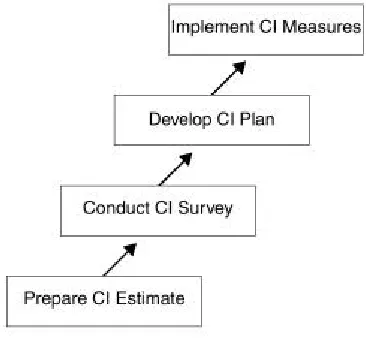
The CI process at all levels is conducted by using a standard methodology that consists of four steps: develop a CI estimate, conduct CI survey(s), develop the CI plan, and conduct CI operations and assist with
implementation of CI measures. Figure 1-1 summarizes the CI process.
The CI Estimate
[image:15.612.136.319.538.712.2]Included in CI estimates are known factors on location, disposition, composition, strength, activities, capabilities, weaknesses, and other pertinent information. CI estimates also provide conclusions concerning probable courses of action and future activities of these organizations, effects of those activities on friendly courses of action, and effectiveness of friendly force CI measures. Comprehensive CI estimates are normally prepared by senior echelon commands. Within the MAGTF, intelligence and CI analysts of the MAGTF CE, intelligence battalion (intel bn), and its CI/ HUMINT company/detachment will normally prepare a tailored CI estimate that addresses threats to the MAGTF by using an IPB methodology that is focused on CI factors and the CI threat. However, each level of command must conduct its own evaluation to determine which adversary’s capabilities identified in the MAGTF CI estimate represent a threat to their particular unit. The CI estimate must be updated on a regular basis, and the revised
1-6 MCWP 2-14 Counterintelligence
estimate or appropriate CI warning reports must be disseminated to units involved in the operation.
The CI Survey
The CI survey assesses a unit’s security posture against the threats detailed in the CI estimate. The CI survey should identify vulnerabilities to specific hostile intelligence, espionage, sabotage, subversion or terrorist capabilities and provide recommendations on how to eliminate or minimize these vulnerabilities. The survey should be as detailed as possible. During the planning phase of an operation, it may be possible to do a formal, written survey. In a time-compressed situation, the survey will likely result from a brief discussion between the appropriate intelligence, CI, operations, communications, and security personnel. It is critical that the survey look forward in both space and time to support the development of the CI measures necessary to protect the unit as it carries out successive phases of the operation; the survey makes recommendations to improve the CI posture of the command both now and in the future.
The CI Plan
The CI plan details the activities and operations that the command uses to counter hostile intelligence, sabotage, subversion, and terrorist threats. It includes procedures for detecting and monitoring the activities of hostile intelligence and terrorist organizations and directs the implementation of active and passive measures that are intended to protect the force from these activities. The CI plan is based on the threats identified in the CI estimate and the vulnerabilities detected by the CI survey. The intel bn commander, as the intelligence support coordinator (ISC), assisted by CI/HUMINT company, the production and analysis (P&A) cell officer in charge (OIC), and the MEF staff CI officer, will normally prepare a detailed,
comprehensive CI plan that addresses the MEF and is integrated with CI plans of the JTF and other pertinent forces. Included in the MAGTF CI plan are details of the employment of dedicated CI capabilities and the conduct of specialized CI operations intended to detect and neutralize or eliminate specific threats. Plans of subordinate MAGTF elements closely follow the MAGTF plan, normally adding only security measures that are applicable to their specific units.
CI Execution
An understanding of the interest and capability of adversarial intelligence organizations to collect information on evolving U.S. technologies is critical to developing appropriate countermeasures. CI personnel can readily obtain information from other national intelligence and security organizations because of its unique liaison arrangements. That capability not only supports the analytical efforts of the national agencies and intelligence centers, but also give an added dimension to I&W. The CFSO provides commanders with a collection and production capability to protect their forces without resorting to complex national coordination procedures. The role of CI is even greater as U.S. military operations increasingly rely upon cooperation and support of our allies. CI personnel can assess the capabilities,
effectiveness, organization, and methods of operation of allied intelligence
CI estimates provide information on enemy intelligence, sabotage, subversive, and terrorist organizations relevant to the current mission, situation and area of operations.
One of the most highly effective tools of the CI collection activity is the counterintelligence force protection source operations (CFSO).
services as well as the effectiveness of their security procedures and ability to support or to detract from the U.S. effort.
1005.
CI MEASURES
CI measures—both active and passive—encompass a range of activities designed to protect against hostile intelligence, espionage, sabotage, subversion, and terrorism threats.
Active Measures
Active CI measures are those designed to neutralize the multi-discipline intelligence effort (all disciplines used to collect intelligence such as HUMINT, signals intelligence [SIGINT], and imagery intelligence [IMINT]) and hostile efforts toward sabotage, subversion, and terrorism. Active CI measures include counterespionage, countersabotage,
countersubversion, counterterrorism, counterreconnaissance,
concealment, and deception operations and vary with the mission and capabilities of the unit.
Passive Measures
Passive CI measures are designed to conceal and deny information to the enemy, protect personnel from subversion and terrorism, and protect installations and material against sabotage. Measures include security of classified material, personnel security, physical security, security education, communications security, data security, electromagnetic emission security, censorship, camouflage, concealment, light, and security discipline. Passive measures are readily standardized in the unit’s standing operating
procedures (SOPs) regardless of the unit’s mission.
Types of CI Measures
The three general CI measures are denial, detection, and deception. Frequently, the measures applied to accomplish one of these purposes contribute to the others.
Denial Measures
Denial measures are applied to prevent the enemy from gaining access to classified and sensitive information, subverting personnel, and penetrating the physical security barriers established at command posts and echelons, facilities, and installations. Counterreconnaissance is one example of a denial measure that may be used.
Detection Measures
Detection measures are used to expose and to neutralize enemy efforts directed toward intelligence collection, sabotage, subversion, and terrorism. MAGTF units detect or aid in the detection of these enemy efforts by collecting, analyzing, and reporting information on enemy activities that may indicate an intelligence effort by establishing checkpoints to control the
1-8 MCWP 2-14 Counterintelligence
movement of personnel within or through their areas of responsibility and by evacuations of possible enemy agents and materials to higher echelons for interrogation and exploitation. Other detection measures, usually
accomplished by specialists, include document translation and analysis, screening, interrogation, and offensive and defensive CI activities.
Deception Measures
Deception measures mislead or otherwise confuse the enemy concerning our capabilities, centers of gravity, vulnerabilities, plans, and intentions.
Deception measures may include feints, ruses, demonstrations, and the provision of false information to the enemy. Deception measures depend on effective command security for success. Special precautions must be taken ensuring there is no leakage of friendly force information during the planning or execution of an operation. When enemy intelligence activities are identified, consideration must be given to the potential for using that activity in support of deception measures. The potential threat posed by the enemy must be weighed against the potential intelligence benefits of continued exploitation of the enemy’s intelligence system versus its destruction or other degradation
1006.
CI SUPPORT TO OPERATIONS
MAGTF CI support to operations normally falls within one of the following two categories: support to military security or civil security.
Support to Military Security
Military security encompasses all measures taken by a command to protect itself from sabotage, terrorism, and subversion and to deny information to the enemy. MAGTF units emphasize protection of airfields and other major installations and the defeat of hostile target acquisition efforts. Typical measures include OPSEC, counterreconnaissance, countersigns, passwords, and restrictions on access to selected areas and installations.
Support to Operations Security
To be effective, OPSEC vulnerabilities must be determined and
countermeasures implemented commencing with operational planning and continuing through completion of any operation. Commanders must determine what essential elements of friendly information (EEFI) and operations must be protected, what OPSEC measures to implement, when to implement them, and what level of risk they are willing to accept.
Commanders, staffs, and individuals at all echelons of command are responsible for developing and implementing an effective OPSEC program.
OPSEC denies the enemy prior knowledge of EEFI regarding command activities, plans, operations, strengths, vulnerabilities, and intentions. The enemy collects this information through a variety of means—human, electronic, photographic, etc. To effectively counter this threat, commanders must have access to timely, reliable, and accurate intelligence on enemy intelligence capabilities and operations.
Control of deception operations should be at the highest level of command likely to be significantly affected by the enemy’s reactions.
Support to Information Security and C2 Protect
The INFOSEC program—a responsibility of the unit’s security manager— includes a proper security classification determination being made with applicable security regulations and the proper protection being afforded to the material throughout its life cycle. These measures include proper preparation, reproduction or manufacturing, storage, use, and destruction. Failure to comply with required INFOSEC measures exposes sensitive information to potential compromise. The rapid advancement of the microprocessor and the maturity of computer age technologies have presented a significant new area of exposure that leaves us particularly vulnerable. While these advances provide new capabilities and
opportunities, they also create new vulnerabilities to be exploited. Evolving information operations (IO) concepts and doctrine recognizes the potential and the threats created by this trend. IO include actions taken to affect adversary information while defending one’s own information and
information systems during both routine peacetime, MOOTW, and combat operations. Command and control protect are defensive measures taken to detect and prevent hostile efforts against our C2 and supporting
communications and information systems. The ability to directly influence key decisionmakers through the injection, disruption, manipulation or destruction of information and information means is a powerful tool in the advance of military objectives. Information system vulnerabilities include denial of service, information theft, information replacement or introduction of false data. Defensive measures to provide information assurance include use of secure networks, firewalls, encryption, anti-virus scans to detect malicious code, and proper systems administration to include aggressive auditing. Information protection includes the authenticity, confidentiality, availability, integrity, and non-repudiation of information being handled by anyone involved with C2. It requires proper implementation of appropriate security features such as passwords, authentication or other
countermeasures. The criticality for CI in this area is the ability to identify the adversary’s potential capability to exploit, deny, degrade or destroy friendly C2 before an attack to counter the attempt. Reporting and tracking of attempted and successful attacks will, through trend analysis, assist in the development of countermeasures.
Counterreconnaissance
Units may be assigned both reconnaissance and counterreconnaissance responsibilities; these two activities complement each other and are
inseparable. Good reconnaissance ensures a certain amount of security, and counterreconnaissance provides a certain amount of reconnaissance
information. However, a unit tasked with a reconnaissance mission is not ordinarily given a supplementary counterreconnaissance mission as completing the counterreconnaissance mission generally requires
neutralizing the hostile reconnaissance elements, while the primary goal of reconnaissance is collection of information without being detected by the enemy. Counterreconnaissance includes setting up a defensive screen to deny enemy reconnaissance or an offensive screen designed to meet and destroy enemy reconnaissance in combat air operations. Counterair operations may be defined as counterreconnaissance when counterair
CI supports commanders’ OPSEC programs by providing assessments of friendly vulnerabilities; briefings on enemy threats of espionage, sabotage, subversion, and terrorism; and assistance in establishing safeguards and
countermeasures against these threats.
1-10 MCWP 2-14 Counterintelligence
operations deny or reduce an enemy’s capability for visual, photographic or electromagnetic reconnaissance.
Principles of Counterreconnaissance. Counterreconnaissance elements focus on friendly forces being screened. Hostile reconnaissance forces are destroyed or neutralized, and friendly screening forces are echeloned in depth.
Forms of Counterreconnaissance. The defensive screen is protective. It is usually established behind natural obstacles. An offensive screen may be moving or stationary depending on the activities of the friendly force being screened. The offensive screen meets the enemy’s reconnaissance forces and neutralizes them. The commander’s adoption of a form of
counterreconnaissance screen depends on the situation, mission, weather, and terrain; thus the form of counterreconnaissance screen adopted, need not reflect solely the tactical mission of the command. Because there are offensive and defensive screens does not imply a requirement for their employment only in support of a like tactical mission. An offensive screen may well be employed to support a tactical mission of defense, while an attack mission may be supported best by a defensive screen.
Support to Embarkation Security
Embarkation security consists of the special application of military and civil security measures to the embarkation phase that include the movement to the point of embarkation and the actual embarkation. Examples include the screening of civilians employed in the port or airfield, control of contact between troops and civilians, covering or removing tactical markings and other unit designations, and moving to the port or airfield under the cover of darkness.
Support to Civil Security
Civil security operations include CI measures affecting the civilian population of the area. Typical measures include security screening of civilian labor, imposing curfews and other circulation control measures, and the monitoring of suspect political groups.
One of the most effective CI measures taken by a unit is counterreconnaissance.
C
HAPTER
2. C
OUNTERINTELLIGENCE
F
UNCTIONS
AND
S
ERVICES
2001.
COUNTERINTELLIGENCE FUNCTIONS
There are four CI functions: operations; investigations; collection and reporting; and analysis, production, and dissemination (see table 2-1).
CI Operations
Offensive CI operations are the employment of specialized CI techniques and procedures. They are directed against the espionage, sabotage,
subversive, and terrorism threat. These operations are planned, coordinated, and conducted by MAGTF CI personnel and include the following
operations:
Counterespionage Operations
These operations are designed to detect, destroy, neutralize, exploit or prevent espionage activity. This is accomplished through the identification, penetration, manipulation, deception, and repression of individuals, groups or organizations conducting or suspected of conducting espionage activities.
Countersubversion Operations
These operations are designed to detect, prevent or neutralize the activities of subversive groups. Subversive activity is closely related to and frequently supports, conceals or provides a favorable environment for espionage and sabotage operations. Based on this environment, the countersubversive mission may include offensive measures directed toward the origin of hostile subversive plans and policies.
“...Mogadishu has been one tough nut to crack . . . we are making steady and perceptible progress. From my perspective, one of the most encouraging outgrowths of our efforts in this socially, politically and geographically complex urban environment has been the
emergence of tactical HUMINT as the driving force behind operations . . . in-by-9 out-by-5 service on priority intelligence requirements.”
“. . . been directed against clearly defined targets—there have been remarkably few dry holes. Spared the long unproductive walks in the sun sometimes associated with the Vietnam Conflict. The troops have remained alert, tactically disciplined and tightly focused. I believe this accounts, in some measure, for our low casualty rate.”
“. . . it’s refreshing to see things in their proper order—INTELLIGENCE DRIVING OPERATIONS . . . instead of operations driving intelligence.”
—MajGen Charles E. Wilhelm Commander, Marine Corps Forces Somalia
Table 2-1. Objectives of CI Functions.
CI Function Objectives
CI Operations
Determine foreign intentions.
Support tactical and strategic perception management operations. Support all-source intelligence and other CI operations.
Support planning and military operations.
CI Investigations
Detect, exploit, prevent, or neutralize espionage activities.
Detect and resolve incidents of foreign directed sabotage, subversion, sedition, terrorist activities, and assassinations.
Document elements of proof for prosecutions.
Provide military commanders and policy makers with intelligence and informa-tion to use to eliminate security vulnerabilities and improve security postures.
CI Collections and Reporting
Provide indications and warning of security threats to U.S. forces, facilities, and operations.
Provide intelligence on threats to forces to support planning and implementation of defensive or offensive countermeasures.
Respond to commander’s priority intelligence requirements.
CI Analysis, Production, and Dissemination
Provide analysis and assessments of threats to U.S. forces, facilities, and operations.
Provide causal analysis of past events to identify vulnerabilities and risks. Identify adversary organizations, personalities, and capabilities posing threats to
2-2 MCWP 2-14 Counterintelligence Countersabotage Operations
These operations require a comprehensive program to penetrate saboteur, partisan or other dissident groups. The goal of the program is to determine sabotage plans and to identify saboteurs, methods of operation, and specific targets, and thus support MAGTF force protection efforts.
Counterterrorism Operations
These operations are planned, coordinated, and conducted to detect, prevent, or neutralize terrorist groups or organizations by determining terrorist plans or intentions. They are also employed to identify terrorists, methods of operation, and specific targets.
Exploitation and Neutralization Operations
These operations are targeted against personalities, organizations, and installations of intelligence or CI interest, which must be seized, exploited or protected. Screening and interrogations are operations designed to identify and apprehend enemy intelligence agents, subversives, terrorists, and saboteurs who attempt to infiltrate friendly lines and operations or conceal themselves among the civilian population.
CI Investigations
CI investigations are investigations concerning personnel, security matters, espionage, sabotage, terrorism, and subversive activities, including
defection. A CI investigation is a duly authorized, systematic, detailed examination/inquiry to uncover and report the facts of a matter. Jurisdiction for CI investigations will vary according to which commander is exercising C2 of the force’s CI assets. However, CI investigations and attendant matters carried out by a CI element remain part of the administrative responsibilities of the military department to which the specific CI element is subordinate.
Additionally, MAGTF CI elements may conduct investigations of friendly prisoners of war and persons missing (non-hostile) in action cases. The type of activities required in these investigations include collecting information of potential intelligence value on friendly personnel possibly in enemy hands (including debriefings of returned POW/MIA, with emphasis on identifying, locating, and recovering additional personnel) and the collection of
information that aids in identifying, locating, and recovering those friendly personnel known or suspected in enemy hands. Initial damage assessments relating to the possible compromise of operational and sensitive material must be included.
CI Collections and Reporting
CI collections and reporting are a significant force multiplier, which are intended to identify actual and potential threats to the command. Collections include the following.
Liaison
organizations/agencies, and civil affairs and psychological operations units where appropriate. Within the DON, NCIS is the element exclusively assigned to maintain liaison with federal law enforcement, security and intelligence agencies on criminal investigative, CI and security matters. NCIS is the primary agency for liaison in these matters with state local and foreign law enforcement, security and intelligence agencies, including those of foreign and U.S. military departments. Following notification of the local NCIS office, MAGTF CI personnel may conduct liaison necessary to accomplish its mission during combat operations. If prior notification of NCIS is not possible, notification will be made at the earliest opportunity.
CI Force Protection Source Operations
CI force protection source operations (CFSO) are overt source collection activities of an expedient nature intended to identify threats to the command in support of the commander’s force protection mission.
CI Analysis and Production
Limited initial analysis is conducted by MAGTF CI elements that originally collect and report the information. Detailed analysis occurs as part of the MAGTF’s all-source intelligence effort.
2002.
COUNTERINTELLIGENCE SERVICES
They enhance the security of the command against espionage, sabotage, subversion, and terrorism. Technical surveillance countermeasures (TSCM) involve the employment of services and techniques designed to locate, identify, and neutralize the effectiveness of hostile technical surveillance activity (see chapter 10).
2003.
CI SUPPORT TO THE STRATEGIC, OPERATIONAL,
AND TACTICAL LEVELS OF WAR
The levels of war form a hierarchy. Tactical engagements are components of battle, and battles are elements of a campaign. The campaign is but one phase of a strategic design for gaining the objectives of policy. While a clear hierarchy exists, there are no sharp boundaries between levels; they merge and form a continuum. A particular command echelon is not necessarily concerned with only one level of war. A commander’s responsibilities within the hierarchy depend on the scale and nature of the operation and may shift up or down as the operation develops (see MCDP 1-1, Strategy, and MCDP 1-2, Campaigning, for additional information on the levels of war).
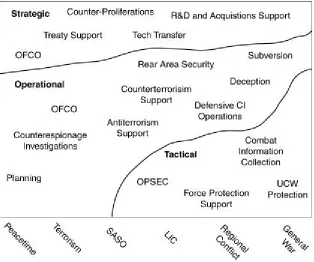
CI provides critical support to all three levels of war (see figure 2-1 on page 2-4). While certain activities may crosslevels based on the environment and the nature of the threat; the levels and type of CI support remain fairly distinct. The distinctions are based on the supported commander’s intelligence and CI requirements. If the support satisfies national interests and policy objectives, it is part of the strategic level CI support. When the
2-4 MCWP 2-14 Counterintelligence
objectives and requirements focus on the overall joint force and its operations and sustainment, CI support is at the operational level. Tactical CI support addresses the immediate needs of commanders, particularly maneuver commanders, conducting the battles and engagements, with CI support emphasizing force protection from proximate threats. This publication will focus predominantly on tactical CI support to MAGTF operations.
Strategic CI Support
The strategic level focuses on security objectives, and involves the National Command Authorities, National Security Council, JCS, and Congress. This is a macro perspective in looking at how the instrument of national power is used to satisfy the overarching national objectives, interests, and policies.
Strategic-level CI helps provide answers to the question, “What threats exist to the national interests and instruments of national power?” Strategic CI primarily supports national-level programs and satisfies requirements across the spectrum of potential threats. Strategic CI emphasizes systems
[image:24.612.140.454.62.324.2]protection, acquisition, proliferation, and strategic level offensive CI operations (OFCO). Although the above programs may also impact on the operational and tactical level, they are generally focused on addressing national-level requirements and support. The impact of these programs should be on national-level decisionmaking with direct linkages supporting combatant commands’ strategies and initiatives. National-level agencies centrally manage and control strategic CI support, since the scope of these operations spans across geographic regions and Service or organizational lines.
Figure 2-1. Levels of Counterintelligence Support.
Marines support these programs independently and are fully integrated into these programs conducting CI operations, often under the
Operational CI Support
The operational level looks at how to translate the national strategy and objectives into reality through the use of assigned forces. Although
strategy—derived from national policies and objectives—defines the nature of the operations, the operational level is responsible for the specific implementation of those strategies. The operational level links strategic security objectives to the tactical decisionmaking and the employment of forces. It is the level that wars are conducted. The operational level looks at the design, organization and integration of strategies, campaigns, and major operations.
Operational CI support, across the joint spectrum of potential employment, is probably the most active area of CI support. It has a major impact on the overall ability of commanders to conduct operations in support of national objectives. Operational CI focuses more on threats to plans and operations, particularly within the context of the wider scope of the campaign, than the more specific scope of the tactical commander. Operational CI focuses on the question of “What are the threats to continuity and the ability to retain the tempo of overall operations?” Operational level CI emphasizes contingency planning, liaison, collections (including CFSO),
counterespionage investigations, offensive and defensive CI operations, analysis, production and dissemination of threat related reporting. In contingencies and warfare, many operational CI activities focus on the rear areas, since that is where critical C2, logistics and other sustainment are located.
Tactical CI Support
The integration, sustainment, and protection of tactical level forces are of primary concern at this level. The perspective focuses on supporting strategic and operational objectives by implementing and achieving tactical objectives through the use of tactical forces. To a great extent, the tactical level looks at the application of resources (means) applied to achieve national objectives (ends). Responsibility for fighting battles and engagements rests with tactical commanders. Tactical CI support
emphasizes direct support to tactical commanders’ intelligence and force protection requirements and operations through the identification,
neutralization/destruction, and potential exploitation of threats to maneuver forces through the collection of threat related information.
CI personnel conduct vulnerability assessments to look within the command’s overall security posture and provide threat assessments to evaluate the infrastructure, capabilities, and intentions of potential threats to the command. They also provide commanders with assessments of the civil population within the AO, and determine their response to the MAGTF presence and actions. The following provides typical examples of CI tactical support.
The operational-level commander is the principal supported commander at this level; MAGTF commanders also are key recipients of operational level CI support.
The combatant command’s joint intelligence center and the JTF joint intelligence support element are the principal planners and producers of operational CI support.
Tactical CI is tailored to the needs of the MAGTF and subordinate
commanders and addresses their
2-6 MCWP 2-14 Counterintelligence Non-combatant Evacuation Operations
CI elements deploy to the embassy and other evacuation sites to coordinate and validate the screening of evacuees and assist at the evacuation site to ensure no one attempts to infiltrate with the evacuees.
Peace Operations
CI helps identify and monitor the warring factions and possible third parties to determine potential threats to the peacekeeping/peace enforcement forces.
Humanitarian and Disaster Relief
CI helps identify potential threats to the relief force, providers of aid and assistance, and aid recipients. Often the situation requiring assistance is caused by conflict and can flash with little warning.
Psychological Operations
Psychological operations are normally an activity embedded within other operational activities. CI can assist in gauging the effectiveness of psychological operations and special contingency planning.
Due to the intelligence requirements of commanders in direct contact with hostile forces, the line between CI and HUMINT at the tactical level is blurred almost beyond differentiation. Ground order of battle intelligence is a key area of CI HUMINT collections and production support and seeks to identify enemy forces, dispositions, capabilities, and vulnerabilities. In particular, the identification of threats posed against the MAGTF and the development of countermeasures are key areas CI supports. Intel bn’s CI and HUMINT elements are typically task organized into HUMINT support teams (HST). HSTs can satisfy both CI and HUMINT requirements through the collection of threat information from all sources. The teams accomplish this through collection activities including CFSO, overt tactical source HUMINT operations, liaison, interrogation, observation, and debriefings. Threat information in a contingency environment is highly perishable and may have limited utility to anyone other than forces in direct contact.
2004.
GARRISON SUPPORT
The primary peacetime/garrison mission of MAGTF CI activities is planning, preparing, and training to accomplish tactical CI functions. A secondary mission is to advise and assist commanders in the planning, coordinating, and implementing of command security and force protection efforts. See chapter 10 for additional information on garrison CI services.
C
HAPTER
3. O
RGANIZATION
AND
R
ESPONSIBILITIES
3001.
GENERAL
CI, like intelligence, supports all warfighting functions across the spectrum of military operations. Its effective integration within the intelligence effort requires a basic understanding of the national through tactical intelligence organizations. Commanders, through their intelligence officers, depend on coordination and support from many organizations to satisfy their CI and operational requirements.
3002.
COMMANDERS AND STAFF PRINCIPALS
Commander
Intelligence and CI are inherent and essential command responsibilities that require the personal involvement of the commander. Commanders at command echelons are responsible for formulating CI plans and
implementing CI measures. Commanders must have an understanding of the capabilities and limitations of CI-an understanding of concepts and theory, practical capabilities, limitations and support requirements of their CI personnel, systems, procedures, operations, and products. They must specify CI requirements, focus their efforts and operations, and provide any
necessary guidance to ensure timely and useful products and support. CI activities and measures help the commander shape the battlefield for a decisive action. CI measures support effective command security and force protection operations.
Intelligence Officer
The intelligence officer (G-2/S-2) manages these efforts for the commander, acting as principal advisor on intelligence and CI, and implement activities that carry out the commander’s responsibilities. The commander relies on the intelligence officer to provide the necessary information and intelligence on the weather, terrain, and enemy capabilities, status, and intentions. The intelligence officer is a full participant in the commander’s decisionmaking process, ensuring that intelligence and CI are effectively used throughout the command during all phases of mission planning and execution.
Through the intelligence operations plan and supporting intelligence, CI and reconnaissance and surveillance plans, the G-2/S-2 validates and plans IRs, coordinates intelligence priorities, integrates collection, production and dissemination activities, allocates resources, assigns specific intelligence and reconnaissance missions to subordinate elements, and supervises the CI
While the intelligence officer advises, plans, and implements command CI activities, the commander
3-2 MCWP 2-14 Counterintelligence
The G-2/S-2’s CI responsibilities parallel basic intelligence responsibilities and include—
l Facilitate understanding and use of CI in the planning and execution of
operations.
l Use CI to support situation development and the commander’s estimate of
the situation through the identification of enemy capabilities, strengths, and vulnerabilities as well as opportunities and limitations presented by the environment.
l Provide necessary CI support to command security and force protection
operations.
l Assist the commander in developing priority intelligence requirements
and supporting CI requirements.
l Develop and answer outstanding MEF and subordinate units’ PIRs and
IRs by planning, directing, integrating, and supervising organic CI and multi-discipline MEF and supporting intelligence operations.
l Prepare appropriate CI and other intelligence and reconnaissance plans
and orders for the MEF and review and coordinate the CI and all-source intelligence plans of JTFs, theaters, and other organizations.
l Supervise the integration of CI in the development and dissemination of
all-source intelligence products tailored to the unit’s mission and concept of operations.
l Submit and coordinate all-source and CI collection, production, and
dissemination requirements beyond the capability of the MEF to satisfy to higher headquarters for JTF, theater, or national CI systems support.
l Evaluate JTF, theater, and national CI and all-source intelligence support
and adjusting stated IRs, if necessary.
l Ensure that the command’s intelligence and CI requirements are received,
understood, and acted on by organic and supporting intelligence assets as part of an integrated, all-source intelligence effort.
l Ensure that CI and other intelligence information is rapidly processed,
analyzed, and incorporated where appropriate in all-source intelligence products, and rapidly disseminated to MEF and external units requiring these.
l Monitor the effectiveness of CI activities and the flow of CI products
throughout the command and initiate timely corrective action as appropriate.
l Identify and correct deficiencies in CI and other intelligence and
reconnaissance personnel and equipment resources.
l Incorporate exercise CI in training exercises to improve MEF individual,
collective, and unit readiness.
Operations Officer
The operations officer (G-3/S-3) is the commander’s principal staff assistant in matters pertaining to organization, training and tactical operations. In addition to planning, coordinating and supervising the tactical employment of units, the G-3/S-3’s principal responsibilities requiring CI support include—
l Planning and coordinating command security (to include operations and
signals security).
l Planning and coordinating command force protection operations.
l Recommending missions and, with the intelligence officer, coordinating
reconnaissance and counterreconnaissance operations.
l Planning and coordinating electronic warfare and command and control
warfare operations and activities (to include electronic protection and C2 protection).
3003.
MEG G-2 SECTION AND
INTELLIGENCE BATTALION
G-2 Operations Officer
The G-2 operations officer, under the direction of the MEF AC/S G-2, has primary responsibility for intelligence support to the CG and the remainder of the MEF CE in support of current operations and future operations. Specific all-source intelligence and key CI related duties include (see figure 3-1)—
l Coordinating and providing intelligence and CI support to the CG, the
G-3 operations section, and the rest of the MEF CE’s battlestaff.
l Serving as the G-2 representative to the MEF CE crisis action team. l Coordinating, providing and supervising intelligence and CI support to
the MEF CE current operations center (COC), future operations center (FOC), and force fires.
[image:29.612.159.471.396.688.2]l Planning, directing, and supervising the Red Cell.
3-4 MCWP 2-14 Counterintelligence l Providing recommendations on PIR and IR validation, prioritization, and
tasking to the AC/S G-2 and the ISC.
l Coordinating and supervising the transition of intelligence and CI
planning and operations from G-2 plans to G-2 future operations, and from G-2 future operations to G-2 current operations, to effectively support the MEF’s single battle transition process.
l Planning, directing, and supervising MEF liaison teams to external
commands (e.g., the JTF and joint functional components headquarters) and intelligence organizations.
l Coordinating with the ISC and MEF MSCs’ G-2 operations officers to
ensure unity of effort of MEF intelligence and CI operations.
l Providing intelligence and CI input and other support to MEF warning
and fragmentary orders and to operations related reporting (e.g., periodic situation reports).
l Coordinating intelligence and CI training for the MEF G-2 section and
providing G-2 oversight for and integration of the entire MEF intelligence training program.
l Other intelligence and CI support and tasks as directed by the AC/S G-2.
G-2 Plans Officer
The G-2 plans officer, under the direction of the MEF AC/S G-2, has primary responsibility for intelligence support to the MEF CE’s future plans cell. Specific all-source and key CI related duties include (see figure 3-1)—
l Planning the MEF concept of intelligence operations for approval by the
AC/S G-2 and subsequent implementation by the ISC based upon the mission, threat, commander’s intent, guidance, and concept of operations. This concept of intelligence operations will include a supporting CI concept of operations.
l Leading, coordinating and providing intelligence and CI support to MEF
G-5 future plans section.
l Planning and coordinating intelligence and CI support requirements for
and the deployment of intelligence elements and resources into the AO.
l Providing recommendations on PIR and IR validation, prioritization, and
tasking to the AC/S G-2 and the ISC.
l Coordinating, with the ISC, G-2 development of Annex B (Intelligence)
to MEF operations plans (OPLAN), their supporting appendices (such as the initial appendix 3, Counterintelligence, and appendix 5, Human Resources Intelligence), and all intelligence input to other annexes of OPLANs.
l Keeping the G-2 section, other CE staff sections, intelligence liaison
personnel, augmentees, and others as appropriate apprised of MEF intelligence and CI planning actions and requirements.
l Identifying requirements and providing recommendations to the G-2
operations officer for MEF intelligence liaison teams to external commands (e.g., the JTF or other components’ headquarters) and intelligence agencies.
l Coordinating and developing policies for MEF intelligence, CI and
l Planning, directing, and supervising the MEF G-2’s imagery and
mapping, CI/HUMINT, SIGINT, and weather sections.
l Accomplishing other intelligence and CI support and tasks as directed by
the AC/S G-2.
Intel Bn Commander/Intelligence Support Coordinator
The intel bn commander is responsible for planning and directing, collecting, processing, producing and disseminating intelligence, and providing CI support to the Marine expeditionary force (MEF), MEF MSCs, subordinate MAGTFs, and other commands as directed.
Garrison Operations
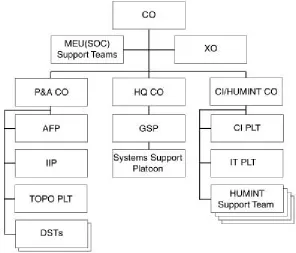
In garrison the principal task of the intel bn commander is to organize, train, and equip detachments that support MAGTFs or other designated commands to execute integrated collection, intelligence analysis, production, and dissemination of intelligence products. The composition of intel bn is shown in figure 3-2.
Actual Operations
[image:31.612.160.456.445.698.2]During operations, the intel bn commander is dual-hatted as the ISC, serving as such under the direct staff cognizance of the MEF AC/S G-2 (see figure 3-1). During garrison operations, many of the tasks listed here are the responsibility of the G-2 operations officer. The intel bn’s S-3 section along with the operations center element of the MEF G-2 form the core of the ISC support effort, with planning, direction, and C2 conducted within the IOC’s support cell. The ISC is responsible to the MEF AC/S G-2 for the overall planning and execution of MEF all-source intelligence operations. Specific
Figure 3-2. Intelligence Battalion.
3-6 MCWP 2-14 Counterintelligence
all-source and key CI responsibilities of the ISC during actual operations include—
l Implementing the concept of intelligence operations and the supporting
CI concept of operations developed by the G-2 plans officer and approved by the AC/S G-2.
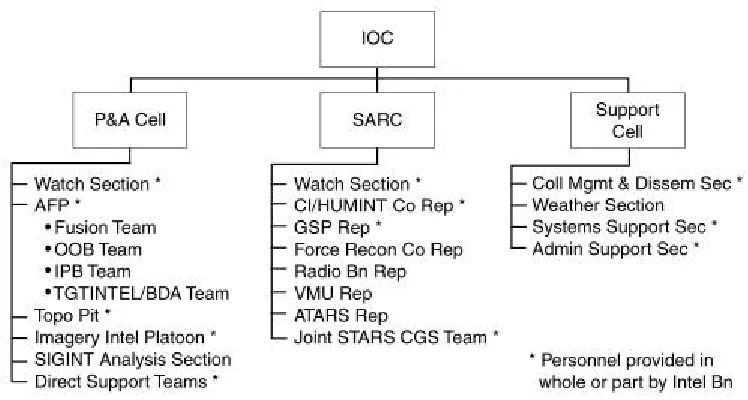
l Establishing and supervising operation of the MEF intelligence
operations center (IOC), including the support cell, the surveillance and reconnaissance cell (SARC), and the P&A cell (see figure 3-3.) Generally the IOC will be co-located with the MEF CE’s main command post.
l Establishing and supervising operation of the intel bn’s CI/HUMINT
company command post.
l Developing, consolidating, validating, and prioritizing recommended
PIRs and IRs to support MAGTF planning and operations.
l Planning, developing, integrating, and coordinating MEF intelligence and
CI collection, production, and dissemination plans, including the effective organic and external integration and employment of MAGTF CI as well as staff cognizance of MEF SIGINT, IMINT, HUMINT, geographic intelligence (GEOINT), ground remote sensors, ground reconnaissance, and tactical air reconnaissance intelligence collections, production, and dissemination operations.
l Developing, with the G-2 plans officer and G-2 operations officer, and
completing Annex B, Intelligence to MEF operations orders (OPORD), supporting appendices (such as appendix 3, CI), and intelligence and CI input to other annexes of OPORDs.
l Planning, developing, integrating, and coordinating intelligence and CI
support to the commander’s estimate, situation development, indications and warning, force protection, targeting, and combat assessment.
l Managing and fusing the threat (or red) COP/CTP inputs from
subordinate units and external commands and intelligence agencies into the MEF CE’s threat COP/CTP.
l Providing intelligence and CI support to the MEF CE G-2 section and the
MSCs.
[image:32.612.99.473.504.704.2]l Preparing the intelligence and CI estimates to support G-2 plans.
Figure 3-3. Intelligence Operations Center.
The ISC is tasked to perform PIR and IR validation and
prioritization only during actual operations when the IOC is activated. During routine peacetime operations the PIR/IR validation and
l Planning, developing, and coordinating intelligence communications and
information systems architecture, including its integration and support of MEF CI and other intelligence and reconnaissance requirements.
l Coordinating and integrating MEF CI and all-source intelligence
operations with other service components, JTF joint intelligence support element (JISE) and the joint force J-2 CI/HUMINT staff element (J-2X), theater joint intelligence center (JIC) or joint analysis center (JAC), and national intelligence agencies and operations (e.g., NIMA), including all aspects of intelligence and CI reach-back support.
l Assisting with the evaluation and improvement of MEF CI and all-source
intelligence operations.
l Accomplishing other intelligence and CI support and tasks as directed by
the AC/S G-2.
(See table 3-1 for a summary of the principal responsibilities of the AC/S G-2’s three principal staff subordinate officers.)
CI/HUMINT Officer
During garrison operations the CI/HUMINT Officer (CIHO) is responsible to the G-2 plans officer, in coordination with the intel bn commander, for the planning, direction, and execution of MEF CI/HUMINT operations. In intelligence sections without a CIHO, a designated officer will generally be assigned to perform these tasks. If a HST or other CI/HUMINT Co element is attached, its senior CI/HUMINT officer will serve in this capacity. During action operations, the CIHO’s specific duties include—
l Preparing MAGTF CI/HUMINT concept of operations, plans and orders;
and directing, coordinating a