ST 2-22.7 (FM 34-7-1)
TACTICAL HUMAN INTELLIGENCE AND
COUNTERINTELLIGENCE OPERATIONS
US Army Intelligence Center and Fort Huachuca
Fort Huachuca, Arizona 85613-6000
APRIL 2002
TABLE OF CONTENTS
Page Preface...iii
CHAPTER 1 TACTICAL HUMAN INTELLIGENCE COLLECTION ASSETS ...1-1 HUMINT and CI Interaction ...1-1
Human Intelligence...1-1 Counterintelligence...1-2
What is Tactical HUMINT? ...1-3 HUMINT and CI Operations on the Battlefield...1-5 HUMINT and CI Operations Within the Urban Environment ...1-5 Army HUMINT and CI Organizations ...1-6 Other Sources of HUMINT on the Battlefield...1-11
CHAPTER 2 ORGANIZATION AND STRUCTURE...2-1 Tactical HUMINT Organization...2-1
J/G/S2X ...2-3
CHAPTER 3 COMMAND AND CONTROL...3-1 Role of the MI Commander ...3-1
Command Relationships ...3-2 Support Relationships ...3-3 Technical Control...3-5 Reporting ...3-6
CHAPTER 4 COLLECTION ACTIVITIES ...4-1
Collection Methodology ...4-1 Operations ...4-2 Human Sources...4-4 Other Sources ...4-8 CHAPTER 5 TEAM OPERATIONS ...5-1
Concentric Rings Operation Methodology...5-1 Levels of Employment ...5-2
Equipment Requirements ...5-5 Tactics, Techniques, and Procedures ...5-7
CHAPTER 6 HUMINT AND CI MISSION PLANNING ...6-1 Steps in HUMINT and CI Mission Analysis ...6-1 Selecting Courses of Action ...6-4
Task Organization ...6-5 Operations Plans, Operations Orders, and Annexes ...6-7
CHAPTER 7 HUMINT AND CI COLLECTION MANAGEMENT ...7-1 Collection Management Process...7-1 HUMINT and CI Support to Targeting ...7-6
Control Measures ...7-10
CHAPTER 8 AUTOMATION AND COMMUNICATIONS...8-1
Automation ...8-1 Communications...8-6
GLOSSARY ...Glossary-1
This manual establishes the initial doctrinal foundation for Tactical HUMINT Operations. It provides the basis for the organization and structure of tactical HUMINT operations from peacetime military engagements (PME) to major theater war (MTW).
This manual is designed primarily for the commanders and soldiers of units conducting tactical HUMINT collection. It can also be used by commanders, staffs, and intelligence personnel at all echelons, and applies equally to Active Components (AC) and Reserve Components (RC), to include US Army Reserves (USAR) and the Army National Guard (ARNG).
This manual addresses requirements, expanding on the doctrine in FM 2-O (FM 34-l), FM 3-O (FM 100-5), FM 5-O and FM 6-O (FM 101-5), and FM 2-01.3 (FM 34-1 30).
The proponent of this publication is the US Army Intelligence Center and Fort Huachuca. We consider this a living manual and will dynamically revise this doctrine as frequently as necessary based on comments from the field or when significant changes occur within the Military Corps’ force structure. Under normal circumstances appropriate revisions will be made within two weeks of receipt. While the initial (one time) distribution of this field manual will be made, users should realize that to capture the dynamic changes/revisions to the manual as they occur, they should check the Intelligence Center Homepage frequently for the most current version.
We welcome your comments and recommended changes at any time. You may email them directly to the proponent at ATZS-FDC-D, or mail them to: Commander, US Army Intelligence Center and Fort Huachuca (ATZS-FDR-CD), Fort Huachuca, AZ 85613-6000, You can also access the Doctrine Division Homepage at
http: //usaic, hua, army, roil/doctrine. htm and leave your comments or changes with the Webmaster.
This handbook does not implement any international Standardization Agreements (STANAGS). It complies with all applicable STANAGS and Quadripartite Standardization Agreements.
Unless this publication states otherwise, masculine nouns and pronouns do not refer exclusively to men.
This manual incorporates the emerging intelligence and operational doctrine and terminology from FM 3-O, Operations, dated 14 June 2001, It uses the new manual numbers with the old manual numbers in parentheses. Although not all manuals have been updated to the new numbering system, this was done to transition the force to the new numbering system.
Chapter 1
Tactical Human Intelligence Collection Assets
Timely and accurate intelligence derived from human intelligence (HUMINT) and
counterintelligence (CI) assets is critical to the military decision-making process (MDMP). Despite the array of intelligence sensors, recent operations have shown that a local population is a key element in most operational planning. The early and continuous contact by HUMINT collectors and CI agents with the civilian population is often the best source of information about the area of operations (AO). Understanding the capabilities and limitations of this collection system is vital to operational planning and execution in operations from peacetime military engagements (PME) to major theater war (MTW).
Regulations governing HUMINT and CI collection and reporting include but are not limited to ARs 381-10, 381-20, 381-100, 381-172 (S/NF), and DCID 5/1 (S/NF). (Note: For questions regarding HUMINT and CI collection and reporting, you must talk to the J/G2X or a judge advocate general (JAG) officer who has completed the Intelligence Law Course.)
HUMINT AND CI INTERACTION
1-1. HUMINT and CI have distinctly different missions. HUMINT collectors gather information to answer intelligence and information requirements while CI personnel help protect the force from an adversary’s intelligence collection efforts. HUMINT collectors and CI personnel bring unique sets of skills to any mission. At times each discipline may uncover information relating to the other’s primary mission. Although HUMINT collectors and CI personnel appear to have similar functions, because the common denominator is human interaction, each discipline has its own area of expertise.
1-2. Understanding their capabilities and limitations and the judicious combination of assets maximizes mission accomplishment. HUMINT collectors best accomplish collection tasks; other tasks such as subversion and espionage directed against the US Army (SAEDA) and deliberate security violation investigations can only be accomplished by CI personnel under authorization of Executive Order (EO) 12333.
HUMAN INTELLIGENCE
1-3. HUMINT is the oldest collection discipline and a key contributor to the all-source picture of the battlefield. HUMINT is the intelligence, to include adversary intentions, derived from
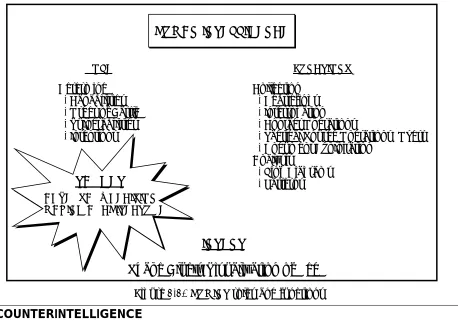
information collected from people and related documents. It uses human sources acquired both passively and actively to gather information to answer intelligence requirements and to cross-cue other intelligence disciplines. HUMINT is produced from the collection on a wide range of requirements with the purpose of identifying adversary capabilities and intentions. Figure 1-1 shows the roles and functions of HUMINT.
1-4. HUMINT tasks include but are not limited to—
• Conducting liaison with host nation (HN) officials and allied counterparts.
• Eliciting information from a civilian populace, to include transients.
• Debriefing US and allied forces and civilian personnel.
• Interrogating detainees to include enemy prisoners of war (EPWs).
• Exploiting adversary documents and media.
FUNCTIONS
Collection - Debriefings - Interrogation - Contact Operations
- Tactical Source Operations (Overt) - Document Exploitation
Analysis
- Link Diagrams - Patterns ROLE
Determine - Capabilities - Order of Battle - Vulnerabilities - Intentions
HUMAN INTELLIGENCE
INTENT
Shape Blue’s Visualization of Red TARGET
[image:6.612.77.535.220.541.2]ADVERSARY DECISION MAKING ARCHITECTURE
Figure 1-1. HUMINT roles and functions
COUNTERINTELLIGENCE
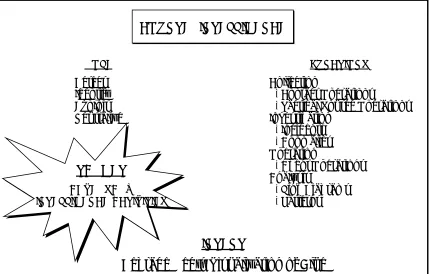
1-5. The mission of CI is to detect, identify, assess, counter, neutralize, or exploit the entire spectrum of adversary intelligence collection efforts. It is the key intelligence community asset to protect the force against espionage, other Foreign Intelligence Service Security (FISS) activities, sabotage, or assassination when the activity is conducted for, or on behalf of, foreign powers, organizations, persons, or international terrorist groups. Figure 1-2 shows the roles and functions of CI.
COUNTERINTELLIGENCE
FUNCTIONS Collection
- Contact Operations
- Tactical Source Operations Investigation
- Incidents - Anomalies Operation
- Agent Operations Analysis
- Link Diagrams - Patterns ROLE
Detect Identify Exploit Neutralize
INTENT
Degrade Red’s Visualization of Blue TARGET
ADVERSARY
[image:7.612.79.509.116.390.2]INTELLIGENCE ACTIVITIES
Figure 1-2. Counterintelligence roles and functions
WHAT IS TACTICAL HUMINT?
1-7. Tactical HUMINT is the task organization of HUMINT collection assets and CI assets into combined teams to accomplish the mission of both disciplines at the tactical level (echelon corps and below). This task organization supports the force protection plan and answers the commander’s intelligence requirements by employing
• CI agents to conduct focused identification, collection, analysis, recommendation of countermeasures, and production against FISS technical means and other adversary intelligence collection threats.
• HUMINT collectors to conduct focused collection, analysis, and production on the adversary’s composition, strength, dispositions, tactics, equipment, personnel, personalities, capabilities, and intentions.
1-8. Tactical HUMINT teams can be tailored to any operational environment, ranging from PME to MTW. These teams conduct coordinated collection and support to force protection efforts with HUMINT and CI assets from
• US Army Intelligence and Security Command (INSCOM).
• Defense HUMINT Service (DHS).
• National level HUMINT, CI, and law enforcement agencies (LEAs).
• Intelligence agencies from coalition forces.
1-9. New technologies and techniques will continue to enhance HUMINT and CI capabilities and maintain HUMINT and CI reporting as a prime factor in the MDMP. In order to understand the full scope of tactical HUMINT, it is helpful to look at the definitions of the separate disciplines and functions that make up this cooperative partnership: HUMINT and CI.
1-10. HUMINT collectors are personnel who, by training or in certain specific positions, are tasked with collecting information for intelligence use from people or related documents. A HUMINT source is any person who can provide information to answer collection requirements. [Unless otherwise noted in this manual, the term “HUMINT collector” refers to personnel in MOSs 351E and 97E. The term “CI collector” or “CI agent” refers to 35E, 351B, and 97B
personnel.] The HUMINT and CI force is organized, trained, and equipped to provide timely and relevant answers to information requirements at each echelon. While HUMINT and CI have a different focus, in most deployment scenarios they work best in a collaborative effort.
1-11. In an MTW environment, the number of detainees to include EPWs increase. To meet this collection requirement, 351/97Es and a small 351/97B element from the corps or echelon above corps (EAC) assets would establish a joint debriefing and interrogation facility. It may be necessary to separate the two disciplines depending on mission, enemy, terrain and weather, troops, time available, and civilians (METT-TC.) In an MTW at the division level, HUMINT collectors primarily conduct tactical questioning of EPWs and detainees, as close to the point of capture as possible, as well as civilians on the battlefield, for perishable tactical information. CI agents focus on threat and vulnerability assessments, CI investigations, and the exploitation of individuals identified as being of CI interest.
1-12. 351E/97E missions in an MTW include but are not limited to
• Conducting screening operations and tactical questioning.
• Interrogating detainees to include EPWs.
• Debriefing civilians on the battlefield.
• Debriefing friendly forces.
• Conducting HUMINT analysis.
• Performing document exploitation (DOCEX).
1-13. 351B/97B missions in an MTW include but are not limited to
• Identifying and recommending countermeasures to threat intelligence collection efforts.
• Performing CI investigations.
• Conducting CI analysis.
1-14. See FM 2-22.3 (FM 34-52) and FM 2-01.2 (FM 34-60) for more information on the use of HUMINT collectors and CI agents in an MTW.
HUMINT AND CI OPERATIONS ON THE BATTLEFIELD
1-15. HUMINT collectors and CI assets employ many sets of eyes and ears. Starting with the commander, every member of a deployed force can contribute to formulating the HUMINT and CI portions of the all-source picture.
1-16. Whenever deployed forces encounter humans on the battlefield, the resulting interaction becomes a source of information the deployed commander can use to answer questions about his adversary or to gauge the security of his own forces. While military intelligence (MI) units are the primary collectors and processors of HUMINT, commanders must ensure that
procedures are in place to collect combat information from the various assets.
HUMINT AND CI OPERATIONS WITHIN THE URBAN ENVIRONMENT
1-17. Tactical HUMINT tactics, techniques, and procedures (TTP) change very little when operating in an urban environment. The most significant changes focus on unique mission types and the increased number of assets required to complete these missions.
UNIQUE MISSION
1-18. Because of American dominance on the traditional battlefield, the threat may move the operational environment to densely populated urban areas. This in turn prevents employment of conventional, destructive means to eliminate the threat, forcing American ground forces into a costly urban deployment. Once committed to this course, commanders may find structural density and line-of-sight (LOS) problems degrade the effectiveness of signals intelligence (SIGINT) and imagery intelligence (IMINT) collectors. These problems force greater reliance on HUMINT and CI assets to obtain information on threats that do not fit traditional operational patterns. These patterns may include
• Identifying the work force (hours, physical location, and key positions).
• Evaluating internal and external communication.
• Obtaining key data on water and sewage facilities or the internal layout of a structure.
• Recognizing other targets not normally found on the conventional battlefield.
ASSET REQUIREMENT
ARMY HUMINT AND CI ORGANIZATIONS
1-20. Some
of the Army HUMINT and CI organizations involved in Tactical HUMINT
operations are discussed below.
US ARMY INTELLIGENCE AND SECURITY COMMAND
1-21. INSCOM is responsible for all US Army EAC MI actions to include CI analysis, collection, investigations, operations, tactical intelligence, and related activities of HUMINT collection at the operational and strategic levels. INSCOM also supports the deployed commander with
information operations, polygraphs, and TSCM support. INSCOM units include the following organizations:
• 902d MI Group – This unit deploys technical teams to support the deployed commander with investigative and CI special operations capabilities; polygraph, TEMPEST and TSCM support; and command and control (C2) protect and security support to
information security. CI personnel from the 902d MI Group also deploy individually to support operations worldwide.
• MI brigades and MI groups supporting component commands – Each Army Service Component Commander (ASCC) with an outside continental United States (OCONUS) responsibility has an INSCOM MI brigade or group to provide operational HUMINT and CI support to that command. These MI elements provide peacetime support to the unified command and add a consistent, forward-deployed presence in a particular theater of operations. Theater MI brigades and group assets provide HUMINT and CI support during contingency operations. These HUMINT and CI teams can support a joint task force (JTF), Joint Force Land Component Commander (JFLCC), an ASCC, or any deployed element that requires augmentation.
• INSCOM theater support elements
− Are responsible for establishing joint interrogation facilities (JIFs), joint debriefing centers, joint document exploitation centers (JDECs), and captured material exploitation centers (CMECs).
− Maintain databases and all-source products required by tactical echelons in a contingency through the analysis and control elements (ACEs).
ARMY CORPS AND BELOW
1-21. Army HUMINT and CI assets organic at corps and below are uniquely qualified to be the primary collection asset in many of our future conflicts. They are organic to—
• Tactical exploitation battalions (TEBs) and the corps support battalions (CSBs) at the Corps MI brigade.
• MI companies at armored cavalry regiments (ACRs) and separate brigades (SEP BDEs).
• MI elements at Special Forces Groups (SFGs).
1-22. Army HUMINT and CI assets provide technologically enhanced exploitation of human sources and media. This exploitation provides valuable intelligence to meet the critical requirements affecting the MDMP. The simultaneous digital interaction between operational HUMINT and CI teams and analytical elements provides the deployed commander with near-instantaneous information. This rapid transmission of critical intelligence to the user gives the supported command an information edge and a more complete vision of the battlespace.
INTERIM BRIGADE COMBAT TEAM
1-23. The brigade’s intelligence system is a flexible force of Intelligence, Surveillance, and Reconnaissance (ISR) personnel, organizations, and equipment. Individually and collectively, these assets provide commanders throughout the brigade with the capability to plan and direct ISR operations, collect and process information, produce relevant intelligence, and disseminate combat information and intelligence to those who need it, when they need it. The brigade and its subordinate units possess organic ISR assets that enable the above actions. Based on METT-TC considerations the brigade task organizes its organic ISR assets for the operation and, in addition, may receive additional ISR assets from corps, joint, and national organizations.
1-24. The brigade’s tactical HUMINT assets include an S2X team, a tactical HUMINT platoon with two operational management teams (OMTs) and tactical HUMINT teams, and troop HUMINT collectors in the reconnaissance, surveillance, and target acquisition (RSTA) squadron. The functions and responsibilities of these assets are the same as at higher
echelons. The mission of the Troop HUMINT collector is limited to providing tactical questioning and DOCEX in support of the squadron’s multidimensional reconnaissance and surveillance (R&S) mission and identifying possible sources of interest for the tactical HUMINT platoon. The functions of the different teams and offices in tactical HUMINT are similar through the echelons where tactical HUMINT is conducted. Further information on the brigade combat team can be found in FM 34-80-2ST, which is posted at http://huachuca-USAIC.Army.mil\doctrine\dlb.htm.
RESERVE COMPONENT INTEGRATION
1-25. Given the Army’s current operational tempo and force structure, the integration of RC forces into the AC is a near certainty for future operational deployments. Commanders must identify their requirements early and establish proactive coordination (both in garrison and while deployed) with their RC counterparts to fully integrate them during all phases of training and operations.
1-26. During operations that include significant RC participation, an RC liaison officer (LNO) normally will be assigned, either temporarily or permanently (at higher echelons), at the appropriate level of command. The commander and staff must ensure that the RC LNO is involved in all aspects of operational planning and execution.
• Category 1: Formation of specialized units that include a fully integrated AC and RC table of organization and equipment (TO&E). The activation of the RC of these units is required for their full operational capability.
• Category 2: Augmentation of active duty units by RC units to fill out unit strength levels or to provide additional functionality. For example, an AC division might require
additional HUMINT teams to support it during a stability operation. If a division required one additional team, it should request a team and not request four HUMINT collectors. If the requirement is for three additional teams, it should request a HUMINT platoon with its organic C2 and OMTs .
• Category 3: Focuses on the requirement for individual augmentees. This usually occurs when a unit has the C2 structure but needs either additional personnel or additional capability within the command structure. For example, a unit may have a HUMINT platoon but the platoon is at 50 percent strength. Individual augmentation is the easiest method of integration since the
individual is integrated in the same manner as any replacement. The augmented unit is normally required to provide all equipment other than initial issue-type equipment.
1-28. There are several items to consider when the unit is augmented:
• Accurate Identification of Requirements: During the MDMP, units need to identify those mission-essential capabilities not already present in the unit. The G3/S3, working in conjunction with the G1/S1, considers options that may include RC augmentation of organic units although the final decision to employ RC units is usually determined at Headquarters, Department of Army (HQDA). The requirement for augmentation is forwarded through appropriate channels to the Commander in Chief (CINC) then
forwarded to US Army Forces Command (FORSCOM) and HQDA which will identify the appropriate units or personnel. If approved, they will work with the appropriate agencies to establish the timeline in which the units can respond on the Time Phased Forces Deployment Data List (TPFDDL). When developing requirements, the requesting unit must be sure to articulate its need accurately, specifying required skills, numbers, and any additional skill identifiers (ASIs). For example: “Request augmentation by a tactical HUMINT platoon consisting of at least a platoon headquarters, three tactical HUMINT collection teams, one OMT, two linguists, and one CHATS proficient operator. The augmenting element will be operating in support of the commander’s force protection program in the gaining unit’s AOR.”
• Activation Timeline: Units need time to mobilize and conduct any additional collective and individual training that may be specific to the unit’s mission or operational
environment. The requesting unit needs to be aware of the time required to activate the requested RC and that there may be differences in levels of training or equipment. Timelines should be established by FORSCOM to allow resolution of these problems and should be reflected in the commander’s operational planning sequence. Timelines will vary from unit to unit and mission to mission.
Because of this limitation, a certain degree of train-up prior to deployment may be
necessary. Commanders should identify available training opportunities and request the participation of personnel identified for augmentation. For an ongoing mission,
commanders should also plan for an extended “right seat ride” mission handover period once the individuals or unit arrives in the theater of operations.
• C2: If the RC augmentation requires activation of an entire unit, it should include their C2 element. If the augmentation is by individuals, then they will fall under the C2 of the gaining units.
• Time on Active Status: USAR and ARNG soldiers can remain on active status for a maximum of 270 days. This timeline begins on the date of mobilization and ends on the day the soldier leaves active duty status. Deployed units must take this into account when conducting continuous operations and must identify the requirement to replace RC forces early enough to allow for the required training and handoff procedures.
• Experience: While RC personnel normally lack current military experience, they often perform jobs in the civilian sector that either mitigates this lack of experience or they are able to bring a new and useful capability with them. Commanders should try to
capitalize on these skills.
SERVICE COMPONENT HUMINT AND CI ELEMENTS
• Marine Human Exploitation Teams - Marine expeditionary elements deploy with human exploitation teams (HETs) that provide organic HUMINT and CI support to the deployed Marine force. Marine HETs are rapidly deployable and fully equipped to conduct the full range of tactical HUMINT and CI functions. They can provide support to either the deployed Marine force or as part of a JTF HUMINT and CI team. Some HETs also deploy with CI technical support capabilities. Each Marine Expeditionary Force (MEF) has organic HETs. HETs can also be attached to a Marine Air-Ground Task Force (MAGTF) for a particular operation.
• Navy Criminal Investigative Service - Navy Criminal Investigative Service (NCIS) agents deploy with the Navy force to provide CI and criminal investigative support to the Navy or joint force commander. They work aboard ships and at sea points of
embarkation and debarkation. They use liaison and source operations to support the deployed Navy joint force from land and seaborne threats. NCIS reports any information of CI or intelligence interest gathered during its normal duties.
NATIONAL HUMINT AND CI SUPPORT
1-29. HUMINT and CI agencies from the Department of Defense (DOD), national level intelligence agencies, and at times LEAs might support the commander. In a JTF, a national intelligence support team works with the J2X to coordinate national level activities with JTF and component HUMINT and CI assets.
• Defense Intelligence Agency- The Defense Intelligence Agency (DIA) conducts all-source analysis and disseminates products to answer requirements from the Joint Chief of Staff level down to the tactical force on the battlefield.
• Defense HUMINT Service - DHS is an element of DIA that supports battlefield commanders by reporting intelligence from collection operations within and external to the joint AO. DHS support to a joint force is outlined in the classified DIAMs 58-11 and 58-12.
• Central Intelligence Agency - Details of Central Intelligence Agency (CIA) contributions to the deployed force can be found in Joint Pub 2-01.2 (S/NF).
• Department of State - The State Department’s Bureau of Diplomatic Security provides CI support to diplomatic missions worldwide and gathers extensive information on intelligence capabilities of adversaries within that diplomatic mission’s area of concern. The Bureau of Intelligence and Research is the State Department's primary source for interpretive analysis of global developments. It is also the focal point in the State Department for all policy issues and activities involving the intelligence community.
• National Security Agency - The National Security Agency (NSA) uses its extensive SIGINT and information systems security expertise to support deployed HUMINT and CI forces.
• Department of Justice:
− Federal Bureau of Investigation - The Federal Bureau of Investigations (FBI), if currently operating in a TF AO and liaison is established early, may provide the deployed commander with national level expertise on criminal and CI issues.
− Drug Enforcement Agency - The Drug Enforcement Agency (DEA) provides counter-drug operational expertise to a deployed TF and coordinates its operations with those of a deployed TF.
COALITION HUMINT AND CI ELEMENTS
1-30. Most potential coalition partners have some type of HUMINT and CI capability. Less developed nations may use HUMINT as their primary collection system. These assets will be present on the battlefield, and US assets are likely to work with them:
• The Allied Military Intelligence Battalion (AMIB) consists of coalition HUMINT collectors and US HUMINT collectors with other coalition members to answer TF and higher intelligence requirements.
Europe a dedicated CI support system. In its role as the Allied Command Europe CI activity, it conducts CI investigations and operations in conjunction with other North Atlantic Treaty Organization (NATO) CI services.
OTHER SOURCES OF HUMINT ON THE BATTLEFIELD
1-31. While trained HUMINT personnel and CI agents are the primary collectors and
processors of human information on the battlefield, other elements can gain information that could answer questions important to a deployed commander. Tactical HUMINT and CI assets lose valuable information if they are not regularly coordinating with the following elements:
• Long-Range Surveillance - Direct observation and reporting on targets such as
activities and facilities may provide timely and accurate intelligence to support a decision or cross-cue other collection capabilities. Long-range surveillance (LRS) is often
employed when discreet observation of an activity is necessary over a long period of time or when a collection system that can respond to immediate redirection is necessary.
• Cavalry Troops, Unit Patrols, and Scouts - Unit patrols and scouts have a view of the battlefield that sensors may not detect. Using size, activity, location, unit, time, and equipment (SALUTE) spot reporting, unit patrols and scouts give you an eye on the battlefield that can provide very accurate information. During operations from peacetime military engagements to MTW, unit patrols and scouts often patrol villages or populated areas that are contentious and therefore of interest. Through mission reporting and debriefing by their unit S2 or HUMINT collector, valuable information on the current status of an area will enter into intelligence reporting channels or intelligence architecture, potentially answering intelligence requirements.
• Military Police - The Military Police (MPs) are a key force protection asset throughout the AO. Tactical HUMINT and CI assets work with the MPs who gain area knowledge through their extensive foot and vehicular patrols. MPs also man checkpoints and traffic control points where they interact with large groups of the civilian populace and
encounter people and situations that often answer intelligence or force protection requirements.
• Civil Affairs - Civil Affairs (CA) units have daily interaction with the civilian populace including key members of the civilian community such as politicians, technical personnel, and military leadership. CA association with collection operations could lead to
suspicion from their local contacts, but this should not preclude tactical HUMINT and CI elements from working closely with CA units or, at a minimum, debriefing CA personnel to gather information that meets intelligence requirements and enhances your force protection program.
• Psychological Operations - Psychological operations (PSYOP) teams often interview civilians on the battlefield to determine the effectiveness of friendly and threat PSYOP campaigns. A deployed commander needs this information to determine the
• Special Operation Forces - The Special Operation Forces (SOF) team often has greater access to humans and certain areas on a battlefield than any other collection asset. While their primary mission is not to collect HUMINT, their observation of and interaction with the local population provides them access to information that often answers collection requirements. The following are examples of these types of collection assets:
− Special reconnaissance missions into denied territory to satisfy intelligence gaps or to confirm information from another source.
− Unconventional warfare (UW) missions normally of a long duration. SOF are
inserted into hostile territory to conduct sensitive operations that support US national objectives. During these missions, SOF units often come in contact with the local population and gather information that meets intelligence requirements.
Chapter 2
Organization and Structure
The success of the HUMINT and CI collection effort depends on a complex interrelationship between command guidance, requirements, technical support, and collection assets. Each echelon of command has its supporting HUMINT and CI elements. No MI organization in the Army is robust enough to conduct sustained tactical HUMINT and CI operations during
operations from PMEs to MTW using only its organic HUMINT and CI assets. HUMINT and CI units have specific support requirements to the commander. They must be flexible, versatile, and prepared to conduct HUMINT and CI analysis, collection, investigations, and operations in support of any echelon of command.
NOTE: HUMINT and CI units provide augmentation to the next echelon down or lower if necessary. Higher echelon HUMINT and CI units should forge relationships with lower echelon elements long before operations become imminent.
During initial deployment, the corps TEB, corps support battalions, or division MI battalion forms the framework for HUMINT and CI support to a deployed commander. The MI battalion may require augmentation or reinforcement from non-organic teams and INSCOM capabilities. Commanders must consider the proper force structure and capabilities needed to meet requirements.
To optimize limited assets, HUMINT collectors and CI agents must receive operational guidance (technical control) and direction at each echelon. This technical support and guidance includes the J/G2X at the TF, tactical HUMINT operations within a corps TEB, and an operational
• Receive requirements.
• Coordinate all the actions necessary to satisfy requirements.
• Identify and integrate available HUMINT and CI assets.
• Provide the requirement to the appropriate MI commander for execution.
TACTICAL HUMINT ORGANIZATION
2-1. HUMINT collectors and CI agents are organized into tactical HUMINT teams based on METT-TC. These teams are self-contained modular elements with organic transportation, communications, automation, and special technology-aided applications.
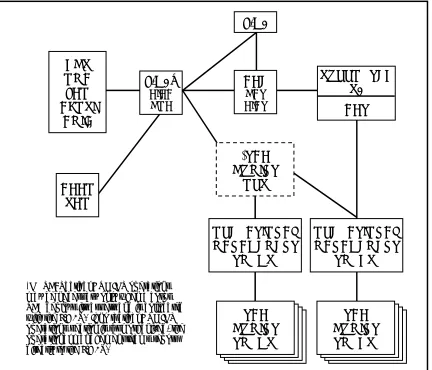
2-2. Tactical HUMINT is layered with sections that operate collectively to ensure the execution of proper technical quality and control measures over both operations and reporting. It also precludes any one element from becoming inundated with the large
*NOTE: Tactical HUMINT operations may be necessary only when a corps TEB deploys its assets and is collocated with the J/G2X. If no tactical HUMINT operations section is task organized, the operational management teams report directly to the J/G2X.
DHS OMA JCO AFOSI
AMIB
J/G2
ACE HAT
CIAT ACT
SUPPORTED S2
*TAC HUMINT
OPS
TAC HUMINT TM (GS) J/G2X
CICA HOC
ACCO SCO
TAC HUMINT TM (DS) OPERATIONAL MANAGEMENT
TM (DS) OPERATIONAL
[image:18.612.74.506.118.488.2]MANAGEMENT TM (GS)
Figure 2-1. Tactical HUMINT organization
2-3. Regardless of the echelon, the following six basic elements work together to provide the deployed commander with well-focused, thoroughly planned collection and support. Each element has specific management, analytical, or operational responsibilities, and all elements combined are the backbone of tactical HUMINT collection. Each piece of the structure builds on the next and is based on the size, complexity, and type of operation.
• J/G/S2X.
• HUMINT analysis team.
• CI analysis team.
• Tactical HUMINT operations section (task organized from existing assets if needed).
• Tactical HUMINT team.
J/G/S2X
2-4. The J/G/S2X is the primary advisor to the J/G2 who advises the task force (TF)
commander on HUMINT and CI and is the focal point for all HUMINT and CI activities within a JTF (J2X) or an Army component task force (G2X) or interim brigade combat team (IBCT) (S2X) structure. Depending on the size and mission of the TF, the J/G/S2X should be a field grade officer with a HUMINT area of concentration (AOC) (35E with specialized training) organic to the TF staff or can be drawn from the theater MI brigade. The J/G/S2X operations are integrated into a coherent structure (that is, the national, theater, and non-DOD HUMINT and CI resources supporting the TF).
2-5. The J/G/S2X is the coordination and deconfliction authority for all HUMINT and CI activities within their organization’s AO. The J2X accomplishes technical control of all HUMINT and CI assets through the Army component G2X, the tactical HUMINT operations section, or the OMT. Specifically, the J/G/S2X
• Comprises a Task Force Counterintelligence Coordinating Authority
(TFCICA)/Counterintelligence Coordinating Authority (CICA) and a HUMINT operations cell (HOC).
• Participates in planning for deployment of HUMINT and CI assets in support of operations.
• Coordinates, through the HOC and TFCICA/CICA, all HUMINT and CI activities to support intelligence collection and the intelligence aspects of force protection for the deployed commander.
• Manages collection requirements for HUMINT and CI in coordination with the collection manager.
• Provides the HUMINT and CI specific collection plans to the collection manager for inclusion in the integrated ISR plan.
• Coordinates and deconflicts for all HUMINT and CI operations within the operational area.
• Does not exercise operational control (OPCON) over the HUMINT and CI assets
assigned, attached, or reinforcing the TF; however, the J/G/S2X must be empowered by the TF commander to supervise a cohesive HUMINT and CI effort.
• Is the release authority for tactical HUMINT reporting.
• Releases reports to the all-source system only after ensuring all technical control measures for reporting have been met?
2-6. The military departments always remain in control of CI (and law enforcement)
TFCICA/CICA
2-7. The TFCICA/CICA coordinates all CI activities for a deployed force. There can be only one TFCICA in a theater of operations. When multiple echelons exist, the highest echelon has the TFCICA and subordinate G2X offices have a CICA. Depending on the size and scope of the operation, the TFCICA could be the unified command’s CI staff officer; the CI or HUMINT staff officer from corps or division; or a senior warrant officer or branch CI officer designated by the unified command CI staff officer or TF commander.
2-8. In a joint or combined operation, the TFCICA/CICA must have the authority to coordinate the activities of all CI agencies involved in the operation. The TFCICA’s staff should include CI professionals from every major CI element represented on the battlefield since each CI element is constrained by its own regulations and policies. This ensures that all CI activities are
adequately coordinated and deconflicted and all sources are properly registered. 2-9. The TFCICA/CICA
• Exercises technical control of all CI assets and coordinates and deconflicts CI activities in the deployed AO.
• Establishes and maintains a CI source database.
• Coordinates with the HUMINT and CI operations sections located at the MI battalion (component J/G2X elements) and other service CI agencies.
• Coordinates and supervises CI force protection source operations (CFSO) conducted by all services and components in the AO.
• Develops and manages collection requirements for CI in coordination with the requirements manager.
• Develops and provides the CI portion of the ISR plan to the J/G/S2X and requirements manager for inclusion in the integrated ISR plan.
• Establishes and maintains the theater-consolidated database of sources in coordination with the HOC.
• Coordinates with the HOC for CI support to the TF detention and interrogation facility.
• Coordinates CI activities with senior CI officers from all CI organizations on the battlefield.
• Performs liaison with HN and US national level CI organizations.
• Coordinates with requirements managers and the CI analysis team to identify CI collection priorities to ensure intelligence and force protection requirements are met.
HUMINT OPERATIONS CELL
• Exercises technical control of all HUMINT assets and coordinates and deconflicts HUMINT activities in the deployed AO.
• Establishes and maintains a HUMINT source database.
• Coordinates and supervises tactical HUMINT force protection source operations conducted by all services and components in the AO.
• Develops and manages collection requirements for HUMINT in coordination with the requirements manager.
• Develops and provides the HUMINT portion of the ISR plan to the J/G/S2X and requirements manager for inclusion in the integrated ISR plan.
• Coordinates the activities of HUMINT collectors assigned or attached to interrogations and debriefing facilities.
• Expedites preparation of intelligence information reports and their distribution to consumers at all levels.
• Performs liaison with HN and US national HUMINT organizations.
HUMINT ANALYSIS TEAM
2-11. The HUMINT analysis team is the “fusion point” for all HUMINT reporting and operational analysis in the ACE and joint intelligence support element (JISE). It determines gaps in
reporting and coordinates with the collection manager to cross-cue other intelligence sensor systems. The HUMINT analysis team
• Produces and disseminates HUMINT products and provides input to intelligence summaries.
• Uses analytical tools found at the ACE or JISE to develop long-term analyses and provides reporting feedback that supports the J/G/S2X, tactical HUMINT operations section, OMTs, and tactical HUMINT teams.
• Produces country and regional studies tailored to HUMINT collection.
• Compiles target folders to assist J/G2X assets in focusing collection efforts.
• Analyzes and reports on trends and patterns found in HUMINT reporting.
• Analyzes source reliability and credibility as reflected in reporting and communicating that analysis to the collector.
• Develops and maintains databases specific to HUMINT collection activities that directly support the collection efforts of tactical HUMINT teams and are directly accessible by tactical HUMINT teams.
• Provides collection requirements input to the HOC.
• Supports requirements management through the development of HUMINT specific information requirements based on command priority intelligence requirements (PIR).
CI ANALYSIS TEAM
2-12. The ACE and JISE CI analysis team analyzes threat intelligence collection, and the intelligence collection efforts of foreign persons and organizations involved in terrorism and sabotage, in order to develop countermeasures against them. CI analysis cross-cues SIGINT, measurement and signature intelligence (MASINT), technical intelligence (TECHINT), and IMINT resources in addition to CI-related HUMINT reporting and analysis to counter threat collection capabilities against the deployed force. While the HUMINT analysis team (HAT) supports the positive collection efforts of the force, the CI analysis team supports the “defend” aspects of the commander’s force protection program.
2-13. CI analysis is the analysis of the adversary’s SIGINT, HUMINT, MASINT, and IMINT capabilities in support of intelligence collection, terrorism, and sabotage in order to develop countermeasures against them. It involves a reverse intelligence preparation of the battlefield (IPB) process in which the analyst looks at US forces and operations from the threat’s
perspective. CI analytical products are an important tool in the course of action (COA) development in the MDMP. This analytical tool supports the commander’s force protection program and facilitates the nomination of CI targets for neutralization or exploitation. See FM 2-01.2 (FM 34-60) for more information on CI analysis.
2-14. CI analysis—
• Produces and disseminates CI products and provides input to intelligence summaries.
• Provides collection requirements input to the TFCICA/CICA.
• Analyzes source reliability and credibility as reflected in reporting and communicating that analysis to the collector.
• Nominates CI targets for neutralization or exploitation.
• Identifies and submits CI-related requirements to fill collection gaps.
• Assists HAT personnel in focusing the CI aspects of the HUMINT collection program.
• Presents CI analysis products such as CI estimates, target lists, reports, and graphics that support the commander.
TACTICAL HUMINT OPERATIONS SECTION
2-15. The tactical HUMINT operations section provides the highest level of technical control within the MI battalion. METT-TC will dictate when a tactical HUMINT operations section is necessary based on the number of OMTs and tactical HUMINT teams in an AOR. For example, if a Corps TEB deploys in support of an operation and there are 4 to 5 OMTs controlling 16 to 20 tactical HUMINT teams, it may be necessary to task organize a tactical HUMINT operations section from existing assets. The tactical HUMINT operations section
• Prevents the J/G/S2X from becoming inundated with reporting and tracking all the collection assets in the AOR.
• Is the link between OMTs and higher echelon elements when deployed. In smaller operations these functions can be performed by an OMT.
• Provides operational and technical control and intelligence oversight for OMTs and tactical HUMINT teams.
• Coordinates and tracks collection requirements and MI battalion HUMINT and CI activities.
• Receives reports from the OMTs and provides quality control for tactical HUMINT team reporting.
• Maintains resource status reports (RSRs) (for example, significant activities reports, equipment status reports).
• Provides source administration and operational review for CFSO and tactical HUMINT source operations conducted by MI battalion assets.
• Coordinates CI investigations with G/J2X or SCO and ACCO.
• Manages intelligence contingency funds and source incentives for an MI battalion.
• Coordinates with the TFCICA/CICA for technical support such as TSCM or polygraph.
OPERATIONAL
MANAGEMENT TEAM
2-16. The OMT performs a necessary function when two or more tactical HUMINT teams deploy to support an operation. The OMT
• Provides vital technical control to deployed tactical HUMINT teams. (The optimum ratio is 2 to 4 tactical HUMINT teams per OMT.)
• Normally consists of senior warrant officers and noncommissioned officers (NCOs) whose experience and knowledge provide the necessary guidance for effective team collection operations.
• Provides the collection focus for tactical HUMINT teams.
• Provides quality control and dissemination of reports for subordinate tactical HUMINT teams.
• Directs the activities of subordinate tactical HUMINT teams.
• Conducts single-discipline HUMINT analysis, CI analysis, and mission analysis for the supported commander.
• Acts as a conduit between subordinate tactical HUMINT teams, the tactical HUMINT operations section (if applicable), and the unit headquarters.
• Reports the tactical HUMINT team mission and equipment status to the tactical HUMINT operations section (if applicable) or the unit headquarters.
disciplines. The collection effectiveness of the tactical HUMINT teams is degraded without the guidance of the OMT.
2-18. When two or more tactical HUMINT teams are deployed in direct support (DS) of a maneuver element, an OMT will also be deployed to provide technical control. The OMT works closely with the supported S2 and analysis and control team (ACT) to furnish current threat information and answer the supported commander’s PIR and information requirements (IR). The OMT is crucial in
• Educating the supported commander on the capabilities of the tactical HUMINT teams.
• Integrating the tactical HUMINT teams directly into the maneuver commander’s R&S planning.
• Acting as the maneuver commander’s primary representative for HUMINT and CI issues.
TACTICAL HUMINT TEAM
2-19. Tactical HUMINT teams are the collectors or operators on the ground and the backbone of HUMINT and CI collection. While HUMINT and CI are separate in unit TO&Es, the tactical HUMINT teams can be task organized to enable the full range of HUMINT collection and CI functions described in Chapter 7. These teams combine the protective aspects of CI with the collection aspects of HUMINT and are tactically tailored to meet mission requirements. 2-20. The standard tactical HUMINT team can be augmented as necessary to meet mission requirements. Primary augmentation is by the addition of military or civilian linguists or security support such as MPs. The mix of HUMINT collectors and CI agents can vary based on METT-TC, ranging from totally CI or totally HUMINT to an equal mix of the two disciplines. Basic automation and technical support equipment (see Chapter 8) needs to be standardized to maximize flexibility and interoperability.
Chapter 3
Command and Control
The C2 of HUMINT and CI assets in a tactical environment involves different elements working together to ensure unity of command and effort.
ROLE OF THE MI COMMANDER
3-1. MI commanders are responsible for task organization, mission tasking, designation of subordinate AOs, resource allocation, logistics, training, and support of all intelligence disciplines assigned to their units to ensure mission accomplishment. There is a need for a partnership between the J/G2X and the MI commander but not for duplication of effort.
BATTALION COMMANDER
3-2. The MI battalion commander analyzes the higher echelon’s mission, concept of
operations, and the specified and implied tasks given to the battalion. He restates the battalion mission, designs the concept of operations, task organizes the battalion, and provides support to subordinate units. Specifically, the MI battalion commander
• Issues mission orders with sufficient details and time for subordinate commanders to plan and lead their units.
• Must know the threat; their organization, ISR systems, counter-ISR systems, operations, and terrain over which his units will operate and how that terrain enhances or limits R&S operations.
• Must be aware of the operational and technical limitations of his unit and ensures all battalion assets are properly positioned and fully synchronized to accomplish the mission.
• Oversees the collective and individual training of the battalion. While the unit may have a tendency to train every intelligence task, the commander must ensure that only mission-essential task list (METL)-related intelligence and non-intelligence tasks are trained. This is done by linking intelligence and non-intelligence tasks in support of the division’s METL tasks, which ensures that the MI battalion’s METL directly supports the division. These METL tasks become the focus of all the battalion’s field training.
• Continually assesses the battalion’s ability to sustain its internal operations and its ability to support assigned missions.
• Establishes clear, consistent standards and guidance for current and future operations in order to adhere to the commander’s intent without his constant personal supervision.
• Keeps the G2 and G3 informed of unit, equipment, and personnel status that affect collection.
• Advises the division commander and G2 on the capabilities, limitations, and most effective employment of the battalion.
COMPANY COMMANDER
• Coordinates continuously with the battalion staff, the supported maneuver unit staff, and other commanders to ensure integrated R&S operations and support.
• Remains flexible during operations to adjust or execute missions upon receipt of new orders and when the situation changes.
• Ensures that all intelligence and non-intelligence individual and collective tasks are incorporated into the company METL and trained to standard.
• Continually assesses the company’s ability to sustain its internal operations and its ability to support assigned missions.
• Establishes clear and consistent standards and guidance for current and future operations.
• Advises the supported maneuver unit commander and S2 on the capabilities, limitations, and most effective employment of the company.
3-4. The C2 of HUMINT and CI assets is affected by the specific
• Command relationships.
• Support relationships.
• Technical control.
COMMAND RELATIONSHIPS
3-5. There are four basic types of relationships that exist between deployed HUMINT and CI assets and their supported units.
• Organic - A HUMINT or CI asset is organic to the commander’s organization if it is part of the unit’s modified table of organization and equipment (MTOE) or table of distribution and allowances (TDA). The commander is responsible for C2 functions, administrative and Uniform Code of Military Justice (UCMJ) actions, logistical support, and technical support to that unit.
• Assigned - A HUMINT or CI asset is assigned to the commander when it is placed in the commander’s organization permanently or the commander’s organization controls or administers the HUMINT or CI asset for its primary function. The commander is
responsible for C2 functions, administrative and UCMJ actions, logistical support, and technical support for that unit.
• Attached - If a HUMINT or CI asset is attached to an organization, it is placed there for a short time. The attachment orders will describe every aspect of the command
• Operational Control - If a HUMINT or CI asset is under the OPCON of a unit, that unit can organize and employ those forces as needed to accomplish its mission. The parent unit retains responsibility for administrative and UCMJ actions, logistical support, and technical support. The supported unit generally provides limited logistical support to the asset in order to facilitate accomplishing the mission.
SUPPORT RELATIONSHIPS
3-6. Support relationships define the responsibilities and relationships between the HUMINT and CI asset and the supported unit. The key to these relationships is which collection requirements are given priority by the HUMINT or CI collection unit. The determination of support relationships must balance the benefits of having HUMINT and CI assets support a particular unit with the benefits of support to the force as a whole during an operation. Note that the balance of benefits is fluid and may change as the operation continues. Two basic types of support relationships apply to HUMINT and CI assets: general support (GS) and direct support (DS). In operations from PMEs to small scale contingencies (SSCs), HUMINT and CI assets normally operate in GS. In an MTW, while CI assets normally remain in GS, HUMINT collection teams are more likely to operate in DS of subordinate elements in support of key operations. 3-7. The purpose of intelligence requirement tasking is to provide selected tactical HUMINT teams with specific requirements, but not necessarily specific instructions, on how to execute missions. In a GS role, the tasking of the HUMINT and CI assets is executed through the parent unit. In a DS role it is executed through the supported unit.
GENERAL SUPPORT
3-8. In a GS role, HUMINT and CI assets focus primarily on the collection requirements of the entire command to which it is organic, assigned, attached, or OPCON rather than to any subordinate element of that command. Subordinate units can request assistance from the GS HUMINT and CI asset, but higher headquarters determines the assets’ priorities and missions. This relationship neither prevents a GS team from supporting the units within the team’s AOR nor inhibits the timely reporting of threat information affecting those units.
DIRECT SUPPORT
3-10. A HUMINT and CI asset is DS when it is organic, assigned, attached, or OPCON to a parent unit; however, its priority of support is to a subordinate element of that unit. Its primary focus is to receive and answer the PIR and IR of the supported unit. The HUMINT and CI asset’s parent unit retains command and technical control functions. This relationship is best used when—
• The supported unit has continuous requirements, the scope of which cannot normally be provided by a GS team.
• The subordinate unit has specific requirements, the accomplishments of which are critical to the parent unit’s overall mission accomplishment.
• A team may be tasked for a specific period or for the duration of an operation. The orders to the DS assets must clearly identify the period and circumstances of the relationship.
3-11. In DS, the supported unit provides all administrative and logistical support unless otherwise specified by the order. The DS team may rely on the parent unit for technical and logistical support not resident in the supported unit. The DS company is responsible for the coordination of this support. For example, a corps tactical HUMINT team in DS of a brigade should coordinate its support requirements through the MI DS company at that brigade. See Table 3-1 for support relationships.
RELATIONSHIPS Has command relationship with: May be task organized by: Receives logistic support from: Receives
tasking from: Establishesand maintains communications with: Collection priorities established by: ORGANIC/ ASSIGNED ATTACHED OPCON GENERAL SUPPORT DIRECT SUPPORT Parent Unit Gaining Unit Gaining Unit Parent Unit Parent Unit Parent Unit Gaining Unit Gaining Unit Parent Unit Parent Unit Parent Unit Gaining Unit Parent Unit Parent Unit Parent Unit Parent Unit Gaining Unit Gaining Unit Parent Unit Supported Unit Parent Unit Gaining Unit Parent Unit, Gaining Unit Parent Unit Parent Unit, Supported Unit Parent Unit Gaining Unit Gaining Unit Parent Unit Supported Unit SUPPORT COMMAND
TECHNICAL CONTROL
3-12. Technical control is the supervision of the TTP for conducting collection. Commanders direct operations but rely on resident expertise organic within their unit in developing, managing, and controlling the HUMINT and CI effort. Technical control is assisting teams in translating executable tasks derived from intelligence requirements. Technical control may encompass the following functions:
• Define and manage operational coverage and direction.
• Identify critical collection criteria such as indicators associated with targeting.
• Advise teams on collection techniques and procedures.
• Register and deconflict sources.
• Conduct operational reviews.
• Advise senior intelligence officers (SIOs).
• Conduct operational coordination with staff elements.
• Conduct operational coordination with other intelligence agencies.
• Manage intelligence contingency fund (ICF) and incentive usage.
REPORTING
3-13. Basically, there are three major categories for reporting information: operational reports, technical reports, and intelligence reports.
OPERATIONAL
REPORTS
3-14. Operational reporting tells the MI commander where and when assets are conducting missions and what support must be provided to accomplish those missions. Operational reporting is sent via the organic communications architecture.
3-15. Operational reports should be forwarded to the MI commander of the element reporting; this is usually the MI unit resident at the level a DS team is operating or the parent unit of a GS element. Operational reports include but are not limited to
• RSRs, which detail sensitive items, personnel strengths and conditions, and equipment status.
• Mission planning reports.
• Mission status reports.
TECHNICAL REPORTS
3-16. Tactical HUMINT collection assets provide technical reports to the OMT supporting the tactical HUMINT team. These reports include but are not limited to
• Contact reports.
• CI investigative reports.
• ICF usage reports.
3-17. The tactical HUMINT control team provides quality control, databasing, technical support and advice, and limited analysis based on these reports. The OMT forwards these reports to tactical HUMINT operations or the G2X via organic communications architecture.
INTELLIGENCE REPORTS
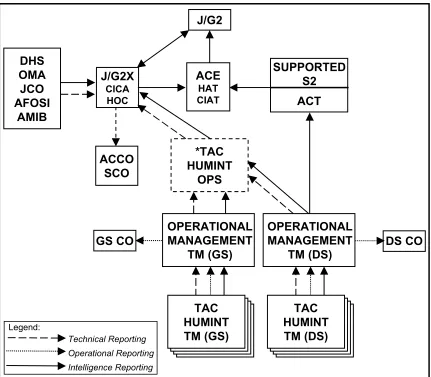
3-18. Teams forward intelligence information reports through their respective OMT (if one exists at their echelon) to the supported unit’s S2 or the S2’s analytical element. For example, a unit in DS of a brigade reports intelligence to the brigade S2 or ACT. A division GS team operating in a brigade area should report its information through the tactical HUMINT operations team to the division G2 or ACE. Units affected by the intelligence should also be notified.
3-20. See Figure 3-1 for an example of reporting connectivity for the operational, technical, and intelligence reports.
*Tactical HUMINT operations may be necessary only when a corps TEB deploys its assets and is collocated with the J/G2X. If no tactical HUMINT operations section is task organized, the operational management teams report directly to the J/G2X.
GS CO DHS
OMA JCO AFOSI
AMIB
ACT SUPPORTED
S2 J/G2X
CICA HOC
ACCO SCO
*TAC HUMINT
OPS
Legend:
Technical Reporting Operational Reporting Intelligence Reporting
TAC HUMINT TM (DS) TAC
HUMINT TM (GS) OPERATIONAL MANAGEMENT
TM (GS) DS CO
OPERATIONAL MANAGEMENT
TM (DS) J/G2
[image:31.612.70.501.147.524.2]ACE HAT CIAT
Figure 3-1. HUMINT and CI reporting channels
Chapter 4
Collection Activities
Collection methodology
4-1. The information collection system extends into every aspect of life in the AO and taps every facet of potential information. This output is expressed in terms of six collection methodologies:
• Debriefing – Debriefing is the questioning of individuals who are sources of information in a strategic or operational environment to obtain information in response to command and national level intelligence needs (FM 1-02 (FM 101-5-1)). The primary categories of sources for debriefing are military personnel (such as patrols), personnel who have been in contact with HN personnel, business people who may have worked in the areas of interest (AOIs), and foreign personnel such as refugees and local inhabitants.
• Interrogation – Interrogation is the systematic effort to procure information to answer specific collection requirements by direct and indirect questioning techniques of a person who is in the custody of the forces conducting the questioning. Some examples of interrogation sources include EPWs and detainees.
• Elicitation – Elicitation is the gaining of information through direct interaction with a human source where the source is not aware of the specific purpose for the conversation. Elicitation is the baseline method for initiating source operations.
• Interview – Interview is the questioning of an individual to ascertain the individual’s degree of knowledge on various topics; interviews are also used in reference to a CI investigation.
• Screening – Screening is the process of identifying an individual for further exploitation. Discriminators used in screening can range from general appearance and attitude to specific questions to assess areas of knowledge and degree of cooperation. Screening is not in itself an intelligence collection technique but a timesaving measure that
identifies those individuals most likely to answer PIR or to be of CI interest.
• Surveillance – Surveillance is the process of keeping a person, place, or other target under physical or technical observation. Surveillance may be conducted to collect data to enhance the safety of a specific HUMINT or CI operation or to collect information to answer collection requirements. HUMINT and CI surveillance is not for physical security purposes. The type of surveillance conducted, whether physical or technical, is METT-TC dependent.
4-2. Collection methodology techniques are further explained in FM 2-22.3 (FM 34-52) and FM 2-01-2 (FM 34-60). Regardless of how information is collected, any information gathered concerning US persons must be handled in accordance with AR 381-10.
OPERATIONS
4-3. There are two types of operations used in collection activities:
• Tactical HUMINT support operations.
TACTICAL HUMINT COLLECTION OPERATIONS
4-4. Tactical HUMINT operations are conducted using HUMINT and CI collection techniques to meet the mission requirements of both disciplines.
• CI Force Protection Source Operations - CFSO is a tactically oriented, overt CI collection program that uses human sources on the battlefield to identify potential and actual intelligence collection threats to deployed US and coalition forces. CFSO is a valuable tool that can provide critical information to a commander as well as answer intelligence requirements. Under the CFSO program, tactical CI assets have at their disposal sources to provide information on threat intelligence collection activities against deployed US and coalition forces. These sources can also contribute to the tactical MDMP. This program requires a great deal of planning, and CI planners must seek approval for CFSO before the operation begins; doing so after a unit has deployed into an operational area is usually too late (see AR 381-172(S)).
• HUMINT Contact Operations - HUMINT contact operations are tactically oriented, overt collection activities that use human sources to identify attitude, intentions, composition, strength, dispositions, tactics, equipment, target development, personnel, and
capabilities of those elements that pose a potential or actual threat to US and coalition forces. These forces provide early warning of imminent danger to US and coalition forces and contribute to the MDMP.
• Liaison Operations - Liaison operations are programs to gain rapport with, and elicit information from, host country and allied military and civilian agencies. Liaison is conducted with HN military and LEAs to answer collection requirements, coordinate activities, and foster cooperation between US, coalition, and HN LEAs and security personnel.
• DOCEX Operations - DOCEX operations are the systematic extraction of information from documents in response to collection requirements. They may be conducted by military personnel only or may utilize civilian translators under military supervision.
• Open Source Information Operations - Open source information
operations are the systematic extraction of information from open sources such as television, radio broadcasts, Internet sites, and publications. This is done in response to intelligence
or planning requirements. These operations are not exclusive to HUMINT. All intelligence disciplines can participate and benefit from these operations.
a facility, activity, or individual to answer collection requirements or support any number of CI programs. CI personnel conduct surveillance to support CI investigations and operations.
• Screening Operations - Screening operations are both tactical HUMINT and CI and are conducted to identify or assess possible sources
− Who may be able to answer collection requirements?
− Who can be used as a force protection source?
− Who may pose a threat to US forces as a part of a base or area security program? 4-5. Screening operations include—
− Mobile and static checkpoint screening to include screening of refugees and displaced persons.
− Screening as part of a cordon and search operation.
− Locally employed personnel security screening.
− EPW and detainee screening.
• Interrogation and Detainee Operations - Interrogation and detainee operations are the systematic questioning of large numbers of EPWs or detainees in response to collection requirements. These operations are usually conducted at an MP or other agency-operated collection facility.
• Friendly Force Debriefing Operations - Friendly force debriefing operations are the systematic debriefing of US forces to answer collection requirements. These operations must be coordinated with US units.
• Refugee Debriefing Operations - Refugee debriefing operations are the systematic debriefing of refugees to answer collection requirements. These are usually conducted at refugee collection points or checkpoints and may be integrated into CA or MP
operations.
TACTICAL HUMINT SUPPORT OPERATIONS
4-6. Tactical HUMINT support operations are operations using multidiscipline analytical and assessment techniques.
• Tactical HUMINT Support to Force Protection - A commander’s force protection program encompasses many assets designed to provide survivability to the force. HUMINT collection can supply information in support of a supported commander's force protection program while CI can use its unique collection capabilities to identify FISS and terrorist threats. Support to force protection can and should be applied to all aspects of a unit’s operations.
CI INVESTIGATION AND TECHNICAL SUPPORT
4-7. CI investigations are operations requiring CI certification. Only CI agents with a badge and credentials may conduct these types of operations. Due to their credentials, there are often legal restrictions regarding the use of CI agents that do not apply to HUMINT collectors. For example, the use of CI agents to collect information on criminal activities is severely curtailed. HUMINT collectors, on the other hand, are prohibited to engage in CI investigative operations in any capacity other than as a translator or assistant.
• CI Investigations - CI agents are trained to conduct investigations into national security crimes. The average tactical HUMINT team will not spend a great amount of time conducting CI investigations and will require assistance from operational and strategic CI assets to conduct any more than initial CI investigations. Areas of CI investigation include espionage, terrorism, treason, subversion, sedition, and intrusion of automated information systems. Although HUMINT and CI personnel are capable of conducting a wide range of each other’s duties, only CI personnel are authorized to conduct CI investigations. Investigations are conducted in accordance with