
MSc Environmental Consultancy
Placement Case Studies
Volume 1
MSc Environmental Consultancy Placement Case Studies
Volume 1
Introduction
This is one of a linked pair of publications which show case the excellent work done by MSc Environmental Consultancy students in placements and on research projects:
MSc Environmental Consultancy Placement case studies Volume 1 MSc Environmental Consultancy Research project summaries Volume 1
Students undertaking the MSc Environmental Consultancy come from a wide range of backgrounds, some straight from a first degree, others after a period of work in another field. During the course they undertake a 3 month work placement and also a research project. Over a number of years it has become apparent that these are especially valuable parts of the course for the students. The quality of placement opportunities has been very high with students undertaking placements in an interesting range of public and private sector organisations. Students and the Department of Geography and Environmental Management, which hosts the Masters programme, are grateful for opportunities those organisations have provided and students are grateful for what they have been able to gain from their experience of working with them. Former students have frequently said that the placement was the most valuable part of the course and it has often been an invaluable part in securing relevant employment after their study. They have also commented on how the intensely practical study undertaken in UWE prepared them effectively for those placements. Of course the learning curve on a placement is often very steep. Students typically find themselves joining in with projects and work for clients that is in progress. Often they are part of a team working on a related set of projects, but still have clearly identifiable projects or tasks for which they are responsible. However, a recurring theme is that capable committed students are rapidly given a lot of responsibility and rise to the challenge.
Similarly students on the MSc Environmental Consultancy have undertaken an interesting and diverse range of research projects. Sometimes they have used the research project as an opportunity to explore in greater depth an issue that is relevant to consultancy practice and for some it has also helped secure employment after the course. Others have pursued interests that they have enjoyed following for their own sake and for some this has led on to signing up for a research degree (e.g. a PhD).
Above all it is worth emphasising that the title of a degree can only capture part of what it is about, whereas spending some time finding out what students have actually done and how they have then used that study and placement work to find employment and further their careers allows a much richer understanding of the opportunities that the MSc provides. Since the MSc Environmental Consultancy started we have been pleasantly surprised at the variety of placements students have found and the diversity of work they have gone on to and we are delighted that this course has acted very effectively as a bridge between previous study (and work experience) and a rewarding range of careers. Often when applying for jobs students find that employers want some previous experience in the field and a placement can provide that vital element. Many employers also want to know that students they take on are able to tackle complex problems in a defined timescale with a high degree of autonomy and many research project projects demonstrate exactly those skills.
Career destinations of former students have included, for example, the following roles:
• EIA co-‐ordinator. Environmental impact assessments are complex processes involving many technical experts and often many sub-‐contractors. An EIA co-‐ordinator plays a vital role in commissioning, coordinating contributions and then compiling the Environmental Statement for submission to the relevant planning authority
• Technical roles in environmental consultancies, in specialisms such as contaminated land surveys, ecological surveys, bat surveys
• Energy manager in the public sector. e.g. Undertaking energy surveys and behavioural change work across an NHS trust to improve energy efficiency.
• Environmental business advisor to SMEs in the South West
• Renewable energy projects community liaison officer, working with planned wind farm projects
• BREEAM assessor and Code for Sustainable home assessor, assessing the environmental performance of proposed buildings and assisting with improving their performance • Waste manager for a packaging company
• Environmental transport logistics officer for a major international deliveries business, seeking to reduce the environmental impact of their operations
• Implementing Environmental management Systems for SMEs
Duncan H. Bayliss July 2015
Copyright notice and terms of publication and dissemination
This Yearbook is published electronically by the Department of Geography and Environmental Management at UWE, Bristol to inform prospective students and potential placement providers of the types of work placements and research projects former students have undertaken. It also acts as a record of the achievements of students on the MSc Environmental Consultancy.
You may , free of charge, download, read and forward this document in its entirety without modification to other individual interested persons with a legitimate interest in the MSc
Environmental Consultancy at UWE, but must respect copyright. You may not post it on a website, Linked-‐In page, Facebook page or other means of publication, but you may post a link to where the document may be found.
The copyright for each individual summary remains with the student authors. The copyright for the document as a whole is held by the Department of Geography and Environmental Management at UWE and Duncan Bayliss as editor. Do not reproduce in whole, or in part, by electronic or other means, any part of this document, or host it on a web site or any other means of dissemination without the express written permission of the editor and where he deems appropriate, the express permission of the original student author(s). Student contributions to this document were
commissioned by the Department of Geography and Environmental Management and are subject to a publication agreement that includes safeguards for the student authors, the Department of Geography and Environmental Management and placement providers. The student's summaries represent significant hard work on placements and research projects of which they are justly proud. Please respect their effort and ownership of their work. Thank you for your co-‐operation.
Acknowledgements
Desk Top Publishing by Chris Wade, Graphics Technician, FET, UWE.
Enquiries
Enquiries about the MSc Environmental Consultancy should be directed to the Admissions Office. The Admissions Office deals with enquiries and applications for all full-‐time postgraduate
programmes.
Telephone: +44 (0)117 32 83333 Fax: +44 (0)117 32 82810 E-‐mail: [email protected]
Contact address: Admissions Office
University of the West of England Frenchay Campus
Bristol, BS16 1QY UK
MSc Environmental Consultancy Placement
case studies Volume 1
Contents
Placement
Student
Page
Greengage Environmental LLP
RSK
Department for Transport
Carbon Leapfrog
b:ssec
Capita
South Gloucester Council
James Bumphrey
1
Duncan White
5
Patricia Allen
9
Adam Withers
16
Zeta Watkins
20
Stephanie Jones
24
Ian Brooks
27
James Bumphrey
Placement Role: Graduate Ecological Consultant
Placement Organisation: Greengage Environmental LLP
Current Role: Ecological Consultant, Greengage Environmental LLP
Abstract
My passion for ecology lead me to a 6 month placement with Greengage, a London based multi-‐ disciplinary environmental consultancy, where I was employed as a Graduate Ecological Consultant. My main roles were to provide support on ecology surveys such as Phase 1, Reptile and Bat surveys, and to write the reports to accompany those surveys. In addition to support on ecology I also worked on Environmental Impact Assessment projects and more specifically the preparation of the Environmental Statement for a football stadium. After my placement completed I was offered a full time contract.
Summary
Whilst I have a broad interest in the environmental sector my real passion and interest lies in the field of ecology. It was this passion that that led me to study Environmental Sciences for my undergraduate degree and subsequently Environmental Consultancy at UWE. Consequently, I was determined to gain a placement with an ecological focus and was therefore thrilled to be offered a role with Greengage, a small London based environmental consultancy, as a Graduate Ecological Consultant. The placement was initially 6 months with possibility of an extension depending on performance and the level of work available.
Although brought in primarily to support with ecology surveys much of the work I initially undertook was related to Environmental Impact Assessment (EIA) and more specifically the preparation of an Environmental Statement (ES) for a new football stadium in West London. Initially my role was more admin based, assisting different members of the team with a range of tasks such as researching policy, liaising with sub-‐consultants and editing of draft chapters. As I spent more time working on the project I was tasked with writing a number of the chapters of the ES. The most interesting of which, owing to the sites location in an area of significant development activity, was the cumulative impacts chapter which covered the impact of the proposed development in the context other schemes in the local area.
planning applications or act as documentary evidence for BREEAM and CSH assessments. To begin with I attended surveys with a more senior member of staff and I would shadow them as they completed the survey. However, as I moved through my placement I began to undertake the surveys for more simple sites myself and would draft the associated reports with less and less input from other members of the team.
In addition to these more general surveys I also assisted with specific protected species surveys. One of the major projects I was involved was a large scale reptile relocation exercise. This consisted of moving a population of common lizard (Zootoca vivipara), slow worm (Anguis fragilis) and grass snake (Natrix natrix) from one part of the site to another area outside of the development footprint. To ensure this receptor area could support an increased population of reptiles it was necessary to enhance the habitat. This was primarily achieved through the incorporation of log piles in addition to a number of specially built reptile hibernacula. These hibernacula were constructed to act as refuges for the relocated reptiles and as well as invertebrates, providing habitat, shelter and places to bask. The hibernacula were constructed from mixture of materials including logs, rocks, pipes, iron sheeting, broken pots.
(Photo 1) Common lizard using reptile hibernacula
Photo taken by Morgan Taylor of Greengage (Photo 2)
Grass snake being relocated
An additional relocation exercise on the same site involved an interesting mollusc called the roman snail (Helix pomatia). Helix pomatia gained protection under the Wildlife and Countryside Act 1981 only relatively recently, primarily as a result of an increasing trend in collection of large numbers by amateur cooks and for commercial use in restaurants. Again a population of these snails was located within the footprint of the proposed development. Greengage therefore gained a licence from Natural England to move the snails to another part of the site. I was named on the licence meaning I was legally allowed handle the snails.
In addition to reptile and snail relocation works I also undertook numerous bat surveys during my placement. In the height of summer, some surveys ended as late as 11.30pm and started as early as 03.00am! These surveys were completed on a wide range of sites, from medieval palaces out in the countryside to central London housing estates. Although one may have expected activity to be significantly greater outside of the city, on one of my very first surveys, I recorded a bat foraging over an old fridge-‐freezer located outside a burnt out flat in south London. Even with the late nights and early mornings, the range of sites and the opportunity to travel, whilst undertaking the bat surveys, was something I really enjoyed.
(Photo 3)
Reptile hibernacula
Photo taken by James Bumphrey (Photo 4)
Reptile fencing
Being a London based consultancy a considerable proportion of Greengages work involves integrating ecology in the urban form. One of the most popular methods by which this is achieved is through the incorporation of living roofs. Indeed many local authorities in London make it a requirement for developments to incorporate these systems. Greengage's role in this process is to write living roof management plans. During my placement I myself wrote a number of these plans which detailed the roof build up and plant species mix. Additionally, where the roofs were large enough, other features were designed in to them and this included log piles, rocks, rope coils and sandy piles which aimed to increase the range of micro-‐habitats across the roof.
A year and a half after starting my placement I am still working for Greengage! When my six months was up I was offered a permanent contract. Whilst being retained after the placement is no guarantee, if a business has invested time and money in a student and their performance is good, then there is a realistic chance they will look to offer them a job if it fits their business needs. Therefore, for me the placement was the most important part of the MSc and I have seen first-‐hand, having subsequently interviewed graduate candidates, that experience in a consultancy environment is something highly valued by prospective employers. My role at Greengage has developed from very much a supportive role in the beginning to leading and managing entire projects, starting from receiving a fee proposal request, to undertaking the survey, producing report and sending out final invoices. I have now led on many Phase 1, BREEAM/CSH Ecology, Reptile and Bat Surveys. Furthermore, I am also currently developing my involvement with EIA and am currently act as day to day project manager on a number of these projects. Without the MSc I do not believe that any of this would have been possible.
Duncan White
Placement organisation
:
Geo-‐environmental engineer
at Structural Soils Limited
Current Role: Environmental Consultant RSK
Abstract
This summary introduces my experience as a mature student. I saw the placement aspect of
the course a key selling point. My placement with Structural Soils as a geo-‐environmental
engineer is outlined in terms of office and site based work as well the development of
consultancy skills. I wanted initially to work in EIA but found the direct route to such a post
was difficult, so I used the opportunity afforded by this placement to gain relevant
experience and make contacts before finally securing the job I wanted.
Summary
The work placement aspect of the MSc was one of the key selling points of the course from
my perspective, as I knew the value of being able to demonstrate to prospective employees
that I had gained some practical experience. I had come to UWE as a mature student and
was looking to become an environmental consultant having worked for many years in
completely unrelated industries. My problem, as I saw it was that I hadn’t made up my mind
as to which aspect of the industry to focus on in building a new career. My placement was
as a geo-‐environmental engineer with Structural Soils, a site investigation company in
Bristol. I was attracted to working for this company because it formed part of the larger RSK
group, who undertake a wide range of environmental consultancy work, and as such I
anticipated that there may be opportunities within the company for a wider variety of roles
than at a purely specialist organisation.
Structural Soils are a site investigation company, whose purpose is to drill or excavate soils
or rock to determine its contaminative status or strength for engineering purposes. During
my placement I was involved in many of the activities required throughout the life cycle of a
typical project. Preparatory tasks included writing tenders to win the work and making
preparations for site work, such as writing health and safety documentation and checking
and loading equipment.
done over a number of repeat visits to site to gain a broader understanding of the
conditions on, or under, the site over time.
Photo shows Structural Soils drilling rig and Landrover on the Olmypics site. (copyright Duncan White)
After the site investigation had been completed, tests were scheduled and samples were
sent to the lab. Test results were analysed and results were reported and sent to the client,
along with the invoices. Dependant on the type of project and the needs to the client, a
report would often require a desk study of available historic and environmental mapping.
This exercise served as a useful tool in bringing the findings of the site investigation into the
context of local environmental designations or historical use of the site.
Many of the employees within Structural Soils were engineering geologists and as a
Geographer with a generalist’s background I found much of the terms used to describe rock
and soil types were alien to me. This made for an interesting placement, with a very steep
learning curve. Tasks that were appointed to me often led to many more questions as well
as detailed internet searches. Personally I found that having the expectation to deliver a
piece of work in a time constrained working environment was much more conducive to self
learning than within the atmosphere of the University.
consultant as possible. As such, although my placement was unpaid, I was required to keep
a record of hours that I spent on each project, in anticipation of chargeability to clients.
The knowledge and experience I gained on my placement provided me with the ability to be
able to converse with any prospective employers, if not expertly but certainly with more
degree of assurance about practices within contaminated land, and environmental
consultancy in general than if the course had been a purely taught course. My placement
was a perfect starting point for anybody wanting to progress in the field of contaminated
land.
I started my time at UWE with an open mind about which area of consultancy I wanted to
specialise in, but as I progressed through the course I was drawn more to a project
management role within EIA, which I felt suited a background in Geography. I suspect that
this view was shared by many of the fellow students, particularly as the MSc Environmental
Consultancy course covers a range of consultancy topics and students do not graduate with
a defined technical specialism.
When attempting to secure a placement, initially I struggled to secure a place within an EIA
consultancy. The economic climate at the time was one of the reasons. Many companies
were experiencing a period of contraction rather than a time where they were looking to
expand and recruit students. Another factor was the fact that although EIA practitioners are
generalists, they are expected to have a working level of knowledge for most of the
disparate specialisms which constitute an EIA project. For this reason I adopted a strategy
of trying to gain experience in one of the specialisms relevant to EIA, whilst keeping my eye
open for opportunities to move into my more preferred role.
Patricia Allen
Placement organisation:
The Department for Transport
April – June 2013
Current Role:
Head of South West Local Growth Delivery Team
Department for Communities and Local Government
uk.linkedin.com/pub/tricia-‐allen/8b/407/974
Abstract
This placement took place at the Department for Transport, which is responsible for
supporting the UK transport network, planning and investing in infrastructure and
services that enable people and goods to reach their destinations. The Department
employs over 18,000 staff, with an annual spend of approximately £13 billion. As
‘Head of Local Sustainable Travel’, I managed implementation of the Local
Sustainable Transport Fund (‘the fund’), which provides £600 million for 96 bespoke
projects across England during 2011-‐15. All projects are expected to generate local
economic growth and cut transport-‐based carbon emissions.
Summary
This placement happened within my existing employment, having worked for the
Department for Transport (‘the Department’) since 2008. My interest in this
placement stemmed from an on-‐going professional interest in achieving carbon
reduction goals through transport interventions. Since 2005, I have been employed
to manage public funds invested in travel behaviour change programmes. For the
Department, I was responsible for ensuring that public funds were invested wisely to
achieve carbon reduction and economic growth objectives through diverse yet high
value for money projects. The opportunity to reflect on how I achieved this role
through this placement enriched my professional development by sharpening my
analytical skills.
Initially, I negotiated a learning agreement with my supervisor, Professor Graham
Parkhurst, Director of UWE’s Centre for Transport and Society (see Table 1). This
identified five tasks as the focus for critical analysis and reflection. My work on
Spending Round 2013 (task 5) was prioritised for an in-‐depth study, given its
significance both for the programme and my personal learning and development.
Table 1 -‐ Learning Agreement overview
Task title Task description Timeframe Learning goals
(1) Annual Report production
Publish the first annual report for the Local Sustainable Transport Fund, covering activity during 2011/12.
January –
June 2013 • How to communicate activity through the fund in an accessible and appropriate way; • Understand the stages involved
in taking a communications resource concept from inception to publication;
• How to guide and provide effective feedback to colleagues working on the same project. (2) Grant
payments system changes
Explore possibilities for changing the grant payments system for local authorities, and lead a change
management process if agreement is achieved.
December 2012 – June 2013
• The feasibility of effecting process changes regarding financial management;
• Internal clearance processes for new approaches, and how to navigate them successfully.
(3) Staff
management Manage a new staff person's induction to the team, and manage the team through the annual performance appraisal and objective setting process.
February –
June 2013 •• People management skills; Designing integrated work programmes;
• Performance management and continual improvement.
(4) New funding streams support
Provide expert advice and support for the delivery of the assessment and decision-‐making process for two new funding streams for cycling cities and National Parks, valued at £42 million for 2013-‐ 2015.
March –
June 2013 •• Mentoring and skills exchange; Developing expertise in managing and participating in a competitive bidding process for cycling.
(5) Spending Round
Assist with input to the Spending Round process for 2015/16, with the goal of
securing future funding for investment in local sustainable transport.
March –
June 2013 • Spending Round process skills and experience; • Communication, negotiation and
persuasion skills;
• How to make the case for local sustainable transport
investment.
[image:15.595.85.512.101.730.2]
As a result of managing these tasks to a professional standard, I delivered the
following outputs:
1.
Web publication of an Annual Report for the fund covering 2011/12
(Department for Transport, 2013). This report describes the processes
leading to investment decisions, and the deliverables resulting from
government funding, increasing transparency and accountability for public
investment decisions (see Figure 1).
Figure 1 -‐ Local Sustainable Transport Fund Annual Report 2011/12 (Dept for Transport, 2013)
2.
A fundamental change in payment systems for the vast majority of projects
receiving grants from the fund. The change process was universally popular
and straightforward to understand and implement, resulting in simpler grant
management systems and processes for both the Department and local
councils.
3.
An induction programme for a new staff person, who quickly became
competent and high-‐performing; performance review reports for 2012/13;
performance management objectives for 2013/14, enabling everyone to
focus on integrated objectives and a common purpose; and an updated ‘roles
and responsibilities’ schedule and risk register for the year, ensuring team
agreement and ownership.
4.
Rigorous assessment of cycling funding bids, enabling Ministerial decision-‐
making to allocate funding for high value for money cycling projects that
contribute to local economic growth, carbon reduction and physical health
benefits.
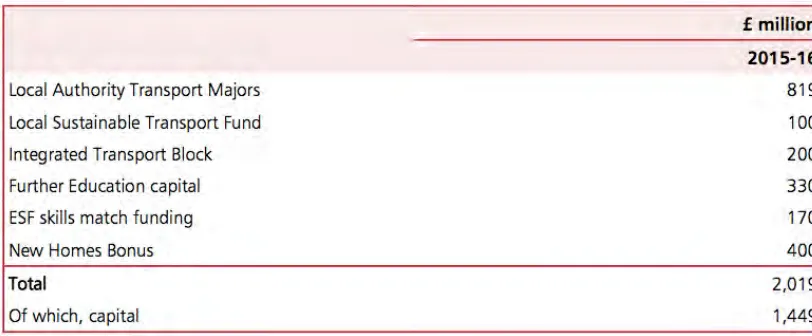
5.
Further investment for local sustainable transport delivery for 2015/16,
[image:16.595.234.376.216.423.2]Figure 2 -‐ Spending Round announcement: page 60, ‘Investing in Britain’s future’ (HM Treasury, 2013)
In Focus – An Analysis of Spending Round 2013
Spending Rounds (also called Spending Reviews) are the processes by which
Treasury allocates future government funding. An incoming government holds a
Spending Round shortly after being elected, to align funding to policies they intend
to implement. The existing coalition government announced Spending Review
budgets for 2011-‐15 in October 2010 (Inside Government, 2010). Since these
budgets expire weeks before the next General Election, the Chancellor announced a
Spending Round purely for 2015/16 in early 2013, which was commissioned by HM
Treasury on 28 March 2013 (Inside Government, 2013b).
As an official contributing to this Spending Round, I completed templates covering
financial and evidence information for future investment in local sustainable
transport, including information on different financial scenarios and the risks
associated with each. These templates were rigorously tested by senior officials
before submission to Ministers, and subsequently refined before submission to HM
Treasury by 29 April. Treasury officials then interrogated these templates and sought
clarification in preparation for the Chancellor’s consideration and decision-‐making by
26 June.
The case for sustainable transport was built on the following three assertions:
1.
Investment in sustainable transport frequently demonstrates very high value
for money (Sloman
et al
., 2010);
2.
Sustainable transport delivery contributes towards realising several
government-‐wide policy goals, such as local economic growth, carbon
reduction, physical activity, safety, environmental benefits, and social well-‐
being (Department for Transport, 2011); and
3.
Previous sustainable transport projects have been universally popular, and
[image:17.595.91.497.72.240.2]Evidence supporting these assertions was provided from several sources, including
monitoring and evaluation research commissioned by the Department for previous
sustainable transport programmes (Sloman
et al
., 2010); and sectoral analysis
research (Cairns
et al
., 2004). The ‘ROAMEF’ model from HM Treasury’s Green Book
(HM Treasury, 2011) formed the basis for illustrating that monitoring and evaluation
are essential to policy formation (see Figure 4).
Figure 3 -‐ ROAMEF model (HM Treasury, 2011)
Five evidence and analytical gaps became clear during the Spending Round process,
which have since become Departmental research priorities to overcome potential
obstacles for future funding cases. These gaps concerned:
1.
Demonstrating economic growth benefits;
2.
Developing robust monitoring and evaluation outputs from previous and
current investment programmes;
3.
Calculating trustworthy benefit-‐cost ratios for cycling programmes;
4.
Assessing the appropriate balance of revenue and capital investment for
effective local sustainable transport projects (including cycling); and
5. Communicating investment outputs in a tangible way.Research commissioned by the Department since completion of this placement will
directly address the above evidence gaps. Research findings will be available in time
for the next Spending Review, anticipated for after the May 2015 General Election.
The Technical Report produced for this placement became a valuable source
document in making the case to finance these research proposals. Work completed
during this placement directly addressed the final evidence gap (see Figure 5).
Ragonale
Objecgves
Appraisal
Monitoring Evaluagon
[image:18.595.172.408.189.445.2]
Aerial view of Stratford Parkway Station,
Stratford-‐upon-‐Avon, Warwickshire
Stratford Parkway Station, Bishopton, was formally opened on 14 June 2013 (services started on Sunday 19 May). The scheme is supported by a package of service
improvements, including enhanced off-‐ peak, evening and weekend train services, ‘Smarter Choices’ measures and ‘Station Travel Plan’ infrastructure investment.
OneLink Employment Bus, Crewe, Cheshire East
Crewe’s OneLink employment bus links areas of deprivation with key employment hubs. The bus also serves a popular business park in an attempt to address the park’s congestion and parking issues.
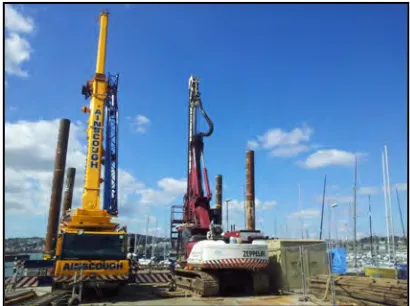
Torquay Ferry Pontoon, Torbay, Devon
Currently under development, the Torbay commuter ferry will link the towns of Brixham and Torquay. This new transport option will address serious peak-‐time congestion problems by encouraging commuters to consider travelling by boat instead of car.
Lewes Road Sustainable Transport Corridor,
Brighton & Hove
The Lewes Road sustainable transport corridor provides a safe, partially segregated cycleway along the Lewes Road, and a bus lane with improved bus stops.
The aim is to address congestion issues by encouraging more active forms of
commuting within the area.
Figure 4 -‐ Illustrations of sustainable transport investment
[image:19.595.95.300.398.551.2]Conclusion
This placement provided me with a valuable opportunity to critically appraise my
work, encouraging a meta-‐analysis not normally required as part of learning and
development. The Spending Round analysis enabled me to successfully articulate
evidence gaps for research funding subsequent to this placement, and also provided
me with a rich insight into political and financial decision-‐making at the highest level
in government. The discipline and critical thinking required for this placement has
since enabled me to secure a promotion within the civil service, with the
Department for Communities and Local Government. In my new role, I am managing
a major investment programme across the South West of England for sustainable
economic regeneration. This covers a diverse portfolio, including renewable energy,
innovative research, and business start-‐up projects.
References
Cairns, S., Sloman, L., Newson, C., Anable, J., Kirkbride, A. and Goodwin, P. (2004) Smarter Choices – Changing the Way We Travel. Final report of the research project for the Department for Transport: ‘The influence of soft factor interventions on travel demand’ [online]. Available from:
http://webarchive.nationalarchives.gov.uk/20100304134509/http://www.dft.gov.uk/pgr/sustainable /smarterchoices/ctwwt/chapter1introduction.pdf [Accessed 22 June 2013].
Department for Transport (2011) Creating Growth, Cutting Carbon – Making Sustainable Local Transport Happen [online]. Available from:
https://www.gov.uk/government/uploads/system/uploads/attachment_data/file/3890/making-‐ sustainable-‐local-‐transport-‐happen-‐whitepaper.pdf [Accessed 22 June 2013].
Department for Transport (2013) Local Sustainable Transport Fund Annual Report 2011/12 [online]. Available from: https://www.gov.uk/government/publications/local-‐sustainable-‐transport-‐fund-‐ annual-‐report-‐2011-‐to-‐2012 [Accessed 5 June 2013].
HM Treasury (2011) The Green Book: Appraisal and Evaluation in Central Government [online]. Available from:
https://www.gov.uk/government/uploads/system/uploads/attachment_data/file/179349/green_boo k_complete.pdf.pdf [Accessed 22 June 2013].
HM Treasury (2013) Investing in Britain’s future [online]. Available from:
https://www.gov.uk/government/uploads/system/uploads/attachment_data/file/209279/PU1524_I UK_new_template.pdf [Accessed 21 July 2013].
Inside Government (2013b) What is the Spending Round? [online]. Available from:
https://www.gov.uk/government/news/what-‐is-‐the-‐spending-‐round [Accessed 22 June 2013].
Sloman, L., Cairns, S., Newson, C., Anable, J., Pridmore, A. and Goodwin, P. (2010) The Effects of Smarter Choice Programmes in the Sustainable Travel Towns: Research Report to the Department for Transport [online]. Available from: https://www.gov.uk/government/publications/the-‐effects-‐of-‐ smarter-‐choice-‐programmes-‐in-‐the-‐sustainable-‐travel-‐towns-‐full-‐report [Accessed 22 June 2013].
Adam Withers
Placement organisation:
Carbon Leapfrog
Current Role
: Associate Project Planner for AEE Renewables
Abstract
One of the most appealing aspects of the MSc Environmental Consultancy was the opportunity to do a placement. I wanted to work with community groups and to develop my skills in a number of areas. I undertook a placement with Carbon leapfrog and this has been a key element in gaining my present employment with AEE Renewables.
Summary
One of the most appealing aspects of the MSc Environmental Consultancy course was the opportunity to gain work experience in an exciting, developing sector. The course provides a
plethora of contacts that have previously taken students from the course. This was obviously a great prospect and probably the most important part of the course. The calibre of employers, who have a good connection with the university and in particular the course, is impressed me. The usual method of submitting a CV to an organisation and hoping for a response did not apply here; I received considered responses.
For me, I wanted to gain some experience working with community groups. Carbon Leapfrog specialised in assisting community energy groups with planning, finance and legal matters. They had a number of experts who were able to offer support to communities, and also help with the financial issues. I particularly liked the idea of being exposed to many clients and assisting on a number of renewable projects; learning first hand the issues faced by these sorts of groups. The projects covered an array of different technologies and all had unique setups and characters. Having this exposure has been incredibly useful for my current work. I have even combined some of the contacts gained from the placement with my current projects.
I approached Carbon Leapfrog emphasising my desire to work with communities and suggested a number of ways in which I could be of assistance. One of the key attributes that appealed to Carbon Leapfrog was my module in Environmental Impact Assessments. They believed this background knowledge could have some useful applications within their business.
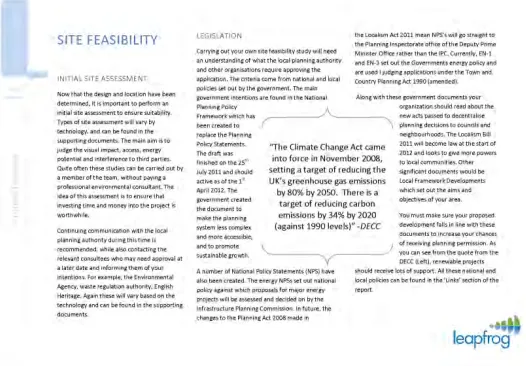
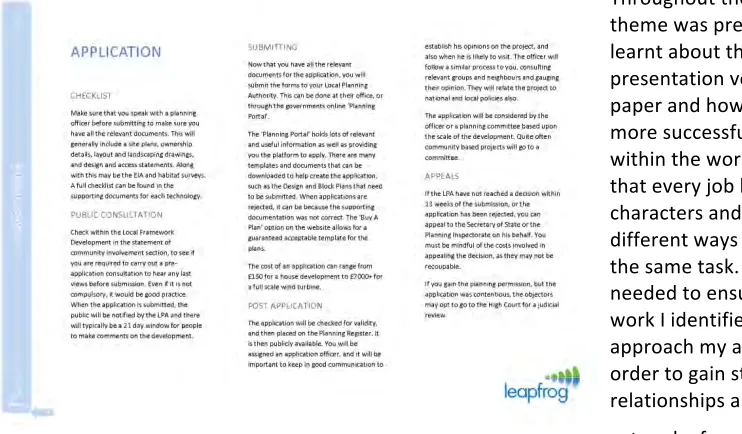
fairly open until this point. This required me to think on my feet and confirm to the placement supervisor what level of work would be suitable. This also required some pre-‐meeting ideas so that I showed at an early stage that I had already put some thought into the project. We decided that a renewables planning guide could be very useful to the company and would hopefully become important to their clients as the first port of call for renewable planning information. A big benefit of this placement was the agreement I could be based from home, and travel up to the head office in London once a week.
My placement with Carbon Leapfrog agreed to research and create a document that explained the planning process for medium-‐large scale community renewable energy projects. This involved research into wind, solar, hydro anaerobic and biomass energy schemes, presenting information on lead times, feasibility studies and statutory consultees to name a few. I had 10 weeks to complete several planning guidance documents and a report. Arrangements for the final week of the
placement were made involving a presentation to the supervisor, the CEO and the visiting tutor from UWE, with deliverance of several planning process guidance documents and a report.
This work involved high levels of independent research into the planning sector bringing together copious and often conflicting pieces of information into one concise working document which would be published on an online learning facility used by the company's clients. The work also involved talking with professionals and members of the public to utilise their knowledge and experience.
[image:22.595.74.541.467.735.2]The main bulk of the placement was spent doing independent research using the internet to understand the planning process. This also presented one of the main challenges of the project in
organising my time effectively between researching several different technologies. By using Gantt Chart systems to allocate my time effectively, I have discovered a successful time management tool which I still use today in my job.
Researching information via the web is becoming an ever increasingly integral role in modern day jobs. Being able to research online within a timescale requires more acumen than just ‘Googling’. As many of the documents were similar in content, I developed a routine for finding key information. For example, lead times on renewable projects were something I found through a useful information page on the Planning Portal. By sourcing and referencing this data I was able to return to the same place quickly when working on other documents. I learnt that filing and organising your information enabled the editing process of the placement to go much smoother. Again, this is a process I have incorporated into my current work, by being able to recall where you gathered information, helps with the credibility of work, which is released to fellow colleagues and the public. It also helped me to really understand the importance of avoiding ‘plagiarism’ and respecting ‘ownership of
knowledge’ in the workplace. Because the documents I created were for Carbon Leapfrog and being published in the public domain, I had to learn at the very start of the research what I could and could not include. Even though my role with the company was temporary, I had a large responsibility to double check my work, reference everything, and provide information on all my sources.
Working with the community is something I enjoy and at the time of looking for a placement, was something I was keen to experience in my future career. This is the main reason I wanted to work with Carbon Leapfrog. I was particularly involved with a community group in the Thames Valley region setting up their own hydro project. I helped them in some difficulties in obtaining work
permits from the Environment Agency and was able to offer advice for the project. For many projects, the public and parish will not be won over, but it is important to inform people of planning intentions and provide a platform for anti-‐lobbyists to
communicate with you. I highlight the importance of early consultation, to avoid problems arising at a later date. I learnt that communities were becoming increasingly more powerful in the planning sector under the Localism Act 2011 and that working with them in regular contact provides many benefits. My first job after the placement was as a project planner for a renewable energy company, with one of my main responsibilities liaising with communities on various projects. Because of my experience within the Thames Valley, it was one of the main contributing factors to being successful in the job interview.
[image:23.595.75.338.431.614.2]
What began as a simple community guidance document quickly became a crucial document in terms of presentation for the company. As this was a public document I needed to ensure that people would want to read it. I achieved this by formatting the word documents slightly differently with a
number of pictorial representations. I have little experience as a graphic designer, so I kept things simple. I flipped to a landscape profile and included a pictorial representation of the lead times for a project running throughout the document. I optimized white space and included the ‘Carbon Leapfrog’ logo to make the documents look professional. This way I did not focus overly on
presentation but did enough to produce a concise, professional looking, and interesting document.
Throughout the placement the theme was presentation. I learnt about the importance of presentation verbally and on paper and how this can lead to more successful outcomes within the workplace. I realised that every job has different characters and therefore different ways of approaching the same task. I realised I needed to ensure in future work I identified how I should approach my audience early, in order to gain strong reliable relationships and a good network of contacts. The final presentation involved me preparing a 10-‐minute
PowerPoint overview of what I had done, to be presented to the CEO, the workplace, and UWE visiting tutor. Developing my presentation skills has undoubtedly given my employers greater confidence in my abilities in my current role.
My placement also taught me the importance of time management and developing techniques to be quick and thorough during independent research. I took forward many techniques, which aided my research. The most important was the ability to plan effectively at the start of the project. Without the time management plans on my desktop and the initial structuring of the documents I would have needed much more time to achieve the final documents.
Without question this placement has had a significant impact on my career in the renewables sector. My current employer explained to me recently that the reason I got the job was my experience with Carbon Leapfrog, and working with community groups has proved an important factor in gaining full time employment. The placement notably improved my presentation, research, and communication skills, and gave me an incredibly useful contact for my current work. This is an essential component of the course that had a big impact on my future direction. I am now a project planner at AEE Renewables, working with communities to overcome the challenges of implementing solar farms in rural areas. There is a lot of cross over between both jobs and I certainly would not be in my current role without my time at Carbon Leapfrog.
[image:24.595.74.445.173.390.2]
Zeta Watkins
Abstract
I worked with b:ssec on a 7 month work placement as part the UWE MSc course requirement. Whilst working with them I was able to learn and develop the skills and knowledge that are essential to working within a successful consultancy. I spent a majority of the placement working on BREEAM assessments whilst also assisting with technical duties. Working with b:ssec for a further 7 months following the end of my placement I was able to further expand on my experience. I recently departed from b:ssec and am now working in London and about to begin training to become a BREEAM assessor – a job I wouldn’t have considered without my time with b:ssec.
Summary
The professional practice element of UWE’s MSc Environmental Consultancy course required a 48 days minimum work placement at an Environmental Consultancy company. This brief report will outline the experience that I had whilst working for b:ssec as a Junior Consultant.
During the taught element of the MSc course sustainability modules in which energy, renewables and carbon were the ones that interested me most. Following some research into potential career opportunities I decided that sustainability in businesses was an area I wanted to explore. I felt it was essential that my placement included my personal preferences in order for me to secure my ideal career path; see table 1.
Table 1: Personal Requirements for Professional Practice
Personal Requirements Comments
To work for an SME
• Felt I would have the chance to grow as an individual at a quicker
pace in an SME than if I was in a larger corporation.
• Enable a more direct learning experience.
• Chance to get involved in more tasks/activities.
A sustainability focused company
• Sustainability was the topic during my MSc that sparked the most
passion and enthusiasm and therefore a company that specialised in sustainability were the types of companies that I was looking for.
Placement organization
b: ssec (7 months)
Linkedin Profile
[image:25.595.49.554.68.233.2]To be able to commute with ease
• Relocation for placement would have been difficult due to financial
constraints; therefore a placement which could be easily accessible via a personal vehicle or public transport was the ideal choice.
Hands on approach
• I was looking for a company that would allow me to experience
everything possible.
• To experience the pressures and responsibilities of a consultancy.
Following an extensive search I managed to secure a 7 month work placement with b:ssec (building
services sustainability environmental consultancy) who were able to meet almost all of my
preferences for a placement. b:ssecare based in Wiltshire and are an established, well respected energy and carbon consultancy. They have worked with a range of clients such as the MoD, HM Prison Service, Asda and E-‐on but their biggest clients to date are Morrison’s and Primark. Employed by b:ssec as a Junior Consultant for 7 months in March 2013 I was required to provide technical and administrative support to staff whilst developing the necessary transferable skills to work in a successful consultancy. With just 10 members of staff b:ssec are considered to be an SME. All their staff work remotely in their respective locations meeting just once a fortnight in the office. Despite being small in size b:ssec have a considerable client list and are inundated with work which is one of the main reasons they saw the need to appoint a junior within the company.
Working from home was an entirely new experience for me and made my placement experience incredibly different from others on my course. I created weekly to do lists and ensured I remained in close contact with other members of staff to ensure I remained on track and motivated. It’s an experience that has greatly strengthened my communication skills and professionalism.
For the first three months of my placement I was supervised by the technical director and carried out technical duties. These derived from a learning agreement drawn up prior to beginning the placement that proposed a range of tasks to be undertaken all of which varied in length, the technical capabilities required and offered differing challenges. Some examples of these follow:
• Cr





![Figure
1.
Embankment
structures
in
hydraulic
model
[Source:
Captia,
2013]](https://thumb-us.123doks.com/thumbv2/123dok_us/628644.563740/29.595.67.549.50.215/figure-embankment-structures-hydraulic-model-source-captia.webp)
