Unsupervised vs. supervised weight estimation
for semantic MT evaluation metrics
Chi-kiu LO and Dekai WU
HKUST
Human Language Technology Center Department of Computer Science and Engineering Hong Kong University of Science and Technology
{jackielo,dekai}@cs.ust.hk
Abstract
We present an unsupervised approach to esti-mate the appropriate degree of contribution of each semantic role type for semantic transla-tion evaluatransla-tion, yielding a semantic MT eval-uation metric whose correlation with human adequacy judgments is comparable to that of recent supervised approaches but without the high cost of a human-ranked training corpus. Our new unsupervised estimation approach is motivated by an analysis showing that the weights learned from supervised training are distributed in a similar fashion to the relative frequencies of the semantic roles. Empiri-cal results show that even without a training corpus of human adequacy rankings against which to optimize correlation, using instead our relative frequency weighting scheme to approximate the importance of each semantic role type leads to a semantic MT evaluation metric that correlates comparable with human adequacy judgments to previous metrics that require far more expensive human rankings of adequacy over a training corpus. As a result, the cost of semantic MT evaluation is greatly reduced.
1 Introduction
In this paper we investigate an unsupervised ap-proach to estimate the degree of contribution of each semantic role type in semantic translation evalua-tion in low cost without using a human-ranked train-ing corpus but still yields a evaluation metric that correlates comparably with human adequacy judg-ments to that of recent supervised approaches as in Lo and Wu (2011a, b, c). The new approach is motivated by an analysis showing that the distri-bution of the weights learned from the supervised
training is similar to the relative frequencies of the occurrences of each semantic role in the reference translation. We then introduce a relative frequency weighting scheme to approximate the importance of each semantic role type. With such simple weight-ing scheme, the cost of evaluatweight-ing translation of lan-guages with fewer resources available is greatly re-duced.
For the past decade, the task of measuring the per-formance of MT systems has relied heavily on lex-ical n-gram based MT evaluation metrics, such as
BLEU (Papineni et al., 2002), NIST (Doddington,
2002), METEOR (Banerjee and Lavie, 2005), PER
(Tillmannet al., 1997), CDER (Leuschet al., 2006)
and WER (Nießenet al., 2000) because of their
sup-port on fast and inexpensive evaluation. These met-rics are good at ranking overall systems by averaging their scores over the entire document. As MT sys-tems improve, the focus of MT evaluation changes from generally reflecting the quality of each system to assisting error analysis on each MT output in de-tail. The failure of such metrics in evaluating trans-lation quality on sentence level are becoming more apparent. Though containing roughly the correct words, the MT output as a whole sentence is still quite incomprehensible and fails to express mean-ing that is close to the input. Lexical n-gram based evaluation metrics are surface-oriented and do not do so well at ranking translations according to ad-equacy and are particularly poor at reflecting sig-nificant translation quality improvements on more meaningful word sense or semantic frame choices which human judges can indicate clearly.
Callison-Burch et al. (2006) and Koehn and Monz (2006)
even reported cases where BLEU strongly disagrees with human judgment on translation quality.
Liu and Gildea (2005) proposed STM, a struc-tural approach based on syntax to addresses the fail-ure of lexical similarity based metrics in evaluating translation grammaticality. However, a grammatical translation can achieve a high syntax-based score but still contains meaning errors arising from confusion of semantic roles. On the other hand, despite the fact that non-automatic, manually evaluations, such
as HTER (Snoveret al., 2006), are more adequacy
oriented and show a high correlation with human ad-equacy judgment, the high labor cost prohibits their widespread use. There was also work on explicitly evaluating MT adequacy with aggregated linguistic features (Gim´enez and M`arquez, 2007, 2008) and
textual entailment (Padoet al., 2009).
In the work of Lo and Wu (2011a), MEANT and its human variants HMEANT were introduced and empirical experimental results showed that HMEANT, which can be driven by low-cost mono-lingual semantic roles annotators with high inter-annotator agreement, correlates as well as HTER and far superior than BLEU and other surfaced ori-ented evaluation metrics. Along with additional im-provements to the MEANT family of metrics, Lo and Wu (2011b) detailed the studies of the impact of each individual semantic role to the metric’s corre-lation with human adequacy judgments. Lo and Wu (2011c) further discussed that with a proper weight-ing scheme of semantic frame in a sentence, struc-tured semantic role representation is more accurate and intuitive than flattened role representation for se-mantic MT evaluation metrics.
The recent trend of incorporating more linguistic features into MT evaluation metrics raise the dis-cussion on the appropriate approach in weighting and combining them. ULC (Gim´enez and M`arquez, 2007, 2008) uses uniform weights to aggregate lin-guistic features. This approach does not capture the importance of each feature to the overall translation quality to the MT output. One obvious example of different semantic roles contribute differently to the overall meaning is that readers usually accept trans-lations with errors in adjunct arguments as a valid translation but not those with errors in core argu-ments. Unlike ULC, Liu and Gildea (2007); Lo and Wu (2011a) approach the weight estimation prob-lem by maximum correlation training which directly optimize the correlation with human adequacy
judg-Figure 1: HMEANT structured role representation with a weighting scheme reflecting the degree of contribution of each semantic role type to the semantic frame. (Lo and Wu, 2011a,b,c).
ments. However, the shortcomings of this approach is that it requires a human-ranked training corpus which is expensive, especially for languages with limited resource.
We argue in this paper that for semantic MT eval-uation, the importance of each semantic role type can easily be estimated using a simple unsupervised approach which leverage the relative frequencies of the semantic roles appeared in the reference transla-tion. Our proposed weighting scheme is motivated by an analysis showing that the weights learned from supervised training are distributed in a similar fashion to the relative frequencies of the semantic roles. Our results show that the semantic MT eval-uation metric using the relative frequency weight-ing scheme to approximate the importance of each semantic role type correlates comparably with hu-man adequacy judgments to previous metrics that use maximum correlation training, which requires expensive human rankings of adequacy over a train-ing corpus. Therefore, the cost of semantic MT eval-uation is greatly reduced.
2 Semantic MT evaluation metrics
Adopting the principle that a good translation is one from which human readers may successfully un-derstand at least the basic event structure-“who did
what to whom, when, where and why” (Pradhanet
al., 2004)-which represents the most essential
[image:2.612.315.541.54.212.2]proposed HMEANT to evaluate translation utility based on semantic frames reconstructed by human reader of machine translation output. Monolingual (or bilingual) annotators must label the semantic roles in both the reference and machine translations, and then to align the semantic predicates and role fillers in the MT output to the reference translations. These annotations allow HMEANT to then look at the aligned role fillers, and aggregate the
transla-tion accuracy for each role. In the spirit of
Oc-cam’s razor and representational transparency, the HMEANT score is defined simply in terms of a weighted f-score over these aligned predicates and role fillers. More precisely, HMEANT is defined as follows:
1. Human annotators annotate the shallow seman-tic structures of both the references and MT output.
2. Human judges align the semantic frames be-tween the references and MT output by judging the correctness of the predicates.
3. For each pair of aligned semantic frames,
(a) Human judges determine the translation correctness of the semantic role fillers. (b) Human judges align the semantic role
fillers between the reference and MT out-put according to the correctness of the se-mantic role fillers.
4. Compute the weighted f-score over the match-ing role labels of these aligned predicates and role fillers.
mi ≡
#tokens filled in frame i of MT total #tokens in MT
ri ≡
#tokens filled in frame i of REF total #tokens in REF
Mi,j ≡ total # ARG j of PRED i in MT
Ri,j ≡ total # ARG j of PRED i in REF
Ci,j ≡ # correct ARG j of PRED i in MT
Pi,j ≡ # partially correct ARG j of PRED i in MT
precision = ∑i
mi
wpred+∑jwj(Ci,j+wpartialPi,j) wpred+∑jwjMi,j
∑imi
recall = ∑i
ri
wpred+∑jwj(Ci,j+wpartialPi,j) wpred+∑jwjRi,j
∑iri
HMEANT = 2∗precision∗recall
precision+recall
wheremi andri are the weights for frame,i, in the
MT/REF respectively. These weights estimate the degree of contribution of each frame to the overall
meaning of the sentence. Mi,j and Ri,j are the
to-tal counts of argument of type j in frame i in the
MT/REF respectively. Ci,j andPi,j are the count of
the correctly and partial correctly translated
argu-ment of type jin frame i in the MT. wpred is the
weight for the predicate andwjis the weights for the
arguments of type j. These weights estimate the
de-gree of contribution of different types of semantic roles to the overall meaning of the semantic frame they attached to. The frame precision/recall is the weighted sum of the number of correctly translated roles in a frame normalized by the weighted sum of the total number of all roles in that frame in the MT/REF respectively. The sentence precision/recall is the weighted sum of the frame precision/recall for all frames normalized by the weighted sum of the to-tal number of frames in MT/REF respectively. Fig-ure 1 shows the internal structFig-ure of HMEANT.
In the work of Lo and Wu (2011b), the correla-tion of all individual roles with the human adequacy judgments were found to be non-negative. There-fore, grid search was used to estimate the weights of each roles by optimizing the correlation with hu-man adequacy judgments. This approach requires an expensive human-ranked training corpus which may not be available for languages with sparse re-sources.Unlike the supervised training approach, our proposed relative frequency weighting scheme does not require additional resource other than the SRL annotated reference translation.
3 Which roles contribute more in the semantic MT evaluation metric?
Role Deviation (GALE-A) Deviation (GALE-B) Deviation (WMT12)
Agent -0.09 -0.05 0.03
Experiencer 0.23 0.05 0.02
Benefactive 0.02 0.04 -0.01
Temporal 0.11 0.08 0.03
Locative -0.05 -0.05 -0.07
Purpose -0.01 0.03 -0.01
Manner -0.01 0.00 -0.01
Extent -0.02 0.00 -0.01
Modal — 0.04 0.01
Negation — 0.01 -0.01
[image:4.612.109.502.53.223.2]Other -0.12 0.05 -0.01
Table 1: Deviation of relative frequency from optimized weight of each semantic role in GALE-A, GALE-B and WMT12
semantic role contribute more to the overall meaning in a sentence for semantic MT evaluation, we first show that the unsupervised estimation are close to the weights obtained from the supervised maximum correlation training on a human-ranked MT evalua-tion corpus. More precisely, the weight estimaevalua-tion function is defined as follows:
cj ≡ # count of ARG j in REF of the test set
wj =
cj
∑jcj
3.1 Experimental setup
For our benchmark comparison, the evaluation data for our experiment is the same two sets of sentences, GALE-A and GALE-B that were used in Lo and Wu (2011b). The translation in GALE-A is SRL an-notated with 9 semantic role types, while those in GALE-B are SRL annotated with 11 semantic role
types (segregating themodaland thenegationroles
from theotherrole).
To validate whether or not our hypothesis is lan-guage independent, we also construct an evalua-tion data set by randomly selecting 50 sentences from WMT12 English to Czech (WMT12) transla-tion task test corpus, in which 5 systems (out of 13 participating systems) were randomly picked for translation adequacy ranking by human readers. In total, 85 sets of translations (with translations from some source sentences appear more than once in dif-ferent sets) were ranked. The translation in WMT12
are also SRL annotated with the tag set as GALE-B, i.e., 11 semantic role types.
The weightswpred,wj andwpartialwere estimated
using grid search to optimize the correlation against human adequacy judgments.
3.2 Results
Inspecting the distribution of the trained weights and the relative frequencies from all three data sets, as shown in table 1, we see that the overall pattern of weights from unsupervised estimation has a fairly small deviation from the those learned via super-vised optimization. To visualize more clearly the overall pattern of the weights from the two estima-tion methods, we show the deviaestima-tion of the unsuper-vised estimation from the superunsuper-vised estimation. A deviation of 0 for all roles would mean that unsu-pervised and suunsu-pervised estimation produce exactly identical weights. If the unsupervised estimation is higher than the supervised estimation, the deviation will be positive and vice versa.
What we see is that in almost all cases, the de-viation between the trained weight and the relative frequency of each role is always within the range [-0.1, 0.1].
Closer inspection also reveals the following more detailed patterns:
• The weight of the less frequent adjunct
super-PRED estimation Deviation (GALE-A) Deviation (GALE-B) Deviation (WMT12)
Method (i) 0.16 0.16 0.31
[image:5.612.91.523.56.101.2]Method (ii) 0.02 0.01 0.01
Table 2: Deviation from optimized weight in GALE-A, GALE-B and WMT12 of the predicate’s weight as estimated by (i) frequency of predicates in frames, relative to predicates and arguments; and (ii) one-fourth of agent’s weight.
vised maximum correlation training.
• The unsupervised estimation usually gives a
higher weight to the temporal role than the su-pervised training would.
• The unsupervised estimation usually gives a
lower weight to the locative role than the super-vised training would but the two weights from the two approach are still high similar to each other, yielding a deviation within the range of [-0.07, 0.07].
• There is an obvious outlier found in GALE-A
where the deviation of the relative frequency from the optimized weight is unusually high. This suggests that the optimized weights in GALE-A may be at the risk of over-fitting the training data.
4 Estimating the weight for the predicate
The remaining question left to be investigated is how we are to estimate the importance of the predicate in an unsupervised approach. One obvious approach is to treat the predicate the same way as the arguments. That is, just like with arguments, we could weight predicates by the relative fre-quency of how often predicates occur in semantic frames. However, this does not seem well motivated since predicates are fundamentally different from arguments: by definition, every semantic frame is defined by one predicate, and arguments are defined relative to the predicate.
On the other hand, inspecting the weights on the predicate obtained from the supervised maximum correlation training, we find that the weight of the predicate is usually around one-fourth of the weight of the agent role. More precisely, the two weight estimation functions are defined as follows:
cpred ≡ # count of PRED in REF of the test set
Method(i) = cpred
cpred+∑jcj
Method(ii) = 0.25·wagent
We now show that the supervised estimation of the predicate’s weight is closely approximated by unsupervised estimation.
4.1 Experimental setup
The experimental setup is the same as that used in section 3.
4.2 Results
The results in table 2 show that the trained weight of the predicate and its unsupervised estimation of one-fourth of the agent role’s weight are highly sim-ilar to each other. In all three data sets, the devia-tion between the trained weight and the heuristic of one-fourth of the agent’s weight is always within the range [0.1, 0.2].
On the other hand, treating the predicate the same as arguments by estimating the unsupervised weight using relative frequency largely over-estimates and has a large deviation from the weight learned from supervised estimation.
5 Semantic MT evaluation using unsupervised weight estimates
Having seen that the weights of the predicate and semantic roles estimated by the unsupervised ap-proach fairly closely approximate those learned from the supervised approach, we now show that the unsupervised approach leads to a semantic MT eval-uation metric that correlates comparably with hu-man adequacy judgments to one that is trained on a far more expensive human-ranked training corpus.
5.1 Experimental setup
Following the benchmark assessment in NIST
Met-ricsMaTr 2010 (Callison-Burchet al., 2010), we
Metrics GALE-A GALE-B WMT12
HMEANT (supervised) 0.49 0.27 0.29
HMEANT (unsupervised) 0.42 0.23 0.20
NIST 0.29 0.09 0.12
METEOR 0.20 0.21 0.22
TER 0.20 0.10 0.12
PER 0.20 0.07 0.02
BLEU 0.20 0.12 0.01
CDER 0.12 0.10 0.14
[image:6.612.164.449.53.197.2]WER 0.10 0.11 0.17
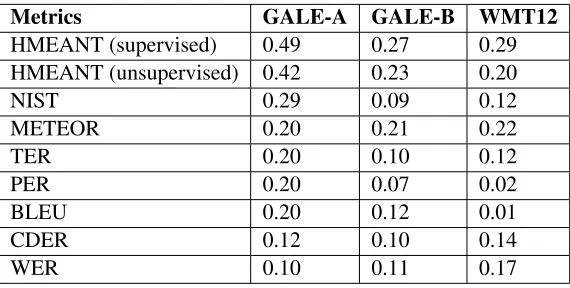
Table 3: Average sentence-level correlation with human adequacy judgments of HMEANT using supervised and unsupervised weight scheme on GALE-A, GALE-B and WMT12, (with baseline comparison of commonly used automatic MT evaluation metric.
metric at the sentence level using Kendall’s rank correlation coefficient which evaluate the correla-tion of the proposed metric with human judgments on translation adequacy ranking. A higher the value for indicates a higher similarity to the ranking by the evaluation metric to the human judgment. The range of possible values of correlation coefficient is [-1,1], where 1 means the systems are ranked in the same order as the human judgment and -1 means the systems are ranked in the reverse order as the man judgment. For GALE-A and GALE-B, the hu-man judgment on adequacy was obtained by show-ing all three MT outputs together with the Chinese source input to a human reader. The human reader was instructed to order the sentences from the three MT systems according to the accuracy of meaning in the translations. For WMT12, the human adequacy judgments are provided by the organizers.
The rest of the experimental setup is the same as that used in section 3.
5.2 Results
Table 3 shows that HMEANT with the proposed un-supervised semantic role weighting scheme corre-late comparably with human adequacy judgments to that optimized with a more expensive human-ranked training corpus, and, outperforms all other com-monly used automatic metrics (except for METEOR in Czech). The results from GALE-A, GALE-B and WMT12 are consistent. These encouraging results show that semantic MT evaluation metric could be widely applicable to languages other than English.
6 Conclusion
We presented a simple, easy to implement yet well-motivated weighting scheme for HMEANT to esti-mate the importance of each semantic role in eval-uating the translation adequacy. Unlike the previ-ous metrics, the proposed metric does not require an expensive human-ranked training corpus and still outperforms all other commonly used automatic MT evaluation metrics. Interestingly, the distribution of the optimal weights obtained by maximum correla-tion training, is similar to the relative frequency of occurrence of each semantic role type in the refer-ence translation. HMEANT with the new weight-ing scheme showed consistent results across differ-ent language pairs and across differdiffer-ent corpora in the same language pair. With the proposed weight-ing scheme, the semantic MT evaluation metric is ready to be used off-the-shelf without depending on a human-ranked training corpus. We believe that our current work reduces the barrier for semantic MT evaluation for resource scarce languages sufficiently so that semantic MT evaluation can be applied to most other languages.
Acknowledgments
We would like to thank Ondˇrej Bojar and all the annotators from the Charles University in Prague
for participating in the experiments. This
Eu-ropean Union under the FP7 grant agreement no. 287658; and by the Hong Kong Research Grants Council (RGC) research grants GRF621008, GRF612806, DAG03/04.EG09, RGC6256/00E, and RGC6083/99E. Any opinions, findings and conclu-sions or recommendations expressed in this material are those of the authors and do not necessarily reflect the views of the RGC, EU, or DARPA.
References
Satanjeev Banerjee and Alon Lavie. METEOR: An Auto-matic Metric for MT Evaluation with Improved Corre-lation with Human Judgments. InProceedings of the 43th Annual Meeting of the Association of Computa-tional Linguistics (ACL-05), pages 65–72, 2005.
Chris Callison-Burch, Miles Osborne, and Philipp Koehn. Re-evaluating the role of BLEU in Machine Translation Research. InProceedings of the 13th Con-ference of the European Chapter of the Association for Computational Linguistics (EACL-06), pages 249– 256, 2006.
Chris Callison-Burch, Philipp Koehn, Christof Monz, Kay Peterson, Mark Pryzbocki, and Omar Zaidan. Findings of the 2010 Joint Workshop on Statistical Machine Translation and Metrics for Machine Transla-tion. InProceedings of the Joint 5th Workshop on Sta-tistical Machine Translation and MetricsMATR, pages 17–53, Uppsala, Sweden, 15-16 July 2010.
G. Doddington. Automatic Evaluation of Machine Trans-lation Quality using N-gram Co-occurrence Statistics. In Proceedings of the 2nd International Conference on Human Language Technology Research (HLT-02), pages 138–145, San Francisco, CA, USA, 2002. Mor-gan Kaufmann Publishers Inc.
Jes´us Gim´enez and Llu´ıs M`arquez. Linguistic Features for Automatic Evaluation of Heterogenous MT Sys-tems. In Proceedings of the 2nd Workshop on Sta-tistical Machine Translation, pages 256–264, Prague, Czech Republic, June 2007. Association for Computa-tional Linguistics.
Jes´us Gim´enez and Llu´ıs M`arquez. A Smorgasbord of Features for Automatic MT Evaluation. In Proceed-ings of the 3rd Workshop on Statistical Machine Trans-lation, pages 195–198, Columbus, OH, June 2008. As-sociation for Computational Linguistics.
Philipp Koehn and Christof Monz. Manual and Auto-matic Evaluation of Machine Translation between Eu-ropean Languages. InProceedings of the Workshop on Statistical Machine Translation, pages 102–121, 2006.
Gregor Leusch, Nicola Ueffing, and Hermann Ney. CDer: Efficient MT Evaluation Using Block Movements. In
Proceedings of the 13th Conference of the European Chapter of the Association for Computational Linguis-tics (EACL-06), 2006.
Ding Liu and Daniel Gildea. Syntactic Features for Eval-uation of Machine Translation. InProceedings of the ACL Workshop on Intrinsic and Extrinsic Evaluation Measures for Machine Translation and/or Summariza-tion, page 25, 2005.
Ding Liu and Daniel Gildea. Source-Language
Fea-tures and Maximum Correlation Training for Machine Translation Evaluation. In Proceedings of the 2007 Conference of the North American Chapter of the As-sociation of Computational Linguistics (NAACL-07), 2007.
Chi-kiu Lo and Dekai Wu. MEANT: An Inexpensive, High-Accuracy, Semi-Automatic Metric for Evaluat-ing Translation Utility based on Semantic Roles. In Proceedings of the Joint conference of the 49th Annual Meeting of the Association for Computational Linguis-tics : Human Language Technologies (ACL-HLT-11), 2011.
Chi-kiu Lo and Dekai Wu. SMT vs. AI redux: How se-mantic frames evaluate MT more accurately. In Pro-ceedings of the 22nd International Joint Conference on Artificial Intelligence (IJCAI-11), 2011.
Chi-kiu Lo and Dekai Wu. Structured vs. Flat Semantic Role Representations for Machine Translation Evalu-ation. In Proceedings of the 5th Workshop on Syn-tax and Structure in Statistical Translation (SSST-5), 2011.
Sonja Nießen, Franz Josef Och, Gregor Leusch, and Her-mann Ney. A Evaluation Tool for Machine Transla-tion: Fast Evaluation for MT Research. In Proceed-ings of the 2nd International Conference on Language Resources and Evaluation (LREC-2000), 2000.
Sebastian Pado, Michel Galley, Dan Jurafsky, and Chris Manning. Robust Machine Translation Evaluation with Entailment Features. InProceedings of the Joint conference of the 47th Annual Meeting of the Associ-ation for ComputAssoci-ational Linguistics and the 4th Inter-national Joint Conference on Natural Language Pro-cessing of the Asian Federation of Natural Language Processing (ACL-IJCNLP-09), 2009.
Kishore Papineni, Salim Roukos, Todd Ward, and Wei-Jing Zhu. BLEU: A Method for Automatic Evaluation of Machine Translation. In Proceedings of the 40th Annual Meeting of the Association for Computational Linguistics (ACL-02), pages 311–318, 2002.
the 2004 Conference on Human Language Technology and the North American Chapter of the Association for Computational Linguistics (HLT-NAACL-04), 2004.
Matthew Snover, Bonnie J. Dorr, Richard Schwartz, Lin-nea Micciulla, and John Makhoul. A Study of Trans-lation Edit Rate with Targeted Human Annotation. In Proceedings of the 7th Conference of the Association for Machine Translation in the Americas (AMTA-06), pages 223–231, 2006.