How do Humans Evaluate Machine Translation
Francisco Guzm´an Ahmed Abdelali Irina Temnikova Hassan Sajjad and Stephan Vogel ALT Research Group
Qatar Computing Research Institute, HBKU
{fguzman,aabdelali,itemnikova,hsajjad,svogel}@qf.org.qa
Abstract
In this paper, we take a closer look at the MT evaluation process from a glass-box
perspective using eye-tracking. We an-alyze two aspects of the evaluation task – the background of evaluators ( monolin-gual or bilinmonolin-gual) and the sources of in-formation available, and we evaluate them using time and consistency as criteria. Our findings show that monolinguals are slower but more consistent thanbilinguals, especially when only target language in-formation is available. When exposed to various sources of information, evaluators in general take more time and in the case ofmonolinguals, there is a drop in consis-tency. Our findings suggest that to have consistent and cost effective MT evalua-tions, it is better to usemonolingualswith only target language information.
1 Introduction
Each year thousands of human judgments are used to evaluate the quality of Machine Translation (MT) systems to determine which algorithms and techniques are to be considered the new state-of-the-art. In a typical scenario human judges evalu-ate a system’s output (orhypothesis) by comparing it to a source sentence and/or to a reference trans-lation. Then, they score the hypothesis according to a set of defined criteria such asfluencyand ad-equacy (White et al., 1994); or rank a set of hy-potheses in order of preference (Vilar et al., 2007; Callison-Burch et al., 2007).
Evaluating MT output can be a challenging task for a number of reasons: it is tedious and there-fore evaluators can lose interest quickly; it is com-plex, especially if the guidelines are not well de-fined; and evaluators can have difficulty distin-guishing between different aspects of the transla-tions (Callison-Burch et al., 2007).
As a result, evaluations suffer from low inter- and intra-annotator agreements (Turian et al., 2003; Snover et al., 2006). Yet, as Sanders et al. (2011) argue, using human judgments is essential to the progress of MT because: (i) automatic translations are produced for a human audience; and (ii) hu-man understanding of therealworld allows to as-sess the importance of the errors made by MT sys-tems.
Most of the research in human evaluation has focused on analyzing the criteria to use for evalu-ation, and has regarded the evaluation process as ablack-box, where the inputs are different sources of information (i.e source text, reference transla-tion, and translation hypotheses), and the output is a score (or preference ranking).
In this paper, we focus on analyzing evalua-tion from a different perspective. First, we regard the process as a glass-box and use eye-tracking to monitor the times evaluators spend digesting different sources of information (scenarios) be-fore making a judgment. Secondly, we contrast how the availability of such sources can affect the outcome of the evaluation. Finally, we analyze how the background of the evaluators (in this case whether they aremonolingualorbilingual) has an effect on the consistency and speed in which trans-lations are evaluated. Our main research questions are:
• Given differentscenarios, what source of in-formation do evaluators use to evaluate a translation? Do they use the source text, the target text, or both? Does the availability of specific information changes the consistency of the evaluation?
• Are there differences of behavior between
bilinguals (i.e. evaluators fluent in both source and target languages) and monolin-guals(i.e. evaluators fluent only in the target language)? Which group is more consistent?
Our goal is to provide actionable insights that can help to improve the process of evaluation, es-pecially in large-scale shared-tasks such as WMT. In the next sections we summarize related work, provide details of our experimental setup, and an-alyze and discuss the results of our experiment.
2 Related Work
Previous work on human evaluation has focused on various aspects of the evaluation process rang-ing from categorization of the possible scenarios (Sanders et al., 2011) to the effectiveness of the evaluation criteria (Callison-Burch et al., 2007). Callison-Burch et al. (2007) define several criteria to evaluate the effectiveness of a MT evaluation task: (i) Theeasewith which humans are able to perform the task; (ii) theagreement with respect to other annotators; and (iii) thespeedwith which annotations can be collected.
Based on those criteria they recommended that evaluations should be done in the form of ranking translations against each other instead of assign-ing absolute scores to individual translation be-cause ranking is easier to perform, can be done faster, and produces evaluations with higher levels of inter-annotator agreement. As a result, recent WMT evaluations have adopted this evaluation-by-ranking approach and instructions are kept minimalby only asking the evaluator to rank hy-potheses from worst to best (Bojar et al., 2011).
In this work, we consider the three criteria proposed by Callison-Burch et al. (2007): ease,
agreement andspeed; but with a few differences. Regardingease, instructions are kept minimal, and the evaluation criteria is left to the evaluator to decide (or discover). Furthermore, by framing the evaluation as a game we aim to keep partici-pants engaged, and make the evaluation task eas-ier. With respect to the other two criteria, we use them to analyze two different aspects of the evalu-ation process: the sources of informevalu-ation available to the evaluator, and the background of the evalu-ator.
Eye-tracking has been previously used in MT evaluation research for different purposes. Do-herty et al. (2010) used eye-tracking to evaluate the comprehensibility of machine translation out-put in French, by asking native speakers to read MT output. They found that eye-tracking data had a slight correlation with HTER scores.
Stymne et al. (2012) applied eye-tracking to ma-chine translation error analysis. They found that longer gaze time and and a higher number of fix-ations correlate with high number of errors in the MT output. Doherty and O’Brien (2014) used eye-tracking to evaluate the quality of raw machine translation output in terms of its usability by an end user. They concluded that eye-tracking corre-lates well with the other measures which they used for their study. In this work, we use eye-tracking to observe which sources of information evalua-tors use while performing an MT evaluation task and how this impacts the task completion time and the consistency in their judgements.
3 Method
In order to understand how humans evaluate MT, we ran an evaluation experiment using eye-tracking, involving 20 human participants, half of them monolingual in English and the other half bilingual in Spanish-English. We chose the Spanish-English language pair because of the large amount of freely available data (e.g. WMT) and the sizable pool of available participants in our environment. In our setup, we contrasted the evaluation procedure under alternative scenarios
in which different sources of information (e.g. source sentence, reference translation) are avail-able. To keep things simple, we only asked par-ticipants to evaluate one translation at a time and provide a single score representing the transla-tion quality. To prevent biasing the behavior of the participants, and to encourage them to eval-uate translations naturally, participants were not given any precise instructions regarding the re-quirements of agoodtranslation. To increase en-gagement, we formulated the evaluation experi-ment as a game, where participants are provided feedback after each evaluation according to how close their own score was to a precomputed quality score. Below, we further describe the data used, the differentscenarios, the background of the par-ticipants, and other details of our experiment.
3.1 Data
The annotation effort generated a total of 5705
labels with an inter-annotator agreement of κ = 0.222. Unfortunately, many of the translations have rankings coming from a single evaluator only.In practical terms, this means that at least two evaluators had to evaluate the translations of the same source sentence, and at least two systems were ranked by both of those evaluators. In the WMT12 data, a total of923different source sen-tences were evaluated. From these, we kept only the155that complied with our requirement.
To control for length (i.e number of words), we divided the sentences into three equally sized groups based on the sentence length of their refer-ence translations. Discarding the five longest ones the resulting sets long, medium, and short aver-aged30.88,18.18, and10.18words.
To have diversity in the quality of the transla-tions, we collected two translations per source sen-tence, one of superior quality (best), and another one of inferior quality (worst). We measured qual-ity according to theexpected wins(Callison-Burch et al., 2012). In total, we used300different trans-lations.1
3.2 Sources of Information
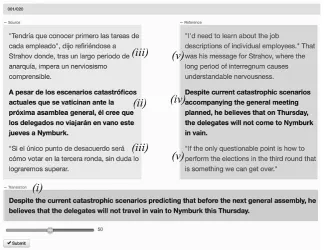
Our evaluation setup is based on a typical Ap-praise configuration (Federmann, 2012), where evaluators are provided with different sources of information in different areas of the screen: (i) the hypothesis to be evaluated; (ii) the source sen-tence; (iii) the context of the source sentence (previous and next sentences in the same source document); (iv) the reference translation for the source sentence; and (v) the context of the refer-ence translation (previous and next sentrefer-ences in the same reference document). Figure 1 presents a snapshot of our experimental setup, along with the labels for the corresponding areas of the screen.
To ease the scoring procedure, instead of pro-viding a set of predefined levels of quality (e.g. 1 to 5), we used a continuous range (a slider from 0 to 100), and let the evaluator freely set the level of translation quality.
To contrast the effect that different sources of information have on the evaluation procedure, we explored three different evaluationscenarios:
1For reproducibility, the full data matrix can be obtained at https://github.com/Qatar-Computing-Research-Institute/wmt15eyetracking
• Scenario 1(source-only) shows participants the translated sentence (in English) along with the source text of the translation (in Spanish), including the context of the source sentence (one sentence before and one sen-tence after the translated sensen-tence).
• Scenario 2 (source+target) shows partici-pants the translated sentence (in English), along with the source text of the translation (in Spanish), and a reference translation done by a human (also in English), plus context for both source and reference.
• Scenario 3(target-only) shows the translated sentence (in English) only with a reference translation including its context (in English).
3.3 Feedback
To keep participants engaged, they were given feedback according to a previously computed quality score for each translation. This score was calculated using a linear interpolation of the
expected wins score obtained from the ranking evaluations (normalized to the range [0, 100]) and DISCOTKparty (Joty et al., 2014), a high-performing automatic MT metric based on dis-course (Guzm´an et al., 2014), which won the WMT 2014 metrics task. This was done because expected wins only provide relative scores (i.e. which of two translations is ranked better given the same source sentence), while the participants were evaluating absolute scores. To keep things sim-ple, we provided feedback based on the difference between the evaluator’s score and the computed quality scores. Participants were given a five scale feedback depending on the magnitude of these dif-ferences (5: [0–10], 4: [11–20], 3: [21–30], 2: [31–40],1: [>40]). In Section 5.2 we analyze the impact of feedback on the evaluator behavior.
3.4 Participants
In our experiment we had 20 participants 27 to 45 years old. Seven of the participants were female, and 13 were male. Seventeen of our participants were computer scientists; ten had experience with manually translating documents; and four had ex-perience with machine translation evaluation.
Figure 1: Our modified evaluation layout showing: the translation (i) ; the source (ii) , (iii) ; the reference (iv) , (v) ; and the scoringslider.
• Bilingual participants did speak the source language (Spanish) at a native or advance level of comprehension.
• Monolingual participants did not speak the source language. Note that this group in-cluded some speakers of other Romance lan-guages. However, the participants insisted that their understanding of Spanish was not enough to correctly comprehend the source text.
3.5 Experimental Design
We planned our experiment to collect1200 eval-uations, 60 from each of the 20 participants. To do so, we designed an experimental ma-trix in which we considered the following vari-ables: (i) evaluator type: monolingual, bilingual; (ii) length of reference: short, medium, long; (iii)scenario:source-only,source+target, target-only; and (iv) type of translation:worst,best.
In our experimental matrix, each participant evaluated60 translations evenly divided into: 20
translations in each of the scenario; 20 transla-tions from each length type; 30 translations of each quality type. On the other hand, each trans-lation was evaluated by four different participants, twobilingualand twomonolingual. To avoid any bias, we made sure that each evaluator saw each source sentence only once.
3.6 Eye-tracking Setup
We used the EyeTribe eye-tracker2to collectgaze
information from the participants. The informa-tion was sent in messages to a modified version of Appraise3 at a rate of 60Hz (a packet in every
16ms).
Each message contained the gaze position in the screen of both eyes, a flag indicating if the point represented a fixation, a time stamp, and other device-related information. To ensure opti-mal readings, participants were asked to calibrate the eye-tracking device before starting the exper-iments, and a warning message was displayed whenever the eye-tracker lost track of the partic-ipant’s gaze.
3.7 Instructions and Exit Survey
Participants were asked to move as little as possi-ble to not interrupt the readings of the eye-tracker, and to not interrupt their work while working through the translations belonging to onescenario, as the time for executing all sentences in one sce-nario was measured. Before conducting the eval-uation, participants were shown two tutorials, one showing how to calibrate the eye-tracker and one showing how to conduct the experiment.
2http://dev.theeyetribe.com/api/
After the tutorials they were asked to perform a warm-up exercise consisting of two sentences per
scenario. Then, the participants proceeded to eval-uate the 20 translations in each of the scenarios
in the following ordersource-only,source+target
andtarget-only4.
After the experiment, the participants were asked to fill in an on-line exit survey, which col-lected their impressions about the experiment and their physiological status during the experiment.
From the survey we learned about the physi-ological state of the participants: 55% of them were in a normal state, 15% were slightly tired or sleepy, 25% were tired, and 10% were sleep-deprived or sick. Yet, all these reports were evenly distributed amongbilingualsandmonolinguals.
There were only few complaints about the setup, and they were related to: (i) the lack of pre-cise instructions of what constitutes agood trans-lation, (ii) the large range of the evaluation score (0-100), (iii) the difficulty to understand the con-text of the translations, and (iv) the cognitive over-head needed to evaluate long translations, espe-cially in thesource+target scenario. As expected, some of the monolingual participants noted that in thesource-only scenariothey mostly evaluated the readability of the translation, as they had no knowledge of the source language.
4 Results
In this section we analyze the process that partic-ipants use to evaluate translation. We focus on three different aspects. First, we use eye-tracking data to observe in which areas do participants spend most of their time. Next, we analyze the time that participants take to complete the evalua-tion. Finally, we analyze the scores given by the participants, and their consistency.
4.1 How Long Does it Take?
One important aspect to take into account is the time at which annotations can be collected (Callison-Burch et al., 2007). To discount the time a participant spends idle (be either by fatigue, dis-traction, etc.), here we analyze only the focused
time, i.e. the amount of time a participant gaze is focused inareas of interest.
4In hindsight, randomizing the order in which the
scenarioswere performed would have allowed to answer an additional set of questions.
In our experiments, we observed that on average annotations take 26.06 seconds to be collected, which is in line with the measurements reported by Callison-Burch et al. (2007). In Table 1, we further break down the task durations by: (i) type of evaluator (i.e. monolingual and bilingual), (ii)scenario(i.e. source-only,source+target, and
target-only); and (iii) the length of the source sen-tence (i.e.short,medium,long).
scnr. usr type long med short avg 1 src biling 36.89 24.54 17.92 26.46 2 src mono 44.11 28.58 19.17 30.55 3 src+tgt biling 40.16 23.99 15.46 26.59 4 src+tgt mono 46.76 29.69 21.63 32.71 5 tgt biling 26.41 15.03 10.54 17.28
6 tgt mono 35.90 19.41 12.69 22.77
Table 1: Average task duration time (in seconds) according to type of setup, type of evaluator and source sentence length.
The first observation to make is that bilingual
evaluators are consistently faster thanmonolingual
evaluators in evaluation. This is true even in the
target-only condition, where both evaluators can leverage the same amount of information (i.e. both are fluent in English). This can have two possi-ble explanations: (i) bilingual evaluators develop
internalrules that allow them to perform the task faster, and (ii) since the order of the conditions was fixed (i.e evaluators performed first the source-onlytasks, then thesource+targettasks and lastly the target-only tasks), this could mean that the
bilingualevaluators gotmore efficientsooner, just because thesource-onlytask wasn’t noise to them. However, we show later that (i) is more plausible. The second observation to make is that eval-uators tend to take longer to evaluate scenarios with more sources of information available. This is true for monolingual if we analyze the results either by scenario or by source length5.
Surprisingly, monolingual participants in the
source-onlycondition perform the task7%faster than in the source+target condition, which leads to hypothesize that the more information is in the screen, the longer the task will take, even if the information is not particularly useful for the task completion. On the other handbilingualtake the least time when evaluatingtarget-onlyscenario.
To measure the significance of our observations, we fitted a random intercepts model and analyzed the relationship between task duration time, length of the sentences, type of evaluator and type of sce-nario while taking into account the variability be-tween evaluators. Therefore, as fixed effects, we had the length of the sentences, the type of evalu-ator (bilingualandmonolingual) and thescenario
into the model. We also included the interaction between the type of evaluator and the length of the sentences. As random effects, we had intercepts for each of the 20 evaluators. P-values were ob-tained by likelihood ratio tests of the full model with the effect in question against the model with-out the effect in question.
In general, the effect ofscenario is highly sig-nificant (χ2
2 = 121.71, p = 2.2e−16), and for long sentences the target-only scenario is 8.52
and 9.6 seconds faster than the source-only and
source+target scenarios, respectively. The effect of the type of evaluator is also significant (χ2
3 =
7.45, p = 0.05), and on average bilingual are faster thanmonolingualby7.76seconds for long sentences. These results were obtained using R (R Core Team, 2015) and lme4 (Bates et al., 2015), following Winter (2013).
4.2 Where Do Evaluators Look?
The eye-tracking data allowed us to analyze the behavior of the evaluators across different condi-tions. In particular, we focused in thedwelltime, i.e. the amount of time an evaluator is looking at a particular area of interest in the screen. In Table 2, we present the proportional dwell time (out of thefocusedtime) that the evaluators spent in the different areas of the screen: (i) translation, (ii) source (with previous and next context), (iii) reference (with previous and next context), (iv) and the sum of the source and reference times.
From the table, the main observation is that evaluators spend most of their time looking at re-gions other than the translation (src+ref). This supports the hypothesis that evaluators try to un-derstand the source and reference before making a judgment about the translation. However, there are some peculiarities worth noting. First, bilingual
participants spend less time reading the translation than theirmonolingualcounterparts.
scnr. usr type tra ref src src+ref
1 src mono 0.18 - 0.82 0.82
2 src biling 0.12 - 0.88 0.88
3 src+tgt mono 0.13 0.24 0.63 0.87 4 src+tgt biling 0.07 0.16 0.78 0.93
5 tgt mono 0.26 0.74 - 0.74
6 tgt biling 0.19 0.81 - 0.81
Table 2: Proportional time spent by evaluators while focusing in different regions of the screen: translation (trans), reference and its context (ref), source and its context (src), and the aggregate of src and ref.
For example, this means that on average, in the
target-onlycondition, abilingualevaluator would spend5(0.19∗26.41) seconds6focused on along
translation while a monolingual evaluator would spend 9.3 (0.26 ∗ 35.9) seconds, that is almost double the time. In contrast, the difference times bothbilingualandmonolingualevaluators would spend reading the reference is only a factor of
1.2 (21.3 and 26.6 seconds, respectively). This tells thatbilingualare faster (mostly) because they spendlesstime reading the translation.
Another interesting observation is that
monolingual spend a sizable proportion of their time reading the source (which they suppos-edlydo notunderstand), even in thesource+target
scenario. This suggests thatmonolingual evalua-tors developrules-of-thumbto analyze the source, even if it is a foreign language (e.g. translation of named entities, numbers, dates). This can be an artifact of the relatedness between English and Spanish, or an priming effect induced by the order in which the tasks were done (i.e by asking
monolingual evaluators to score source-only
tasks first, we forced them into developing this behavior). The analysis of such phenomena, while interesting, is beyond the scope of this paper.
Finally, if we look across conditions, we observe that evaluators spend a larger proportion of their time evaluating the translation in the
target-onlycondition than in the source-onlyand
source+targetconditions. Yet, when we calculate the expected focused time in the translation region for each condition (across different lengths and evaluator types), we obtain 4.48, 4.35 and 2.85
seconds for each condition, respectively.
This tells us that having more information on the screen (the case of source+target) decreases the total amount of time spent reading the trans-lation. In other words, if a evaluator has more sources of information to evaluate a translation, s/he’ll spend more time performing the task, but less time evaluating the translation itself.
4.3 Score Consistency
Another important aspect to take into account is how consistent are the scores provided by differ-ent evaluators, and how this consistency varies de-pending on the type of evaluator, and thescenario
that is used. Unlike other studies where categori-cal and ordinal scores are produced, here each an-notation generates a score in a continuous scale7.
Thus, using the standard inter-annotator agree-ment is impractical. Instead, we evaluate consis-tencyas the standard deviation of scores for each translation with respect to a class or group aver-age (i.e. monolingualorbilingual). This quantity gives us an idea of how much variation there is in the score for a specific translation across different groups of evaluators. To be able to compare across evaluators, we normalized their individual scores to a 0-1 range usingminmax. Then, computed the consistency as follows:
σc2 = N1
c
X
i∈T
X
j∈C
(˜xij −xic¯˜ )2 (1)
where x˜ij is the normalized score of translation i by an evaluator j who belongs to class c (e.g.
monolingual), and ¯˜xic is the average score given to translation i by evaluators in class c, and Nc is the total number of translations scored by evaluators in classc.
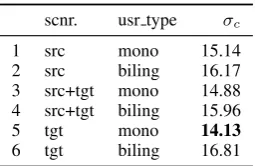
In Table 3 we present the consistency measure-ments for monolingual and bilingual evaluators across the different conditions.
First note that monolingual evaluators are more consistent within their group (σc) than the
bilingual evaluators. This observation holds true across all the different scenarios. Note also that
monolingualevaluators are themostconsistent in the target-only condition. We hypothesize that this is due to the longer times spent analyzing the translation in comparison tobilingual evaluators. 7Actually it is an ordinal scale from 0-100, but for practi-cal purposes we treat it as continuous
scnr. usr type σc
1 src mono 15.14
2 src biling 16.17 3 src+tgt mono 14.88 4 src+tgt biling 15.96
5 tgt mono 14.13
[image:7.595.353.481.61.144.2]6 tgt biling 16.81
Table 3: Consistency scores: standard deviation with respect to the class average (σc) for the scores produced by different types of evaluators across different conditions. Lower scores means higher consistency. Each measure is calculated overN = 200points.
But also, we think this is related to the simplicity of the task. There is less information to analyze. On the other hand bilingual, have a larger varia-tion, which can be attributed to the heterogeneity ofrules of thumbthat the evaluators develop from looking at the source. Finally, note howbilingual
have a problem of consistency with thetarget-only
task. Without more fine-grained information, we can only hypothesize that this is due to the lack of familiarity with the scenario. Before performing tasks in thetarget-onlyscenario, they were relying primarily on the source to evaluate.
4.4 Summary of Observations
We have observed that there are differences in how translations are evaluated according to the type of evaluator, and the scenario. In summary, the ob-servations are:
• The bilingual evaluators perform the tasks faster than themonolingual. They also spend less time evaluating the translation.
• The monolingual evaluators are slower, but more consistent in the scores they provide.
5 Discussion
Using eye-tracking allowed us to dive into the pro-cess of evaluation and explore new aspects regard-ing the behavior of evaluators. However, there were a few additional questions that might arise from our setup and experimental results. In this section we address some of them.
5.1 Is Bilingual Adequacy Necessary?
Bilingual evaluators are considered to be thegold standardfor the evaluation of machine translation (Dorr et al., 2011). However, the use of mono-lingual evaluators has been previously advocated, since the end-users of MT are in fact monolin-gual (Sanders et al., 2011). The results obtained in this paper lead us to challenge the inclusion of
bilingual evaluators for MT evaluation. As seen in the results,monolingualevaluators were slower thanbilinguals, but they were more consistent in their evaluations. Given the open-ended nature of
bilingualevaluation (e.g. given a source text, they can formulate their own set of plausible transla-tions), we believe that the evaluations ofbilinguals
can be more subjective and prone to influence by the evaluator’s background and knowledge of a specific subject. Moreover, recruiting bilingual
evaluators can be harder and more expensive. We consider that consistency should be a primary goal of any evaluation task. Therefore, it seems more practical to rely only onmonolingualsfor the eval-uation of machine translation. Our findings are in line with the observations in the post-editing com-munity wheremonolingualswere more apt for the task and improved the fluency and comprehensi-bility of translations (Mitchell et al., 2013). Our findings are also in partial agreement with White et al. (1993) (which is not directly comparable to our work, as it does not compare monolinguals and bilinguals performing the same task), who state that less time is spent in evaluation techniques that use only target side information.
5.2 Can Feedback Bias the Evaluation?
The process of evaluation can be cumbersome, es-pecially if the evaluation sessions last for long; hence we used feedback to boost the engagement of participants throughout the evaluation process. This is a double-edged sword, as the feedback has the potential to bias the evaluators and influence their decision.
To rule-out any potential bias from the feed-back, we investigated the effects that the progres-sion in which the tasks were performed might have on the differences between the evaluator scores and the feedback scores.
If the evaluatorslearnedto reproduce the feed-back scores, we would expect that the feedfeed-back error (τc) would decrease as a function of time. We calculated the feedback error as follows:
τc2= N1
c
X
i∈T
X
j∈C
(˜xij −fi)2 (2)
where fi is the feedback score for translation i, and other variables are the same as in eq. 1.
We fitted a linear model to the data, using the
scenario, the evaluator type and the progression (time) as predictors; and the feedback error as a response. We did not find that the progression had any significant effect (p = 0.2856) on the feed-back error. This means that the feedfeed-back did not bias the scoring behavior of the evaluators.
5.3 Can We do More with Eye-tracking?
Eye-tracking technology has proven useful in dif-ferent scenarios related to translation. Yet, here we have only used the eye-tracking device to measure thedwelltime an evaluator spends reading a spe-cific portion of the screen. Nonetheless, one can think of more refined uses for this technology.
Potentially, using eye-tracking can give us a fine-grained insight on how evaluators differenti-ate good from bad translations, making it easier tolearnthe intrinsic rules of thumb that they use during the evaluation process. The applications for this are manifold. For example, by learning which type of errors (e.g. morphological, syntactic, se-mantic) can make a stronger impact on the read-ing behavior while evaluatread-ing, we could help to develop better automatic MT evaluation metrics. Additionally, we can use gaze-data to model the evaluation score (or rank) given by an evaluator, and thus reduce the subjective score bias. This can help to alleviate the high variance found in evalu-ation.
Eye-tracking errors can be divided into two cat-egories: variable (device-related precision) and systematic. Fortunately, the former has improved over the past years, and high-precision devices can be now acquired for only a few hundred dollars. The latter, however is more complex. Often, a loss in accuracy known asdriftis observed as time pro-gresses, requiring frequent re-calibrations of the eye-tracking device.
This can be due to evaluator movements, and other environmental factors. Reducing and eliminating drift is imperative to make progress in this area. Up to now, only heuristic approaches have been proposed (Mishra et al., 2012), leaving plenty of room for improvement.
6 Conclusion
In this paper, we analyzed the process of MT eval-uation from a glass-box perspective, using eye-tracking data. We contrasted two main aspects of the evaluation tasks: the background of the eval-uators, and the sources of information available to them during the evaluation task. We used time and consistency as our main criteria for compari-son. Our results show that: (i)monolingual evalu-ators take relatively longer to evaluate translations (except when only the target language information is available, then they complete the tasks in less time), yet they are more consistent in their judge-ments. (ii) The amount of information provided to evaluators can affect their performance. We ob-served that when more information is available, the tasks take longer to complete, and yield less consistent results.
Therefore, based on our empirical results, we suggest that future evaluation campaigns be done withmonolingualevaluators in atarget-only scenario. We argue that this setting can increase the consistency of results while reducing the po-tential costs of recruitingbilinguals.
In future studies we would like to extend our explorations into using eye-tracking to model the behavior of evaluators and to help predict reli-able and unrelireli-able translations. In particular, we would like to explore the application of eye-tracking in ranking scenarios. We believe that given the popularity and availability of low-cost
devices, eye-tracking can position itself as a use-ful aid to reduce subjectivity in evaluation.
References
Douglas Bates, Martin Maechler, Benjamin M. Bolker, and Steven Walker. 2015. Fitting linear mixed-effects models using lme4. Journal of Statistical Software, arXiv:1406.5823.
Ondrej Bojar, Miloˇs Ercegovˇcevi´c, Martin Popel, and Omar Zaidan. 2011. A grain of salt for the wmt manual evaluation. In Proceedings of the Sixth Workshop on Statistical Machine Translation, Edin-burgh, Scotland.
Chris Callison-Burch, Cameron Fordyce, Philipp Koehn, Christof Monz, and Josh Schroeder. 2007. (Meta-) Evaluation of Machine Translation. In Pro-ceedings of the Second Workshop on Statistical Ma-chine Translation, Prague, Czech Republic.
Chris Callison-Burch, Philipp Koehn, Christof Monz, Matt Post, Radu Soricut, and Lucia Specia. 2012. Findings of the 2012 Workshop on Statistical Ma-chine Translation. In Proceedings of the Seventh Workshop on Statistical Machine Translation, pages 10–51, Montr´eal, Canada, June. Association for Computational Linguistics.
Stephen Doherty and Sharon O’Brien. 2014. Assess-ing the Usability of Raw Machine Translated Out-put: A User-Centered Study Using Eye Tracking.
International Journal of Human-Computer Interac-tion, 30(1):40–51.
Stephen Doherty, Sharon O’Brien, and Michael Carl. 2010. Eye Tracking as an MT Evaluation Tech-nique. Machine translation, 24(1):1–13.
Bonnie Dorr, Matthew Snover, and Nitin Madnani. 2011. Introduction. In Joseph Olive, Caitlin Chris-tianson, and John McCary, editors, Handbook of Natural Language Processing and Machine Trans-lation, pages 745–758. Springer.
Christian Federmann. 2012. Appraise: An Open-source Toolkit for Manual Evaluation of MT Out-put. The Prague Bulletin of Mathematical Linguis-tics, 98:25–35.
Francisco Guzm´an, Shafiq Joty, Llu´ıs M`arquez, and Preslav Nakov. 2014. Using discourse structure improves machine translation evaluation. In Pro-ceedings of 52nd Annual Meeting of the Association for Computational Linguistics, Baltimore, Mary-land, USA.
Shafiq Joty, Francisco Guzm´an, Llu´ıs M`arquez, and Preslav Nakov. 2014. DiscoTK: Using discourse structure for machine translation evaluation. In Pro-ceedings of the Ninth Workshop on Statistical Ma-chine Translation, Baltimore, Maryland, USA. Abhijit Mishra, Michael Carl, and Pushpak
Linda Mitchell, Johann Roturier, and Sharon O’Brien. 2013. Community-based Post-editing of Machine-translated Content: Monolingual vs. Bilingual. In
Proceedings of the Machine Translation Summit XIV, Nice, France.
R Core Team, 2015. R: A Language and Environment for Statistical Computing. R Foundation for Statis-tical Computing, Vienna, Austria.
Gregory Sanders, Mark Przybocki, Nitin Madnani, and Matthew Snover. 2011. Human Subjective Judg-ments. In Joseph Olive, Caitlin Christianson, and John McCary, editors, Handbook of Natural Lan-guage Processing and Machine Translation, pages 750–759. Springer.
Matthew Snover, Bonnie Dorr, Richard Schwartz, Lin-nea Micciulla, and John Makhoul. 2006. A Study of Translation Edit Rate with Targeted Human An-notation. InProceedings of the 7th Biennial Confer-ence of the Association for Machine Translation in the Americas, Cambridge, Massachusetts, USA. Sara Stymne, Henrik Danielsson, Sofia Bremin,
Hongzhan Hu, Johanna Karlsson, Anna Prytz Lil-lkull, and Martin Wester. 2012. Eye Tracking as a Tool for Machine Translation Error Analy-sis. InProceedings of the International Conference on Language Resources and Evaluation, Istanbul, Turkey.
Joseph Turian, Luke Shen, and I. Dan Melamed. 2003. Evaluation of Machine Translation and its Evalua-tion. InProceedings of Machine Translation Summit IX, New Orleans, LA, USA.
David Vilar, Gregor Leusch, Hermann Ney, and Rafael E. Banchs. 2007. Human Evaluation of Ma-chine Translation Through Binary System Compar-isons. InProceedings of the Second Workshop on Statistical Machine Translation, Prague, Czech Re-public.
John S White, Theresa A O’Connell, and Lynn M Carl-son. 1993. Evaluation of machine translation. In
Proceedings of the workshop on Human Language Technology, Stroudsburg, PA, USA.
John White, Theresa O’Connell, and Francis O’Mara. 1994. The ARPA MT Evaluation Methodologies: Evolution, Lessons, and Future Approaches. In Pro-ceedings of the Association for Machine Translation in the Americas Conference, Columbia, Maryland, USA.