http://www.scirp.org/journal/jmp
ISSN Online: 2153-120X ISSN Print: 2153-1196
DOI: 10.4236/jmp.2017.89097 Aug. 31, 2017 1633 Journal of Modern Physics
Unitless Physics II: Internal Proton Structure
US9-2
James W. Christy
7285 Golden Eagle Drive, Flagstaff, AZ, USA
Abstract
The internal structure of the proton is chaotic according to the Standard Model. This paper explores several possibilities, based on US9-1, for produc-ing an internal structure of the proton which is orderly. The hypothesis that quantized distance determination via particle to particle communication is required for force application eliminates E & M in the proton interior enabl-ing a structure consistenabl-ing of gravitational orbits. Communication velocities much greater than the velocity of light are required to enable the fundamental particles to generate the accepted laws of physics. In order to generate in-creasing complexity in Nature, the Uncertainty Principle must become the Organizational Principle. The Hydrogen atom is the source of evolution.
Keywords
Unitless Physics, Fundamental Particle Communication
1. Introduction
This paper presents ideas concerning the internal structure of the proton. These ideas are enabled by the unitless system developed in US9-1. Familiarity with US9-1 is required in the following presentation [1]. The primary constants of US9-1, me, R and @, adequately describe the actual values of mass, lifetime, and
mass times lifetime of fundamental particles. This unexpected correlation should lead directly to internal algorithms. In US9, me and @ are components of
inter-nal temporal processing in particles. US9 has entered the heart of the Standard Model.
Therefore, a primary objective of US9-2 is to produce a preliminary internal model of the proton which will provide practitioners of the Standard Theory a stable proton to interact with.
How to cite this paper: Christy, J.W. (2017) Unitless Physics II: Internal Proton Structure US9-2. Journal of Modern Phys-ics, 8, 1633-1649.
https://doi.org/10.4236/jmp.2017.89097
Received: June 16, 2017 Accepted: August 28, 2017 Published: August 31, 2017
Copyright © 2017 by author and Scientific Research Publishing Inc. This work is licensed under the Creative Commons Attribution International License (CC BY 4.0).
http://creativecommons.org/licenses/by/4.0/
DOI: 10.4236/jmp.2017.89097 1634 Journal of Modern Physics
The evolution of Physics in the Universe must emphasize efficiency of infor-mation processing and communication. The Hydrogen atom has the inherent capability of evolving to more complex structures, the atoms and molecules. This leads to biological evolution and thus must exhibit similar traits. The pro-ton must contain fundamental properties that are shared by all evolved crea-tures. The experience of life is shared by all entities in the Universe. The Uncer-tainty Principle will become the Organizational Principle [2].
This results in internal time which can appear as external space-time but is simply a consequence of internal information processing. Force fields are com-munications between particles which originate within the particles but require a distance determination to be activated.
In US9-1, a unitless Physics was derived from fundamental constants which demonstrated intimate relationships in many areas of Physics that were not re-cognizable with the standard system. US9-1 produced a simple relationship be-tween electrostatics and gravity and simple relationships bebe-tween the constants of US9-1 and the masses and lifetimes of fundamental particles. Standard Phys-ics concludes that the internal structure of the proton is chaotic [3].
US9-2 will consider the internal structure of the proton as the stable source of communications and physical law. We will introduce several principles which are required to answer logical gaps in the Standard Model and to provide con-nections in Physics to evolution. Such concon-nections require an internal viewpoint of particles in addition to field theory. The purpose of this paper is to illuminate the properties necessary for a complete theory of Physics which provides inter-nal mechanisms for the creation of communication fields and the reaction of fundamental particles to fields.
MKS constants US9 constants π = 3.141592654 π = 3.141592654 @ = 137.035999074(44) = 1/α @ = 137.035999074(44) R = 1836.15267245(75) R = 1836.15267245(75) c = 2.99792458E8 [M/S] c=me@
h = 6.62606957(29)E−34 [KM2/S] 3
e
m
=
me = 9.10938291(40)E−31 [K] me=3.6249118 6E electron mass
G = 6.67384(80)E−11 [M3/KS2] 4 2
1 e 1 p 1
G= Rm = M = Re
2
e =αc
e
=
m
e2US9 values are always underlined.
All physical constants are intimately related in US9, based on the value of the electron mass. A value of “1” has the same meaning for length, time and mass. The US9 values are assumed to be for internal processing where units are tem-poral.
US9 conversion constants:
[ ]
1.4598347
17 M
M
K
=
E
−
[ ]
(
2)
2.5129944 37 Kg or 0.141 ev
Kg
DOI: 10.4236/jmp.2017.89097 1635 Journal of Modern Physics
[ ]
2.41888433 17 S
S
K = E−
[
]
0.60351572 M S
V M S
K =K K =
[ ]
2
9.1531103 38 J
J Kg V
K =K K = E− or Kev =5.712922471E−19 ev
[ ]
These constants are to be multiplied times the unitless values to obtain meas-ured values in MKS units. Note the similarity of KMand KS.
The K’s are the equivalents of the US9 value of “1”. 1ev is equivalent to a US9 mass: M1ev = 7.127827701
US9 requires minimum and maximum values for all parameters. This is re-quired to prevent information processing in Nature from the infinities in the Standard model.
As energy,
3
2 2 1 2 2.381564 19
e
m = =Spin = E
or
[
×Kev =13.60569049 ev]
Mystery of US9-1 Table 2 from US9-1
In US9-1, Table 2 demonstrated that for 22 fundamental particles the values of Δt could be represented using only meand @ with coefficients of relatively low
value, 1.785 ± 1.097. Also, M could be represented by me, R and @, 1.309 ±
0.580. This clearly indicates that the internal processing of fundamental particles generates particles in terms of US9 constants.
2. The Uncertainty Principle
In US9, Einstein’s rest energy and Plank’s constant are intimately related:
2 2@2 @2 1 @2
M e e M M
Mc =R m m =R =R
or RM per 1.28808867E−21 sec.
For the electron: RM = 1.
The assumption of “per α2” refers to speculated internal processing time. Such
relationships are not possible with MKS units. The association of rest energy with the Uncertainty Principle has a much deeper meaning [4].
e
p m v
∆ = ∆ assume ∆ =x λdB 2
In the Bohr Hydrogen atom:
[
]
3
2π 2π
dB h m ve me m m ne e B nB me
λ
= = =2
2 e dB 2 e B2π e 2 e Bπ
p x m vλ m vn m m vn
∆ ∆ ≥ ± = ± ∆ = ± ∆ = ± ∆
3 2 2 π 2π
e e B e B
v m m n m n
∆ = ± = ±
[
e B2π] [
e B]
1 2πv v m n m n
∆ = ± = ±
2 2@ 2π2 2 3
@ 2π 4π 4π
dB M e e M e
Mc ∆t =R m m R = m = = ± ∆ ∆ = ± ∆ ∆h E t p x
DOI: 10.4236/jmp.2017.89097 1636 Journal of Modern Physics
Even if a small part of the U.P. were systematic, Physics would require adjust-ments. If ±∆p @ represented digital motion decisions based on interaction
communications, there would be systematic errors in Standard Physics. This will be discussed later in this paper.
3. Internal Proton Structure
Force fields originate from particles. An Internal structure is required to produce communication and to react to the communicated field.
The internal structure of the proton is enabled via the elimination of the elec-trostatic force and the part of the strong force that counters the elecelec-trostatic force within the proton. The inefficiency of opposing forces requires excessive information processing that is unlikely in Nature.
Electrostatic force from the proton is inactive over the proton radius. This
oc-curs because the deBroglie communication does not complete a full cycle. The proton radius has been measured to be about 0.86E−15 meters or/KM = 58.9. The
gravitational force replaces the need for the strong force. Gravitational orbits are possible.
Applying the deBroglie period to the proton:
2 2π 3 2 2 2
@ 2π @ 1.822225567 7
dBp P e e e
t h M c m Rm m R E
∆ = = = = −
or
[
×KS =4.407752875E−24 sec]
The time required for a round trip communication which enables definition of distance is
2 3.644451134 7
r dBp r
N ∆t =N E−
or
[
×Ks =Nr8.81550575E−24 sec]
which replaces “r” internally as the measurement of distance between interacting particles.
Minimum Proton electrostatic comm. distance:
2π @ 90.51785422
p dBp e
r = ∆t c= m R =
or
[
×KM =1.321411046E−15 m]
The larger value, ×1.54, requires a new theory regarding the quantized dis-tance force. The similarity of the measured proton radius value and the value from the deBroglie period indicates the following hypothesis.
Hypothesis I: The electrostatic force requires quantized communication be-tween interacting particles to determine distance. Electrostatic force from the proton is inactive over the proton radius. Gravitational internal structure is
possible.
DOI: 10.4236/jmp.2017.89097 1637 Journal of Modern Physics
inefficient. The chaotic internal state of the proton predicted by the Standard Model is inappropriate for the foundation particle of the Universe. Gravitation may be the foundation of internal particle structure and E&M may be a later de-velopment in the evolution of Physics.
Applying the deBroglie period to the electron:
2 2
2π @ 3.345884344 4
dBe e
t h m c E
∆ = = = −
or
[
×Ks =4.747422865E−21 s]
Minimum electron electrostatic comm. distance:
2π @ 1.662044478 5
e dBe e
r = ∆t c= m = E
or
[
×KM =2.426310203E−12 m]
This is the ground radius of the Hydrogen atom divided by 21.81. Calculation of superconductivity would be altered if an electronic dead zone does occur. This is a quantized distance measurement. This contributes greatly to the Uncertainty Principle.
The time required for a round trip communication which enables definition of distance is
2∆tdBe =6.691768688E−4
or
[
×Ks =9.49484573E−21 s]
If we assign the deBroglie period to the spin rotation period:
2
2πr v=2π RM@
2
@
M r=v R
2 2 2 2 3
@ @ 2 2
M e M e e
Mv r =R m v R =m v = =m
2 2 2 2
@ 2 2
e
v =m =c
1 2
2
v= ±c
(
)
11 2 2 2
1 1 1 2 3.414213562
γ = − =
Spin velocity is independent of mass. proton: RM =γR electron: RM =γ
2
@
M r=v R
1 2 2
2 3.414213562 @ 5.478442307 3
e
r =c = E
or
[
×
K
M=
7.997620182
E
−
14 m
]
or about 0.15% of the H1 radius.1 2 2
2 3.414213562 @ 2.98365234
p
r =c R =
or
[
×KM =4.355640086E−17 m]
or about 3% of the proton radius.These values are possible.
DOI: 10.4236/jmp.2017.89097 1638 Journal of Modern Physics
US9: 4 2
1 e 1 P 1
G= Rm = M = Re
Kepler’s Harmonic Law in US9 for gravitational orbits:
[
]
2 2 3 2 3 4
1 2
4π 4π e
P = a G M +M = a Rm M
e
Rm =M is the total mass of a proton binary system.
2 4π2 3 3 4π2 3
P = a m = a
3 2 4π2 3 2 4π2 2 8π2
e
a =P m =P = ±P ∆ ∆p x
This relationship between the gravitational orbit radius and the Uncertainty Principle is a deeper mystery.
For electron: 2 2 3 4 2 3 3
4π e e 4π e
P = a Rm m = a Rm
For a=1 or
[
xKM =1.4598347E−17 m]
3 2
2π 4.336367035 10
p e
P = m = E
or
[
×KS =1.048917027E−6 sec]
12 3 2
2π 1.858148541 12
e e
P = R m = E
or
[
×KS =4.494646389E−5 sec]
Electron Gravitational Binaries:
2 4π2 3 4π2 3 3 4π2 3
e e
P = a Gm = a Rm = a
2
2π @ 3.345881282 4
dBe
P= ∆ = = E−
or
[
×KS =8.093299804E−21 sec]
2 4π @2 4 4π2 3 3
e
P = = a Rm
3 3 4 4
1 e@ 1 @
a = Rm = R
1 3 4 3
1 e@ 3.188747033 11
a= R m = E−
or
[
×KM =4.655043568E−28 m]
This result is possible.
Hypothesis III: All known fundamental particles can be considered as gravitational binaries.
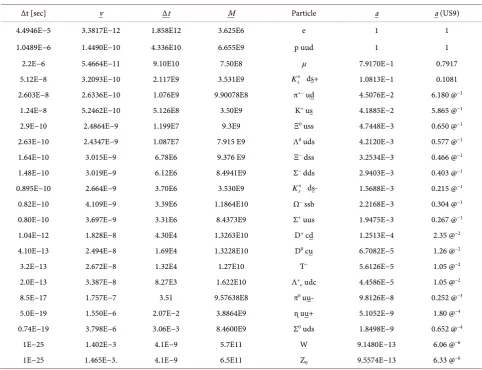
Assuming that the lifetimes of all fundamental particles are orbital periods yields reasonable gravitational orbits down to periods of 1E−25 seconds. This is demonstrated in Table 1[5].
Calculations for Table 1 and Table 2:
(
)
2 2 3 2 3 4 1 2
4π 4π e
P = a G M +M = a Rm M
assume P= ∆ = ∆t tsec 2.41888433E−17 = lifetime
(
2 4)
1 3 2 3 1 34π e 2.32177175 10
a= ∆tM Rm = ∆t M E
2π
v= a ∆t
DOI: 10.4236/jmp.2017.89097 1639 Journal of Modern Physics Table 1. Gravitational Orbits for 22 fundamental particles in US9.
Δt [sec] v Δt M Particle a a (US9)
4.4946E−5 3.3817E−12 1.858E12 3.625E6 e 1 1
1.0489E−6 1.4490E−10 4.336E10 6.655E9 p uud 1 1
2.2E−6 5.4664E−11 9.10E10 7.50E8 μ 7.9170E−1 0.7917
5.12E−8 3.2093E−10 2.117E9 3.531E9 0
L
K ds+ 1.0813E−1 0.1081
2.603E−8 2.6336E−10 1.076E9 9.90078E8 π+− ud 4.5076E−2 6.180 @−1
1.24E−8 5.2462E−10 5.126E8 3.50E9 K+ us 4.1885E−2 5.865 @−1
2.9E−10 2.4864E−9 1.199E7 9.3E9 Ξ0 uss 4.7448E−3 0.650 @−1
2.63E−10 2.4347E−9 1.087E7 7.915 E9 Λ0 uds 4.2120E−3 0.577 @−1
1.64E−10 3.015E−9 6.78E6 9.376 E9 Ξ− dss 3.2534E−3 0.466 @−1
1.48E−10 3.019E−9 6.12E6 8.4941E9 Σ− dds 2.9403E−3 0.403 @−1
0.895E−10 2.664E−9 3.70E6 3.530E9 0
S
K ds- 1.5688E−3 0.215 @−1
0.82E−10 4.109E−9 3.39E6 1.1864E10 Ω− ssb 2.2168E−3 0.304 @−1
0.80E−10 3.697E−9 3.31E6 8.4373E9 Σ+ uus 1.9475E−3 0.267 @−1
1.04E−12 1.828E−8 4.30E4 1.3263E10 D+ cd 1.2513E−4 2.35 @−2
4.10E−13 2.494E−8 1.69E4 1.3228E10 D0 cu 6.7082E−5 1.26 @−2
3.2E−13 2.672E−8 1.32E4 1.27E10 Ƭ− 5.6126E−5 1.05 @−2
2.0E−13 3.387E−8 8.27E3 1.622E10 Λ+
c udc 4.4586E−5 1.05 @−2
8.5E−17 1.757E−7 3.51 9.57638E8 π0 uu- 9.8126E−8 0.252 @−3
5.0E−19 1.550E−6 2.07E−2 3.8864E9 ɳ uu+ 5.1052E−9 1.80 @−4
0.74E−19 3.798E−6 3.06E−3 8.4600E9 Σ0 uds 1.8498E−9 0.652 @−4
1E−25 1.402E−3 4.1E−9 5.7E11 W 9.1480E−13 6.06 @−6
1E−25 1.465E−3. 4.1E−9 6.5E11 Z0 9.5574E−13 6.33 @−6
Conclusions from the Gravitational Orbit Table
Values of “a” [E−17 to E−29 m] fit deep within the dead zone postulated for electrostatics. The value of G seems tailored for this purpose.
Hypothesis IV: All binary components of fundamental particles are also gravitational binaries.
There would be 2n components associated with each fundamental particle.
Perhaps some of these are quarks. Here, assume a proton binary.
2 4π2 3 4π2 3 3
e e
P = a GRm = a m
22
2 =1.157077532me
22
10! 1.0010726 2 0.8642463207 3.6249118 6
e
m = = = E
[ 1 1 2] 3 2 3 2
2π 2n
n e
P = a m −
“a” must decrease to avoid orbital interactions.let 1
1 4n
a= −
[ ]1 3 2 3 2
1 4n
a = − 2π 3 2 [ ]1 1 2 [ ]1 3 2 2n 4n
n e
P = m − −
[ ]1 1 2 [ ]1 3 2
4.3363677035 10 2n 4n
n
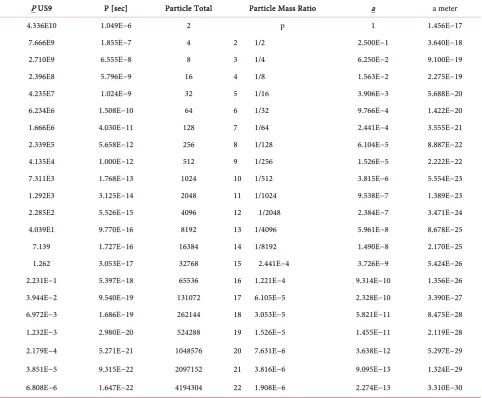
DOI: 10.4236/jmp.2017.89097 1640 Journal of Modern Physics Table 2. Gravitational Binary Orbits for 4.196E6 particle system in US9.
P US9 P [sec] Particle Total Particle Mass Ratio a a meter
4.336E10 1.049E−6 2 p 1 1.456E−17
7.666E9 1.855E−7 4 2 1/2 2.500E−1 3.640E−18
2.710E9 6.555E−8 8 3 1/4 6.250E−2 9.100E−19
2.396E8 5.796E−9 16 4 1/8 1.563E−2 2.275E−19
4.235E7 1.024E−9 32 5 1/16 3.906E−3 5.688E−20
6.234E6 1.508E−10 64 6 1/32 9.766E−4 1.422E−20
1.666E6 4.030E−11 128 7 1/64 2.441E−4 3.555E−21
2.339E5 5.658E−12 256 8 1/128 6.104E−5 8.887E−22
4.135E4 1.000E−12 512 9 1/256 1.526E−5 2.222E−22
7.311E3 1.768E−13 1024 10 1/512 3.815E−6 5.554E−23
1.292E3 3.125E−14 2048 11 1/1024 9.538E−7 1.389E−23
2.285E2 5.526E−15 4096 12 1/2048 2.384E−7 3.471E−24
4.039E1 9.770E−16 8192 13 1/4096 5.961E−8 8.678E−25
7.139 1.727E−16 16384 14 1/8192 1.490E−8 2.170E−25
1.262 3.053E−17 32768 15 2.441E−4 3.726E−9 5.424E−26
2.231E−1 5.397E−18 65536 16 1.221E−4 9.314E−10 1.356E−26
3.944E−2 9.540E−19 131072 17 6.105E−5 2.328E−10 3.390E−27
6.972E−3 1.686E−19 262144 18 3.053E−5 5.821E−11 8.475E−28
1.232E−3 2.980E−20 524288 19 1.526E−5 1.455E−11 2.119E−28
2.179E−4 5.271E−21 1048576 20 7.631E−6 3.638E−12 5.297E−29
3.851E−5 9.315E−22 2097152 21 3.816E−6 9.095E−13 1.324E−29
6.808E−6 1.647E−22 4194304 22 1.908E−6 2.274E−13 3.310E−30
Conclusions:
This particular model nearly covers the range of periods in Table 1. The pro-ton binary can be composed of two distinct systems which communicate and in-teract. To relate with the quark model, we could introduce a triplet.
Table 2 expresses a potential for sufficient complexity in the proton to gener-ate the Laws of Physics. Needed is a rationale for a minimum value of distance. This type of complexity along with internal communication structure is a re-quirement for particle generation of the fields of the Standard Model and for particle reaction to those fields.
Efficient information processing is the fundamental requirement for the maintenance of particle lifetime. Nature is governed by internal processing. This enables evolution to produce atoms, molecules, biology and higher life forms. Ignoring this fact has resulted in the stagnation of the Standard Model.
DOI: 10.4236/jmp.2017.89097 1641 Journal of Modern Physics
which impart energy to the appropriate orbits in +/− momentum changes. De-fining the Uncertainty Principle as the Organizational Principle would increase understanding of internal mechanisms. Finding the mode that enables evolution would enlighten biological studies, because the fundamentals of evolution are preserved in all entities.
4. Define Digital Parameters at Nonrelativistic Velocities
Hypothesis V: Fundamental particle dynamics arise from internal digital deci-sions based on an internal clock which is coordinated with external cosmic and local communications.The following presents a digital unitless physics in which all velocities occur due to internal processing delay. The time interval for all physical processes is a US9 constant,
[
1 @] [ ]
= α , independent of velocity and mass.0 1 @
t ∆ =
or
[
×KS =1.76514518E−19 sec]
Define digital parameters at nonrelativistic velocities:
0 1 @
t
∆ = Nc=me δxM
2
@
c M e
N =R m =Mc δxM =m Ne c =R mM @=1 M@
2 2 2 2
0 c M e@ 1 M e@ 1 M
t N α R m R m R c
∆ = = =
For electron: RM = 1
2 2 2
0 ce 1 e@ 1 4.052618953 18
t N m c E
∆ = = = −
or
[
×KS =9.802816481E−35 sec]
, time per electron step1 @ 2.013111759 9
e e
x m E
δ = = −
or
[
×KM =2.9388104E−26 M]
step size2
1
4.052618953
18
e e
t
x c
c
E
δ
=
δ
=
=
−
or
[
×Ks =9.80281648E−35 sec]
step timec M e
Nδx =m maximum distance per α
For proton:
1836.152672
M
R = ∆t Ncp =1Rme2@2=2.20712565E−21
or
[
×KS =5.338780718E−38 sec]
time per proton step1 @ 1.096374931 12
P e
x Rm E
δ = = −
or
[
×KM =1.600526168E−29 M]
proton step size2
1 2.207125265 21
P P
t x c Rc E
δ =δ = = −
or
[
×Ks =5.338780718E−38 sec]
c P e
Nδx =m maximum distance at velocity c per α
[
]
2[
]
2@ 2π @ @ 2π 2π 8.256096419 13
dBp M e M M e e
cP δx = m R R m = m = e= E
DOI: 10.4236/jmp.2017.89097 1642 Journal of Modern Physics
v c
N =βN =βMc=Mv= p in increments of 1
min 1 M e
v = R m
This results in quantized momentum at a low level, 4.030E−37 kg∙m/s.
3
2π
dB h Mv me Nv
λ
= = Nvλ
dB =hv dB
N
λ
=hBohr atom:
2
n e
r =n m vn =m ne
2
n e v
p =m n=N
2
v e
N n=m =e 4π @ 2 2 2 2
e f i f i
m n n n n
λ= −
For nf = 2, ni = 1:
4π @ 4 3 8.323015723 9me E
λ = =
or
[
×
K
M=
1.215022716
E
−
7 m
]
1215 AngThe critical factor in this approach is that motion occurs digitally after com-munication interaction with other particles. It also includes internal information processing delays which result in the velocity of light and all lower velocities. It further allows the possibility that internal processing may result in negative mo-tion that promotes higher organizamo-tion (creativity). Adjusting momo-tion to avoid collisions may be the source of the Uncertainty Principle.
Introducing an internal perspective on Special Relativity:
Hypothesis VI: SR gamma is the result of a limitation on internal temporal data.
time dilation in S.R.:
(
)
1 22
1
meas rest rest
t
γ
t tβ
∆ = ∆ = ∆ −
(
2)
1 21
meas rest
t
β
t∆ − = ∆
squaring this:
2 2 2 2 2 2 2 2
meas meas rest meas rest
t β t t v t c t
∆ = ∆ + ∆ = ∆ + ∆
2 2 2 2 2 2 2 2 2 2
meas v M v M
v t c r c N δx c N δt
∆ = ∆ = =
This term is obviously an orthogonal delay proportional to distance traveled. Internal digital motion step processing delay can replace the external space-time concept.
Electrostatic Acceleration from proton on electron:
2 2 2
E e
v
t m
γ
r
αγ
r
∆ = ∆
=
2 2 3 2 2 2 2
1
E e
x t γ m r α β r
∆ = ∆ = − 2 2 2 2 2
@
r r e
r
= ∆
t c
= ∆
t m
DOI: 10.4236/jmp.2017.89097 1643 Journal of Modern Physics
5. Communication Theory
The assumptions of the Standard Model of Physics do not allow generation of many of the known facts of Physics. Primary among these are the velocity of light, the gravitational force, the electrostatic forces, Mach’s principle, inertia and alocality in quantum mechanics. Although the Standard Model provides adequate description of these facts, it does not provide the possibility of genera-tion of the bases of physical law. This is primarily because communicagenera-tion is not allowed to exceed the velocity of light and arbitrary units do not provide suffi-cient insight [6].
Therefore, we postulate two communication velocities that exceed the velocity of light for consideration under the US9 unitless system.
Hypothesis VII: The velocities c2 and c3 are required communication
veloci-ties for the interaction of fundamental particles which enables the U.P. to create greater complexity.
Communication between particles requires both local and cosmic interac-tions. In US9 it is simplest to consider c, c2 and c3 as communication velocities.
Being unitless allows consideration of any of these as communication velocities and c is the foundation of Standard Physics.
Three communication velocities for the proton deBroglie period:
2π @ 0.660540696 @
dB e P
c t∆ = m R =h M c=
or ×KM =1.321409837E−15 m
E & M is enabled,
2
2π
22π1.075176754
4.496410645 10
dB e P e
c
∆
t
=
m
R
=
h M
=
Rm
=
E
or ×KM =6.564016285E−7 m
Gravitational aberration is significantly reduced and spin alocality is enabled. Spin is a gravitational phenomenon. “c” is regulated by “c2” via receptor
com-munication.
3
2π @
32.233562357 19
dB e P
c
∆
t
=
m
R
=
hc M
=
E
or ×KM =326.0631833 m
Mach’s Principle is enabled. Momentum is defined.
Hypothesis VIII: The gravitational field is generated at velocity c2[7].
Particle to particle communication is via gravitinos. The virtual particle sce-nario is actually internal particle temporal processing.
Gravitational Acceleration from proton on electron:
4
1
eG
=
Rm
∆ =t 1 @=αGravitational comm. velocity at c2:
4 2 3 2 2
G e e e
v
t Rm Rm r
γ
t
γ
m r
αγ
r
∆ = ∆
= ∆
=
2 2 3 2 2 2 2
1
G e
x t γ m r α β r
∆ = ∆ = − 2 2 4
2
r
r
= ∆
t c
2 2 3 4 4 2 6 2 7 2
2 2
@ 1
G e r e r
x α γ m m t α β m t
∆ = ∆ = − ∆
DOI: 10.4236/jmp.2017.89097 1644 Journal of Modern Physics
US9: 2 6 2
8.89 42
0.2087 @
e2.134
2.134
UR
=
E
=
m
=
e G
=
R
Distance to Galactic Center: 26,000 light years:
US9: 2 5
1.685 37 1.434@
eDGC
=
E
=
m
2 5 2 3
1.434
e e1.434
e1.434
4.763 19
DGC c
=
m m
=
m
=
=
E
or × Ks = 1152 sec
3 2 5 3 3 2
1.434@
e e@
1.434
e@ 1.375 11
DGC c
=
m m
=
m
=
E
or ×Ks = 3.326E−6 sec This is near the muon lifetime.
3
2.134
6 3@
32.134
3@
37.253 16
e e e
UR c
=
Rm
m
=
Rm
=
E
or ×KS = 1.754 sec
Hypothesis IX: Inertia, Mach’s Principle, rest energy and velocity definition are defined by cosmic communication at velocity c3.
Inertia, rest energy and velocity definition via cosmic communication is enabled, solving Einstein’s dilemma. A particle’s identity is defined by mass and velocity with respect to a cosmic frame. The evolution of particle communica-tion probably occurred in the sequence: c3, c2, c. Momentum defined, followed
by gravitational force, followed by E & M. This is evolutionary Physics which provides the fundamental properties of biological evolution providing a Un-iverse with increasing information content and increasing complexity of funda-mental components.
Gravitational communication inside fundamental particles is now assumed to be at velocity c2. Internal proton forces require interaction between internal
par-ticles. Interaction requires transfer of particle identity and energy transfer.
2 2 2 2 2
@ 2π @ @ 2π @
dB c v dB c PdB v me RM me m Re M
λ
=ω
= =β
=β
in H ground orbit RM =1 β =1 @
λ
dB=2πmeHypothesis X: Angular Momentum Conservation is the result of gravita-tional communication delay time.
In an organized system, the radial communication delay time can be assumed to be:
2 2 2
@
r e
t
r c
r m
∆ =
=
If this is assumed to be the internal digital step time interval:
v e r v M e r
v=Nδx ∆ =t N R m∆t
[
]
2 2M e v M e r r v
Mv r =R m N R m∆t c ∆ =t N c =L
Reduction of ∆tr results in corresponding digital increase in motion per
time.
The law of angular momentum conservation has been used as a basis for much of physics without producing a rationale for the physics which produces the law. Radial communication time is the rationale. “c2” has been introduced as
DOI: 10.4236/jmp.2017.89097 1645 Journal of Modern Physics
time between steps, δt, producing larger Δx per time, α.
As an example, a tornado would follow this law. The ability to confuse this signal would disrupt the structure of the tornado. 1E3 m tornado radius ×2 con-verts in US9 to:
2r=1.370018126 20E 2
2r c =555.2161423 or 8.105237905 15 sec
s
K E
× = −
Conservation of helicity is angular momentum conservation within fluids. This proves that organized particle to particle communication is well established in Nature.
Quarks Mass Charge u 5.87me 2/3
d 11.7me −1/3
s 1.57@me −1/3
c 1.39Rme 2/3
b 4.48Rme −1/3
t 1.40@Rme 2/3
The more massive group is close to R x the first group [8]. Neutrinos
M e
M =R m Values of electron neutrinos mass can be around “1”.
RM includes gamma. 0.139707191 ev Kev = =1 M Neutrinos may be
gravi-tinos.
6. Photons in US9
Photon view:@
e
c m
λ
ω = λ= λ
2 2 2
@
e hω =λ m cλ =m mλ
2 2 3 2 2
@ 2π @ 2π @ 2π 1
e e e
m m m m m R P
λ λ λ λ λ
ω = = = =
2
2π @ dB
Pλ = Rλ =P
The photon mass can be treated as a normal mass.
Wavelength is the Bohr base orbit circumference divided by @Rλ.
US9 enables new relationships.
1 2πm Re 1@
λ =
U.P. view: 2π 2
@
tλ Pλ Rλ λ c
∆ = ± = ± = ±
2
Eλ tλ
∆ ∆ ≥ ±
3 2 2 2
@ 4π 4π 4π 4π
e e
Eλ m Rλ R m cλ m cλ hωλ
∆ = ± = = =
3
2 2 2
e e
p x R mλ vλ m
∆ ∆ = ∆ = ± = ±
2
e
v m Rλλ
∆ = ±
@ @ @ 2π 1 2π
e e e
v c m Rλλ m Rλ Rλ m
∆ = ± = ± = ±
DOI: 10.4236/jmp.2017.89097 1646 Journal of Modern Physics
Kepler’s Harmonic Law Photon Gravitational Binary with Pλ as orbital
pe-riod [9]
[
]
2 2 3 2 3 4 1 2
4π 4π e
Pλ = a G M +M = a Rm mλ
e mλ =R mλ
2 4π2 3 3 4π2 2 4
@
e
Pλ = a Rm Rλ = Rλ
3 3 1 2@4 1 3 @4
e e
a =Rλ Rm Rλ = Rm Rλ
1 3 1 3 4 3 1 3
1 e @ 3.188747033 11
a= R m Rλ = E− Rλ
or
[ ]
1 34.655043568 28 M
M
xK = E− Rλ
For H1 ionization energy, find Rλ:
3 3
2 2.381564435 19 2π
e e
m = E =hωλ = m c λ
2πm Re λ@
λ =
3 3 3 2
2 2π @ @ 2π @
e e e e e
m = m m Rλ m =m Rλ
2
1 1 2 @ 2.662567725 5
R = = E−
2
2 @ 96.51573166
e e
mλ =R mλ =m =
1 3
1 3.188747034 11 1 1.067873588 9
a = E− R = E−
or xKM =1.558918919E−26 M
[ ]
1 2πm Re 1@ 4π @ 4πme c 6.242261793 9E
λ
= = = = Note this equivalence!or xKM =9.112670372E−8 M
[ ]
[911.267037 Ang]2
1 e@ 2π 1@ 4π @ 6.242261792 9e
cPλ =m Rλ = m = E
Cosmic Background Radiation as gravitational binary
1089
S
R = λ =cb 1.063E−3 m 1.063E−3 m 1089=0.9761E−6 m
2
1.063 3 m 7.28164634 13 5.541593868
cb E KM E me
λ = − = =
2 2
@ 2π @ 2π @ 5.541593868
cb cPdB me Rcb m Re cb me
λ = = = =
2
2π @ 5.541593868 1 @ 0.881972057
1.133822769 @ 2.282511948 9
cb e e e
e
R m m m
m E
= =
= = −
1 cb 1.166507683 4
R R = E
1.133822769 @
cb e
mλ =R m = near electron neutrino mass
1 3 1 3 4 3 1 3
1 @ 3.188747034 11
cb e cb cb
a = R m R = E− R R1 3cb =1.316652059E−3
2.421860065 8 or 3.535515362 25 m
cb M
a = E− ×K = E−
Conclusions
DOI: 10.4236/jmp.2017.89097 1647 Journal of Modern Physics
7. Complexity in Physics
In the last fifty years an enormous amount of information has been acquired about Nature and the Universe. Because of the static point of view of the Stan-dard Model of Physics, much of the new information would be classified as “emergent phenomena”.
The dominant view of complexity is that evolving forms are disconnected from the causality that characterizes traditional Physics. This static viewpoint bypasses an obvious alternative: creativity is inherent in the fundamental struc-ture of causality; emergent phenomena are an inherent part of the evolutionary process of physics.
The limiting of communication velocity to the velocity of light is obviously contradicted by non-locality in quantum mechanics. US9 provides an excellent opportunity to consider an addition to the Standard Model which provides flex-ibility.
Fundamental particles are artifacts of evolution. Each represents a quantum state of the evolution of the Universe. Perhaps all quantum states are artifacts of universal evolution, representing epochs in the development of the Universe. Therefore, physics must develop an evolutionary sequence of logical events that involve all of the fundamental parameters of Physics.
Fundamental particles live in the same Universe as humans, and share similar properties and evolutionary requirements. Survival for fundamental particles requires maintaining a defined level of communication. To exist is to communi-cate. The communication scheme is also subject to evolution and probably con-sists of several levels. E&M and gravity are separate levels. Angular momentum and nuclear forces are probably two more levels. These levels are separated by digital frequencies and communication velocities which do not normally interact in the internal processing.
Digital calculations internal to particles result in the reaction of the particles to the fields of Standard Physics. This requires a balance between external fields and internally generated actions. This is a concept inherent in conservation of momentum and energy.
In US9, the concept of zero is equivalent to non-existence and therefore is ex-cluded from the physics of nature. Standard Physics has required the existence of zero because of the arbitrary units. US9 assumes the existence of a minimum di-git (1), the smallest entity in Nature, yet to be determined. As a consequence, the concept of mathematical infinity is non-existent. However, all other real num-bers are valid, but they are expected to have defined physical minimum and maximum values.
8. The Organizational Principle
DOI: 10.4236/jmp.2017.89097 1648 Journal of Modern Physics
hypothesis requires evaluating what fraction of +/− ħ is available for nonrandom action under what interaction conditions. In US9-1, a unitless transformation of ħ puts momentum and distance on the same scale which enables a discussion of a causal component in the U.P.
The causal component of the U.P. occurs when [+ or − or 0] is a decision reaction with interacting particles which results in a momentum change parallel or anti-parallel to the momentum of the interacting particle. The result appears random when the incoming particle momenta are random. The accumulated ef-fects of many such decisions can accumulate to produce stream motion [+] or orbital motion [−]. This is the primary cause of the dominance of order in atoms, star systems and galaxies. This also results in a common explanation for jet streams, tornadoes, eddies, hurricanes, spiral galaxies, galactic jets and mag-matic plumes. Standard Physics provides an excellent description of all such events, but it does not provide a causal description, a physical step-by-step evo-lution that produces these phenomena.
The [+] events, resulting in currents (streaming) are fairly intuitive. In the Hydrogen atom, we can easily see the result of the [−] events in the Bohr de-scription where the electron [−] events have interacted with the proton's motion, thus producing conservation of angular momentum.
The recent discovery of giant magmatic plumes cooling the core of the earth is not predicted by Standard Physics, but can be with the OP.
The Organizational Principle enables production and maintenance of atomic and molecular structures via a bias towards larger organizations.
In order for the OP to operate on cosmic scales in a similar manner, e.g. hur-ricanes and spiral galaxies, tornadoes and galactic jets, the communication time between particles must be shorter than that provided by the velocity of light. This is also clearly required to explain the communication required to produce Newton’s Laws and Mach's Principle (Einstein’s Failure) and quantum mechan-ical non-locality.
Angular momentum conservation is the dominant expression of order in the Universe. The similar morphology of tornadoes and galactic jets, hurricanes and spiral galaxies, atoms and binary stars, etc. suggest a physical law which spans the enormous size scale. This requires a communication time much shorter than that available with communication via the velocity of light.
The magnetic field is the equivalent of the Organizing Principle as the indi-vidual particles move in response to the dominant motion of other charged par-ticles.
9. Summary
DOI: 10.4236/jmp.2017.89097 1649 Journal of Modern Physics
the assumed randomness to contain significant ordered action which creates evolution to greater complexity, then the laws of Physics become the basis of bi-ological evolution. The OP is an internal particle processing system.
The above work contains a new way of looking at Physics and many clues to a more complex system of fundamental particle communication which enables evolution of Physics as a base for biological evolution.
Evolving Physics creates complexity. Nature is never as simple as we imagine it to be. Although we discover that Laws of Physics are amazingly simple, they will always be found to have limits where complexity increases. Physicists must always be searching for alternative viewpoints, otherwise the search for truth becomes stagnant.
Experience of Nature is Universal, we have inherited this from the Hydrogen atom. We are a part of fundamental Physics.
References
[1] Christy, J.W. (2015) Unitless Physics I: Relating the Fundamental Constants. Inter-national Journal of Astronomy and Astrophysics, 5, 182-192.
https://doi.org/10.4236/ijaa.2015.53023
[2] Smolin, L. (2006) The Trouble with Physics. Houghton Mifflin Company, Boston, 349. [3] Lincoln, D. (2012) Understanding the Universe. World Scientific,Singapore, 190.
https://doi.org/10.1142/8313
[4] Bowman, G.E. (2011) Essential Quantum Mechanics. Oxford University Press, Ox-ford, 91.
[5] Yang, F. and Hamilton, J.H. (2010) Modern Atomic and Nuclear Physics. World Scientific, Singapore, 664.
[6] Schlegel, R. (1980) Superposition and Interaction. University of Chicago Press, Chicago, 171.
[7] Van Flandern, T. (1993) Dark Matter, Missing Planets and New Comets. North At-lantic Books, Berkeley, 51.
[8] Henley, E.M. and Garcia, A. (2007) Subatomic Physics. World Scientific, Singapore, 115. https://doi.org/10.1142/6263
Submit or recommend next manuscript to SCIRP and we will provide best service for you:
Accepting pre-submission inquiries through Email, Facebook, LinkedIn, Twitter, etc. A wide selection of journals (inclusive of 9 subjects, more than 200 journals)
Providing 24-hour high-quality service User-friendly online submission system Fair and swift peer-review system
Efficient typesetting and proofreading procedure
Display of the result of downloads and visits, as well as the number of cited articles Maximum dissemination of your research work
Submit your manuscript at: http://papersubmission.scirp.org/