Standardizing Complex Functional Expressions in Japanese
Predicates: Applying Theoretically-Based Paraphrasing Rules
Tomoko Izumi
†Kenji Imamura
†Genichiro Kikui
†Satoshi Sato
‡ †NTT Cyber Space Laboratories,
NTT Corporation
{izumi.tomoko, imamura.kenji,
kikui.genichiro}@lab.ntt.co.jp
‡
Graduate School of Engineering,
Nagoya University
[email protected]
Abstract
In order to accomplish the deep semantic understanding of a language, it is essen-tial to analyze the meaning of predicate phrases, a content word plus functional expressions. In agglutinating languages such as Japanese, however, sentential predicates are multi-morpheme expres-sions and all the functional expresexpres-sions including those unnecessary to the mean-ing of the predicate are merged into one phrase. This triggers an increase in sur-face forms, which is problematic for NLP systems. We solve this by introduc-ing simplified surface forms of predi-cates that retain only the crucial meaning of the functional expressions. We con-struct paraphrasing rules based on syn-tactic and semantic theories in linguistics. The results of experiments show that our system achieves the high accuracy of 77% while reducing the differences in surface forms by 44%, which is quite close to the performance of manually simplified predicates.
1
Introduction
The growing need for text mining systems such as opinion mining and sentiment analysis re-quires the deep semantic understanding of lan-guages (Inui et al., 2008). In order to accomplish this, one needs to not only focus on the meaning of a single content word such as buy but also the meanings conveyed by function words or
func-tional expressions such as not and would like to. In other words, to extract and analyze a predi-cate, it is critical to consider both the content word and the functional expressions (Nasukawa, 2001). For example, the functional expressions would like to as in the predicate “would like to buy” and can’t as in “can’t install” are key ex-pressions in detecting the customer’s needs and complaints, providing valuable information to marketing research applications, consumer opi-nion analysis etc.
Although these functional expressions are important, there have been very few studies that extensively deal with these functional expres-sions for use in natural language processing (NLP) systems (e.g., Tanabe et al., 2001; Mat-suyoshi and Sato, 2006, 2008). This is due to the fact that functional expressions are syntactically complicated and semantically abstract and so are poorly handled by NLP systems.
In agglutinating languages such as Japanese, functional expressions appear in the form of suffixes or auxiliary verbs that follow the content word without any space. This sequence of a content word (c for short) plus several of functional expressions (f for short) forms a predicate in Japanese (COMP for completive aspect marker, NOM for nominalizer, COP for copular verb).
(1) kat -chai -takat -ta -n -da buy -COMP -want -PAST -NOM -COP
c -f1 -f2 -f3 -f4 -f5 “(I) wanted to buy (it)”
The other functional expressions, -chai(f1), -n(f4), and -da(f5), only slightly alter the predicative meaning of “wanted to buy,” as there is no direct English translation. Therefore, (1) expresses the same fact as (2).
(2) kai -takat -ta buy -want -PAST
“(I) wanted to buy (it).”
As shown, in Japanese, once one extracts a predicate phrase, the number of differences in surface forms increases drastically regardless of their similarities in meaning. This is because sentential predicates are word or multi-morpheme expressions and there are two differ-ent types of functional expressions, one which is crucial for the extraction of predicative meaning and the other, which is almost unnecessary for NLP applications. This increase in surface forms complicates NLP systems including text mining because they are unable to recognize that these seemingly different predicates actually express the same fact.
In this study, we introduce paraphrasing rules to transform a predicate with complex functional expressions into a simple predicate. We use the term standardize to refer to this procedure. Based on syntactic and semantic theories in lin-guistics, we construct a simple predicate struc-ture and categorize functional expressions as either necessary or unnecessary. We then pa-raphrase a predicate into one that only retains the crucial meaning of the functional expression by deleting unnecessary functional expressions while adding necessary ones.
The paper is organized as follows. In Section 2, we provide related work on Japanese functional expressions in NLP systems as well as problems that need to be solved. Section 3 introduces several linguistic theories and our standardizing rules that we constructed based on these theories. Section 4 describes the experiments conducted on our standardization system and the results. Section 5 discusses the results and concludes the paper. Throughout this paper, we use the term functional expressions to indicate not only a single function word but also compounds (e.g., would like to).
2
Previous Studies and Problems
Shudo et al. (2004) construct abstract semantic rules for functional expressions and use them in order to find whether two different predicates mean the same. Matsuyoshi and Sato (2006, 2008) construct an exhaustive dictionary of functional expressions, which are hierarchically organized, and use it to produce different func-tional expressions that are semantically equiva-lent to the original one.
Although these studies provide useful sights and resources for NLP systems, if the in-tention is to extract the meaning of a predicate, we find there are still problems that need to be solved. There are two problems that we focus on. The first problem is that many functional ex-pressions are unnecessary, i.e., they do not ac-tually alter the meaning of a predicate.
(3) yabure -teshimat -ta -no -dearu
rip -COMP -PAST -NOM -COP
c -f1 -f2 -f3 -f4 “(something) ripped.”
(3) can be simply paraphrased as (4)
(4) yabure -ta rip -PAST c -f1
In actual NLP applications such as text mining, it is essential that the system recognizes that (3) and (4) express the same event of something “ripped.” In order to achieve this, the system needs to recognize -teshimat, -no, and -dearu as unnecessary (f1, f3, f4 →Ø). Previous studies that focus on paraphrasing of one functional expres-sion to another (f → f’) cannot solve this prob-lem.
The second problem is that we sometimes need to add certain functional expressions in order to retain the meaning of a predicate (Ø →f).
(5) (Hawai-ni) P1iki, P2nonbirishi -takat -ta (Hawaii-to) go relax -want -PAST
c1 c2 f1 f2 “I wanted to go to Hawaii and relax.”
(5) has a coordinate structure, and two verbal predicates, iki (P1) “go” and nonbirishi-takat-ta (P2) “wanted to relax”, are coordinated.
go,” which implies that the speaker was not able to go to Hawaii. If the first predicate was ex-tracted and analyzed as iku, the base (present) form of “go,” then this would result in a wrong extraction of predicate, indicating the erroneous fact of going to Hawaii in the future (Present tense in Japanese expresses a future event). In this case, we need to add the functional expres-sions takat “want” and ta, the past tense marker, to the first verbal predicate.
As shown, there are two problems that need to be solved in order for a system to extract the actual meaning of a predicate.
i. Several functional expressions are neces-sary for sustaining the meaning of the event expressed by a predicate while others barely alter the meaning (f →Ø).
ii. Several predicates in coordinate sentences lack necessary functional expressions at the surface level (Ø →f) and this results in a wrong extraction of the predicate meaning. Based on syntactic and semantic theories in lin-guistics, we construct paraphrasing rules and solve these problems by standardizing complex functional expressions.
3
Construction of Paraphrasing Rules
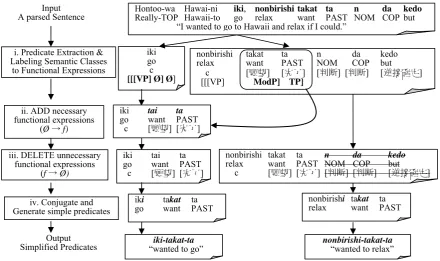
The overall flow of our standardizing system is depicted in Figure 1. The system works as fol-lows.
i. Given a parsed sentence as an input, it ex-tracts a predicate(s) and assigns a semantic label to each functional expression based on Matsuyoshi and Sato (2006).
ii. As for an intermediate predicate, necessary functional expressions are added if missing (Ø →f).
iii.From each predicate, delete unnecessary functional expressions that do not alter the meaning of the predicate (f →Ø).
iv.Conjugate each element and generate a simplified predicate.
There are two fundamental questions that we need to answer to accomplish this system.
A) What are UNNECCESARY functional ex-pressions (at least for NLP applications), i.e., those that do not alter the meaning of the event expressed by a predicate?
B) How do we know which functional expres-sions are missing and so should be added? We answer these questions by combining what is needed in NLP applications and what is dis-cussed in linguistic theories. We first answer Question A.
3.1 Categorization of Functional Expressions
As discussed in Section 1 and in Inui et al. (2008), what is crucial in the actual NLP appli-cations is to be able to recognize whether two seemingly different predicates express the same fact.
This perspective of factuality is similar to the truth-value approach of an event denoted by pre-dicates as discussed in the field of formal seman-tics (e.g., Chierchia and Mcconnel-Ginet, 2000; Portner, 2005). Although an extensive investiga-tion of these theories is beyond the scope of this paper, one can see that expressions such as tense (aspect), negation as well as modality, are often discussed in relation to the meaning of an event (Partee et al., 1990; Portner, 2005).
Tense (Aspect): Expresses the time in (at/for)
which an event occurred.
Negation: Reverses the truth-value of an event. Modality: Provides information such as
possi-bility, obligation, and the speaker’s eagerness with regard to an event and relate it to what is true in reality.
The above three categories are indeed useful in explaining the examples discussed above.
(6) kat -chai -takat -ta -n -da buy -COMP -want -PAST -NOM -COP
aspect modality tense(aspect)
(7) kai -takat -ta buy -want -PAST modality tense(aspect)
“wanted to buy”
re-dundant and so unnecessary.
On the other hand, the predicate “iku” in (5) and “iki-takat-ta,” which conveys the actual meaning of the predicate, express a different fact because they establish a different tense (present vs. past) and different modality (none vs. want).
As shown, once we examine the abstract se-mantic functions of functional expressions, we can see the factual information in a predicate is influenced by tense (aspect), negation, and mod-ality. Therefore, the answer to Question A is that necessary functional expressions are those that belong to tense (aspect), negation, and modality. Furthermore, if there are several functional ex-pressions that have the same semantic function, retaining one of them is sufficient.
3.2 Adding Necessary Functional Expressions
The next question that we need to answer is how we find which functional expressions are miss-ing when standardizmiss-ing an intermediate predicate in a coordinate structure (e.g., (5)). We solve this based on a detailed analysis of the syntactic structure of predicates.
Coordinate structures are such that several equivalent phrases are coordinated by conjunc-tions such as and, but, and or. If a predicate is coordinated with another predicate, these two
predicates must share the same syntactic level. Therefore, the structure in (5) is indeed depicted as follows (What TP and ModP stand for will be discussed later).
[TP[ModP[VP(Hawai-ni) iki][VPnonbirishi]takat]ta ] [TP[ModP[VP(Hawaii-to) go][VPrelax] want]PAST]
This is the reason why the first predicate iki should be paraphrased as iki-takat-ta “wanted to go.” It needs to be tagged with the modality ex-pression tai and the past tense marker ta, which seems to attach only to the last predicate.
This procedure of adding necessary function-al expressions to the intermediate predicate is not as simple as it seems, however.
(8) nemutai-mitai-de kaeri -tagatte -tei -ta sleepy-seems-COP gohome-want-CONT-PAST
“He seemed sleepy and wanted to go home.”
In (8), the first predicate nemutai-mitai-de “seem to be sleepy” should be paraphrased as nemutai-mitai-dat-ta, “seemed to be sleepy,” in which only the functional expression indicating past is required. The other functional expressions such as tagatte “want,” and the aspect marker tei (CONTinuation) should not be added (nemutai-mitai-de-tagat(want)-tei(CONT)-ta(PAST) is completely ungrammatical).
Input
A parsed Sentence Hontoo-wa Hawai-niReally-TOP Hawaii-to go relax want iki, nonbirishi takat taPAST n da NOM COP kedobut “I wanted to go to Hawaii and relax if I could.”
i. Predicate Extraction & Labeling Semantic Classes
to Functional Expressions
ii. ADD necessary functional expressions
(Ø→f)
iii. DELETE unnecessary functional expressions
(f→Ø)
iv. Conjugate and Generate simple predicates
Output Simplified Predicates
iki go c [[[VP] Ø] Ø]
iki tai ta
go want PAST
c [願望] [完了]
iki takat ta
go want PAST nonbirishrelax want i takat ta PAST
iki-takat-ta
[image:4.595.75.516.72.333.2]“wanted to go” nonbirishi-takat-ta “wanted to relax”
Figure 1. The flow of Standardization.
iki tai ta
go want PAST
c [願望] [完了]
nonbirishi takat ta n da kedo
relax want PAST NOM COP but
c [願望] [完了] [判断] [判断] [逆接確定]
nonbirishi takat ta n da kedo
relax want PAST NOM COP but
c [願望] [完了] [判断] [判断] [逆接確定]
Furthermore, the intermediate predicate in the following example does not allow any functional expressions to be added.
(9) (imawa) yasui-ga (mukashiwa) takakat-ta (today) inbut (in old days) expensive-PAST
“(They) are inexpensive (today), (but) used to be very expensive (in the old days.)”
In (9), the first predicate yasui “inexpensive” should not be paraphrased as yasukat-ta “was inexpensive” since this would result in the un-grammatical predicate of “*(they) were inexpen-sive (today).”
In order to add necessary functional expres-sions to an intermediate predicate, one needs to solve the following two problems.
i.Find whether the target predicate indeed lacks necessary functional expressions. ii. If such a shortfall is detected, decide which
functional expressions should be added to the predicate.
We solve these problems by turning to the in-completeness of the syntactic structure of a pre-dicate.
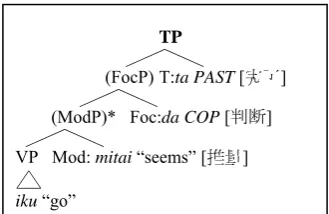
Studies such as Cinque (2006) and Rizzi (1999) propose detailed functional phrases such as TopP (Topic Phrase) in order to fully describe the syntactic structures of a language. We adopt this idea and construct a phrase structure of Jap-anese predicates which borrows from the func-tional phrases of TP, ModP, and FocP (Figure 2). ModP stands for a modality phrase and this is where modality expressions can appear.1 FocP stands for a focus phrase. This is the phrase where the copula da appears. This phrase is needed because several modality expressions syntactically need the copula da in either the following or preceding position (Kato, 2007). The existence of FocP also indicates that the modality expressions within the phrase are com-plete (no more modality phrase is attached). TP stands for a tense phrase and this is where the tense marker appears.
Note that this structure is constructed for the purpose of Standardization and other functional
1The structure of Figure 2 is recursive. A modality expres-sion can appear after a TP. Also, more than one ModP can appear although ModP and FocP are optional.
projections such as NegP (negation phrase) will not be discussed although we assume there must be one. Based on the predicate structure in Fig-ure 2, we solve the two problems as follows.
The first problem: Detecting whether the target
predicate lacks necessary functional expressions. ¾ If the predicate has the past tense marker ta or if the coordinate conjunction following the predicate is for combining phrases with tense, then consider the predicate as com-plete and do not add any functional expres-sions. Otherwise, consider the predicate as incomplete and add the appropriate func-tional expressions.
The underlying principle of this rule is that if a predicate is tensed, then its syntactic structure is complete. As often described in syntactic theo-ries (e.g., Adger, 2003), a sentence can be said to be a phrase with tense (i.e., TP). In other words, if a predicate is tensed, then it can stand alone as a sentence.
By adopting this idea, we judge the com-pleteness of a predicate by the existence of tense. Because Japanese marks past tense by the past tense marker -ta, if a predicate has -ta, it is com-plete and no functional expressions need be add-ed.
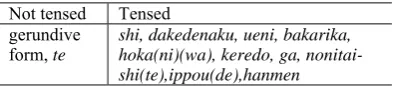
However, Japanese does not hold an explicit present tense marker; the base form of a verb is also a present form. We solve this by looking at which conjunction follows the predicate. As dis-cussed in Minami (1993), the finite state and the type of conjunction are related; some conjunc-tions follow tensed phrases while others follow infinitival phrases. Following this, we categorize all the coordinate conjunctions based on whether they can combine with a tensed phrase. These conjunctions are listed as tensed in Table 1. If
TP 3
(FocP) T:ta PAST [完了] 3
(ModP)* Foc:da COP [判断] 3
VP Mod: mitai “seems” [推量] 4
[image:5.595.331.496.73.180.2]iku “go”
the target phrase is followed by one of those conjunctions, then we do not add any functional expressions to them because they are complete.
The second problem: Finding the appropriate
functional expressions for incomplete interme-diate predicates.
As discussed, we assume that predicates are coordinated at one of the functional phrase levels in Figure 2. Functional expressions that need to be added are, therefore, those of the outer phras-es of the target phrase.
For example, if the target phrase has da, the head of FocP, then it only needs the past tense marker to be added, which is located above the FocP (i.e., TP). This explains the paraphrasing pattern of (8). Therefore, by looking at which functional expressions held by the target predi-cate, one can see that functional expressions to be added are those that belong to phrases above the target phrase.
As shown, the answer to Question B is that we only add functional expressions to incom-plete predicates, which are judged based on the existence/absence of tense. The appropriate functional expressions to be added are those of outer phrases of the target phrase.
3.3 Implementing the Standardization
In this final subsection, we describe how we ac-tually implement our theoretical observations in our standardization system.
CATEGORIZE functional expressions
First, we selected functional expressions that belong to our syntactic and semantic categories from those listed in Matsuyoshi and Sato (2006), a total of about 17,000 functional expressions with 95 different semantic labels. We use ab-stract semantic labels, such as “completion,” “guess,” and “desire” for the categorization (Table 2).
We divided those that did not belong to our syntactic and semantic categories into Deletables and Undeletables. Deletables are those that do
not alter the meaning of an event and are, there-fore, unnecessary. Undeletables are those that are a part of content words, and so cannot be deleted (e.g., kurai [程度] “about” as in 1-man-en-kurai-da “is about one million yen”). Based on the categorization of semantic labels as well as surface forms of functional expressions, our system works as follows;
ADD necessary functional expressions
A-1: Examine whether the target predicate has the tense marker ta or it is followed by the conjunctions categorized as tensed. If not, then go to Step A-2.
A-2: Based on the semantic label of the target predicate, decide which level of syntactic phrase the predicate projects. Add functional expressions from the last predicate that be-longs to outer phrases.
DELETE unnecessary functional expressions
D-1: Delete all the functional expressions that are categorized as Deletables.
D-2: Leave only one functional expression if there is more than one same semantic label. For those categorized as Negation, however, delete all if the number of negations is even. Otherwise, leave one.
D-3: Delete those categorized as Focus if they do not follow or precede a functional expres-sion categorized as Modality.
GENERATE simple predicates
Last, conjugate all the elements and generate simplified surface forms of predicates.
4
Experiments and Evaluations
4.1 Constructing Paraphrase Data
We selected 2,000 sentences from newspaper and blog articles in which more than one predi-cate were coordinated.2 We manually extracted predicates (c-f1-f2..fn). Half of them were those in which the last predicate had three or more func-tional expressions (n ≥ 3).
2We use [image:6.595.84.281.74.117.2]
Mainichi Newspapers from the year 2000.
Table 1. Coordinate conjunctions.
Not tensed Tensed gerundive
form, te
We then asked one annotator with a linguistic background to paraphrase each predicate into the simplest form possible while retaining the mean-ing of the event.3 We asked another annotator, who also has a background in linguistics, to check whether the paraphrased predicates made by the first annotator followed our criterion, and if not, asked the first annotator to make at least one paraphrase. 424 out of 4,939 predicates (8.5%) were judged as not following the crite-rion and were re-paraphrased. This means that the accuracy of 91.5% is the gold standard of our task.
One of the authors manually assigned a cor-rect semantic label to each functional expression. Procedure i in Figure 1 is, therefore, manually implemented in our current study.
4.2 Experiments and Results
Based on the standardization rules discussed in Section 3, our system automatically paraphrased functional expressions of test predicates into simple forms. We excluded instances that had segmentation errors and those that were judged as inappropriate as a predicate.4 A total of 1,501 intermediate predicates (287 for develop-ment and 1,214 for test) and 1,958 last predi-cates (391 for development and 1,567 for test) were transformed into simple predicates.
The accuracy was measured based on the ex-act match in surface forms with the manually constructed paraphrases. For comparison, we
3 We asked to delete or add functional expressions from each predicate when paraphrasing. Only the surface forms (and not semantic labels) were used for annotation.
4 In Japanese, a gerundive form of a verb is sometimes used as a postposition. The annotators excluded these examples as “not-paraphrasable.”
used the following baseline methods.
¾ No Add/Delete: Do not add/delete any functional expression.
¾ Simp Add: Simply add all functional ex-pressions that the intermediate phrase does not have from the last predicate.
Table 3 indicates the results. Our standardizing system achieved high accuracy of around 77% and 83 % in open (against the test set) and closed tests (against the development set) com-pared to the baseline methods (No Add/Delete (open), 55%; Simp Add (open), 33%).
We also measured the reduced rate of differ-ences in surface forms. We counted the number of types of functional expressions in the last pre-dicates (a sequence of f1-f2-f3 is counted as one) before and after the standardization.
For comparison, we also counted the number of functional expressions of the manually pa-raphrased predicates. Table 4 lists the results. As shown, our standardizing system succeeded in reducing surface differences in predicates from the original ones at the rate of 44.0%, which is quite close to the rate achieved by the human annotators (52.0%).
5
Discussion and Conclusion
Our standardization system succeeded in gene-rating simple predicates in which only functional expressions crucial for the factual meaning of the predicate were retained.
The predicates produced by our system showed fewer variations in their surface forms while around 77% of them exactly matched the simplified predicates produced by human anno-tators, which is quite high compared to the base-line systems.
Table 2. Syntactic and semantic categorization of semantic labels.
Syntactic Semantic Semantic Labels
T if the
surface is ta
Tense (Aspect)
完了(completion),継起,付帯,回避,経験,事後,習慣,継続,発継続, 着継続, 最中,事 前, 放置, 傾向
Negation 否定(negation), 放置,否定意志,否定推量,不可能,不必要,不許可, 不可避, 無意味 Mod Modality 推量(guess), 願望(desire),疑問,許可,当為,意志,依頼,勧め, 勧誘, 可能, 比況, 順接
必要, 不可能, 不必要,不許可,回想,不可避,無意味 Foc Focus 判断(affirmation), 名詞化,同格
Deletables 丁寧(politeness),他-授与,伝聞,相応,内-授与,自然発生,添加, 理由, 逆接確定, 感 嘆,不満, 順接確定,順接仮定,想外,限定,極端例
Undele-tables
程度(about), 終点,根拠,は観点,も観点,割合,基準,起点,場合, 状態, 想外無視,相 関, 対象, 仲介, 定義, 範囲, 非限定, 不均衡, 立場, 同時性, 順接限定, 逆接仮定, 目的,
This was achieved because we constructed solid paraphrasing rules by applying linguistic theories in semantics and syntax. The quite low accuracy of the baseline method, especially SimpAdd, further supports our claim that im-plementing linguistic theories in actual NLP ap-plications can greatly improve system perfor-mance.
Unlike the study by Inui et al. (2008), we did not include the meaning of a content word for deciding the factuality of the event nor did we include it in the paraphrasing rules. This lowers the accuracy. Several functional expressions, especially those expressing aspect, can be de-leted or added depending on the meaning of the content word. This is because content words in-herently hold aspectual information, and one needs to compare it to the aspectual information expressed by functional expressions. Because we need a really complicated system to compute the abstract semantic relations between a content word and functional expressions, we leave this problem for future research.
Regardless of this, our standardizing system is useful for a lot of NLP applications let alone text mining. As mentioned in Inui et al. (2008), bag-of-words-based feature extraction is insuffi-cient for conducting statistically-based deep se-mantic analysis, such as factual analysis. If stan-dardized predicates were used instead of a single content word, we could expect an improvement in those statistically-based methods because each predicate holds important information about fact while differences in surface forms are quite li-mited.
In conclusion, we presented our system for standardizing complex functional expressions in Japanese predicates. Since our paraphrasing
rules are based on linguistic theories, we suc-ceeded in producing simple predicates that have only the functional expressions crucial to under-standing of the meaning of an event. Our future research will investigate the relationship be-tween the meaning of content words and those of functional expressions in order to achieve higher accuracy. We will also investigate the impact of our standardization system on NLP applications.
References
Adger, David (2003). Core Syntax: A minimalist
ap-proach. New York: Oxford University Press.
Chierchia, Gennaro, & Sally McConnell-Ginet (2000).
Meaning and grammar: An introduction to se-mantics (2nd ed.). Cambridge, MA: The MIT
press.
Cinque, Guglielmo (2006). Restructuring and
func-tional heads: The cartography of syntactic struc-tures, Vol. 4. New York: Oxford University Press.
Haugh, Michael (2008). Utterance-final conjunctive particles and implicature in Japanese conversation.
Pragmatics, 18 (3), 425-451.
Inui, Kentaro, Shuya Abe, Kazuo Hara, Hiraku Mori-ta, Chitose Sao, Megumi Eguchi, Asuka Sumida, Koji Murakami, & Suguru Matsuyoshi (2008). Experience mining: Building a large-scale data-base of personal experiences and opinions from
web documents. Proceedings of the 2008
IEEE/WIC/ACM International Conference on Web Intelligence and Intelligent Agent Technolo-gy, Vol. 1., 314-321.
Kato, Shigehiro (2007). Nihongo-no jutsubu-kouzou to kyoukaisei [Predicate complex structure and
morphological boundaries in Japanese]. The
an-nual report on cultural science, Vol. 122(6) (pp.
97-155). Sapporo, Japan: Hokkaido University, Graduate School of Letters.
Matsuyoshi, Suguru, & Satoshi Sato (2006). Compi-lation of a dictionary of Japanese functional ex-pressions with hierarchical organization. Proceed-ings of the 21st International Conference on Computer Processing of Oriental Languages
Normalization No Add/Delete Simp Add
Open (Intermediate) 77.7%(943/1214) 57.8%(702/1214) 32.8%(398/1214)
Closed (Intermediate) 82.9%(238/287) 62.0%%(178/287) 35.2%(101/287)
Open (Last) 76.2%(1194/1567) 51.9% (203/391) n.a
Closed (Last) 83.4%(326/391) 48.1%(188/391) n.a.
Table 3. Results of our normalization system.
Original 943 types Reduced Rate
Normalization 530 types 44.0% Human Annotation 448 types 52.0%
(ICCPOL), Lecture Notes in Computer Science, Vol. 4285, 395-402.
Matsuyoshi, Suguru, & Satoshi Sato (2008). Auto-matic paraphrasing of Japanese functional expres-sions using a hierarchically organized dictionary.
Proceedings of the 3rd International Joint Confe-rence on Natural Language Processing (IJCNLP), Vol. 1, 691-696.
Minami, Fujio (1993). Gendai nihongobunpou-no
rinkaku [Introduction to modern Japanese gram-mar]. Tokyo: Taishuukan.
Nasukawa, Tetsuya (2001). Kooru sentaa-niokeru tekisuto mainingu [Text mining application for call centers]. Journal of Japanese society for Ar-tificial Intelligence, 16(2), 219-225.
Partee, Barbara H., Alice ter Meulen, & Robert E. Wall (1990). Mathematical methods in Linguistics.
Dordrecht, The Netherland: Kluwer.
Portner, Paul H. (2005). What is meaning?:
Funda-mentals of formal semantics. Malden, MA:
Blackwell.
Rizzi, Luigi (1999). On the position “Int(errogative)” in the left periphery of the clause. Ms., Università
di Siena.
Shudo, Kosho, Toshifumi Tanabe, Masahito Takaha-shi, & Kenji Yoshimura (2004). MWEs as
non-propositional content indicators. Proceedings of
second Association for Computational Linguistics (ACL) Workshops on Multiword Expressions: In-tegrating Processing, 32-39.
Tanabe, Toshifumi, Kenji Yoshimura & Kosho Shu-do (2001). Modality expressions in Japanese and
their automatic paraphrasing. Proceedings of the
6th Natural Language Processing Pacific Rim Symposium (NLPRS), 507-512.
Tsujimura, Natsuko. (2007). An Introduction to
Jap-anese Linguistics (2nd Ed.). Malden, MA: