http://www.scirp.org/journal/ss ISSN Online: 2157-9415
ISSN Print: 2157-9407
DOI: 10.4236/ss.2017.88038 Aug. 16, 2017 348 Surgical Science
Laparoscopic vs. Robotic Approach to Partial
Colon Resection
Jordan L. White1, Francis A. Buzad2, Herschel B. Patel1
1College Station, Texas A&M Health Science Center, College of Medicine, Bryan, USA 2General Surgery Department, North Austin Medical Center, Austin, USA
Abstract
We retrospectively collected data on 130 minimally invasive colon resection cases performed by the same surgeon from April 2005 to February 2017, of which 35 were completed laparoscopically and 95 were completed robotically. The first 30 robotic cases were allocated to a Training group to account for the learning needed to stabilize operative ability. The 35 laparoscopic cases and 65 of the 95 robotic cases, starting with the 31st case, were compared. Robotic
partial colon resection was significantly more capable than the laparoscopic approach in limiting blood loss (p < 0.05) during the procedure, lessening conversion to a traditional open approach (p < 0.05), and produced a quanti-tatively larger lymph node harvest (p < 0.05). Patients of robotic cases also had overall shorter hospital stay (p < 0.05). Laparoscopic cases were signifi-cantly shorter in terms of operation time (p < 0.05). Laparoscopic and robotic approaches had similar rates of several aspects of morbidity and mortality. The robotic approach to partial colon resection is a technically capable mod-ality of operation intraoperatively, as shown by increased lymph node harvest and less blood loss, and may provide some benefits to patients postoperative-ly, evidenced by shorter hospital stays, and potentially an oncologic benefit by obtaining higher lymph node harvest in cancer cases. Another benefit of the implementation of a robotic approach is the increased number of patients that are eligible for and ultimately undergo a safe and successful minimally inva-sive surgery as compared to a more traditional surgical approach.
Keywords
Robot, Da Vinci, Laparoscopic, Hemicolectomy, Colon Resection, Short-Term Outcomes
1. Introduction
There is a growing body of evidence that minimally invasive surgical techniques How to cite this paper: White, J.L., Buzad,
F.A. and Patel, H.B. (2017) Laparoscopic vs. Robotic Approach to Partial Colon Resection. Surgical Science, 8, 348-357.
https://doi.org/10.4236/ss.2017.88038
Received: July 20, 2017 Accepted: August 13, 2017 Published: August 16, 2017
Copyright © 2017 by authors and Scientific Research Publishing Inc. This work is licensed under the Creative Commons Attribution International License (CC BY 4.0).
DOI: 10.4236/ss.2017.88038 349 Surgical Science are superior to open approach in patient outcomes and overall cost [1][2]. The advantages minimally invasive techniques are commonly accepted and widely demonstrated [3]. Our goal was to compare minimally invasive approaches to-wards colorectal resection, specifically laparoscopic and robotic-assisted surgery. Robotic-assisted surgery may be a safe and effective alternative to laparoscopic surgery, as it combines the advantages of minimally invasive surgery while al-lowing the technique and clarity of an open procedure [3][4]. The use of robot-ics in surgery has incorporated a level of sophistication in the way of stabiliza-tion, 3-D visualizastabiliza-tion, and ergonomic support [3][5][6][7].
The minimally invasive approach to surgery is widely applied to many diges-tive procedures in current surgery practice, including colon resection. However, there is still debate over whether robotic-assisted laparoscopy confers benefits over the more routinely used laparoscopic approach [7][8][9].
The objective of this study was to evaluate differences in laparoscopic and ro-botic-assisted surgery by evaluating short-term outcomes including hospital stay, morbidity, and mortality when used for partial colon resection. We also evaluated aspects of the operation including operation time, blood loss, and op-eration time. We hypothesized that robotic surgery would show benefits in terms of intraoperative ability and short-term patient outcomes due to the tech-nical precision it offers intraoperatively.
2. Materials and Methods
2.1. Study Design
This study was an observational, retrospective single provider analysis of lapa-roscopic and robotic colon resections completed between April 2005 and Febru-ary 2017 performed by one general surgeon at North Austin Medical Center (Austin, Texas). This surgeon gained prior laparoscopic experience during resi-dency and subsequently in private clinical practice focused on minimally inva-sive surgery since 2001.
The robot surgical system (da Vinci) was first introduced to this practice in 2008 and the first operation in which the system was used by this provider was in July 2008.
The inclusion criteria for cases included that the case was a non-emergent partial colon resection performed at North Austin Medical Center, and the at-tending surgeon directing the case was Dr. Francis Buzad. We did not exclude patients based on age, prior abdominal surgery, or anticipated outpatient treat-ment.
The variables that were analyzed in this study were collected by retrospective medical chart review. Two medical students collected data on operating time, es-timated blood loss (EBL), post-op hospital stay, morbidity and mortality.
DOI: 10.4236/ss.2017.88038 350 Surgical Science cases performed between April 2005 and March 2011.
The second group was composed of the first 30 cases in which the surgeon at-tempted a robotic approach and is therefore named Training. There is evidence to suggest that robotic skills will stabilize after a substantial allowance for adap-tation through an ample learning curve [10] [11]. The Training group was created to minimize variability in robotic-assisted surgery data that would be eliminated through experience with the technique.
The third group was composed of all colon resections with a robotic approach including the 31st procedure and all robotic-assisted cases performed thereafter.
This group was referred to as Robotic throughout this paper. Data was collected from cases performed between March 2009 and February 2017. Measures of ef-ficacy included morbidity and mortality, blood loss, conversion to open, and length of hospital stay. Secondary outcomes included lymph node collection for oncologic cases.
Postoperative morbidity parameters were divided into local and systemic morbidity. Local morbidity included local hematoma formation, wound infec-tion, anastomotic leak, intraperitoneal abscess, bowel obstrucinfec-tion, intraperito-neal bleeding, anastomotic stenosis, and significant anastomotic bleeding. Sys-temic morbidity included atelectasis producing fever, anemia requiring transfu-sion, prolonged ileus defined as return of bowel function delayed more than 3 days, urinary retention requiring catheterization, pneumonia, pulmonary em-bolism, pulmonary edema, cardiac arrest, and admittance to ICU care. Mortality in the perioperative period and reoperation rate was also evaluated.
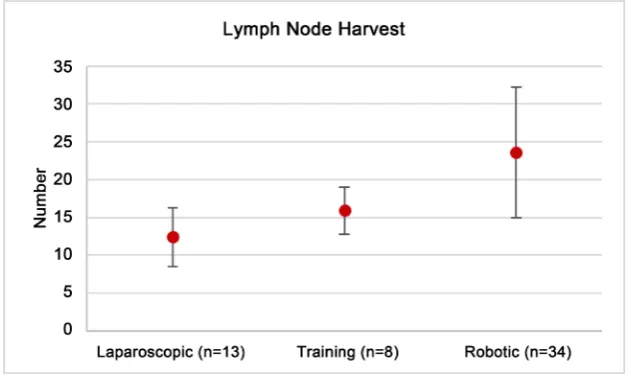
There were 13 cases within the Laparoscopic group, 8 in the Training group, and 34 in the Robotic group that were pathologically evaluated for oncologic staging. The number of lymph nodes harvest in these cases was quantified for comparison between the Laparoscopic and Robotic groups.
2.2. Statistical Analysis
Discrete variables including operating time, blood loss, and hospital stay were expressed as the mean (standard deviation) and compared using the Mann Whitney U Test. Categorical variables including conversion to open surgery and post-op morbidity variables were expressed as frequency (percent) and com-pared using the Fisher Exact Test (v2). Differences were considered significant if
p values were <0.05.
3. Results
DOI: 10.4236/ss.2017.88038 351 Surgical Science
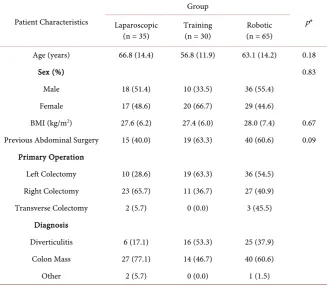
Table 1. Patient Characteristics.
Patient Characteristics
Group
p* Laparoscopic
(n = 35)
Training (n = 30)
Robotic (n = 65)
Age (years) 66.8 (14.4) 56.8 (11.9) 63.1 (14.2) 0.18
Sex (%) 0.83
Male 18 (51.4) 10 (33.5) 36 (55.4)
Female 17 (48.6) 20 (66.7) 29 (44.6)
BMI (kg/m2) 27.6 (6.2) 27.4 (6.0) 28.0 (7.4) 0.67 Previous Abdominal Surgery 15 (40.0) 19 (63.3) 40 (60.6) 0.09
Primary Operation
Left Colectomy 10 (28.6) 19 (63.3) 36 (54.5) Right Colectomy 23 (65.7) 11 (36.7) 27 (40.9) Transverse Colectomy 2 (5.7) 0 (0.0) 3 (45.5)
Diagnosis
Diverticulitis 6 (17.1) 16 (53.3) 25 (37.9) Colon Mass 27 (77.1) 14 (46.7) 40 (60.6)
Other 2 (5.7) 0 (0.0) 1 (1.5)
Discrete data are given as mean values with standard deviation in parenthesis. Categorical data are given as raw values with percentage of total in parenthesis. *p values of discrete data were calculated using Mann-Whitney U-Test to compare Laparoscopic and Robotic data, and categorical data was calculated us-ing Fisher Exact Test to comparison of Laparoscopic and Robotic data.
Table 2. Intraoperative and Perioperative Outcomes.
Intraoperative and Perioperative Outcomes
Group
p* Laparoscopic
(n = 35)
Training (n = 30)
Robotic (n = 65)
Mean Operating Time (min) 131.8 (55.6) 214.5 (41.6) 200.8 (46.7) <0.01
Post-Op Hospital Stay (days) 5.6 (3.1) 5.0 (3.7) 4.3 (2.4) 0.02
Estimated Blood Loss, EBL (mL) 70.0 (51.5) 73.4 (71.3) 44.8 (53.9) <0.01
Discrete data are given as mean values with standard deviation in parenthesis. Data for cases that were converted to open were excluded for comparison of discrete variables. *p values of discrete data were calcu-lated using Mann-Whitney U-Test to compare Laparoscopic and Robotic data.
BMI, or proportion of patients with previous abdominal surgery between the Laparoscopic and Robotic groups.
[image:4.595.207.539.452.556.2]DOI: 10.4236/ss.2017.88038 352 Surgical Science
Figure 1. Intraoperative and Perioperative Outcomes: Mean Operating Time, Post-Op
Hospital Stay, and EBL.
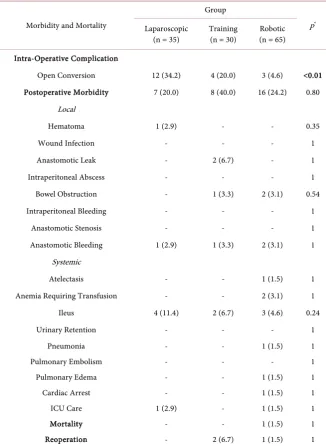
DOI: 10.4236/ss.2017.88038 353 Surgical Science to open in the Robotic group (p < 0.05). There was no significant difference in rate of post-op morbidity between Laparoscopic and Robotic groups. The high-est frequency of complication overall was prolonged ileus, followed by anasto-motic bleeding. There were nine overall cases of ileus, four in the Laparoscopic, one in the Training, and three in the Robotic group. There were total four cases complicated by bleeding from the anastomotic closure, one in the Laparoscopic group requiring observation, one in the Training group requiring reoperation, and two in the robotic group. The two robotic cases were evidenced by a signifi-cant drop in hematocrit requiring one and two units of transfused blood. Bleed-ing resolved spontaneously in both cases without the need for reoperation.
Table 3. Morbidity and Mortality.
Morbidity and Mortality
Group
p* Laparoscopic
(n = 35) Training (n = 30) (n = 65) Robotic
Intra-Operative Complication
Open Conversion 12 (34.2) 4 (20.0) 3 (4.6) <0.01 Postoperative Morbidity 7 (20.0) 8 (40.0) 16 (24.2) 0.80
Local
Hematoma 1 (2.9) - - 0.35
Wound Infection - - - 1
Anastomotic Leak - 2 (6.7) - 1
Intraperitoneal Abscess - - - 1
Bowel Obstruction - 1 (3.3) 2 (3.1) 0.54
Intraperitoneal Bleeding - - - 1
Anastomotic Stenosis - - - 1
Anastomotic Bleeding 1 (2.9) 1 (3.3) 2 (3.1) 1 Systemic
Atelectasis - - 1 (1.5) 1
Anemia Requiring Transfusion - - 2 (3.1) 1
Ileus 4 (11.4) 2 (6.7) 3 (4.6) 0.24
Urinary Retention - - - 1
Pneumonia - - 1 (1.5) 1
Pulmonary Embolism - - - 1
Pulmonary Edema - - 1 (1.5) 1
Cardiac Arrest - - 1 (1.5) 1
ICU Care 1 (2.9) - 1 (1.5) 1
Mortality - - 1 (1.5) 1
Reoperation - 2 (6.7) 1 (1.5) 1
DOI: 10.4236/ss.2017.88038 354 Surgical Science
Table 4. Technical Ability.
Technical Ability Group p*
Laparoscopic (n = 13) Training (n = 8) Robotic (n = 34) Lymph Node Harvest 12.4 (3.9) 15.9 (3.1) 23.6 (8.6) <0.01
[image:7.595.217.533.188.376.2]Data includes cases where resection was indicated for a colon mass and subsequent pathologic evaluation required oncologic staging. Cases in which conversion to open were required were excluded. *p values were calculated using Mann-Whitney U-Test to compare Laparoscopic and Robotic groups.
Figure 2. Technical Ability: Lymph Node Harvest.
There were three total instances of reoperation throughout the study. Two were within the Training group, both due to the need for surgical repair of an anastomotic leak. One case in the Robotic group required reoperation due to prolonged ileus and subsequent small bowel obstruction.
There was one case of perioperative mortality in the Robotic cohort. The pa-tient died during coronary catheterization after experiencing a cardiovascular complication.
Technical Ability in oncologic resection is given in Table 4 and Figure 2. Harvest of lymph nodes was quantitatively analyzed in applicable cases. There were a significantly higher number of lymph nodes harvested in oncologic cases within the Robotic group when compared with the Laparoscopic group (p < 0.05).
4. Discussion
DOI: 10.4236/ss.2017.88038 355 Surgical Science compared to similar laparoscopic procedures. The precision of robotic-assisted surgery makes it a reasonable alternative in difficult surgical situations where the laparoscopic approach may not be adequate [3]. An additional and significant impact of the greater technical capability of the robotic system is the elimination of a selective approach to offering MIS. Prior to adopting robotics in this prac-tice, the use of a laparoscopic method averaged 58.3% of electively scheduled partial colectomy cases. After adoption, the application of robotics to partial co-lectomy approaches 100% of elective case volume.
The robotic approach may also confer benefits to postoperative patient recov-ery. Decreased hospital stay may indicate a more robust patient recovery post- op. The exact cause of decreased length of stay is not entirely clear. We postulate that, although some parts of the impact are accounted for by improved surgical technique, some of the effects are results of increased use of various elements of enhanced recovery pathways [12]. There were no significant differences in mor-bidity or mortality between laparoscopic and robotic groups. However, we sus-pect that this may be in part due to the limited amount of data.
In scrutiny of operation time, robotic cases were significantly longer. We sus-pect this is likely a reflection the wider ssus-pectrum of more difficult partial colec-tomies not attempted laparoscopically prior to adoption of robotics. The longer operation time may also be in part due to the docking and undocking of the ro-bot itself, a maneuver which is not necessary in laparoscopic cases [3][13]. The efficiency of the docking process is highly dependent on the familiarity of the surgical team with the da Vinci Robotics system and can therefore be quite vari-able. This may also be affected by the generation of robot used, and is a possible parameter to evaluate in future study. Two generations of the da Vinci Robot, Si and Xi, were used in accordance with what was available at the medical facility of interest over the course of the material analyzed. Therefore, technical advances between the first and second iteration of the robot used in this study were not evaluated. Although docking time may not completely remove the significant difference in operation time, the decrease in hospital stay may outweigh the longer time spent operatively. Overall, the demonstrated advantages in patient outcomes could outweigh long setup and procedure time [3][13]. Evaluation of the two variables in comparison to one another is outside of the scope of this study and a point for future research.
Although this study is unique in its ability to control for many independent variables due to the consistency in the medical staff and resources available, it should be mentioned that there may be limits to this research since it is an eval-uation of only one physician’s work. Our data was highly dependent on one surgeon’s skill and individual experience [14]. Additionally, advances in medical treatment that were implemented within this time span of this project which may influence the data could not be accounted for [12].
DOI: 10.4236/ss.2017.88038 356 Surgical Science [8]. Collecting information about overall cost was beyond the scope of this study. However, we hypothesize that the gap between laparoscopic and robotic surgical costs may not be as wide as was previously thought [1][15]. The lifetime use of robotic equipment greatly dilutes its initial cost. More importantly, the advantages that robotic surgery may confer in patient healing as shown by de-creased hospital stay may prove to be a major factor in reducing overall hospital cost of surgical patient care [1][8][15].
Although data was collected as concisely as possible, changes in record-keeping practices over time this institution may have played an immeasurable influence on data that was collected.
Many studies have shown the comparable safety and results of laparoscopic and robotic approaches to colon resection [7][9][11][16]. However, robotics is an innovative way to reestablish some advantages of open surgery that were lost in the transition to laparoscopy, including 3D visualization, free motion of sur-gical instruments, and stabilization [4][9]. Robotics also confers a serious ad-vantage when considering large surgical volumes due to the increased availabili-ty of the minimally invasive approach to patients that would not be ideal candi-dates for a purely laparoscopic approach [3][6][7][17][18]. Although operat-ing times are substantially longer, our evaluation of evidence at this institution demonstrates that the benefits of robotic-assisted surgery are substantial in sev-eral aspects of the surgical approach, specifically intraoperative technical ability and patient outcomes as indicated by shortened hospital stay.
Disclosures
Dr. Francis Buzad serves as a proctor for Intuitive Surgical, Inc. (Sunnyvale, CA).
References
[1] Hollis, R.H., Cannon, J.A., Singletary, B.A., Korb, M.L., Hawn, M.T. and Heslin, M.J. (2016) Understanding the Value of Both Laparoscopic and Robotic Approach-es Compared to the Open Approach in Colorectal Surgery. Journal of Laparoen-doscopic & Advanced Surgical Techniques A, 26, 11.
https://doi.org/10.1089/lap.2015.0620
[2] Lacy, A.M., García-Valdecasas, J.C., Delgado, S., Castells, A., Taurá, P., Piqué, J.M. and Visa, J. (2002) Laparoscopy-Assisted Colectomy versus Open Colectomy for Treatment of Non-Metastatic Colon Cancer: A Randomized Trial. Lancet, 3599, 2224-2229. https://doi.org/10.1016/S0140-6736(02)09290-5
[3] Massimilliano, F., Cirillo, P. and Corcione, F. (2016) Surgical Approach to Right Colon Cancer: From Open Technique to Robot. State of the Art. World Journal of Gastrointestinal Surgery, 8, 564-573. https://doi.org/10.4240/wjgs.v8.i8.564
[4] Benlice, C., Aytac, E., Costedio, M., Kessler, H., Abbas, M.A., Remzi, F.H. and Gorgun E. (2016) Robotic, Laparoscopic, and Open Colectomy: A Case-Matched Comparison from the ACS-NSQIP. The International Journal of Medical Robotics and Computer Assisted Surgery, 1-6.
DOI: 10.4236/ss.2017.88038 357 Surgical Science
Biffi, R. (2011) Surgical and Pathological Outcomes after Right Hemicolectomy: Case-Matched Study Comparing Robotic and Open Surgery. The International Journal of Medical Robotics and Computer Assisted Surgery, 7, 298-303.
https://doi.org/10.1002/rcs.398
[6] Tonutti, M., Elson, D.S., Yang, G.Z., Darzi, A.A.W. and Sodergren, M.H. (2017) The Role of Technology in Minimally Invasive Surgery: State of the Art, Recent De-velopments and Future Directions. Postgraduate Medical Journal, 93, 159-167.
https://doi.org/10.1136/postgradmedj-2016-134311
[7] D’Annibale, A., Morpurgo, E., Fiscon, V., Trevisan, P., Sovernigo, G., Orsini, C. and Guidolin, D. (2004) Robotic and Laparoscopic Surgery for Treatment of Colorectal Diseases. Diseases of the Colon & Rectum, 47, 2162-2168.
https://doi.org/10.1007/s10350-004-0711-z
[8] Rodriguez-Sanjuan, J.C., Gomez-Ruiz, M., Trugeda-Carrera, S., Manuel-Palazuelos, C., Lopez-Useros, A. and Gomez-Flietas, M. (2016) Laparoscopic and Robot-As- sisted Laparoscopic Digestive Surgery: Present and Future Directions. World Jour-nal of Gastroenterology, 22, 1975-2004. https://doi.org/10.3748/wjg.v22.i6.1975
[9] Park, J.S., Choi, G.S., Lim, K.H., Jang, Y.S. and Jun, S.H. (2010) Robotic-Assisted versus Laparoscopic Surgery for Low Rectal Cancer: Case-Matched Analysis of Short-Term Outcomes. Annals of Surgical Oncology, 17, 3195-3202.
https://doi.org/10.1245/s10434-010-1162-5
[10] Torricelli, F.C., Barbosa, J.A. and Giovanni, S.M. (2016) Impact of Laparoscopic Surgery Training Laboratory on Surgeon’s Performance. World Journal of Ga-strointestinal Surgery, 8, 735-743. https://doi.org/10.4240/wjgs.v8.i11.735
[11] Pigazzi, A., Ellenhorn, J.D., Ballantyne, G.H. and Paz, I.B. (2006) Robotic-Assisted Laparoscopic Low Anterior Resection with Total Mesorectal Excision for Rectal Cancer. Surgical Endoscopy, 20, 1521-1525.
https://doi.org/10.1007/s00464-005-0855-5
[12] Shida, D., Tagawa, K., Inada, K., Nasu, K., Seyama, Y., Maeshiro, T., Miyamoto, T., Inoue, S. and Umekita, N. (2017) Modified Enhanced Recovery after Surgery (ERAS) Protocols for Patients with Obstructive Colorectal Cancer. BMC Surgery, 17, 18.
[13] Jensen, J.S., Antonesen, H.K. and Durup, J. (2017) Two Years of Experience with Robot-Assisted Anti-Reflux Surgery: A Retrospective Cohort Study. International Journal of Surgery, 39, 260-266. https://doi.org/10.1016/j.ijsu.2017.02.014
[14] Lujan, H.J., Maciel, V.H., Romero, R. and Plasencia, G. (2013) Laparoscopic Versus Robotic Right Colectomy: A Single Surgeon’s Experience. Journal of Robotic Sur-gery, 7, 95-102. https://doi.org/10.1007/s11701-011-0320-5
[15] Hagen, M.E., Rohner, P., Jung, M.K., Amirghasemi, N., Buchs, N.C., Fakhro, J., Buehler, L. and Morel, P. (2017) Robotic Gastric Bypass Surgery in the Swiss Health Care System: Analysis of Hospital Costs and Reimbursement.Obesity Surgery, 27, 2099-2105. https://doi.org/10.1007/s11695-017-2613-x
[16] Hellan, M., Anderson, C., Ellenhorn, J.D., Paz, B. and Pigazzi, A. (2007) Short-Term Outcomes after Robotic Assisted Total Mesorectal Excision for Rectal Cancer. An-nals of Surgical Oncology, 14, 3168-3173.
https://doi.org/10.1245/s10434-007-9544-z
[17] Moser, F. and Horgan, S. (2004) Robotically Assisted Bariatric Surgery. The Ameri-can Journal of Surgery, 188, 38S-44S. https://doi.org/10.1016/j.amjsurg.2004.08.027
Submit or recommend next manuscript to SCIRP and we will provide best service for you:
Accepting pre-submission inquiries through Email, Facebook, LinkedIn, Twitter, etc. A wide selection of journals (inclusive of 9 subjects, more than 200 journals)
Providing 24-hour high-quality service User-friendly online submission system Fair and swift peer-review system
Efficient typesetting and proofreading procedure
Display of the result of downloads and visits, as well as the number of cited articles Maximum dissemination of your research work
Submit your manuscript at: http://papersubmission.scirp.org/