D S Sharma, R Sangal and A K Singh. Proc. of the 13th Intl. Conference on Natural Language Processing, pages 10–19, Varanasi, India. December 2016. c2016 NLP Association of India (NLPAI)
Can SMT and RBMT Improve each other’s Performance?- An
Experiment with English-Hindi Translation
Debajyoty Banik, Sukanta Sen, Asif Ekbal, Pushpak Bhattacharyya
Department of Computer Science and Engineering Indian Institute of Technology Patna
{debajyoty.pcs13,sukanta.pcs15,asif,pb}@iitp.ac.in
Abstract
Rule-based machine translation
(RBMT) and Statistical machine
translation (SMT) are two well-known approaches for translation which have their own benefits. System archi-tecture of SMT often complements RBMT, and the vice-versa. In this paper, we propose an effective method of serial coupling where we attempt to build a hybrid model that exploits the benefits of both the architectures. The first part of coupling is used to obtain good lexical selection and robustness, second part is used to improve syntax and the final one is designed to com-bine other modules along with the best phrase reordering. Our experiments on a English-Hindi product domain dataset show the effectiveness of the proposed approach with improvement in BLEU score.
1 Introduction
Machine translation is a well-established paradigm in Artificial Intelligence and Natural Language Processing (NLP) which is getting more and more attention to improve the qual-ity (Callison-Burch and Koehn, 2005; Koehn and Monz, 2006). Statistical machine lation (SMT) and rule-based machine trans-lation (RBMT) are two well-known methods for translating sentences from one to the other language. But, each of these paradigms has its own strengths and weaknesses. While SMT is good for translation disambiguation, RBMT is robust for morphology handling. There is no systematic study involving less-resourced languages, where the coupling of SMT and
RBMT has been shown to achieve better per-formance. In our current research we attempt to provide a systematic and principled way to combine both SMT and RBMT for translat-ing product related catalogs from English to Hindi. We consider English-Hindi scenario as an ideal platform as Hindi is a morphologically very rich language compared to English. The key contributions of our research are summa-rized as follows:
(i). Proposal of an effective hybrid system that exploits the advantages of both SMT and RBMT.
(ii). Developing a system for translating prod-uct catalogues from English to Hindi, which is itself a difficult and challenging task due to the nature of the domain. The data is often mixed, comprising of very short sentences (even the phrases) and the long sentences. To the best of our knowledge, for such a domain, there is no work involving Indian languages.Below we describe SMT and RBMT very briefly.
1.1 Statistical Machine Translation (SMT)
Statistical machine translation (SMT) systems are considered to be good at capturing knowl-edge of the domain from a large amount of parallel data. This has robustness in resolv-ing ambiguities and other related issues. SMT provides good translation output based on statistics and maximum likelihood expectation (Koehn et al., 2003a):
ebest=argmaxeP(e|f)
=argmaxe[P(f|e)PLM(e)]
where f and e are the source and target lan-guages, respectively. PLM(e) and P(f|e) are
by ebest. Language model corresponds to the
n-gram probability. The translation probabil-ityP(f|e) is modeled as,
P(f1−I|e−1I) =
I ∏
i=1
ϕ( ¯fi|e¯i)d(starti−endi−1−1)
ϕ is phrase translation probability and d(.) is distortion probability.
starti−endi–1−1, which is the argument of d(.) is a function of i, whereas starti and endi−1 are the starting positions of the trans-lation of ith phrase and end position of the
(i−1)th phrase of e in f. In the above equa-tion, it is well defined that most probable phrases present in training corpora will be cho-sen as the translated output. This could be useful in handling ambiguity at the transla-tion level. The work reported in (Dakwale and Monz, 2016) focuses on improving the performance of a SMT system. Along with the translation model authors allow the re-estimation of reordering models to improve ac-curacy of translated sentences. The authors in their work reported in (Carpuat and Wu, 2007) show how word sense disambiguation helps to improve the performance of a SMT system. Literature shows that there are few systems available for English-Indian language machine translation (Ramanathan et al., 2008; Rama and Gali, 2009; Pal et al., 2010; Ra-manathan et al., 2009).
1.2 Rule-based Machine Translation (RBMT)
Rule-based system generates target sentence with the help of linguistic knowledge. Hence, there is a high chance that translated sentence is grammatically well-formed.There are sev-eral steps required to build linguistic rules for translation. Robustness of a rule-based sys-tem greatly depends on the quality of rules devised. A set of sound rules ensures to build a good accurate system. Generally, the steps can be divided into three sub parts:
1. Analysis 2. Transfer 3. Generation
Analysis step consists of pre-processing, mor-phological analysis, chunking, and pruning. Transfer step consists of lexical transfer, transliteration, and WSD. Finally, generation
step consists of genderization, vibhakti putation, TAM computation, agreement com-puting, word generator and sentence gener-ator. The agreement computing can be ac-complished with three sub steps: intra-chunk, inter-chunk and default agreement computing. In (Dave et al., 2001) authors have proposed an inter-lingua based English–Hindi machine translation system. In (Poornima et al., 2011), authors have described how to simplify En-glish to Hindi translation using a rule-based approach. AnglaHindi is one of the very pop-ular English-Hindi rule-based translation tools proposed in (Sinha and Jain, 2003). Multilin-gual machine aided translation for English to Indian languages has been developed in (Sinha et al., 1995). Apertium is an open source rule-based machine translation tool proposed in (Forcada et al., 2011). Rule-based approach for machine translation has been proposed with respect to Indian language (Dwivedi and Sukhadeve, 2010).
1.3 Hybrid Machine Translation
A hybrid model of machine translation can be developed using the strengths of both SMT and RBMT. In this paper, we develop a hy-brid model to exploit the benefits of disam-biguation, linguistic rules, and structural is-sues. Knowledge of coupling is very useful to build hybrid model of machine translation. There are different types of coupling, viz. se-rial coupling and Parallel coupling. In sese-rial coupling, SMT and RBMT are processed one after another in sequence. In parallel cou-pling, models are processed in parallel to build a hybrid model. In Indian languages, few hy-brid models have been proposed as in(Dwivedi and Sukhadeve, 2010; Aswani and Gaizauskas, 2005).
The rest of the paper is structured as fol-lows. We present a brief review of the existing works in Section 2. Motivations and various characteristic features have been discussed in Section 3. We describe our proposed method in Section 4. Experiential setup and results are discussed in Section 5. Finally, we con-clude in Section 6.
2 Related work
In rule-based MT, various linguistic rules are defined and combined in (Arnold, 1994). Sta-tistical machine translation models have re-sulted from the word-based models (Brown et al., 1990). This has become so popular because of its robustness in translation only with the parallel corpora. As both of this ap-proaches have their own advantages and dis-advantages, there is a trend nowadays to build a hybrid model by combining both SMT and RBMT (Costa-Jussa and Fonollosa, 2015). Various architectures of hybrid model have been compared in (Thurmair, 2009). Among the various existing architectures, serial cou-pling and parallel coucou-pling are the most popu-lar (Ahsan et al., 2010).Rule-based approach along with post-processed SMT outputs are described in (Simard et al., 2007). A review for hybrid MT is available in (Xuan et al., 2012). In (Eisele et al., 2008), authors proposed an architecture to build a hybrid machine trans-lation engine by following a parallel coupling method. They merged phrase tables of gen-eral training data of SMT and the output of RBMT. However, they did not consider the source and target language ordering charac-teristics. In this paper, we combine both SMT and RBMT in order to exploit advantages of both the translation strategies.
3 Necessity for Combining SMT and RBMT
In this work we propose a hybrid architecture for translating English documents into Hindi. Both of these languages are very popular. English is an international language, whereas Hindi is one of the very popular languages. Hindi is the official language in India and in terms number of native speakers it ranks fourth in the world.Linguistic characteristics of English and Hindi are not similar and their differences are listed below:
• Hindi is a relatively morphologically richer language compared to English.
• Word orders are not same for English and Hindi. Subject-Object-Verb (SOV) is the standard way to represent Hindi whereas SVO ordering is followed for English.
• Hindi uses postposition whereas English uses preposition.
• Hindi uses pre-modifiers, whereas English uses post-modifiers.
SMT and RBMT can not solve the problems as mentioned above independently.So, main fo-cus of our current work is to develop a hy-brid system combining both SMT and RBMT which can efficiently solve the problems.In ad-dition to combining these two methods we also introduce reordering to improve the transla-tion quality. Our main motivation was to make use of the strength of SMT (better in handling translation ambiguities) and RBMT (better for dealing with rich morphology)
3.1 Morphology
As already mentioned Hindi is a morpholog-ically richer language compared to English. Morphology plays an important role in the translation quality of English-Hindi. Let us consider the examples: case: ए (e – plural direct) or ओं (on – plural oblique) is used as plural-marker for ”boy”. But in the case of ”girl” याँ (on) is used for plural direct, andओं (on) is used for plural oblique.
Singular direct:
E: The boy is going. H:लड़का जा रहा है। HT: Ladka ja raha hai. E: The girl is going. H:लड़क जा रह है। HT: Ladki ja rahi hai.
Plural direct:
E: The boys are going. H:लड़के जा रहे ह। HT: Ladke ja rahe hain. E: The girls are going. H:लड़ कयाँ जा रह ह। HT: Ladkiya ja rahi hae.
Singular oblique:
E: I have seen a boy. H:म ने एक लड़के को देखा। HT: Main ne ek ladke ko dekha. E: I have seen a girl.
plural oblique:
E: I have seen five boys. H:म ने पाँच लड़क को देखा।
HT: Main ne paanch ladkon ko dekha. E: I have seen five girls.
H:म ने पाँच लड़ कय को देखा।
HT: Main ne paanch ladkiyon ko dekha.
Tense: Tenses are directed by the verbs. For example,एगा(aega) andएगी(aegi) denote future connotation in singular form for mascu-line gender and feminine gender, respectively. आएगा (ayega), आएगी (ayegee). एंगे (aenge) and एंगी (aengi) denote future tense in plural form for masculine and feminine geneder, respectively. Here we show the few usages:
Singular form in future
tense:-E: The boy will come. H:लड़का आएगा । HT: ladka ayenga E: The girl will come. H:लड़क आएगी । HT: ladki ayegi
Plural form in future
tense:-E: Boys will come. H:लड़के आएंगे । HT: ladke ayenge. E: Girls will come. H:लड़ कयाँ आएंगी । HT: ladkiyan ayengi.
The above examples describe how morphol-ogy influences the structure and meaning of the language. A root word can appear in dif-ferent forms in difdif-ferent sentences depending upon tense, number or gender. Such kinds of diversities can not be handled properly by a SMT system because of lack of data or enough grammatical evidences. This can, however, be handled efficiently in a RBMT system due to the richness of linguistic rules that it embeds. It is very important to have all the morpho-logical forms and case structures along with their equivalent representations in the target language. Under this scenario, hybridization of SMT and RBMT is a more preferred ap-proach.
3.2 Data Sparsity
While translating from English to Hindi we encounter with the problems of data sparsity
due to the variations in morphology and case marking in source and target language pairs.
From the examples shown in the previous subsection, it is seen that same word may ap-pear in different positions of a sentence, often followed or preceded by different words, due to varying morphological properties such as case, gender and number information. For exam-ple, the English word ‘girl‘ can be translated to लड़क (ladki),लड़ कयाँ(ladkiyan),लड़ कय (lad-kiyon) etc. in Hindi based on case and num-ber information. Even though both लड़ कयाँ (ladkiyan) and लड़ कय (ladkiyon) are in plu-ral forms, they convey differnt meanings based on the context. The word लड़ कय (ladkiyon) is placed with case markers, but लड़ कयाँ (lad-kiyan) is used without it. The word ‘Child‘ can beब ा(bachcha) andब े ने (bachche ne) in singular form in direct and oblique cases, respectively. Here,नेis followed byब (bach-chon), but if ब यो ने (bachchon) ne) does not occur in corpora then it can not be translated. Such problems can be resolved using proper linguistic knowledge, which is the strength of a rule-based system.In statistical approach, sys-tem is modeled using a probabilistic method that retrieves the target phrase based on maxi-mum likelihood estimates. Hence, this may not be possible to resolve the issues using a SMT system. In contrast, RBMT has the power to deal with such situation that incorporates proper grammatical knowledge.
3.3 Ambiguity
Ambiguity is a very common problem in machine translation. Ambiguities can appear in many different forms. For example, the following sentence has ambiguities at the various levels:
E: I went with my friend Washington to the bank to withdraw some money, but was disappointed to find it closed.
Bank may be verb or noun-Part of speech ambiguity.
Washington may be a person name or place-Named entity ambiguity.
Bank may be placed for the borders of a water body or financial transaction- Sense ambiguity.
understand its proper reference-Discourse/co-reference ambiguity.
It is not understood who was disappointed for the closure of bank (Pro-drop ambiguity).
3.3.1 Semantic Role Ambiguity
Let us consider the following example sen-tence:
H: मुझे आपको मठाई िखलानी पड़ेगी
HT: Mujhe aapko mithae khilani padegee.
In this sentence, it is not properly dis-closed who will feed the sweets (to/by me or to/by you). Thus, English sentence for the above Hindi sentence may take any of the following forms:
E1: I have to feed you sweets. E2: You have to feed me sweets.
3.3.2 Lexical Ambiguity
We discuss the problem of lexical ambiguity with respect to the following example sentence. E: I will go to the bank for walking today.
Here, bank may be a financial institu-tion or the shore of a river or sea. It is difficult to interpret exact meaning of bank. Context plays an important role in interpreting the current sense. Here, bank is used in the context of walk. Hence, there is a greater chance that it denotes the `bank of river`' instead of `financial institution`. Use of proverbs complicates translation further.
E: An empty vessel sounds much.
H: थोथा चना बाजे घना. / अधजल गगर
छलकत जाय.
HT: Thotha chana baaje ghana./ adhajal gagaree chhalkat jai.
Its actual meaning should be िजसको कम ान होता है वो दखावा करने के लए अ धक बोलता है. (jisko kam gyan hota hai wo dikhava karne ke liye adhik bolta hai.)
All of the above mentioned issues can not be efficiently handled by statistical or rule-based approach independently. Some of the issues are better handled by a RBMT approach whereas some are better handled by a SMT system. In this paper we develop a hybrid model by combining the benefits of both rules and statistics.
3.4 Ordering
We further study the effect of ordering in our proposed model. Ordering can be considered as a basic structure of any language. Different lan-guages have different structure patterns at sen-tence which can be achieve after merging PoS. For example, English uses subject-verb-object (SVO) whereas Hindi uses subject-object-verb (SOV). These structural differences of language pair can be the vital cause of affecting the ac-curacy. So, we shall incorporate the concept of ordering along with SMT and RBMT to build the hybrid model.
4 Proposed MT Model: A
Multi-Engine Translation System
We propose a novel architecture that improves translation quality by combining the benefits of both SMT and RBMT. We also devise a mechanism to further improve the performance by integrating the concept of reordering at the source side. This architecture is trying to combine the best parts from multiple hypothesis to achieve maximum advantages of different MT engines and remove the pitfall of the translated texts so that the quality of the translated text could be improved. Translation models are combined in such a way that the overall performance is improved over the individual models. In literature it was also shown that an effective combination of different complimentary models could be more useful (Rayner and Carter, 1997; Eisele et al., 2008).
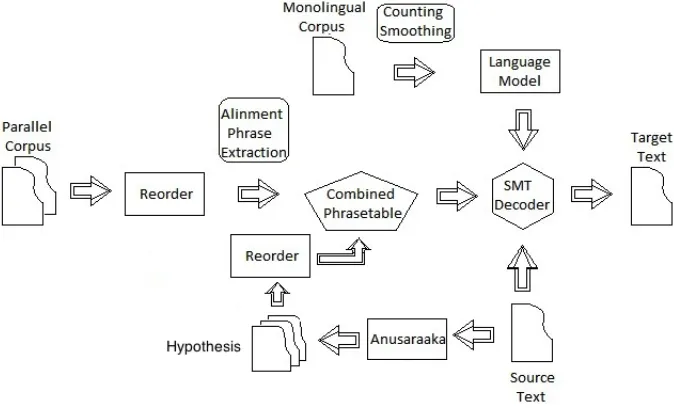
Figure 1: Architecture for multi-engine MT driven by a SMT decoder
pecially for the pair of languages where source language is relatively less-rich compared to the target. Our source language, which is English, follows a Subject-Verb-Object (SVO) fashion whereas Hindi follows a Subject-Object-Verb (SOV) ordering scheme. At first we extract syntactic information of the source language. The syntactic order of source sentence is converted to the syntactic order of target language. The source language sentences are pre-processed following the set of trans-formation rules as detailed in (Rao et al., 2000).
SSmV VmOOmCm → Cm′ Sm′ S′O′mO′Vm′ V′
where, S: Subject V : Verb O: Object
X′: Hindi corresponding constituent, where X
is S, V, or O Xm: modifier of X Cm: Clause modifier
Pre-ordering alters the English SVO order to Hindi SOV order, and post-modifiers generate the pre-modifiers. Our prepossessing module performs this by parsing English sentence and applying the reordering rules on the parse tree to generate the representations in the target side. After pre-ordering of source sentences, we combine the RBMT and SMT based mod-els.After pre-ordering of training and tuning corpora we also do the same for the test set. Alignment was done using the hypothesis of
RBMT.Beam search algorithm of SMT decoder is used to obtain the best target sentence. De-tailed architecture of the proposed technique is shown in Figure 1. In this figure, lower por-tion represents different modules and resources used in the RBMT model, whereas the upper portion represents the SMT model. Because of this effective combination we obtain a model that produces target sentences of better quali-ties compared to either RBMT or SMT with respect to morphology and disambiguation (at the level of lexical and structural).
Sets Number of sentences
Training Set 111,586
Tune Set 602
[image:6.612.140.477.41.245.2]Test Set 5,640
Table 1: Datasets statistics
5 Data Set, Experiential setup, Result and analysis
5.1 Data Set
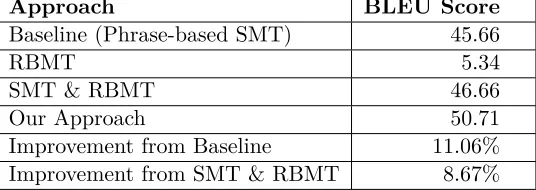
Approach BLEU Score
Baseline (Phrase-based SMT) 45.66
RBMT 5.34
SMT & RBMT 46.66
Our Approach 50.71
Improvement from Baseline 11.06%
[image:7.612.174.442.41.136.2]Improvement from SMT & RBMT 8.67%
Table 2: Results of different models
are sentences of varying lengths consisting of minimum of 3 tokens to the maximum of 80 tokens. Average length of the sentences is approximately 10. In one of our experiments we distributed the sentences into short and long sets, containing less than 5 and more than equal to 5 sentences, respectively. Training, tuning and evaluation were then carried out, which reveals that performance deteriorates due to the reduction in size. Hence, we mix all kinds of sentences for training, and then tune and test.
5.2 Experiential Setup
We use the pre-order tool developed at CFILT lab. (Dwivedi and Sukhadeve, 2010) We use Moses 1 setup for SMT related experiments. The model is tuned using a tuning set. We use ANUSAARAKA (Ramanathan et al., 2008) rule-based system for translation. Phrase tables are generated by training SMT model on the parallel corpora of English-Hindi. The RBMT system is evaluated on the test data. The outputs produced by this model are used as the silver standard data. The SMT model is trained on this silver standard data to produce a phrase table. The phrase table, thus obtained, is added to the phrase table generated using the original training data. Secondly, the silver standard parallel corpora is added to the original training corpora and a new parallel corpora is generated. The SMT model is again built on this new data-set. This generated model is used to evaluate the test set thereafter.
5.3 Results and Analysis
We report the experimental results in Table 4. Accuracy is calculated using the standard evaluation metric called BLEU (Papineni et al., 2002). A baseline model (Phrase-based SMT model) is developed by training Moses
1http://www.statmt.org/moses/
with default parameter settings (Koehn et al., 2003b). We achieve a BLEU score of 45.66. Our proposed hybrid model attains a BLEU score of 46.66, which is 2.19% higher com-pared to the baseline model. When re-ordering is performed at the source side, we obtain the BLEU score of 50.71, which is nearly 8.68% higher compared to the hybrid model (without re-ordering) . This is 11.06% higher compared to the baseline phrase-based model. Generated outputs of the proposed model are better in various respects like structure, morphology etc. With the following examples, we describe how the proposed model can be used to improve the performance over SMT or RBMT model. Here ST, SMT, AMT, HMT, and PMT denote source sentence, SMT output, RBMT output, output of the hybrid model and output of the proposed system, respectively.
a. SMT output is incomplete while PMT output is complete and better than SMT output. ST: All applicable shipping fees and custom duties up to customers address are included in the price
SMT: डल वर तक लागू सभी कःटम और शु क जोड़े जा चुके ह इस दाम म
HT: Delivary tak lagu sabhi custom aur shulk joden ja chuke hain is daam mein
PMT: डल वर तक लागू सभी कःटम और शु क माहक के घर तक श पंग के मू य म शा मल ह
HT: Delivery tak lagu sabhi custom aur shulk grahak ke ghar tak shipping ke mullya mein samil hain
AMT: सब माहक जहाँ तक क शु क और रवाज काय जहाज से भेजता हुआ लागू होना पते मू य म सि म लत हुए गये ह
HT: Sab grahakon jahan tak ki shulk aur rivaz karya jahaz se bhejta hua lagu hona pate mulya mein sammilithue gaye hain
b. PMT output is a reordered version of SMT which is an exact translation. Hence, this is better compared to the others. Also PMT retrieves proper phrase to generate better quality. ST: Add loads of flirty colours to your wardrobe!
SMT: म शोख रंग को शा मल कर अपनी अलमार
HT: mein shokh rangon ko shamiln karen apni almaree
PMT: अपनी अलमार म शोख रंग को शा मल कर
HT:apni almaree mein shokh rangon ko shamil karen
AMT: आपक अलमार को इँकबाज र के
बहुत जो डए!
HT:aapki almaree ko ishqbaaz radgon ko bahut jodiye
c. PMT is capable to select better sen-tence of generated translated output by both of the systems. AMT is better than SMT. PMT produces quite simliar output as AMT. Hence, the overall quality will improve.
ST: A classy way to hang your clothes SMT: एक उ म दज के तर का अपने कपड़े िसफ लटका कर
HT Ek utam darje ke tareeka apne kapde sirf latka kar
PMT: एक वशेष एवं उ तम माग आपके व लटकाने का
HT: Ek vishesh evam uchchtam marg apke vastra latkane ka.
AMT: एक वशेष एवं उ तम माग आपके व लटकाने का
HT: Ek vishesh evam uchchtam marg apke vastra latkane ka.
d. PMT output is better because it is in correct syntax order (ends in verb).
ST: 11 Diamonds provides lifetime manu-facturing & exchange warranty
SMT: ूदान करता है 11 ह रे और ए सचज वारंट जीवन भर नमाण
HT: Pradan karta hai 11 hire or exchange warranty jeevan bhar nirman
PMT: 11 डायमंड आजीवन नमाता और ए सचज वांरट देता है
HT: 11 diamond aajeevan nirmata aur exchange warranty deta hai
AMT: 11 डाइम ज जीवन-काल उ पादन और अदला बदला अ धकार देता है
HT: Diamond jeevan-kaal utpadan aur adla badla adhikar deta hai
It is out-of-scope to compare the existing English-Hindi MT systems (as mentioned in the related section) as none of the techniques was evaluated on the product catalogue domain. Since the domain as well as the training and test data are different, we can not directly compare our proposed system with the others. It is also to be noted that none of the existing systems makes use of an infrastructure like ours. The multi-engine MT model proposed in (Eisele et al., 2008) can not be compared as this was not evaluated for the language pair and domain that we attempted.
6 Conclusion
In this paper we have proposed a hybrid model to study whether RBMT and SMT can improve each other's efficiency. We use an effective method of serial coupling where we have com-bined both SMT and RBMT. The first part of coupling has been used to obtain good lexical selection and robustness, second part has been used to improve syntax and the final one has been designed to combine other modules along with source-side phrase reordering. Our ex-periments on a English-Hindi product domain dataset show the effectiveness of the proposed approach with improvement in BLEU score. In future we would like to evaluate the proposed model on other domains, and study hierarchical SMT model for the product catalogues domain.
References
Arafat Ahsan, Prasanth Kolachina, Sudheer Ko-lachina, Dipti Misra Sharma, and Rajeev San-gal. 2010. Coupling statistical machine transla-tion with rule-based transfer and generatransla-tion. In Proceedings of the 9th Conference of the Asso-ciation for Machine Translation in the Americas. Doug Arnold. 1994. Machine translation: an
intro-ductory guide. Blackwell Publisher.
of the ACL Workshop on Building and Us-ing Parallel Texts, pages 57--64. Association for Computational Linguistics.
Peter F Brown, John Cocke, Stephen A Della Pietra, Vincent J Della Pietra, Fredrick Jelinek, John D Lafferty, Robert L Mercer, and Paul S Roossin. 1990. A statistical approach to machine transla-tion. Computational linguistics, 16(2):79--85. Chris Callison-Burch and Philipp Koehn. 2005.
In-troduction to statistical machine translation. Lan-guage, 1:1.
Marine Carpuat and Dekai Wu. 2007. Improving statistical machine translation using word sense disambiguation. In EMNLP-CoNLL, volume 7, pages 61--72.
Marta R Costa-Jussa and José AR Fonollosa. 2015. Latest trends in hybrid machine translation and its applications. Computer Speech & Language, 32(1):3--10.
Praveen Dakwale and Christof Monz. 2016. Im-proving statistical machine translation perfor-mance by oracle-bleu model re-estimation. In The 54th Annual Meeting of the Association for Computational Linguistics, page 38.
Shachi Dave, Jignashu Parikh, and Pushpak Bhat-tacharyya. 2001. Interlingua-based english--hindi machine translation and language divergence. Ma-chine Translation, 16(4):251--304.
Sanjay K Dwivedi and Pramod P Sukhadeve. 2010. Machine translation system in indian perspectives. Journal of computer science, 6(10):1111. Andreas Eisele, Christian Federmann, Hans
Uszko-reit, Hervé Saint-Amand, Martin Kay, Michael Jellinghaus, Sabine Hunsicker, Teresa Herrmann, and Yu Chen. 2008. Hybrid architectures for multi-engine machine translation. Proceedings of Translating and the Computer, 30.
Mikel L Forcada, Mireia Ginestí-Rosell, Jacob Nord-falk, Jim O’Regan, Sergio Ortiz-Rojas, Juan An-tonio Pérez-Ortiz, Felipe Sánchez-Martínez, Gema Ramírez-Sánchez, and Francis M Tyers. 2011. Apertium: a free/open-source platform for rule-based machine translation. Machine translation, 25(2):127--144.
Philipp Koehn and Christof Monz. 2006. Shared task: Exploiting parallel texts for statistical ma-chine translation. In Proceedings of the NAACL 2006 workshop on statistical machine translation, New York City (June 2006).
Philipp Koehn, Franz Josef Och, and Daniel Marcu. 2003a. Statistical phrase-based translation. In Proceedings of the 2003 Conference of the North American Chapter of the Association for Computational Linguistics on Human Language Technology-Volume 1, pages 48--54. Association for Computational Linguistics.
Philipp Koehn, Franz Josef Och, and Daniel Marcu. 2003b. Statistical phrase-based translation. In Proceedings of the 2003 Conference of the North American Chapter of the Association for Computational Linguistics on Human Language Technology-Volume 1, pages 48--54. Association for Computational Linguistics.
Santanu Pal, Sudip Kumar Naskar, Pavel Pecina, Sivaji Bandyopadhyay, and Andy Way. 2010. Handling named entities and compound verbs in phrase-based statistical machine translation. As-sociation for Computational Linguistics.
Kishore Papineni, Salim Roukos, Todd Ward, and Wei-Jing Zhu. 2002. Bleu: a method for au-tomatic evaluation of machine translation. In Proceedings of the 40th annual meeting on asso-ciation for computational linguistics, pages 311--318. Association for Computational Linguistics. C Poornima, V Dhanalakshmi, KM Anand, and
KP Soman. 2011. Rule based sentence simpli-fication for english to tamil machine translation system. International Journal of Computer Appli-cations, 25(8):38--42.
Taraka Rama and Karthik Gali. 2009. Modeling machine transliteration as a phrase based statisti-cal machine translation problem. In Proceedings of the 2009 Named Entities Workshop: Shared Task on Transliteration, pages 124--127. Associ-ation for ComputAssoci-ational Linguistics.
Ananthakrishnan Ramanathan, Jayprasad Hegde, Ritesh M Shah, Pushpak Bhattacharyya, and M Sasikumar. 2008. Simple syntactic and mor-phological processing can help english-hindi sta-tistical machine translation. In IJCNLP, pages 513--520.
Ananthakrishnan Ramanathan, Hansraj Choudhary, Avishek Ghosh, and Pushpak Bhattacharyya. 2009. Case markers and morphology: addressing the crux of the fluency problem in english-hindi smt. In Proceedings of the Joint Conference of the 47th Annual Meeting of the ACL and the 4th International Joint Conference on Nat-ural Language Processing of the AFNLP: Vol-ume 2-VolVol-ume 2, pages 800--808. Association for Computational Linguistics.
Durgesh Rao, Kavitha Mohanraj, Jayprasad Hegde, Vivek Mehta, and Parag Mahadane. 2000. A practiced framework for syntactic transfer of compound-complex sentences for english-hindi machine translation. In Knowledge Based Com-puter Systems: Proceedings of the International Conference: KBCS--2000, page 343. Allied Pub-lishers.
Michel Simard, Nicola Ueffing, Pierre Isabelle, and Roland Kuhn. 2007. Rule-based translation with statistical phrase-based post-editing. In Proceed-ings of the Second Workshop on Statistical Ma-chine Translation, pages 203--206. Association for Computational Linguistics.
RMK Sinha and A Jain. 2003. Anglahindi: an english to hindi machine-aided translation system. MT Summit IX, New Orleans, USA, pages 494--497.
RMK Sinha, K Sivaraman, A Agrawal, R Jain, R Srivastava, and A Jain. 1995. Anglabharti: a multilingual machine aided translation project on translation from english to indian languages. In Systems, Man and Cybernetics, 1995. Intelligent Systems for the 21st Century., IEEE Interna-tional Conference on, volume 2, pages 1609--1614. IEEE.
Gregor Thurmair. 2009. Comparing different archi-tectures of hybrid machine translation systems. In Proceedings of MT Summit XII, Ottawa (2009). HW Xuan, W Li, and GY Tang. 2012. An advanced review of hybrid machine translation (hmt). Procedia Engineering, 29:3017--3022.