Towards Efficient Large-Scale Feature-Rich Statistical Machine
Translation
Vladimir Eidelman1, Ke Wu1, Ferhan Ture1, Philip Resnik2, Jimmy Lin3 1Dept. of Computer Science 2 Dept. of Linguistics 3The iSchool
Institute for Advanced Computer Studies University of Maryland
{vlad,wuke,fture,resnik,jimmylin}@umiacs.umd.edu
Abstract
We present the system we developed to provide efficient large-scale feature-rich discriminative training for machine trans-lation. We describe how we integrate with MapReduce using Hadoop streaming to allow arbitrarily scaling the tuning set and utilizing a sparse feature set. We report our findings on German-English and Russian-English translation, and discuss benefits, as well as obstacles, to tuning on larger development sets drawn from the parallel training data.
1 Introduction
The adoption of discriminative learning methods for SMT that scale easily to handle sparse and lex-icalized features has been increasing in the last several years (Chiang, 2012; Hopkins and May, 2011). However, relatively few systems take full advantage of the opportunity. With some excep-tions (Simianer et al., 2012), most still rely on tuning a handful of common dense features, along with at most a few thousand others, on a relatively small development set (Cherry and Foster, 2012;
Chiang et al., 2009). While more features tuned
onmoredata usually results in better performance
for other NLP tasks, this has not necessarily been the case for SMT.
Thus, our main focus in this paper is to improve understanding into the effective use of sparse fea-tures, and understand the benefits and shortcom-ings of large-scale discriminative training. To this end, we conducted experiments for the shared translation task of the 2013 Workshop on Statis-tical Machine Translation for the German-English and Russian-English language pairs.
2 Baseline system
We use a hierarchical phrase-based decoder im-plemented in the open source translation system
cdec1 (Dyer et al., 2010). For tuning, we use
Mr. MIRA2 (Eidelman et al., 2013), an open
source decoder agnostic implementation of online large-margin learning in Hadoop MapReduce. Mr. MIRA separates learning from the decoder, allow-ing the flexibility to specify the desired inference procedure through a simple text communication protocol. The decoder receives input sentences and weight updates from the learner, while the
learner receivesk-best output with feature vectors
from the decoder.
Hadoop MapReduce (Dean and Ghemawat, 2004) is a popular distributed processing frame-work that has gained widespread adoption, with the advantage of providing scalable parallelization in a manageable framework, taking care of data distribution, synchronization, fault tolerance, as well as other features. Thus, while we could oth-erwise achieve the same level of parallelization, it would be in a more ad-hoc manner.
The advantage of online methods lies in their ability to deal with large training sets and high-dimensional input representations while remain-ing simple and offerremain-ing fast convergence. With Hadoop streaming, our system can take advantage of commodity clusters to handle parallel large-scale training while also being capable of running on a single machine or PBS-managed batch clus-ter.
System design To efficiently encode the infor-mation that the learner and decoder require (source sentence, reference translation, grammar rules) in a manner amenable to MapReduce, i.e. avoiding dependencies on “side data” and large transfers across the network, we append the reference and
1http://cdec-decoder.org
2https://github.com/kho/mr-mira
per-sentence grammar to each input source sen-tence. Although this file’s size is substantial, it is not a problem since after the initial transfer, it re-sides on Hadoop distributed file system, and Map-Reduce optimizes for data locality when schedul-ing mappers.
A single iteration of training is performed as a Hadoop streaming job. Each begins with a
mapphase, with every parallel mapper loading the
same initial weights and decoding and updating parameters on a shard of the data. This is followed by a reducephase, with a single reducer collect-ing final weights from all mappers and computcollect-ing a weighted average to distribute as initial weights for the next iteration.
Parameter Settings We tune our system toward
approximate sentence-level BLEU(Papineni et al.,
2002),3 and the decoder is configured to use cube
pruning (Huang and Chiang, 2007) with a limit of 200 candidates at each node. For
optimiza-tion, we use a learning rate ofη=1, regularization
strength of C=0.01, and a 500-best list for hope
and fear selection (Chiang, 2012) with a single passive-aggressive update for each sentence (Ei-delman, 2012).
Baseline Features We used a set of 16 stan-dard baseline features: rule translation relative
frequencyP(e|f), lexical translation probabilities
Plex(e|f) andPlex(f|e), target n-gram language
modelP(e), penalties for source and target words,
passing an untranslated source word to the tar-get side, singleton rule and source side, as well as counts for arity-0,1, or 2 SCFG rules, the total number of rules used, and the number of times the glue rule is used.
2.1 Data preparation
For both languages, we used the provided Eu-roparl and News Commentary parallel training data to create the translation grammar
neces-sary for our model. For Russian, we
addi-tionally used the Common Crawl and Yandex data. The data were lowercased and tokenized, then filtered for length and aligned using the GIZA++ implementation of IBM Model 4 (Och and Ney, 2003) to obtain one-to-many align-ments in both directions and symmetrized sing the grow-diag-final-and method (Koehn et al., 2003).
3We approximate corpus BLEUby scoring sentences
us-ing a pseudo-document of previous 1-best translations (Chi-ang et al., 2009).
We constructed a 5-gram language model us-ing SRILM (Stolcke, 2002) from the provided English monolingual training data and parallel data with modified Kneser-Ney smoothing (Chen and Goodman, 1996), which was binarized using KenLM (Heafield, 2011). The sentence-specific translation grammars were extracted using a suffix array rule extractor (Lopez, 2007).
For German, we used the 3,003 sentences in newstest2011 as our Dev set, and report results on the 3,003 sentences of the newstest2012 Test
set using BLEU and TER (Snover et al., 2006).
For Russian, we took the first 2,000 sentences of newstest2012 for Dev, and report results on the re-maining 1,003. For both languages, we selected 1,000 sentences from the bitext to be used as an additional testing set (Test2).
Compound segmentation lattices As German is a morphologically rich language with produc-tive compounding, we use word segmentation lat-tices as input for the German translation task. These lattices encode alternative segmentations of compound words, allowing the decoder to auto-matically choose which segmentation is best. We use a maximum entropy model with recommended settings to create lattices for the dev and test sets, as well as for obtaining the 1-best segmentation of the training data (Dyer, 2009).
3 Evaluation
This section describes the experiments we con-ducted in moving towards a better understanding of the benefits and challenges posed by large-scale high-dimensional discriminative tuning.
3.1 Sparse Features
Dev Test Test2 5k 10k 25k 50k
en 75k 74k 27k 132k 255k 634k 1258k
[image:3.595.74.503.65.112.2]de 74k 73k 26k 133k 256k 639k 1272k
Table 1: Corpus statistics in tokens for German.
Dev Test Test2 15k
ru 46k 24k 24k 350k
[image:3.595.71.299.163.250.2]en 50k 27k 25k 371k
Table 2: Corpus statistics in tokens for Russian.
Set # features Tune Test
↑BLEU ↑BLEU ↓TER
de-en 16 22.38 22.69 60.61
+sparse 108k 23.86 23.01 59.89
ru-en 16 30.18 29.89 49.05
[image:3.595.310.526.164.300.2]+sparse 77k 32.40 30.81 48.40
Table 3: Results with the addition of sparse fea-tures for German and Russian.
All of these features are generated from the translation rules on the fly, and thus do not have to be stored as part of the grammar. To allow for memory efficiency while scaling the training data, we hash all the lexical features from their string representation into a 64-bit integer.
Altogether, these templates result in millions of potential features, thus how to select appropriate features, and how to properly learn their weights can have a large impact on the potential benefit.
3.2 Adaptive Learning Rate
The passive-aggressive update used in MIRA has a
single learning rateηfor all features, which along
withαlimits the amount each feature weight can
change at each update. However, since the typical dense features (e.g., language model) are observed far more frequently than sparse features (e.g., rule identity), it has been shown to be advantageous to use an adaptive per-feature learning rate that allows larger steps for features that do not have much support (Green et al., 2013; Duchi et al., 2011). Essentially, instead of having a single
pa-rameterη,
α←min
C,cost(y0)−w>(f(y
+)−f(y0))
kf(y+)−f(y0)k2
w←w+αη f(y+)−f(y0)
we instead have a vectorΣwith one entry for each
feature weight:
Σ−1 ←Σ−1+λdiagww>
w←w+αΣ1/2 f(y+)−f(y0)
η=1 λ=0.01
λ=0.1
22.2 22.4 22.6 22.8 23 23.2 23.4 23.6 23.8 24
B
LEU
Iteration
Figure 1: Learning curves for tuning when using
a single step size (η) versus different per-feature
learning rates.
In practice, this update is very similar to that of AROW (Crammer et al., 2009; Chiang, 2012).
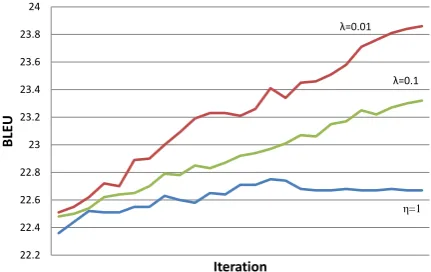
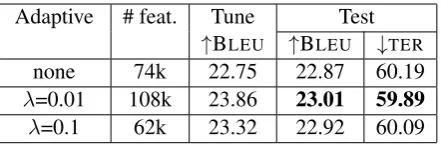
Figure 1 shows learning curves for sparse mod-els with a single learning rate, and adaptive
learn-ing with λ=0.01 and λ=0.1, with associated
re-sults on Test in Table 4.4 As can be seen, using
a singleηproduces almost no gain on Dev.
How-ever, while both settings using an adaptive rate fare
better, the proper setting of λis important. With
λ=0.01 we observe 0.5 BLEU gain overλ=0.1 in
tuning, which translates to a small gain on Test. Henceforth, we use an adaptive learning rate with
λ=0.01 for all experiments.
Table 3 presents baseline results for both lan-guages. With the addition of sparse features,
tun-ing scores increase by 1.5 BLEUfor German,
lead-ing to a 0.3 BLEUincrease on Test, and 2.2 BLEU
for Russian, with 1 BLEU increase on Test. The
majority of active features for both languages are rule id (74%), followed by target bigrams (14%) and context-dependent word pairs (11%).
3.3 Feature Selection
As the tuning set size increases, so do the num-ber of active features. This may cause practi-cal problems, such as reduced speed of computa-tion and memory issues. Furthermore, while some
4All sparse models are initialized with the same tuned
Adaptive # feat. Tune Test
↑BLEU ↑BLEU ↓TER
none 74k 22.75 22.87 60.19
λ=0.01 108k 23.86 23.01 59.89
[image:4.595.190.411.61.134.2]λ=0.1 62k 23.32 22.92 60.09
Table 4: Results with differentλsettings for using a per-feature learning rate with sparse features.
Set # feat. Tune Test
↑BLEU ↑BLEU ↓TER
all 510k 32.99 22.36 59.26
top 200k 200k 32.96 22.35 59.29
all 373k 34.26 28.84 49.29
[image:4.595.74.291.179.267.2]top 200k 200k 34.45 28.98 49.30
Table 5: Comparison of using all features versus
topkselection.
sparse features will generalize well, others may not, thereby incurring practical costs with no per-formance benefit. Simianer et al. (2012) recently
explored `1/`2 regularization for joint feature
se-lection for SMT in order to improve efficiency and counter overfitting effects. When performing par-allel learning, this allows for selecting a reduced
set of the topkfeatures at each iteration that are
effective across all learners.
Table 5 compares selecting the top 200k fea-tures versus no selection for a larger German and
Russian tuning set (§3.4). As can be seen, we
achieve the same performance with the top 200k features as we do when using double that amount, while the latter becomes increasing cumbersome to manage. Therefore, we use a top 200k selection for the remainder of this work.
3.4 Large-Scale Training
In the previous section, we saw that learning sparse features on the small development set leads to substantial gains in performance. Next, we wanted to evaluate if we can obtain further gains by scaling the tuning data to learn parameters di-rectly on a portion of the training bitext. Since the bitext is used to learn rules for translation, using the same parallel sentences for grammar extrac-tion as well as for tuning feature weights can lead to severe overfitting (Flanigan et al., 2013). To avoid this issue, we used a jackknifing method to
split the training data inton= 10folds, and built
a translation system onn−1folds, while sampling
sentences from the News Commentary portion of the held-out fold to obtain tuning sets from 5,000 to 50,000 sentences for German, and 15,000 sen-tences for Russian.
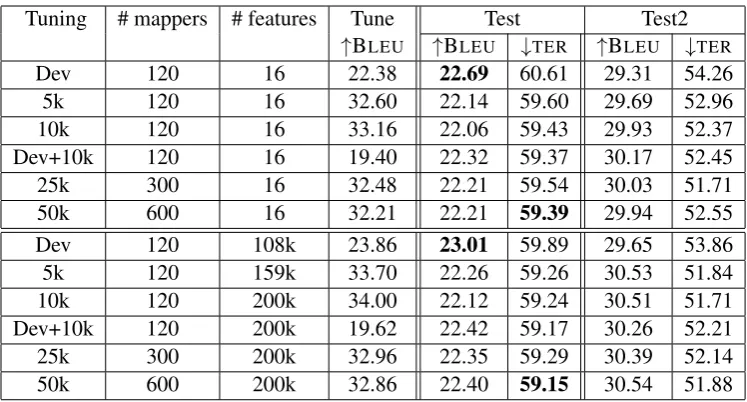
Results for large-scale training for German are presented in Table 6. Although we cannot com-pare the tuning scores across different size sets, we can see that tuning scores for all sets improve substantially with sparse features. Unfortunately, with increasing tuning set size, we see very little
improvement in Test BLEU and TER with either
feature set. Similar findings for Russian are pre-sented in Table 7. Introducing sparse features im-proves performance on each set, respectively, but Dev always performs better on Test.
While tuning on Dev data results in better BLEU
on Test than when tuning on the larger sets, it is important to note that although we are able to tune more features on the larger bitext tuning sets, they are not composed of the same genre as the Tune and Test sets, resulting in a domain mismatch.
This phenomenon is further evident in German when testing each model on Test2, which is se-lected from the bitext, and is thus closer matched to the larger tuning sets, but is separate from both the parallel data used to build the translation model and the tuning sets. Results on Test2 clearly show significant improvement using any of the larger tuning sets versus Dev for both the baseline and sparse features. The 50k sparse setting achieves
almost 1 BLEUand 2TERimprovement, showing
that there are significant differences between the Dev/Test sets and sets drawn from the bitext.
For Russian, we amplified the effects by select-ing Test2 from the portion of the bitext that is sepa-rate from the tuning set, but is among the sentences used to create the translation model. The effects of overfitting are markedly more visible here, as there
is almost a 7 BLEUdifference between tuning on
Tuning Test
↑BLEU ↓TER
5k 22.81 59.90
10k 22.77 59.78
25k 22.88 59.77
[image:5.595.117.245.61.146.2]50k 22.86 59.76
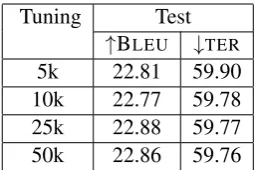
Table 8: Results for German with 2 iterations of tuning on Dev after tuning on larger set.
reasonably well, while the introduction of sparse features leads to overfitting the specificities of the Dev/Test genre, which are not present in the bitext. We attempted two strategies to mitigate this problem: combining the Dev set with the larger bitext tuning set from the beginning, and tuning on a larger set to completion, and then running 2 additional iterations of tuning on the Dev set using the learned model. Results for tuning on Dev and a larger set together are presented in Table 7 for Rus-sian and Table 6 for German. As can be seen, the resulting model improves somewhat on the other genre and strikes a middle ground, although it is worse on Test than Dev.
Table 8 presents results for tuning several ad-ditional iterations after learning a model on the larger sets. Although this leads to gains of around
0.5 BLEUon Test, none of the models outperform
simply tuning on Dev. Thus, neither of these two strategies seem to help. In future work, we plan to forgo randomly sampling the tuning set from the bitext, and instead actively select the tuning set based on similarity to the test set.
4 Conclusion
We explored strategies for scaling learning for SMT to large tuning sets with sparse features. While incorporating an adaptive per-feature learn-ing rate and feature selection, we were able to use Hadoop to efficiently take advantage of large amounts of data. Although discriminative training on larger sets still remains problematic, having the capability to do so remains highly desirable, and we plan to continue exploring methods by which to leverage the power of the bitext effectively.
Acknowledgments
This research was supported in part by the DARPA BOLT program, Contract No. HR0011-12-C-0015; NSF under awards 0916043 and IIS-1144034. Vladimir Eidelman is supported by a
NDSEG Fellowship.
References
S. Chen and J. Goodman. 1996. An empirical study of smoothing techniques for language modeling. In
ACL.
Colin Cherry and George Foster. 2012. Batch tun-ing strategies for statistical machine translation. In
NAACL.
David Chiang, Yuval Marton, and Philip Resnik. 2008. Online large-margin training of syntactic and struc-tural translation features. InEMNLP.
D. Chiang, K. Knight, and W. Wang. 2009. 11,001 new features for statistical machine translation. In
NAACL-HLT.
D. Chiang. 2012. Hope and fear for discriminative training of statistical translation models. JMLR, 13:1159–1187.
K. Crammer, A. Kulesza, and M. Dredze. 2009. Adap-tive regularization of weight vectors. InNIPS. J. Dean and S. Ghemawat. 2004. MapReduce:
Simpli-fied data processing on large clusters. InOSDI. J. Duchi, E. Hazan, and Y. Singer. 2011. Adaptive
sub-gradient methods for online learning and stochastic optimization. JMLR, 12:2121–2159.
C. Dyer, A. Lopez, J. Ganitkevitch, J. Weese, F. Ture, P. Blunsom, H. Setiawan, V. Eidelman, and P. Resnik. 2010. cdec: A decoder, alignment, and learning framework for finite-state and context-free translation models. InACL System Demonstrations. Chris Dyer. 2009. Using a maximum entropy model to build segmentation lattices for mt. InProceedings of NAACL-HLT.
Vladimir Eidelman, Ke Wu, Ferhan Ture, Philip Resnik, and Jimmy Lin. 2013. Mr. MIRA: Open-source large-margin structured learning on map-reduce. InACL System Demonstrations.
Vladimir Eidelman. 2012. Optimization strategies for online large-margin learning in machine translation. InWMT.
Jeffrey Flanigan, Chris Dyer, and Jaime Carbonell. 2013. Large-scale discriminative training for statis-tical machine translation using held-out line search. InNAACL.
S. Green, S. Wang, D. Cer, and C. Manning. 2013. Fast and adaptive online training of feature-rich translation models. InACL.
Kenneth Heafield. 2011. KenLM: faster and smaller language model queries. InWMT.
Tuning # mappers # features Tune Test Test2
↑BLEU ↑BLEU ↓TER ↑BLEU ↓TER
Dev 120 16 22.38 22.69 60.61 29.31 54.26
5k 120 16 32.60 22.14 59.60 29.69 52.96
10k 120 16 33.16 22.06 59.43 29.93 52.37
Dev+10k 120 16 19.40 22.32 59.37 30.17 52.45
25k 300 16 32.48 22.21 59.54 30.03 51.71
50k 600 16 32.21 22.21 59.39 29.94 52.55
Dev 120 108k 23.86 23.01 59.89 29.65 53.86
5k 120 159k 33.70 22.26 59.26 30.53 51.84
10k 120 200k 34.00 22.12 59.24 30.51 51.71
Dev+10k 120 200k 19.62 22.42 59.17 30.26 52.21
25k 300 200k 32.96 22.35 59.29 30.39 52.14
50k 600 200k 32.86 22.40 59.15 30.54 51.88
Table 6: German evaluation with large-scale tuning, showing numbers of mappers employed, number of active features for best model, and test scores on Test and bitext Test2 domains.
Tuning # mappers # features Tune Test Test2
↑BLEU ↑BLEU ↓TER ↑BLEU ↓TER
Dev 120 16 30.18 29.89 49.05 57.14 32.56
15k 200 16 34.65 28.60 49.63 59.64 30.65
Dev+15k 200 16 33.97 28.88 49.37 58.24 31.81
Dev 120 77k 32.40 30.81 48.40 52.90 36.85
15k 200 200k 35.05 28.34 49.69 59.81 30.59
[image:6.595.112.486.60.261.2]Dev+15k 200 200k 34.45 28.98 49.30 57.61 32.71
Table 7: Russian evaluation with large-scale tuning, showing numbers of mappers employed, number of active features for best model, and test scores on Test and bitext Test2 domains.
Liang Huang and David Chiang. 2007. Forest rescor-ing: Faster decoding with integrated language mod-els. InACL.
Philipp Koehn, Franz Josef Och, and Daniel Marcu. 2003. Statistical phrase-based translation. In
NAACL.
Adam Lopez. 2007. Hierarchical phrase-based trans-lation with suffix arrays. InEMNLP.
Franz Och and Hermann Ney. 2003. A systematic comparison of various statistical alignment models. InComputational Linguistics.
Franz Josef Och. 2003. Minimum error rate training in statistical machine translation. InACL.
K. Papineni, S. Roukos, T. Ward, and W.-J. Zhu. 2002. BLEU: a method for automatic evaluation of ma-chine translation. InACL.
P. Simianer, S. Riezler, and C. Dyer. 2012. Joint fea-ture selection in distributed stochastic learning for large-scale discriminative training in SMT. InACL.
M. Snover, B. Dorr, R. Schwartz, L. Micciulla, and J. Makhoul. 2006. A study of translation edit rate with targeted human annotation. InAMTA.